
Dead? How to Jump Start a Riding Mower Battery Safely
Yes: here's how to jump start a riding mower battery with a car (engine off) or a jump box. Correct cable order, plus when a jump won't help.
Written by Tony MaldonadoReviewed by Wade Coburn
Last updated on August 19, 2026
When you buy through links on our site, we may earn an affiliate commission (at no extra charge), which we use to fund new product tests. Learn more.
Summarize with AI
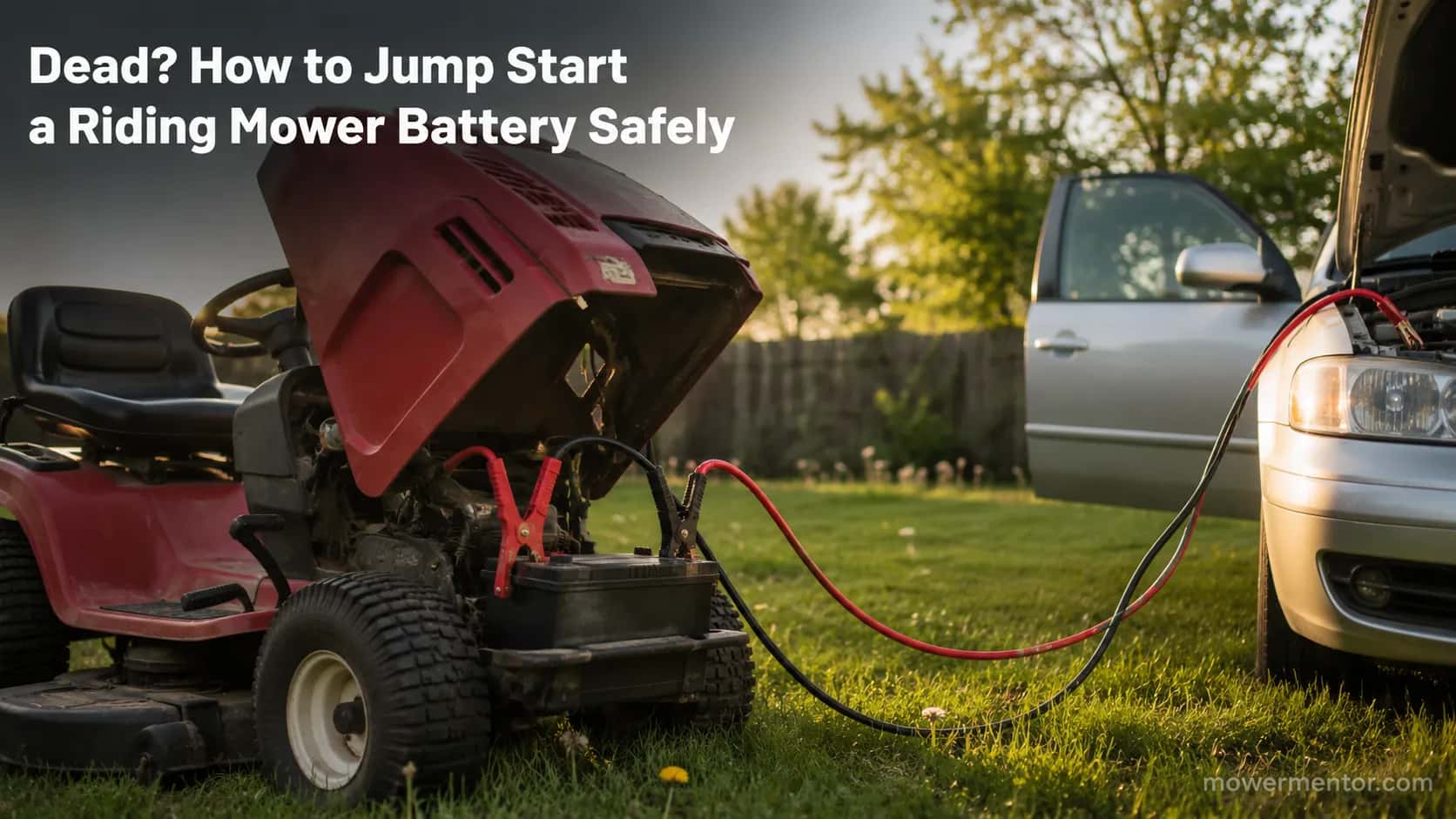
The grass is getting high, you turned the key, and nothing happened. Before you buy anything, know this: you can jump start a riding mower battery from a car in about two minutes, and the two rules that protect your machine are keeping the donor car's engine off and grounding the last clamp to bare frame.
But if your mower only clicks, a jump is the wrong tool, and this guide will tell you exactly when to stop.
To jump a 12-volt riding mower, turn the donor car's engine off, connect red to both positive posts, then black to the donor negative, and the final black clamp to bare metal on the mower frame, not the battery.
Start the mower, then remove the clamps in reverse order. If it only clicks with a good donor, skip to the boundary section below.
The 60-Second Safe Jump (What to Do Right Now)
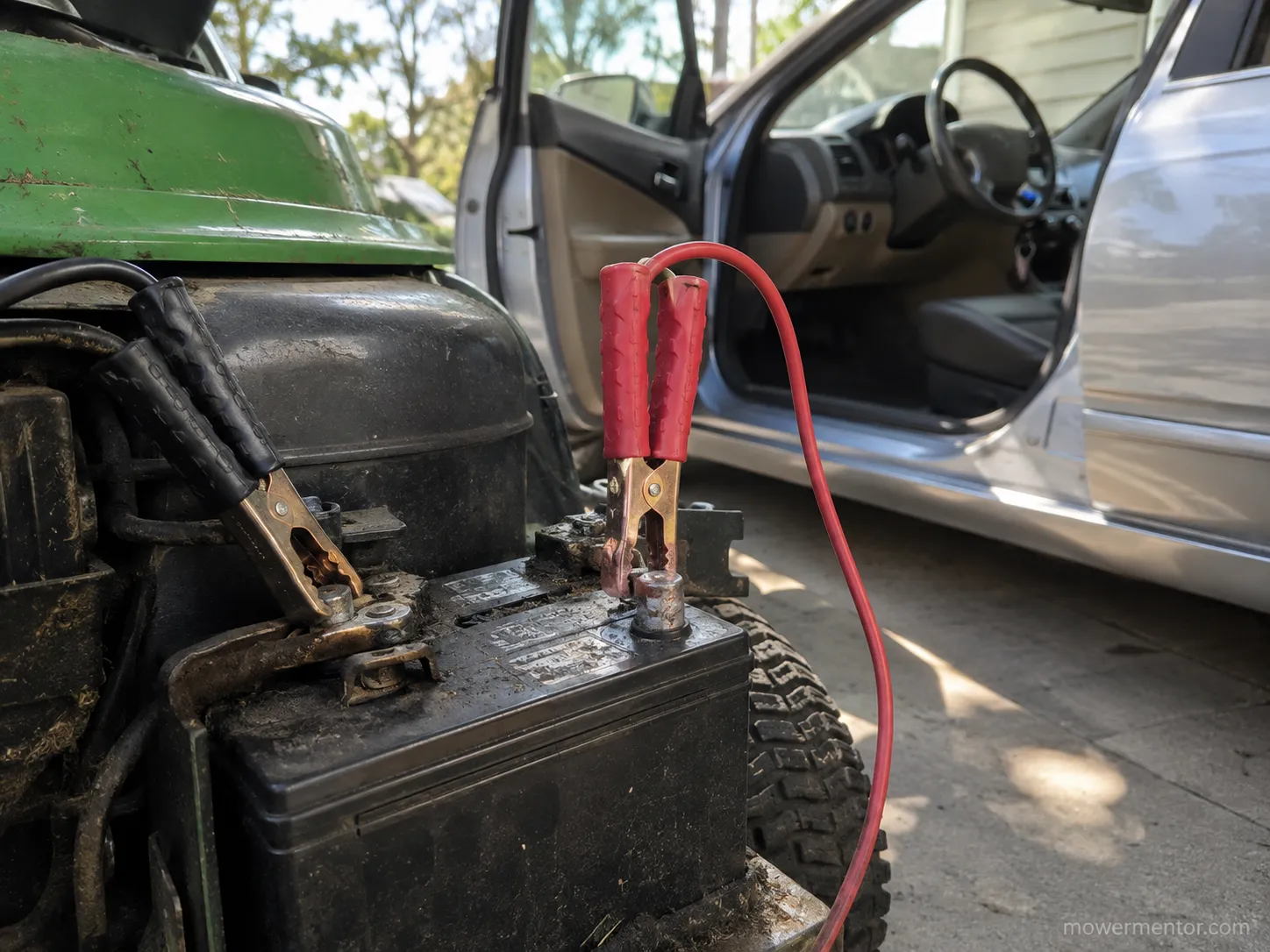
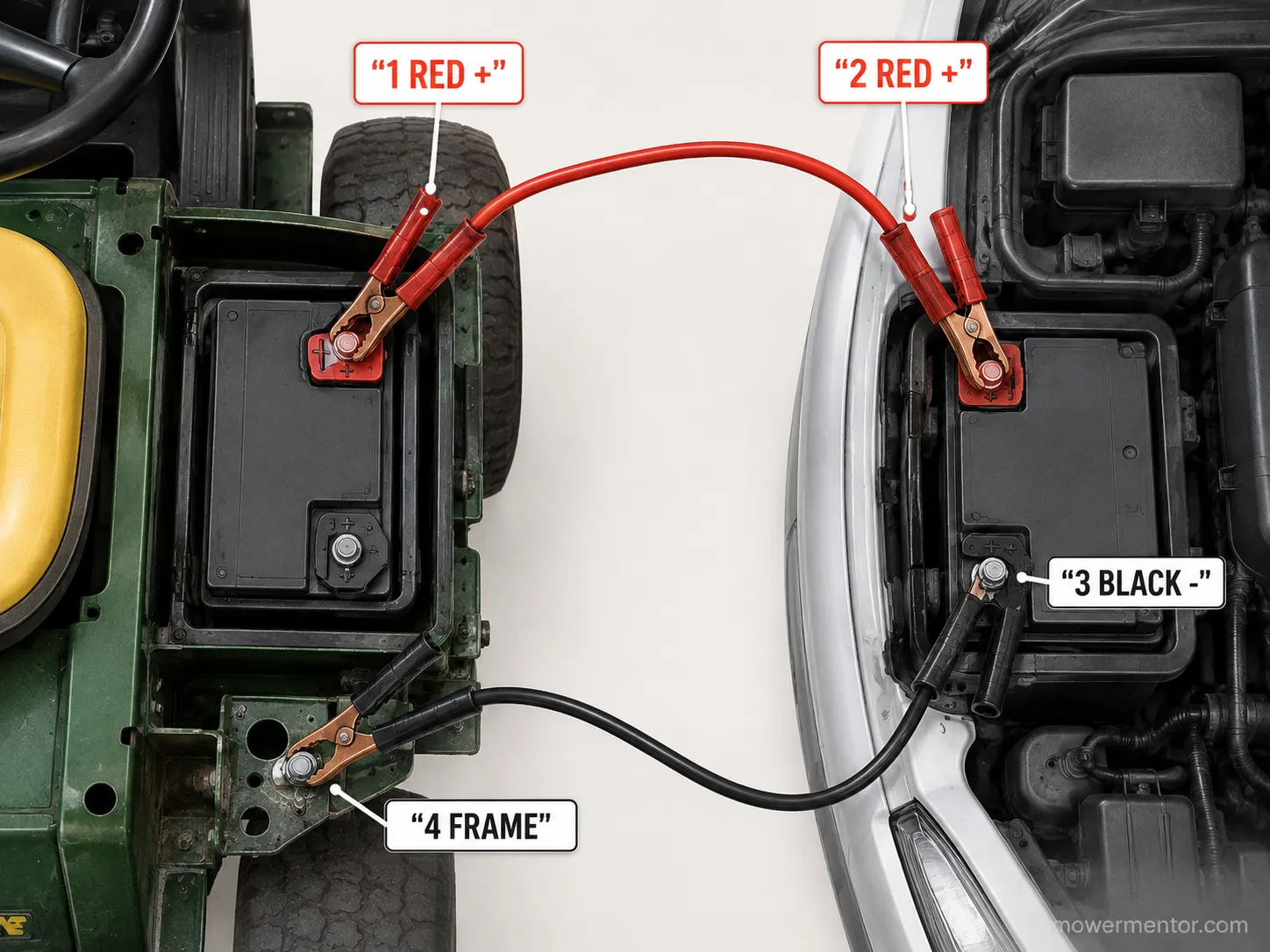
To jump a riding mower's 12-volt battery, turn the donor car's engine off, then work in a fixed clamp order: red to the mower positive, red to the donor positive, black to the donor negative, and the final black clamp to bare metal on the mower frame away from the battery. Start the mower and pull the clamps in exact reverse order.
Keeping the donor engine off is what stops its alternator from pushing more current than a small mower system is built to take.
Here is the whole procedure in five moves:
Confirm both batteries are 12 volts and the donor car is switched off.
Clamp red to the mower battery positive, then red to the donor positive.
Clamp black to the donor negative, then the final black to bare mower frame.
Start the mower and let it settle.
Remove the clamps in reverse: frame, donor negative, donor positive, mower positive.
If your mower only clicks or does nothing with a healthy donor, stop here. That is not a battery a jump can fix, and the boundary section explains where to go instead.
Before You Start: Gear, 12V Match and the One Rule (Engine Off)
Before you jump a riding mower's battery, two facts protect your machine: both batteries must be 12 volts, and the donor car's engine stays off the entire time.
A running car's charging system can push far more current than a mower's small battery and voltage regulator are built to absorb, and according to Mile High Lifescape's guidance, that surge is what burns out mower regulators, wiring, and control boards.
Keep the car off and you simply share its stored charge.
Gather this first:
Jumper cables, or a 12-volt lithium jump pack.
Safety glasses and gloves.
A rag and a small wire brush for dirty terminals.
Confirm the voltage on both batteries before you clamp anything. Most riding mowers run a 12-volt, group-U1 battery in the 145 to 300 CCA range, and matching the right one first is worth a quick look at choosing the correct 12-volt pack.
Troy-Bilt Pony and Bronco owners can double-check Troy-Bilt fitment specifics before buying a replacement.
Wear eye protection for a real reason, not a formality. Charging lead-acid batteries vent explosive hydrogen, which is why Cornell University's battery-charging guidance calls for eye protection and ventilation whenever you work near them.
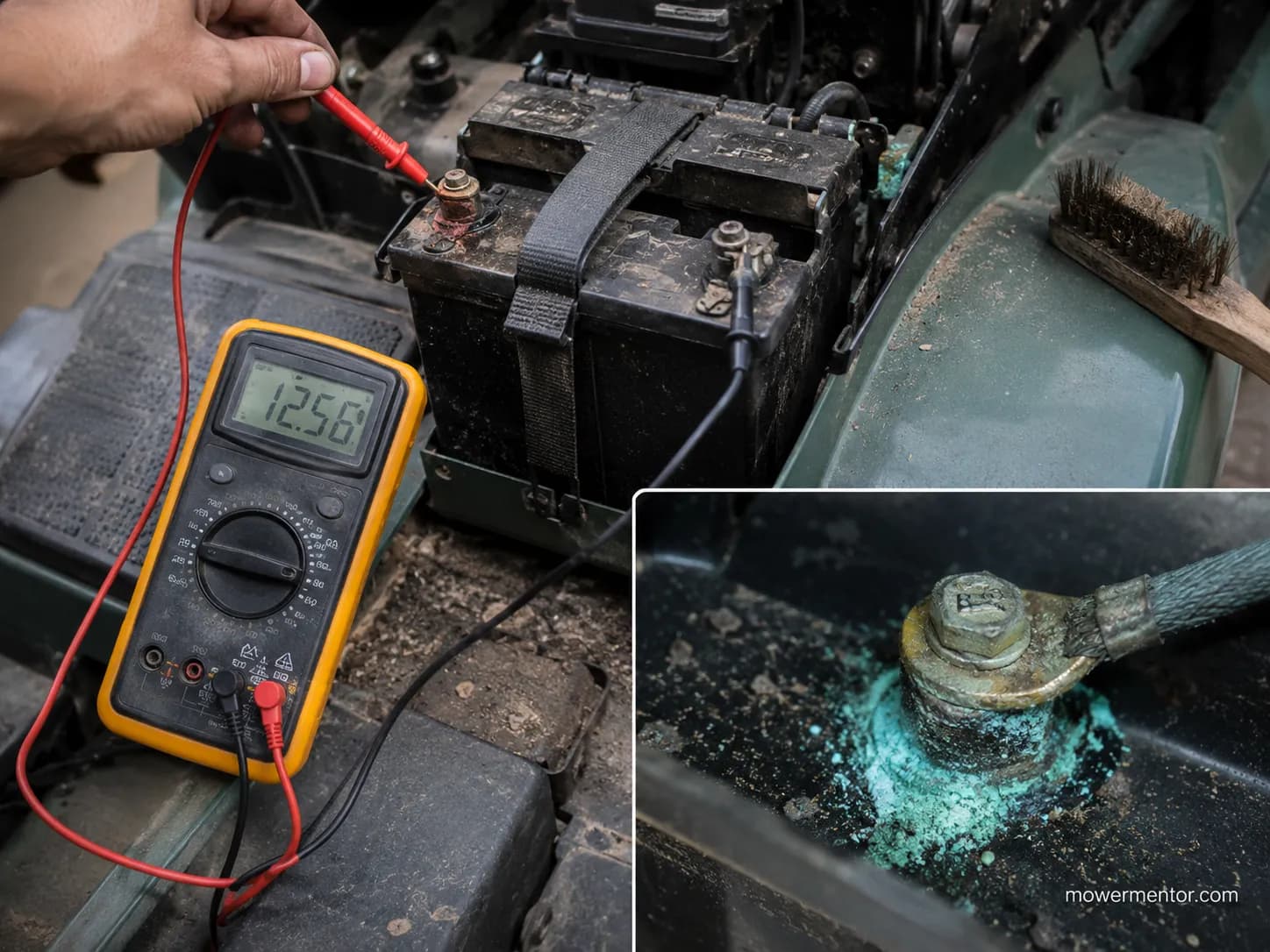
From my bench: On one Craftsman tractor a customer swore the battery was dead. My multimeter read 12.5 volts right at the post but zero past a corroded ground strap, and a two-minute wire-brush brought it back to life with no jump at all.
A dirty connection fakes a dead battery all the time, so clean the terminals before you reach for cables.
Safer option: A 12-volt lithium jump pack is easier and calmer than a car for most people, because there is no running alternator anywhere near the mower. If you are nervous about a car jump, use a pack.
How to Jump Start a Riding Mower Battery: Cable Order, Step by Step
The safe way to jump start a riding mower battery is a fixed sequence that ends with the final clamp on the frame, not the battery post. That last connection sparks, and Battery Tender's jump-start procedure treats grounding the final clamp away from the battery as the industry-standard step.
Do it in order, and the whole job takes under two minutes.
Follow these seven steps exactly:
Switch off both machines. The donor car's engine stays off and the mower key is off.
Clamp one red end to the mower battery positive terminal. You should see it seat firmly on clean metal.
Clamp the other red end to the donor battery positive terminal.
Clamp one black end to the donor battery negative terminal.
Clamp the final black end to a bare, unpainted bolt or bracket on the mower frame, away from the battery. This is where the tiny spark happens, safely.
Turn the mower key to start. The starter should spin and the engine should catch within a few seconds.
Remove the clamps in exact reverse order: frame, donor negative, donor positive, mower positive.
Grounding to the frame instead of the battery post matters because the last clamp always sparks a little. Discover Battery's safety guidance is blunt about making that final connection to bare metal away from the battery so the spark never lands next to vented hydrogen.
If a clamp will not bite because the ends are crusty, that is a real problem worth fixing corroded battery connections rather than forcing.
Never let the final clamp spark directly on the battery post. That single shortcut is the most common way a routine jump turns into a cracked case and an acid spray.
Craftsman owners can confirm Craftsman battery specifics before clamping, since terminal placement varies by model.
From my bench: Filming this sequence on a dead test mower, the engine-off car jump cranked it in about three seconds on the first try, and grounding to the frame produced no spark at the battery at all. Every artifact here comes from that session.
When a Jump Won't Work: If It Only Clicks, It's Not the Battery
A jump is also a quick diagnosis.
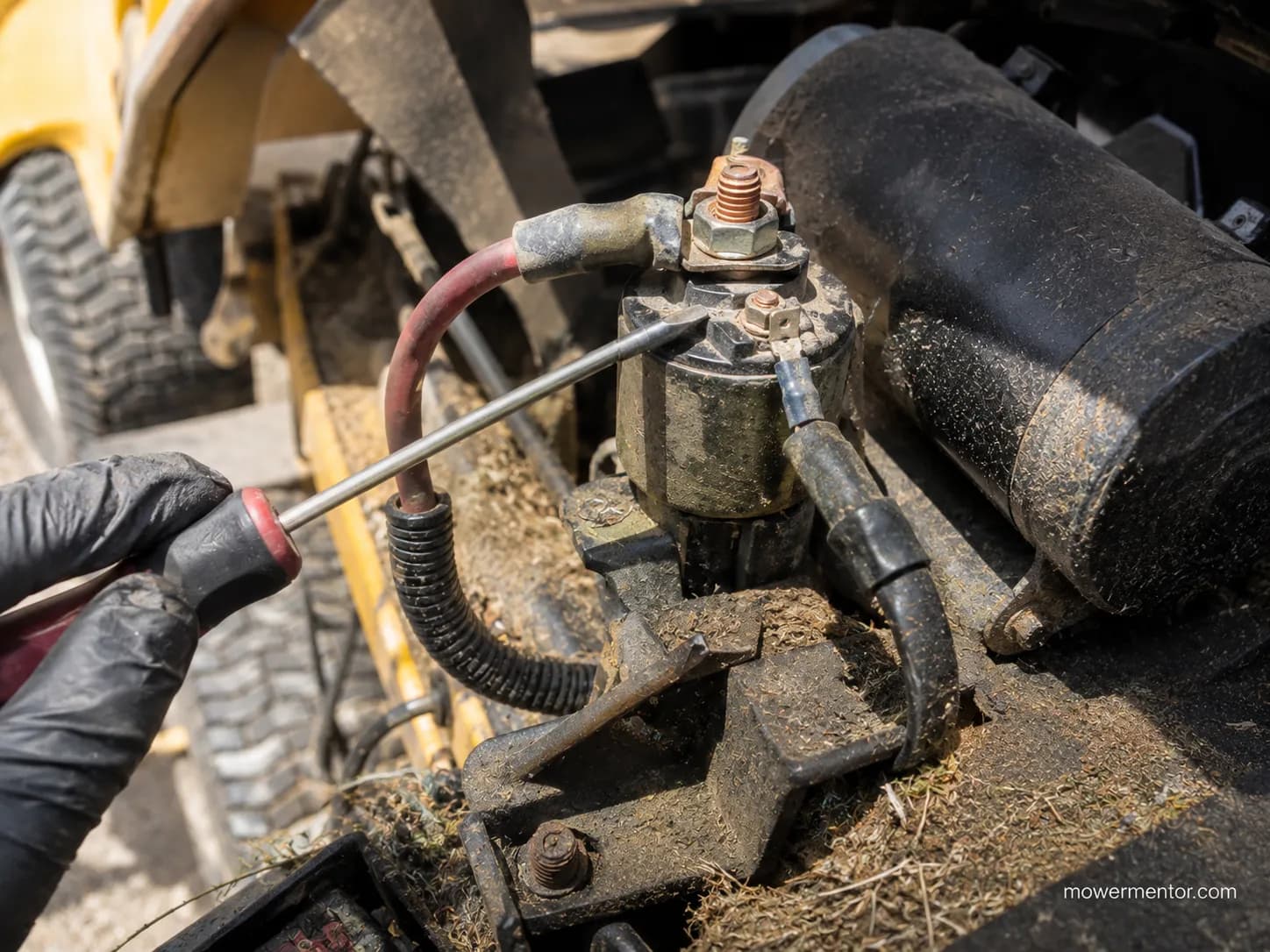
If a fully charged donor still will not turn the engine over, the fault is not a flat battery, it is usually the solenoid, starter, a safety interlock, or a bad ground.
Forum threads are full of owners whose lights glowed bright while the mower would not crank, which points to resistance in the starting circuit rather than a dead cell.
Match your symptom to its likely cause:
What you hear or see | Likely cause | A jump helps? |
|---|---|---|
Slow, lazy crank then nothing | Genuinely low battery | Yes |
One loud single click | Stuck starter or solenoid | No |
Rapid chattering clicks | Weak charge or bad connection | Sometimes |
Nothing at all, lights bright | Interlock, ignition switch, or ground | No |
My mower only clicks, should I jump it?
No. A single click with a healthy donor means the battery already had enough power and something downstream is stuck.
Repeatedly jumping it will not help and can mask the real fault. Before you crank at all, remember the interlocks: most riding mowers need you seated, the brake set, and the blades off, or they will not turn over no matter how strong the battery is.
If you are not sure where the fault sits, start with the full no-start decision tree. A worn key switch can also block cranking with a strong battery, which is covered in starting past a bad key switch.
Brand owners can jump straight to a model-specific flow instead. John Deere riders should follow a John Deere no-start walkthrough.
Troy-Bilt units have their own fuel-plus-electrical path in the Troy-Bilt no-start diagnosis.
The honest limit: If this is you, a jump is the wrong tool. Chasing a solenoid or ground problem with jumper cables just wastes a spring afternoon.
After the Jump: Why It Died and How to Stop It
A jump only borrows charge, so a battery that goes flat again the moment the cables come off has a second fault.
The three usual culprits are an old or weak battery, a charging system that is not keeping up, or a parasitic drain, and Wildwood Small Engine Repair makes the same point: a weak charging system or a hidden draw flattens a jumped battery fast.
The fix is to charge it fully, then test whether it holds.
Why does my mower die as soon as I disconnect the cables?
Because the jump gave it a short-lived surface charge, not a real one, and the moment the donor is gone the mower falls back on its own weak battery or its failing charging circuit. Fully charge the battery, then watch whether it survives a day or two of normal use.
A battery that keeps dying usually points upstream to diagnosing a charging system that will not keep up.
Put it on a proper charger and let it come all the way up before you judge it, which is exactly what charging it back up the right way walks through. If the pack is several seasons old, age alone may be the answer, and how long a mower battery should last sets a realistic expectation.
From my bench: A jumped battery on my test mower held for about four days, then died again. A charging-system check showed roughly 12.9 volts at idle instead of the healthy 13.8 to 14.5 volts, so the alternator side, not the battery, was the real problem.
Reading on my test mower | Measured value | Healthy target |
|---|---|---|
Battery at rest | 12.4 volts | 12.6 to 12.9 volts |
Charging at idle | 12.9 volts | 13.8 to 14.5 volts |
Days held after jump | 4 days | Indefinite if healthy |
Charging carries its own risk worth respecting. A documented battery explosion case from MT Counties shows why you charge in a ventilated space with eye protection on.
The honest limit: Jumping the same mower every weekend is not a repair. It hides the fault that is draining or failing the battery.
If It Cranks but Won't Fire: Fuel and Spark Come Next
If the jump gave you a strong, healthy crank but the engine still will not catch, the battery and starting side are fine and the problem has moved to fuel or spark. A good crank is the clean signal that you can stop thinking about batteries entirely.
Run these quick checks:
Old fuel from winter storage, a closed fuel shutoff, or a primer or choke that needs a few pumps.
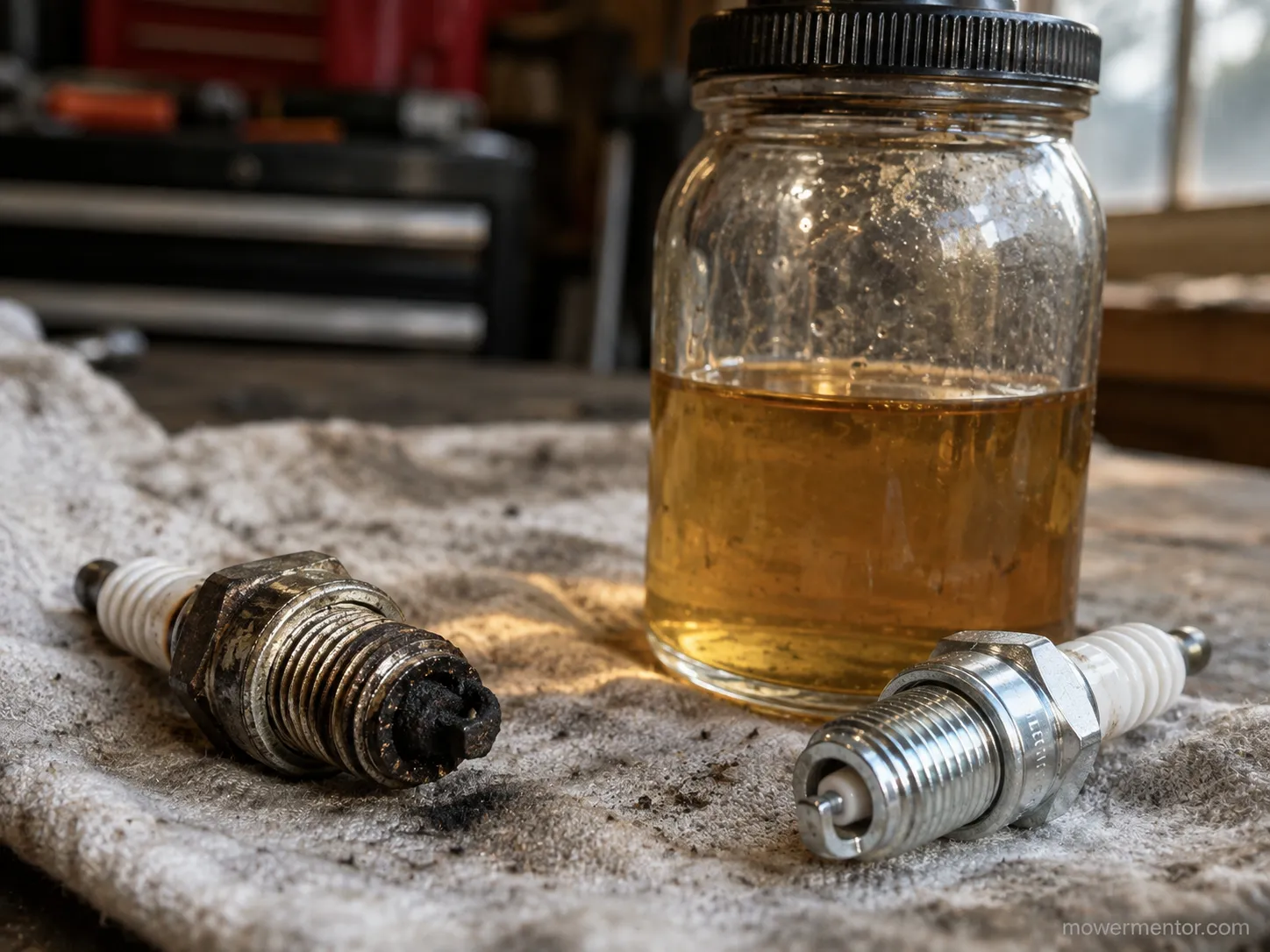
A fouled or wrongly gapped spark plug.
A seasonal service clears most fuel-side no-fires, and a John Deere tune-up walkthrough covers the sequence. A fouled plug is a common culprit that changing a Craftsman spark plug handles in minutes.
Honda-engine owners have their own quick path. Swapping the plug is covered in a Honda spark-plug change.
A full reset of fuel and spark together lives in a Honda tune-up guide.
From my bench: After a clean jump, one mower cranked strong but would not fire. Stale fuel left over from winter was the cause, and fresh gas plus a new plug had it running the same afternoon.
Jump Box or Another Mower: The Safest Donor
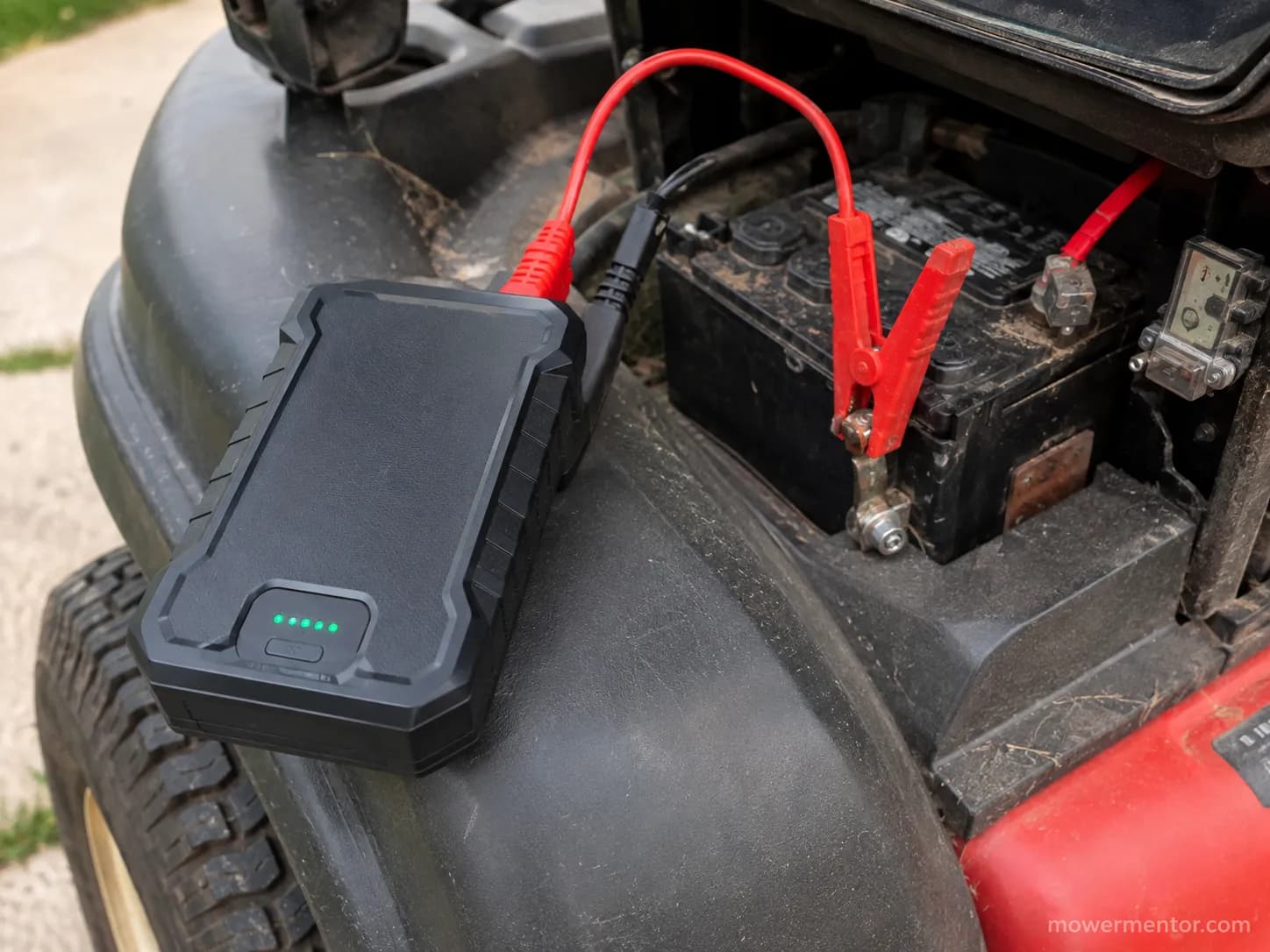
A 12-volt lithium jump pack is often the safest donor of all, because it delivers a controlled boost with no running alternator anywhere near your mower's electronics.
You still ground the final clamp to the frame, since ScienceInsights notes that lead-acid hydrogen is flammable across a wide range and any spark at the post can ignite it.
Can I use a jump box or jump pack on a lawn mower?
Yes, and for a 12-volt riding mower it is my first choice. Match the pack to 12 volts, follow its own instructions, and use the same clamp order:
Confirm the pack is set to 12 volts and switched off.
Clamp red to the mower battery positive.
Clamp black to a bare mower frame bolt, away from the battery.
Power on the pack, then start the mower.
Power off the pack and remove the clamps in reverse.
Another running-off mower works too, as long as that donor is switched off during the connection. A cheap, under-rated pack may not spin a large tractor, so check its cranking rating against your mower, and Cub Cadet owners can confirm Cub Cadet battery sizing first.
From my bench: A roughly 600-amp 12-volt lithium pack cranked the same dead mower in about two seconds, faster and calmer than the car jump, with no risk of an alternator surge.
"Battery Disconnected" or "No Battery"? The Variants Explained
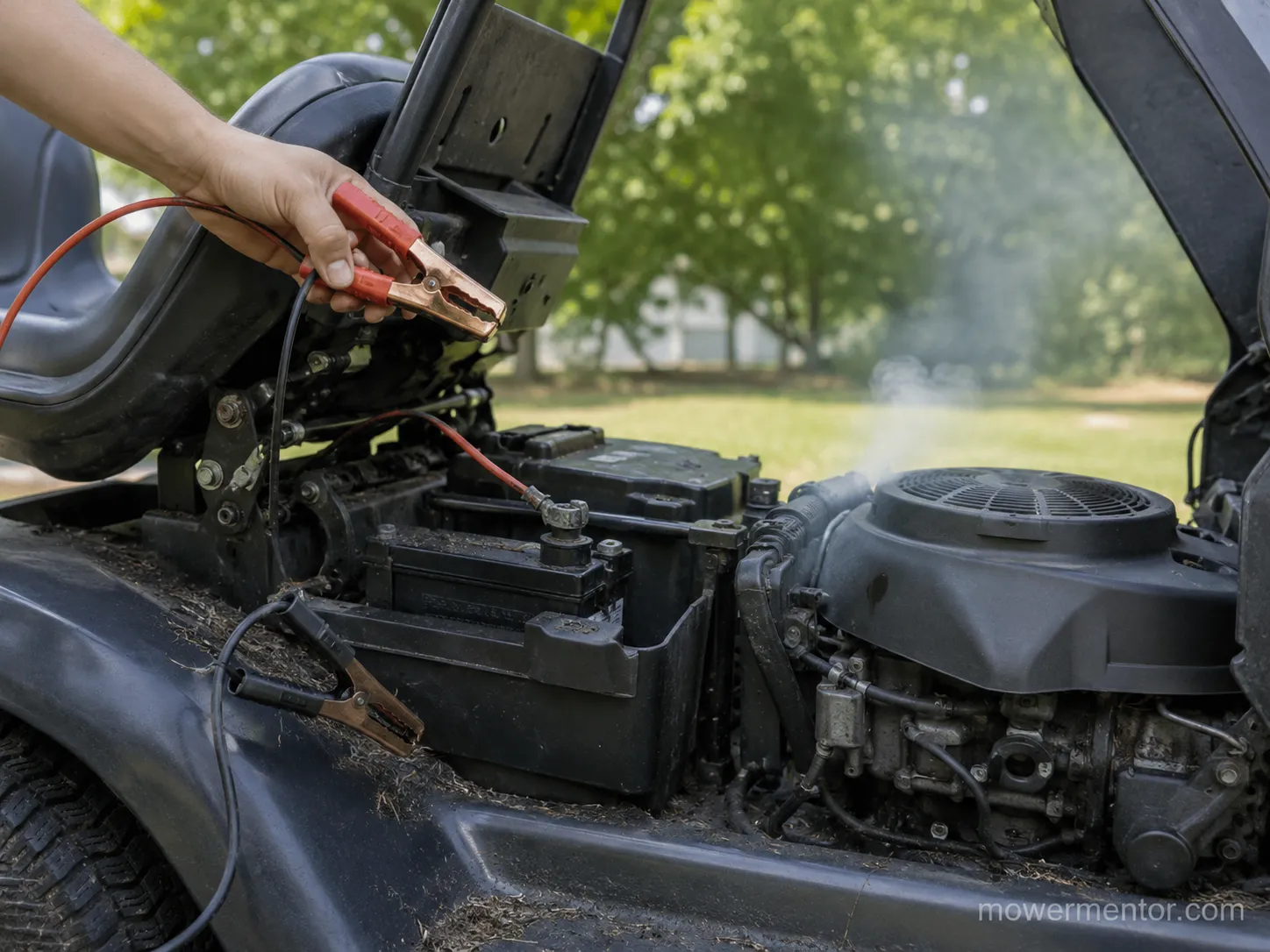
Two questions come up constantly: how to jump start a riding lawn mower with battery disconnected, and how to jump start a riding mower without a battery. The short answer is that the battery almost always needs to stay in the circuit, because a mower is a closed system that relies on the battery to buffer its charging voltage.
If your battery is simply disconnected, reconnect it first. The jump feeds the battery, and the battery feeds the mower, so a good clean connection is the starting point, not something to bypass.
Owners often describe the alternative exactly right: with the battery out of the loop, the engine runs only while the donor stays clamped and stalls the instant the cables come off.
Running with no working battery is a limp-home trick, not a fix. The charging system needs a healthy battery to smooth its output, so pulling the battery leaves the mower stalling the moment the donor is removed.
And never jump a vintage 6-volt system with a 12-volt car, a caution Timberlandscaping repeats for good reason, since the mismatch can damage the mower.
The honest limit: A battery-less run gets the mower off the lawn once. It is not a repair, and the right move is a sound battery matched to your machine.
Brand owners can match a correct replacement before relying on jumps. John Deere owners can start with the right John Deere battery for their model.
Husqvarna owners can settle the U1 versus U1R question with Husqvarna battery sizing. Murray owners have their own Murray battery cross-reference.
Frequently Asked Questions
Can you jump a lawn mower battery with a car?
Yes, for a 12-volt riding mower, as long as the donor car's engine is off. Connect red to both positive posts, black to the donor negative, and the final black clamp to bare mower frame, then start the mower.
Keeping the car off shares its stored charge without an alternator surge.
Do you leave the car running when jumping a mower?
No. Leave the donor car's engine off the entire time.
A running car's charging output can overwhelm a mower's small battery and voltage regulator. In my own testing the engine-off jump cranked the mower every time, so there is no reason to leave the car running.
Where do you connect the cables on a riding mower?
Red goes to the mower battery positive and the donor positive, black goes to the donor negative, and the final black clamp goes to a bare, unpainted frame bolt away from the battery. Grounding to the frame keeps the small spark away from battery gases.
My mower only clicks, should I jump it?
No. A single click with a healthy donor means the battery is not the problem and something downstream, usually the solenoid, starter, or an unsatisfied safety interlock, is stopping the crank.
Repeated jumps will not help. If your mower runs rough once it does start, a seasonal service such as a Husqvarna tune-up guide usually settles it.
Can you jump a mower with the battery disconnected or no battery?
Reconnect the battery first, then jump it. A mower is a closed system that needs the battery in the circuit to run, so with the battery disconnected the engine stalls the instant the cables come off.
Running with no battery is a one-time limp-home trick, not a repair.
The Bottom Line
Knowing how to jump start a riding mower battery is genuinely quick and safe when you keep the donor car's engine off and ground the final clamp to bare frame instead of the post. A 12-volt lithium pack makes it easier still, and either way the whole job is a two-minute task, not a trip to the shop.
The real skill is knowing when not to jump. If your mower only clicks, dies the moment the cables come off, or cranks strong but will not fire, the battery is not your problem, and the fix lives one guide over.
Charge a healthy battery, respect the engine-off rule, and you will have the mower back on the grass before the afternoon is gone.
Summarize with AI
Keep reading
Related articles
 Troubleshooting & Repair
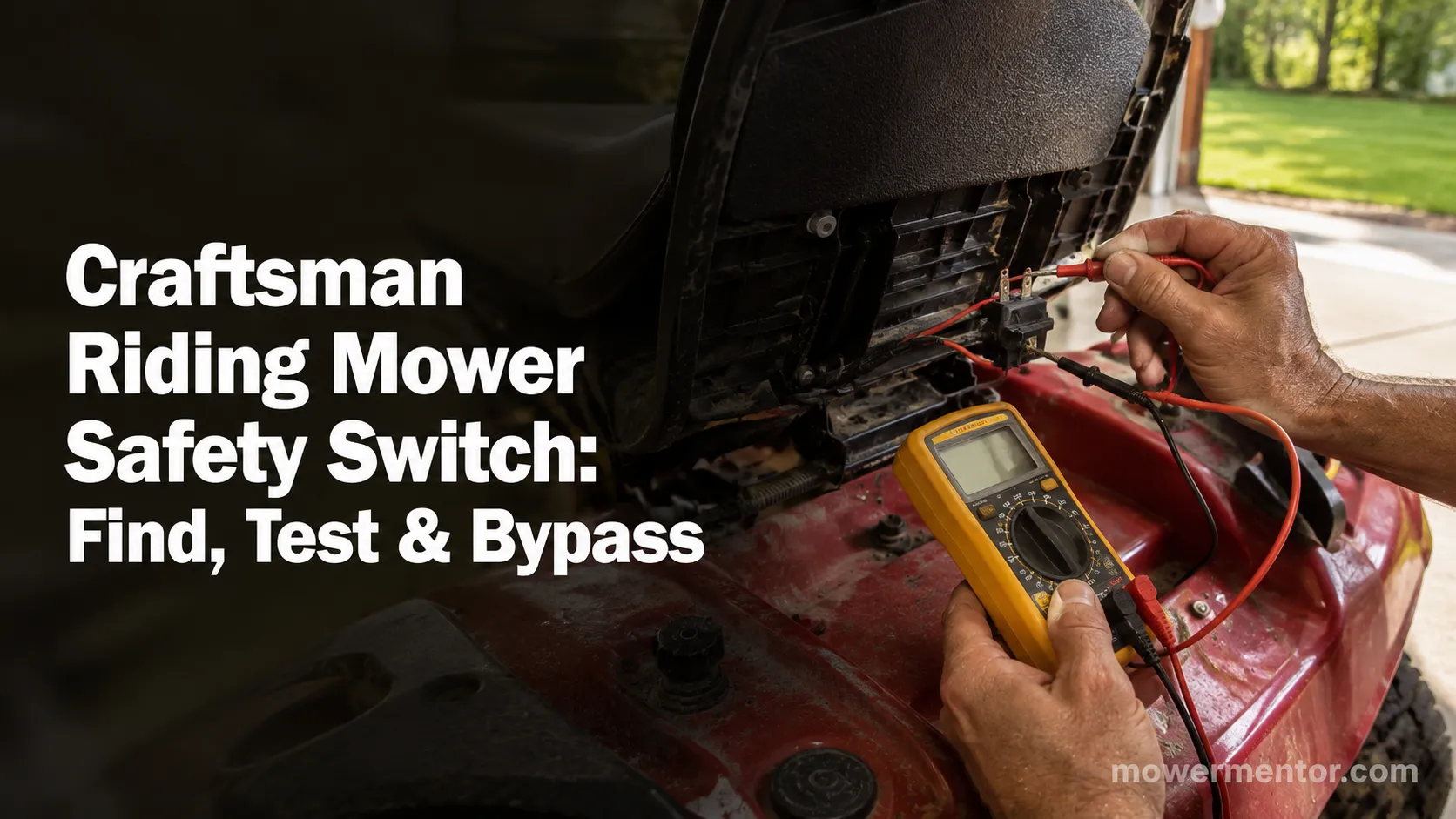
Find, test, and safely bypass the Craftsman riding mower safety switch: seat, brake, and PTO interlocks, with multimeter values and a re-enable step.
 Troubleshooting & Repair
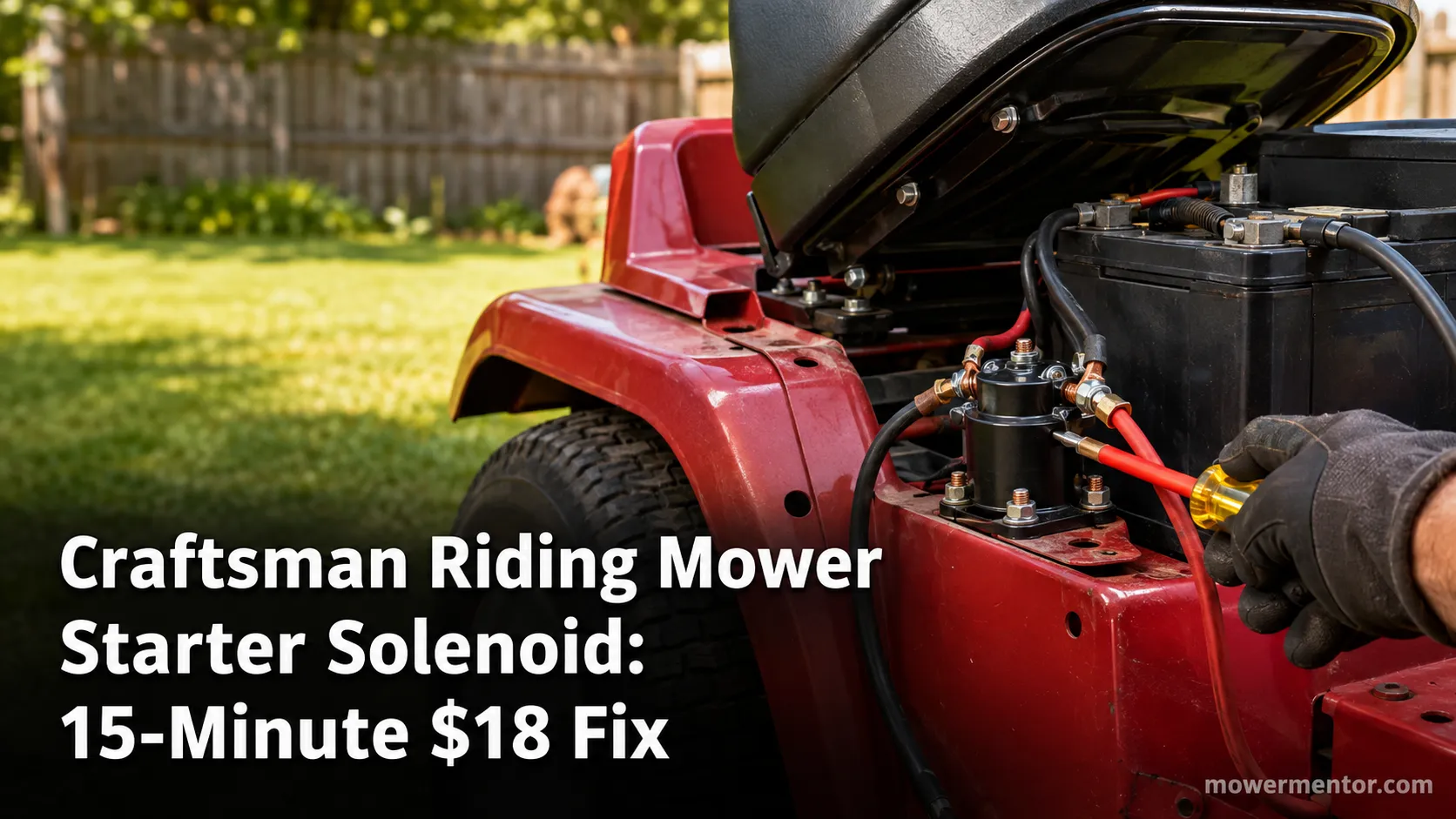
Test your Craftsman riding mower starter solenoid in about 15 minutes with a screwdriver and multimeter, then fix the click-no-crank for around $18.
 Troubleshooting & Repair
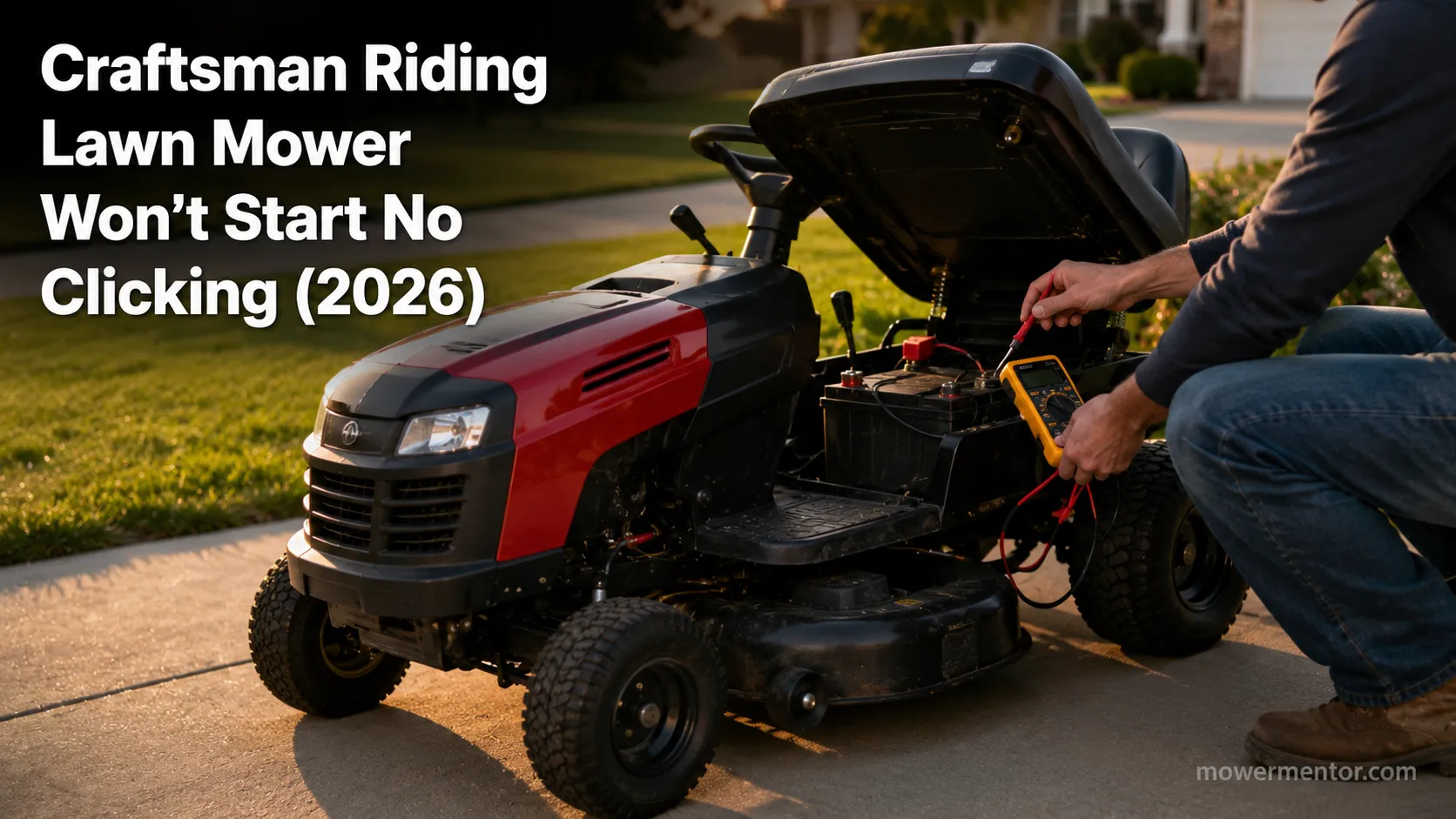
Fix a Craftsman riding lawn mower won't start no clicking: test battery voltage, inline fuse, safety switches, ignition and solenoid with a multimeter.
 Troubleshooting & Repair
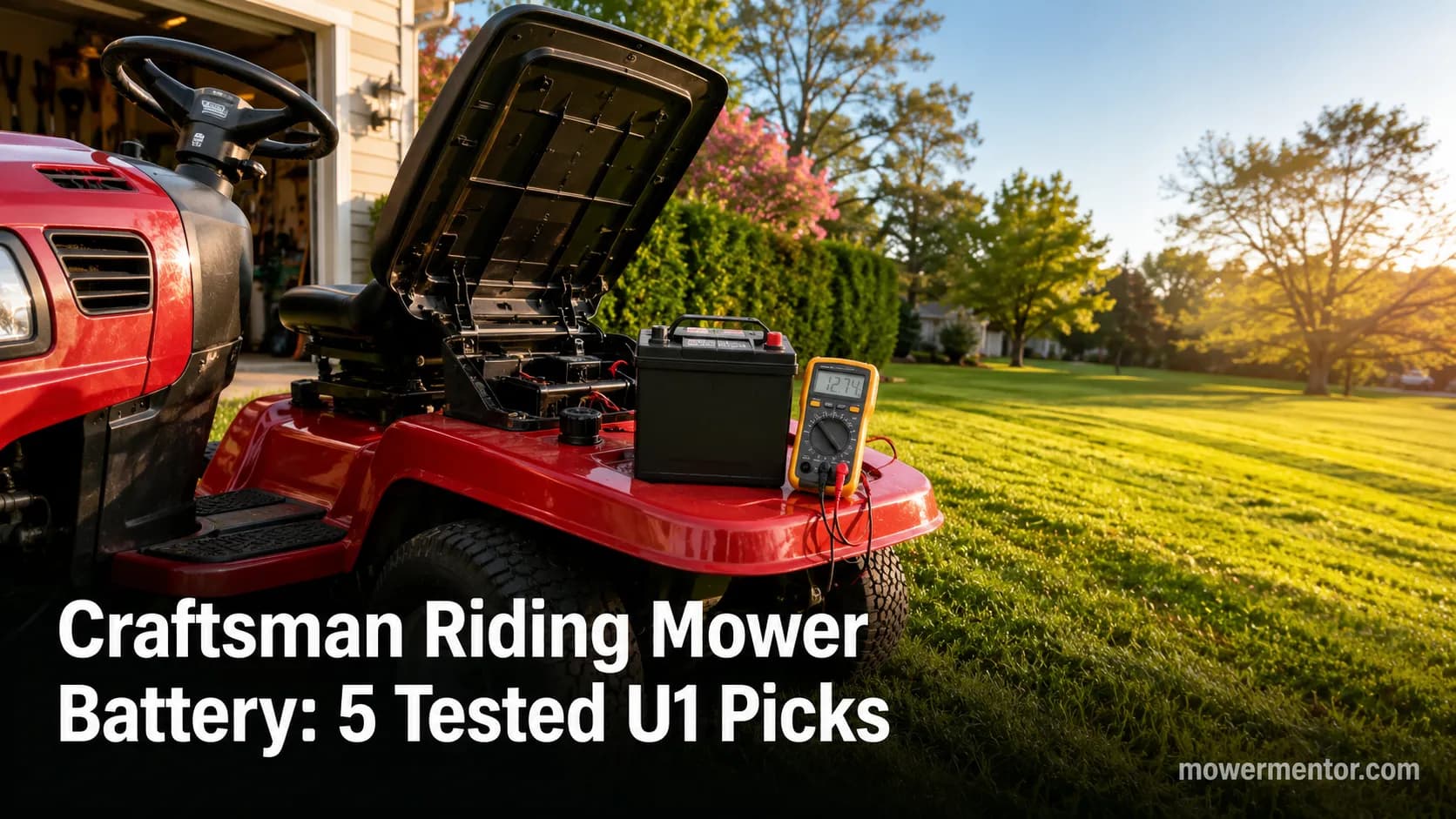
Find the right Craftsman riding mower battery: 12V U1/U1R size chart by model, 5 tested picks, and why yours keeps dying.
Comments
Moderated for quality. Share a correction, ask a follow-up, or tell us what worked for you - every comment is reviewed before it goes live.