
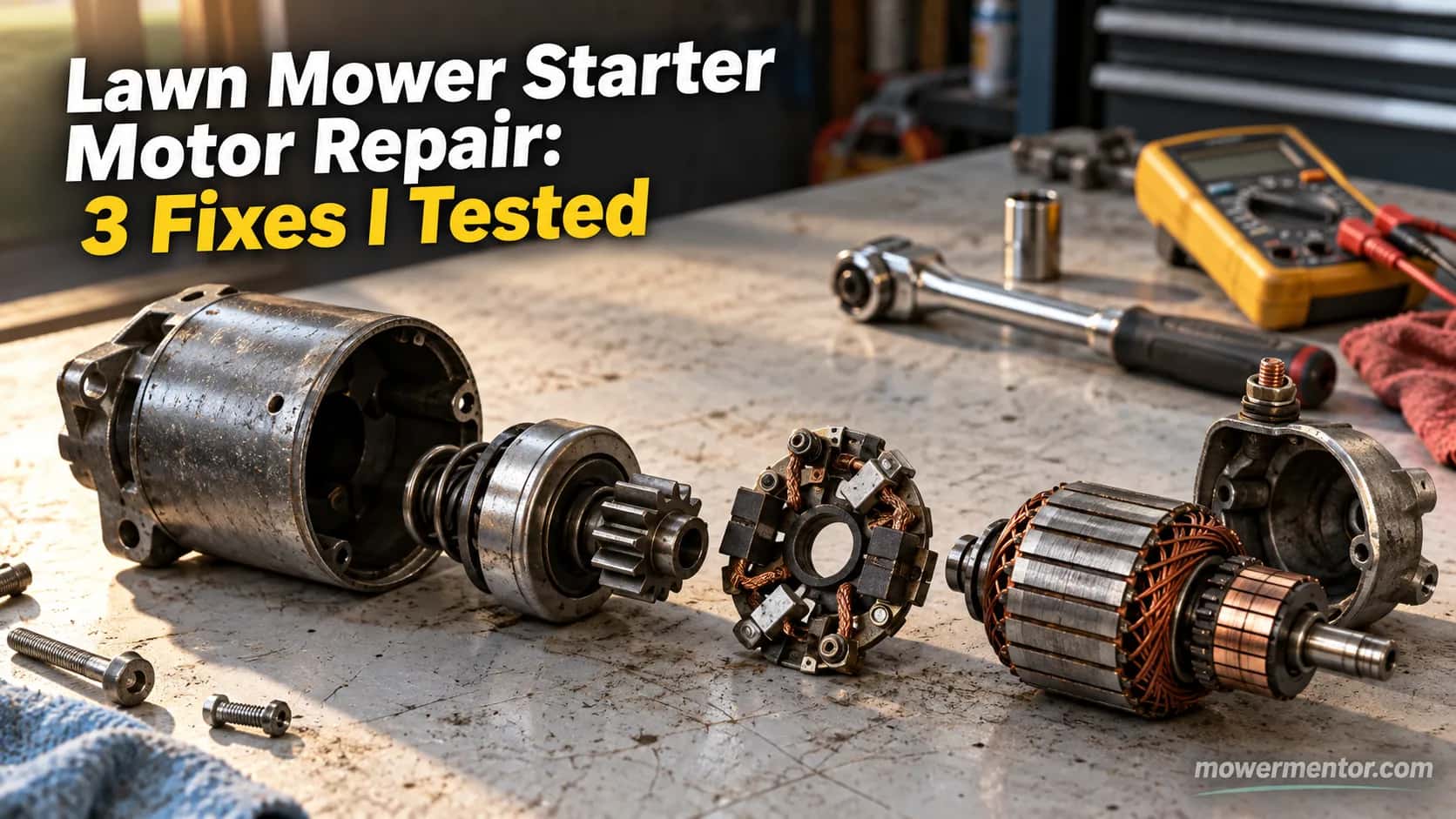
Lawn Mower Starter Motor Repair: 3 Fixes I Tested
Master lawn mower starter motor repair: fix a sticky Bendix, worn brushes and corroded contacts, plus repair-vs-replace costs and when to use a shop.
Written by Tony MaldonadoReviewed by Wade CoburnLast updated on September 24, 2026
When you buy parts or tools through links on our site, we may earn a commission at no extra cost to you. It never changes what we recommend. Learn more.
A slow crank on a spring weekend usually sends people straight to the parts counter for a new unit. Most of the time that is the wrong first move.
Lawn mower starter motor repair is realistic for the three failures that actually kill these starters, and each one is a cheap bench fix rather than a full replacement.
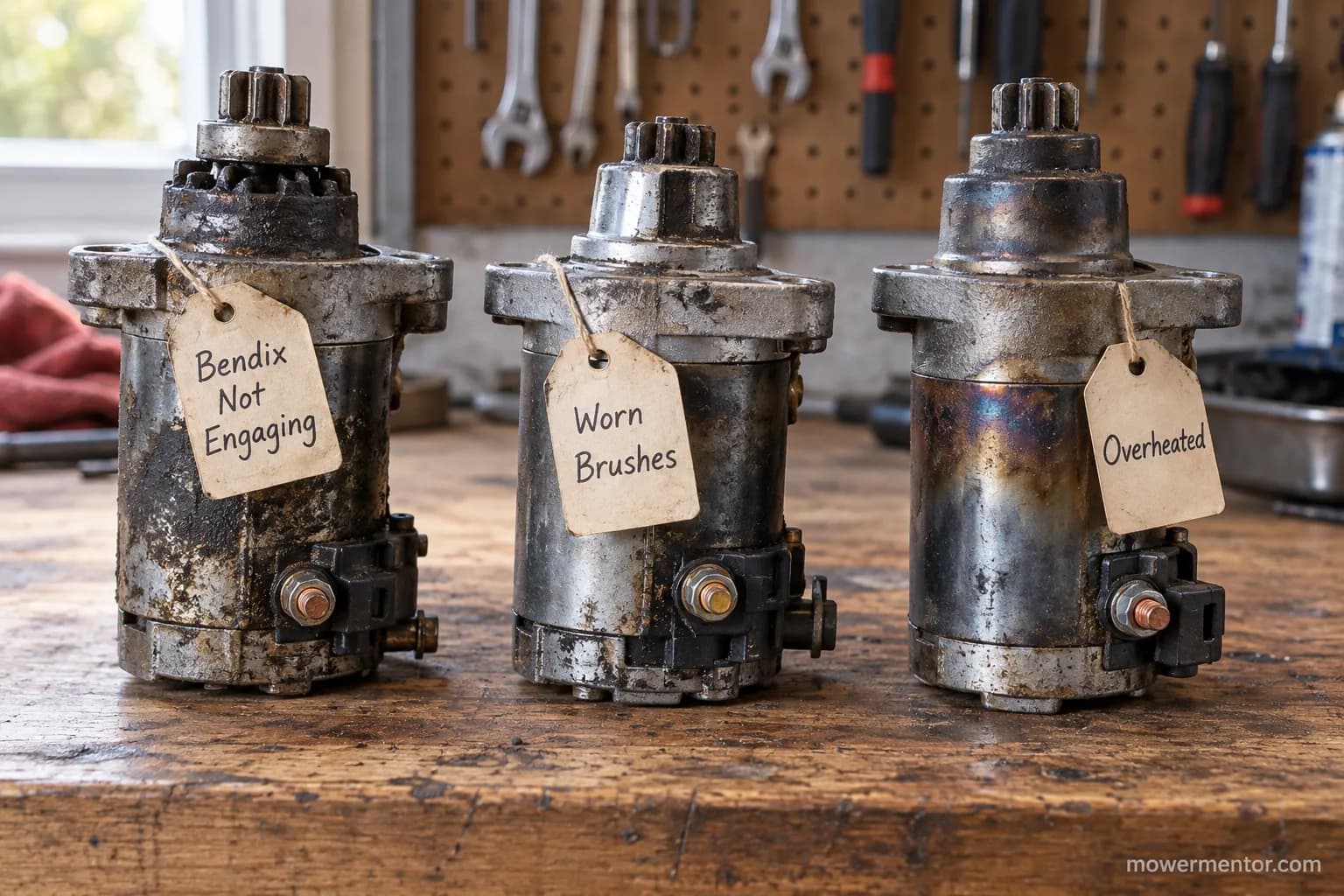
I pulled and tore down three riding-mower starters for this guide, and every one had failed in one of the same three ways.
Below is what those failures look like, how to rule out the cheaper impostors first, how to rebuild the starter yourself, and the 2026 cost math for when replacing or paying a shop is the smarter call.
A lawn mower starter that cranks slowly, clicks once, or spins without engaging can usually be repaired, not replaced.
The three fixable failures are a sticky Bendix drive, worn carbon brushes, and corroded contacts on the commutator, and together they run about $15 to $25 in parts.
Rule out a weak battery, a bad ground, the solenoid, and valve lash first, then rebuild.
Replace the whole starter only when the housing is cracked or the armature windings are damaged.
Can You Repair a Lawn Mower Starter Motor?
Yes. A lawn mower starter motor can usually be repaired rather than replaced, because the three most common failures are a sticky Bendix drive, worn carbon brushes, and corroded contacts on the commutator.
All three are a roughly $15 to $25 parts fix at the bench, which makes riding lawn mower starter repair a genuine DIY job for most owners.
Replace the starter outright only when the housing is cracked, the armature windings are burned, or the commutator is melted.
That repair-first verdict is the opposite of what most pages tell you, and it holds up against the manufacturer's own fault list.
Worn brushes, weak brush springs, and a faulty solenoid are all recognized starter faults, according to Briggs & Stratton, which is exactly the parts a home rebuild replaces.
Match your symptom to the likely fix before you touch a bolt.
Symptom | Most likely cause | Repair or replace |
|---|---|---|
Slow, labored crank with a known-good battery | Worn brushes or a dragging Bendix | Repair |
One click, then nothing (battery good) | Solenoid or contacts, not the motor | Repair or test solenoid |
Motor spins but will not engage the flywheel | Sticky or worn Bendix drive | Repair |
Cracked housing, burned smell, melted commutator | Damaged armature or windings | Replace |
When not to repair: If the case is cracked, the copper windings are scorched, or the commutator bars are melted together, no brush kit saves it.
That is a replacement, and Section five does the cost math on it.
First, Make Sure It's Really the Starter
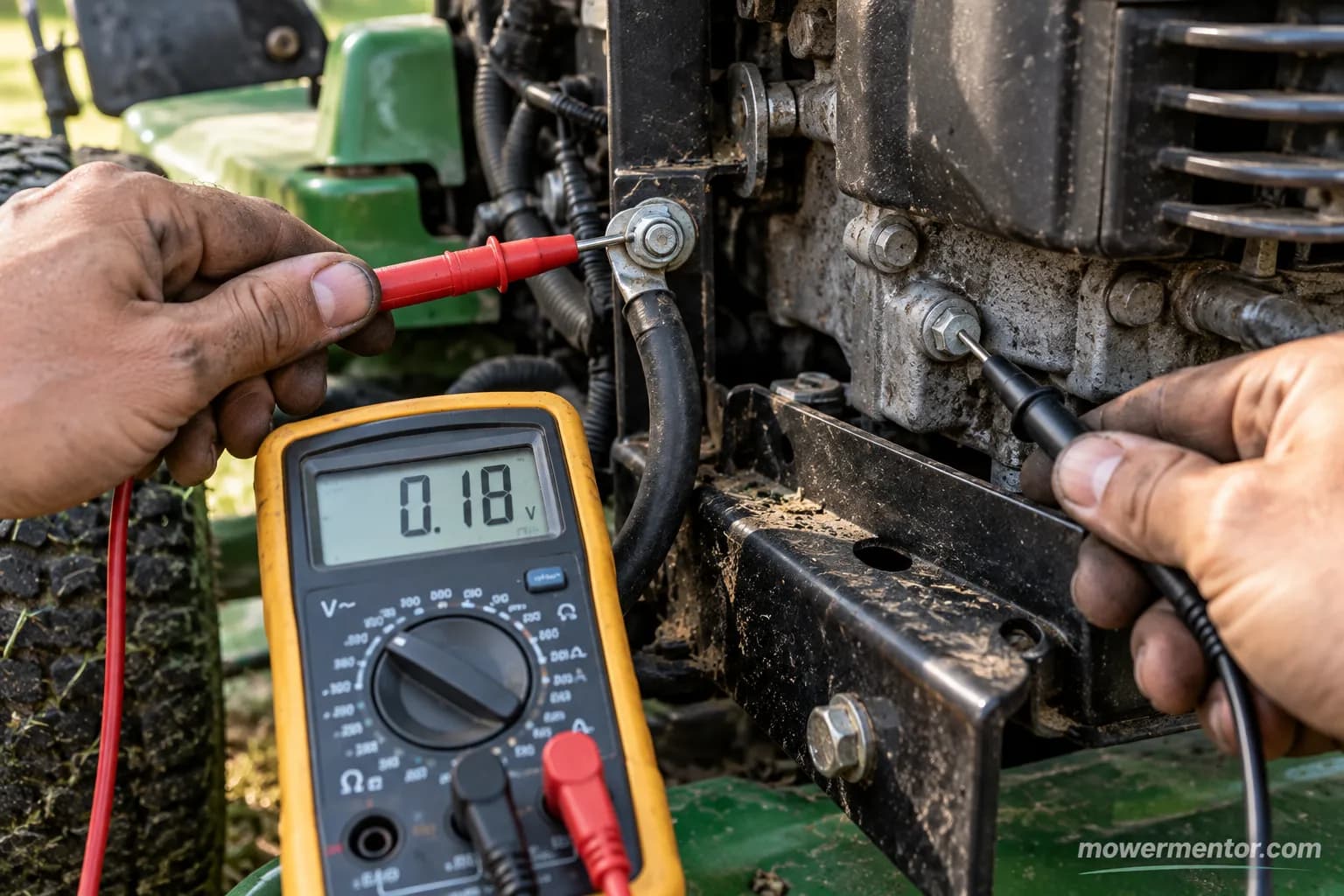
Before any riding mower starter repair, confirm the starter is actually the fault, because half of the starters people condemn are innocent.
A rested 12-volt battery should read at least 12.4 volts, and a slow crank with a good battery is more often a corroded ground, a failing solenoid, or, on Briggs Intek engines, valve lash mimicking a weak starter.
Ruling those out takes ten minutes and can save a pointless teardown.
Start at the battery and its connections.
A weak or mismatched battery and thick, cold oil both add drag that stresses the starter and looks like a starter fault, as DB Electrical notes in its maintenance guide.
If the mower is completely dead with no dash lights, walk the full starting-circuit diagnosis before you single out the starter.
Clean and tighten both battery terminals, then check for voltage drop across the ground strap while a helper turns the key.
Next, separate the solenoid from the motor. A single click when you turn the key usually means what a single click really means is a solenoid or contact problem, not a dead motor.
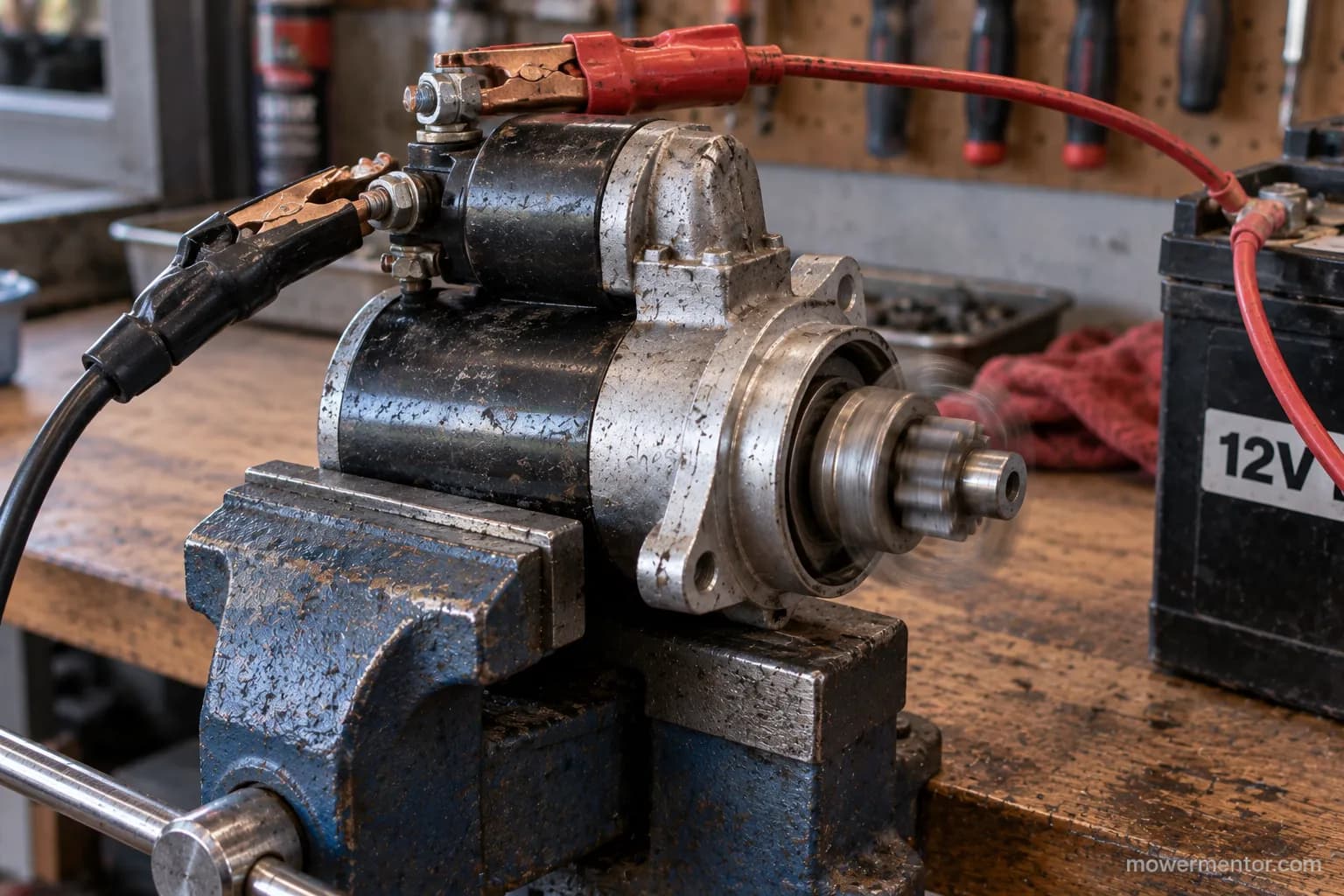
You can jump the solenoid to isolate it and send battery power straight to the starter to see whether the motor itself spins.
Is It the Starter, or the Valves?
Here is the rule-out no parts page mentions.
On Briggs Intek and other overhead-valve engines, the compression release rides on the camshaft and only works when valve lash is in spec, commonly around 0.004 to 0.006 inch on the intake and 0.006 to 0.008 inch on the exhaust, set with the piston a quarter inch past top dead center.
When the lash drifts tight, the compression release stops lifting the valve and the engine cranks slow and hard, exactly like a weak starter.
Owners on small-engine forums repeatedly trace a slow crank to valve lash and confirm a real starter by bench-testing its amp draw, as this LawnSite thread shows.
The field test is simple: if the engine has a manual rope backup, rope-start it. If it spins over easily by rope but drags on the electric start, look at the valves and the battery before the starter.
Finally, bench-test the starter first once it is off the engine, or have an auto-parts store test its amp draw for free.
One caution before you commit to a rebuild: a starter that cranks the engine fine but the engine still will not fire is a fuel or spark problem, so that is when a no-fire isn't the starter at all.
Lawn Mower Starter Motor Repair: The 3 Fixes You Can Do Yourself
Lawn mower starter motor repair comes down to three fixable failures: a sticky or worn Bendix drive, worn carbon brushes, and corroded contacts on the commutator.
A Bendix that spins but will not engage needs cleaning or a $15 to $25 drive kit, brushes worn past their limit need a brush set, and a carbon-fouled commutator needs cleaning, not replacing.
Each is a bench repair on a starter you already have off the engine.
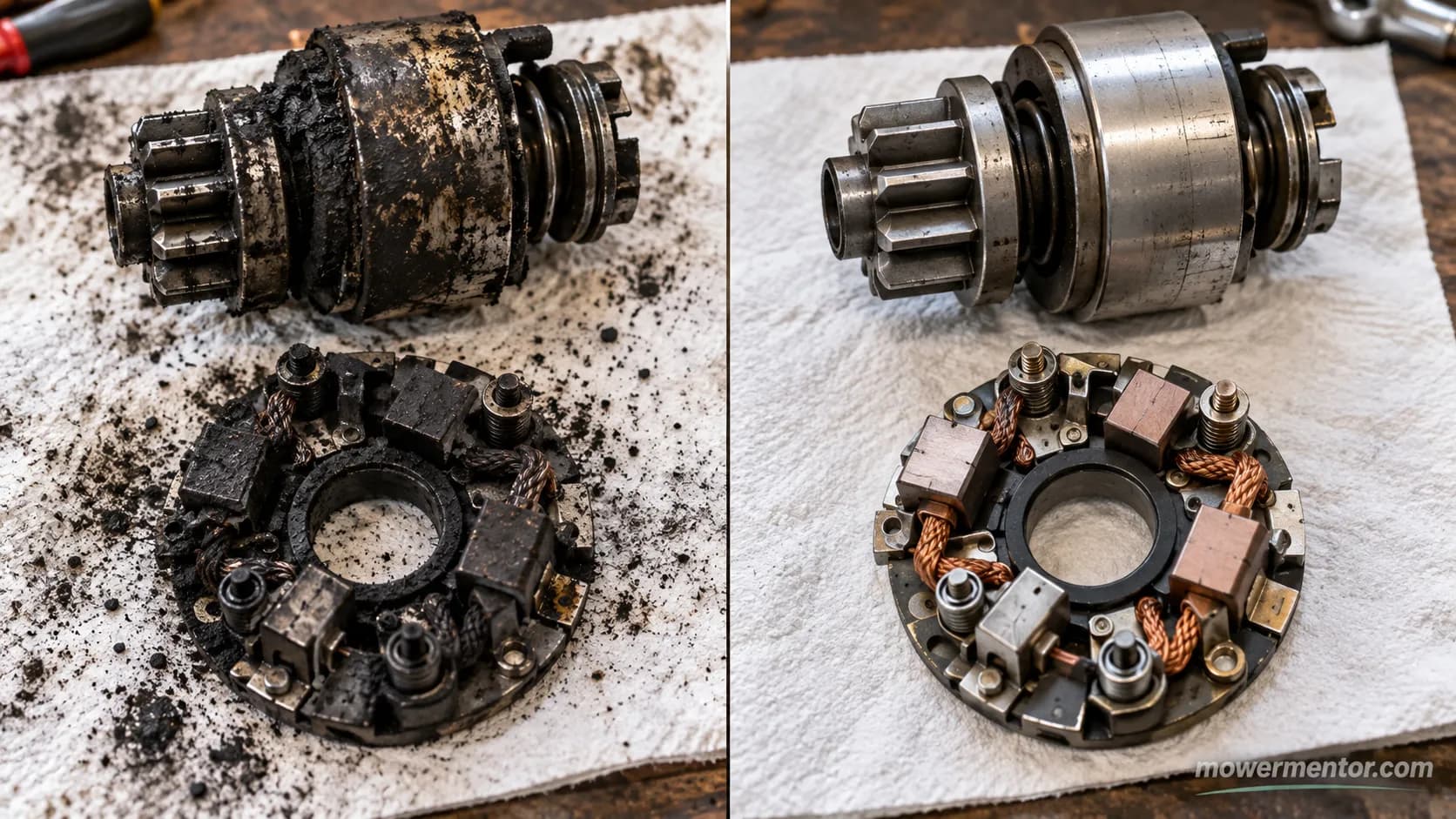
On the first bench starter I opened, the pinion was glazed and the brush plate was coated in black dust; a degrease and a new drive kit cured the will-not-engage.
Use the table to match your failure to its part before you buy anything.
Failed part | What you see or hear | The fix | Typical part |
|---|---|---|---|
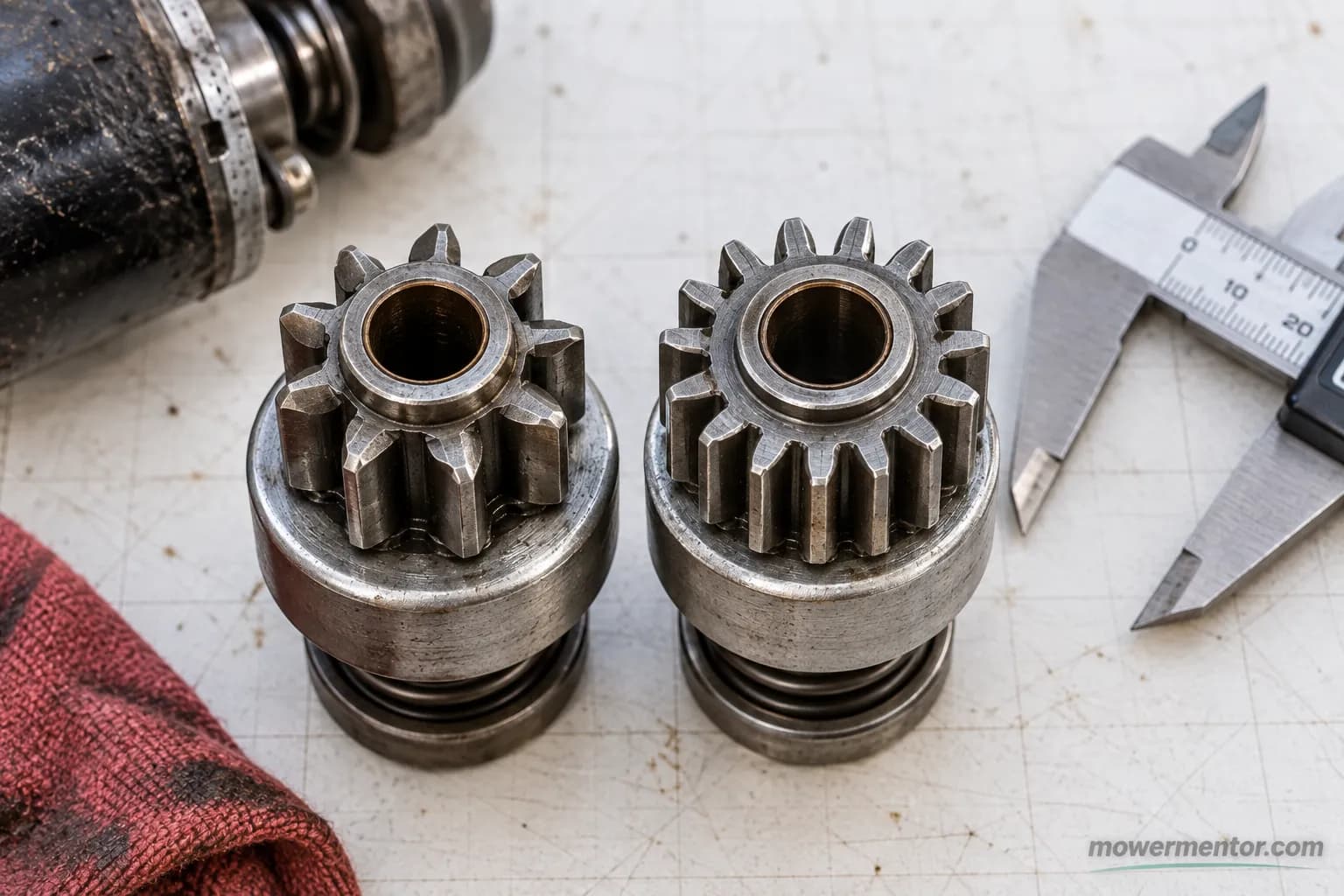
Bendix drive | Spins but will not engage; grinds; sticks up | Clean and degrease, or fit a new drive kit | 16-tooth drive kit, $15 to $25 |
Carbon brushes | Slow crank, then nothing; short brush stubs | Replace brushes and springs | Brush set, about $15 |
Contacts / commutator | Intermittent crank; black, fouled bars | Clean commutator and contacts | Sandpaper and contact cleaner, under $10 |
How Do You Fix a Sticking Bendix?
A sticky Bendix is the most common of the three, and spraying WD-40 on it only treats the symptom.
Owners who actually cure it degrease or kerosene-wash the drive so the pinion slides freely again, as this MyTractorForum thread describes.
Pull the drive, clean the old grease and grass paste off the helix, and check the pinion teeth for chips.
If the teeth are rounded or the spring is tired, fit a new 16-tooth drive kit with its retainer and roll pin rather than nursing the old one.
Can You Replace Just the Brushes?
Yes, and it is the cheapest real fix. Measure each brush against its wear limit, check that the springs still push firmly, and if a brush is worn to a stub or a lead has broken off the stud, replace the set and reseat the new brushes on the commutator.
Corroded contacts often live on the solenoid rather than the motor, so it helps to understand how the solenoid actually works before you blame the brushes.
If the fault turns out to be the solenoid, replacing a bad solenoid instead is a separate and simpler job.
Corroded Contacts and Commutator
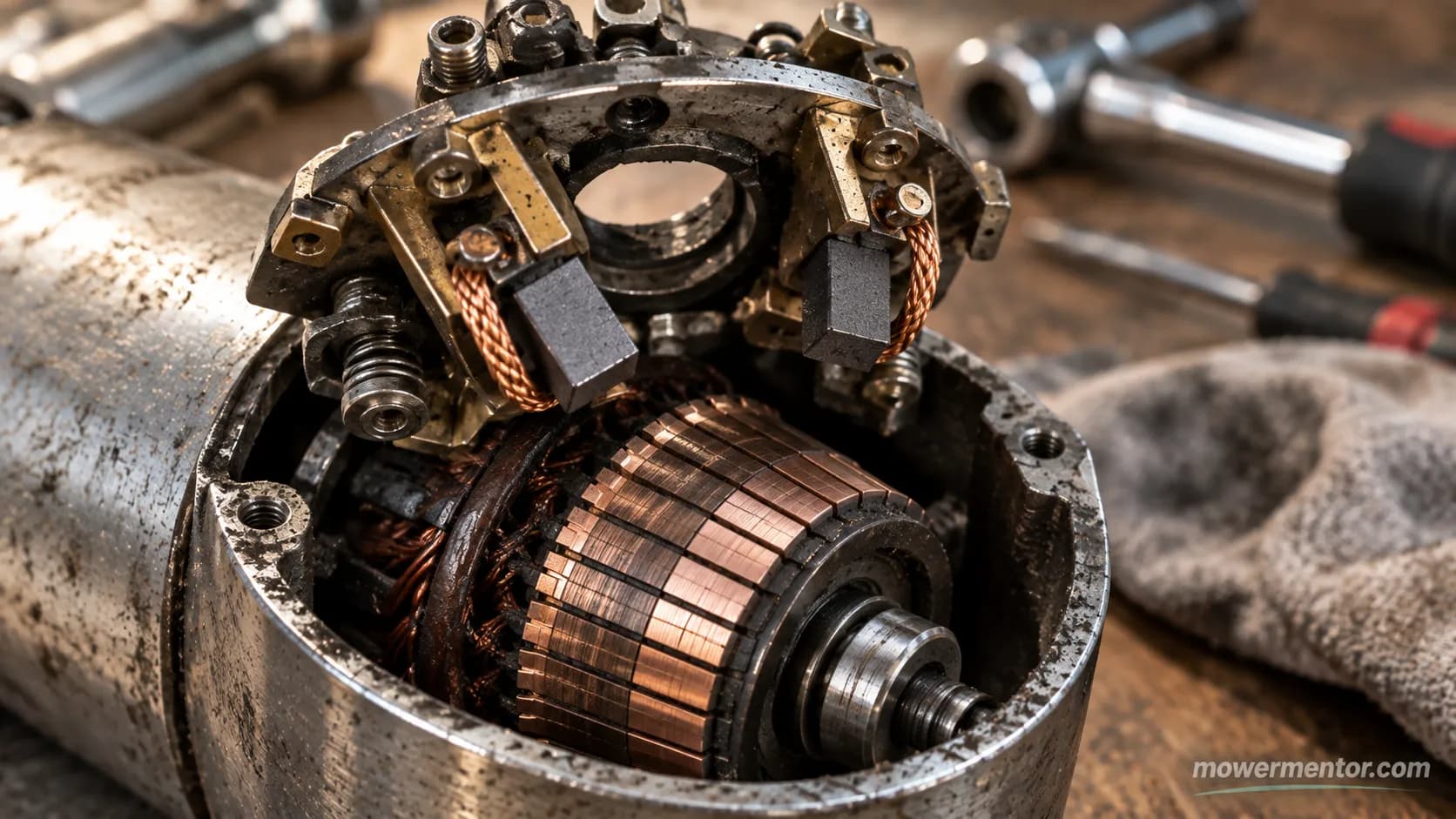
Black dust across the brush plate is normal wear, not damage. Wipe it out, shine the commutator bars with fine sandpaper or a strip of 400-grit, and clean the contacts with electrical contact cleaner so current flows cleanly again.
If a broken lead or stripped terminal stud needs rethreading, a small thread-and-lead repair kit can save the end cap.
One honest limit: if the armature windings are scorched or the commutator is melted, cleaning will not save it, and you are into replacement territory covered below.
How to Rebuild the Starter Step by Step
To rebuild a lawn mower starter motor, remove it from the engine, free the Bendix drive, clean the commutator, and replace worn brushes and springs before reassembling in reverse.
A community rebuild write-up confirms the core sequence: remove the retainer to open the case, clean the brush plate and commutator, and reseat the brushes, as documented on MyTractorForum.
The whole job takes about an hour on the bench with basic tools.
Gather your tools and parts first so you are not stopping mid-teardown.
Multimeter and a 12-volt test source
Snap-ring pliers and a small pry tool
Socket set or torx bits for the two mounting bolts
Fine sandpaper (400-grit), degreaser, and contact cleaner
New brush set and, if needed, a matching 16-tooth drive kit
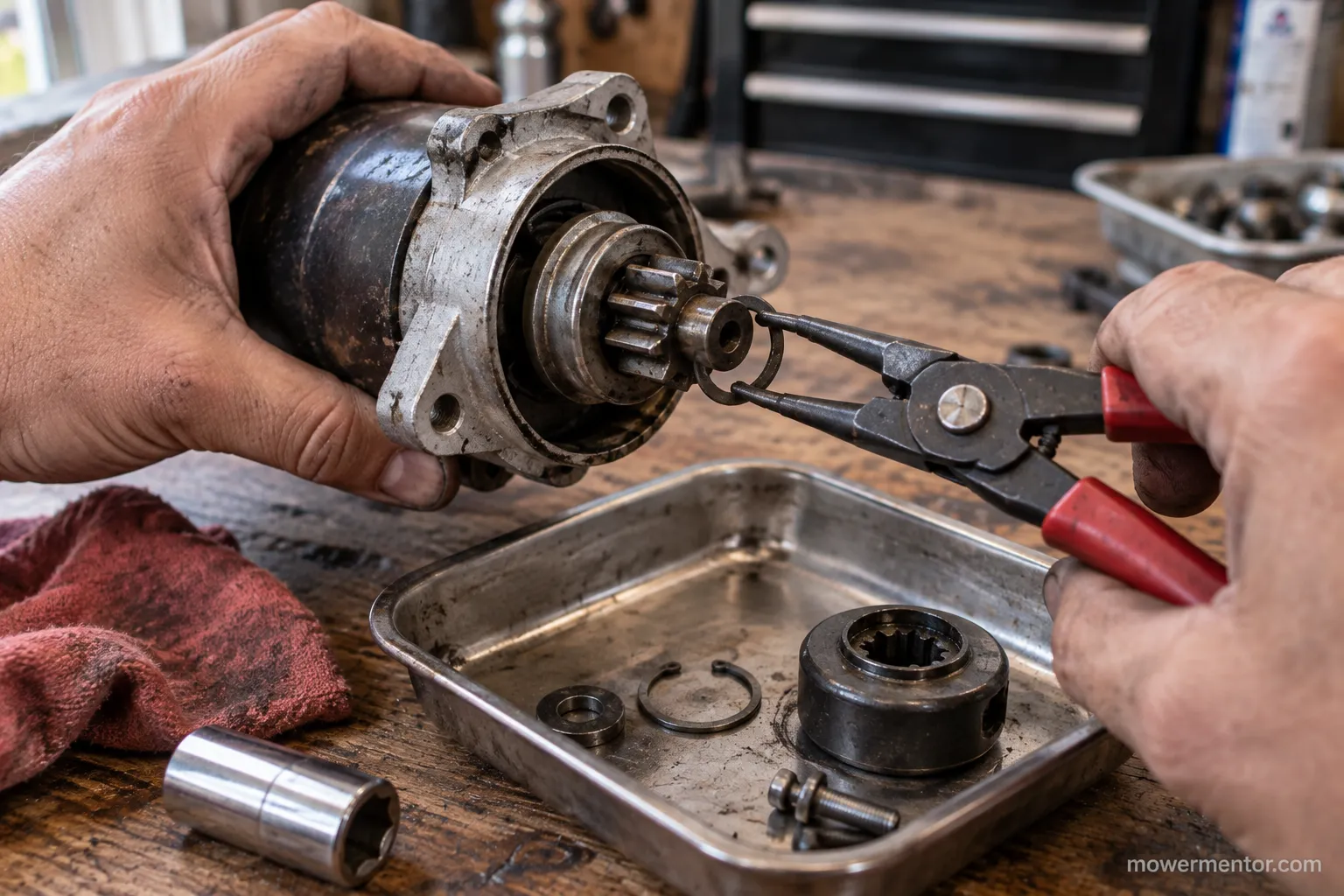
Then work the rebuild in order. On my first teardown the C-clip, the little retainer some owners call the jesus clip, pinged clear across the shop; I now pop it inside a clear zip bag so it cannot escape.
Disconnect the battery, then unbolt and remove the starter (usually two bolts or torx screws).
Mark the housing orientation with a paint pen so it goes back exactly as it came apart.
Remove the retainer cap and C-clip over a tray or inside a bag to free the Bendix drive.
Slide off the drive, then open the case by removing the through-bolts.
Lift out the armature and inspect the commutator; shine the bars and undercut the mica between them only if it is fouled and raised.
Replace the brushes and springs, easing the brush plate over the commutator so the brushes do not sproing out the back.
Reassemble in the reverse of your marked order, seating the drive and a new retainer.
Bench-test for a smooth, strong spin, then reinstall and snug the mounting bolts evenly.
While the starter is out, it is a natural moment to fold it into a broader tune-up so you are not pulling covers twice.
If your no-crank turns out to trace back to wiring rather than the motor, trace the solenoid wiring layout before reassembly.
If it did not work: If you cannot source internal parts for your specific starter, or the case will not come apart cleanly, a rebuild is not viable and replacement is the path.
Repair vs Replace: What It Actually Costs (2026)
Repairing a lawn mower starter is usually far cheaper than replacing it: a brush set runs about $15, a Bendix drive kit about $15 to $25, against roughly $40 to $90 for a new aftermarket starter and $95 to $250 to have a shop install one.
On my last rebuild the brush kit was $15, while a new starter would have been several times that.
The decision rule is simple: rebuild when the fix is one worn part and the housing and armature are sound.
Here is the money math, using current 2026 parts and labor.
Option | Typical 2026 cost | Notes |
|---|---|---|
Repair: brush set | about $15 | Cheapest fix; cures most slow cranks |
Repair: 16-tooth Bendix drive kit | $15 to $25 | Includes gear, spring, retainer, roll pin |
Repair: clean contacts and commutator | under $10 | Sandpaper and contact cleaner |
New aftermarket starter (DIY install) | $40 to $90 | Quality varies by brand |
New OEM starter (DIY install) | $90 to $180 | Exact fitment, longer warranty |
Shop-installed new starter | $95 to $250 | Parts plus labor |
Auto-parts amp-draw bench test | free | Confirm the fault before you buy |
The threshold for stopping a repair is clear.
Replace the whole starter when repair cost approaches a new unit or the windings are damaged, as DB Electrical's troubleshooting guide advises.
If replacing wins the math, how the full swap is done is a straightforward two-bolt job on most riding mowers.
When you do buy a replacement, fitment matters more than brand. Match the engine, the tooth count, and the roll-pin versus through-bolt mount so you pick the right replacement unit the first time.
Craftsman owners in particular should check the Briggs-versus-Kohler split, since the Craftsman starter fitment notes differ by engine.
One more cost lever sits off to the side. If the mower is already due for service, what a full service runs can absorb the starter job and change the total picture.
And because a clogged air filter can make an engine harder to spin and mimic a weak starter, it is worth taking a minute to clean a clogged air filter while you are in there.
Honest caveat: Aftermarket starter quality varies, and shop labor can tip a marginal repair toward simply DIYing a new unit. Weigh the parts cost against your own time.
When to Take It to a Shop (and What They Charge)
Take a lawn mower starter to a shop when the housing is cracked, the armature or windings are damaged, you cannot source internal parts, or the mower is still under warranty.
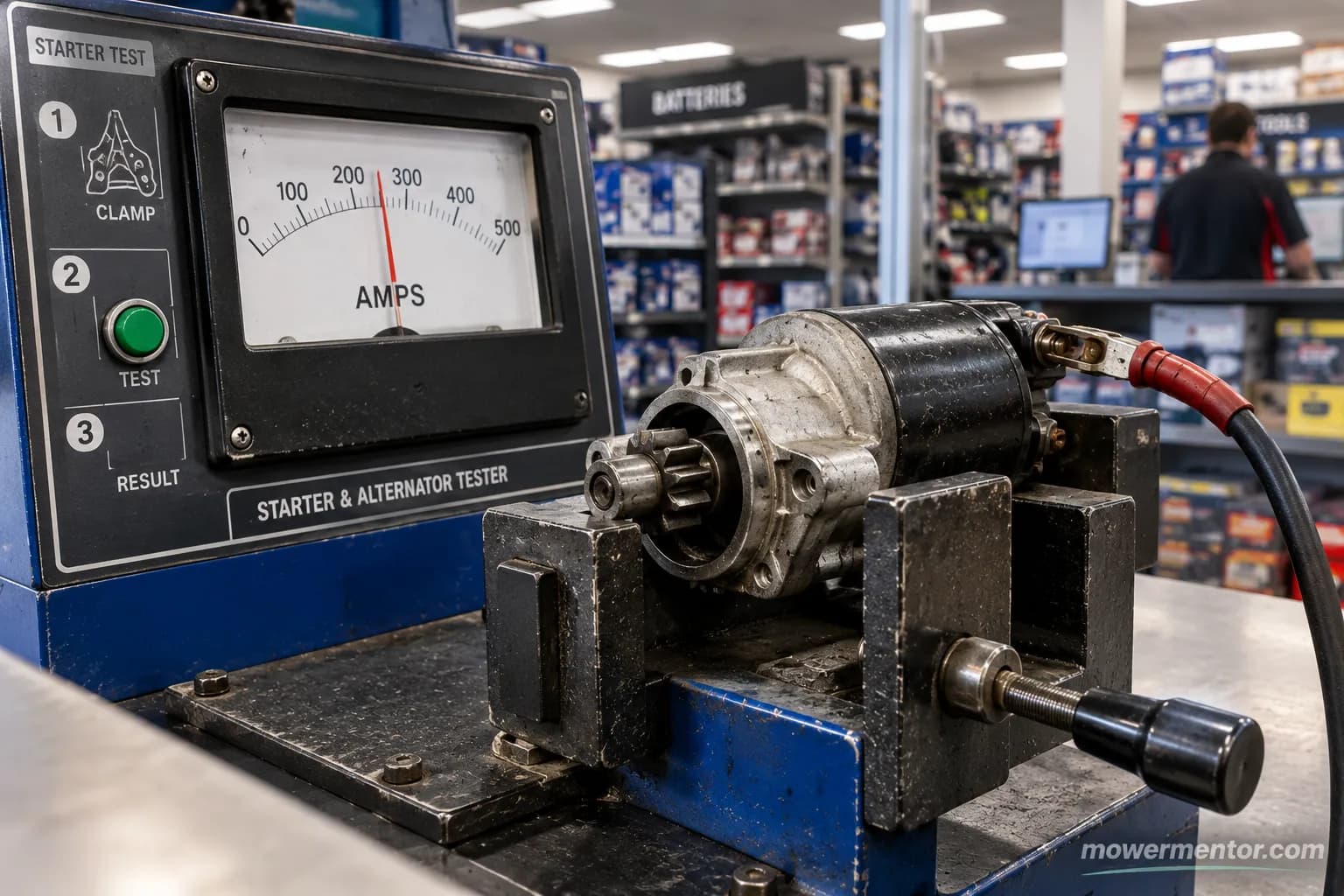
A small-engine shop typically charges about $95 to $250 to install a new riding-mower starter, and many auto-parts stores will bench-test a removed starter's amp draw for free.
That free test is worth doing before you pay for a replacement, and it is the smartest first step in any riding mower starter repair you plan to hand off.
Hand it off when any of these are true.
The housing is cracked or a mounting ear is broken
The armature is scored or the windings smell burned
You have no way to bench-test or source internal parts
The mower or engine is still under warranty
You simply do not have the time this weekend
What a shop charges lands in a predictable band. Installing a new riding-mower starter runs roughly $95 to $250 in parts and labor, per Cherrone Equipment's 2026 cost guide, and most small-engine shops bill in that range.
Fitment still matters when a pro does the work, so bring your model and engine numbers.
Deere owners can check the ignition-switch angle first with these John Deere starter specifics, and Husqvarna's parts differ enough to confirm Husqvarna starter fitment separately.
The same is true across brands with mixed engine suppliers.
Cub Cadet varies by whether it runs a Kohler, Briggs, or Kawasaki, so match the Cub Cadet starter by engine, and Pony and Bronco owners should confirm Troy-Bilt starter fitment before ordering.
Frequently Asked Questions
Does a battery or electric mower have a starter motor?
No. Battery and corded electric mowers drive the blade motor directly and have no Bendix starter to fail, so their no-start problems are batteries, switches, and controllers instead.
Battery mowers skip the starter but still need seasonal care, and how battery mowers are serviced covers what actually wears on them.
How do I find the right starter part number?
Match by engine, not by mower brand. Pull the engine model, type, and code from the blower housing or valve cover, then confirm the tooth count and whether the drive is held by a roll pin or a through-bolt.
Is a remanufactured starter as good as new?
Usually, yes. Quality remanufactured and aftermarket starters are rebuilt with new wear parts and tested to original-equipment spec, as DB Electrical describes, and a good reman unit typically carries a warranty.
The caveat is that a rebuild can fail again if the core armature was already marginal.
How long should a rebuilt starter last?
A properly rebuilt starter with fresh brushes and a clean commutator should give years of normal seasonal use. Longevity depends on the armature and bushings being sound, which is why a bench test after the rebuild matters.
Can I bench-test the starter without removing it?
Partly. You can jump the solenoid on the mower to see whether the motor spins, but a true amp-draw test needs the starter on a bench tester, which most auto-parts stores will do for free.
The Bottom Line
A dragging, clicking, or dead mower rarely needs a brand-new starter. Confirm the battery, the ground, the solenoid, and the valves are not the real culprit, and most of the time the starter itself is a $15 to $25 rescue rather than a $90 replacement.
That is the whole case for lawn mower starter motor repair: three cheap, nameable failures, one bench hour, and a clear line where replacing or paying a shop finally makes more sense than fixing.
Keep the drive clean, keep the brushes above their wear limit, and the same starter can serve for years.
When the housing cracks or the windings burn, replacement is the honest answer, and a free amp-draw test at the parts counter tells you which side of that line you are on before you spend a dollar.
Start with the diagnosis, rebuild when the math favors it, and hand off only what genuinely needs a shop.
Found this useful? Make us a preferred source so we show up in your Google results.
Keep reading
Related articles
Troubleshooting & Repair
Dead Dash? Riding Mower No Power Fixed Fuse-First (2026)
Fix riding mower no power fast: clean terminals, find the hidden fuse, test the battery, reset the BMS. A fuse-first checklist for gas & electric mowers.
Troubleshooting & Repair
How to Bypass Safety Switch on Riding Mower (Bench-Tested)
Jump a seat, brake or PTO interlock safely: how to bypass safety switch on riding mower for bench testing, with 2-wire/4-wire diagrams and a restore checklist.
Troubleshooting & Repair
Riding Lawn Mower Won't Turn Over: 5-Stage Voltage Test
Fix it fast: a riding lawn mower won't turn over usually means battery, ground, solenoid or starter. Test each in 5 ordered stages.
Troubleshooting & Repair
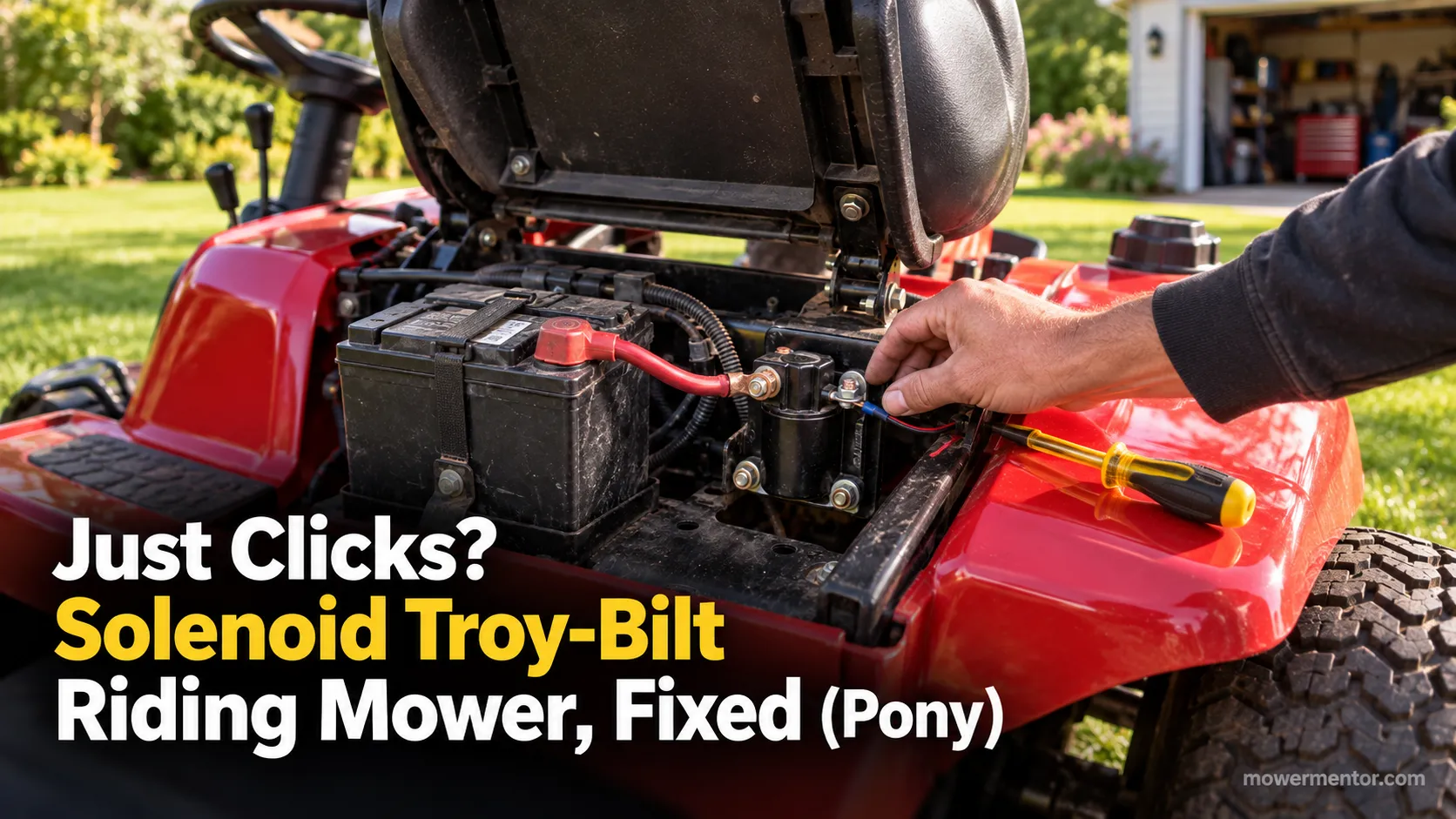
Just Clicks? Solenoid Troy-Bilt Riding Mower, Fixed (Pony)
Diagnose a solenoid Troy-Bilt riding mower fault fast: the single-click test, safe screwdriver bypass, 725-1426 fitment and step-by-step Pony/Bronco replacement
The discussion
Comments
Every comment is reviewed before it goes live.