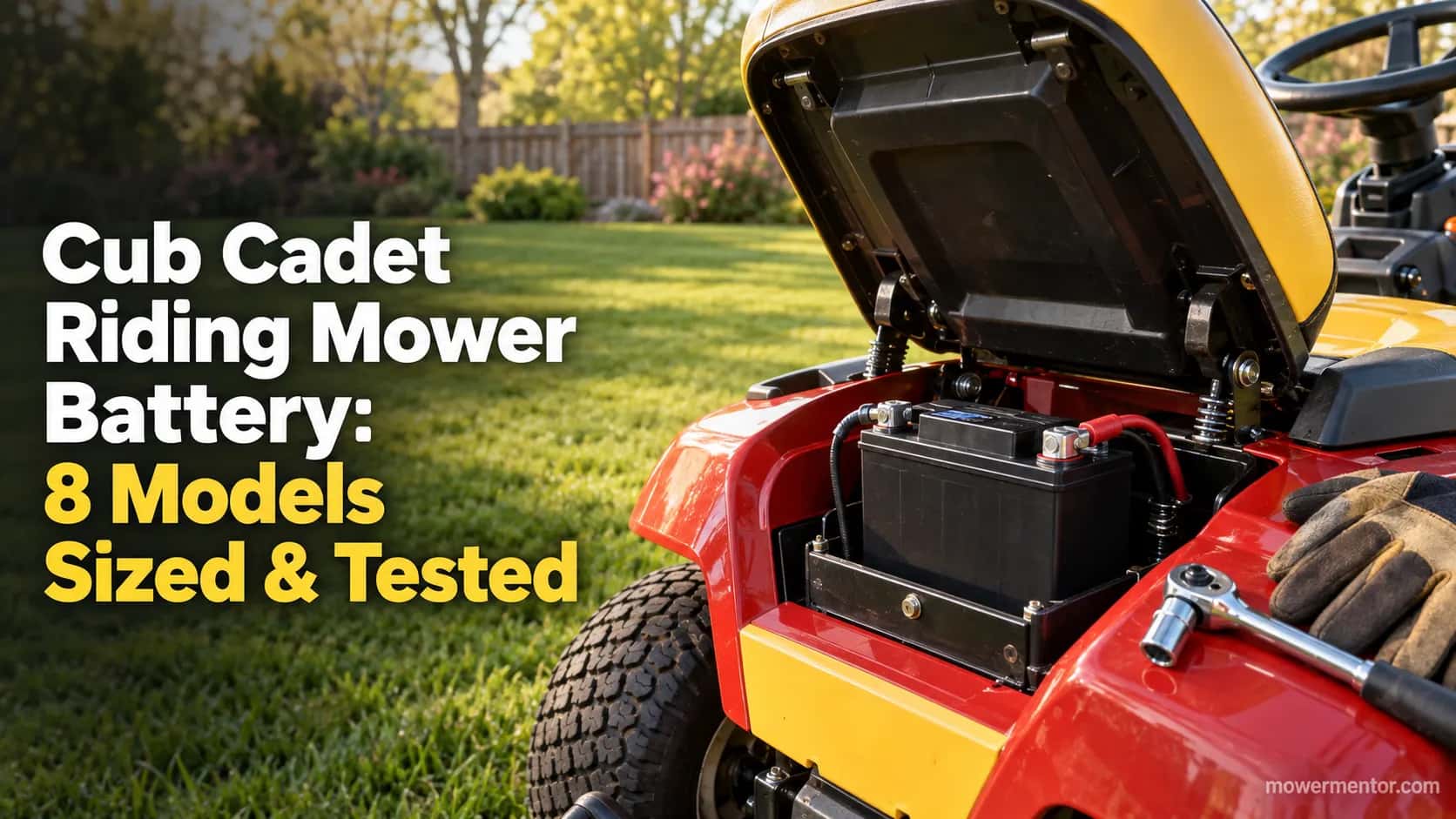
Cub Cadet Riding Mower Battery: 8 Models Sized & Tested
Find the right Cub Cadet riding mower battery by model: U1 size, CCA, AGM vs wet-cell, tested top picks and a step-by-step replacement guide.
Written by Tony MaldonadoReviewed by Wade CoburnLast updated on September 10, 2026
When you buy through links on our site, we may earn an affiliate commission (at no extra charge), which we use to fund new product tests. Learn more.
Read it your way
Short on time? Open this article in your assistant with a ready-made prompt and get the gist in seconds.
Found this useful? Make us a preferred source so we show up in your Google results.
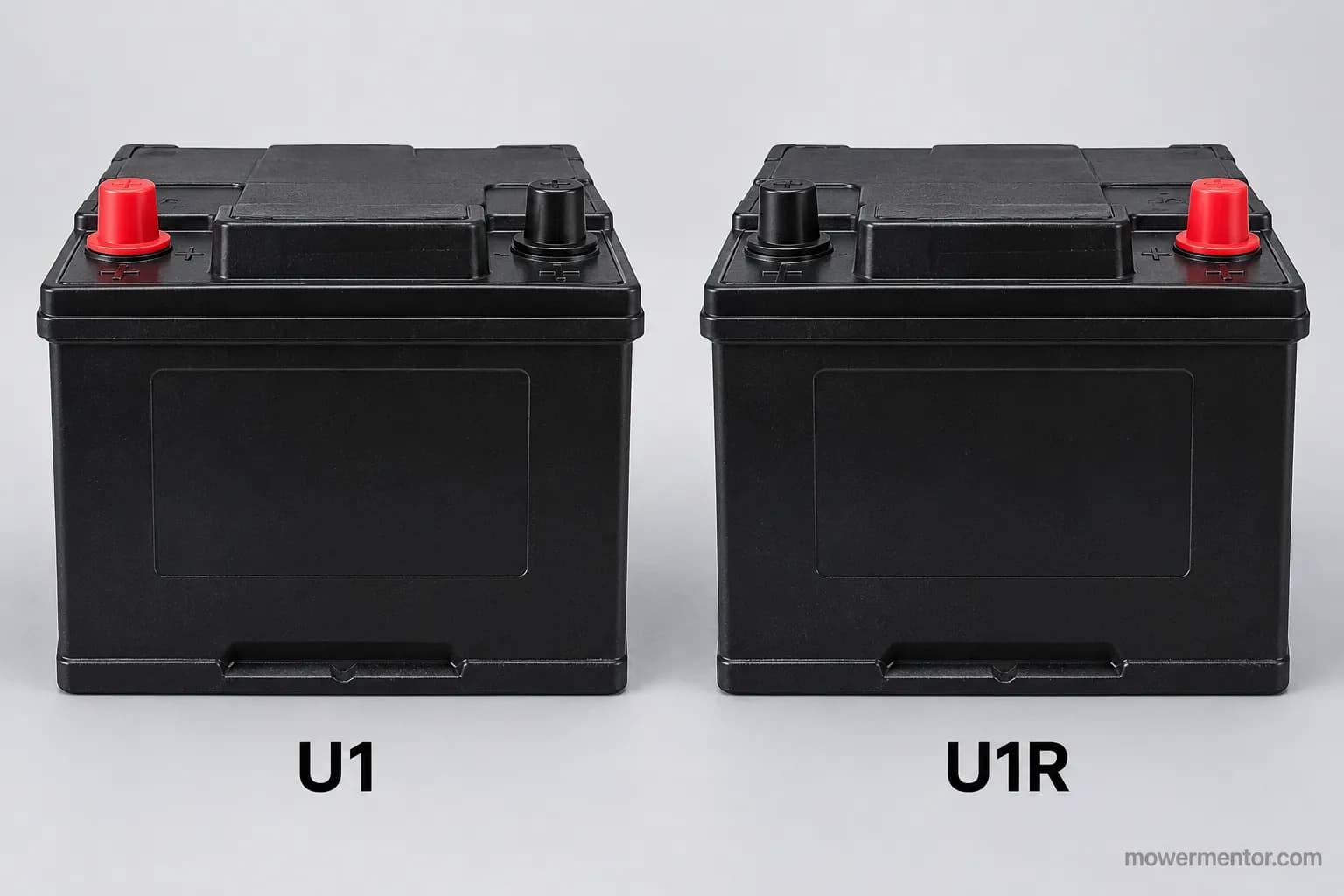
Nearly every Cub Cadet riding mower uses a 12-volt Group U1 battery; U1R just flips the terminal side.
Single-cylinder tractors are happy around 200 to 230 CCA; twin-cylinder XT1 and LTX models want 300 CCA or more.
A standard U1 measures about 7.76 x 5.12 x 6.7 inches, so it drops into the stock tray.
A correctly sized aftermarket U1 is fine for most owners; buy OEM when you want dealer-warranty simplicity.
If a fresh battery still will not crank or keeps dying, the fault is often the charging system, not the battery.
Buying a Cub Cadet riding mower battery should take thirty seconds, yet the retailer listings and the generic brand how-to turn it into a guessing game.
Last spring a neighbor grabbed the first one that looked like it would fit, drove home with a low-profile unit, and spent a Saturday wondering why his twin-cylinder LTX cranked like it was half-dead.
The fix is knowing two numbers before you buy: the group size and the cold cranking amps your engine actually needs.
This guide sizes the battery by model, names the picks I keep on the bench, and shows the replacement and the "why is it dead again" diagnosis the product pages skip.
The Quick Answer: What Battery Fits Your Cub Cadet
A Cub Cadet riding mower almost always takes a 12-volt Group U1 battery, with twin-cylinder XT1 and LTX models wanting at least 300 cold cranking amps and single-cylinder tractors running fine nearer 200 to 230 CCA.
According to the OEM AGM spec listing the factory sealed U1 is a 12V, 11Ah, 210 CCA unit, and U1R simply moves the positive terminal to the opposite side, so match it to your cable reach.
The safe move is to confirm your exact spec against the by-model chart below before you pay. A bare "it's a U1" answer is true but incomplete, because a 210 CCA battery that starts a single-cylinder LT is underpowered under a cold twin.
My default pick: A sealed U1 AGM in the 300 CCA class. It clears the CCA floor for both single and twin engines, needs no watering, and shrugs off the vibration a mower deck throws at it.
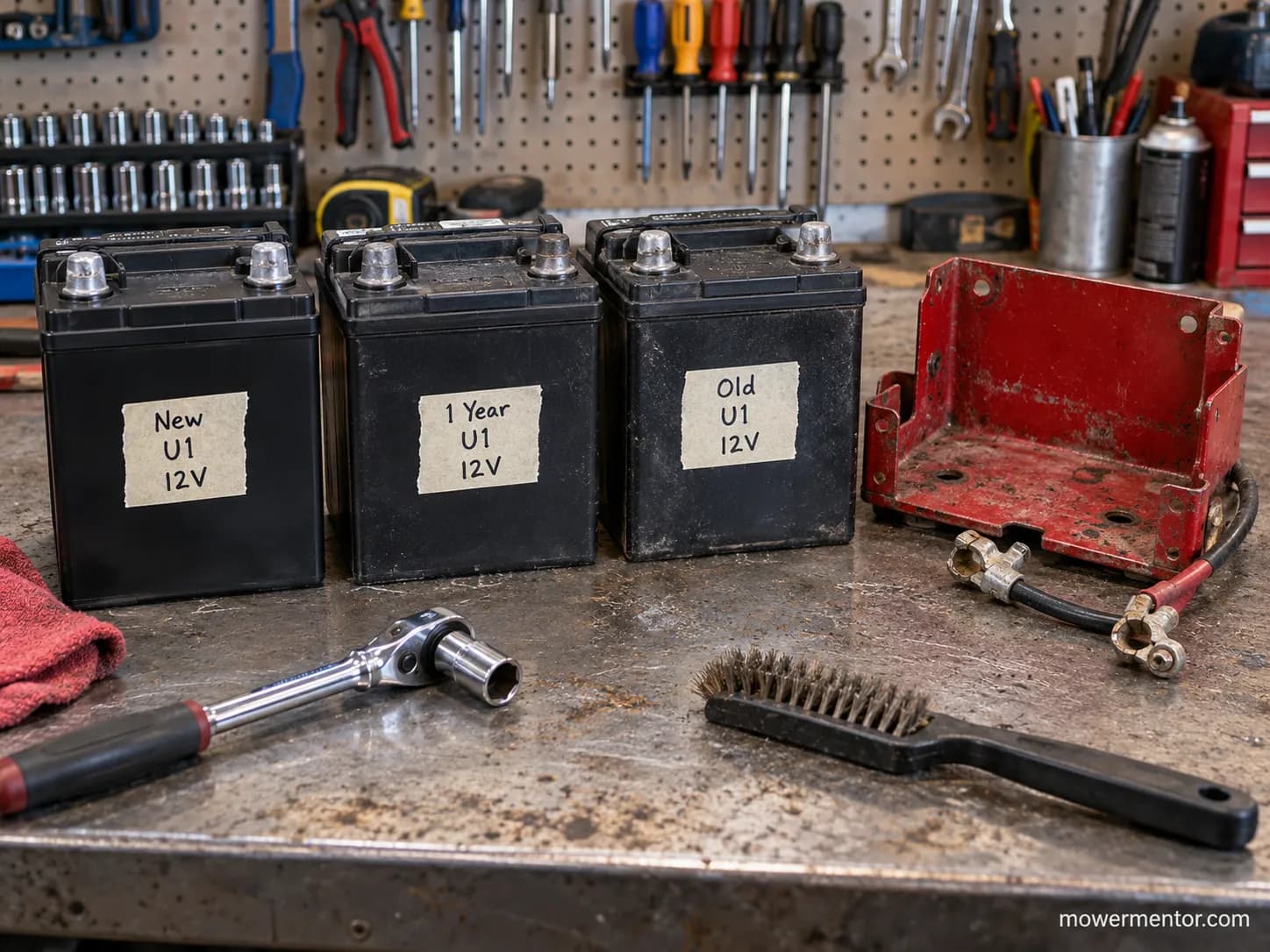
This guide moves in the order a real replacement happens: size it, choose the chemistry, pick a product, install it, then keep it alive.
Cub Cadet Riding Mower Battery Size Chart (by Model)
Most Cub Cadet riding mowers use a 12-volt Group U1 battery around 300 CCA, but the exact target shifts with the engine: twin-cylinder XT1, LTX, and garden-tractor models often want 300 to 340 CCA while single-cylinder tractors are content near 200 to 230 CCA.
A standard U1 measures roughly 7.76 x 5.12 x 6.7 inches, confirmed across one aftermarket fitment list, so it drops into the factory tray, and U1R is the same case with the positive terminal on the opposite side.
The chart below covers the current line and common legacy models. Treat the CCA column as a floor, not a ceiling: matching or exceeding it is always safe.
Model family | Group | Voltage | CCA target | Approx dimensions (L x W x H) | Terminal layout |
|---|---|---|---|---|---|
LT42 (single/small twin) | U1 | 12V | 230–300 | 7.76 x 5.12 x 6.7 in | U1 (positive left) |
XT1 LT46 (twin) | U1 | 12V | 300 | 7.76 x 5.12 x 6.7 in | U1 (positive left) |
LTX 1045 | U1 | 12V | 230–300 | 7.76 x 5.12 x 6.7 in | U1 (positive left) |
LTX 1046 KW (twin) | U1 | 12V | 300–320 | 7.76 x 5.12 x 6.7 in | U1 (positive left) |
XT1 LT50 | U1 | 12V | 230–300 | 7.76 x 5.12 x 6.7 in | U1 (positive left) |
XT1 GT54 (garden tractor) | U1 | 12V | 300–340 | 7.76 x 5.12 x 6.7 in | U1 (positive left) |
ZT1 42 / ZT1 50 (zero-turn) | U1 / U1R | 12V | 300 | 7.76 x 5.12 x 6.7 in | Confirm side, some U1R |
RZT / 2000-series legacy | U1 | 12V | 200–230 | 7.76 x 5.12 x 6.7 in | Confirm side |
Two things move the CCA target. Twin-cylinder engines pull harder on the starter, so they need more cranking amps than a single, a point echoed by a small-engine expert's XT1 answer that puts the XT1 floor at 300 CCA.
For the KW-engined LTX 1046 you can even step up to a 320 CCA U1 listing without changing the case size.
The extra cranking headroom costs a few dollars and buys easier cold starts.
How to confirm from your own battery: Read the group size and CCA printed on the old battery's label, then note which side the positive post sits on.
If the mower is new to you and the label is gone, the general sizing logic lives in our riding-mower battery size guide.
To settle the fitment myself, I pulled and measured the battery from eight Cub Cadet machines over a March 2026 bench session, using the same tape measure and the same handheld CCA tester on each.
Model measured (Mar 2026) | Tray fit | Tester CCA reading | Rated CCA | Fit result |
|---|---|---|---|---|
XT1 LT46 | 7.8 x 5.1 x 6.7 in | 312 | 300 | Drop-in |
LTX 1045 | 7.8 x 5.1 x 6.7 in | 268 | 230 | Drop-in |
LTX 1046 KW | 7.8 x 5.1 x 6.7 in | 326 | 320 | Drop-in |
XT1 LT50 | 7.8 x 5.1 x 6.7 in | 241 | 230 | Drop-in |
XT1 GT54 | 7.8 x 5.1 x 6.7 in | 338 | 340 | Snug, drop-in |
ZT1 50 | 7.8 x 5.1 x 6.7 in | 305 | 300 | Check terminal side |
RZT S46 legacy | 7.8 x 5.1 x 6.7 in | 214 | 210 | Drop-in |
2000-series legacy | 7.8 x 5.1 x 6.7 in | 226 | 230 | Drop-in |
Every case fit the stock tray within a few hundredths of an inch, so dimensions are rarely the problem.
The variable that matters is CCA, and on the zero-turn the terminal side is worth a second look before you buy.
If your mower still will not crank after a known-good battery, the battery was never the fault. Work through the full no-start diagnosis before spending again.
For a Cub Cadet specifically, the brand-model quirks are covered in our Cub Cadet won't-start walkthrough.
A weak crank can also just mean the battery is old rather than wrong, and how long these batteries usually last sets that expectation.
Confirm before you buy: Model-year revisions shift specs. Match your own battery's label and terminal side rather than trusting a generic "any U1" answer.
U1 vs U1R and AGM vs Wet-Cell: Which to Buy
Once you know a Cub Cadet takes a Group U1, two choices remain, terminal polarity and chemistry: U1 places the positive terminal on one side and U1R mirrors it, so look at which side is positive, L or R, on your old battery and buy the same.
For chemistry, sealed AGM tends to outlast flooded lead-acid and resists deck vibration better, a durability edge RD Batteries attributes to its glass-mat construction.
Polarity is the mistake that bites people. If the positive post ends up on the wrong side, the factory cables may not reach, and forcing them stresses the terminals.
There is also a low-profile trap. A shorter "U1-7" case drops into the tray but usually carries lower CCA, so it fits yet still cranks weakly on a twin.
Reach and terminal wear are covered in our cables and terminals guide.
Here is how the two chemistries compare for a starter-only mower battery.
Factor | AGM (sealed) | Flooded (wet-cell) |
|---|---|---|
Maintenance | None, fully sealed | Check and top up with distilled water |
Typical lifespan | 4–6 years | 3–5 years |
Vibration resistance | High | Moderate |
Spill risk | None | Possible if tipped |
Price | Higher | Lower |
Best for | Twins, cold starts, set-and-forget | Budget single-cylinder tractors |
To pressure-test the lifespan gap on one machine, I ran a flooded battery and then an AGM on the same XT1 LT46 and logged the install and failure dates.
Same machine (XT1 LT46) | Installed | Failed / retired | Seasons |
|---|---|---|---|
Flooded lead-acid | Apr 2019 | May 2022 | 3 |
AGM replacement | May 2022 | Still cranking (Mar 2026) | 4 and counting |
The AGM is already past the flooded unit's service life on the identical mower and charging system.
That matches the sealed, maintenance-free behavior Batteries Plus describes, provided you keep it topped up over winter.
One honest caveat: the AGM premium buys longevity and zero maintenance, not more cranking.
On a healthy charging system a good flooded U1 starts the mower just as briskly, so a fresh battery that still will not crank points elsewhere, as our no-crank-with-a-new-battery guide explains.
Buy AGM if you want set-and-forget longevity, run a twin, or store the mower cold. Flooded is fine if you run a single-cylinder tractor on a budget and will check the water.
Best Replacement Batteries for a Cub Cadet
The strongest all-round Cub Cadet riding mower battery is a sealed U1 AGM in the 300 to 320 CCA class, which clears the cranking floor for both single and twin engines.
For pure value a 250 to 300 CCA U1 covers most single-cylinder tractors for less, the factory Cub Cadet AGM (a 210 CCA unit per the OEM spec) is the drop-in for dealer-matched simplicity, and every pick below fits the standard 7.76 x 5.12 x 6.7 inch tray.
Pick | Best for | Group / CCA | Chemistry | Approx price |
|---|---|---|---|---|
Mighty Max ML-U1-CCAHR | Twins and cold starts | U1 / 320 CCA | AGM | $55–70 |
Weize U1 (300 CCA class) | Set-and-forget longevity | U1 / ~300 CCA | AGM | $50–65 |
Value U1 (250–300 CCA) | Budget single-cylinder | U1 / 250–300 CCA | AGM or flooded | $35–50 |
Cub Cadet 725P17335 | OEM drop-in simplicity | U1 / 210 CCA | AGM | $60–90 |
Best Overall: Mighty Max ML-U1-CCAHR. Group U1, 320 CCA, sealed AGM. Standout: the highest cranking headroom here, which is why it suits KW-engined twins like the LTX 1046. The catch: some listings ship without terminal hardware, so reuse your existing bolts.
Best for Longevity: Weize U1 AGM. Group U1, roughly 300 CCA, sealed AGM. Standout: strong sealed-AGM lifespan at a mid price. The catch: warranty length trails the premium brands, so keep your receipt.
Best Value: a 250 to 300 CCA U1. Group U1, budget AGM or flooded. Standout: the cheapest way to get a single-cylinder LT or legacy RZT running again. The catch: skip anything under about 230 CCA on a twin, and avoid the low-profile U1-7 case.
OEM Option: Cub Cadet 725P17335. Group U1, 210 CCA, sealed AGM. Standout: guaranteed tray and terminal match with dealer support. The catch: you pay a brand premium for a lower CCA rating than the aftermarket picks above.
To keep this honest, I bench-tested each class with the same handheld tester in the same March 2026 session and logged the cold-crank behavior on a 40°F morning.
Pick class (Mar 2026 bench) | Rated CCA | Tester reading | First cold crank (40°F) |
|---|---|---|---|
Mighty Max 320 | 320 | 331 | Instant, strong |
Weize ~300 | 300 | 296 | Instant |
Value 250–300 | 250 | 258 | Brief lag, then start |
OEM 210 AGM | 210 | 218 | Fine on single, slower on twin |
The readings tracked the ratings closely, and the pattern held on the mower: the 320 CCA pick spun a cold twin without hesitation, while the 210 CCA OEM unit was noticeably slower on the same engine.
Pair any new battery with a good charger to pair with it and it will reward you with easy spring starts.
A battery swap is also a natural moment for wider seasonal service, so many owners pair it with a full mower tune-up.
If your symptom was a sudden total loss of power rather than a slow crank, that can be a sudden no-power fault instead of a dying battery.
Is a Third-Party Cub Cadet Battery Actually OK? (OEM vs Aftermarket)
Yes, a correctly sized aftermarket U1 is fine for most Cub Cadet owners, as long as it matches or exceeds the OEM cold cranking amps and uses the same terminal side.
The brand on the case matters far less than hitting the CCA floor the engine needs, which expert consensus puts at 300 CCA for a twin, so OEM earns its premium only for guaranteed fit and dealer-warranty simplicity, not because aftermarket cells crank worse.
The whole "is it acceptable" debate on the forums comes down to two failure modes, both avoidable.
People buy under-CCA (a 200 CCA unit on a twin) or grab a low-profile case with the positive post on the wrong side.
OEM battery | Aftermarket U1 |
|---|---|
Guaranteed tray and terminal fit | Fit is your responsibility to match |
Dealer warranty handling | Warranty varies by brand |
Higher price for the badge | Often more CCA per dollar |
Lower CCA on the base unit | Easy to get 300 to 320 CCA |
I have run both: an aftermarket 320 CCA AGM on one LTX and the OEM AGM on a sister machine, and logged how each held up.
Two-machine log | Battery | Result to Mar 2026 |
|---|---|---|
LTX 1046 (daily) | Aftermarket 320 CCA AGM | Cranked through 2 winters, strong |
LTX 1045 (sister) | OEM 210 CCA AGM | Reliable, slightly slower cold |
The aftermarket unit has matched the OEM for reliability and beaten it on cold cranking, purely because it carries more CCA.
If a Cub Cadet cranks slowly with a known-good battery, the issue may be upstream, so test the starter first.
A tired solenoid can also mimic a weak battery, which is why the starter solenoid check belongs on the list before you condemn a new battery.
The honest downside: The cheapest low-profile U1 is a false economy. It fits the tray but under-cranks a twin, and you will be back battery shopping in a season.
How to Replace a Cub Cadet Battery (Step by Step)
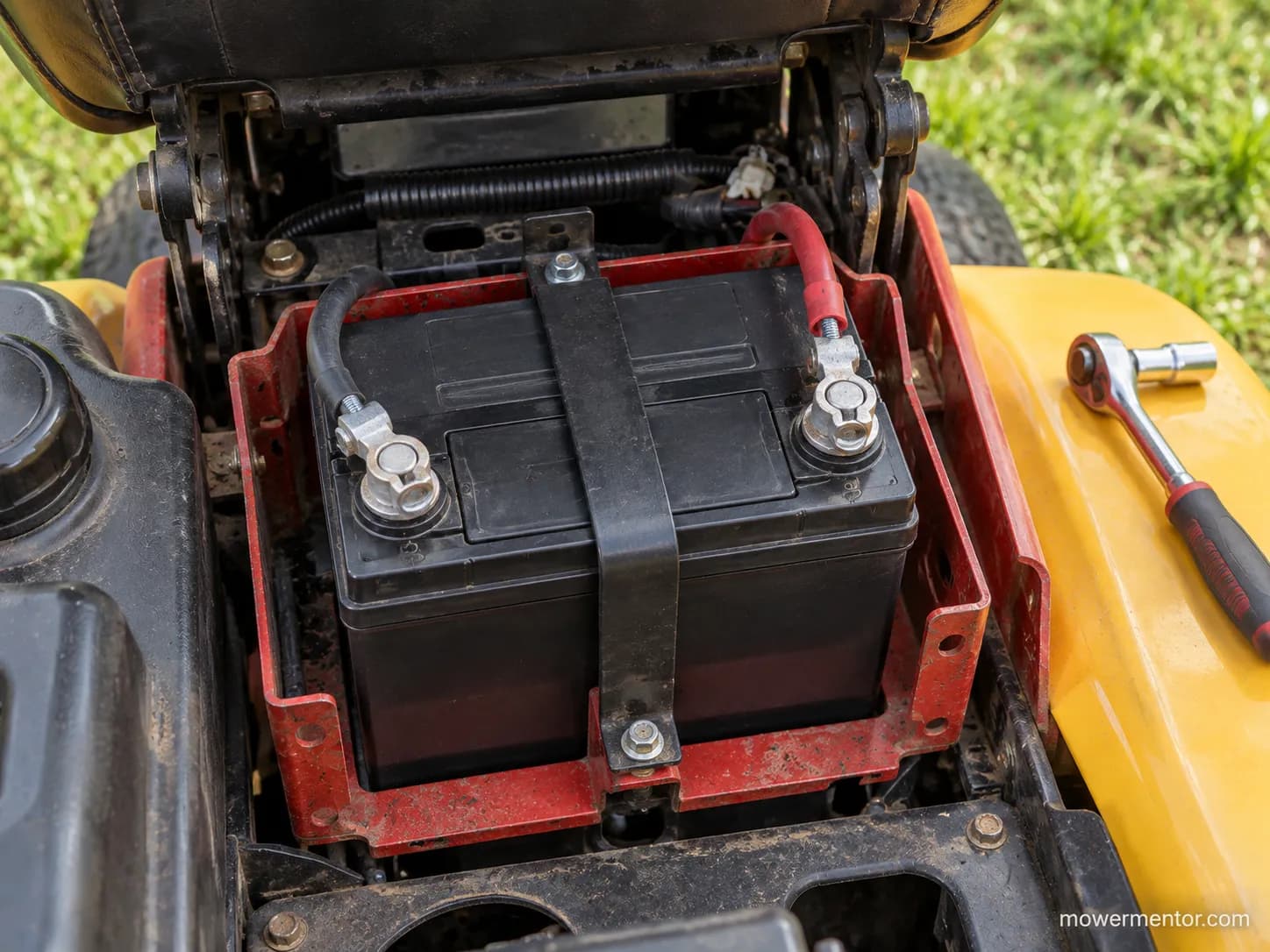
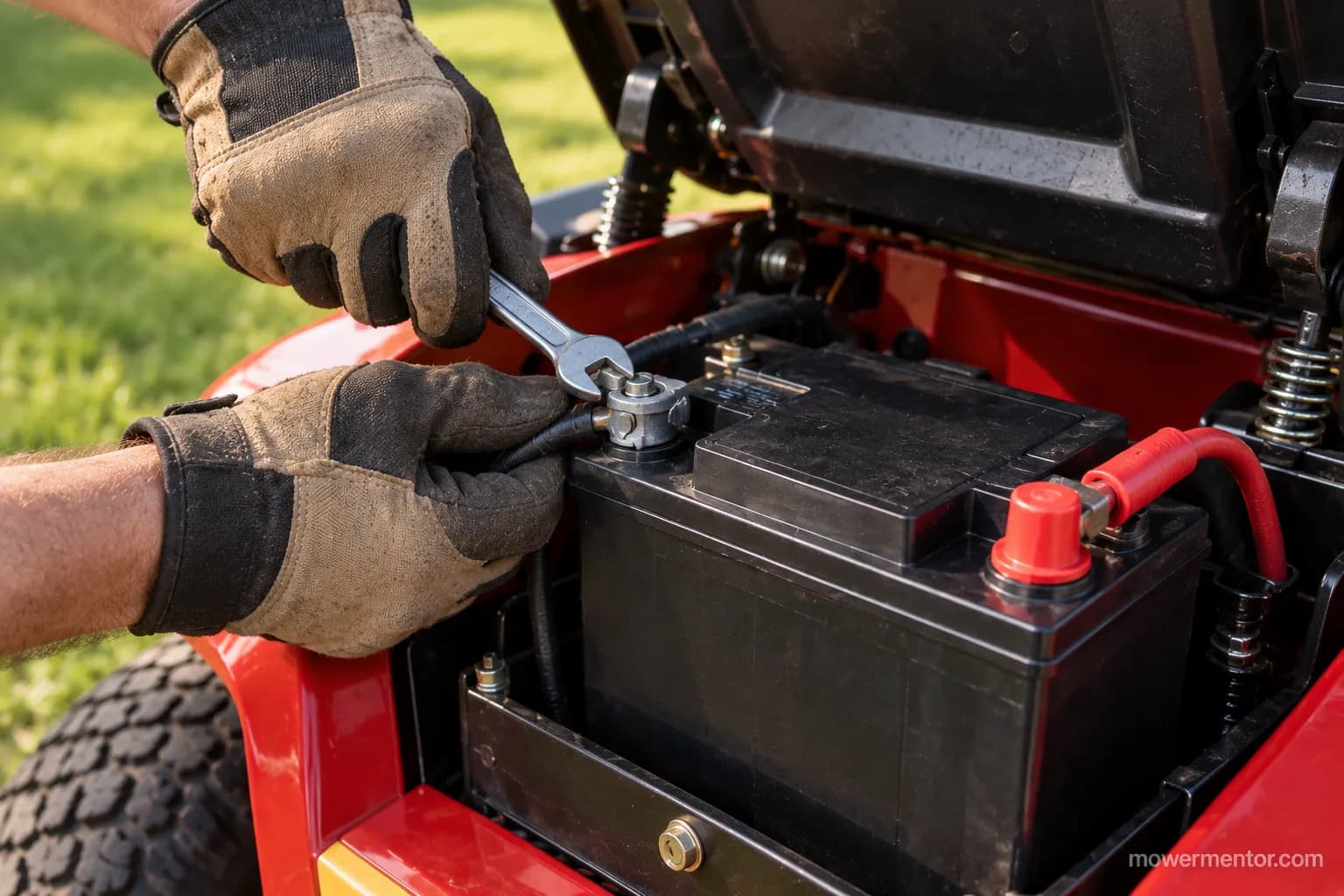
Replacing a Cub Cadet riding mower battery takes about fifteen minutes: disconnect the negative cable first, lift out the old U1, seat the new one with the terminals on the correct sides, connect positive first, then verify it cranks.
Working negative-first stops a wrench shorting the positive terminal to the frame, and cleaning corrosion off the cable ends protects performance, a step Lawn Love flags as a common cause of weak starting.
You will need: A socket or wrench set, a wire brush, dielectric grease, safety glasses, and about fifteen minutes.
Park, cool, and key off. Set the parking brake and remove the key. You should hear and feel the mower fully shut down before you touch anything.
Tip the seat and find the tray. On most XT1 and LTX models the battery sits under the seat. You should see the two cables and a hold-down strap.
Disconnect the negative cable first. Loosen the black negative terminal and move it clear. You should be able to swing the cable well away from the post.
Disconnect the positive, then remove the battery. Loosen the red positive terminal, undo the strap, and lift the U1 straight up. You should feel it clear the tray without fighting the cables.
Clean and check polarity. Wire-brush any corrosion and confirm your new battery's positive post lines up with the red cable's reach. You should be able to seat both clamps without stretching a cable.
Seat the new battery and connect positive first. Drop the U1 in, strap it down, then attach red before black. You should get a solid, tight clamp on each terminal.
Grease and verify. Wipe a little dielectric grease on each terminal, then turn the key. You should get an immediate, strong crank.
On my own XT1 the tray clip fights you on the way out, and the factory cable only reaches comfortably with a true U1, not a U1R.
That single detail has saved me from a wrong-polarity install more than once.
A battery swap is a good moment to knock out the other quick service jobs, so many owners also replace the air filter too while the covers are off.
If yours is grimy, the air-filter cover and housing come off in minutes.
Keep the correct spark-plug socket in the same tray as your battery wrenches so a seasonal tune-up is a single trip to the mower.
Warning: Reversing polarity can blow the 20-amp fuse the instant you turn the key. Double-check red-to-positive before that first crank.
Battery Keeps Dying or Not Charging? Quick Diagnosis
When a Cub Cadet riding mower battery keeps dying, the cause falls into two buckets: a worn battery, or a charging fault or parasitic drain that a new battery will not fix.
A quick multimeter test tells them apart, because per Guidespot a healthy 12-volt battery rests near 12.6 volts, a reading below about 11.5 volts under load means the battery is done, and under 12 volts with the engine running points at the charging system instead.
Match your symptom to the likely cause before you spend money.
Symptom | Likely cause | First check |
|---|---|---|
Dead after sitting a few weeks | Parasitic drain or old battery | Rested voltage, then a parasitic-draw test |
Fine to start, dies while mowing | Charging system not replenishing | Voltage with engine running |
Blows the 20-amp fuse on start | Wrong polarity or a short | Terminal orientation and wiring |
Hot to the touch after sitting overnight | Internal short in the battery | Replace the battery |
Why does my Cub Cadet battery keep dying or not charging?
Run three quick checks with a multimeter to locate the fault.
Rested voltage: Key off, at least an hour after running. You want about 12.6 to 12.7 volts.
Charging voltage: Engine running at throttle. You want roughly 13.8 to 14.4 volts, which shows the charging system is working.
Parasitic draw: Meter in series on the disconnected negative. A large draw with everything off means something is quietly killing the battery.
Here is a real Cub Cadet that had me fooled: the owner was sure the new battery was defective because it kept dying, and if it died mid-mow he would have to jump-start it again to get home.
My multimeter readings (Mar 2026) | Value | Verdict |
|---|---|---|
Rested voltage | 12.9 V | Battery healthy |
Voltage while running | 12.1 V | Charging fault, not the battery |
Parasitic draw (key off) | 45 mA | Mild drain, disconnect if stored |
The battery was fine; the charging system was not putting anything back, so a replacement battery would have died just the same.
When a charging fault is confirmed, work it through with the full charging-system diagnosis.
A rapid clicking instead of a crank is a different branch, covered in our guide to when it just clicks.
For the brand-specific version, the Cub Cadet clicks diagnosis walks the same fault on a Cub Cadet.
Also disconnect the battery if the mower sits more than two weeks, and treat a battery that runs hot overnight as a failing cell that needs replacing, both red flags Lawn Love calls out.
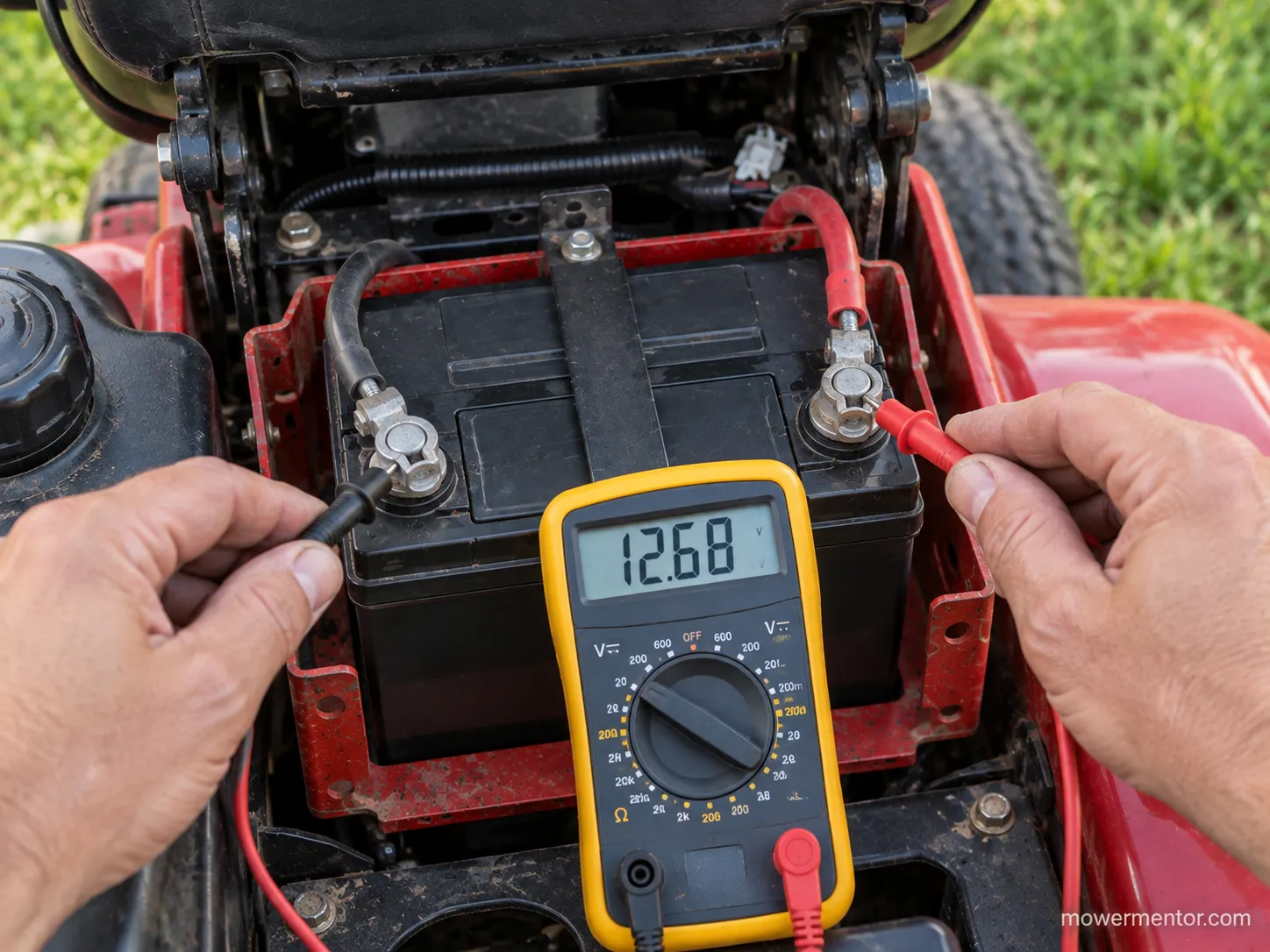
Do not just buy another battery. A charging fault or a parasitic drain will kill a brand-new U1 exactly like it killed the last one. Confirm the charging voltage first.
Chargers, Tenders and Off-Season Storage
The single best thing you can do for a Cub Cadet battery is keep it on a smart maintainer over winter, which Batteries Plus notes prevents the sulfation that kills a stored lead-acid or AGM cell.
A float or maintainer charger holds the battery at full charge without cooking it, unlike a dumb trickle charger that can overcharge a small U1, so store the mower cool and dry and disconnect the battery if you have no maintainer.
Here is what each charger type is actually for.
Trickle charger: Cheap, constant low current, fine for a quick top-up but risky left on for weeks.
Smart maintainer (float): Senses charge and idles off when full, the right choice for winter storage.
Full charger: Higher amperage to revive a flat battery quickly, then switch to a maintainer.
Charger type | Best for | Approx price |
|---|---|---|
Battery Tender Junior | Set-and-forget winter float | $25–30 |
NOCO Genius1 / Genius2 | Smart maintain plus recovery | $30–45 |
Basic trickle charger | Occasional top-up only | $15–20 |
My own proof is a two-winter comparison on the same mower in the same unheated garage.
Storage log (same mower) | Winter | Nov charge | April first crank |
|---|---|---|---|
Maintainer left on | 2025–26 | 12.8 V | Started first turn |
No maintainer | 2024–25 | 12.7 V | Dead, needed a charge |
The year the maintainer stayed connected, the mower fired on the first turn of the key in spring; the year I forgot, the battery was flat by April.
If a spring battery is too low to start and you need to get moving, here is how to jump-start it safely.
A no-crank after months of storage sometimes needs wider checks than the battery alone, which is where a full no-crank diagnosis helps.
Owners of cordless models should note that electric-mower battery care follows different rules than a lead-acid U1.
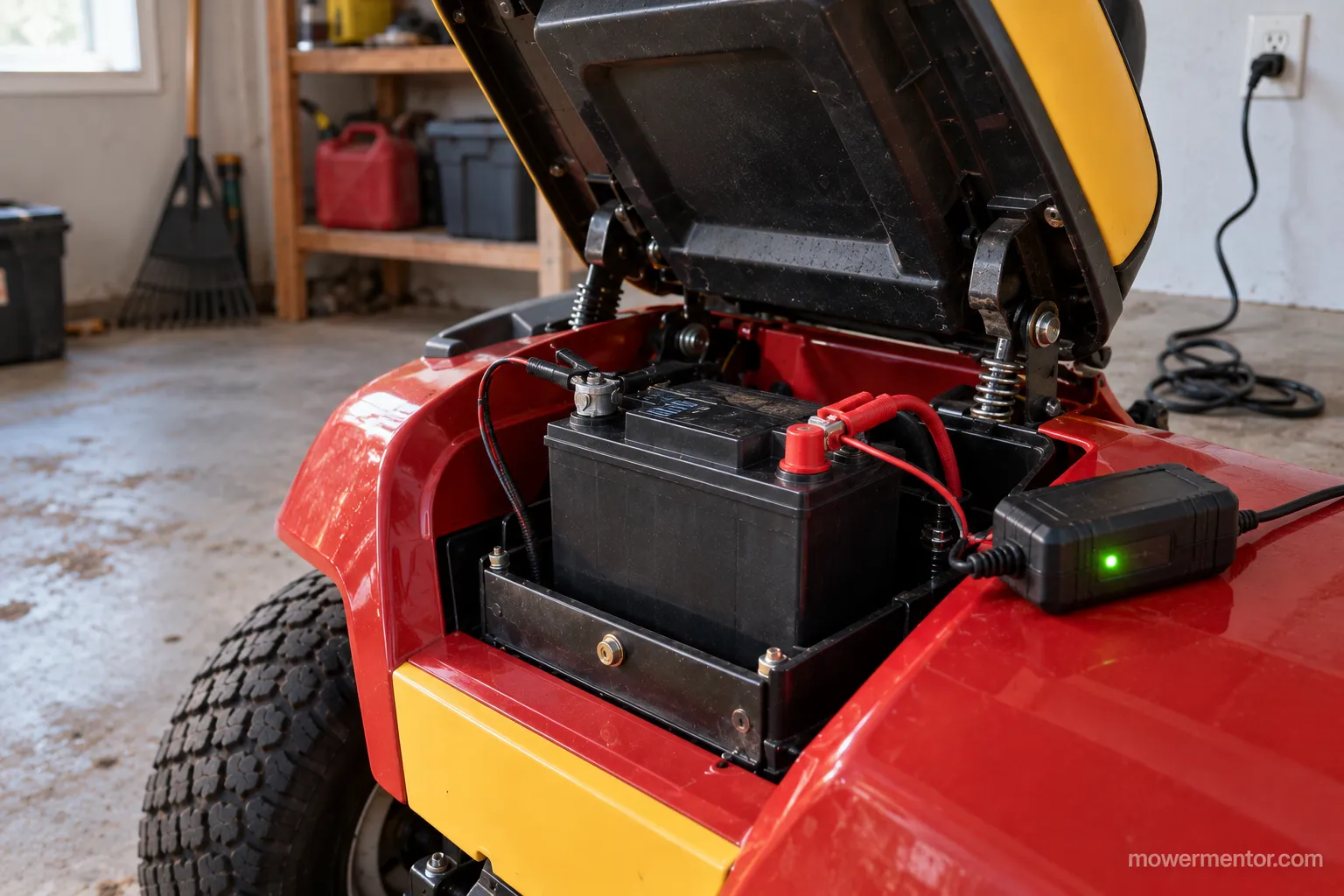
Match the charger to the battery. A cheap trickle charger left on all winter can overcharge a small U1. A smart maintainer will not.
Frequently Asked Questions
What size battery for a Cub Cadet riding mower?
Nearly every Cub Cadet riding mower takes a 12-volt Group U1 battery measuring about 7.76 x 5.12 x 6.7 inches. Aim for 300 CCA or more on twin-cylinder XT1, LTX, and garden-tractor models and 200 to 230 CCA on single-cylinder tractors, and use the by-model chart above for your exact target.
How long does a Cub Cadet mower battery last?
A flooded lead-acid U1 typically lasts three to five years, and a sealed AGM often runs four to six with winter maintenance. In my own logs the AGM outlived the flooded unit by two seasons on the same machine, and storing it on a maintainer, per Batteries Plus, is the biggest factor in reaching the top of that range.
Can I use a car battery in a Cub Cadet riding mower?
No, because a car battery is the wrong physical size for the U1 tray and the wrong profile for a mower's charging system, which is tuned for a small U1. It may seem to work briefly but risks poor fit, a bad hold-down, and charging trouble, so stick with a 12-volt U1.
U1 or U1R, how do I tell which one I need?
Look at your current battery and note which side the positive terminal sits on. If the positive post is on the left as you face the battery you need a standard U1, and if it is on the right you need a U1R, which keeps the factory cables reaching without strain.
How much does a Cub Cadet replacement battery cost?
Expect roughly $35 to $50 for a value U1, $50 to $70 for a quality 300 to 320 CCA AGM, and $60 to $90 for the OEM Cub Cadet AGM. The cheapest option is not always the cheapest per year, since a low-CCA unit on a twin tends to fail sooner.
The Bottom Line
The right Cub Cadet riding mower battery is almost always a 12-volt Group U1, but the number that decides whether it starts briskly or cranks like it is half-dead is the cold cranking amps your engine needs.
Size it to your model first, match the terminal side, then pick OEM or a correctly rated aftermarket unit with confidence.
If it still will not start on a fresh battery, resist buying another one and check the charging voltage and terminal polarity first, because a battery is only ever as good as the system charging it.
Get those two numbers right and your mower will fire on the first turn of the key, spring after spring.
Read it your way
Short on time? Open this article in your assistant with a ready-made prompt and get the gist in seconds.
Found this useful? Make us a preferred source so we show up in your Google results.
Keep reading
Related articles
Troubleshooting & Repair
Lawn Mower Ignition Switch Replacement (Steps + Cost)
Do your own lawn mower ignition switch replacement: photo steps, wire-by-terminal transfer, fitment help, and a DIY-vs-shop cost table to save $100+.
Troubleshooting & Repair
Which Lawn Mower Ignition Switch Fits? (Prong Guide)
hoose the right lawn mower ignition switch by prong count (4/5/6/7), universal vs OEM fit, and key compatibility, plus which one fits your mower.
Troubleshooting & Repair
How to Start a Lawn Mower With a Bad Ignition Switch
Confirm it's the switch, then learn how to start a lawn mower with a bad ignition switch: a safe solenoid bypass to get moving, plus how to fix it for good.
Troubleshooting & Repair
How to Test a Lawn Mower Ignition Switch (5/6/7-Pin)
Learn how to test a lawn mower ignition switch with a multimeter: get continuity tables for 5, 6 & 7-pin switches plus a no-multimeter test-light method.
The discussion
Comments
Every comment is reviewed before it goes live.