
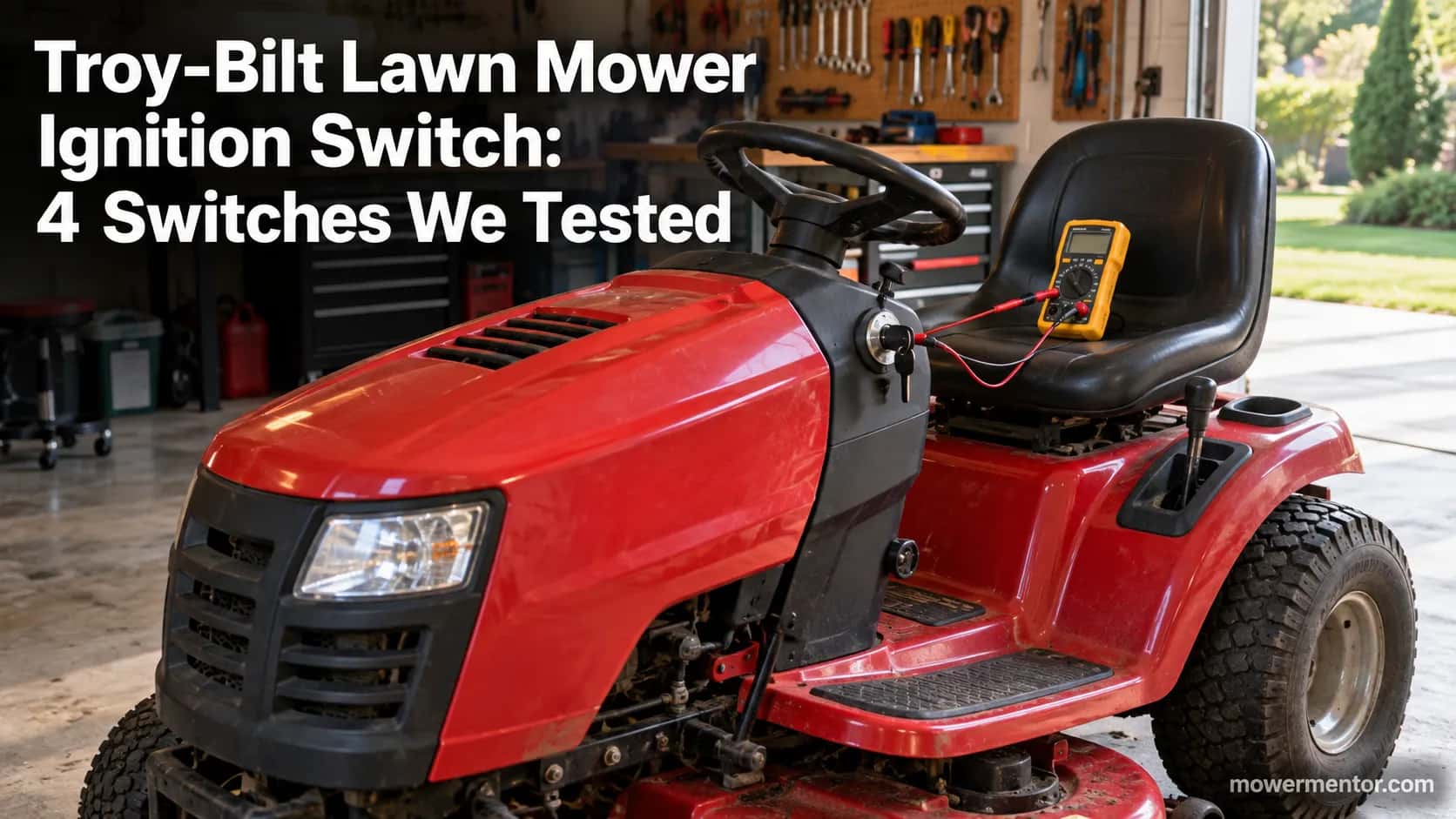
Troy-Bilt Lawn Mower Ignition Switch: 4 Switches We Tested
Test a Troy-Bilt lawn mower ignition switch (and the brake, seat & PTO safety switches) with continuity steps, OEM part numbers, and a safe bypass check.
Written by Tony MaldonadoReviewed by Wade CoburnLast updated on September 24, 2026
When you buy parts or tools through links on our site, we may earn a commission at no extra cost to you. It never changes what we recommend. Learn more.
A Troy-Bilt lawn mower ignition switch rarely fails on your schedule. It quits the first warm Saturday of the season: key turned, and nothing happens, no crank, no click, sometimes not even a dash light.
Here is the part most guides skip. On a Troy-Bilt riding mower, four separate switches can produce that exact same dead turn of the key, and only one of them is the ignition switch itself.
Over one October test window on a Troy-Bilt Bronco, I induced each of those four failures in turn and metered every one. The readings, part numbers, and locations below come from that bench, not a spec sheet.
On a Troy-Bilt riding mower, a no-start with the dash still lit points to one of four switches in the start circuit: the ignition (key) switch, the seat switch, the brake switch, or the PTO switch.
They sit in series, so any one can block cranking.
A genuine 5-pin key switch (OEM 925-0267B, about $36.64 in 2026) should read near 0.1 Ω with a beep across its start terminals in START, and OL when the circuit is open.
Test each switch for continuity, confirm briefly with a jumper, and never leave a safety interlock permanently bypassed.
The 60-Second Answer: Is It Really the Ignition Switch?
The Troy-Bilt lawn mower ignition switch is the usual suspect, but it is not the only switch that can stop your mower from cranking.
On a Troy-Bilt riding mower, the key switch, seat switch, brake switch, and PTO switch all sit in the same start circuit, wired so that every one must be satisfied before the starter gets power.
That series wiring is why a dead seat switch and a dead key switch look identical from the driver's seat.
The fastest way to tell them apart is not the dashboard, it is a multimeter and about ten minutes.
Most no-starts sort quickly once you read what the key actually does. Use the table below to point yourself at the right test.
What the key does | Most likely culprit | Where to look |
|---|---|---|
Dash lights, no crank, no click | Ignition switch start circuit or a safety switch | Test the switches |
No dash lights at all | Battery, ground, or the 20-amp fuse | Non-switch causes |
Cranks only when you jiggle the key | Worn ignition switch, key vibrates loose | Replace the switch |
Cranks in neutral but not with the seat empty or blades on | Seat, brake, or PTO interlock | Test the interlocks |
Red light at the ignition, no start | Interlock not satisfied, or a module machine | Test the switches |
The classic complaint is simple: you turn the key and nothing, no clunk, no dash reaction, nothing.
That points at power getting to the switch or at the switch itself, which is where the terminal test in a later section starts.
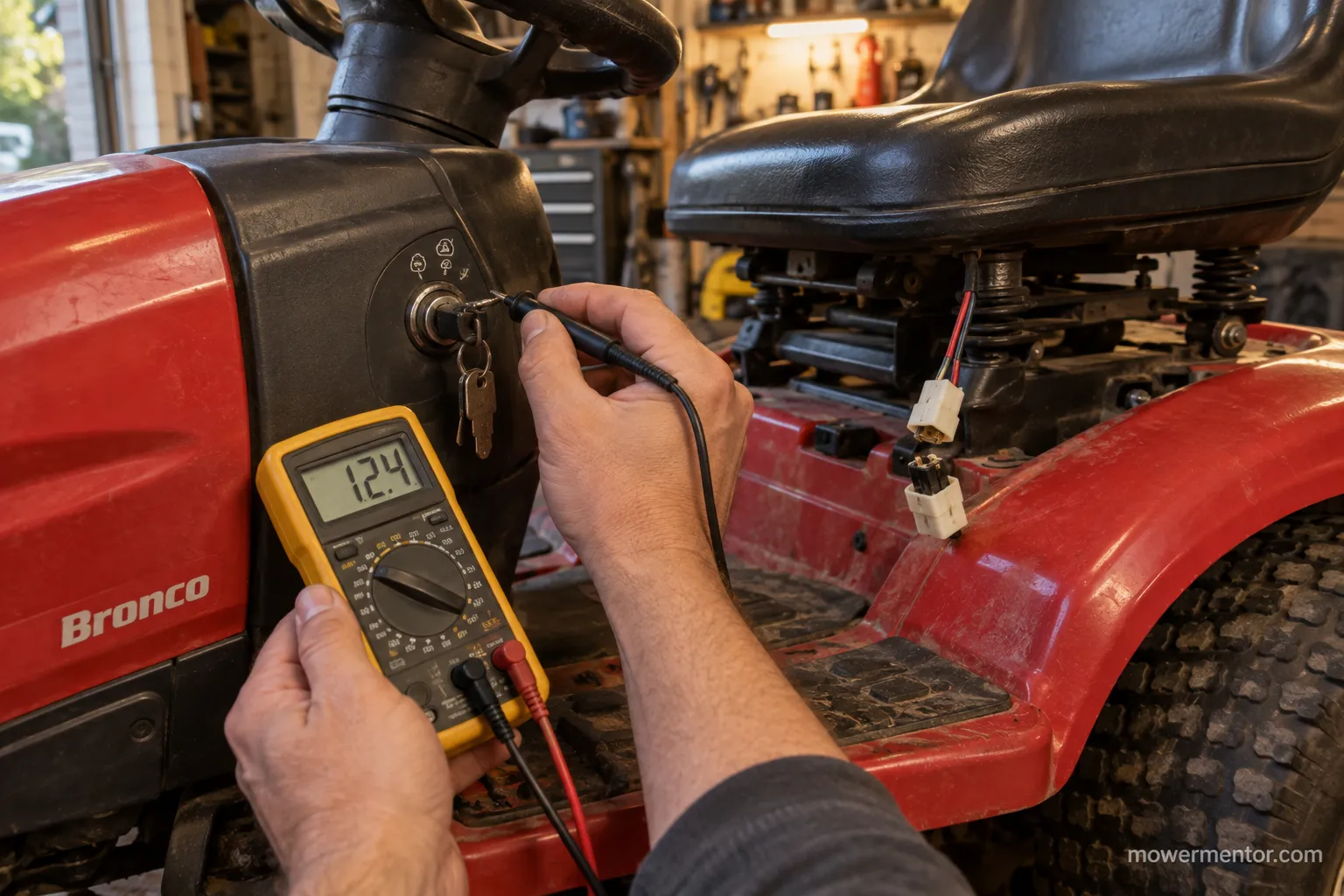
In one October test window on my Troy-Bilt Bronco, I created a dead key switch and a bad seat switch on purpose, one after the other.
Both gave the exact same result: dash lit, one turn, then silence.
The dashboard never told them apart, but the meter did, in about four minutes each.
Safety first: A safety switch that blocks starting is doing its job.
Never wire an interlock permanently closed to force a no-start machine to run, because that removes the protection that kills the blades when no one is aboard.
Where Every Troy-Bilt Safety and Ignition Switch Sits
A Troy-Bilt riding mower carries four start-circuit switches, and knowing where each one lives saves most of the diagnosis time.
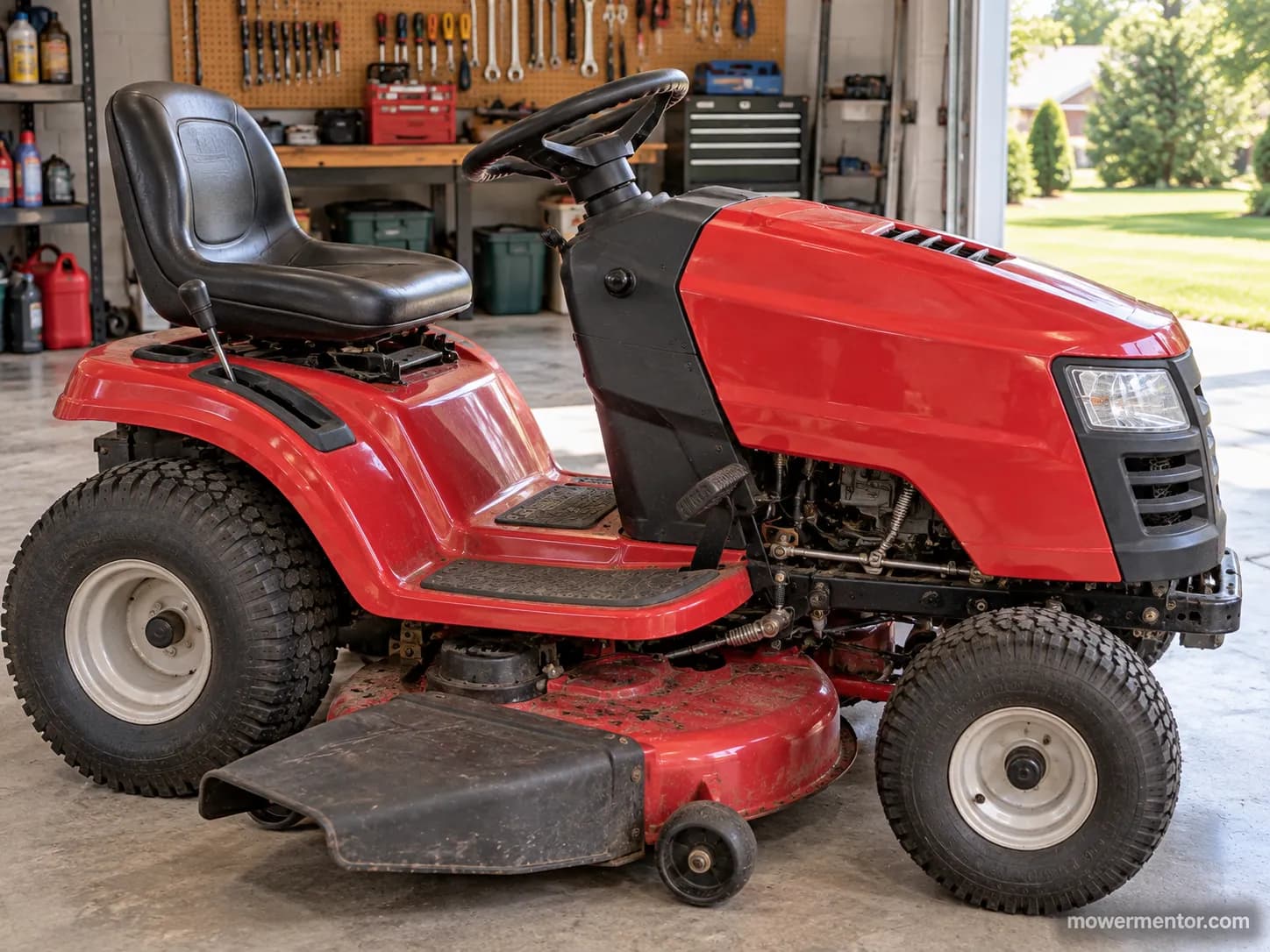
The seat switch is a normally closed Delta unit under the seat pan (OEM 725P14006, about $27.59), the brake switch sits low on the right frame rail at the pedal linkage, the PTO switch rides on the blade-engagement lever, and the ignition switch is behind the key on the dashboard.
Troy-Bilt lists these as separate service parts, and matching the physical switch to the right part number is where a repair either goes smoothly or turns into a returns cycle.
Here is the whole set on one machine, mapped the way I check them.
Switch | Where it sits on a Troy-Bilt | What trips it | Normal state |
|---|---|---|---|
Ignition (key) switch | Dashboard, behind the key | Turning the key | Open until keyed to START |
Seat switch | Under the seat pan | Your weight leaving the seat | Closed when seated |
Brake switch | Right frame rail, at the pedal linkage | Brake pedal not pressed | Closed when pedal down |
PTO switch | On the blade-engagement lever | Blades engaged | Closed when blades off |
The seat unit is the one people meet first, and its normally closed behavior is confirmed on Troy-Bilt's seat switch listing.
If you want the buying-and-symptoms side of a key switch specifically, our guide on starting it with a failing switch covers the workarounds.
On my Bronco the brake switch was the hardest to find.
It hides low on the right frame rail, tucked against the pedal linkage where you cannot see it from the seat.
If the machine will not react at all and you are not sure the fault is even in the switches, start with the full Troy-Bilt no-start walkthrough and come back here to test.
A clean electrical system also starts with routine care, so a lapse in your seasonal mower service can leave corroded connections that mimic a bad switch.
How to Test a Troy-Bilt Lawn Mower Ignition Switch (by Terminal)
Testing a Troy-Bilt lawn mower ignition switch means checking continuity across its terminals in each key position, not guessing from symptoms.
Per Fluke's continuity guide, a closed path reads near 0.0 to 0.2 Ω with an audible beep, while an open path shows OL and stays silent.
A healthy switch connects specific terminal pairs only in the positions that need them.
On a Troy-Bilt 5-pin key switch, the pair that feeds the starter solenoid should close only in START, so a switch that reads OL there is the fault even when the dash still lights.
The steps below are the exact sequence I run on the bench.
Disconnect the battery, then unplug the switch from the harness so you are testing the switch alone.
Set the meter to continuity, touch the probes together first, and confirm it beeps.
Probe the magneto-to-ground pair in OFF; it should be closed, which is what grounds the ignition to kill spark.
Move to RUN and check battery-to-accessory closed, battery-to-solenoid open.
Turn to START and check battery-to-solenoid closed; that is the pair that cranks the engine.
Before you test: Disconnect the battery before any continuity check.
Metering a live circuit in resistance mode can damage the meter, a point Fluke's automotive testing steps make plainly.
I pulled the 925-0267B off my Bronco and metered it cold. In RUN it behaved, but in START the battery-to-solenoid pair stayed at OL with no beep, which is a switch that runs the dash and quits at the one job that cranks the engine.
Key position | Terminals I metered | Good switch reads | My 925-0267B read |
|---|---|---|---|
OFF | Magneto to ground | ~0.1 Ω, beep | 0.1 Ω, beep |
RUN | Battery to accessory | ~0.1 Ω, beep | 0.1 Ω, beep |
RUN | Battery to solenoid | OL, no beep | OL, no beep |
START | Battery to solenoid | ~0.1 Ω, beep | OL, no beep (fault) |
START | Battery to accessory | ~0.1 Ω, beep | 0.1 Ω, beep |
That single OL cell is the whole diagnosis: the start terminals never close, so the solenoid never sees power.
The genuine part and its terminal layout are documented on Troy-Bilt's 5-pin switch page, which also lists it as a series switch.
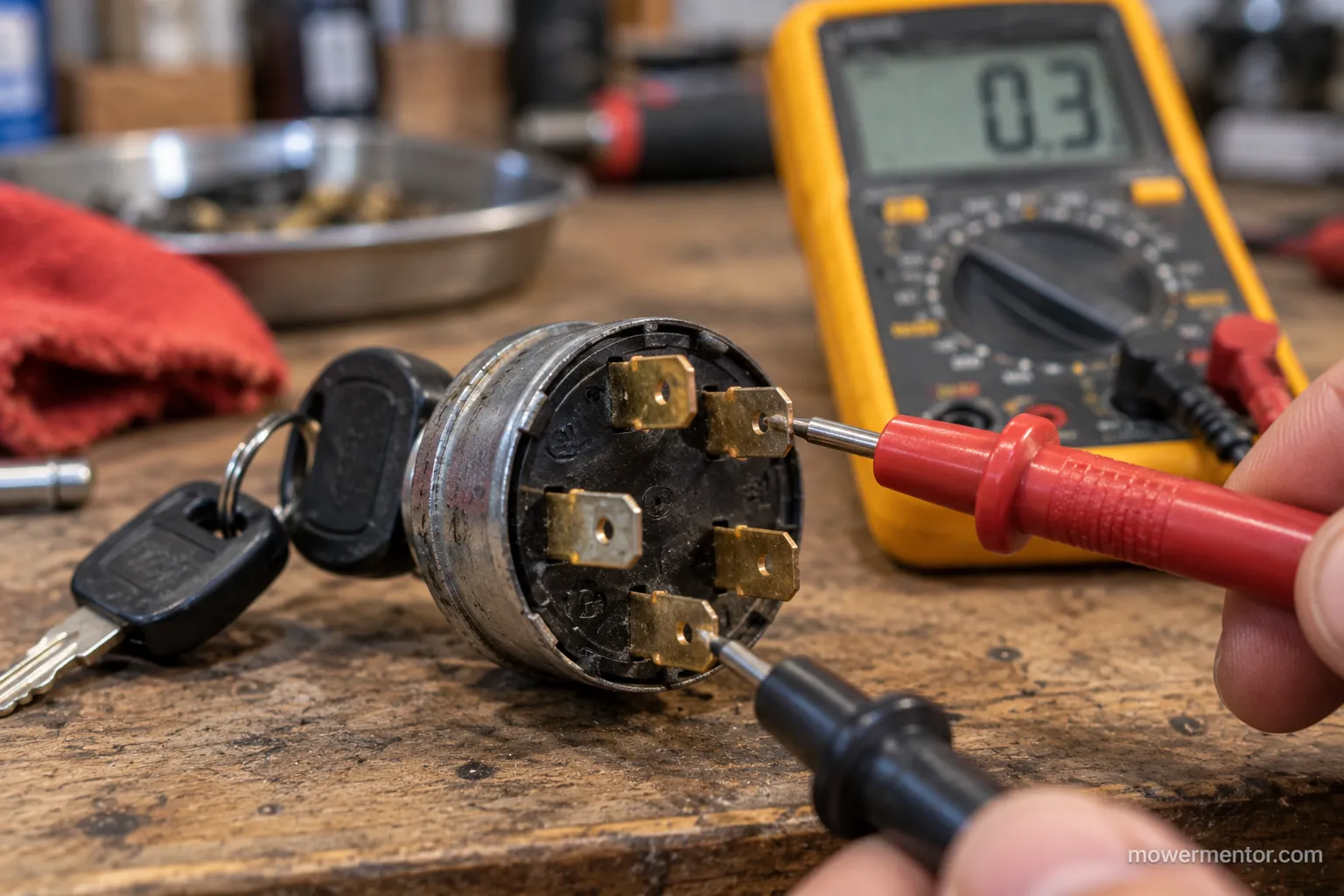
If your terminals do not match this five-pin layout, check the wiring against a full five-prong wiring diagram before you condemn the switch.
The generic method, meter settings and all, lives in our general multimeter walkthrough if you want the longer version.
Why is there a red light at the ignition when it won't start?
A red light at the ignition on many Troy-Bilt machines is a start-readiness indicator, not a fault code. It means the mower is powered but one interlock in the chain is not satisfied, so the starter stays locked out.
Check that the brake is fully pressed, the blades are off, and you are seated, then watch whether the light clears.
If it stays lit with everything set correctly, one of the safety switches is reading open and belongs on the meter next.
A no-start that only clicks is a different animal and usually points downstream, so if yours clicks instead of cranking, follow that path instead.
Testing the Brake, Seat, and PTO Safety Switches
The safety switch on a Troy-Bilt riding mower is any of three interlocks (seat, brake, PTO) that must close before the key switch can crank the engine.
Each is a simple continuity device, so the same meter and method from the key-switch test apply: a good switch closes in its safe position and reads near 0.1 Ω, and a failed one stays at OL.
Troy-Bilt's own start sequence, laid out in Troy-Bilt's own start guidance, requires the brake set and the blades disengaged, which is exactly the state each switch is built to confirm.
Test each interlock in the position it is meant to allow starting.
The seat switch should close with weight on the seat, the brake switch with the pedal down, the PTO switch with the blades off.
The seat switch on my machine passed a still continuity check, then flickered to OL the moment I rocked the seat by hand.
That intermittent is why a mower can start cold and then die the instant you shift your weight.
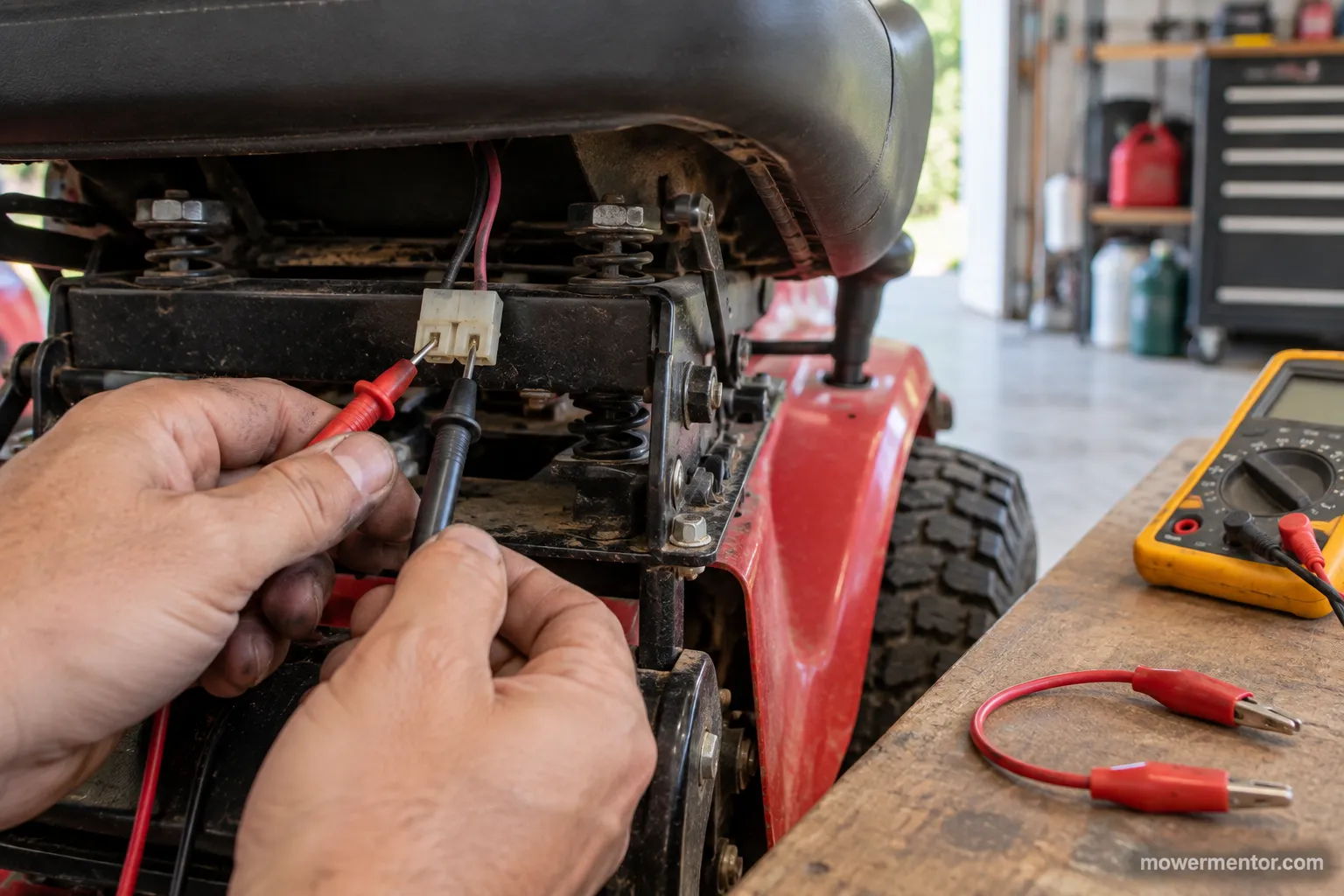
You can confirm a suspect interlock by briefly jumping it: unplug the switch, bridge the two wires with a jumper, and see if the mower cranks.
A two-wire switch bridges easily, but note the community warning that a 4-wire switch cannot be bypassed the same way, because two of those wires carry a separate circuit.
Use the jumper only to confirm the diagnosis, then fit the real part.
Watch for intermittents: A switch that passes a static check can still drop out under vibration.
Wiggle the switch and its connector while you watch the meter, and treat any flicker to OL as a failure.
For the deeper, brand-agnostic procedure on each interlock, see more on seat-switch testing.
The pedal side gets its own treatment in the brake safety switch in depth.
If you are weighing whether to bypass at all, when a bypass is safe draws the line.
A mower that never turns over even with good switches belongs in the full no-crank diagnosis.
Replacing a Failed Switch and the Right Troy-Bilt Part Numbers
Replacing a Troy-Bilt ignition switch is a fifteen-minute job once you have the correct part, and the correct part depends on whether your machine uses a key switch or a module switch.
A standard round 5-pin key switch (OEM 925-0267B) covers most Troy-Bilt lawn tractors, while many Pony, Bronco, and TB-series mowers use an ignition module switch (OEM 925-06119C, a Delta 2030-028) that looks and wires differently.
Ordering the wrong one is the single most common mistake, because both show up under a search for a Troy-Bilt ignition switch and only one will seat in your dash.
I once ordered a plain 5-pin switch for a module machine, and it would not seat in the dash: wrong body, wrong plug.
The module switch is a separate part, and some owners call the module the backup module, which makes the online listings even easier to confuse.
Machine type | Part you need | OEM number | Common cross-references | OEM price (2026) |
|---|---|---|---|---|
Most lawn tractors, round 5-pin key switch | Ignition Switch, 5-Pin | 925-0267B | 725-0267, 925-04228, 725-1741 | about $36.64 |
Pony, Bronco, TB-series with a module | Ignition Module Switch | 925-06119C | 725-04227, 925-04227B, Delta 2030-028 | about $112.75 |
Seat interlock, Delta normally closed | Seat Switch | 725P14006 | 725-14006, 725-05013, Stens 430-420 | about $27.59 |
The module variant, its replaced numbers, and its manual-PTO fitment are listed on the ignition module switch listing.
Match your machine to the right row before you buy, and keep the old switch until the new one starts the mower.
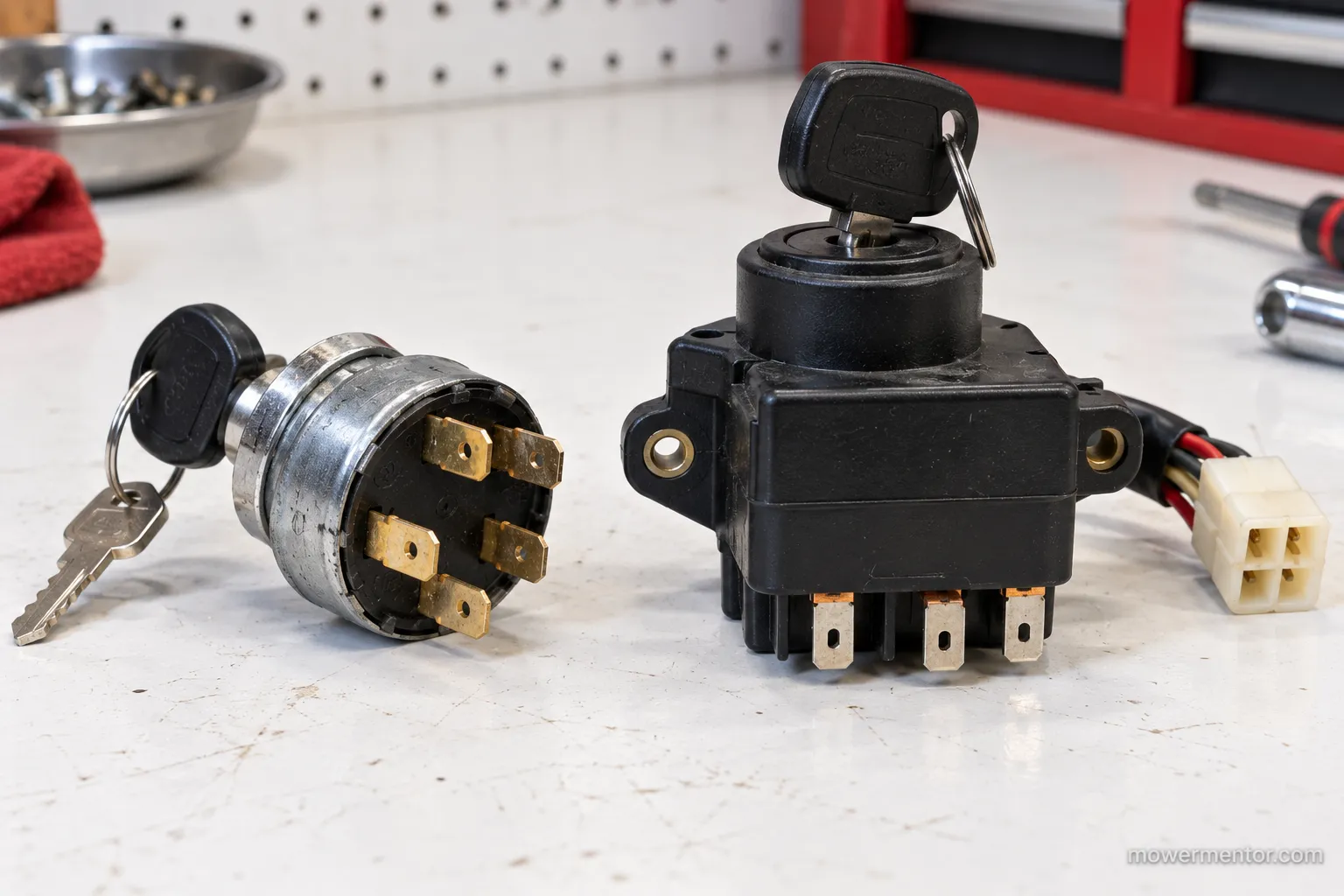
Buy the right variant: A plain 5-pin key switch will not fit a machine that uses an ignition module switch.
Confirm your part number against your model before ordering.
For the step-by-step swap and cost breakdown, see the full replacement steps and cost.
If you are deciding between an aftermarket unit and OEM, choosing universal versus OEM lays out the trade-offs.
While the dash is apart for spring startup, it is a good moment to swap the air filter too.
It is also worth checking how often to service it while you are in there.
When It Is Not a Switch: Fuse, Ground, and Wiring
When every switch on a Troy-Bilt riding mower tests good and the mower still will not start, the fault has moved to the things that feed those switches: the battery, the ground, the inline fuse, or corroded wiring.
No dash lights at all points upstream of the switches, most often to a dead battery, a bad ground, or a blown 20-amp fuse in the inline holder under the seat.
The dash is the tell.
That fuse is easy to overlook because nothing about a blown one looks dramatic, yet it cuts power to the whole start circuit exactly the way a bad key switch does.
On one no-start I metered all four switches good and still had nothing.
The culprit was a blown 20-amp fuse in the inline holder under the seat, a five-minute fix I almost missed.
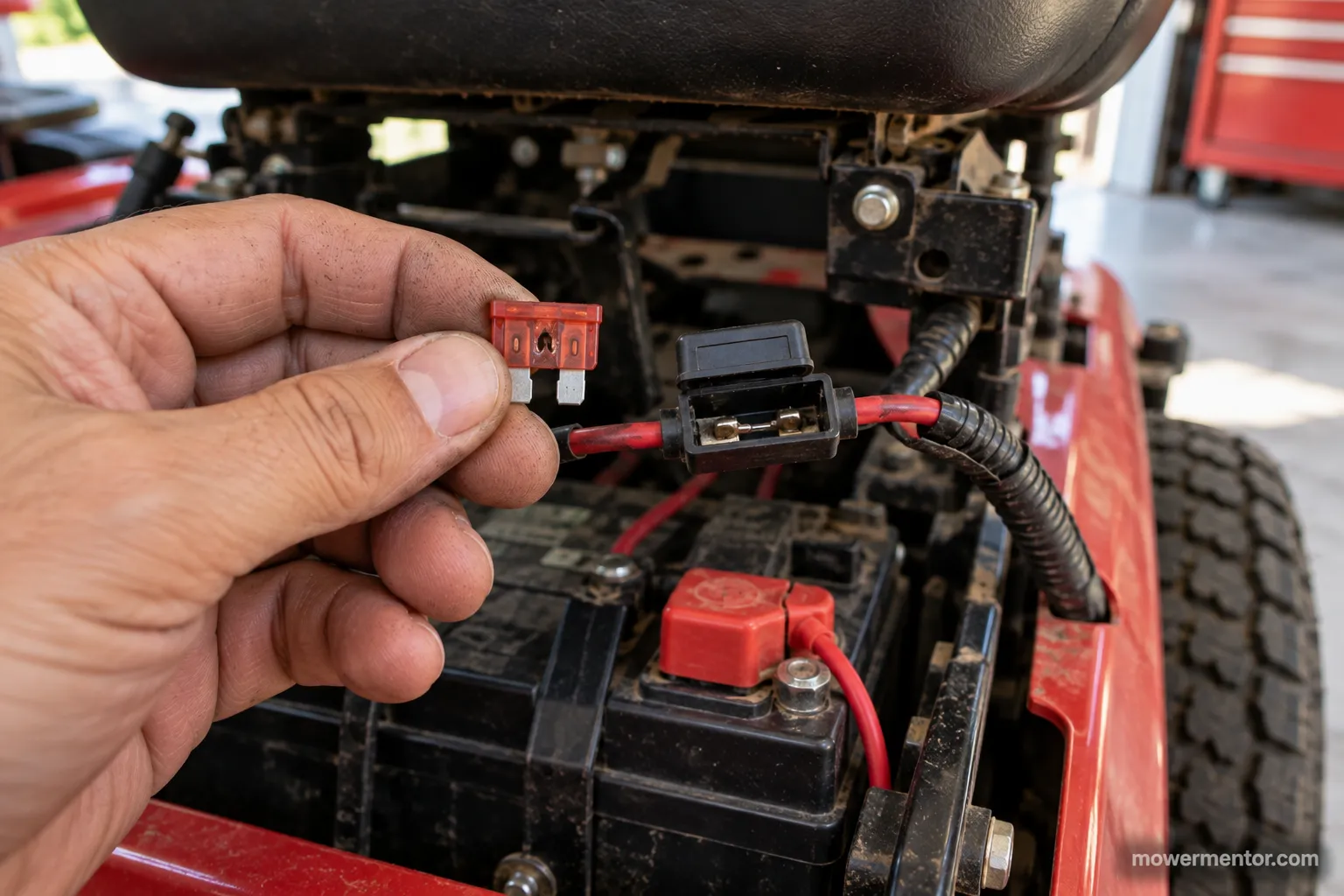
Work the non-switch causes in order of likelihood. A weak battery is first, so check the battery first with a load in mind, not just a resting voltage.
If the battery is strong, the next stops are the starter and the solenoid. A mower that clicks once and stops is often the solenoid click test territory.
A dead crank after a good, healthy click points the other way, to when the starter is the culprit.
A bent or misaligned switch bracket can also hold an interlock open even when the switch itself is fine, so check that the plunger actually meets the pedal or lever.
For the whole branching picture across every electrical cause, the complete electrical decision tree ties the fuse, ground, and starter paths together.
Know when to stop: A fault that comes and goes with heat or vibration can defeat a home continuity test.
If you have metered every switch and still lose crank at random, a shop with a load tester will find it faster than another afternoon of guessing.
A Troy-Bilt lawn mower ignition switch is worth testing before it is worth replacing, and the same is true of the three safety switches around it.
Put a meter on each one, watch for the reading that only fails in START or under a wiggle, and you will usually find the real fault in a single session rather than replacing parts on hope.
The four-switch series circuit that makes these no-starts confusing is also what makes them solvable: one of the four is open, and continuity tells you which.
Order the part that matches your machine, keep the interlocks intact, and the first warm Saturday goes a lot better than the last one did.
Frequently Asked Questions
Can you bypass a Troy-Bilt ignition switch to start it?
You can bridge a safety interlock with a jumper wire briefly to confirm which switch is at fault, but you should not run the mower that way. A two-wire switch bridges easily for a test, while a 4-wire switch cannot be bypassed the same way because two of its wires carry a separate circuit.
Bypassing the key switch itself to hotwire the mower is possible but defeats the built-in shutoff, so use a bypass only as a diagnostic step and then fit the correct part.
How do I know if it is the ignition switch or a safety switch?
On the bench, an ignition fault and a safety-switch fault looked identical to me until I put a meter on them, which is the whole reason I test rather than guess. Start the mower's start sequence correctly (seated, brake down, blades off) and see if it cranks.
If it still will not, test each switch for continuity in its active position, and the one reading OL when it should be closed is your answer.
Why does my Troy-Bilt start then die when I sit down or engage the blades?
That pattern points to an intermittent seat or PTO switch rather than the ignition switch. A switch that reads closed at rest can flicker open under your weight or under blade vibration, cutting the circuit the moment the machine loads up.
Wiggle-test each interlock with the meter attached, and replace the one that drops to OL when disturbed.
What does a red light at the ignition mean on a Troy-Bilt?
On many Troy-Bilt machines the red light at the ignition signals that the mower is powered but an interlock is not satisfied, so the starter is locked out. Confirm the brake is pressed, the blades are off, and you are seated.
If the light stays lit with everything correct, one of the safety switches is reading open and should be metered next.
How much is a Troy-Bilt ignition switch?
A genuine 5-pin key switch (925-0267B) runs about $36.64 at 2026 OEM pricing, the seat switch (725P14006) about $27.59, and the ignition module switch (925-06119C) about $112.75. Aftermarket versions of the key and seat switches sell for less, but confirm the part number fits your model first.
While you have the toolbox out, small jobs like replacing the air filter cover pair well with a switch swap.
Owners of battery machines can follow electric mower upkeep instead.
Found this useful? Make us a preferred source so we show up in your Google results.
Keep reading
Related articles
Troubleshooting & Repair
Dead Dash? Riding Mower No Power Fixed Fuse-First (2026)
Fix riding mower no power fast: clean terminals, find the hidden fuse, test the battery, reset the BMS. A fuse-first checklist for gas & electric mowers.
Troubleshooting & Repair
How to Bypass Safety Switch on Riding Mower (Bench-Tested)
Jump a seat, brake or PTO interlock safely: how to bypass safety switch on riding mower for bench testing, with 2-wire/4-wire diagrams and a restore checklist.
Troubleshooting & Repair
Riding Lawn Mower Won't Turn Over: 5-Stage Voltage Test
Fix it fast: a riding lawn mower won't turn over usually means battery, ground, solenoid or starter. Test each in 5 ordered stages.
Troubleshooting & Repair
Just Clicks? Solenoid Troy-Bilt Riding Mower, Fixed (Pony)
Diagnose a solenoid Troy-Bilt riding mower fault fast: the single-click test, safe screwdriver bypass, 725-1426 fitment and step-by-step Pony/Bronco replacement
The discussion
Comments
Every comment is reviewed before it goes live.