
Troy-Bilt Riding Mower Won't Start, Just Clicks: 2-Min Test
Diagnose a Troy-Bilt riding mower won't start just clicks fast: single-click vs no-click, battery voltage numbers, the solenoid bridge test, and the hidden fuse
Written by Tony MaldonadoReviewed by Wade CoburnLast updated on September 24, 2026
When you buy parts or tools through links on our site, we may earn a commission at no extra cost to you. It never changes what we recommend. Learn more.
When a Troy-Bilt riding mower won't start, just clicks, and leaves you sitting there turning the key over and over, the good news is that it is almost never the engine.
It is the starting circuit, and the exact sound you just heard already told you which part to test first.
I have chased this problem across my own 2011 Troy-Bilt Pony 42 and a Super Bronco 50, and the pattern holds every time.
One click sends you one way, rapid clicking sends you another, and dead silence sends you somewhere else entirely.
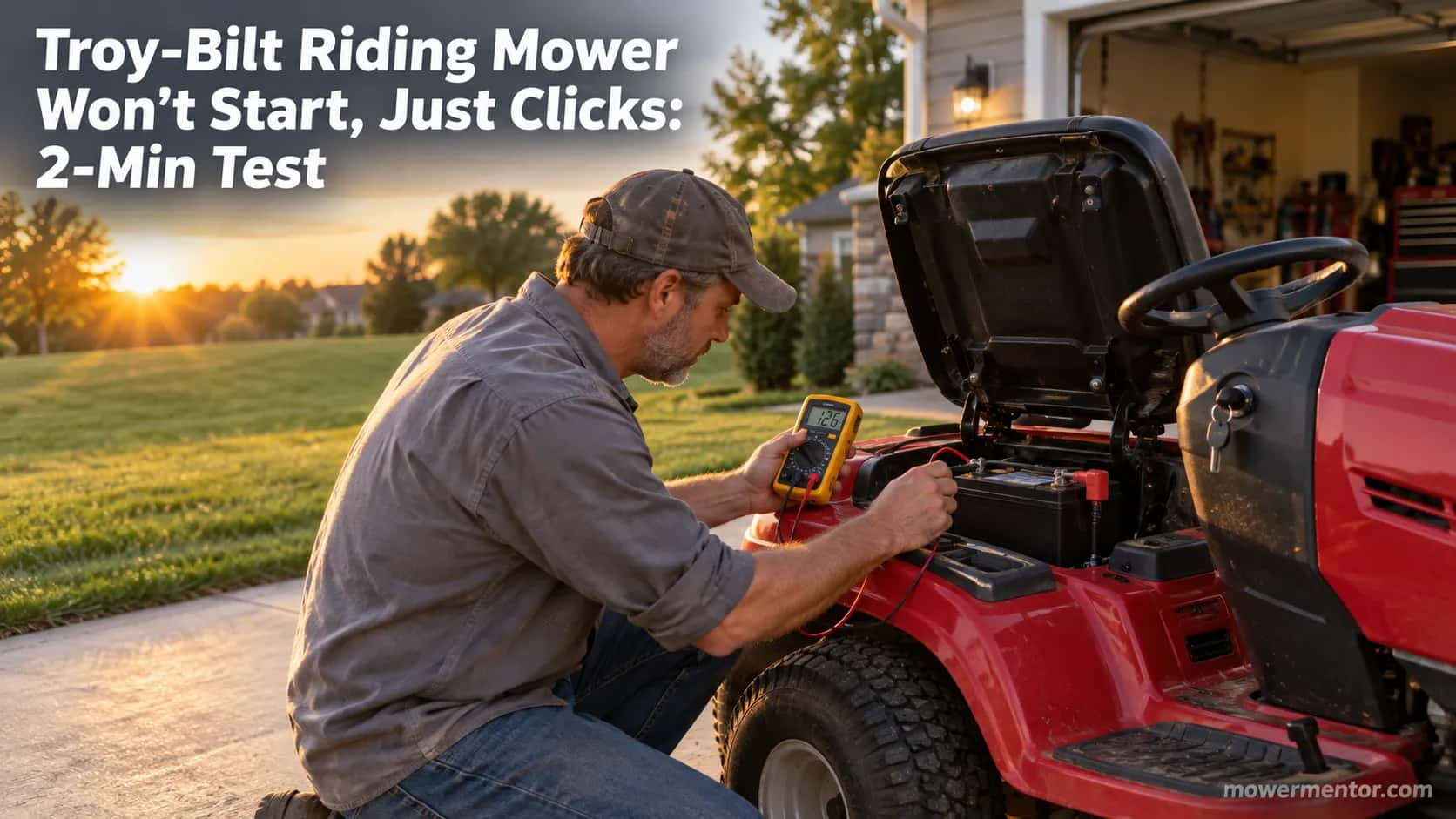
This guide walks each branch with a multimeter in hand, real voltage numbers, and the fuse location most guides skip.
You can work through it in an afternoon and usually fix it before spending a cent on parts.
The 30-Second Answer: One Click, Rapid Clicks, or Silence
A Troy-Bilt riding mower that won't start and just clicks has a starting-circuit fault, not an engine problem.
A single click usually means a weak battery or a failing starter solenoid. Rapid clicking points to a low battery or a corroded cable that collapses under load.
No click at all points to a blown 20-amp fuse, a bad frame ground, or an open safety switch.
Test the battery first, because a healthy 12-volt battery rests near 12.6 volts and anything under 12.2 needs charging before you trust any other reading.
The one-line rule: The sound picks your branch before you touch a tool.
Single click, lights still bright: Jump to the battery check, then the solenoid.
Rapid clicking: Weak battery or bad connection, start with voltage under load.
Silence, nothing at all: Fuse, ground, and safety switches.
This covers a mower that cranks weakly or not at all. If yours cranks normally but the engine will not fire, that is a fuel or spark issue, which is a different branch I point to further down.
First, Listen: What the Sound Is Telling You
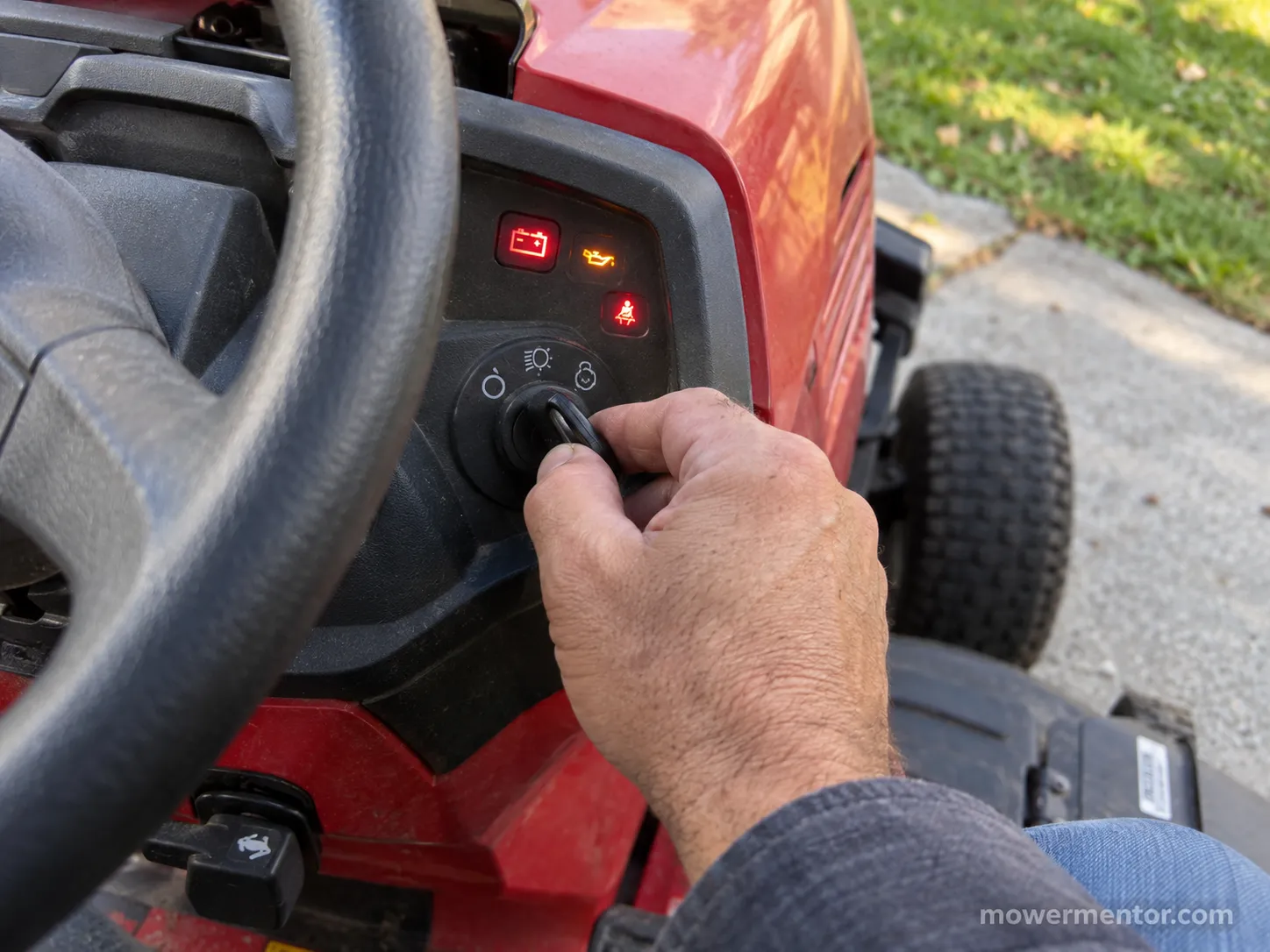
The sound a Troy-Bilt makes when it will not start is the fastest diagnostic you have. A single click is the starter solenoid trying and failing to hold the circuit closed, which points at a weak battery or the solenoid itself.
Rapid clicking is the solenoid chattering because voltage collapses the instant the starter draws current, which points at a low battery or corroded cables.
Complete silence means the circuit never energized at all, so the fuse, the frame ground, or a safety switch is open.
According to a plain-language breakdown of single versus rapid clicking, one definitive click then silence usually means the starter or solenoid, while rapid clicking almost always traces back to a battery that cannot deliver current.
Before you test anything, set up safely.
Blades off, parking brake set, and sit in the seat, because many Troy-Bilt models need all three before the starter circuit will even try.
Here is the routing table I use every time.
What you hear | Most likely cause | First test to run |
|---|---|---|
One single click | Weak battery or failing starter solenoid | Battery voltage, then bridge the solenoid |
Rapid clicking (click, click, click) | Low battery or corroded, loose cable | Battery voltage under load, then clean terminals |
Nothing at all, dead silence | Blown 20-amp fuse, bad ground, or open safety switch | Check the fuse and the key-switch B terminal |
The physics is simple.
The starter needs a huge burst of current, and a tired battery can light the dash yet still sag too low to spin it, which is exactly why bright lights never rule out a weak battery.
If the table points you at the starter itself, how a failing starter behaves is worth a look before you condemn it.
For the broad version across every brand, the master no-start decision tree covers fuel and spark too.
If your Troy-Bilt has other starting symptoms beyond the click, the complete fuel and electrical walkthrough is the hub for the whole system.
Troy-Bilt Riding Mower Won't Start, Just Clicks? Start With the Battery
When a Troy-Bilt riding mower won't start and just clicks, test the battery before you replace anything.
A healthy 12-volt battery rests at about 12.6 volts, 12.2 volts is roughly half charged, and 12.0 volts or below is discharged.
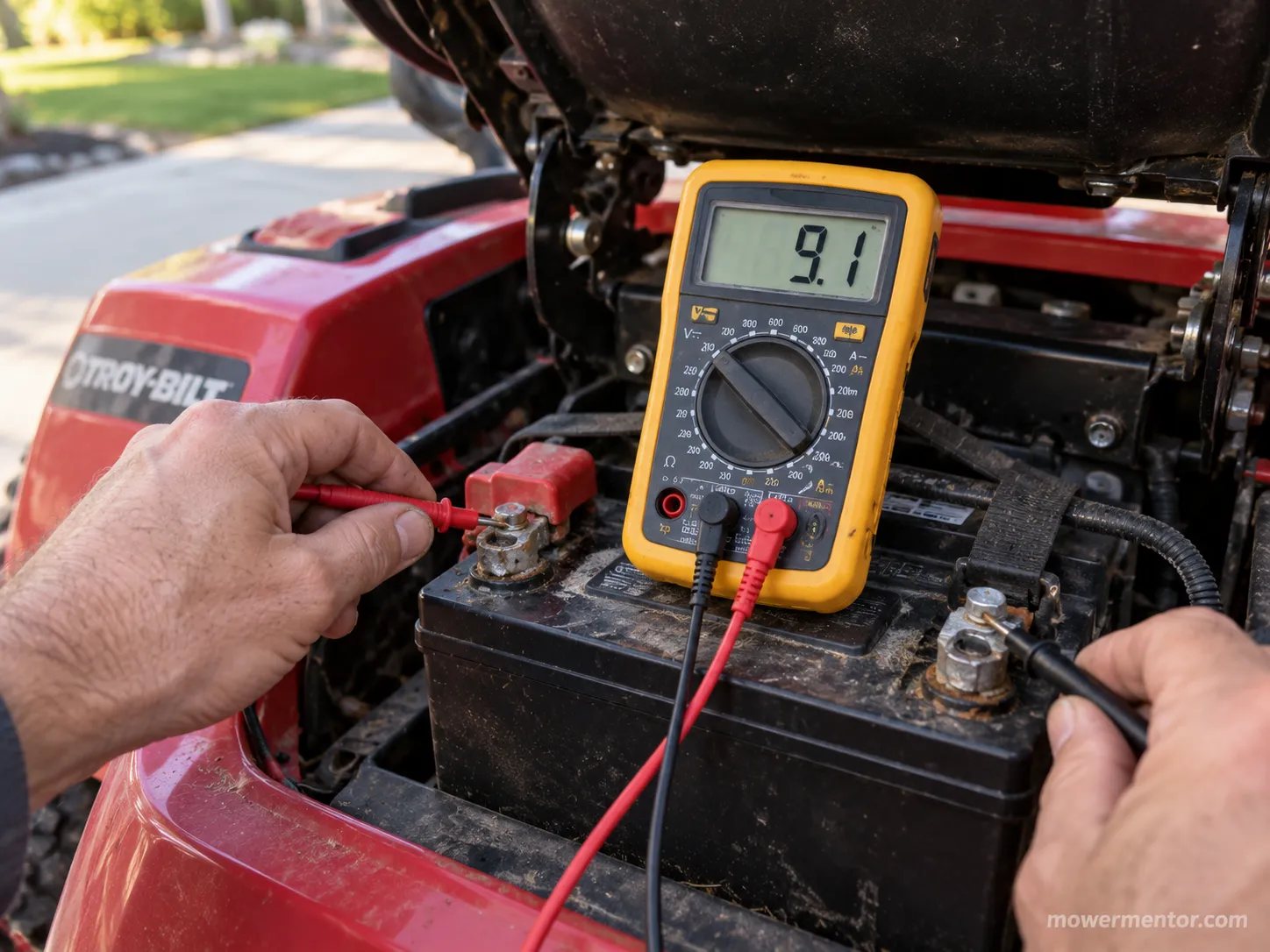
The reading that actually matters is under load: a battery can rest at 12.6 volts and still collapse below 9.6 volts the moment you turn the key, and that sag, not the resting number, is what starves the starter.
The state-of-charge steps come from a standard 12-volt battery guide.
The under-load threshold matches the load-test rule that anything dropping below about 9.6 volts under a crank is finished.
On my Pony 42 the battery rested at a reassuring 12.4 volts, so I nearly skipped it. The moment I turned the key it sagged to 9.1 volts, which is the classic weak-battery click.
Here is the voltage table I keep taped inside the mower shed.
Resting voltage | State of charge | What it means | What to do |
|---|---|---|---|
12.6V or higher | 100% | Healthy, fully charged | Battery is fine, move to the solenoid |
12.4V | About 75% | Slightly down | Charge, then retest under load |
12.2V | About 50% | Half charged | Charge fully before any other test |
12.0V or below | 25% or less | Discharged | Charge or replace, likely your cause |
Sags below 9.6V on key-turn | Fails under load | Cannot hold a 200 to 400 amp draw | Replace the battery |
Run the test in two steps. First, probe the battery at rest with a multimeter set to DC volts and read the resting number.
Second, keep the probes on the terminals while a helper turns the key, and watch where the voltage drops.
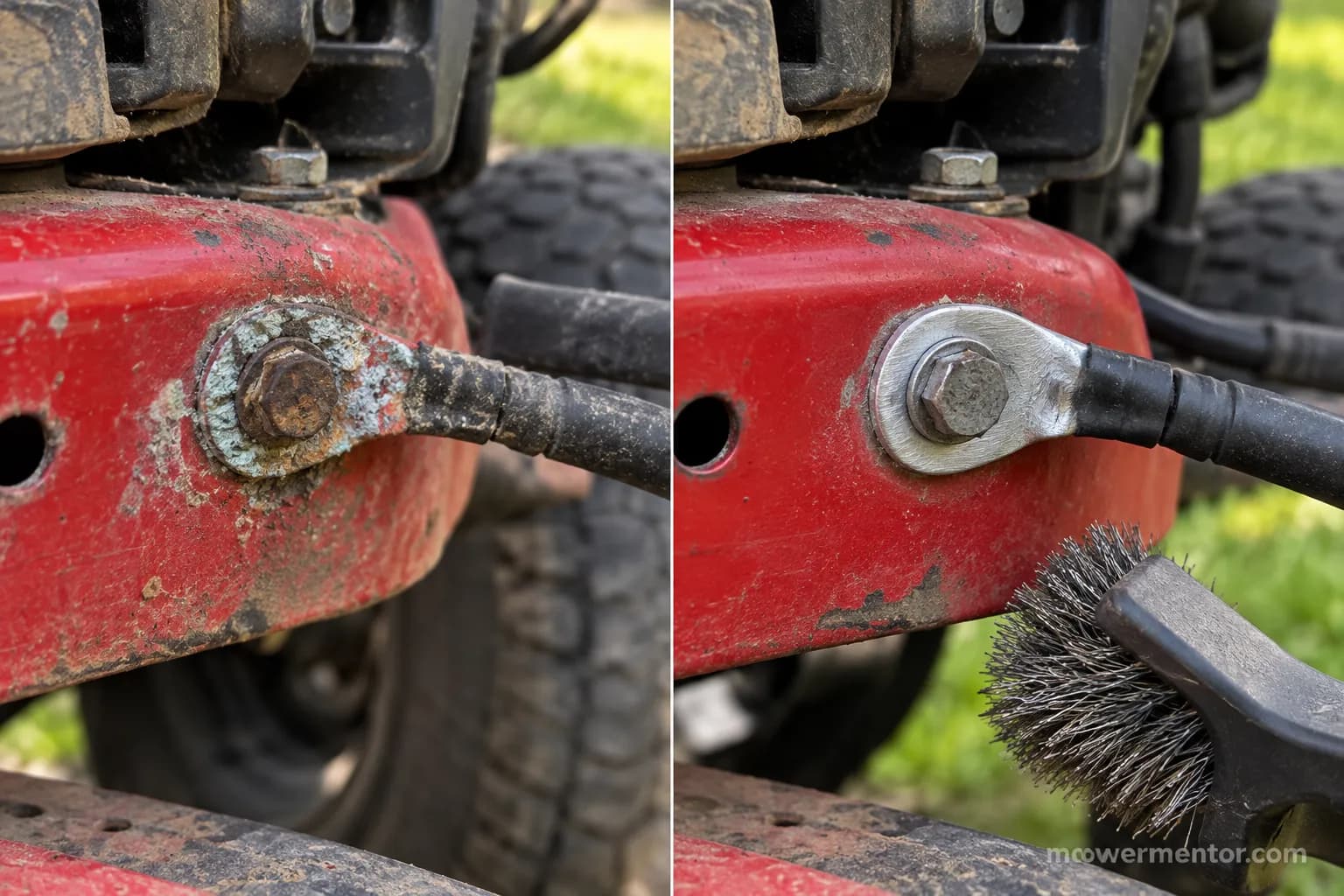
Corroded or loose terminals fake a dead battery, so clean them next. Scrape both posts and clamps to bright metal, retighten, and retest, because high resistance there drops voltage just like a bad battery.
Do not stop at the terminals.
The frame ground is the quiet killer here: fresh paint or rust under the ground eyelet acts like an insulator, and on my Bronco a paint-masked ground lug caused a no-crank that looked exactly like a dead battery until I sanded it to shiny steel.
A meter reading is a snapshot, not a load test, so if the numbers are borderline a shop load-tester is the definitive call.
If the battery keeps going flat, the correct Troy-Bilt battery size covers the right U1 for a Pony or Bronco.
If you already fitted a fresh one and it still will not turn over, when a fresh battery still won't crank is the next stop.
Battery and ground care also belongs in a full seasonal service routine so it does not recur.
Single Click, Good Battery: Test and Bypass the Solenoid
If a Troy-Bilt clicks once but the battery tests good, the starter solenoid is the prime suspect.
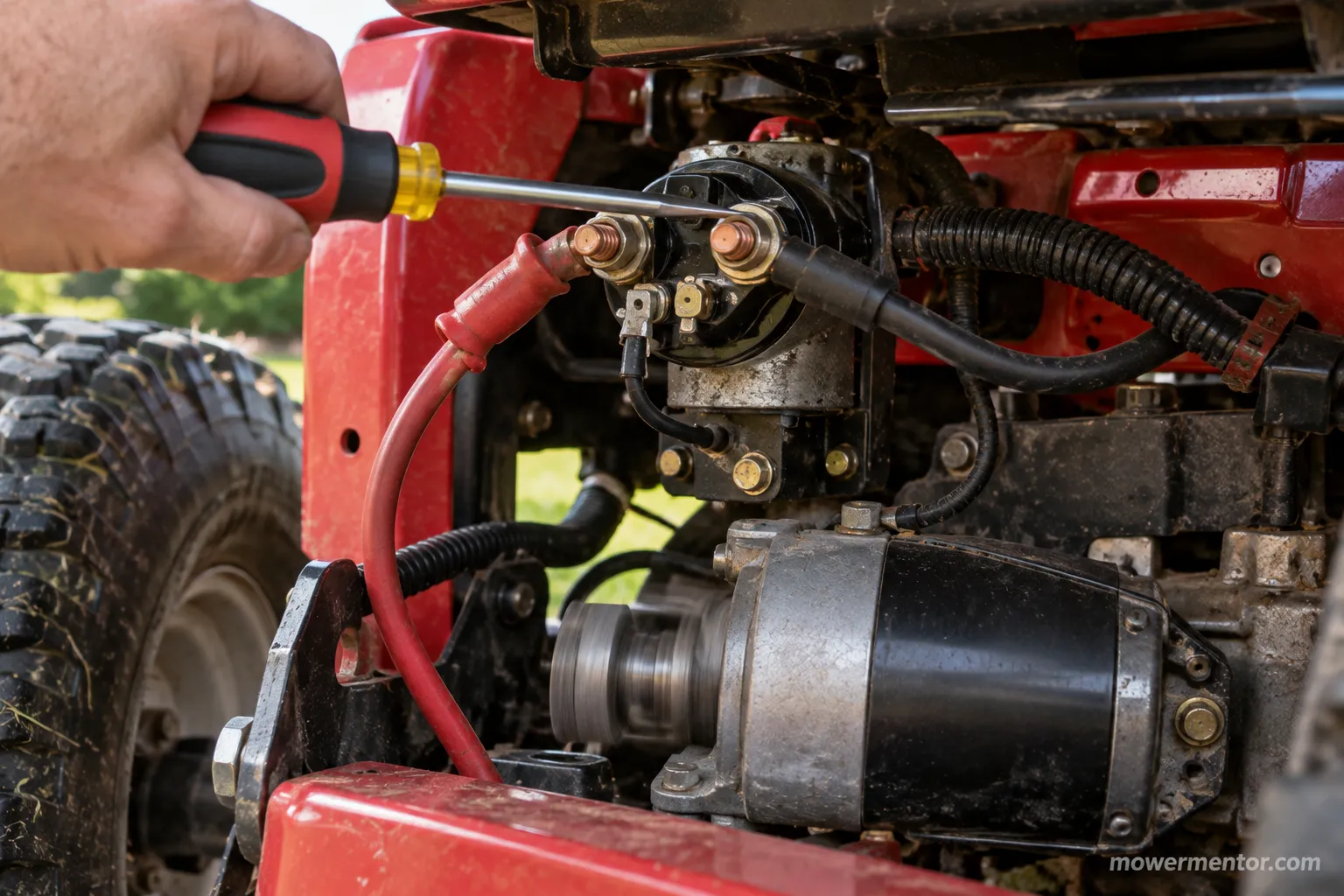
With the blades off, brake set, and an insulated screwdriver, bridge the two large solenoid terminals: if the starter spins, the solenoid or its trigger wire is the fault, and if nothing happens, the starter motor or the cable between the solenoid and starter is open.
That one test separates a cheap solenoid from a pricier starter.
A sharp single click with strong lights is the signature of a solenoid that engages but cannot pass current to the motor.
On my Pony, bridging the solenoid spun the starter instantly, so the motor was clearly fine.
The trigger wire read a full 12 volts, which told me the solenoid coil itself had died rather than a switch upstream.
Run the bridge test in order.
Confirm the blades are off, the brake is set, and you are not seated on the mower.
Find the two thick cables on the solenoid, one from the battery and one to the starter.
Lay an insulated screwdriver blade across both large terminals at once, keeping fingers clear.
Watch the starter: a spin means the solenoid or its small trigger wire is the problem; silence means the starter or the heavy cable is open.
Check that thick cable between the solenoid and starter, because a broken one mimics a dead solenoid.
That last point is not theoretical.
A common Troy-Bilt Pony fix documented on iFixit turned out to be nothing more than the red cable between the solenoid and starter snapping internally, which produces a click and no crank.
Bridging bypasses the safety interlocks, so never do it seated on a mower that could be in gear.
Treat it as a bench-style test, not a way to run the machine.
For the full teardown, the complete solenoid location and replacement guide covers the Pony and Bronco specifics.
The brand-agnostic version of this split lives in battery-versus-solenoid on any riding mower.
If the battery was the culprit and you need to move the machine now, how to jump-start it safely gets you rolling.
If bridging will not spin the motor at all, move on to testing the Troy-Bilt starter.
No Click, Nothing: Fuse, Safety Switches, and Ignition
When a Troy-Bilt will not start and makes no click at all, the starter circuit never energized, so power is being blocked before it ever reaches the solenoid.
Check, in order, the 20-amp fuse, battery voltage at the key switch B terminal, the seat, brake, and PTO safety switches, and the frame ground.
Silence alone does not mean the battery, because a dead-silent no-crank can just as easily be the ignition switch, an interlock, or a fuse.
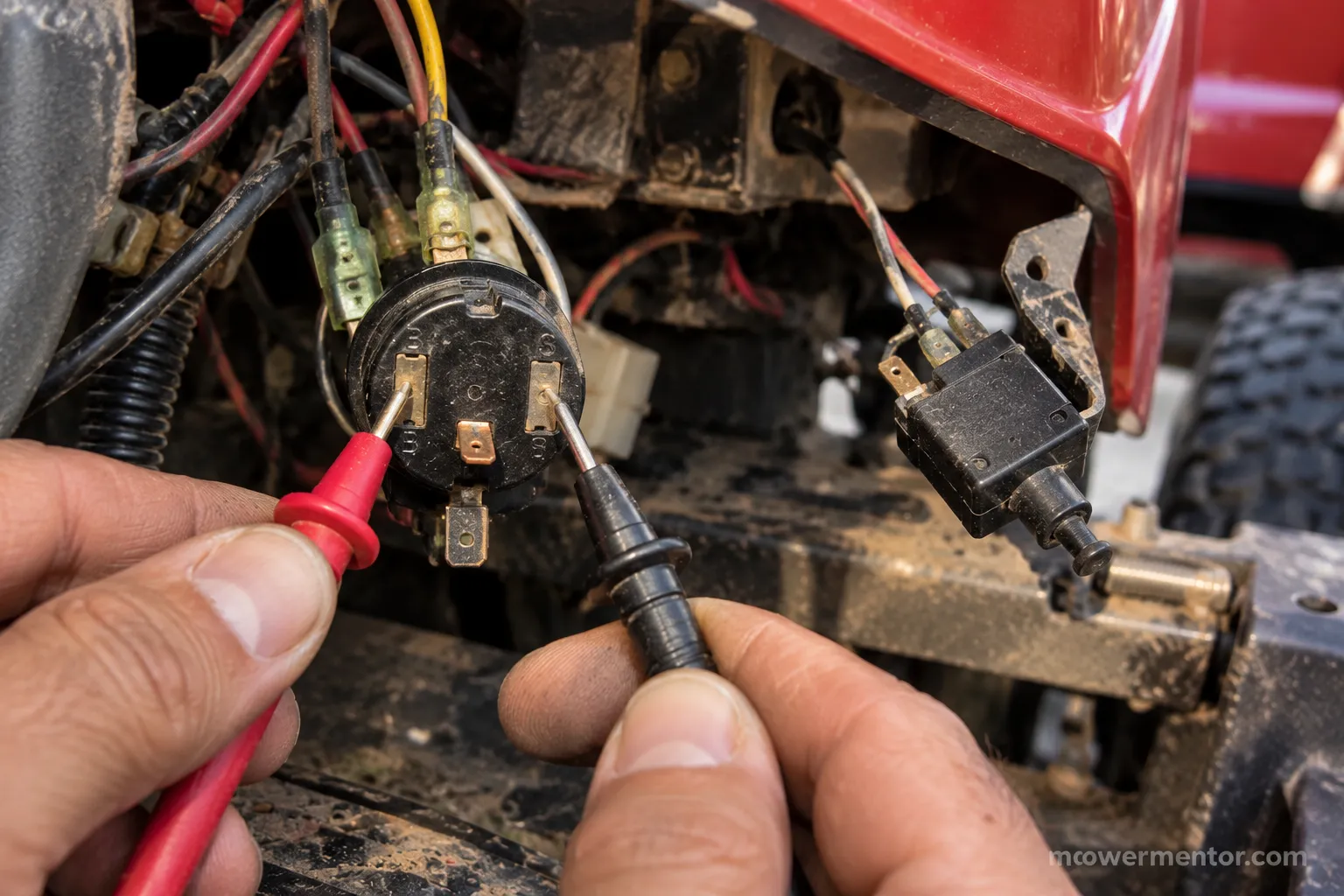
A fast isolating test is to jumper the key switch B and S terminals with the blades off and brake set, and if the solenoid then clicks, the fault sits upstream in the switch or interlock chain.
My Super Bronco went dead-silent in the middle of a mow.
The B terminal at the key switch had a full 12 volts, but the S terminal had nothing until I jumpered across it, and the culprit was a brake safety switch that had backed out of its clip.
Work the no-click checklist in this order.
Check the 20-amp fuse first, covered in detail in the next section.
Probe the key switch B terminal for battery voltage, which confirms power is reaching the switch.
Jumper B to S briefly: a click means the switch or interlocks are the block.
Test each safety switch, seat, brake, and PTO, since they sit in series and any one open kills the circuit.
Confirm the frame ground is clean and tight.
The interlocks exist for a reason, so restore every switch and connector before you mow again. A jumper is a diagnostic shortcut, not a permanent bypass.
Each interlock has its own location and test, and where the interlock switches are maps them out.
If one is genuinely faulty and you need to test-start, there is a responsible way covered in bypassing a safety switch responsibly.
If the key switch itself is dead, testing the Troy-Bilt ignition switch walks the terminal checks.
Where Is the Fuse on a Troy-Bilt Riding Mower? (And Why It's So Hard to Find)
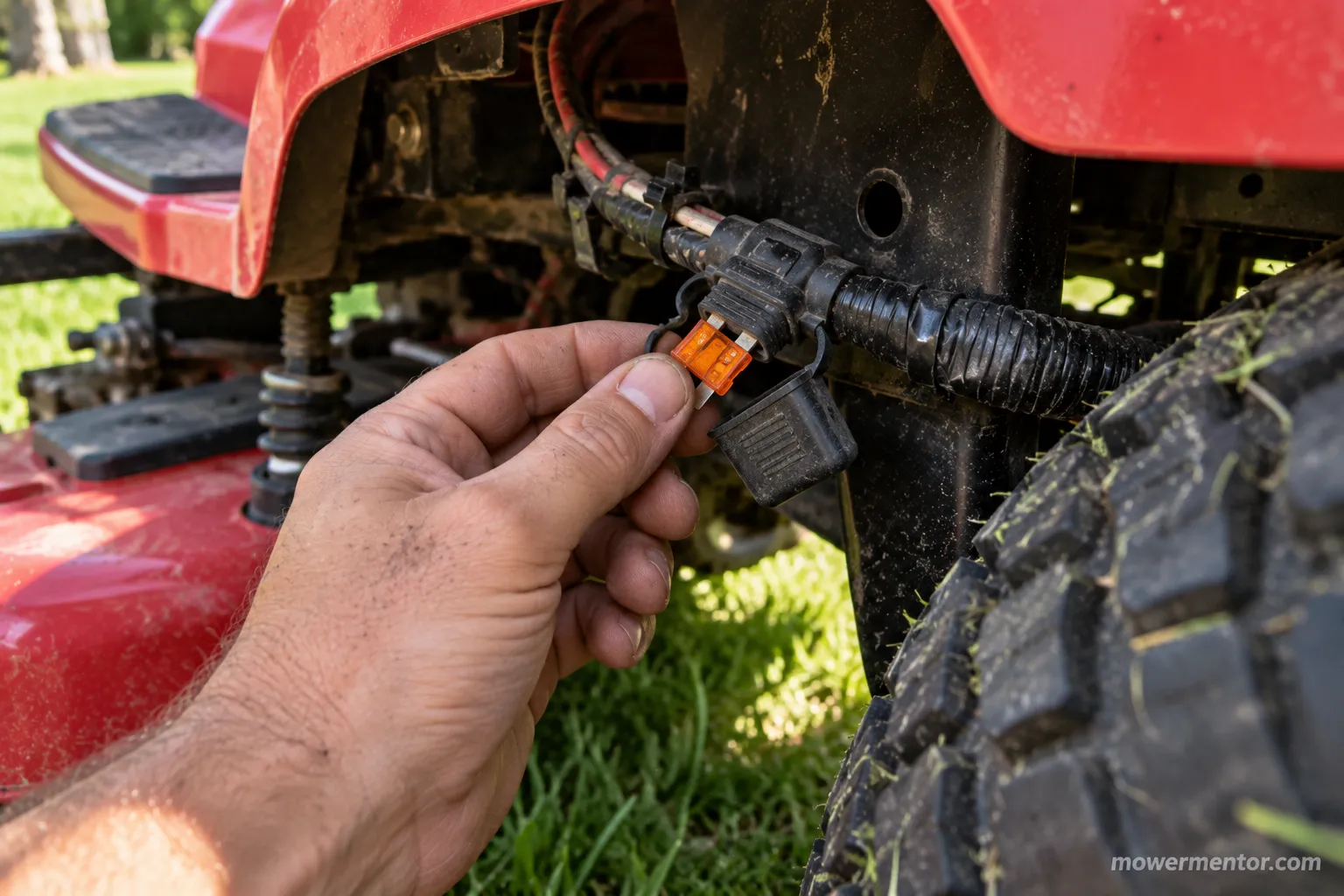
The fuse on most Troy-Bilt riding mowers is a 20-amp, 12-volt ATC two-prong blade fuse, official part number 925-1381, and it hides in one of four places depending on the model and year.
Troy-Bilt's own fuse-location guidance lists it either under the hood behind the dash panel or under and behind the battery beneath the seat, and notes that vintage pre-1999 frames put it under a seat access panel.
Owners on Pony and Bronco frames often find it a third and fourth way: inline in the harness off the solenoid's red wire, or taped into the harness behind the left rear wheel.
A fuse can look perfectly intact and still be open, so test it with a meter rather than trusting your eyes.
This is the single question rivals answer worst, and the reason is that the location genuinely moves by model year and frame style.
When my Pony's fuse was not under the dash, I found it exactly where the dealer swore it would not be, taped into the harness behind the left rear wheel.
Check these spots in order.
Under the hood, behind the steering dash panel.
Under or behind the battery, beneath the seat (you may need to lift the battery).
Inline in the wiring harness, traced from the red wire off the solenoid.
Behind the left rear wheel or under the side cover, common on older Pony frames.
Two habits save you a second failure. Test the fuse for continuity with a meter, and tug the holder, because a loose spade in the holder fails under load even with a good fuse.
Always disconnect the negative cable before you poke around, and never fit a higher-amp fuse to make a symptom go away, since the fuse is protecting the harness from a real fault.
If there is no click and the fuse is fine, the no-clicking dead-circuit checklist covers what is left. A blown fuse is also one branch of the battery-to-ground no-crank diagnosis.
When It's the Starter Motor (Not the Solenoid)
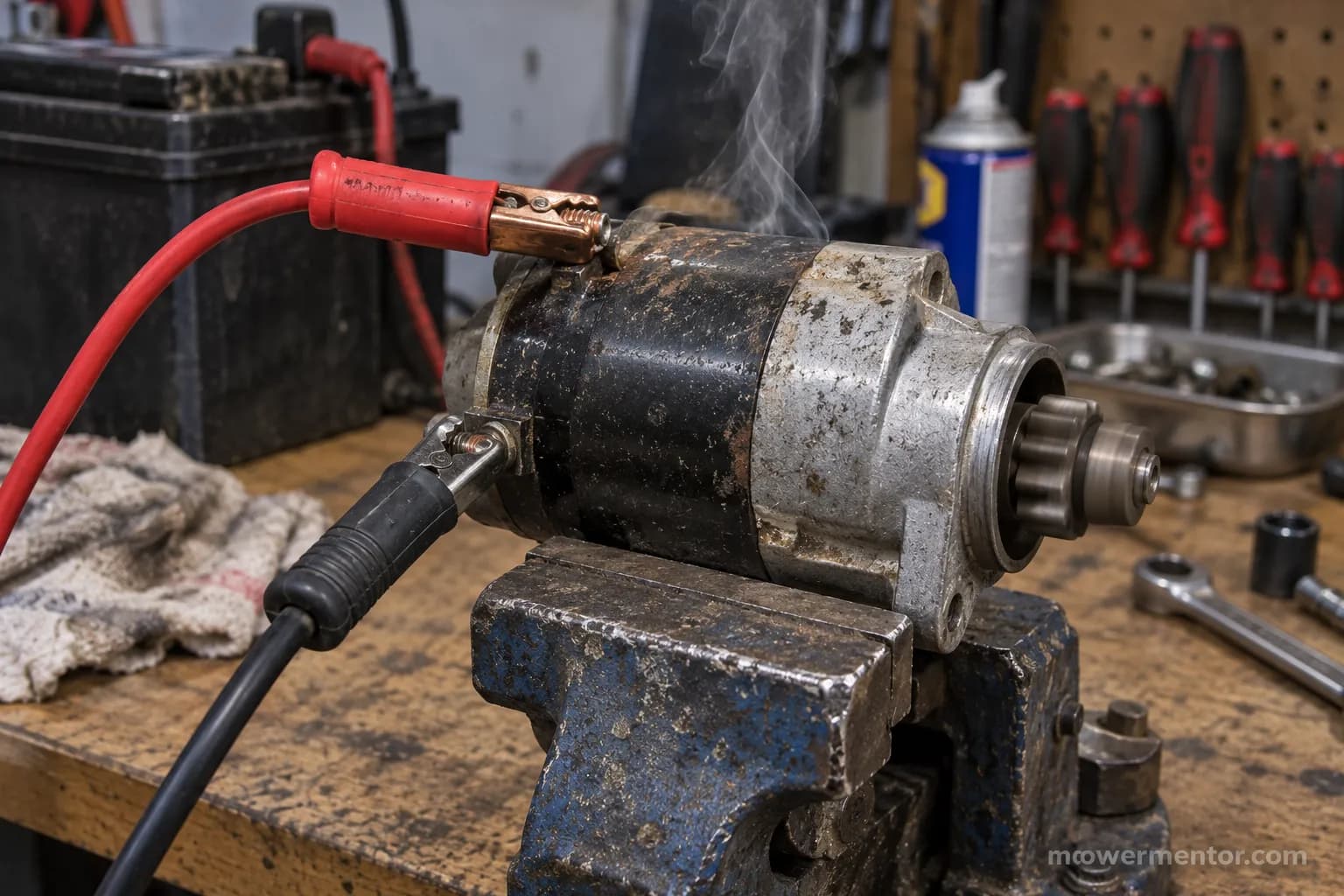
If a Troy-Bilt's battery, solenoid, and wiring all test good but the starter still will not turn, apply 12 volts straight to the starter motor terminal with the blades off.
If it does not spin, the motor is dead and needs a rebuild or replacement, and if it spins but does not engage the flywheel, the pinion gear is sticking.
A starter that spins freely but will not crank the engine is a mechanical fault, not an electrical one, which is your cue to stop testing wires.
On my Bronco, direct 12 volts got one weak grunt and a puff of smoke from the starter, so the motor was toast.
Against a replacement in the range of fifty to sixty dollars, a rebuild made no sense, so I swapped it.
Direct-powering a starter makes it jump hard, so clamp it or brace it before you touch the cable. This is a bench-style test, not a casual one.
There is also a branch this article deliberately does not chase.
If the starter now spins the engine but it will not fire, you have crossed into fuel and spark, and a quick shot of starter fluid to confirm fuel tells you which.
A clogged or missing filter can also stop a cranking engine from catching, which is covered in running without an air filter.
Prevent It Next Season and When to Call a Pro
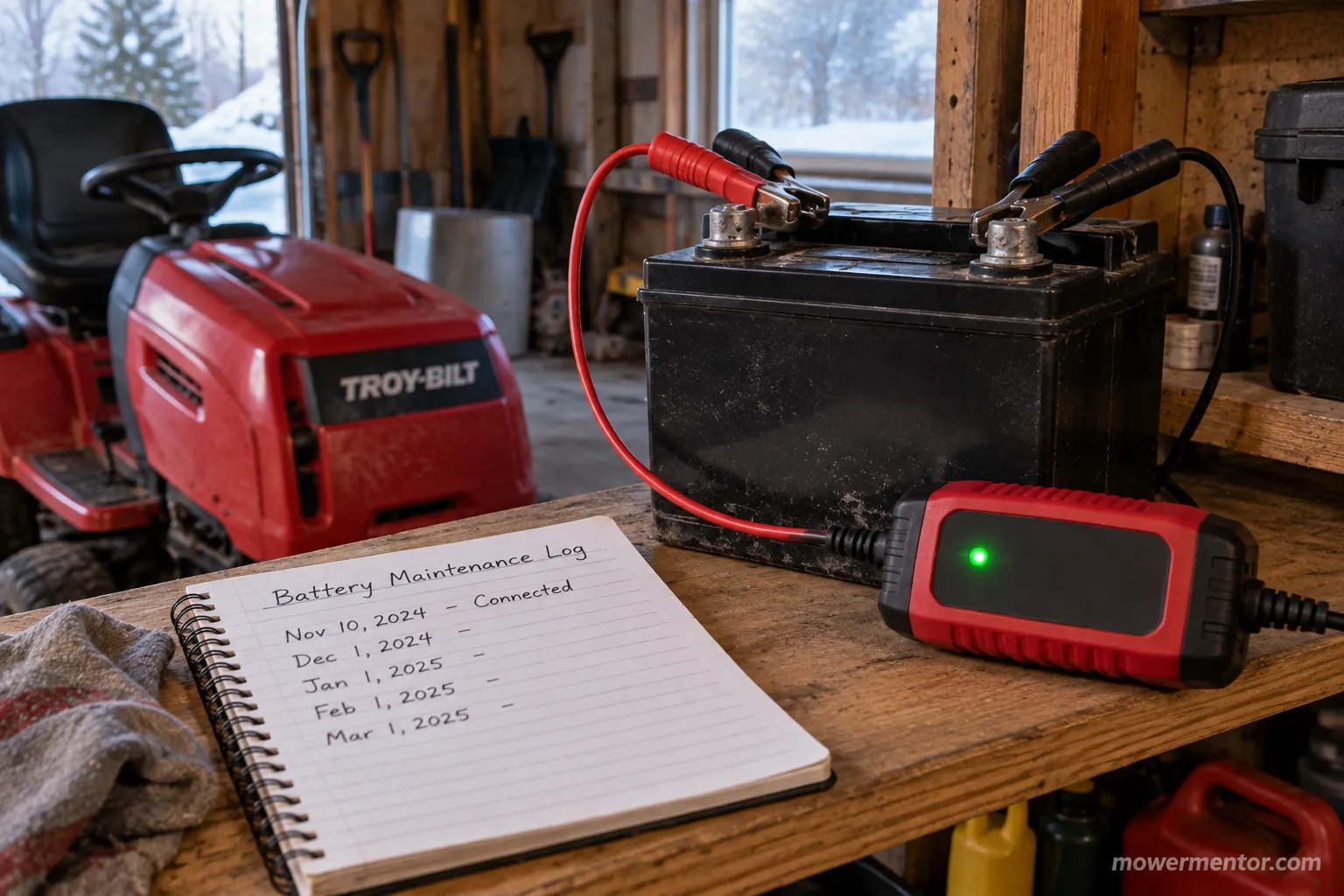
To stop a Troy-Bilt from clicking again next spring, keep the battery on a maintainer over winter, clean and grease the terminals and frame ground each season, and carry a spare 20-amp fuse.
Repeated blown fuses are a warning, not a nuisance, because they mean a short somewhere in the harness that swapping fuses will never fix.
Call a professional if the fuse keeps blowing, if wiring shows melting, or if a full battery-to-starter trace finds no fault, since those cases need shop-level diagnosis.
Since I started putting my Pony's battery on a maintainer every October, it has cranked first-turn every spring for three seasons, with no click and no drama.
That one habit prevents the slow off-season discharge that causes most spring no-starts.
Keep three prevention habits in view.
Put the battery on a maintainer through the off-season to stop it sulfating.
Clean and grease the terminals and the frame ground once a year.
Keep a spare 20-amp ATC fuse in the toolbox, because it is the cheapest insurance you can buy.
The pro threshold is about safety and cost. Once you are into repeated shorts or melted insulation, the risk outweighs the DIY savings.
Battery-electric mowers need their own light routine, covered in seasonal care for electric mowers.
Seasonal service is also the moment to swap a tired filter, handled in replacing the air filter.
A cracked housing is worth fixing the air-filter housing while you are in there.
Frequently Asked Questions
Why does my Troy-Bilt just click and not start?
A single click means the starter solenoid is getting power but cannot pass enough current to spin the starter, usually because the battery is weak or the solenoid is failing. Test the battery under load first, then bridge the solenoid with an insulated screwdriver to see which one is at fault.
Where is the fuse on a Troy-Bilt riding mower?
Troy-Bilt uses a 20-amp ATC blade fuse, part number 925-1381, and it sits in one of four spots: under the dash panel, under or behind the battery, inline off the solenoid's red wire, or behind the left rear wheel on older Pony frames. Test it with a meter, because a blown fuse can still look intact.
Is it the battery or the solenoid?
Measure the battery under load: if it holds above about 9.6 volts when you turn the key and still only clicks, the battery is fine and the solenoid is the likely culprit. In my own testing, a battery that rested at 12.4 volts but sagged to 9.1 volts under load was the click every time.
How do I bypass the solenoid safely?
With the blades off and the brake set, lay an insulated screwdriver across the two large solenoid terminals to bridge them, and a spinning starter means the solenoid or its trigger wire is bad. This bypasses the safety switches, so never do it while seated on a mower that could be in gear.
What safety switch stops a Troy-Bilt from starting?
The seat, brake, and PTO interlocks all sit in series, so any one of them being open will kill the starter circuit and give you silence when you turn the key. Jumper the key switch B and S terminals to confirm the block is in the switch chain, then test each interlock in turn.
Can a bad ground make it just click?
Yes, a corroded or paint-masked frame ground adds resistance that drops voltage exactly like a weak battery, producing a click or a slow no-crank. Remove the ground lug, sand it to bright metal, reattach it, and retest before condemning the battery.
The Bottom Line
A Troy-Bilt riding mower won't start, just clicks is not a mystery once you let the sound do the diagnosis for you.
One click sends you to the battery and solenoid, rapid clicking sends you to a weak battery or bad connection, and silence sends you to the fuse, ground, and safety switches, each with a number you can measure and a test you can run.
The reason this beats swapping parts blind is that a ten-dollar meter and the fuse location most guides omit will usually find the fault in minutes.
Start with the resting and under-load voltage, prove the solenoid with a screwdriver before you buy one, and check all four fuse spots before you blame the wiring.
Work the branches in order and you will fix it yourself, keep your money, and know exactly why it happened so it does not catch you out next season.
Found this useful? Make us a preferred source so we show up in your Google results.
Keep reading
Related articles
Troubleshooting & Repair
Dead Dash? Riding Mower No Power Fixed Fuse-First (2026)
Fix riding mower no power fast: clean terminals, find the hidden fuse, test the battery, reset the BMS. A fuse-first checklist for gas & electric mowers.
Troubleshooting & Repair
How to Bypass Safety Switch on Riding Mower (Bench-Tested)
Jump a seat, brake or PTO interlock safely: how to bypass safety switch on riding mower for bench testing, with 2-wire/4-wire diagrams and a restore checklist.
Troubleshooting & Repair
Riding Lawn Mower Won't Turn Over: 5-Stage Voltage Test
Fix it fast: a riding lawn mower won't turn over usually means battery, ground, solenoid or starter. Test each in 5 ordered stages.
Troubleshooting & Repair
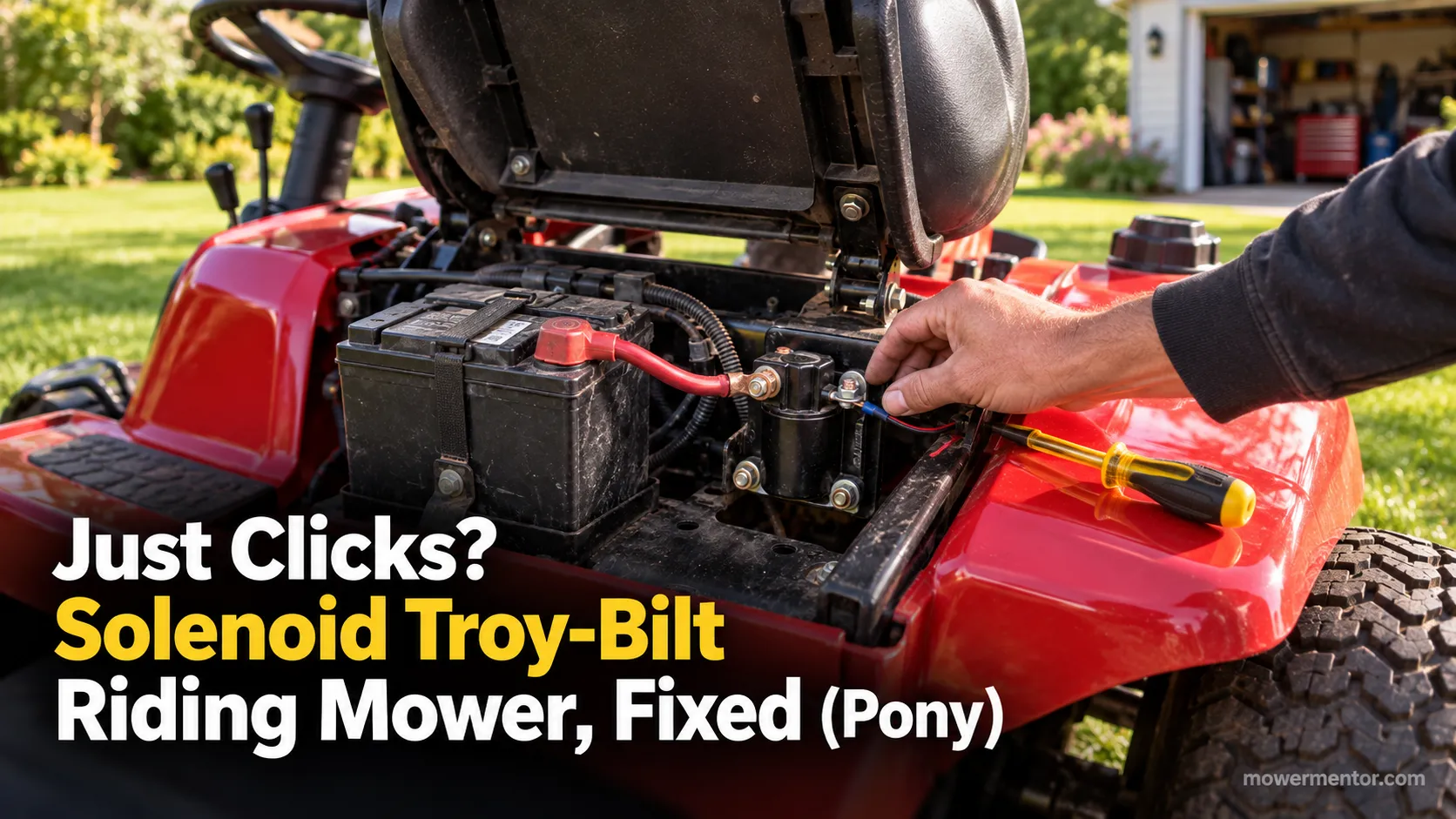
Just Clicks? Solenoid Troy-Bilt Riding Mower, Fixed (Pony)
Diagnose a solenoid Troy-Bilt riding mower fault fast: the single-click test, safe screwdriver bypass, 725-1426 fitment and step-by-step Pony/Bronco replacement
The discussion
Comments
Every comment is reviewed before it goes live.