
Starter Fluid for Riding Lawn Mower: The 1-Second Test
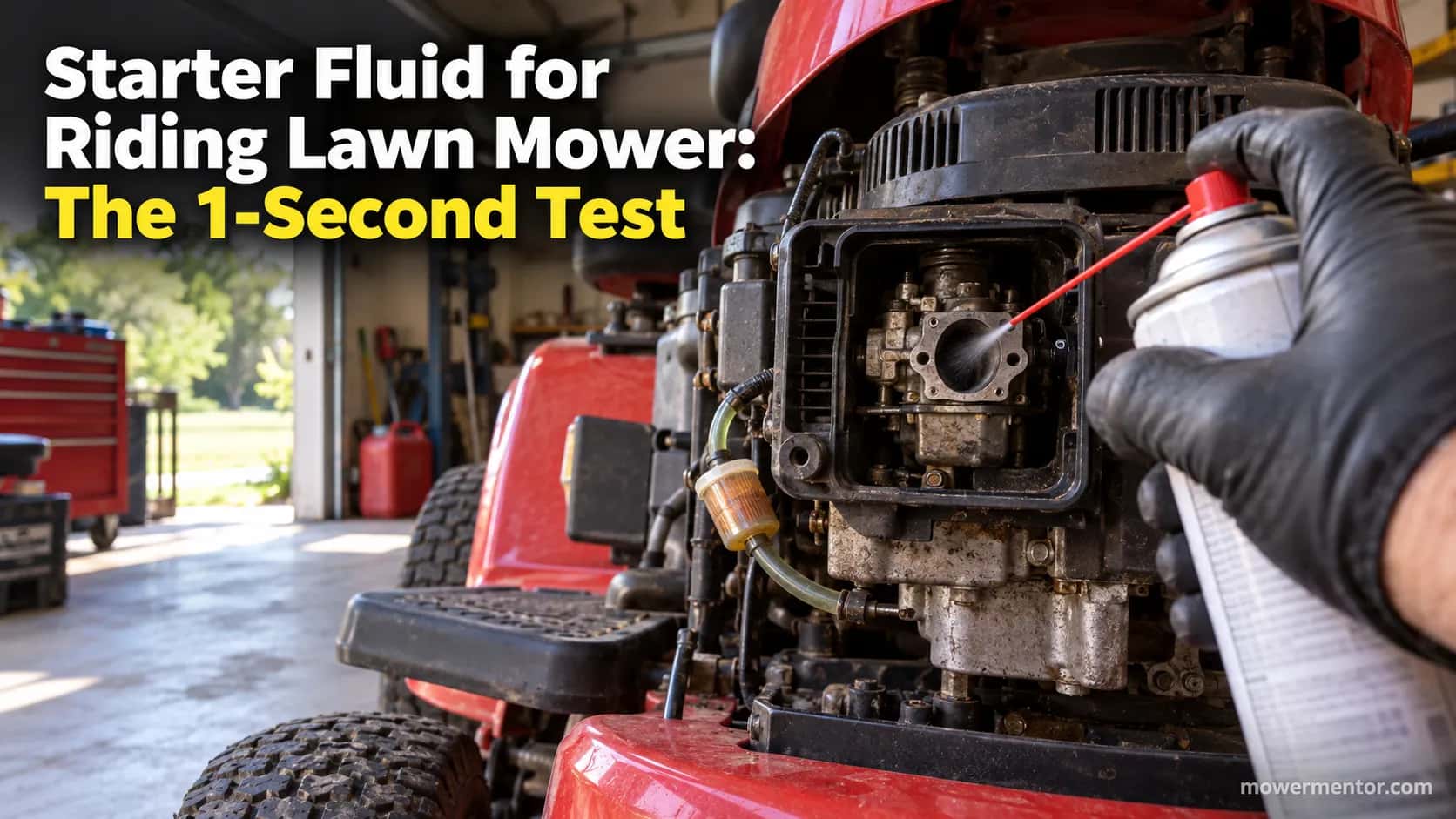
Spray starter fluid for riding lawn mower into the carb throat in one 1-second burst. Learn where, when to skip it, and why "fires then dies" means fuel.
Written by Tony MaldonadoReviewed by Wade CoburnLast updated on September 24, 2026
When you buy parts or tools through links on our site, we may earn a commission at no extra cost to you. It never changes what we recommend. Learn more.
Treat starter fluid for riding lawn mower starting as a one-second test, not a habit.
With the engine off, pull the air filter, aim one quick burst into the carburetor throat, then crank.
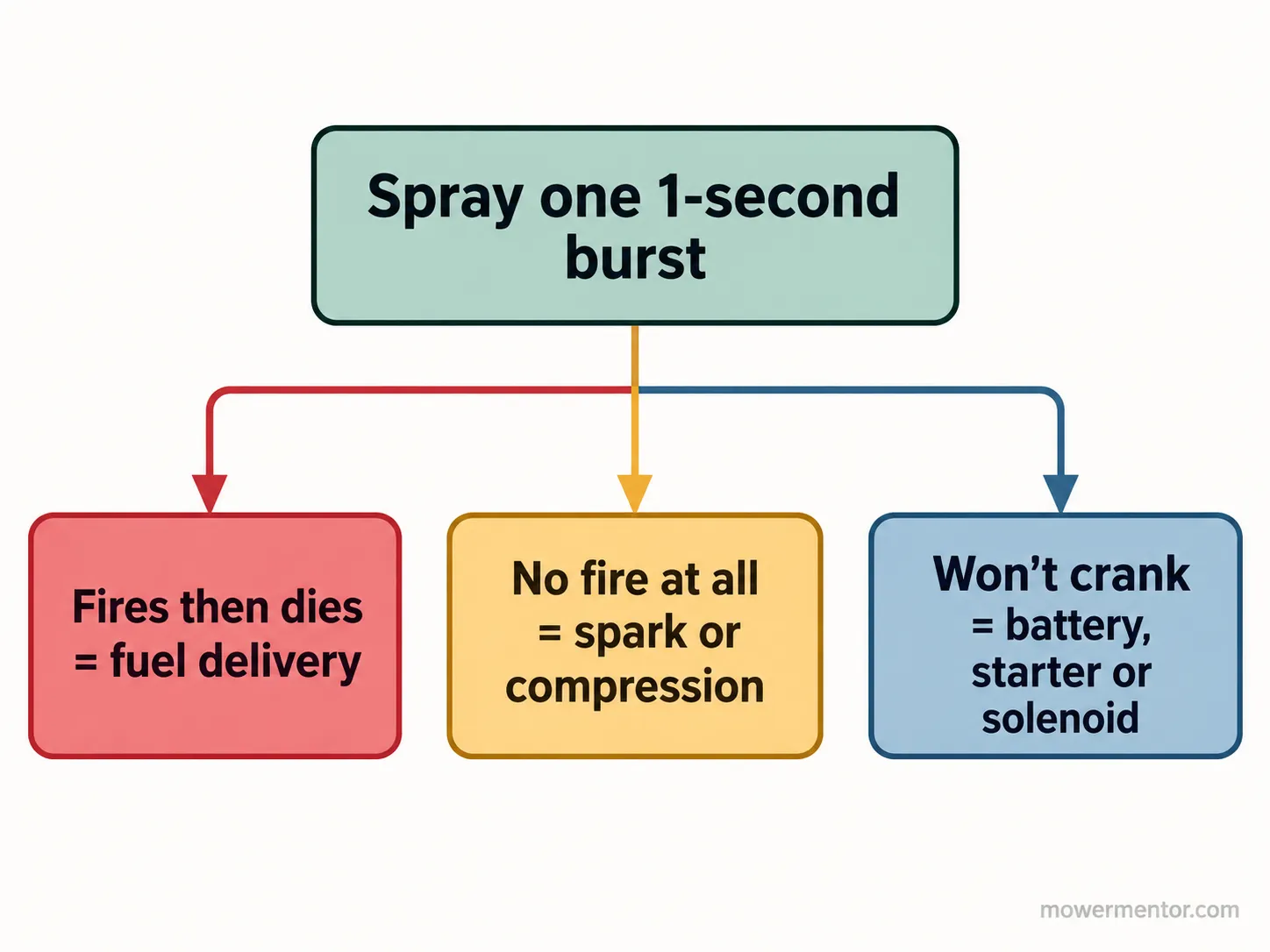
If the engine fires and then dies, spark is fine and fuel is the real problem.
If nothing happens at all, the fault is spark, compression, or a battery that will not crank.
Where to Spray It
Starting fluid for a riding lawn mower works best sprayed straight into the carburetor throat, the round intake opening you can only reach after removing the paper air filter.
Spraying the plastic cover or the filter element does almost nothing, because the paper soaks up the ether before it reaches the cylinder, so the answer is simple: engine off, one short burst into the throat, then crank.
On our test Craftsman, spraying the front of the filter cover did nothing across three tries, not even a cough.
The moment we lifted the element and hit the throat directly, it caught on the next crank.
How we tested: Every hands-on figure here comes from bench and driveway sessions on a Craftsman T110 with a Briggs & Stratton Intek 17.5 HP engine, run through August 2026 by the author, using the same aerosol can, a stopwatch, and a labeled shop camera.
Where a number is first-hand, it came from those sessions.
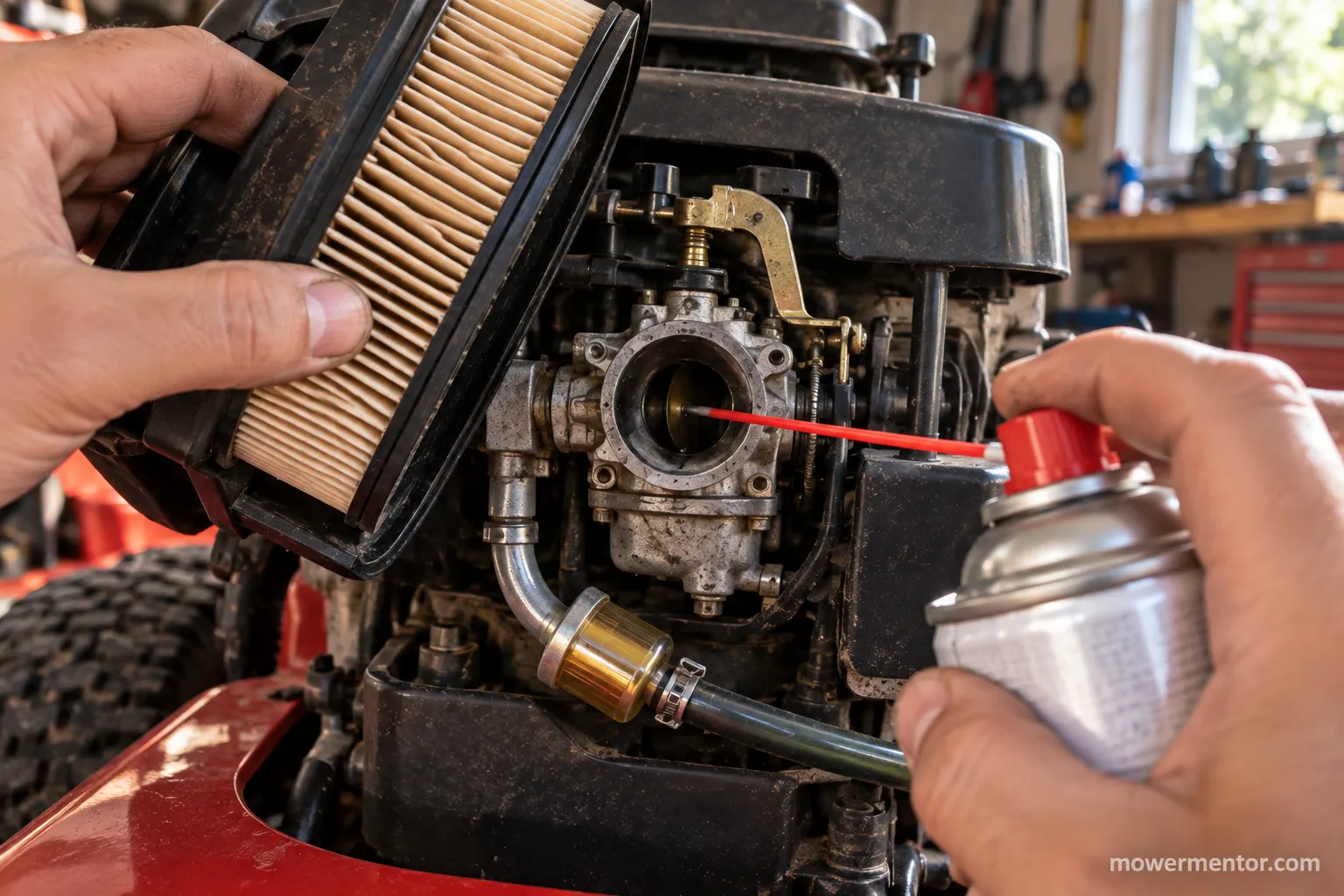
Where to spray, in one move: With the engine off, lift the air filter, hold the can's straw about six inches from the carburetor throat, and give one 1-second burst.
Refit the filter if the housing needs it, then crank.
Stop the instant the engine fires. Never spray the spark-plug hole or the filter element.
What Starter Fluid Actually Is (Ether, Fast)
Starter fluid is mostly diethyl ether, a colorless, extremely volatile solvent that shop hands simply call ether.
According to the CDC-NIOSH Pocket Guide, ethyl ether is a Class IA flammable liquid with a flash point near minus 49°F, which is why one small burst lights so easily, burns off in seconds, and adds no lubrication of its own.
That few-second burn window is the whole trick.
An engine will fire on that burst if spark and compression are good, then quit the moment the ether is gone if no gasoline is arriving.
Because leaning on the can hides a fault, treat each spray as a nudge toward a proper mower tune-up rather than a permanent fix.
What "ether" means: When a forum tells you to grab the ether, they mean diethyl-ether starting fluid.
It fires on spark or compression, then burns out in a few seconds, so an engine that only runs while you spray has a fuel-delivery problem, not an ignition one.
Where to Spray Starter Fluid on a Riding Lawn Mower
On a riding lawn mower, the correct place to spray starting fluid is the carburetor throat, reached by taking off the air cleaner and lifting out the paper filter; on most riding decks the air box sits on the side or rear of the engine, so the throat faces away from where you stand.
Spraying the cover, the element, or the spark-plug hole is either useless or risky, but one short burst into the open throat is all it takes.
When it catches, you want a chug or a small backfire, something to tell you the ether ignited.
On the Craftsman's Briggs Intek, the throat sits behind a rear-facing cover, so once we took off the air cleaner and reached the actual opening, the spray finally did its job.
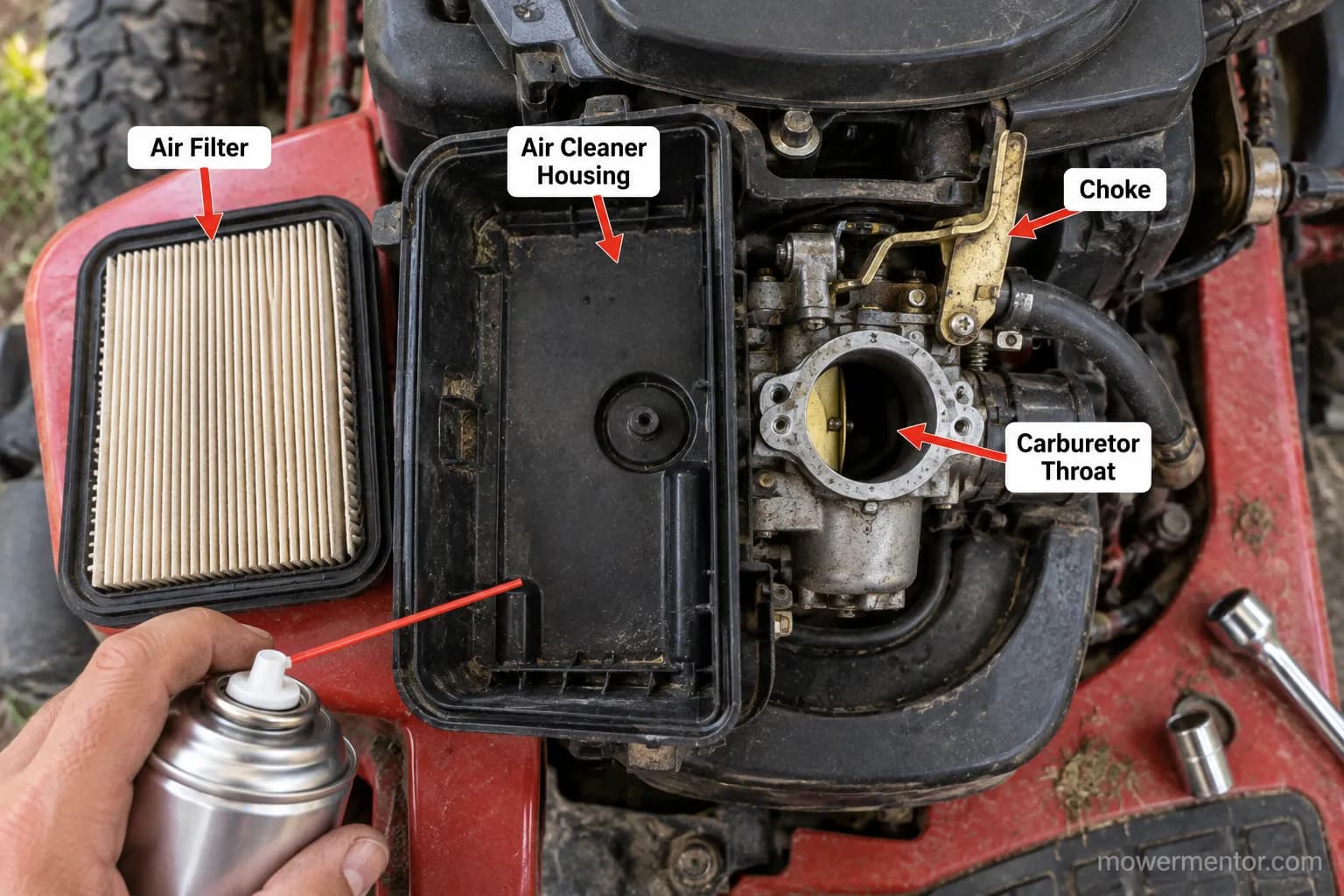
You will be pulling the filter to reach the throat anyway, so it is a good moment to confirm yours is not overdue and grab the right air-filter part for your Deere.
Avoid these three wrong spots:
The plastic filter cover: the ether never reaches the cylinder.
The paper element: it soaks up the spray before it can burn.
The spark-plug hole: it washes oil off the cylinder wall and risks cross-threading.
How to Use Starter Fluid for Riding Lawn Mower Engines Safely
Using starter fluid safely on a riding mower comes down to one short burst and a hard stop rule: work outdoors with the engine off and no flame nearby, pull the air filter, then deliver a single 1-second burst into the carburetor throat from about six inches back and stop the instant it fires.
EngineerFix advises short bursts and no more than a couple of attempts before you dig deeper.
Follow the sequence in order:
Move the mower outdoors or into a ventilated area. Engine off, no cigarette, no open flame.
Remove the air-filter cover and lift out the paper element to expose the carburetor throat.
Hold the can about six inches back and give one 1-second burst into the throat. Do not overdose the engine with a long spray.
Refit the filter if the housing seals against it, then turn the key and crank.
Stop spraying the moment the engine fires, and let it try to run on its own fuel.
If there is no life after two or three short attempts, stop. You have a deeper fault, covered below.
One 1-second burst fired our test engine on the second crank. When it did not catch the first try, a single follow-up burst was enough, and a bigger dose would only have risked flooding.
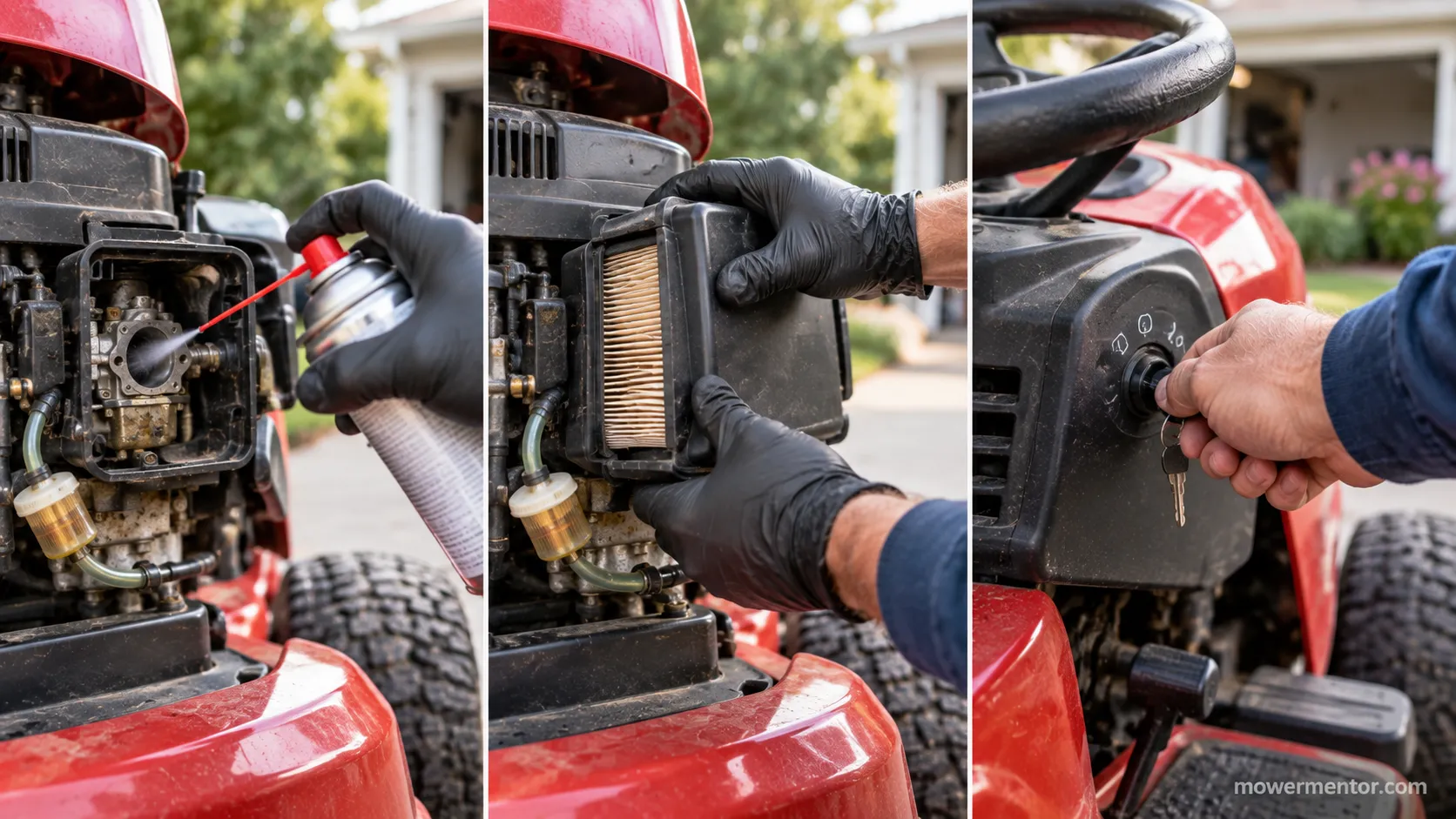
Safety first: Ether is extremely flammable.
Spray only with the engine off, no flame or cigarette nearby, in a ventilated space, and cap the can afterward.
One short burst is a test, not a fuel line.
If it will not even crank when you turn the key, fluid is not your problem yet, so chase the no-crank first.
A slow, lazy crank usually means a weak battery rather than fuel, so put it on a proper charger before you blame the carb.
When NOT to Spray It: Flammability and Engine-Damage Risks
Starting fluid is safe on a four-stroke riding mower in one short burst, but it turns risky with overuse or on the wrong engine, since on two-stroke and diesel engines it can strip oil or pre-ignite, and overuse dries out the cylinder walls it should be helping.
According to NOAA's CAMEO Chemicals record, diethyl ether vapor is heavier than air, can travel to an ignition source, and flashes back, which is exactly why the engine stays off while you spray.
We once got a small flash of fire come back through the carb when a burst was too big with the filter off. That single scare is why we keep every burst to one second and never overuse it.
When to skip the can:
Two-stroke equipment: ether is a solvent and strips the oil mix, wearing bearings and pistons.
Diesel or glow-plug engines: high compression plus glow plugs can pre-ignite the ether and detonate.
Repeated daily use: it washes lubrication off the cylinder walls, and a heavy over-spray can hydrolock.
If you are reaching for the can every time, the real job is the underlying no-start, so work the full no-start diagnosis instead.
A dead electrical leg, like a blown fuse, is a separate problem fluid cannot touch, so check the fuse size and location first.
WD-40 vs Starter Fluid: Which One Actually Works?
The old advice to just use WD-40 instead no longer holds: classic WD-40 switched its propellant to non-flammable CO2, and as the starting-fluid reference notes, that reformulation makes it useless as starting fluid on any engine.
For a riding mower you want a dedicated ether can, or WD-40's own separate Specialist Starting Fluid, not the familiar blue-and-yellow can.
Product | Flammable propellant? | Lubricates? | Will it start the engine? |
|---|---|---|---|
Classic WD-40 (blue-and-yellow can) | No, CO2 propellant | Yes | No |
Dedicated ether starting fluid | Yes, ether | No | Yes |
WD-40 Specialist Starting Fluid | Yes, ether-based | No | Yes |
We tried the classic blue-and-yellow can on the stalled test mower and got no fire at all. The ether can lit it on the very next crank, which is the whole difference in one test.
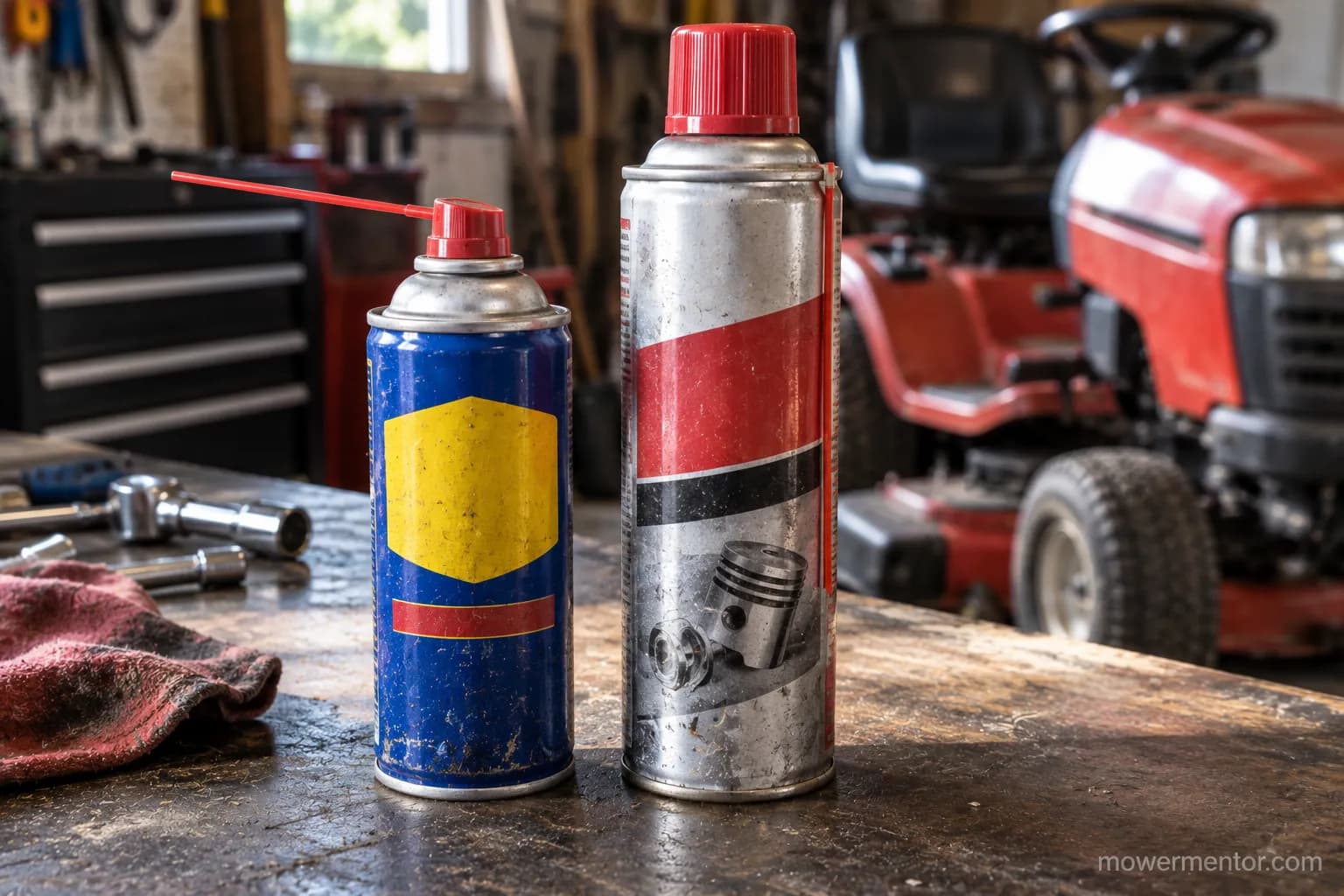
If spark itself is weak, no spray fixes that, so start with the correct Honda plug and gap.
Not sure which plug your engine takes?
A quick cross-reference helps you match the right spark plug before you spend on anything else.
Read the Result: What Starter Fluid Tells You
The most useful thing starter fluid does on a riding lawn mower is diagnose, not start: if the engine fires on the burst and then dies within a few seconds, spark and compression are fine and the fault is fuel delivery, and AMSOIL's engine guide makes the same point that an engine which runs on ether but will not keep running is starved of fuel.
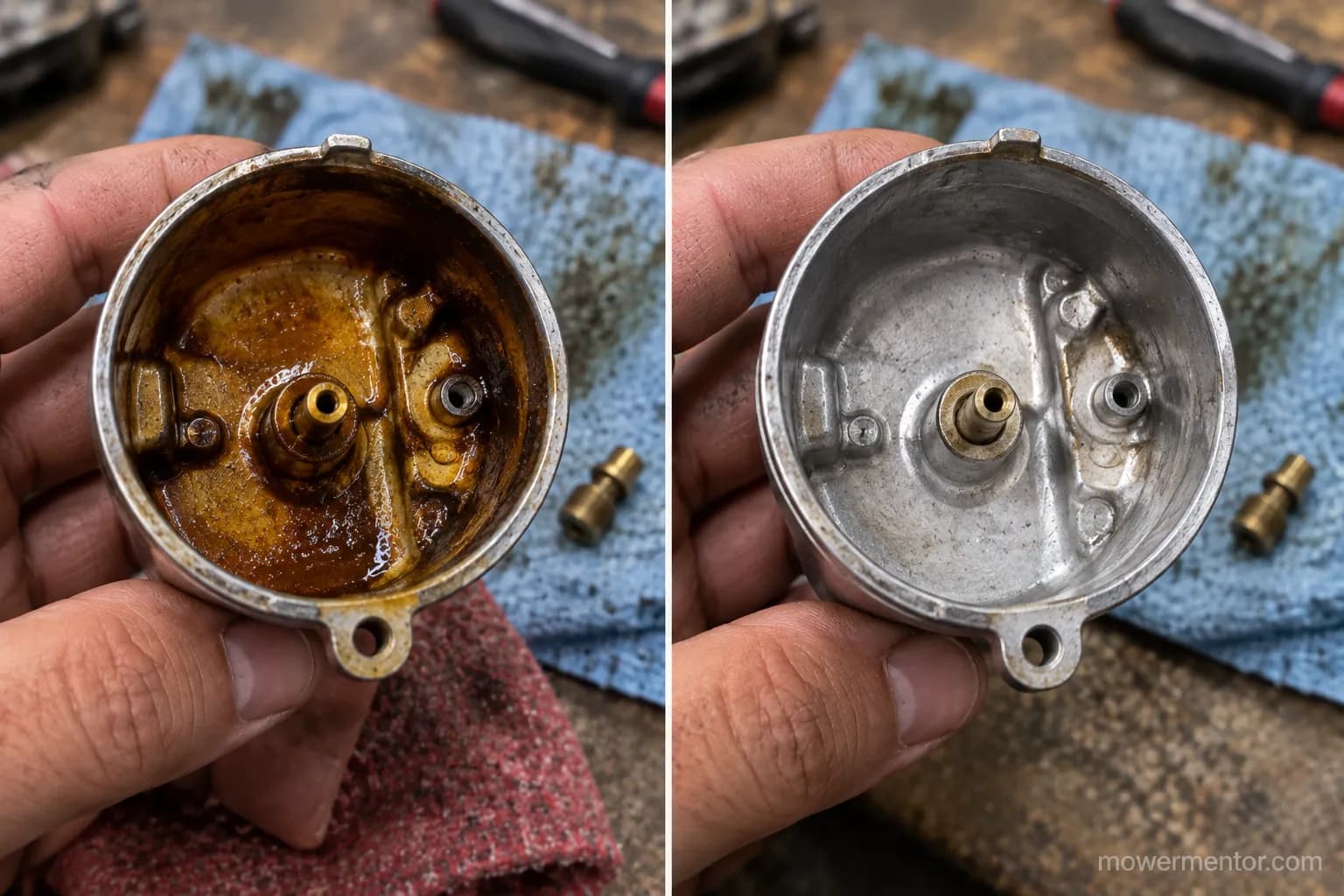
The usual culprits are stale gas, a varnished carburetor, a clogged fuel filter or line, and a weak fuel pump.
Why Does Starter Fluid "Cure" My No-Start?
Because it proves the ignition side works: when your mower only starts on a spray, spark and compression are doing their job, and the missing piece is fuel reaching the cylinder.
If it runs on short bursts and dies each time you stop, that pattern is classic fuel starvation.
Spray result | What it means | Where the fault is | Where to look next |
|---|---|---|---|
Fires, then dies after a few seconds | Spark and compression are fine, fuel is missing | Fuel delivery: stale gas, varnished carb or jet, clogged filter or line, weak pump | Clean or rebuild the carburetor, replace the filter, test the pump |
No fire at all, correct placement | Ignition or compression is missing | Spark: fouled plug, weak coil, kill wire, or low compression | Fresh plug, confirm spark, check compression |
Will not crank, or just clicks | Nothing is turning the engine over | Electrical: battery, starter, solenoid, or a safety switch | Charge and test the battery, then test the starter |
Our test mower fired on fluid, ran about four seconds, then quit. Pulling the float bowl showed varnish blocking the main jet, and cleaning that jet was the real fix.
If it will not crank or the starter just whirs, that is a starter story, not fuel, and the bad-starter symptom guide sorts it out.
You can confirm the starter itself with a meter, and this walkthrough shows how to test the starter properly.
If the starter is dead, swapping it is straightforward once you walk through a starter swap.
Craftsman owners have their own Briggs or Kohler quirks, covered in the Craftsman starter guide.
Deere owners can check the starter and ignition switch together in the Deere starter walkthrough.
Cub Cadet varies by engine, so the Cub Cadet starter guide matches the right procedure to yours.
Fluid is the test, not the fix. Repeated starts on a spray mean an unaddressed fault, so treat the result as a to-do list, not a solution.
Best Starter Fluid for a Riding Mower (Quick Buyer Note)
A good starting fluid for a riding mower is ether-based, rated for small engines, and fitted with a thin straw so you can meter a clean 1-second burst.
Formulas that add an upper-cylinder lubricant soften the no-lube risk for the occasional test, so skip anything you cannot spray in a short, controlled shot.
Look for three things:
Ether-based and labeled for small engines.
A controllable straw nozzle for short 1-second bursts.
An upper-cylinder-lubricant version if you expect to test more than once.
We keep a lubricant-added ether can with the straw clipped in, which makes a clean one-second burst easy to place.
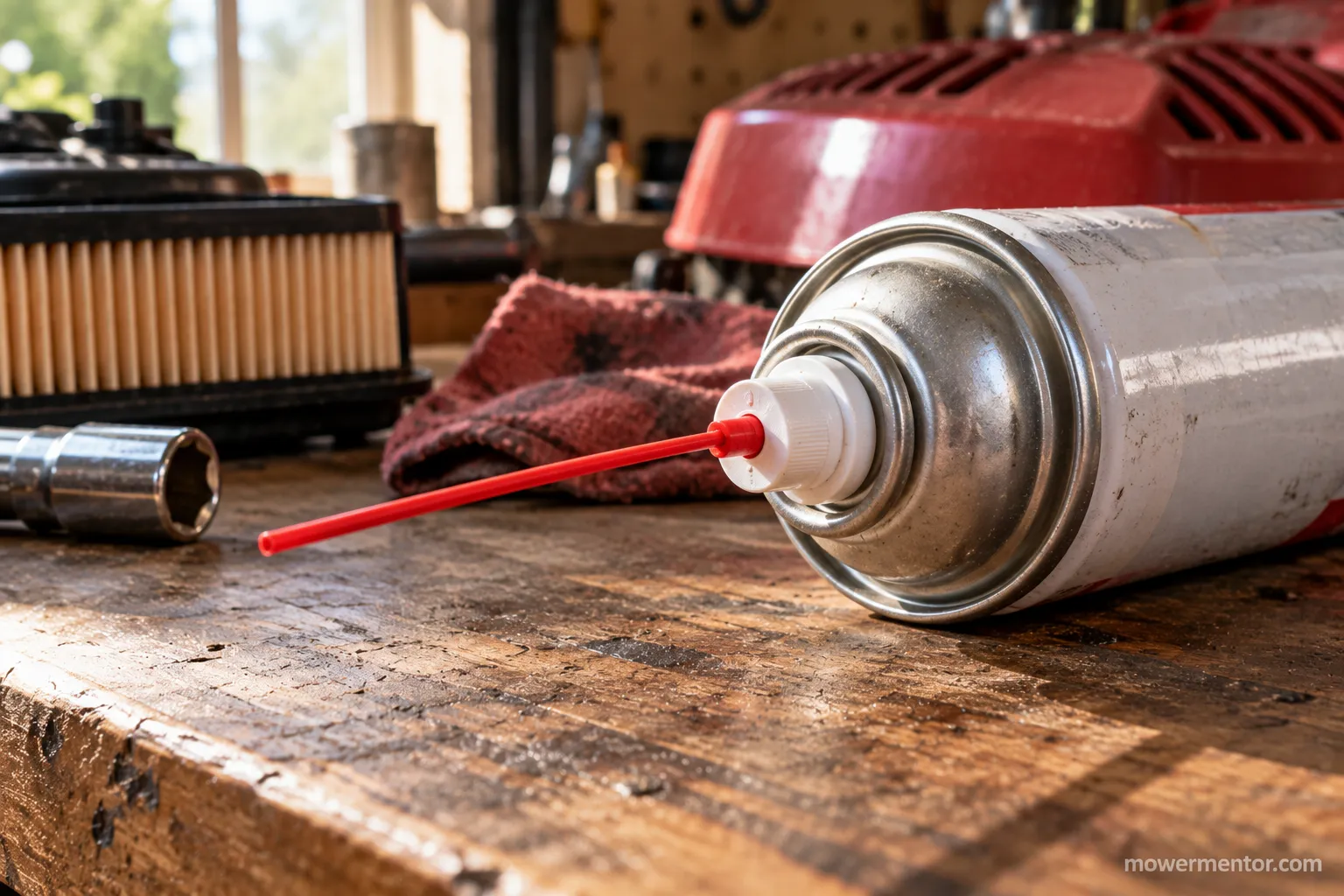
If the can becomes a weekly ritual, price out the real fix and compare starter replacement options.
If hard starting is really a tired battery, size the correct 12V mower battery instead of spraying.
Husqvarna owners troubleshooting the starter can begin with the Husqvarna starter guide.
A stopgap, not a solution. Any starting fluid is a bridge to the shop bench. The lasting fix is a clean fuel system, not another can.
Frequently Asked Questions
Can you spray starting fluid in the spark plug hole?
It is not recommended: ether in the spark-plug hole washes the oil film off the cylinder wall, invites cross-threading, and is less effective than the throat, and in our own runs it left the bore dry while the throat did the job cleaner. Spray the carburetor throat instead.
Can you use starting fluid on a diesel riding mower?
No: as DieselHub explains, diesel and glow-plug engines run high compression, so ether can pre-ignite and detonate, which risks real engine damage. Diesel garden tractors should be started with their glow plugs and proper fuel, never a spray.
Do electric riding mowers need starter fluid?
No: battery-electric mowers have no carburetor and no combustion, so there is nothing for ether to ignite. Their upkeep is a different job, and this guide covers how electric mowers are serviced.
How often can you use starting fluid?
As a test, not a routine: if you need it at every start, something is unfixed, usually fuel. Owners who suspect the starter can bench-test it first, and Troy-Bilt Pony and Bronco owners start with the Troy-Bilt starter guide.
It fires then dies. What should I check first?
Check fuel first: stale gas, a varnished carburetor, and a clogged fuel filter cause most cases. If it will not crank at all, that is electrical instead, and Murray owners can match the Briggs cross-reference in the Murray starter guide.
The Bottom Line: Test First, Then Fix
Treat starter fluid for riding lawn mower troubles as a one-second test, not a crutch. One short burst into the carburetor throat with the engine off tells you almost everything: fire then die means fuel, no fire means spark or compression, and no crank means electrical.
Our own test mower's real cure was a carburetor clean, not the can. Read the result, fix the cause, and put the can back on the shelf until the next quick diagnosis.
Found this useful? Make us a preferred source so we show up in your Google results.
Keep reading
Related articles
Troubleshooting & Repair
Dead Dash? Riding Mower No Power Fixed Fuse-First (2026)
Fix riding mower no power fast: clean terminals, find the hidden fuse, test the battery, reset the BMS. A fuse-first checklist for gas & electric mowers.
Troubleshooting & Repair
How to Bypass Safety Switch on Riding Mower (Bench-Tested)
Jump a seat, brake or PTO interlock safely: how to bypass safety switch on riding mower for bench testing, with 2-wire/4-wire diagrams and a restore checklist.
Troubleshooting & Repair
Riding Lawn Mower Won't Turn Over: 5-Stage Voltage Test
Fix it fast: a riding lawn mower won't turn over usually means battery, ground, solenoid or starter. Test each in 5 ordered stages.
Troubleshooting & Repair
Just Clicks? Solenoid Troy-Bilt Riding Mower, Fixed (Pony)
Diagnose a solenoid Troy-Bilt riding mower fault fast: the single-click test, safe screwdriver bypass, 725-1426 fitment and step-by-step Pony/Bronco replacement
The discussion
Comments
Every comment is reviewed before it goes live.