
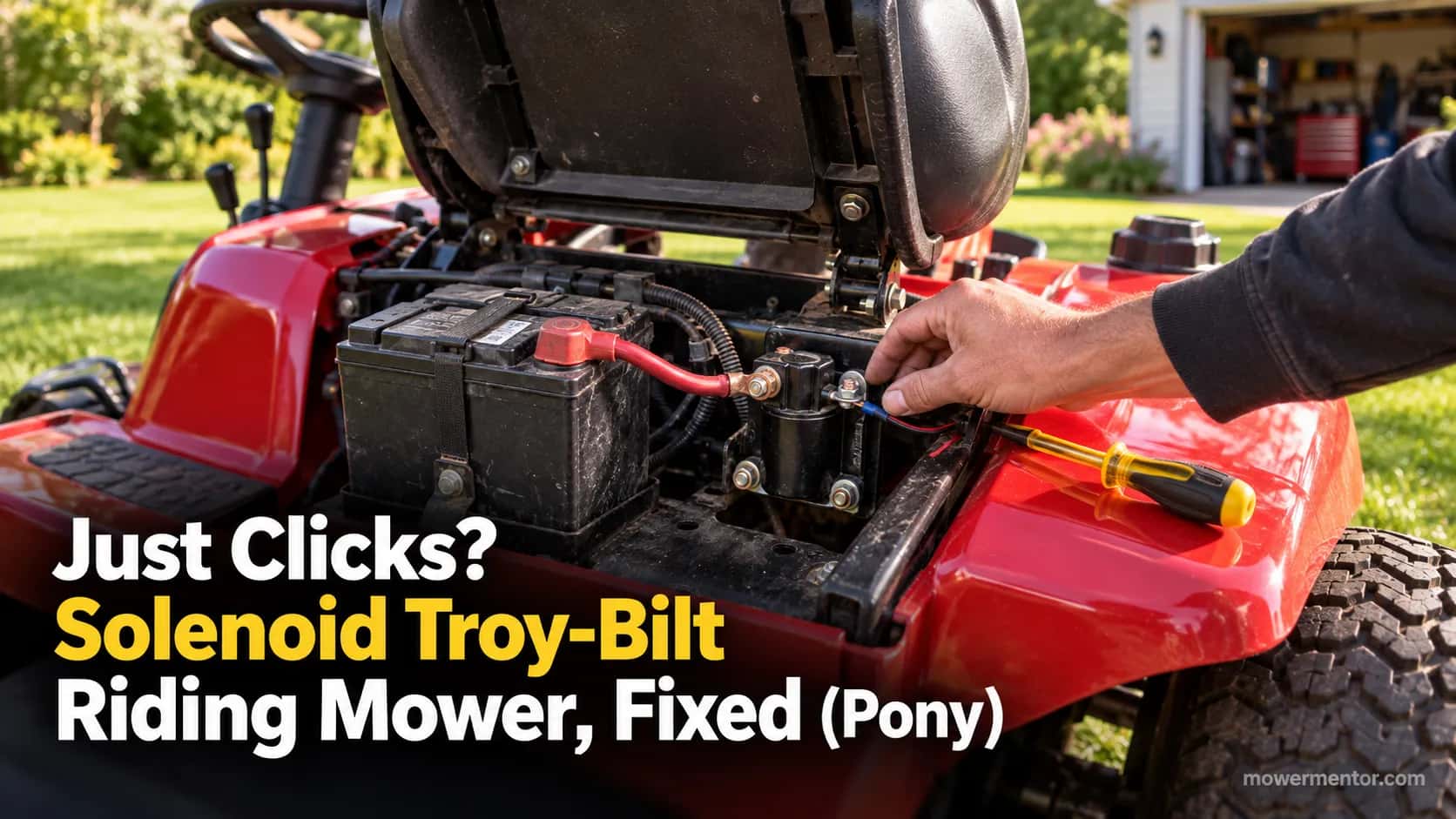
Just Clicks? Solenoid Troy-Bilt Riding Mower, Fixed (Pony)
Diagnose a solenoid Troy-Bilt riding mower fault fast: the single-click test, safe screwdriver bypass, 725-1426 fitment and step-by-step Pony/Bronco replacement
Written by Tony MaldonadoReviewed by Wade CoburnLast updated on September 24, 2026
When you buy parts or tools through links on our site, we may earn a commission at no extra cost to you. It never changes what we recommend. Learn more.
On a solenoid Troy-Bilt riding mower, one flat click with a charged battery almost always means a dead starter solenoid or a bad ground, not a dead engine.
Confirm the battery reads about 12.6 volts at rest, bridge the two large solenoid posts with an insulated screwdriver, and if the starter spins the solenoid is the culprit.
The common fit is the MTD 725-1426 family (now sold as 925-1426A), a $12 to $35 part you can swap in about 15 minutes.
You turned the key, expecting the engine to roar, and got a single flat click instead. Nothing else.
That one click is the most misdiagnosed sound in small-engine repair, and it sends people straight to a new battery or a shop bill they did not need.
On a solenoid Troy-Bilt riding mower, the click usually points at a cheap relay you can test in two minutes and replace for the price of lunch.
This guide walks the exact order I use on the bench: confirm the battery, prove the solenoid, buy the right part, and swap it.
No throwing parts at it, and no guessing.
Solenoid Troy-Bilt Riding Mower: What It Does and Where It Sits (Pony/Bronco/Super Bronco)
The starter solenoid on a Troy-Bilt riding mower is a high-current relay that connects the battery to the starter motor when you turn the key.
According to Troy-Bilt's own parts catalog, the genuine unit is a 12 volt relay rated near 100 amps, because the starter draws far more current than the thin key-switch wiring could ever carry.
The key switch sends a small trigger signal, the solenoid slams a heavy internal contact closed, and the full battery current reaches the starter. When that contact wears out, you get the click with no crank.
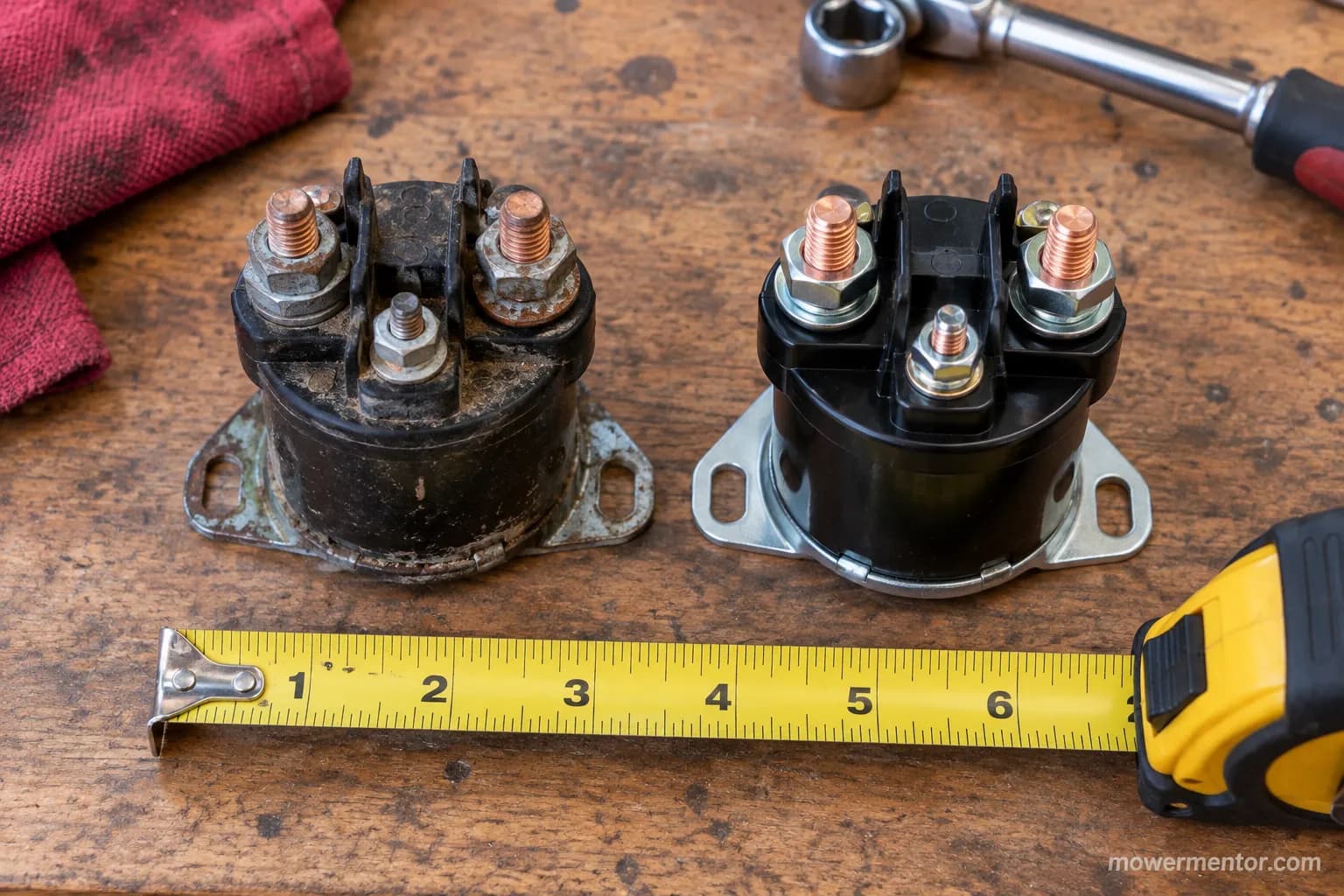
On the MTD-based Pony, Bronco, and Super Bronco platforms, the solenoid is a small black cylinder about the size of a shotgun shell, bolted to the frame.
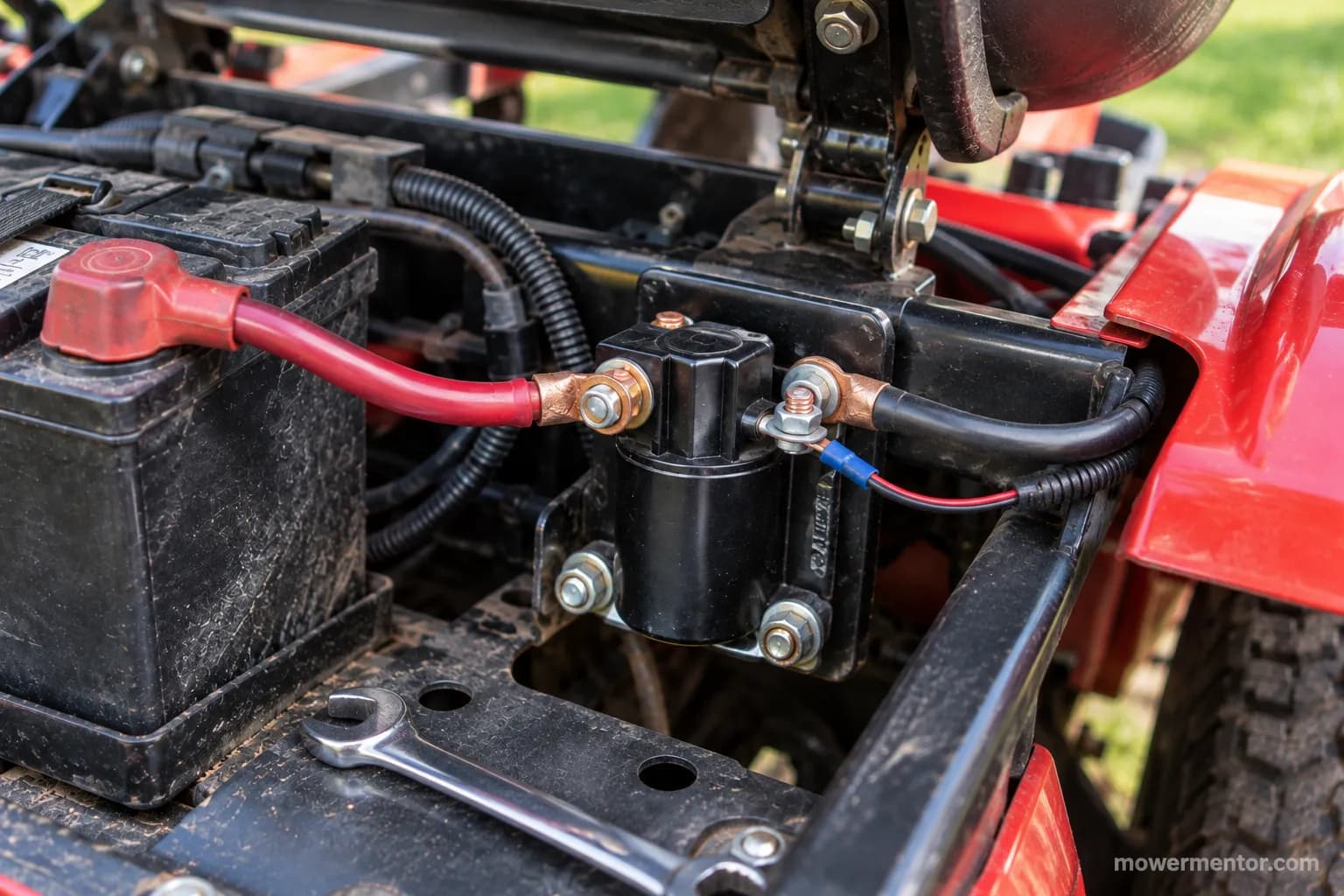
You will find it in one of two spots. Trace the heavy red cable straight off the battery positive terminal, and it lands on the solenoid every time.
Under the seat, just left of the battery, bolted to the frame rail (most common on Bronco and Super Bronco).
Up under the dash tower, near the ignition switch, on some Pony builds.
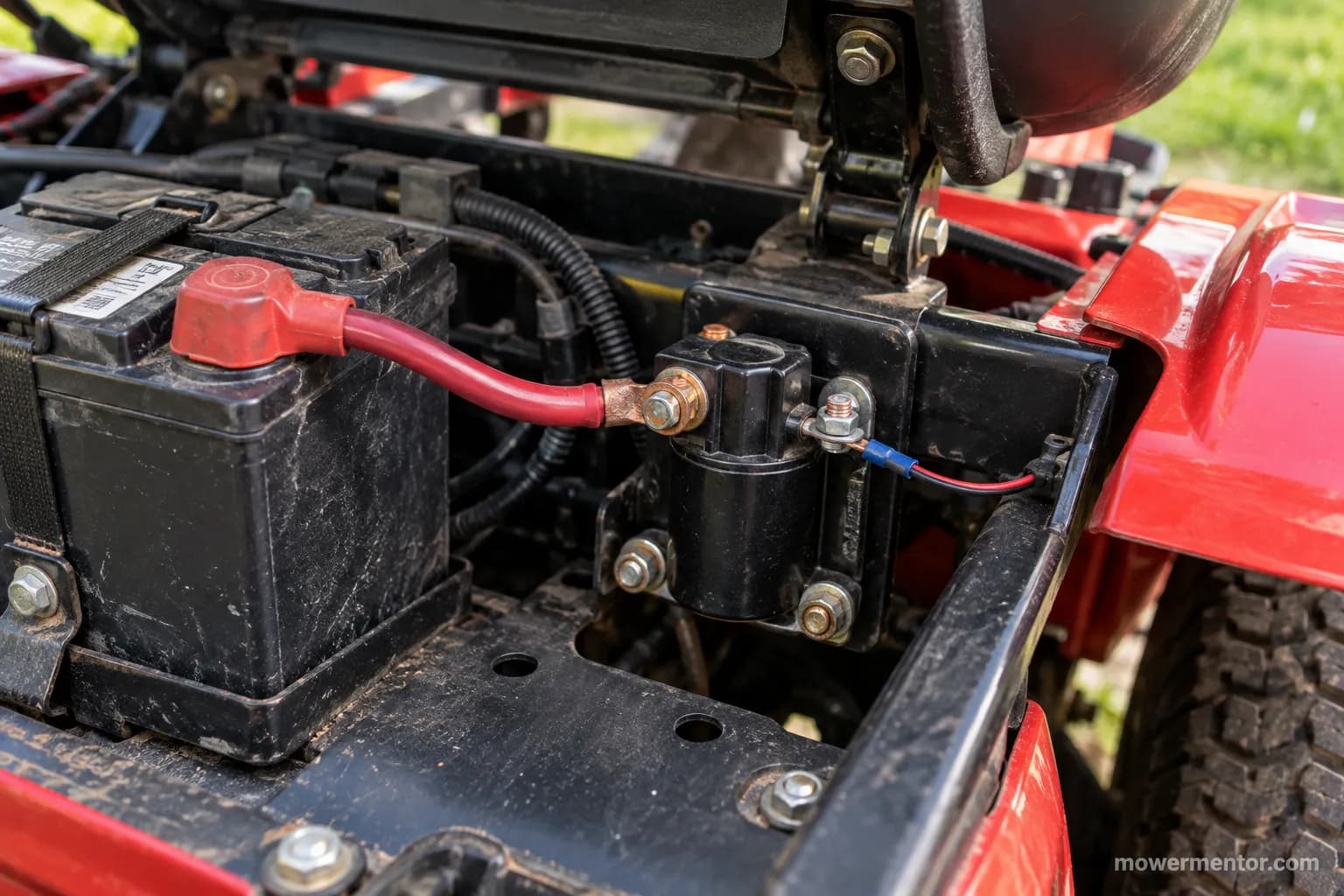
Understanding what a starter solenoid actually does makes the rest of this diagnosis obvious.
The part is just a remote switch, and it either passes current or it does not.
One detail trips people up. Most Troy-Bilt units are the three-post type, which grounds through its own mounting bracket, so a rusty bracket alone can mimic a dead solenoid before the relay is ever at fault.
If the relay turns out to be fine, the fault often lives one step downstream in the starter motor it feeds, which is a different repair with different symptoms.
Solenoid, Battery, or Ground? The 60-Second Diagnosis
Before touching the solenoid on a Troy-Bilt riding mower, the sound of the click tells you where to look first.
According to Interstate Batteries, a charged 12 volt battery should rest at 12.6 volts or higher, and that single reading splits the diagnosis in half.
One slow, flat click with a good battery points at the solenoid or a ground.
Rapid machine-gun clicking points at a weak battery or a loose cable instead, so getting this step right is what stops you from throwing parts at it.
Here is the pattern I check first, every time.
What you hear or see | Most likely cause | First move |
|---|---|---|
One flat click, lights stay bright | Solenoid contacts, or frame ground | Bridge the solenoid posts (next section) |
Rapid clicking, lights dim | Low or dead battery, loose cable | Charge and load-test the battery |
Total silence, no click at all | Safety interlock, ignition switch, or fuse | Check seat, brake, and PTO switches |
Click plus hot or smoking wire | Failed solenoid stuck partly closed | Disconnect the battery, replace the solenoid |
Start with the battery, because it is the cheapest thing to rule out.
Set a multimeter to DC volts and read straight across the battery terminals with the key off.
Anything at or above 12.6 volts is a healthy resting charge, while a reading down near 12.2 volts is roughly half charged and worth topping up before you blame anything else.
It is always worth taking a minute to confirm the battery first so you do not replace a good solenoid.
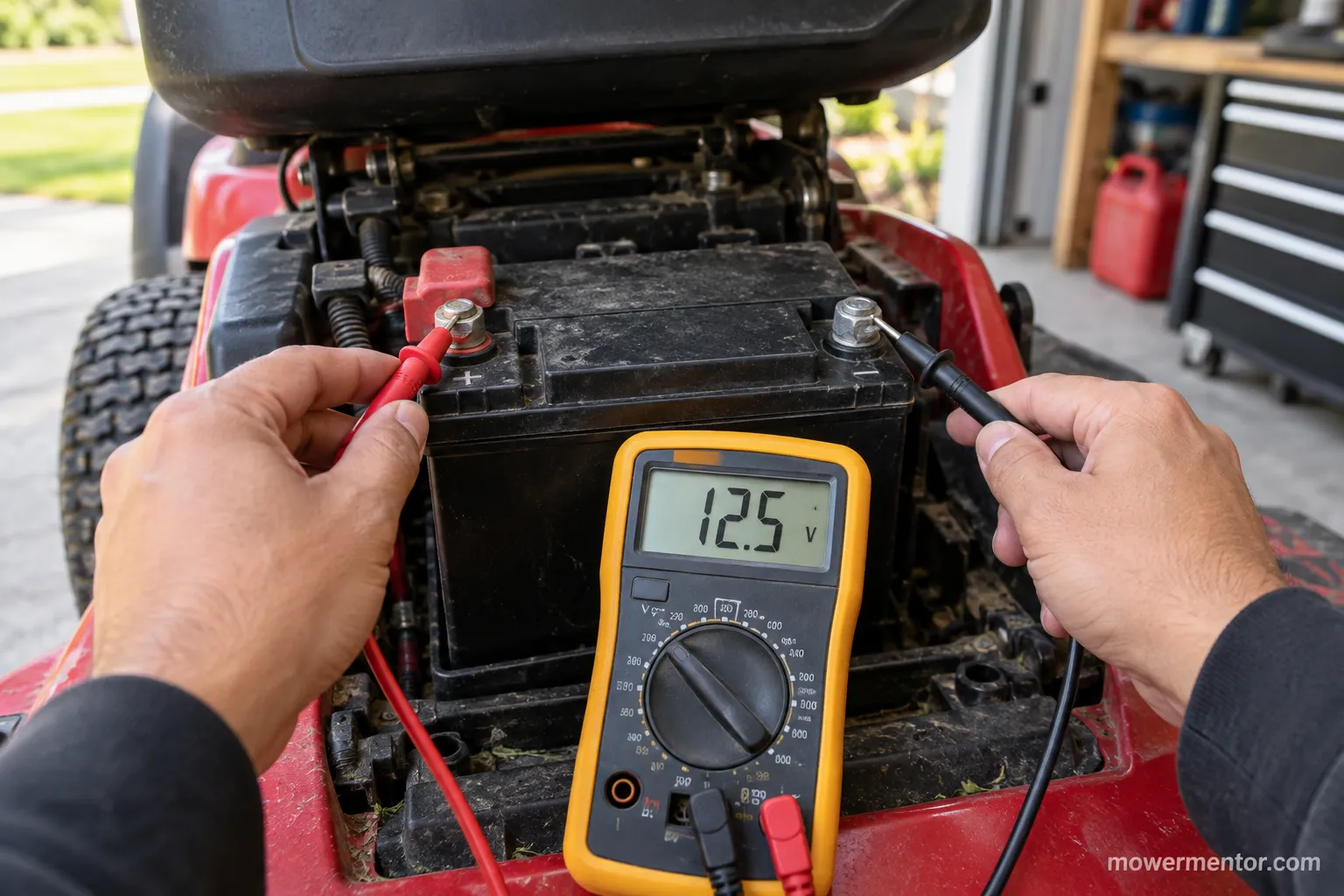
The next suspect costs nothing to check. A loose or corroded frame ground is the single most common false alarm on these machines, because the corrosion adds just enough resistance to produce a no-crank click that looks exactly like a dead relay.
Wiggle the ground strap where it bolts to the frame, scrape the contact point clean, and retry the key.
If the click pattern still has you stuck, why a mower only clicks breaks down each sound in more detail.
Our Troy-Bilt click-no-start walkthrough covers the model-specific quirks. For the relay angle alone, what the click pattern tells you maps each sound to a fault.
How to Test It: Screwdriver Bypass + Multimeter
The fastest way to prove a solenoid Troy-Bilt riding mower fault is to do the solenoid's job by hand.
As Garden Aider describes the field test, bridging the two large posts with an insulated screwdriver sends battery current straight to the starter.
If the starter spins strongly, the relay was the only thing failing and the starter is healthy.
Expect a spark when the metal touches both posts, which is normal and not a sign of damage.
This one test settles the question in under a minute.
Set the parking brake, disengage the blade (PTO off), and keep your hands clear of the belt before you start.
The screwdriver bypass test:
Peel back the rubber boots covering the two large terminals on the solenoid.
Wear eye protection and clear away any fuel cans or dry debris nearby.
Lay the shaft of a thick, insulated-handle screwdriver across both large posts at once.
Watch and listen: a small spark is expected, so do not flinch and drop the tool.
If the starter spins the engine over, the solenoid is bad. If nothing happens, the fault is the starter, the cables, or the battery.
Bridging the posts safely is worth doing right, and safely bridging the posts covers the technique in full if this is your first time.
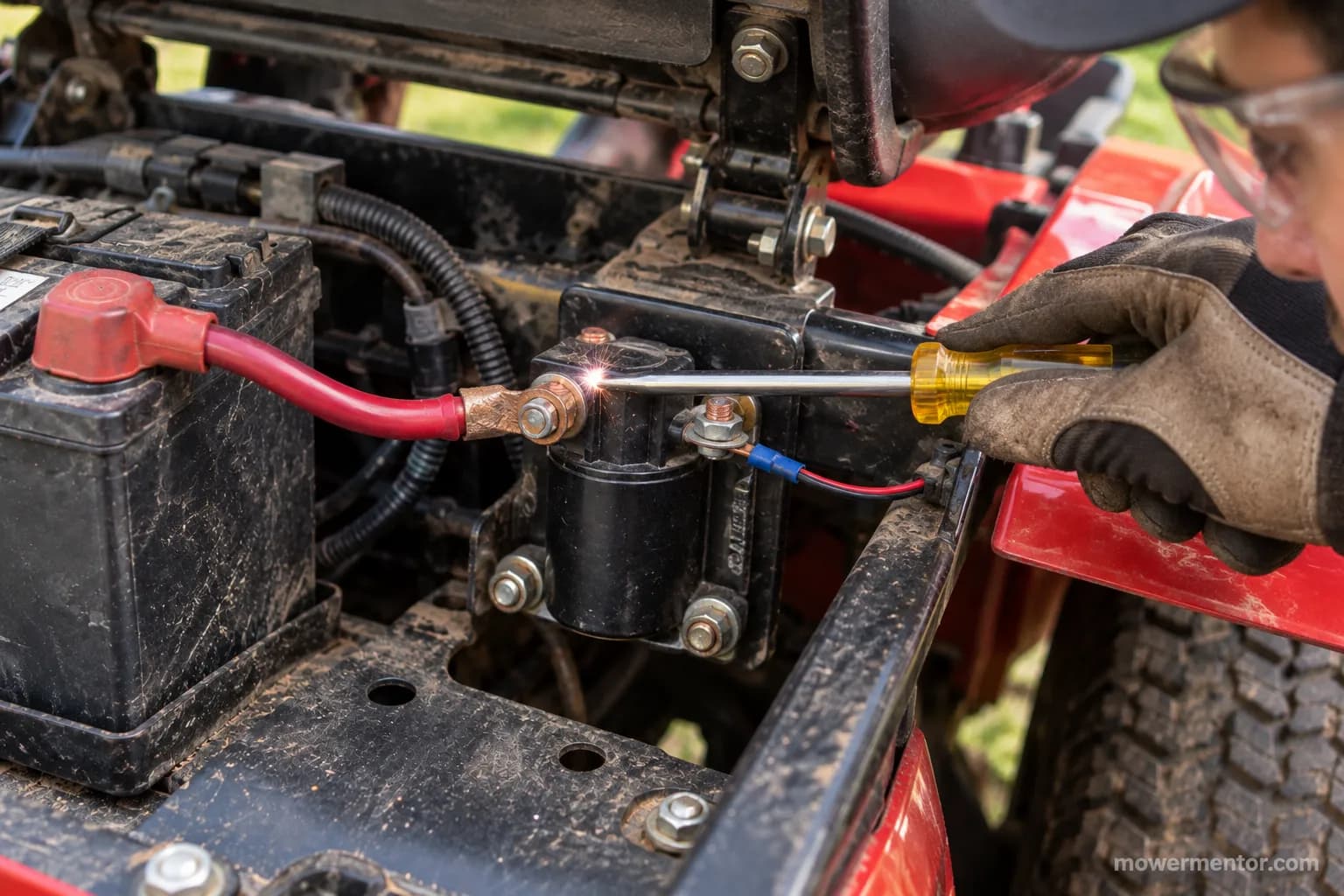
For a cleaner yes-or-no answer, the multimeter test removes all doubt. It reads what the relay is actually doing under load, which the bypass cannot show you.
The multimeter test (DC volts):
Set the meter to DC volts and back-probe the small trigger terminal.
With a helper turning the key to start, the trigger should read roughly battery voltage, about 12 volts.
Move the probe to the large output post (the cable heading to the starter) and turn the key again.
Trigger voltage present but zero output voltage means the contacts are not closing. The solenoid is bad.
Here is what my meter showed on the Bronco, and it is the textbook signature of a failed relay.
Test point | Key off | Key to start | Verdict |
|---|---|---|---|
Battery terminals | 12.5 V | 12.5 V | Battery healthy |
Solenoid trigger post | 0 V | 12.4 V | Switch and safeties good |
Solenoid output post | 0 V | 0 V | Contacts not closing, solenoid bad |
Voltage in on the trigger, nothing out to the starter, is the clearest fail you will find. If you want the bench version with the part removed, the full bench-test method shows the continuity checks too.
One reading surprised me the first time I saw it.
A solenoid can pass the click test and still fail the output test, because the coil that makes the click is a separate circuit from the heavy contacts that carry the current.
That is why the meter beats your ears here.
When the wiring layout throws you, how the terminals are wired lays out the three-post and four-terminal versions side by side.
The Right Replacement Part: 725-1426 Cross-Reference & Fitment
Buying the right solenoid for a Troy-Bilt riding mower is mostly about matching the MTD 725-1426 family.
Troy-Bilt runs on the MTD platform, so the same relay carries a stack of part numbers across brands, and MaxPower's cross-reference listing confirms one aftermarket unit replaces MTD 725-1426, 925-1426 and 925-1426A plus Toro 112-0309 and Snapper 18817.
The genuine Troy-Bilt part number 725-1426 now ships as the superseding 925-1426A. It runs about $12 to $35 depending on brand.
Two physical details decide whether a part actually fits, no matter what the box says.
Fitment check | What to match | Why it matters |
|---|---|---|
Post count | Three-post (grounds through bracket) vs four-terminal (dedicated ground) | Wrong count means no ground path or a spare stud |
Eyelet size | Accepts both 5/16 inch and 1/4 inch cable ends | Cable lugs must seat on the studs |
Mount | Bracket fits chassis or wall mount | Solenoid must bolt to your frame point |
Duty | 12 volt, roughly 80 to 100 amp | Undersized relays burn out fast |
The cross-reference below saves you a second trip to the parts counter.
Brand | Interchange part numbers |
|---|---|
MTD / Troy-Bilt / Cub Cadet | 725-1426, 725-1426A, 925-1426, 925-1426A |
Toro | 112-0309, 334009B |
Snapper | 18817, 75671 |
Murray | 424285, 21261 |
Bolens | 1751569 |
A universal three-post relay from the MTD family is the safe default for most Pony and Bronco riders.
Aftermarket is genuinely fine here, as long as the post count and eyelet size match your old part, because this is a commodity relay rather than a precision assembly.
If you are still narrowing down whether the solenoid is even your problem, the whole no-start decision tree routes every symptom.
For the brand from end to end, the complete Troy-Bilt no-start guide picks up where this leaves off.
How to Replace the Starter Solenoid on a Troy-Bilt Riding Mower (Step-by-Step)
Replacing the starter solenoid on a Troy-Bilt riding mower takes about 15 minutes and one wrench.
According to BlueStars' install notes, the two rules that prevent a repeat failure are disconnecting the negative battery terminal first and photographing the wiring before you remove anything.
Skip either and you risk a dead short or a swapped cable.
The job itself is four bolts and four wires, and the new relay drops straight onto the same bracket.
Work slowly on the wiring and this is a genuinely easy swap.
Disconnect the negative battery cable first. This kills the short-circuit risk while you handle the heavy positive cable.
Photograph the old solenoid. Capture which cable lands on which post before anything moves.
Label the wires with tape if your phone photo is not crystal clear.
Remove the four connections: the heavy battery cable, the heavy starter cable, the small trigger wire, and the ground wire or bracket bolt.
Unbolt the solenoid from its frame bracket.
Mount the new solenoid on the same bracket, snug but not stripped.
Reattach the wires exactly as your photo shows, saving the negative battery cable for last.
Test: set the brake, blade off, and turn the key. It should crank and start.
One tip from doing this more than once: snug the large-post nuts properly.
A loose large-post nut lets the high current arc and heat the terminal, which burns it and mimics a bad solenoid all over again a few weeks later.
Since the seat is already up and the battery is loose, it is a good moment for a broader spring service.
If the mower has been sitting, it is also the easy time to swap a clogged air filter while your tools are out.
For the brand-neutral version of this swap, the generic replacement walkthrough covers other mounting styles.
When It's NOT the Solenoid (What to Check Next)
Sometimes the solenoid on a Troy-Bilt riding mower tests good, and the no-crank fault lives somewhere else.
As Wildwood Small Engine Repair lays out, a mower with a confirmed-good battery that still will not crank has its problem in one of two parts, the relay or the starter, and the sound tells them apart.
Silence, a grinding noise, or a slow drag points at the starter, not the solenoid. This is the honest part most parts listings skip: the cheapest part is not always the answer.
Run through these before you spend another dollar.
A corroded ground or battery cable. The same false alarm from the diagnosis section, worth a second look if the bypass test was inconclusive.
A tripped safety interlock. Seat, brake, or PTO switches cut the circuit, and a bad one gives you total silence, not a click.
A worn ignition switch. If the key does nothing at all, the switch itself may not be sending the trigger signal.
The starter motor. If bridging the posts gives a slow drag or nothing, the starter is the likelier suspect.
Total silence usually means a safety switch or the ignition, so a worn ignition switch is where I look when there is no click at all.
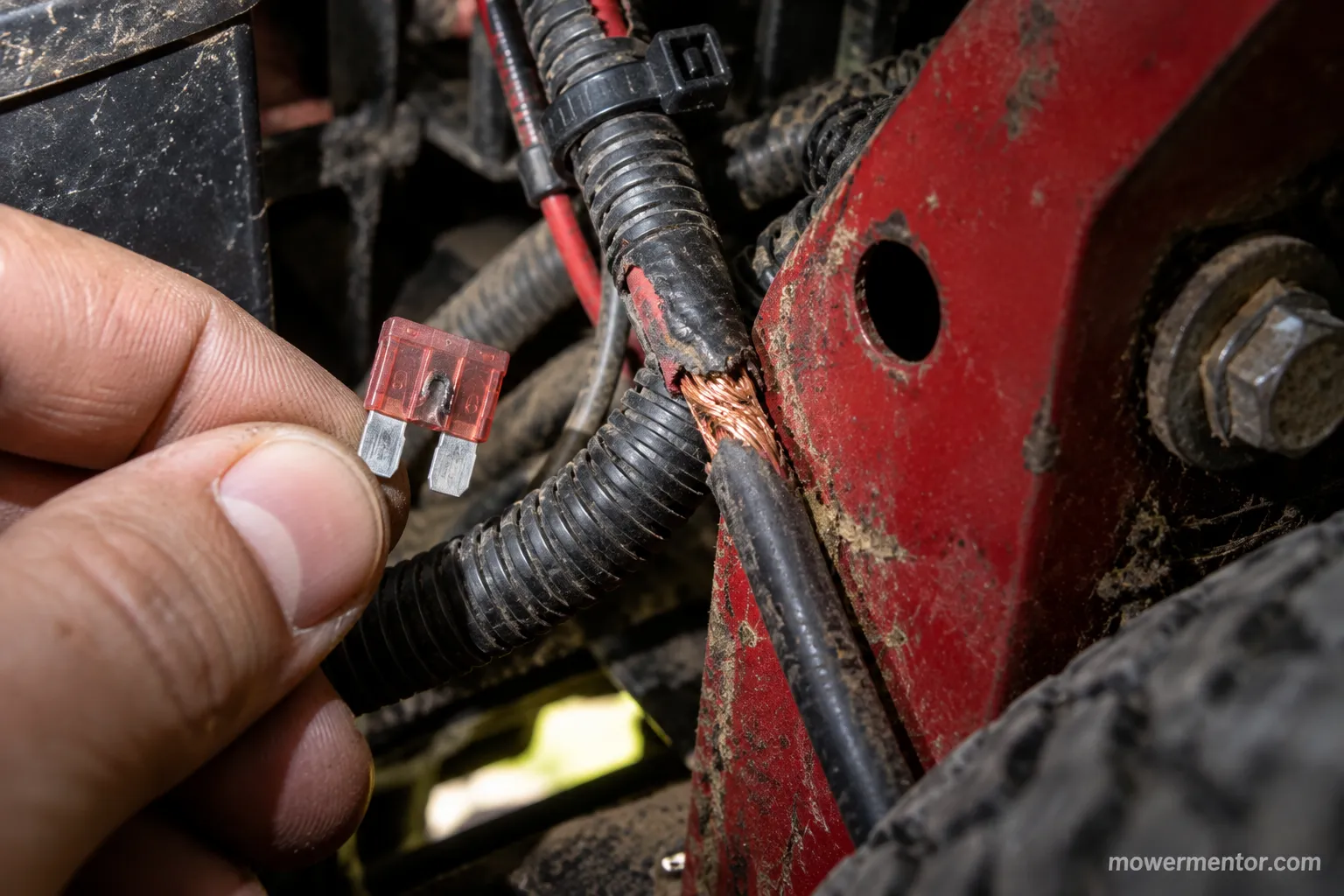
Watch for one telltale case. If the mower blows a fuse the instant you turn the key, you have a short somewhere in the harness, not a bad relay, and a new solenoid will blow that fuse too.
I hit exactly that on one reader's Bronco. It blew its 20 amp fuse on every key-turn, and the cause was a chafed harness wire rubbing the frame, not the solenoid at all.
If bridging the posts gives a slow drag instead of a strong spin, learn the signs of a failing starter before you swap anything.
And if it cranks fine but simply will not fire, that is a fuel or spark issue, so check for spark instead.
Frequently Asked Questions
Why does my Troy-Bilt just click and not start?
A single flat click with bright lights and a charged battery is the classic dead-solenoid signature. The relay's coil is pulling in (that is the click) but its worn contacts are not passing battery current to the starter.
Confirm the battery at 12.6 volts, bridge the posts, and if the starter spins, replace the solenoid.
Where is the solenoid on a Troy-Bilt Pony or Bronco?
Trace the heavy red cable off the battery positive terminal. On most Bronco and Super Bronco riders the solenoid sits under the seat just left of the battery, while on some Pony builds it is up under the dash tower near the ignition switch.
It is a small black cylinder bolted to the frame.
Can you bypass the solenoid to start the mower?
Yes, briefly, as a test. With the brake set and blade off, lay an insulated screwdriver across the two large posts, where a spark is normal.
If the engine cranks, the solenoid is bad. This is a diagnosis and not a permanent fix, so replace the relay rather than running it bridged.
What part number solenoid does a Troy-Bilt use?
Most Troy-Bilt riders use the MTD 725-1426 family, now sold as the superseding 925-1426A. The same relay cross-references to Toro 112-0309, Snapper 18817, Murray 424285, and others.
Match the post count and eyelet size and any of these will fit.
How much does the solenoid cost, and is aftermarket okay?
Expect roughly $12 to $35. Aftermarket is fine on this part as long as the post count (usually three) and the 5/16 or 1/4 inch eyelets match your old one.
It is a commodity relay, not a precision component.
What if the mower won't turn over at all, with no click?
No click at all points away from the solenoid toward a safety interlock, the ignition switch, or a blown fuse.
A dead circuit like a mower that won't turn over is a different branch of the diagnosis than the single-click case.
Check the seat, brake, and PTO switches first.
While the tools are out, a battery-powered Troy-Bilt follows a different rhythm covered in battery-mower upkeep.
A cracked airbox is a quick same-afternoon fix too if you are replacing a cracked filter cover.
Bottom Line: Prove It, Then Fix It
The whole point of a solenoid Troy-Bilt riding mower diagnosis is to prove the fault before you spend a cent.
One flat click, a battery at 12.6 volts, and a starter that spins when you bridge the posts is all the confirmation you need.
Match the 725-1426 family, mount the new relay, and snug the posts. Most riders are back to cutting the same afternoon for the price of a $16 part and about 15 minutes.
If your test did not confirm the solenoid, you just saved that money. Go check the next suspect instead of throwing parts at it.
Found this useful? Make us a preferred source so we show up in your Google results.
Keep reading
Related articles
Troubleshooting & Repair
Dead Dash? Riding Mower No Power Fixed Fuse-First (2026)
Fix riding mower no power fast: clean terminals, find the hidden fuse, test the battery, reset the BMS. A fuse-first checklist for gas & electric mowers.
Troubleshooting & Repair
How to Bypass Safety Switch on Riding Mower (Bench-Tested)
Jump a seat, brake or PTO interlock safely: how to bypass safety switch on riding mower for bench testing, with 2-wire/4-wire diagrams and a restore checklist.
Troubleshooting & Repair
Riding Lawn Mower Won't Turn Over: 5-Stage Voltage Test
Fix it fast: a riding lawn mower won't turn over usually means battery, ground, solenoid or starter. Test each in 5 ordered stages.
Troubleshooting & Repair
Troy-Bilt Riding Mower Starter: 14/16-Tooth Fit & Test
Test your Troy-Bilt riding mower starter in two minutes, tell it apart from a bad solenoid, and match the 14- or 16-tooth Briggs/Kohler unit before you buy.
The discussion
Comments
Every comment is reviewed before it goes live.