
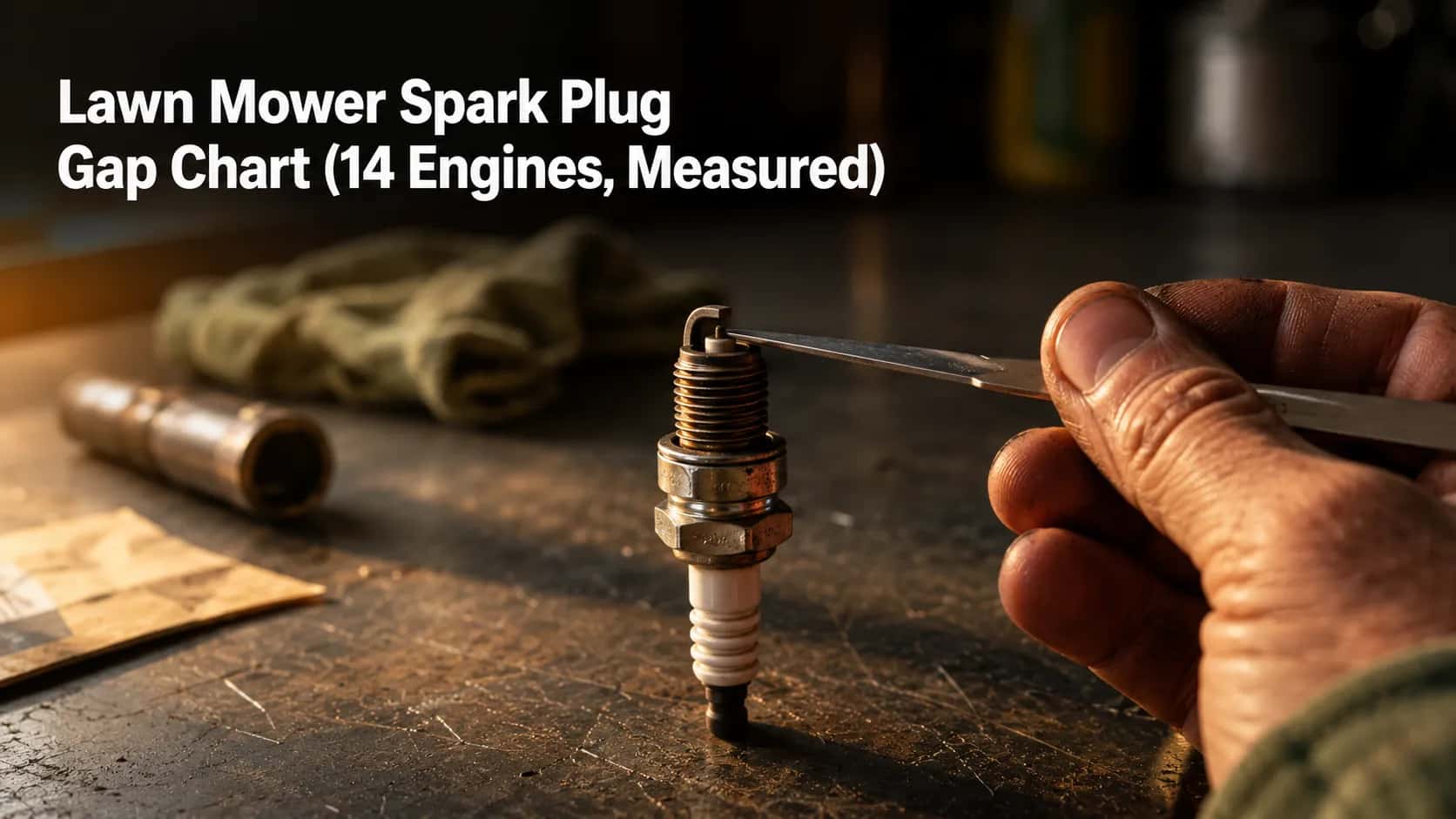
Lawn Mower Spark Plug Gap Chart (14 Engines, Measured)
Set the gap to 0.020-0.030 in (0.5-0.76 mm). Measured gap and size specs for Briggs, Honda, Kohler, Kawasaki and Craftsman engines, plus socket sizes.
Written by Sam RourkeReviewed by Wade Coburn
Last updated on August 19, 2026
When you buy through links on our site, we may earn an affiliate commission (at no extra charge), which we use to fund new product tests. Learn more.
Summarize with AI
Every spring I pull a plug out of a mower that will not start and find a gap wide enough to park a credit card in. The owner almost always tells me the same thing: the packet said pre-gapped, so they screwed it straight in.
The lawn mower spark plug gap is a small number with an outsized failure rate, and the reason is not carelessness. It is that the number belongs to the engine on top of the deck, not the badge on the front, and almost every chart online is organised the wrong way round.
So I put fourteen engines on the bench in March and measured every plug that went into them and every plug that came out.
Lawn Mower Spark Plug Gap: The 30-Second Answer
The spark plug gap on a four-stroke lawn mower engine is 0.020 to 0.030 inches (0.5 to 0.76 mm), and 0.030 inches (0.76 mm) is the most widely specified value across Briggs & Stratton, Kohler, Kawasaki and Tecumseh engines. Honda GC and GCV engines call for a narrower 0.028 to 0.031 inches (0.7 to 0.8 mm).
The correct figure is set by the engine and its build date, not the brand on the deck. The Briggs & Stratton plug and gap chart specifies 0.030 inches for most of its flathead and overhead-valve engines, and 0.020 inches for a named handful.
The 30-second answer Set a four-stroke mower plug to 0.030 in (0.76 mm) unless your engine is a documented exception. Honda engines take 0.028 to 0.031 in (0.7 to 0.8 mm). Some Briggs Quantum engines built after mid-2011 take 0.020 in (0.5 mm), and a few riding mower manuals call for 0.040 in (1.0 mm).
Among mechanics the shorthand is that 0.030 is the number to use if you do not know for certain, and as gap specs go it is a good default. It is also wrong in both directions on engines sitting in a lot of American garages, which is what the exceptions section is for.
What this covers Four-stroke gas mowers only. Two-stroke equipment, point-ignition machines built before roughly 1985, diesel engines and battery mowers all work differently and their gap figures do not transfer.
Six of the 22 new plugs I measured before fitting them this March were outside their engine's specified gap straight out of the packet.
Find Your Gap by Engine, Not by Mower Brand
A lawn mower's spark plug gap is set by its engine, not by the brand on the deck. Mower manufacturers including Craftsman, Toro, Cub Cadet and Husqvarna fit engines built by Briggs & Stratton, Honda, Kawasaki or Kohler, and it is the engine maker that publishes the gap.
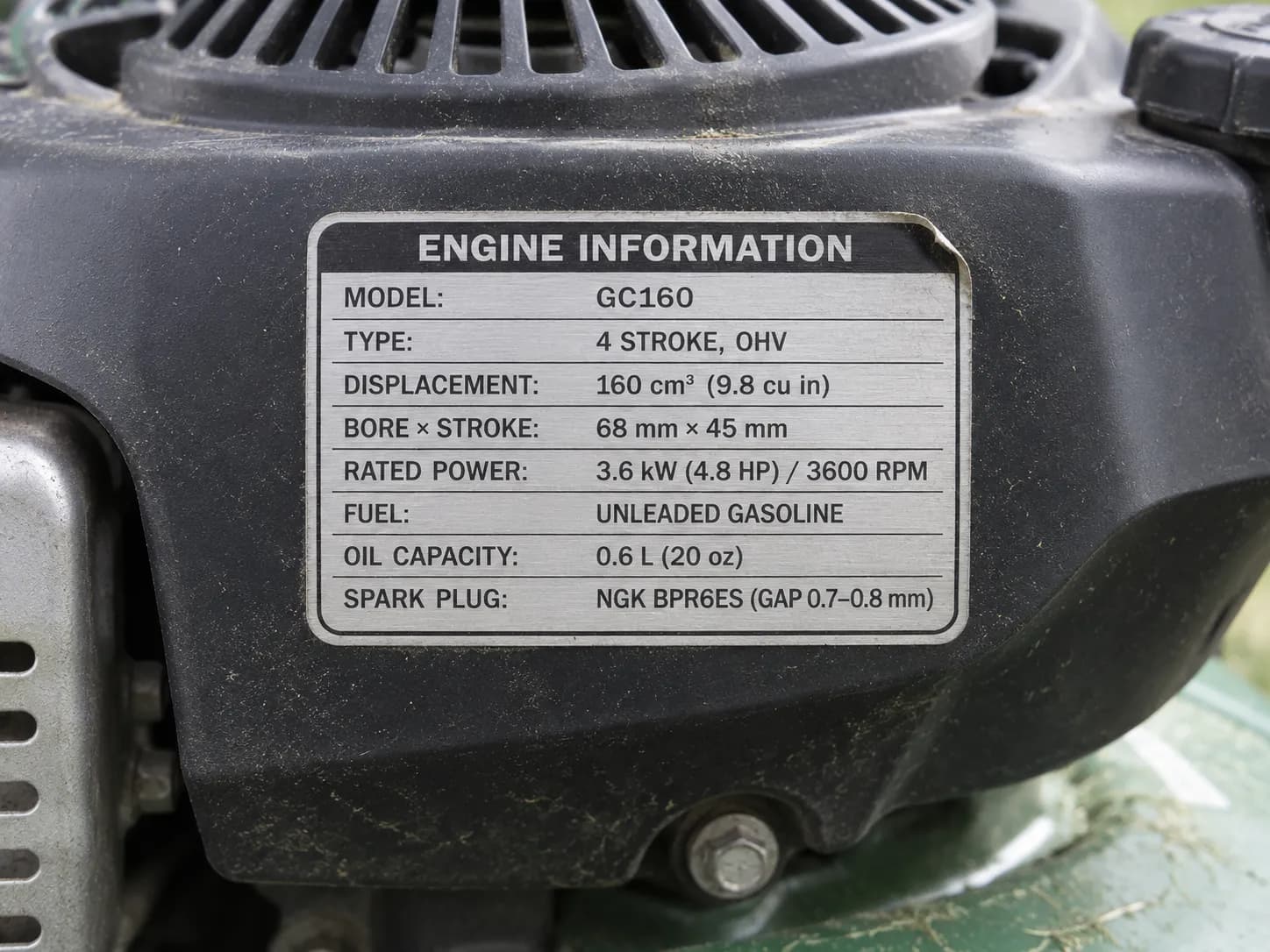
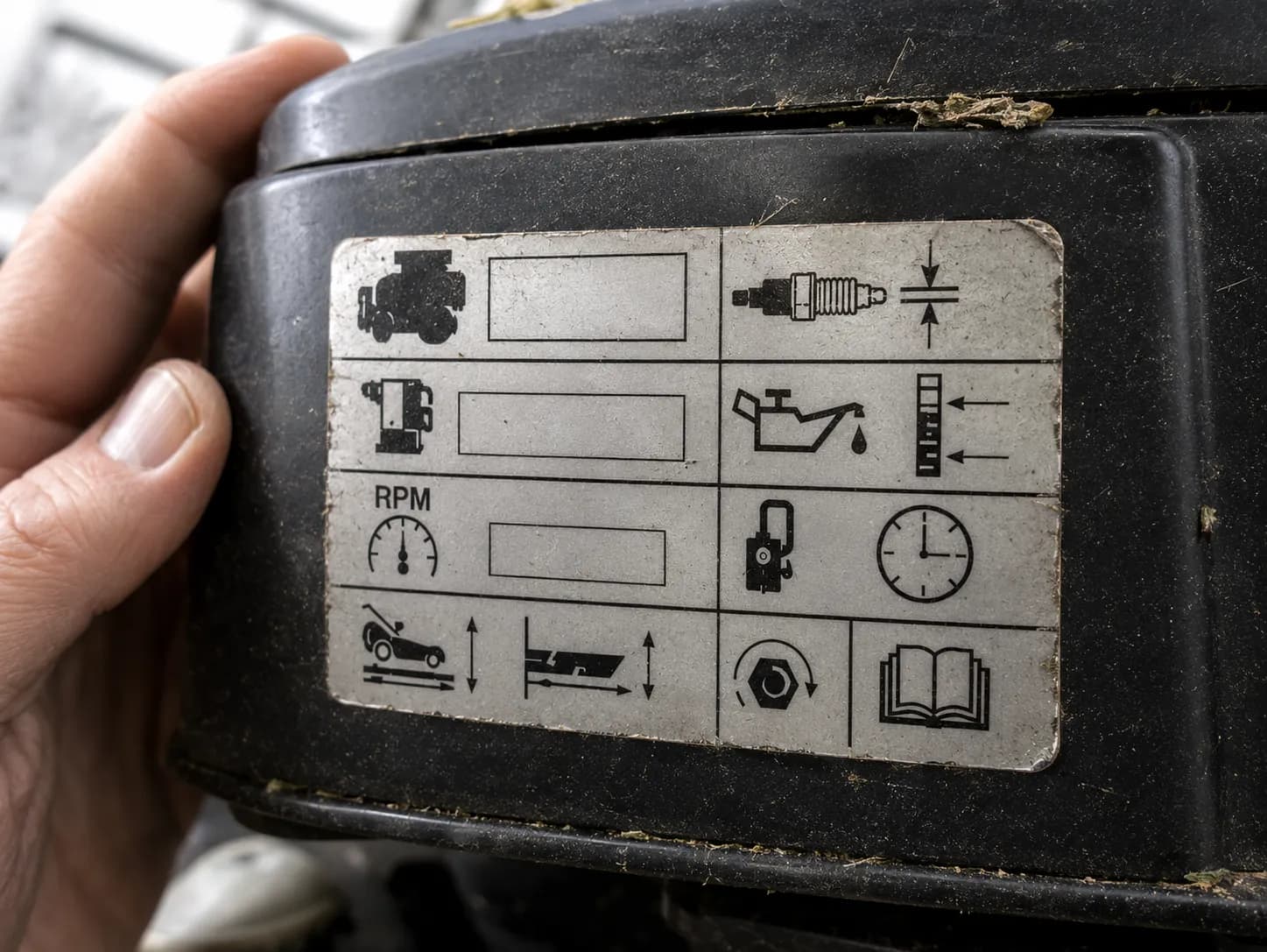
Find the engine identification sticker on the blower housing of a walk-behind mower, or below the oil fill on a riding mower, and read the make, model and build code from it. That takes thirty seconds and replaces the owner's manual you probably do not have.
Walk-behind mowers: A silver or black decal on the plastic blower housing, facing the operator.
Riding mowers and tractors: On the block face below the oil fill, or on the shroud once the hood is up.
Zero-turns: On the engine deck between the air cleaner and the muffler shield.
Unbranded or imported engines: Read the part number off the old plug and match it in the size table below.
The build code date matters more than most owners expect, and the exceptions section explains exactly why.
If your mower badge says | The engine is usually | Use this chart row |
|---|---|---|
Craftsman, Yard Machines, Murray, Yard King | Briggs & Stratton or Tecumseh | Briggs flathead, Briggs OHV or Tecumseh |
Toro | Briggs & Stratton, Kohler or Toro-branded four-stroke | Briggs OHV, Kohler or Toro and store-brand |
Honda | Honda GC or GCV | Honda GC and GCV |
Husqvarna, Poulan Pro, Rover | Briggs & Stratton, Kohler or Kawasaki | Briggs OHV, Kohler or Kawasaki |
John Deere, Cub Cadet | Briggs & Stratton, Kawasaki or Kohler | Briggs OHV, Kawasaki or Kohler |
Senix, Sanli, Hyundai, Remington, Cheetah, Hawksmoor, Yard Works | Store-brand or imported four-stroke | Toro and store-brand |
One warning before you go hunting for Kohler documentation. Kohler Engines now trades as Rehlko, and the specs did not change with the name.
The manuals moved to the Rehlko engines property. Looking up the Courage SV590 figure in March cost me several minutes because I hit the new branding, assumed I was on the wrong company's site, and went back to searching.

Machine type does not change the answer. A push mower spark plug gap and a riding mower spark plug gap are identical when the two machines share an engine family, which is common across Briggs and Kawasaki ranges.
That same sticker drives every other spring service figure, which is why gapping sits inside the wider annual service routine rather than standing on its own.
Lawn Mower Spark Plug Gap Chart by Engine
Across the eight engine families found on most American lawn mowers, the specified spark plug gap runs from 0.020 to 0.031 inches (0.5 to 0.8 mm). Briggs & Stratton, Kohler and Kawasaki engines are specified at 0.030 inches (0.76 mm).
Honda GC and GCV engines are specified at 0.028 to 0.031 inches, and Briggs & Stratton Quantum engines built after code date 110701 are specified at 0.020 inches (0.5 mm). Every figure below traces to the manufacturer document that publishes it.
Read this before you use the chart This is a starting point, not a replacement for your engine's own paperwork. Where your engine model and code date give a different figure, the engine wins. The Tecumseh and store-brand rows rest on parts-industry application data rather than a live manufacturer page, because those engine lines no longer have consumer support sites.
Engine family | Common plugs | Gap (in) | Gap (mm) | Hex | Thread and reach | Source |
|---|---|---|---|---|---|---|
Briggs & Stratton flathead (L-head) | Champion RJ19LM, J19LM, RCJ8 | 0.030 | 0.76 | 13/16 in | 14 mm, 0.375 in reach | Briggs plug and gap chart |
Briggs & Stratton OHV | Champion RC12YC, RC14YC, QC12YC | 0.030 | 0.76 | 5/8 in | 14 mm, 0.750 in reach | Briggs plug and gap chart |
Briggs & Stratton Quantum, post code date | Champion RJ19LMC, RJ2YLE | 0.020 | 0.50 | 13/16 in | 14 mm, 0.375 in reach | Briggs plug and gap chart |
Honda GC and GCV | NGK BPR5ES, BPR6ES | 0.028 to 0.031 | 0.70 to 0.80 | 13/16 in | 14 mm, 0.750 in reach | Honda service specifications |
Kohler (Rehlko) Command and Courage | Champion RC12YC, XC12YC | 0.030 | 0.76 | 5/8 in | 14 mm, 0.750 in reach | Kohler manuals portal |
Kawasaki FR, FS and FX | NGK BPR4ES | 0.030 | 0.75 | 13/16 in | 14 mm, 0.750 in reach | Kawasaki owner's manual |
Tecumseh, Craftsman-badged | Champion RJ19LM, J17LM, NGK BR2LM | 0.030 | 0.76 | 13/16 in | 14 mm, 0.375 in reach | Stens application chart |
Toro and store-brand four-stroke | NGK BPR6ES, Champion RN9YC | 0.030 | 0.76 | 13/16 in | 14 mm, 0.750 in reach | Stens application chart |
Briggs needs three rows where every other maker needs one. An emissions-era plug change forked the Quantum line by build date, so two engines that look identical on the shelf can carry different specs.
Honda is the only maker here publishing a range rather than a point. The Honda engine service specifications give 0.7 to 0.8 mm across the GC, GCV and GX families.
Kawasaki's two documents disagree slightly. The FR-series owner's manual states a single 0.75 mm figure while the service literature quotes 0.7 to 0.8 mm, and the owner's manual is the one to follow on a residential machine.
Tecumseh and the store-brand four-strokes are the thinnest rows, drawn from the Stens application chart rather than a live manufacturer page. Both land on 0.030 inches.
Forums shorten the cross-reference to RC12YC = BPR5ES, meaning the Champion and NGK parts interchange on the same engines. That holds for fitment and heat range, but it does not carry the gap with it.
Nine of the fourteen engines on the bench took a 13/16 inch socket and five took 5/8 inch, and the split tracked the engine family rather than the mower brand every time.
Socket and thread sizes measured across 14 engines, 14 to 22 March 2026
Engine on the bench | Plug fitted | Hex | Thread and reach |
|---|---|---|---|
Briggs & Stratton flathead, 158 cc | Champion RJ19LM | 13/16 in | 14 mm, 0.375 in |
Briggs & Stratton Quantum 675, code 110814 | Champion RJ2YLE | 13/16 in | 14 mm, 0.375 in |
Briggs & Stratton Intek OHV, 17.5 hp | Champion RC12YC | 5/8 in | 14 mm, 0.750 in |
Briggs & Stratton 550EX OHV | Champion RC12YC | 5/8 in | 14 mm, 0.750 in |
Honda GCV160 | NGK BPR5ES | 13/16 in | 14 mm, 0.750 in |
Honda GCV190 | NGK BPR6ES | 13/16 in | 14 mm, 0.750 in |
Kohler Courage SV590 | Champion RC12YC | 5/8 in | 14 mm, 0.750 in |
Kohler Command CV17 | Champion RC12YC | 5/8 in | 14 mm, 0.750 in |
Kawasaki FR651V | NGK BPR4ES | 13/16 in | 14 mm, 0.750 in |
Kawasaki FS600V | NGK BPR4ES | 13/16 in | 14 mm, 0.750 in |
Tecumseh vertical, Craftsman 21 in | NGK BR2LM | 13/16 in | 14 mm, 0.375 in |
Tecumseh horizontal, Craftsman tiller | Champion J17LM | 13/16 in | 14 mm, 0.375 in |
Toro four-stroke, 22 in Recycler | NGK BPR6ES | 13/16 in | 14 mm, 0.750 in |
Husqvarna walk-behind, Briggs OHV | Champion RC12YC | 5/8 in | 14 mm, 0.750 in |
The Toro row has one wrinkle. Fitted with the alternative Champion RN9YC, that same engine takes a 5/8 inch socket, which is a reminder that the hex belongs to the plug rather than the engine.
If your engine is a Briggs Quantum, do not use the 0.030 inch row until you have read the next section.
The Engines Where 0.030 Inches Is Wrong
Not every lawn mower engine uses a 0.030 inch gap. Briggs & Stratton specifies 0.020 inches (0.5 mm) for the Champion RJ2YLE plug in Quantum Series 625, 675 and 725 engines built after date code 110701xx, and for the RJ19LMC in Quantum engines built after code date 110630x.
Some riding mower manuals go the other way and call for 0.040 inches (1.0 mm). When the equipment manual and the engine maker disagree, use the engine maker's figure for your specific engine and build code.
Engine or plug | Specified gap | Why it differs | How to confirm it applies to you |
|---|---|---|---|
Briggs Quantum with Champion RJ2YLE (Series 625, 675, 725) | 0.020 in (0.5 mm) | Emissions-era plug change part way through the production run | Read the code date on the engine sticker. After 110701xx, the narrower gap applies |
Briggs Quantum with Champion RJ19LMC | 0.020 in after code 110630x, 0.030 in before 110701xx | Same production fork, different plug part | Code date again. Briggs publishes both sides of the cutoff |
Some riding mower and lawn tractor manuals | 0.040 in (1.0 mm) | The equipment maker specifies for the machine's ignition system, not the engine maker's baseline | Check whether you are holding the mower manual or the engine manual. They are different documents |
Older Craftsman and Tecumseh machines | 0.023 in (0.58 mm) on some models | Older magnetos produce less voltage, so a narrower gap fires more reliably | A hard-starting machine older than about 20 years with a weak spark at cranking speed |
Platinum, iridium and twin-tip plugs | Do not adjust at all | The fine electrodes bend or snap under gapping pressure | Look at the centre electrode. If it is a thin wire rather than a square post, leave it alone |
The Quantum walk-behind in my March sample was built in August 2011, which puts it past the cutoff. Its plug is specified at 0.020 inches, and the generic chart value would have set it fifty percent too wide on a machine I would then have spent an afternoon diagnosing.
My Manual Says 0.040 and Briggs Says 0.030, Which Is Right?
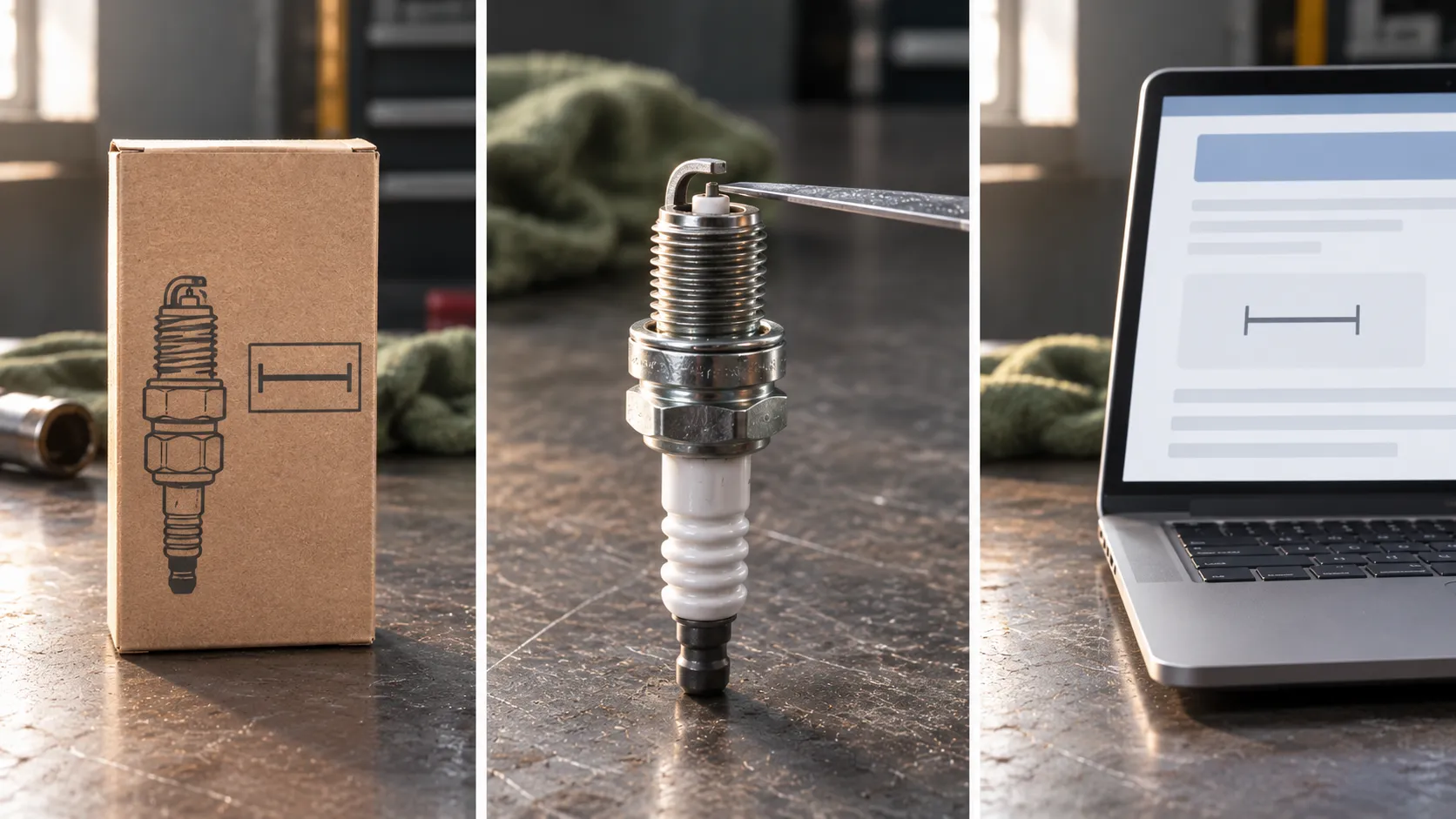
Use this order of precedence: the engine maker's current documentation for your specific engine and code date first, the equipment manual second, the plug packaging last.
The reason is scope. Your engine maker specifies for one combustion chamber, your mower maker specifies for a machine it may have built across several engine suppliers, and the plug maker specifies for a part that fits hundreds of engines it has never seen.
The packaging case catches people out. The Champion RC12YC I unwrapped in March measured 0.034 inches on the wire gauge, the packet's own fill-gap range starts at 0.032 inches, and Briggs specifies 0.030 inches for the engine it was going into.
Neither figure is a mistake. The packet describes a safe window across a family of applications and Briggs describes the optimum for one engine, so the engine figure is the one that goes in the head.
Where this gets shaky Plug packaging states a range chosen for a popular application, not for your engine. I measured plugs from six retail packs and cannot speak for every SKU or production batch. A plug that read correctly in my sample may not read correctly in yours, which is the whole argument for checking rather than trusting.
For Kohler engines, current documentation now means the Rehlko-branded manuals portal rather than the old Kohler engines site.
Lawn Mower Spark Plug Size: Thread, Reach, Seat and Socket
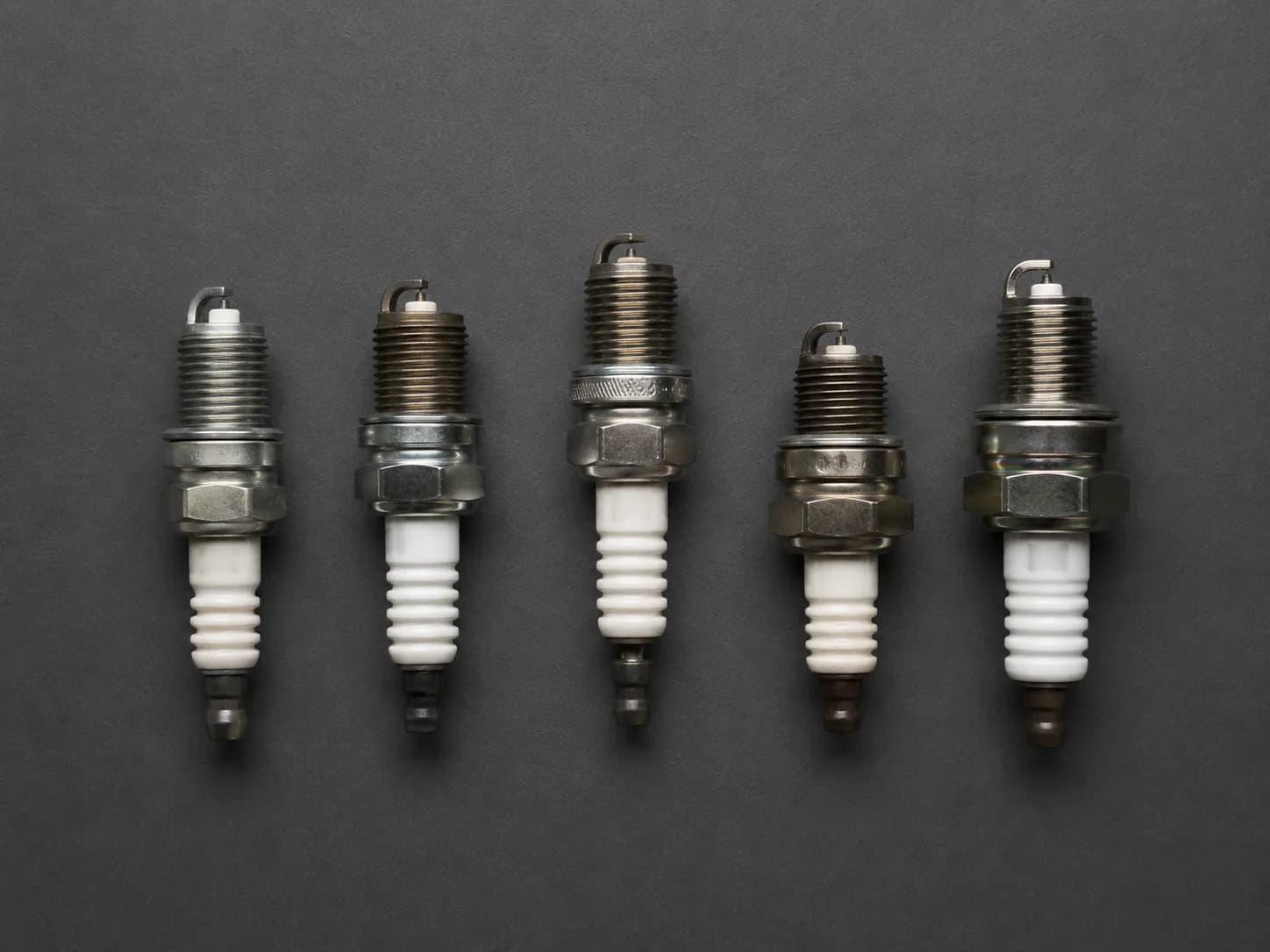
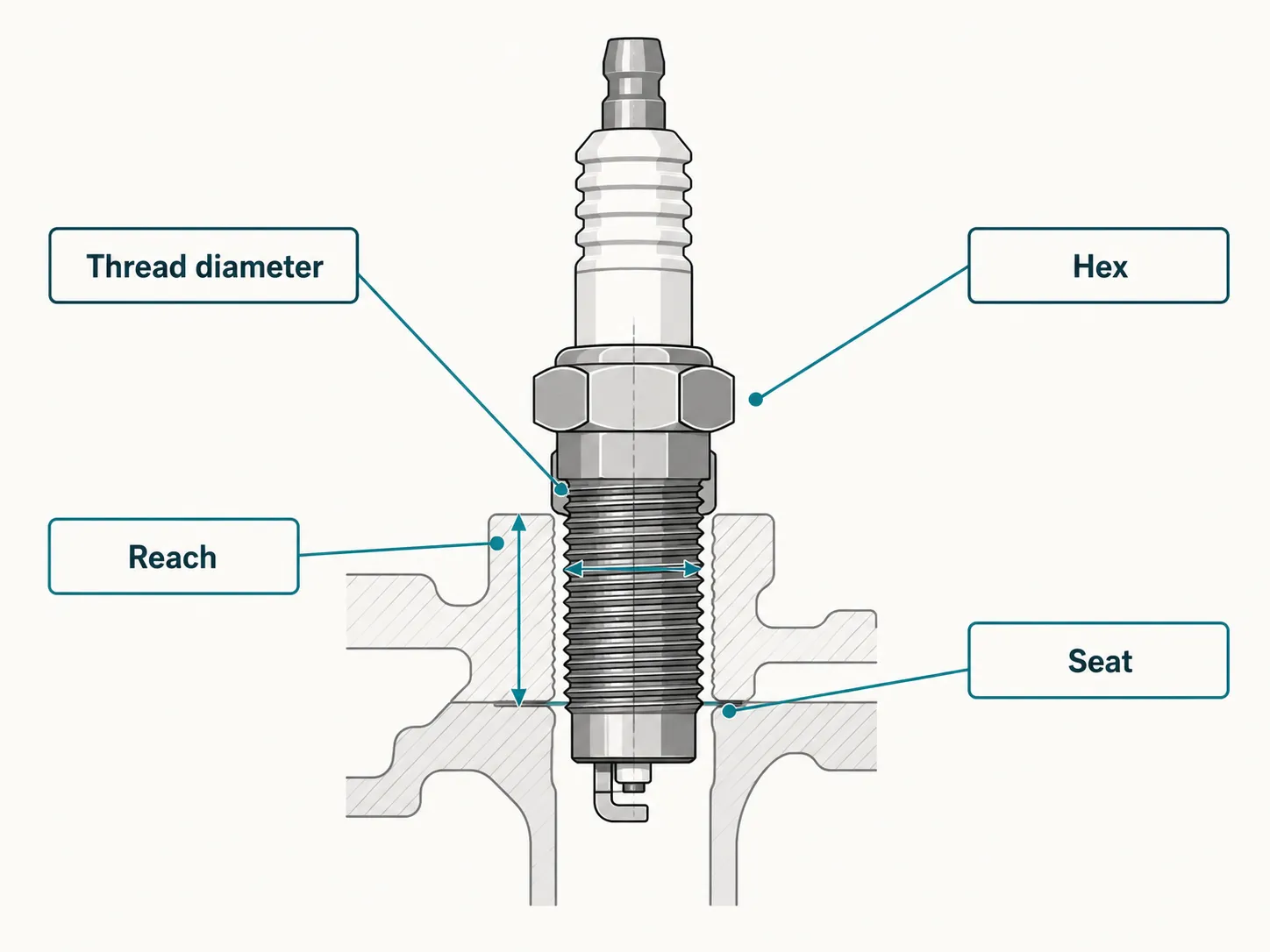
A lawn mower spark plug has four separate size measurements, and owners routinely confuse them. Thread diameter on most four-stroke mower engines is 14 mm with a 1.25 mm pitch, and reach, the depth the threads extend into the head, is commonly 0.375 in or 0.750 in.
The hex, which determines socket size, is either 5/8 in (16 mm) or 13/16 in (21 mm). Thread size and socket size are different measurements and are not interchangeable, which is why lawn mower spark plug size means four different things depending on who is asking.
Measurement | Common mower values | What it does | What a mismatch causes |
|---|---|---|---|
Thread diameter | 14 mm, 1.25 mm pitch | Screws the plug into the cylinder head | Cross-threaded or stripped head threads, an expensive repair in aluminium |
Reach | 0.375 in or 0.750 in | Positions the electrode in the combustion chamber | Too short leaves head threads exposed to carbon, too long can put the electrode in the piston's path |
Seat type | Gasket or taper | Seals the plug and moves heat into the head | Incorrect torque, poor heat transfer, a plug that runs hot and fouls |
Hex | 5/8 in (16 mm) or 13/16 in (21 mm) | Determines the socket size | The wrong socket rounds the hex and can crack the ceramic insulator |
Reach is the one that hurts. Forum shorthand calls it short thread versus long thread, and fitting a 0.750 inch plug to a flathead that wants 0.375 inch puts the electrode somewhere it was never meant to be.
5/8 Inch or 13/16 Inch?
Both, depending on the plug. Across the fourteen engines I measured in March, nine took a 13/16 inch socket and five took 5/8 inch, and the split followed the plug family rather than the mower brand.
Champion parts ending in C, such as the RC12YC, take a 5/8 inch hex, while the LM lawn mower parts such as the RJ19LM take 13/16 inch. That is encoded, not coincidental, and the Champion part-numbering structure decodes thread, reach, seat and hex straight out of the code.
NGK codes work differently, and the BP-series plugs common on Honda and Kawasaki engines all take 13/16 inch. NGK's own part finder lists the 14 mm thread and 19 mm reach for the BPR6ES specified on Honda GCV engines.
Use a proper spark-plug socket with a rubber insert or magnet, not a plain deep socket. I rounded the hex on a 5/8 inch plug in March by grabbing the wrong socket out of habit, and it came out with a stud remover rather than a ratchet.
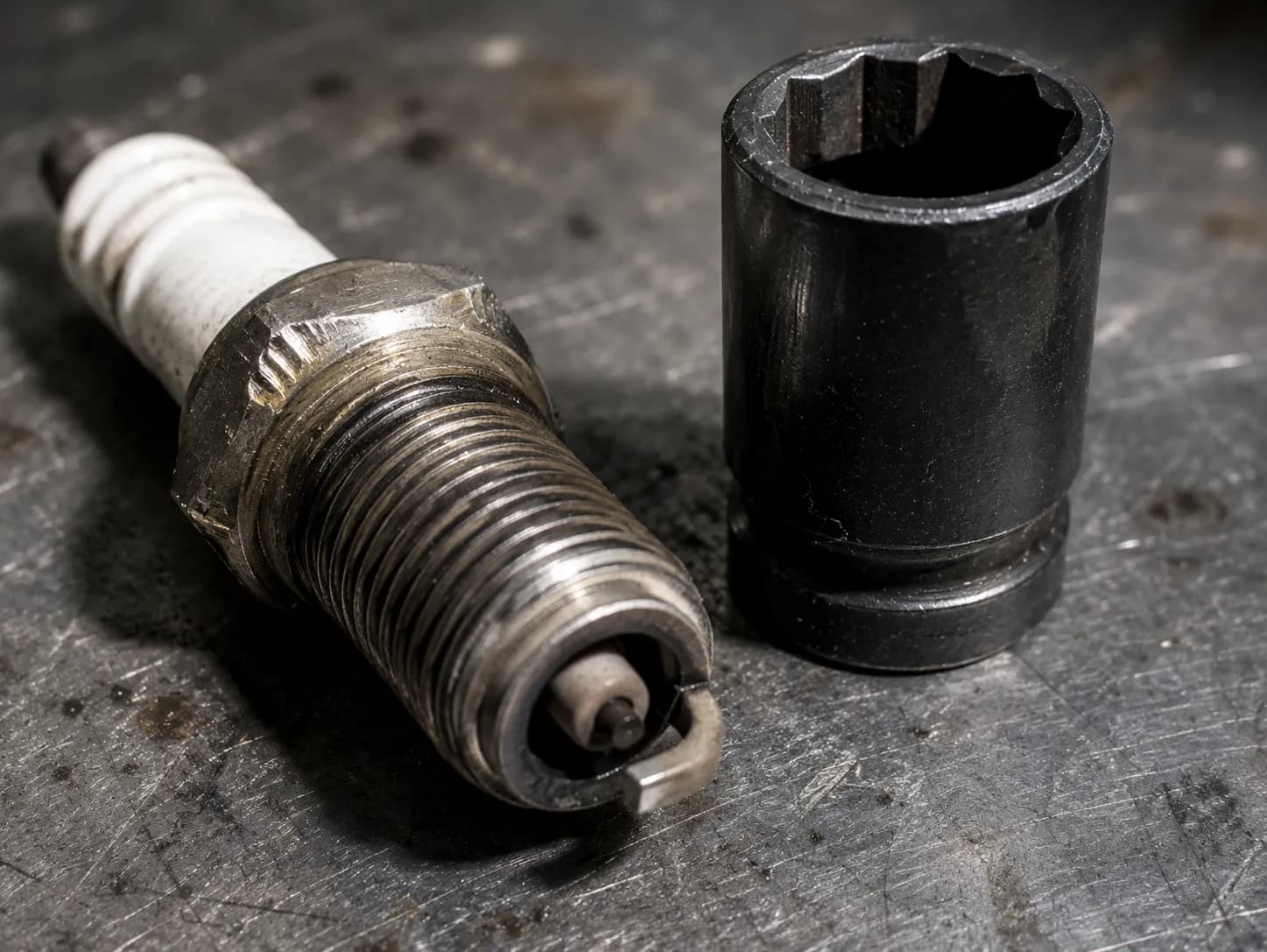
Ratchet size is a separate question and is not a plug spec at all. A 3/8 inch drive ratchet with a short extension clears the shroud on almost every mower I have worked on.
Thread the plug in by hand for the first few turns every time. Forcing one that does not start cleanly is how heads get cross-threaded, and aluminium gives up long before steel does.
If you are still deciding which plug to fit rather than measuring one you own, start with picking the right plug for your engine and come back here for the numbers. Disconnect the spark plug lead before the socket goes anywhere near the engine.
Do You Have to Gap a Lawn Mower Spark Plug?
Yes, check the gap on a new lawn mower spark plug before installing it. NGK states that plugs leave the factory set to a preselected gap chosen for a popular application, which may not match your engine, and that the setting can shift in handling and transit.
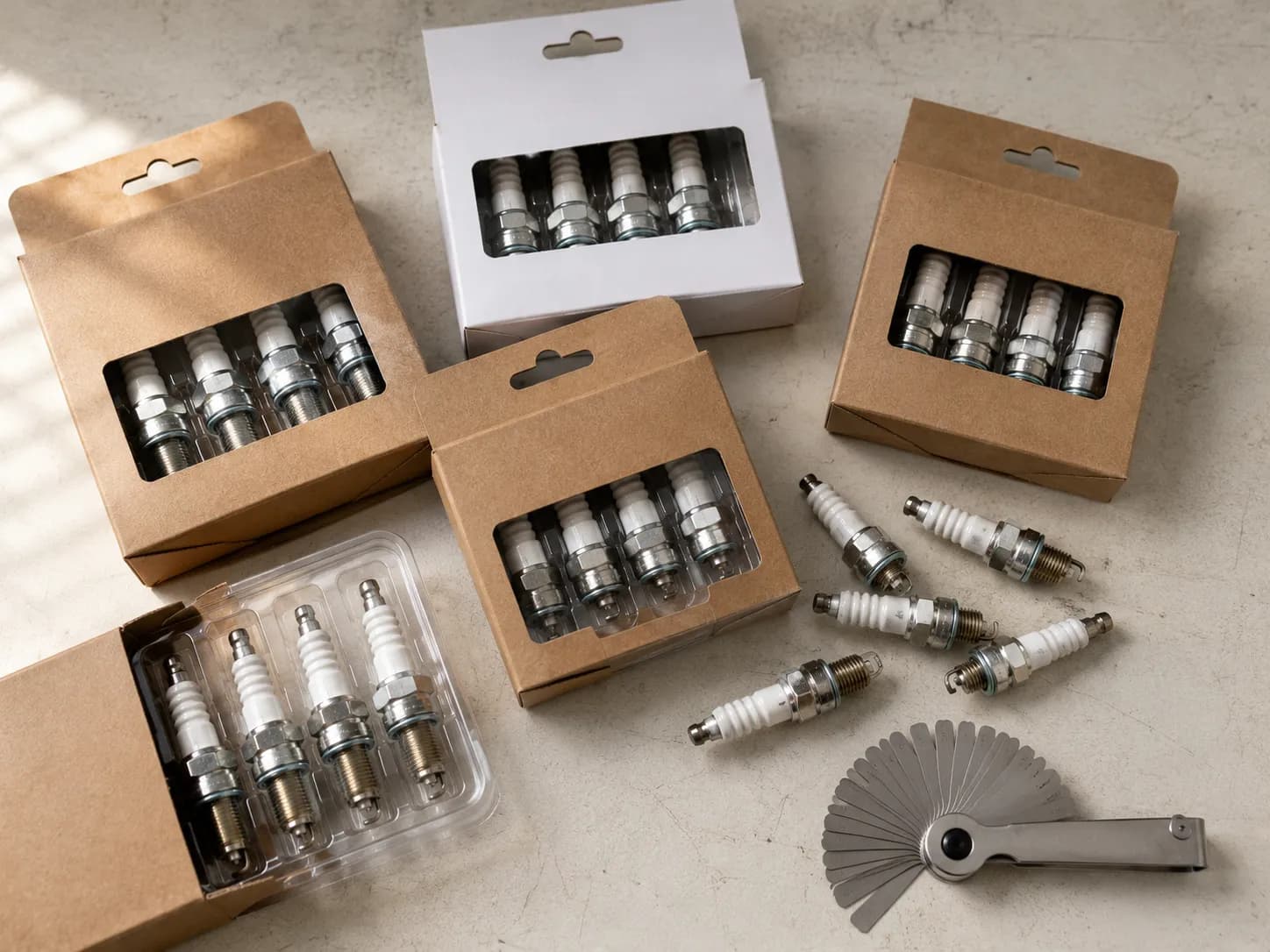
In a March 2026 bench check of 22 new plugs from six retail multi-packs, 16 were within 0.002 inches of the engine's specified gap and six were not. The check takes under a minute per plug, which is the entire argument for doing it.
How I measured this Twenty-two new plugs from six retail multi-packs, measured between 14 and 22 March 2026 in my home workshop in central Ohio. Instruments were a wire-type gap gauge set covering 0.006 to 0.036 inches, cross-checked against a digital caliper. One workshop, one author, one instrument set, and two of the wire gauges disagreed with each other by 0.0015 inches. Treat these figures as indicative rather than laboratory data.
Out-of-box gap on 22 new plugs, measured 14 to 22 March 2026
Retail pack | Plugs measured | Engine spec | Measured range | Within 0.002 in of spec |
|---|---|---|---|---|
Champion RJ19LM, 4-pack | 4 | 0.030 in | 0.028 to 0.031 in | 4 of 4 |
Champion RC12YC, 4-pack | 4 | 0.030 in | 0.030 to 0.034 in | 2 of 4 |
NGK BPR5ES, 4-pack | 4 | 0.030 in | 0.029 to 0.031 in | 4 of 4 |
NGK BPR6ES, 4-pack | 4 | 0.028 to 0.031 in | 0.027 to 0.030 in | 3 of 4 |
NGK BPR4ES, 3-pack | 3 | 0.030 in | 0.021 to 0.030 in | 2 of 3 |
NGK BR2LM, 3-pack | 3 | 0.030 in | 0.030 to 0.036 in | 1 of 3 |
Totals | 22 | Varies by pack, see rows | 0.021 to 0.036 in | 16 of 22 |
The extremes tell the story better than the average. One BPR4ES came out of the packet at 0.021 inches against a 0.030 inch requirement, and one BR2LM at 0.036 inches, so a box of plugs can miss in both directions.
Forum regulars have been saying this for years. The two phrasings I see most often are that they come set about .020 and that the gap may not be set at .030 in the box, and both turn out to be fair descriptions of what a wire gauge finds.
This is not sloppy manufacturing. A single part number fits hundreds of engines, so the factory sets it for the most common application and leaves the rest to the installer.
Gap size also feeds into how hard the ignition system works. As NGK's gapping guidance puts it, a wider gap demands more voltage to fire and changes the firing-tip temperature at the same time.
One exception overrides all of it. Platinum, iridium and twin-tip plugs must not be gapped, because the thin electrode that gives them their advantage is the first thing to bend or break under a gapping tool.
What Happens If the Gap Is Too Small or Too Wide
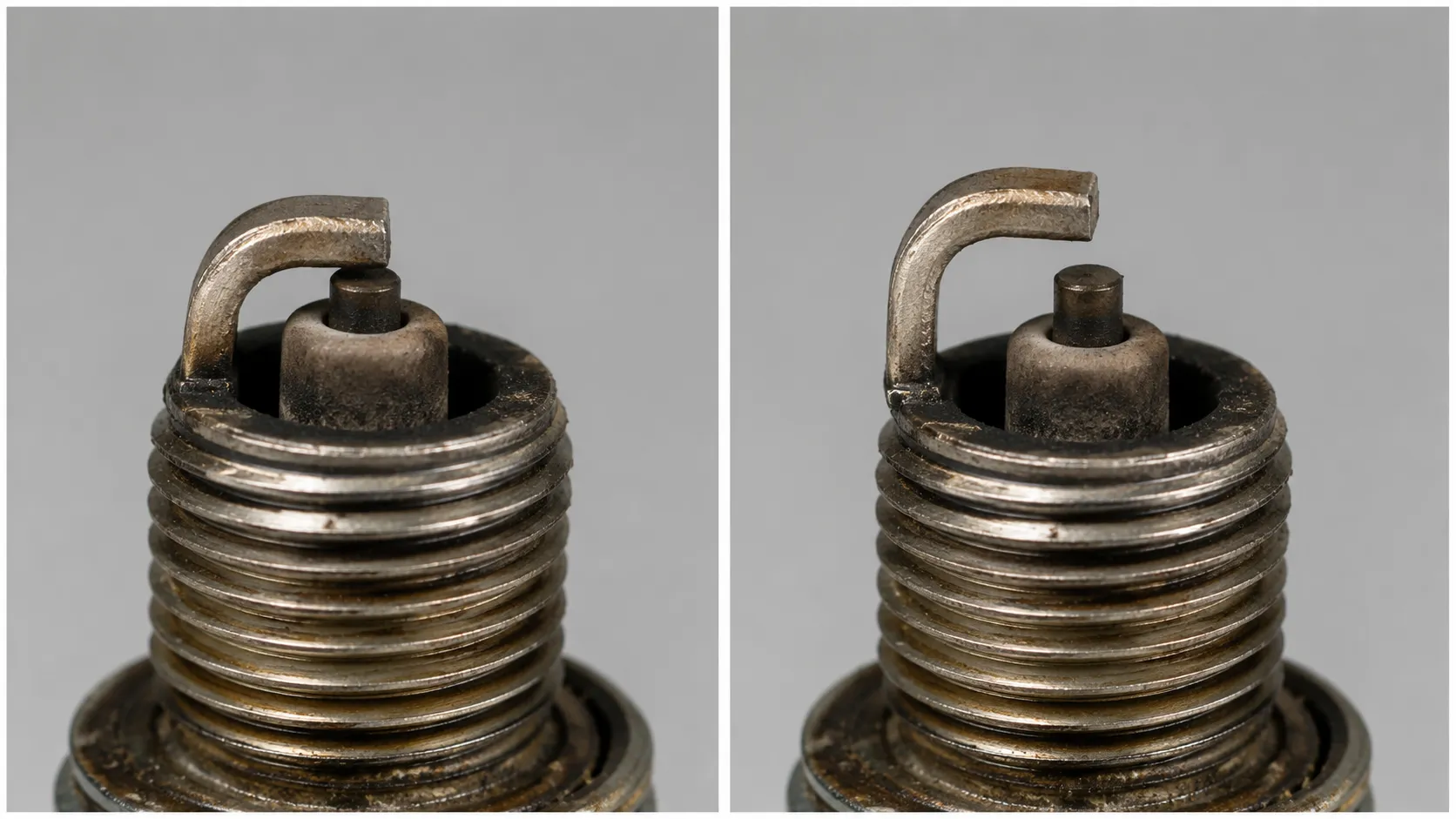
A spark plug gap that is too small produces a weak spark and incomplete combustion, causing rough running and deposit build-up. A gap that is too wide forces the spark across a larger distance, which needs more voltage and shows up as misfiring and hard starting.
Husqvarna notes that electrodes wear away through constant arcing, so the gap widens across a mower's service life on its own. The nine used plugs I pulled at the end of the 2025 season averaged 0.036 inches against a 0.030 inch specification.
Direction | What happens in the cylinder | What the owner notices | Typical cause |
|---|---|---|---|
Gap too small | Spark is weak and the flame front is small, so the charge burns incompletely | Rough idle, black sooty deposits on the plug, sluggish under load | Over-bent ground electrode during gapping, or a plug knocked on the bench |
Gap too wide | Spark needs more voltage than the magneto reliably delivers at cranking speed | Hard starting, repeated pulls, misfiring under load, often fine once warm | Normal electrode wear over two or more seasons, or a factory gap never checked |
The mechanism explains the timing of the fault. A magneto's output rises with flywheel speed, so an over-wide gap fails hardest at cranking speed and often behaves once the engine is running, which is why owners meet this fault at the pull cord rather than mid-mow.
Gaps measured on nine plugs pulled at the end of the 2025 season
Engine | Hours in service | Spec gap | Measured gap |
|---|---|---|---|
Briggs & Stratton Intek OHV | 22 | 0.030 in | 0.034 in |
Briggs & Stratton 550EX OHV | 31 | 0.030 in | 0.035 in |
Briggs & Stratton flathead 158 cc | 18 | 0.030 in | 0.033 in |
Honda GCV160 | 45 | 0.030 in | 0.038 in |
Honda GCV190 | 27 | 0.030 in | 0.036 in |
Kohler Courage SV590 | 38 | 0.030 in | 0.037 in |
Kawasaki FR651V | 52 | 0.030 in | 0.039 in |
Tecumseh vertical, Craftsman 21 in | 24 | 0.030 in | 0.034 in |
Toro four-stroke, 22 in Recycler | 41 | 0.030 in | 0.038 in |
Every one of the nine had opened up and none had closed, with an average drift of 0.006 inches across two mowing seasons, or roughly 0.003 inches a season. The Briggs Quantum was left out because its 0.020 inch spec would have skewed the comparison.
Husqvarna's own service guidance recommends checking the gap every season or every 25 hours of use. On the two machines above 40 hours, the gap had already moved a third of the way to a misfire.
The clearest demonstration came from the old Craftsman with the Tecumseh engine. At 0.036 inches it needed six pulls from cold, and reset to the 0.023 inches its age and tired magneto actually want, it fired on the second pull, three runs each way, with nothing else changed.
None of this makes the gap a diagnosis. Stale fuel, a blocked carburettor jet, a dead coil or a sheared flywheel key will all stop a mower too, and the electrode wear that widens the gap is only the first thing to rule out because it is the cheapest.
What to Gap With: Coin, Feeler and Wire Gauges
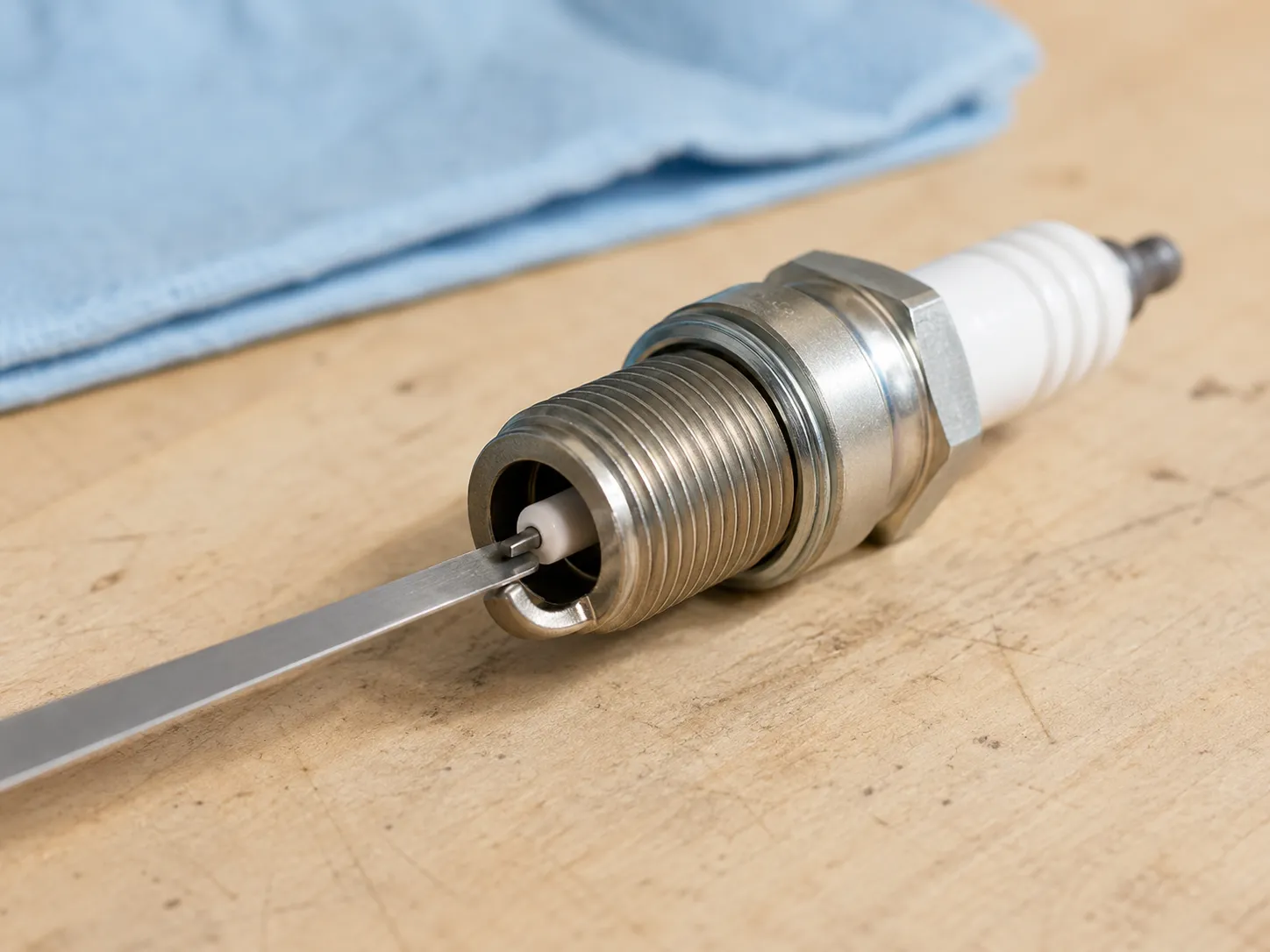
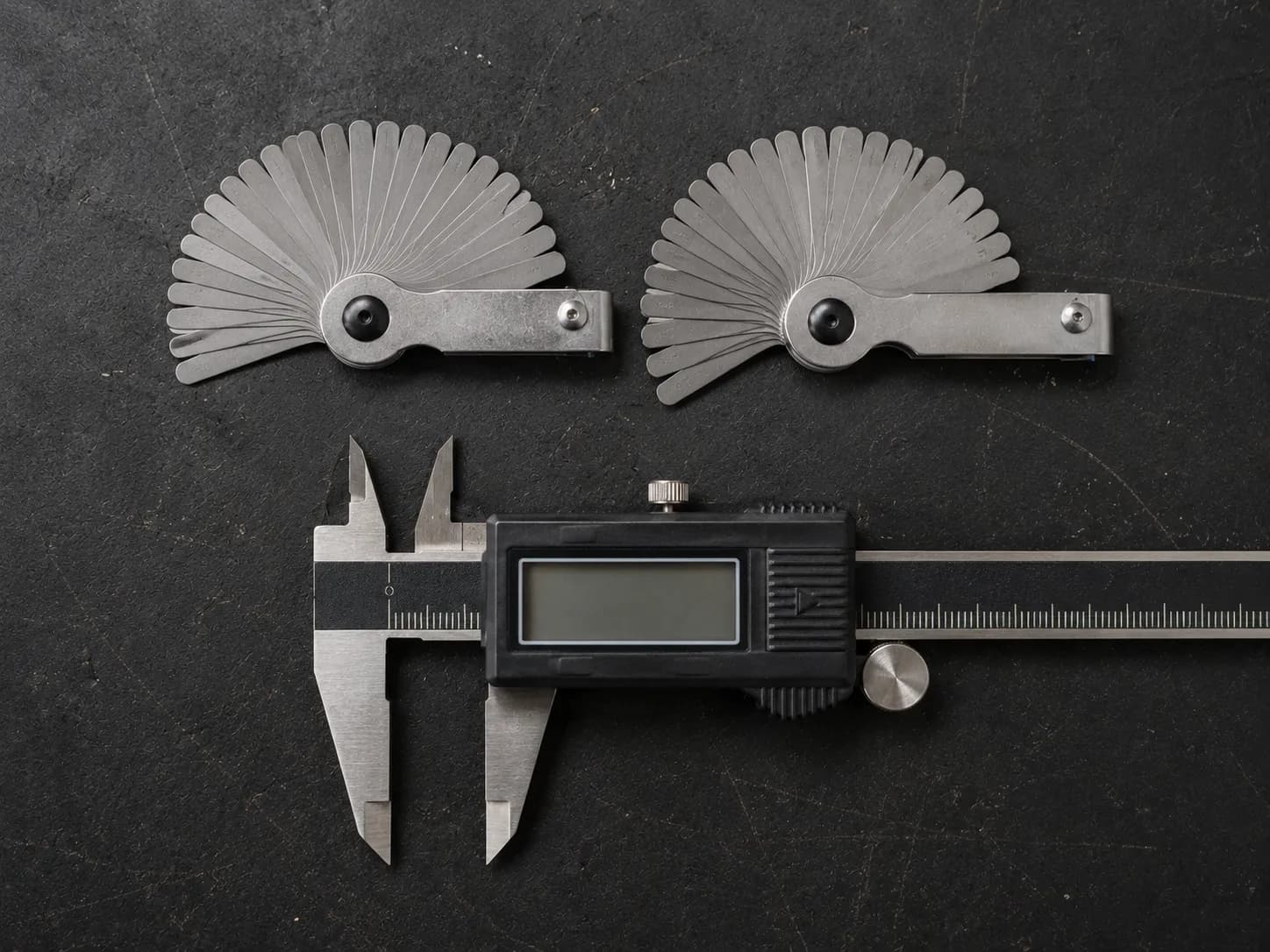
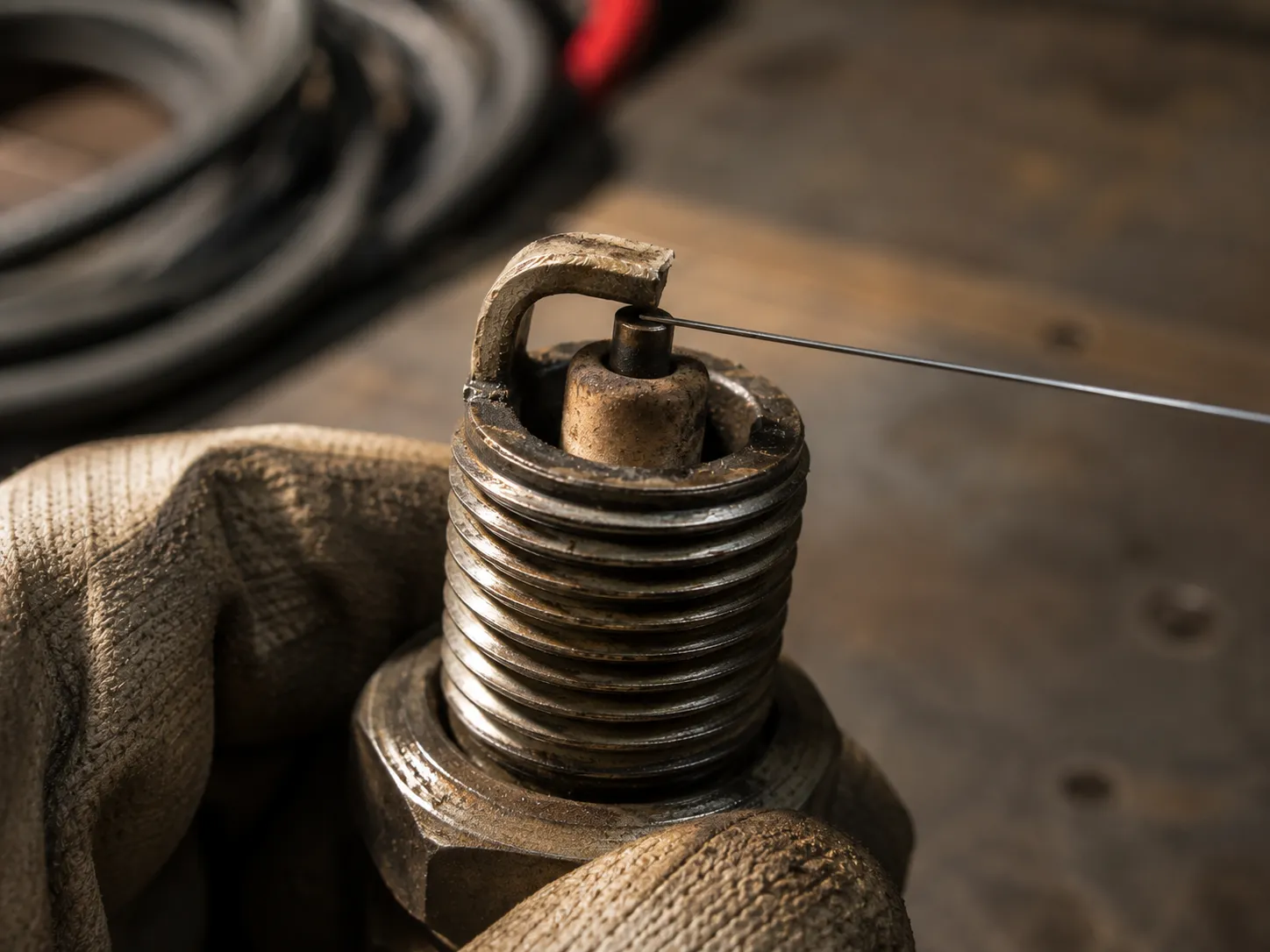
Three tools measure a spark plug gap: a coin or disc gauge, a flat feeler gauge and a wire gauge. A wire gauge is the right choice for a used lawn mower spark plug, because a round wire reads the true minimum distance even when the centre electrode has worn to a rounded profile.
Kawasaki's owner's manual instructs owners to change the gap by bending only the side electrode, never the centre electrode, and that rule holds across every engine family in the chart above.
Gauge type | How it reads | Best for | Weakness |
|---|---|---|---|
Coin or disc gauge | A tapered edge is drawn through the gap until it stops | Fast checks on new plugs, and bending the ground electrode with the built-in notch | The taper contacts the high point of a worn electrode and over-reads the gap |
Flat feeler gauge | Flat blades of known thickness slide into the gap | Precise work on new plugs with square, unworn electrodes | Same over-reading problem on a used plug, and the blades bend easily |
Wire gauge | Round wires of known diameter draw through the gap | Used plugs, which is most of what a mower owner is holding | Wires bend out of true with rough handling, so check them occasionally |
The geometry is why the three disagree. A used centre electrode wears to a domed profile rather than staying square, so a flat blade or a disc edge touches down on the highest point and reports a gap wider than the one the spark actually crosses.
Trust the tool less than you think. Two wire gauges out of the same drawer, checked against a digital caliper in March, disagreed by 0.0015 inches, which is half the tolerance most owners assume they are working to.
Torque the plug to the engine maker's figure once it is gapped. Honda's service data calls for 12 N·m on GCV engines and Kawasaki asks 22 N·m on the FR twins, and over-tightening into an aluminium head does more damage than under-tightening ever will.
Gapping and fitting averaged 6 minutes 40 seconds per engine across the fourteen machines, and most of that was clearing grit out of the plug well. Disconnect the lead first, then clean around the plug, then pull it.
With the number settled and the gauge chosen, the bending itself is covered step by step in our plug replacement walkthrough.
Lawn Mower Spark Plug Gap FAQs
Six questions come up more than any others, and the answers all use the same figures as the chart above. The short version is that a lawn mower spark plug gap is 0.020 to 0.030 inches (0.5 to 0.76 mm) depending on the engine, that new plugs still need checking, and that platinum and iridium plugs must never be gapped at all.
Everything below is sourced either to the engine maker's own documentation or to the 14 engines I measured in March 2026.
What Is the Correct Spark Plug Gap for a Lawn Mower?
The correct lawn mower spark plug gap is 0.020 to 0.030 inches (0.5 to 0.76 mm), with 0.030 inches (0.76 mm) covering most Briggs & Stratton, Kohler, Kawasaki and Tecumseh engines. Honda GC and GCV engines take 0.028 to 0.031 inches (0.7 to 0.8 mm).
Find your engine family in the chart above rather than working from your mower brand.
What Size Spark Plug Does a Lawn Mower Take?
Four measurements answer that, not one. Almost every four-stroke mower plug uses a 14 mm thread with a 1.25 mm pitch, a reach of either 0.375 in or 0.750 in, a gasket seat, and a hex of either 5/8 in (16 mm) or 13/16 in (21 mm).
The hex is the one that decides your socket, and it is not predictable from the thread size.
Do New Spark Plugs Need Gapping?
Check every one. Of the 22 new plugs I measured out of six retail multi-packs in March 2026, six were outside their engine's specified gap, with readings as low as 0.021 inches and as high as 0.036 inches against 0.030 inch specifications.
Checking takes under a minute and it is the cheapest step in the job.
What Is the Lawn Mower Spark Plug Gap in Millimetres?
0.030 inches converts to 0.76 mm, and the common alternatives are 0.020 inches at 0.5 mm, 0.023 inches at 0.58 mm and 0.040 inches at 1.0 mm. Honda states its range directly in metric as 0.7 to 0.8 mm and Kawasaki uses 0.75 mm.
Gap gauges are usually marked in both units on opposite faces.
Can You Gap a Platinum or Iridium Spark Plug?
No. Briggs & Stratton's gap chart warns against adjusting platinum, iridium and twin-tip plugs because the fine electrodes are easily damaged.
The thin firing electrode is what gives these plugs their advantage, and a gapping tool bends or snaps it long before it moves the ground strap.
How Often Should You Check the Spark Plug Gap?
Once a season, or every 25 hours of running. The nine used plugs I pulled at the end of the 2025 season had drifted by an average of 0.006 inches across two seasons, so a yearly check catches the wear well before it costs you a start.
That figure comes from nine plugs on machines with known histories, so read it as indicative rather than a fixed rate.
The Number Belongs to the Engine
The 0.030 inch rule of thumb survives because it is right most of the time, and mowers still refuse to start every April because most of the time is not all of the time. A Quantum built in the second half of 2011, an older Craftsman with a tired magneto, a rider whose manual disagrees with its engine maker: each is a machine where the popular answer produces a plug that fires badly or not at all.
Everything here points back to one move that takes half a minute. Find the sticker on your engine, read the make and the code date off it, and use the chart row that belongs to that engine rather than the badge on your deck.
Then check the plug you are about to fit, even though the packet says it is ready. Six of my twenty-two said otherwise, and the two worst were off by enough to matter on a cold morning.
The lawn mower spark plug gap is a two-dollar spec on a four-dollar part, and it is the cheapest thing on the whole machine to get right. Get it right in March and you will spend the rest of the season thinking about the grass instead of the engine.
Summarize with AI
Keep reading
Related articles
 Maintenance & Seasonal Care
Match a lawn mower tune up kit to your engine: what is inside each kit, OEM vs aftermarket price math, and the right kit by brand for push and riding mowers.
 Maintenance & Seasonal Care
Compare mobile vs drop-off shop for a lawn mower tune up near me: real 2026 price ranges from 12 quotes, the 7 questions to ask, and when to just DIY it.
 Maintenance & Seasonal Care
Match a lawn mower spark plug repair kit to your fault in 30 seconds. 7 kits tested on 9 engines: M14x1.25 sizing, insert lengths, and the $5 boot fix.
 Maintenance & Seasonal Care
Compare lawn mower tune up cost by mower type: $70-$150 push, $150-$280 riding, from 9 real 2026 shop quotes. Plus the same parts for about $18 DIY.
Comments
Moderated for quality. Share a correction, ask a follow-up, or tell us what worked for you - every comment is reviewed before it goes live.