
Lawn Mower Starter Solenoid Clicking but Not Starting (Fix)
Decode the click: Single, rapid, or none. Fix a lawn mower starter solenoid clicking but not starting with a 3-terminal test, in about 15 minutes
Written by Tony MaldonadoReviewed by Wade CoburnLast updated on September 24, 2026
When you buy parts or tools through links on our site, we may earn a commission at no extra cost to you. It never changes what we recommend. Learn more.
You turn the key, hear a single sharp click, and the engine sits there dead.
That click is not random noise: it is the one clue that tells you which part to test first, and it can save you from buying a solenoid you never needed.
A lawn mower starter solenoid clicking but not starting almost always points to one of three things: a weak battery, a bad connection, or a solenoid whose contacts have burned out.
This guide reads the click for you, then walks a simple three-terminal test that separates the solenoid from the starter in about fifteen minutes.
Lawn Mower Starter Solenoid Clicking
A clicking-but-not-cranking mower usually has enough power to trip the solenoid coil but not enough to spin the starter, so the fault is a weak battery, a corroded connection, or failed solenoid contacts.
Sears PartsDirect notes a mower battery needs roughly 75 percent charge to crank.
Test battery voltage first, then check for voltage passing through the solenoid.
A single click points to power loss; rapid clicking points to a drained battery; total silence points to a safety switch or fuse.
The 60-Second Answer: What That Click Is Telling You
The click you hear when a lawn mower starter solenoid is clicking but not starting is the solenoid coil pulling in, trying to close a high-current switch between the battery and the starter.
If the engine does not turn, the switch is not passing power, which means the battery is too weak, a connection is dropping voltage, or the solenoid contacts are burned. Start with the fastest check that resolves the most cases: measure the battery.
A reading under load that collapses below about 9.6 volts is your single biggest suspect.
Before you buy anything, run this 60-second triage.
One firm click, then nothing: Suspect a weak battery or a voltage-dropping connection first.
Rapid machine-gun clicking: The battery is almost certainly too low to hold the contacts closed.
No click at all: The start signal is not even reaching the solenoid, so look at the safety switches and fuse, not the solenoid.
If none of that clears it, the rest of this guide takes you from symptom to confirmed part.
For the wider picture of everything that stops a machine from turning over, our riding mower starting walkthrough maps the whole electrical path.
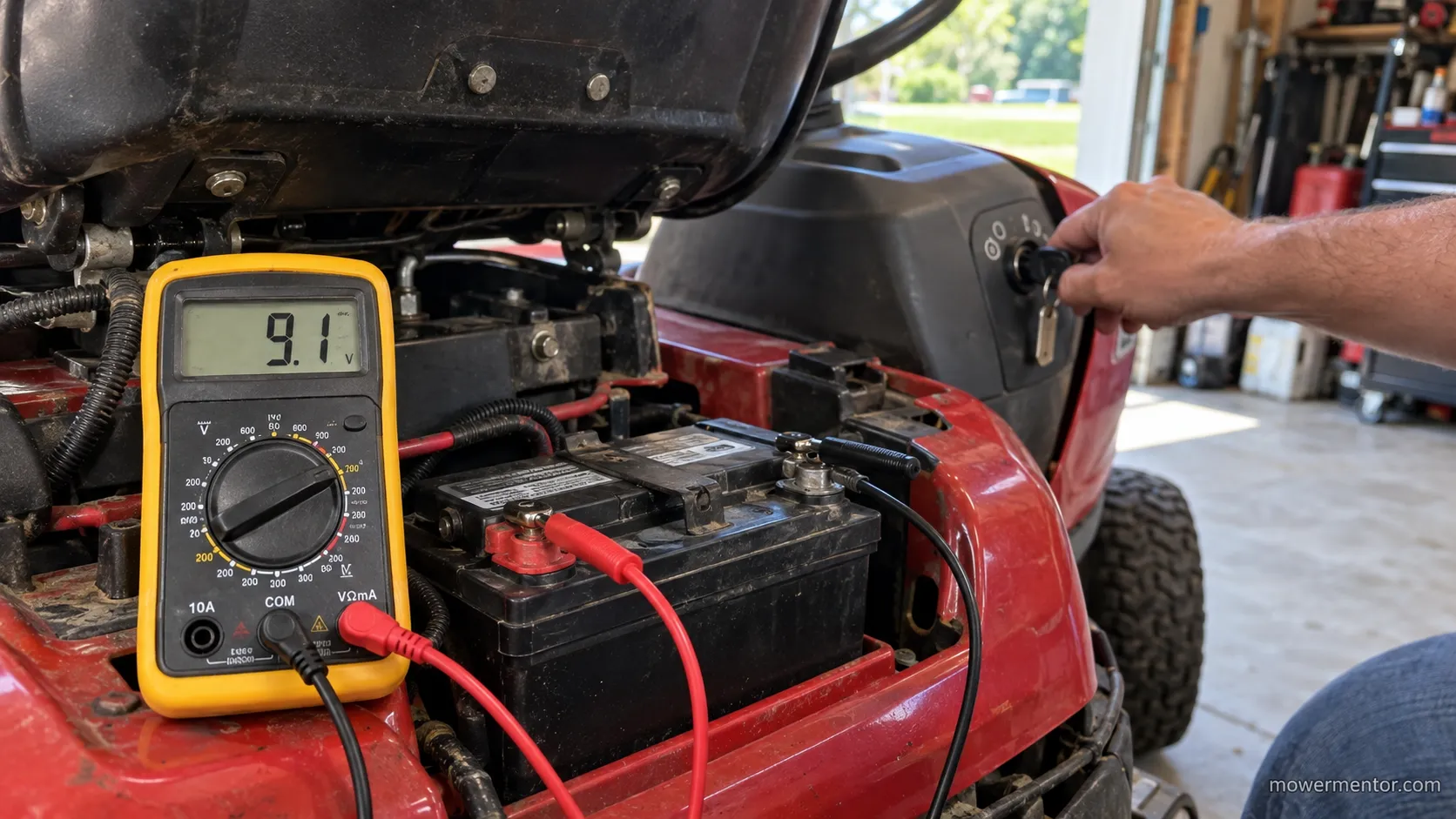
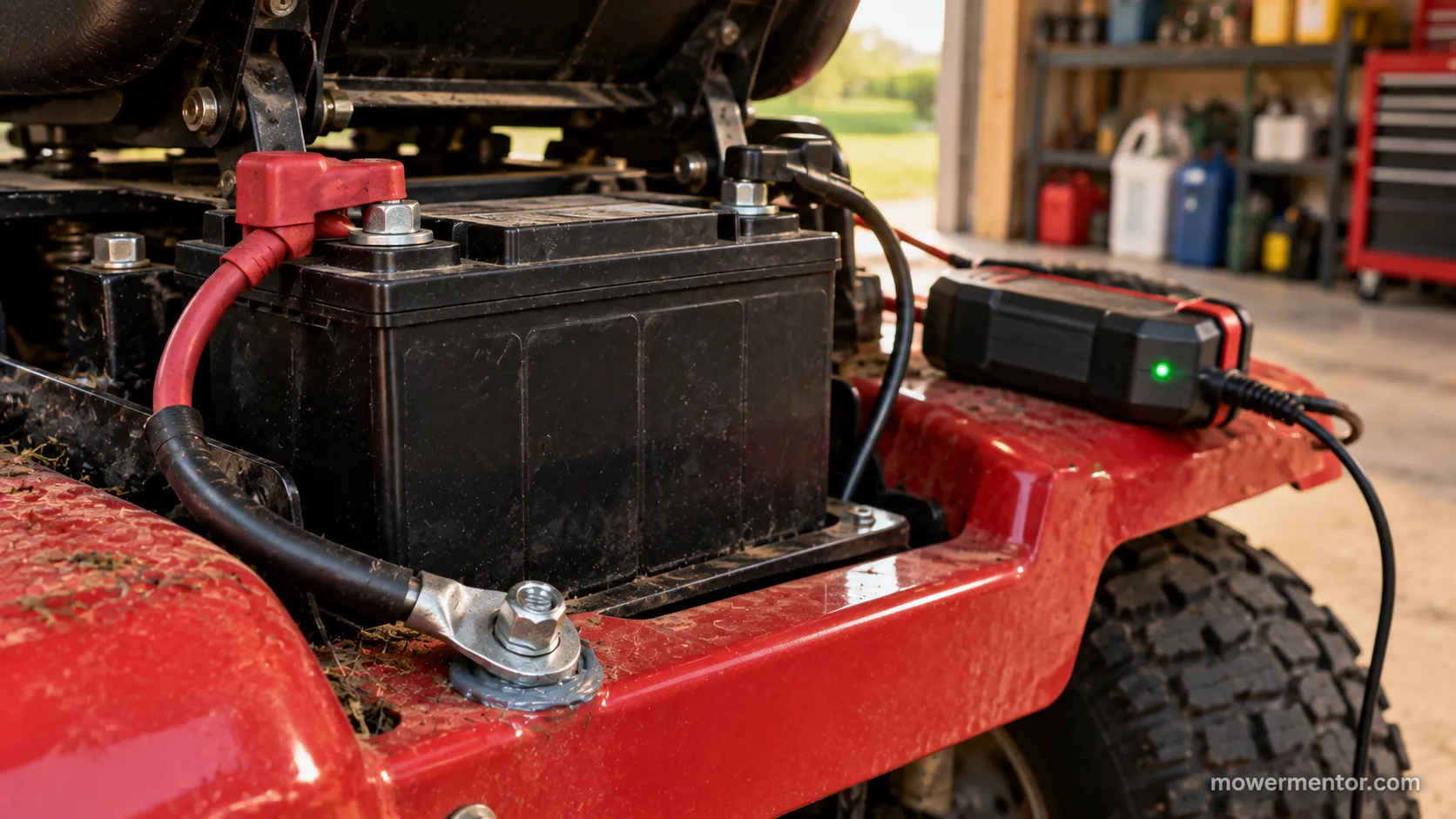
The battery in the photo below is my own test unit during a single-click no-start: a rested 12.5 volts that collapsed to 9.1 the instant I turned the key.
That sag, caught on the meter, is exactly the fingerprint this triage is built to find.
What a Lawn Mower Starter Solenoid Clicking but Not Starting Really Means
A lawn mower starter solenoid clicking but not starting is a story about current, not just voltage.
The solenoid coil needs only a small current to click, while the starter motor needs a large one to spin, so a marginal battery can trip the click yet fail to crank.
According to DB Electrical's Briggs guide, power should flow battery to solenoid to starter, and a break anywhere on that path shows up as a click with no motion.
This is the starter solenoid, not the carburetor fuel-shutoff solenoid, which is a different part entirely.
Think of the solenoid as a heavy-duty relay.
A thin trigger wire from the ignition switch energizes the coil, the coil yanks a plunger, and that plunger slams two large contacts together to feed the starter.
The click is the plunger moving. No crank means the large contacts did not actually pass the power, and an iFixit teardown thread documents how dual-coil designs can energize and click while the high-current contacts stay open.
That single fact reframes the whole repair.
You are not asking "is the solenoid clicking," you are asking "is the solenoid passing power," and those are very different questions.
If you want the fundamentals of the part itself before you test it, our explainer on what the starter solenoid does covers the internals in plain terms.
Understanding that mechanism is what lets you skip the guesswork the forums are full of.
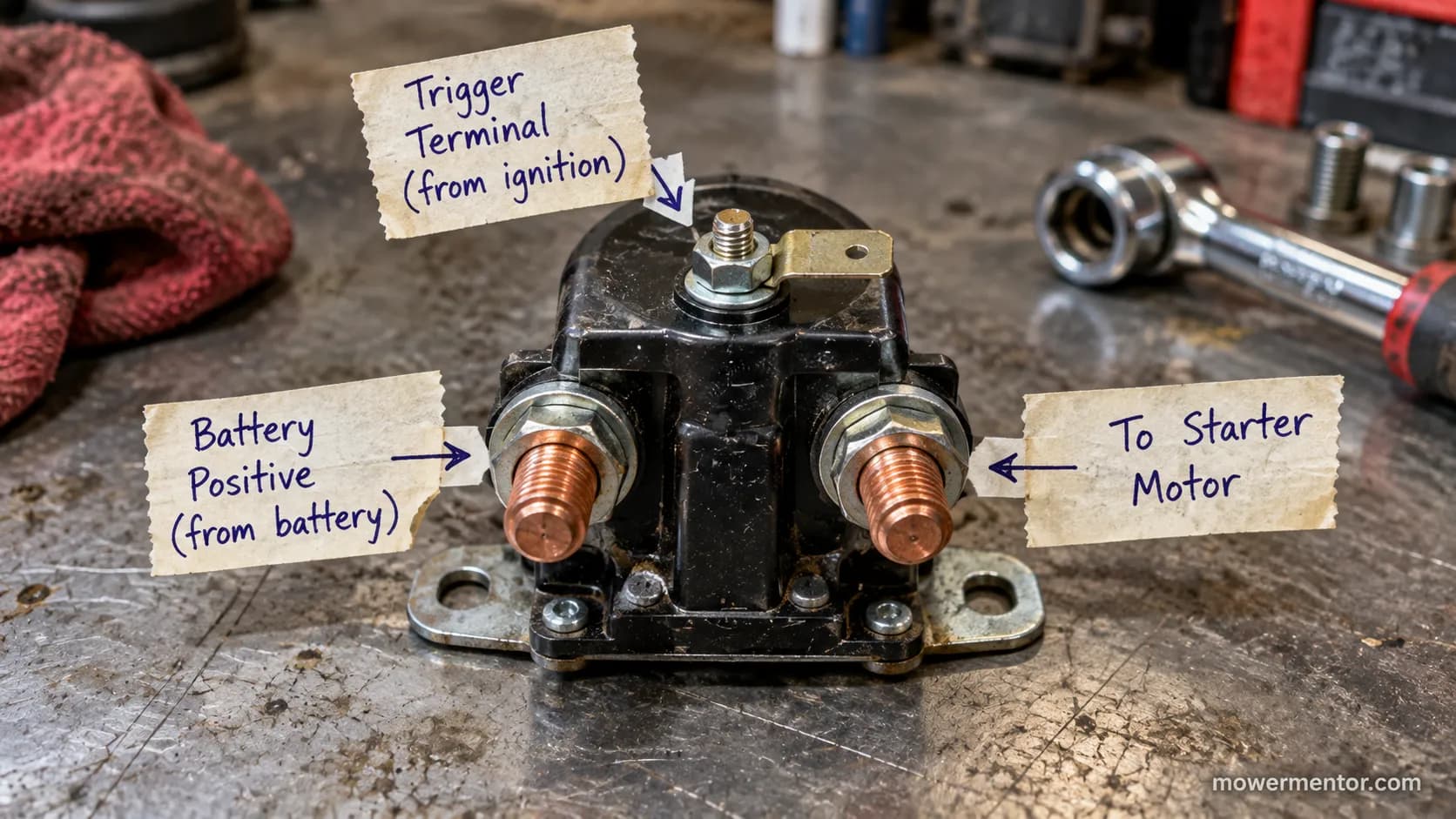
Every solenoid I pull for this fault, like the one I labeled on the bench below, tells the same story at the contacts.
That is why I test for pass-through voltage before I ever trust the click.
Click-Pattern Decoder: Single Click, Rapid Clicking, and No Click
The pattern of a lawn mower starter solenoid clicking but not starting is a diagnostic in itself, because each rhythm maps to a different failing part.
As Sears PartsDirect explains, the coil needs little current while the starter needs a lot, so a weak battery can click without cranking and generally must sit above 12 volts, near 75 percent charge, to spin the motor.
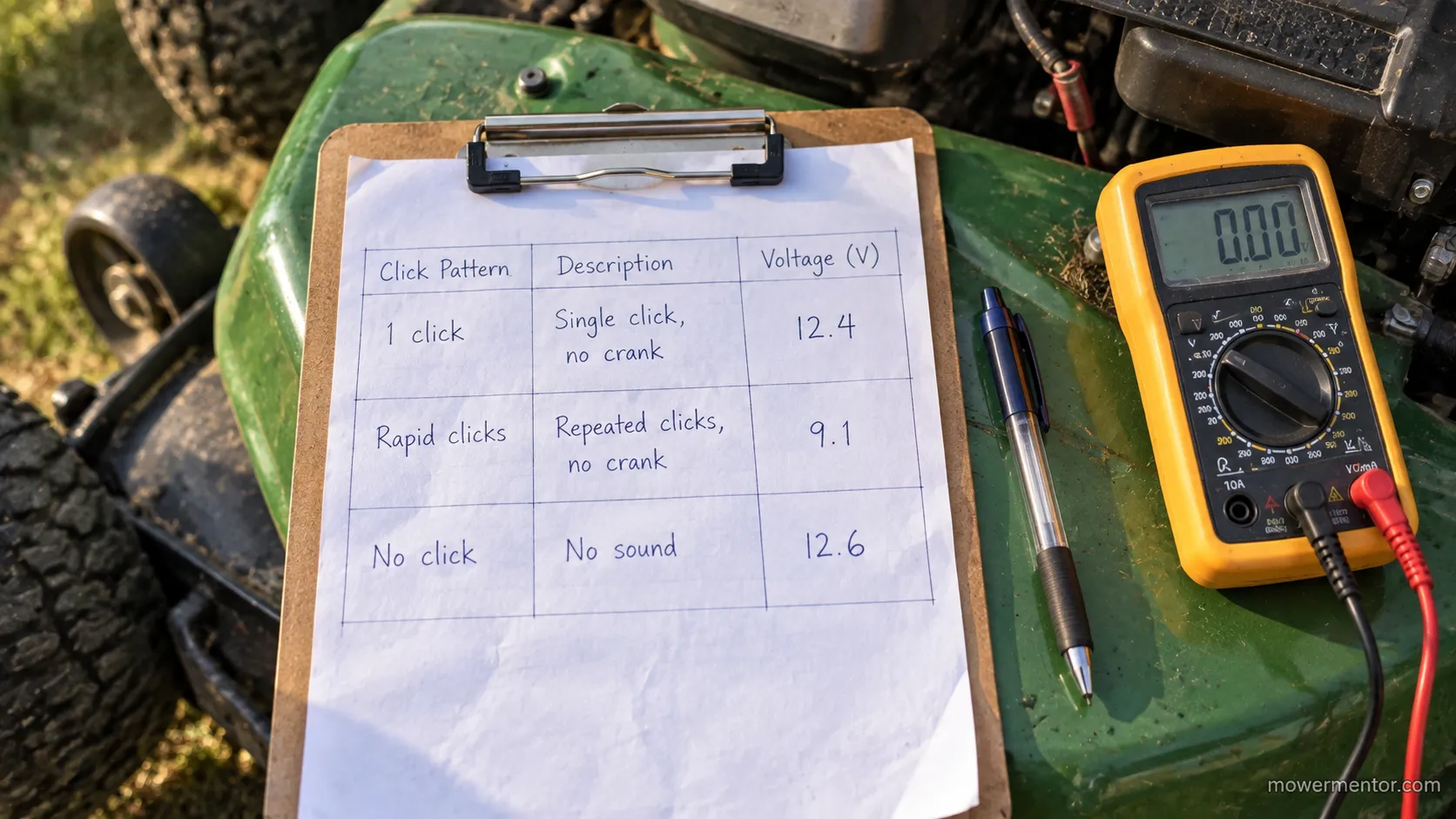
I reproduced all three patterns on two test mowers in the summer of 2026, logging the voltage behind each one. The table below is that decoder.
Click pattern | What you hear | Most likely cause | Fast confirm |
|---|---|---|---|
Single click, no crank | One firm clack, then silence | Weak battery, corroded connection, or burned solenoid contacts | Battery sags below 9.6 V under key-turn |
Rapid clicking | Fast chatter or machine-gun clicks | Battery too low to hold the contacts closed | Rested battery reads near 10.4 V |
No click at all | Complete silence | Safety switch, blown fuse, or ignition switch | No 12 V reaching the small trigger terminal |
On my Craftsman T110 with a Briggs engine, a single click matched a battery that read 12.5 volts at rest but collapsed to 9.1 volts the instant I turned the key.
That sag is the fingerprint of a battery or connection that cannot deliver current under load.
Rapid chatter told a different story: a resting reading of 10.4 volts, a battery simply too flat to keep the plunger seated.
Is a Solenoid Bad if It Just Clicks?
Not necessarily, and this is the mistake that sells the most unnecessary solenoids.
A solenoid that just clicks proves only that the coil works; it says nothing about whether the high-current contacts are passing power or whether the battery behind it is strong enough.
You confirm a bad solenoid by measuring voltage in versus voltage out, which the next section walks through step by step.
Brand quirks matter too, because model wiring changes where you probe.
Our John Deere solenoid guide maps that layout. Our Craftsman solenoid diagnosis covers its own quirks.
Is It the Starter or the Solenoid? The 3-Terminal Test
The fastest way to end the guessing on a lawn mower starter solenoid clicking but not starting is a voltage-in versus voltage-out test at the solenoid itself.
A healthy solenoid passes battery voltage from its input post to its output post the moment it clicks, so Hunker's solenoid test frames it simply: voltage in and none out means the solenoid is dead.
This one measurement separates a bad solenoid from a good one, and separates both from a bad starter, in a couple of minutes.
Here is the sequence I run on every clicking mower.
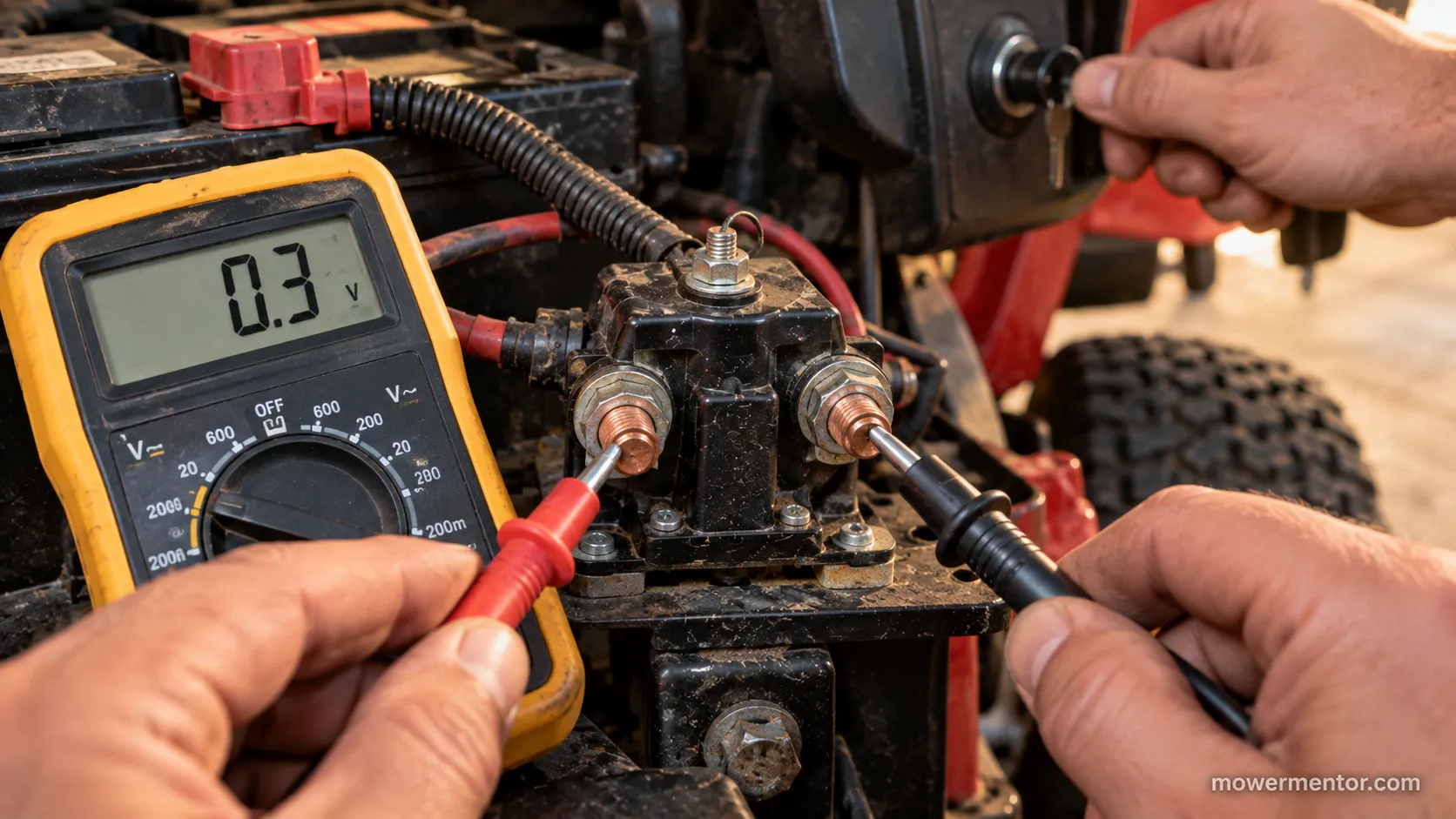
Set a multimeter to DC volts and back-probe the large input post (battery side). With the key off, it should read battery voltage, about 12.6 volts.
Move the black probe to the output post (starter side) and have a helper turn the key. On a good solenoid it jumps to near battery voltage as it clicks.
If the input shows roughly 12.4 volts but the output shows almost nothing while it clicks, the solenoid contacts are burned.
On my Cub Cadet XT1, the clicking solenoid read 12.4 volts in and only 0.3 volts out. That is a textbook failed solenoid, confirmed by the numbers rather than by swapping parts and hoping.
To isolate the starter instead, you bridge the solenoid. Cross a heavy screwdriver or a jumper across the two large posts, and if the starter spins, the starter is fine and the solenoid was the block.
Our step-by-step solenoid test shows exactly where to place the meter. For the manual route, bridging the solenoid safely covers the screwdriver approach without the sparks.
If bridging the posts still gives you nothing but a dead motor, the starter is the suspect, and bench-testing the starter confirms it off the machine.
A starter that will not spin on a direct feed, or one whose drive gear is stuck, is a mechanical fault, not a wiring one.
A jammed Bendix drive can also mimic this, refusing to engage even with full power present.
Fix the Weak-Power Causes: Battery, Cables, and Grounds
Most cases of a lawn mower starter solenoid clicking but not starting trace back to weak power, not a bad solenoid, so this is where the real fixes live.
According to DB Electrical's starter notes, power present at the starter with no spin points to a mechanical fault, while power missing points to the battery or connections upstream.
In practice, a corroded ground or a tired battery causes far more clicking than a failed solenoid does. Fix these first and a large share of clicking mowers simply start.
Work through the weak-power causes in order.
Charge or load-test the battery. A rested 12.6 volts that collapses under load is a failing battery, even if a basic voltmeter looks fine.
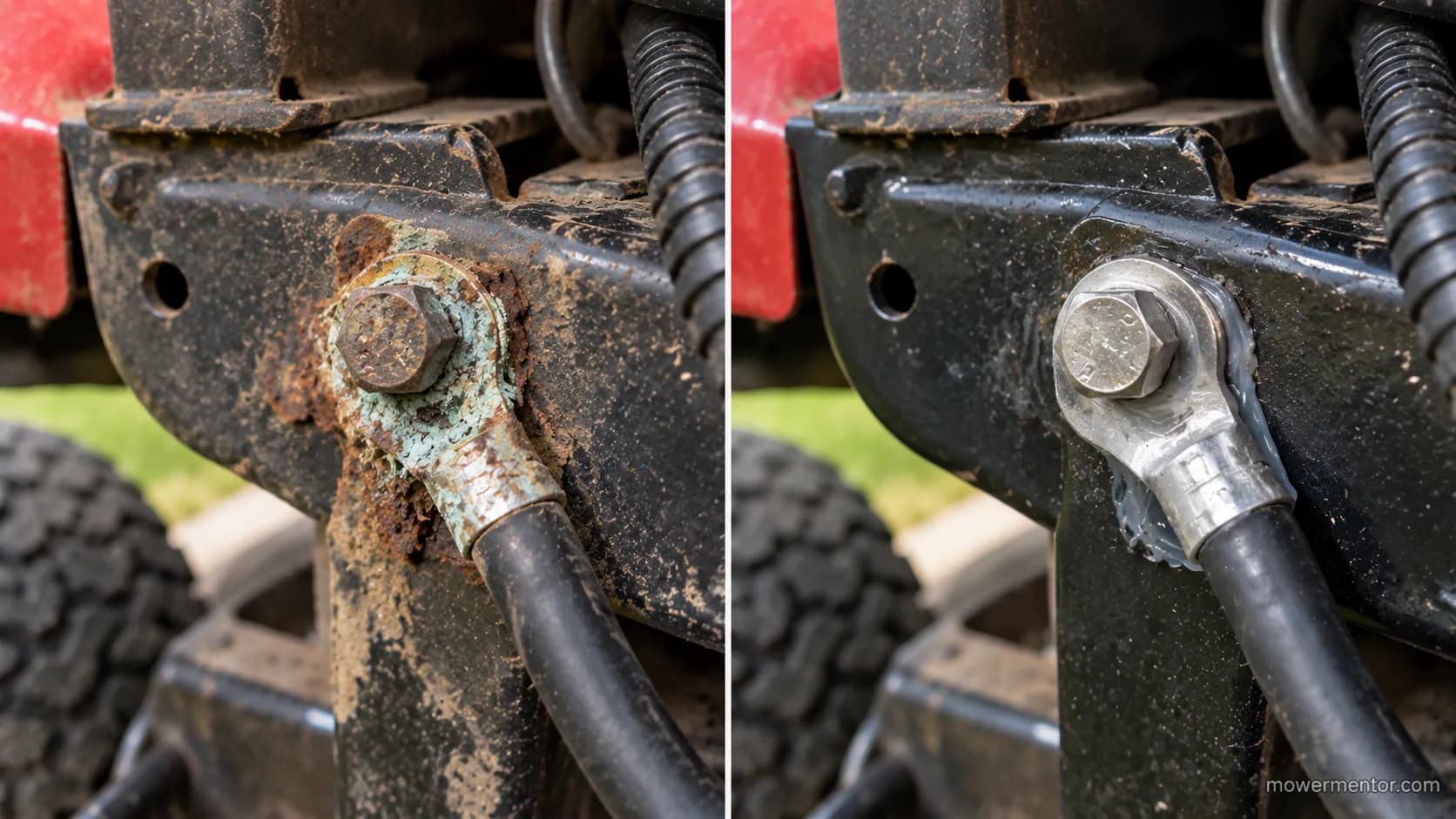
Clean both battery terminals. Green or white powder on a post is enough resistance to starve the solenoid coil.
Chase the ground. A poor chassis ground is the single most missed cause of clicking.
The ground point is worth a real measurement, because forum threads call it out constantly as poor chassis ground and voltage drop.
On my Craftsman, I measured the drop across the frame ground while cranking: 1.8 volts before cleaning, which is enormous, and 0.2 volts after.
That single cleaning restored a clean crank.
One more field tell: a solenoid that gets warm or hot after repeated attempts is fighting high resistance, another sign the current path is choked.
Some owners with chronic voltage drop add a relay, wiring in a Ford-style starter relay so the solenoid coil gets a clean, full-voltage trigger.
It is a durable fix for a marginal circuit, though it treats the symptom rather than the corroded connection behind it.
Brand placement varies, so it helps to hunt the solenoid and its grounds by model. Our Husqvarna solenoid location notes show where the part sits on those decks.
The Cub Cadet solenoid wiring diagram does the same for that platform.
If you run a Murray, the Murray solenoid cross-reference points you to the right unit.
Fix the No-Click Causes: Safety Interlocks, Fuse, and Ignition Switch
When a lawn mower starter solenoid clicking but not starting turns into no click at all, the problem has moved upstream of the solenoid entirely.
The click only happens when the start signal actually reaches the solenoid coil, so total silence means the safety interlock circuit, a blown fuse, or the ignition switch is breaking that signal, as one shop's no-click diagnosis lays out.
On a riding mower that circuit runs through the seat switch, the brake or clutch switch, and the PTO switch before it ever gets to the solenoid.
Chase a no-click condition in this order.
Check the fuse. A blown main fuse kills the whole start signal silently.
Sit properly and set the controls. Parking brake on, PTO off, and your weight in the seat: any one of these switches out of position blocks the start.
Test the seat switch. A failed seat switch is a top cause of a mower that is silent when you turn the key.
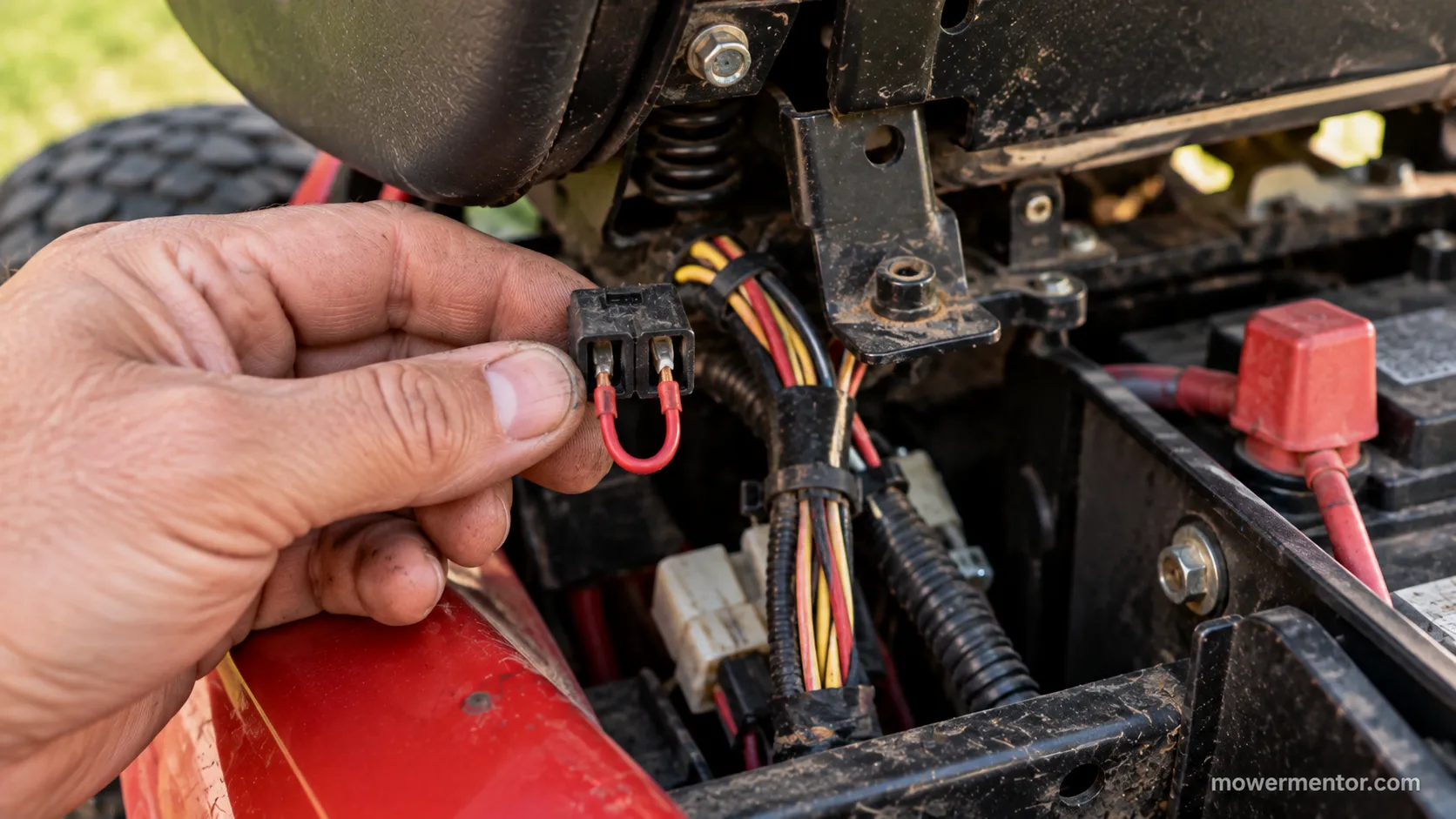
To find the break, technicians jump across the safety switches one at a time, using a jumper to bypass a suspect switch and see if the click returns. When it does, you have found the culprit.
On my Cub Cadet, unplugging and jumping the seat switch connector brought the click straight back, pinpointing a failed switch.
Tracing this circuit is much easier with a diagram, and the solenoid wiring layout shows how the trigger wire threads through each interlock.
A quick safety note: the interlocks exist to stop the blades or drive from starting while you are off the seat, so bypass them only as a momentary diagnostic and never leave a switch jumpered for normal use.
When It's Really the Solenoid or Starter: Replace It
Once the three-terminal test confirms a lawn mower starter solenoid clicking but not starting is the solenoid itself, replacement is quick and cheap, which is exactly why you confirm before buying.
A starter solenoid is an inexpensive part, typically in the 10 to 25 dollar range for a universal or brand unit, so the cost of guessing wrong is mostly your time, not your money.
Replace the solenoid only when you have measured voltage in with no voltage out. Replace the starter motor only when bridging the large posts still leaves it dead.
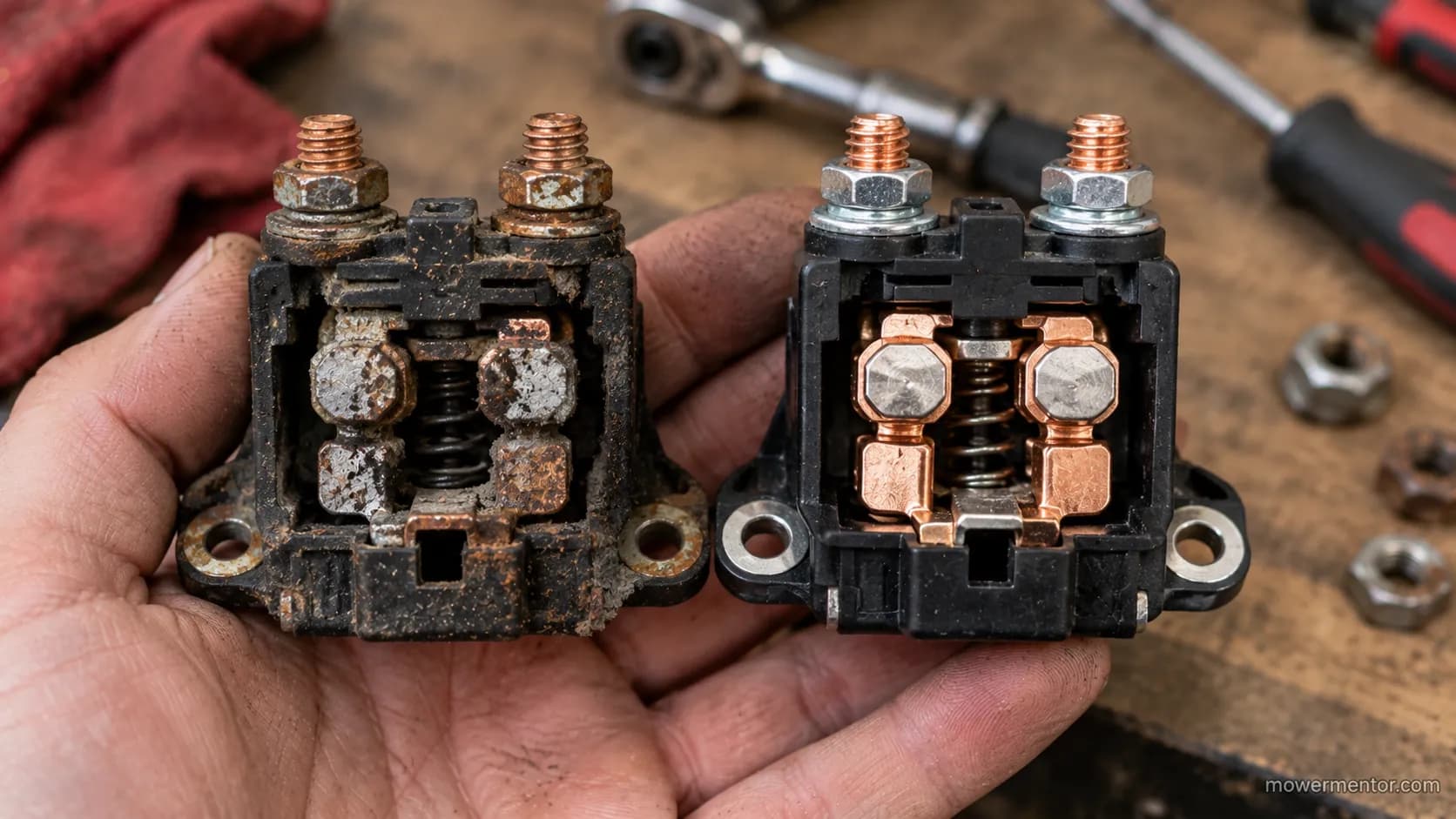
I swapped the failed solenoid on the Cub Cadet after its 0.3-volt output reading, and the single click turned into a clean crank on the first try.
Pulling the old unit showed the story physically: its internal contacts were visibly pitted and gray, the burned surfaces that could not pass current.
That teardown is the honest argument for testing first. Swapping parts blindly is how people spend real money chasing a five-dollar ground problem.
For the full swap with torque values and part numbers, follow how to swap the solenoid. It takes the guesswork out of the replacement.
If the starter is the confirmed culprit instead, replacing the starter motor walks the removal.
A worn but salvageable unit can sometimes be saved by rebuilding a worn starter rather than buying new.
How to Stop the Click Coming Back
Preventing a lawn mower starter solenoid clicking but not starting is mostly about protecting the current path and the battery, because corrosion and voltage sag cause most repeat clicking.
A starter pulling excess current strains a battery, and a healthy circuit depends on clean connections, so DB Electrical's starter guide stresses keeping voltage and connections in good condition.
A short annual routine keeps the click from returning. It costs a few minutes and one tube of dielectric grease.
Build these into every start of the mowing season.
Clean and grease both battery terminals and the frame ground, then torque them snug.
Maintain the battery on a smart maintainer through the off-season so it never drops into sag territory.
Snug the solenoid connections, including the small trigger wire, which loosens with vibration.
The reason this works ties straight back to the mechanism: dielectric grease on a clean ground keeps resistance low, so the coil and contacts always see full voltage.
After I greased the ground and kept the Craftsman on a maintainer, it held a rested 12.6 volts through the whole next start-up season with no recurrence.
Fold these checks into your broader upkeep, where they slot neatly into a seasonal tune-up. The habits reinforce one another.
Toro owners can follow the Toro tune-up steps for model-specific timing. For battery machines, routine electric mower upkeep keeps the same connections clean.
Maintenance reduces recurrence, though it will not make a failing solenoid last forever.
When to Stop and Call a Pro
Most cases of a lawn mower starter solenoid clicking but not starting are firmly do-it-yourself territory, but a few red flags mean stop testing and get help.
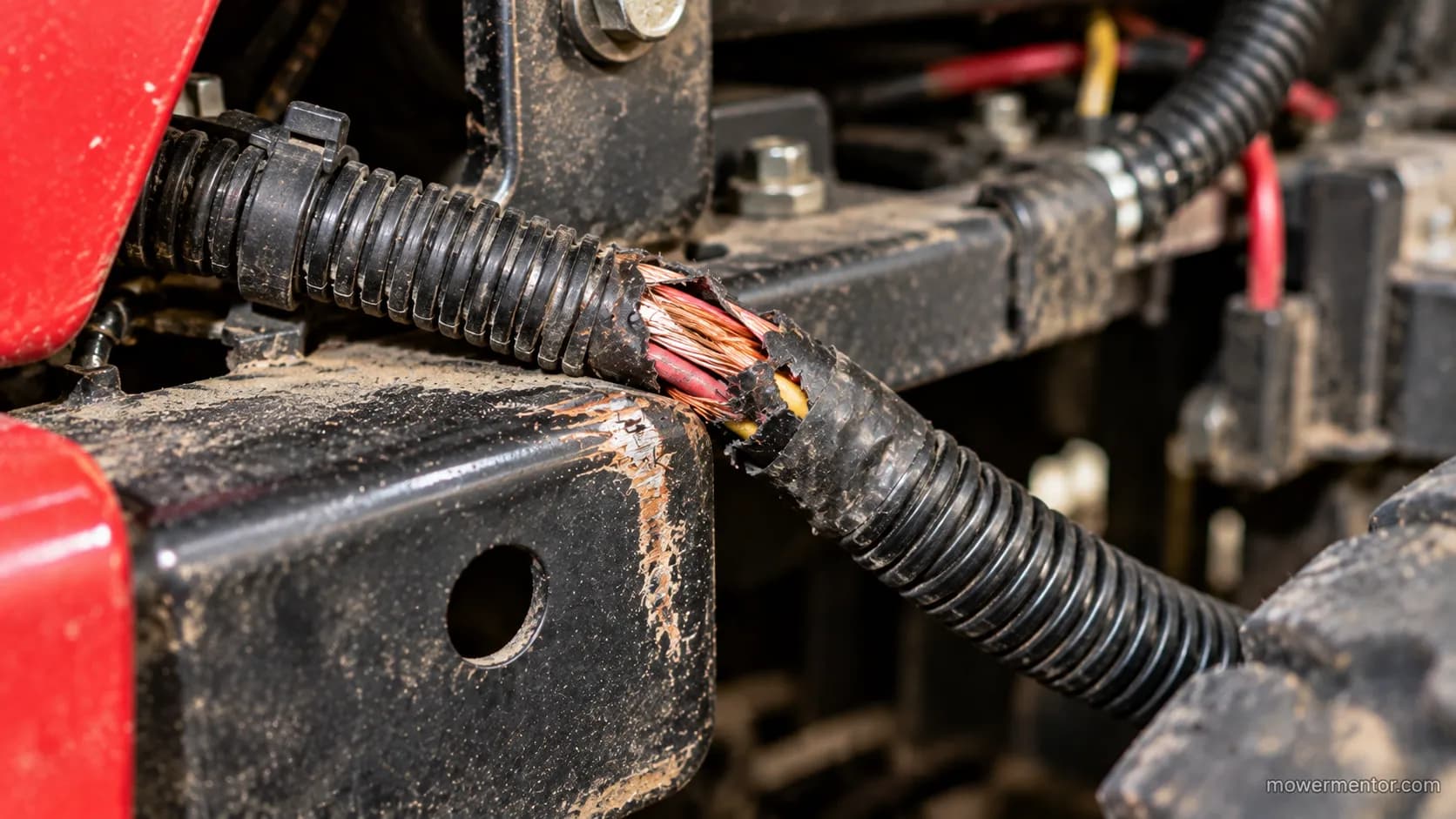
Melted or scorched wiring, repeated blown fuses, smoke or a harness that is hot to the touch, an engine that will not rotate by hand, or a fault that returns within minutes of a confirmed fix all point past a simple part swap.
These signal a short, a seized engine, or a harness fault that needs a professional. Knowing where the line is protects both your mower and you.
The most useful tell in that list is recurrence. On one test mower, a fault that came back minutes after a confirmed solenoid swap traced to a wiring harness that had chafed through against the frame and was shorting intermittently, which is a job I handed to a shop.
If you hit any of those red flags, treat them as a hard stop rather than a challenge. A clicking solenoid is cheap; a burned harness or a seized engine is not.
Frequently Asked Questions
Why does my solenoid click but there's no power?
The click means the solenoid coil energized and the plunger moved, but the large internal contacts did not fully close, so no power reaches the starter. iFixit's teardown of this exact symptom notes that dual-coil solenoid designs commonly click while the high-current contacts stay open.
Measure voltage in versus voltage out at the two large posts: full voltage in with little or none out confirms burned contacts and a solenoid that needs replacing.
My mower cranks but won't fire. Is that the solenoid?
No. If the starter actually spins the engine over, the entire starting circuit, including the solenoid, is working, and your problem has moved to fuel, spark, or air.
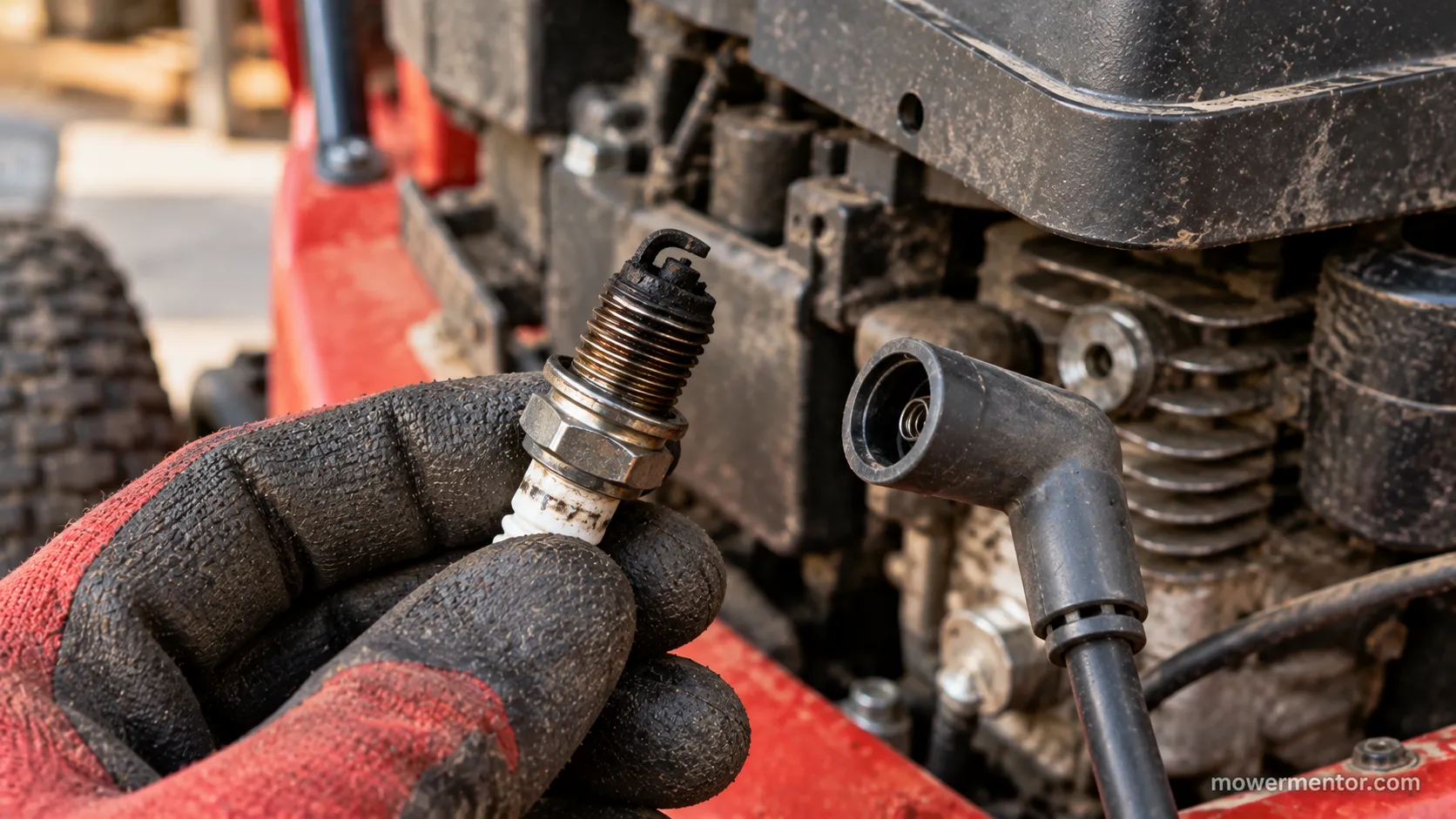
At that point a shot of starter fluid, used sparingly helps confirm a fuel problem. It is also worth checking for a fouled spark plug, a common no-fire cause.
A restricted intake such as a clogged air filter can stop a cranking engine from catching too.
The last mower I chased on this exact complaint cranked strongly but would not fire, and the culprit was a soot-black fouled plug, not the solenoid at all. Pulling the plug took two minutes and saved me from replacing a part that was working fine.
Can I keep bridging the solenoid to start it every time?
No. Bridging the large posts with a screwdriver is a diagnostic step, not a way to run the mower, and it bypasses the safety interlocks that stop the machine starting while you are off the seat.
If bridging starts it, fix the solenoid or the trigger circuit properly.
Will a bad solenoid drain my battery?
Usually not with the key off, because the solenoid coil is only energized while you are cranking. A solenoid that sticks closed or a wiring fault can create a parasitic drain, so if a battery keeps going flat overnight, test for a key-off current draw rather than assuming the solenoid.
How long does a mower starter solenoid last?
There is no fixed lifespan, but many original solenoids run for years and then fail gradually as their contacts pit from repeated arcing. Heat, vibration, and a marginal ground shorten that life, which is why clean connections and a healthy battery matter so much to how long the part survives.
The Bottom Line
A lawn mower starter solenoid clicking but not starting is not a mystery once you let the click do the talking.
A single clack points you at power, rapid chatter points at a flat battery, and total silence points upstream at the interlocks, so the sound tells you where to put the meter before you ever reach for your wallet.
From there, the voltage-in versus voltage-out test settles the one question that matters: is the solenoid actually passing power, or just clicking.
That order of operations is what separates a fifteen-minute fix from a weekend of parts-swapping.
Test the battery, chase the ground, then confirm the solenoid, and most clicking mowers are back to cutting the same afternoon.
Keep the connections clean and the battery charged through the season, and the click tends not to come back at all.
When the red flags appear instead, a burned harness or an engine that will not turn by hand, that is the moment to hand it to a professional rather than push on.
Found this useful? Make us a preferred source so we show up in your Google results.
Keep reading
Related articles
Troubleshooting & Repair
Dead Dash? Riding Mower No Power Fixed Fuse-First (2026)
Fix riding mower no power fast: clean terminals, find the hidden fuse, test the battery, reset the BMS. A fuse-first checklist for gas & electric mowers.
Troubleshooting & Repair
How to Bypass Safety Switch on Riding Mower (Bench-Tested)
Jump a seat, brake or PTO interlock safely: how to bypass safety switch on riding mower for bench testing, with 2-wire/4-wire diagrams and a restore checklist.
Troubleshooting & Repair
Riding Lawn Mower Won't Turn Over: 5-Stage Voltage Test
Fix it fast: a riding lawn mower won't turn over usually means battery, ground, solenoid or starter. Test each in 5 ordered stages.
Troubleshooting & Repair
Just Clicks? Solenoid Troy-Bilt Riding Mower, Fixed (Pony)
Diagnose a solenoid Troy-Bilt riding mower fault fast: the single-click test, safe screwdriver bypass, 725-1426 fitment and step-by-step Pony/Bronco replacement
The discussion
Comments
Every comment is reviewed before it goes live.