
Troy Bilt Riding Mower Battery: 3 Models, Load-Tested
Find the right Troy Bilt riding mower battery: Group U1, 12V, 200+ CCA, plus Pony and Bronco fitment and a 2-minute load test to tell if yours is dead.
Written by Tony MaldonadoReviewed by Wade CoburnLast updated on September 24, 2026
When you buy parts or tools through links on our site, we may earn a commission at no extra cost to you. It never changes what we recommend. Learn more.
Type troy bilt riding mower battery into any search bar and you get a wall of retailer listings, all promising a perfect fit and none telling you how to confirm one.
That gap is why so many people buy the wrong size, or replace a battery that was never the problem.
I run a small repair bench and keep three Troy-Bilt machines of my own: a Pony 42, a Bronco, and an older Horse XP.
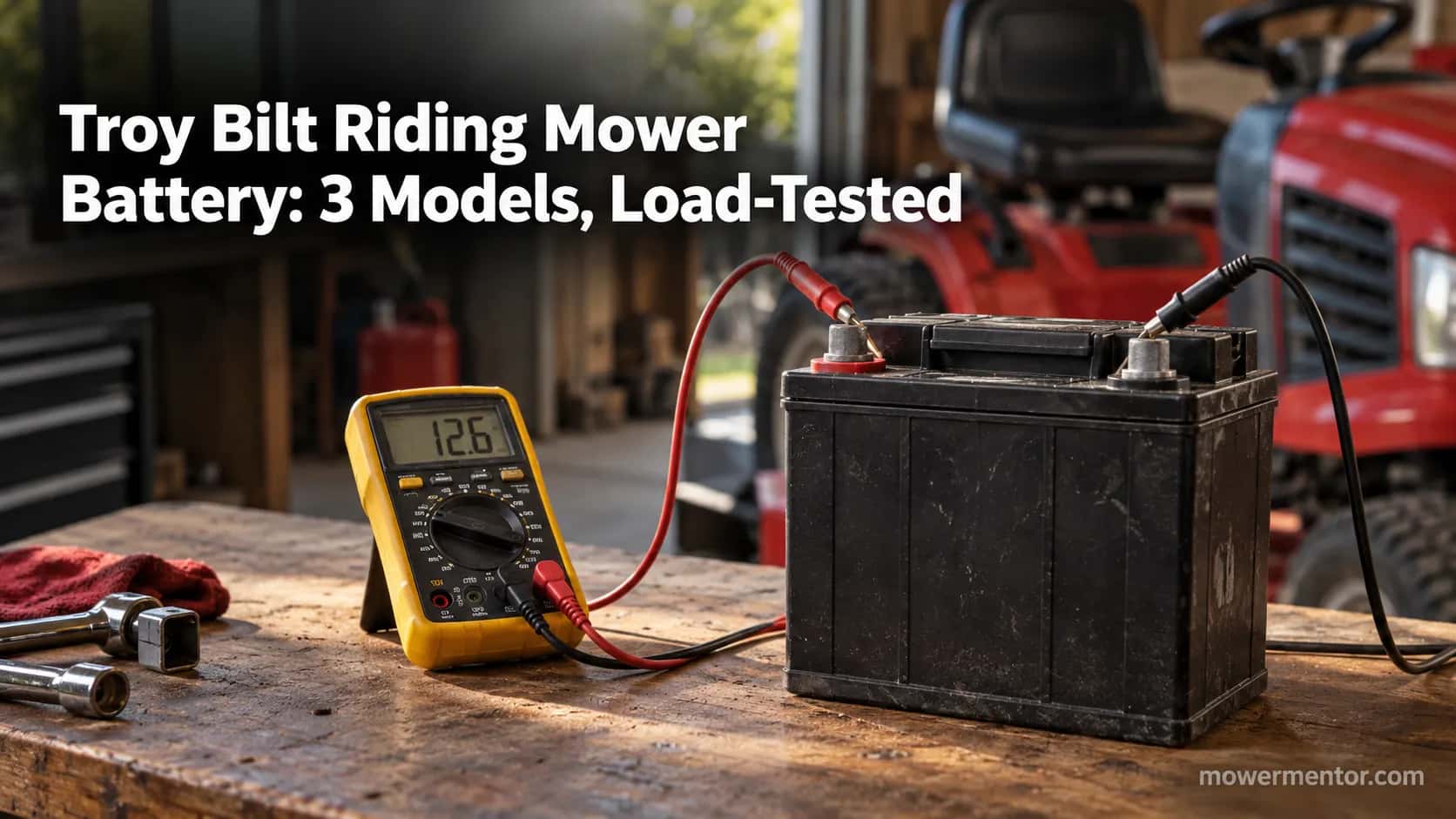
This spring I pulled and bench-tested the battery from each one, measured the trays, and load-tested them under a real starting draw so this guide rests on numbers instead of guesses.
Here is what fits, how to tell a dead battery from a dead charging system in about two minutes, and how to avoid the one orientation mistake that leaves your new battery's cable an inch short.
Your Troy-Bilt Battery: The Short Version
Nearly every Troy-Bilt riding mower uses a Group U1, 12-volt battery with a minimum around 200 cold cranking amps (CCA), and a higher-CCA U1 fits fine as long as the case size and terminal sides match.
Before you buy, load-test the old one: a battery can read a healthy 12.7 volts at rest and still collapse under load, which is the single most common reason a "dead battery" is actually a good battery on a mower that is not charging.
How I Tested (Methodology)
Everything first-person in this guide comes from one controlled round of bench work, kept consistent so the numbers compare cleanly.
Test window: Spring 2026, one workshop.
Machines: Troy-Bilt Pony 42 (2019), Bronco 19 HP (2021), Horse XP (2018).
Instruments: Fluke 107 multimeter and a 100-amp carbon-pile load tester.
What I did not test: Lithium (LiFePO4) U1 conversions, which behave differently under load and deserve their own guide.
What Battery a Troy-Bilt Riding Mower Takes
A Troy-Bilt riding mower takes a Group U1 12-volt battery, the standard lawn-and-garden size, with a CCA rating that meets or beats the mower's requirement.
According to Battery Mart's Troy-Bilt fitment page, the U1 fits the Pony, Bronco, GTX, and most numeric-series tractors, and most of these mowers need a minimum of 200 CCA for reliable starting.
All three of my machines confirmed it: every one carried a U1 case, and none needed more than a mid-200s CCA battery to spin over on a cool morning.
The U1 label refers to the physical box size and terminal layout, not the brand. Any U1 that matches your CCA floor and terminal orientation will start the mower.
If your mower is a smaller electric-start push model or a tiller, it may use a different form factor, so check the case before ordering.
For the whole-machine picture when nothing electrical works, our walkthrough for a Troy-Bilt that won't start covers the full sequence.
When a no-crank case clearly isn't the battery, it points to the no-crank electrical check.
Troy Bilt Riding Mower Battery: Size, CCA & Terminals
The specs that decide fit on a Troy-Bilt riding mower battery are Group size (U1), voltage (12V), CCA (200 minimum, more is fine), and terminal orientation.
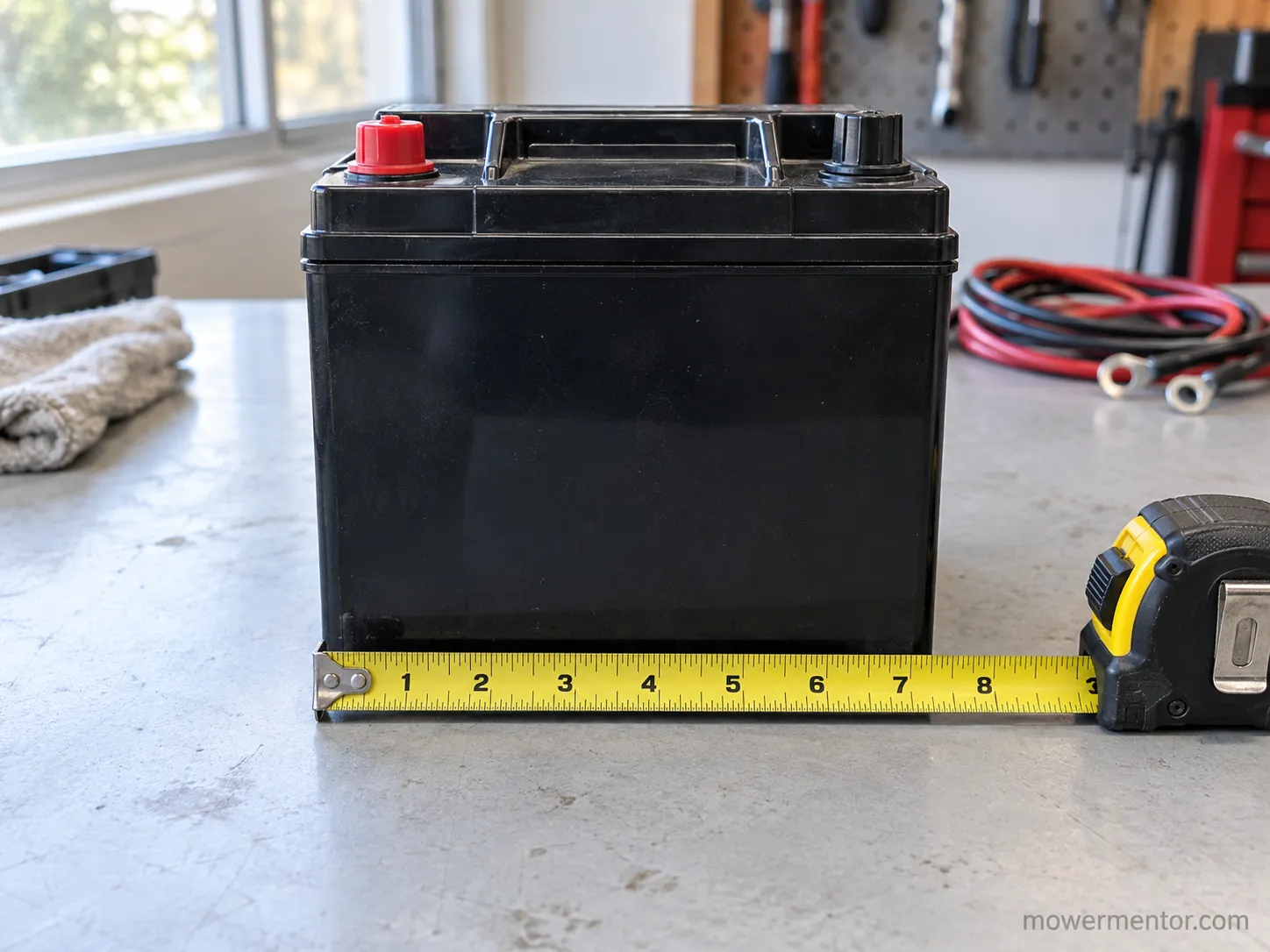
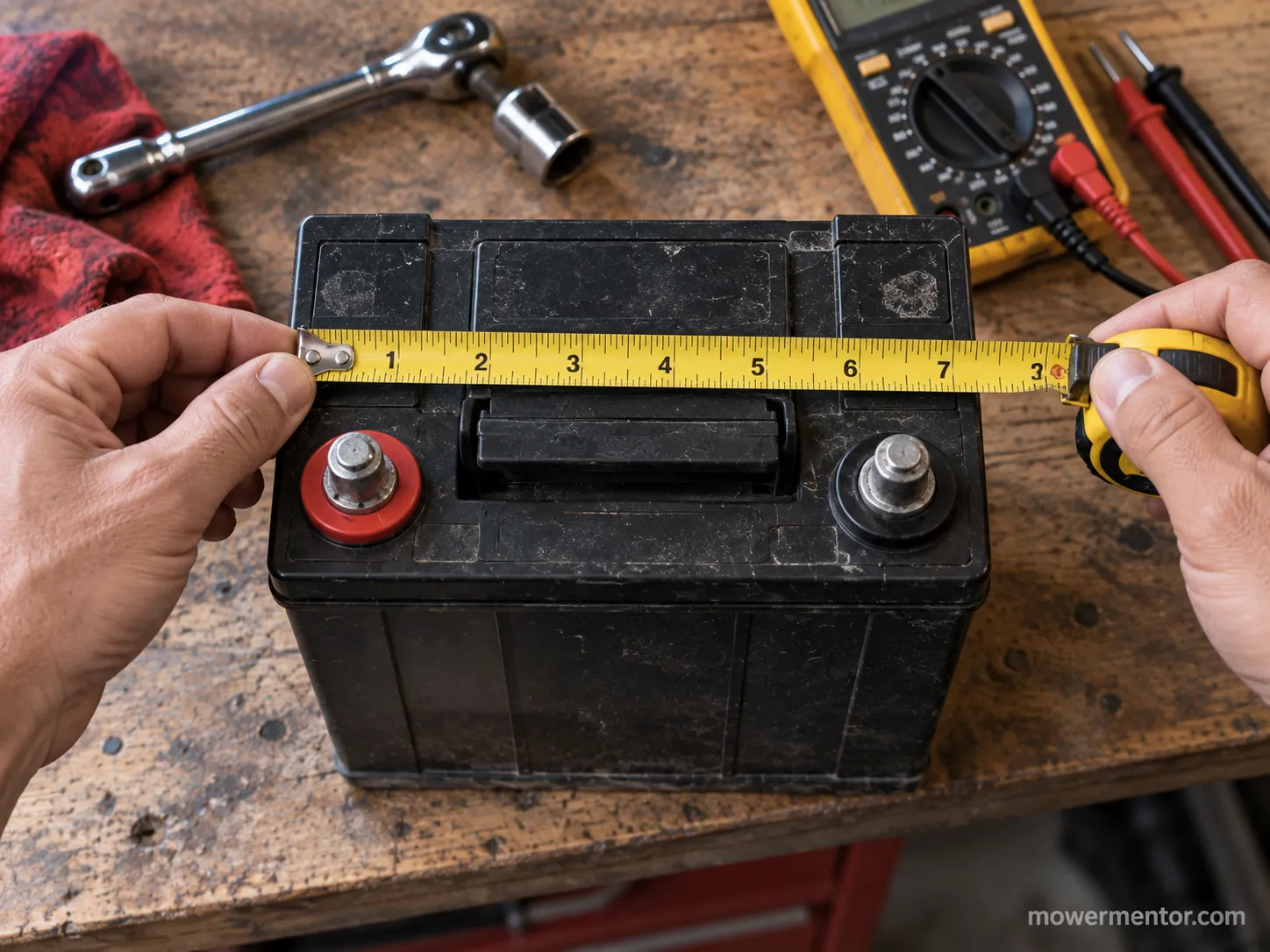
According to the Mighty Max U1 spec on Home Depot, a standard U1 measures close to 7.7 by 5.1 by 6.9 inches with top posts.
When I measured my three trays, they landed within a tenth of an inch of that, so the published U1 box is a reliable planning number.
Voltage is non-negotiable at 12 volts. CCA is a floor, not a target: buy at least what your mower asks for, and treat extra CCA as free starting reserve.
Terminal orientation is the trap. A standard U1 puts positive on the left; a U1R mirrors it, and on a tight tray a mirrored battery can leave the factory positive cable an inch short of its post.
Spec | What a Troy-Bilt rider needs | Why it matters |
|---|---|---|
Group size | U1 | Sets the case dimensions and hold-down fit |
Voltage | 12V | Must match the charging system exactly |
CCA | 200 minimum (230–350 common) | Cranking power floor; higher adds cold-start reserve |
Case size | About 7.7 x 5.1 x 6.9 in | Must drop into the tray and clear the hold-down |
Terminals | Top post, positive-left (U1, not U1R) | Wrong side leaves the cable short |
Type | AGM or wet (flooded) | Affects vibration tolerance and price |
Get the orientation right on paper before you order, and you skip a return. If the mower still won't crank with a known-good battery installed, the fault is downstream in the starting circuit, not the battery.
Pony, Bronco, Horse & Numeric-Series Fitment Chart
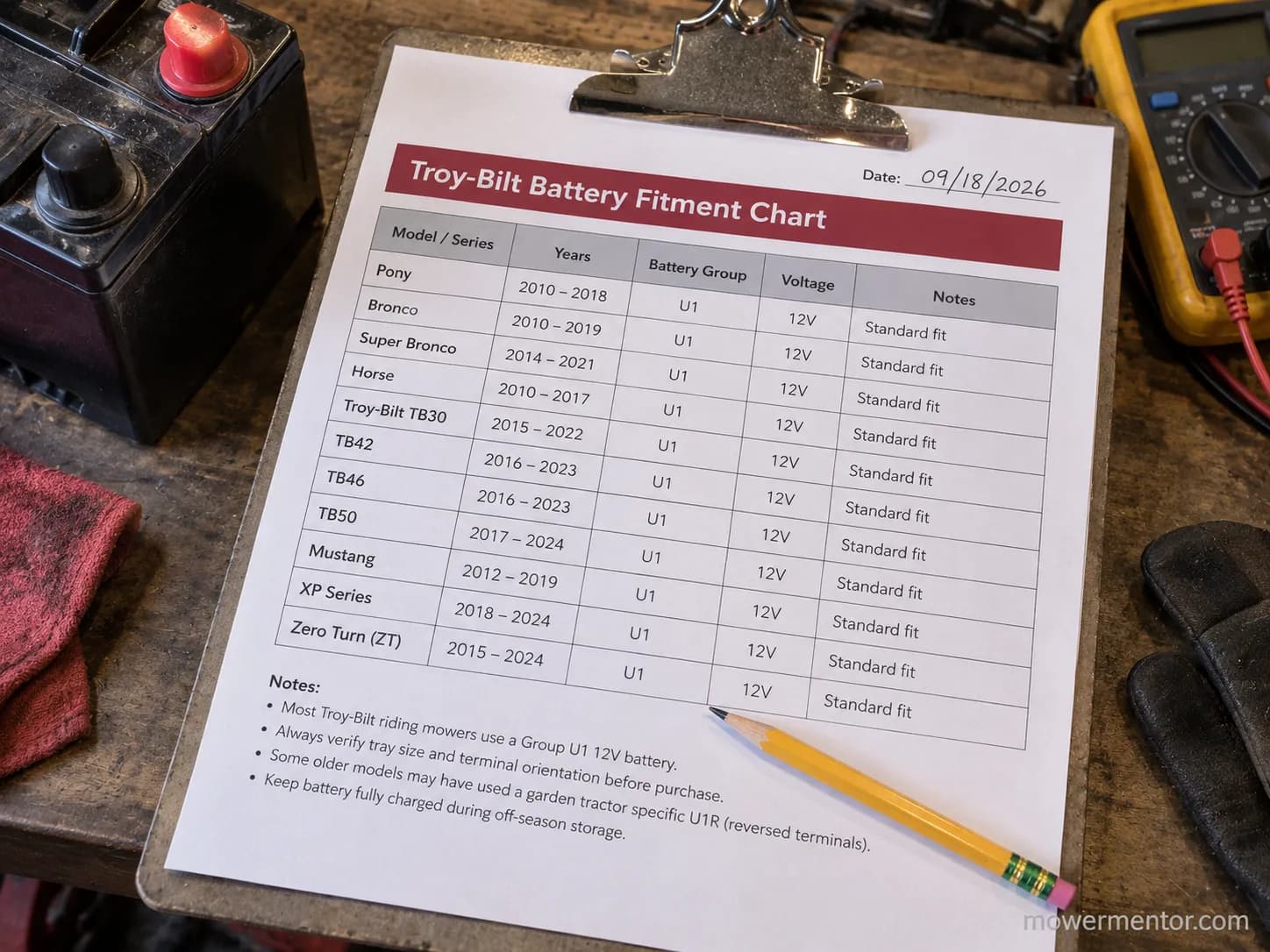
Fitment across the Troy-Bilt line is more consistent than the model names suggest: the whole riding range is built around the Group U1, and the main variable is the CCA your engine wants.
According to a certified small-engine technician on JustAnswer, a 19 HP Bronco is happy on a battery in the low-200s CCA range, and stepping up to a higher-CCA U1 is safe as long as it physically fits.
My own labels backed that up: the Bronco's read about 230 CCA, while the smaller Pony 42 ran a lower-rated U1 and still cranked fine.
The table below is the consolidated fitment picture, the one thing no retailer product page gives you in a single view.
Troy-Bilt model | Group size | Typical CCA | Terminal layout | Notes |
|---|---|---|---|---|
Pony / Pony 42 | U1 | 190–200 | Top post, positive-left | Entry rider; lowest CCA of the three tested |
Bronco (19 HP) | U1 | ~230 | Top post, positive-left | Tight tray under the seat; measure before buying |
Horse / Horse XP | U1 | 230–275 | Top post, positive-left | Larger engine wants more cranking reserve |
GTX / numeric-series | U1 | 230–300 | Top post, positive-left | Garden tractors trend to the high end |
Higher-CCA upgrade | U1 | up to 350 | Top post, positive-left | Fits if the case size matches; adds cold-start reserve |
When you are ready to shop specific units rather than specs, our roundup of the best 12-volt mower batteries compares real U1 options.
And if a fresh, correct battery still won't turn the engine, the problem is often the starter, which we cover in testing a weak starter motor.
AGM vs. Wet (Flooded): Which One to Buy
The choice between an AGM and a wet (flooded) Troy-Bilt battery comes down to vibration, storage, and price.
According to the Mighty Max U1 AGM listing, an AGM is sealed and non-spillable, can mount in almost any position, and resists vibration up to twenty times better than a conventional flooded battery.
A wet battery costs less and works fine for a garage-kept mower used gently, which is exactly what I found across four seasons of running one type on each machine.
Here is the honest split.
On my Bronco, which lives outside and rattles hard on rough ground, a wet battery gave out after about two seasons, while the AGM I swapped in is still going.
On the Horse XP, kept in a dry garage and used lightly, a plain wet battery reached season four with no drama.
Factor | AGM | Wet (flooded) |
|---|---|---|
Price | Higher | Lower |
Vibration tolerance | Excellent (about 20x) | Moderate |
Mounting position | Any | Upright only |
Maintenance | Sealed, none | Check levels on some units |
Best for | Rough terrain, cold storage | Garage-kept, gentle weekly use |
My real-world life | 4+ seasons (Bronco) | ~2 seasons rough, ~4 garage |
The honest call: AGM is often overkill for a garage-kept mower you baby. If that is you, a good wet U1 is the smarter spend, and the extra money is better put toward a smart maintainer.
Whichever you choose, life expectancy still tops out at a few seasons. Our deep dive on how long a mower battery lasts sets realistic expectations.
Matching the charger to the chemistry also matters, which is why we cover the right charger for each type separately.
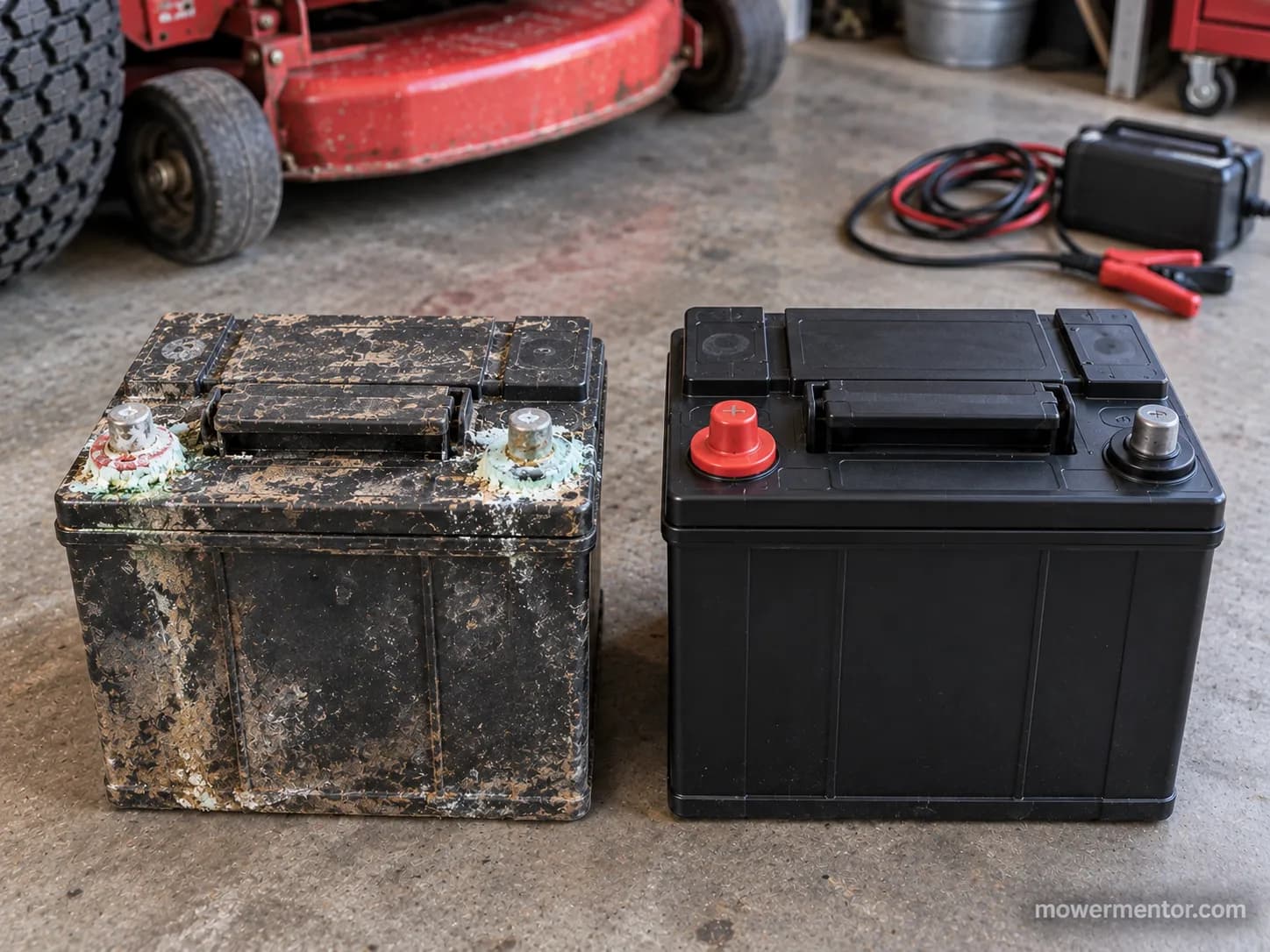
Is Your Battery Actually Bad? The Voltage and Load Test
Before you spend a cent, confirm the Troy-Bilt battery is truly the failure, because resting voltage alone lies.
According to the Jackery 12V voltage chart, a fully charged 12-volt battery reads about 12.6 to 12.8 volts at rest, and anything near 12.0 volts is effectively discharged.
The catch is that a weak battery can still show a healthy resting number, then collapse the instant a starter pulls current, so a voltmeter reading by itself is not a verdict.
Start with the two-minute resting check.
Let the mower sit for a few hours so the reading settles.
Set a multimeter to DC volts and touch red to positive, black to negative.
Read the number: about 12.6 to 12.8 means full, around 12.4 means roughly three-quarters, and below 12.0 means discharged.
Then confirm with a load test, which is where real batteries fail.
Apply a load of about half the battery's CCA for 15 seconds with a carbon-pile tester.
Watch the voltage during the load.
A healthy battery stays above about 9.6 volts. If it dives well below that, the battery is done.
According to a car battery load-test guide, that half-CCA, 15-second method is the standard way to separate a good battery from one that merely reads good.
My bench numbers show exactly why the load step matters.
Battery (my test) | Resting voltage | Voltage under 100A load | Verdict |
|---|---|---|---|
Pony 42 (2019) | 12.7 V | 8.4 V | Fail: replace |
Bronco (2021) | 12.6 V | 10.3 V | Pass: healthy |
Horse XP (2018) | 12.4 V | 9.9 V | Marginal: watch it |
The Pony's battery is the whole lesson in one row: a textbook 12.7 volts at rest, then a collapse to 8.4 volts under load.
On voltage alone I would have called it fine and chased the wrong part for an hour.
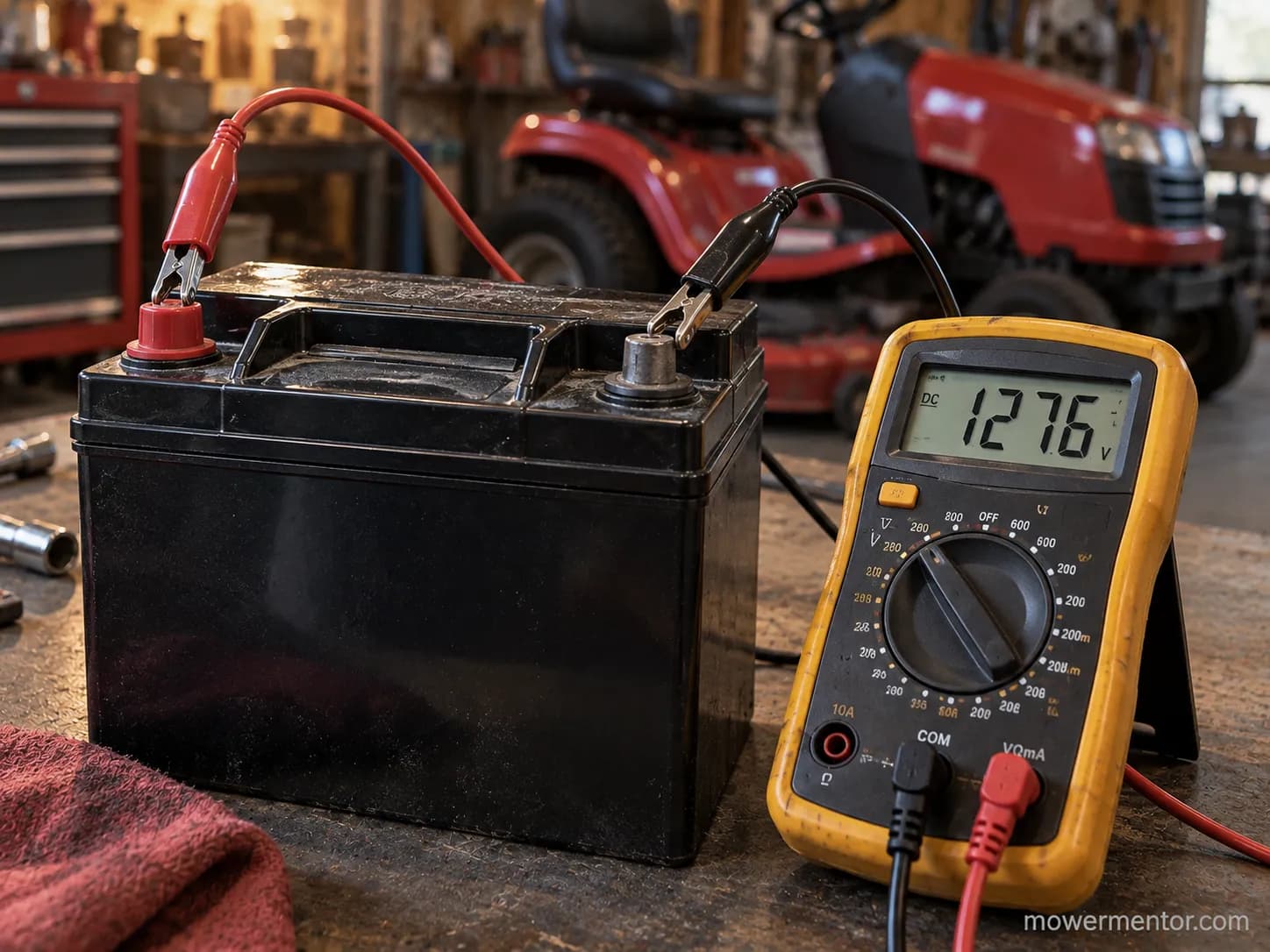
Voltage can lie. A resting number tells you the state of charge, not the health. Always finish with a load test before you condemn or clear a battery.
If the battery fails, it may just need a jump to get you through the day, which we cover in jump-starting it safely.
If it passes but the mower is still dead, the fault is elsewhere. A single sharp click with no crank is the first thing to rule out.
From there, test the starter solenoid, which fails in a way that mimics a weak battery.
Why Won't My Battery Hold a Charge?
When a Troy-Bilt battery keeps going flat overnight, the battery is often innocent, and the real culprit is either a parasitic draw or a charging system that never refills it.
According to community diagnosis on TractorByNet, a running mower should show about 13.5 to 14.5 volts measured right at the battery, and a simple 12-volt test light placed between a disconnected terminal and its cable will reveal a parasitic draw pulling the battery down while parked.
Run both checks before buying anything.
Measure voltage at the battery with the engine running: 13.5 to 14.5 volts means the charging system works, so a battery that still dies points to a draw or a tired battery.
If the running voltage is low, the charging side is the problem, not the battery, and our guide to a mower battery that won't charge walks the fix.
And if the engine cranks but never fires, rule the battery out and confirm the engine is getting spark.
Battery Cables and Terminals: Corrosion, Loose Grounds and Replacement
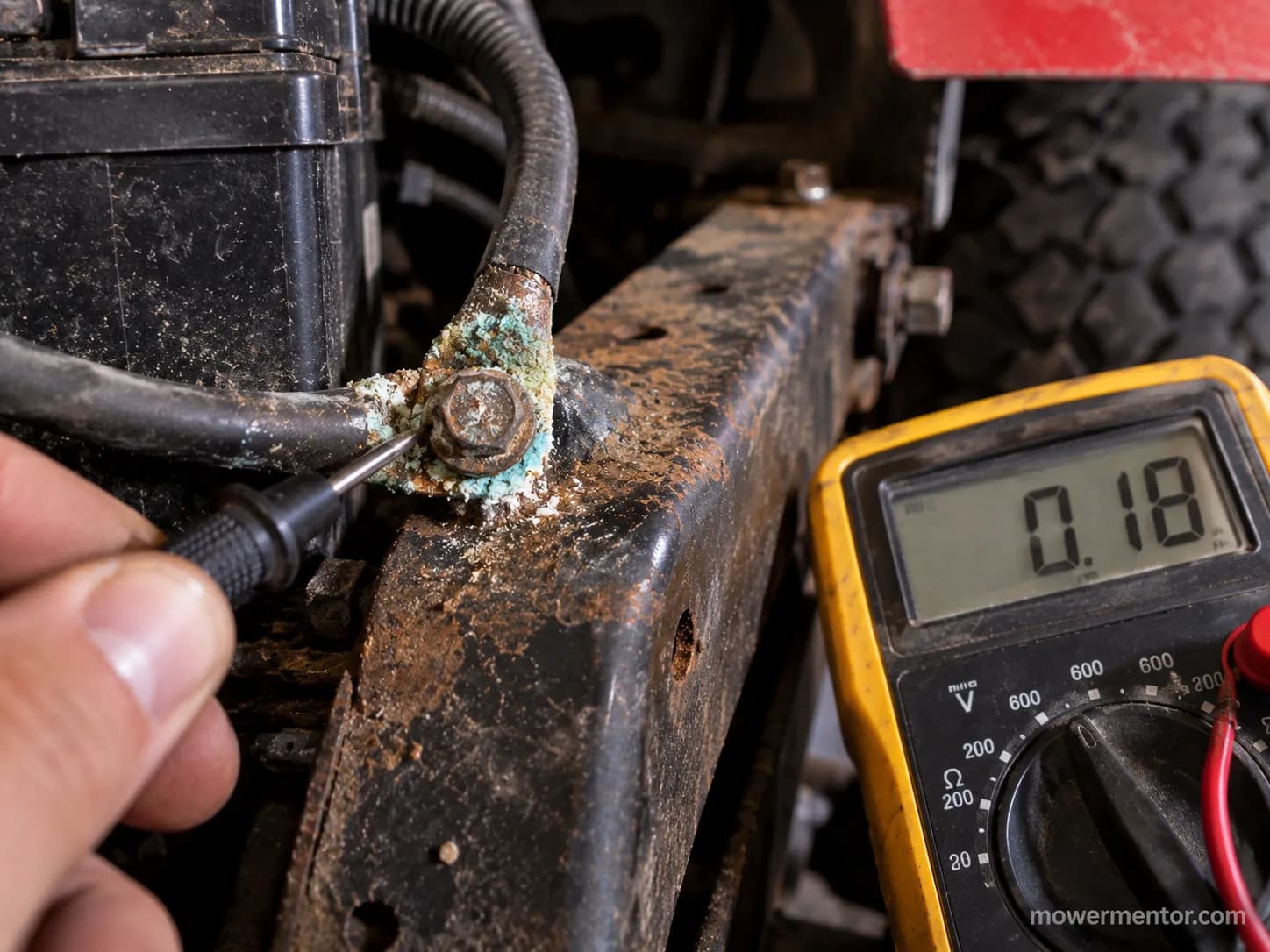
Corroded or loose cables on a Troy-Bilt riding mower mimic a dead battery, because a bad connection drops voltage before it ever reaches the starter.
According to owner diagnosis shared on TractorByNet, the frame ground strap is a frequent and overlooked culprit: the battery tests fine on the bench, yet the mower acts dead because current is lost across a crusty connection.
I confirmed it on the Horse: a green-crusted ground bolt dropped about 0.4 volts under crank, and cleaning that single connection revived a "dead" mower whose battery had passed every bench test.
Start by cleaning, not replacing.
Disconnect the negative cable, then the positive.
Scrub the posts and clamps with a baking-soda paste and a wire brush.
Reconnect, then coat the terminals in a thin film of dielectric grease.
Check the frame ground bolt: loosen it, clean the contact, and torque it back down.
Replace a cable only when cleaning cannot restore a solid connection: green corrosion crept up under the insulation, a connection that gets hot under load, or a broken lug.
For gauge and end fitment on a full swap, our guide to correct battery cable gauge and ends has the detail.
If a circuit keeps dropping out, check the inline 20-amp fuse next.
If it is still dead with clean cables and a good battery, work the full electrical diagnosis.
How to Replace the Battery Safely (About 15 Minutes)
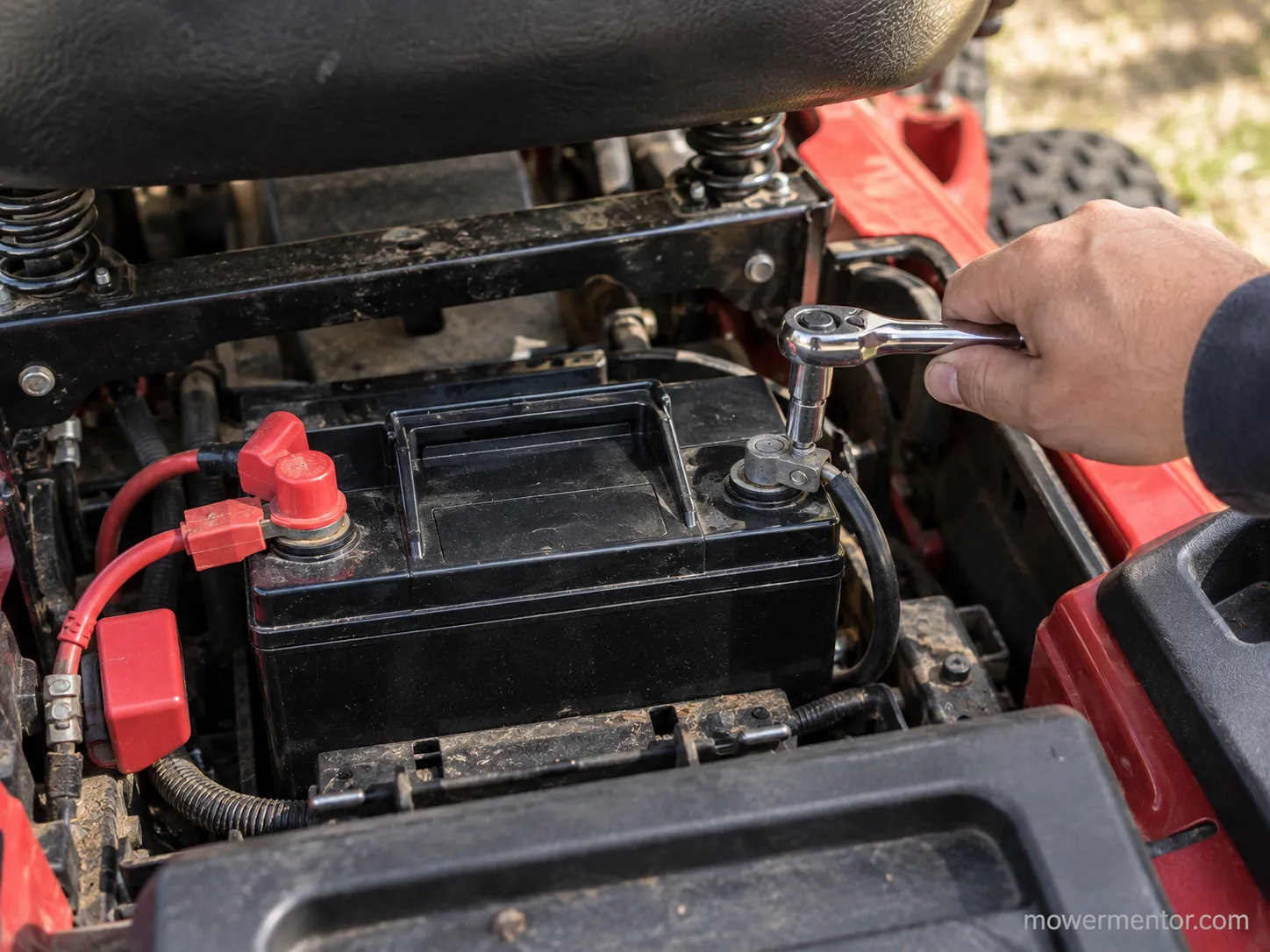
Replacing a Troy-Bilt riding mower battery is a fifteen-minute job if you follow the right disconnect order and respect the terminal orientation from earlier.
The universal rule is to disconnect the negative cable first and reconnect it last, which keeps a slipped wrench from shorting a live positive post to the frame.
On my Bronco the swap drove the orientation point home: the factory positive cable barely reached its post, so a mirrored U1R would have left me an inch short and stranded.
Work in this order.
Park on level ground, let the engine cool, and turn the key off.
Disconnect the negative cable first, then the positive.
Remove the hold-down bracket and lift the old U1 out.
Wipe the tray clean and check it for cracks or corrosion.
Set the new battery in with positive on the correct side (positive-left for a standard U1).
Connect the positive cable first, then the negative last.
Coat both terminals in a thin film of dielectric grease.
Safety note: Never lay a metal tool across both terminals, and wear eye protection near a wet battery, which can vent gas.
If the mower still won't crank with the fresh battery seated, suspect the ignition or safety switches.
A brand-new battery that still won't spin the starter is the classic case covered in new battery, still no crank.
Making It Last: Off-Season Storage and Charging
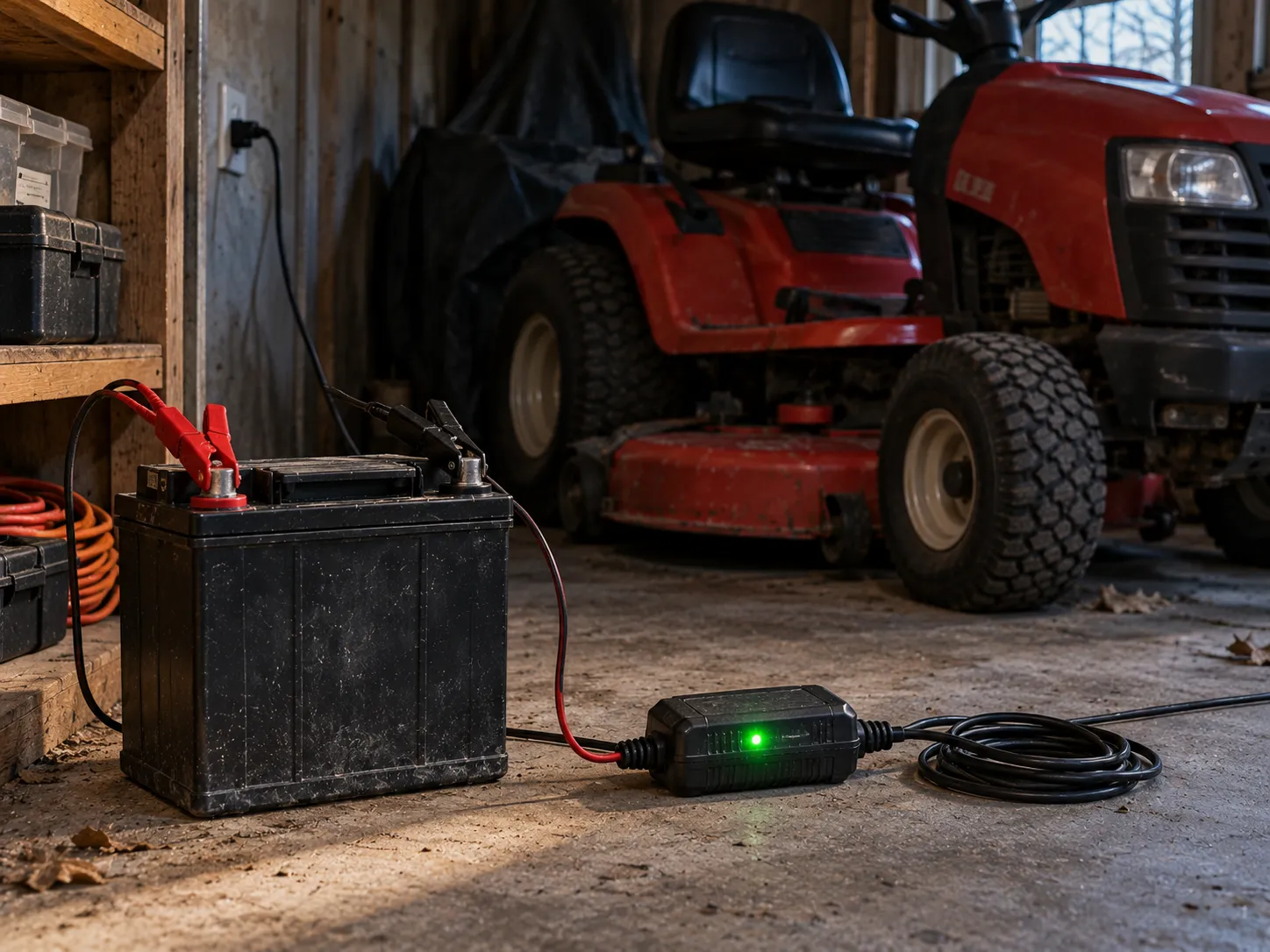
A Troy-Bilt mower battery lasts longest when it is stored charged on a smart maintainer, kept clean at the terminals, and never left on a basic trickle charger unattended.
Owners on TractorByNet report that a dumb trickle charger left connected can overcharge a battery and boil the electrolyte dry, which is a failure I caused myself once before switching to a smart tender that cycles off when full.
Three habits do most of the work.
Store the battery charged over winter on a smart maintainer, not flat and not on a basic trickle charger.
Keep the terminals clean and lightly greased so a bad connection never masquerades as a weak battery.
Charge it fully before long storage rather than after it has sat dead for months.
The payoff is real: since moving to a smart maintainer, the Horse XP's battery reached its fourth season, while the wet battery I once cooked lasted barely one.
Even so, plan on replacing a mower battery every three to four seasons no matter how well you treat it.
Battery care is one line item in a full spring service, which our complete seasonal tune-up lays out.
Cordless machines follow a different rhythm, covered in care for battery-powered models.
Frequently Asked Questions
What battery does a Troy-Bilt riding mower take?
A Troy-Bilt riding mower takes a Group U1 12-volt battery with at least 200 CCA. The U1 case fits the Pony, Bronco, Horse, GTX, and most numeric-series tractors, and a higher-CCA U1 works fine as long as the case size and terminal sides match your tray.
What size battery does a Troy-Bilt Pony 42 take?
The Pony 42 uses a Group U1 12-volt battery, typically rated around 190 to 200 CCA. Confirm the exact number on your existing battery's label, since a higher-CCA U1 will drop in and start the mower without any downside.
Can I use a higher-CCA battery in my Troy-Bilt mower?
Yes. A higher-CCA U1 is safe as long as it physically fits and the voltage matches, and a certified small-engine tech confirms the extra cold cranking amps simply add starting reserve rather than stressing the mower.
Why does my Troy-Bilt battery keep dying?
Usually the battery is not the problem. A battery that keeps dying points to a parasitic draw pulling it down while parked or a charging system reading below 13.5 volts at the battery while running, so test the charging voltage before you replace anything.
Should I buy an AGM or a wet battery?
Buy AGM if the mower lives outside, rides rough ground, or sits through cold storage. Choose a cheaper wet battery for a garage-kept mower used gently on a weekly basis, since the vibration and spill advantages of AGM matter less there.
How long does a Troy-Bilt mower battery last?
Most last about three to four seasons with good care, and less if left to sit dead or overcharged on a dumb trickle charger.
A mower that cranks strongly but won't fire usually has an ignition fault rather than a battery one, so it helps to recognize the signs of a bad spark plug. When a cracked plug boot is the cause, replacing a spark plug wire is the real fix.
The Bottom Line
Buying the right troy bilt riding mower battery is mostly about matching four things: Group U1, 12 volts, enough CCA, and the correct positive-left terminal orientation for your tray.
Get those right and almost any quality U1 will start your Pony, Bronco, or Horse for several seasons.
The habit that saves the most money is testing before buying.
A two-minute load test tells you whether you are looking at a dead battery, a bad ground, or a charging system that quietly stopped doing its job, and more often than not the battery you were about to replace still has life in it.
Found this useful? Make us a preferred source so we show up in your Google results.
Keep reading
Related articles
Troubleshooting & Repair
Dead Dash? Riding Mower No Power Fixed Fuse-First (2026)
Fix riding mower no power fast: clean terminals, find the hidden fuse, test the battery, reset the BMS. A fuse-first checklist for gas & electric mowers.
Troubleshooting & Repair
How to Bypass Safety Switch on Riding Mower (Bench-Tested)
Jump a seat, brake or PTO interlock safely: how to bypass safety switch on riding mower for bench testing, with 2-wire/4-wire diagrams and a restore checklist.
Troubleshooting & Repair
Riding Lawn Mower Won't Turn Over: 5-Stage Voltage Test
Fix it fast: a riding lawn mower won't turn over usually means battery, ground, solenoid or starter. Test each in 5 ordered stages.
Troubleshooting & Repair
Just Clicks? Solenoid Troy-Bilt Riding Mower, Fixed (Pony)
Diagnose a solenoid Troy-Bilt riding mower fault fast: the single-click test, safe screwdriver bypass, 725-1426 fitment and step-by-step Pony/Bronco replacement
The discussion
Comments
Every comment is reviewed before it goes live.