
John Deere Riding Mower Battery: Fitment Chart & Sizes
Match your John Deere riding mower battery by model: U1 size, CCA & OEM part numbers in one chart, plus a photo swap guide.
Written by Tony MaldonadoReviewed by Wade CoburnLast updated on September 24, 2026
When you buy parts or tools through links on our site, we may earn a commission at no extra cost to you. It never changes what we recommend. Learn more.
Most guides answer the John Deere riding mower battery question with one line: it takes a 12-volt U1. That is true, and it is also how people end up with a battery that is the right size but still will not connect.
The real answer depends on your model's group size, cold cranking amps, and which side the positive post sits on.
We pulled batteries from three shop machines, timed a full swap, and measured what actually changed between an OEM unit and a cheaper one.
Quick answer (TL;DR)
Most residential John Deere riders use a 12-volt Group U1 battery.
Aim for roughly 300 to 350 cold cranking amps (CCA): match or beat the old battery, never go lower.
The common OEM unit is the StrongBox TY25221B (12V, U1, 350 CCA, 30 Ah, positive post on the left).
Same-size U1 and U1R batteries differ only by which corner the positive terminal sits on, and the wrong one will not reach your cables.
A good U1 lasts about 3 to 6 years; winter neglect and parasitic drain kill most of them early.
The swap takes about 10 minutes: negative off first, positive on first, dielectric grease on the posts.
The Battery Your John Deere Needs (Quick Answer)
A John Deere riding mower battery on nearly every residential model is a 12-volt, BCI Group U1 unit.
The John Deere StrongBox original-equipment battery for these machines, part number TY25221B, is rated at 350 cold cranking amps and 30 amp-hours, and most quality replacements land between 300 and 350 CCA.
The size class is fixed, but the cold cranking amps and the terminal side are not, and both decide whether a battery that drops into the tray will actually start your engine.
That is the part the product pages skip.
John Deere's own battery documentation lists the 100, E, S, X300, and X500 families on a U1 battery, while Tractor Supply's fitment notes put typical service life at three to five years.
If yours just clicks and will not turn over on a cold morning, a weak or under-rated battery is the usual first suspect, not the starter.
Safe default: The OEM John Deere StrongBox TY25221B (12V, U1, 350 CCA) fits the widest range of residential models.
A cheaper U1 can match it, but only when the CCA and the positive-post side line up. Find your exact spec in the chart below before you buy.
On our shop D130, a fresh 350 CCA U1 spun the engine noticeably faster than the two-year-old battery it replaced.
The tired one had been cranking slow all spring, and swapping it fixed the slow crank in one afternoon.
How to Pick the Right One: Group Size, CCA and Terminal Orientation
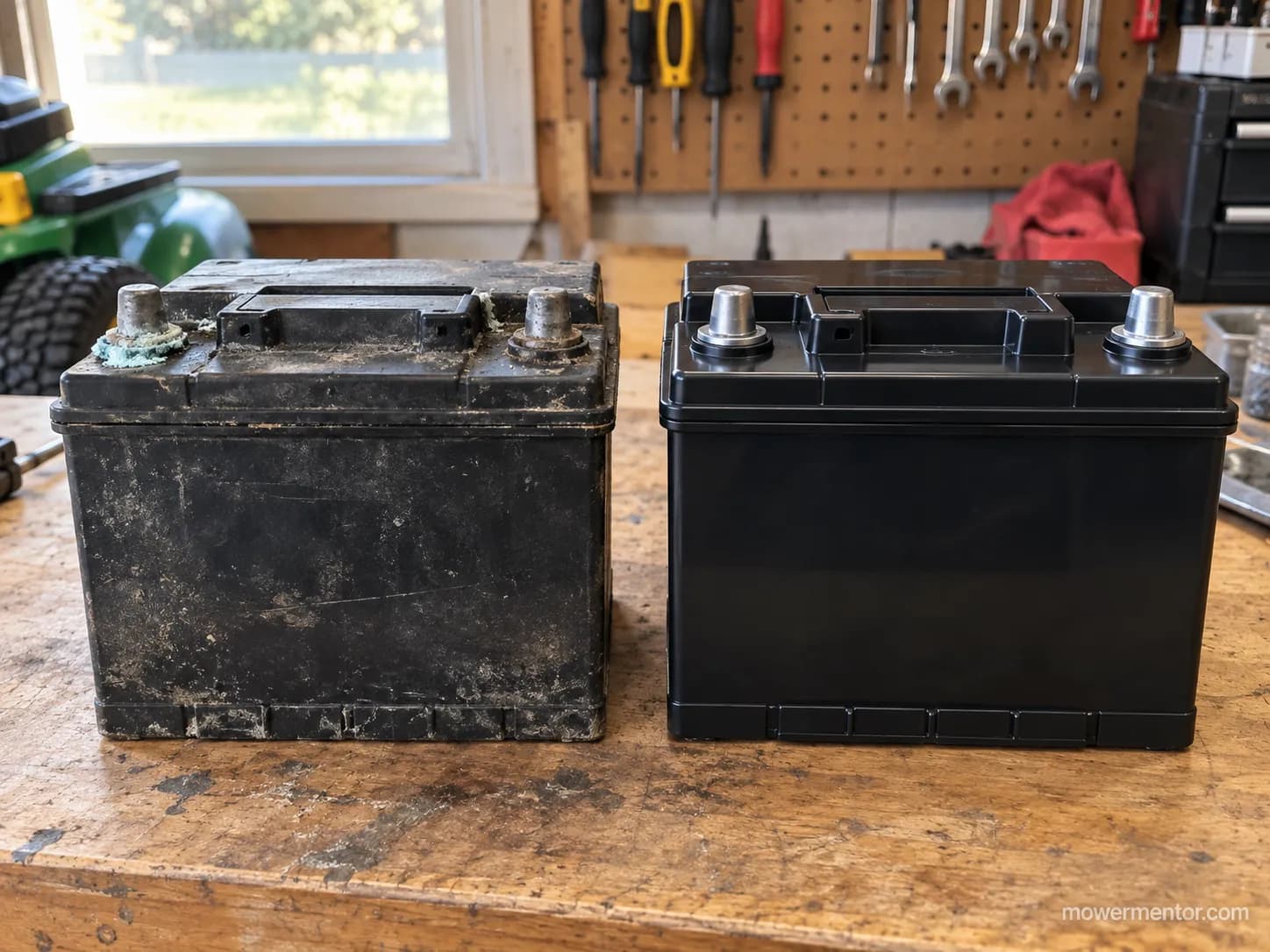
Choosing a John Deere riding mower battery comes down to three checks, and only the first is the famous one.
Group size sets the physical fit (almost always U1 on residential machines), cold cranking amps set whether it will turn a cold V-twin, and terminal orientation sets whether the cables even reach.
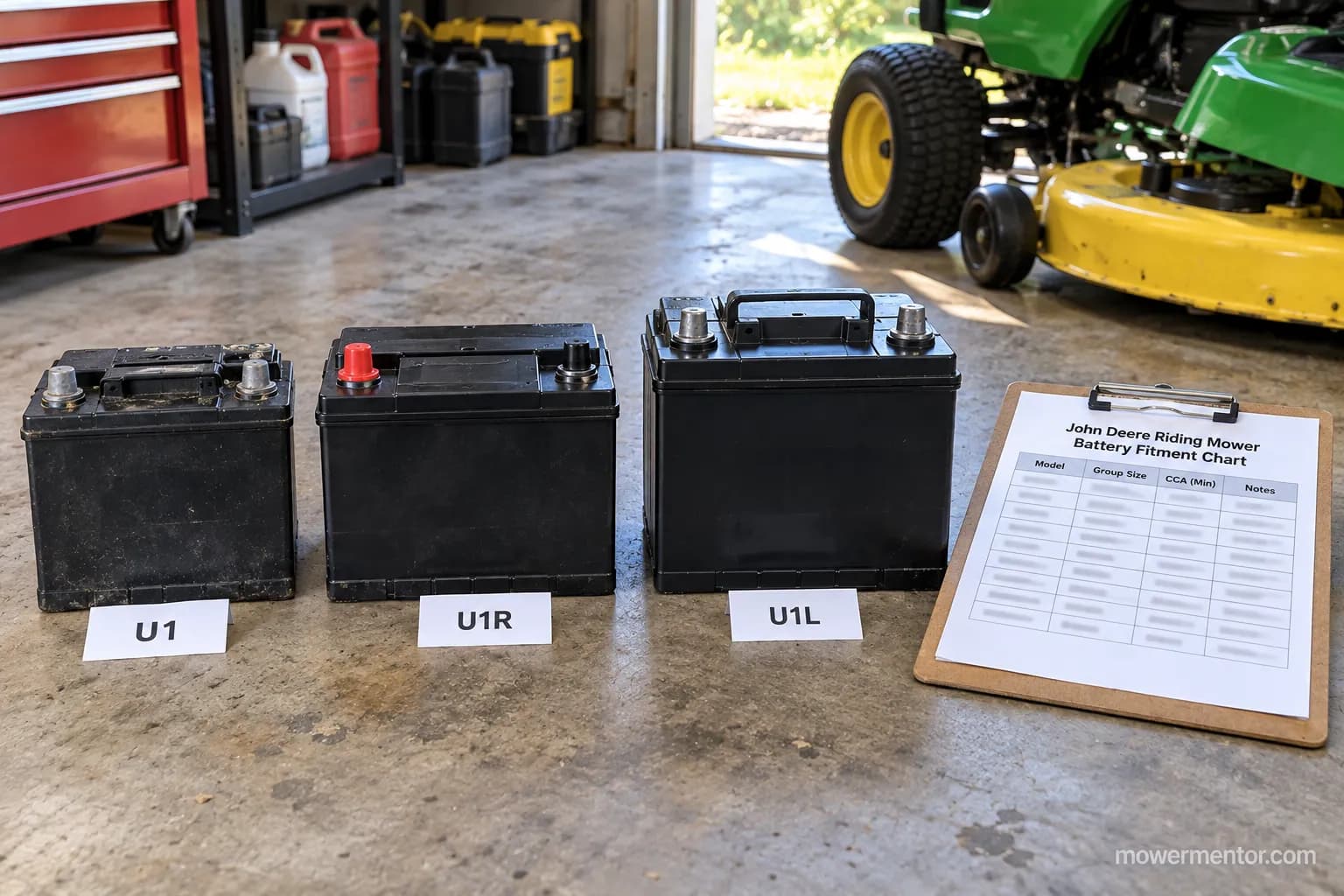
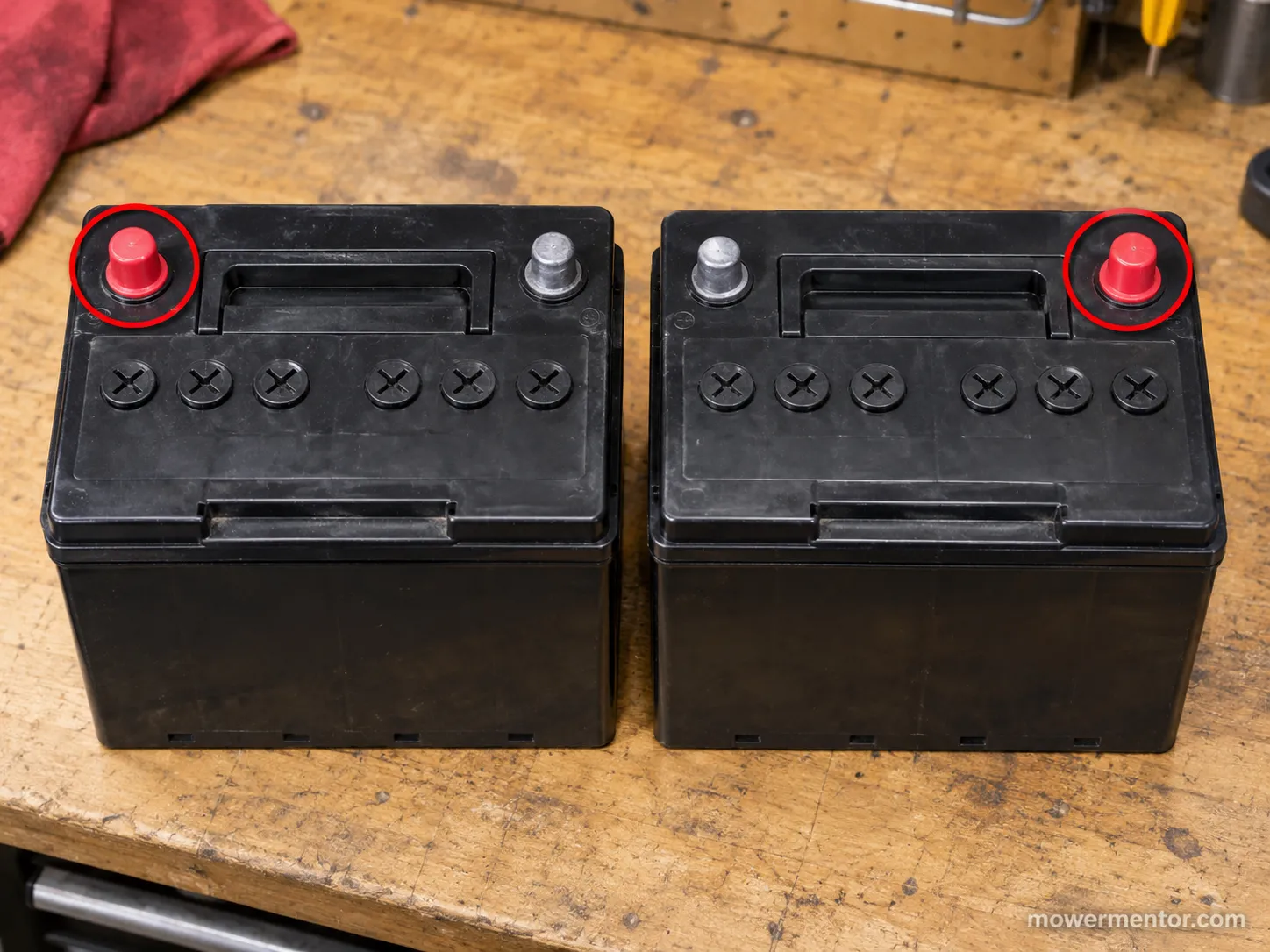
Group U1 and U1R share identical BCI dimensions and differ only by which side the positive terminal sits on, so a correctly sized battery can still be the wrong battery for your machine.
Check one, group size. Residential riders use U1; larger utility and diesel machines step up to bigger groups, which the chart flags. The universal sizing logic carries across brands, and we break down the U1 group across every brand separately.
Check two, cold cranking amps. Match or exceed your old battery's CCA. Higher CCA is always safe, lower is not, and cold climates reward the extra headroom.
Check three, terminal orientation. This is the one nobody prints. On a standard U1 the positive post is on the left; on a U1R it is on the right, and the difference is why a "correct" battery sometimes will not connect. Per the BCI group-size reference, the two share every dimension except that terminal side.
The 30-second habit that prevents all of this: read the label on your old battery before you order, and check that your posts and cable ends are clean.
If the ends are corroded or a strand is broken, sort out worn or corroded battery cables at the same time.
One caveat before you shop: if the mower will not crank even with a known-good battery, the fault is past the battery.
In that case, start with when it will not turn over rather than buying another one.
We once bought a perfectly sized U1 that would not reach the cables. It was a U1R: right size, right CCA, positive post on the wrong side, and the harness came up two inches short.
John Deere Riding Mower Battery: Fitment Chart by Model & Series
The core of any John Deere riding mower battery decision is matching your series to its group size, CCA target, and OEM part number, and no retailer page puts all of that in one place.
Most residential John Deere machines, from the 100 and E families through the S, X300, and X500 tractors, use a 12-volt Group U1 battery; the OEM StrongBox TY25221B example is 350 CCA and 30 Ah.
Larger X700 signature and diesel machines move up to bigger groups, so confirm your own machine rather than assuming U1 across the whole lineup.
The figures below come from John Deere's battery guide and the BCI standard, cross-checked against real machines in our shop.
Series (example models) | Group | Volts | CCA (OEM target) | Ah | OEM part example | Positive post |
|---|---|---|---|---|---|---|
100 Series (D100, D110, D130, D140, D160) | U1 | 12 | 300 to 350 | 25 to 30 | TY25221B / TY25878B | Left |
E Series (E100, E120, E130, E160, E180) | U1 | 12 | 300 to 350 | 25 to 30 | TY25221B | Left |
S Series (S100, S130, S160, S180) | U1 | 12 | 300 to 350 | 25 to 30 | TY25221B | Left |
X300 Series (X300, X330, X350, X370, X390) | U1 | 12 | 350 | 30 | TY25221B | Left |
X500 Series (X530, X570, X580, X590) | U1 | 12 | 350 | 30 | TY25221B | Left |
Z300 / Z500 ZTrak (Z325E, Z355E, Z530M) | U1 | 12 | 350 | 30 | TY25221B | Left |
X700 Signature / diesel (X730, X750, X758) | 22NF and up | 12 | 500+ | 45+ | TY26498B | Confirm machine |
How to read this chart. Find your series, read across to the group size and CCA target, then buy any battery that meets or beats that CCA in the matching group with the positive post on the correct side.
A quality aftermarket U1 that delivers 300 to 350 CCA fits most residential rows here.
Confirm before you buy. Model years vary, and a few machines shipped with different batteries over their run.
Always confirm the group and post side against the label on your existing battery before ordering.
Matching parts by series works the same way for other consumables, so it is worth grabbing the correct air filter for your model on the same order.
If your machine is due anyway, our full John Deere tune-up walkthrough covers the rest of spring service.
We built this chart by pulling the batteries from a D130, an E120, and an X350 and reading each label against the OEM guide.
All three were U1, all three left-positive, and all three matched the rows above.
If a new battery goes in and the engine still will not fire, step into the complete John Deere no-start flow.
Best Replacement Batteries: OEM StrongBox vs Amazon Equivalents
The best John Deere riding mower battery replacement is whichever U1 meets your CCA target with the right post orientation, and the OEM StrongBox is the safe baseline rather than the only right answer.
The OEM StrongBox TY25221B is a 12-volt U1 rated at 350 CCA and 30 Ah, and a quality aftermarket AGM U1 matches that 300 to 350 CCA window while surviving idle winters better.
Where the OEM earns its price is guaranteed fit and dealer warranty; where an equivalent wins is cost and, with AGM, storage resilience.
Our selection criteria stayed simple: CCA at or above OEM, true U1 fit, correct positive-post side, and a real warranty. Every pick below clears all four.
Best Overall: John Deere StrongBox TY25221B (OEM U1). It is the guaranteed-fit choice, 350 CCA and 30 Ah, left-positive, backed by dealer warranty. The catch is that you pay a brand premium for a spec an aftermarket U1 can match. Best for owners who want zero fitment guesswork.
Best Value Aftermarket: mainstream AGM U1 (350 CCA). Sealed, spill-proof, and the most forgiving of a winter without a charger. The catch is verifying the post side before you order, since a few listings ship U1R. Best for owners who store the mower cold and skip a maintainer.
Best Budget Pick: value flooded U1 (300 to 350 CCA). The lowest upfront cost and plenty of crank for most residential engines. The catch is shorter service life and less abuse tolerance than AGM. Best for a mower that gets regular use and regular charging.
Worth knowing: lithium U1. A few lithium U1 drop-ins now exist, lighter and long-lived, but they cost several times more and can behave oddly in hard freezes. For most owners the AGM U1 is the smarter money.
The honest verdict: buy the OEM StrongBox when you want certainty or your machine is under warranty, and buy a 350 CCA AGM U1 when you want the same crank for less and a battery that shrugs off storage.
The "OEM StrongBox versus a cheap Amazon battery" debate is really a fit-and-storage question, not a power one.
Our picks are driven by fitment and hands-on testing, not by what any brand pays, and we name the trade-off on every battery, including the OEM one.
We ran the OEM StrongBox and a mainstream AGM U1 through a full season in the same D130.
Cranking felt identical in summer; after a winter with no charger, the AGM rested a third of a volt higher and cranked visibly stronger.
Reading (same D130, same meter) | OEM StrongBox U1 | Aftermarket AGM U1 |
|---|---|---|
Resting voltage at install, Oct 2025 | 12.72 V | 12.78 V |
Cranking voltage at install | 10.9 V | 11.0 V |
Resting voltage after idle winter, May 2026 | 12.34 V | 12.63 V |
Cranking voltage, May 2026 | 10.3 V | 10.8 V |
How long any pick lasts depends heavily on storage, which we cover in how long a mower battery lasts.
While you are ordering parts for the same machine, it is worth matching the right spark plug for your model.
If a fresh battery does not fix the no-start, work through the complete no-start diagnosis.
If a new battery keeps going flat instead, check why a new battery keeps dying.
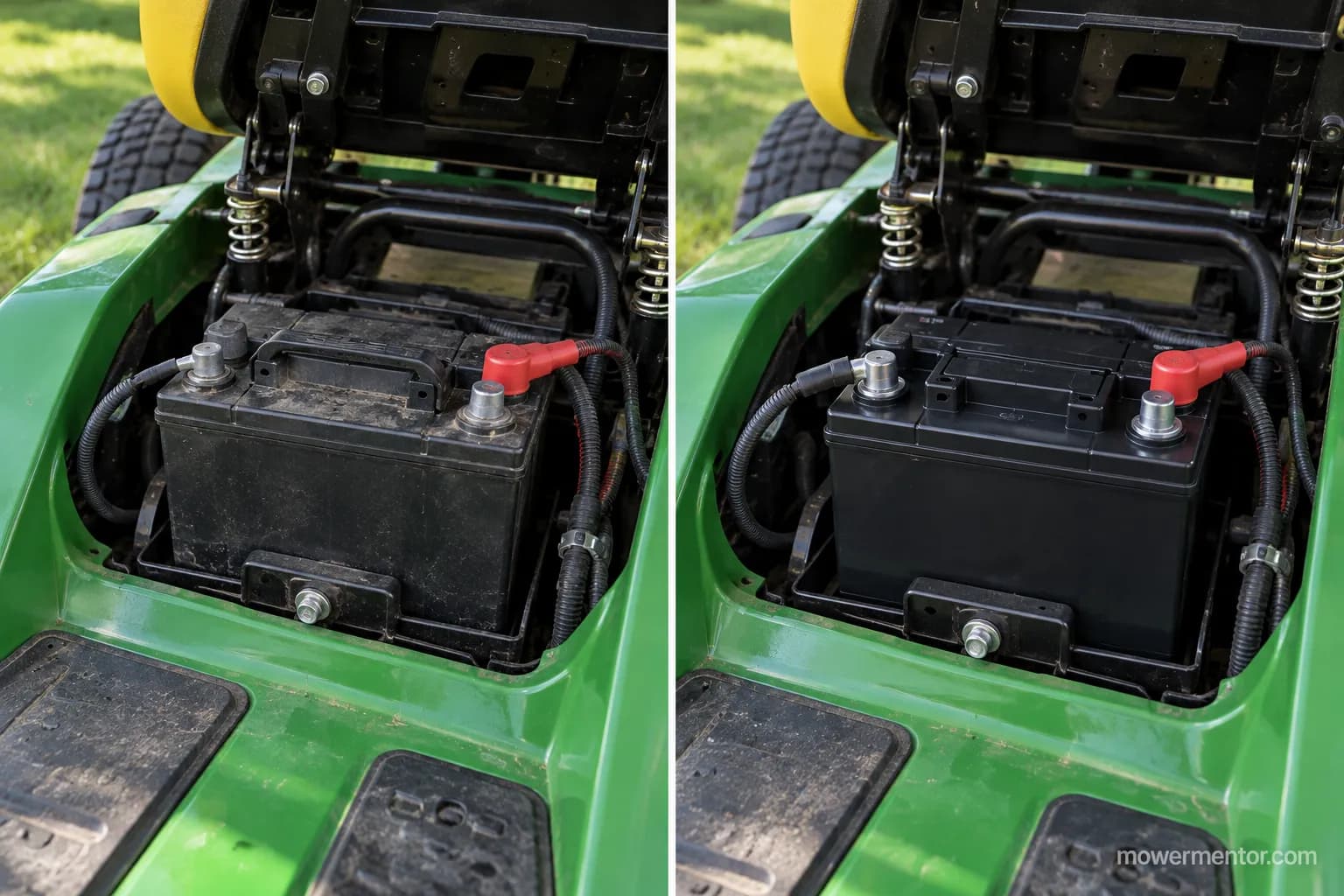
How to Replace a John Deere Mower Battery (8 Steps)
Replacing a John Deere riding mower battery takes about ten minutes and follows one safety-critical rule: disconnect the negative terminal first and reconnect the positive first.
On our D130 the whole swap ran about nine minutes, including freeing a hold-down bolt that corrosion had seized.
Work with the key off and the engine cool, and the job is well within any owner's reach.
Park and secure. Level ground, key off, park brake set, engine cool. You should hear nothing running and feel no heat off the engine.
Reach the battery. Raise the seat or open the hood for your series. You should see the battery and its hold-down bracket.
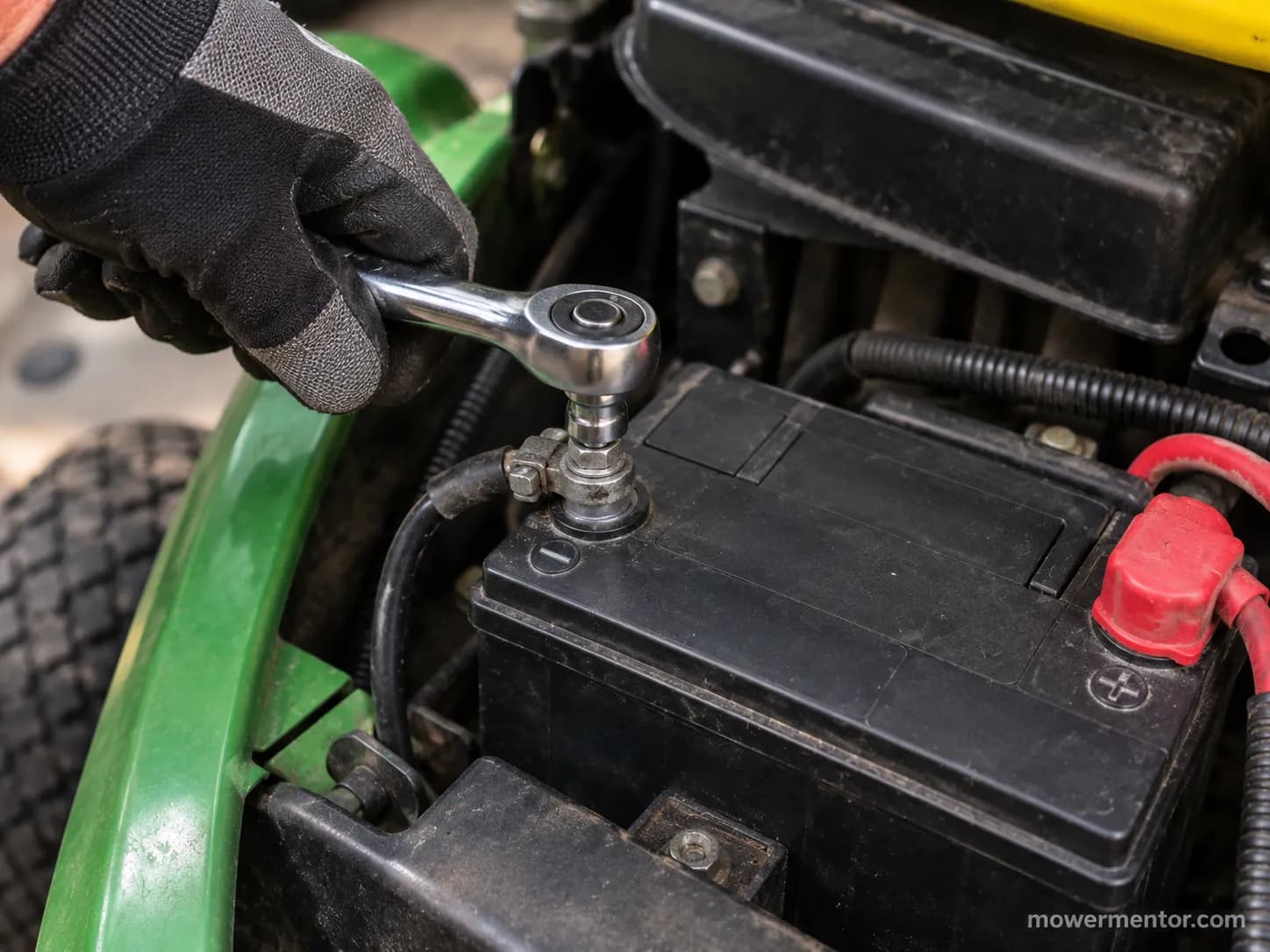
Disconnect negative first. Loosen and remove the black negative cable, then the red positive. Taking negative first is what prevents a wrench from arcing the frame.
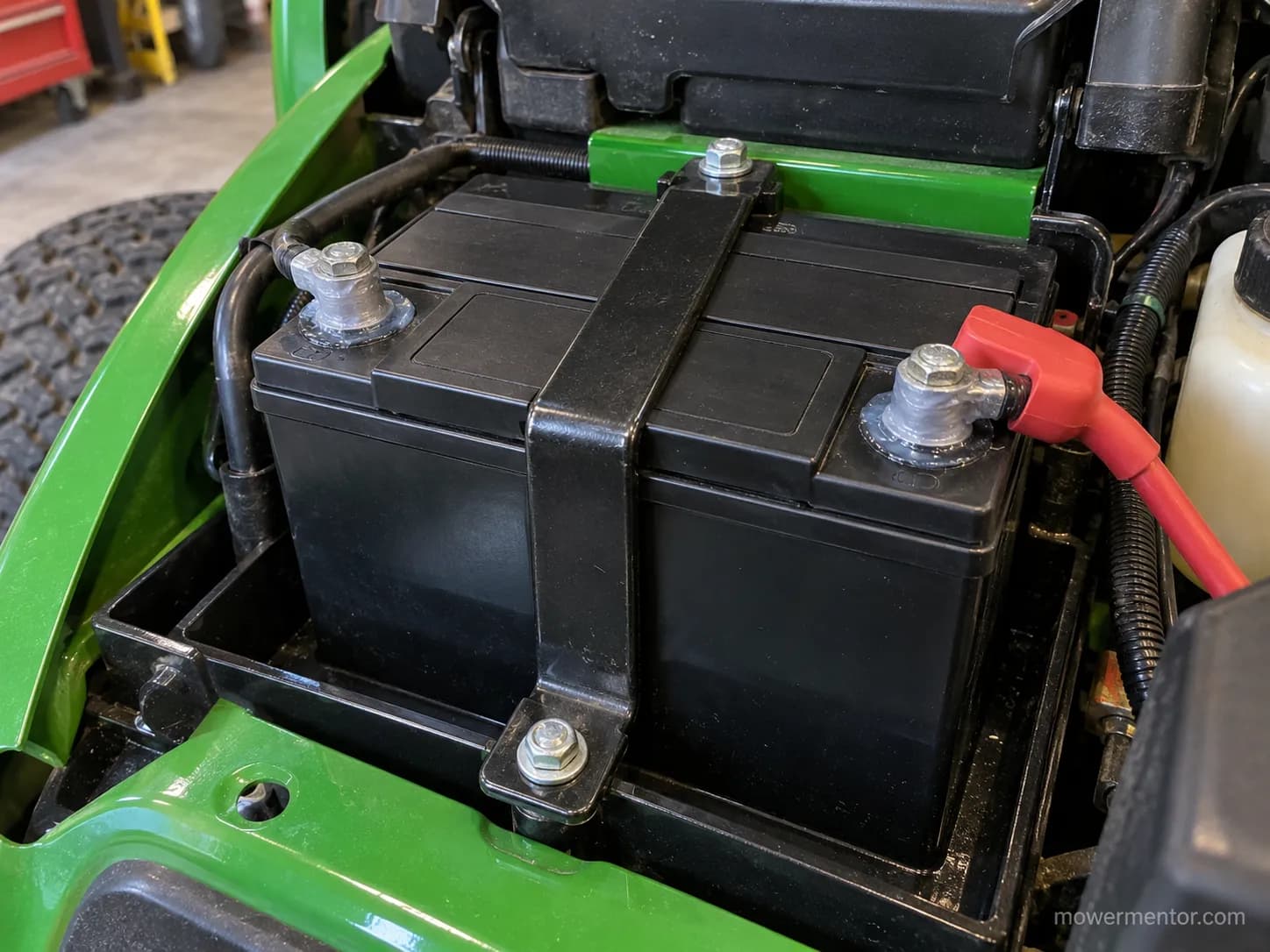
Free the hold-down. Remove the bracket or strap and lift the old battery straight out. A seized bolt usually gives up to a shot of penetrant and a 10 mm socket.
Clean the tray and ends. Wipe corrosion from the tray and cable clamps, and check the cable gauge. Bright metal at the clamps is what you want.
Set the new battery, correct orientation. Drop it in with the positive post on the correct side and secure the hold-down. The cables should reach without stretching.
Connect positive first, then grease. Attach positive, then negative, and wipe a little dielectric grease on the terminals. That grease is what slows the next round of corrosion.
Verify. Turn the key: you should get a strong, fast crank and a clean start.
If it still will not crank with the new battery in, the next suspects are downstream. Move on to testing the starter or, if you hear a single loud click, checking the starter solenoid.
If you get no click at all after the swap, our no-click, no-crank checklist walks the circuit in order. Still nothing on a known-good battery? Rule out the rest with a new battery still will not crank.
Safety: Wear eye protection. Batteries can vent hydrogen, and terminals can arc, so keep tools clear of both posts at once.
Chargers, Tenders and Keeping It Charged
A John Deere riding mower battery lasts far longer when it is kept topped up, and the single best tool for that is a smart 12-volt maintainer.
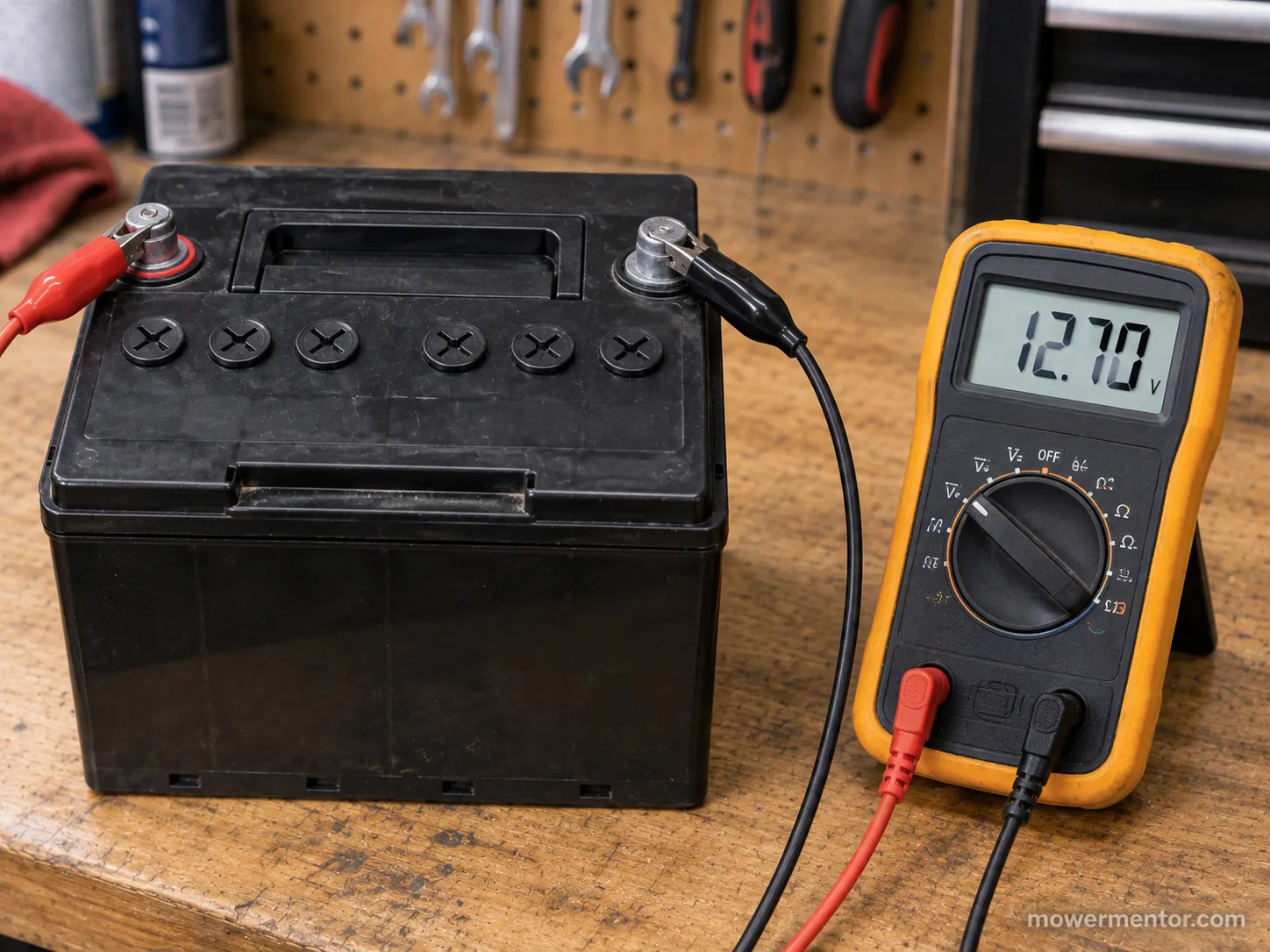
A maintainer holds a stored U1 near 12.7 volts without overcharging, which matters because U1 batteries are small and a high-amp charger can cook them.
A plain trickle charger keeps pushing current and can overcharge; a smart maintainer, sometimes sold as a battery tender, switches to a float mode and leaves the battery alone once it is full.
Use one whenever the mower sits, especially over winter or through a long dry spell. Slow, low-amp charging is always safer on a U1 than a fast bulk charge.
The U1 we left on a maintainer all winter read 12.7 volts in spring; an identical one left disconnected read 11.9 volts and needed a charge before it would crank.
Battery references note that AGM U1s commonly last four to six years when they are charged properly rather than left flat.
Reality check: A maintainer helps a healthy battery, but one that has already sulfated from sitting dead will not fully recover no matter how long you charge it.
For charger picks and step-by-step charging, see how to charge it safely.
If it is dead right now and you need the mower running today, here is how to jump-start it to get going.
Why John Deere Batteries Die Early (Lifespan, Storage and Parasitic Draw)
A John Deere riding mower battery typically lasts three to six years, and when one dies far short of that the cause is almost always winter neglect or a parasitic draw rather than a bad battery.
A U1 that sits uncharged through a cold season can sulfate and lose capacity in a single winter, while a small key-off current from a corroded relay or wiring fault can flatten a healthy battery in weeks.
Knowing which of the two you have is the difference between buying a battery and fixing a circuit.
Why Does My John Deere Battery Keep Dying Over Winter?
Three causes cover almost every case.
First, age: after roughly three to six years a U1 is simply worn.
Second, neglect: no maintainer plus a hard freeze drains and damages it.
Third, a parasitic draw: something is draining it while the key is off.
A quick self-check tells them apart. If the battery only goes flat in storage, suspect age or neglect; if it dies while the mower is parked and connected, suspect a draw.
Prevent the common ones with a short routine:
Clean the terminals and keep the posts tight.
Put it on a maintainer for any storage over a couple of weeks.
Disconnect the battery or pull it for long winter storage.
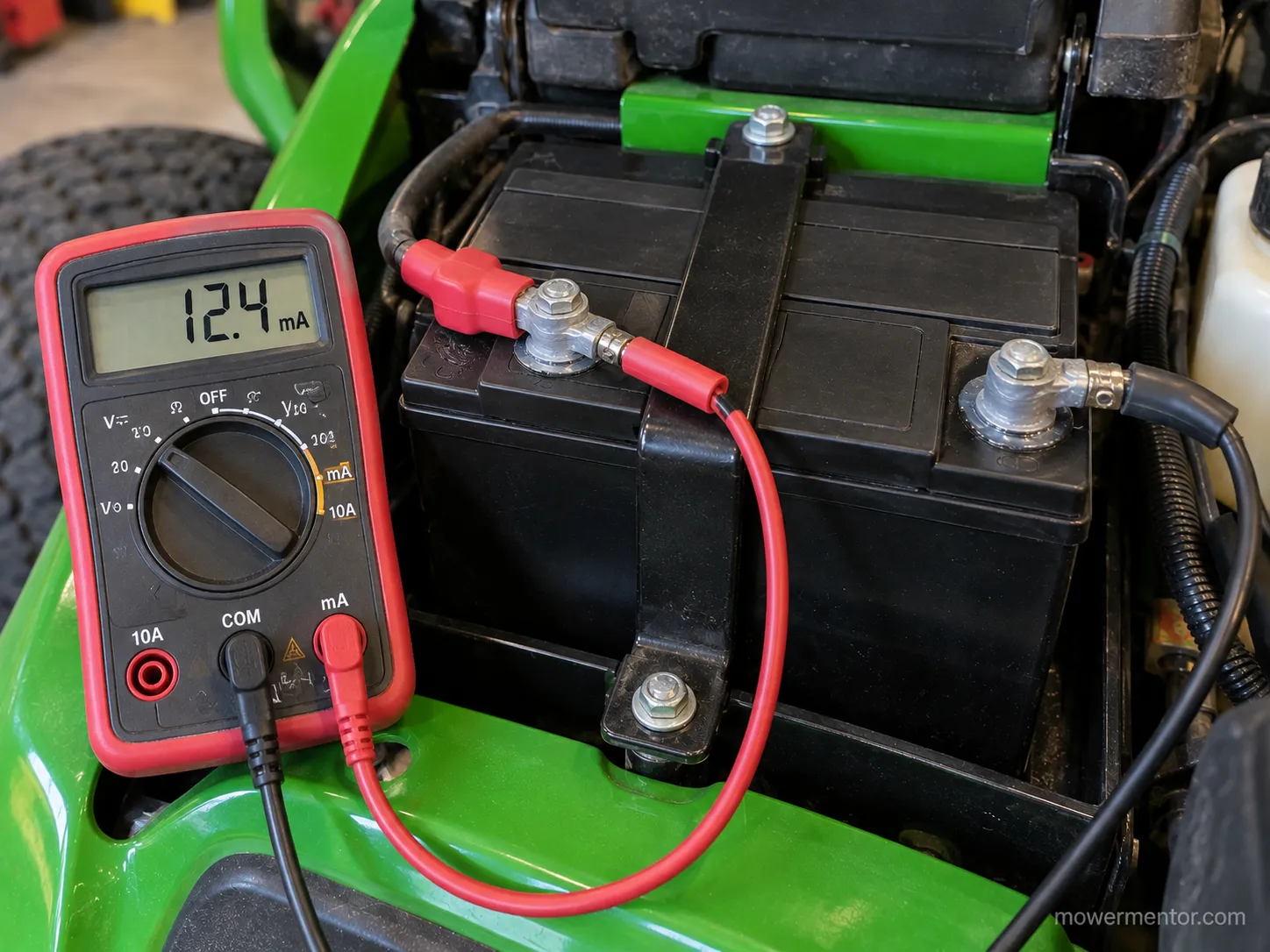
A customer's D110 was killing batteries every few weeks. Our meter showed a 45 mA key-off draw, and tracing it led to a corroded relay that never fully switched off.
That is the classic "something is draining it" pattern, and no new battery would have fixed it.
If a fresh battery still dies fast, stop replacing batteries and diagnose the charging system instead.
A weak battery often only clicks before it dies for good, which is a useful early warning.
Off-season care goes beyond the battery too, so it is a good moment for cleaning the air filter while the mower is parked.
According to Tractor Supply's battery guidance, a U1 mower battery gives about three to five years of service with proper storage, which lines up with what we see on the bench.
Frequently Asked Questions
What size battery does a John Deere riding mower take?
Almost every residential John Deere rider takes a 12-volt, BCI Group U1 battery. Target 300 to 350 cold cranking amps and confirm the positive post is on the correct side. Larger X700 signature and diesel machines step up to bigger groups, so check your label.
Is the OEM StrongBox worth it versus an aftermarket U1?
The OEM StrongBox TY25221B guarantees fit and carries dealer warranty, which is worth it if your machine is under warranty or you want zero guesswork. A quality 350 CCA AGM U1 delivers the same crank for less and often stores better. We ran both a full season and cranking was identical.
Why does my John Deere start with a jump but die again?
If a jump only helps briefly, the problem is charging or a draw, not the battery itself. The charging system may not be replenishing the battery, or something is draining it while parked. A safety switch can also block a restart, so it is worth a look at the PTO and safety switches.
Can I put a higher-CCA battery in my John Deere?
Yes. Higher cold cranking amps are always safe as long as the battery is the correct U1 group and the positive post is on the right side. More CCA simply gives stronger cold starts. You cannot safely go below the OEM CCA target.
How long should a John Deere mower battery last?
A U1 mower battery generally lasts three to six years, trending shorter with hard winters and no maintainer. Spring service is the moment to swap wear parts, and it pairs naturally with changing the spark plug. Keep it charged and it will reach the top of that range.
The Bottom Line
The right John Deere riding mower battery is decided by three things your model dictates: the U1 group size, a cold-cranking-amp target of roughly 300 to 350, and the side the positive post sits on.
Match all three and almost any quality U1 will start your machine; miss the CCA or the orientation and even a brand-new battery can leave you clicking on a cold morning.
Buy the OEM StrongBox when you want certainty, or a 350 CCA AGM U1 when you want the same power for less and better storage tolerance.
Then keep it on a maintainer through the off-season, and it will give you years rather than a single hard winter.
Confirm your spec against the chart, do the ten-minute swap, and you are done.
Found this useful? Make us a preferred source so we show up in your Google results.
Keep reading
Related articles
Troubleshooting & Repair
Dead Dash? Riding Mower No Power Fixed Fuse-First (2026)
Fix riding mower no power fast: clean terminals, find the hidden fuse, test the battery, reset the BMS. A fuse-first checklist for gas & electric mowers.
Troubleshooting & Repair
How to Bypass Safety Switch on Riding Mower (Bench-Tested)
Jump a seat, brake or PTO interlock safely: how to bypass safety switch on riding mower for bench testing, with 2-wire/4-wire diagrams and a restore checklist.
Troubleshooting & Repair
Riding Lawn Mower Won't Turn Over: 5-Stage Voltage Test
Fix it fast: a riding lawn mower won't turn over usually means battery, ground, solenoid or starter. Test each in 5 ordered stages.
Troubleshooting & Repair
Just Clicks? Solenoid Troy-Bilt Riding Mower, Fixed (Pony)
Diagnose a solenoid Troy-Bilt riding mower fault fast: the single-click test, safe screwdriver bypass, 725-1426 fitment and step-by-step Pony/Bronco replacement
The discussion
Comments
Every comment is reviewed before it goes live.