
Symptoms of Bad Starter on Riding Mower (+ Won't Engage)
Spot the symptoms of bad starter on riding mower fast: clicks, spins-no-engage, or smoke. Then safely start it and know when to replace.
Written by Tony MaldonadoReviewed by Wade CoburnLast updated on September 24, 2026
When you buy parts or tools through links on our site, we may earn a commission at no extra cost to you. It never changes what we recommend. Learn more.
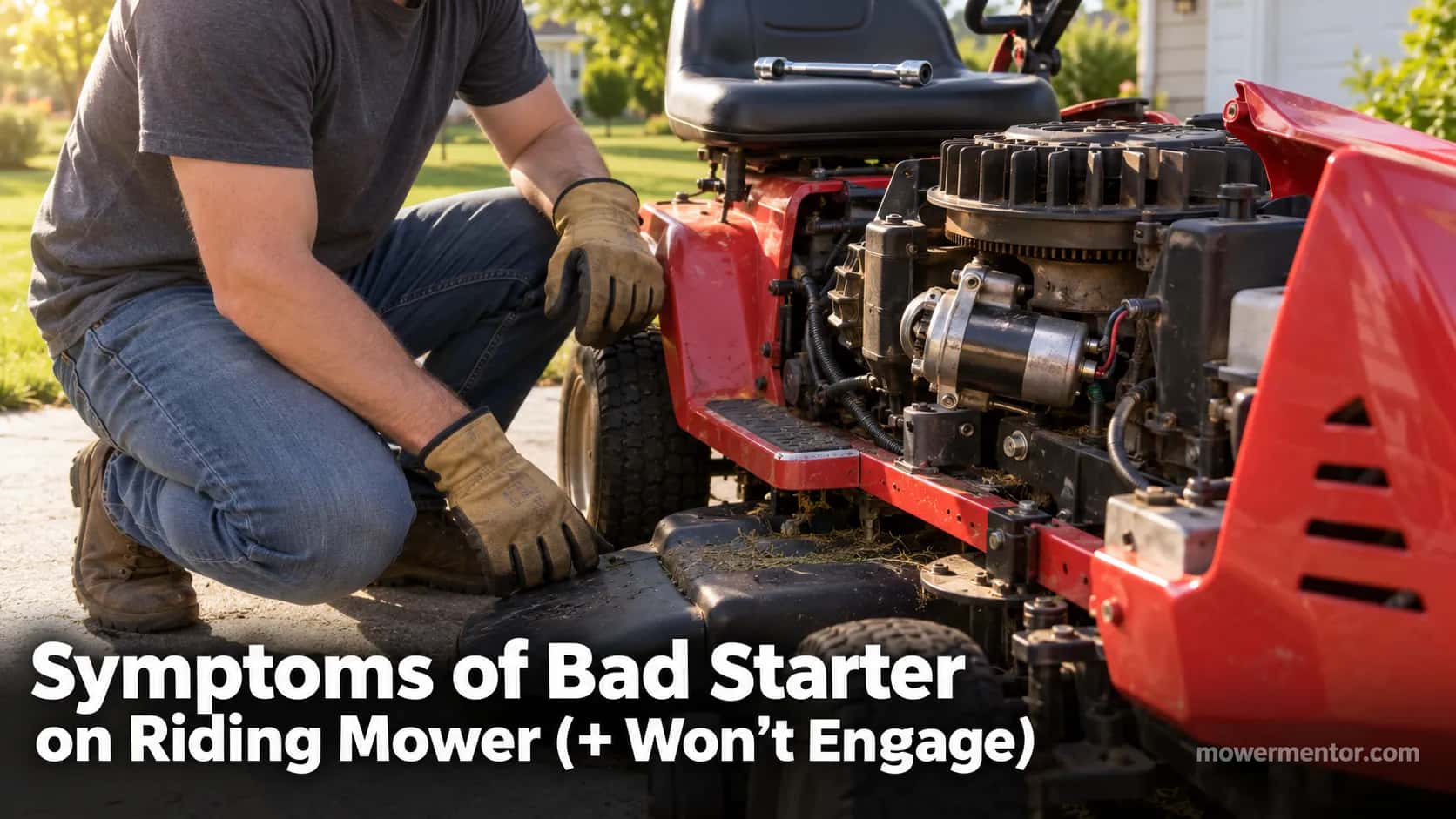
You turn the key on a July morning, the grass is ankle-high, and the mower answers with a single loud clunk, an angry whir, a whiff of hot electrical smell, or nothing at all.
The symptoms of bad starter on riding mower fall into four tell-tale signatures, and once you match yours to its cause you can usually start the engine one more time, safely, before you replace a single part.
This page separates the four modes, explains the one failure most guides skip (a starter that spins but never grabs the flywheel), and gives a safety-boxed way to get mowing today.
What a Bad Starter Actually Does
A riding-mower starter announces its failure four ways:
a single click with no spin (usually the solenoid or a weak battery),
a spin that never engages the flywheel (a worn Bendix drive or stripped ring gear),
smoke or a hot smell (the starter staying energized), or
dead silence (no power reaching the starter at all). Only two of those four are the starter itself.
The other two point upstream, which is why swapping the starter blind so often wastes a good part.
The four signatures at a glance
One loud click, no spin: Weak battery or a bad solenoid, not usually the motor.
Spins but won't grab: The Bendix pinion or the flywheel ring gear, covered below.
Smoking or hot smell: Stop now and disconnect the battery.
Nothing at all: No power to the starter, an upstream electrical fault.
Match your symptom above, then read its section.
A starter that whirs freely feels healthy, yet a free spin is one of the clearest signs the drive has failed, so do not rule the starter out just because it makes noise.
Symptoms of Bad Starter on Riding Mower: The Symptom-to-Cause Table
The symptoms of bad starter on riding mower map cleanly to causes once you note two things: what you hear when you turn the key, and how hard the headlights dim during that attempt.
According to a 12-volt battery reference, a healthy battery rests near 12.6 to 12.8 volts, and about 12.4 volts is only roughly 75 percent charged, so a click that pulls the headlights down hard is pointing you at the battery, not the motor.
A click that barely dims the lights is a different story and usually lands on the solenoid or starter side.
Across the mowers I pulled the shroud on for this piece, the same four signatures showed up cleanly and repeatably, and the dim-headlight tell sorted the electrical faults from the mechanical ones faster than any other single check.
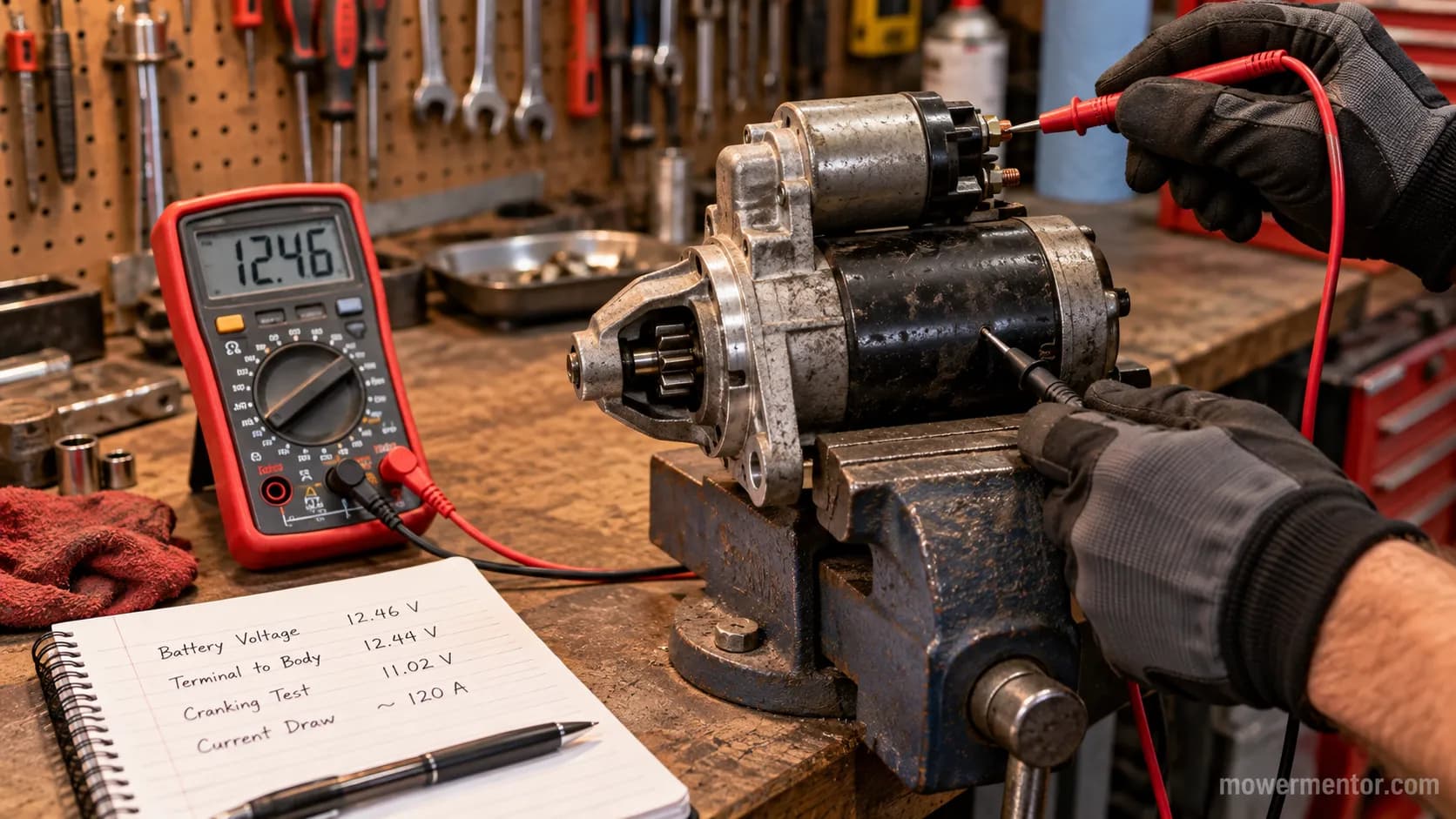
The table below is the fast triage. Each row ends by pointing you to the section that resolves it.
Before you condemn the motor, it is worth taking a minute to confirm it with a bench test rather than guessing from sound alone.
What you hear and see | Headlights during the attempt | Most likely cause | Where it routes |
|---|---|---|---|
One loud click, no spin | Dim hard | Weak or dead battery | Rule-out section |
One loud click, no spin | Barely flicker | Bad solenoid or corroded cable | Rule-out section |
Rapid machine-gun clicking | Dim with each click | Battery too low to hold under load | Rule-out section |
Starter whirs, engine never turns | Steady, no big dim | Worn Bendix pinion or stripped ring gear | Spins-but-won't-engage |
Smoke or hot electrical smell | Varies | Starter staying energized, overheating | Smoking section |
Total silence, no click | No change | No power reaching the starter | See the full walkthrough |
If nothing at all happens when you turn the key, the fault is almost never the starter motor, so start with the full won't-start walkthrough before you spend money.
The table gives you likelihoods, not a verdict, so confirm the suspected cause with the test in its section before buying parts.
First, Rule Out the Things That Fake a Bad Starter
Before the starter earns the blame, rule out the five upstream faults that imitate it: a weak battery, corroded cables or a bad engine ground, a failing solenoid, an open safety interlock, and a blown fuse.
The single most decisive check is at the starter terminal itself.
According to DB Electrical's starter troubleshooting guide, voltage present at the starter terminal with no crank points to a mechanical fault in the starter or drive, while no voltage there points to an upstream electrical problem.
That one reading splits the whole diagnosis in half.
The dim-headlight test has saved me a starter more than once.
Lights that die hard on the click led to a corroded engine ground on one tractor, not a bad motor, and cleaning the ground brought it straight back to life.
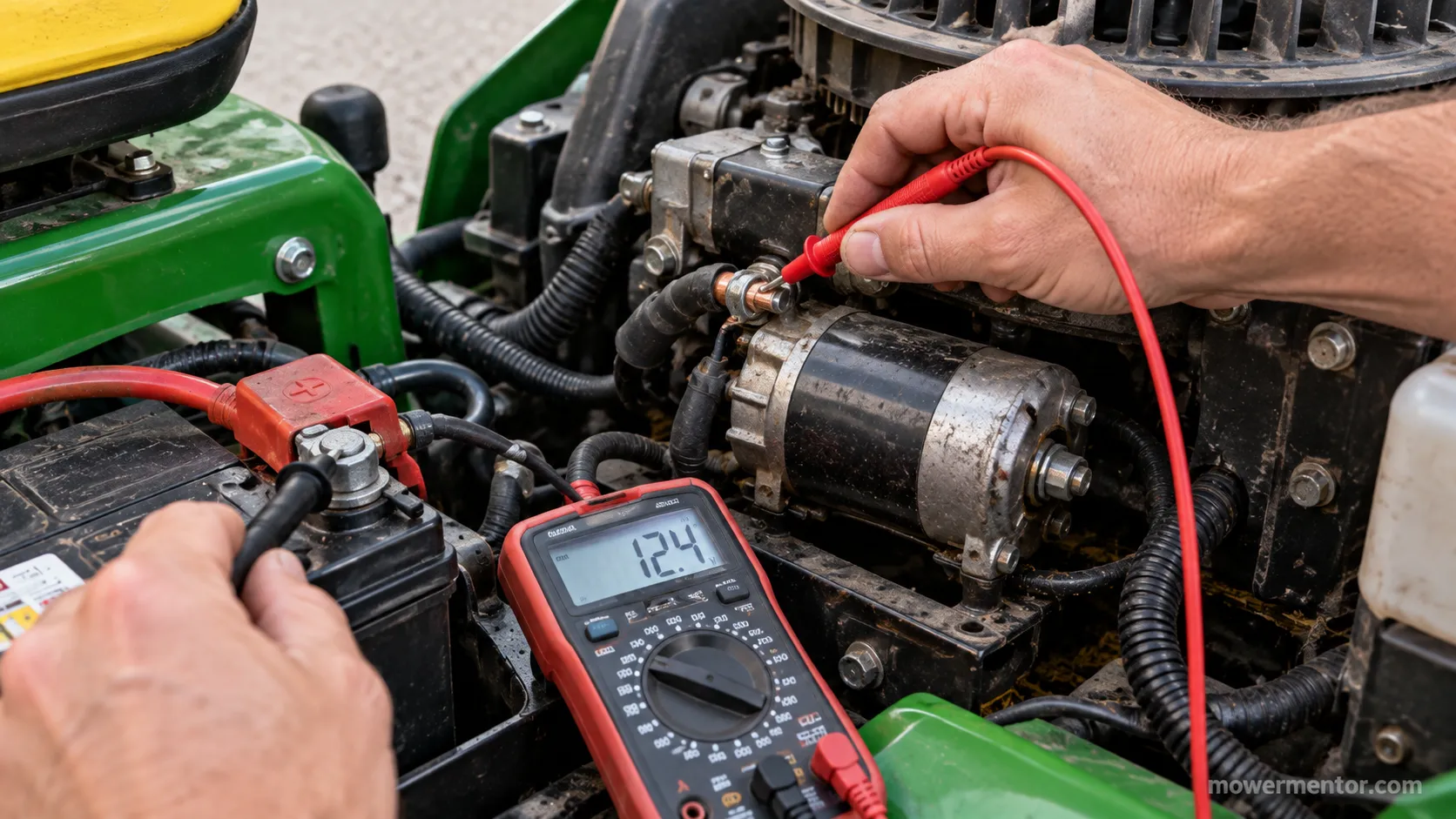
Work these five in order, and stop at the first one that fails.
Battery and connections. Check resting voltage first, then watch the headlights on a crank. A hard dim means the battery or a cable is the problem, so charge or clean before going further.
Cables and engine ground. Loosen, clean to bright metal, and retighten both battery posts and the ground where it bolts to the frame or engine. A mower people describe as "boosted it off but still nothing" is often a dirty ground, not a dead battery.
Solenoid. A solenoid that only clicks can look exactly like a dead starter, so a clicking box under the seat deserves its own test. A clicking solenoid can look like this and is a much cheaper part to replace.
Safety interlocks. The seat, brake, and PTO switches must all be satisfied or the circuit never closes and the starter never sees current. Sit in the seat, set the brake, and switch the PTO off before you crank.
Fuse and ignition. A blown fuse or a dead ignition switch kills power upstream of the starter. If the key feels lifeless in every position, check the ignition switch too.
One more upstream check rules out the engine itself.
According to Sears Home Services, you can remove the access plug over the flywheel and turn the crankshaft by hand at the flywheel bolt, and if the engine will not spin it is seized rather than the starter.
That five-second test stops you from replacing a healthy starter on a locked-up engine.
There is a second fork worth naming here: a starter problem stops the engine from cranking, while a spark or fuel problem lets it crank freely but never fire.
If yours spins the engine over normally and simply will not catch, test for spark before you touch the starter.
A starving engine can mimic the same "won't run" frustration, so it also helps to recognize a clogged air filter's symptoms.
Deere owners chasing the right part can use the Deere air-filter finder.
If you get no crank and no click at all, the trail leads into the wider electrical system, and the no-crank electrical diagnosis walks the whole path from battery to ground.
Whatever you defeat to test an interlock, put it back before you mow.
Safety note: Never leave a seat, brake, or PTO switch bypassed after testing.
Those interlocks stop the blades and the drive when you leave the seat, and a defeated switch turns a stall into an injury.
Why Does My Starter Spin but Won't Engage the Flywheel?
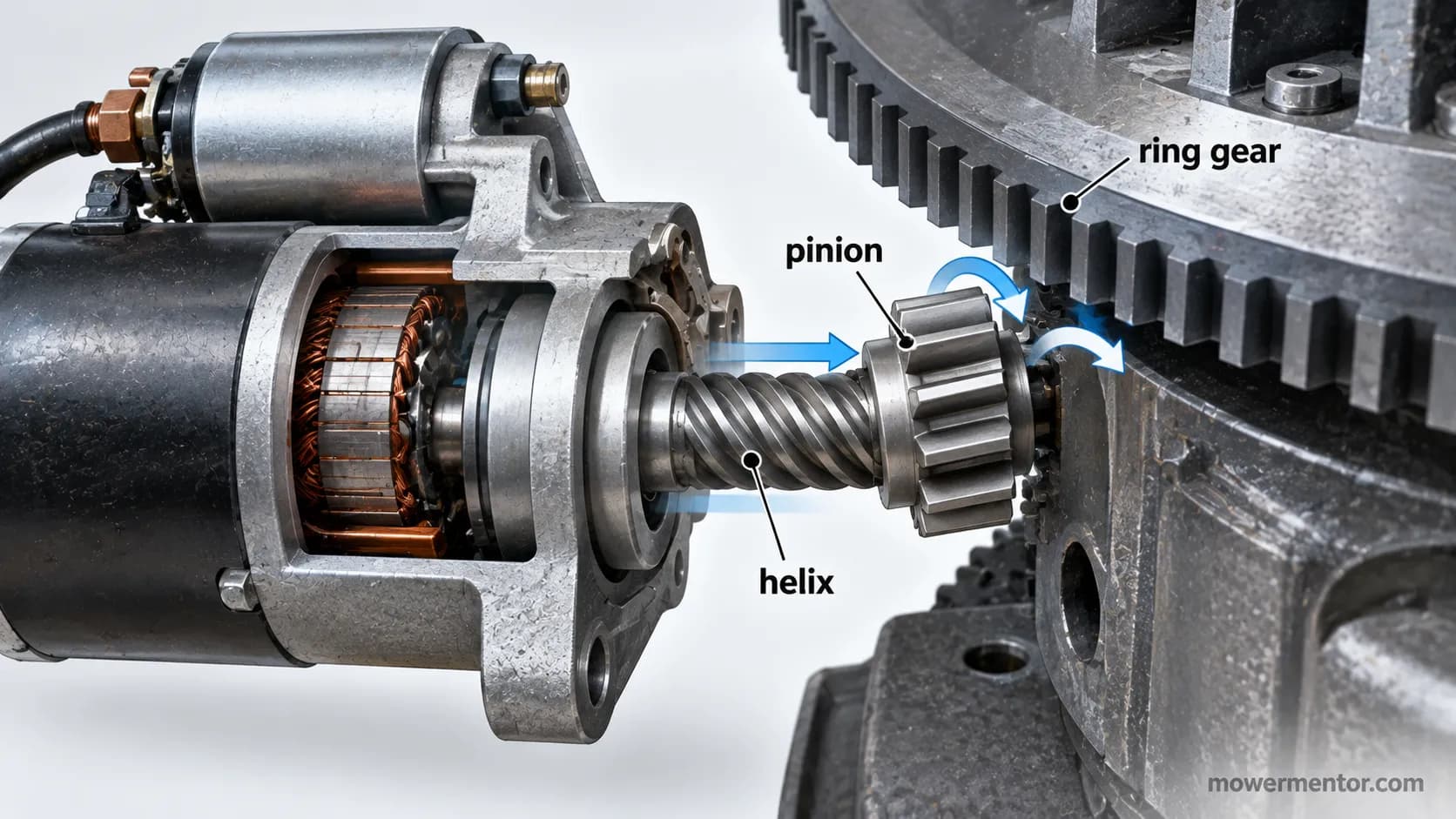
When a starter spins but won't engage the flywheel, the motor is fine and the drive is not. A small pinion gear is supposed to climb a spiral shaft, mesh with the flywheel's ring gear, and turn the engine, then retract once it fires.
According to Briggs & Stratton's starter FAQ, the fix often starts with cleaning debris from the gear shaft and applying a light lithium-based grease.
Four causes produce the same "spins but won't grab" symptom, and three of them do not need a new starter.
On one Briggs-powered tractor I worked through for this piece, the starter whirred but never caught.
The helix was gummed with old grease and lawn grit, and a clean-and-relube brought the pinion back up the shaft with no new part at all.
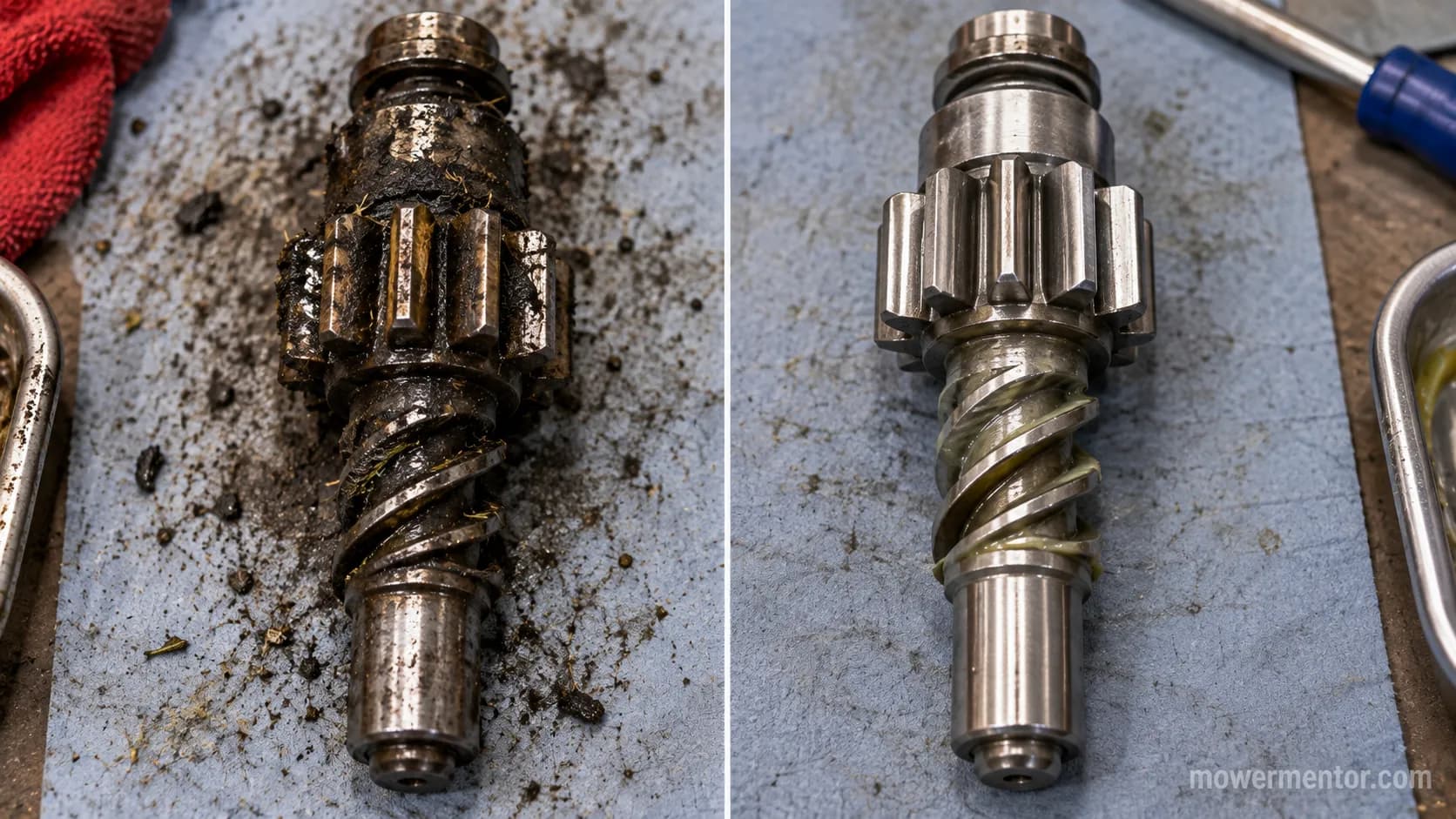
Here is how the four causes sort out, simplest to fix first.
Fouled or dry helix (the spiral shaft). Old grease and grit turn the shaft sticky, so the gear won't travel up to meet the flywheel. Clean it and relube lightly, and the "gear won't travel up the helix" complaint usually clears.
Worn Bendix pinion or stripped flywheel ring gear. If the pinion teeth are rounded or the ring gear has gone (some engines use a plastic ring gear whose teeth strip out), the starter will spin all day and never turn the engine over. A stripped ring gear means the flywheel needs work, not just the starter.
Too slow a spin. A weak battery or corroded cable can spin the starter, but not fast enough to throw the gear up. Owners describe it as the starter "lock and slip" against compression, and it loops right back to the battery and cable checks above.
Reversed polarity. Swapped cables spin the motor backward and the gear never climbs. If someone recently worked on the battery, confirm the connections before condemning the drive.
A quick self-check settles which one you have: with the shroud off and the engine cool, push the pinion up the shaft by hand.
If it binds, the shaft is fouled or the gear is worn, and if it climbs freely you are chasing spin speed or polarity instead.
Before you commit to a new part, rule the solenoid out first, since a solenoid that never throws the gear can mimic a bad Bendix.
When the drive really is worn past cleaning, the right replacement depends on your engine as much as your mower.
Craftsman owners can start with the correct Craftsman unit.
Deere fitment has its own quirks. Husqvarna owners should check the Husqvarna starter specifics.
Troy-Bilt Pony and Bronco owners have their own starter layout to reach, which changes how you get to the drive in the first place.
Is Your Starter Smoking or Staying Engaged? Stop Now
A smoking riding-mower starter is the one symptom you act on before you diagnose: release the key, disconnect the battery negative, and stop cranking.
According to The Motor Guy, a starter can stay engaged after the engine fires and overheat, producing a loud noise and, if it keeps running, smoke.
A motor held under power is dumping heat it cannot shed, and continuing to crank risks melted insulation or a fire.
I have watched an owner burn through two starters in a single season. The starters were never the root cause.
A corroded cable was dropping more than a volt under load and cooking each new motor in turn, and no third starter would have survived that connection.
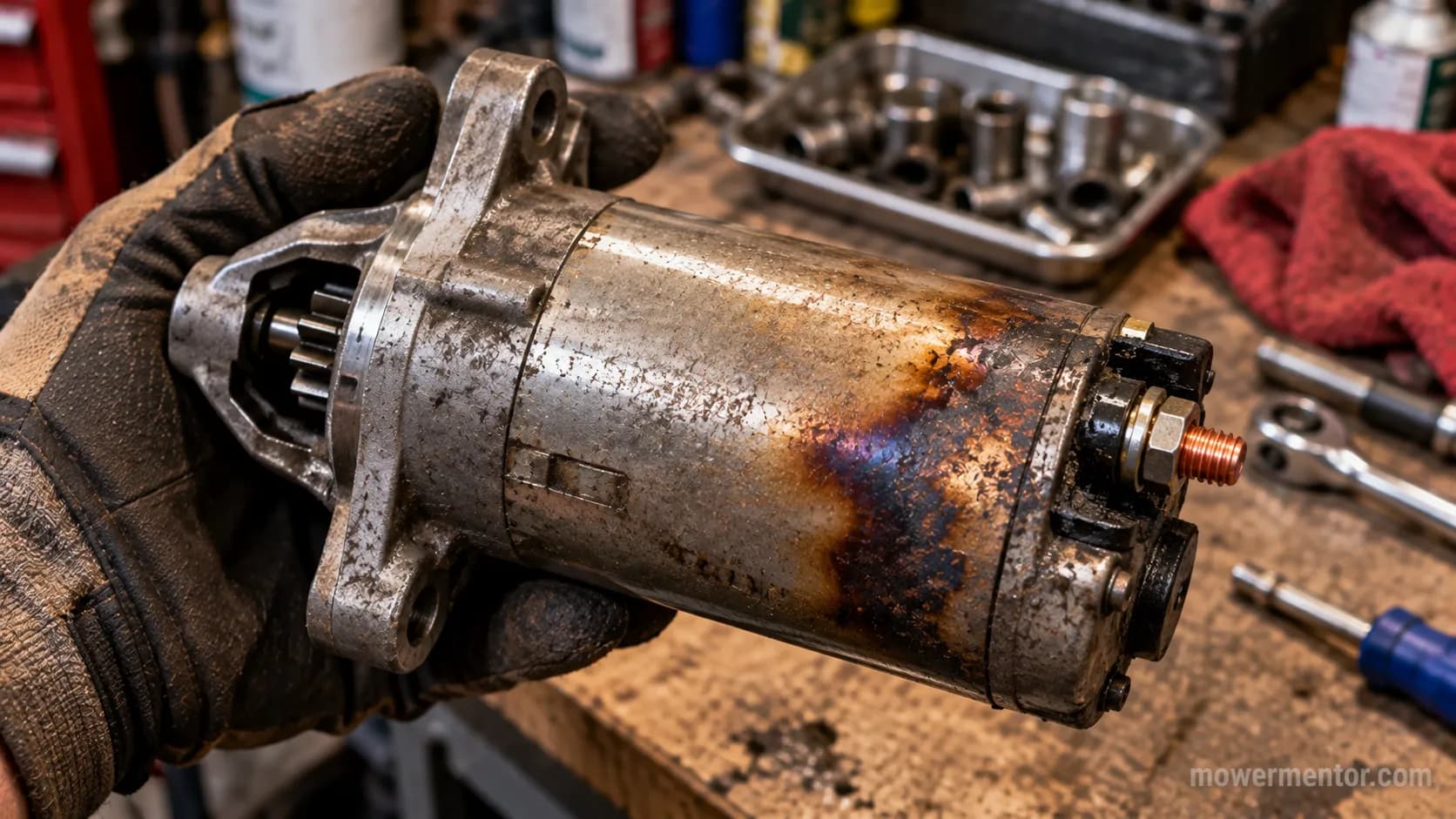
Warning: If the starter smokes or smells hot, disconnect the battery immediately. This is a fire risk, not a wait-and-see symptom.
The lesson from that repeat burnout is the useful one: when a second starter dies fast, suspect a high-resistance connection or a stuck solenoid holding the motor live, not the starter you just installed.
A regular reminder to run the engine right, like a seasonal tune-up that keeps this from recurring, also keeps the whole starting circuit clean.
If the motor case is scorched, it is past testing and needs to come out, and how the starter comes out covers the removal.
How to Start a Riding Mower With a Bad Starter, Safely
You can start a riding mower with a bad starter by bridging the solenoid's two large terminals to send battery current straight to the starter, but only with the brake set, the PTO off, and the transmission in neutral.
This is a limp-start to finish a job or move the mower to where you can fix it, not a repair.
Owners have jumped starters this way for decades, and the danger is never the electricity, it is a mower lurching because it was left in gear.
Bridging the solenoid once got a dead-starter tractor running long enough for me to finish a yard.
The one step I will not skip is confirming neutral first, because a mower that jumps into motion with no one ready on the controls is how people get hurt.
Before you try either method: Sit in the seat, set the parking brake, switch the PTO off, and put the transmission in neutral.
Never defeat the seat or brake interlock to do this.
Method A, the manual Bendix nudge. This is for the fouled-helix case where the gear will not climb on its own.
Remove the engine shroud so you can reach the starter pinion, with the engine cool and the key off.
Have a helper turn the key to start while you gently push the pinion up its shaft toward the flywheel.
Watch for the gear to mesh and the engine to turn. If it catches, let go immediately and let the starter work.
If the gear still will not climb or grab, stop and move to the drive fixes above, since the shaft or gear is worn.
Method B, the solenoid jump. This sends current to the starter when the ignition path or solenoid is the weak link.
Confirm neutral, brake set, PTO off, and stand clear of the deck and wheels.
Lay a thick screwdriver or jumper across the two large solenoid terminals, not the small trigger terminals.
The starter should spin and crank the engine, so hold the bridge only until it fires, then remove it.
If the starter spins but the engine never turns, you are back to the Bendix or ring-gear problem, not the solenoid.
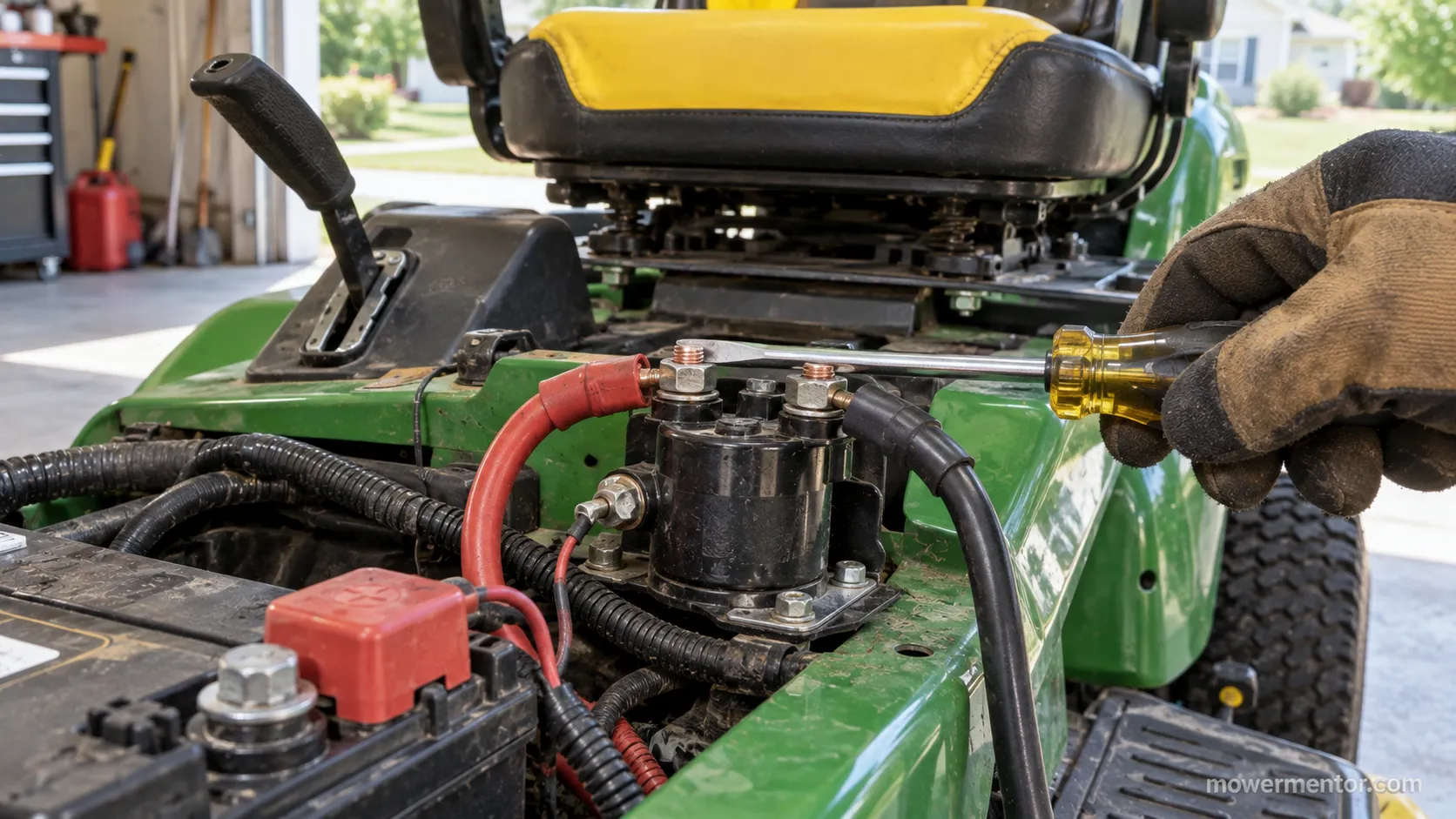
Do not attempt either method if the starter is smoking, if you suspect reversed polarity, or if working around live 12-volt current near moving parts makes you uneasy.
If the engine cranks but will not catch once it is spinning, a careful shot of starting fluid used the right way can bridge the gap while you sort the fuel side.
Reaching the starter differs by machine, and Murray owners in particular should confirm fitment with a Briggs cross-reference.
If the whole mower is dead beyond the starter, work a full model-specific diagnosis instead.
Once it starts, treat it as borrowed time and drive straight to where you plan to repair it.
Repair or Replace? Cost, and When to Call a Pro
Whether you repair or replace comes down to which symptom you confirmed.
A starter that spins but won't engage because of a fouled helix is often a clean-and-relube for the cost of a rag and some grease, while a smoked motor or a stripped flywheel ring gear needs replacement.
The same decisive rule applies here as in the rule-out: with power reaching the starter and no crank, the fault is mechanical and the starter comes out; with no power there, you are replacing the wrong part.
The clean-and-relube saved a starter I would otherwise have replaced.
The stripped-ring-gear tractor went the other way, where no starter on earth would have fixed a flywheel with no teeth left, and that repair moved well past a simple swap.
The table below maps the symptom to a repair path and a rough cost picture, verified against current parts listings at the time of writing.
Confirmed symptom | Likely fix | Rough cost picture |
|---|---|---|
Spins, won't grab, helix fouled | Clean and relube the shaft | Under 15 dollars in supplies, DIY |
Spins, won't grab, worn pinion | Replace the starter | 45 to 130 dollars for the part, DIY |
Stripped flywheel ring gear | Replace ring gear or flywheel | Part cost plus significant labor, often a shop job |
Smoked or dead motor | Replace the starter | 45 to 130 dollars for the part, DIY |
Single click, weak battery | Charge or replace the battery | 30 to 90 dollars for a battery |
Rebuilding a small worn starter rarely pays, since a rebuild kit only addresses brushes or a solenoid and a heavily worn motor comes back around fast.
To avoid a repeat, clean the grounds each season, keep the battery topped, and follow the maker's advice to crank in short cycles rather than long grinding bursts.
When the engine turns out to crank fine but never fires, rule out spark before you spend on a starter, and change and gap the spark plug first.
If you land on a full replacement and want the right unit for your engine, picking a Cub Cadet starter by engine shows how the engine brand, not just the mower brand, decides fitment.
When to call a pro: A seized engine, a stripped flywheel ring gear, or any discomfort working with live 12-volt current near a blade deck are all good reasons to hand it to a technician.
Frequently Asked Questions
Is a starter bad if it just clicks?
A single click is usually not the starter motor. On a riding mower a lone click most often means the solenoid is trying to engage but the battery is too low to spin the motor, or a corroded cable is starving it of current.
Confirm the battery rests near 12.6 volts and clean the connections before you condemn the starter, since a click with hard-dimming headlights points squarely at the battery.
Why does my starter spin but not engage the flywheel?
A starter that spins but won't engage almost always has a drive problem, not a motor problem. The Bendix pinion may be stuck on a fouled helix, the pinion or the flywheel ring gear may be worn, the spin may be too slow to throw the gear up, or reversed battery cables may be spinning it backward.
Clean and relube the shaft first, since that clears the most common version without a new part.
Can you jump a lawn mower starter with a screwdriver?
Yes, you can bridge the two large solenoid terminals with a thick screwdriver to send current straight to the starter, but only safely. Sit in the seat, set the parking brake, switch the PTO off, and put the transmission in neutral first, and never bridge the small trigger terminals or defeat a safety interlock.
Hold the bridge only until the engine fires, then remove it.
What does a bad starter sound like on a riding mower?
A bad starter makes one of three sounds. It clicks once with no spin when the solenoid or battery is the issue, it whirs freely without turning the engine when the drive has failed, or it makes no sound at all when no power is reaching it. A grinding whir that never catches is the classic worn-Bendix signature.
How long does a riding mower starter last?
Small-engine starters wear with use rather than by a fixed calendar, and hard starting habits shorten them. Long grinding cranks, a chronically weak battery, and corroded connections all cook a starter early, so short crank cycles and clean grounds are what stretch its life.
Replace it when the symptoms above confirm the motor or drive has failed, not on a schedule. A starter that tests good but keeps failing early is almost always telling you the connections feeding it are the real problem.
The Bottom Line
The symptoms of bad starter on riding mower come down to four signatures, and telling them apart is what keeps you from throwing money at a good part.
A single click sends you to the battery and solenoid, a free spin sends you to the Bendix drive and flywheel, smoke sends you to an immediate stop, and dead silence sends you upstream to the electrical system.
Match your symptom, confirm it with the one terminal-voltage check, and you will know whether you are cleaning a shaft, jumping a solenoid to mow today, or ordering a new starter.
Start it safely, finish the yard, and fix it right when the engine is cool.
Found this useful? Make us a preferred source so we show up in your Google results.
Keep reading
Related articles
Troubleshooting & Repair
Dead Dash? Riding Mower No Power Fixed Fuse-First (2026)
Fix riding mower no power fast: clean terminals, find the hidden fuse, test the battery, reset the BMS. A fuse-first checklist for gas & electric mowers.
Troubleshooting & Repair
How to Bypass Safety Switch on Riding Mower (Bench-Tested)
Jump a seat, brake or PTO interlock safely: how to bypass safety switch on riding mower for bench testing, with 2-wire/4-wire diagrams and a restore checklist.
Troubleshooting & Repair
Riding Lawn Mower Won't Turn Over: 5-Stage Voltage Test
Fix it fast: a riding lawn mower won't turn over usually means battery, ground, solenoid or starter. Test each in 5 ordered stages.
Troubleshooting & Repair
Just Clicks? Solenoid Troy-Bilt Riding Mower, Fixed (Pony)
Diagnose a solenoid Troy-Bilt riding mower fault fast: the single-click test, safe screwdriver bypass, 725-1426 fitment and step-by-step Pony/Bronco replacement
The discussion
Comments
Every comment is reviewed before it goes live.