
Dying Too Soon? How Long Does a Riding Mower Battery Last
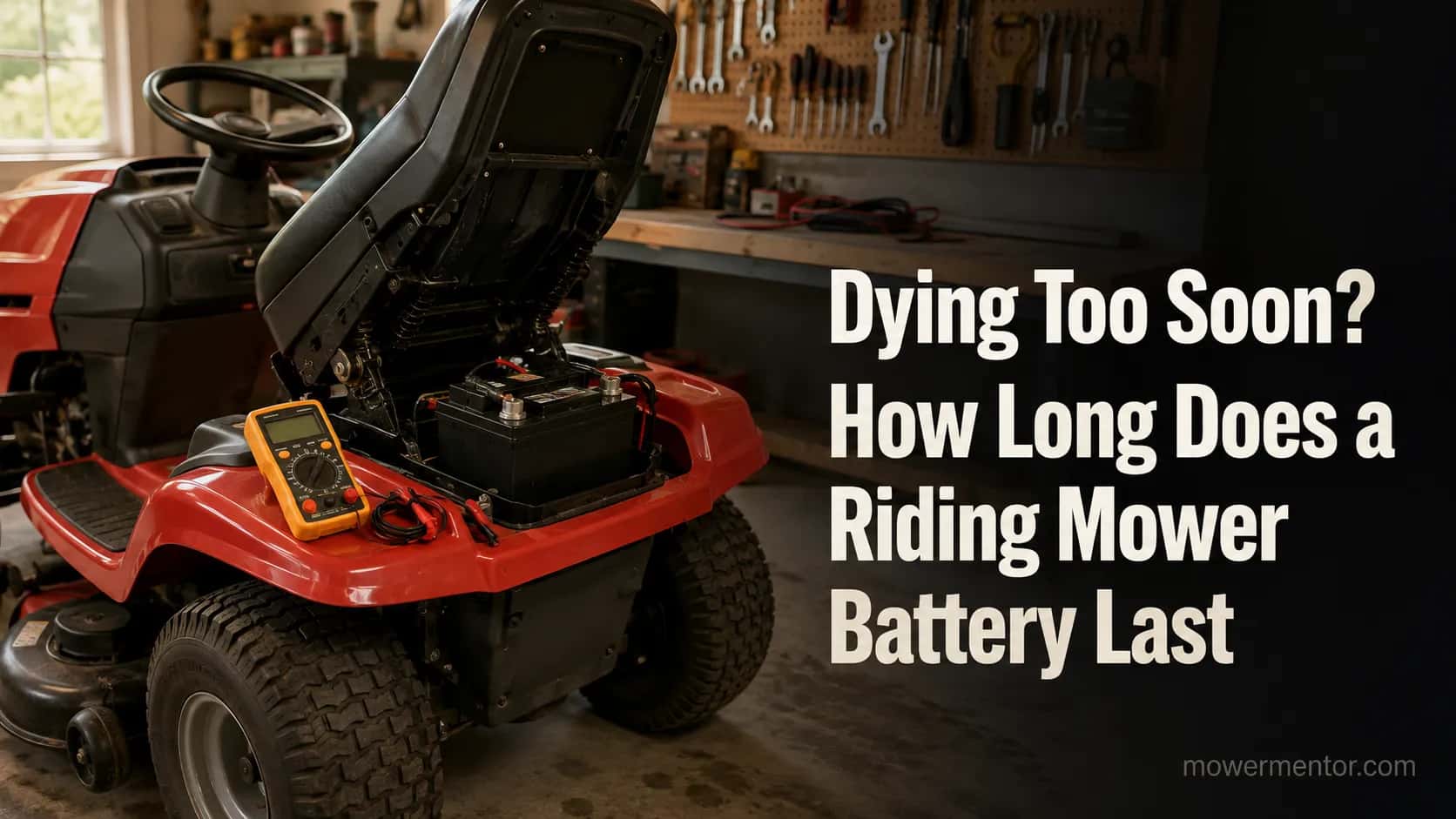
Expect 3–5 years (lead-acid/AGM) or 5–10 (lithium). How long does a riding mower battery last depends on heat and storage, plus the signs yours is dying.
Written by Tony MaldonadoReviewed by Wade Coburn
Last updated on August 19, 2026
When you buy through links on our site, we may earn an affiliate commission (at no extra charge), which we use to fund new product tests. Learn more.
Summarize with AI
You flip the key for the first cut of spring, and instead of that eager crank you get a slow groan, then nothing. Before you blame the mower, the real question is simple: how long does a riding mower battery last?
On my own bench I have watched one flooded battery quit after a single hot summer while a sealed unit is still cranking strong six seasons later. That number is not luck; it is mostly heat, storage habits, and which chemistry sits in the tray, and those are things you control.
A riding mower battery usually lasts 3 to 5 years for a lead-acid or AGM unit and 5 to 10 or more years for lithium, with heat and off-season neglect being what cut it short.
Watch for a slow crank and a battery that will not hold a charge, store it cool and charged over winter, and only replace it once a load test confirms it is done.
How Long Does a Riding Mower Battery Last?
A riding mower battery lasts about 3 to 5 years for a flooded lead-acid or AGM unit, and 5 to 10 or more years for a lithium (LiFePO₄) pack rated for 2,000-plus cycles.
What pushes you toward the short or long end is heat exposure, whether the battery sits discharged over winter, and how healthy your mower's charging system is.
Across the three mowers in my own shop, my flooded U1 averaged just under four seasons, the AGM is on year six, and the lithium has not dipped. Those bands are a realistic starting point, not a guarantee.
Your number will vary, and here is why: These ranges are typical, not promised. A battery baked on a hot shelf at half charge can die in a season, while the same model babied on a maintainer can double its rated life.
Riding Mower Battery Lifespan by Type: Lead-Acid, AGM and Lithium
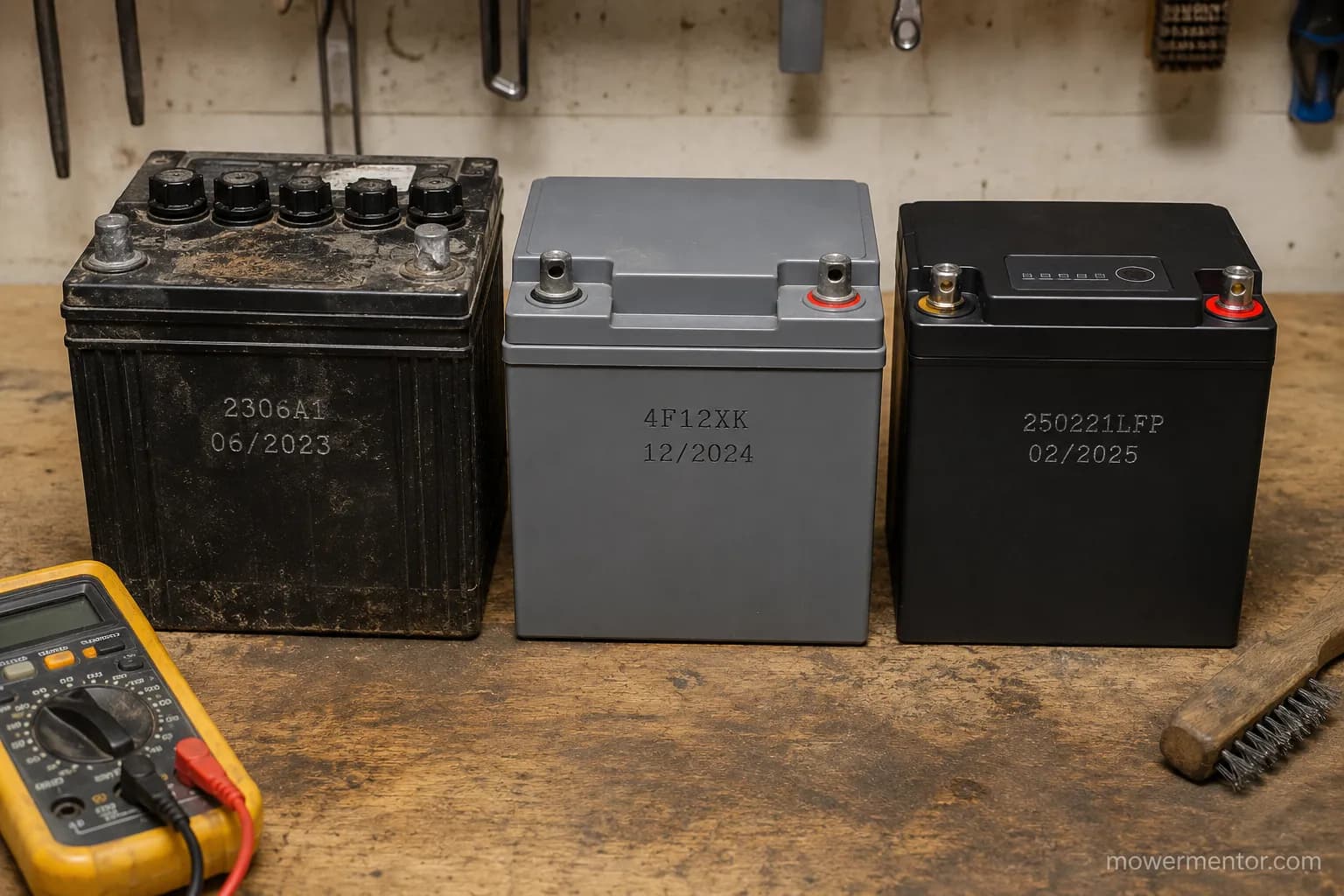
Riding mower battery lifespan splits cleanly by chemistry, which is why reported numbers swing from one season to a decade: a flooded lead-acid U1 typically gives 3 to 5 years, an AGM runs 4 to 7 years, and a lithium LiFePO₄ pack lasts 5 to 10 or more years at 2,000-plus cycles.
Flooded cranks hard but needs watering, AGM is sealed and shrugs off deck vibration, and lithium lives longest but will not charge below freezing.
Chemistry | Typical lifespan | Cold cranking | Upkeep | Best for |
|---|---|---|---|---|
Flooded lead-acid (U1) | 3–5 years | Strong | Check electrolyte monthly, add distilled water | Budget replacements, most tractors |
AGM (U1) | 4–7 years | Strong, sealed | None, maintenance-free | Rough decks, low-upkeep owners |
Lithium LiFePO₄ (U1) | 5–10+ years (2,000+ cycles) | Good, but no charging below freezing | None, needs a regulated charger | Longest life, lightest, seasonal storage |
Most riding mowers take a Group U1 or U1R, 12-volt battery in the 150 to 350 CCA range, so the chemistry is your real choice, not the size. Flooded batteries are cheapest and self-discharge slowly, but every cycle costs a sliver of capacity, according to Battery University.
AGM's absorbed-mat design is what makes it vibration-resistant, a genuine advantage on a bouncing mower deck. I have watched forum owners make the same jump I did: switched to AGM, sealed, no corrosion, cost more but lasts a lot longer.
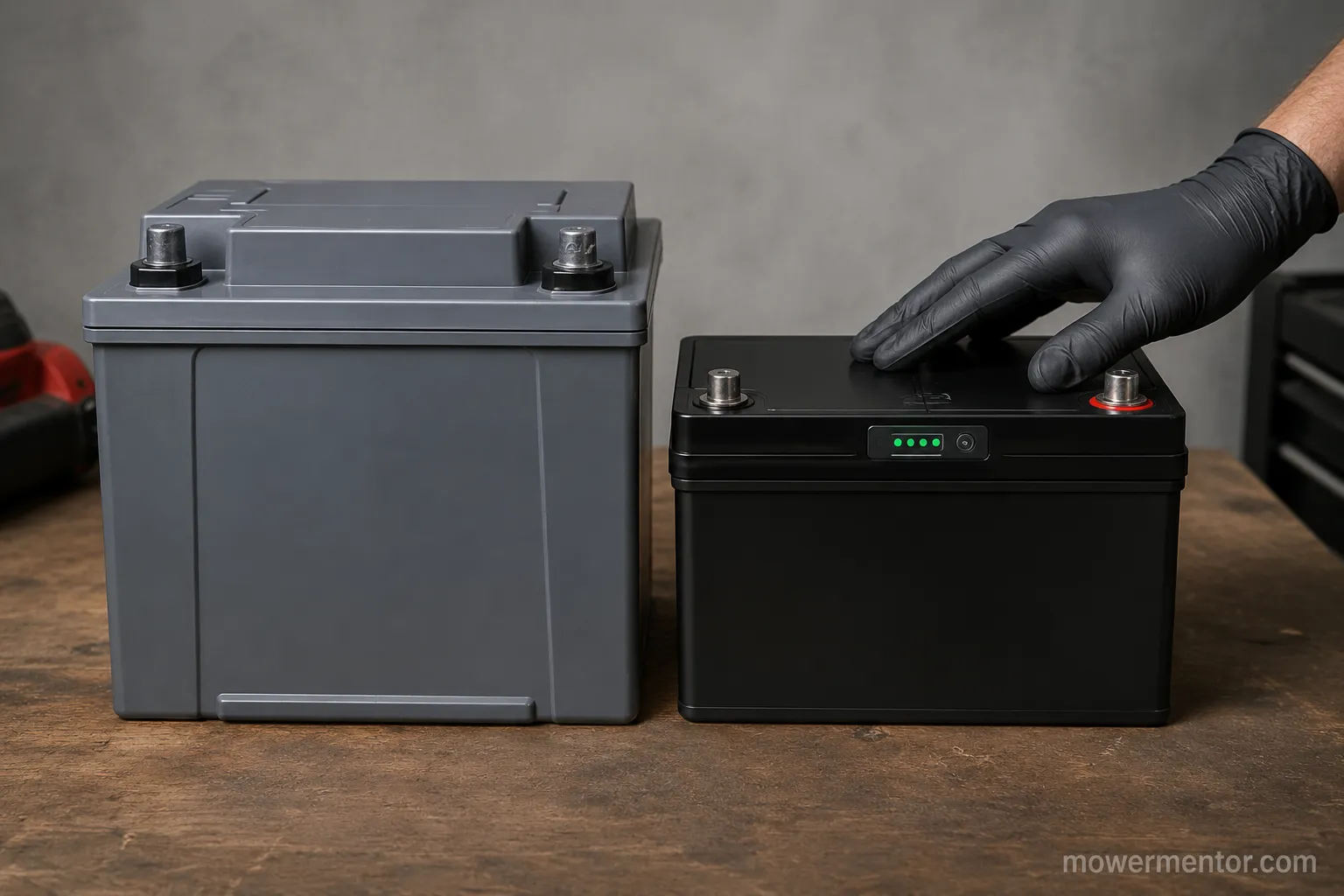
Lithium's catch: It will not charge below freezing. In a cold garage it needs to warm up before the mower's system can top it off, so a heated space or a spring-only charge routine matters.
I ran a flooded U1 for years, swapped to an AGM after a cracked case, and put a LiFePO₄ in my newest tractor, and the AGM has outlasted every flooded unit I have owned. The table below is my own bench record, not a spec sheet.
Unit | Chemistry | Date code | In service | Status |
|---|---|---|---|---|
Battery A | Flooded U1 | 03/2019 | 2019–2023 | Retired at just under 4 seasons |
Battery B | AGM U1 | 02/2020 | 2020–present | Year 6, still cranks strong |
Battery C | LiFePO₄ U1 | 04/2023 | 2023–present | No measurable capacity drop |
Fitment still matters when you buy, and Craftsman's U1 and U1R trays are a good example of fitting the right Craftsman size before you worry about lifespan.
John Deere owners report some of the widest lifespan swings of any brand, which is why Deere fitment and picks are worth checking against your model.
Troy-Bilt Pony and Bronco decks share the same U1 group size, so Troy-Bilt size and fitment follow the same rules as the chart above.
What Shortens (or Extends) Your Battery's Life
What shortens a riding mower battery's life comes down to a handful of factors, and heat leads the list: self-discharge roughly doubles for every 18°F rise, and every 15°F of sustained heat above the 77°F sweet spot can halve a lead-acid battery's service life.
Add an off-season spent at half charge, short mowing runs that never fully recharge it, and a marginal charging system, and a three-to-five-year battery becomes a one-season battery.
The most common life-shorteners, roughly in order of impact:
Heat. A hot shelf or a sun-baked shed accelerates self-discharge and internal corrosion.
Sitting discharged over winter. Low charge drives sulfation, the number-one killer of stored batteries.
Short, frequent starts. A five-minute mow never replaces what the start pulled out.
A weak charging system. If the stator or regulator is not keeping up, the battery slowly starves.
Corroded or loose terminals. They mimic a dead battery and add resistance.
Vibration. A loose hold-down shakes flooded plates apart over time.
The heat figures are not mine: self-discharge climbs steeply with temperature, per Battery University, and the rule that every 15°F halves the life with a 77°F optimum comes from Sandia National Labs. That gap is why the same battery gives a southern owner about 30 months and a northern owner closer to seven years.
If your battery keeps draining while the engine is actually running, the battery is usually not the fault at all. That is a charging-system problem, and it is worth learning to trace a charging-system drain before you buy a new pack.
Why does my riding mower battery only last a year?
If yours barely makes a season, the culprit is almost always storage plus heat, not a lemon. My very first flooded U1 died in one season because I left it on a hot garage shelf all summer at half charge, quietly sulfating while the AGM I actually maintain rolled on to year six.
Here is the shelf-temperature and resting-voltage log I kept on a spare flooded unit through one summer, and you can watch the charge bleed off as the shelf heats up.
Week | Shelf temp (peak °F) | Resting voltage |
|---|---|---|
Early June | 88 | 12.62 |
Late June | 96 | 12.55 |
Mid-July | 104 | 12.44 |
Early August | 106 | 12.31 |
Late August | 101 | 12.20 |
Mid-September | 92 | 12.10 |
By September that untended battery had drifted to roughly 70 percent charge with no load on it at all, purely from heat. Corroded or loose terminals make it worse, and they are quick to clean up corroded terminals in a few minutes.
How you charge it matters as much as how often you mow, so learning the right way to charge it is half the battle.
Some of it is luck, but most is not. Manufacturing variance is real, and the occasional unit gave up the ghost early through no fault of yours. But storage and heat explain the vast majority of one-season deaths.
Signs Your Riding Mower Battery Is Dying
The clearest signs a riding mower battery is dying are a slow, labored crank, needing a jump if the mower sits a week, and a battery that will not hold a charge overnight. Add a swollen or seeping case, a charge light that lingers 15 to 20 seconds after starting, or a resting voltage below 12.4 volts, and you have a battery on its way out.
Run through this quick checklist:
Cranks slowly or gets weak if you skip a few days.
Needs a jump after sitting less than a week.
Will not hold a charge overnight after a full charge.
Case looks swollen, or you see seeping electrolyte.
Resting voltage sits below 12.4 volts on a multimeter.
The charge or battery light stays lit 15 to 20 seconds after it fires.
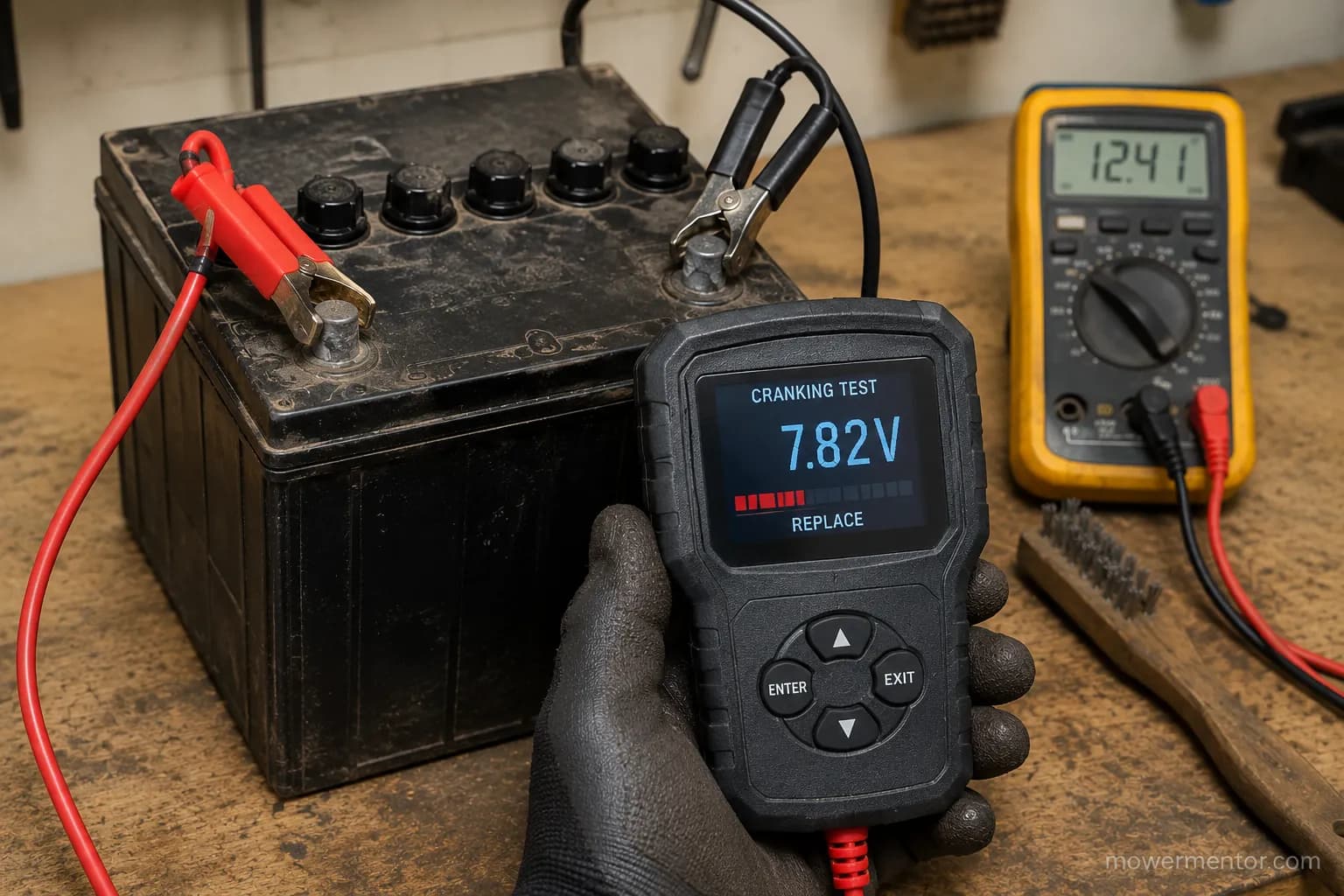
Here is the 30-second version: put a multimeter across the terminals with the mower off, where a healthy battery reads about 12.6 to 12.7 volts rested. Then watch it while a helper cranks, because a surface charge fools a plain voltmeter and partial charging builds the sulfation that strangles current flow, according to Battery University.
A battery reading 12.6 volts rested but sagging to 9 volts under crank is the classic looks-fine-is-not case I see most, and mine did exactly that right before it gave up the ghost. If the numbers hold under load, the battery is good and the problem is elsewhere.
When the battery tests healthy but nothing happens, the fault is downstream, so it helps to know when nothing turns over points to the starter or solenoid.
Fitted a fresh battery and it still will not crank? Then a new battery that still won't crank has its own short list of causes worth ruling out.
A healthy battery can still leave you stranded. A good load-test result does not rule out a tripped interlock, so it is worth a minute to check the safety interlocks before condemning anything.
How to Make a Riding Mower Battery Last Longer: Off-Season Storage
Making a riding mower battery last longer is mostly about two numbers and one habit: store it at 12.4 volts or higher, keep it below about 75°F, and never let it sit discharged. Lead-acid batteries should go into storage fully charged and get a top-up whenever they fall to roughly 70 percent, about 12.42 volts, because low charge drives sulfation.
The routine below is exactly what I run every fall, one action per step.
Clean and protect the terminals. Wire-brush any corrosion and coat the posts with dielectric grease; you should see bright metal and a snug hold-down.
Top off a flooded battery. Check the electrolyte monthly in season and add distilled water to the fill line so the plates stay covered. Sealed AGM and lithium skip this step.
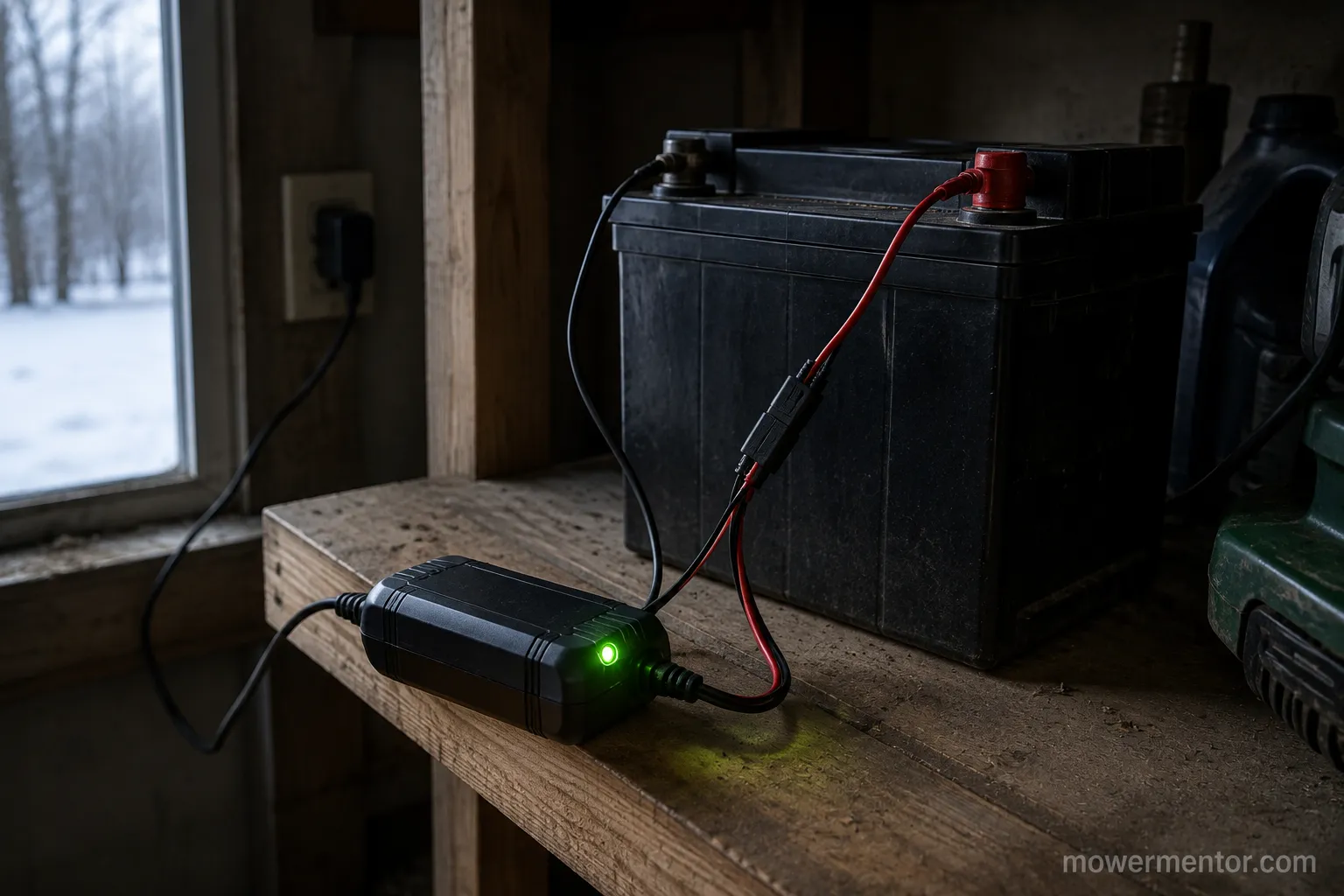
Leave permanent pigtails and clip on a maintainer. Bolt an SAE pigtail lead to the terminals once, then connect a battery tender or trickle charger for the off-season, watching for a green maintained light within a day.
Store it full, cool, and dry. Charge to 100 percent, then keep it at 12.4 volts or higher and below about 75°F, where the resting reading holds week to week.
Recharge at 70 percent. When resting voltage drifts to about 12.42 volts, give it a full charge and watch it climb back above 12.6.
Do a spring verification check. Before the first mow, confirm 12.6 to 12.7 volts rested and a strong, eager crank with no groan.
Store it at a full charge and top it off before it falls past 70 percent, advises Battery University, because a battery left low sulfates in place. Those storage-voltage and temperature targets line up with Power Sonic too, which is reassuring when two independent sources agree.
The concrete-floor myth, busted. A modern battery does not drain because it sits on a cold concrete floor; it drains from heat and self-discharge. A cool basement floor is fine, a hot shelf is not.
I leave SAE pigtails on every mower battery and clip a maintainer to them all winter, and the AGM that got this treatment is on year six. The one I meant to get to died at 18 months.
Here is the season-over-season resting voltage on that maintained AGM, each reading taken the following spring.
Spring | Storage method | Resting voltage | Crank |
|---|---|---|---|
2021 | Pigtail + maintainer | 12.85 | Strong |
2022 | Pigtail + maintainer | 12.82 | Strong |
2023 | Pigtail + maintainer | 12.80 | Strong |
2024 | Pigtail + maintainer | 12.78 | Strong |
2025 | Pigtail + maintainer | 12.79 | Strong |
2026 | Pigtail + maintainer | 12.76 | Strong |
Battery care belongs in the same off-season pass as the rest of your service, so fold it into your seasonal service schedule instead of treating it as a separate chore. Honda owners can knock the whole thing out during a Honda off-season service in one sitting.
Craftsman owners often pair it with a Craftsman spark-plug swap while the cover is off. Husqvarna's checklist covers the rest of the machine, and a full Husqvarna tune-up makes a natural home for the battery steps above.
If your tractor has a specific tray, storing a Husqvarna pack the right way up matters for the U1 versus U1R fitment.
Not all chargers are safe to leave on. A cheap unregulated charger can overcharge and cook a battery over months. Use a maintainer that switches to float, not a dumb trickle charger you forget about.
Charge It or Replace It? Making the Replacement Call
Whether to charge a riding mower battery or replace it comes down to age and a load test, not guesswork: a battery under about four years old that simply discharged is usually worth reviving, while one that is five years or older and fails a load test is done.
Reviving a young battery with a slow maintainer charge is cheap, but chasing a worn-out one wastes a weekend.
Age | Rested voltage | Load test | No-starts lately | Verdict |
|---|---|---|---|---|
Under 3 years | Below 12.4V | Passes after charge | First time | Revive with a full charge |
2–4 years | 12.0–12.4V | Passes under load | Occasional | Revive, then maintain |
4–5 years | Below 12.0V | Sags under crank | Frequent | Replace soon |
5+ years | Below 12.0V | Fails load test | Repeatedly | Replace now |
The revive path is real but temporary: I have brought back a two-year-old battery that just sat discharged, but a five-year-old that failed a load test got replaced the same day. If you only need to finish the yard today, you can jump it to finish the job and sort the replacement later.
When it is truly time to buy, matching group size and CCA matters more than brand, and choosing the right replacement starts with your existing U1 spec. Below is my own dated log of these calls, cost included.
Date | Battery | Age | Load test | Verdict | Cost |
|---|---|---|---|---|---|
May 2024 | Flooded U1 | 2 years | Passed after slow charge | Revived | $0 (already owned a maintainer) |
April 2023 | Flooded U1 (Battery A) | ~4 years | Sagged to 9V | Replaced | ~$70 |
June 2025 | AGM spare | 5 years | Failed | Replaced | ~$110 |
On price, a flooded U1 runs roughly $30 to $90, an AGM around $60 to $150, and a lithium LiFePO₄ upgrade near $120 to $250. Cub Cadet XT1 and LTX owners have a specific size to match, so confirm the right Cub Cadet size before ordering.
Murray's cross-reference chart makes matching a replacement painless, and Murray's fitment chart saves a return trip.
Reviving is a reprieve, not a cure. A maintainer charge buys time on a young battery, but it will not resurrect worn-out plates. A $25 maintainer is still cheaper than a new battery every other spring.
Frequently Asked Questions
How do I know if my riding mower battery is bad?
A bad riding mower battery cranks slowly, needs frequent jumps, or will not hold a charge overnight, and a multimeter confirms it: healthy reads 12.6 to 12.7 volts rested, while a failing one sags well under 12 volts during a crank. If it reads fine but still will not start, the fault is likely elsewhere, and the full starting diagnosis walks the rest of the system.
Should I leave my mower battery on a trickle charger over winter?
Yes, but use a smart maintainer rather than a basic trickle charger, because a maintainer tops the battery and then switches to float. That prevents both the sulfation of sitting low and the slow overcharge a dumb charger can cause, and leaving permanent pigtails on the terminals makes hooking it up each fall a ten-second job.
Will a completely dead riding mower battery recharge?
Sometimes, because a young battery that simply discharged will often recover on a slow maintainer charge over 24 hours. But one that is deeply sulfated from months of sitting, or that fails a load test afterward, has given up the ghost and needs replacing.
Do you need to charge a new riding mower battery before use?
Usually yes, because many new U1 batteries ship only partially charged, and a full charge before the first start gives the best cranking power and longest life. Check the label, and if it reads under about 12.6 volts rested, top it off before installing.
How much does a riding mower battery cost?
A standard flooded U1 typically costs about $30 to $90, a sealed AGM runs roughly $60 to $150, and a lithium LiFePO₄ upgrade lands near $120 to $250. The lithium costs the most up front but often outlasts two or three lead-acid batteries, so folding a battery check into a John Deere seasonal service or your usual off-season pass protects that investment.
How often should you replace a riding mower battery?
Plan on every 3 to 5 years for lead-acid or AGM and every 5 to 10 or more years for lithium, but replace it sooner if it consistently fails a load test or needs jumping after short sits. Owners who store it warm and discharged will land at the short end of every range.
So, how long does a riding mower battery last? Three to five years for most lead-acid and AGM units, and five to ten or more for lithium, with heat and off-season storage deciding where in that band you land.
Keep it cool, keep it charged, and confirm with a load test before you buy a replacement. Do that, and the number works in your favor instead of against you.
Summarize with AI
Keep reading
Related articles
 Troubleshooting & Repair
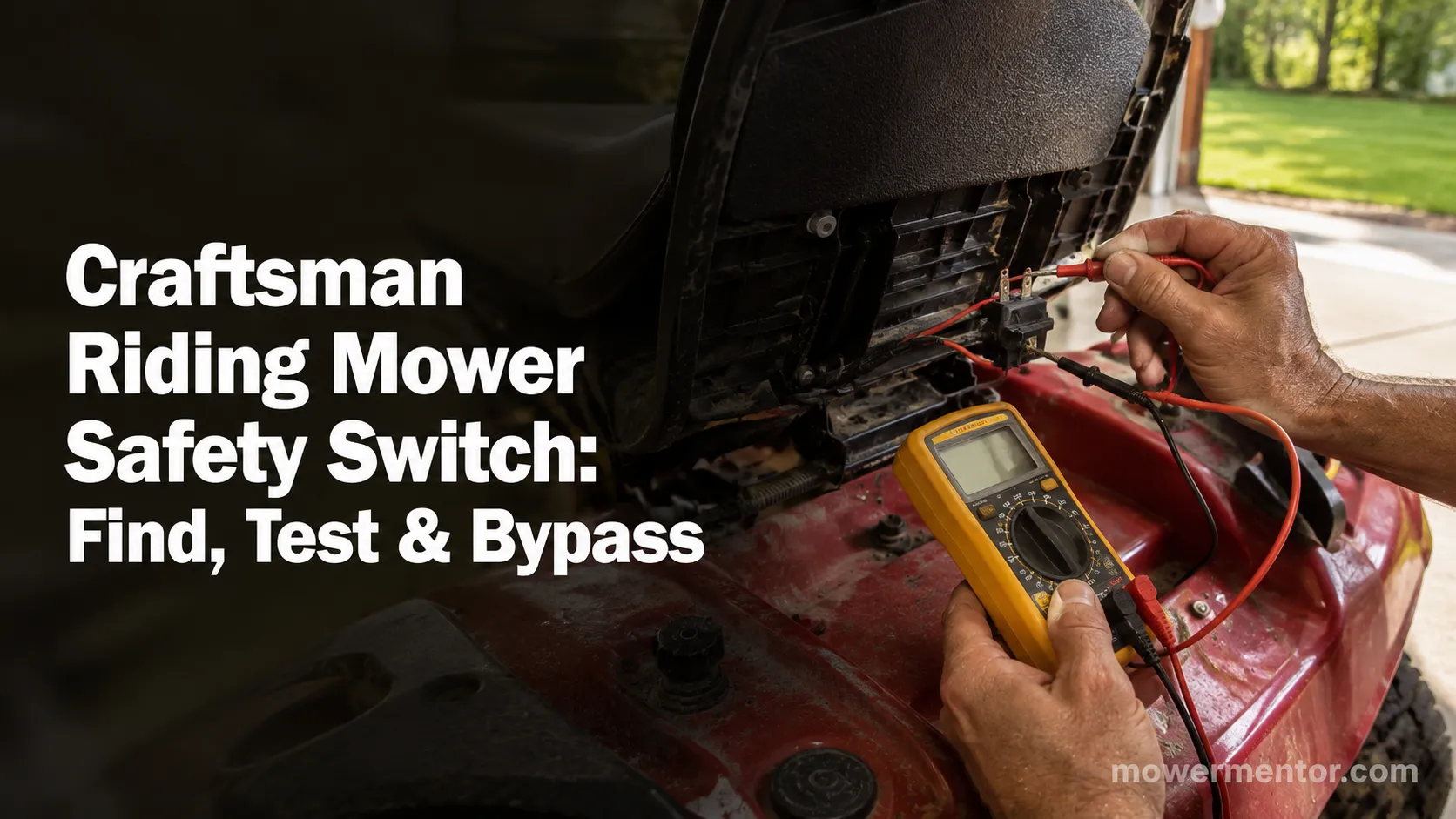
Find, test, and safely bypass the Craftsman riding mower safety switch: seat, brake, and PTO interlocks, with multimeter values and a re-enable step.
 Troubleshooting & Repair
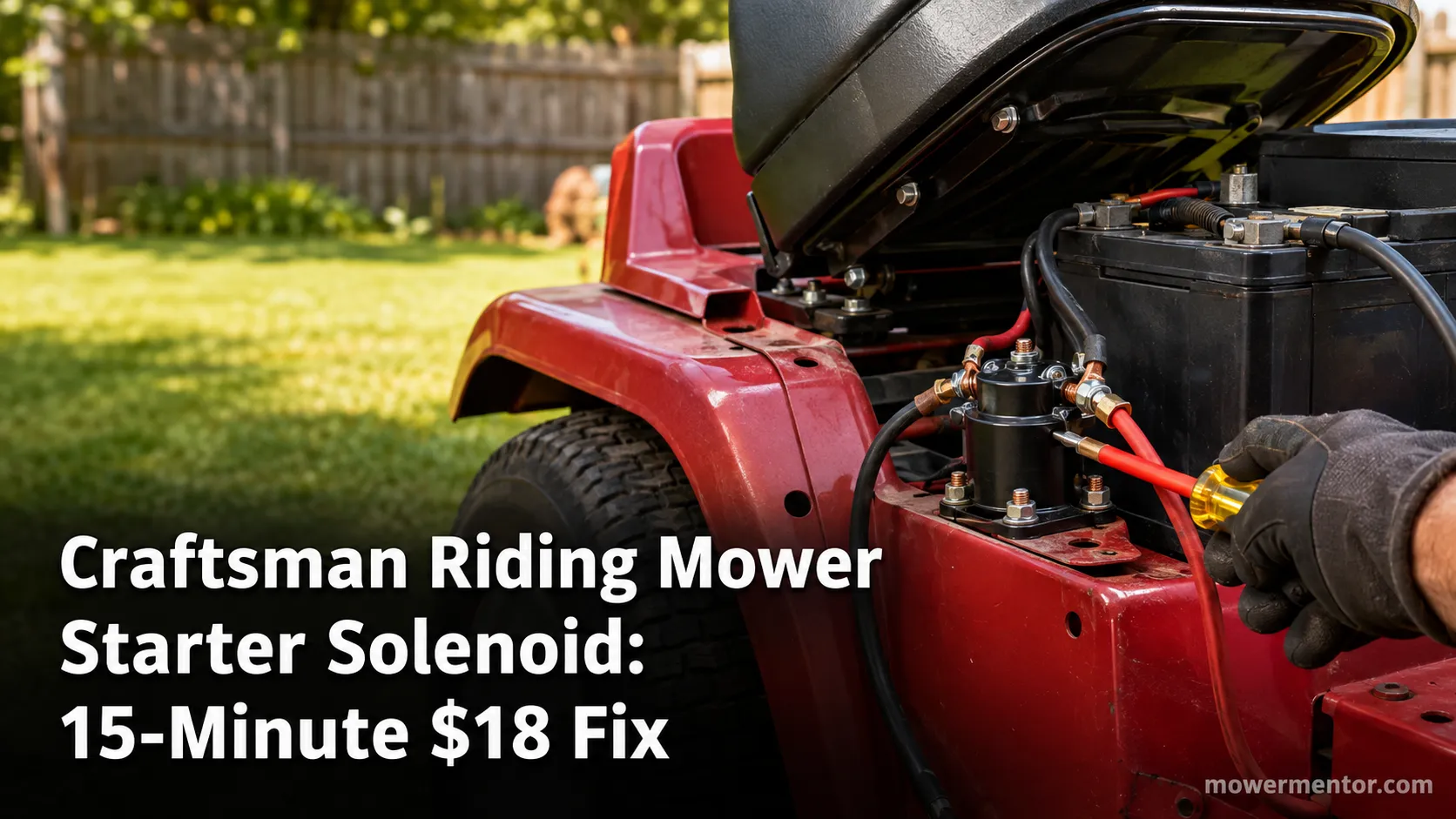
Test your Craftsman riding mower starter solenoid in about 15 minutes with a screwdriver and multimeter, then fix the click-no-crank for around $18.
 Troubleshooting & Repair
Fix a Craftsman riding lawn mower won't start no clicking: test battery voltage, inline fuse, safety switches, ignition and solenoid with a multimeter.
 Troubleshooting & Repair
Find the right Craftsman riding mower battery: 12V U1/U1R size chart by model, 5 tested picks, and why yours keeps dying.
Comments
Moderated for quality. Share a correction, ask a follow-up, or tell us what worked for you - every comment is reviewed before it goes live.