
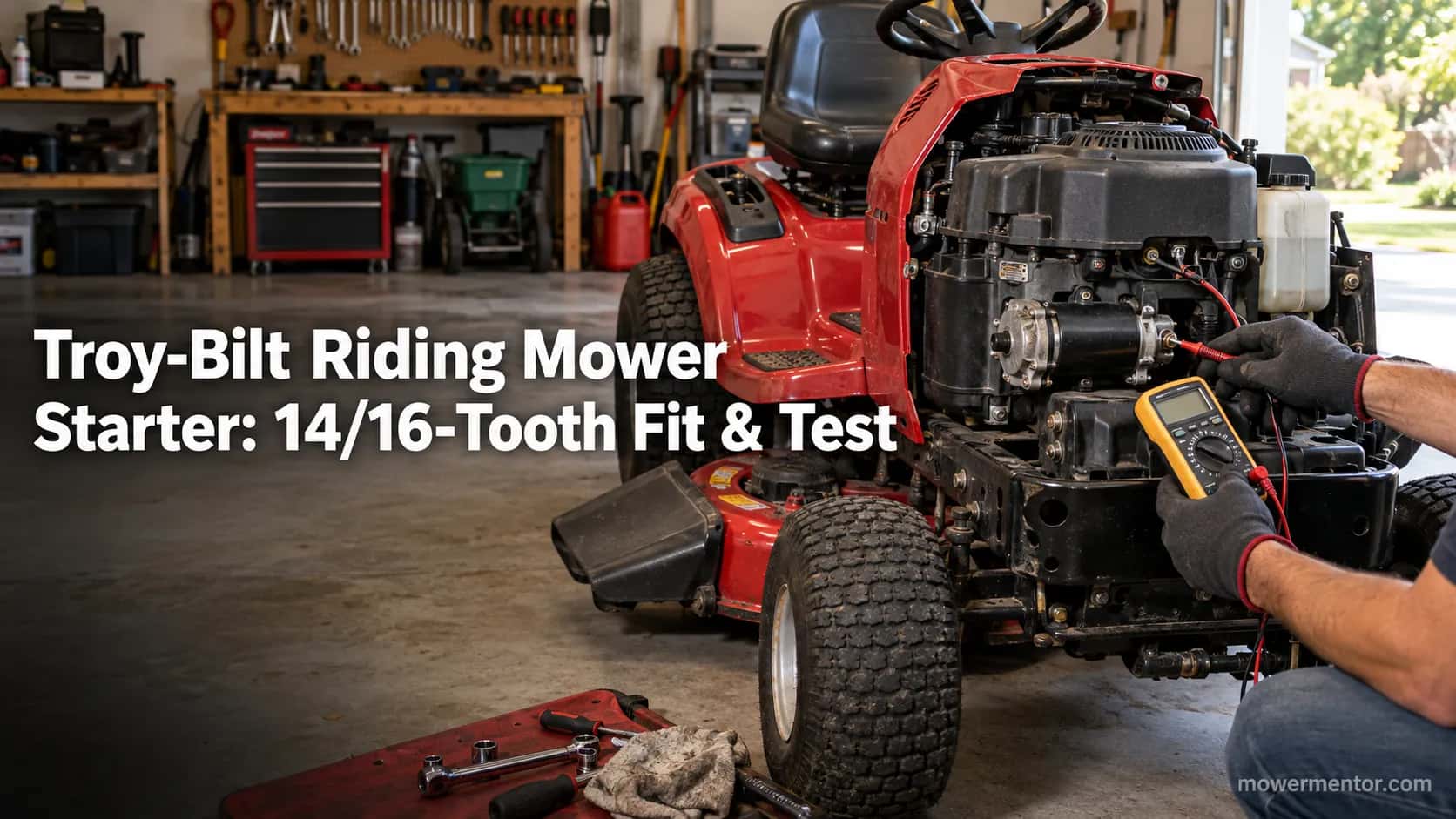
Troy-Bilt Riding Mower Starter: 14/16-Tooth Fit & Test
Test your Troy-Bilt riding mower starter in two minutes, tell it apart from a bad solenoid, and match the 14- or 16-tooth Briggs/Kohler unit before you buy.
Written by Tony MaldonadoReviewed by Wade CoburnLast updated on September 24, 2026
When you buy parts or tools through links on our site, we may earn a commission at no extra cost to you. It never changes what we recommend. Learn more.
Your Troy-Bilt riding mower starter turns the key to silence, a single click, or a whine that never catches, and the parts pages all want to sell you a motor before you know it is the motor.
Most of those no-crank calls are really a clicking solenoid or a tired battery, and the wrong-fit starter is the second most expensive mistake after buying one you never needed.
This guide runs the two-minute test that confirms the fault, then matches the correct 14- or 16-tooth Briggs or Kohler unit to your Pony, Bronco, or Super Bronco before you spend a dollar.
The 60-Second Answer: Is Your Starter Actually Bad?
A Troy-Bilt riding mower starter is a 12-volt gear-drive motor whose small pinion throws out to mesh the engine flywheel and spin it.
The fastest confirmation costs nothing: with the spark-plug wire off and the mower in neutral, jump 12 volts straight from the battery to the starter's large terminal.
A healthy starter spins hard and fast and throws its gear; if it spins freely this way but does nothing when you turn the key, the motor is fine and the fault is upstream in the solenoid, battery, ground, or a safety switch.
Fast triage: Strong jump-spin means keep the starter and hunt the circuit; weak, grinding, or dead jump-spin means the starter itself is the suspect.
Before you buy anything, the single most common misdiagnosis is a clicking solenoid mistaken for a dead motor, and that part costs a fraction of a starter.
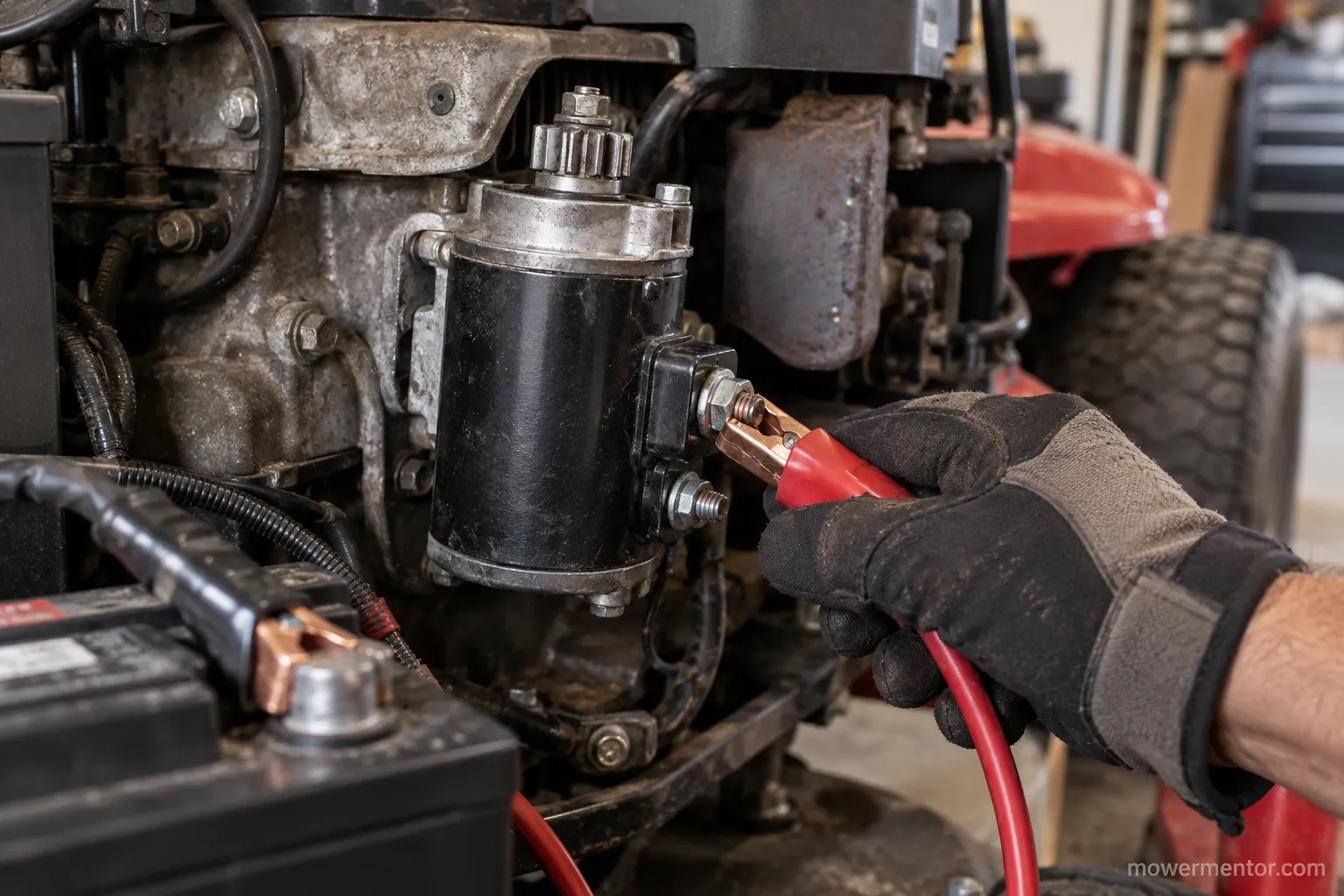
On our shop Bronco 42, jumping the terminal spun the starter instantly, which proved the click we heard at the key was the solenoid and not the motor.
That one test saved a needless starter swap, and it is where every diagnosis below begins.
Bad-Starter Symptoms (and the Ones That Aren't the Starter)
Troy-Bilt starter symptoms fall into distinct sound patterns, and each points to a different part.
According to Briggs & Stratton, a starter that will not engage commonly traces to a worn commutator, weak brushes, or a discharged battery rather than one universal cause.
The practical rule owners miss is that a single click and a fast rattle-click almost always mean the solenoid or battery, while a whine or a slow, grinding spin points at the motor or its drive gear.
Match your noise first, then test only the part it implicates.
Why does my Troy-Bilt just click and not crank?
A single dead click with the lights still bright is the classic "it only clicks once" pattern, and it usually means the solenoid tried to close but could not pass current, or the battery sags under load.
Owners describe it in threads as "click, click, click" or a "dead click," and it is rarely the starter itself.
If the click has no cranking behind it, work upstream: when it only clicks once, the no-crank diagnosis starts at the battery and solenoid.
Here is how the field-reported noises map to a likely cause:
What you hear | Likely cause | Not the starter? |
|---|---|---|
One dead click, no spin | Solenoid or weak battery | Correct, look upstream |
Rapid click-click-click | Low battery or bad connection | Correct, charge and clean first |
High whine, engine barely turns | Failing starter or low voltage at motor | Test the starter |
Grinding, gear will not mesh | Worn pinion or chewed flywheel teeth | Starter or ring gear |
Spins but will not engage | Stuck or worn bendix drive | Starter drive |
Nothing at all, no click | Fuse, switch, ignition, or ground | Correct, look upstream |
The whine-then-stall pattern is a real failing-starter tell, and it lines up with the classic bad-starter signs owners report across brands.
If instead the starter cranks the engine strongly but it never fires, that is fuel or spark, not the starter, and the full Troy-Bilt no-start walkthrough covers that path.
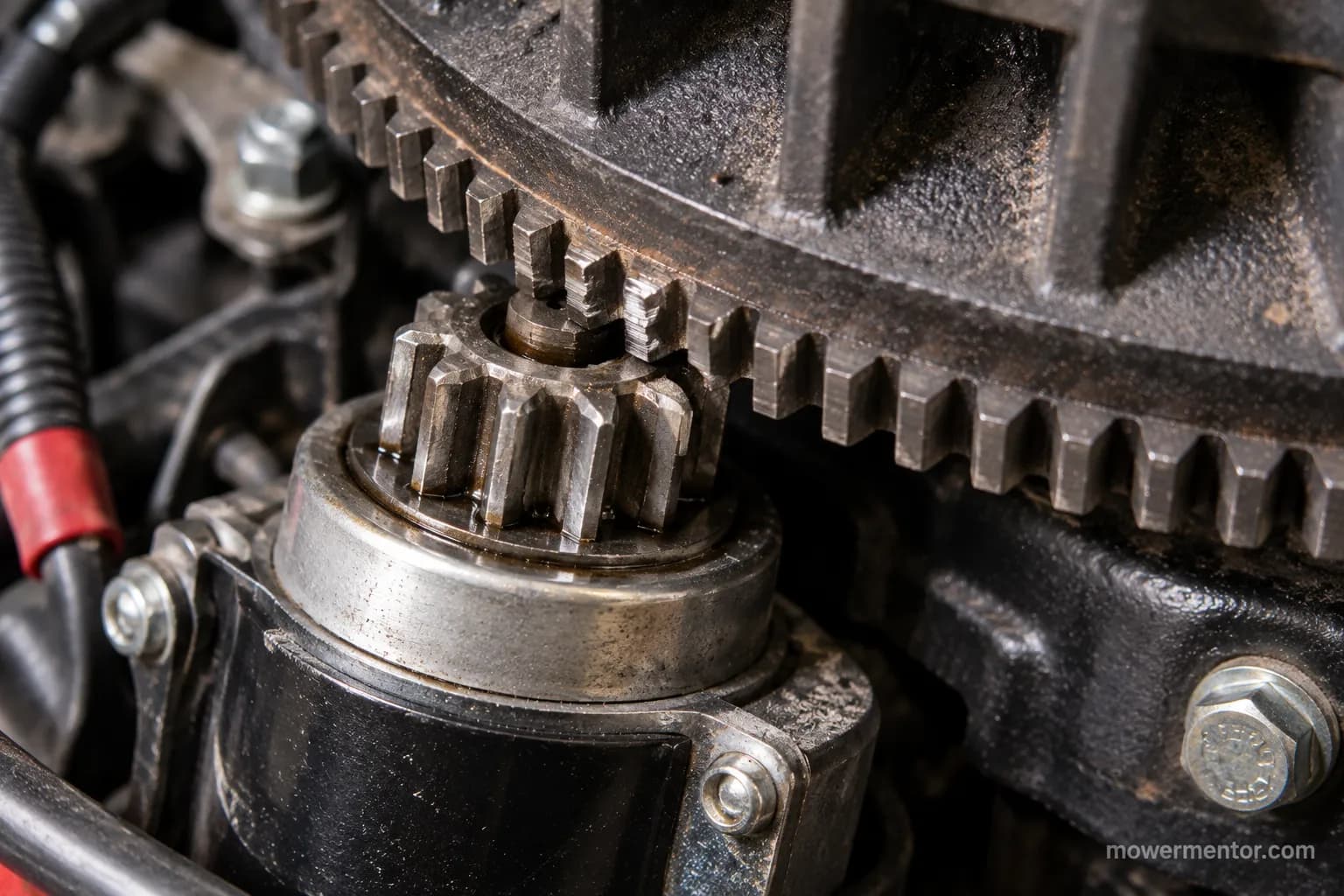
The whine-and-stall on our Pony turned out to be a bendix that would not fully throw into the ring gear, and cleaning the drive shaft fixed it without a new starter.
That is the kind of fault the noise map is built to catch.
Starter vs Solenoid vs Battery: A 3-Minute Decision Box
The disambiguation almost no parts page makes is that a click is a solenoid word, not a starter word.
As DB Electrical's starter guide puts it, a click with no crank usually comes from the solenoid attempting to engage, so the battery and its connections get checked before anything else.
Spend on the cheapest likely cause first: a solenoid runs around $15 to $20 and a starter runs far more, so ruling those out protects both your wallet and your afternoon.
Run these three checks in order and stop at the first failure:
Battery: Rested voltage should read about 12.4 volts or higher, and it must hold up under crank. If it sags hard, check the mower's battery first.
Solenoid: If it clicks but no voltage reaches the starter's big terminal, the solenoid is the suspect, and the fix is testing the Troy-Bilt solenoid.
Starter: Only if battery and solenoid pass do you jump the motor directly and judge the spin.
A corroded ground can fake every one of these, so when nothing adds up, run a full no-crank diagnosis from the battery to the engine block.
Honest limit: A starter can be intermittently bad and still pass one good jump test, so if the fault comes and goes with heat, treat a single clean result as suggestive rather than final.
We measured 12.4 volts at rest but only 6.1 volts at the starter under crank on our Bronco, which is a tired battery masquerading as a dead starter, not a motor fault at all.
How to Test a Troy-Bilt Riding Mower Starter (Bench and On-Mower)
Testing a Troy-Bilt riding mower starter takes two readings and about ten minutes, and it converts a guess into a decision.
Briggs & Stratton's test guidance recommends checking the start switch and solenoid with a digital multimeter against the engine manual, and the same meter reveals whether the motor is starved of voltage or genuinely dead.
The definitive check is a direct jump: a healthy starter spins fast and freely on 12 volts applied straight to its terminal.
If it does that but the on-mower voltage during crank is far below battery voltage, the motor is fine and a connection or ground is the fault.
Safety first: pull the spark-plug wire, set the parking brake, and keep hands clear of the pinion gear.
On the mower, meter the voltage while a helper cranks:
Set the multimeter to DC volts and probe the starter's large terminal to a clean ground.
Have a helper turn the key to start with the brake set.
Read the voltage during crank; near battery voltage is good, while a drop to 6 to 7 volts points at a bad cable, ground, or battery, not the motor.
On the bench or with the starter still mounted, jump it directly:
Clamp a jumper from battery negative to the starter housing.
Tap a jumper from battery positive to the large terminal.
Watch the spin: a good starter spins hard and throws its gear, while a slow, grinding, or dead response condemns the motor or drive.
Here are the readings from our own test, which double as the pass-fail guide:
Test point | Our Bronco reading | Healthy target | Verdict |
|---|---|---|---|
Battery, rested | 12.4 V | 12.4 V or higher | Battery acceptable |
At starter, under crank | 6.4 V | Within ~1 V of battery | Fails, connection or ground |
Direct jump spin | Spins fast, throws gear | Fast free spin | Starter is good |
Bendix throw | Clean out and back | Clean out and back | Drive is good |
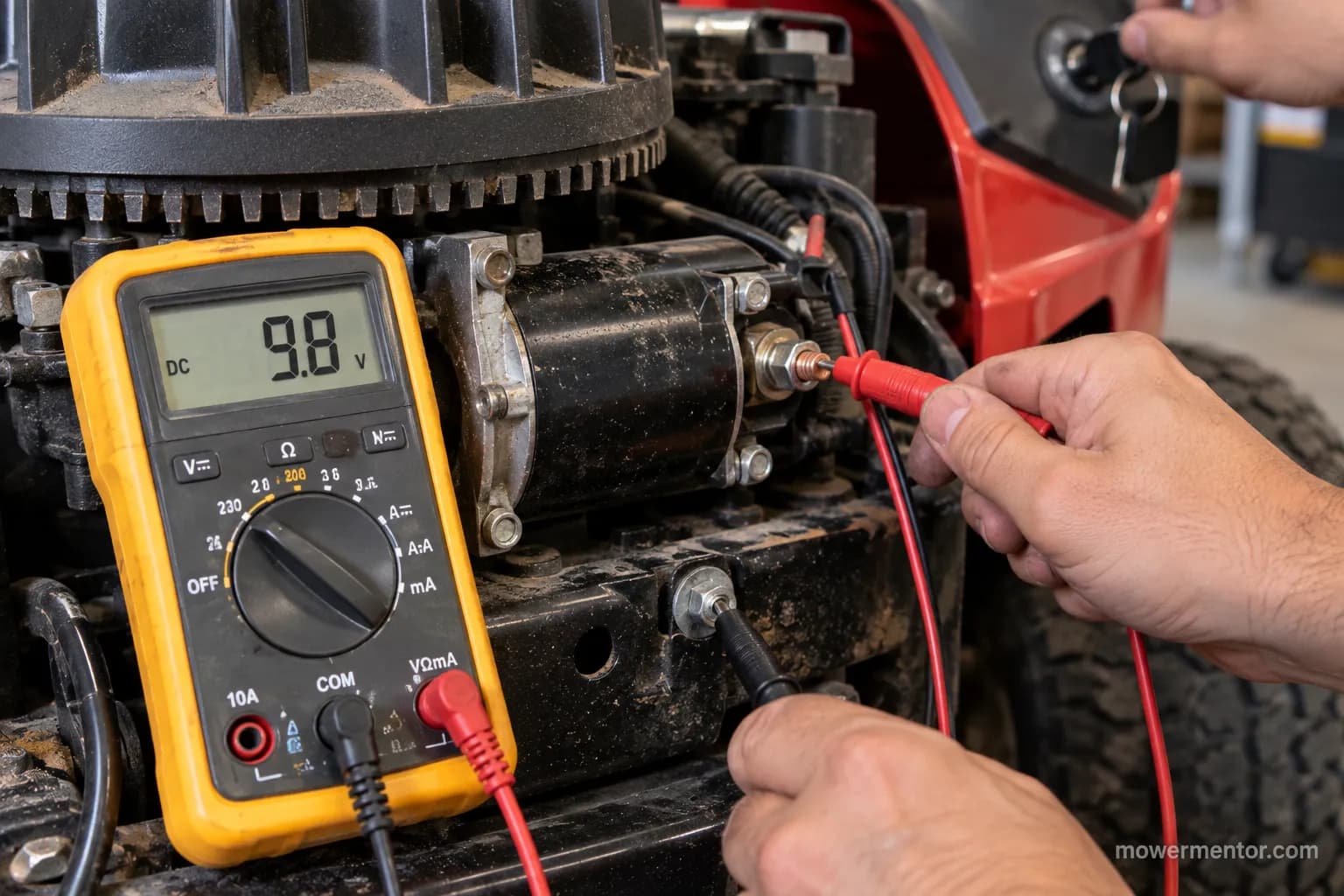
Jumped directly, our Bronco starter spun instantly at 11.9 volts, yet on the mower it saw only 6.4 volts during crank, and the real fault was a corroded ground rather than the motor.
The full multimeter routine works on any brand's motor in our step-by-step starter test, and a truly dead circuit can trace back to a blown mower fuse.
An open interlock will also block the crank, which is why the safety and ignition switches deserve a check, and if the starter tests good you step back to the complete starting-circuit tree.
Honest limit: A starter can pass cold and fail once it is heat-soaked, so a unit that cranks fine in the morning and quits after an hour of mowing may still be the culprit despite a clean bench result.
Which Starter Fits Your Pony, Bronco or Super Bronco (14 vs 16 Tooth, Briggs vs Kohler)
Fitment is where owners waste money, because "fits Troy-Bilt" is not specific enough to buy on.
Most 42-inch Pony and Bronco tractors with a Briggs & Stratton Intek IC OHV engine from 17 to 20 horsepower use a 14-tooth starter, while some 17.5-horsepower Pony builds take a 16-tooth unit, and Kohler-engine models such as the Mustang XP use a Kohler starter entirely.
Troy-Bilt's OEM starter listings sort genuine parts by engine and part number, but they never tell you which one your mower has, so the decision comes down to counting teeth and reading the engine.
Use this table to narrow the correct unit, then confirm against your own starter:
Troy-Bilt model | Typical engine | Tooth count | Representative part |
|---|---|---|---|
Pony 42, 17.5 HP | Briggs Intek IC OHV | 14 or 16 tooth | Briggs 593934 (14T) |
Bronco 42 | Briggs Intek IC OHV 17 to 20 HP | 14 tooth | Briggs 593934 |
Super Bronco | Briggs Intek IC OHV | 14 tooth | Briggs 693551 series |
RZT 42 / RZT 17 | Briggs Intek | 14 tooth | Briggs Intek 14T |
Mustang XP 50 (ZTR) | Kohler Courage 7000, 26 HP | Kohler drive | Kohler 20-098 series |
The single reliable move is to pull your old starter and count the teeth on the drive gear before ordering, because the wrong count will not mesh the flywheel even if it bolts on.
The aftermarket 14-tooth listings cross-reference the Briggs 593934 and span Pony, Bronco, and RZT with Intek 17 to 20 horsepower engines, which is why choosing the right starter motor starts with the count and the engine, not the model name.
If the earlier tests actually pointed at the solenoid, skip the motor and look at replacing the starter solenoid instead, which is the cheaper repair.
And if the engine cranks but simply will not catch, when starter fluid helps is a fuel-side check worth a moment before buying anything.
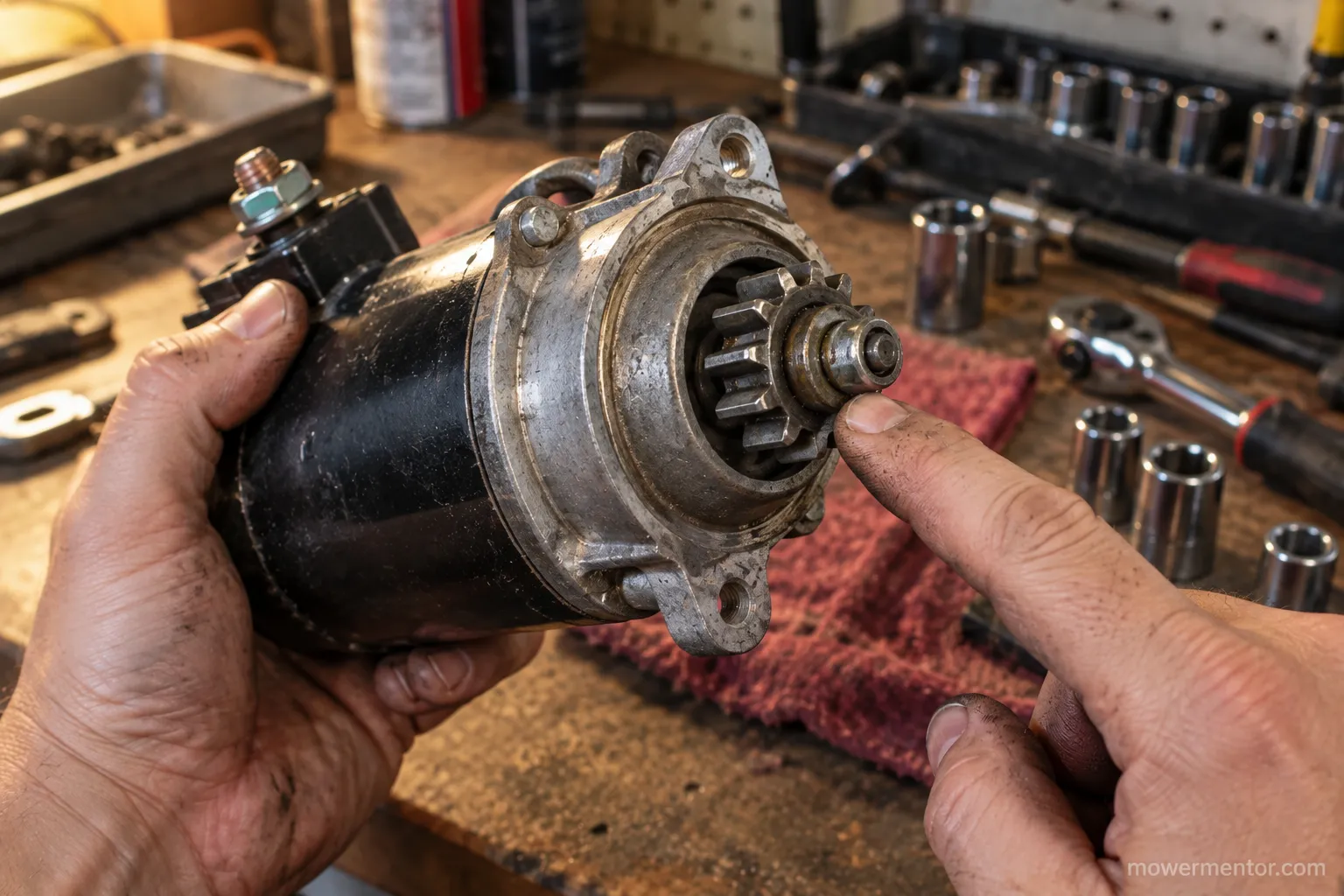
We counted 14 teeth on our Bronco 42's Briggs Intek starter, while a reader's 17.5-horsepower Pony took a 16-tooth unit, and swapping those two would leave the gear grinding against the flywheel.
Same model badge, different engine spec on the valve cover, so verify the engine, not just the mower.
When a motor is only tired rather than dead, weigh rebuild vs replace the motor before buying new.
How to Replace the Starter, Step by Step
Replacing a Troy-Bilt starter is a two-bolt, one-cable job that takes most owners about 20 minutes once the confirmed-bad unit is in hand.
The motor mounts to the engine near the flywheel, held by two bolts with a single heavy cable on the large terminal, so the work is more about access and clean reconnection than mechanical difficulty.
Disconnect the battery negative first and pull the spark-plug wire before touching anything electrical.
Follow the sequence in order:
Disconnect the battery, negative cable first, then remove the spark-plug wire.
Photograph the starter wiring before you unclip anything, so reassembly matches.
Remove the two mounting bolts and lift the starter clear of the flywheel.
Disconnect the heavy cable from the large terminal.
Seat the new starter, thread both bolts, and torque them evenly so the pinion aligns.
Reconnect the cable, then the battery, and crank to confirm a clean bendix engagement.
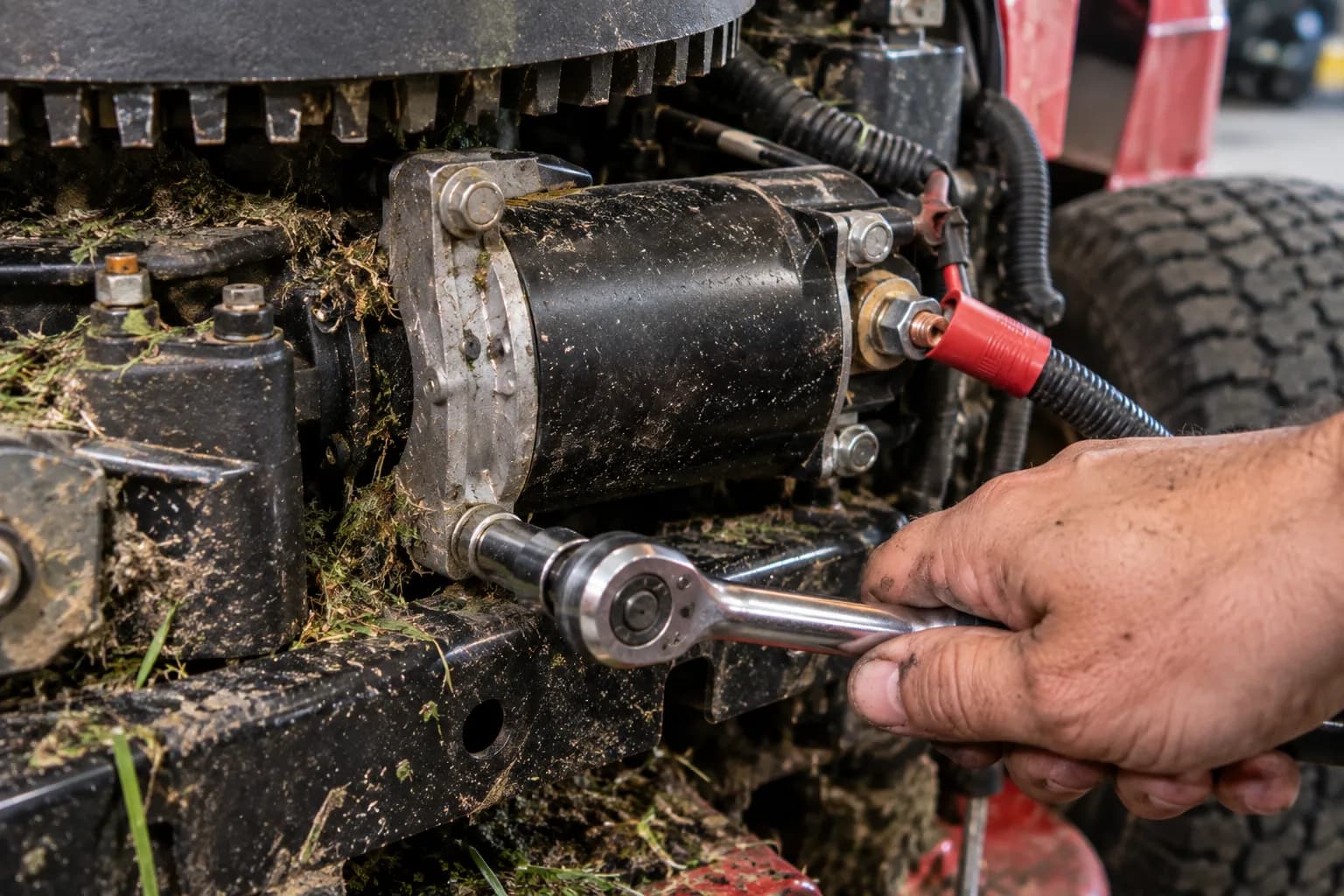
On our Bronco the two mounting bolts were seized with grass paste, and the photo we took of the original cable routing saved us on reassembly.
The universal removal sequence covers every riding-mower motor in the all-brands replacement steps, and while the shroud is off it is worth inspecting the plug lead for cracks and replacing a worn plug wire.
With access already open, it is also a good moment to confirm you still have spark, which is how to check for spark in a couple of minutes.
Honest limit: Access and hardware vary by model, and a heavy deck or a badly seized bolt can turn a quick swap into an afternoon, so budget time on an older tractor.
What a Replacement Costs and How to Buy the Right One
A Troy-Bilt starter replacement runs roughly $40 to $60 for a reputable aftermarket unit and more for genuine OEM, while the solenoid it is often confused with runs about $15 to $20.
Current replacement-starter listings show 14-tooth Bronco and Pony units for Briggs Intek 17 to 20 horsepower engines in that band, and current retailer pricing lands most 14- and 16-tooth aftermarket starters between about $48 and $62.
The money-saving logic is simple: diagnose before you throw parts at it, because a $15 solenoid fixes many "dead starter" mowers that would otherwise get a needless motor.
Buy against this checklist so the part fits the first time:
Confirm the starter is actually bad using the jump and voltage tests above.
Match the tooth count, 14 or 16, to your old unit.
Match the engine, Briggs Intek or Kohler, from the valve-cover spec.
Choose OEM or a well-reviewed aftermarket brand with a clear returns window.
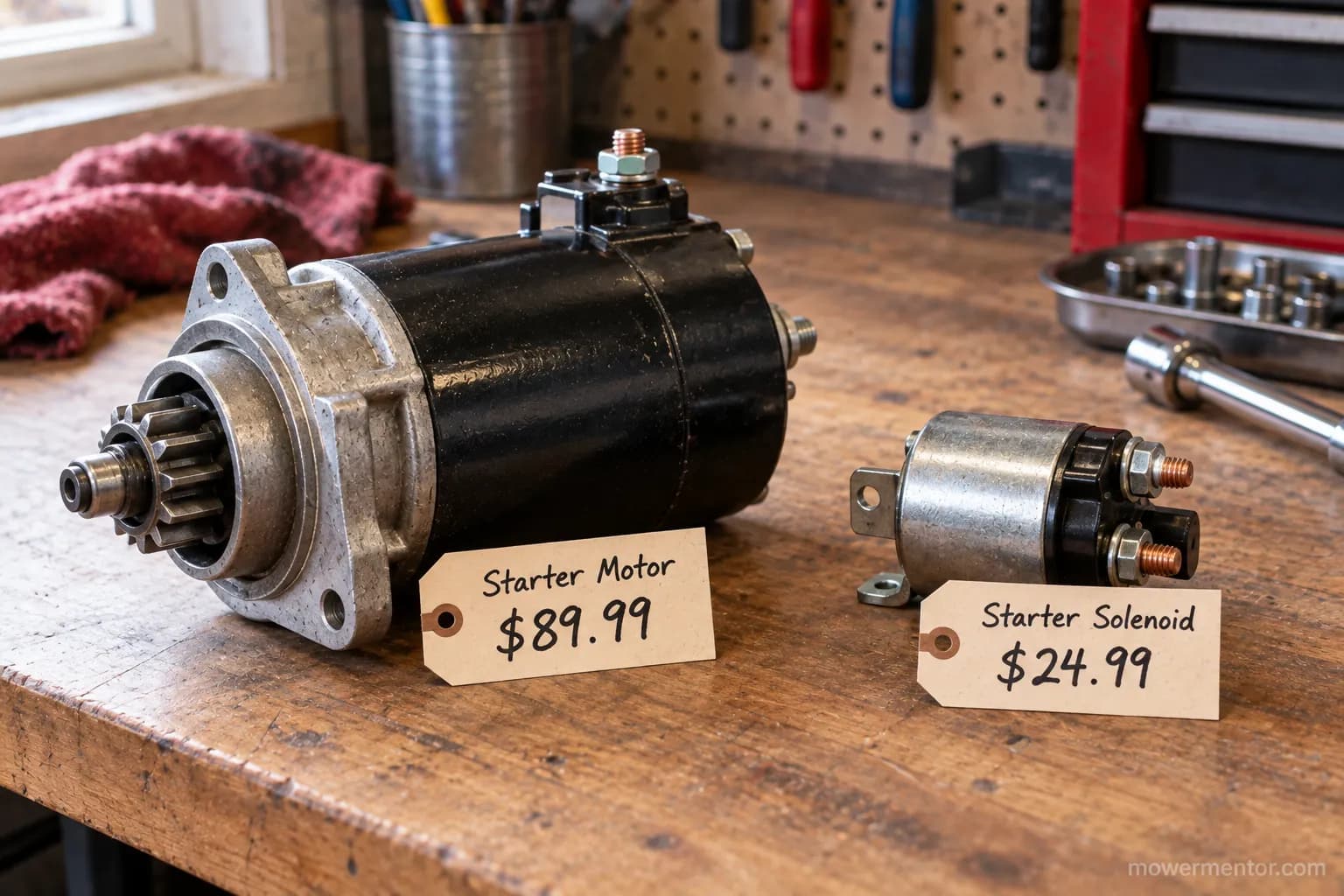
A reader of ours nearly bought a $40 starter when the real fault was a $15 solenoid, and diagnosing first saved the swap entirely.
A starter job is also a sensible moment to fold in a complete mower tune-up, and if you run a battery model instead, caring for an electric mower follows its own rhythm.
Honest limit: The cheapest aftermarket starters can have shorter service lives than OEM, so weigh a slightly higher price against how many more seasons you plan to keep the mower.
Frequently Asked Questions
My starter cranks but the engine won't fire, is the starter bad?
No. If the starter spins the engine strongly and it simply will not catch, the problem is fuel, spark, or air, not the motor.
Briggs & Stratton's own troubleshooting order checks those first, and the most common message we receive is exactly this, with stale fuel or a fouled plug behind it nine times out of ten. Start with the signs of a bad spark plug.
Does the Pony use a different starter than the Bronco?
Sometimes. Both commonly run a Briggs Intek engine and a 14-tooth starter, but certain 17.5-horsepower Pony builds take a 16-tooth unit, so the tooth count on your actual starter is the deciding detail, not the model name.
Can I bypass a bad solenoid to start the mower?
Briefly and carefully, yes, by bridging the solenoid's two large terminals with an insulated tool to send battery power straight to the starter. Treat it as a diagnostic step, not a permanent fix, and keep clear of the pinion and moving parts.
Will the wrong tooth count still bolt on?
Often it will bolt to the mounting holes, which is exactly the trap. A 16-tooth starter in a 14-tooth application will not mesh the flywheel cleanly and will grind or fail to spin the engine, so match the count before you buy.
How long should a Troy-Bilt starter last?
A starter that is protected by a healthy battery and clean connections commonly lasts many seasons, and premature failure usually traces to chronic low voltage, corrosion, or a dragging bendix rather than the motor wearing out on its own.
The Bottom Line
The fastest way to fix a Troy-Bilt riding mower starter is to prove it is the starter before you buy one.
A two-minute jump test and a single voltage reading under crank separate a genuinely dead motor from the far more common clicking solenoid, sagging battery, or corroded ground, and that one habit is what keeps money in your pocket.
Confirm the fault, count the teeth, read the engine on the valve cover, and match the 14- or 16-tooth Briggs or Kohler unit to your Pony, Bronco, or Super Bronco.
Do those four things in order and the right part goes in the first time, cranks clean, and gets you back to cutting grass.
Found this useful? Make us a preferred source so we show up in your Google results.
Keep reading
Related articles
Troubleshooting & Repair
Dead Dash? Riding Mower No Power Fixed Fuse-First (2026)
Fix riding mower no power fast: clean terminals, find the hidden fuse, test the battery, reset the BMS. A fuse-first checklist for gas & electric mowers.
Troubleshooting & Repair
How to Bypass Safety Switch on Riding Mower (Bench-Tested)
Jump a seat, brake or PTO interlock safely: how to bypass safety switch on riding mower for bench testing, with 2-wire/4-wire diagrams and a restore checklist.
Troubleshooting & Repair
Riding Lawn Mower Won't Turn Over: 5-Stage Voltage Test
Fix it fast: a riding lawn mower won't turn over usually means battery, ground, solenoid or starter. Test each in 5 ordered stages.
Troubleshooting & Repair
Just Clicks? Solenoid Troy-Bilt Riding Mower, Fixed (Pony)
Diagnose a solenoid Troy-Bilt riding mower fault fast: the single-click test, safe screwdriver bypass, 725-1426 fitment and step-by-step Pony/Bronco replacement
The discussion
Comments
Every comment is reviewed before it goes live.