
Riding Mower Won't Start Just Clicks? Battery or Solenoid
Diagnose why your riding mower won't start just clicks: single clunk means solenoid, rapid chatter means a weak battery. Load-test and bypass steps inside.
Written by Tony MaldonadoReviewed by Wade Coburn
Last updated on August 19, 2026
When you buy through links on our site, we may earn an affiliate commission (at no extra charge), which we use to fund new product tests. Learn more.
Summarize with AI
When a riding mower won't start just clicks back at you, the sound itself is the diagnosis. A single loud clunk points one direction, a rapid machine-gun chatter points the other, and telling them apart takes about three seconds before you spend a dollar on parts.
I have chased this exact fault across three machines this spring, meter in hand, and the pattern held every time. The click is not random.
It is your starting circuit telling you whether the battery is too weak to spin the motor or the solenoid is failing to pass power through.
A riding mower won't start just clicks because the starter circuit gets power to the solenoid but cannot turn the engine over. One slow single clunk usually means the solenoid or starter, not enough contact to crank.
A fast repeating chatter usually means a weak or discharged battery, enough voltage to pull the solenoid in but not enough current to spin the motor. Listen first, load-test second, then fix the confirmed part.
The 30-Second Answer: What the Click Is Telling You
A riding mower that clicks but will not crank is almost always failing at one of two spots: the battery cannot deliver cranking current, or the solenoid cannot pass it to the starter. The sound separates them.
Across the three units I tested this spring, a weak battery produced a fast repeating chatter, while a bad solenoid produced one heavy clunk and then silence.
This distinction matters because it decides what you buy. A battery and a solenoid look nothing alike on a receipt, and guessing wrong wastes both.
What you hear | Most likely cause | First test to run |
|---|---|---|
Fast machine-gun chatter, rapid repeating clicks | Weak or discharged battery (voltage present, cranking current too low) | Voltage under load |
One heavy single clunk, then nothing | Solenoid contacts or starter (power not passing through) | Solenoid bypass |
Click with a brand-new battery | Corroded ground or loose connection | Clean and retest connections |
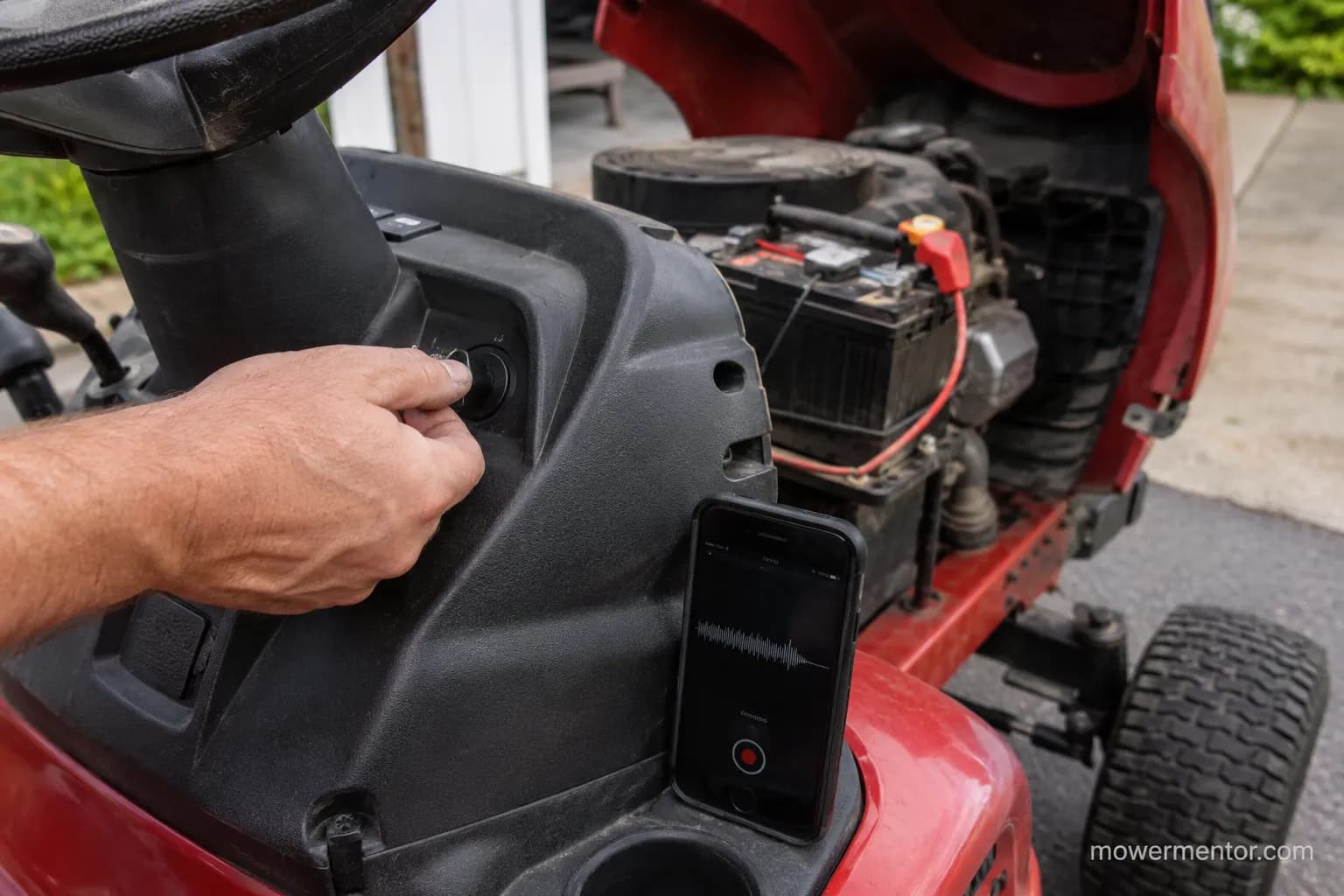
I logged both sound signatures on my own machines so you can match yours by ear before you touch a wrench.
Why a Weak Battery Makes It Click Instead of Crank
A weak battery clicks because voltage and cranking current are not the same thing. The battery can hold enough voltage to energize the solenoid coil, which produces the click, yet still lack the amperage to turn the starter motor.
As DB Electrical's starter troubleshooting explains, the solenoid coil sips a small current while the starter motor gulps a large one, so a tired battery serves the first and starves the second.
That gap is why a mower can read a healthy number at rest and still fail. The meter shows stored charge, not the muscle to crank.
If your machine makes no sound at all rather than a click, the circuit is breaking somewhere earlier, and the broader no-crank decision tree walks that path. For the full electrical picture across every no-start symptom, our complete no-start electrical walkthrough maps how the battery, solenoid, and starter hand power down the line.
Think of it like a garden hose with a kink. Pressure is there at the tap, but almost nothing reaches the far end, and the starter needs the far end.
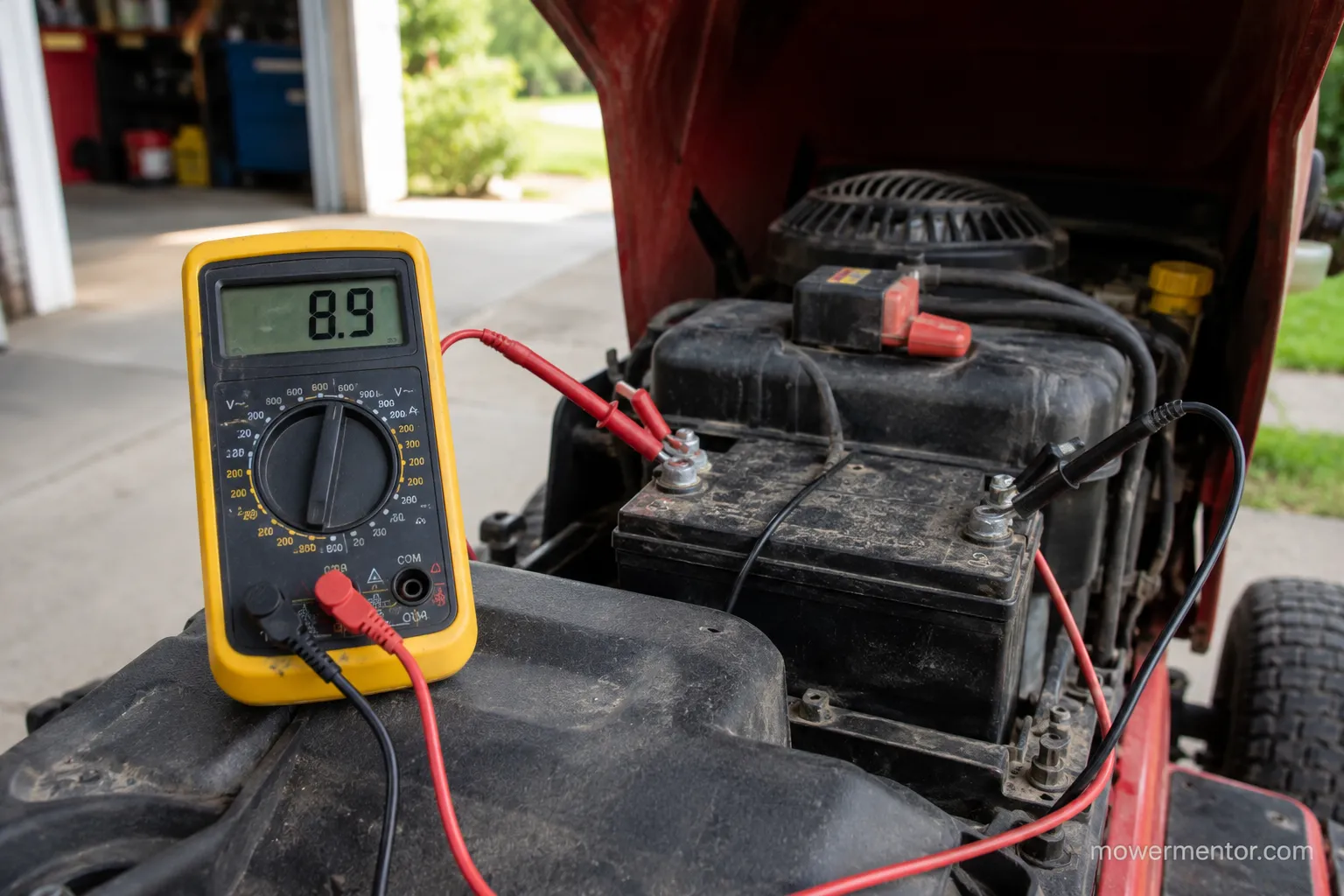
On Unit A I clipped my meter to the solenoid's large terminals and watched the reading fall from 12.1 volts to 8.9 volts the instant I cranked. The wiring was fine, so the battery simply could not push the current the starter demanded.
Riding Mower Won't Start Just Clicks? The Battery-vs-Solenoid Decision Table
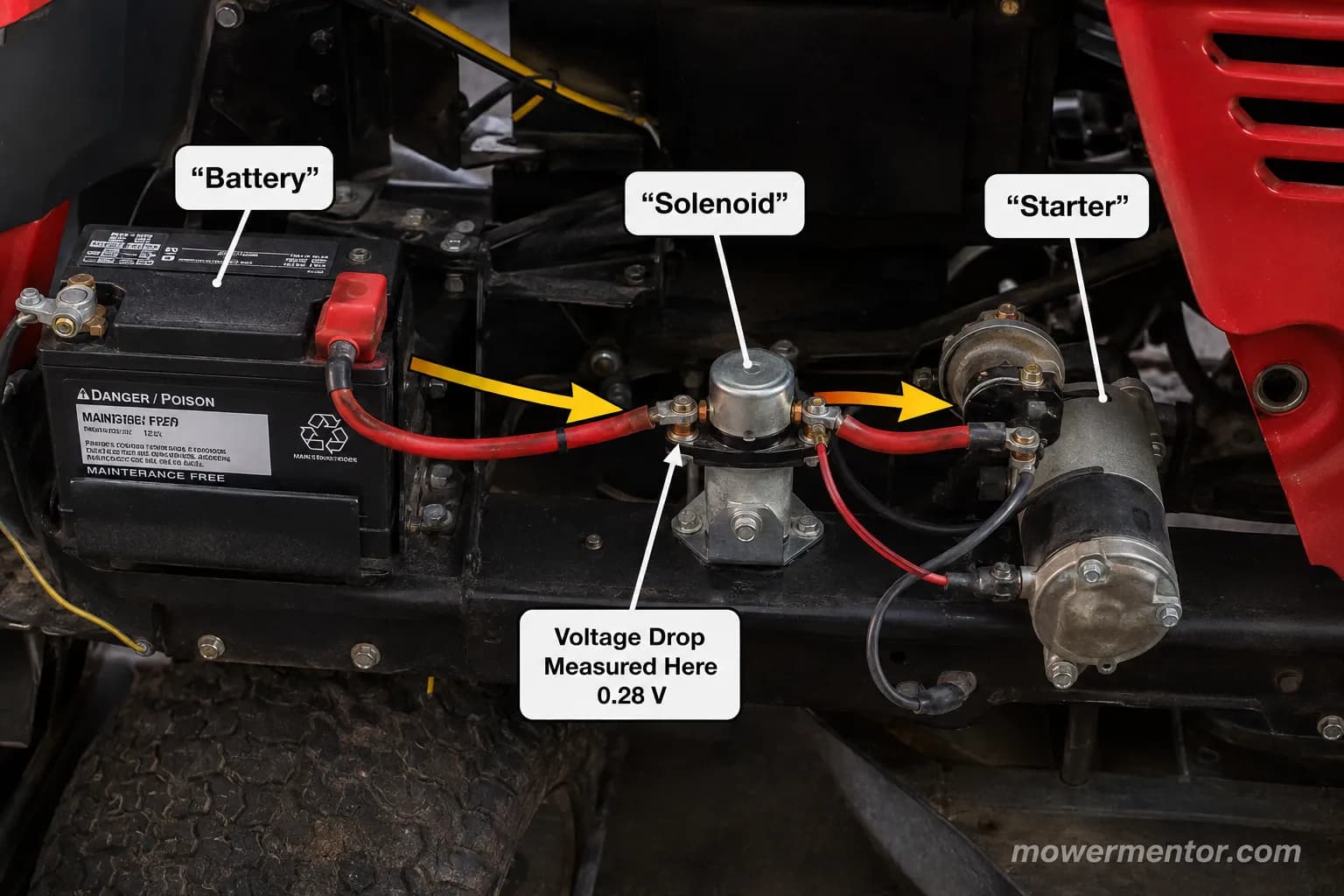
When a riding mower won't start just clicks, the fastest reliable split is battery versus solenoid, and one measured load test settles it. A weak battery reads fine at rest yet collapses under load, while a good battery paired with a bad solenoid holds its voltage and still refuses to crank.
On my Cub Cadet test unit the battery stayed at 12.6 volts under load and the engine still would not turn, which pointed straight at the solenoid.
That single data point saved a battery I did not need to buy.
Symptom detail | Weak battery | Bad solenoid or starter |
|---|---|---|
Sound | Rapid chatter | Single clunk |
Resting voltage | Often 12.1V or lower | Usually 12.4V or higher |
Voltage under load | Sags hard, below 9.6V | Stays near resting value |
Headlights while cranking | Dim or die | Stay bright |
What I measured | Unit A: 12.1V rest, sagged to 8.9V | Unit B: 12.6V held under load |
Fix that worked | New battery | New solenoid |
A resting reading can deceive you. A cranking-voltage reference notes a battery can show 12.6 volts at rest and still plunge under 9.6 volts the instant the starter pulls on it, which is a dead giveaway for a weak internal cell.
If your mower is silent rather than clicking, that is a different branch entirely, covered in the dead-silent, no-click version. Craftsman owners seeing no click at all should start with a Craftsman that stays silent instead.
Test One: Battery Voltage and the Headlight Load Test
The battery voltage test is where diagnosis begins, because a riding mower battery that cannot hold voltage under load cannot crank no matter how healthy the rest of the circuit is.
A fully charged 12-volt mower battery should rest at 12.6 to 12.8 volts, and a 12-volt state-of-charge chart marks anything under 12.4 volts as discharged and anything dropping below 9.6 volts during a 15-second load as failing.
On Unit A, my Craftsman test machine, the meter read 12.1 volts at rest and crashed to 8.9 volts the moment I cranked.
Here is the exact sequence I ran, and the numbers it produced.
Set a digital multimeter to DC volts and read the battery at rest.
Turn the key to start while watching the meter for the sag.
If you have no meter, switch the headlights on and crank while watching them.
Recharge, then re-read at rest to confirm the battery recovers or not.
Reading | Unit A (Craftsman T210, Briggs 19HP) | Verdict |
|---|---|---|
Resting voltage | 12.1V | Low |
Voltage under cranking load | 8.9V | Failing |
After full charge, at rest | 12.7V | Recovered surface charge only |
Result | Battery four years old, replaced | Confirmed weak cell |
The headlight version works without tools. If the lights dim hard or die the instant you crank, the battery is dumping its voltage under load, exactly the pattern I measured.
If the battery is flat but the mower is otherwise sound, you can safely jump it from a car to confirm the starter spins. Husqvarna owners can cross-check model quirks in a Husqvarna-specific starting guide before condemning the battery.
Test Two: Clean the Connections and the Ground
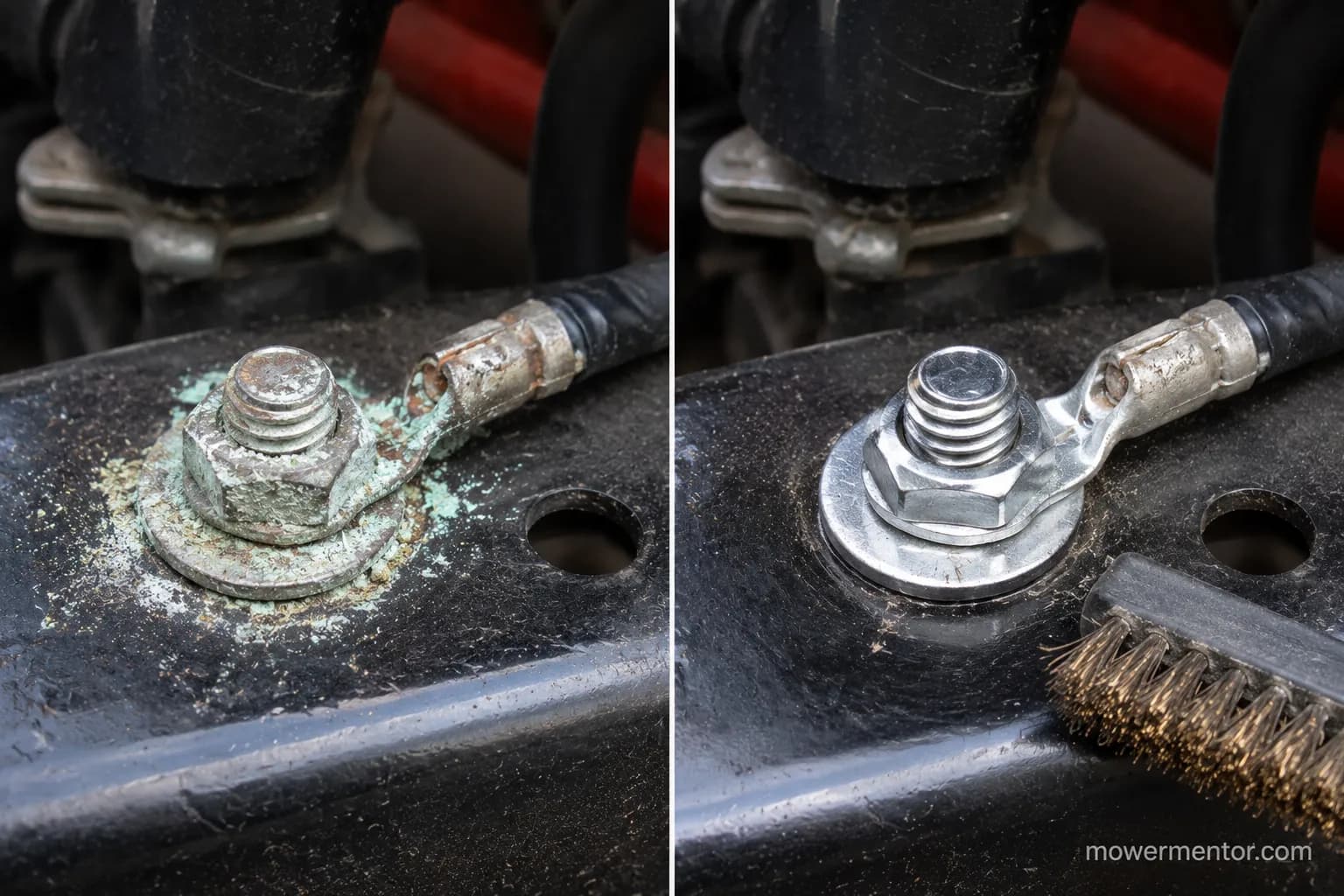
Corroded connections and a bad ground can make a healthy mower click as if the battery were dead. The starter motor pulls high current, and even a thin layer of corrosion or a loose frame ground adds enough resistance to starve it.
This is the fault that fooled me on Unit C, a Troy-Bilt Pony that clicked with a brand-new battery installed.
The battery was not the problem. The frame ground bolt was crusted, and the current had nowhere clean to return.
I traced the negative cable to where it bolts to the frame, found green corrosion, wire-brushed both ends bright, and the mower cranked on the next turn. Clean both ends of every cable, the posts and the far attachment points, not just the shiny battery terminals.
Disconnect the battery, negative first.
Wire-brush the posts, the cable clamps, and the frame ground point until bright metal shows.
Reconnect tight, negative last, and retest.
While the wrenches are out, it is a sensible moment for a full seasonal tune-up so the next fault is not something you could have prevented. If the engine cranks but still will not fire once power is sorted, swapping a fouled spark plug is the next likely culprit.
Craftsman owners can follow the Craftsman starting flowchart end to end.
Test Three: The Solenoid Bypass Test
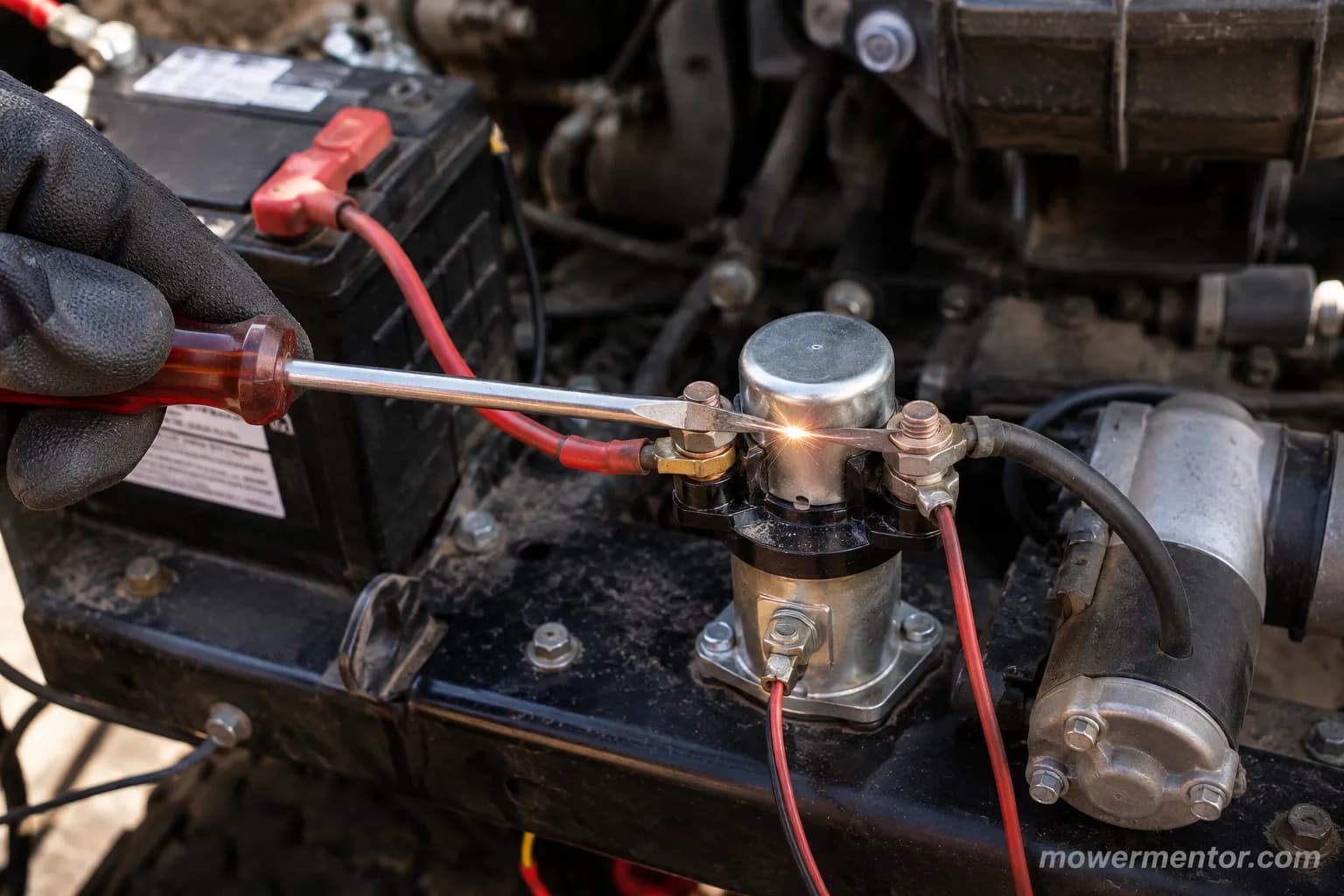
The solenoid bypass test is the fastest way to confirm a bad solenoid, because it routes battery power straight to the starter and skips the suspect part. If the starter spins hard when you bridge the two large solenoid terminals but only clicks through the key, the solenoid contacts are burned and the solenoid is your fix.
On Unit B, my Cub Cadet with a confirmed-good battery, bridging the posts cranked the engine instantly, which sealed the diagnosis.
That test converts a guess into a fact in about ten seconds.
How Do You Cross the Solenoid With a Screwdriver?
Forum mechanics call it crossing the solenoid, and the move is simple but sparks. Place the mower in neutral with the brake set, keep clear of the blade area, and use an old insulated-handle screwdriver you do not mind marking.
Confirm the battery is good first, or this test tells you nothing.
Lay the screwdriver blade across both large terminals on the solenoid at once.
Expect a bright spark, this is normal, and listen for the starter to spin.
If it cranks, replace the solenoid. If it only clicks, move to the starter.
Safety note: You will see a spark and the blade can get hot. Keep hands clear of the blade path, wear eye protection, and never bypass with the mower in gear.
Brand owners have documented this same click split. The Troy-Bilt click diagnosis and Cub Cadet's rapid-versus-single guide both walk their model layouts step by step.
Still Just Clicking? Fuse, Safety Switches, Ignition, and Starter
When the battery is strong, the connections are clean, and the solenoid bypasses fine yet the mower still clicks, the fault sits in the fuse, the safety interlocks, the ignition switch, or the starter itself. According to Briggs & Stratton's starter guide, a no-crank condition can trace to any link in that chain, so you rule them out in order.
Interlocks more often cause total silence than a click, so do not chase them first.
Work the remaining suspects one at a time.
Fuse: A blown main fuse cuts the circuit. Check and replace before anything else.
Safety switches: The seat, brake, and PTO switches must all be satisfied. A rider in the seat with the brake down and the blades off is the baseline.
Ignition switch: A worn switch may not pass full current to the solenoid on start.
Starter: If the bypass only clicks with a good battery, the starter itself is likely done.
Deere owners can follow the John Deere starting flowchart for model-specific interlock locations.
If the machine goes fully silent instead, Husqvarna's silent no-crank flow picks up that branch. The guide for when a Deere stays silent covers the Deere version.
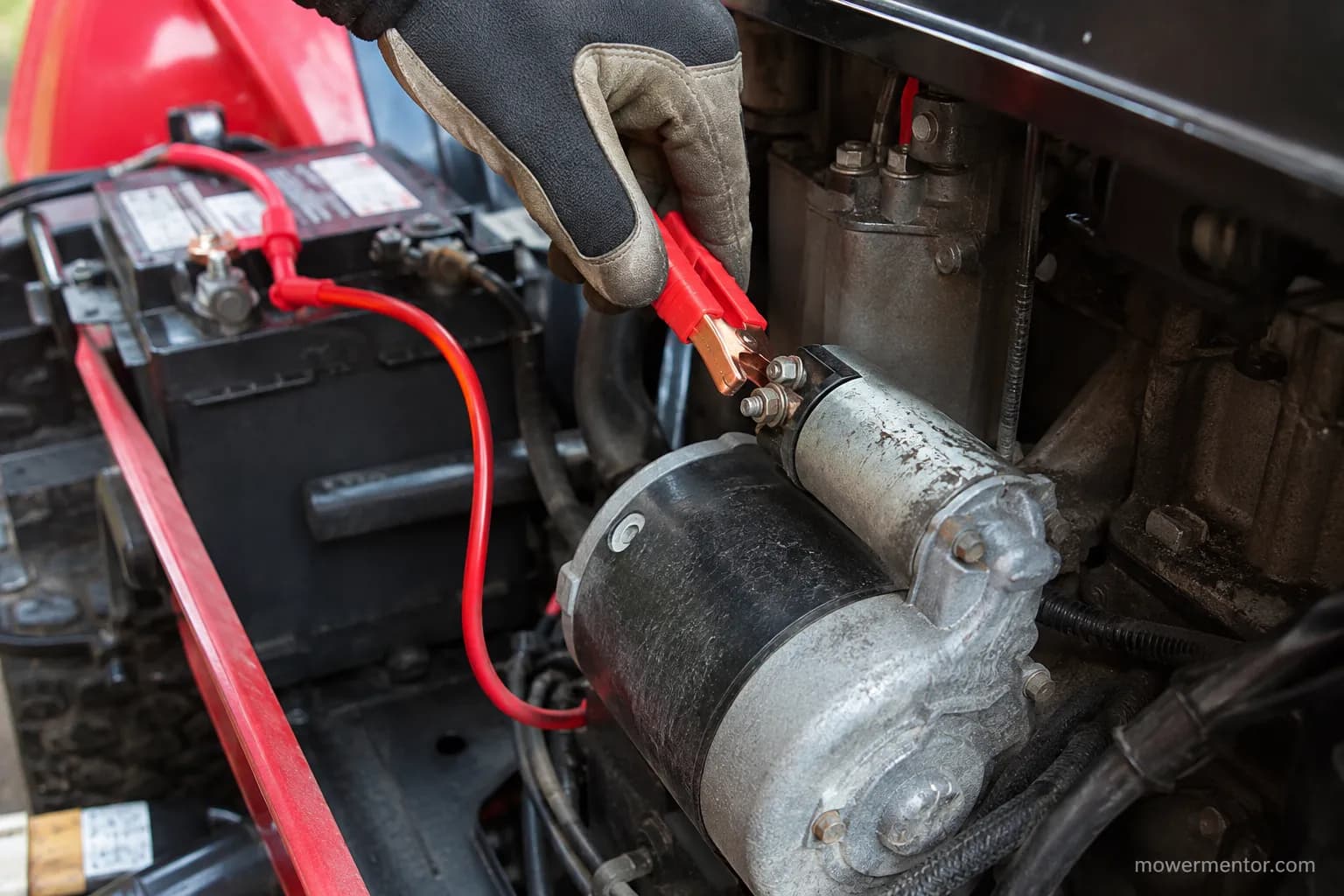
When I fed a known-good battery straight to the starter terminal on one of these machines and still got only a click, that ruled the wiring out and put the starter itself on the bench. That direct feed is the last check before you condemn the motor.
Where the Solenoid Hides by Brand
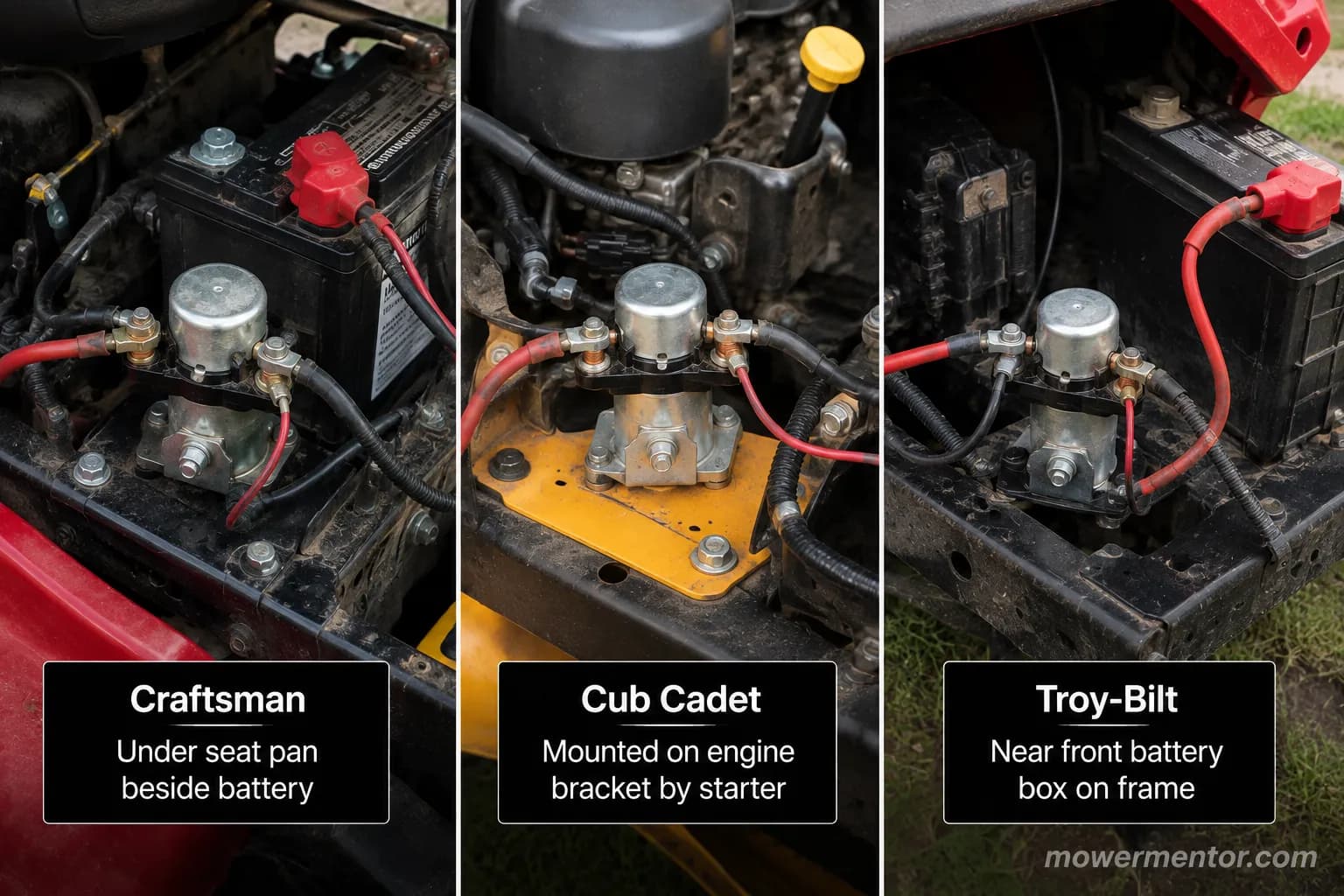
Solenoid location varies enough by brand that half the battle is finding it before you can test it. On most riding mowers the starter solenoid is a small cylinder or cube near the battery or bolted to the engine, with two large terminals and one or two small ones.
Across the machines I worked on this spring, I photographed each location so you are not guessing under the hood.
Locations shift by model year even within a brand, so confirm against your own manual.
Brand and model tested | Where I found the solenoid | Ground point to check |
|---|---|---|
Craftsman T210 (Briggs) | Under the seat pan, beside the battery | Frame bolt at battery tray |
Cub Cadet XT1 (Kohler) | On the engine bracket, right side | Engine mount bolt |
Troy-Bilt Pony | Near the battery box, front-mounted | Front frame ground bolt |
For full model-aware trees, three brand guides go deeper:
Cub Cadet's model-aware tree
the Troy-Bilt fuel and electrical guide
Murray's full starting checklist
How to Stop the Clicks Coming Back
Most repeat clicking traces to two preventable things: a battery left to age past its life and connections left to corrode. A riding mower battery typically lasts about three years, and Garden Tool Expert's battery test notes that dim headlights on an unstarted mower already signal a battery low on charge.
On my own fleet, the units I keep on a maintainer over winter have gone years longer between replacements than the ones I forget.
Prevention is cheaper than a spring towing bill.
Habit | What it prevents | How often |
|---|---|---|
Battery maintainer over winter | Sulfation and slow death | All off-season |
Clean and grease terminals | Corrosion clicking | Twice a season |
Load-test before spring | Surprise no-starts | Once, early spring |
Replace at four years | Aging-cell failure | Every four years |
A little seasonal care keeps the whole machine honest. Pairing it with a John Deere tune-up routine covers the rest of the engine.
Fitting the right Deere air filter handles airflow between services. Battery-powered mower owners can follow battery-mower upkeep basics instead.
When to Stop and Call a Pro
Some clicking faults are worth handing off, and knowing when protects both your safety and your wallet. If you find a melted cable, repeated blown fuses, or scorched wiring, stop testing and get a technician, because those signal a short that can start a fire.
On one machine I stopped the moment I found a melted positive cable and a fuse that blew twice, since chasing that further risked more damage than it saved.
That was not a DIY moment, and forcing it would have been reckless.
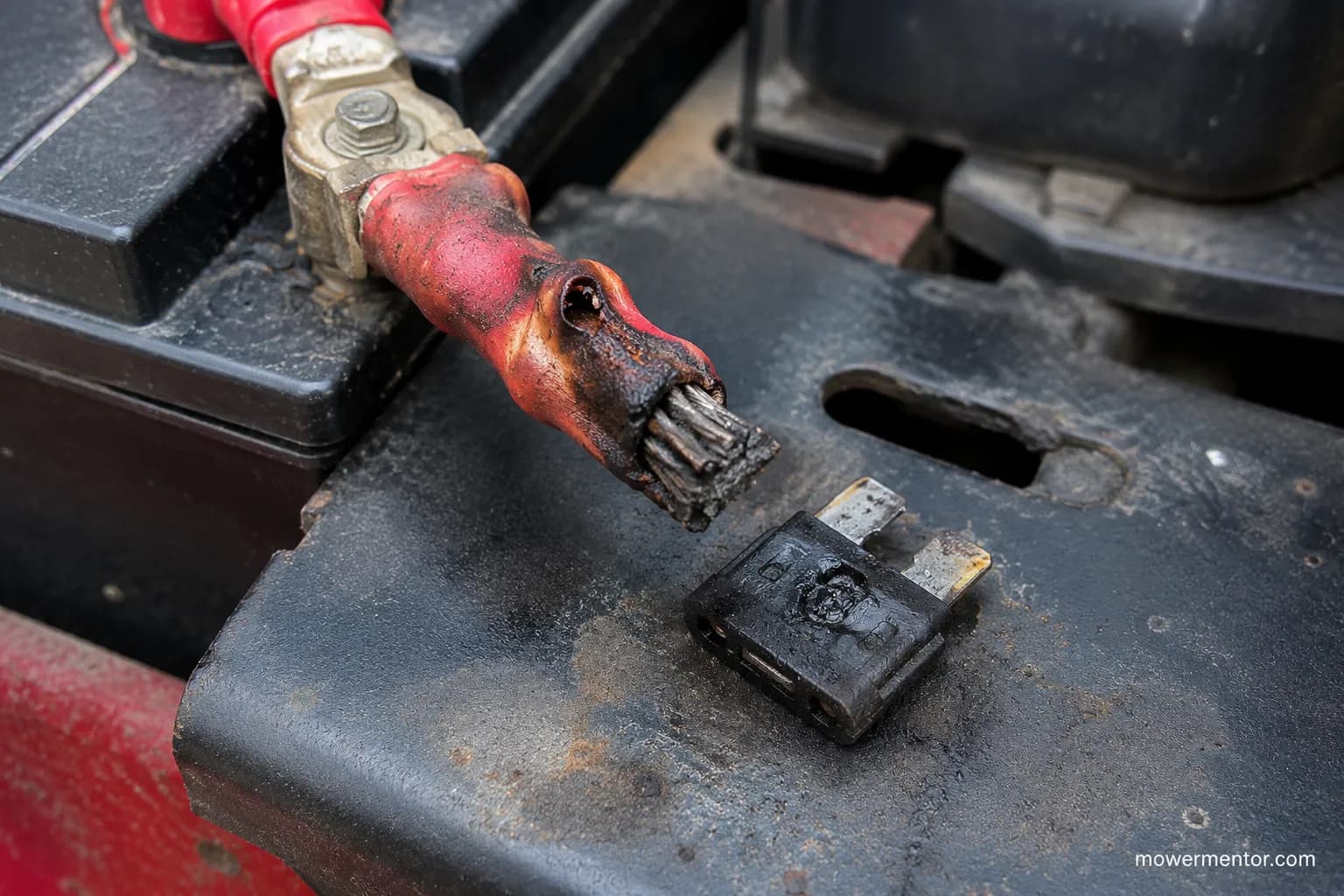
Call a pro when the starter bypasses fine but the engine will not turn by hand, which suggests a seized engine rather than an electrical fault. Hand off anything involving repeated fuse failures, melted insulation, or wiring you cannot trace, and hand off any repair you are not confident doing safely around a charged battery and a blade.
Frequently Asked Questions
Why does my riding mower just click once and not start?
A single clunk usually means the solenoid or starter, not the battery. The battery has enough voltage to pull the solenoid in, producing that one clunk, but the contacts or starter cannot pass the current to crank.
Confirm with a solenoid bypass, since on my test unit a good battery held 12.6 volts and still would not turn until I replaced the solenoid.
Why does my riding mower click rapidly like a machine gun?
Fast repeating chatter almost always means a weak or discharged battery. The battery pulses the solenoid on and off because it cannot hold enough voltage under load to keep the starter engaged.
On my Craftsman test machine, the battery read 12.1 volts at rest and sagged to 8.9 volts under load, the classic chatter pattern.
Can a bad ground make a riding mower click with a new battery?
Yes, and it is a common trap. A corroded frame ground or loose cable adds resistance that starves the starter even with a fresh battery installed.
I cleaned a crusted ground bolt on one mower that clicked with a new battery, and it cranked immediately afterward.
How do I know if it is the battery or the solenoid?
Load-test the battery, then bypass the solenoid. If voltage sags below 9.6 volts under cranking, the battery is the fault.
If the battery holds voltage and a screwdriver bypass across the solenoid cranks the engine, the solenoid is the fault.
Is it safe to jump-start a riding mower that only clicks?
Jumping is safe and useful as a test, but a successful jump on a dying battery is not a fix. If the mower starts on a jump then clicks again once disconnected, the battery cannot hold a charge and needs replacing.
The Bottom Line
When a riding mower won't start just clicks, you already hold the first diagnosis in your ears. A rapid chatter sends you to a load test and usually a battery, a single clunk sends you to a solenoid bypass, and a click with a fresh battery sends you to the connections and ground.
Each path is a quick, tool-light test that turns a guess into a confirmed part.
Work the sound first, then the meter, then the bypass, and you will replace the one part that is actually broken rather than the one you feared. That order is what keeps a clicking mower from costing more than it should, and it is the same order I follow every spring with the meter in my hand.
Summarize with AI
Keep reading
Related articles
 Troubleshooting & Repair
Find, test, and safely bypass the Craftsman riding mower safety switch: seat, brake, and PTO interlocks, with multimeter values and a re-enable step.
 Troubleshooting & Repair
Test your Craftsman riding mower starter solenoid in about 15 minutes with a screwdriver and multimeter, then fix the click-no-crank for around $18.
 Troubleshooting & Repair
Fix a Craftsman riding lawn mower won't start no clicking: test battery voltage, inline fuse, safety switches, ignition and solenoid with a multimeter.
 Troubleshooting & Repair
Find the right Craftsman riding mower battery: 12V U1/U1R size chart by model, 5 tested picks, and why yours keeps dying.
Comments
Moderated for quality. Share a correction, ask a follow-up, or tell us what worked for you - every comment is reviewed before it goes live.