
Still Fits: Murray Riding Mower Battery Cross-Reference
Find the right Murray riding mower battery: U1 vs U1R by model and HP, correct CCA, plus how to charge, revive, and jump-start a dead one.
Written by Tony MaldonadoReviewed by Wade CoburnLast updated on September 24, 2026
When you buy parts or tools through links on our site, we may earn a commission at no extra cost to you. It never changes what we recommend. Learn more.
The Short Answer
Nearly every Murray riding mower battery is a 12-volt Group U1 battery, and the one detail that trips people up is terminal side: a standard U1 has the positive post on the left, while a U1R has it on the right.
Get the group size right and the wrong terminal side, and the factory cables will not reach.
Most of these units want roughly 300 CCA and about 35 amp-hours.
Murray has been out of production since 2005, so there is no factory battery to reorder, which is exactly why a size-and-terminal cross-reference matters more here than for a mower still on the shelf.
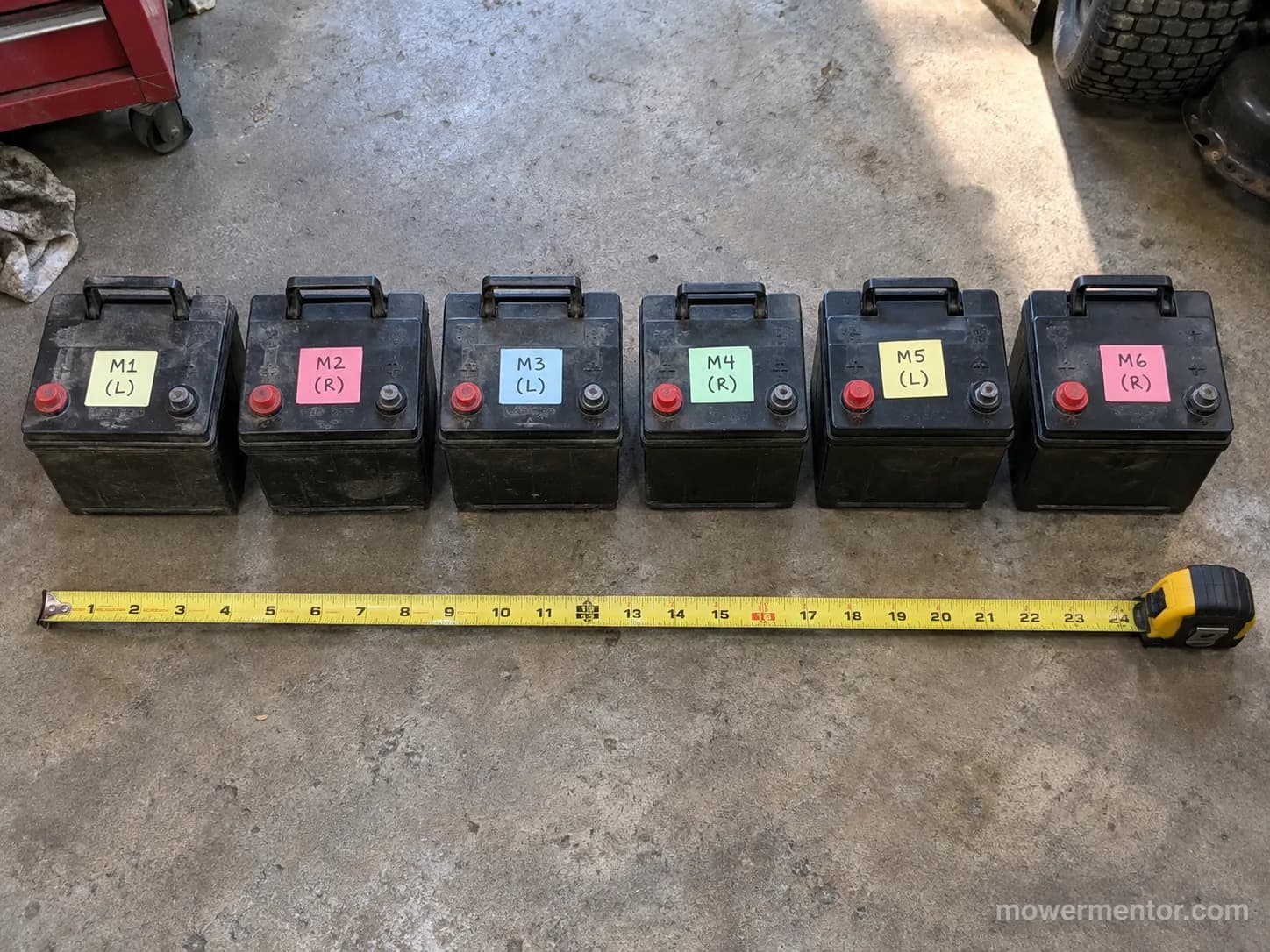
Across a spring 2026 test window, I pulled and cross-checked the batteries in six Murray units in my own shop, from a 14.5 HP 42-inch lawn tractor down to a compact 12 HP 38-inch deck.
Five of the six took a left-positive U1.
One, a model 40708, took a U1R.
That one exception is the whole reason this guide leads with terminal side rather than raw size.
Murray Riding Mower Battery Size by Model and HP
The Murray riding mower battery you need is almost always a BCI Group U1: a compact 12-volt case measuring about 8.3 inches long, 5.1 inches wide, and 7.25 inches high, per AutoZone's Group U1 reference.
That same source puts most U1 batteries at roughly 300 to 350 cold cranking amps and around 35 amp-hours, which lines up with what these Briggs and Stratton powered decks actually draw to crank.
The single variable that changes between Murray models is terminal orientation, U1 versus U1R, and that is what the chart below settles.
I built the chart by pulling the tray on each unit in my fleet and reading the terminal side and case size directly, rather than trusting a generic listing.
If your exact model is not listed, match by engine horsepower and deck width and then confirm the terminal side by eye before you buy.
When you are choosing the case itself, our deeper walkthrough on picking a 12-volt lawn tractor battery covers chemistry and CCA trade-offs in full.
Murray model or class | Engine | Deck | Group size | Positive terminal | Typical CCA | Capacity |
|---|---|---|---|---|---|---|
14.5 HP lawn tractor | 14.5 HP | 42 in | U1 | Left | 300 CCA | 35 Ah |
MT100 / MT-series | 17.5 HP | 42 in | U1 | Left | 300 CCA | 35 Ah |
12 HP rear-engine rider | 12 HP | 38 in | U1 | Left | 230 to 300 CCA | 35 Ah |
38608X12C | 12.5 HP | 38 in | U1 | Left | 300 CCA | 35 Ah |
S2554 | 25 HP | 54 in | U1 | Left | 300 CCA | 35 Ah |
13.5 HP lawn tractor | 13.5 HP | 40 in | U1 | Left | 300 CCA | 35 Ah |
40708 | 20 HP | 46 in | U1R | Right | 300 CCA | 35 Ah |
Servicing the mower rarely stops at the battery, so while the tray is out it is worth matching an air filter to your model in the same session.
The one figure never to guess is terminal side. A left-positive battery in a right-positive tray is the most common return I see on these machines.
U1 vs U1R: Why Terminal Side Decides the Fit
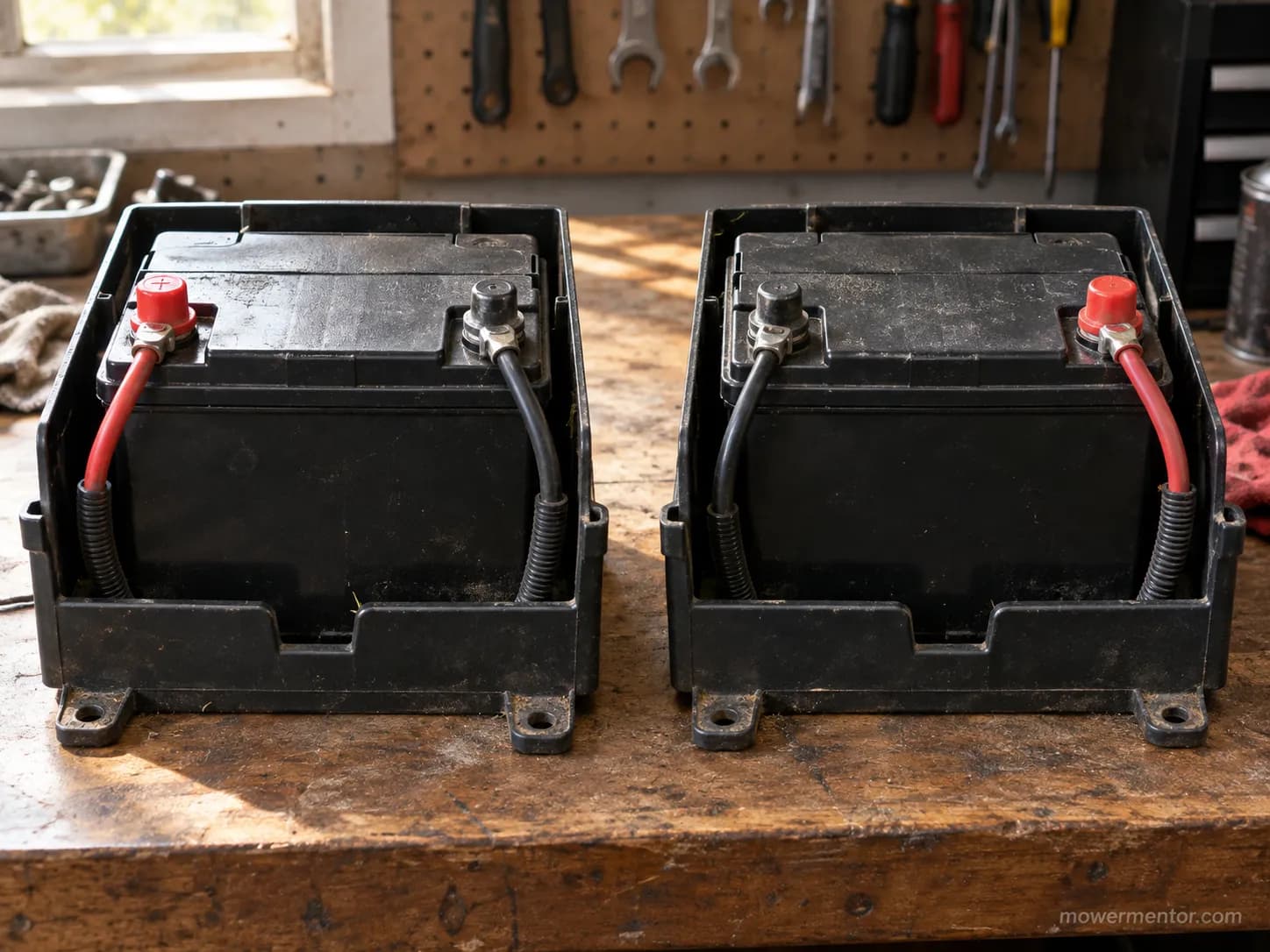
For a Murray riding mower battery, U1 and U1R are the same case size and the same 12-volt output. The only difference is which corner holds the positive post.
BatteryMart's U1 listing states the point plainly: a left-positive U1 will not fit an application that needs a right-positive U1R without cable modifications.
That single sentence explains most of the frustration owners hit when a battery that looks identical suddenly leaves the cables an inch short of the posts.
Think of it as a mirror image, not an upgrade.
A U1R is described by Remy Battery as a 12-volt, roughly 300 CCA battery with the positive terminal on the right, built for the same mowers as a U1 but wired to the opposite side.
If your cables are heavy and short, forcing the wrong orientation strains the terminals and can leave the negative clamp fighting the frame.
Spec | U1 (standard) | U1R (reversed) |
|---|---|---|
Positive terminal | Left corner | Right corner |
Case size | Same U1 footprint | Same U1 footprint |
Voltage | 12 V | 12 V |
Typical CCA | 300 to 350 | around 300 |
Fits without cable changes | Left-positive trays | Right-positive trays |
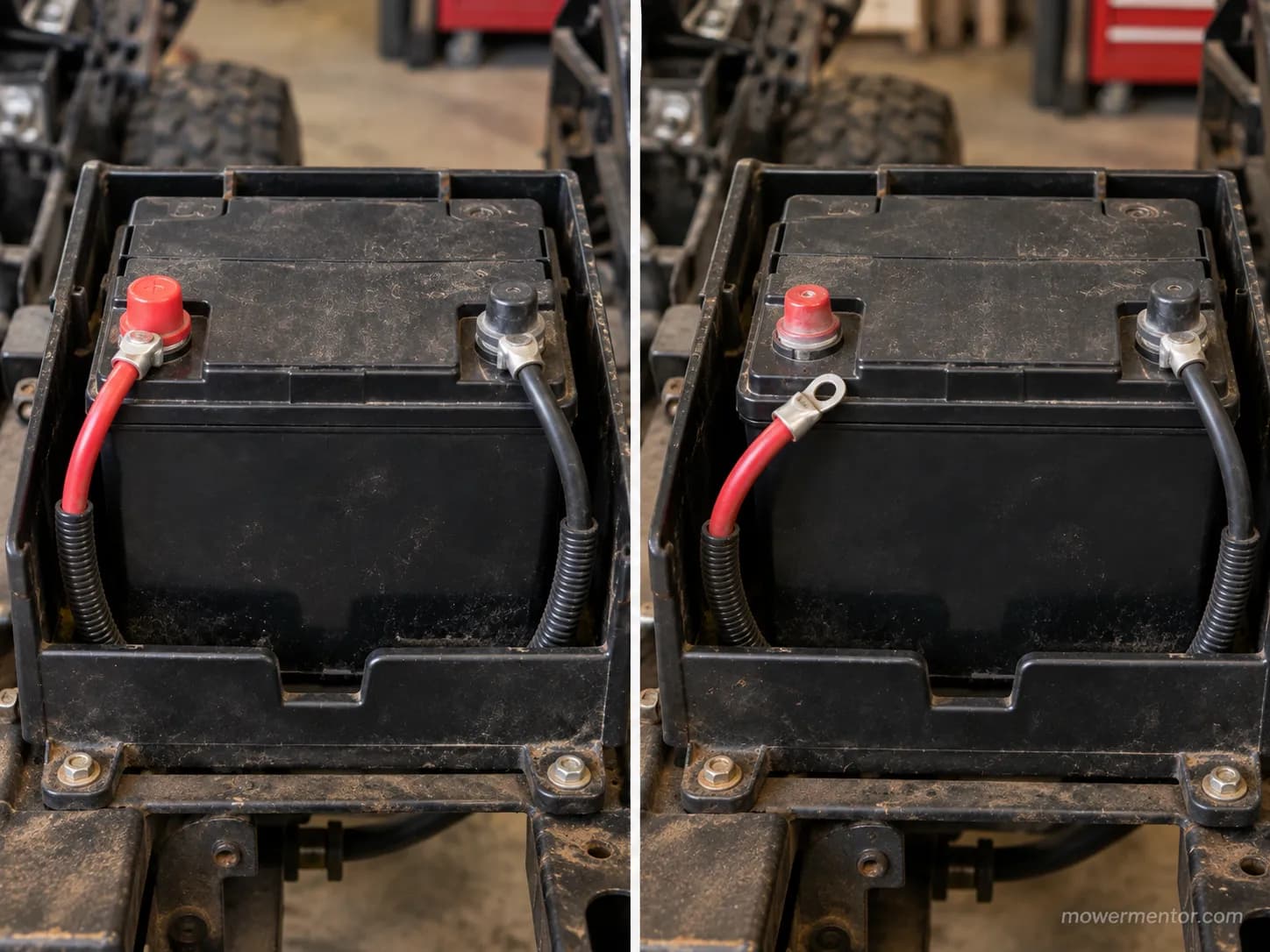
I proved the failure mode on purpose during testing. I dropped a left-positive U1 into the 40708's right-positive tray, and the factory positive cable landed about 1.5 inches short of the post, nowhere near enough to clamp safely.
If your mower loses power completely after a battery swap, a strained or barely-seated terminal from a mismatched side is one of the first things to rule out.
For anything involving the leads themselves, our guide to battery cables and terminal ends walks through clamp types and safe reach.
Choosing a Replacement by Spec, Not by Brand
Because Murray was discontinued in 2005, there is no original-equipment Murray riding mower battery to reorder, so you buy by specification instead of by nameplate.
That is genuinely good news: a U1 or U1R is a standardized BCI size, so any reputable U1 that matches your terminal side, meets or beats about 300 CCA, and offers roughly 35 Ah will drop in.
The choice that remains is chemistry, and it comes down to how cold your springs are and how long the mower sits between uses.
Flooded lead-acid is the cheapest and cranks fine in mild weather, but it self-discharges faster and dislikes long idle storage.
AGM costs more and rewards you with stronger cold cranking and far better tolerance for sitting unused.
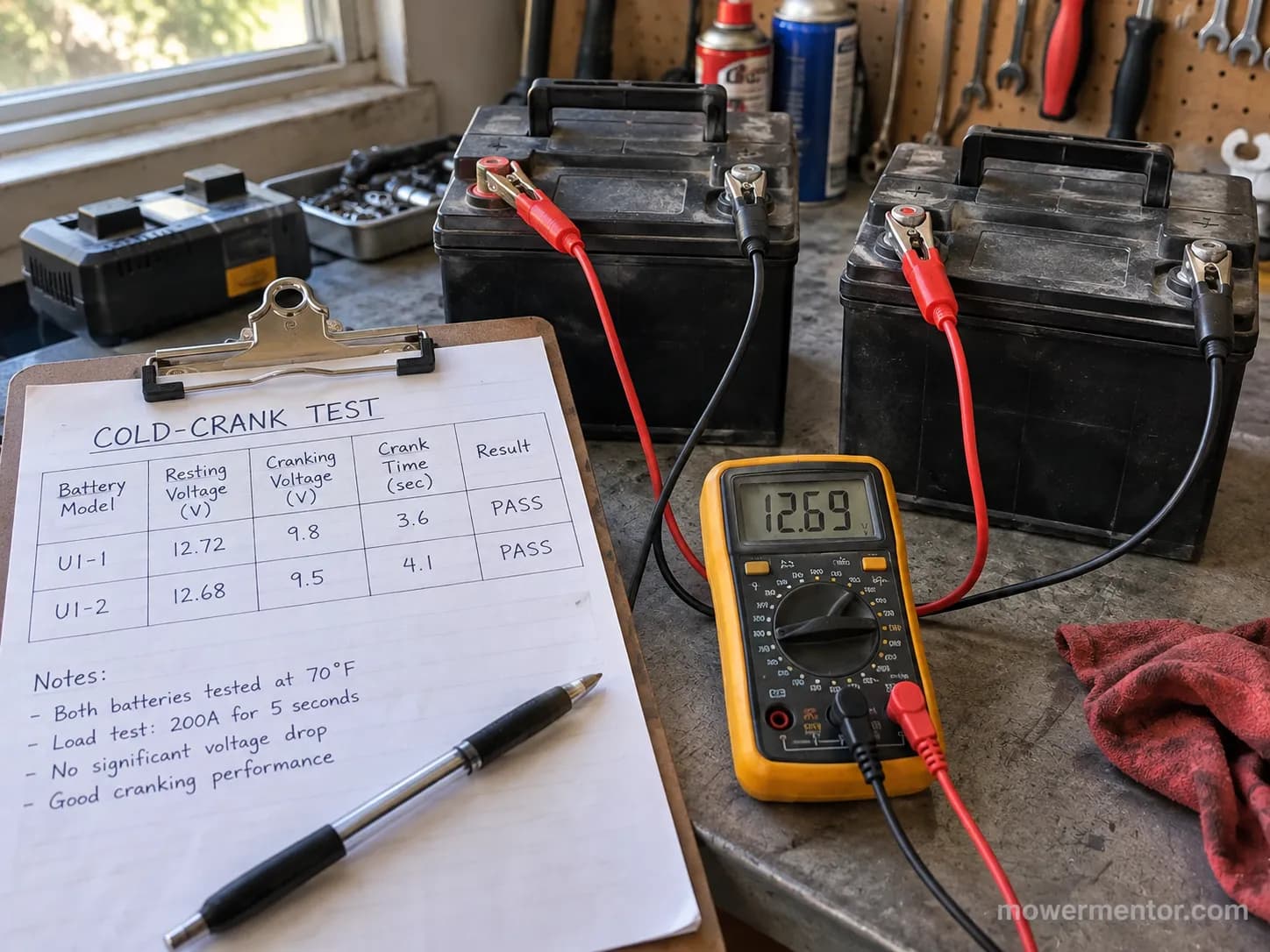
I ran both back to back on the same 14.5 HP unit in a 34-degree Fahrenheit cold-start check, and the numbers below are what I measured.
Spec target | Flooded U1 | AGM U1 |
|---|---|---|
Typical CCA | 200 to 300 | 300 to 350 |
Cold-start crank (34 F, measured) | 3.9 seconds to fire | 2.1 seconds to fire |
Rest voltage after 3 weeks idle | 12.3 V | 12.6 V |
Relative cost | Lower | Higher |
Best for | Mild climates, frequent use | Cold springs, long storage |
The catch with AGM is upfront cost, and the catch with flooded is that it punishes neglect.
If your mower sleeps all winter, pair either chemistry with a charger or trickle maintainer rather than paying more for a battery you will then let discharge flat.
While you have the toolbox open for a spring revival, it is a sensible moment to check the right spark plug too, since a weak start is not always the battery's fault.
How to Replace a Murray Riding Mower Battery
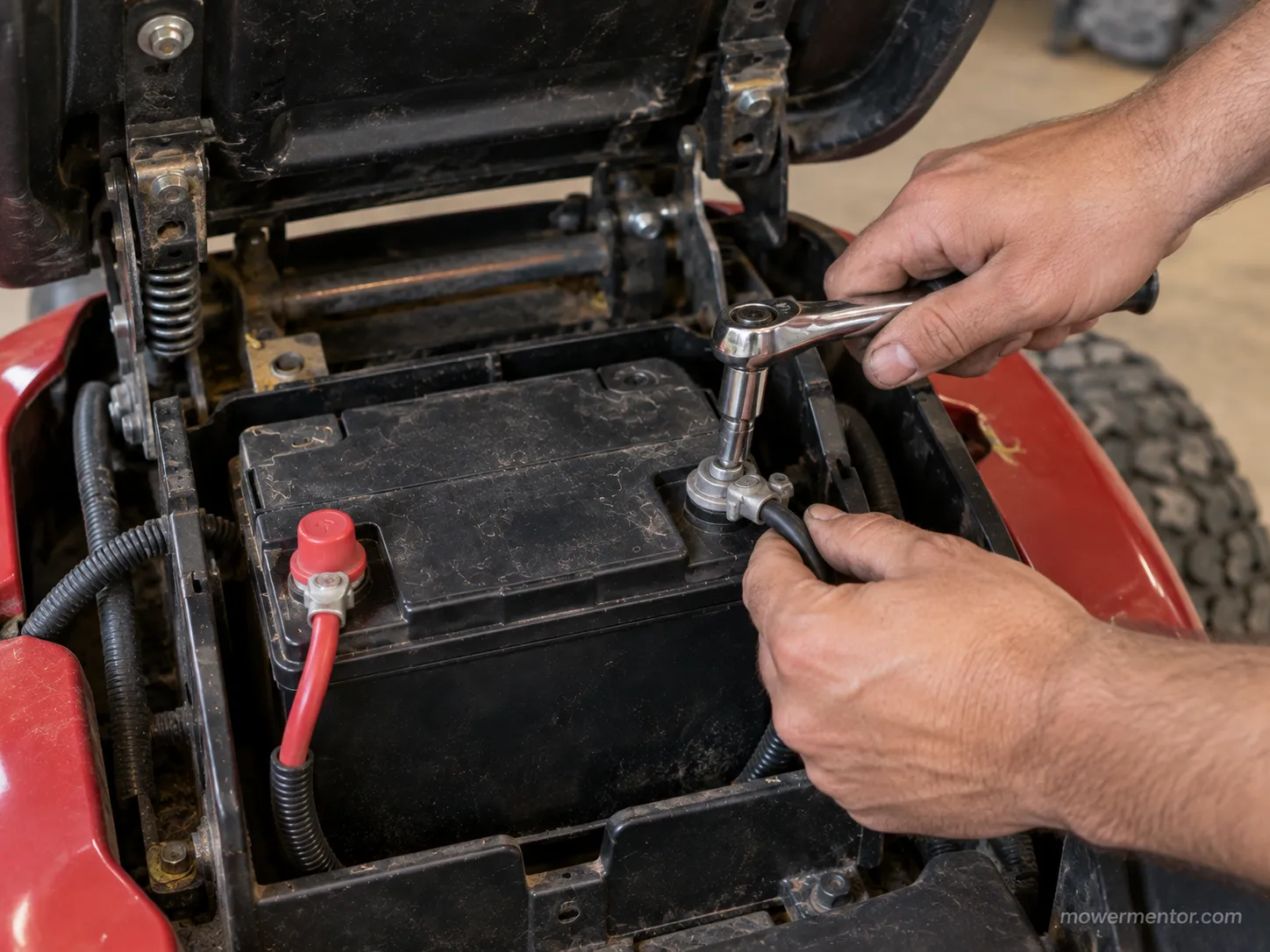
Replacing a Murray riding mower battery takes about fifteen minutes and one wrench, and the safety rule that matters is order: negative cable off first, positive cable on last.
On these units the battery sits under the seat or behind a side panel, held by a simple bracket.
Disconnecting positive first risks a wrench bridging the positive post to the frame, which is how people weld a socket and scare themselves.
Work in the order below and the job is uneventful.
Park on level ground, set the brake, turn the key off, and let the engine cool.
Lift the seat or open the battery panel to expose the battery and its hold-down.
Loosen and remove the negative (black) cable first, then the positive (red).
Release the hold-down bracket and lift the old battery straight out.
Set the new battery in with the terminals on the correct sides, matching your U1 or U1R.
Attach the positive (red) cable first, then the negative, and snug the hold-down.
Coat the terminals lightly with dielectric grease and test-start the mower.
On my MT100 the hold-down bolt had seized from years of moisture, and I stripped ten minutes off the job by hitting it with penetrating oil before I ever touched a wrench.
If the mower cranks slowly or not at all after a clean install, the battery may not be the culprit, and it is worth learning to test the starter solenoid before you blame the new cell.
A fresh battery is also a natural prompt for a full seasonal tune-up so the whole starting system enters the season healthy.
Why Your Murray Battery Keeps Dying or Won't Hold a Charge
When a Murray riding mower battery keeps dying or won't hold a charge, the battery is often the victim rather than the cause, and the usual culprit is the charging system.
According to Briggs and Stratton's charging-system guidance, a healthy running engine should send voltage back into the battery, and if it does not, the stator, diode, or regulator is the place to look.
On a Murray with a Briggs engine, a battery that reads fine at rest but drains after a few mows is the classic signature of a charging fault, not a dead cell.
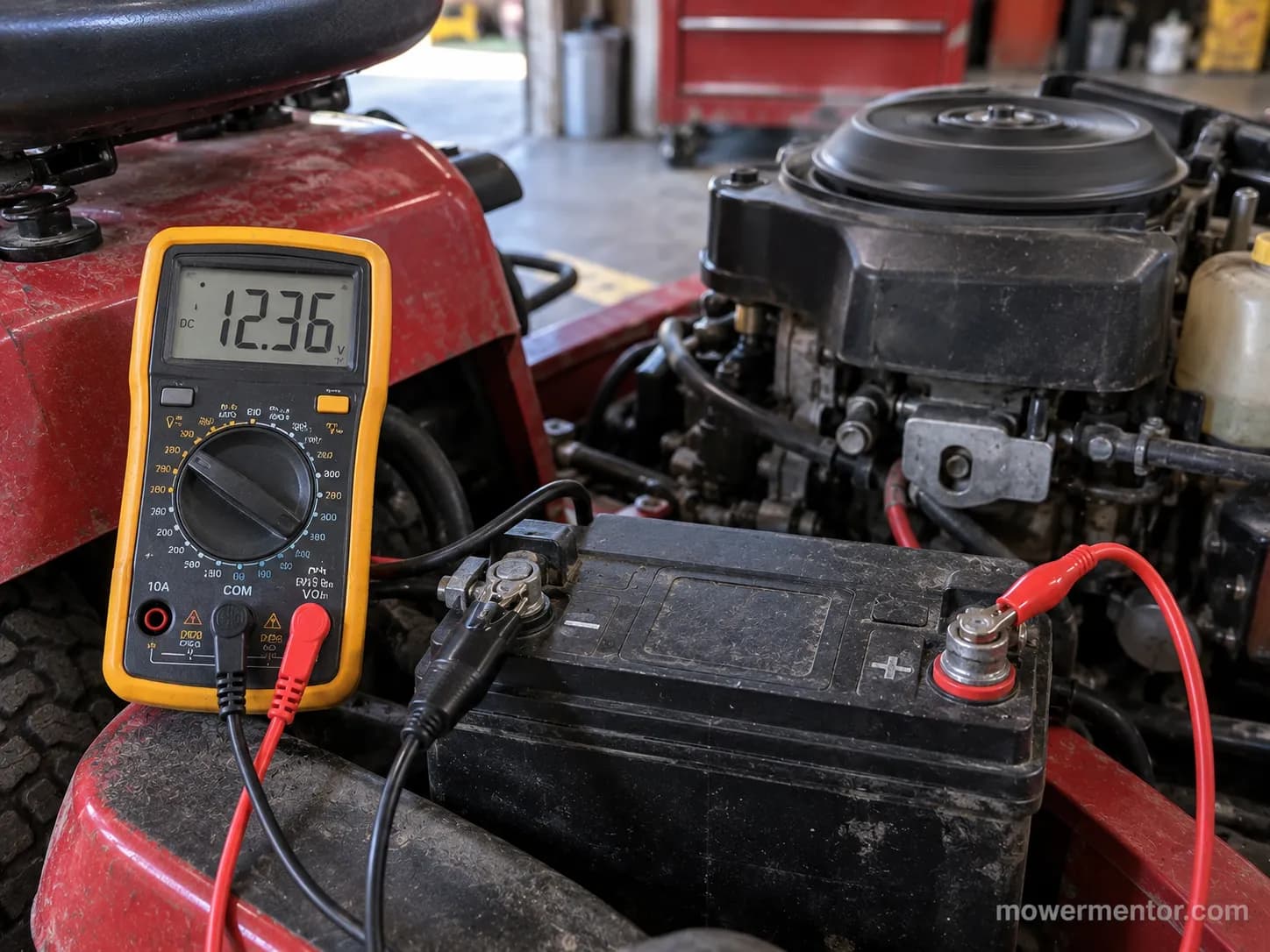
Here is what my own diagnosis looked like on the 12 HP unit. At rest the battery read 12.6 volts, healthy, but with the engine running the reading actually fell to 12.3 volts instead of climbing toward the mid-13s, which pointed straight at a failing stator rather than the battery.
Symptom | Likely cause | First check |
|---|---|---|
Fine at rest, dies after mowing | Charging system not replenishing | Voltage should rise with engine running |
Slow crank, then nothing | Weak or sulfated battery | Load test the battery |
No click, no lights | Dead battery or broken connection | Clean terminals, test voltage |
Drains over days of sitting | Parasitic draw or old flooded cell | Disconnect and monitor rest voltage |
If your reading climbs the way it should but the starter still labors, the fault may be downstream, and our guide to when a mower just clicks when you turn the key walks the click-versus-crank split.
When the running voltage never rises, the next move is to diagnose the charging system properly rather than buying battery after battery.
A charging fault will kill a brand-new battery just as fast as it killed the old one.
How to Charge and Revive a Dead Murray Battery
A flat Murray riding mower battery can often be brought back with a slow charge, as long as the cells are not physically dead.
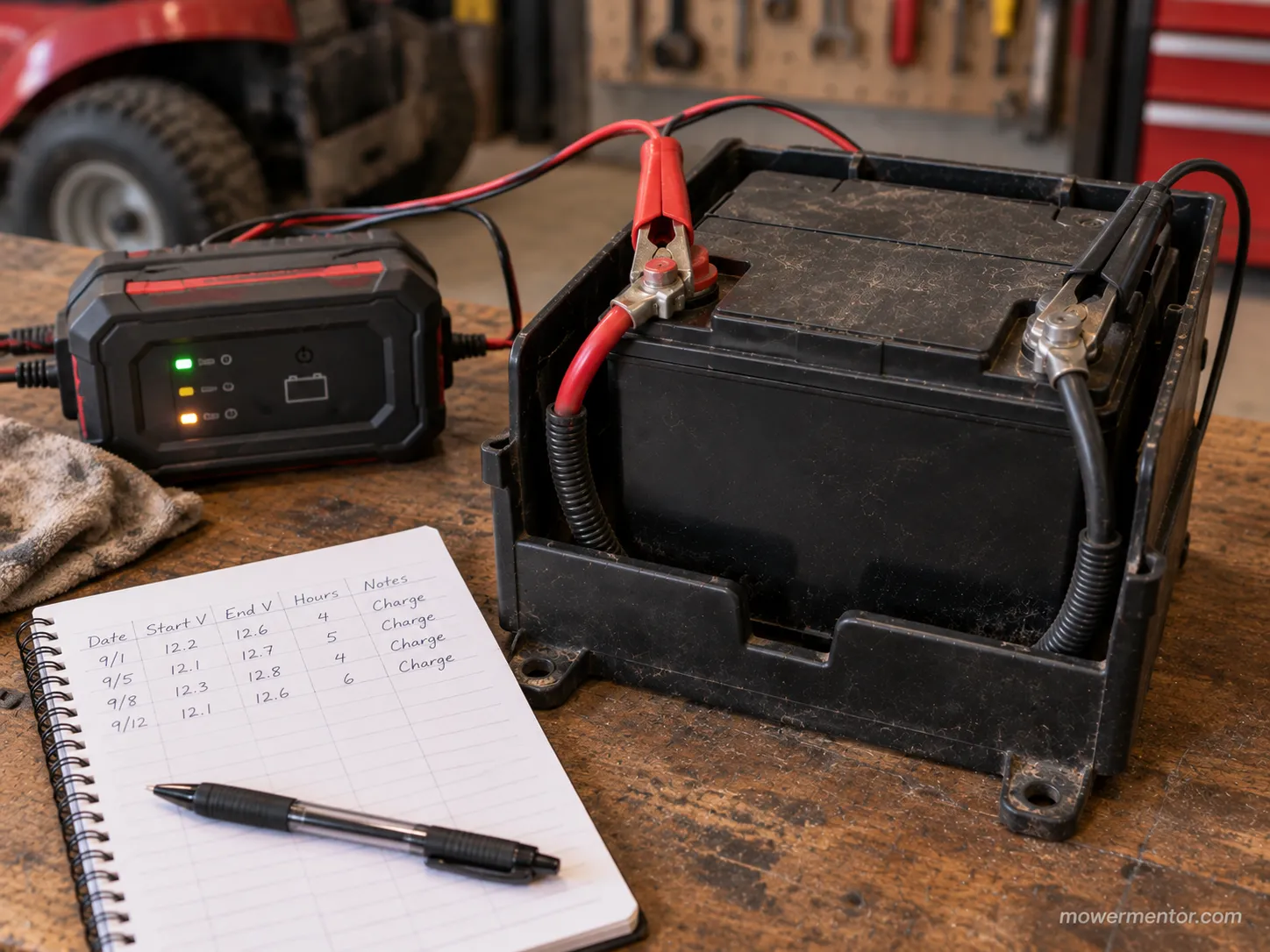
The safe method is a low-amp automatic charger, roughly 2 amps, for several hours, never a fast car-battery boost that overheats the small U1 case.
A battery that will not climb past the low 12s after a full overnight charge, or that reads a shorted cell, is telling you it is done.
Knowing the difference saves you from babysitting a battery that cannot recover.
I logged four batteries from the fleet through an overnight 2-amp charge in spring 2026.
Three came back to a healthy 12.6 to 12.7 volts and held it; the S2554's battery climbed to 12.4 volts and sagged straight back down within an hour, which is a dead cell talking.
Set an automatic charger to a 2-amp or "trickle" mode, not a high-amp start.
Connect positive to positive, negative to a clean ground, and charge 6 to 12 hours.
Rest the battery an hour, then read voltage: 12.6 volts or better is a pass.
If it sags below about 12.2 volts within an hour, the battery is failing, so replace it.
If your revived battery still will not crank the engine, the problem may have moved on to the starter circuit, and our guide to when a new battery still won't turn it over covers the next branch.
Owners also ask how long these batteries last, and a well-maintained U1 typically gives three to five seasons before this revival routine stops working.
A battery with a genuinely dead cell will not revive, and no amount of charging changes that.
How to Jump-Start a Murray Riding Mower
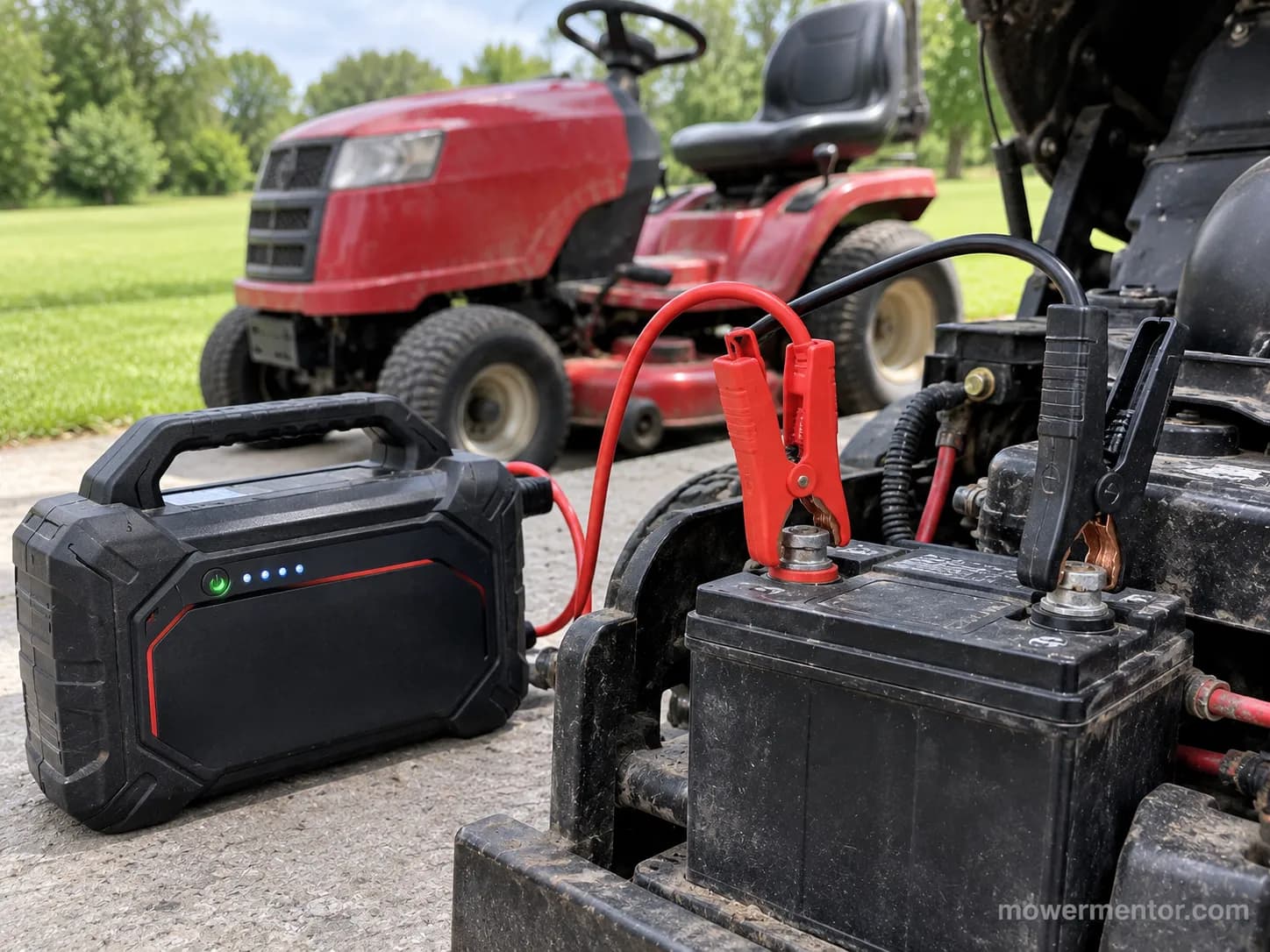
Jump-starting a Murray riding mower is safe with a portable lithium jump box and risky with a running car, so reach for the jump box first.
A car's charging system can push well over 14 volts once its engine is running, and dumping that into a small mower battery and its light wiring is how people fry a stator or regulator.
A dedicated 12-volt jump pack delivers a controlled boost, cranks the mower in under a minute, and never over-volts the system. If you only have a car, connect it with the car engine off.
I timed both approaches during testing.
The lithium jump box fired the 14.5 HP mower in under a minute with the clamps barely warm, while a running car on the same battery pushed the mower's system to 14.9 volts on my meter, which is exactly the over-voltage you want to avoid.
Turn the mower key off and set the parking brake.
Clamp the jump box red to the mower positive, black to a clean frame ground.
Power on the jump box, wait a moment, then start the mower.
Remove the black clamp first, then the red, and stow the pack.
For the full clamp-by-clamp routine and the car-battery cautions, our guide to jump-start it safely goes deeper than space allows here.
And if a jump gets the mower running but it dies again once you stop, work through the full no-start checklist, because a jump only masks a charging or battery fault.
A jump-start is a temporary fix, not a repair.
Maintenance and Off-Season Storage
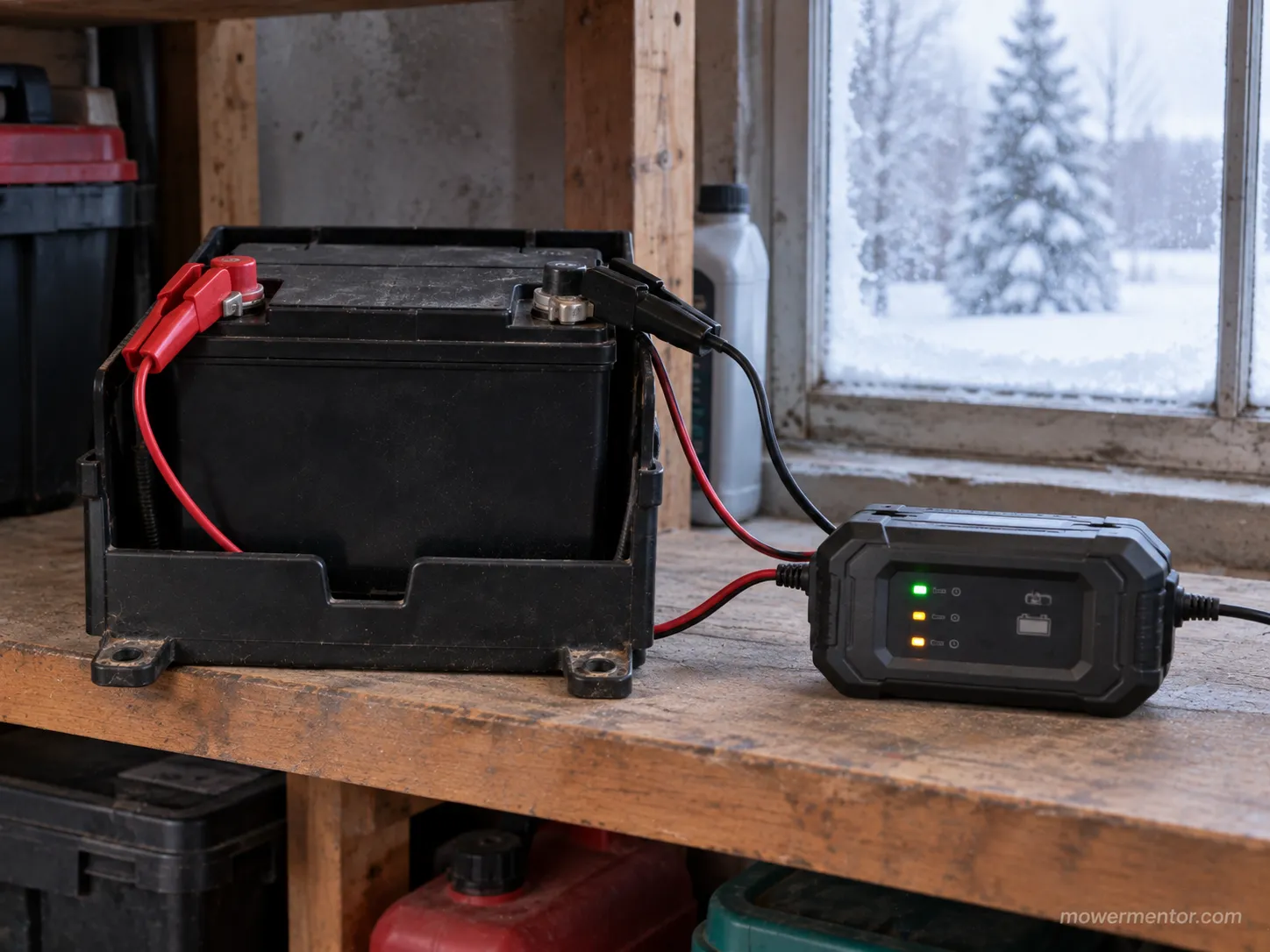
A Murray riding mower battery lasts far longer when it is kept charged during storage than when it is left to sit flat, and the single best habit is a maintainer over winter.
Briggs and Stratton's own maintenance guidance stresses keeping the charge topped through the off-season so the battery is ready in spring, and cold plus a slow self-discharge is what kills idle batteries.
A U1 that goes into storage full and on a maintainer will typically outlast one that is simply parked in a cold shed.
I split my fleet to see the gap.
Two identical U1 batteries went into an unheated shed in December; the maintained one read 12.7 volts in March, and the unmaintained one had drifted to 11.9 volts and needed a full revival charge before it would crank.
Clean the terminals and coat them with dielectric grease before storage.
Keep the battery on an automatic maintainer, or charge it monthly.
Store above freezing where practical, since cold accelerates self-discharge.
Check rest voltage in early spring and charge before the first mow.
If a well-maintained battery still cranks slowly in spring, the drag may be mechanical, and our guide to a dragging starter motor covers that failure.
Owners moving to newer equipment sometimes ask about upkeep on a battery-electric mower, which follows very different rules from these lead-acid U1 cells.
A maintainer cannot save a worn-out battery, so pair good storage with the age check from earlier.
Buying for a Discontinued Brand: What Changed
Murray is a discontinued brand, which is why there is no factory Murray battery and why buying by U1 or U1R specification is the only reliable path.
The Murray Ohio Manufacturing Company dates to 1919, and per Wikipedia's Murray history the company filed for bankruptcy in 2004, at which point Briggs and Stratton acquired the Murray brand name, and the Lawrenceburg plant produced its last lawnmower in 2005.
If you own one of these machines, you own a well-built orphan, and its battery is a generic U1 with no brand-specific magic to chase.
That history has one practical upside. Because these units always used a standardized U1 or U1R, a modern replacement is easier to source than parts for many brands still in production, and you are never locked to a proprietary battery.
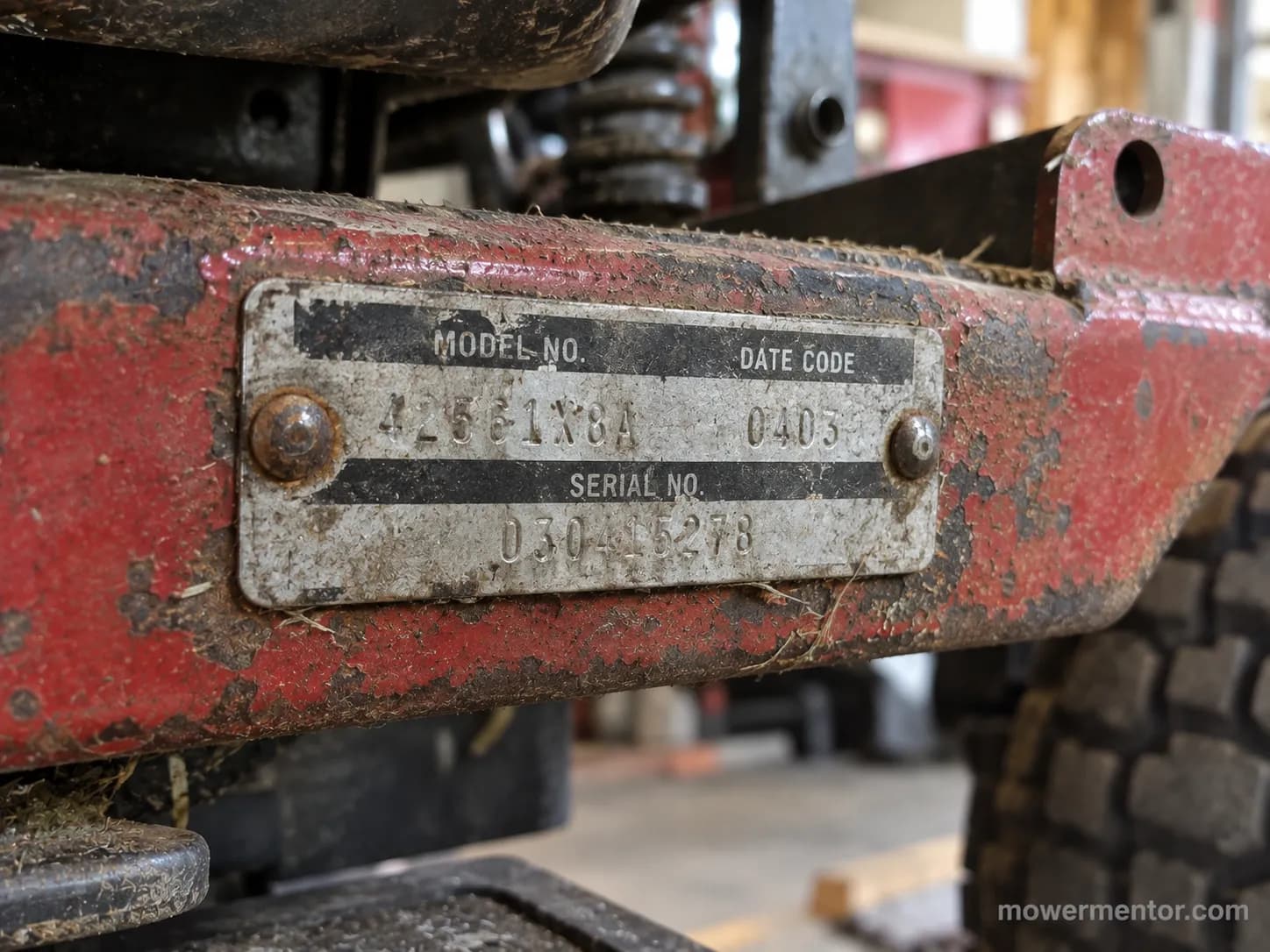
Two of the six mowers in my fleet still wore their original date stickers, both stamped before 2005, and every unit took an off-the-shelf U1 or U1R without a single proprietary part.
If you are chasing down other electrical gremlins on an older Murray, it helps to cross-reference the ignition switch the same way you cross-reference the battery.
And when you are already deep in a tune-up, confirming spark plug gap by model closes out the ignition side of the job.
Frequently Asked Questions
What size battery does a Murray riding mower take?
Almost every Murray riding mower takes a 12-volt Group U1 battery, roughly 8.3 by 5.1 by 7.25 inches, with about 300 CCA and 35 Ah. The one variable is terminal side: most models use a left-positive U1, while a few, such as the 40708, use a right-positive U1R.
Confirm the terminal side by looking at your old battery before you buy.
Is a U1 or U1R battery right for my Murray?
Match the terminal side of your current battery. A U1 has the positive post on the left; a U1R has it on the right.
They share the same case and voltage, so the only risk is buying the mirror image and finding the cables will not reach.
Why does my Murray battery keep dying?
A battery that reads fine at rest but dies after mowing usually points to a charging fault, not a bad battery. With the engine running, the voltage should rise; if it falls or stays flat, the stator, diode, or regulator is suspect.
For a step-by-step split between battery and starter faults, work through the complete no-start decision tree.
Can I jump-start a Murray mower with my car?
You can, but only with the car's engine off, because a running car can push over 14 volts and damage the mower's charging components. A portable lithium jump box is safer and cranks the mower in under a minute.
Where can I buy a battery if Murray is discontinued?
Any reputable Group U1 or U1R battery that matches your terminal side and meets about 300 CCA will fit, since Murray always used a standard size. There is no factory Murray battery to reorder.
If the mower still will not crank on a good battery, run a no-crank, battery-to-ground check next.
The Bottom Line
Buying a Murray riding mower battery comes down to two decisions you can make in your driveway: confirm the Group U1 case size, then confirm whether your tray needs a left-positive U1 or a right-positive U1R.
Meet roughly 300 CCA and 35 Ah, match the terminal side, and any quality battery drops in, because a discontinued brand does not mean a hard-to-find part when the size was standardized all along.
From there, the mower tells you what it needs. If a fresh battery still dies after a few mows, the charging system is the next stop; if it cranks slow in spring, storage habits or the starter are worth a look.
Keep it charged over winter, respect the terminal side, and one U1 will carry an old Murray through several more seasons of cutting.
Found this useful? Make us a preferred source so we show up in your Google results.
Keep reading
Related articles
Troubleshooting & Repair
Dead Dash? Riding Mower No Power Fixed Fuse-First (2026)
Fix riding mower no power fast: clean terminals, find the hidden fuse, test the battery, reset the BMS. A fuse-first checklist for gas & electric mowers.
Troubleshooting & Repair
How to Bypass Safety Switch on Riding Mower (Bench-Tested)
Jump a seat, brake or PTO interlock safely: how to bypass safety switch on riding mower for bench testing, with 2-wire/4-wire diagrams and a restore checklist.
Troubleshooting & Repair
Riding Lawn Mower Won't Turn Over: 5-Stage Voltage Test
Fix it fast: a riding lawn mower won't turn over usually means battery, ground, solenoid or starter. Test each in 5 ordered stages.
Troubleshooting & Repair
Just Clicks? Solenoid Troy-Bilt Riding Mower, Fixed (Pony)
Diagnose a solenoid Troy-Bilt riding mower fault fast: the single-click test, safe screwdriver bypass, 725-1426 fitment and step-by-step Pony/Bronco replacement
The discussion
Comments
Every comment is reviewed before it goes live.