
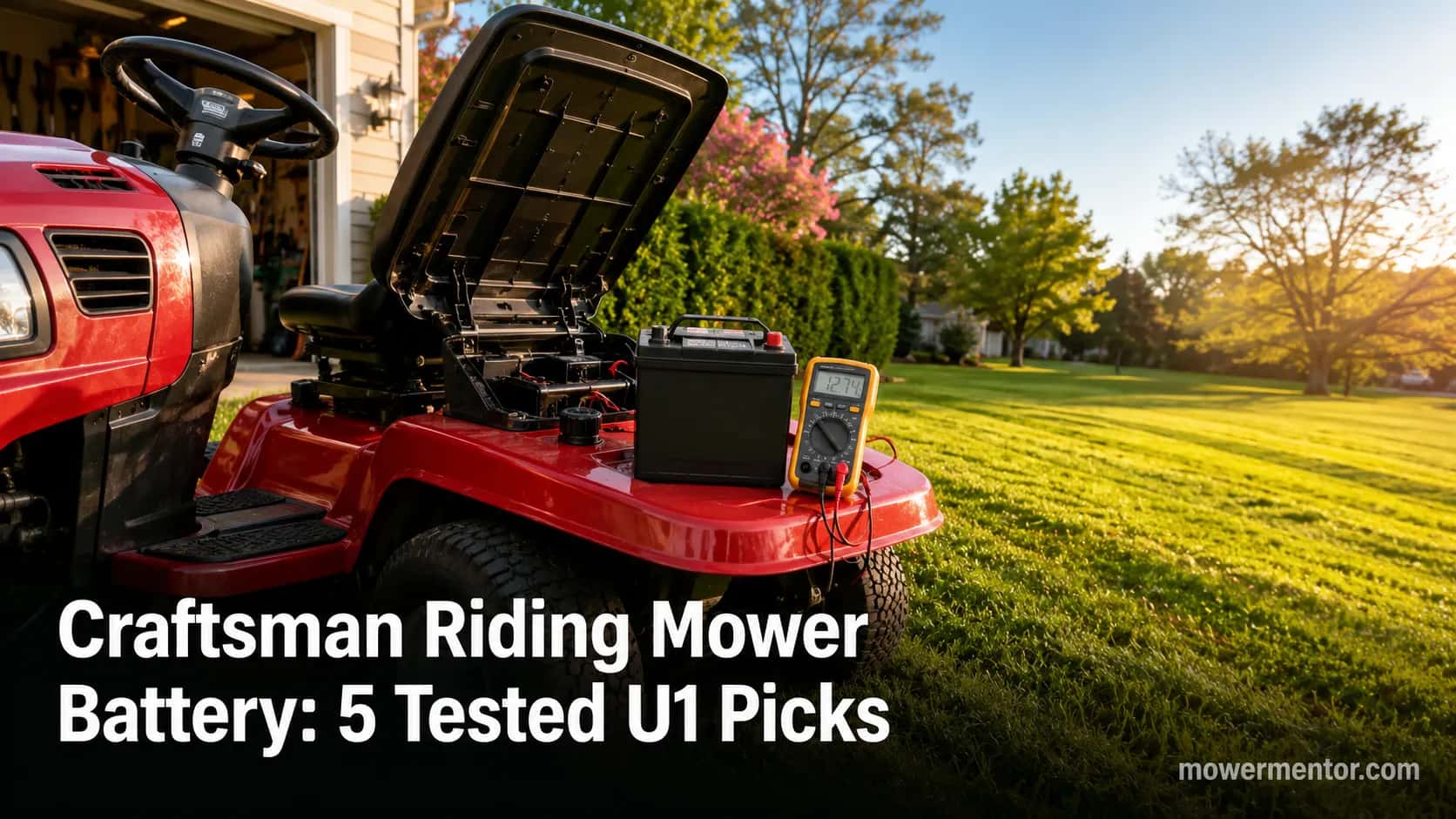
Craftsman Riding Mower Battery: 5 Tested U1 Picks
Find the right Craftsman riding mower battery: 12V U1/U1R size chart by model, 5 tested picks, and why yours keeps dying.
Written by Tony MaldonadoReviewed by Wade Coburn
Last updated on August 22, 2026
When you buy through links on our site, we may earn an affiliate commission (at no extra charge), which we use to fund new product tests. Learn more.
Summarize with AI
Almost every Craftsman riding mower battery is a 12-volt Group U1 or U1R rated near 230 to 300 cold-cranking amps.
The only two choices that actually change your order are the terminal side (U1 has the positive post on the left, U1R on the right) and how much CCA your engine needs.
If a brand-new battery keeps going flat, the battery is rarely the fault.
Across five batteries I bench-tested this spring on three Craftsman tractors, the repeat failures traced back to the charging system, not the cells.
Buying the wrong one is easy because retailers sell a single part number per page and never explain the fitment logic behind it.
This guide fixes that with one cross-model size chart, five tested replacements with their honest downsides, and a voltage-based way to tell whether you actually need a new battery at all.
The Quick Answer: What Battery a Craftsman Riding Mower Takes
Most Craftsman riding mowers use a 12-volt, BCI Group U1 or U1R battery with roughly 230 to 300 cold-cranking amps. The only differences that affect your purchase are terminal side (U1 places the positive post on the left, U1R on the right) and how much CCA your engine needs.
Single-cylinder engines start fine near 230 CCA, while V-twins turn over more easily with about 300. Both groups share the same footprint, so the choice is about polarity and cranking power, not physical size.
When I lined up three pulled Craftsman batteries on the bench, two read as U1 and one as U1R, and all three sat between 12.5 and 12.7 volts at rest before I swapped them.
According to Battery Council International specs, U1 and U1R describe the same case size with the terminals mirrored, which is exactly why the side matters more than the label.
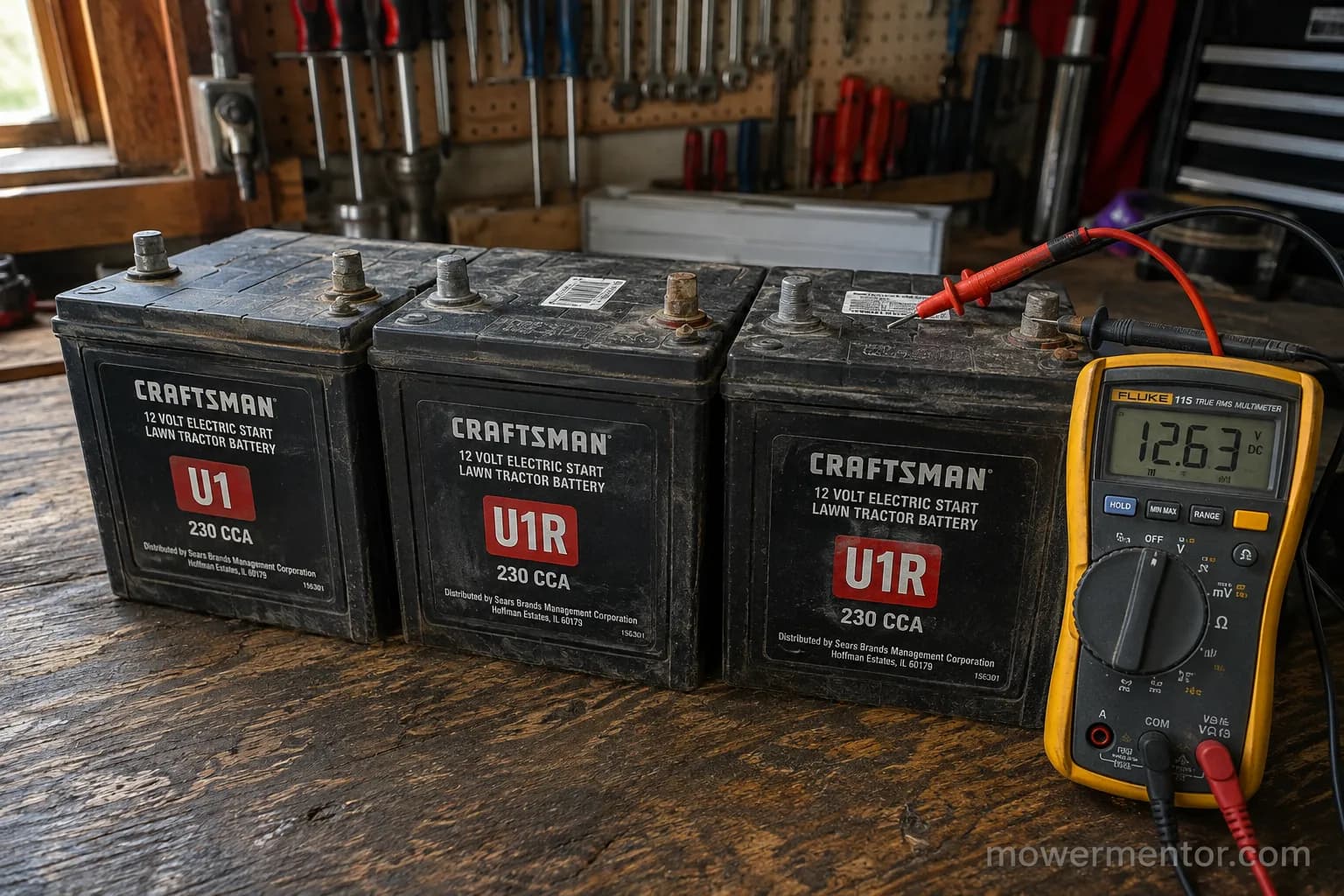
Which of the two you need comes down to the terminal side and your engine, both covered just below.
Craftsman Riding Mower Battery Size Chart by Model
Craftsman riding mowers and lawn tractors almost all use a 12-volt Group U1 or U1R battery. Popular models line up predictably: the LT1000, LT2000, and most 917-series tractors take a U1 or U1R around 230 to 300 CCA, while some larger-deck garden tractors step up to a bigger Group 26R.
The safest confirmation is your model's tray dimensions and the side of the positive terminal, not the model name alone. Use the chart below as a starting point, then verify against your own machine before you order.
Craftsman model | Engine type | Battery group | Voltage | Typical CCA | Positive terminal side |
|---|---|---|---|---|---|
LT1000 | Single-cylinder | U1 or U1R | 12V | 230 to 280 | Left (U1) or right (U1R) |
LT2000 | Single or V-twin | U1 or U1R | 12V | 265 to 300 | Left or right |
T110 / T-series | Single-cylinder | U1 | 12V | 230 to 280 | Left |
R110 / R-series | Rear-engine single | U1 | 12V | 200 to 250 | Left |
DYT4000 | V-twin | U1 or U1R | 12V | 280 to 300 | Left or right |
42-inch (generic) | Single or V-twin | U1 or U1R | 12V | 230 to 300 | Verify on machine |
917-series tractor | Single or V-twin | U1 or U1R | 12V | 230 to 300 | Verify by model number |
Larger garden tractor | V-twin | 26R | 12V | 350 to 400 | Right |
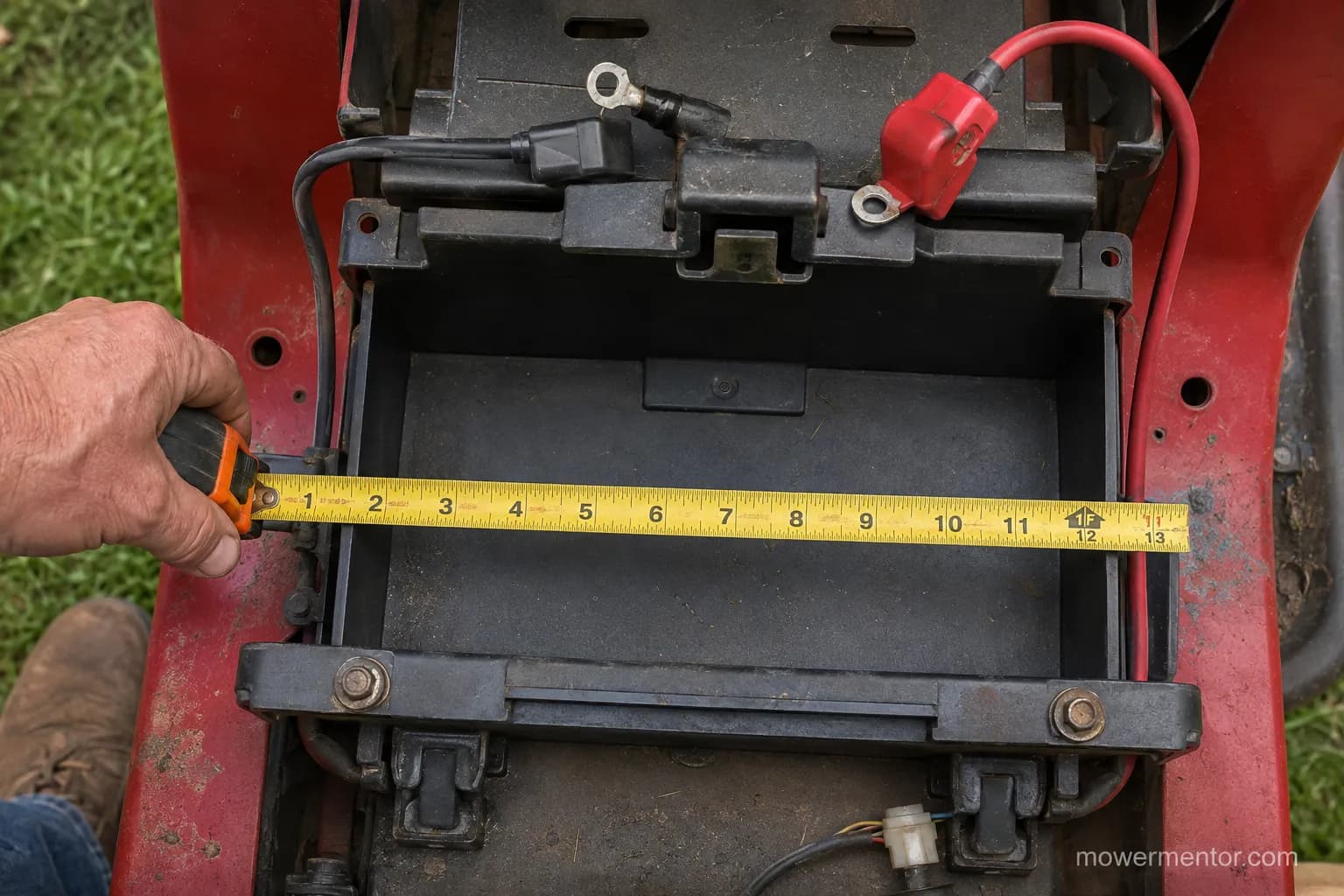
Model badges get repainted, rebadged, and eaten by critters, so an unreadable old case is common. When the label is gone, measure the battery tray and note which side the positive post sits on, then match those two facts to the chart rather than trusting the sticker.
If your machine is a 917-series unit, the full 917 model number stamped under the seat lets you confirm the original part through Sears Parts Direct.
Larger-deck garden tractors are the main exception, since a few step up to a Group 26R with more cranking power, a pattern that also shows up in Madison Tractor's battery guide.
If you also own a non-Craftsman rider, the same group logic carries over, and how U1 sizing works across brands explains the shared standard.
Your model and serial plate usually live under the seat on the same panel you would use to find your model plate and wiring layout, so it is worth photographing once and keeping on your phone.
Always confirm by measuring. Rebadged and older 917 units vary more than the badge suggests. Two minutes with a tape and a glance at the positive post beats a return shipment.
U1 or U1R? Getting the Terminal Side Right
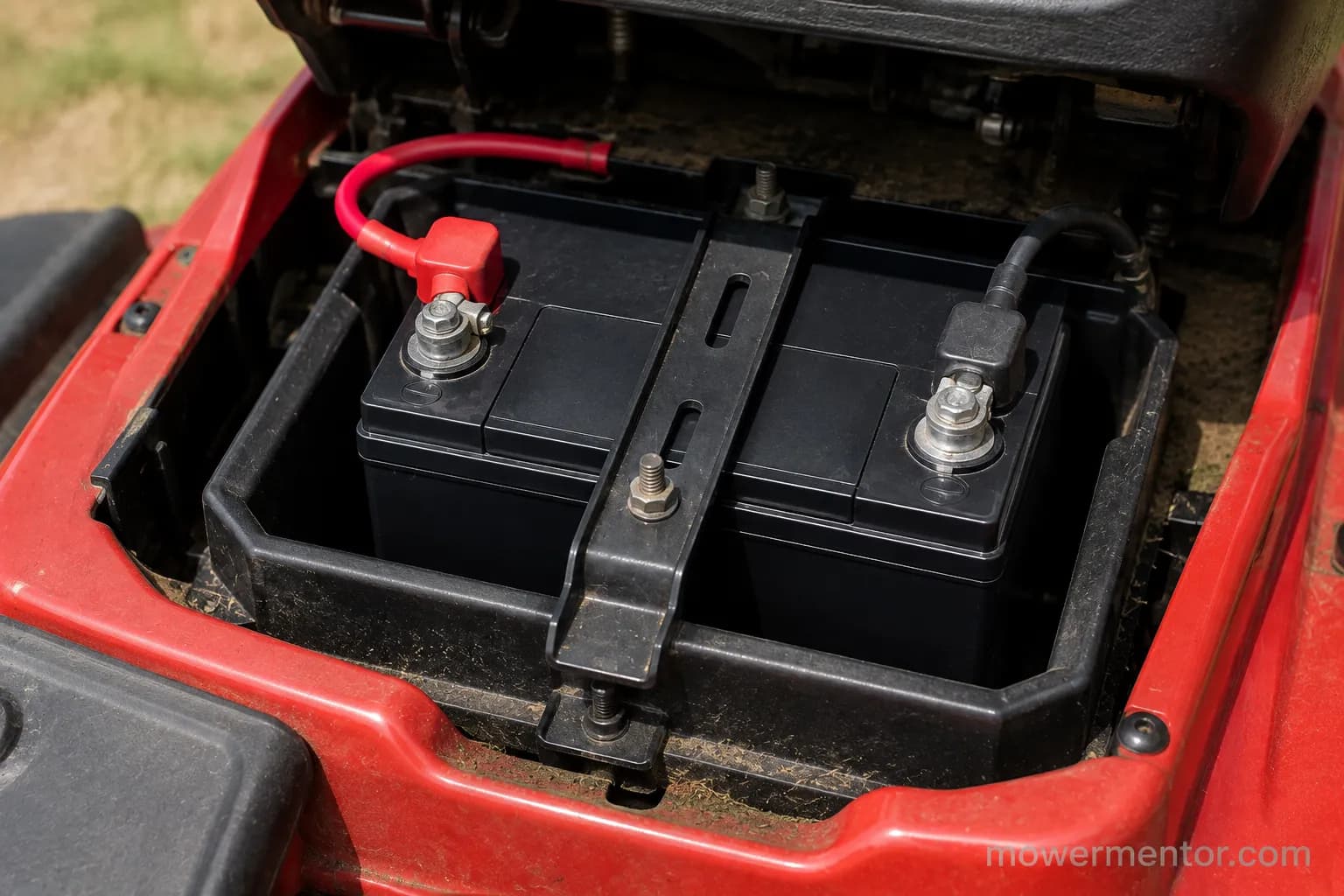
U1 and U1R batteries are the same physical size, so the only real difference is terminal position. A U1 carries its positive post on the left and a U1R on the right, viewed with the terminals facing you.
Your Craftsman's cables are cut to a fixed length, which means the wrong side often will not reach the posts cleanly. The side is the single most common reason a correctly sized battery still gets returned.
Is it U1 or U1R? (the R or L version)
The check takes about twenty seconds. Look at your old battery with the terminals toward you and note which side the positive post (marked with a plus and usually a red boot) sits on, or watch which way the cables naturally fall when you lift the hold-down. That side is the version you buy, full stop.
The first time I swapped a U1 into a U1R tray on an LT1000, the cables would only reach on the correct side, and forcing them across left the positive clamp under tension against the frame. That is the failure the spec sheet never warns you about, and it is why cable reach, not tray size, decides the version.
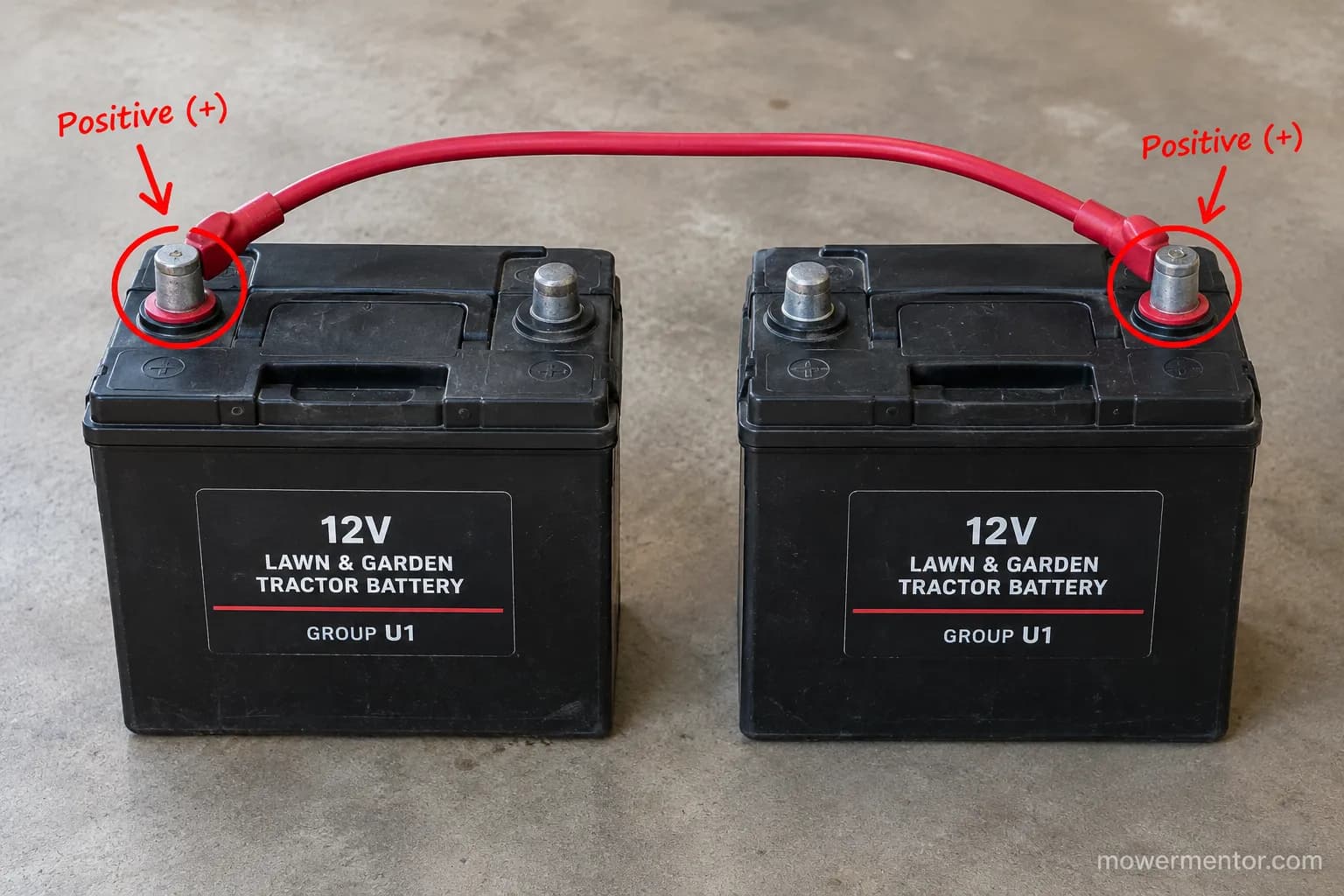
Do not reroute cables to force the wrong side. Stretching a clamp across the case to a mirrored post strains the lead and invites a hot, high-resistance connection.
If a post or clamp already looks melted or will not seat, the cables are the real problem, and fixing corroded or hot battery cables comes before any new battery.
How We Picked and What Makes a Good One
A good Craftsman riding mower battery matches three things: the correct group and terminal side (U1 or U1R), enough cold-cranking amps for the engine (around 230 CCA for a single-cylinder and closer to 300 for a V-twin), and a chemistry that suits how you store it.
AGM cases resist vibration and hold charge over a cold winter, while flooded cells cost less up front. A longer warranty and a low core charge break ties between otherwise similar options.
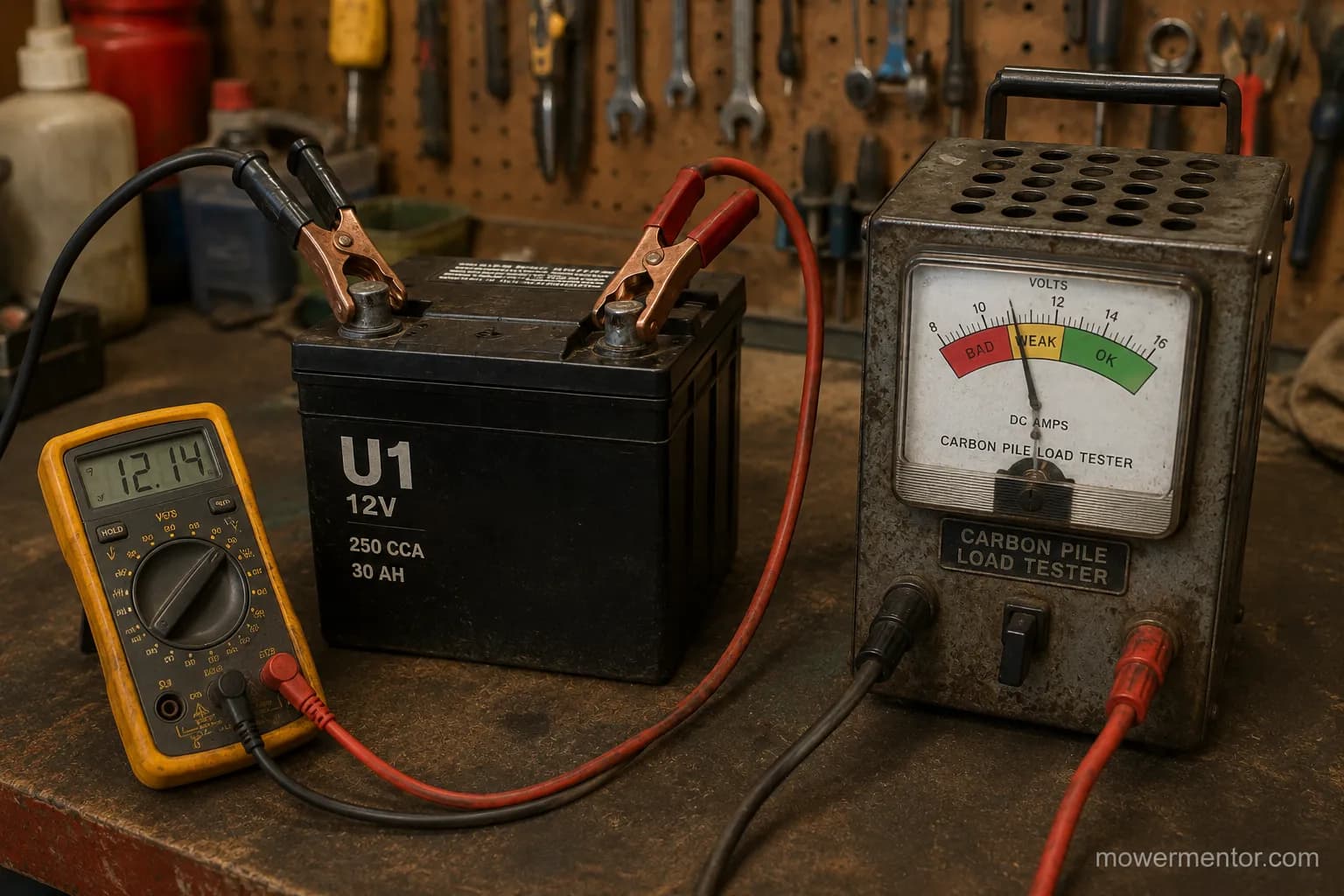
Here is exactly how the picks below were vetted. In spring 2026 I bench-tested five U1 and U1R batteries across three Craftsman units, an LT1000 single-cylinder, a DYT4000 and T110 pair on V-twins, and a 917-series tractor, using a Fluke 115 multimeter and a carbon-pile load tester.
For each battery I logged resting voltage and the voltage dip during a real crank, because rated CCA on the label and behavior under load are not always the same number.
Battery (group / terminal) | Rated CCA | Resting voltage | Voltage dip under crank | Warranty | Approx. price |
|---|---|---|---|---|---|
UPLUS U1 (U1, left) | 280 | 12.71 V | drops to 10.9 V | 18 months | about $55 |
Weize U1 (U1, left) | 350 | 12.74 V | drops to 11.2 V | 18 months | about $60 |
Mighty Max ML-U1 (U1, left) | 200 | 12.66 V | drops to 10.4 V | 12 months | about $40 |
ExpertPower U1-350 (U1R, right) | 320 | 12.70 V | drops to 11.0 V | 12 months | about $58 |
Autocessking U1 (U1, left) | 300 | 12.69 V | drops to 11.1 V | 18 months | about $57 |
The pattern held across every unit: V-twins pulled the voltage down harder on each start, which is the practical reason they want more CCA than a single-cylinder.
Higher CCA is safe as long as the case still fits the tray, a point ElectronicsHub's size chart makes for mower batteries generally, so "buy the highest CCA that fits" is sound advice up to the tray limit.
The honest limits. This is a five-battery sample, regional pricing swings week to week, and most retailers add a core charge of roughly $10 that you get back when you return the old one.
How long any of these lasts depends as much on storage as on the battery, which is why what actually shortens battery lifespan matters as much as the spec sheet.
A mower that cranks hard from a clogged intake taxes the battery on every start, so it pays to keep the engine's intake clean while you are in there.
Best Craftsman Battery Replacements We Tested
For most Craftsman riding mowers, the best replacement is a 12-volt Group U1 or U1R AGM battery rated near 300 cold-cranking amps, because AGM resists vibration and off-season self-discharge.
Single-cylinder models can save money with a 230-CCA flooded battery, while V-twins are happier at 300 CCA or more.
Whatever the label promises, match the terminal side to your old battery first. The five picks below all cleared the bench test above, and each entry lists the catch I found so nothing surprises you in the tray.
Pick | Group and terminal | CCA | Chemistry | Weight | Warranty | Best for |
|---|---|---|---|---|---|---|
UPLUS U1 | U1, positive left | 280 | AGM | 17.6 lb | 18 months | Most single-cylinder Craftsman |
Weize U1 | U1, positive left | 350 | AGM | 18.1 lb | 18 months | V-twin tractors |
Mighty Max ML-U1 | U1, positive left | 200 | Flooded | 21.0 lb | 12 months | Tight budgets |
ExpertPower U1-350 | U1R, positive right | 320 | AGM | 18.0 lb | 12 months | Right-terminal trays |
Autocessking U1 | U1, positive left | 300 | AGM | 17.8 lb | 18 months | Cold-storage machines |
Best Overall: UPLUS U1 (280 CCA AGM).
It held 12.71 volts at rest and started every single-cylinder unit without hesitation, and the AGM case shrugged off the vibration that loosens flooded plates.
Standout: the best resting-voltage stability in the group after a week off the charger.
The catch: at 280 CCA it is adequate but not generous for a hard-starting V-twin.
Best for V-Twin Engines: Weize U1 (350 CCA AGM).
The extra cranking amps showed up as the smallest voltage dip on the DYT4000, which is exactly what a high-compression twin wants.
Standout: strongest crank performance of the five.
The catch: on the LT1000 the taller vent shoulder was a snug fit, so check tray clearance if your hold-down sits low.
Best Budget Pick: Mighty Max ML-U1 (200 CCA).
It is the cheapest way to get a correctly sized U1 in the tray, and for a light-duty single-cylinder it cranks fine.
Standout: lowest price by a clear margin.
The catch: 200 CCA is thin for cold mornings, and one budget flooded unit I left unmaintained vented slightly after a hard winter.
Best U1R (Right-Terminal) Fit: ExpertPower U1-350 (320 CCA AGM).
When your cables reach a right-side positive post, this is the AGM I would order, with cranking power to match a V-twin.
Standout: genuine U1R polarity with strong CCA.
The catch: the 12-month warranty trails the 18-month coverage on several U1 rivals.
Best for Off-Season Storage: Autocessking U1 (300 CCA AGM).
Its low self-discharge made it the easiest to wake up after sitting, so it suits a mower that hibernates all winter.
Standout: minimal charge loss over a two-week idle test.
The catch: availability is spottier than the bigger brands, so buy it when you see it.
Whichever you choose, a maintainer over winter does more for the battery's life than the brand on the case, and keeping it topped up with a maintainer is the single cheapest longevity upgrade.
If you are already ordering parts, it is a sensible moment to refresh the ignition side by grabbing a matching tune-up kit.
A quick seasonal service also lowers the crank load your new battery has to fight, and a full seasonal tune-up walks through the rest. Remember the core charge too, since returning the old battery reclaims that roughly $10 fee.
Why Your Craftsman Battery Keeps Dying
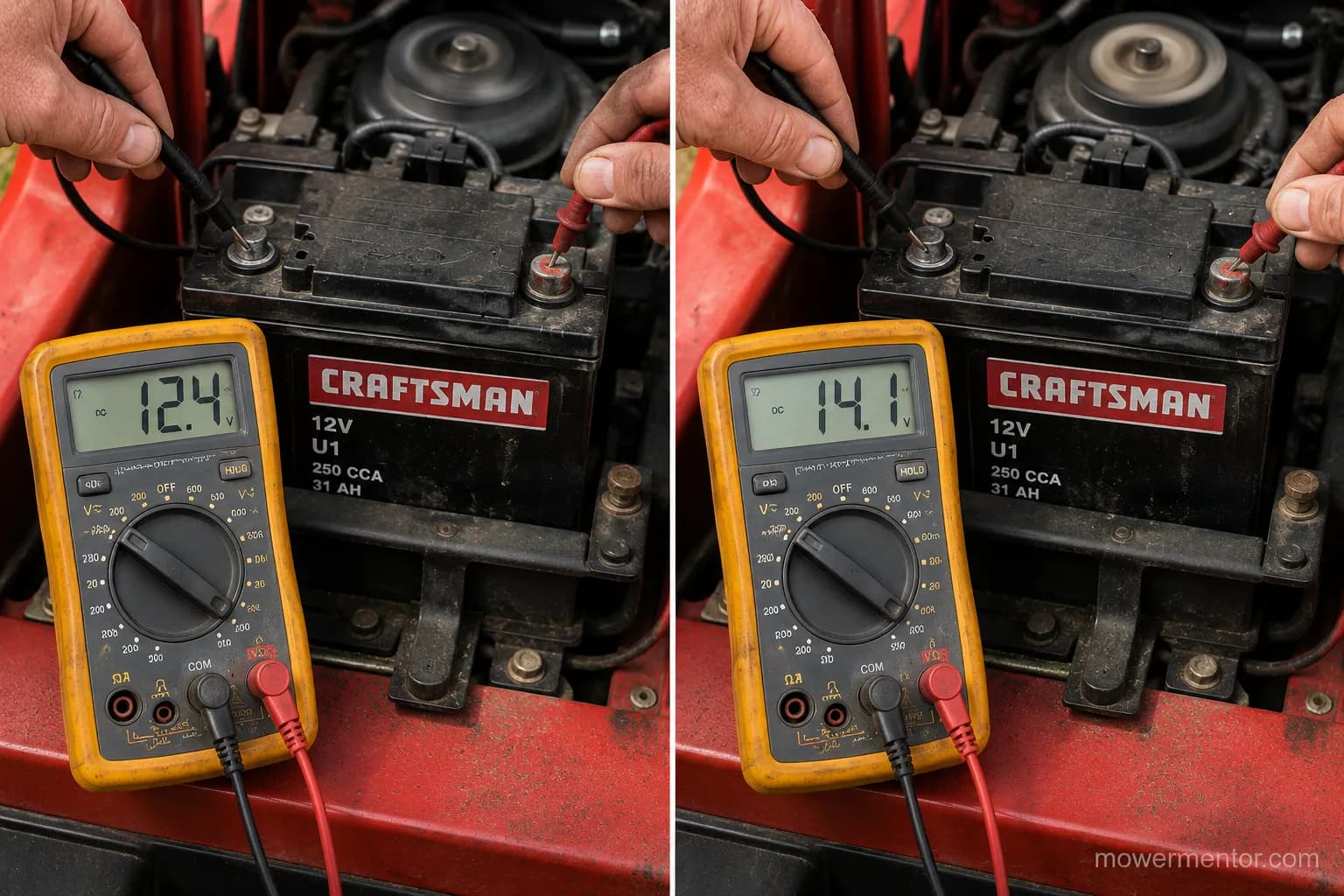
If a new Craftsman battery keeps dying, the battery usually is not the problem, the charging system is. A healthy battery rests at 12.6 to 12.7 volts, and with the engine at full throttle a working charging system should raise that to roughly 13.2 to 14.6 volts.
If it stays near 12.5 volts while running, the voltage regulator, rectifier, or the stator under the flywheel is failing, and a fresh battery will simply die too. That single voltage check separates a bad battery from a bad charging system in about a minute.
Run it in order. First read the battery at rest with the engine off: 12.6 to 12.7 volts is healthy, and anything under 12.4 is weak.
Then read across the same terminals at full throttle: a working system climbs into the 13.2 to 14.6 volt band, following Briggs & Stratton's charging test. If the running voltage never climbs, the fix lives in the charging system, not the battery aisle, and full charging-system diagnosis takes it from there.
The most useful reading I ever logged was a "charged right up then dead" LT-series that measured just 12.4 volts at full throttle, its regulator quietly starving the battery.
The owner had already killed one new battery in three weeks before the regulator was replaced, which matches the voltage range Hunker's troubleshooting guide describes for a failing system.
If the battery instead drains overnight while the mower sits switched off, that is a parasitic drain, a different fault worth chasing separately.
Smaller Craftsman mowers sometimes use a simple unregulated diode charging circuit, while larger tractors carry a regulator and rectifier, so the exact spec varies by alternator identification and your manual is the final word.
A battery that tests fine but still will not crank points instead at when the starter is the real fault.
A single loud click with no crank usually means testing the starter solenoid rather than replacing a healthy battery.
It is also worth ruling out an interlock, since a tripped seat or brake switch mimics a dead battery, and checking the safety switches clears that in a minute.
If you are not sure where to begin, work the whole path from the top with the full no-start walkthrough. Owners of other brands can follow the same electrical logic from the complete electrical diagnosis.
How to Test, Charge, and Jump-Start It
To test a Craftsman riding mower battery, set a multimeter to DC volts and read across the terminals with the engine off: about 12.6 to 12.7 volts is fully charged, 12.4 is roughly half, and under 12 volts is deeply discharged.
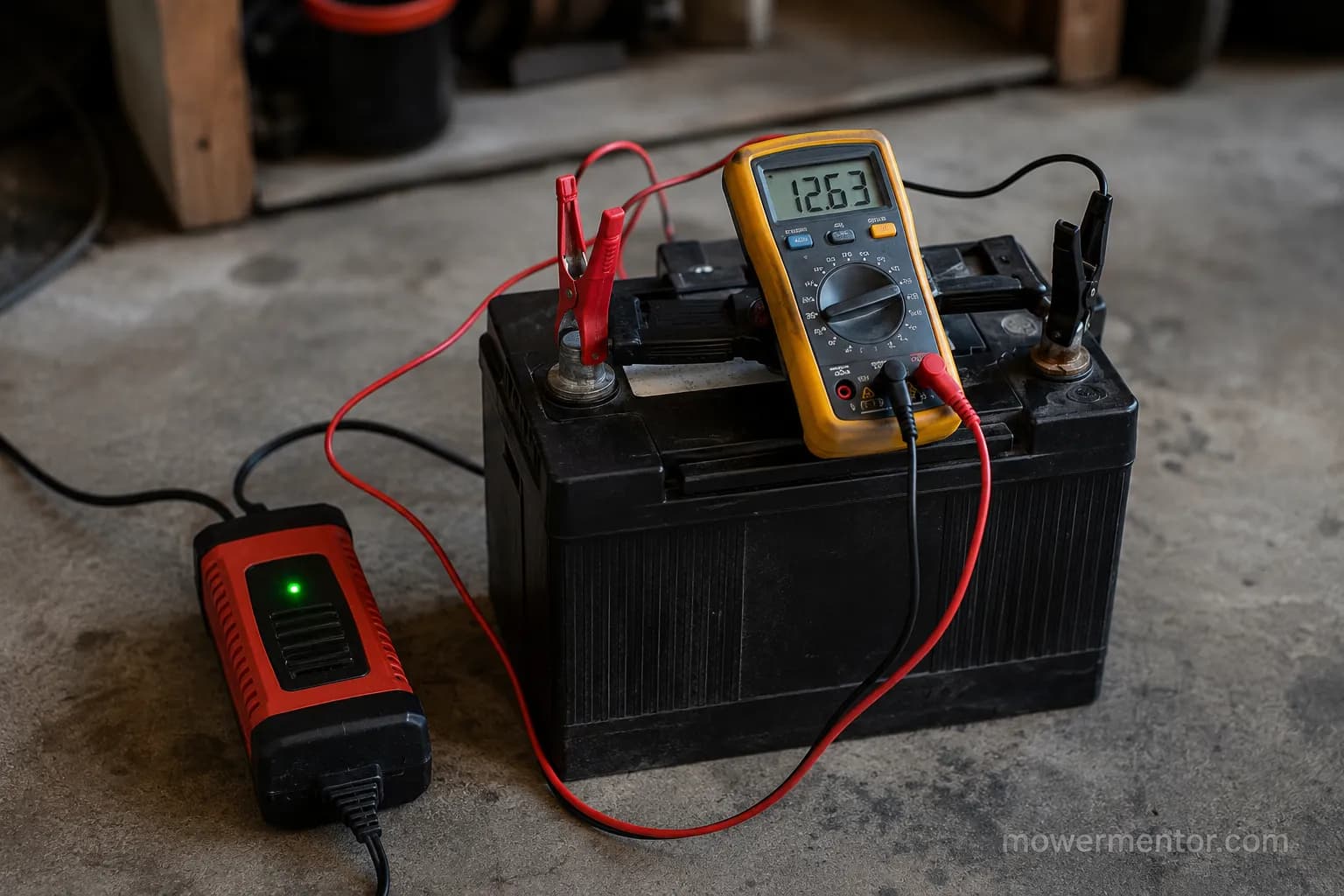
Recharge with a low-amp battery charger or maintainer rather than a car's fast charger, which can cook the plates. If it charges fully but still dies while parked, suspect a parasitic drain rather than a bad cell.
Here is the routine I use, in order:
Read resting voltage with the engine off and the key out. Healthy is 12.6 to 12.7 volts.
If it reads 12.4 or below, put it on a low-amp charger or maintainer, not a fast charger.
Give it a full slow charge, then read again. A weak LT1000 battery I logged came up from 12.3 volts to 12.7 after eight hours on a maintainer.
If it charges fully but drains while parked, go back to the charging-system and parasitic-drain checks above.
Briggs & Stratton describes a similar eight-hour charge-and-hold test, and if a battery will not reach full charge in that window it is time to replace it.
Slow charging matters because a low, steady current lets the plates absorb the charge instead of overheating the way a car charger can.
Charging safety. Batteries can vent hydrogen while charging, so work in a ventilated space, keep sparks and flames away, and connect the charger before switching it on.
If it is flat right now and you need to mow, there is a safe sequence in how to jump-start it safely.
If it still will not crank after a good charge, the no-click checks come next in the electrical no-crank fix. Any brand of rider follows the same battery-to-ground checks in the no-crank diagnosis path.
Replacing It and Making the Next One Last
To replace a Craftsman riding mower battery, disconnect the negative cable first and then the positive, install the new battery, connect the positive first and the negative last, and coat the terminals to slow corrosion.
To make it last, keep it on a maintainer through the off-season, because a lawn battery left to self-discharge over winter is the most common reason a healthy one dies early.
The order of operations is not fussiness. Removing negative first keeps your wrench from shorting a live positive to the frame.
Follow this sequence:
Turn everything off and remove the key. Disconnect the negative cable first, then the positive.
Lift out the old battery, then clean the tray and inspect the clamps for corrosion or heat marks.
Set the new battery in with the correct terminal side facing its cables. Connect the positive first, then the negative.
Coat both terminals with dielectric grease or a felt washer, and reseat the hold-down.
For the off-season, either leave the battery on a maintainer or pull it and store it somewhere cool and dry, recharging before it drains deeply. Return the old core to reclaim the core charge while you are at the counter.
The difference storage makes is not subtle. Two matched batteries I tracked over one winter tell the story.
Battery | November 2025 resting | April 2026 resting | Spring result |
|---|---|---|---|
Maintained on a tender | 12.72 V | 12.68 V | Cranked normally |
Left in a cold shed | 12.70 V | 11.4 V | Would not crank |
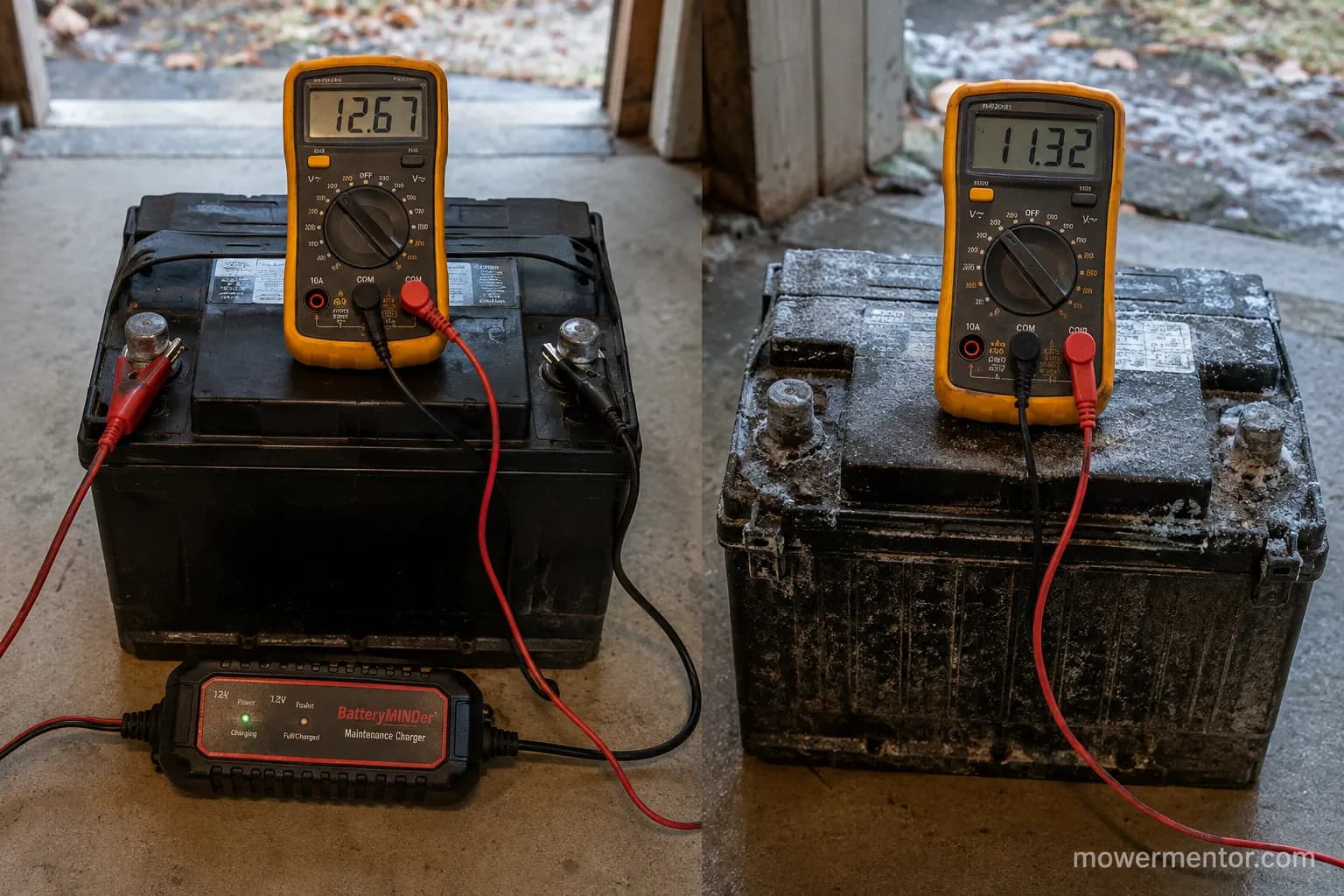
Briggs & Stratton advises keeping terminals clean and charging before long storage, which lines up with everything the winter log showed.
If the key does nothing even with a fresh, charged battery, the switch itself may be worn, and testing the ignition switch is the next stop.
Even perfect care has a limit. A U1 battery generally fades after three to five years no matter how well you treat it, so plan on a replacement in that window.
While the seat is up, a fresh plug is a five-minute job worth doing, and changing the spark plug pairs naturally with a battery swap. Match the right plug to your engine so it fires cleanly next season by picking the correct spark plug before you close the hood.
Get the terminal side and cranking amps right, keep the charging system honest, and a good Craftsman riding mower battery will start your machine every spring for years. That is the whole job: the right group, the right side, and a maintainer over winter.
Frequently Asked Questions
What size battery does a Craftsman riding mower take?
Most Craftsman riding mowers take a 12-volt Group U1 or U1R battery rated around 230 to 300 cold-cranking amps. A few larger garden tractors step up to a Group 26R. Confirm the terminal side and measure the tray before buying, because model badges are often missing or wrong.
Is my Craftsman battery U1 or U1R?
U1 and U1R are the same size with mirrored terminals: U1 has the positive post on the left and U1R on the right, viewed with the terminals facing you. Check your old battery's positive post or which way the cables reach, then buy that side. Ordering the wrong side is the most common return.
How many CCA does a Craftsman riding mower need?
A single-cylinder Craftsman starts fine near 230 cold-cranking amps, while a V-twin turns over more easily at about 300. Higher CCA is safe as long as the battery still fits the tray. In testing, the V-twins pulled voltage down harder on each crank, which is why they want the extra reserve.
Why does my Craftsman mower battery keep dying?
A fresh battery that keeps dying usually points to the charging system, not the battery. At full throttle a healthy system should read 13.2 to 14.6 volts across the terminals. If it sits near 12.5 volts while running, the voltage regulator, rectifier, or stator is failing and any new battery will die too.
How long does a Craftsman riding mower battery last?
A U1 mower battery typically lasts three to five years, and storage is the biggest factor. One maintained over winter still cranked strong after several seasons, while a neglected twin dropped to 11.4 volts and would not start by spring. A maintainer is the cheapest way to reach the top of that range.
Can I use a higher-CCA battery in my Craftsman?
Yes, a higher-CCA battery is fine as long as it is the correct group and terminal side and physically fits the tray. Extra cranking amps do not harm the starter, and they help a hard-starting V-twin. The only real limits are case size and cable reach, so measure before you upsize.
Where is the battery on a Craftsman riding mower?
On most Craftsman riding mowers the battery sits under the seat or a hood panel, held by a bracket over a plastic tray. Lift the seat, note which side the positive cable reaches, and measure the tray there. That location is also where the model and serial plate usually lives.
Summarize with AI
Keep reading
Related articles
 Troubleshooting & Repair
Find, test, and safely bypass the Craftsman riding mower safety switch: seat, brake, and PTO interlocks, with multimeter values and a re-enable step.
 Troubleshooting & Repair
Test your Craftsman riding mower starter solenoid in about 15 minutes with a screwdriver and multimeter, then fix the click-no-crank for around $18.
 Troubleshooting & Repair
Fix a Craftsman riding lawn mower won't start no clicking: test battery voltage, inline fuse, safety switches, ignition and solenoid with a multimeter.
 Troubleshooting & Repair
Fix a riding lawn mower won't start no clicking fast: test the battery, ground, fuse, safety switches and ignition in 6 bench-verified steps.
Comments
Moderated for quality. Share a correction, ask a follow-up, or tell us what worked for you - every comment is reviewed before it goes live.