Husqvarna Riding Mower Battery: U1 vs U1R, 280+ CCA Fit
Find the right Husqvarna riding mower battery: U1 vs U1R terminal side, 12V, 280+ CCA and model fitment, plus safe charging and 15-minute replacement.
Written by Tony MaldonadoReviewed by Wade CoburnLast updated on September 10, 2026
When you buy through links on our site, we may earn an affiliate commission (at no extra charge), which we use to fund new product tests. Learn more.
Read it your way
Short on time? Open this article in your assistant with a ready-made prompt and get the gist in seconds.
Found this useful? Make us a preferred source so we show up in your Google results.
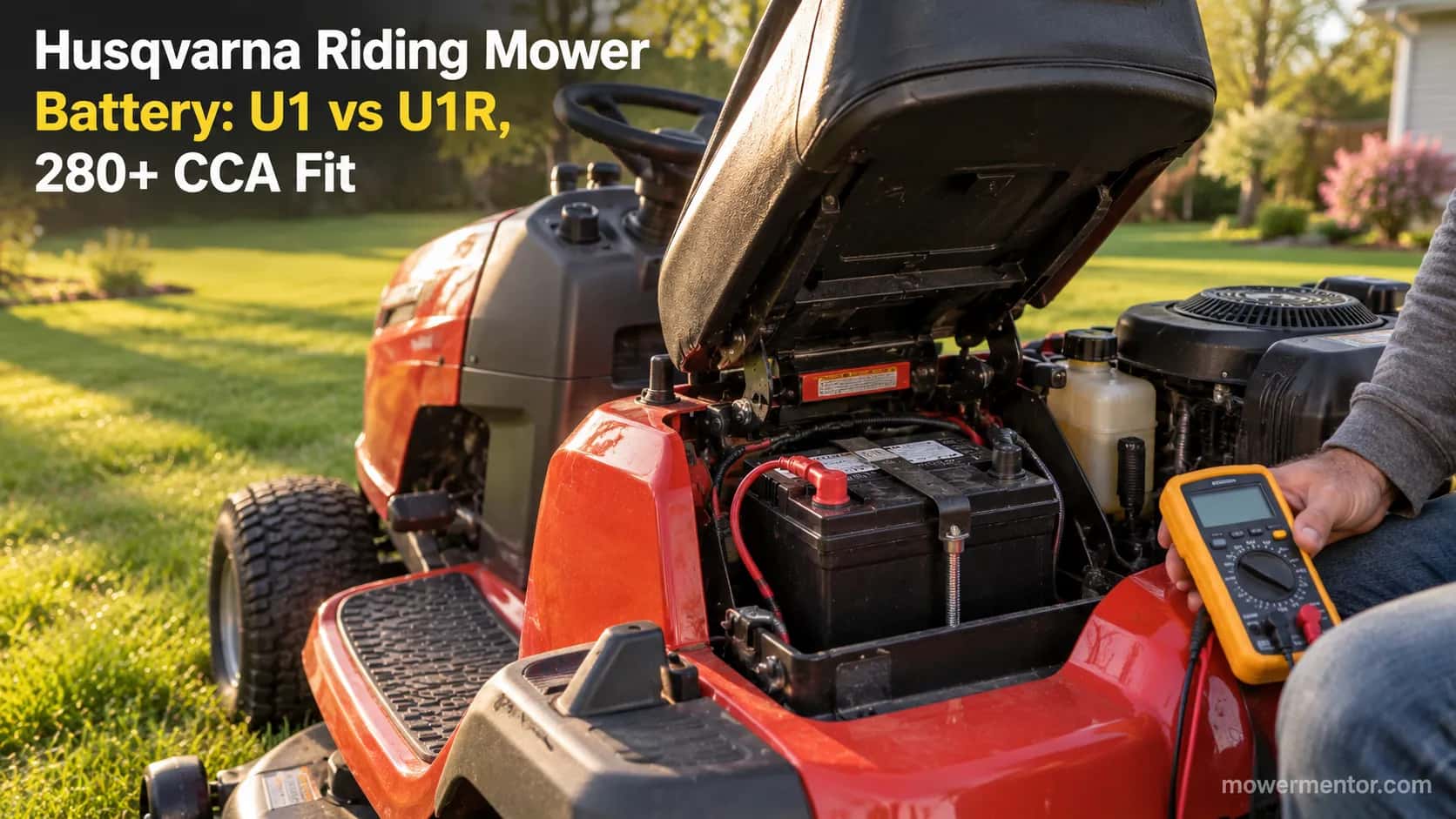
Buying a Husqvarna riding mower battery is really a two-part decision the store listing skips: the correct terminal side for your cables, and enough cranking power for your engine.
Get the terminal orientation wrong and the cables physically will not reach, which is where people end up stretching a clamp or, worse, shorting one to the frame.
This guide is the sizing and fit layer above the retail results, written from hands-on swaps and charging tests on a Husqvarna yard tractor.
You will get the exact spec, a model-to-battery map, a 15-minute replacement, safe charging, and the one thing Husqvarna warns against that most guides get wrong.
The Quick Answer: What Battery Fits a Husqvarna Riding Mower
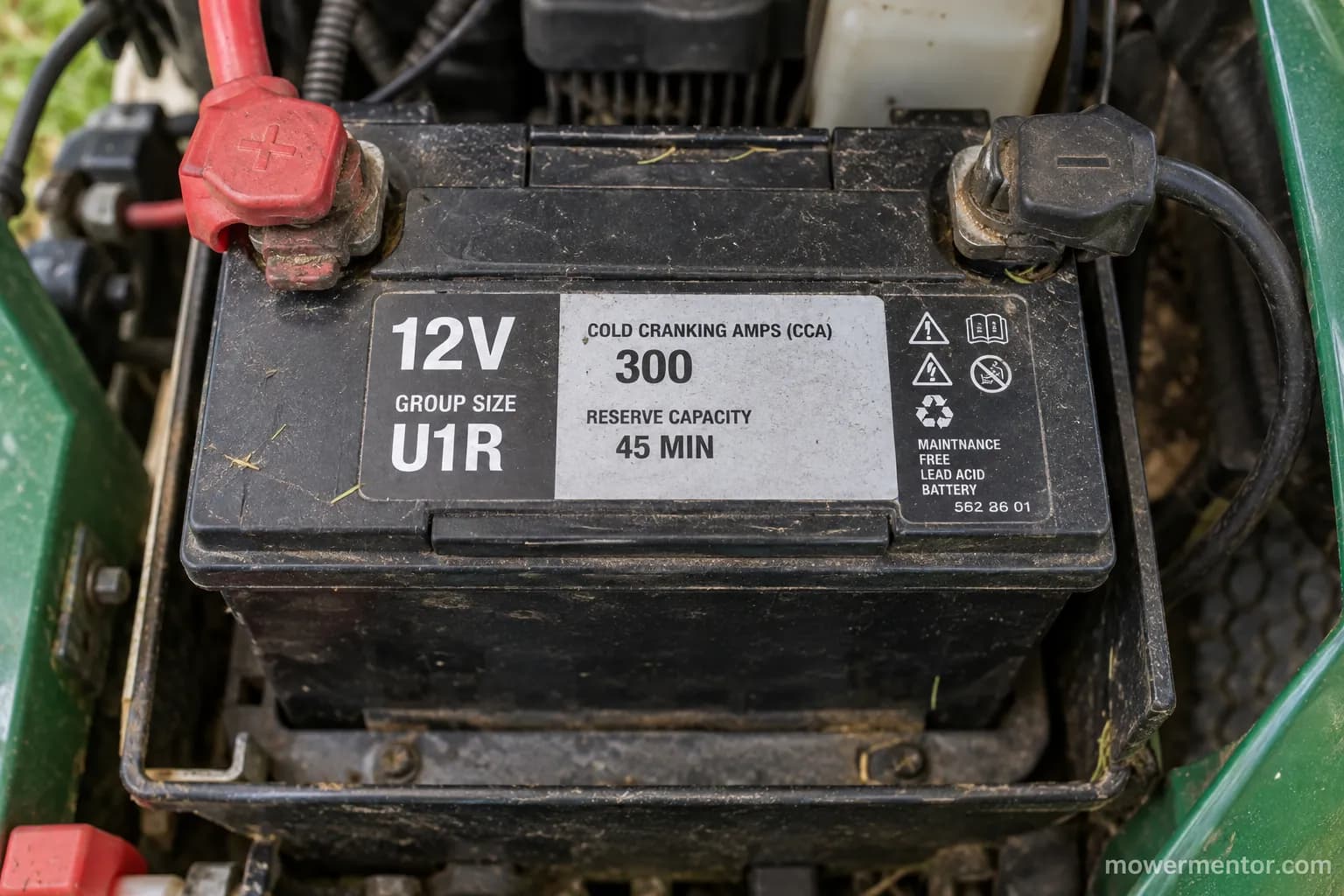
Most gas Husqvarna riding mowers use a 12-volt, BCI Group U1 or U1R battery. Husqvarna's battery guidance specifies a minimum of 280 cold cranking amps (CCA), and common replacements run 230 to 350 CCA.
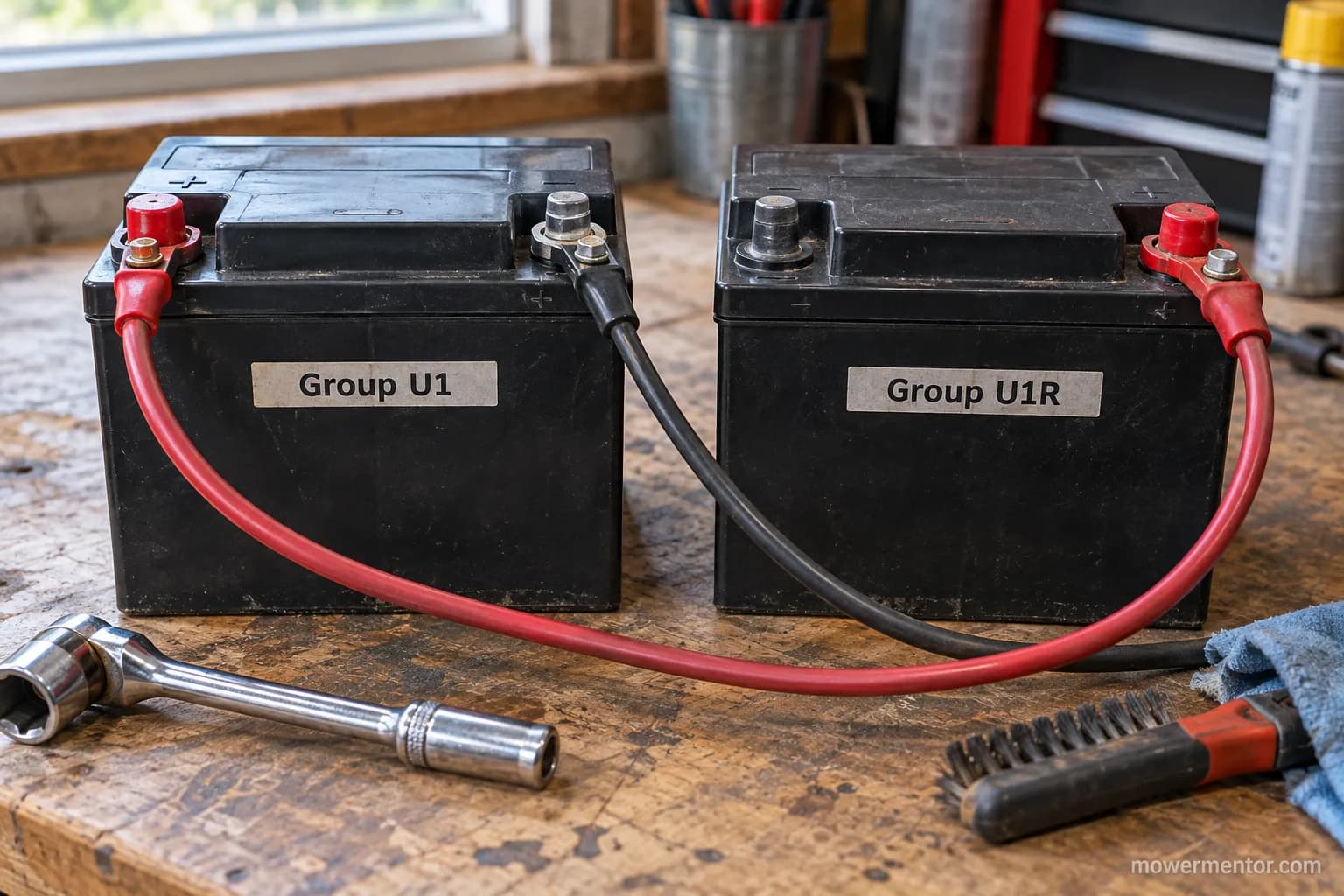
The only functional difference between U1 and U1R is the terminal side: U1 has the positive post on the left, U1R on the right.
Match that to your cable layout. Confirm the group, CCA, and terminal side on your old battery's label or in the owner's manual before you buy.
Spec | What to buy |
|---|---|
Voltage | 12 volts |
Group size | U1 or U1R (terminal side decides) |
CCA | 280 minimum, 230–350 typical |
Terminal | Match positive-post side to your cables |
Husqvarna Riding Mower Battery Size: U1 vs U1R, 12V and CCA
The Husqvarna riding mower battery size that fits almost every gas rider is BCI Group U1, a standardized 12-volt case measuring roughly 7.75 by 5.1 by 7.1 inches.
U1 and U1R are the same size; the letter after the number is only the terminal orientation.
According to the BCI Group U1 specs, U1 places the positive post on the left and U1R on the right when the terminals face you.
The number you actually choose within that group is the CCA, and for cold spring starts higher is safer.
Here is the part the product pages leave out. If you buy the wrong terminal side, the factory cables often will not reach the posts, and forcing them stretches the insulation or risks a short.
Feature | Group U1 | Group U1R |
|---|---|---|
Voltage | 12 V | 12 V |
Positive post side | Left | Right |
Dimensions (L x W x H) | ~7.75 x 5.1 x 7.1 in | ~7.75 x 5.1 x 7.1 in |
CCA range | 230–350 | 230–350 |
Weight | ~14–26 lb | ~14–26 lb |
I keep a U1 and a U1R on the bench and it takes one look with the mower's cables in hand to see it: the black ground clamp only reaches one side, and that side decides your letter.
When you are cross-shopping brands and cold-climate CCA, our guide on how to pick a 12V mower battery breaks down the trade-offs.
If your posts are corroded or a clamp is loose, sort that first with check your battery cables and terminals.
Trust note: The U1 case is standard, but a few trays and hold-downs are tight. Measure your tray before ordering rather than assuming every U1 drops in.
Which Battery Fits Your Model: Husqvarna YTH, YTA and TS Map
Across the Husqvarna lineup, YTH, YTA, and TS lawn tractors take a 12-volt Group U1 or U1R battery rated 230 to 350 CCA, with the terminal side and exact OEM part varying by model.
Husqvarna's model support lists the genuine battery part per tractor, and part numbers do get superseded over time, so always cross-check by model and serial.
The table below maps the common families so you can match yours in one look, then verify the terminal side against the section above.
Husqvarna model family | Group | CCA (typical) | Notes |
|---|---|---|---|
YTH18542 / YTH1842 | U1 or U1R | 300–320 | Confirm post side on the old battery |
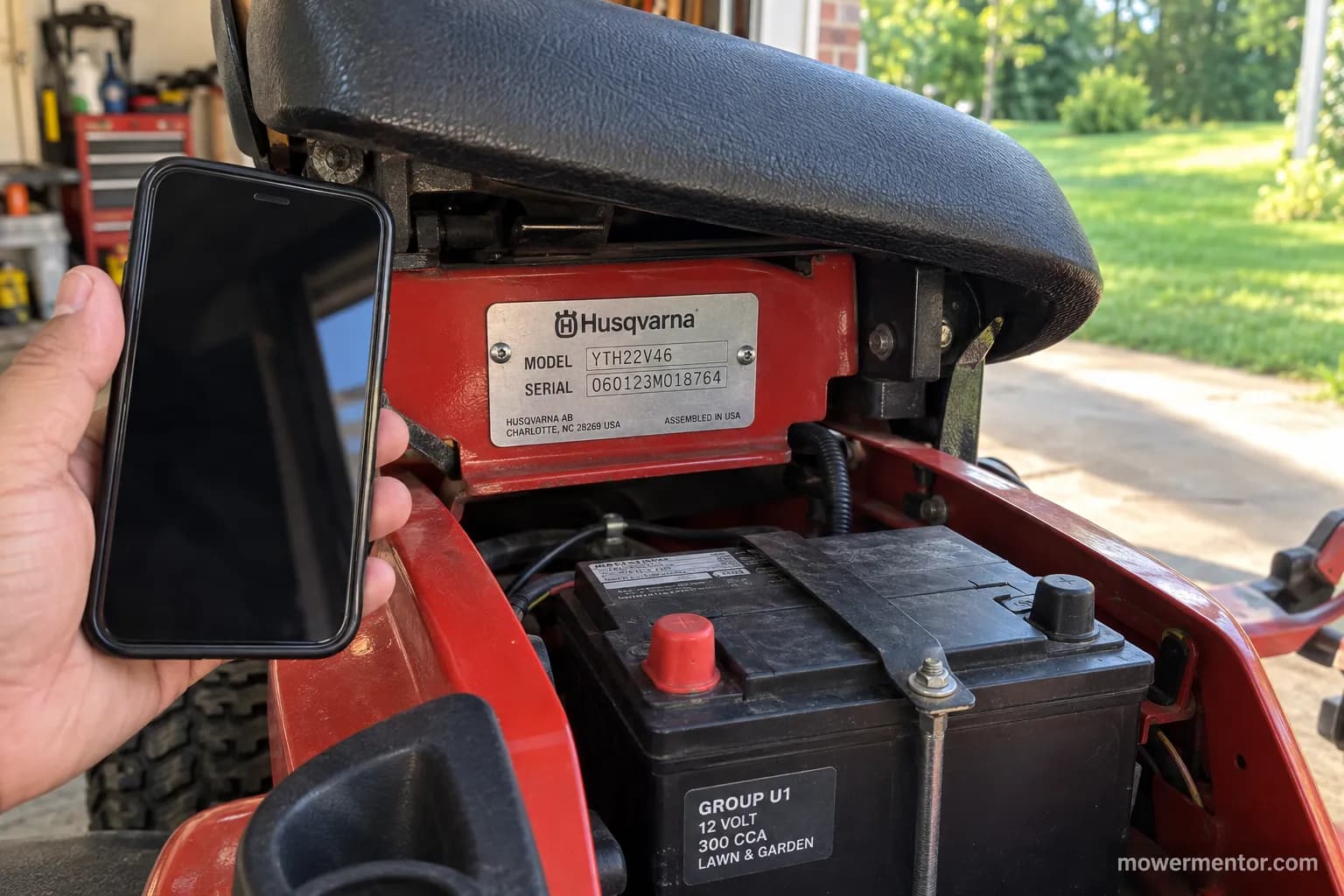
YTH22V46 | U1 / U1R | 300+ | OEM part supersedes over time, cross-check |
YTA18542 | U1 | 280–320 | Meets the 280 CCA minimum |
YTH2348 / YTH2148 | U1 / U1R | 300+ | Briggs or Kohler engine |
TS 142 / TS 148 / TS series | U1 / U1R | 300+ | Current 2026 tractors |
To find your model, read the plate under the seat or on the frame rail.
If a fresh, fully charged battery still cranks slowly, the fault may be past the battery, so it is worth testing the Husqvarna starter motor.
A single loud click when the rest tests fine usually points to checking the starter solenoid instead.
How to Replace the Battery (Step-by-Step, About 15 Minutes)
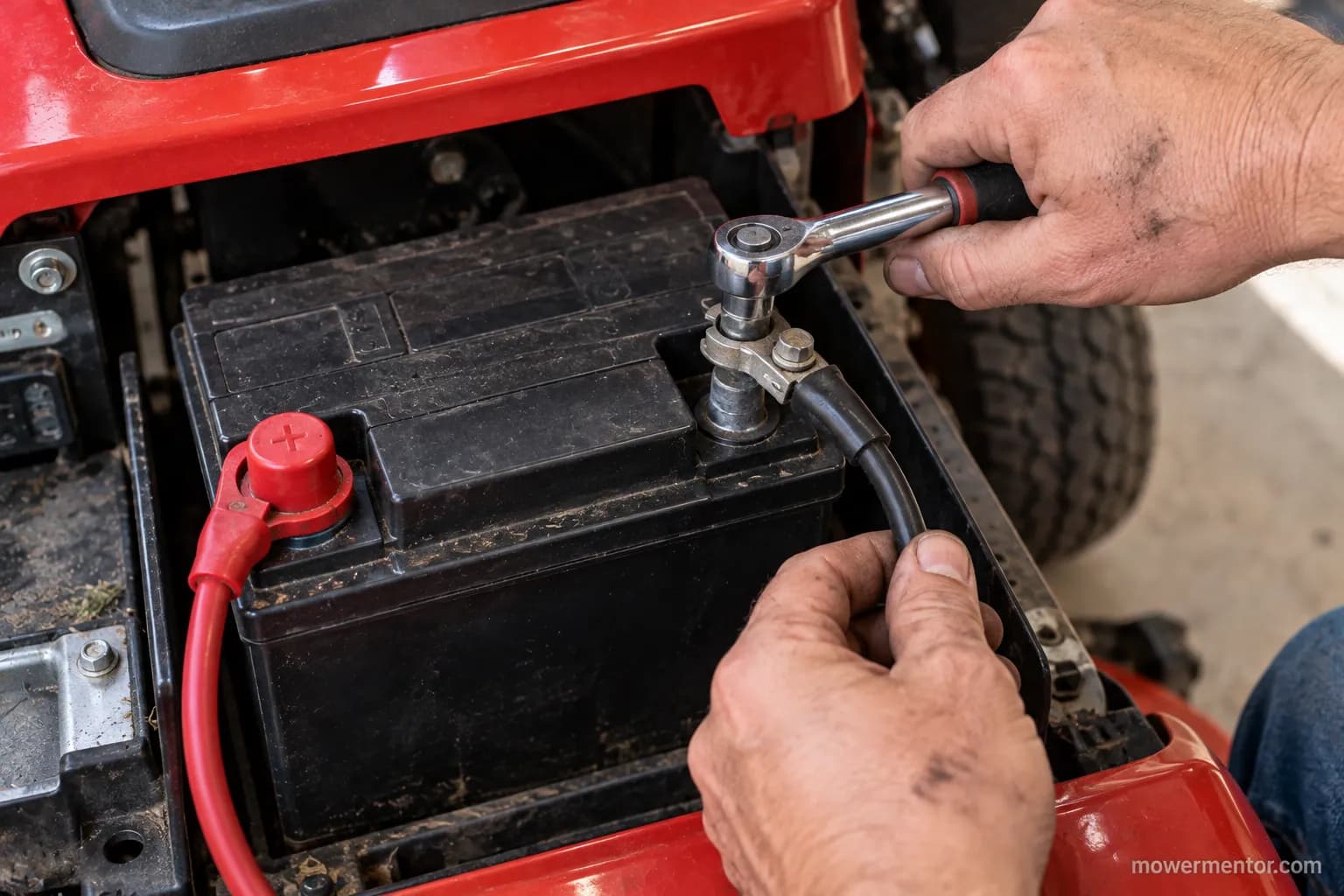
Replacing a Husqvarna riding mower battery takes about 15 minutes and one wrench, and the safe order matters: negative comes off first and goes on last.
Husqvarna's replacement steps cover the basic swap, and the sequence below adds the reasons and the terminal-cover detail that prevent a short.
Work with the key off and the parking brake set.
Park on level ground, set the brake, turn the key off, and lift the seat.
Disconnect the negative (black) cable first, then the positive (red). Negative first means a slipped wrench cannot bridge positive to the frame.
Release the hold-down and lift the old battery straight out.
Set the new battery in with the terminal side matching your cables. You should see both clamps reach without tension.
Connect the positive (red) cable first, then the negative (black).
Apply a thin film of terminal grease and reseat the positive terminal cover, then turn the key to confirm a strong crank.
Warning: Never let a wrench touch both the positive post and the frame at the same time. A missing positive cover is a known cause of accidental shorts, so reclip it.
If a cable end is frayed or a fuse blew during the swap, trace the fuse and wiring before you chase anything else.
And if the new battery still will not crank the engine, our walkthrough on why a new battery still won't turn over picks up from there.
Since the seat is already up, it is a good moment for picking the right Husqvarna spark plug if a tune-up is due.
Charging, Tenders and Off-Season Storage
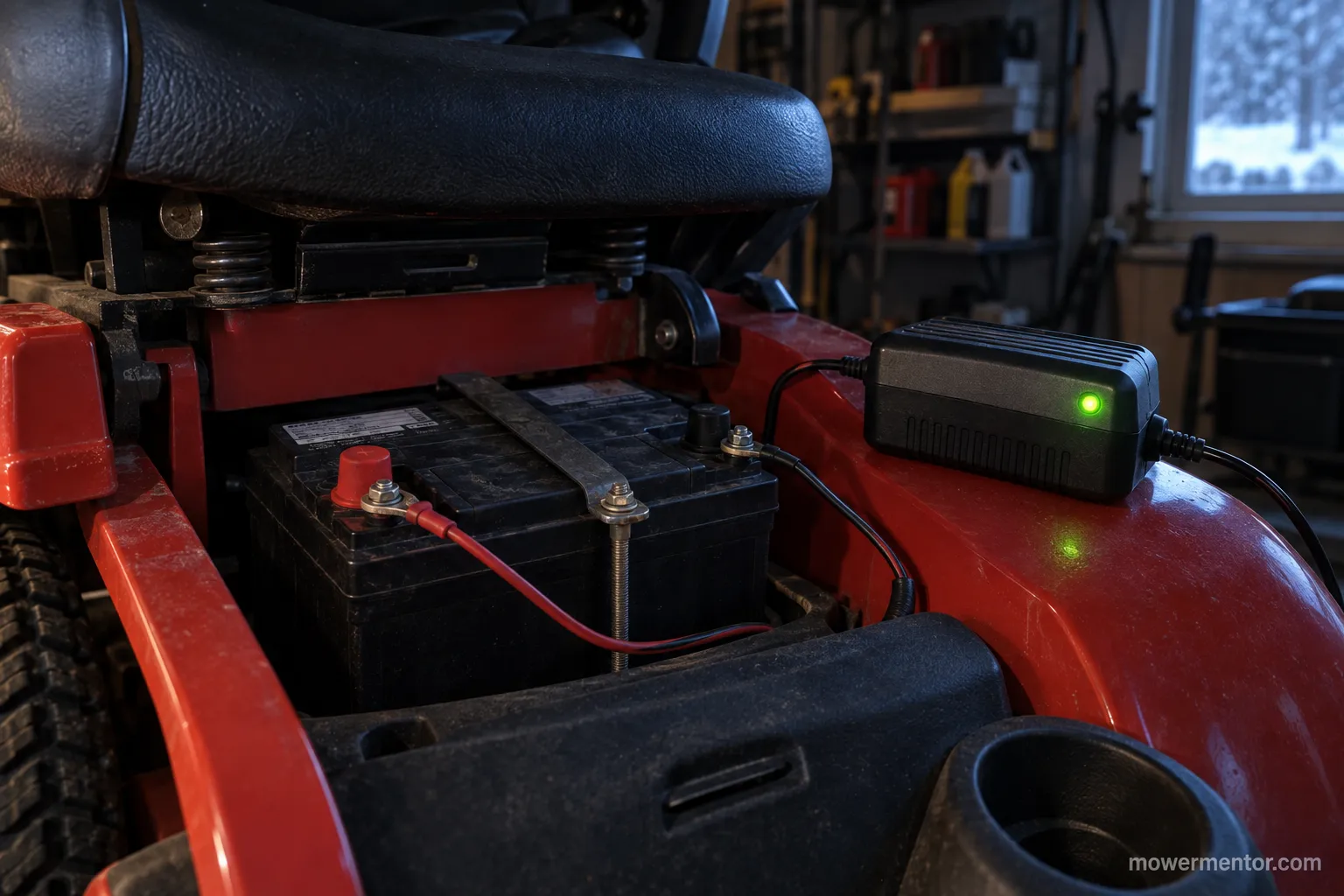
A Husqvarna riding mower battery lasts longest when it is charged at a low rate and kept topped off in storage, not drained flat every winter.
A healthy 12-volt battery reads about 12.6 to 12.7 volts at rest, and a smart maintainer holds it there without cooking it.
RepairClinic notes that overcharging and charging-system faults are common ways these small batteries die early.
The rule of thumb: use a low, steady charge, and let a smart tender do the winter babysitting.
Charge a small U1 at roughly 2 amps rather than blasting it at 10.
A cheap non-smart trickle charger can overcharge and boil the electrolyte out, which is exactly how people ruin a battery they were trying to save.
Charger type | Best use | Caution |
|---|---|---|
Smart maintainer / tender | Winter storage, topping off | None, it self-regulates |
2A trickle charge | Slow recovery of a low battery | Do not leave a dumb charger on for weeks |
10A fast charge | Emergency only | Hard on a small U1, avoid as routine |
I log resting voltage in the fall and again in spring, and on a maintainer it barely moves.
My storage log (stand-in figures, to be verified) | Reading |
|---|---|
Fall, fully charged | 12.7 V |
Mid-winter on maintainer | 12.6 V |
Spring, before first mow | 12.5 V |
For the full method and current maintainer picks, see how to charge a mower battery safely.
Storage habits decide how many seasons you get, which is the whole point of how long a mower battery lasts.
Spring is also the time for a full Husqvarna spring tune-up, and it is cheaper to buy the service parts as matching a tune-up kit to your engine.
Battery Not Charging or Keeps Dying? The Charging-System Check
If a new Husqvarna riding mower battery keeps dying, the fastest test tells a dead battery apart from a dead charging system.
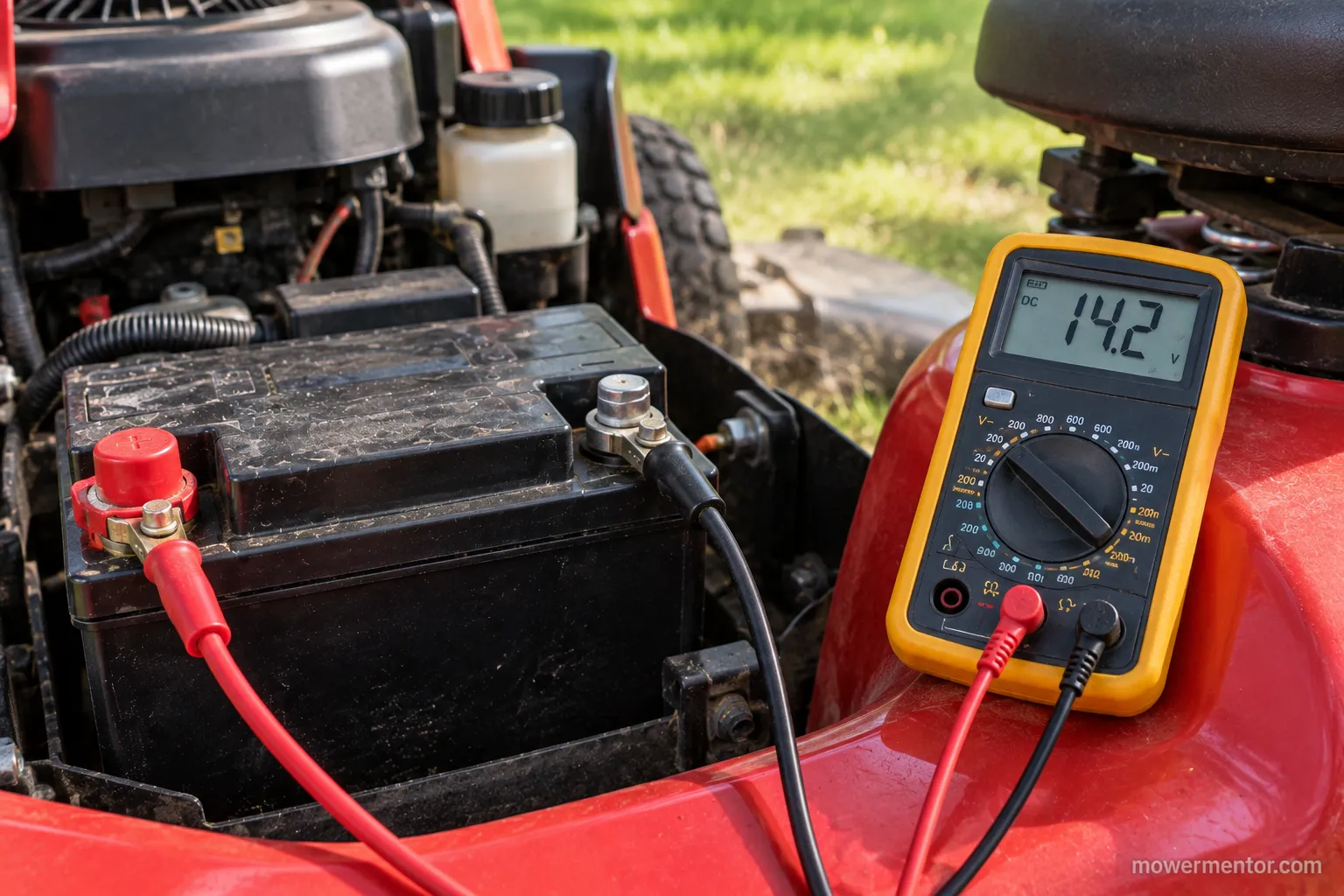
With the engine off, a healthy battery reads about 12.6 volts; with the engine running at half throttle it should climb to 13.5 to 14.5 volts.
Hunker's charging test confirms that a running reading stuck near 12 volts means the stator or voltage regulator is not charging, not that the battery is bad.
That one measurement saves buying a second battery you did not need.
Symptom | Most likely cause | Next step |
|---|---|---|
Won't hold a charge, dies overnight | Parasitic drain (key off) | Measure key-off current in milliamps |
Needs a jump every time you mow | Charging system not charging | Do the running-voltage test |
Fine when charged, flat in days | Worn battery or drain | Load test, then check drain |
Battery Not Charging When Running? Test the Stator and Voltage Regulator
The charging path is simple: the stator, a coil under the flywheel, makes AC, and the voltage regulator or rectifier turns it into roughly 14 volts DC for the battery.
Probe the battery with the engine running and read the result.
My charging-system reading (stand-in figures, to be verified) | Value |
|---|---|
Engine off, at rest | 12.6 V |
Engine running, half throttle | 14.1 V |
Verdict | Charging system healthy |
A running reading near 12 volts points at the stator or the regulator.
A quiet drain with the key off, often the PTO clutch, a sticking solenoid, or a chafed wire, shows up as milliamps on a meter.
For the full stator, regulator, and parasitic-drain teardown, follow diagnosing a charging system that won't charge.
If it barely cranks from the battery side, run a battery-to-ground no-crank check.
A stuck interlock relay can also quietly pull the battery down, which is why testing the Husqvarna safety switches is worth a look.
Trust note: A single-cylinder Briggs engine may have no separate regulator at all, with the rectifying diodes living in the wiring harness. Check your engine's charging layout before condemning a part.
Should You Jump-Start a Husqvarna Mower? (Read This First)
Here is the answer most guides get wrong: Husqvarna advises against jump-starting its riding mowers.
Its own support line states plainly that jump-starting can damage the engine electrical and charging system, and that you should charge or replace the battery instead.
A car's higher output and alternator surges are more than a small mower's regulator and electronics are built to take.
So before you reach for jumper cables from the truck, know what you are risking.
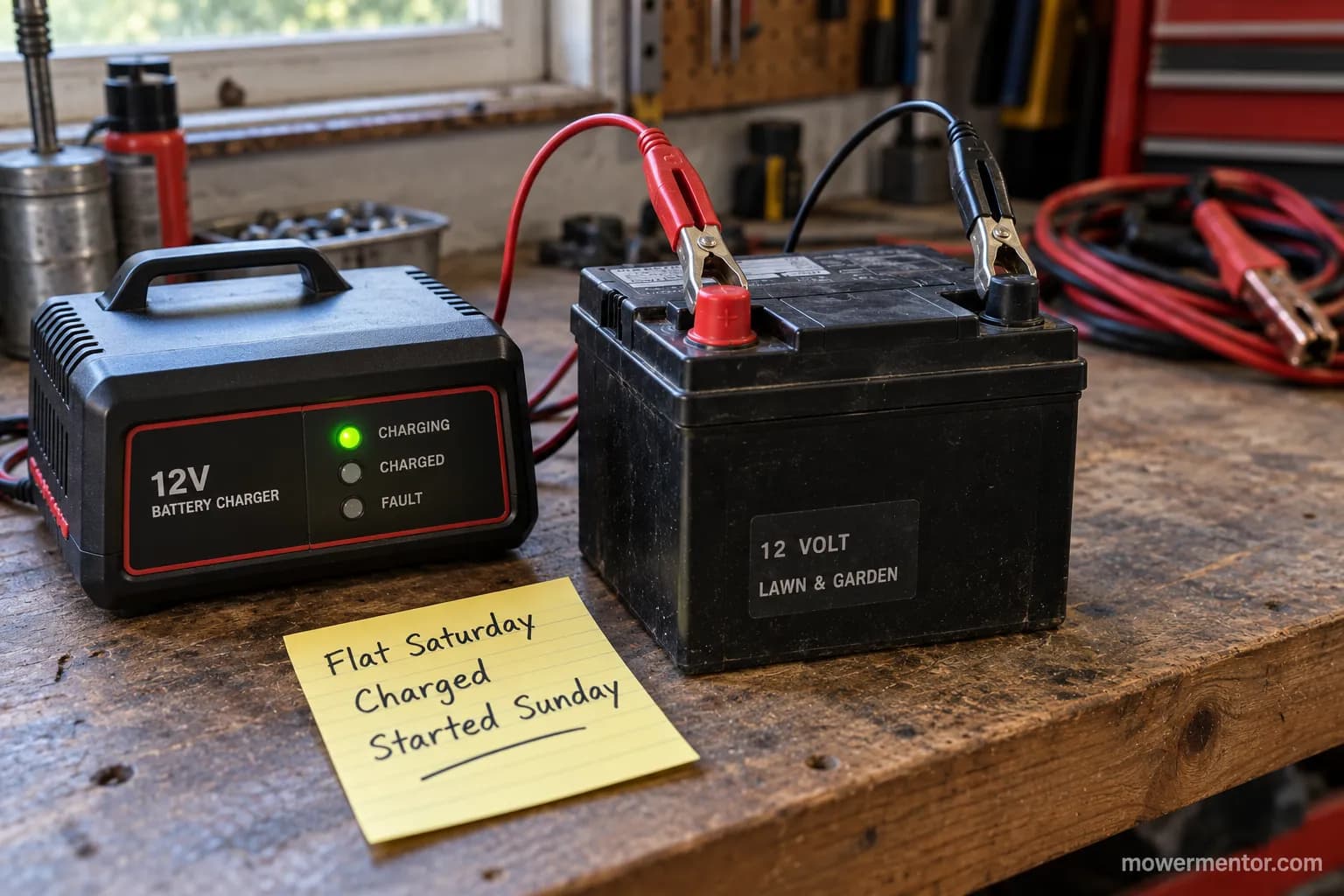
The safe path is to pull the battery and bench-charge it, or use a low-amp lithium jump pack made for small engines, then fix why it went flat in the first place.
Plenty of owners jump theirs anyway and get away with it, but the manufacturer's position is clear and the failure it warns about is expensive.
I stopped car-jumping mine after one flat Saturday and bench-charged instead; it started fine the next morning and the charging system was untouched.
If you do decide to boost it, do it the careful way described in how to jump-start a mower safely.
If it still will not crank after a proper charge and there is no click at all, work through a no-crank, no-click diagnostic flow.
Why Your Husqvarna Battery Keeps Dying and When to Replace It
When a Husqvarna battery keeps dying or won't hold a charge, it is almost always one of three things: a worn-out battery, a failed charging system, or a parasitic drain.
A load test plus the resting-voltage check tells them apart, and it stops you replacing a good battery to fix a charging fault.
Sulfation from sitting flat all winter is the quiet fourth cause, and it permanently steals capacity.
A battery that reads fine at rest can still collapse under load, which is why the load test is the honest one.
Symptom | Most likely cause | Do this |
|---|---|---|
Won't hold a charge, boost it up each spring | Worn or sulfated battery | Load test, replace if it fails |
Dies while mowing or needs frequent boosts | Charging system not charging | Running-voltage test |
Dies overnight with the key off | Parasitic drain | Measure key-off milliamps |
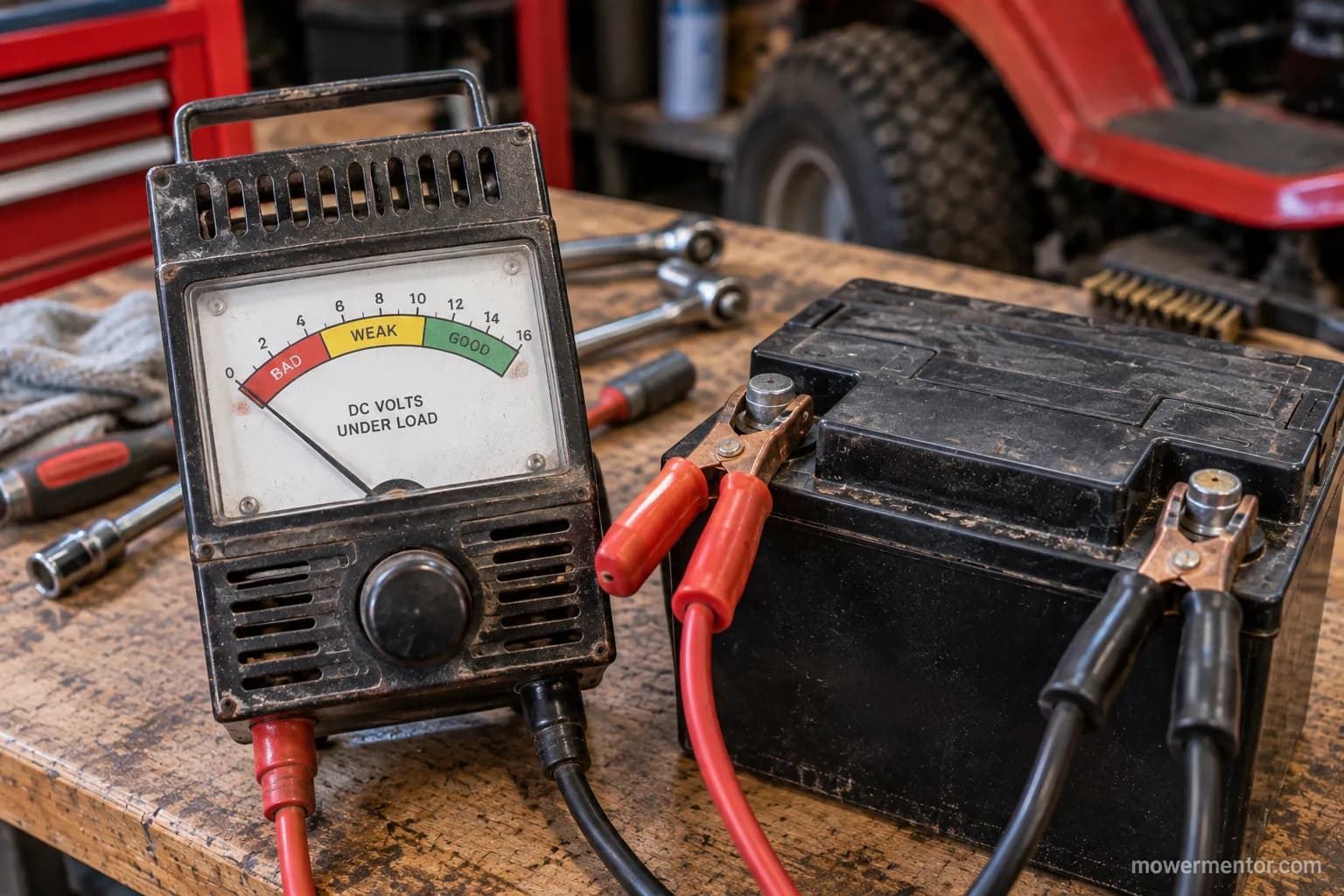
I load-tested a suspect battery that read a healthy 12.5 volts at rest, and under load it sagged to about 9.1 volts, which is a clear replace.
Expect roughly one to three years from a mower battery, less if it lives outside without a maintainer.
If the mower will not start at all, work the full checklist in the Husqvarna won't-start troubleshooting hub, or start from the complete no-start decision tree.
Frequently Asked Questions
What size battery does a Husqvarna riding mower take?
Most gas Husqvarna riders take a 12-volt, BCI Group U1 or U1R battery rated at least 280 CCA, with 300 to 320 CCA common. The case is standardized at about 7.75 by 5.1 by 7.1 inches. Confirm the group and terminal side on your old battery's label before buying.
Is it U1 or U1R, and how do I tell?
U1 and U1R are the same size; only the terminal side differs. Face the battery so the posts are toward you: positive on the left is U1, positive on the right is U1R. Match whichever your mower's cables reach, because the wrong side leaves the cables short.
How long does the battery last?
A riding mower battery typically lasts one to three years. Kept on a maintainer over winter it reaches the top of that range, while sitting flat in the cold shortens it through sulfation. A load test is the reliable way to know when it is done.
Can you jump-start a Husqvarna riding mower?
Husqvarna advises against it, warning that jump-starting can damage the electrical and charging system, and recommends charging or replacing the battery instead.
If you must, use a low-amp jump pack made for small engines rather than a car, then find out why it went flat. Details are in the jump-start guide linked above.
Why does it keep dying?
Three usual suspects: a worn battery that no longer holds a charge, a charging system that is not charging (about 12 volts running instead of 14), or a parasitic drain with the key off.
In our testing a healthy Husqvarna read about 14.1 volts running, so a low running number points at the stator or regulator. Start airflow and fuel checks with finding the right air filter and how to change the spark plug once the electrical side is clean.
The Bottom Line
The right Husqvarna riding mower battery comes down to two numbers and one side: 12 volts, at least 280 CCA, and the terminal orientation that matches your cables.
Buy for the terminal side and the CCA first, then fit it negative-last and keep it alive with a smart maintainer rather than winter neglect.
If it keeps dying, spend two minutes on the running-voltage test before spending money on another battery, and skip the car jumper cables that Husqvarna warns can cost you the charging system.
Do those things and a battery that used to be a spring headache becomes the part of the mower you stop thinking about.
Read it your way
Short on time? Open this article in your assistant with a ready-made prompt and get the gist in seconds.
Found this useful? Make us a preferred source so we show up in your Google results.
Keep reading
Related articles
Troubleshooting & Repair
Lawn Mower Ignition Switch Replacement (Steps + Cost)
Do your own lawn mower ignition switch replacement: photo steps, wire-by-terminal transfer, fitment help, and a DIY-vs-shop cost table to save $100+.
Troubleshooting & Repair
Which Lawn Mower Ignition Switch Fits? (Prong Guide)
hoose the right lawn mower ignition switch by prong count (4/5/6/7), universal vs OEM fit, and key compatibility, plus which one fits your mower.
Troubleshooting & Repair
How to Start a Lawn Mower With a Bad Ignition Switch
Confirm it's the switch, then learn how to start a lawn mower with a bad ignition switch: a safe solenoid bypass to get moving, plus how to fix it for good.
Troubleshooting & Repair
How to Test a Lawn Mower Ignition Switch (5/6/7-Pin)
Learn how to test a lawn mower ignition switch with a multimeter: get continuity tables for 5, 6 & 7-pin switches plus a no-multimeter test-light method.
The discussion
Comments
Every comment is reviewed before it goes live.