
Troy-Bilt Riding Mower Won't Start? Meter-Tested Fixes
Diagnose why your Troy-Bilt riding mower won't start with a fuel-vs-electrical decision tree, real meter readings, and Pony/Bronco fixes that get it running.
Written by Tony MaldonadoReviewed by Wade CoburnLast updated on September 24, 2026
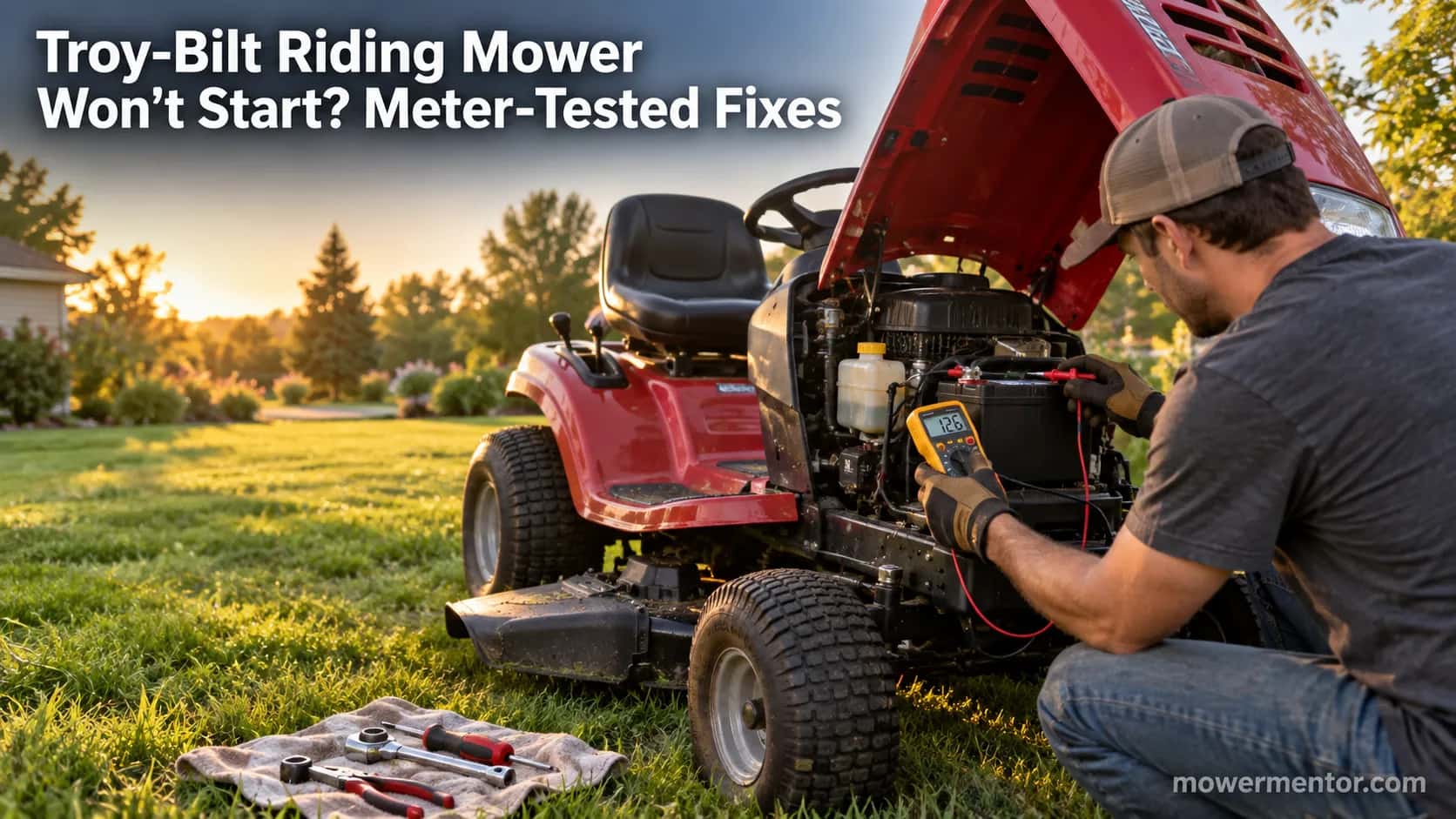
When you buy parts or tools through links on our site, we may earn a commission at no extra cost to you. It never changes what we recommend. Learn more.
The 30-Second Check: What to Try First
You walked out to mow, turned the key, and got nothing useful. If you searched troy bilt riding mower won't start and landed here, the fastest path forward is to rule out two culprits before you touch a single tool.
Most Troy-Bilt no-starts are either stale fuel or a weak battery.
Set the parking brake fully, switch the PTO off, and make sure the tank holds fresh gas.
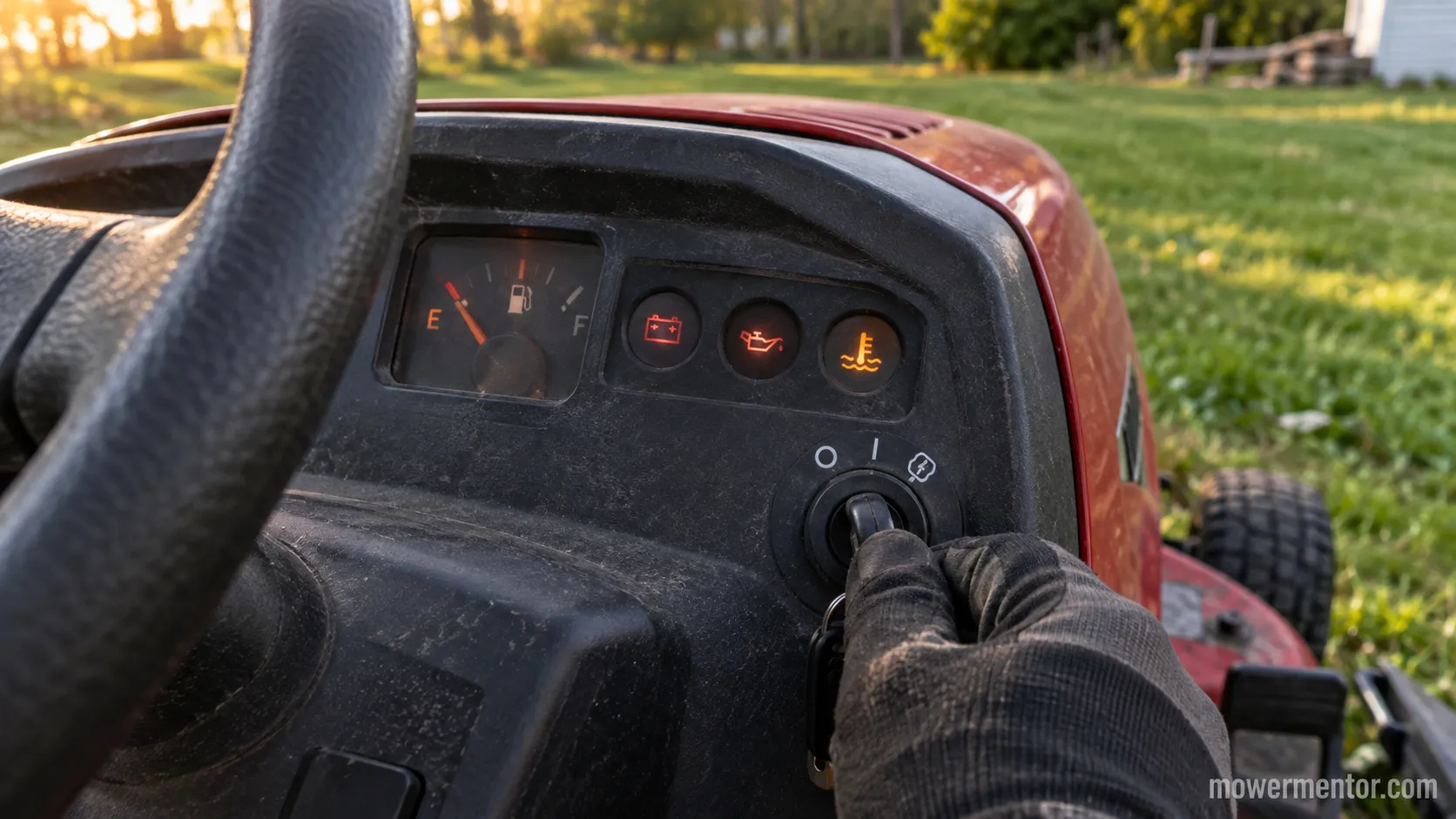
Then turn the key: if the dash lights are dim or dead, the fault is electrical; if the lights are strong but the engine will not catch, the fault is fuel.
Run these three checks before anything else:
Set the parking brake all the way and switch the blades (PTO) off. Many mowers will not turn over otherwise.
Confirm fresh fuel is in the tank. Gasoline older than about a month starts breaking down, and stale fuel is the single most common reason an engine will not fire, according to Briggs & Stratton.
Turn the key and watch the dash. Bright lights point you down the electrical branch; a healthy crank with no fire points you at fuel.
Most no-starts come down to one of those two branches, and the next section splits them apart in one question.
This is a 30-second triage, not the full fix. Work the matching branch below to actually solve it.
Why Your Troy-Bilt Riding Mower Won't Start: Fuel vs Electrical
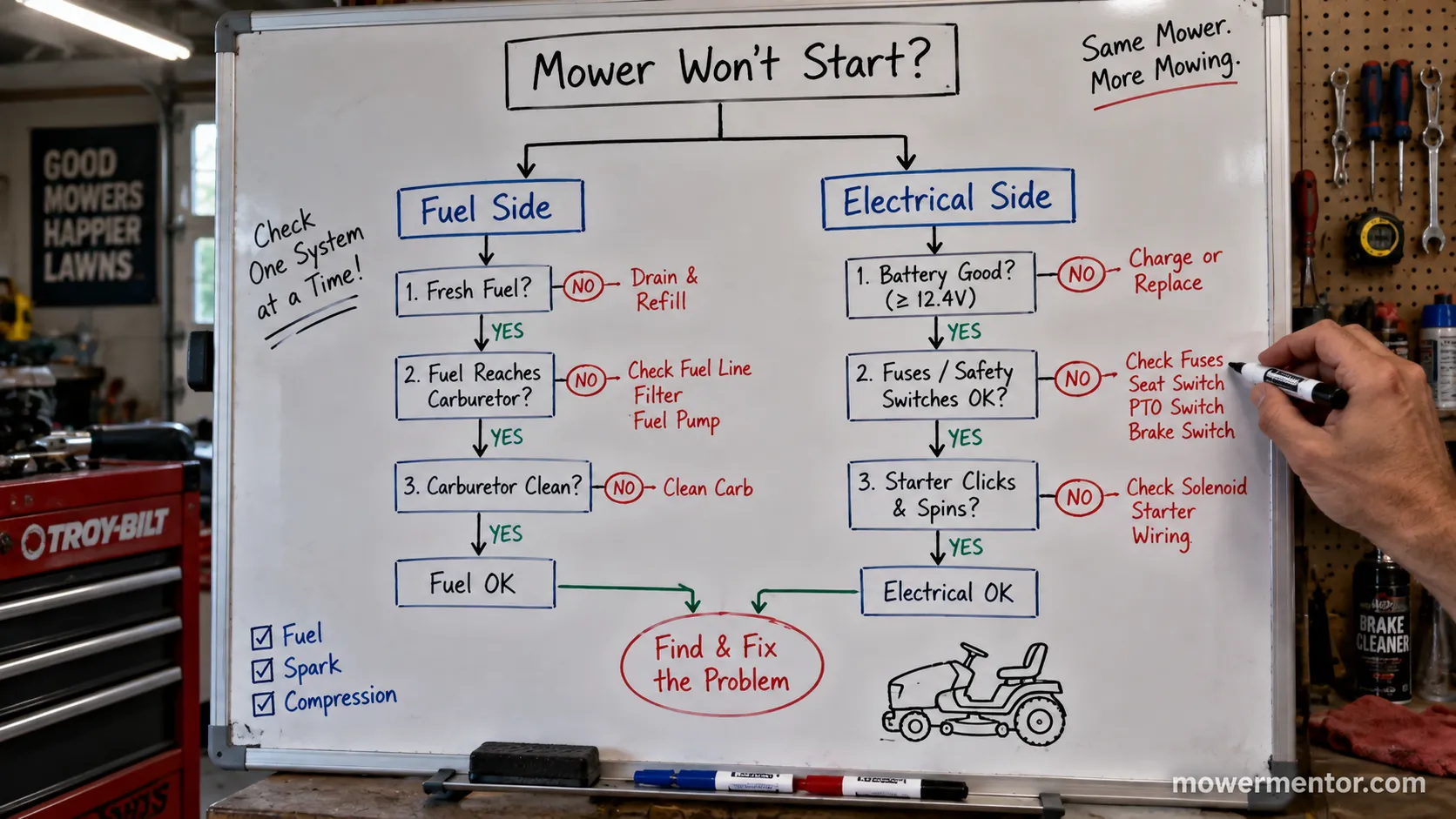
Why won't a Troy-Bilt riding mower start? The fastest way to know is to ask one question: does the engine crank, meaning it spins over, when you hold the key to start?
If it cranks but never fires, the fault is on the fuel side, usually stale gas or a gummed carburetor.
If it clicks, cranks slowly, or does nothing, the fault is electrical: a weak battery, a corroded connection, a tripped safety switch, a blown fuse, or the solenoid.
A resting battery below about 12.2 volts points straight at the electrical branch.
This one fork is what most top results skip. Videos and forum threads each cover a single branch, so owners guess and throw parts at the machine.
Ask yourself the branch question and follow it:
Engine cranks but will not catch goes to the fuel side, covered next.
One dead click, a slow crank, or total silence goes to the electrical side.
Troy-Bilt's own guidance starts the same way, telling owners to set the brake, switch the PTO off, and check for fresh fuel before anything else, per Troy-Bilt's starting guide.
The decision tree below just adds one meter reading so you stop guessing.
For the electrical branch, take one resting-voltage reading at the battery.
A reading at or above 12.4 volts is healthy enough to crank, while a reading below about 12.2 volts means the battery is roughly half charged or worse, based on a 12-volt state-of-charge chart.
Here is the same logic as a routing table.
What you hear or see | Most likely branch | Where to go next |
|---|---|---|
Engine spins but never catches | Fuel: stale gas or carburetor | Fuel side, below |
Rapid clicking when you turn the key | Electrical: weak battery | Electrical: battery |
One loud "dead click," no spin | Electrical: solenoid or battery | Electrical: solenoid |
Nothing at all, no dash lights | Electrical: dead battery, connection, or fuse | Electrical: battery and fuse |
Cranks slowly, labors to turn over | Electrical: battery or starter cable | Electrical: battery and starter |
The same fork applies to any brand, and the master starting-diagnosis walkthrough covers the generic version.
If it turns over but you want the no-crank electrical path in depth, follow the no-crank electrical path instead.
Some faults straddle both branches.
A failed safety switch can also kill spark, so if a fix half-works, re-run the branch question.
When the whole machine is dead with no lights at all, start with the power-loss checklist.
Fuel Side: It Cranks but Won't Fire
If a Troy-Bilt riding mower cranks but won't fire, the fuel system is almost always the cause.
Drain fuel older than about a month, including the gas trapped in the carburetor float bowl, and refill with fresh 87-octane holding no more than 10 percent ethanol.
Then pull the spark plug: a wet plug means fuel is reaching the cylinder and ignition is suspect, while a dry plug means fuel is not getting through, which points at a clogged filter, a closed fuel valve, or a gummed carburetor.
Work the fuel branch in this order and stop when it starts:
Fresh fuel and a bowl drain. Dump last season's stale gas, drain the carburetor float bowl, and refill with fresh fuel. Ethanol draws moisture and leaves varnish in the tiny jets and welch-plug passages, which is why a machine that ran fine in the fall can crank all day in spring without firing.
Read the spark plug. A wet plug tells you fuel is arriving, so suspect spark or a flooded cylinder; a dry plug tells you fuel delivery is the problem. That wet-versus-dry read is the single fastest fuel-side test, and it is demonstrated in Briggs & Stratton's starting video.
Reseat the plug wire and check the plug itself. A loose, dirty, or disconnected spark plug lead mimics a dead engine, a point Briggs & Stratton's top mower tips also flags. Replace the plug every season or 25 hours.
Check the fuel filter, shut-off valve, and line. Confirm the shut-off valve is open, the inline filter is not clogged, and the fuel line has no cracks or kinks. While you are in the airbox, check the filter fit, because a choked air filter starves the same engine of air.
Clean or rebuild the carburetor. If fresh fuel and a bowl drain do not help, the carburetor likely needs a spray-clean or a full soak. Gummed jets and welch plugs are common on stored machines.
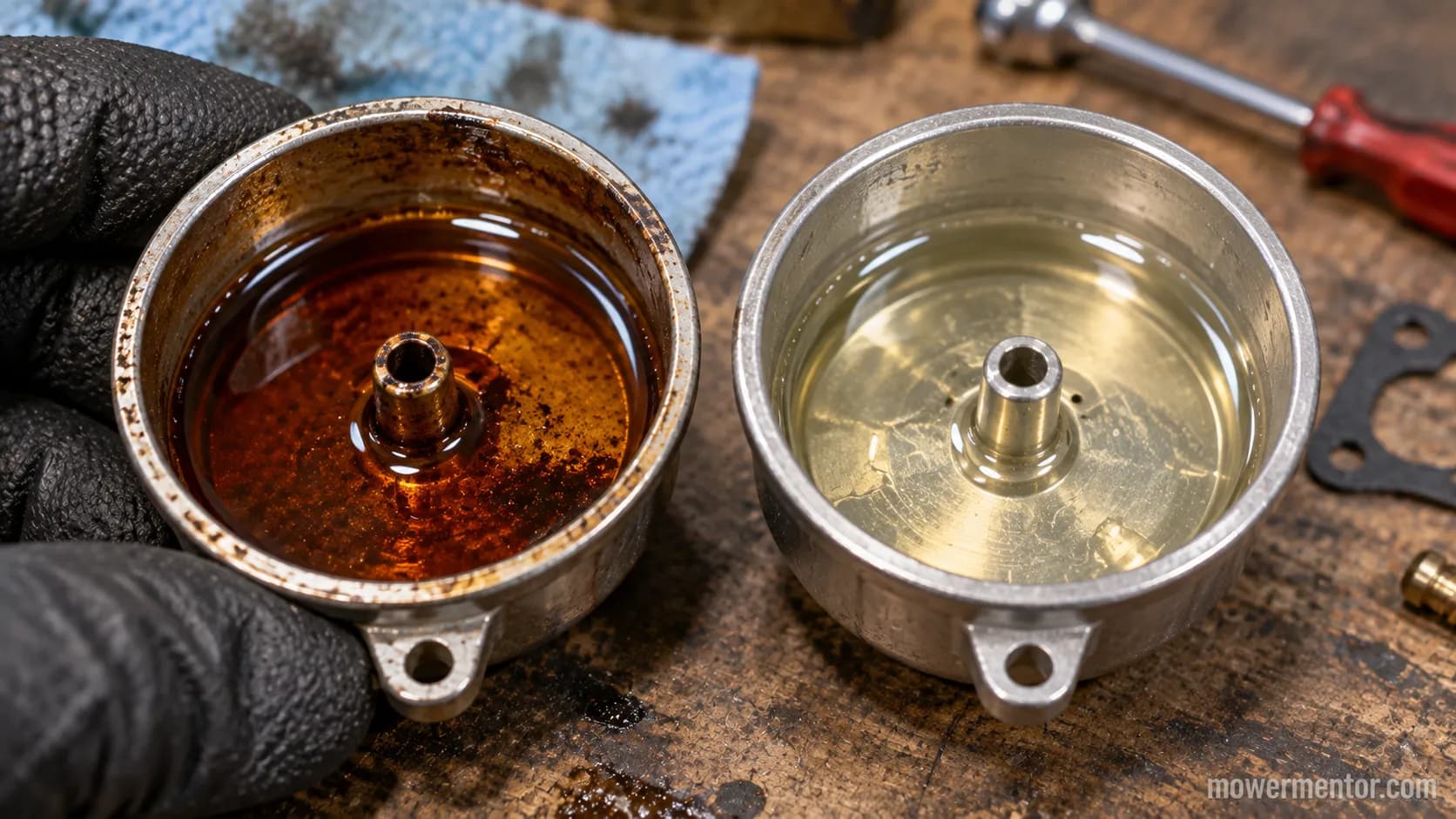
On a Pony 42 that had been sitting all winter, draining the varnished float bowl and refilling with fresh gas fixed a stubborn no-fire on the first try.
The photo below shows the amber, syrup-like old fuel next to a clean pour.
A full carburetor rebuild can run past what many owners want to tackle. If a spray-clean does not do it, that is a fair place to hand it off.
Electrical Side: It Clicks, Cranks Slow, or Does Nothing
When a Troy-Bilt riding mower clicks, cranks slowly, or does nothing, the fault is electrical. Start at the battery: a healthy 12-volt battery rests near 12.6 volts, so a reading below about 12.2 means charge or replace it first.
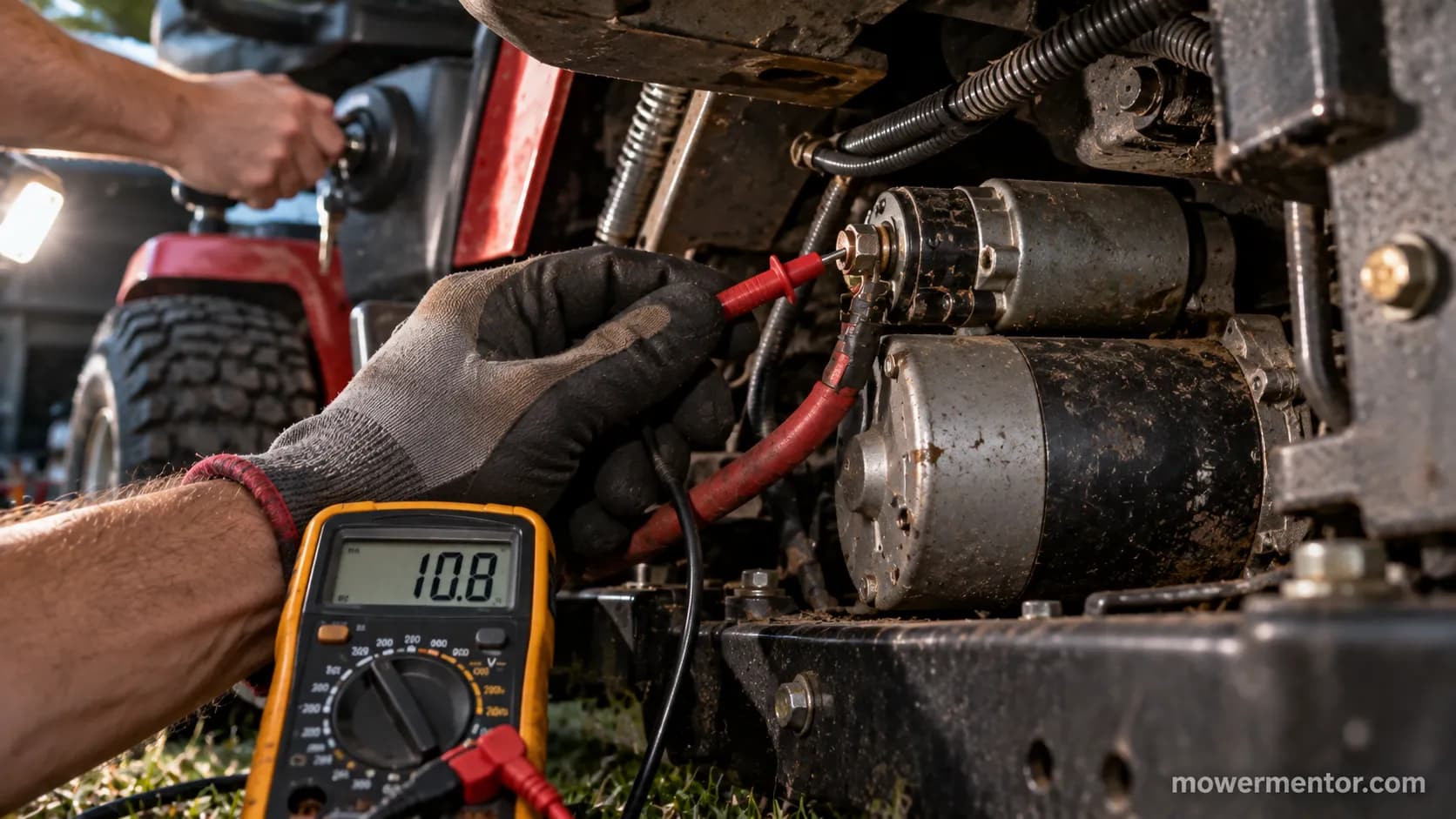
If the battery is good but you get only around 6 volts at the starter while cranking, a corroded cable or ground is dropping the voltage.
From there, work outward through the safety switches, the fuse between the battery and solenoid, the solenoid itself, the ignition switch, and finally the starter.
Battery
Measure resting voltage with the key off. A flooded 12-volt battery reads 12.6 to 12.8 volts at full charge, about 12.2 volts at half charge, and is critically low below 12.0 volts, per a 12-volt charge-level guide.
Rapid clicking usually means the battery cannot supply cranking current, not a bad solenoid, and the battery-vs-solenoid test explains why.
Connections and ground
Clean the terminals and the ground strap, then look for a voltage drop.
If the battery shows 12.3 volts at the posts but only about 6 volts at the starter while cranking, the cable or ground connection is the real fault, not the battery.
Total silence with no click at all points to a dead circuit, which the dead-circuit checklist walks through step by step.
Here is a reading taken on our Bronco 42 while chasing exactly that symptom.
Test point (Bronco 42) | Reading | What it tells you |
|---|---|---|
Battery at rest, key off | 12.3 V | Looks borderline healthy |
Battery posts during cranking | 11.1 V | Sags under load, still plausible |
Starter stud during cranking | 6.2 V | About 5 volts lost in the cable and ground |
Starter stud after cleaning ground | 11.0 V | Connection restored, engine cranked |
The battery was fine the whole time. A corroded ground strap was eating the voltage, and cleaning it turned a dead mower into a running one.
Safety interlocks (seat, brake, PTO)
Set the brake fully, switch the PTO off, and stay seated, because a failed seat, brake, or PTO switch stops the starter from engaging at all, as Sears PartsDirect's interlock guide documents for Troy-Bilt and other MTD machines.
Each of these switches can block a start on its own, and the safety-switch overview maps where they live.
To find a bad one, test each switch for continuity with a multimeter as you press and release it, a method Madison Tractor's interlock guide lays out clearly. A switch that never closes is your no-start.
Fuse
Trace the small red wire from the positive battery post toward the solenoid and find the inline fuse.
A blown fuse between the battery post and the solenoid kills the start circuit, and if a new fuse blows again immediately, you have a short, not a weak fuse.
A short in the blade or start circuit is a common cause of a popped fuse, as Madison Tractor's blade-engagement guide explains.
Solenoid
A single "dead click" with no crank often means the solenoid is not passing current to the starter. If all you hear is that one click when you turn the key, run the dedicated no-crank diagnosis.
To test the solenoid itself, our Troy-Bilt solenoid guide shows the cross-post jump safely.
Ignition switch
If the key does nothing, meaning no power with the key on and no crank, the switch or its wiring may be dead.
Check for power at the start terminal, and if the switch is the culprit, follow the ignition-switch guide.
Starter
A starter that cranks slow or not at all, especially when you are only getting 6 volts at the starter with good cable connections, is usually failing internally.
Some owners find it turns over every 5 key turns and dies between, which is a classic dying-starter tell.
Those are classic bad-starter symptoms, and a bench test confirms it.
Bypassing a safety switch is a diagnostic test only.
Never mow with an interlock defeated, because that is exactly the protection that stops the blades when you leave the seat.
Pony vs Bronco (and TB30 and RZT) Model Notes
Troy-Bilt no-start fixes vary by model. A Pony 42 uses a 547cc Troy-Bilt (Powermore) engine, while a Bronco 42 typically runs a Briggs & Stratton, so fuel-side specs differ.
The compact TB30B uses a 344cc Briggs and an AGM battery, which reads slightly higher than a flooded battery at the same charge.
Zero-turn RZT models add a rule: both steering levers must be centered in neutral before the engine will start.
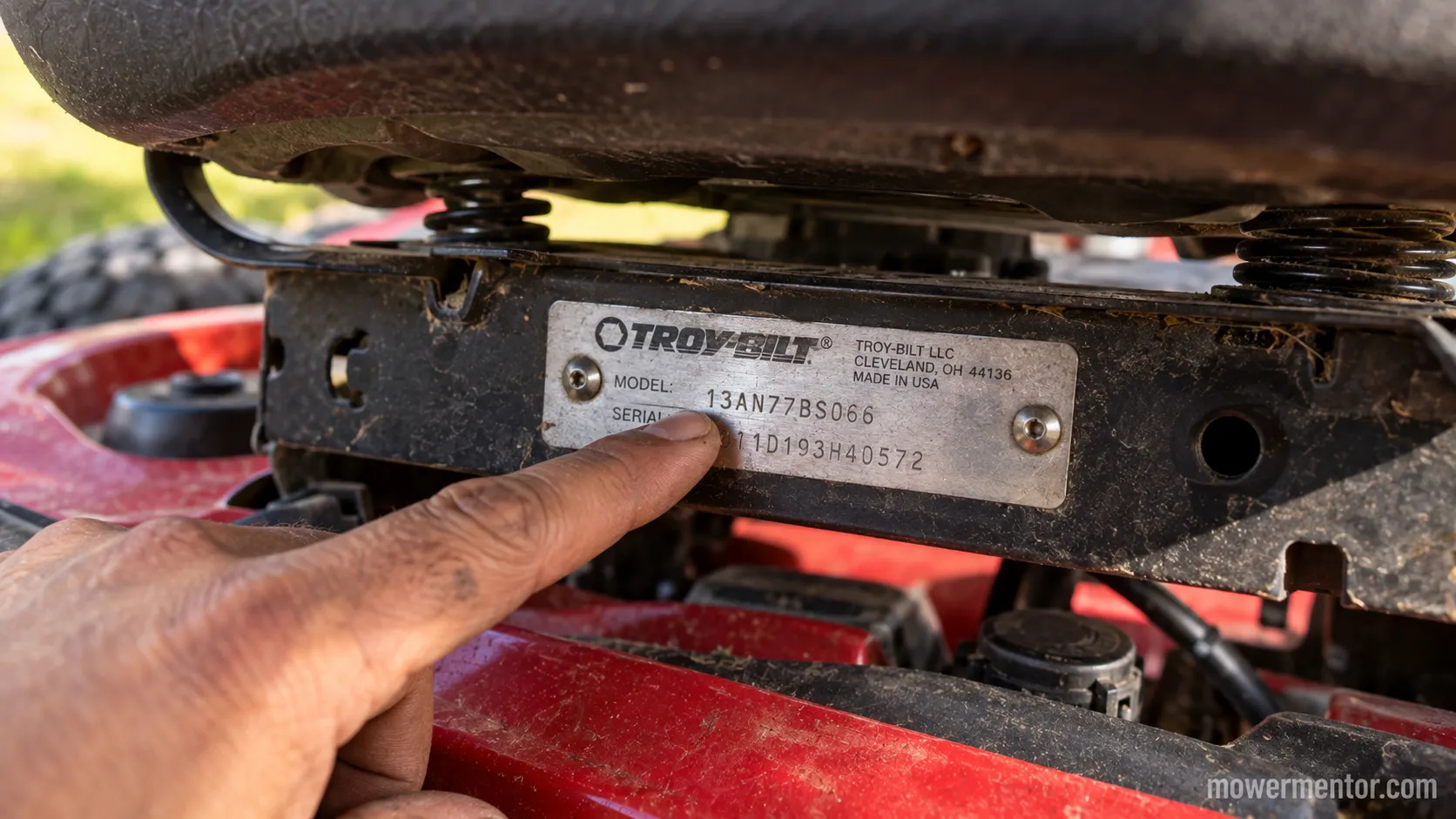
Read the model plate first to know which machine you have.
What's the model number on your plate?
The model and serial plate is a small tag, roughly two inches by three, usually under the seat or on the frame below it. It carries an 11-character model and serial string.
A model that begins 13A877BS is a Pony 42, a mapping you can confirm against the Pony 42 specifications.
Reading that plate on our own Pony 42 confirmed the Powermore engine before ordering a spark plug, which saved buying the wrong part for a Briggs.
Model | Engine | Battery | No-start quirk to know |
|---|---|---|---|
Pony 42 | 547cc Troy-Bilt (Powermore) | Group U1 flooded | Plate prefix 13A877BS; run 87-octane at 10 percent ethanol or less |
Bronco 42 | Briggs & Stratton | Group U1 flooded | Carburetor and plug specs differ from the Powermore engine |
TB30B rear-engine rider | 344cc Briggs & Stratton | AGM | Read it on the AGM row of the voltage chart, not the flooded row |
RZT zero-turn | Varies by year | Group U1 | Both steering levers must be centered in neutral to start |
Troy-Bilt is an MTD brand, now part of Stanley Black & Decker, and its Powermore engines come from an MTD engine venture.
That is why one owner's fuel-side fix does not always match another's: the engine under the hood can be a different brand entirely.
Once you know your model, match the right battery group and CCA for a Pony or Bronco.
Engine brand also decides starter fitment, covered in the Troy-Bilt starter guide.
If you already fitted a new battery and it still will not crank, run the battery-eliminated check.
Specs shift year to year. Always confirm against the plate on your machine, not a generic chart.
Troy-Bilt Won't Start After Winter Storage
If a Troy-Bilt riding mower ran last fall but won't start after winter, two things usually happened over storage: the fuel went stale and the battery self-discharged.
Drain the old gas, including the carburetor float bowl, and refill with fresh fuel.
Then charge or replace the battery, since a resting reading below about 12.2 volts means it lost too much charge to crank.
If it still will not start, run the fuel-versus-electrical decision tree from the top of this guide.
Work the spring revival in this order:
Drain the stale gas and the float bowl, then refill with fresh fuel. Untreated gasoline breaks down in about 30 days, which is why Briggs & Stratton's storage advice recommends a stabilizer before storage.
Charge or replace the battery. Batteries self-discharge in cold storage, and a flat one will not crank no matter how fresh the fuel is.
Check the deck, airbox, and exhaust for mouse nests or debris that moved in over winter.
If it still will not start, return to the branch question and follow the matching side.
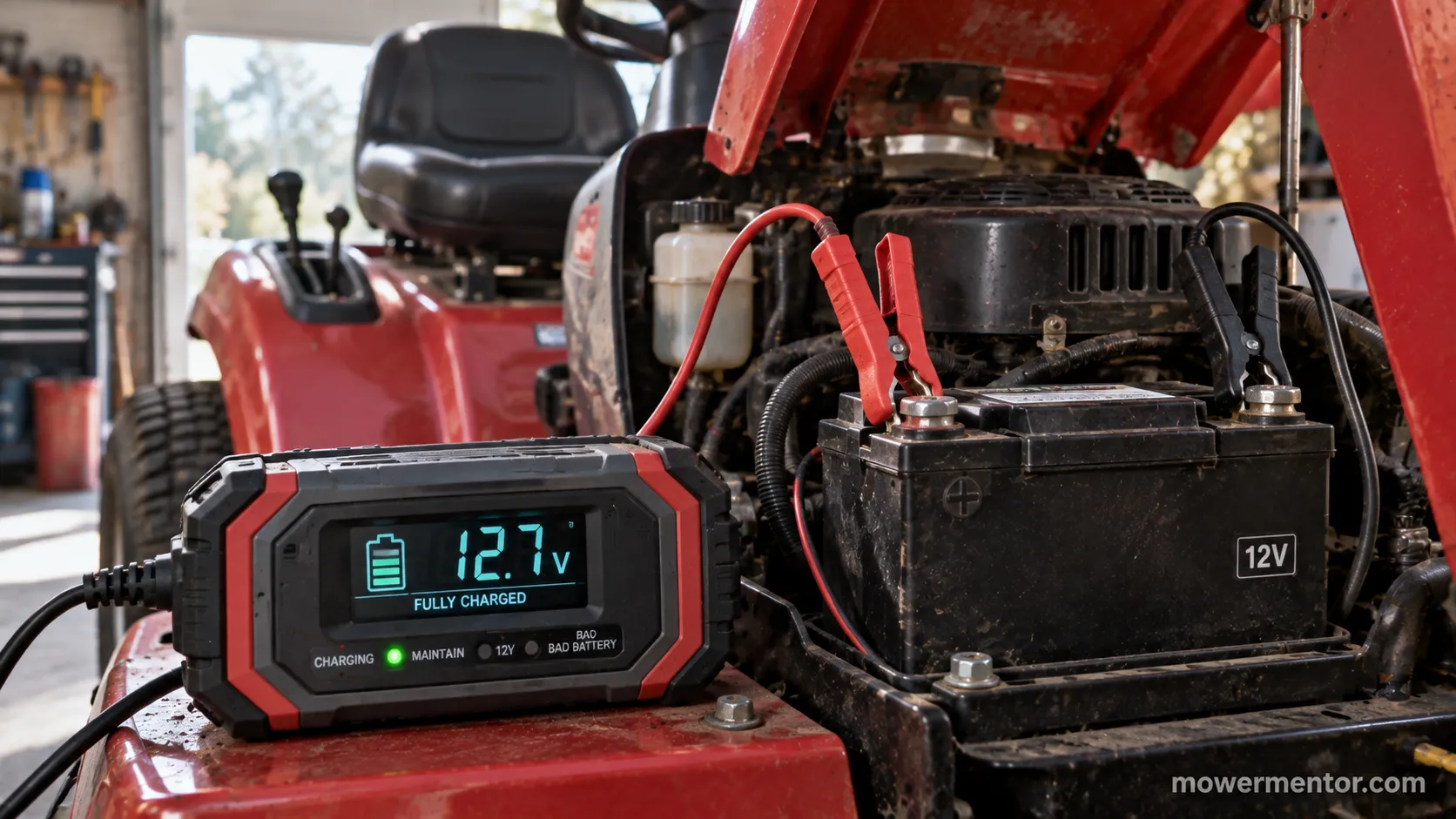
Our Pony sat untouched all winter. Fresh fuel plus a full charge that took the battery from 11.9 volts up to 12.7 volts on the charger brought it back to a first-turn start.
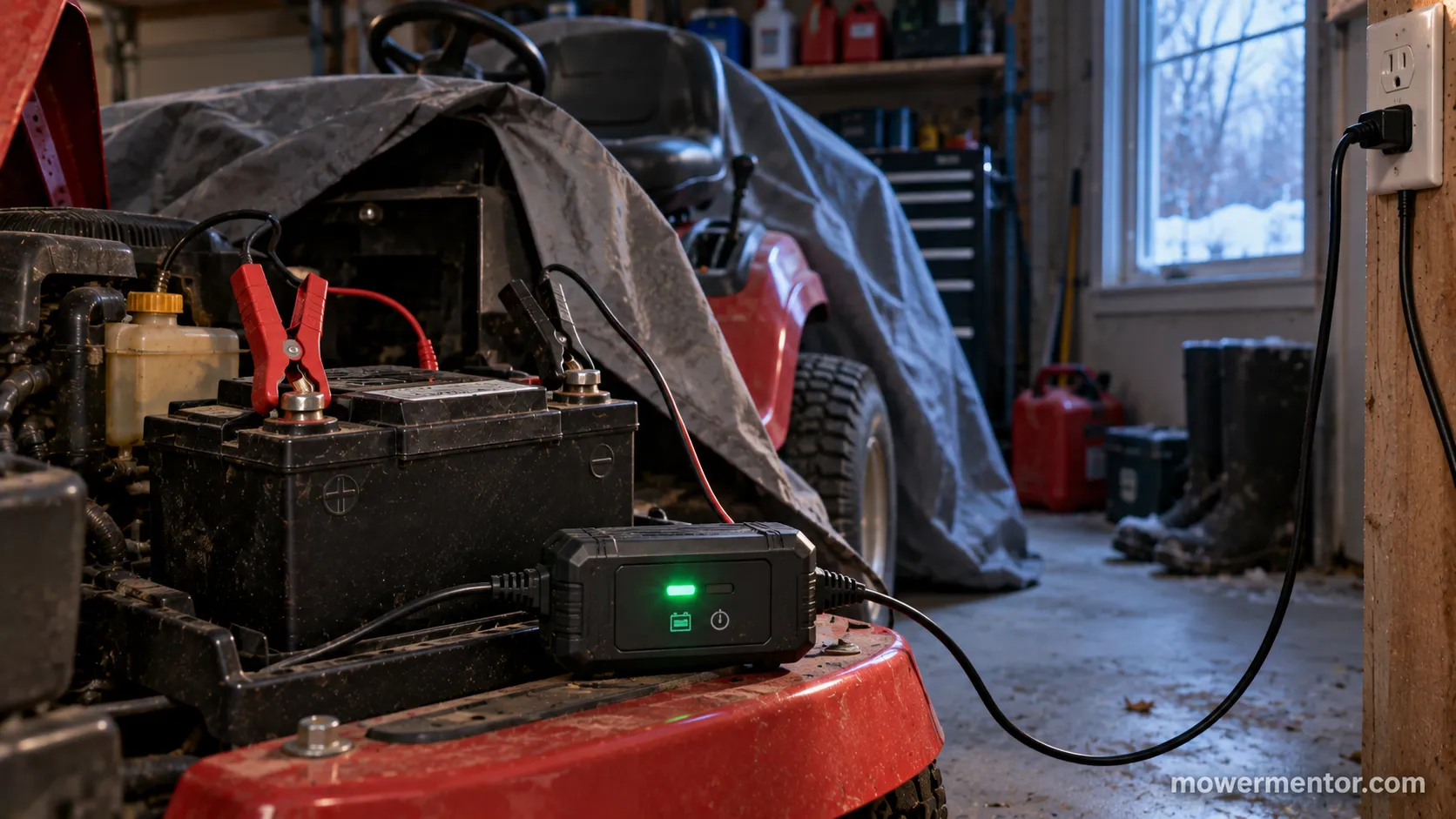
If the battery is flat after storage and you need to mow today, you can get going by jump-starting it safely while the charger catches up.
If the battery will not hold at least 12.4 volts a few hours after a full charge, it is likely worn out and due for replacement.
When to Stop: Safety Red Flags and When to Call a Pro
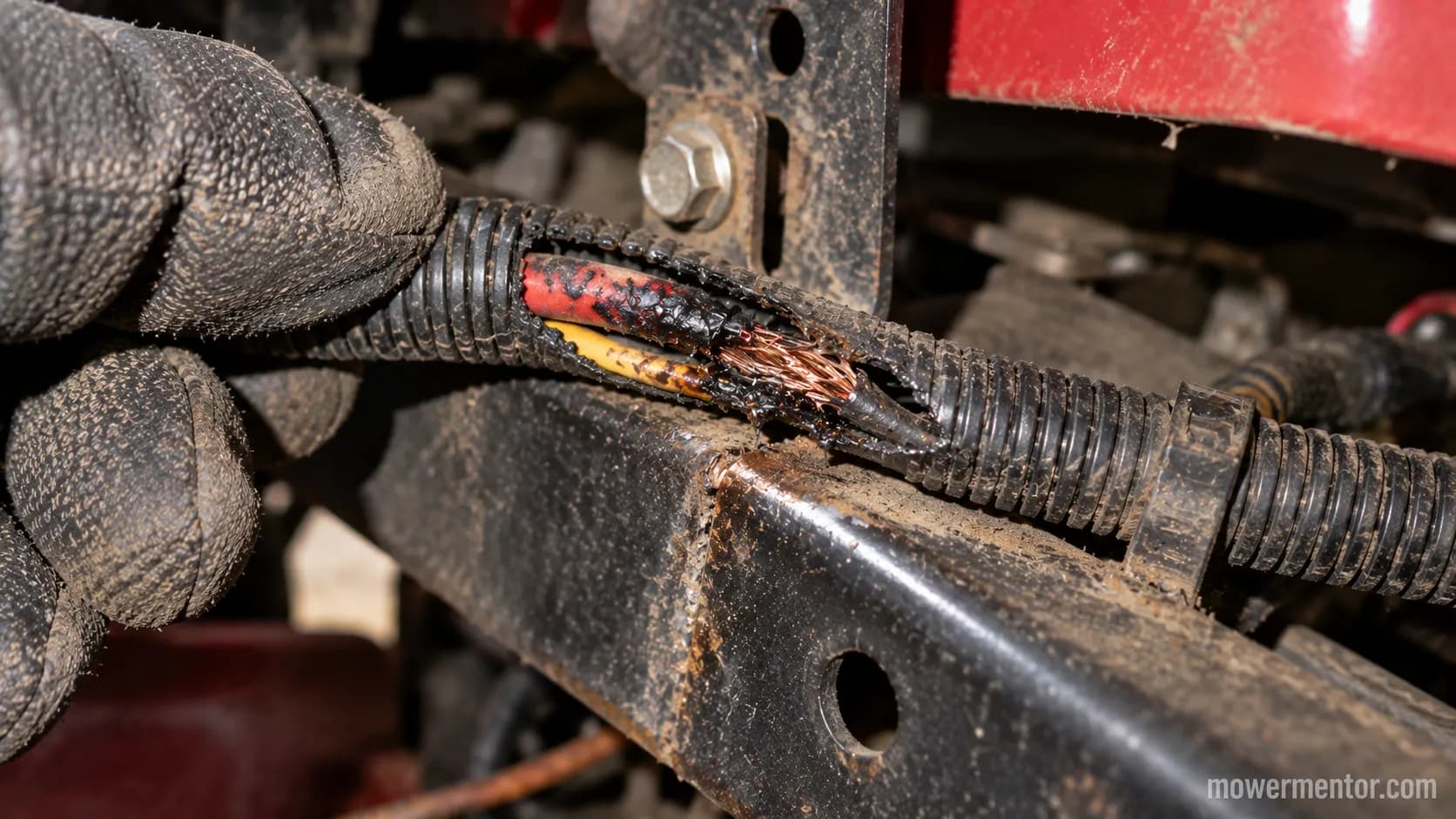
Some Troy-Bilt no-starts are not safe do-it-yourself jobs. Stop and call a professional if you smell fuel or see a leak, if a new fuse blows again immediately, which signals a wiring short, or if the engine has no compression or pops back through the carburetor, which points at valve or internal-engine trouble.
Never mow with a safety interlock bypassed, because bypassing is for a quick diagnostic test only.
When the likely parts bill approaches the cost of a shop visit, a dealer is often the cheaper choice.
Treat these as hard stops:
You smell raw fuel or see gas dripping anywhere.
A fresh fuse blows again the instant you turn the key, meaning a short somewhere in the harness.
The engine has no compression, or it pops and kicks back, which suggests a valve-clearance or internal problem best handled with a leak-down test or a Briggs & Stratton dealer.
You see smoke, or sparks at the battery terminals.
We stopped on one mower whose new fuse blew instantly every time. Tracing it later revealed a chafed wiring harness rubbing bare against the frame, with melted insulation, exactly the short a re-blowing fuse warns about.
If you truly must isolate a switch to test it, do it the safe, temporary way, not a permanent bypass.
And before you sink money into parts, weigh the bill against the current tune-up cost ranges at a shop.
Prevent the Next No-Start: Off-Season and Seasonal Care
To keep a Troy-Bilt riding mower starting reliably, prevent the two faults behind most no-starts.
Add fuel stabilizer before storage so the gas does not varnish the carburetor, and keep the battery on a maintainer so it does not self-discharge below about 12.2 volts.
Each season, replace the spark plug and air filter roughly every 25 hours, and clean the battery terminals and safety-switch connectors, adding a little dielectric grease to stop corrosion.
A simple off-season checklist covers it:
Add fuel stabilizer and run the engine a few minutes so treated fuel reaches the carburetor, or run the tank dry if your manual prefers that.
Put the battery on a maintainer, or pull it and trickle-charge it through winter.
Clean the terminals and interlock connectors, then add dielectric grease on connectors so corrosion does not creep back in.
Fit a fresh spark plug and air filter, which routine checks of fuel, air, and plug help you stay ahead of.
Our maintainer-kept Pony has started on the first turn three springs running, and the storage log ties each easy start to the maintainer being left connected.
Fold these into a full seasonal service using our lawn mower tune-up walkthrough.
Battery-powered owners have a different routine in the electric tune-up guide.
If the airbox is cracked and leaking, replace the cover and housing so the filter seals.
Some manuals prefer that you run the tank dry rather than store stabilized fuel. Follow the one printed for your engine.
Frequently Asked Questions
Why won't my Troy-Bilt turn over even with a good battery?
A good battery can still fail to crank if the voltage is not reaching the starter. Clean the ground strap and cable ends, then check for a voltage drop: if you read a healthy number at the battery but only about 6 volts at the starter while cranking, the connection or a tired solenoid is the problem, not the battery.
Do all the safety switches have to be set to start?
Yes. The parking brake must be fully set, the PTO or blade switch must be off, and you must be seated.
A failed seat, brake, or PTO switch will block the start on its own. On a zero-turn RZT, both steering levers also have to be centered in neutral.
My battery reads 12.3 volts but it still won't crank. Why?
A Troy-Bilt battery can read 12.3 volts at rest yet fail to crank, because that surface voltage does not reflect its ability to deliver high cranking current. Load-test it, or watch voltage at the starter while cranking; if it collapses toward 6 volts, the battery or a cable and ground connection is the fault.
Where's the fuse on a Troy-Bilt riding mower?
It sits inline on the small red wire between the positive battery post and the starter solenoid. Trace that wire from the battery and you will find the fuse holder.
If a fresh fuse blows immediately, you have a short rather than a bad fuse.
Why won't it start after sitting all winter?
Two things usually happened in storage: the fuel went stale and the battery self-discharged. Drain the old gas including the float bowl, refill with fresh fuel, and charge or replace the battery.
If it still will not start, work the fuel-versus-electrical branch from the top of this guide.
These answers are general. Your exact model and its plate may change a few specifics, so confirm against your machine.
Getting Your Troy-Bilt Running Again
Nearly every no-start comes down to that first fork. Whether you type it troy bilt riding mower won't start or Troy-Bilt with the hyphen, the method is the same: ask whether the engine cranks, then work the fuel side or the electrical side instead of guessing.
Fuel problems reward fresh gas, a bowl drain, and the wet-versus-dry plug read.
Electrical problems reward a meter, because a resting voltage and a reading at the starter tell you in seconds whether the battery, a connection, a switch, the fuse, the solenoid, or the starter is at fault.
The owners who fix these fastest are the ones who measure once instead of buying parts five times.
Read your plate, take two readings, follow the branch, and a Troy-Bilt riding mower that won't start usually turns back into one that does by the end of the afternoon.
Found this useful? Make us a preferred source so we show up in your Google results.
Keep reading
Related articles
Troubleshooting & Repair
Dead Dash? Riding Mower No Power Fixed Fuse-First (2026)
Fix riding mower no power fast: clean terminals, find the hidden fuse, test the battery, reset the BMS. A fuse-first checklist for gas & electric mowers.
Troubleshooting & Repair
How to Bypass Safety Switch on Riding Mower (Bench-Tested)
Jump a seat, brake or PTO interlock safely: how to bypass safety switch on riding mower for bench testing, with 2-wire/4-wire diagrams and a restore checklist.
Troubleshooting & Repair
Riding Lawn Mower Won't Turn Over: 5-Stage Voltage Test
Fix it fast: a riding lawn mower won't turn over usually means battery, ground, solenoid or starter. Test each in 5 ordered stages.
Troubleshooting & Repair
Just Clicks? Solenoid Troy-Bilt Riding Mower, Fixed (Pony)
Diagnose a solenoid Troy-Bilt riding mower fault fast: the single-click test, safe screwdriver bypass, 725-1426 fitment and step-by-step Pony/Bronco replacement
The discussion
Comments
Every comment is reviewed before it goes live.