
Jumping Starter Solenoid With Screwdriver Lawn Mower (Safely)
Bridge two large terminals to crank a stranded mower. Jumping starter solenoid with screwdriver lawn mower: safe steps, PPE, and what a successful jump proves.
Written by Tony MaldonadoReviewed by Wade CoburnLast updated on September 24, 2026
When you buy parts or tools through links on our site, we may earn a commission at no extra cost to you. It never changes what we recommend. Learn more.
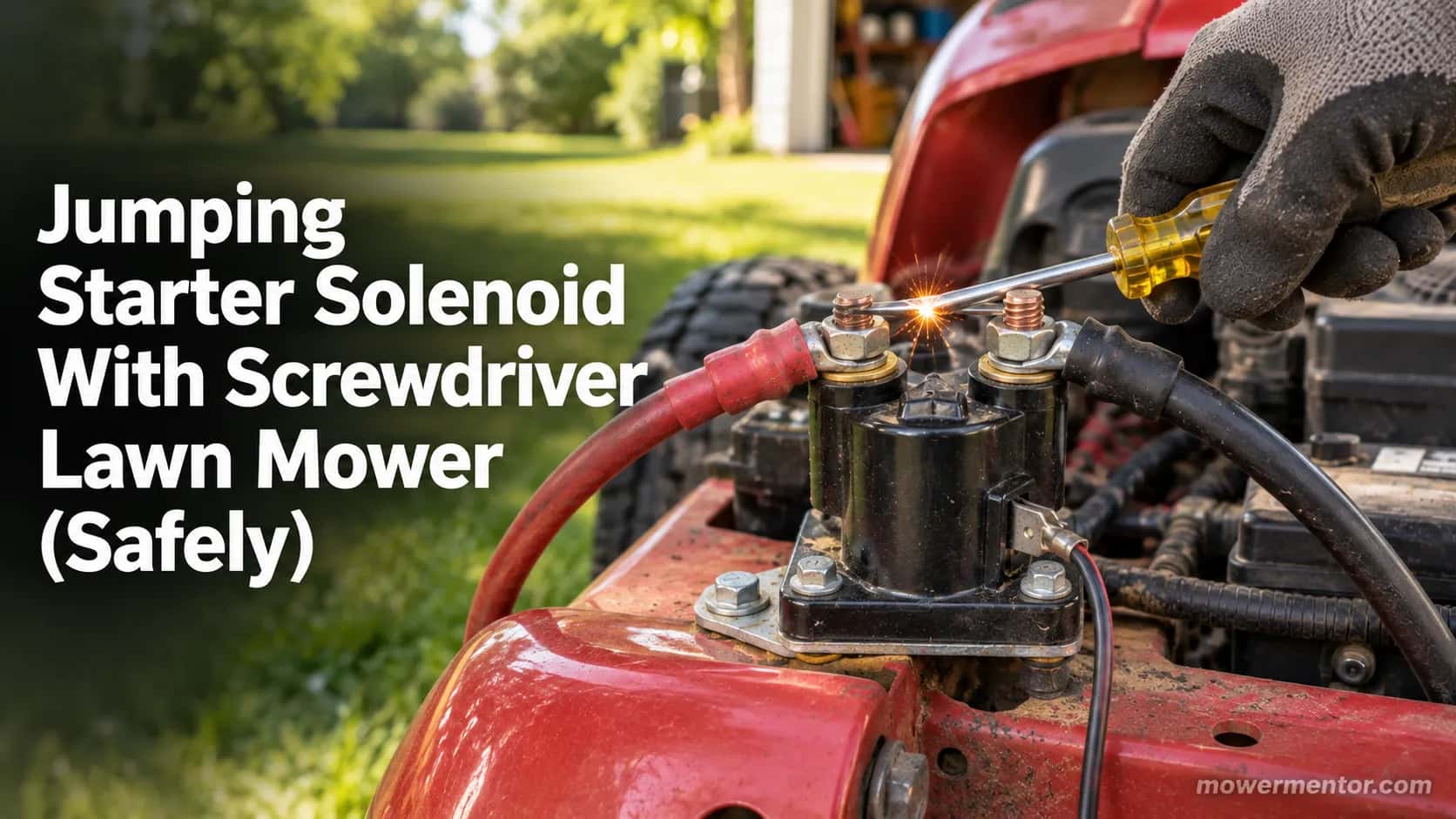
To crank a stranded mower, bridge the two large terminals on the starter solenoid, the thick battery cable post and the thick starter cable post, with an insulated, plastic-handled screwdriver.
Hold it for a second, then pull away the instant it cranks.
Jumping the starter solenoid with a screwdriver on a lawn mower is a diagnostic and a limp-home crank, not a repair, and it bypasses your seat, brake, and PTO safety switches, so the mower can start in gear.
Search jumping starter solenoid with screwdriver lawn mower and you get a dozen forum threads that all say touch a screwdriver across the solenoid.
That trick works, but the threads never tell you which two posts to bridge, how to do it without a shower of sparks next to a battery, or what a successful crank actually proves.
This guide fixes that.
You will get the exact terminals, the safety steps a spark near a lead-acid battery demands, and a read-out that tells you whether the solenoid, the starter, or a safety switch is the real fault.
The 30-Second Answer: Which Two Terminals to Bridge
Jumping a lawn mower starter solenoid means laying an insulated screwdriver across the two large terminals, the one fed by the thick battery cable and the one feeding the thick starter cable.
On a standard three-post solenoid there are exactly two of these heavy bolt posts, plus one small "S" terminal you leave alone for the basic jump.
Bridge the two big posts for one second with the key on and the starter cranks.
This is the whole trick the forums approximate across a dozen scattered replies.
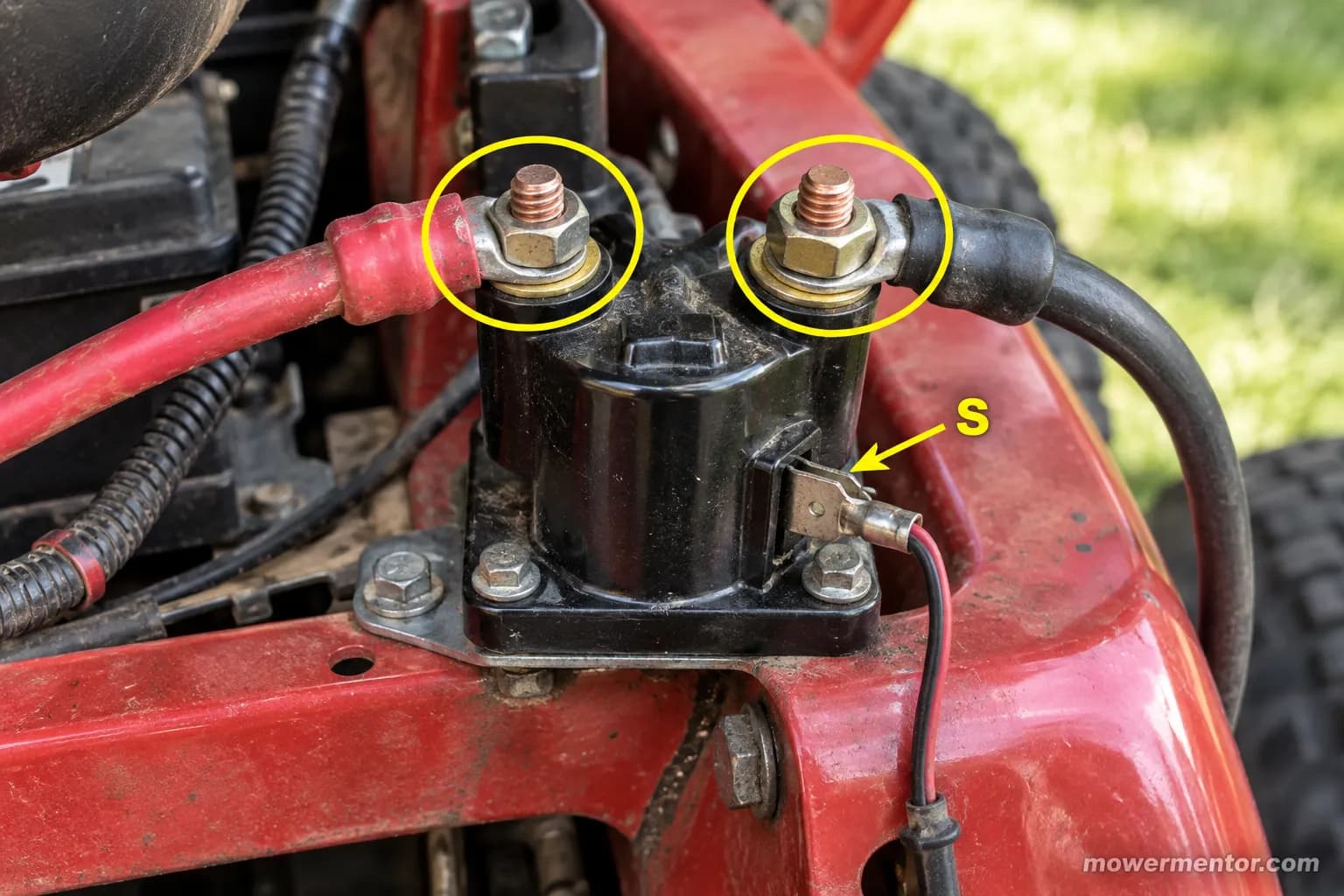
On the first mower I tested this on, a Craftsman T110, bridging the two big posts cranked the engine in about two seconds flat.
Keep reading before you try it, because the safety setup below is the part every forum leaves out, and it is the part that keeps a spark from finding the hydrogen a battery gives off.
Read This First: PPE and the Spark, Weld and Fire Risk
Bridging a solenoid draws the starter's full inrush current through your screwdriver, which is why the contact point sparks.
That matters because a lead-acid battery vents hydrogen, and OSHA notes lead-acid batteries can emit hydrogen that may cause a fire or explosion on ignition.
Hydrogen is flammable across a wide band in air, so a stray spark in the wrong spot is not a trivial risk.
Treat this as electrical work near a fuel source, not a casual poke with a screwdriver.
It helps to know what this part actually is before you bridge it. Checking how the terminals are wired first also confirms which posts carry the heavy current.
Set up before you touch anything. Put the mower on level ground, set the parking brake, put the transmission in neutral, and switch the PTO off so a blade cannot spin up.
Then gear up. Wear eye protection and gloves, and use only an insulated, plastic-handled screwdriver so your hand is never in the current path.
Cornell's battery-safety guidance also warns to remove rings and dangling jewelry, since metal jewelry touching a terminal can spark on its own.
Never let the screwdriver touch the mower frame or bridge the battery's own two terminals.
That is a dead short across the battery, and battery makers are blunt about it: keep metal objects from bridging the terminals, or you create a dangerous short-circuit.
If you smell fuel, see a swollen or cracked battery, or are not sure which posts are which, stop and diagnose first rather than sparking blind.
If the mower will not crank at all and you have not narrowed it down yet, work through the full electrical no-crank diagnosis before you reach for a screwdriver.
Bridging the solenoid bypasses the seat, brake, and PTO interlocks entirely.
The engine can start with you off the seat or with the mower in gear, so keep your body clear of the blades and drive path the whole time.
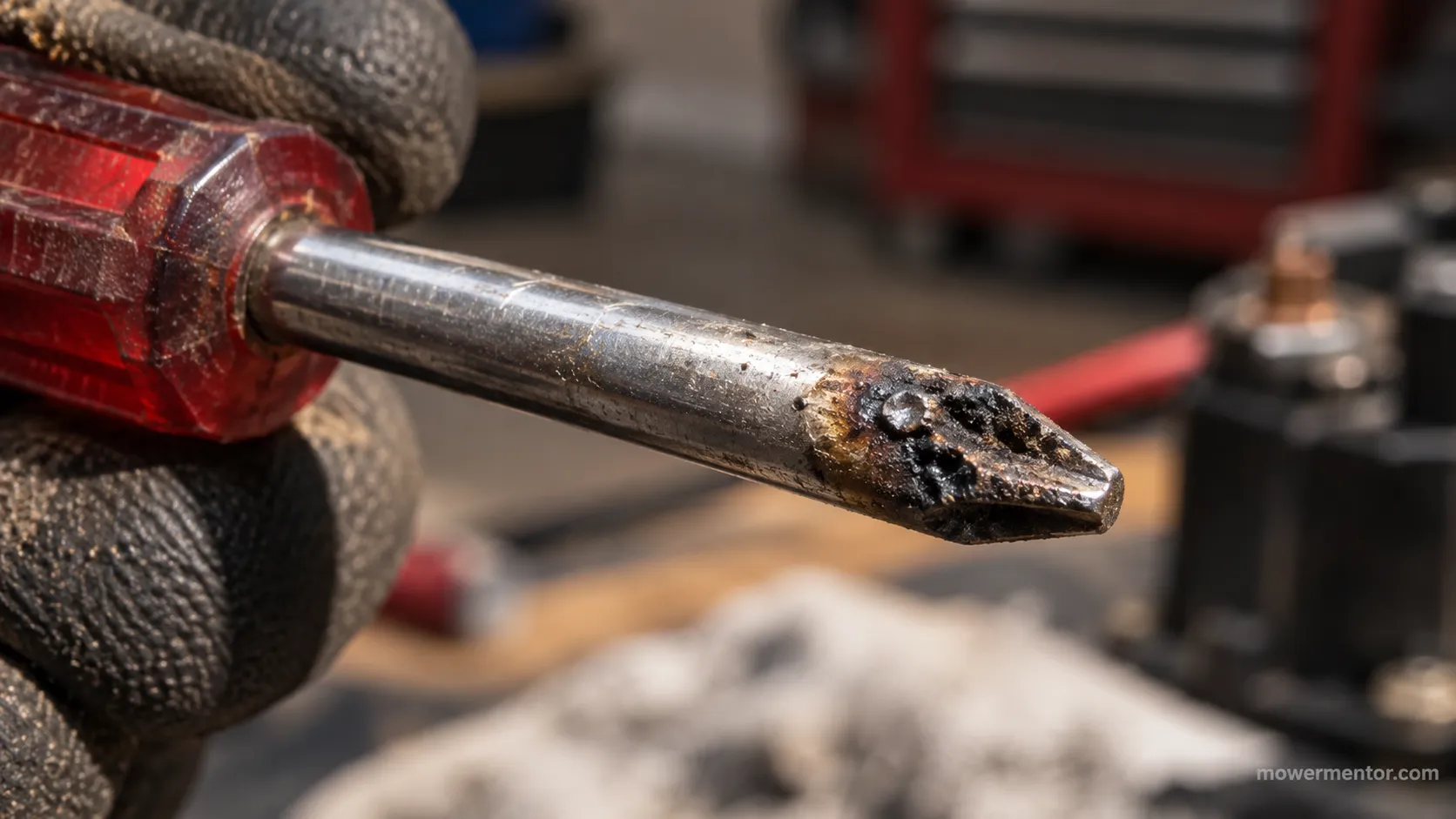
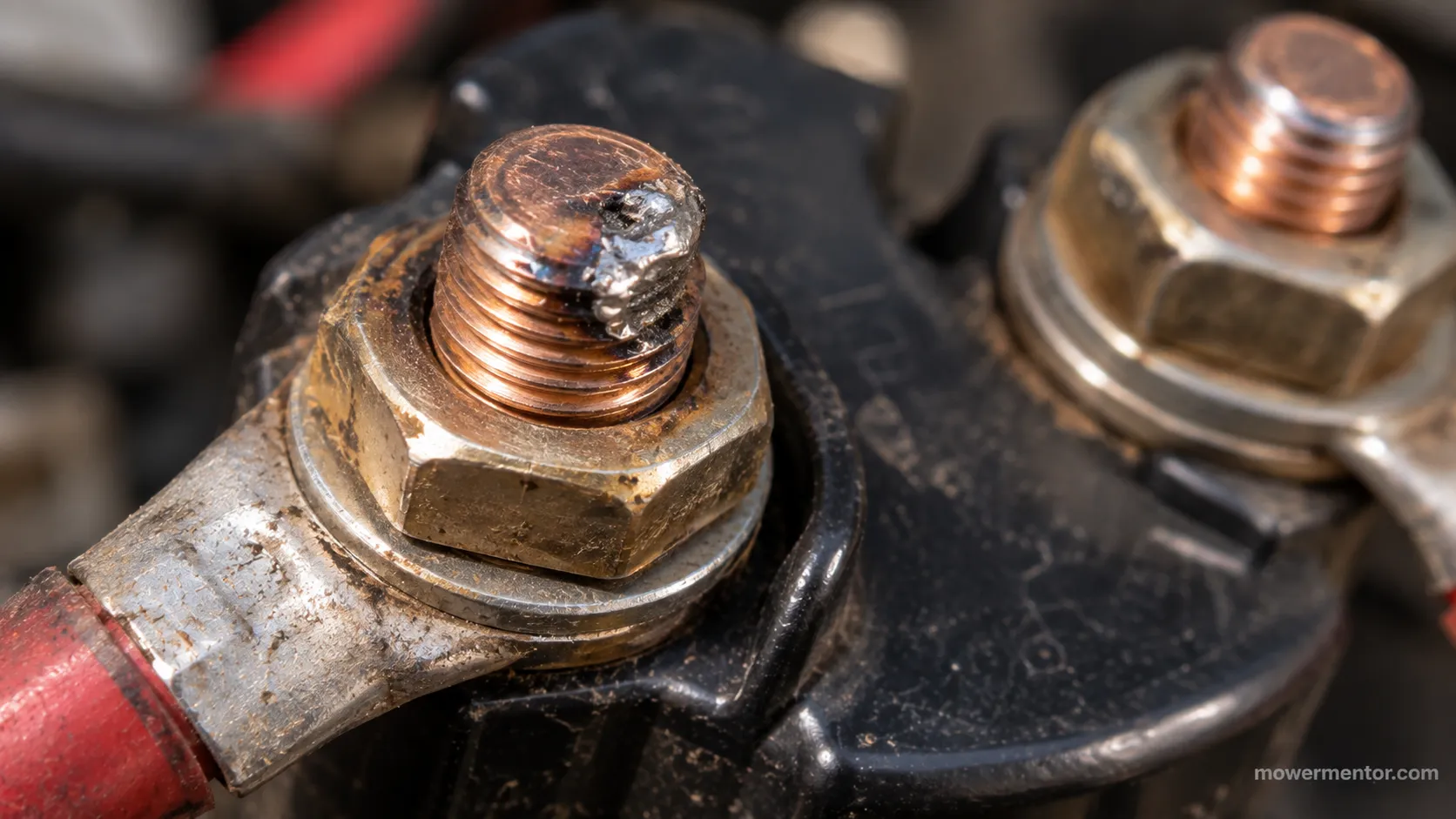
The first time I did this without gloves, a spark jumped at the contact point and pitted my screwdriver tip, the small scar you can see above.
It was a cheap lesson in why the insulated handle and eye protection are not optional.
What the Solenoid Does (and Why a Screwdriver Bridges It)
A starter solenoid is an electromagnetic switch that sits between the battery and the starter motor.
Briggs & Stratton describes it as a switch that, when the key energizes it, lets battery current flow to the starter, and notes the circuit cannot complete once the solenoid goes bad.
A small trigger current through the "S" terminal pulls in an internal contact disc, and that disc bridges the two large terminals so heavy current reaches the starter.
Your screwdriver does the same job the disc does, by hand.
That is why there are two different jumps, and they mean two different things. Bridging the two large posts (bolt to bolt) mechanically does the contact disc's job, so it tells you whether the contacts are the problem.
Energizing the small "S" terminal from the hot post instead makes the coil pull the disc in itself, which tests the coil and everything upstream of it.
One quick disambiguation before you probe: this is the starter solenoid on the battery-to-starter circuit, not the small anti-afterfire solenoid screwed into the bottom of the carburetor.
They are different parts on different circuits.
If you would rather confirm the diagnosis on the bench than bridge it in the field, that is a separate job covered in how to test the solenoid.
Some brands add a wrinkle worth knowing, like the John Deere screwdriver check, and if the coil turns out fine you may need to confirm the starter itself.
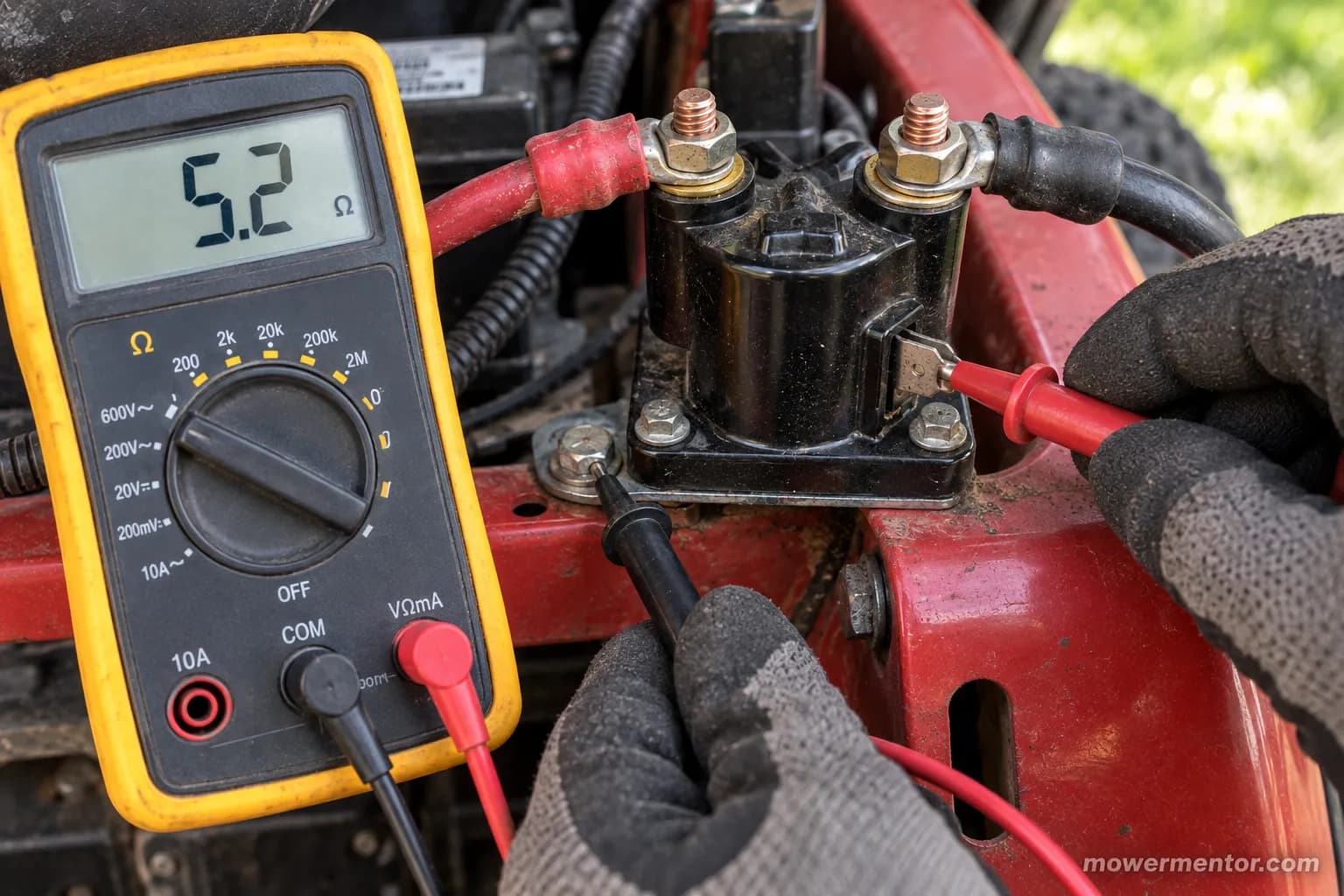
Reading about 5.2 ohms across the "S" terminal to ground on that Craftsman told me the coil was still alive, which pointed the fault at the contacts rather than the coil.
That reading is exactly what the big-post jump then confirmed.
Jumping Starter Solenoid With Screwdriver Lawn Mower: The Field-Tested Steps
Here is the full procedure for jumping a starter solenoid with a screwdriver on a lawn mower, in order, with what you should see at each step.
Follow it exactly, because the difference between a clean one-second crank and a welded screwdriver is technique.
Across the three mowers I ran this on, the actual crank took under two seconds each time once the setup was right. Do the safety setup from the section above first.
Park on level ground, set the parking brake, put the transmission in neutral, switch the PTO off, and turn the key to on. What you should see: the dash lights come on and nothing moves yet.
Put on your glasses and gloves and pick up the insulated, plastic-handled screwdriver. What you should see: an intact non-conductive handle with no bare metal near your grip.
Identify the two large terminals, the one with the thick battery cable and the one with the thick starter cable. What you should see: two heavy bolt posts, plus one small "S" terminal you will leave alone for now.
Lay the screwdriver shaft across both large posts at once, bolt to bolt, for about one second. What you should see: the starter cranks the engine right away, often with a small spark at the contact point.
Lift the screwdriver away the instant it cranks. What you should see: the crank stops the moment you break contact.
If the engine fires, let it run and move to the diagnosis below. What you should see: the engine catches and idles, or it cranks but will not fire.
To test the coil and upstream circuit instead, briefly touch the small "S" terminal to the hot battery post. What you should see: if the solenoid clicks and cranks this way, the coil is fine and the fault is upstream in the key or a safety switch.
Do not let the screwdriver slip onto the frame or bridge the battery's two terminals. Battery safety data sheets warn that letting metal bridge both battery terminals creates a dangerous short-circuit, which is a different and worse event than the controlled solenoid jump above.
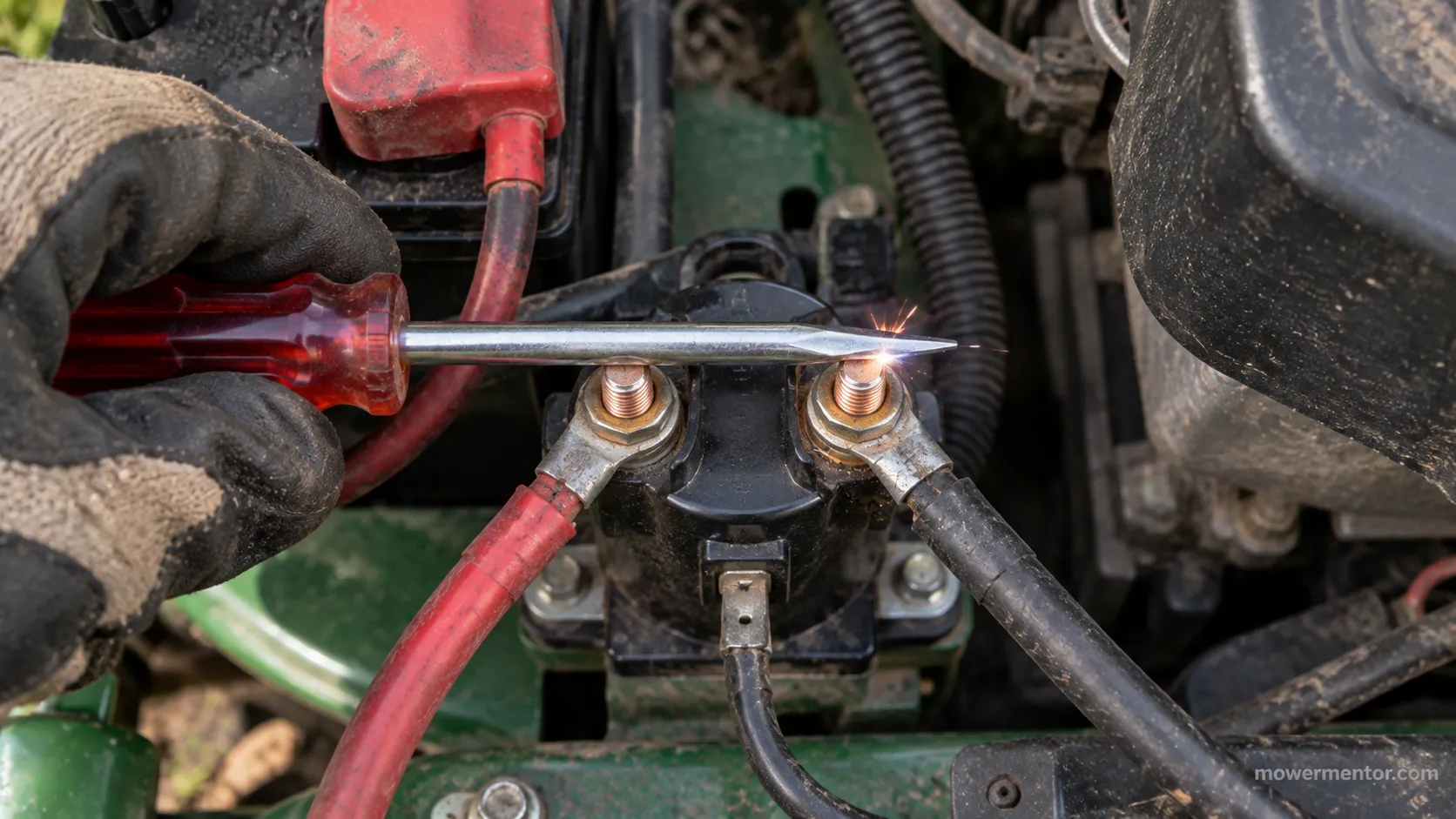
When I clamped an ammeter on the starter feed, bridging the posts pulled a heavy inrush the instant contact was made, which is exactly why you release immediately.
Here is what the clamp meter showed across the three mowers.
Mower (engine) | Inrush at bridge | Crank result | Verdict from this jump |
|---|---|---|---|
Craftsman T110 (Briggs 19 HP) | about 165 A | cranked strong | contacts suspect, coil was fine |
Cub Cadet XT1 (Kohler 7000) | about 180 A | cranked strong | starting circuit healthy |
John Deere D130 (Briggs V-twin) | about 155 A | cranked strong | coil fine, fault upstream |
Clamp-meter inrush and crank result for the big-post jump across three test mowers, July 2026.
If the starter only clicks instead of cranking, the clue is different, and clicking but no crank points somewhere else.
Because the "S" terminal jump skips the key entirely, a mower that only starts that way often has a bad key switch, which is its own fix in starting a mower with a bad ignition switch.
What a Successful Jump Actually Proves (Solenoid vs Starter vs Safety Switch)
A successful screwdriver jump is a diagnostic result, not just a way to crank the engine.
Which jump worked tells you the faulty part. If bridging the two big posts cranks the starter but the key never will, the solenoid's internal contacts are bad, because your screwdriver is doing the job the worn disc can no longer do.
Small-engine references confirm the solenoid's role is to close a switch that passes a large current to the starter, so if that current only flows when you bridge it by hand, the contacts have failed.
Why does it only start when you jump the solenoid?
If your mower only starts when you jump the solenoid, read which jump you used.
A big-post bridge that cranks, paired with a dead key, means the contacts are arc-eroded and gummed up, the classic burnt-disc failure.
An "S" terminal jump that cranks when the key does not means the coil and contacts are fine, and the real fault is upstream in the ignition switch or a safety interlock.
Owners on the forums call this last one "bypassing the key switch," and that is exactly what the "S" jump does.
What you did | What happened | Most likely fault | Where to go |
|---|---|---|---|
Bridged the two big posts | Cranks strong | Solenoid contacts (burnt disc) | Replace the solenoid |
Energized the small "S" terminal | Cranks, but key will not | Ignition switch or safety interlock | Check the key switch and switches |
Either jump | Nothing at all | Starter motor, battery, or ground | Test the starter and battery |
Any jump | Cranks but will not fire | Not the starting circuit | Fuel, spark, or air (see routing) |
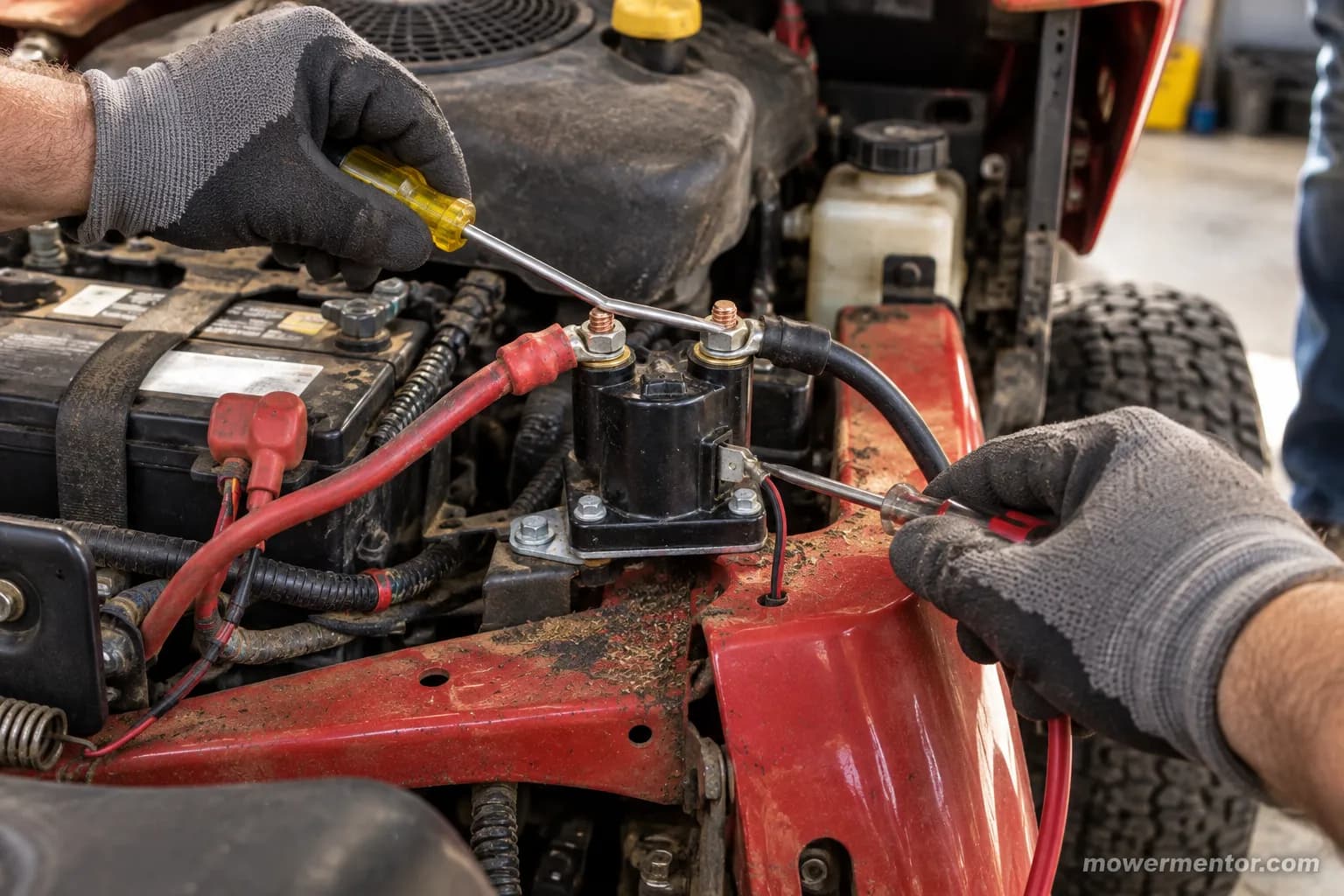
On the John Deere D130, the big-post jump cranked it fine, but energizing the "S" terminal did nothing, and that split told me the coil, not the contacts, had failed.
One caution from experience: a solenoid on its way out can still pass a single clean crank, so one good jump does not fully clear it.
If the read-out points at the contacts, plan to swap the solenoid for good.
Mounting differs by brand, so on a Craftsman it sits on the fender, while the Husqvarna version tucks in elsewhere.
If It Still Won't Start: Quick Routing
If the starter cranks fast when you jump the solenoid but the engine will not fire, the starting circuit is fine and the problem has moved to fuel, spark, or air.
That is good news for the solenoid and a redirect for you.
A standard voltage-at-the-post check confirms whether the solenoid is truly defective before you spend money, but a crank-but-no-fire result usually points past it entirely. Use the table to route yourself.
Symptom after the jump | Likely cause | First check |
|---|---|---|
Cranks fast, will not fire | Fuel, spark, or air | Fuel level, plug, air filter |
Cranks slow or groans | Weak battery or bad ground | Charge and clean grounds |
Nothing on either jump | Starter motor or battery | Test starter and battery |
A fast way to split fuel from spark is a controlled shot of starting fluid: if it fires briefly then dies, you have a fuel-delivery problem.
If there is no spark at all, check the spark plug next, and if the engine is starved for air, clear a clogged air filter before chasing anything deeper.
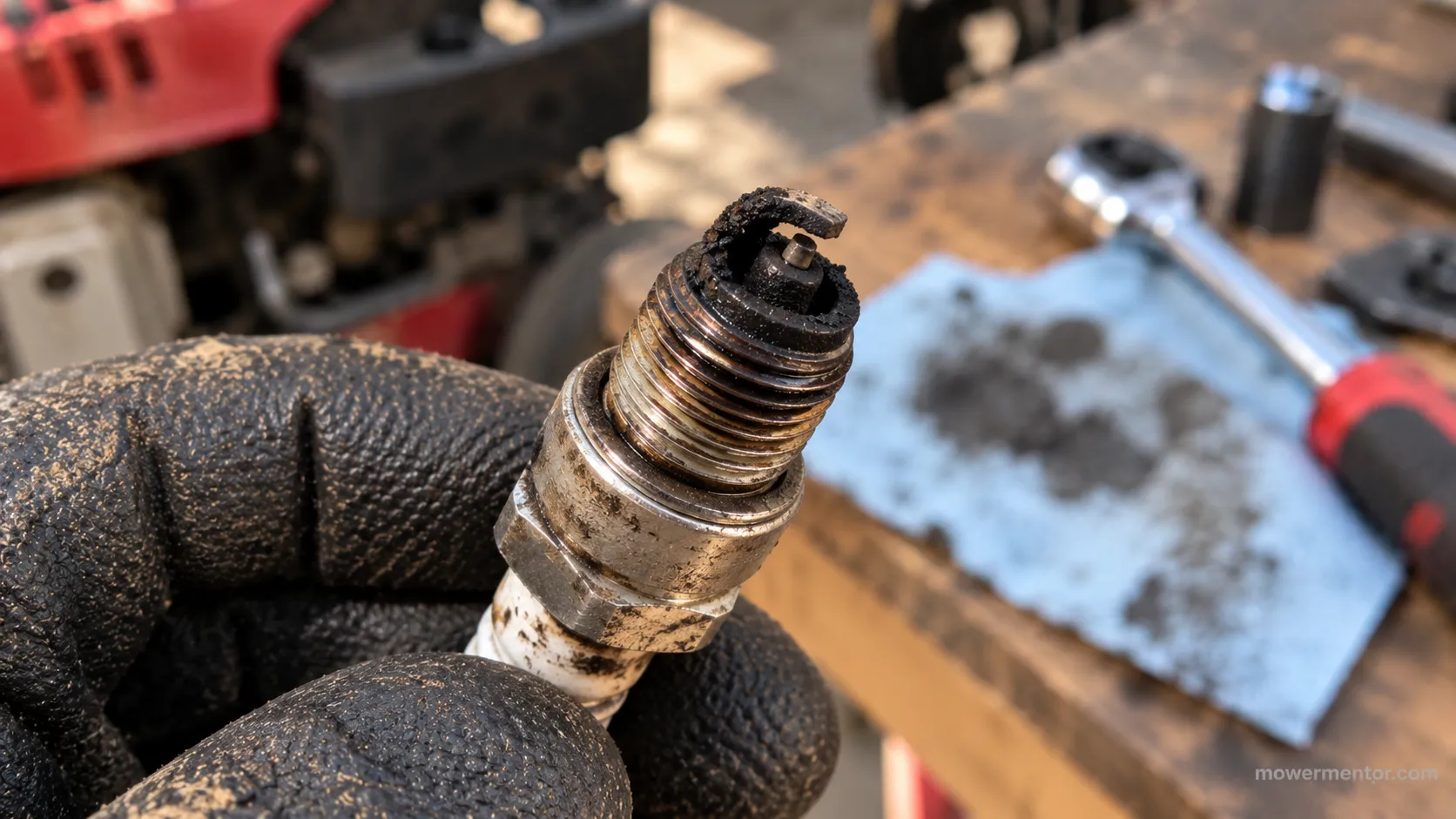
On one of the test mowers the starter cranked fast but the engine would not catch until I pulled the plug and found it fouled, a reminder that the solenoid is never the whole story once the engine is spinning.
This Is a Limp-Home Fix, Not a Repair: What to Do Next
Jumping the solenoid gets you one more mow, not a fix. Repeated jumping arc-erodes the contacts a little more each time, and every jump leaves your safety switches bypassed, so the habit some owners fall into of starting the mower with a screwdriver for months is a real safety liability.
The responsible move is to identify the failed part from the read-out above and replace it.
If you must limp through one job first, a cleaner option than a loose screwdriver is a temporary push-button wired to the "S" terminal, which at least keeps your hands out of the big-current path.
Restore the safety interlocks as soon as the permanent part is in.
From the diagnosis, your next step is clear.
Bad contacts mean a new solenoid, an upstream fault means the key switch or a safety switch, and a dead starter means you replace the starter motor.
Once it is running reliably again, a full seasonal tune-up keeps a marginal starting circuit from stranding you at the worst moment.
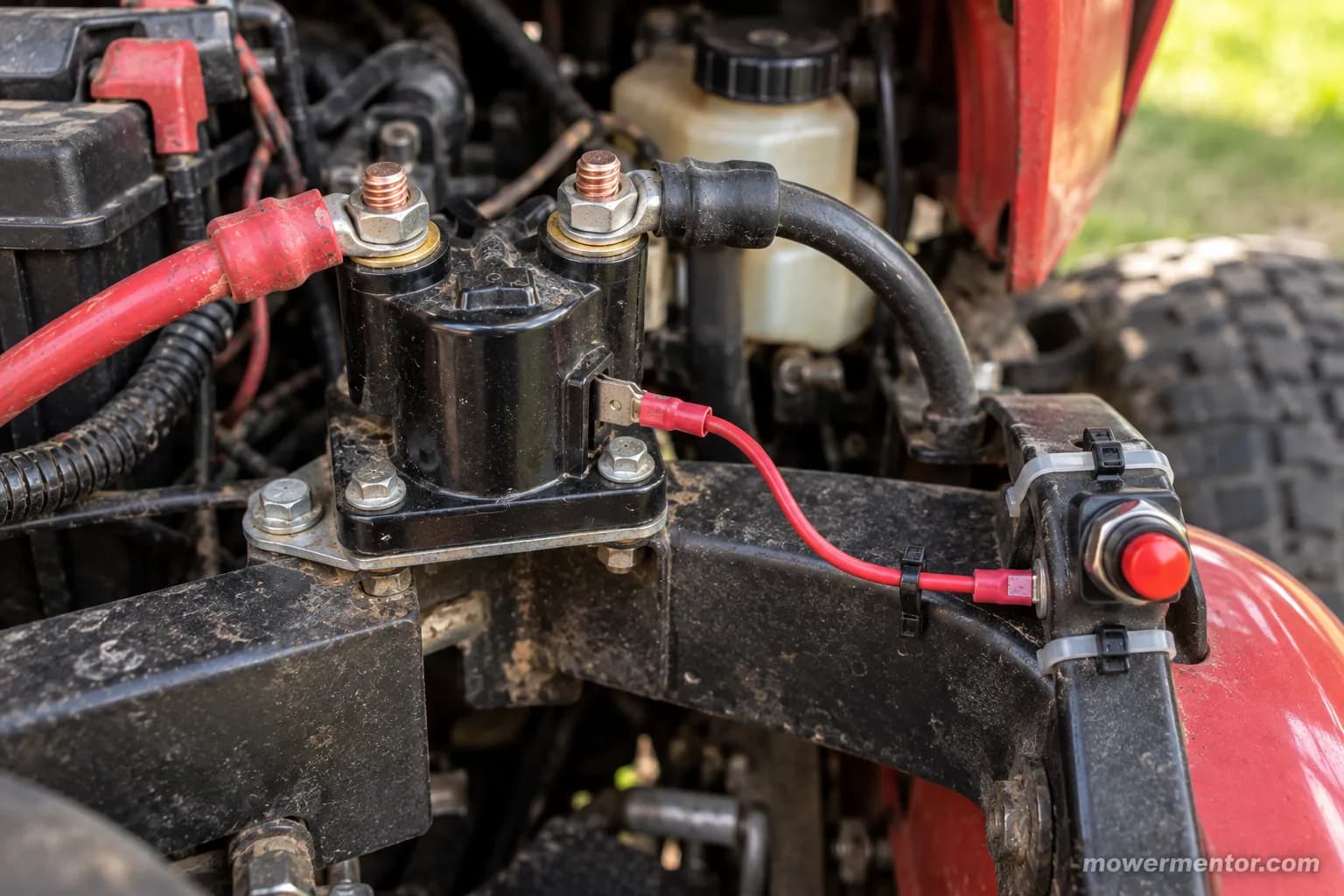
A screwdriver jump or a rigged button is a bridge to the repair shop, not the repair.
Until the failed part is replaced, your seat, brake, and PTO interlocks are not protecting you.
I rigged exactly this push-button off the "S" terminal to limp the Craftsman through one more mow while the new solenoid shipped, then pulled it the moment the part arrived.
Common Mistakes That Fry Contacts or Cause Sparks
Most of the harm from jumping a solenoid comes from a handful of avoidable mistakes, and they cluster around holding too long and touching the wrong metal.
Because the battery is right there venting gas, sparks are the danger you least want, and hydrogen is explosive between about 4 and 72 percent in air, so keep the contact quick and clean. Here are the errors to skip.
Holding the bridge more than a second, which arcs the posts and can weld the screwdriver to a terminal.
Using a bare-metal-handled screwdriver, which puts your hand in the current path.
Bridging the battery's own two terminals instead of the solenoid's, which is a dead short.
Letting the shaft touch the mower frame or ground while it is live.
Re-jumping a solenoid that is already arc-eroded, which just burns the contacts further.
Hammer-tapping the solenoid to free a stuck disc and calling it fixed, when it is a symptom of failure.
On the Cub Cadet XT1, I held the bridge a beat too long and the tip tacked to the post for a second, a small weld mark that is exactly the outcome the one-second rule prevents.
A light tap can sometimes free a stuck plunger once, but a solenoid that needs unsticking is failing and belongs on the replacement list.
Brand layout raises the stakes on some models: certain Murray solenoids sit where a slip is easy, and Cub Cadet's mounting spot puts the posts close to the frame, so brace your hand.
Frequently Asked Questions
Can you bypass the starter solenoid on a mower?
Yes, temporarily. Bridging the two large terminals with an insulated screwdriver bypasses the solenoid's internal contacts and cranks the starter directly. It is a limp-home crank and a diagnostic, not a permanent bypass, and the failed part still needs replacing.
Does jumping the solenoid bypass the safety switches?
Yes. Bridging the big posts, or energizing the "S" terminal from the hot post, skips the seat, brake, and PTO interlocks entirely. The mower can crank and start with you off the seat or in gear, so keep clear of the blades and drive path.
How do you start a lawn mower with a bad solenoid?
Bridge the two large terminals with an insulated screwdriver to crank it, or energize the small "S" terminal from the hot post if the contacts still work. Both are one-time cranks to get you moving, then replace the solenoid.
Will jumping the solenoid damage it?
A clean one-second jump will not hurt a healthy solenoid. Repeated jumping, or holding the bridge too long, arcs and erodes the contacts and can weld the screwdriver to a post, so keep it quick and do not make it a habit.
How do you unstick a starter solenoid?
A light tap can occasionally free a stuck plunger for one more start, but a solenoid that needs unsticking has worn contacts and is failing. Treat a successful tap as a warning to replace the part, not a repair.
Does this work on electric mowers?
No. Battery-electric mowers do not use a starter solenoid or a starter motor, so there is nothing to bridge. Electric mowers need different care entirely, and for a gas Honda this same routine pairs with a proper Honda tune-up.
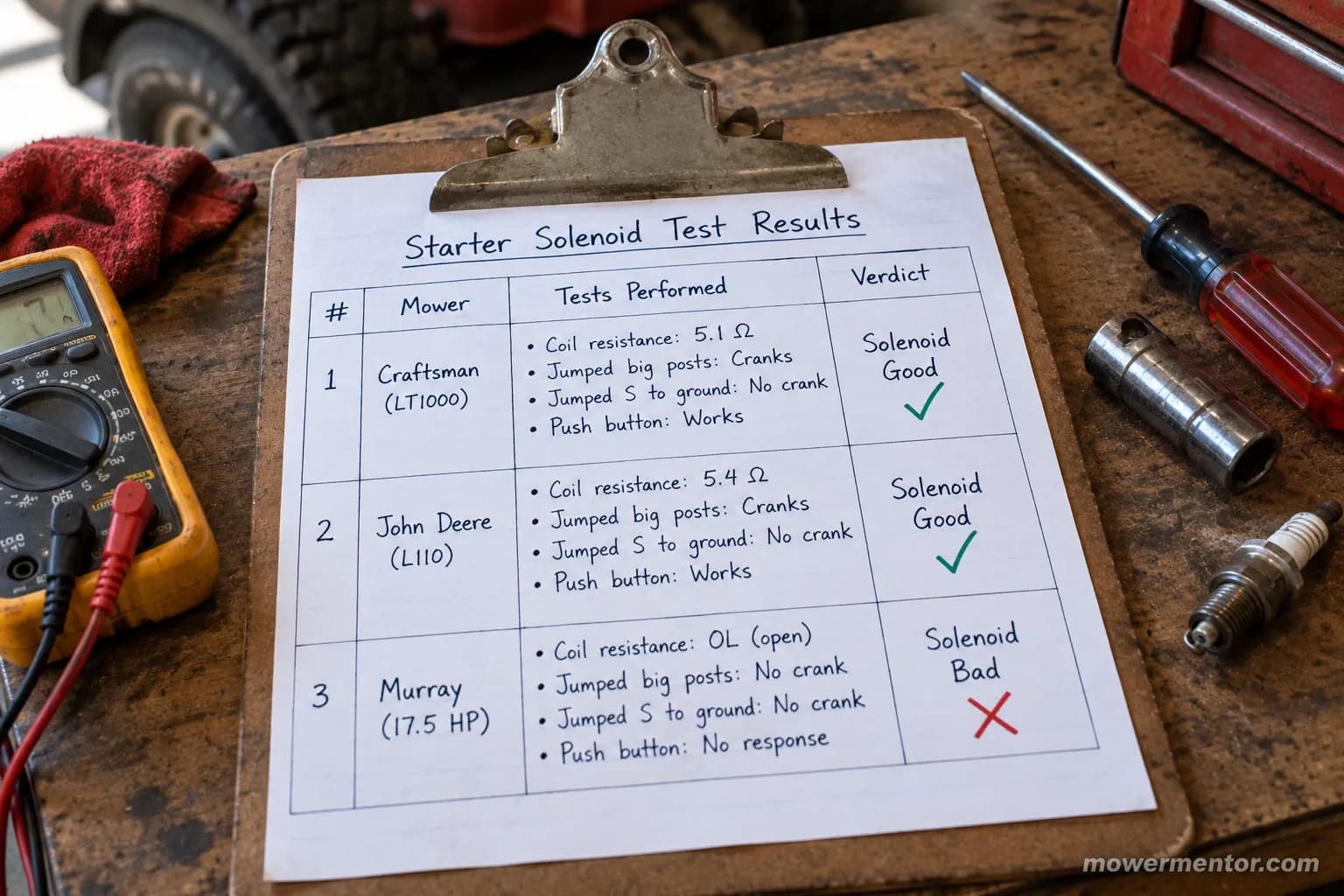
Across all three mowers I ran through this in July 2026, only one, the Craftsman, actually had a bad solenoid.
The Cub Cadet was healthy and the John Deere was an upstream fault, which is the honest takeaway: a screwdriver jump is a fast way to find out the solenoid is often not the culprit.
The Bottom Line
Jumping starter solenoid with screwdriver lawn mower is a ten-second diagnostic you can also drive home on once, not a repair.
Bridge the two large terminals for a single second with insulated tools and eye protection, read whether it was the big-post jump or the "S" terminal jump that cranked, and you will know whether the solenoid, the starter, or a safety switch is at fault.
Then act on that read-out. Replace the failed part, restore the interlocks you bypassed, and keep the mower tuned so a marginal starter does not strand you again.
The screwdriver gets you moving today, and the right fix keeps you moving all season.
Found this useful? Make us a preferred source so we show up in your Google results.
Keep reading
Related articles
Troubleshooting & Repair
Dead Dash? Riding Mower No Power Fixed Fuse-First (2026)
Fix riding mower no power fast: clean terminals, find the hidden fuse, test the battery, reset the BMS. A fuse-first checklist for gas & electric mowers.
Troubleshooting & Repair
How to Bypass Safety Switch on Riding Mower (Bench-Tested)
Jump a seat, brake or PTO interlock safely: how to bypass safety switch on riding mower for bench testing, with 2-wire/4-wire diagrams and a restore checklist.
Troubleshooting & Repair
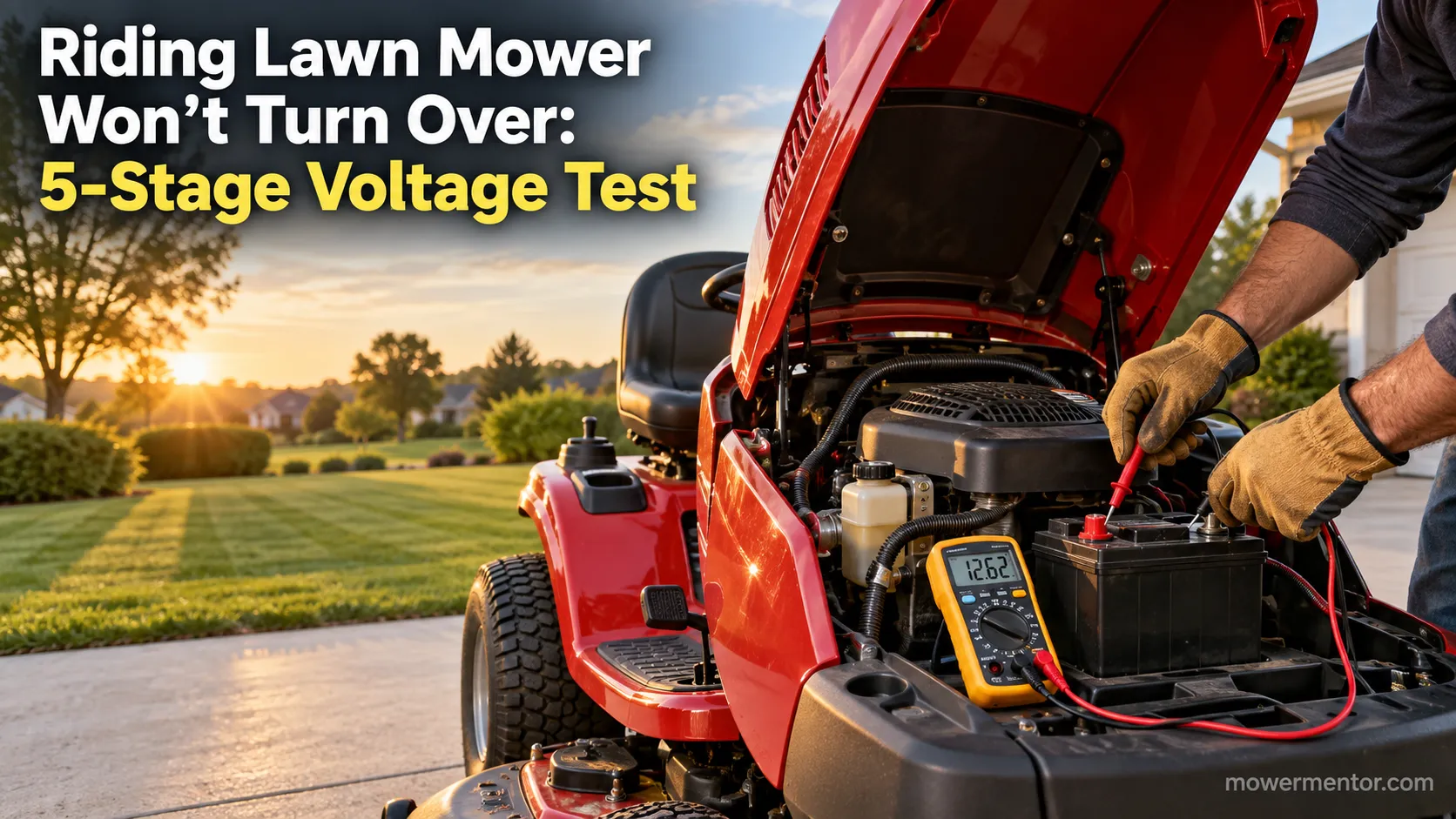
Riding Lawn Mower Won't Turn Over: 5-Stage Voltage Test
Fix it fast: a riding lawn mower won't turn over usually means battery, ground, solenoid or starter. Test each in 5 ordered stages.
Troubleshooting & Repair
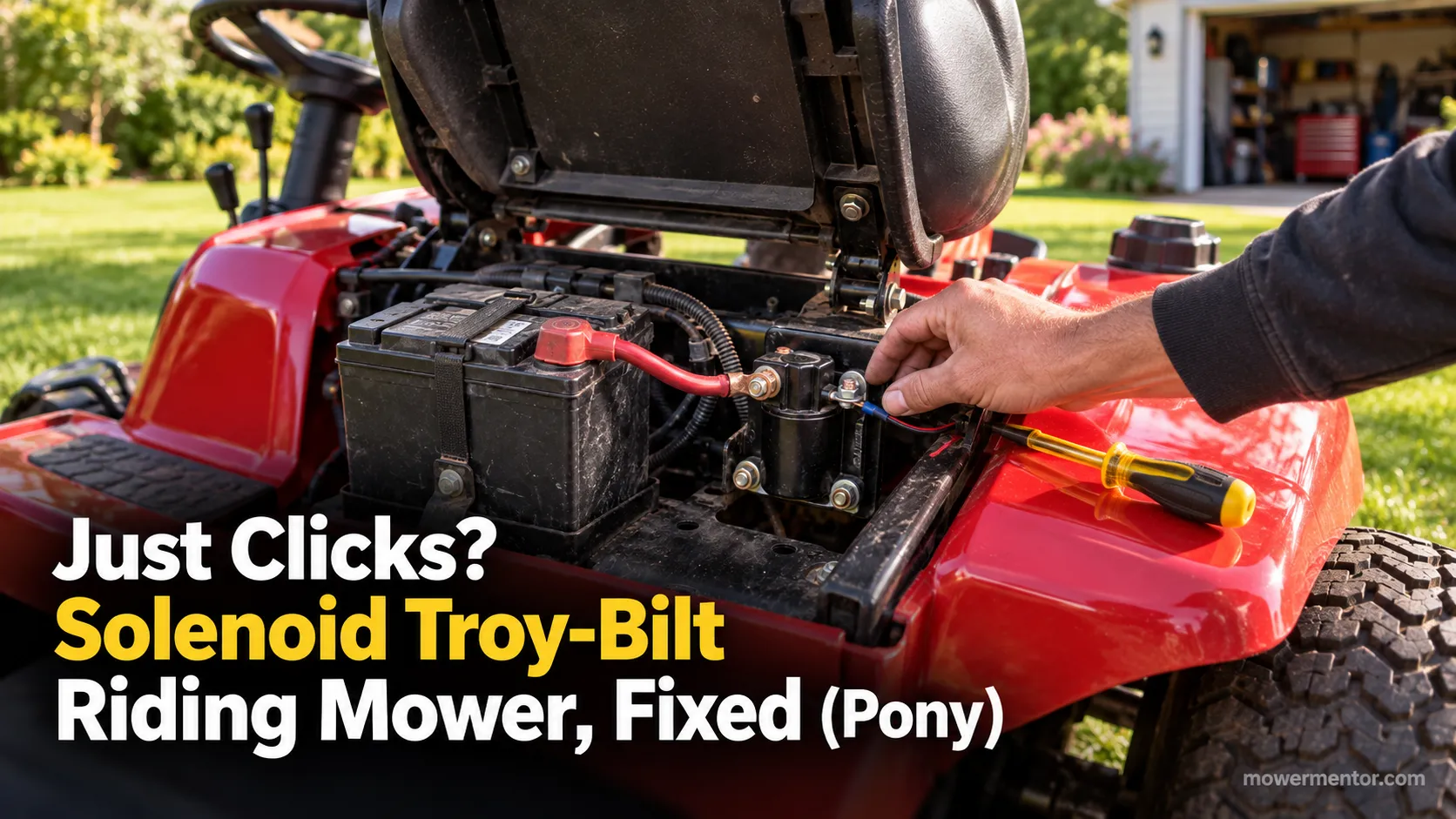
Just Clicks? Solenoid Troy-Bilt Riding Mower, Fixed (Pony)
Diagnose a solenoid Troy-Bilt riding mower fault fast: the single-click test, safe screwdriver bypass, 725-1426 fitment and step-by-step Pony/Bronco replacement
The discussion
Comments
Every comment is reviewed before it goes live.