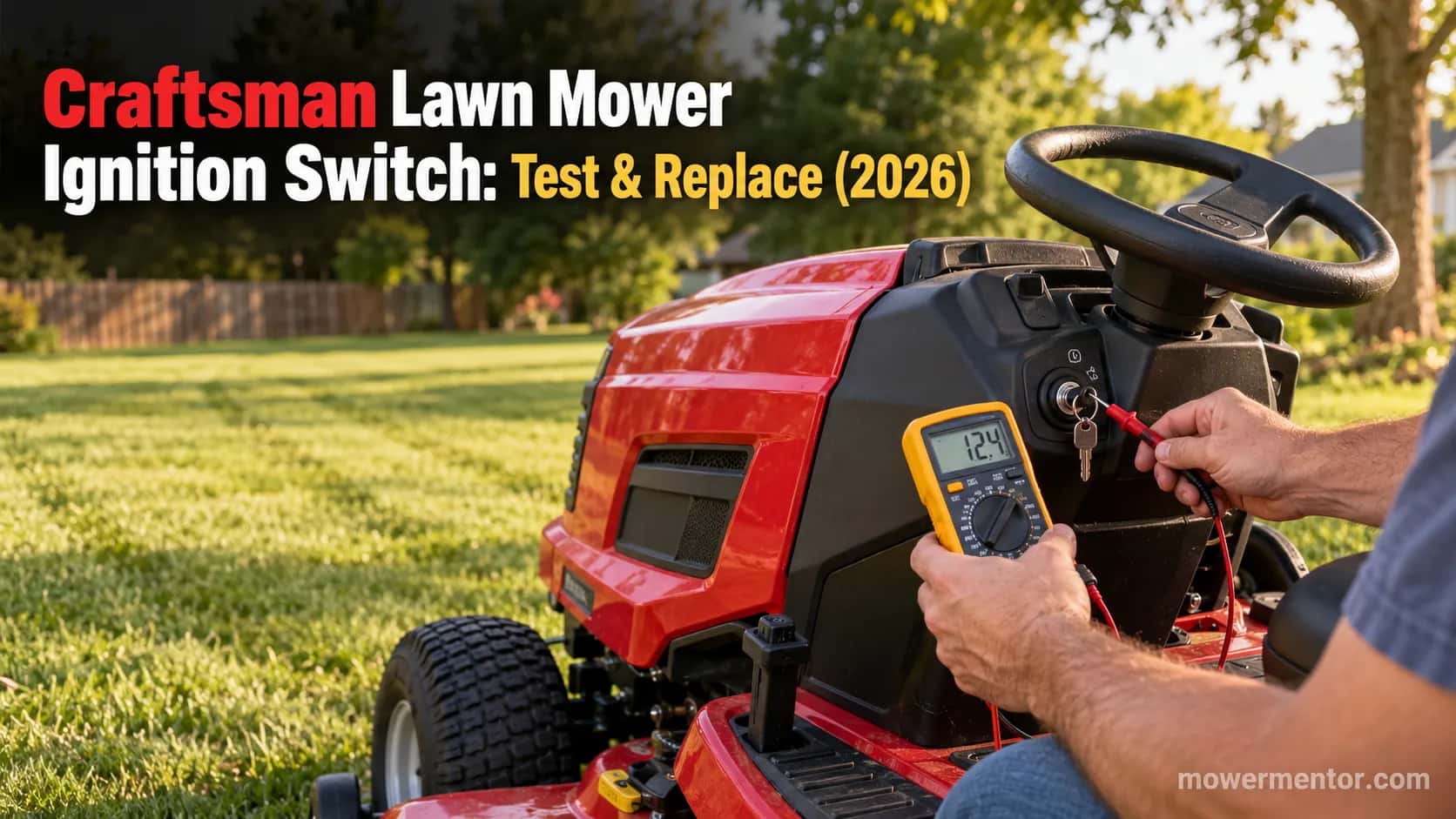
Craftsman Lawn Mower Ignition Switch: Test & Replace (2026)
Test your Craftsman lawn mower ignition switch by terminal, decode 917 vs 247 fitment, find the right part number, and swap it in under an hour.
Written by Tony MaldonadoReviewed by Wade CoburnLast updated on September 8, 2026
When you buy through links on our site, we may earn an affiliate commission (at no extra charge), which we use to fund new product tests. Learn more.
Read it your way
Short on time? Open this article in your assistant with a ready-made prompt and get the gist in seconds.
Found this useful? Make us a preferred source so we show up in your Google results.
A bad key switch on a Craftsman shows up two ways: the engine won't crank with a healthy battery, or it won't shut off when you turn the key to OFF.
Confirm it with a multimeter before you buy anything.
At OFF the switch should ground the M terminal to G. At RUN you should read continuity between B and L, and at START between B and S.
The correct replacement depends on who built your mower, since model prefix 917 means AYP/Husqvarna and 247 means MTD, so decode that before ordering.
Genuine switches run about $25 to $40, universals about $12 to $20.
The 60-Second Answer: Is Your Craftsman Ignition Switch Bad?
A failing Craftsman lawn mower ignition switch almost always announces itself in one of two ways: the starter stays silent even with a fully charged battery, or the engine keeps running after you turn the key to OFF.
Both point at the same part, because a mower key switch does two jobs, closing the start circuit and grounding the magneto to stop the engine.
The SearsPartsDirect repair guide notes the fastest confirmation is a continuity check across the switch terminals.
A switch shows no continuity where a given key position demands it.
Here is the quick check most product pages never give you.
Test in 60 seconds (bench check). Set a multimeter to continuity.
OFF: M to G should beep.
RUN: B to L should beep.
START: B to S should beep. On my bench switch, a good unit beeped exactly there, while the failed one stayed silent between M and G at OFF, which is why that mower would not shut off. This is a fast heuristic, not a full electrical diagnosis.
If your battery is dead or the mower only clicks, the fault is probably not the key switch, so start with power delivery instead.
The rest of this guide tests the switch properly, decodes which one fits your Craftsman, and walks the swap.
Craftsman Lawn Mower Ignition Switch: Symptoms of a Bad Switch
The symptoms of a bad Craftsman ignition switch cluster into a short, recognizable list.
The two signatures are a no-crank with a known-good battery and a runs-on condition where the engine will not stop at OFF.
According to the SearsPartsDirect repair guide, at OFF the switch grounds the magneto (the M terminal) to kill spark, so a switch that no longer makes that ground cannot stop the engine.
Everything else, from dead accessory lights to an intermittent start, tends to follow from worn internal contacts.
Watch for these signs:
No crank at all, even though the battery is fully charged and the terminals are clean.
Intermittent starting that comes and goes when you wiggle the key.
The key turns but nothing happens, no click and no crank.
Dash lights or headlights that die when the key is in RUN.
The engine won't shut off when you turn the key to OFF (runs-on).
Craftsman Riding Mower Won't Shut Off With the Key?
This is the classic magneto-kill failure. At OFF, a healthy switch connects M to ground, which shorts the ignition coil and stops the spark.
When the internal contact for M wears open, the coil keeps firing and the engine keeps running even with the key out.
If the mower still fires with a jump but the key will not kill it, the switch is the prime suspect, and you can read more on starting it with a failing switch safely.
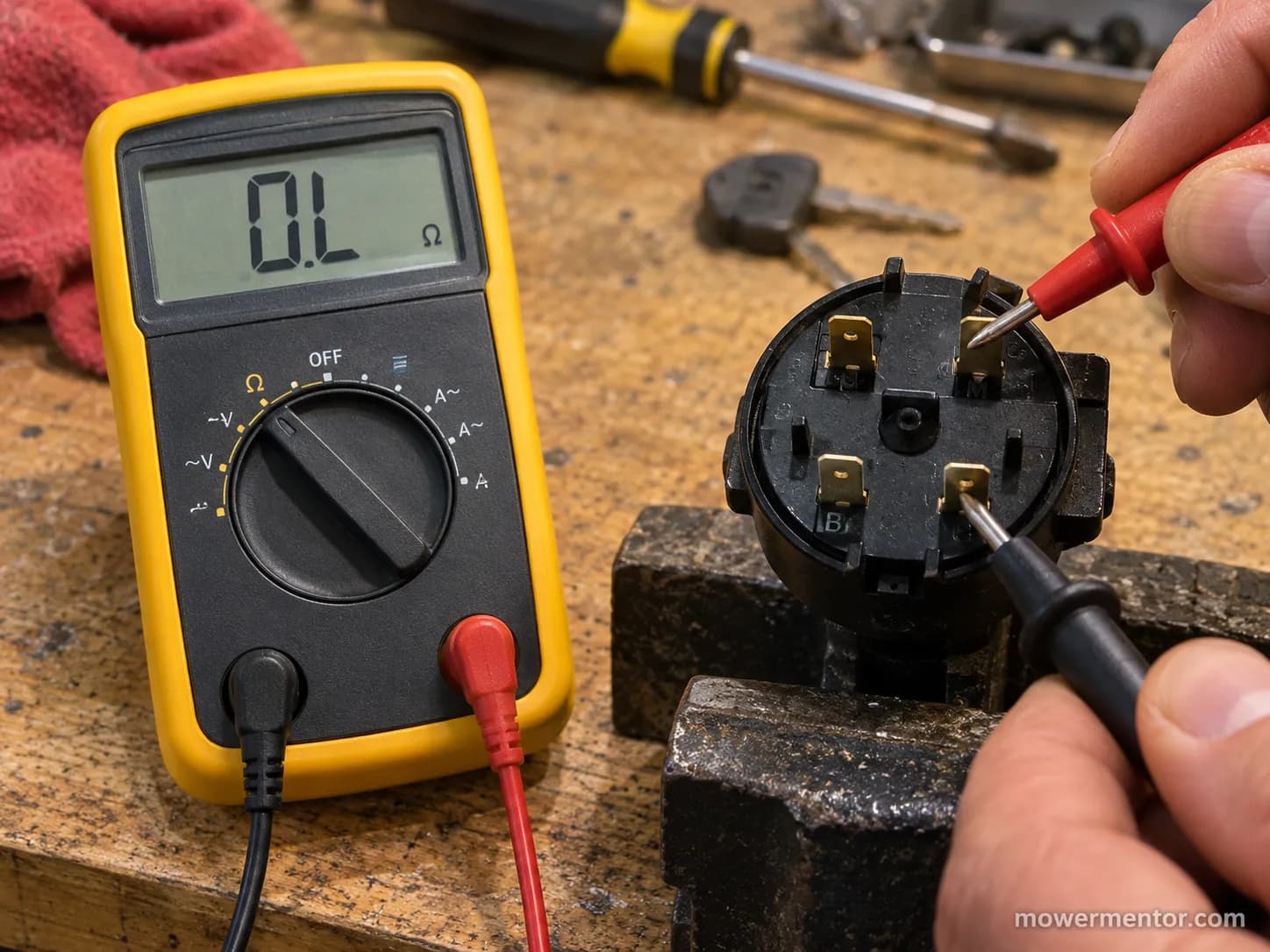
These symptoms can also mean something else. A blown fuse, a tired battery, or an open seat, brake, or PTO interlock can all mimic a bad switch.
If nothing happens at all, no click and no crank, the fault is likely upstream, so work through a no-click, no-crank Craftsman first before you condemn the key switch.
How to Test a Craftsman Ignition Switch by Terminal (OFF / RUN / START)
Testing how to test ignition switch on craftsman riding mower comes down to a continuity sweep across three key positions.
The switch has lettered terminals: B (battery, 12V in), S (starter or solenoid), M (magneto or kill), L (lights), and G (ground), with some five-terminal switches leaving off A (accessory).
SearsPartsDirect confirms the core test is continuity between S and B to prove the start circuit closes.
A good switch beeps only where the position demands it, and a bad one goes quiet where it should conduct.
Follow these steps with the mower off and cool:
Disconnect the negative battery cable first, then lift the seat to reach the switch.
Photograph and label each wire before you pull anything, because colors vary between builds.
Set your multimeter to continuity (the beep or ohm symbol).
Probe each terminal pair for each key position and compare against the table below.
For a live check, switch to DC volts: RUN should show about 12V at B, and START about 12V at S.
Bench readings, August 2026, tested with a Klein Tools MM400 on a 917-built Craftsman switch:
Key position | B to L (ignition and lights) | B to S (starter feed) | M to G (magneto kill) |
|---|---|---|---|
OFF | Open | Open | Continuity (beep) |
RUN | Continuity (beep) | Open | Open |
START | Continuity (beep) | Continuity (beep) | Open |
On the good switch, every cell matched the table exactly. On the failed unit, the only deviation was M to G, which stayed open at OFF, and that single open contact was the entire runs-on problem.
Read it this way: RUN with no B to L continuity means a dead ignition feed, and OFF with no M to G means the engine will not kill.
If you want the same continuity logic across other pin counts, the full multimeter walkthrough covers five, six, and seven-pin bodies.
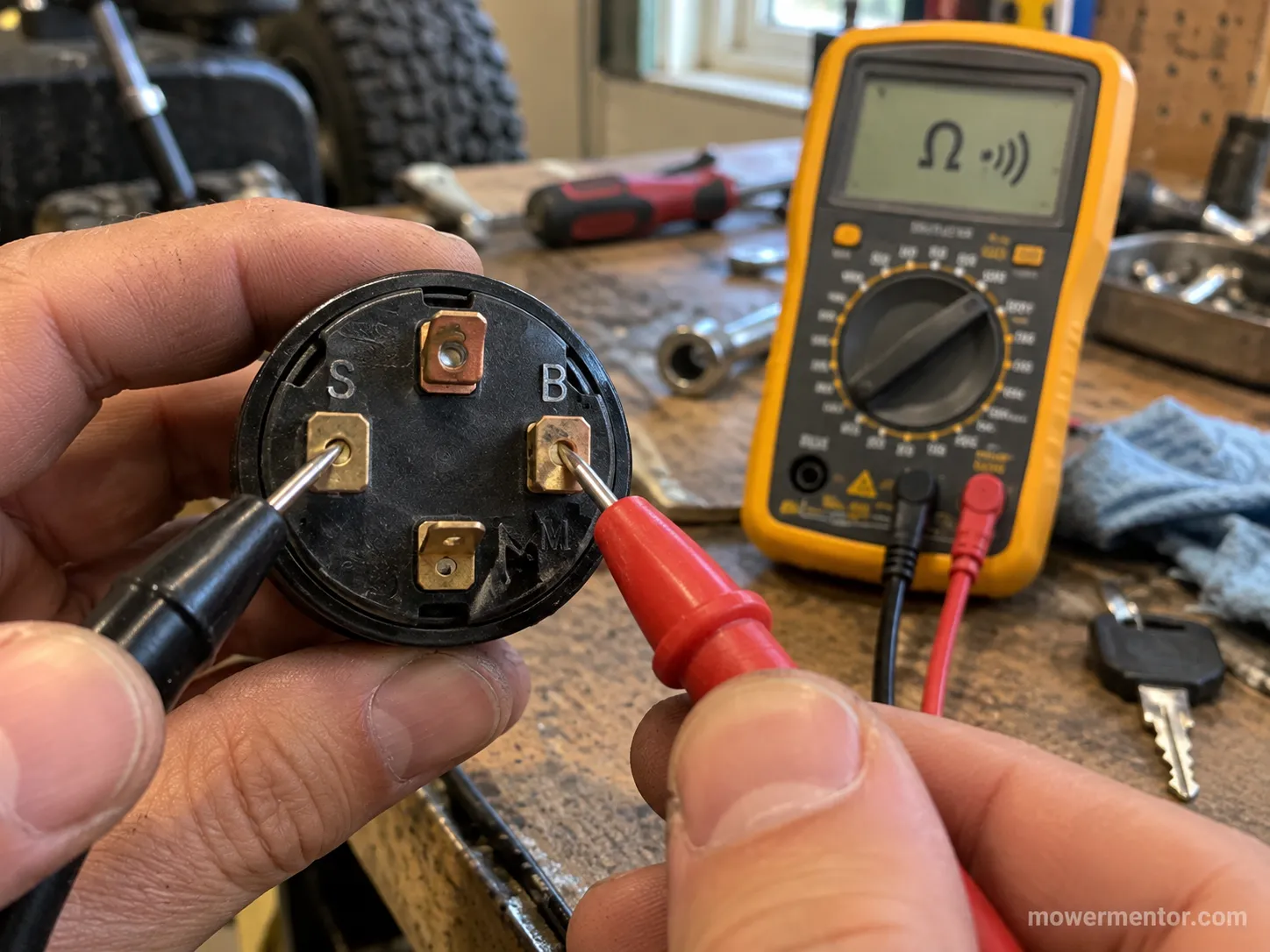
The terminal letters themselves are worth matching to your harness. A clear prong-by-prong terminal map helps before you probe.
The Madison Tractor key-switch guide documents the common B, S, I, M, and L markings and their per-position behavior.
Terminal letters vary by switch maker, so verify the markings on your own switch rather than assuming.
One more thing before you blame the key. A stuck parking-brake switch can fake a no-crank, so clear the parking-brake interlock first.
An open seat switch produces the same dead-key symptom, and a failing seat interlock is a five-minute test that saves you from buying the wrong part.
Which Switch Fits? Decode 917 vs 247 (5-Post vs 7-Post)
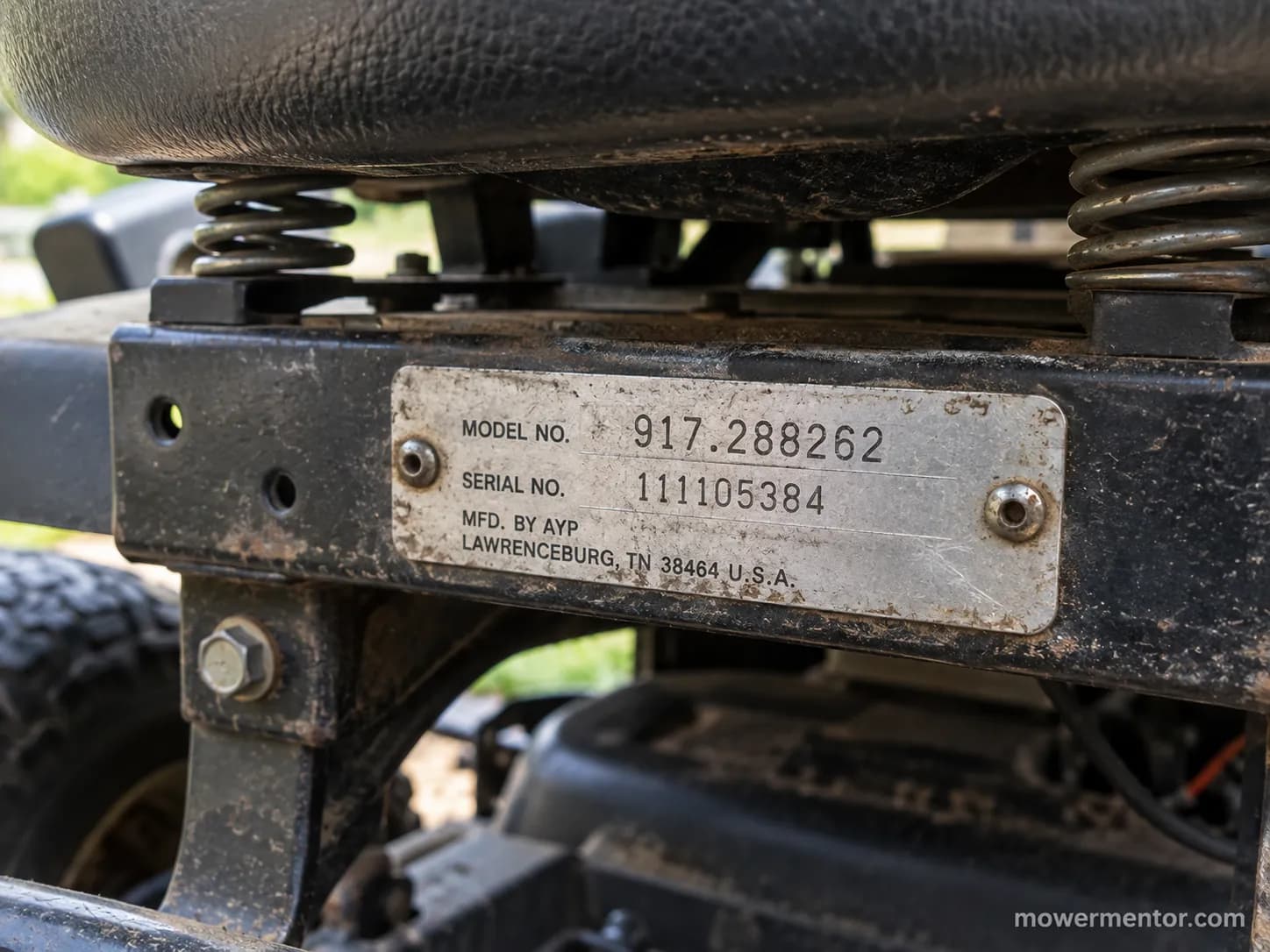
The single most useful fitment fact about any Craftsman: Craftsman is a brand, not a factory. The model number tells you who actually built the machine, and that decides the switch.
A model prefix of 917 means an AYP or Husqvarna-built unit, while 247 (and 316) means MTD, and from model year 2018 onward the lineup is all MTD.
The TodaysMower build history documents that long AYP and Husqvarna manufacturing relationship.
Knowing your builder is what keeps you from ordering a switch that looks right and wires wrong.
Model prefix | Who built it | Typical switch body |
|---|---|---|
917.xxxxxx | AYP / Husqvarna | Often 7-post, 4-position delta (snap-in) |
247.xxxxxx / 316.xxxxxx | MTD | Often 5-post or MTD-spec delta |
2018 and newer | MTD (all) | MTD-spec switch |
The model plate usually sits under the seat or near the battery, and the SearsPartsDirect model-decode article explains how to read the number and serial.
Photograph it before you shop, because the same model-number decoding also finds your other parts, like finding parts by 917 model for filters and tune-up items.
Now the body types that trip people up.
A 5-post switch is usually a three-position unit (OFF, RUN, START), while a 7-post switch is a four-position delta or snap-in body that adds a headlight position, and the extra posts feed lights and accessory rather than the core start-and-kill logic.
Community wisdom on MyTractorForum puts it bluntly: check the first three digits of the model number before you trust any universal listing, because AYP and MTD wiring differs.
Two siblings help if the key checks out clean. Work the rest of the system from the top with the full electrical diagnosis tree.
Not sure the switch is even involved? Start at the Craftsman no-start flowchart instead.
Close is not good enough. A switch that fits the dash hole can still be wired differently, and the wrong one can send 12V out of the L terminal and blow a fuse the moment you turn the key.
Your engine brand also matters downstream, since Briggs or Kohler decides choosing the matching starter.
A tired battery fakes many switch symptoms too, so size and test the right mower battery before you spend on a switch.
Craftsman Ignition Switch Part Numbers & Cross-Reference
Once you know your build, matching an ignition switch for craftsman lawn mower to a part number is straightforward, because most AYP and Husqvarna-built units roll up into one current number.
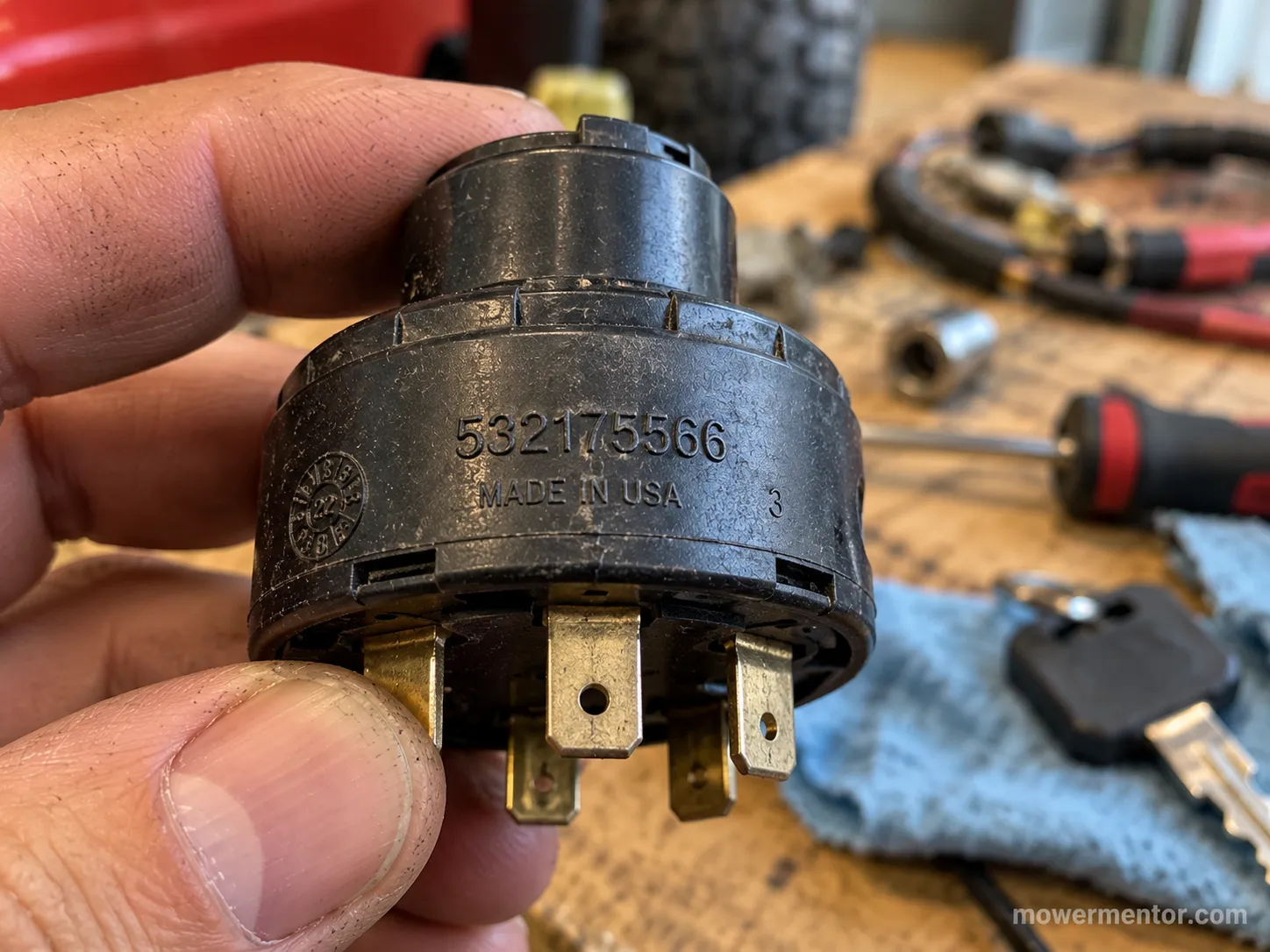
The OEM switch 532175566 is a delta-style, four-position, seven-terminal switch, and it supersedes a long chain of older numbers including 175566, 163968, and 532163968.
The Reliable Aftermarket Parts listing confirms the MTD 925-1741 cross-reference for the same body.
Match the terminal count and letters to your pulled switch, not just the mounting shape.
OEM / current number | Supersedes / cross-references | Also fits (brand) |
|---|---|---|
Husqvarna / AYP 532175566 | 175566, 163968, 532163968, 175442, 189687, 532189687, 539107541, 583068901 | Craftsman 917 builds |
MTD 725-1741 / 925-1741 | 925-04227A/B, 725-04227A/B | Craftsman 247 / Cub Cadet |
Murray 94762 | 94762MA, 94762MAX | Murray-built units |
John Deere GY20074 | (same delta 7-terminal body) | L100-series tractors |
Cub Cadet 725-04227 / 925-04227 | 6900-47P (Delta) | Cub Cadet / MTD |
The Tractor Supply listing for 532175566 documents that same supersession chain, which is why one number covers so many older Craftsman machines.
On cost, a genuine OEM switch runs roughly $25 to $40, while an aftermarket universal runs about $12 to $20.
The OEM premium is often worth it precisely because the wiring is guaranteed to match. For universal-versus-OEM trade-offs across every brand, see how to choose the right switch.
Once the part is in hand, the general guide covers replacement cost and steps for every brand.
Universals may cross-reference and still wire differently. Before you order, verify the terminal count and letters against the switch you pulled.
Ordering the switch alongside a full seasonal tune-up saves a second shipment. A model-matched service kit keeps the ignition and filters on the same schedule.
How to Replace a Craftsman Riding Mower Ignition Switch
Replacing a Craftsman key switch is a 30 to 45-minute job that hinges on one habit: label every wire before you touch it.
The switch pushes into the dash and is held by snap-in tabs or a retaining nut, and each spade wire lands on a lettered terminal.
SearsPartsDirect's replacement guide stresses disconnecting the battery and transferring wires to the matching terminals, and the verification at the end is what most walkthroughs skip.
Work in this order:
Disconnect the negative battery cable before anything else.
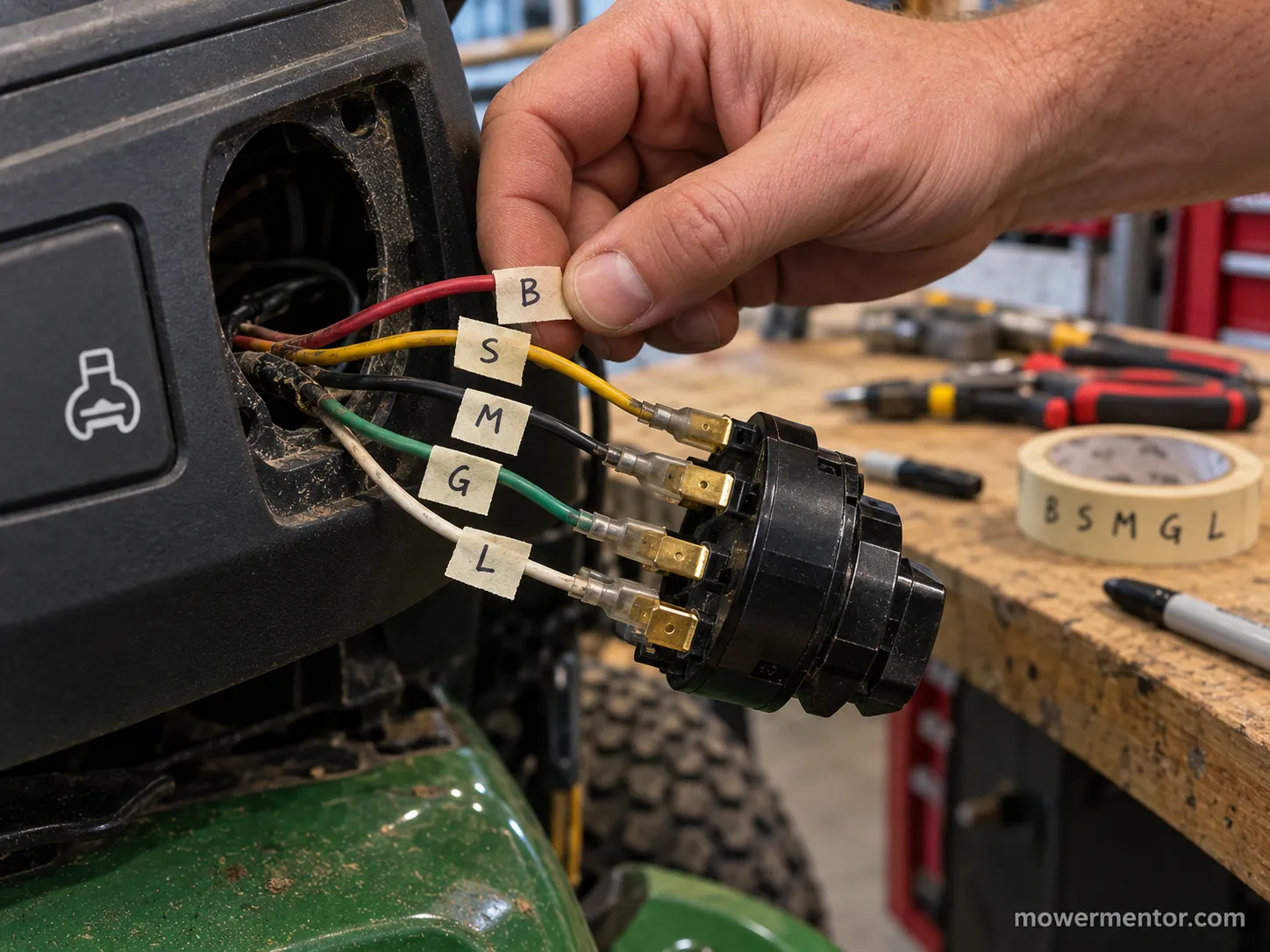
Photograph the wiring, then label each wire to its terminal letter with tape.
Release the snap-in tabs (or remove the retaining nut) and pull the old switch out.
Transfer the wires one at a time to the same letters on the new switch.
Reconnect the battery and test all three key positions.
Confirm the engine cranks at START and, critically, dies at OFF.
Label by letter, not by color. Wire colors change between AYP and MTD builds, but the terminal letters do not, so matching B to B and M to M is what guarantees the mower both starts and kills.
Verifying at OFF ties this swap back to the continuity test above. If M to G reads open after the swap, a wire is on the wrong post.
A clean swap does not always end the trouble. Harness damage or a burnt fusible link near the starter can persist after a good switch goes in.
If the starter motor itself is the real culprit, its removal follows a similar labeled-wire routine, so see swapping the starter motor.
While the dash panel is off, it is also a good moment for changing a Craftsman spark plug.
Bypassing a Bad Ignition Switch (Safely) and When Not To
Bypassing a failed Craftsman ignition switch is a temporary get-it-home move, not a fix, and the safety boundary matters.
The safe path is to briefly jump the starter solenoid to crank the engine, without permanently defeating the seat, brake, or PTO interlocks.
The Madison Tractor interlock guide explains that those interlocks exist to stop the mower starting or running when the operator is not in place.
Because the switch also carries the kill circuit, a permanent bypass can leave you unable to stop the engine.
Two cautions go together here. If the key will not kill a runs-on engine, stall it with the choke or the fuel shutoff rather than letting it run, which is the stop-the-engine half that most bypass clips ignore.
And if a universal switch you fitted blew a fuse, suspect 12V leaving the L terminal, a classic wrong-switch wiring mismatch.
Safety warning. Bypassing interlocks removes seat and blade protection and is strictly temporary.
Never leave the seat, brake, or PTO interlocks defeated after a quick bypass, so plan on resetting the safety interlocks and replacing the switch promptly.
A stuck PTO switch can also block a start, so try testing the PTO switch before you improvise anything.
Frequently Asked Questions
Can I use a universal ignition switch on my Craftsman?
Only if the terminal count and letters match your original. A universal switch that shares the mounting shape can still be wired differently, and a mismatch can blow a fuse.
Pull your switch, count the posts, read the letters, and match those before ordering.
Why does my Craftsman run on after I turn the key off?
Because the M (magneto) terminal is no longer grounding the ignition coil at OFF. A healthy switch shorts M to G to kill spark, so when that internal contact wears open, the engine keeps firing.
A continuity test at OFF confirms it in seconds.
How much does a Craftsman ignition switch cost?
Expect roughly $12 to $20 for an aftermarket universal and about $25 to $40 for a genuine OEM switch. The OEM premium buys guaranteed wiring that matches your build, which matters most on 7-terminal delta switches.
Are 5-post and 7-post switches interchangeable?
Not automatically. The extra posts on a 7-post (four-position) delta switch feed lights and accessory circuits that a 5-post (three-position) switch does not have.
Match your build first, and keep the air filter clean so the engine you just got running keeps breathing.
The Bottom Line
Before you buy any craftsman lawn mower ignition switch, test the one you have by terminal and decode who actually built your mower, because the wrong universal switch will pass the shelf and fail the fuse.
Confirm the fault at OFF, RUN, and START, read your model prefix, then order the switch that matches your build and wire it letter for letter.
Read it your way
Short on time? Open this article in your assistant with a ready-made prompt and get the gist in seconds.
Found this useful? Make us a preferred source so we show up in your Google results.
Keep reading
Related articles
Troubleshooting & Repair
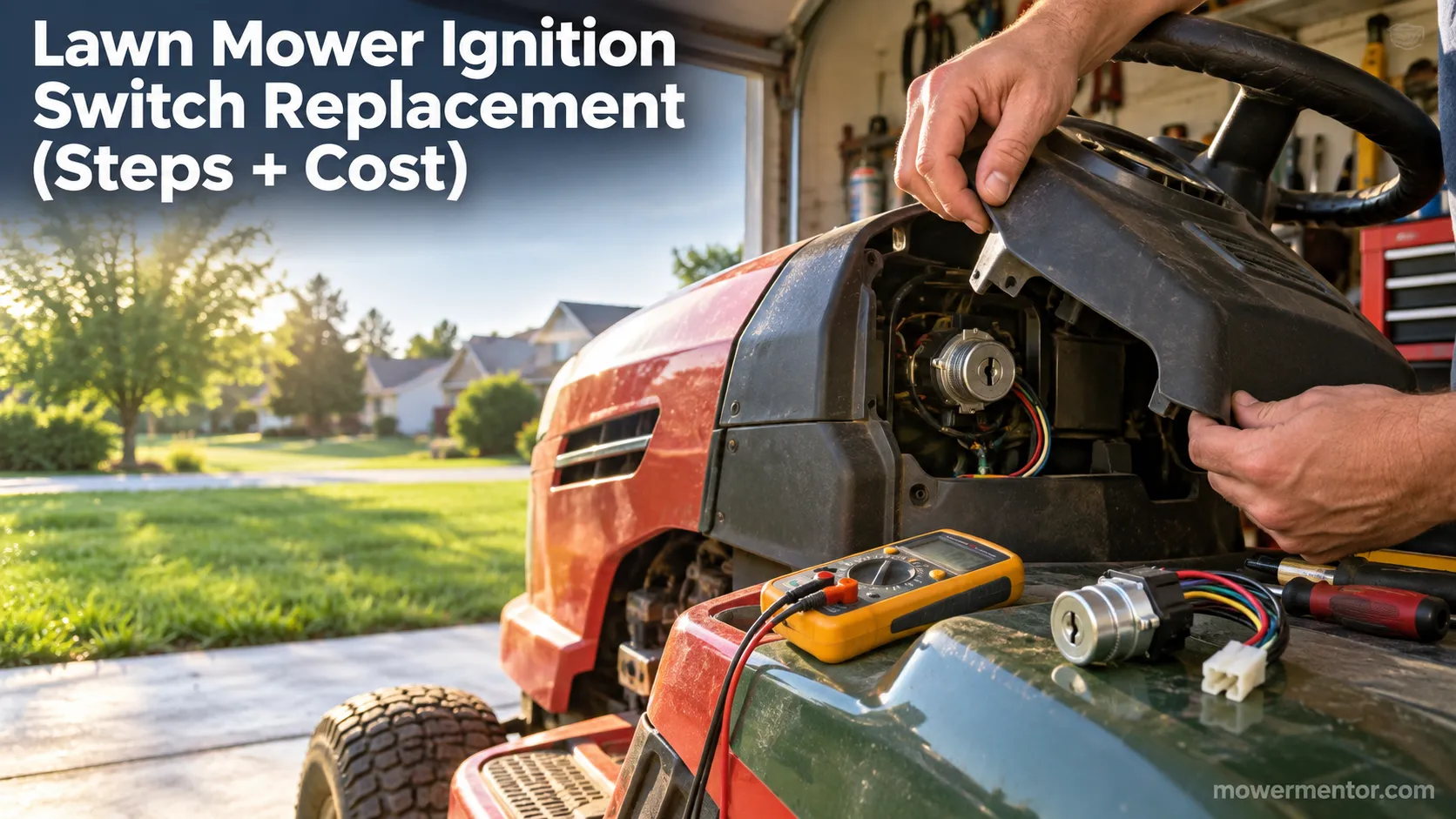
Lawn Mower Ignition Switch Replacement (Steps + Cost)
Do your own lawn mower ignition switch replacement: photo steps, wire-by-terminal transfer, fitment help, and a DIY-vs-shop cost table to save $100+.
Troubleshooting & Repair
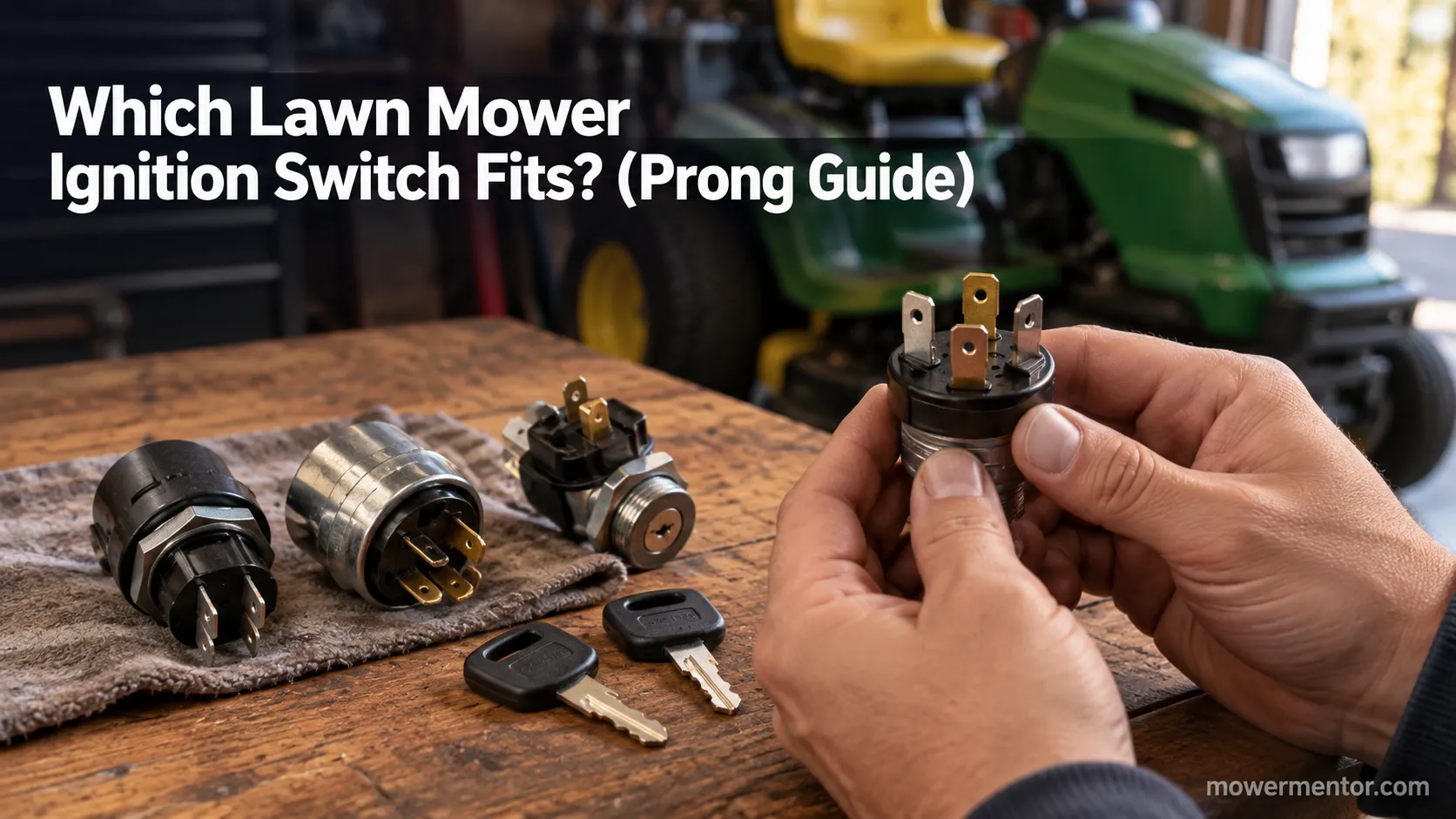
Which Lawn Mower Ignition Switch Fits? (Prong Guide)
hoose the right lawn mower ignition switch by prong count (4/5/6/7), universal vs OEM fit, and key compatibility, plus which one fits your mower.
Troubleshooting & Repair
How to Start a Lawn Mower With a Bad Ignition Switch
Confirm it's the switch, then learn how to start a lawn mower with a bad ignition switch: a safe solenoid bypass to get moving, plus how to fix it for good.
Troubleshooting & Repair
How to Test a Lawn Mower Ignition Switch (5/6/7-Pin)
Learn how to test a lawn mower ignition switch with a multimeter: get continuity tables for 5, 6 & 7-pin switches plus a no-multimeter test-light method.
The discussion
Comments
Every comment is reviewed before it goes live.