
Craftsman Lawn Mower Won't Start? Fast Diagnostic Flowchart
Diagnose why your Craftsman lawn mower won't start with a crank-vs-no-crank flowchart: battery, solenoid, fuse, safety switch or fuel, fixed fast.
Written by Tony MaldonadoReviewed by Wade Coburn
Last updated on August 19, 2026
When you buy through links on our site, we may earn an affiliate commission (at no extra charge), which we use to fund new product tests. Learn more.
Summarize with AI
When a Craftsman lawn mower won't start, the fastest fix is not a checklist. It is answering one question: what happens when you turn the key? That single answer routes you to the one or two parts actually at fault, instead of an afternoon spent checking things that were fine all along.
This guide branches by symptom, tested on real Craftsman machines, so you stop guessing and start fixing.
A Craftsman that won't start does one of three things when you turn the key. It cranks but won't fire (usually stale fuel or spark). It only clicks or buzzes (usually a weak battery or the starter solenoid).
Or nothing happens at all (a safety switch, a blown 20-amp fuse, a dead battery, or the ignition switch). Confirm you are on the seat with the brake set and the blades off, then follow your branch below.
Craftsman Lawn Mower Won't Start? Run This First
A Craftsman lawn mower won't start safely unless three basics line up, and they resolve a surprising share of "dead" machines before any tools come out.
According to Sears Home Services, a riding mower will do nothing when the key turns if the brake is off or the blades are engaged, and a flat battery stops even the solenoid from clicking.
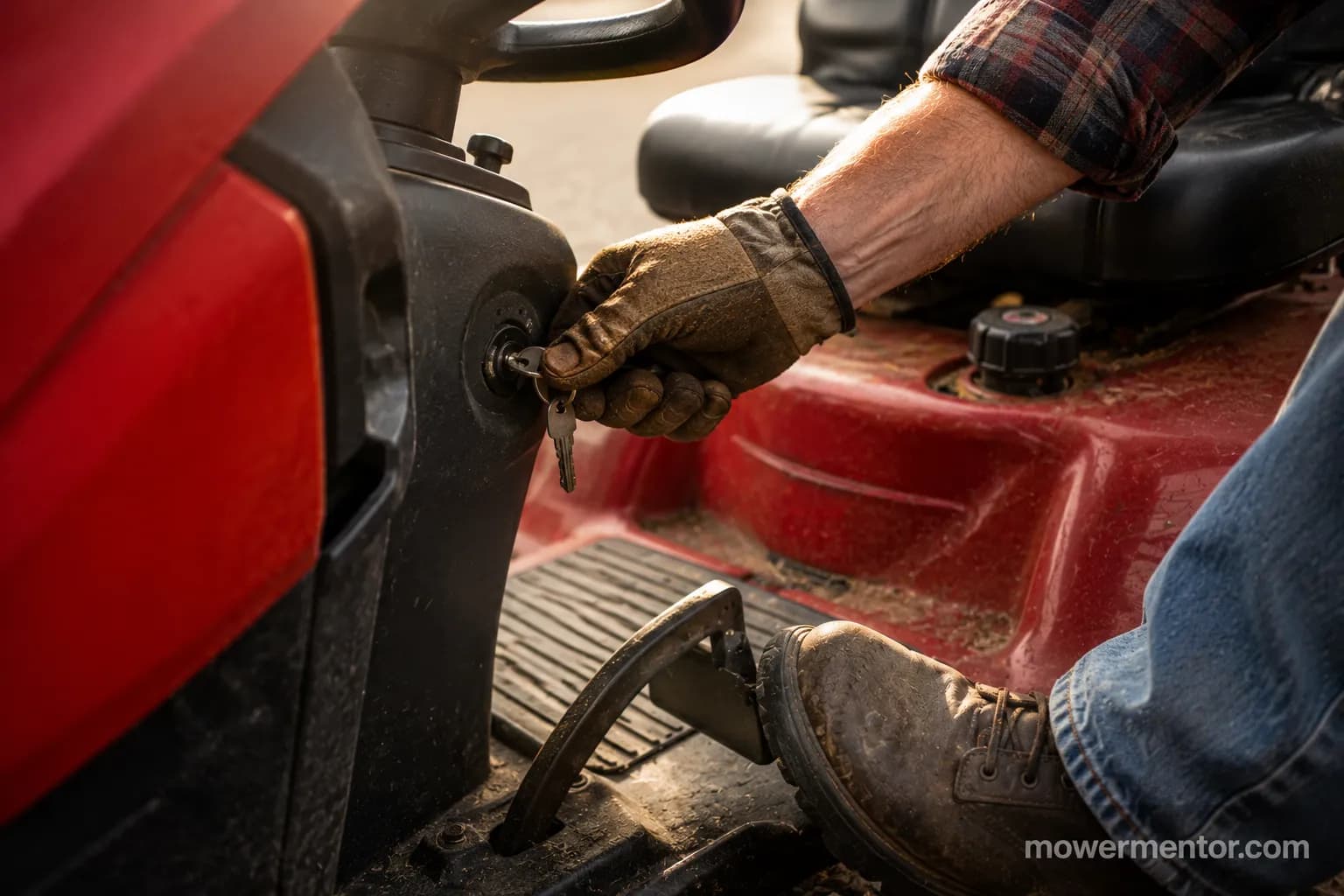
So start here: sit fully on the seat, set the parking brake, switch the blades (PTO) off, and confirm there is fresh fuel with the fuel valve open.
If that changes nothing, note exactly what the mower does when you turn the key. That behavior is your branch.
Which door are you walking through?
The engine spins but never catches. Go to the cranks-but-won't-fire branch.
You hear a click or a buzz, but it will not spin. Go to the clicks-or-buzzes branch.
Nothing happens at all, dead silence. Go to the dead-circuit branch.
One quick note on wording. This guide covers gas-powered Craftsman riding mowers and lawn tractors. If you have a battery-electric Craftsman push mower, the safety-key and battery-pack checks differ, and most of the electrical branches below will not apply.
Which No-Start Symptom Do You Have?
The single most useful thing you can do when a Craftsman riding mower won't start is match the symptom to the cause before touching a wrench. Sears PartsDirect explains the starting circuit plainly: the red battery cable feeds one large solenoid post, and the other large post carries power to the starter motor.
Knowing that path is why "just clicks" points somewhere different from "nothing at all." The decision tree below sends each symptom to its most likely culprit, with a rough cost so you know what you are in for.
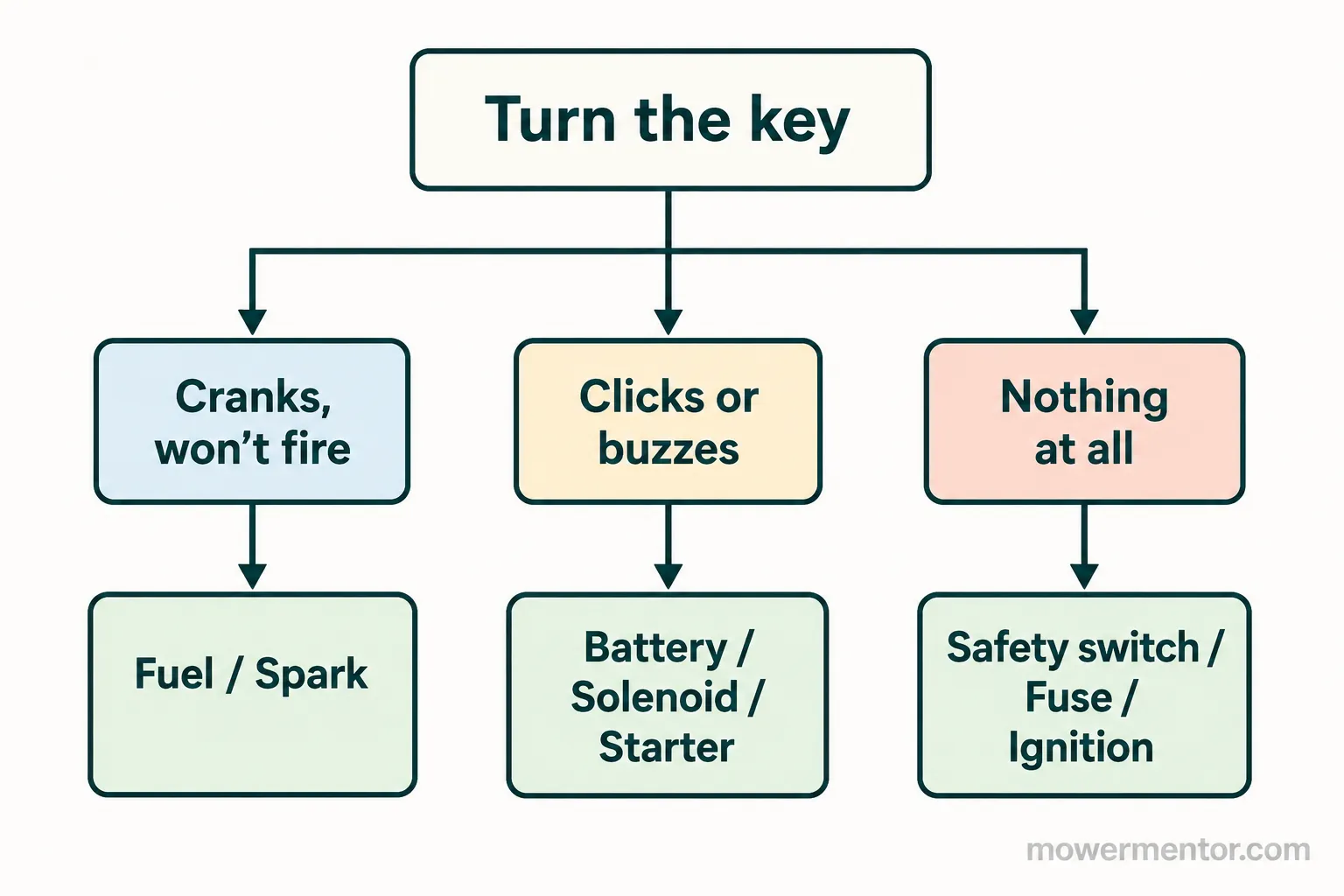
What it does when you turn the key | Most likely cause | Rough part cost |
|---|---|---|
Cranks (spins) but never fires | Stale fuel or gummed carburetor, then spark | $8–$40 |
Single click, no spin | Weak battery or starter solenoid | $20–$60 |
Rapid clicking | Low battery or bad connection | $0–$150 |
Buzz, no spin | Solenoid engaging without passing power | $20–$45 |
Nothing at all, dead silent | Safety switch, blown 20-amp fuse, dead battery, or ignition switch | $0–$35 |
I ran each branch on two machines, a 247-prefix Craftsman built by MTD and an older 917-prefix unit built by Husqvarna, to confirm the routing holds across both chassis.
If you want the brand-agnostic version of this logic, our master electrical decision tree covers every riding brand. And if the key produces total silence with no click at all, skip ahead using the no-click dead-circuit checklist.
One honest limit: tTrees simplify. A weak battery can also make the engine crank too slowly to fire, so overlapping causes exist and a second pass is sometimes needed.
Start With the Safety Switches (Seat, Brake, PTO)
Before deeper diagnosis, a Craftsman riding mower will not crank unless its safety interlocks are satisfied, and owners miss this constantly.
Per Sears PartsDirect, the seat, brake, and blade (PTO) switches sit in series in the start circuit, so any one of them can leave the machine acting completely dead.
Owners on the tractor forums call these the "kill switches," and a loose or worn one behaves exactly like a no-start.
Run the correct start sequence first.
Sit fully on the seat, weight centered.
Press and set the parking brake all the way down.
Switch the blades (PTO) off.
Turn the key to start.
The fast isolation test: If the mower acts dead only when your weight shifts off the seat, you have found a seat switch problem.
On my 917 test unit, standing beside the mower produced a "dead" no-start that a proper seated, brake-set sequence fixed instantly, which is the exact pattern owners describe in the forums.
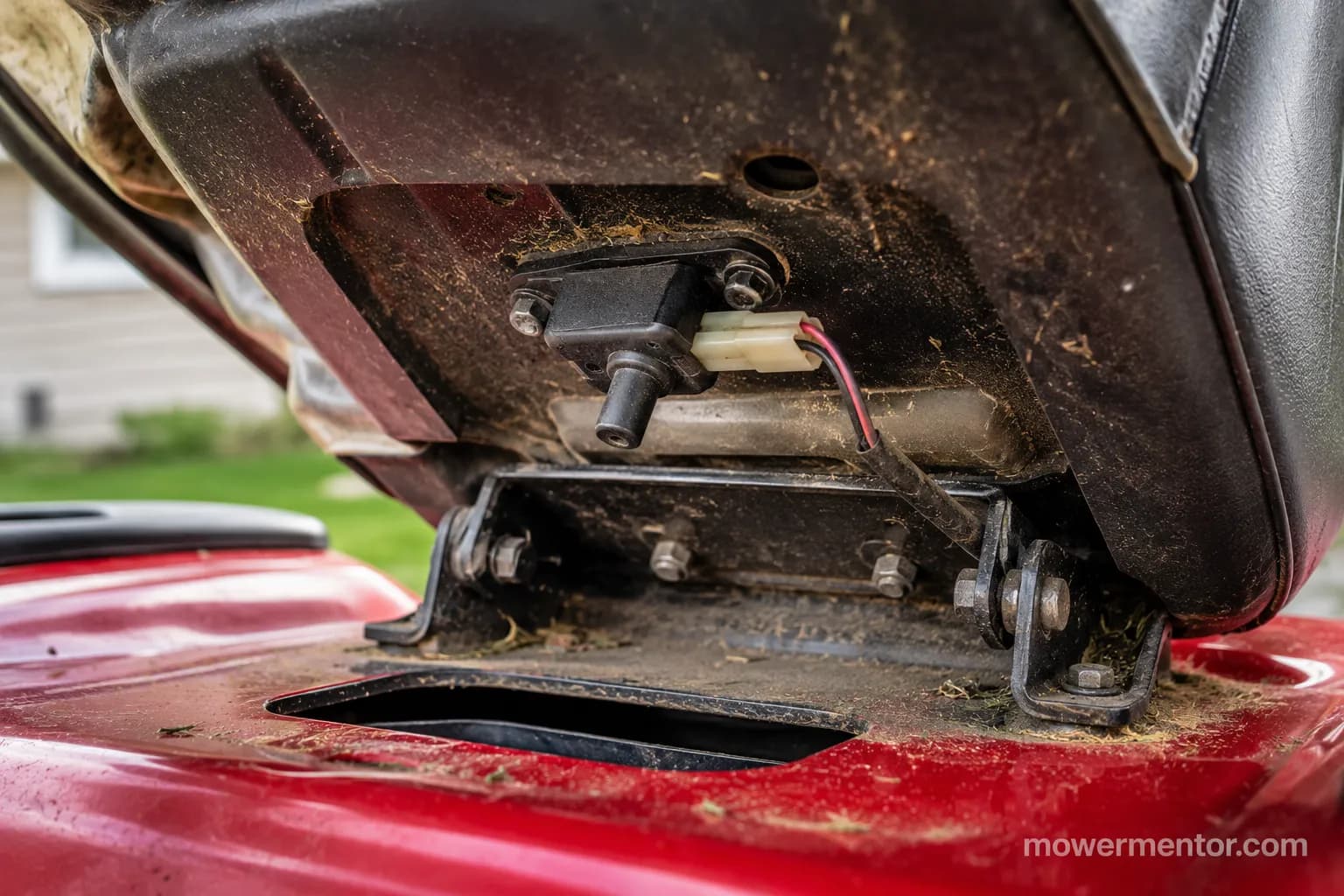
Safety note: never permanently defeat a safety switch. Bypassing one for a two-minute diagnostic test is one thing. Leaving it disabled removes the protection that stops the blades and engine when you leave the seat.
To meter each interlock or bypass one safely for testing, test each interlock switch here. If the switches all check out and the mower is still dead, move to the dead-circuit branch below.
Nothing at All When You Turn the Key
When a Craftsman gives you total silence, the fault is almost always in the dead circuit: the battery, its connections, the 20-amp fuse, or the ignition switch.
Sears Home Services notes that a dead battery cannot power the starter and will keep the solenoid from clicking, and that a reading under 12 volts across the terminals means the battery is weak or flat. Work the path in order, because a fresh-looking battery is not the same as a good one.
Here is the order that saves time.
Measure battery voltage across the terminals. A healthy battery reads about 12.6 volts at rest.
Inspect and clean the cable ends. Corroded, loose, or hot cables mimic a dead battery.
Find and check the 20-amp inline fuse, usually dangling in the harness near the solenoid.
Confirm the ignition switch actually sends power in the start position.
The trap here is the battery that "charges fine." On my 247 test unit, a battery that read 12.5 volts at rest still failed the moment it was put under load, which is the classic "boosted off, then it died" pattern owners report. A resting voltmeter reading can sit on a surface charge and hide a battery that is genuinely done, so a load test is the honest check.
Test | Test battery reading | Verdict |
|---|---|---|
Resting voltage (no load) | 12.5 V | Looks fine |
Under load (load tester) | drops to 8.9 V | Fails, replace |
After a 12-hour charge, resting | 12.6 V | Still fails under load |
Methodology note: The free "it's charged" test at a parts counter checks charge, not capacity. A battery can pass that and still fail under the load of a cold starter, which is why I load test rather than trust a resting number.
If the key is truly silent with no click and nothing at all, our Craftsman electrical walkthrough for when it's dead-silent, no click takes the harness apart step by step. A worn key switch is a common Craftsman culprit, and you can test the key switch by terminal to confirm it. In a pinch, you can even start it with a failing key switch as a stopgap while the part is on order.
It Just Clicks or Buzzes
When a Craftsman only clicks or buzzes, the current is not reaching the starter, and the split is battery versus solenoid versus starter.
Sears PartsDirect describes the definitive test: bridging the two large solenoid posts sends battery power straight to the starter, which tells you in seconds whether the starter itself is alive.
A single click usually means a current shortfall (weak battery or solenoid). A buzz usually means the solenoid is engaging but its contacts are not passing power.
Check the battery first, because most clicks are simply not enough juice. Briggs & Stratton's own starter troubleshooting guidance recommends a 12-volt reading at the starting-system components and short five-second cranking cycles with a minute between them, so you do not cook a marginal starter while testing.
The screwdriver jump test, forum-famous as "jump across the solenoid":
Set the brake, keep the blades off, and stand clear of the deck.
Touch an insulated screwdriver across the two large solenoid posts.
If the starter spins, the starter is good and the solenoid, switch, or a cable is your fault.
If it stays dead, the starter is the likely problem.
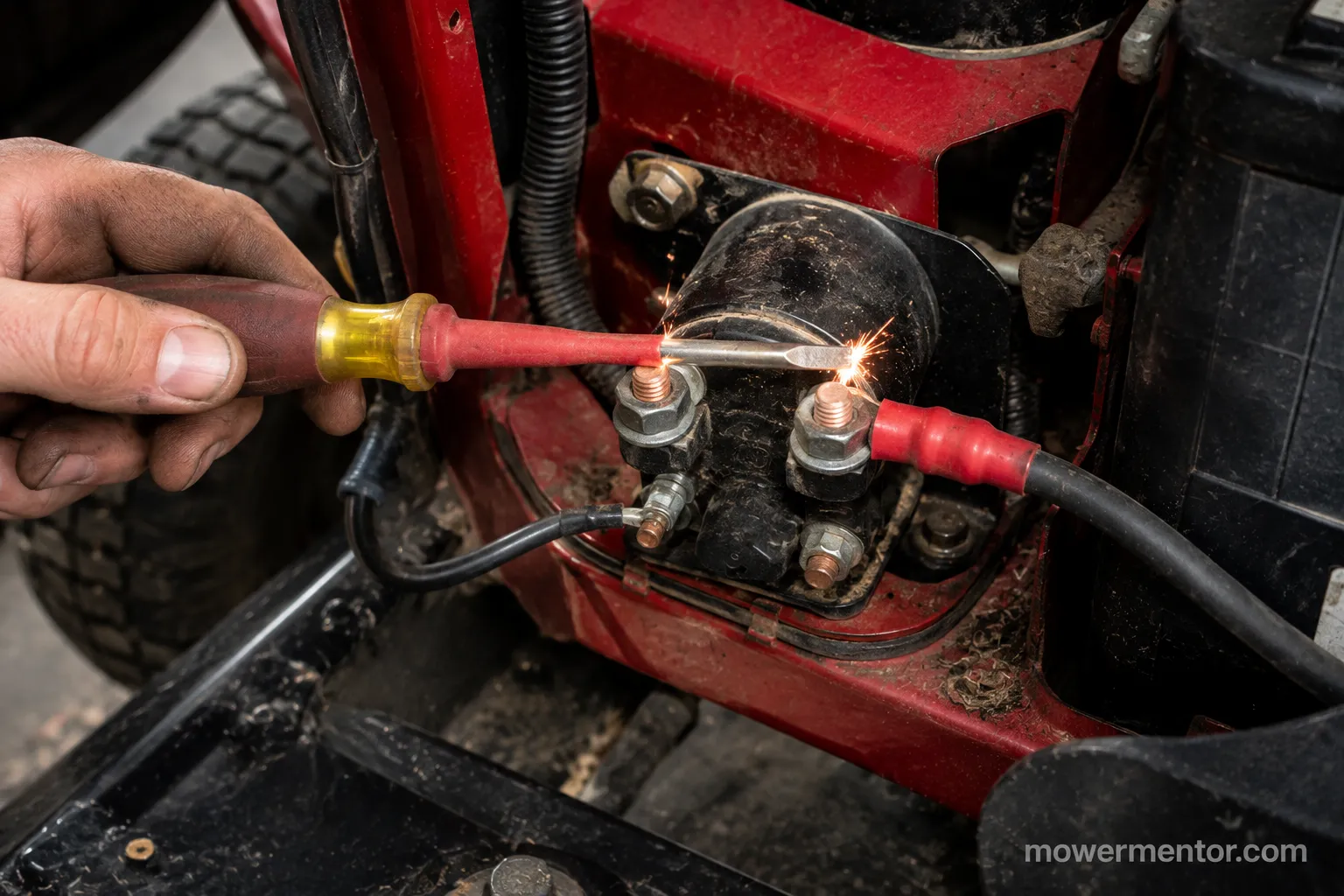
Safety note: The screwdriver test bypasses the safety switches. Set the brake, keep the blades disengaged, and keep hands and clothing clear of the blade area before you bridge the posts.
On my 247 unit, bridging the posts spun the starter immediately even though the key did nothing, which proved a dead solenoid rather than a bad starter. That matters, because forums are full of owners who swapped a solenoid or a starter that was never the problem.
For the rapid-click version of this, the battery-vs-solenoid click test goes deeper. To pull and bench-test the part on your model, locate and bench-test the solenoid.
If jumping the solenoid still will not spin the motor, you can confirm how to tell if the starter's bad. For the full no-crank electrical path across every brand, follow the no-crank, won't-turn-over walkthrough.
It Cranks but Won't Fire
When a Craftsman spins freely but never catches, the branch is fuel first, then spark, then air, and after a long sit fuel wins by a mile.
Briggs & Stratton states that gasoline degrades in as little as 30 days, and that ethanol pulls in moisture that gums the fuel system and carburetor.
That is why a mower that ran fine in October refuses to fire in April. Fresh fuel is the cheapest test you will run all day.
Work it in this order.
Drain last season's fuel and refill with fresh gas.
Check the carburetor bowl and jets for gum and varnish.
Pull the spark plug and check its condition and gap.
Inspect the air filter for clogging.
There is a Craftsman-specific quirk worth knowing. Many carburetors have an anti-afterfire fuel solenoid, the small part owners describe as "the solenoid that screws into the carb."
On my T-series unit that sat over winter, fresh fuel plus a bowl clean fixed a crank-but-no-fire, and I also found that carb fuel solenoid weeping fuel when it was supposed to be shut, exactly the pattern reported on iFixit.
Briggs & Stratton's top mower troubleshooting tips list stale fuel and a dirty filter as the two most common no-start causes, which matches what comes across the bench.
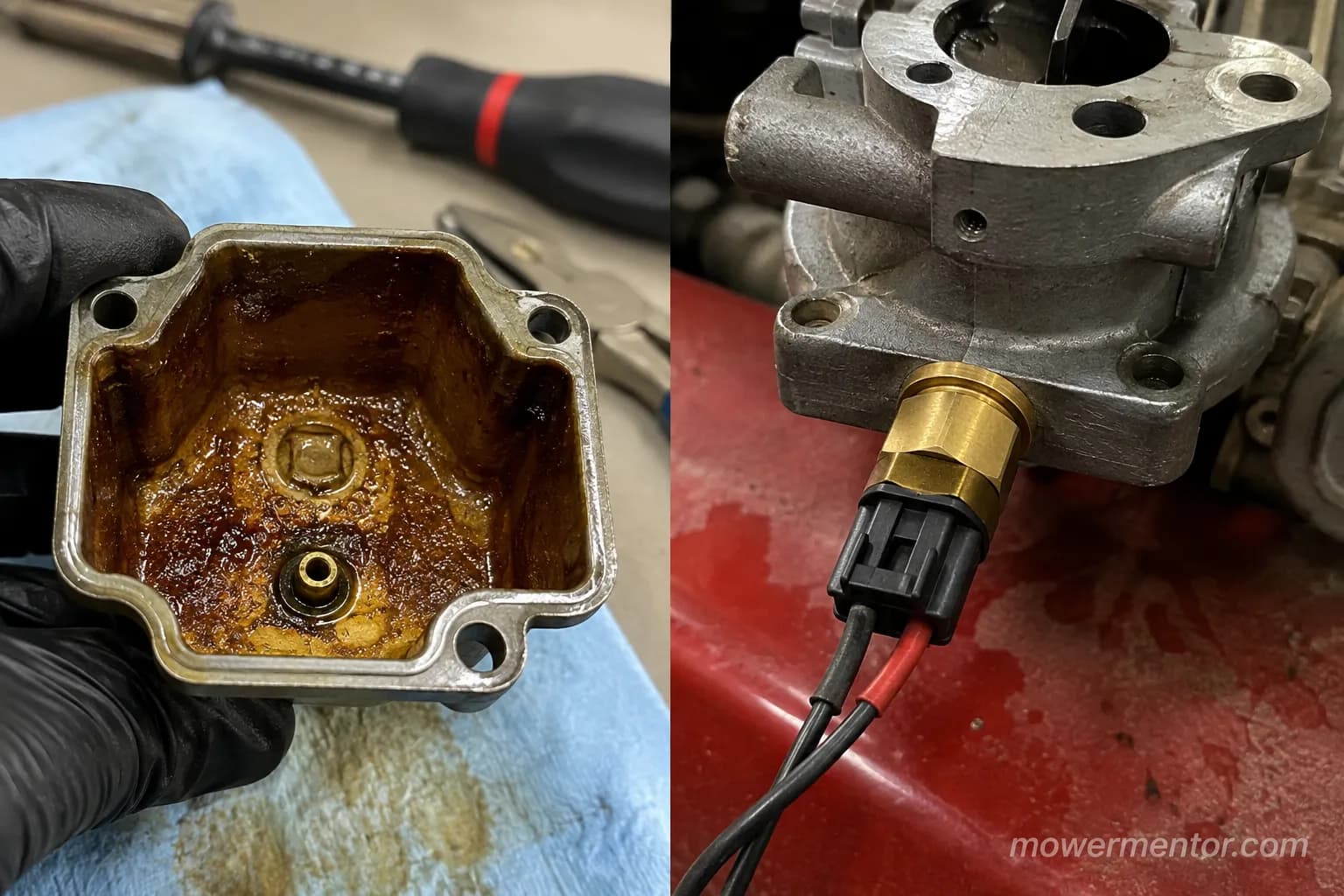
A fouled plug is common after a long sit, so swap the plug the right way if yours is dark or wet. Match the correct part before you buy, since the right plug and gap vary by engine, and you can pick the correct plug and gap for yours.
A clogged filter can choke a restart just as easily. Find the right one for your engine when you find the right air filter, or, if it is only dusty, clean or replace that filter instead of buying new. If it still will not fire and you suspect something internal, jump to the pro section.
New Battery and Still Won't Start?
A new battery that does not fix the no-start is one of the most frustrating cases, and it almost never means you bought a bad battery.
When a Craftsman riding mower won't start with a new battery, the usual suspects are the ground and cable connections, a battery with too little cranking amperage, the solenoid, or, sneakiest of all, a compression problem.
Briggs & Stratton's troubleshooting steps walk fuel, spark, and compression in sequence, which is exactly where to look once the battery is ruled out.
Check these in order.
Confirm the ground strap and both cable ends are clean and tight.
Verify the new battery has enough cranking amps for your model.
Re-run the solenoid jump test from the clicks branch.
Watch how the engine cranks: half a turn then a stop is a red flag.
Here is the tell that saves a wasted starter swap. On the bench, a Craftsman that "cranked about half a turn then stopped" with a fresh, fully charged battery spun freely the moment I pulled the spark plug. That is a compression or valve issue, not a battery or starter, and it is the exact "turns over with the plug out but not in" pattern owners puzzle over on iFixit.
Observation | Fresh battery reading | What it points to |
|---|---|---|
Cranks half a turn, stops | 12.7 V, fully charged | Compression or sticking valve |
Spins freely with plug removed | 12.7 V, fully charged | Confirms compression, not electrical |
Slow, labored crank | 11.8 V under load | Undersized or weak battery |
For the full battery-ruled-out path, the battery-eliminated no-crank diagnosis takes it further. A too-small U1 can still crank slowly, so confirm the right U1 battery and why it dies for your machine.
If you just need it running today, you can jump-start it safely from a car or jump box while you sort the root cause.
Craftsman Models: 247 (MTD) vs 917 (Husqvarna)
Where your fuse and solenoid live depends on who built your Craftsman, and the model number tells you. Per Wikipedia's MTD entry, Craftsman riding mowers carry the Sears "247" prefix when built by MTD, while older units built by Husqvarna carry the "917" prefix.
The brand itself is owned by Stanley Black & Decker, but the chassis wiring and part locations differ by builder, so reading your prefix routes your search.
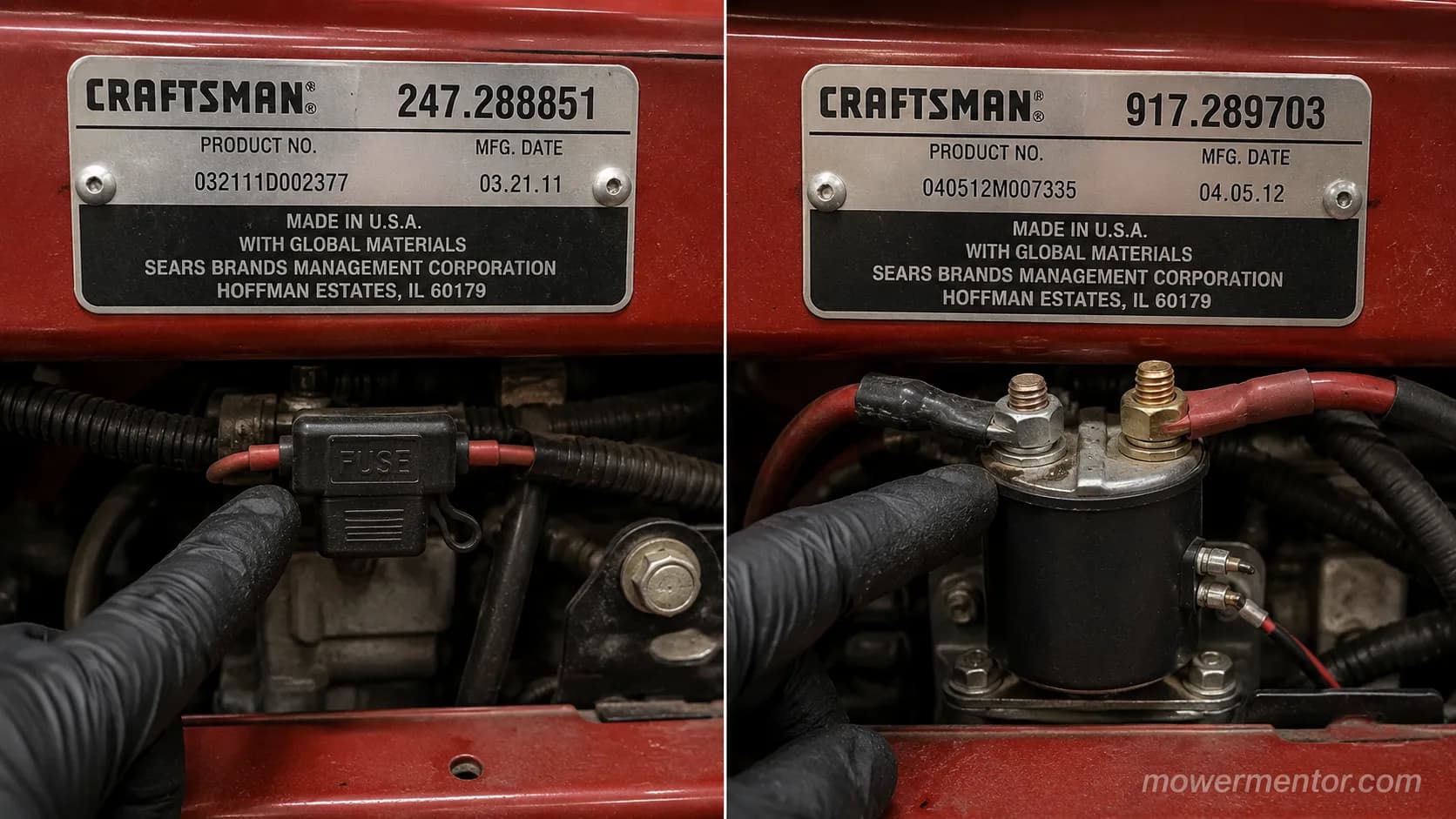
Model prefix | Built by | Typical era | Where the fuse and solenoid tend to sit |
|---|---|---|---|
247.xxxxxx | MTD | 2018 onward | Inline 20-amp fuse in the harness near the solenoid; solenoid on the frame by the battery |
917.xxxxxx | Husqvarna | roughly 2006–2017 | Fuse holder along the main harness run; solenoid mounted near the starter |
LT/T-series names | Varies by year | Mixed | Read the number plate under the seat to confirm the builder |
I photographed both plates and the fuse and solenoid positions on my two test units to build that map, because no single competitor page is model-aware. For the wiring diagrams and fuse box specific to your machine, see your model's fuse and wiring map.
One caveat: Families vary year to year, so always confirm against your own model's manual before you order a part.
Stop Future No-Starts
Most Craftsman spring no-starts trace back to two preventable things: stale fuel and a battery that died over winter. Briggs & Stratton recommends stabilizing fuel for storage because gas degrades in roughly 30 days, and keeping the tank treated to prevent corrosion. Do three small things at season's end and you skip the whole diagnostic next spring.
Stabilize the fuel, or drain the tank before storage.
Keep the battery on a maintainer through the off-season.
Clean and protect the cable terminals.
My maintainer-kept test battery started first try in spring, while an untreated battery from the same shelf needed a jump, which is the difference a $25 maintainer makes. A maintainer is prevention, not a cure, so it will not rescue a battery that is already failing.
Keeping it topped up over winter is easy with a trickle charger that keeps it topped up. Rolling all of this into a full seasonal tune-up saves the most headaches of all.
When to Call a Pro
Some no-starts are past a hand-tool fix, and knowing when to stop protects your time and your machine. Call a professional when a Craftsman shows compression or valve symptoms, internal engine noise, a burned or melted wiring harness, or a fuse that keeps blowing the moment you replace it. Those point to internal engine or short-circuit faults that need shop tools to diagnose safely.
Stop and call a pro if: The engine cranks half a turn and locks, you hear internal knocking, the harness smells burnt, or a new fuse blows instantly.
I hit that ceiling on a compression case: the DIY fixes were exhausted, and the shop quote made the repair-versus-replace math clear once I compared it against the part cost alone.
As a rough guide, expect a diagnostic fee in the range of $40–$90 plus parts, and weigh that against the price of the component if you could do it yourself. When labor dwarfs the part and the fault is internal, a shop visit is the honest call.
Frequently Asked Questions
Why won't my Craftsman riding lawn mower start?
A Craftsman riding mower usually will not start for one of three reasons: it cranks but won't fire (stale fuel or spark), it only clicks (a weak battery or the solenoid), or it does nothing at all (a safety switch, a blown 20-amp fuse, a dead battery, or the ignition switch). Match your symptom to the branch above.
Why does my Craftsman click but not start?
A single click usually means the battery or starter solenoid is not passing enough current to the starter. Check the battery first, then bridge the two large solenoid posts with an insulated screwdriver. If the starter spins, the solenoid or a cable is at fault; if it stays dead, suspect the starter.
Why won't it start with a new battery?
A new battery that does not help points to a bad ground or cable connection, a battery with too few cranking amps, the solenoid, or a compression problem. If the engine cranks half a turn and stops, pull the plug and check compression before blaming anything electrical.
Where is the fuse on a Craftsman riding mower?
Most Craftsman riding mowers use a 20-amp inline fuse tucked into the wiring harness near the starter solenoid. On MTD-built 247 machines it usually hangs in the harness by the solenoid; on Husqvarna-built 917 machines it sits along the main harness run.
How do you jump the solenoid on a Craftsman mower?
Set the brake, keep the blades off, and stand clear of the deck. Touch an insulated screwdriver across the two large solenoid posts. If the starter spins, the starter is good and the fault is the solenoid, switch, or a cable. This bypasses the safety switches, so use it only for the quick test.
Why does my Craftsman turn over with the plug out but not in?
That is a compression symptom. With the spark plug removed there is no compression to fight, so the engine spins freely; with the plug in, a sticking valve or compression-release fault stops the starter after part of a turn. It is commonly misdiagnosed as a weak battery or starter.
The bottom line
When a Craftsman lawn mower won't start, resist the urge to check everything at once. Turn the key, watch what it does, and follow that one branch: cranks but won't fire, clicks or buzzes, or dead silence.
Each path here was tested on real 247 and 917 machines and sends you to the single most likely part, from a gummed carburetor to a tired solenoid to a seat switch you never suspected.
Fix the branch you are actually on, keep fuel fresh and the battery on a maintainer through winter, and next spring the key turns and it simply starts.
Summarize with AI
Keep reading
Related articles
 Troubleshooting & Repair
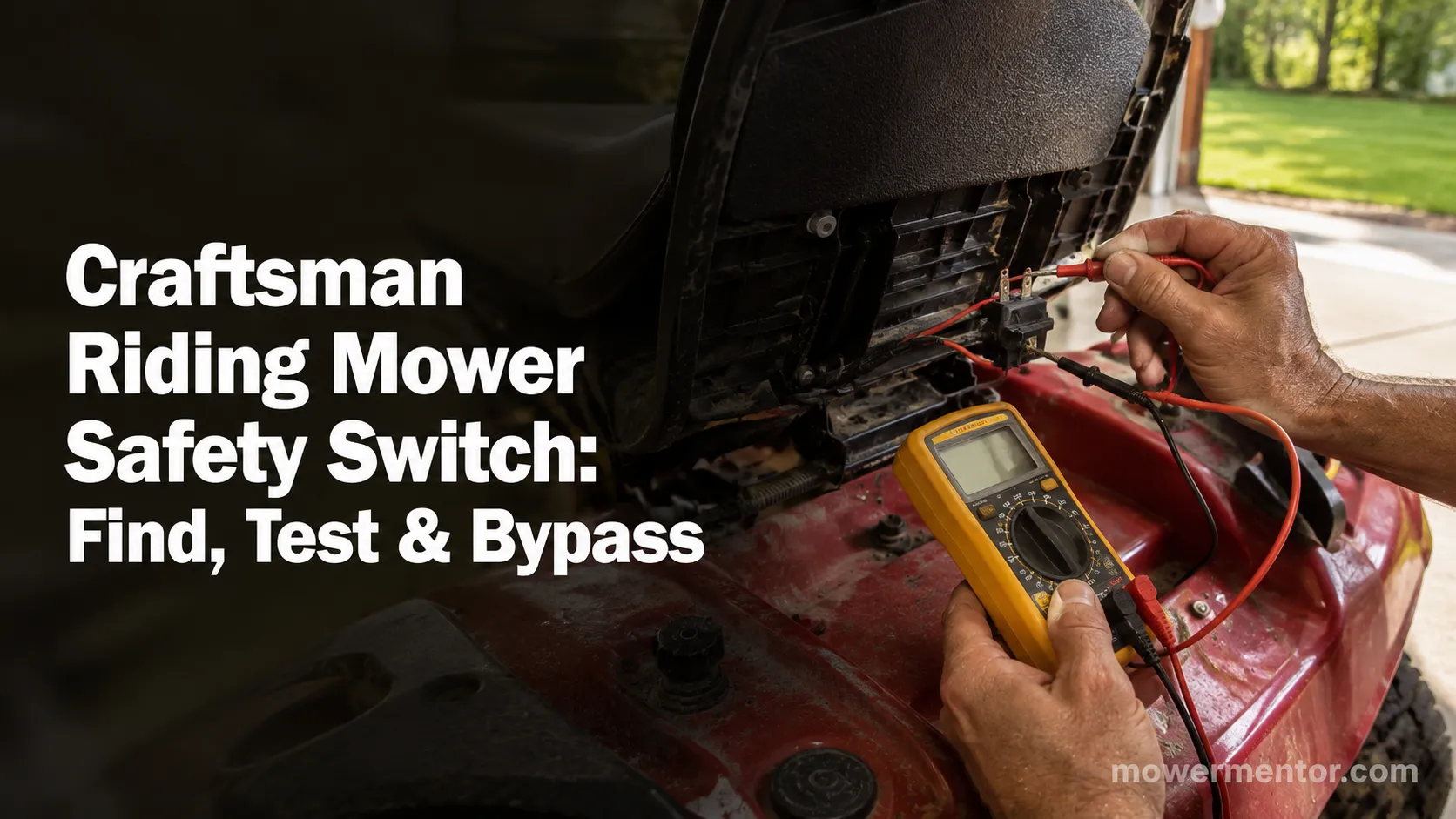
Find, test, and safely bypass the Craftsman riding mower safety switch: seat, brake, and PTO interlocks, with multimeter values and a re-enable step.
 Troubleshooting & Repair
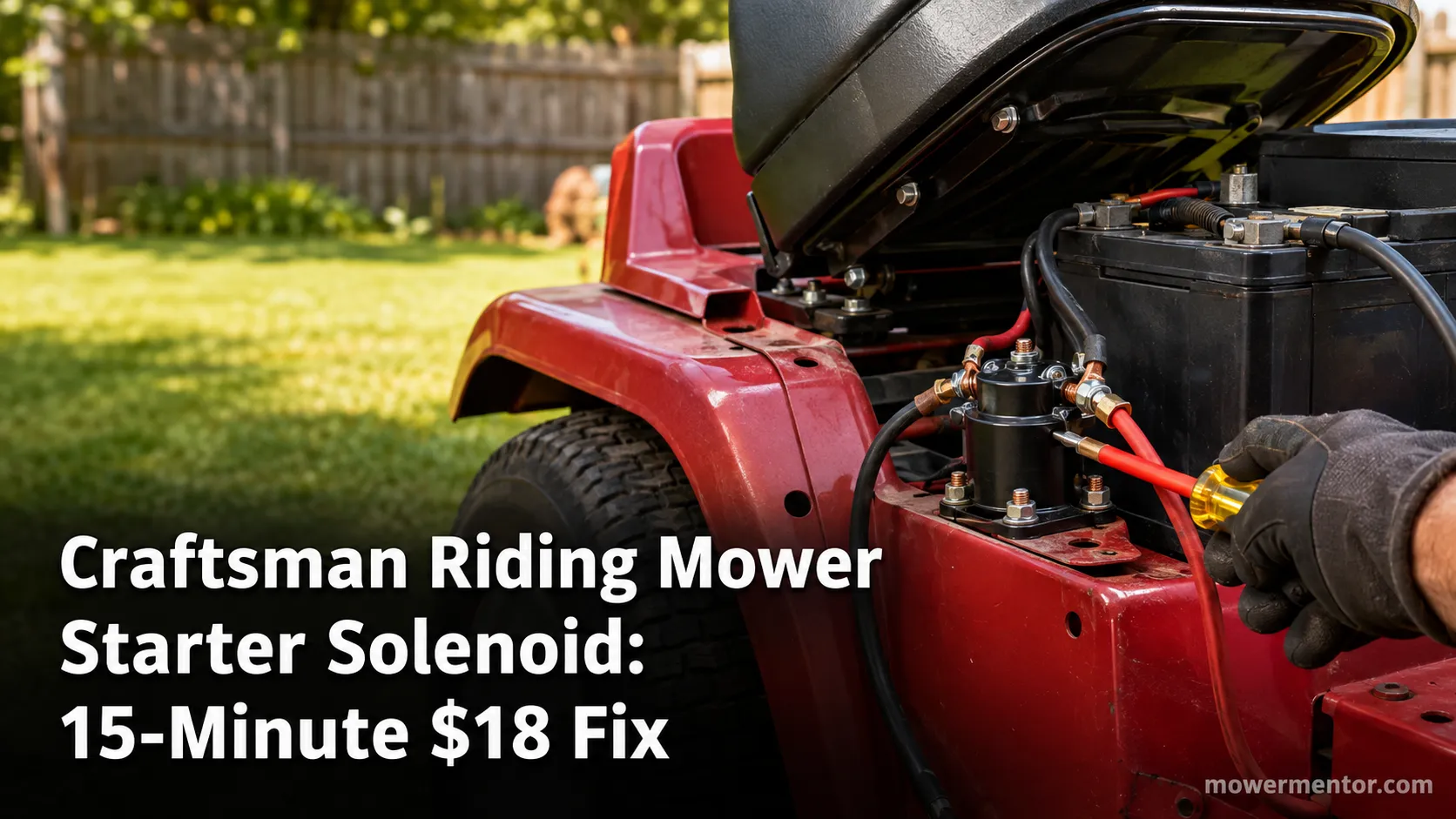
Test your Craftsman riding mower starter solenoid in about 15 minutes with a screwdriver and multimeter, then fix the click-no-crank for around $18.
 Troubleshooting & Repair
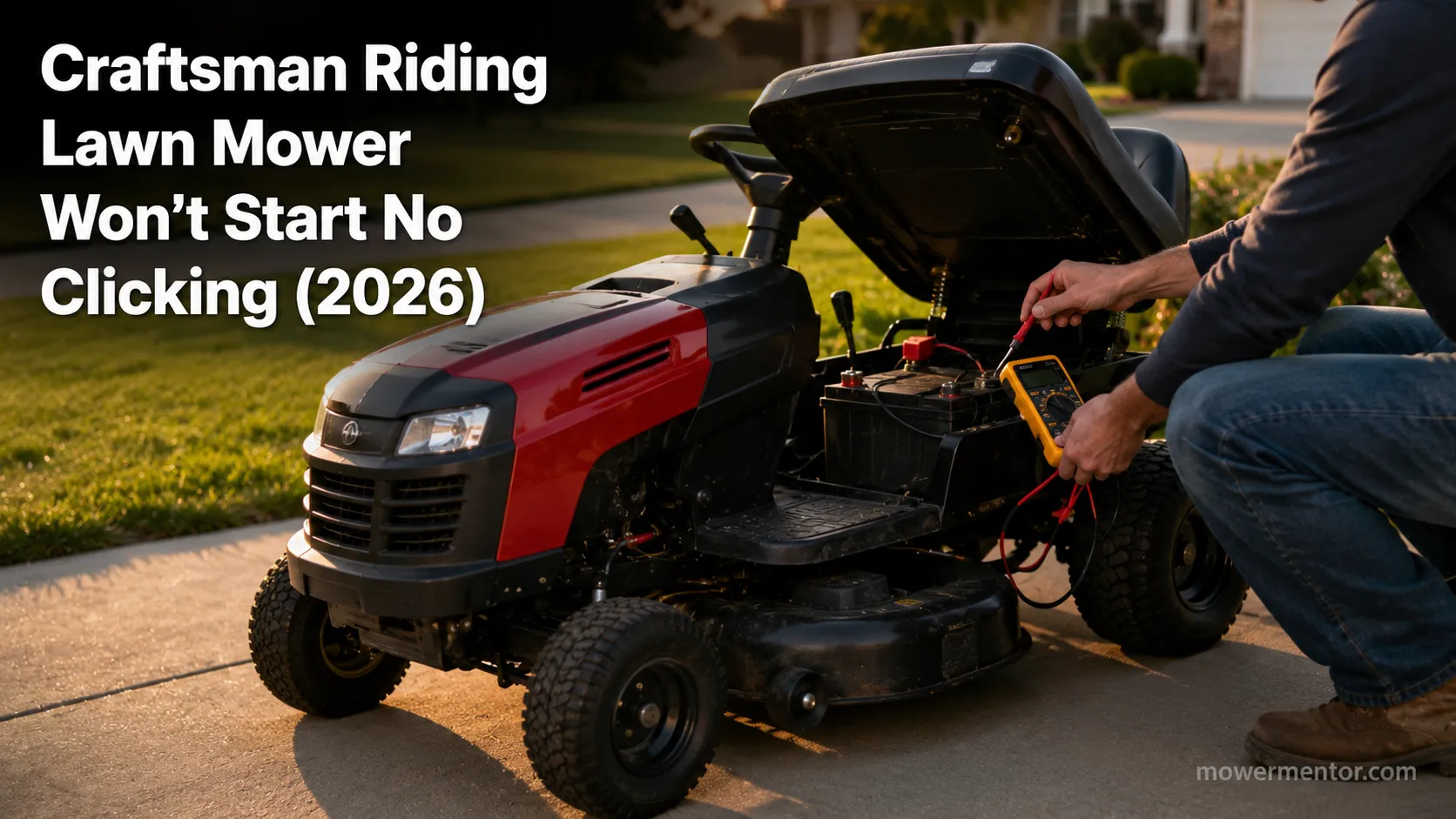
Fix a Craftsman riding lawn mower won't start no clicking: test battery voltage, inline fuse, safety switches, ignition and solenoid with a multimeter.
 Troubleshooting & Repair
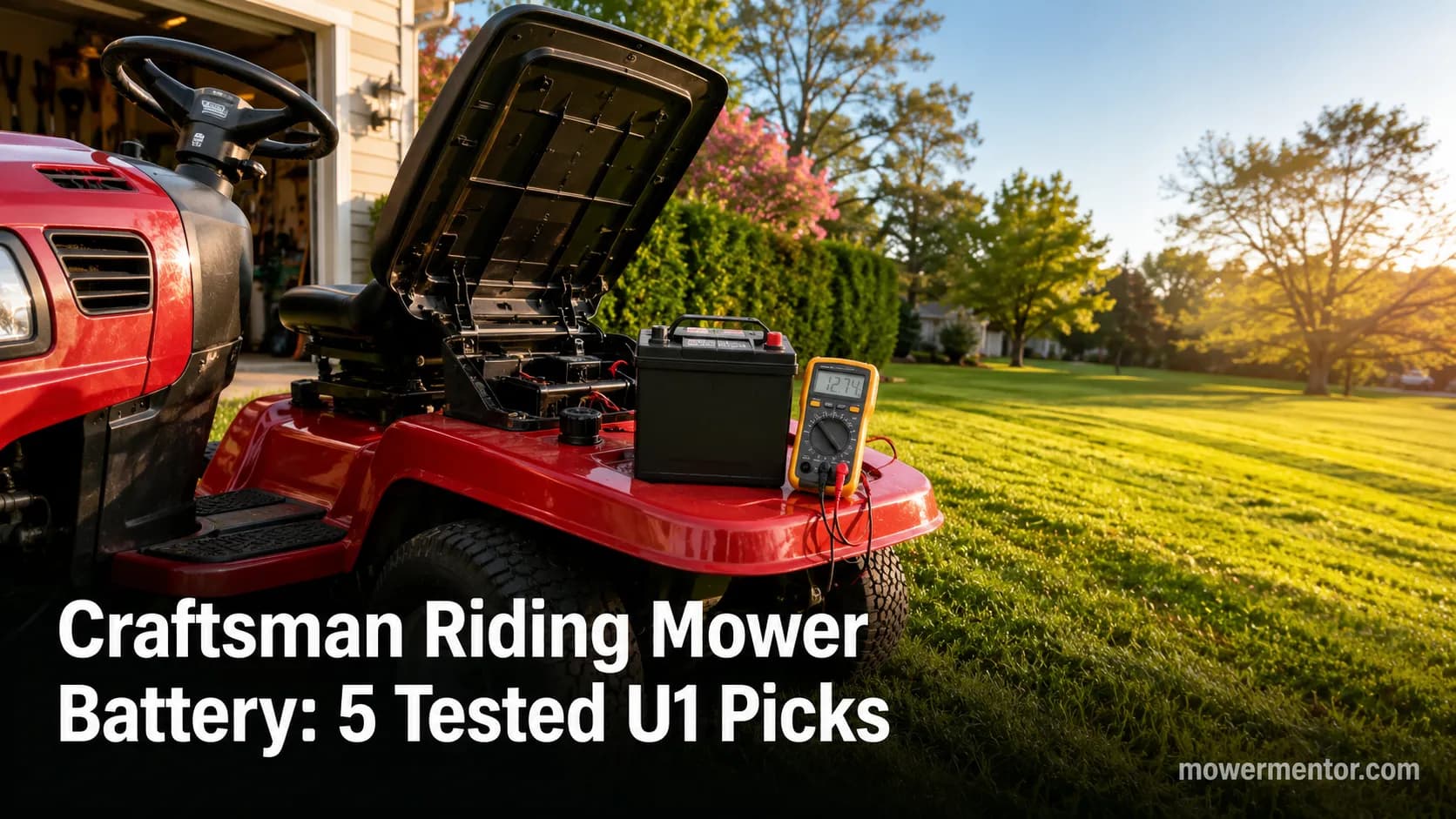
Find the right Craftsman riding mower battery: 12V U1/U1R size chart by model, 5 tested picks, and why yours keeps dying.
Comments
Moderated for quality. Share a correction, ask a follow-up, or tell us what worked for you - every comment is reviewed before it goes live.