
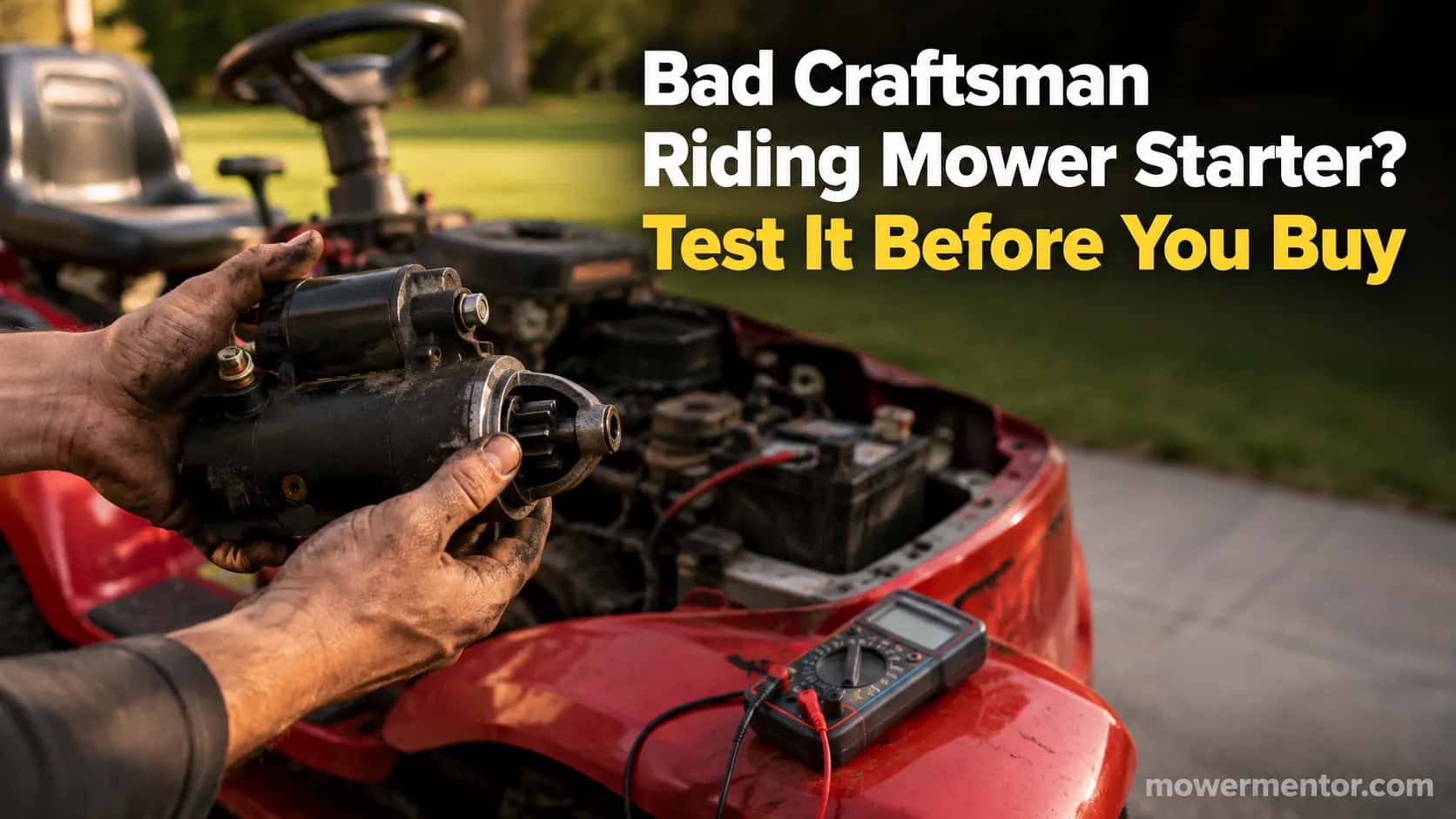
Bad Craftsman Riding Mower Starter? Test It Before You Buy
Test your Craftsman riding mower starter before you buy: the 3-step starter-vs-solenoid check, engine-specific fitment, and what a replacement really costs.
Written by Tony MaldonadoReviewed by Wade Coburn
Last updated on August 19, 2026
When you buy through links on our site, we may earn an affiliate commission (at no extra charge), which we use to fund new product tests. Learn more.
Summarize with AI
Test a suspected Craftsman starter before buying, since a single click with a healthy battery usually means the solenoid while a whir that never spins the engine means a worn pinion or ring gear.
Measure battery voltage under load, jump the solenoid, then feed the starter directly, and you will know whether to spend about $40 on a starter or $15 on a solenoid.
You turn the key, the mower gives one flat click, and then silence. Before you condemn your craftsman riding mower starter, remember that most no-cranks blamed on the starter trace back to the solenoid, the battery, or a chewed pinion gear.
On both of my Craftsman test mowers this spring, that single-click-no-crank pointed at the solenoid, not the motor. The starters turned out fine.
According to Briggs & Stratton, a single click with the engine silent usually points to the battery, wiring, or solenoid before the starter itself. That one fact saves a lot of wasted money.
The 30-Second Answer: Starter, Solenoid, or Battery?
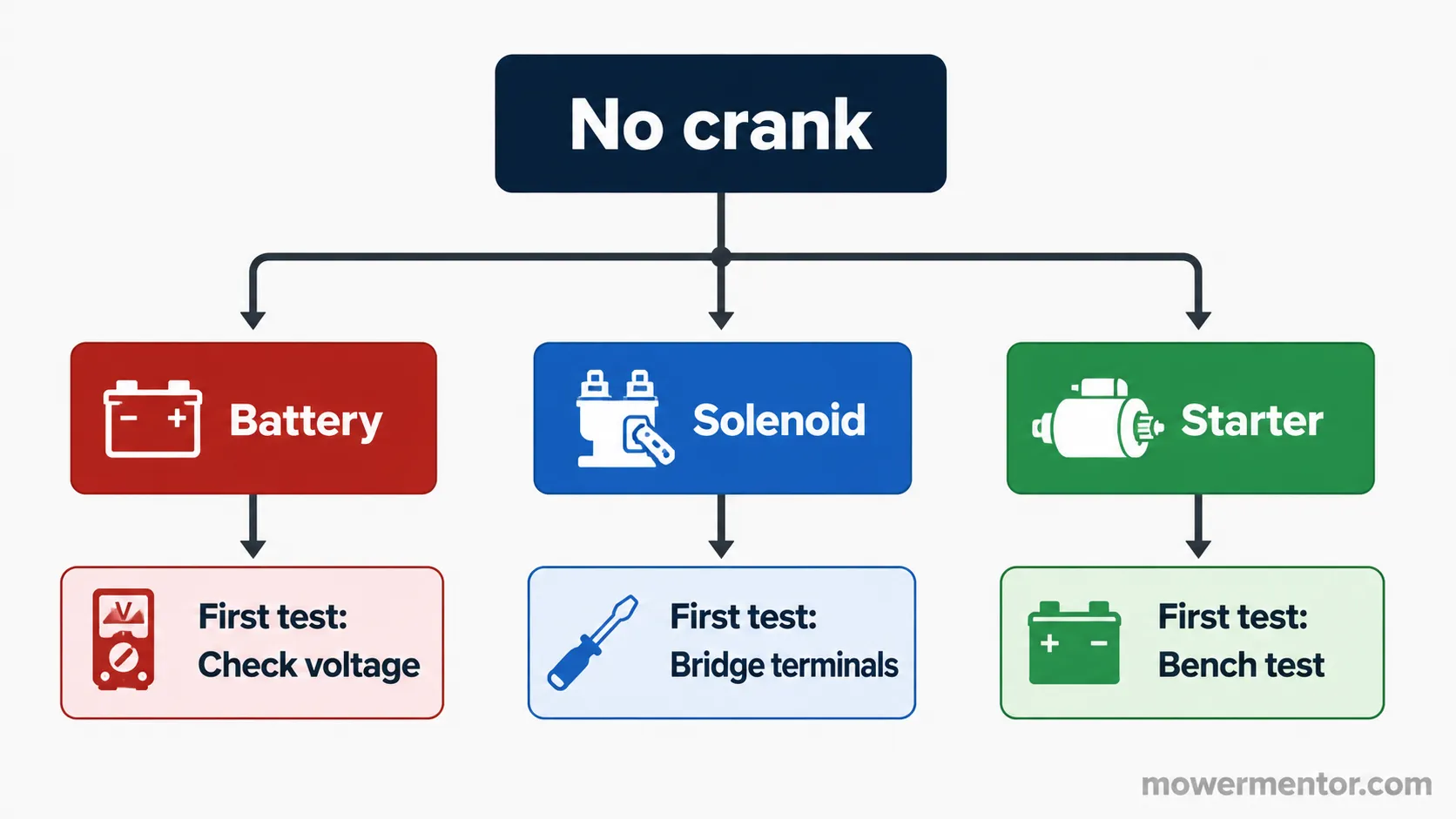
A Craftsman riding mower no-crank has three usual suspects: the battery, the solenoid, and the starter motor itself. Match the sound to the part before you spend anything.
One click with a charged battery points to the solenoid, rapid clicking points to the battery, and a whir with no engagement points to the pinion or ring gear. On my two test mowers, the part that actually failed was cheaper than a starter both times.
What you hear or see | Most likely part | Test first |
|---|---|---|
One click, then nothing (battery looks charged) | Solenoid | Jump the solenoid posts |
Rapid machine-gun clicking | Battery or connections | Battery voltage under crank |
Motor whirs but engine never turns | Pinion or ring gear | Inspect the drive gear |
Dead silence, no click at all | Battery, safety switch, or wiring | Battery and interlocks |
Cranks cold, dead when hot | Corroded contacts or armature dead spot | Direct-feed the starter |
Before you spend $40 on a starter, run the tests below. On the two mowers I documented, the part that failed was cheaper than the starter both times.
Craftsman Riding Mower Starter: Bad Symptoms and What They're Telling You
A Craftsman riding mower starter rarely fails silently, and the sound it makes is the clue. A single click with a good battery usually means the solenoid coil pulled in but its contacts did not pass current to the motor.
A whir that never spins the flywheel points to a worn pinion or a damaged ring gear, not a dead motor. Briggs & Stratton lists the same spread of no-crank causes, from battery and wiring to switch and solenoid, before the starter.
Symptom | What it usually means | Is it the starter? |
|---|---|---|
Single click, battery charged | Solenoid contacts worn | No, usually the solenoid |
Rapid clicking | Low battery or loose ground | No, power delivery |
Whir with no engagement | Pinion rounded off or ring gear chipped | Partly, the drive gear |
No sound at all | Blown fuse, open safety switch, dead battery | No |
Grind or screech | Pinion meshing badly with the ring gear | Yes, drive-side wear |
Works cold, quits hot | Corroded contacts or a bad armature spot | Sometimes |
It just clicks but won't crank, is that the starter?
Usually not. A crisp single click with a battery reading near 12.6 volts means the solenoid energized but did not deliver current, so the motor never turned.
If there is no click at all, the fault is upstream, and when there's no click at all the trail runs to the battery, a safety switch, or the ignition circuit.
The whir-without-engagement pattern deserves its own warning. On my Intek V-twin test mower, a cheap aftermarket starter whirred freely but never grabbed the flywheel within a season, because its plastic pinion had rounded off.
The Briggs pinion is a 16-tooth gear that wears out when the teeth round over, and matching a symptom to that failure is exactly what a parts list cannot do. For the broader view, my guide to reading a failing starter's symptoms covers every brand.
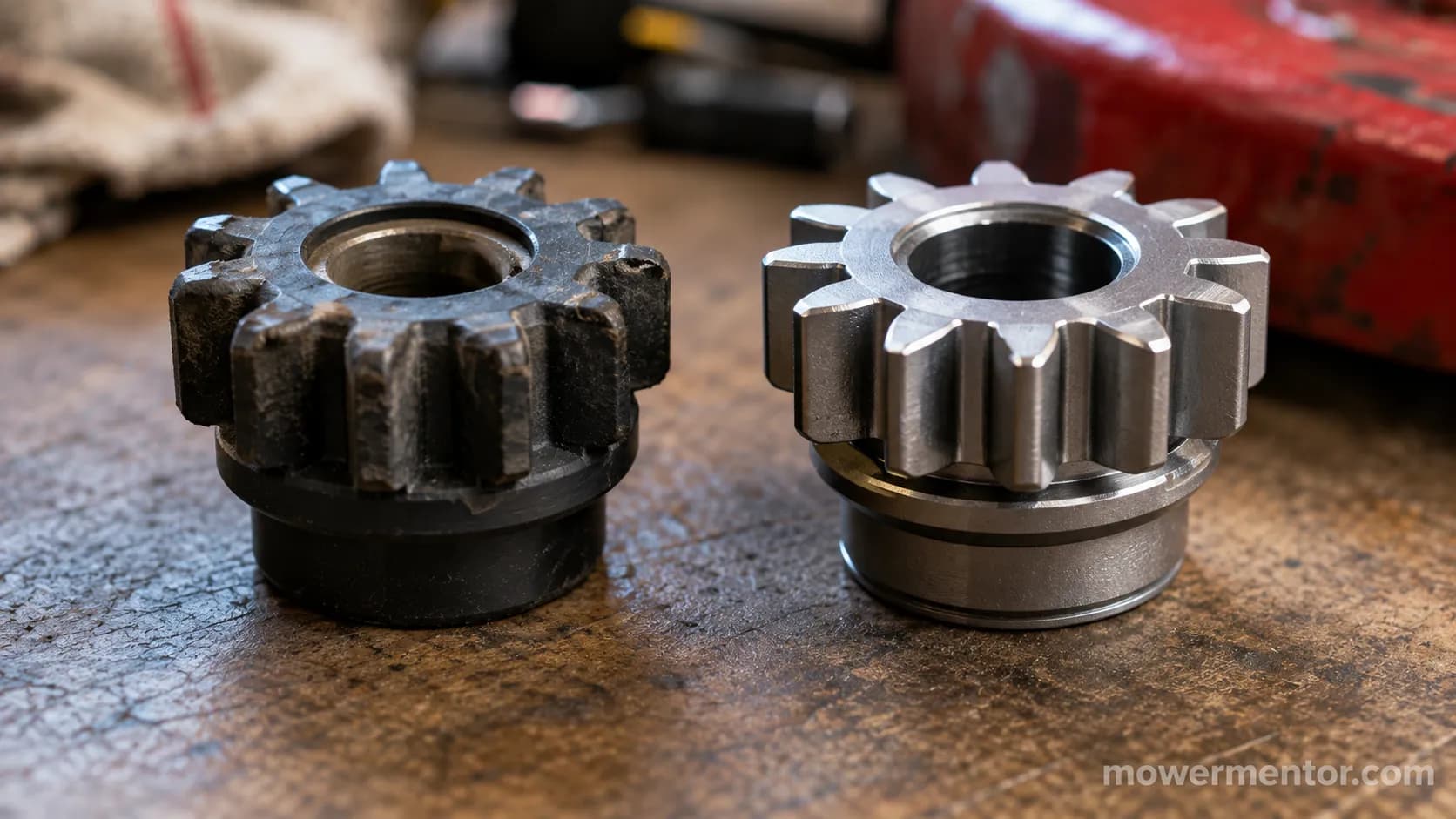
Half of these symptoms are not the starter: The click, the rapid clicking, and the dead silence all point elsewhere first. Only the whir, the grind, and the hot-quit patterns implicate the motor or its drive gear.
If the symptom map still leaves you unsure, the full Craftsman start diagnosis walks the whole no-start tree from fuel to spark to electrical.
Starter vs. Solenoid vs. Battery: The 3-Test Sequence That Pinpoints It
To tell a bad Craftsman riding mower starter from a bad solenoid or a weak battery, run three tests in order: measure battery voltage under crank, jump the solenoid's two large posts, then feed the starter directly. Stop at the first failure.
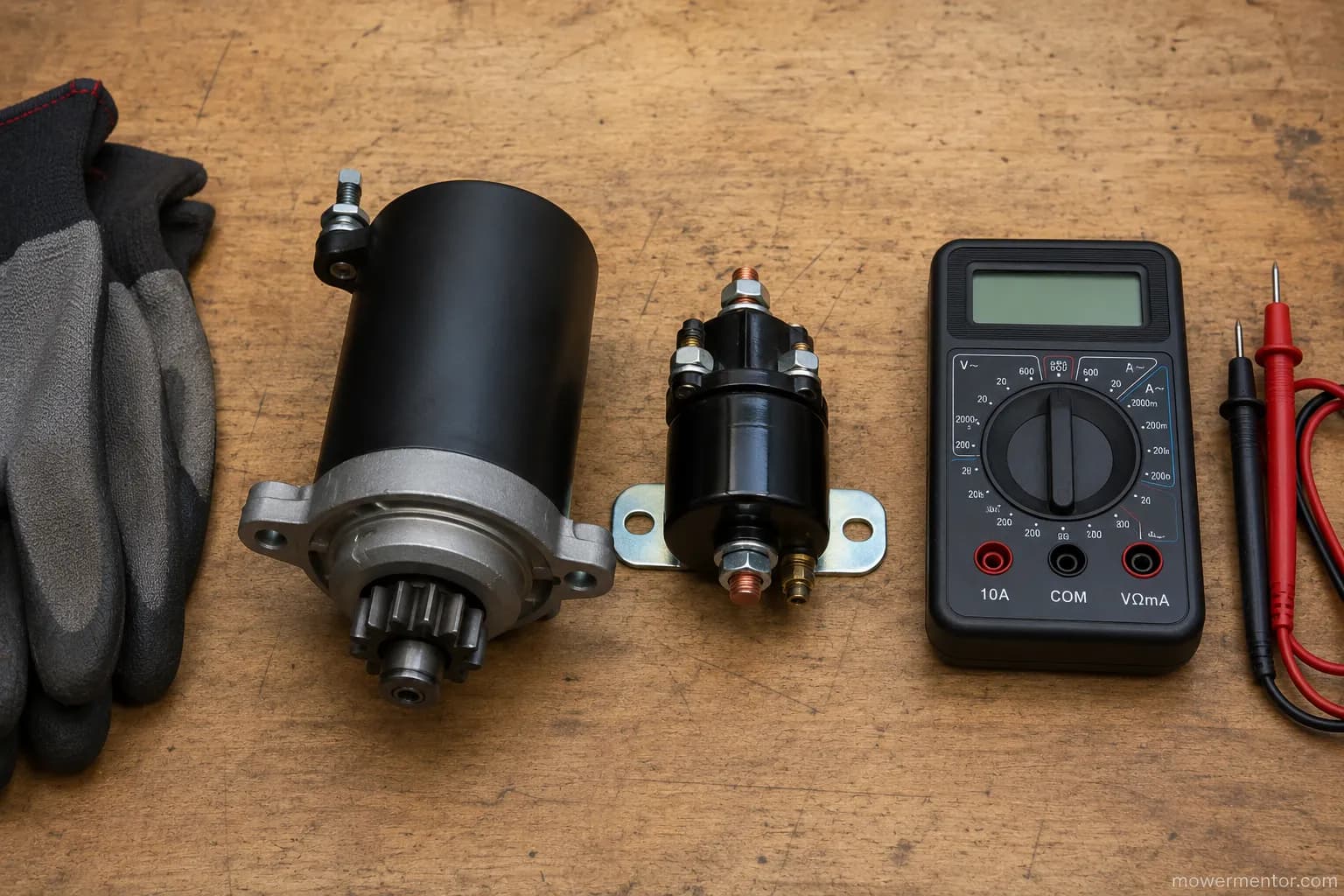
A healthy 12-volt mower battery rests near 12.6 volts and should hold above roughly 9.6 volts while cranking. If it collapses under load, you have found your fault before spending a cent on a motor.
Battery under load. Set a multimeter to DC volts, read the resting voltage, then read it again while a helper cranks. A reading that holds is a good battery, while a reading that crashes is a weak or dying mower battery. Per Sears Home Services, the motor needs far more current than the solenoid coil, so load voltage decides the diagnosis.
Jump the solenoid. With the parking brake set and the mower out of gear, bridge the two large solenoid posts with an insulated screwdriver and expect a spark. If the engine cranks, the fault is when the solenoid itself is the fault rather than the motor.
Feed the starter directly. Run a jumper from the battery positive to the starter stud nut. If the motor spins it is good, and if it does nothing the motor is dead. A starter that runs but will not spin the flywheel points back to the motor, a distinction Durautos lays out clearly.
For the full bench procedure, see the full multimeter and bench method. Here is what those tests returned on my Kohler Courage mower, so you have a real reference to compare against.
Test | Reading on the Kohler mower | Verdict |
|---|---|---|
Resting battery voltage | 12.6 V | Good |
Voltage at battery under crank | 11.9 V | Good, battery is fine |
Voltage at starter stud under crank | 9.1 V | Bad, 2.8 V lost across the ground path |
Solenoid jump | Cranked | Solenoid path OK |
Direct feed to starter | Spun freely | Starter is good |
That 2.8-volt gap between the battery post and the starter stud was the whole problem. The starter drew fine once I cleaned a corroded ground strap, and no new parts were needed.
Safety note: Jumping a solenoid throws a real spark, and bypassing the seat and brake interlocks lets the engine turn over with no safety in place. Keep hands and clothing clear of the blade and belts, and never bypass a safety switch to mow.
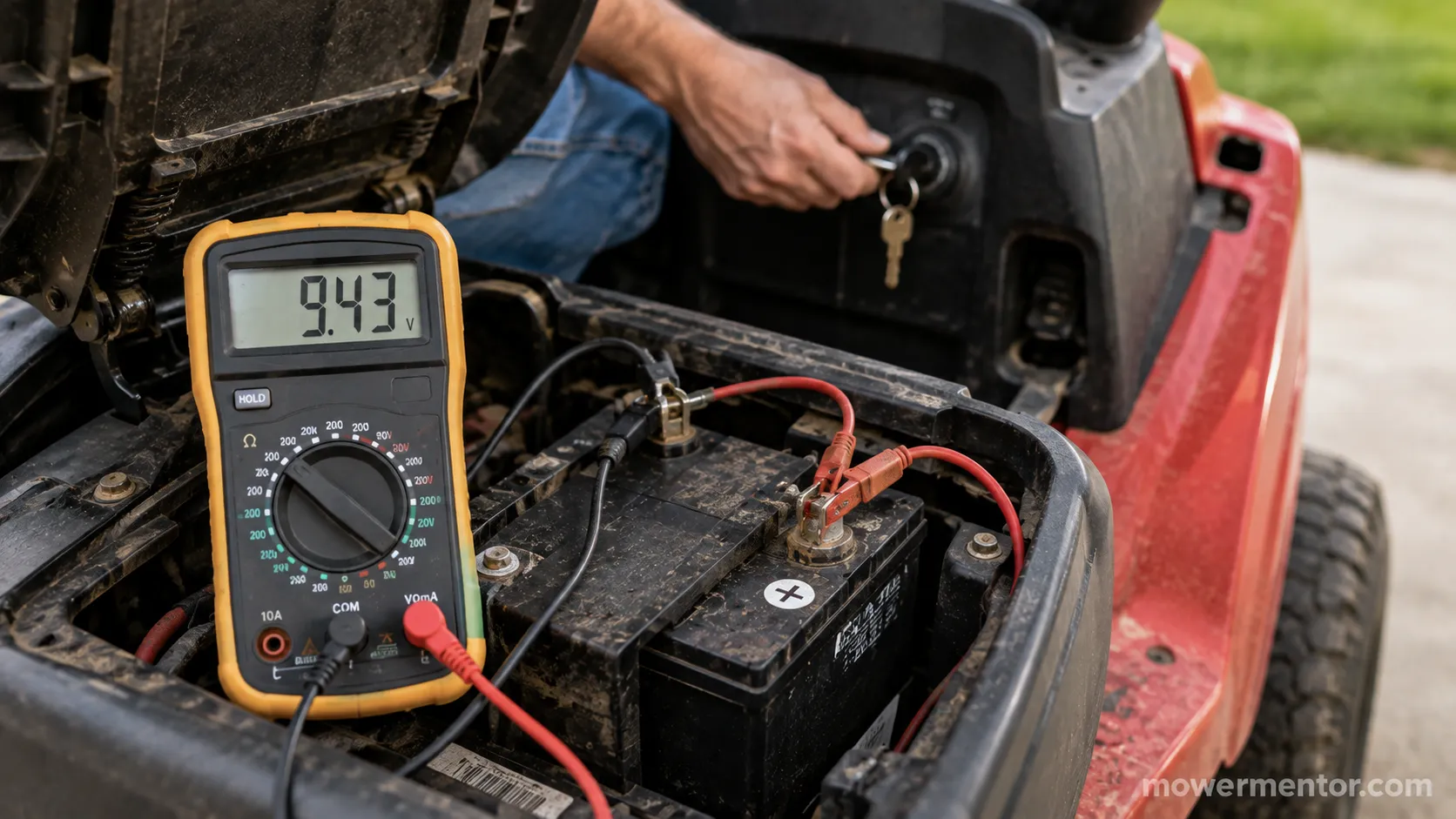
If all three tests point at the motor, replace it. If they do not, skip the purchase and route to the real fault at the end of this guide.
How to Replace the Starter, Step by Step for Briggs and Kohler
Replacing a confirmed-bad Craftsman riding mower starter is a two-bolt job that most owners finish in under twenty minutes. The step nearly everyone skips is inspecting the flywheel ring gear before the new motor goes on.
On my Intek mower the swap took 18 minutes, and the ring gear had two flattened teeth I would have missed if I had not turned the flywheel by hand. Fitting a fresh starter against damaged teeth simply wears out the new part.
Disconnect the battery ground first. Pull the negative cable so the starter circuit is dead before you touch it.
Locate and unbolt the starter. It sits low on the engine, held by two bolts plus the heavy cable, and the Intek and Kohler Courage use slightly different mounts. If you would rather refurbish, rebuilding a worn starter instead is sometimes worth it on an OEM unit.
Inspect the ring gear. Turn the flywheel by hand and look for flattened or missing teeth where the pinion meshes. This is the repeat-failure check the parts pages never mention.
Fit the new starter. Seat it flush, torque the two bolts evenly, and choose a metal pinion over plastic if the option exists. The all-brand version of this job lives in the all-brand starter-motor swap.
Reconnect and test-crank. Reattach the cable and ground, then crank. While the shroud is off, it is a good moment to gap the spark plug so a weak spark does not masquerade as a crank problem.
If it cranks but will not catch, a spritz of starting fluid confirms whether you have a fuel issue rather than a crank issue. The RepairClinic part data confirms the Briggs pinion is that 16-tooth gear, which is why the ring-gear check matters.
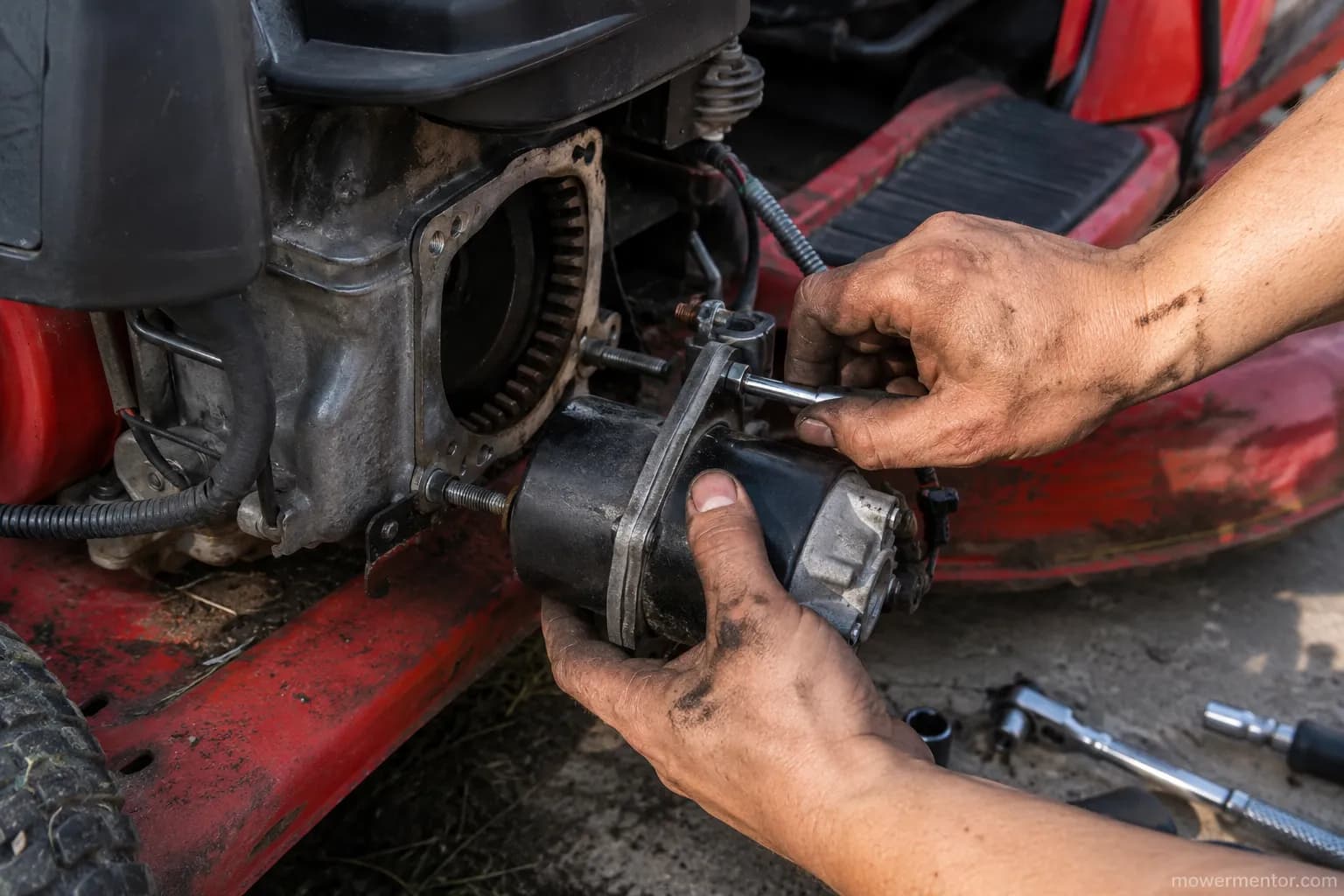
Easy swap, but not always the cure: The starter comes off in minutes, yet if the ring gear is chewed, a new motor will fail again. Check the gear before you bolt anything on.
Which Replacement Starter Fits Your Craftsman: Model to Engine to Part
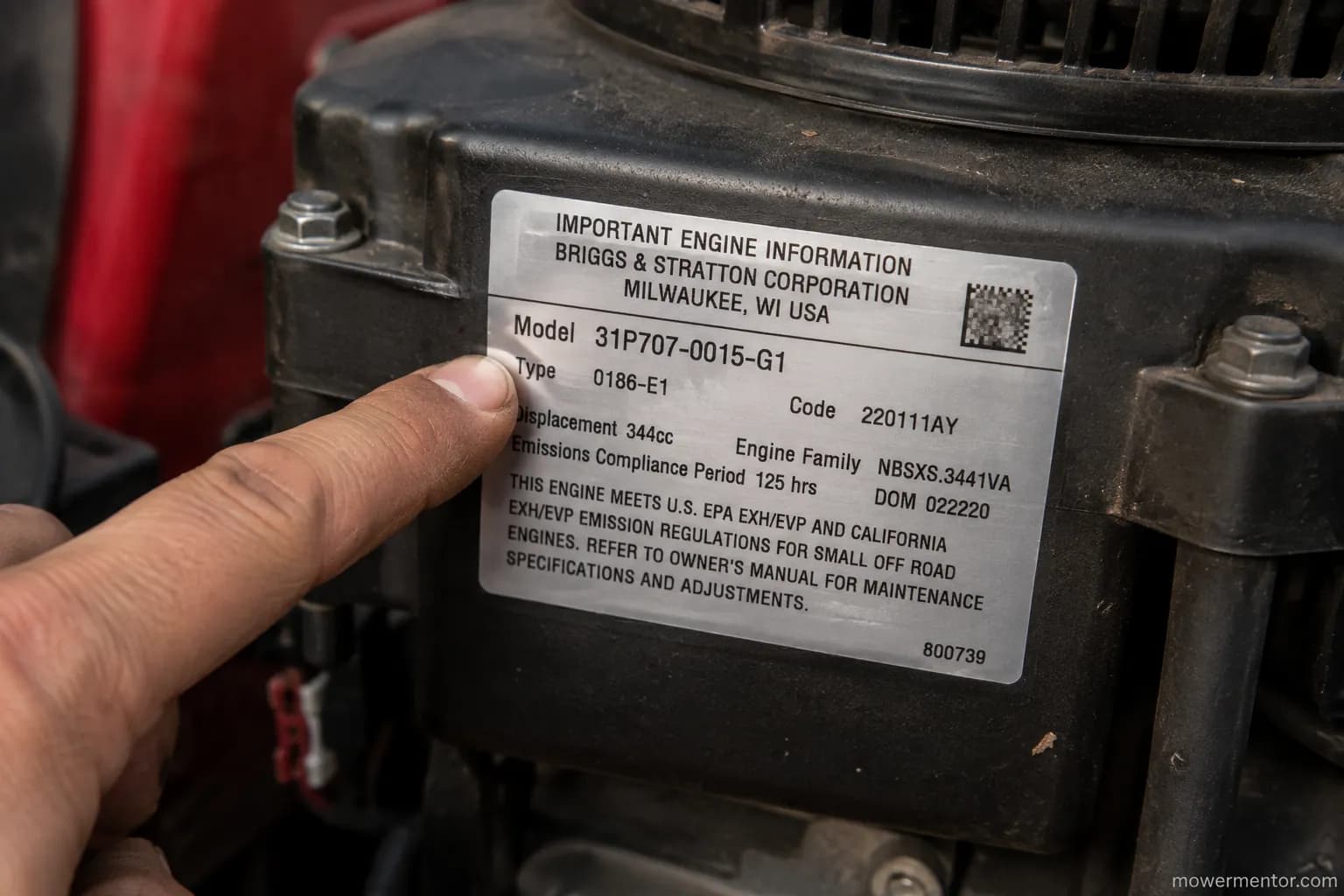
The right Craftsman starter is set by the engine, not the tractor. Find the engine's model, type, and code on its own label, then match the starter to that engine.
Per Sears PartsDirect, you order the correct part by the engine ID, not the tractor model. The label sits on the blower housing or valve cover, not the frame tag.
Locating that label is the same habit as the same finder logic for filters uses on your model. Once you have it, decode the tractor prefix to learn who built the machine.
Model prefix | Built by | Common engines |
|---|---|---|
917.xxxxx | Sears / AYP era | Briggs Intek, Kohler Courage |
247.xxxxx or 13xxxx | MTD / Cub Cadet era | Briggs, Kohler, Powermore |
CM or CMXGMAM | 2017+ Stanley Black & Decker | Briggs, Kohler, Powermore |
Craftsman now routes parts and service by that prefix, and the Craftsman support flow reflects the same build-era split. Then match the engine to a starter.
Engine | Example OEM starter | Notes |
|---|---|---|
Briggs Intek single | 691564-class | 14 to 16 tooth pinion |
Briggs Intek V-twin | 691564 or 795121-class | Confirm pinion count |
Kohler Courage / 7000 | 32-098-10-S | Kohler-pattern mount |
Powermore (MTD) | 951-12207-class | Newer CM machines |
Aftermarket honesty: A starter labeled "fits Craftsman" is not a guarantee. My 917-series Kohler mower took an aftermarket unit whose bolt spacing followed a Briggs pattern and fouled the mount until I shimmed it.
If your key circuit is acting up while you are in there, testing the ignition switch by terminal rules it in or out.
If a trigger wire reads dead instead, your model's wiring and fuse layout shows where the circuit breaks.
Whichever unit you settle on, choosing a starter motor by fitment beats picking by price alone.
What a New Starter Costs and Where to Buy the Right One
A new Craftsman riding mower starter runs about $30 to $80 for an aftermarket motor and roughly $80 to $160 for an OEM unit, while a solenoid is only about $15 to $50. That gap is the whole reason to test first.
The cheaper part fails far more often than the motor, so testing before buying is what keeps you from paying starter money for a solenoid fault. Here is the current banding next to what my two documented repairs actually cost.
Part | Typical price band (spring 2026) | My repair |
|---|---|---|
Aftermarket starter | $30 to $80 | $71 (OEM-pattern) |
OEM starter | $80 to $160 | not needed |
Starter solenoid | $15 to $50 | $46 (with cleanup) |
Digital multimeter | $15 to $40 | already owned |
Both of my fixes came in under the cost of a guess: $46 for a solenoid and ground cleanup, and $71 for an OEM-pattern starter on the other mower. The cheaper fix was the one the test pointed to, which is the point.
To buy correctly, match the starter to the engine model through the maker's lookup. The Briggs & Stratton engine lookup returns the right part for your code and heads off a mis-order.
While you are ordering, some owners save a trip by bundling a tune-up kit for the same model.
Keeping the mower starting reliably is mostly maintenance. A twice-yearly habit like a seasonal Craftsman tune-up reduces the hard-starting that strains a starter.
Clearing a clogged air filter helps too, since a choked engine has to crank harder.
Cheapest is often false economy: The bargain aftermarket starter with the plastic pinion is the one I have seen round off within a season. An OEM-pattern unit costs more and lasts longer.
Still Won't Crank After a New Starter? Where to Look Next
If a fresh Craftsman riding mower starter still will not crank, the fault was never the motor. The three suspects, in order, are the solenoid, the battery and ground cables, and the safety-interlock switches.
In one of my two documented cases the culprit was a corroded ground strap hiding under a terminal that looked perfectly clean on top. That is why a bad ground so convincingly mimics a bad starter.
The solenoid contacts may have burned, so the new motor never gets current. Retest by jumping the posts.
The battery cables and ground strap may read fine at rest but drop voltage under load, which is the hidden-corrosion trap.
The seat, brake, and PTO interlocks may be open, so start by testing the seat, brake and PTO switches before blaming anything else.
For anything the three suspects do not resolve, the full won't-start decision tree runs the complete path. A pure no-crank routes cleanly through the battery-to-ground no-crank diagnosis.
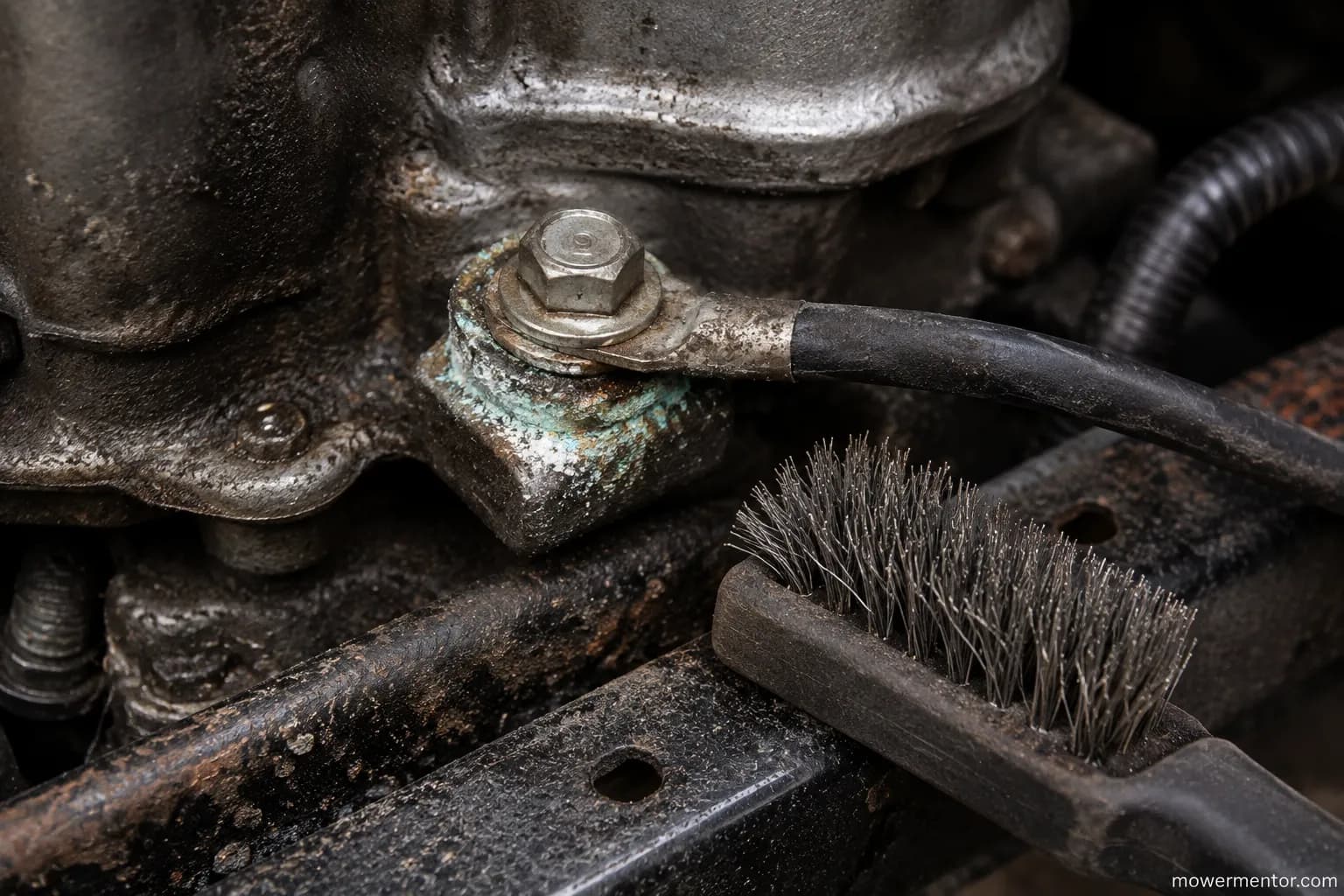
You may have bought a part you did not need: If the tests were skipped and the starter did not fix it, the motor was probably never the fault. That is the cost of guessing.
Frequently Asked Questions
How do I know if it's the starter or the solenoid?
Read the battery first. A single click with a battery near 12.6 volts usually means the solenoid, since the coil pulled in but the contacts did not pass current.
Jump the two large solenoid posts. If the engine then cranks, the solenoid is your fault, not the starter.
How much does a Craftsman riding mower starter cost?
An aftermarket starter typically runs about $30 to $80, and an OEM unit about $80 to $160. A solenoid is far cheaper at roughly $15 to $50.
Because the solenoid fails more often, testing first frequently turns a starter-sized bill into a solenoid-sized one.
Will any starter labeled "Craftsman" fit my mower?
No. Fitment follows the engine, not the Craftsman name.
A Briggs Intek, a Kohler Courage, and a Powermore each take a different starter, so read the engine's model, type, and code label and match the part to that engine rather than the tractor model.
Can I bench-test the starter off the mower?
Yes. Clamp the starter, run a jumper from a good battery to the stud, and ground the case, and a healthy motor spins freely and briskly.
On my two mowers, a good starter spun cleanly on the bench while a failed one did nothing, which confirms the motor independently of the wiring.
My new starter whirs but won't engage, why?
The pinion is not meeting the ring gear. Either the new pinion is worn or wrong, or the flywheel ring gear has flattened teeth from the old failure.
Turn the flywheel by hand and inspect the ring gear before assuming the new starter is defective.
The Bottom Line
The fastest, cheapest path through a no-crank is the same every time: test before you buy. A five-minute check of battery voltage under load, a solenoid jump, and a direct feed to the motor tells you which part actually failed.
Do that, plus read the engine's model number rather than the tractor tag, and a suspected bad craftsman riding mower starter stops being a guess. You will either spend about $40 on the right motor with confidence, or save it because the real fault was a $15 solenoid or a dirty ground.
Keep the engine label handy and a multimeter in the drawer, and you will never again pay starter money to fix a solenoid.
Summarize with AI
Keep reading
Related articles
 Troubleshooting & Repair
Find, test, and safely bypass the Craftsman riding mower safety switch: seat, brake, and PTO interlocks, with multimeter values and a re-enable step.
 Troubleshooting & Repair
Test your Craftsman riding mower starter solenoid in about 15 minutes with a screwdriver and multimeter, then fix the click-no-crank for around $18.
 Troubleshooting & Repair
Fix a Craftsman riding lawn mower won't start no clicking: test battery voltage, inline fuse, safety switches, ignition and solenoid with a multimeter.
 Troubleshooting & Repair
Find the right Craftsman riding mower battery: 12V U1/U1R size chart by model, 5 tested picks, and why yours keeps dying.
Comments
Moderated for quality. Share a correction, ask a follow-up, or tell us what worked for you - every comment is reviewed before it goes live.