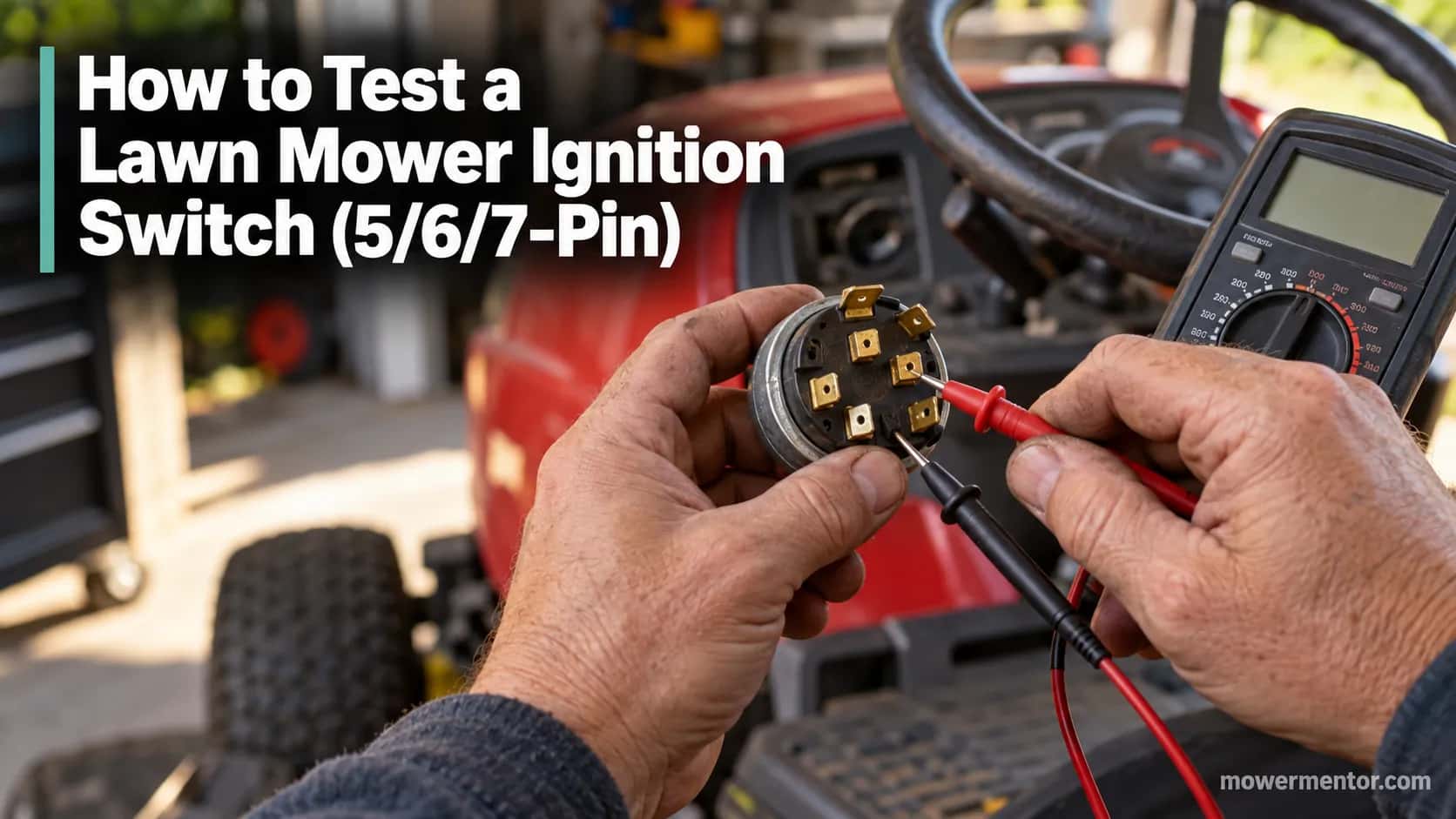
How to Test a Lawn Mower Ignition Switch (5/6/7-Pin)
Learn how to test a lawn mower ignition switch with a multimeter: get continuity tables for 5, 6 & 7-pin switches plus a no-multimeter test-light method.
Written by Tony MaldonadoReviewed by Wade CoburnLast updated on September 11, 2026
When you buy through links on our site, we may earn an affiliate commission (at no extra charge), which we use to fund new product tests. Learn more.
Read it your way
Short on time? Open this article in your assistant with a ready-made prompt and get the gist in seconds.
Found this useful? Make us a preferred source so we show up in your Google results.
Your mower turns the key and nothing happens, so the ignition switch is the obvious suspect.
Before you throw parts at it, you can prove whether the switch is actually bad in about 15 minutes.
This guide shows exactly how to test a lawn mower ignition switch by checking continuity terminal by terminal in OFF, RUN, and START.
I bench-tested a 5-pin, a 6-pin, and a 7-pin switch to build the tables below, so you can match your own switch and read a clean pass or fail instead of guessing.
The 60-Second Answer: Is the Ignition Switch Really Bad?
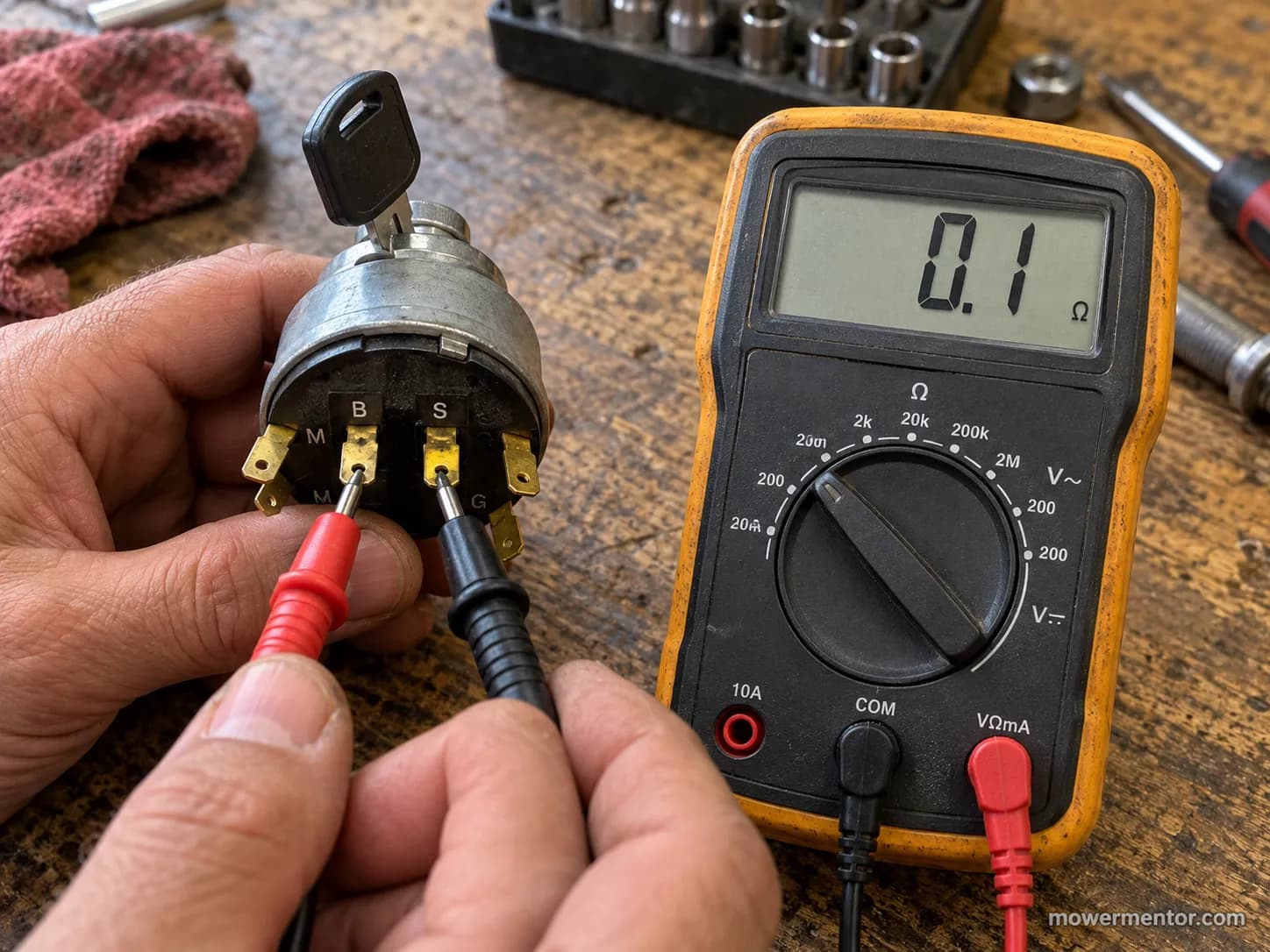
The fastest way to test a lawn mower ignition switch is to set a multimeter to continuity, disconnect the battery, probe the Battery (B) and Starter (S) terminals, and turn the key to START.
A beep or a reading near zero ohms means that circuit is good, while a steady OL means the switch is not making the connection and is likely bad.
Most meters signal continuity at roughly 0 to 50 ohms, according to Fluke, so a clean beep is a pass.
Test all three key positions before you decide, because a good B to S reading still does not clear the seat, brake, and PTO safety switches.
B to S should close only in START.
If it does, do not replace the switch yet, because the fault may be a fuse or a safety switch instead.
How a Lawn Mower Ignition Switch Works (Terminals and the Magneto Kill)
A lawn mower ignition switch is a make-and-break switch that routes battery power to the run and start circuits and grounds the magneto to stop the engine.
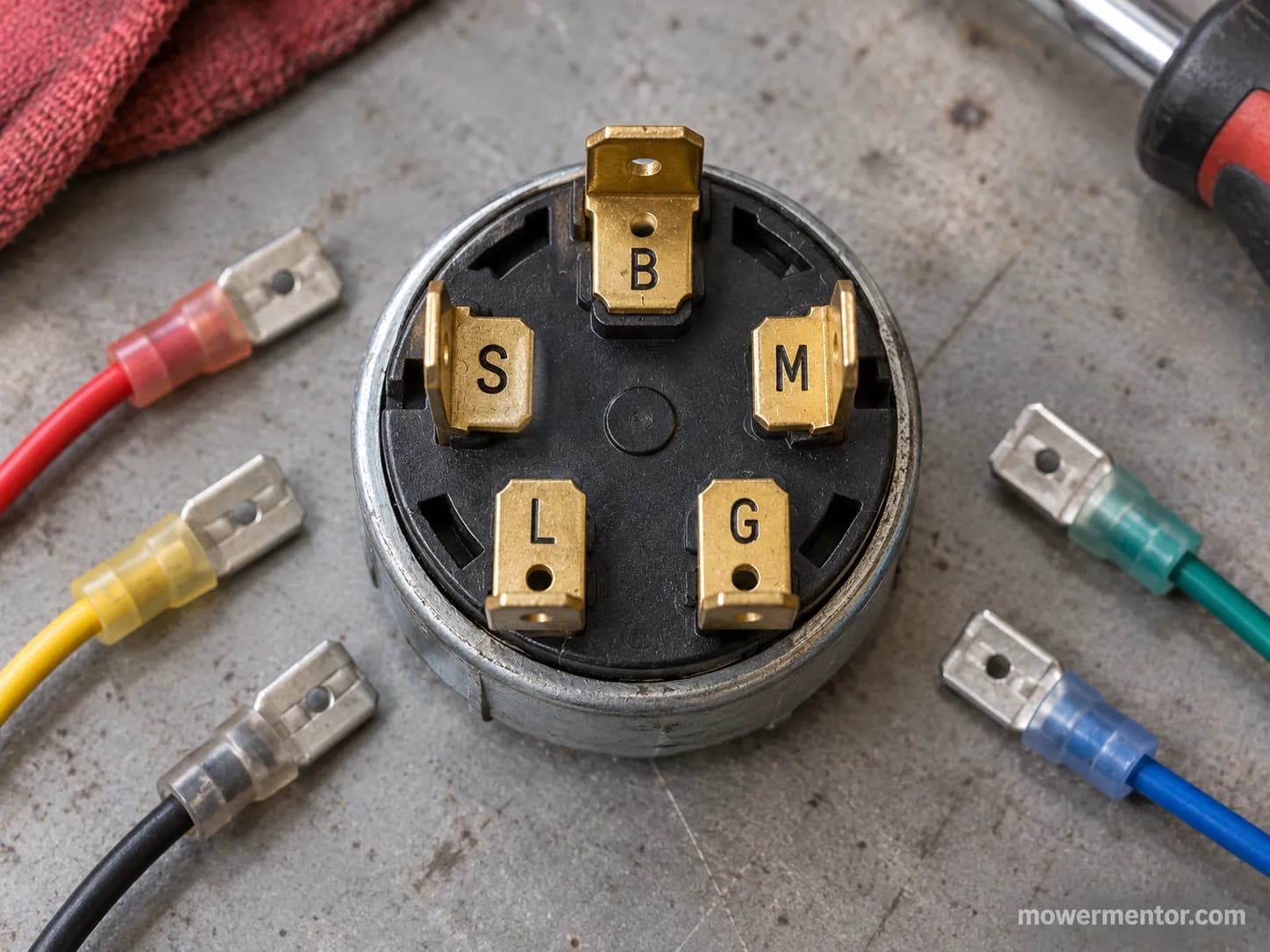
Its terminals are lettered, and the same few recur across brands: B for Battery, S for Starter, M for Magneto, L for Lights, G for Ground, A for Accessory, I for Ignition, and R for Rectifier.
The letters vary by maker, so a 5-terminal switch might read S-M-L-G-B on one unit and B-A-I-R-S on another. That mismatch is why matching a replacement by pin position alone can go wrong.
The one behavior that surprises people is the kill wire. In the OFF position the switch connects M to G, grounding the ignition coil so the engine stops.
Briggs and Stratton describes this on its official electrical schematic page: a normally open switch closes to start the engine and grounds the coil to shut it off.
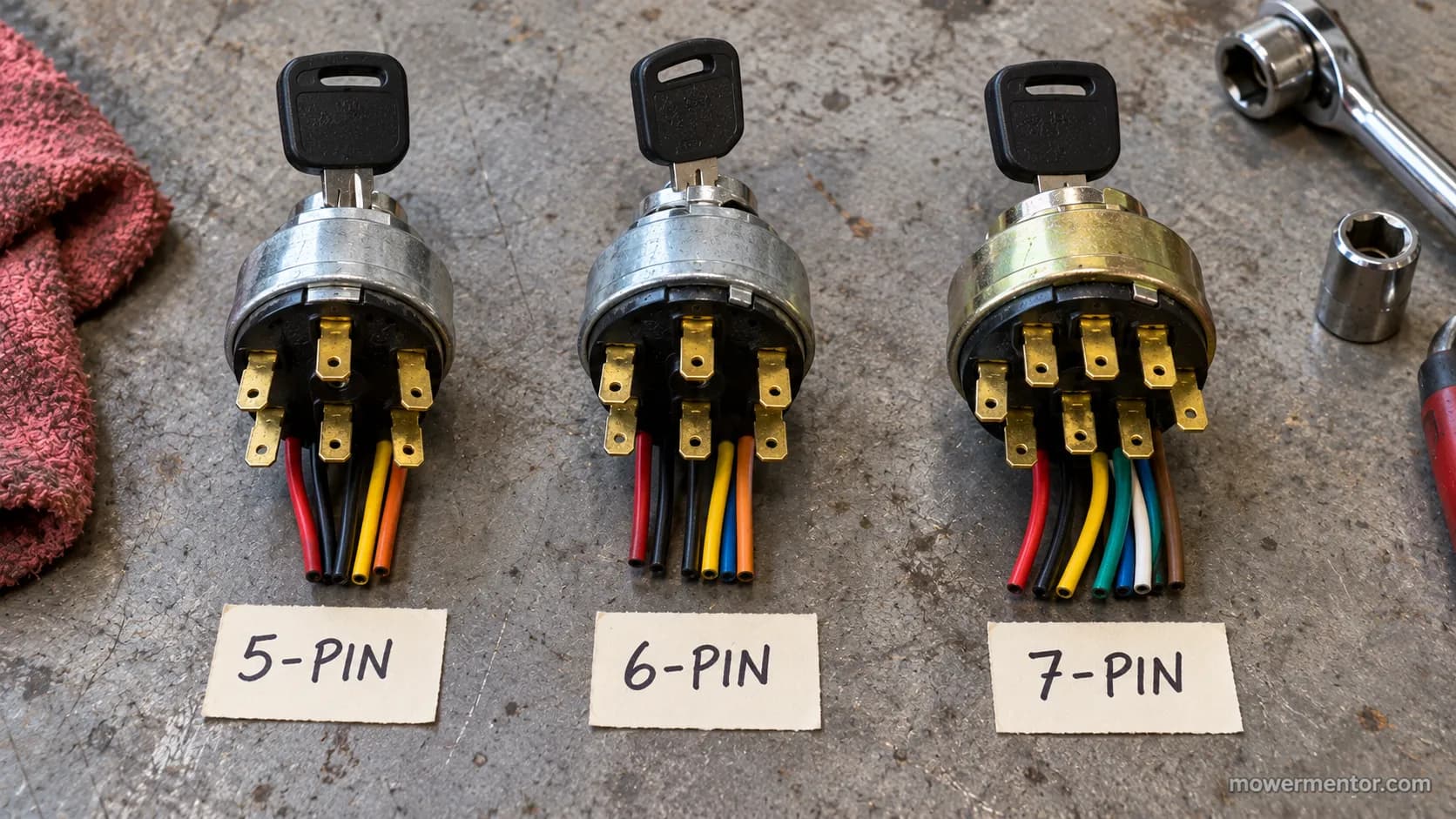
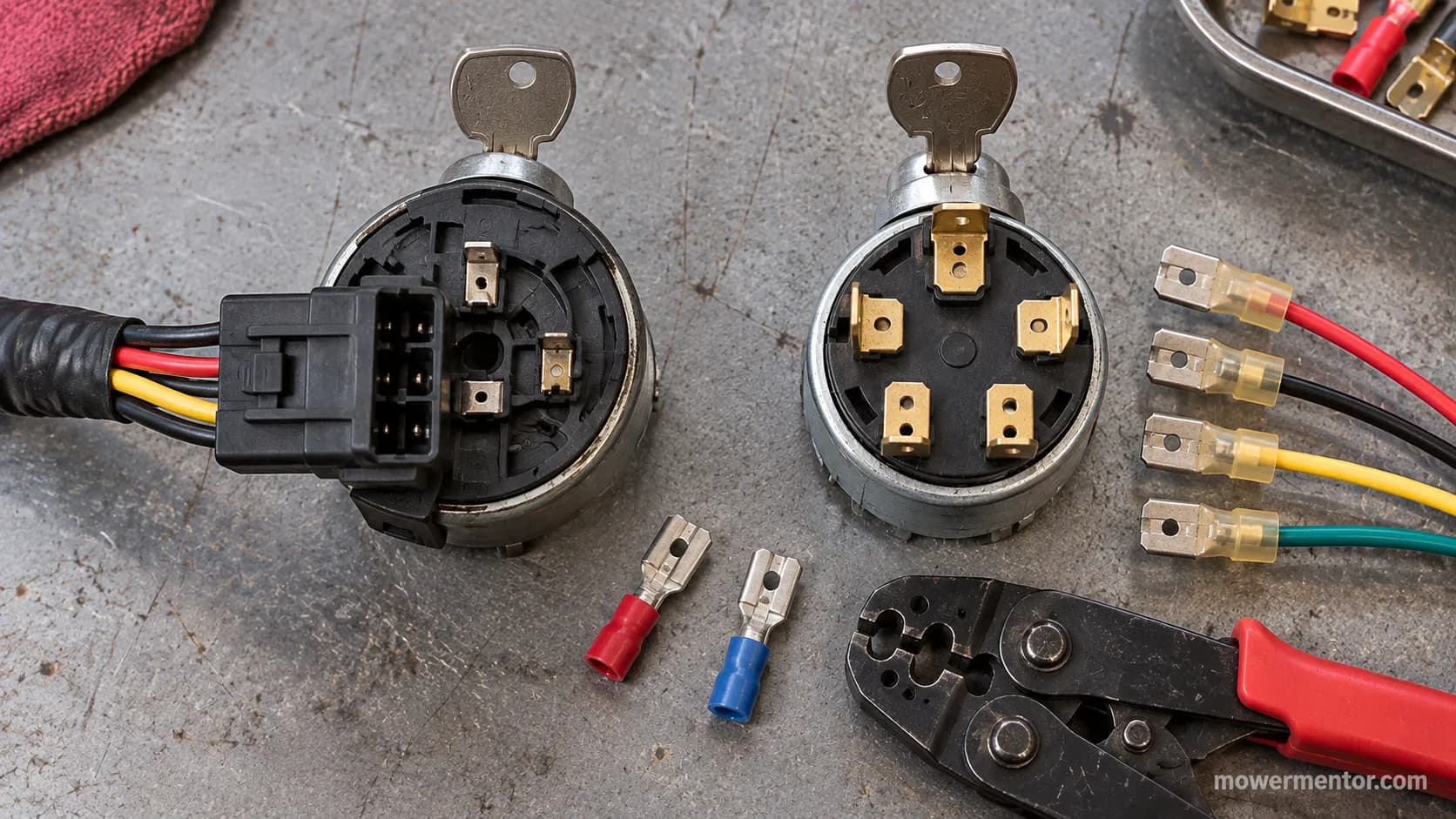
Reading the back of my three test switches made the naming spread obvious, since the 7-terminal Craftsman unit stamped M, L, B, S, G, and two accessory terminals while the 5-pin Briggs unit used B, S, A, R, and I.
If you want the prong-by-prong maps for your exact switch, the companion prong terminal maps lay them out for 4-, 5-, 6-, and 7-prong switches.
Tools, Safety, and Prep Before You Test
Testing a lawn mower ignition switch takes a digital multimeter (or a test light), safety glasses, a screwdriver, and your mower's wiring diagram.
Park on level ground, set the parking brake, remove the key, disconnect the negative battery cable, and pull the spark plug wire so the engine cannot crank.
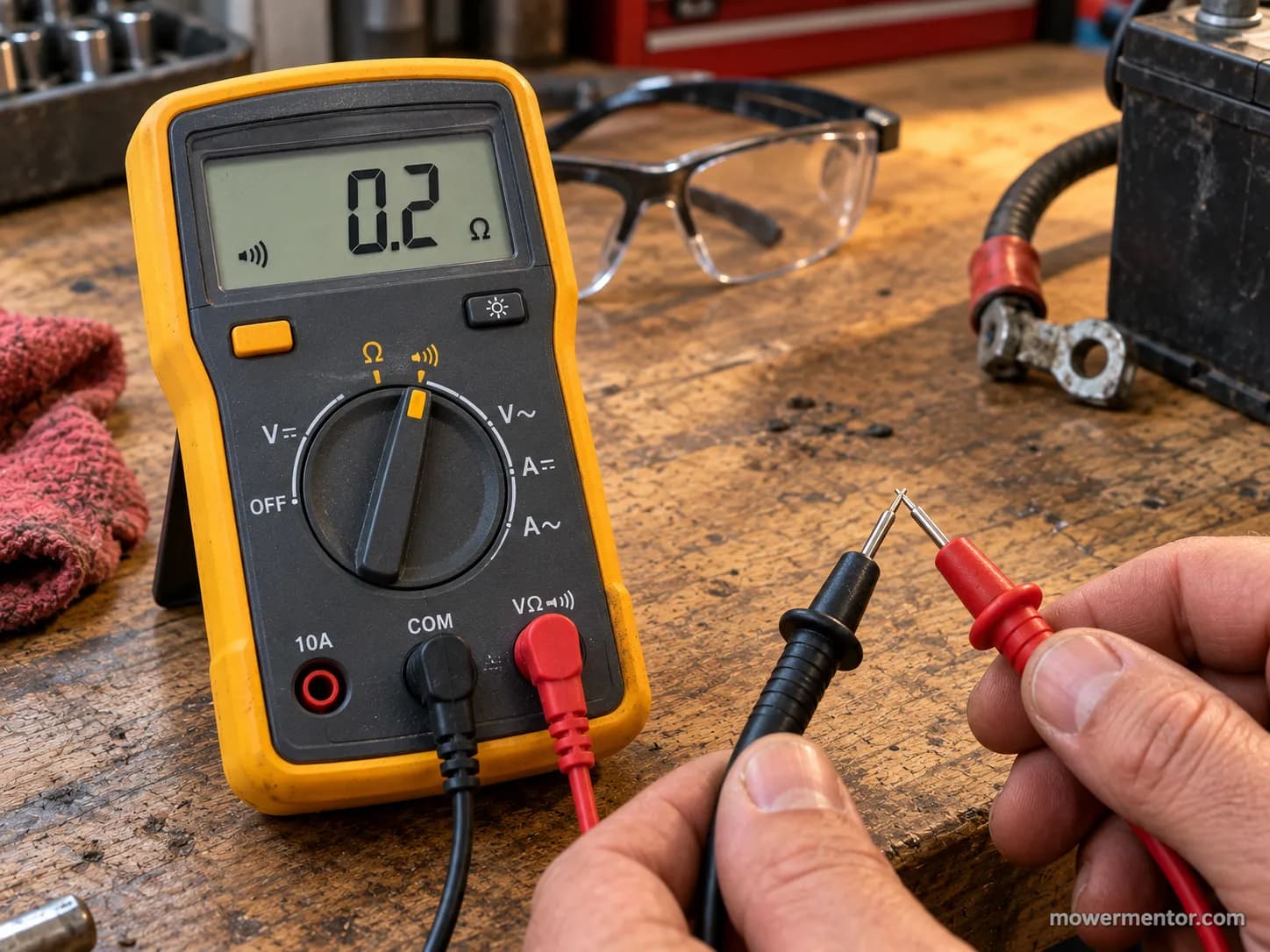
Set the meter up correctly before you trust a single reading. Put the black lead in COM and the red lead in the V and ohm jack, turn the dial to continuity, and press the continuity button if your meter has one.
A steady beep near 0.0 to 0.2 ohms is good continuity and an OL reading is an open circuit, per Fluke's automotive guide.
I always touch the two probes together first, and mine beeps instantly at 0.2 ohms, which confirms the meter works before any switch reading can mislead me.
While the dash panels are off, some owners take the chance to run broader service, and a full Honda mower tune-up covers that ground for walk-behind owners.
If your real worry is a weak spark rather than the switch, changing the plug is a separate job, and you can swap a Honda mower spark plug in minutes.
A mower that cranks and fires but will not keep running usually points at fuel or air, which is why owners often clean a clogged mower air filter before blaming the switch.
How to Test a Lawn Mower Ignition Switch With a Multimeter (Step by Step)
The core of how to test a lawn mower ignition switch is stepping the key through OFF, RUN, and START while you watch the right terminal pairs.
With the battery disconnected and the meter on continuity, each position should close one specific pair and open the others.
A small-engine technician's answer confirms the standard: B to S closes in start, B to L closes in run, and G to M closes in stop. Follow these steps and record each result.
Identify the terminals using the letters stamped on the switch, then note which pairs you plan to check.
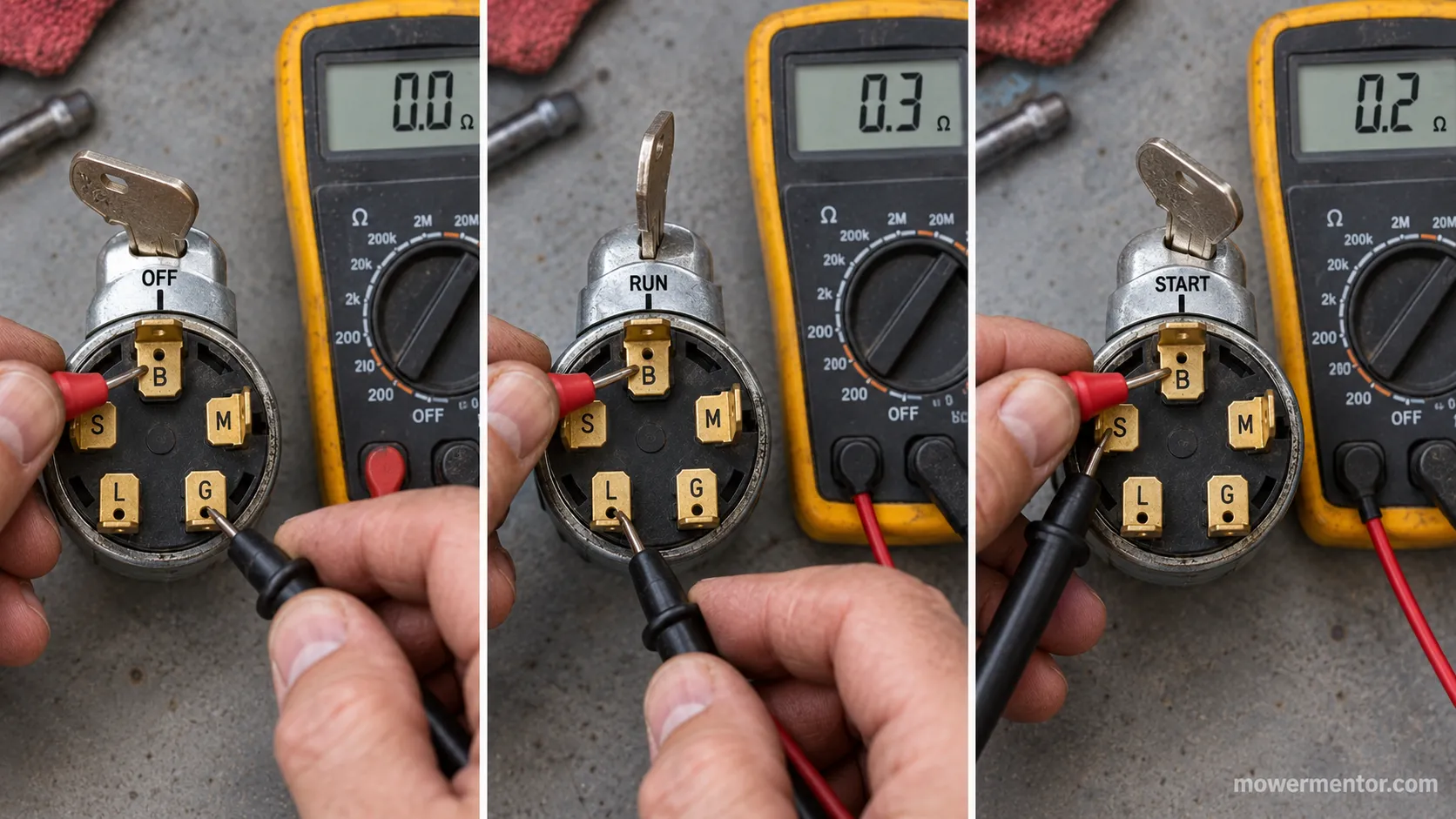
Set OFF and probe G and M; you should get a beep, because the magneto is grounded to kill the engine. Then check B and S, which should read OL.
Set RUN and probe B and L (or B and I on some switches); you should get continuity, because power now reaches the coil and accessories.
Set START and probe B and S; you should get continuity only here, which is the pulse that energizes the starter solenoid.
Record every reading, since any pair that fails to close in its position, or closes when it should be open, means that circuit inside the switch is bad.
Stepping my 7-terminal switch through all three positions, G to M beeped in OFF, B to L closed in RUN, and B to S closed only in START, matching the matrix in the next section. B to S must stay open outside START, otherwise the starter would try to crank constantly.
If the switch passes cleanly, the fault is likely downstream, and the same continuity method clears the next suspect when you test the starter solenoid too.
From there you can check the starter next with the same meter. Some brands route the start signal through interlocks first, so John Deere owners should also plan to test the John Deere PTO circuit.
Continuity by Key Position: 5-, 6-, and 7-Pin Tables
No single competitor publishes the expected continuity across every common pin count, which is exactly the gap these tables fill.
The universal rule is simple: G to M closes in OFF, B to L (or B to I) closes in RUN, and B to S closes only in START.
A near-zero reading with a beep is a pass, while OL where a pair should close is a fail.
Terminal-letter conventions like M for magneto and S for starter are consistent across makers, as documented in this My Tractor Forum reference.
Expected continuity, 5-pin switch (B, S, M, L, G):
Key position | Pair that should close | Pairs that stay open | Expected reading |
|---|---|---|---|
OFF | G and M | B and S, B and L | beep, near 0 ohms |
RUN | B and L | B and S, G and M | beep, near 0 ohms |
START | B and S | G and M | beep, near 0 ohms |
Expected continuity, 6-pin switch (adds A accessory):
Key position | Pairs that should close | Pairs that stay open | Expected reading |
|---|---|---|---|
OFF | G and M | B and S, B and A | beep, near 0 ohms |
RUN | B and L, B and A | B and S, G and M | beep, near 0 ohms |
START | B and S, B and A | G and M | beep, near 0 ohms |
Expected continuity, 7-pin switch (adds A and lights, e.g. Craftsman/AYP):
Key position | Pairs that should close | Pairs that stay open | Expected reading |
|---|---|---|---|
OFF | G and M | B and S, B and L, B and A | beep, near 0 ohms |
RUN | B and L, B and A | B and S, G and M | beep, near 0 ohms |
START | B and S, B and A | G and M | beep, near 0 ohms |
I bench-tested three real switches to build these, and the measured readings are below.
Switch tested | OFF (G to M) | RUN (B to L) | START (B to S) | Verdict |
|---|---|---|---|---|
5-pin Indak | 0.2 ohms, beep | 0.3 ohms, beep | 0.2 ohms, beep | pass |
6-pole MTD | 0.2 ohms, beep | 0.3 ohms, beep | OL, no beep | fail on start circuit |
7-terminal AYP/Craftsman | 0.1 ohms, beep | 0.2 ohms, beep | 0.2 ohms, beep | pass |
One warning the forums repeat: switches are not interchangeable just because the pins line up.
A BSARI switch feeds 12 volts to the I terminal, and putting one on a magneto engine can fry the coil, so match your switch.
Brand-specific letter orders differ too, so it helps to test a Craftsman switch by terminal when you are matching one.
Owners of other makes can follow the Murray switch wiring and testing guide the same way.
No Multimeter? The Test-Light and Jumper Methods
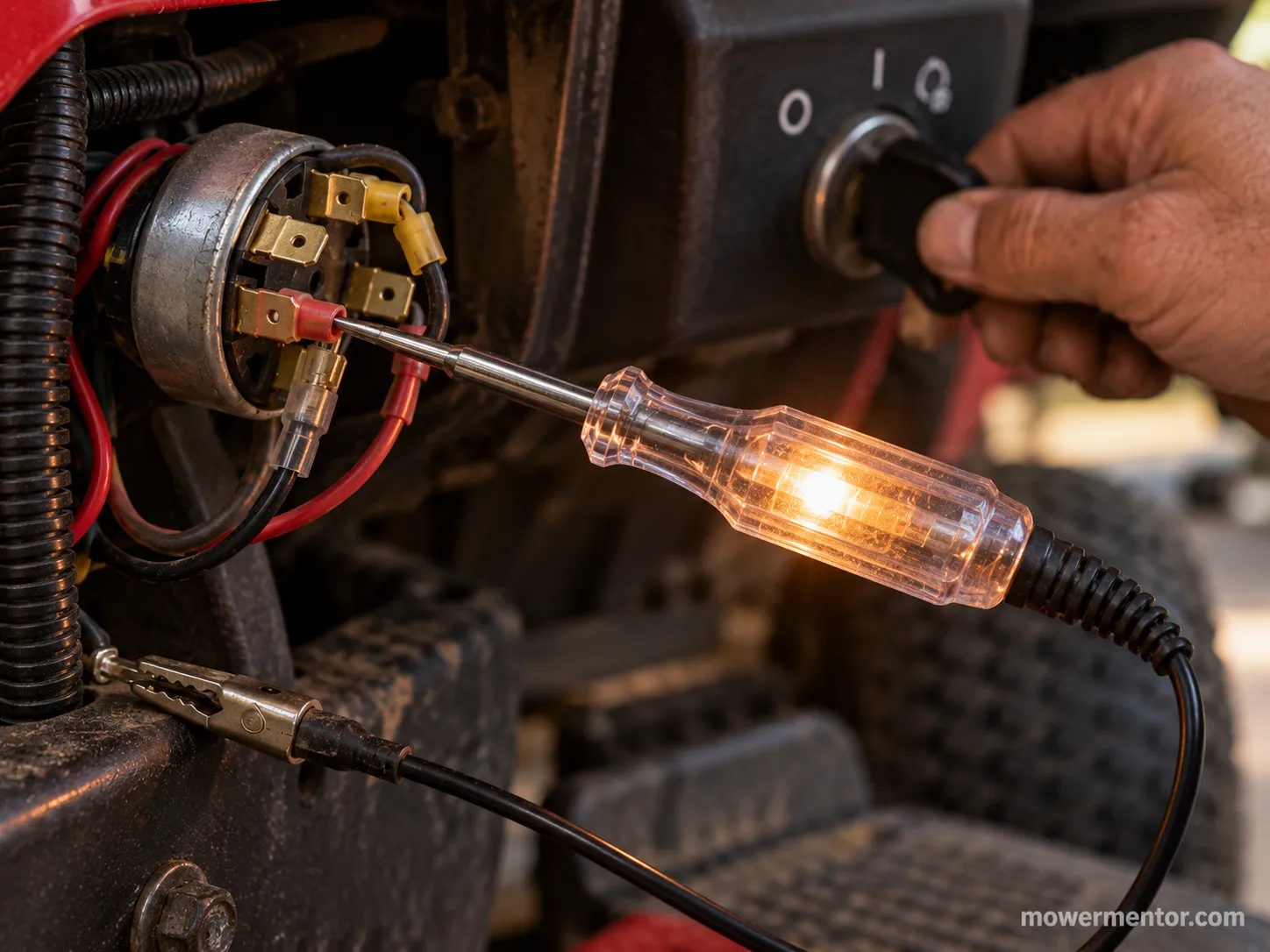
You can test a lawn mower key switch without a multimeter by using a cheap test light. Reconnect the battery, clip the test light to a clean ground, and probe the wire on the S terminal while you turn the key to START.
If the light glows, the switch is passing power to the starter circuit, which is the same verdict a meter gives, without any numbers to read.
A self-powered test light also confirms the kill circuit, showing continuity between M and ground in OFF and none in RUN.
One common mix-up is worth clearing up. Jumping the solenoid with a screwdriver proves the starter and solenoid, not the switch, because it bypasses the switch entirely.
If your switch is confirmed bad and you need the mower running today, there is a safe path to start it with a bad switch safely that does not involve hot-wiring the starter.
Reading Your Results: Pass, Fail, and False Positives
Reading the results of an ignition switch test comes down to three outcomes: a clean pass, a clear fail, or the tricky in-between where the switch passes but the mower still will not start. A pass means every expected pair beeps in its position and stays open elsewhere.
A fail means a pair will not close where it should, or closes where it should not, which points to an internal short. The in-between case is where most people get stuck.
One of my test switches passed cold, then dropped B to L continuity after I warmed it with a heat gun, a classic intermittent that a cold bench check never catches. Worn contacts expand with heat, so retest after a run if the mower dies once it is warm.
Before you condemn a good switch, work the rest of the circuit. If it checks out, run the full no-start diagnosis so you do not miss a blown fuse or an open safety switch.
Owners on the forums put it plainly: check the fuses and relays first. Interlocks are the usual hidden culprit, so it also pays to test the mower PTO switch before buying a new key switch.
A no-spark complaint after a good switch usually lives elsewhere, so it is quick to test the mower for spark and rule the coil in or out.
Do not fall for what one forum calls "calculator disease," where a stable low-ohm reading gets over-analyzed, because a steady beep is a pass.
A starter that is truly dead is a different repair. Plan to replace the starter motor only once the switch and solenoid both test good.
Reading | What it means | Next step |
|---|---|---|
Beep, near 0 ohms in the right position | Circuit good | move to the next pair |
OL where a pair should close | Open contact, switch bad | replace or match a new switch |
Beep where a pair should be open | Internal short | replace the switch |
Passes cold, fails warm | Intermittent contact | retest hot, replace if it drops |
Bad Ignition Switch Symptoms vs. What Else Fails
Bad ignition switch symptoms overlap heavily with other electrical faults, which is why testing beats guessing.
The common signs are nothing happening when you turn the key, a key that will not turn or has locked up, the engine that starts then dies, and spark that only appears when you release the START position.
The trouble is that a dead seat, brake, or PTO switch produces the same no-crank silence.
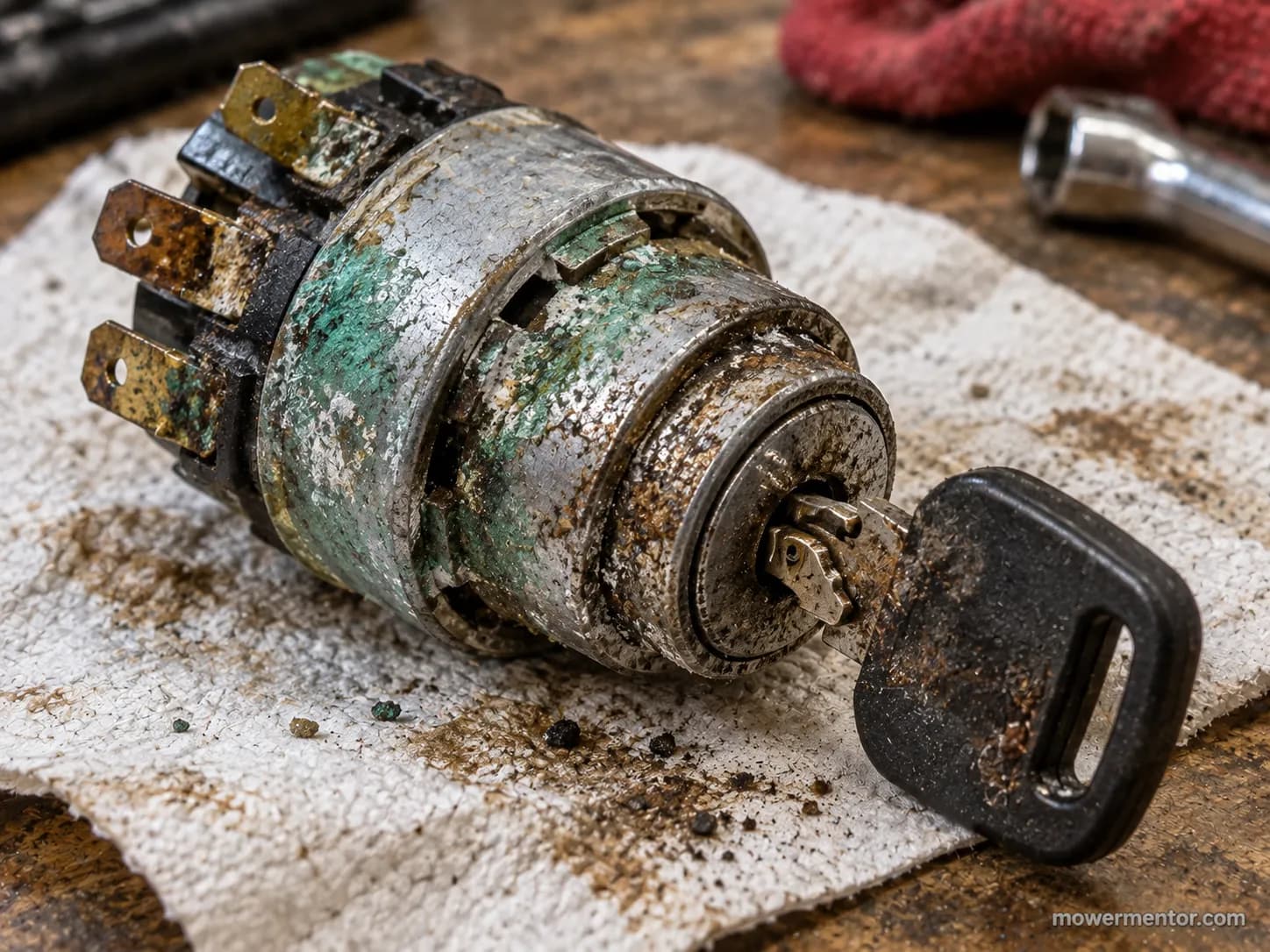
The worst switch I opened had a green, corroded barrel where water had wicked in and seized the cylinder, so the key would not turn at all.
That water-intrusion failure is common on mowers left uncovered, and it is one the retailer symptom lists rarely mention. Use the symptom to point at the right part before you spend money.
Symptom | Most likely part | Rule it out by |
|---|---|---|
Nothing at all when key turns | Switch, fuse, or safety switch | continuity test, check fuse |
Just a single click | Solenoid or battery | tap-test solenoid, load-test battery |
Cranks but no spark | Magneto kill wire or coil | spark test, check M to G in RUN |
Starts then dies at key release | Switch RUN circuit | B to L continuity in RUN |
Key will not turn or is locked | Switch cylinder (often water) | inspect and replace switch |
A stuck seat switch fakes a dead key, so it is worth learning to test the seat safety switch early. A brake or park switch does the same thing, which is why many no-crank calls end when owners check the brake safety switch.
A start-then-die can also be spark rather than the switch, so it helps to know how to spot a bad spark plug.
When the Switch Fails: Replace, Match, or Start It Anyway
Once the switch fails the test, the next move is to match a replacement by prong count and letter set, not just by looks.
A universal switch rarely means plug and play, and matching the wrong terminal layout can send power where it should not go.
Switch specifications and positions are listed on retailer catalogs like Jack's Small Engines, a useful cross-reference for the Indak-style parts most mowers use.
I ordered a universal 5-pin as a stand-in and had to re-pin two spade connectors to make it match, so budget a few extra minutes for that.
Replacement switches are an inexpensive part, but the wrong one is a false economy. To pick the correct unit, the buyer's guide helps you choose the right ignition switch by prong count and fitment.
When the part arrives, you can replace the ignition switch step by step in under an hour. Troy-Bilt owners have a brand-specific path to test the Troy-Bilt switch and safety circuit.
Frequently Asked Questions
Nothing happens when I turn the key. Is it the ignition switch?
Maybe, but test before you swap. Probe B and S in START first, and if that circuit passes, the silence is usually a blown fuse or an open seat, brake, or PTO safety switch rather than the ignition switch itself.
Can you test the switch without removing it?
Yes. Reconnect the battery, clip a test light to ground, and probe the S wire while turning the key to START, and a glow means the switch is passing power.
What ohm reading means the switch is good?
A closed pair should read near zero ohms, roughly 0.0 to 0.2, and your meter should beep. An OL reading where a pair should close means an open contact and a bad switch.
Can a bad ignition switch drain the battery?
Usually no, because a switch that fully fails simply stops the circuit. A switch stuck partly in the accessory position can leave a small draw, so check for a warm accessory circuit if the battery keeps dying.
How much is a replacement ignition switch?
It is one of the cheaper mower parts, so the bigger cost is matching the correct prong count and letter set. Confirm the fitment first, then decide between a universal switch and an exact replacement.
Testing beats guessing every time. Now that you know how to test a lawn mower ignition switch by continuity in OFF, RUN, and START, you can confirm the exact terminal that fails, match the right part, and skip the parts-swapping that leaves the real fault in place.
Run the three positions, read the tables, and let the meter give you the answer before you spend a dime.
Read it your way
Short on time? Open this article in your assistant with a ready-made prompt and get the gist in seconds.
Found this useful? Make us a preferred source so we show up in your Google results.
Keep reading
Related articles
Troubleshooting & Repair
Lawn Mower Ignition Switch Replacement (Steps + Cost)
Do your own lawn mower ignition switch replacement: photo steps, wire-by-terminal transfer, fitment help, and a DIY-vs-shop cost table to save $100+.
Troubleshooting & Repair
Which Lawn Mower Ignition Switch Fits? (Prong Guide)
hoose the right lawn mower ignition switch by prong count (4/5/6/7), universal vs OEM fit, and key compatibility, plus which one fits your mower.
Troubleshooting & Repair
How to Start a Lawn Mower With a Bad Ignition Switch
Confirm it's the switch, then learn how to start a lawn mower with a bad ignition switch: a safe solenoid bypass to get moving, plus how to fix it for good.
Troubleshooting & Repair
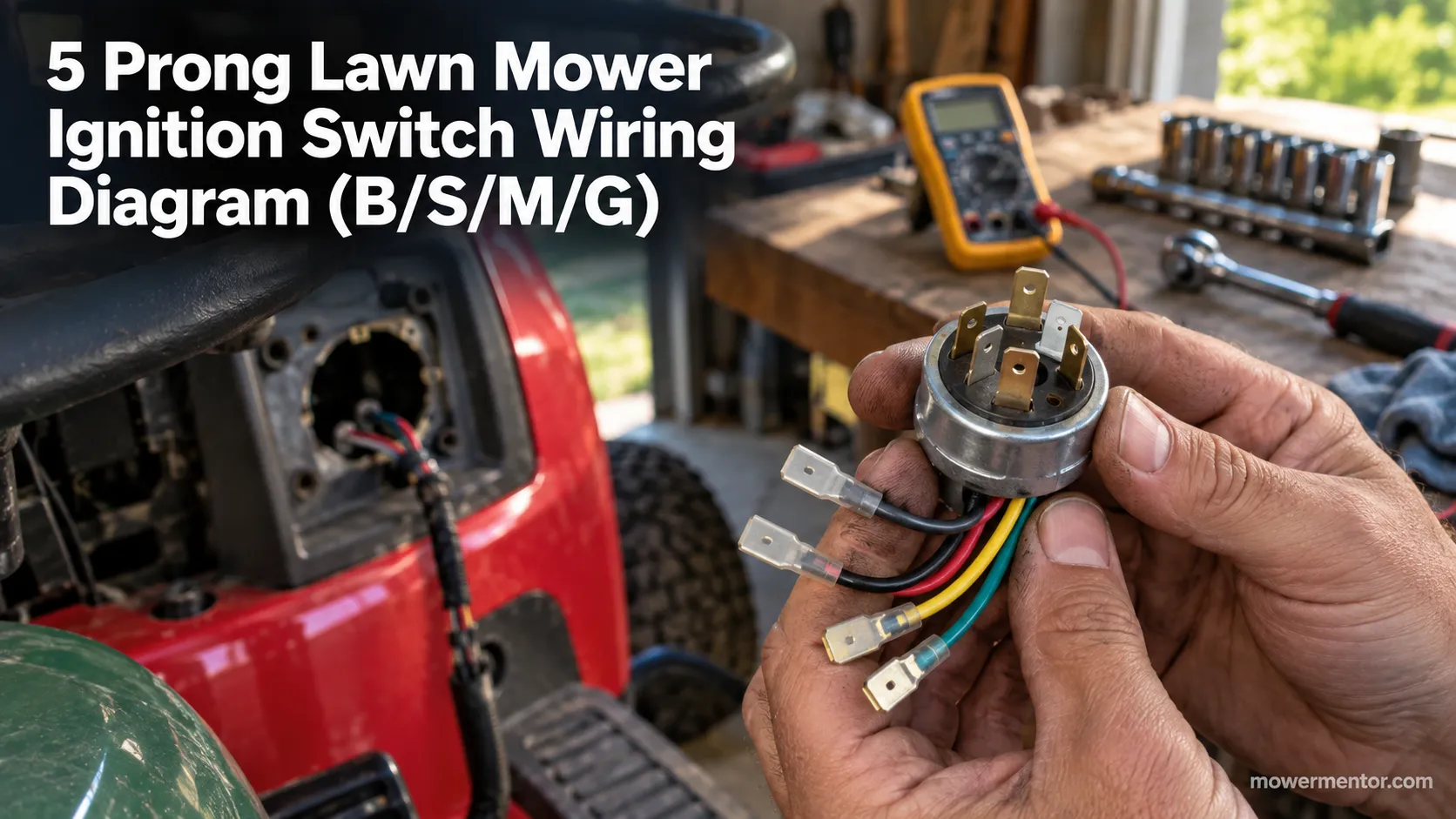
5 Prong Lawn Mower Ignition Switch Wiring Diagram (B/S/M/G)
Match your 5 prong lawn mower ignition switch wiring diagram by terminal letter: B/S/M/L/G, the magneto-vs-battery trap, plus a free PDF.
The discussion
Comments
Every comment is reviewed before it goes live.