Which Lawn Mower Ignition Switch Fits? (Prong Guide)
hoose the right lawn mower ignition switch by prong count (4/5/6/7), universal vs OEM fit, and key compatibility, plus which one fits your mower.
Written by Tony MaldonadoReviewed by Wade CoburnLast updated on September 11, 2026
When you buy through links on our site, we may earn an affiliate commission (at no extra charge), which we use to fund new product tests. Learn more.
Read it your way
Short on time? Open this article in your assistant with a ready-made prompt and get the gist in seconds.
Found this useful? Make us a preferred source so we show up in your Google results.
Your rider clicks, cranks wrong, or won't shut off, you pull the key switch, and now you are staring at a fistful of prongs wondering which replacement actually fits.
Buy by the brand name on the mower and you can still end up with the wrong part, because a lawn mower ignition switch is defined by its terminals, not its badge.
Match three things to your old switch, the prong count, the number of key positions, and the letters stamped on the back, and the right part becomes obvious, often a universal switch that costs a third of the dealer price.
This guide shows you how to read those three things in about a minute, then choose between universal and OEM, sort out whether your key will still work, and buy the correct switch the first time.
The bottom line
Fitment is decided by three things: prong count (usually 5, 6, or 7), key positions (3 or 4), and the terminal letters (B, S, I, M, G).
A correctly matched universal switch fits most riding mowers and runs about $16 to $23; an OEM part runs roughly $40 to $70.
Buy OEM only when you need a drop-in plug match or a specific key. Otherwise a matched universal switch is the value pick.
Most riding mower brands share a small set of common keys, so one Indak-type key starts a wide range of machines.
A "new switch that doesn't work" is almost always a wiring mismatch, not a bad part.
The 60-Second Way to Pick the Right Switch
To choose a lawn mower ignition switch fast, match three features to the switch you are replacing: the number of prongs on the back, the number of key positions, and the letters stamped beside each terminal.
Nail those three and a correctly matched universal switch fits most riding mowers, so you only need OEM when the plug or key has to match exactly.
This is the whole decision in one move, and it works even when the model number is worn off or the part is discontinued.
Here is the fastest correct buy I make on the bench: I ignore the model number at first and read the letters on the old switch instead.
The letters tell me what each wire does, and a switch that matches them will crank, run, and kill the engine correctly regardless of which brand printed its name on the housing.
If you just want a safe default, a three-position, five-terminal universal switch (Indak style) matches the most common riding-mower wiring.
Confirm the terminal letters match your old switch before you buy, and check that keys are included.
What a Lawn Mower Ignition Switch Does (and the Terminals That Decide Fitment)
A lawn mower ignition switch is the key-operated switch that controls a riding mower's starting and stop circuits.
Its terminals are lettered, and those letters, not the brand, decide what each wire does: B is battery, S is start (the wire that triggers the solenoid), I is ignition, M is magneto (the kill wire that grounds the coil to stop the engine), and G is ground, with some switches adding A for accessory or L for lights.
A replacement fits only when its terminal count and letters match the original, which is why two switches with the same prong count are not automatically interchangeable.
On a five-terminal switch I pulled from a Briggs-powered rider this spring, bridging B and S is what cranked the engine, and connecting M to G is what killed it.
That single observation is the whole logic of the part: the switch is just routing battery power to the right places as you turn the key.
The terminal-letter meanings below are near-universal across brands, and they line up with the breakdown in Madison Tractor's switch guide as well.
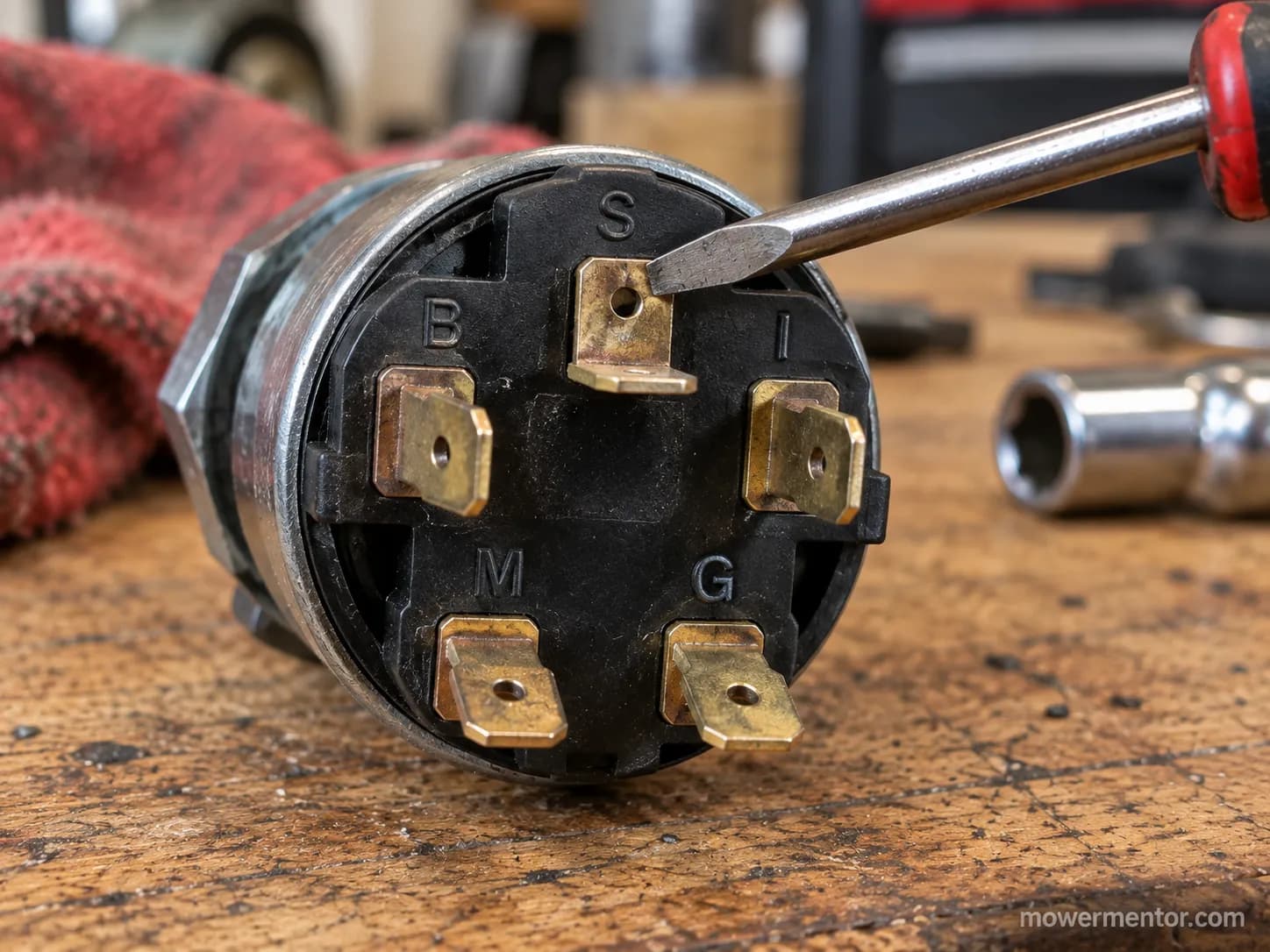
What each terminal does:
B (Battery): Constant power in from the battery.
S (Start): Sends power to the starter solenoid to crank.
I (Ignition): Feeds the ignition/run circuit.
M (Magneto): Grounds the magneto to stop the engine (the kill wire).
G (Ground): Switch ground path.
A / L (Accessory / Lights): Extra circuits on some switches.
Community threads back this up in plain owner language, with posters on a My Tractor Forum thread describing the same lettered terminals and noting that the exact layout varies by maker and model.
That variation is the catch worth remembering, so compare the letters on your own switch rather than assuming every five-terminal unit is wired alike.
If you want the full terminal-by-terminal picture for each prong count, the companion piece with terminal wiring maps by prong lays them out in detail.
When a switch tests fine but the mower still won't start, the fault usually sits elsewhere in the circuit, and the broader guide for when your rider won't start walks the whole path.
A dead-silent no-crank often traces past the switch to the battery, cables, and ground, which is the focus of the no-crank electrical walkthrough.
Identify Your Switch: Prong Count, Positions, and Terminal Letters
Identifying a riding lawn mower ignition switch comes down to three counts you can take in under a minute.
Most riding mowers use a switch with five, six, or seven terminals and three or four key positions, with three-position (off, run, start) being the most common.
According to the spec on Tractor Supply's OEM listing, a very common replacement in the MTD 725/925-0267 family is a three-position, five-terminal switch that stands in for a long list of older part numbers.
Count the prongs, count the positions, read the letters, and you have a fitment profile that survives even when the part number does not.
Do it in this order:
Pull the switch from the dash so you can see the back.
Count the metal terminals (prongs).
Count the key positions as you turn it (off, run, start, and sometimes accessory).
Read the letter stamped beside each terminal.
Write the arrangement down, for example "5-terminal, 3-position, B-S-I-M-G."
When I lined up a five-, six-, and seven-terminal switch side by side on the bench, the only reliable tell between two of the "five-prong" units was the letters: one ran the S and M terminals in a different order, so a same-count swap would not have killed the engine.
That is why prong count alone is a trap, and why the letters do the real work.
More prongs usually means the switch adds accessory or light circuits, not more key positions, so a seven-terminal switch is often a five-terminal wiring plan with two extra feeds.
Which prong does what on the back of the switch?
Match the letters, not the holes. A five-terminal B-S-I-M-G switch cranks on B-to-S, runs on the I circuit, and stops when M grounds to G, and a comparable three-position, five-terminal unit sold as the Arnold switch at Lowe's ships with two keys and the same letter logic.
If your replacement carries the same letters in the same roles, it will behave the same way on your mower.
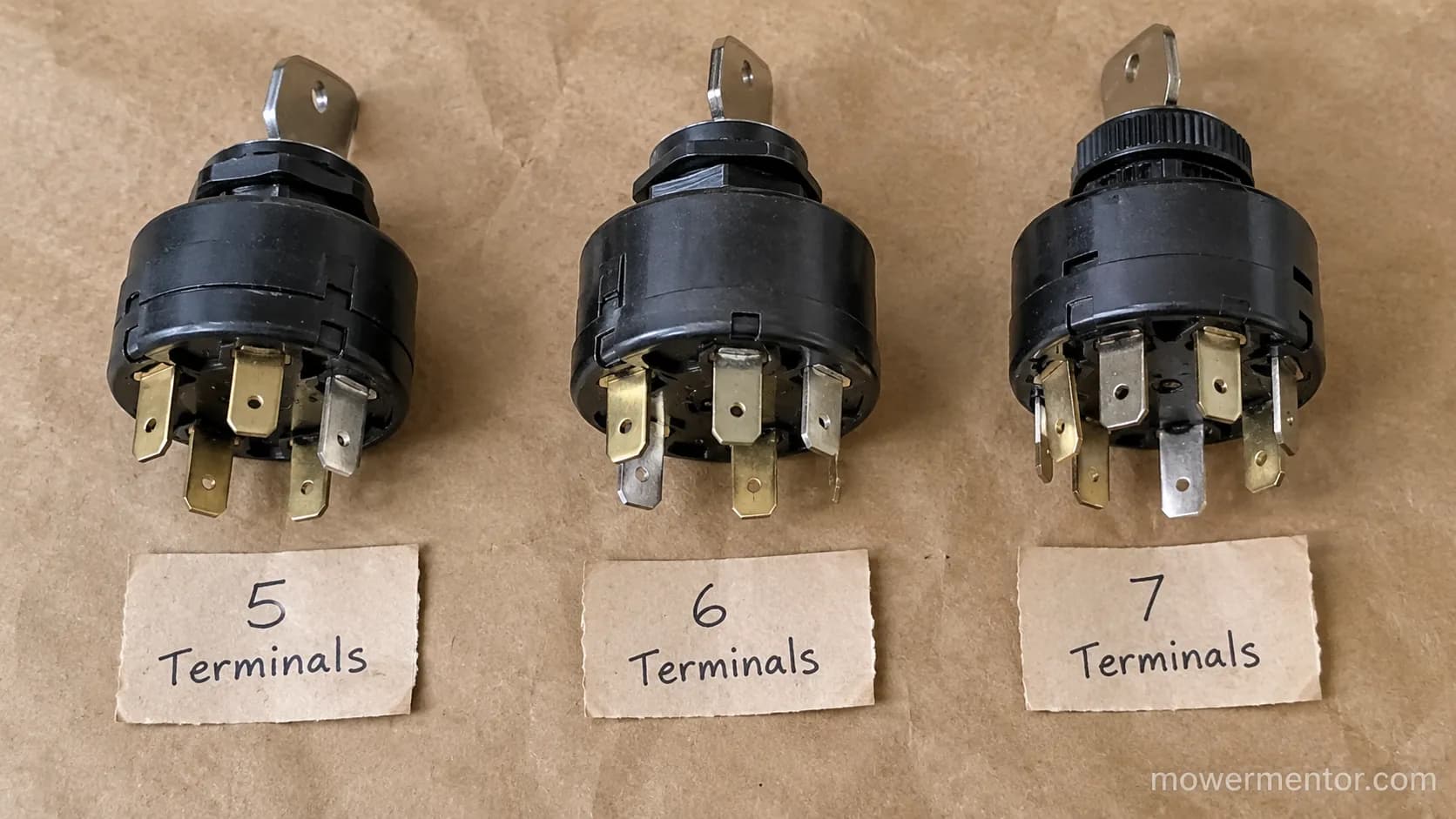
Use this matrix to place your switch and see what typically goes with each configuration.
Prong count | Key positions | Typical terminal letters | Common on | Universal or OEM |
|---|---|---|---|---|
4 | 3 (off/run/start) | B, S, M, G | Older or simple magneto riders | Universal usually fits |
5 | 3 (off/run/start) | B, S, I, M, G | Most MTD, Craftsman, Cub Cadet, Toro riders | Universal fits when letters match |
6 | 3 or 4 | B, S, I, M, G, A/L | Riders with accessory or light feed | Match the extra letter, then universal |
7 | 3 or 4 | B, S, I, M, G, A, L | Loaded riders and zero-turns | Confirm both extra feeds; OEM if unsure |
Before you trust a used or salvaged switch you plan to match, it is worth taking a minute to test the switch first with a multimeter.
The same fitment-first habit applies to the rest of the starting system, including picking the right starter motor if the crank problem turns out not to be the switch.
Recording the switch profile also pays off at every service interval, so it is a natural thing to note during your seasonal tune-up routine.
Universal vs OEM: Which Should You Buy?
Lawn mower ignition switches are largely interchangeable when the terminal count and letters match, so a universal switch fits most riding mowers and usually costs far less than the branded part.
A matched three-position, five-terminal universal switch runs about $16 to $23 at write-time, while an OEM equivalent commonly lands between $40 and $70.
Choose OEM only when you need a true drop-in plug match or a specific key profile.
A universal switch fails when its terminals differ from the original, never because it is "universal," which is why the letter check in the previous section matters more than the price.
On a mid-2000s rider this spring, a $17 universal five-terminal switch worked perfectly once I moved a single terminal over to match the original letter order.
The $60 OEM part would have been a straight plug-in, but it was not worth roughly three times the price for fifteen minutes of re-pinning I was happy to do.
Factor | Universal switch | OEM switch |
|---|---|---|
Typical price | $16 to $23 | $40 to $70 |
Fitment work | May need terminal re-pinning to match letters | Usually drop-in |
Plug match | Not guaranteed | Exact for the model |
Keys | Common Indak-type keys included | Model-specific keys |
Best for | Discontinued or unknown parts, budget repairs | Exact drop-in, anti-theft or specialty keys |
The honest catch with universal is the re-pinning: "universal" can mean fifteen minutes of moving a terminal to match your letters, not a guaranteed plug-and-play.
If your budget is tight and you are comfortable matching letters, universal wins almost every time on a standard rider.
If a correctly matched switch still won't crank, the next suspect is the solenoid, and it is quick to check the starter solenoid before you blame the new part.
Buying by fitment is the same discipline that keeps routine service painless, the way it does when tuning up a Honda mower by matching parts to the model.
Key Compatibility: Do Riding Mowers Share Keys?
Most riding mower brands share a small set of common ignition keys, so a single universal Indak-type key starts a wide range of machines.
Brands including Cub Cadet, MTD, Toro, Husqvarna, Craftsman, Ariens, Murray, and many John Deere models use these common blanks, which is why key sets that cover dozens of mowers exist and cost only a few dollars.
A handful of zero-turn, commercial, or anti-theft models use unique keys, so the rule is "mostly shared, with named exceptions."
When you replace a switch, confirm it includes keys and keep a labeled spare.
I keep one Indak-type universal key in a drawer, and this season it started a Cub Cadet, a Troy-Bilt, a Toro, and a Craftsman without complaint.
The John Deere in the same shed took a different key, though that one is just as common across the Deere lineup.
That matches what SlashGear's key rundown reports: John Deere has largely used one shared key style for decades, with a few zero-turn and Gator lines differing mainly in the molded grip.
A single replacement blank, such as a universal key at Home Depot, is sold as fitting many brands at once.
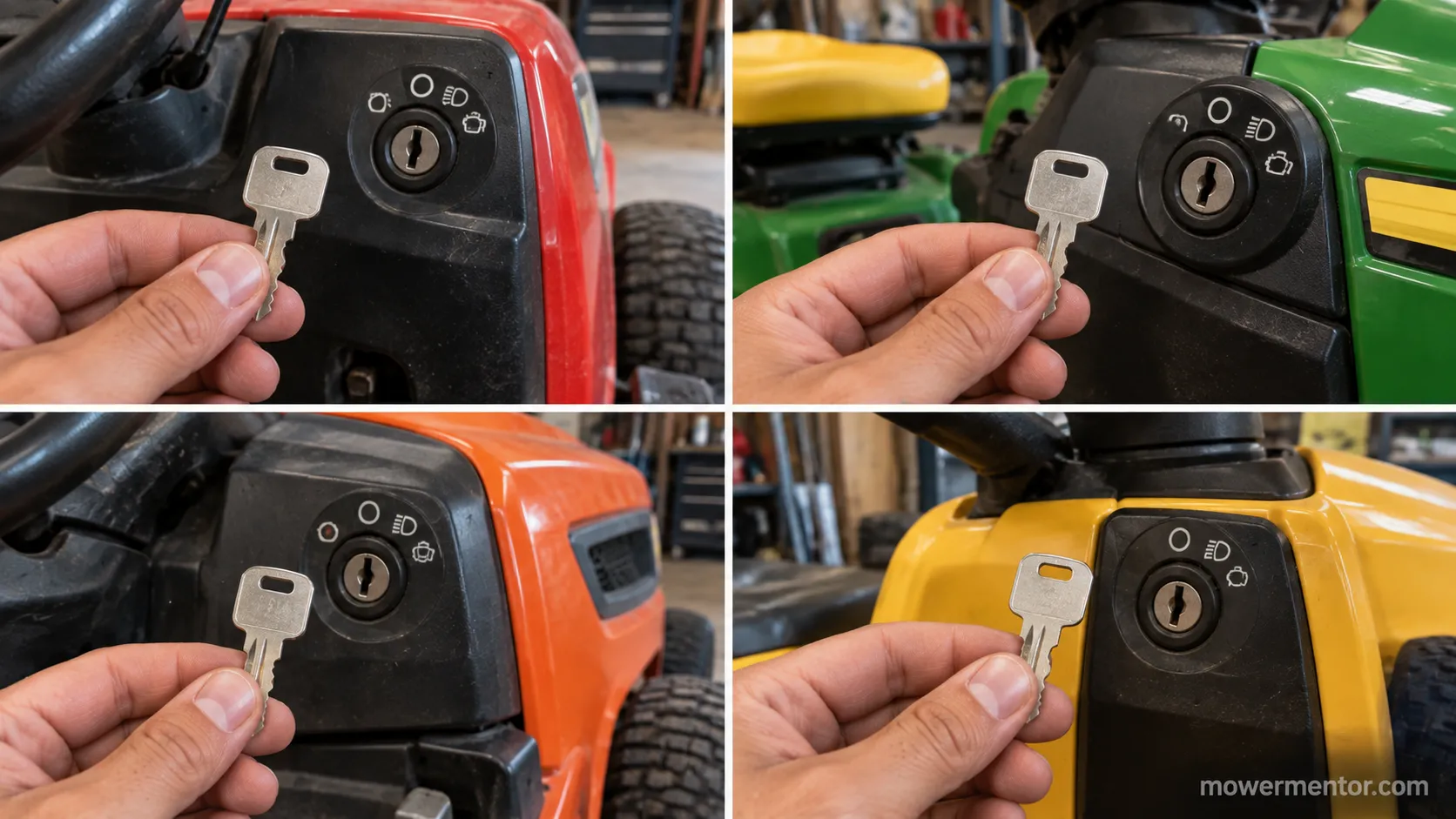
The honest limit here: a shared key means easy spares, not theft protection, since your neighbor's key may well start your mower.
If your mower is a specific brand, the terminal logic still applies, and you can go deeper on a Craftsman switch by terminal when that is what you own.
Murray owners get an added key-and-part cross-reference in the Murray cross-reference guide.
Troy-Bilt no-start cases often mix the ignition switch up with the safety switches, which the Troy-Bilt switch and safety switches guide untangles.
Which Switch to Buy for Your Mower (and Where to Buy It)
To buy the right riding lawn mower ignition switch, match your fitment profile (prong count, key positions, terminal letters) to a switch type, then pick a channel by how fast you need it.
An OE-style drop-in makes sense when the plug matches; a universal switch is the move when the part is discontinued or unknown; a brand-specific switch suits an unusual dash.
Buy online for the widest part-number cross-reference and selection, or locally at a farm-and-hardware retailer for same-day pickup. Always confirm keys are included before you check out.
These picks are matched to situations, not brands, so find the row that sounds like you.
Your situation | Buy this type | What to check | Typical channel |
|---|---|---|---|
Best overall value: standard rider, letters readable | Matched universal five-terminal switch | Terminal letters match your old switch | Online or local |
Best drop-in: plug and keys must match exactly | OE-style or OEM switch | Part number cross-reference | Dealer or online |
Discontinued or unknown part | Universal switch plus pigtail | Re-pin to match letters | Online |
Just need a spare key | Universal Indak-type key set | Key profile matches your slot | Local or online |
Unusual brand-specific dash | Brand switch | Model fitment listed | Dealer or online |
For a discontinued part this spring I bought a universal switch and pigtail online in an afternoon, and when I needed a mower running that same day I grabbed an OE-style switch off a farm-store shelf.
Both worked, and the only difference was how long I waited and how much cross-referencing I did.
The honest catch on channel: local stock is narrow, so call ahead, and online returns can lag your mowing window, so order before the switch fully dies if you can.
A single OEM part often replaces several older numbers, so cross-referencing your number, the way Tractor Supply's cross-reference lists a long fitment string, widens your options.
Before you check out, confirm: Prong count, key positions, terminal letters, keys included, and a return policy.
Once the right switch arrives, the swap itself is quick, and the walkthrough for swapping the switch step by step covers removal, wiring, and cost.
On a John Deere, a no-start can also live in the PTO or safety switches rather than the ignition, which the John Deere PTO and safety checks guide covers.
Buying the right part by model is the same skill behind matching a Honda tune-up kit, so it is worth building the habit.
Fitment Mistakes That Waste a New Switch
Most "my new lawn mower ignition switch doesn't work" complaints are fitment mistakes, not defective parts.
Matching prong count but not the terminal letters can leave the engine unable to crank or unable to shut off; an unaddressed extra wire (the classic five-versus-six-plug mismatch) often disables the safety or kill circuit; and a poor ground can blow the fuse the moment you turn the key.
Match the letters, account for every wire, and confirm the ground path, and the great majority of these failures never happen.
The mistakes, and how to avoid each:
Buying by prong count alone. Two five-terminal switches with different S and M placement will crank wrong or fail to kill the engine. Match the letters, not the hole count.
Ignoring the extra wire. A five-versus-six-plug mismatch usually leaves a lone wire for the safety or kill circuit unconnected. Trace every wire before you finish.
Skipping the ground. Some metal-body switches ground through the housing, and a missing ground path blows the fuse on start. Confirm the G terminal or body ground.
Forcing a universal without re-pinning. If the letters don't line up, move the terminal, don't jam the plug on and hope.
A "universal" five-terminal switch I fitted this spring blew the 25-amp fuse the instant I turned the key, and the cause was not the switch: it grounded through the body rather than a G wire, so the circuit back-fed until I corrected the ground.
Members on Lawn Mower Forum describe the same class of faults, and warn that comparing the lettered terminals to the old switch first prevents an improper switch from damaging the ignition coil.
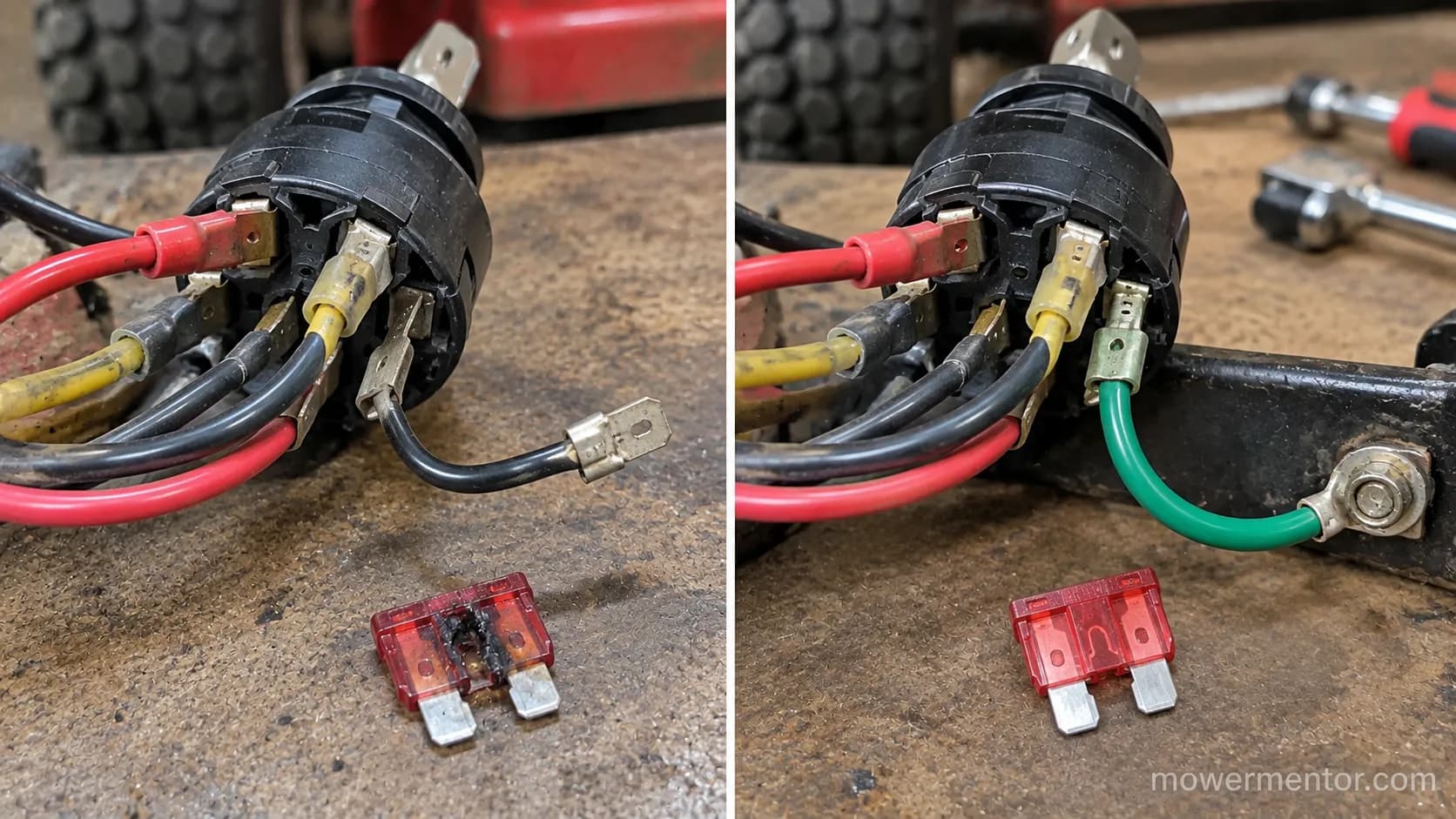
The rule to remember: A new switch that "fails" is almost always a wiring mismatch, not a bad part.
If the engine runs but won't shut off, that is a symptom worth working through the guide on starting it with a bad switch safely.
That lone extra wire is often the PTO or safety circuit, so it helps to know how the PTO switch wires in before you finish the job.
Frequently Asked Questions
Are lawn mower ignition switches universal?
Mostly, yes. A universal switch fits most riding mowers as long as its terminal count and letters match your original, which is what makes the Indak-style switches so common.
Match the letters first, and a universal part behaves exactly like the branded one. Buy OEM only when you need an exact drop-in plug or a specific key.
How many prongs does a lawn mower ignition switch have?
Most riding mowers use a switch with five, six, or seven terminals, and simpler magneto machines sometimes use four. Five terminals in a three-position (off, run, start) layout is the single most common configuration.
The extra terminals on six- and seven-prong switches usually add accessory or light feeds, not more key positions.
Are riding mower keys universal?
For most brands, largely yes. Cub Cadet, MTD, Toro, Husqvarna, Craftsman, Ariens, Murray, and many John Deere mowers share a small set of common keys, so one Indak-type key starts a wide range of machines.
Some zero-turn, commercial, and anti-theft models are the exceptions. A shared key is convenient for spares, but it is not theft protection.
Can I use any ignition switch on my riding mower?
Only if the prong count and terminal letters match. A switch with the same number of prongs but a different letter order can crank wrong, fail to kill the engine, or blow a fuse.
Read the letters on your old switch, match them, and re-pin a universal unit if needed. If a matched switch still won't crank, suspect the solenoid, and if the mower cuts out when you shift or stand, look at the seat safety switch rather than the key.
How much does a lawn mower ignition switch cost?
At write-time, a matched universal switch runs about $16 to $23, and an OEM part commonly runs $40 to $70. A universal Indak-type replacement key is only a few dollars, often $6 to $9.
Prices move with availability, so verify the current figure before you buy.
Why does my new ignition switch blow the fuse?
Almost always a wiring mismatch, not a defective switch. A missing ground path, a back-fed terminal from the wrong letter order, or an unconnected safety wire will blow the fuse on start.
Recheck the letters and the ground before returning the part, and if the mower won't start with the brake released, check the brake safety switch too.
Next Steps: Test, Wire, and Replace It
The right lawn mower ignition switch is the one whose prong count, key positions, and terminal letters match your original.
A correctly matched universal switch fits most riding mowers, while OEM matters only when you need a drop-in plug or a specific key.
Once you have the fitment profile written down, the rest of the job is straightforward: confirm the switch, wire it by the letters, install it, and keep a labeled spare key.
The jobs that go smoothly are the ones where I recorded the prong, position, and letter profile before ordering anything.
Do that, wire by the letters rather than by wire color, and you sidestep the fuse-blowing and no-kill mistakes entirely.
That same fitment-first habit carries into routine upkeep, the way it does when you tune up a Craftsman rider each spring.
It is also the habit behind ordering a Craftsman tune-up kit matched to your exact model instead of guessing.
Read the terminals, match the three counts, and the correct switch stops being a guess and starts being a sixty-second decision you can make with confidence.
Read it your way
Short on time? Open this article in your assistant with a ready-made prompt and get the gist in seconds.
Found this useful? Make us a preferred source so we show up in your Google results.
Keep reading
Related articles
Troubleshooting & Repair
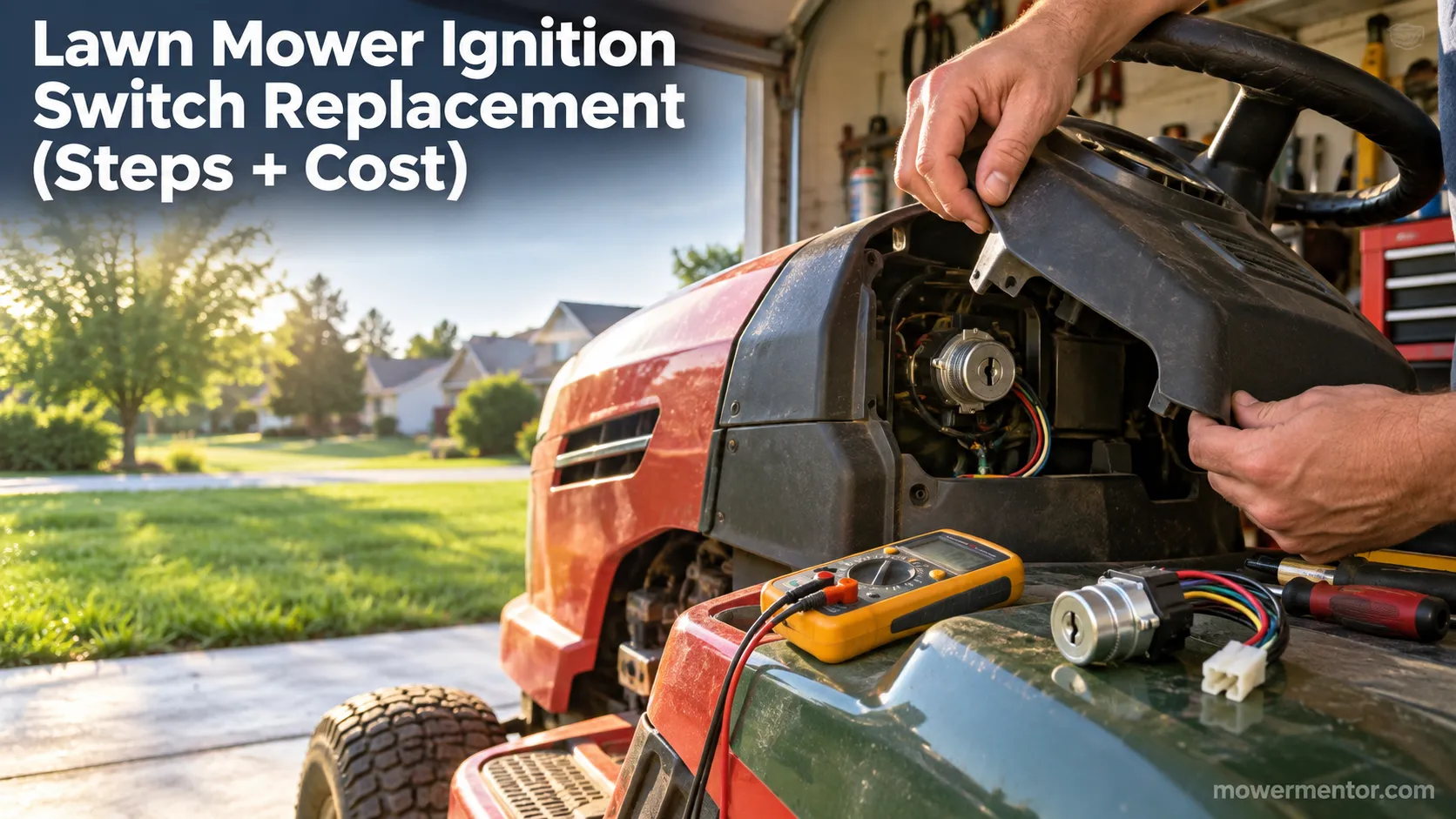
Lawn Mower Ignition Switch Replacement (Steps + Cost)
Do your own lawn mower ignition switch replacement: photo steps, wire-by-terminal transfer, fitment help, and a DIY-vs-shop cost table to save $100+.
Troubleshooting & Repair
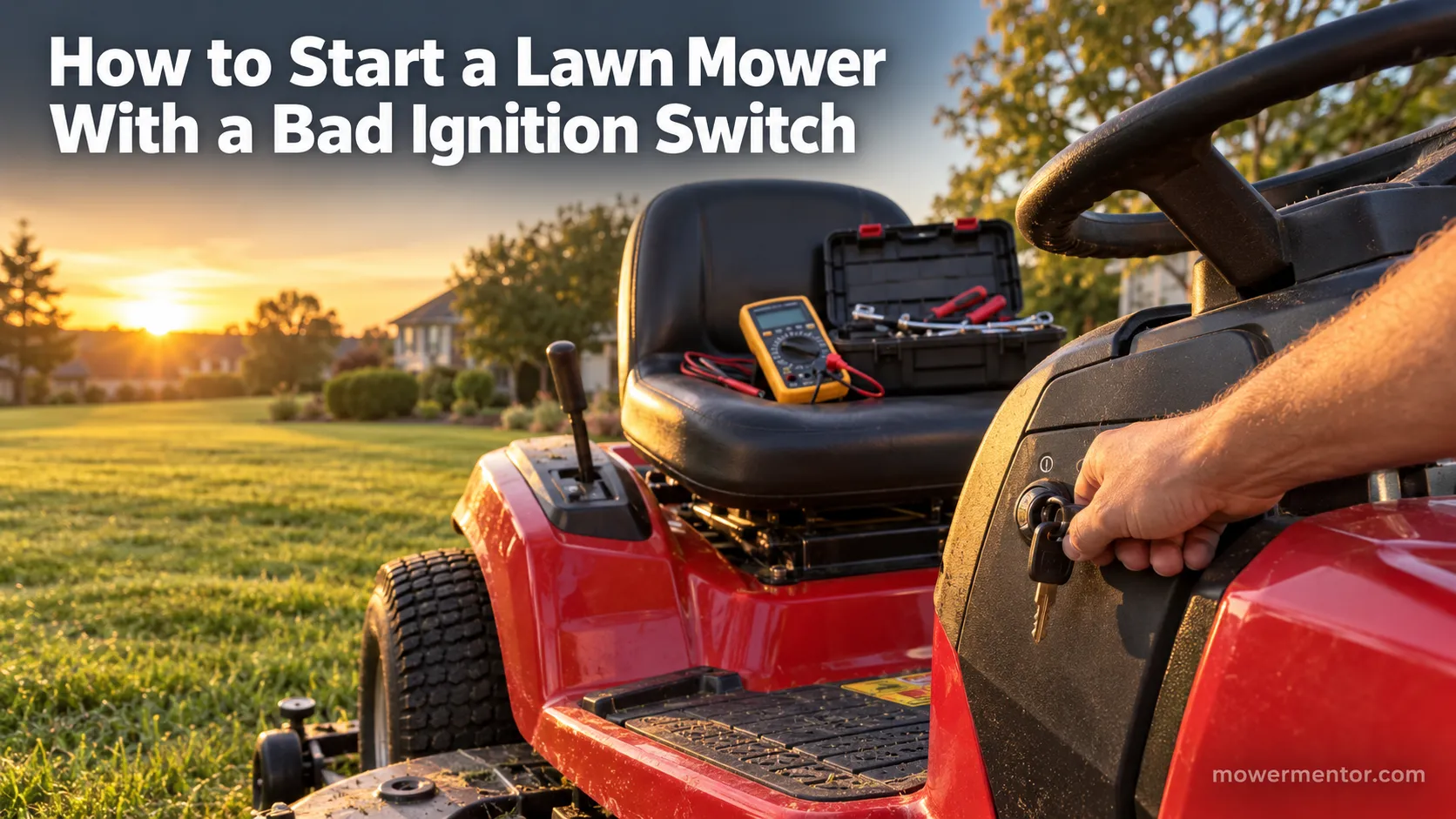
How to Start a Lawn Mower With a Bad Ignition Switch
Confirm it's the switch, then learn how to start a lawn mower with a bad ignition switch: a safe solenoid bypass to get moving, plus how to fix it for good.
Troubleshooting & Repair
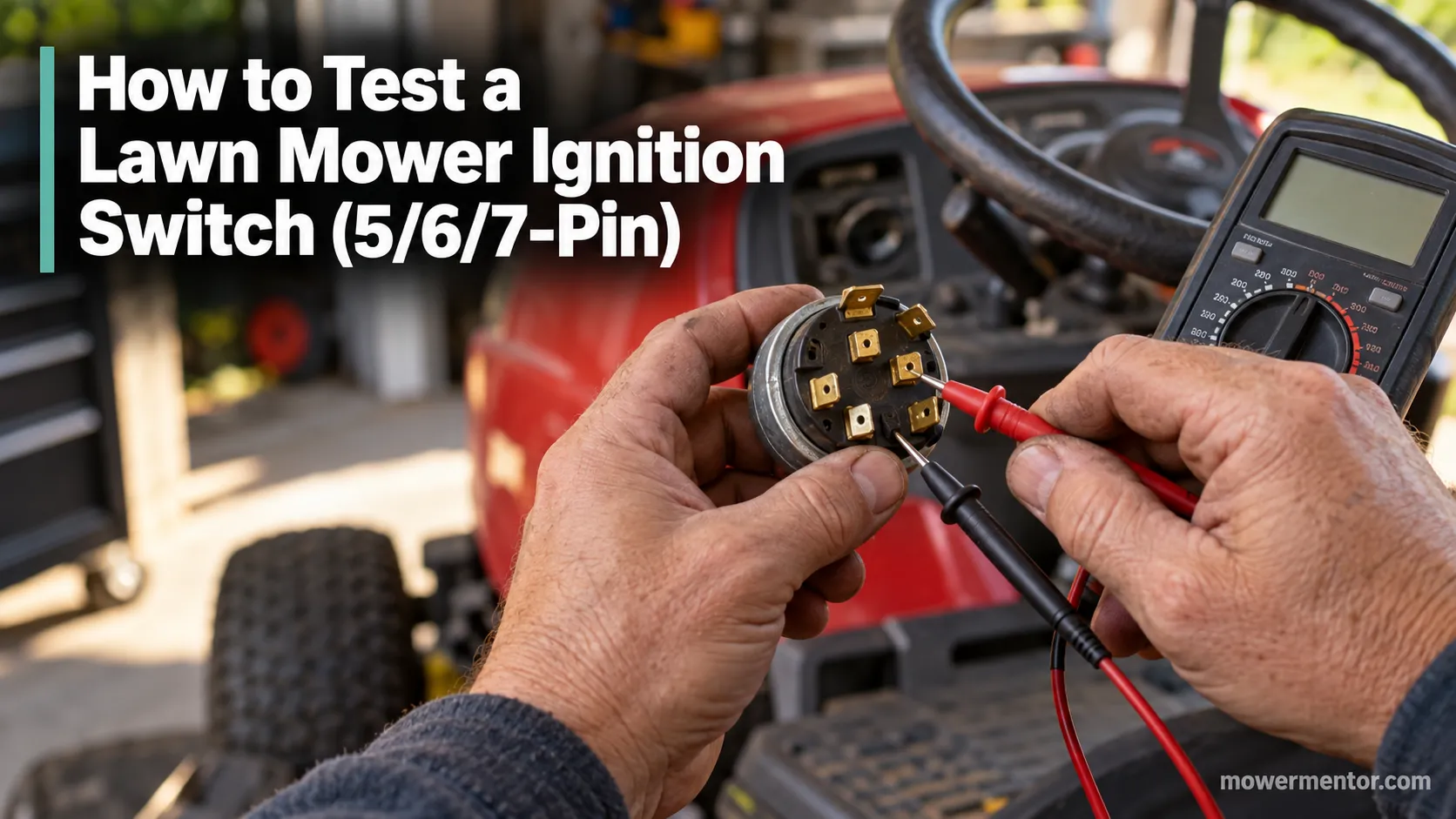
How to Test a Lawn Mower Ignition Switch (5/6/7-Pin)
Learn how to test a lawn mower ignition switch with a multimeter: get continuity tables for 5, 6 & 7-pin switches plus a no-multimeter test-light method.
Troubleshooting & Repair
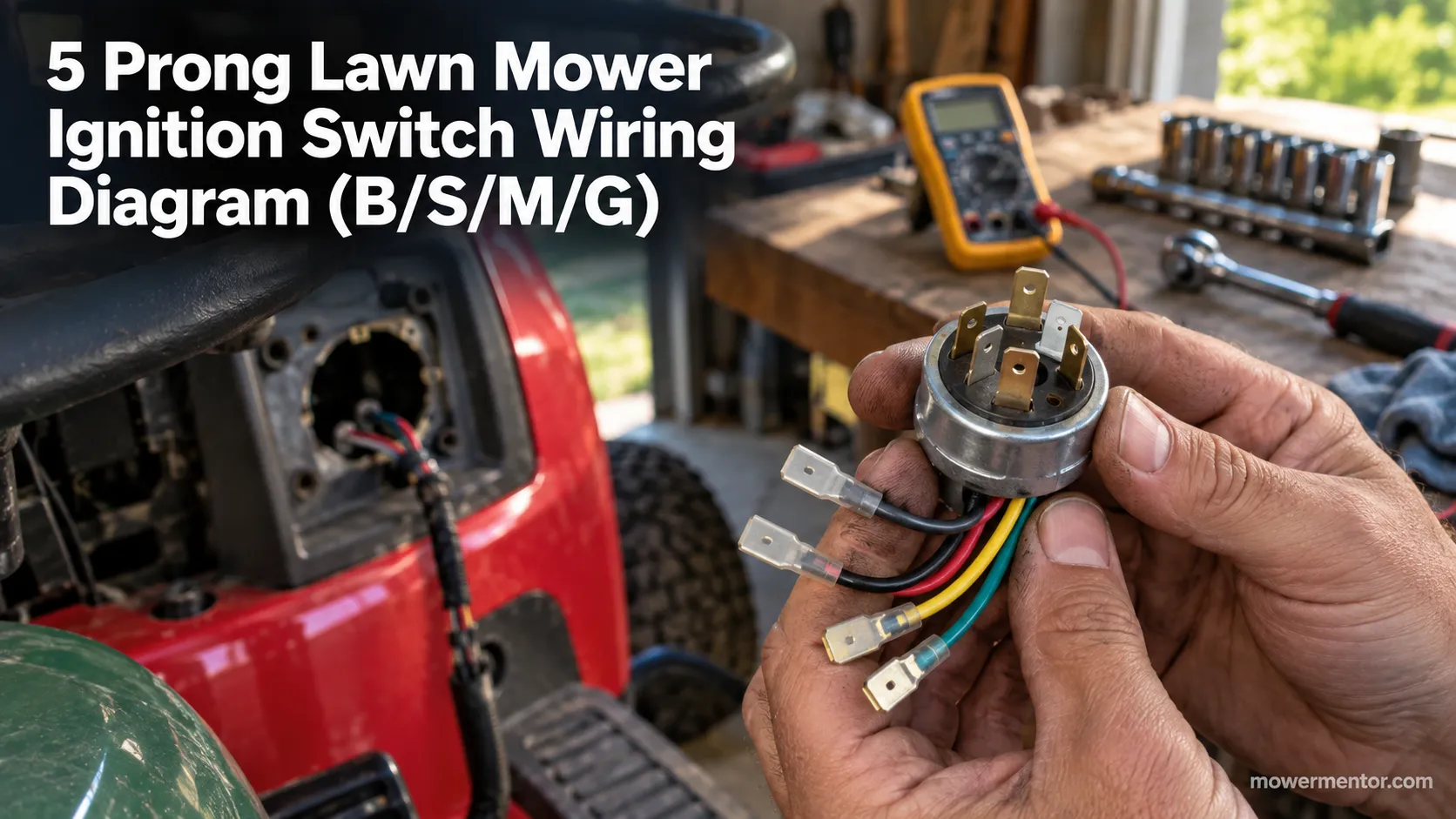
5 Prong Lawn Mower Ignition Switch Wiring Diagram (B/S/M/G)
Match your 5 prong lawn mower ignition switch wiring diagram by terminal letter: B/S/M/L/G, the magneto-vs-battery trap, plus a free PDF.
The discussion
Comments
Every comment is reviewed before it goes live.