
Murray Lawn Mower Ignition Switch: Test, Wire & Replace
Test your Murray lawn mower ignition switch by terminal, read the 5-post wiring diagram, then find the right OEM or universal cross-reference before buying.
Written by Tony MaldonadoReviewed by Wade CoburnLast updated on September 24, 2026
When you buy parts or tools through links on our site, we may earn a commission at no extra cost to you. It never changes what we recommend. Learn more.
A dead key that does nothing in any position sends most people straight to a parts page, but a Murray lawn mower ignition switch is worth two minutes of testing before you spend a cent.
Half the "dead switch" calls I get turn out to be a bad ground, a corroded battery lead, or a safety interlock doing its job.
The other frustration is buying: the original Murray part number for older mowers is discontinued, so matching a switch by its picture usually ends in a wrong-part return.
This guide runs the test first, decodes the terminals, then maps the OEM numbers to a current universal switch you can actually get.
No lights and no click in any key position usually means power, ground, or an interlock, not always the switch. Test before buying.
Test a switch by checking continuity between the expected terminals in each key position (battery to start at START, battery to run and lights at RUN, magneto to ground at OFF).
Match a replacement by counting positions and terminals on the old switch, not by the picture. The original Murray part is often superseded to a universal 5 to 7 post switch.
Most Murray mowers accept a universal key, so a lost key is rarely a dealbreaker.
Is It Your Ignition Switch, and Which One to Get
A Murray lawn mower ignition switch controls the starting circuit through a handful of labeled terminals, and it fails in two recognizable ways: dead in every key position, or the opposite, the engine runs but will not shut off when you turn the key back.
Before replacing it, confirm the fault, because a bad ground or a tripped seat, brake, or PTO interlock produces the same no-start.
On our test mower, a 1996 Murray 42-inch rider, a genuine no-lights, no-click condition turned out to be a worn key switch, but only after we cleared the seat switch first.
If you already know the switch is the problem, skip to the buying section for the OEM to universal cross-reference.
If you are not sure yet, spend two minutes on the terminal test below.
Bad Murray Ignition Switch Symptoms: Dead in Every Position vs. Won't Shut Off
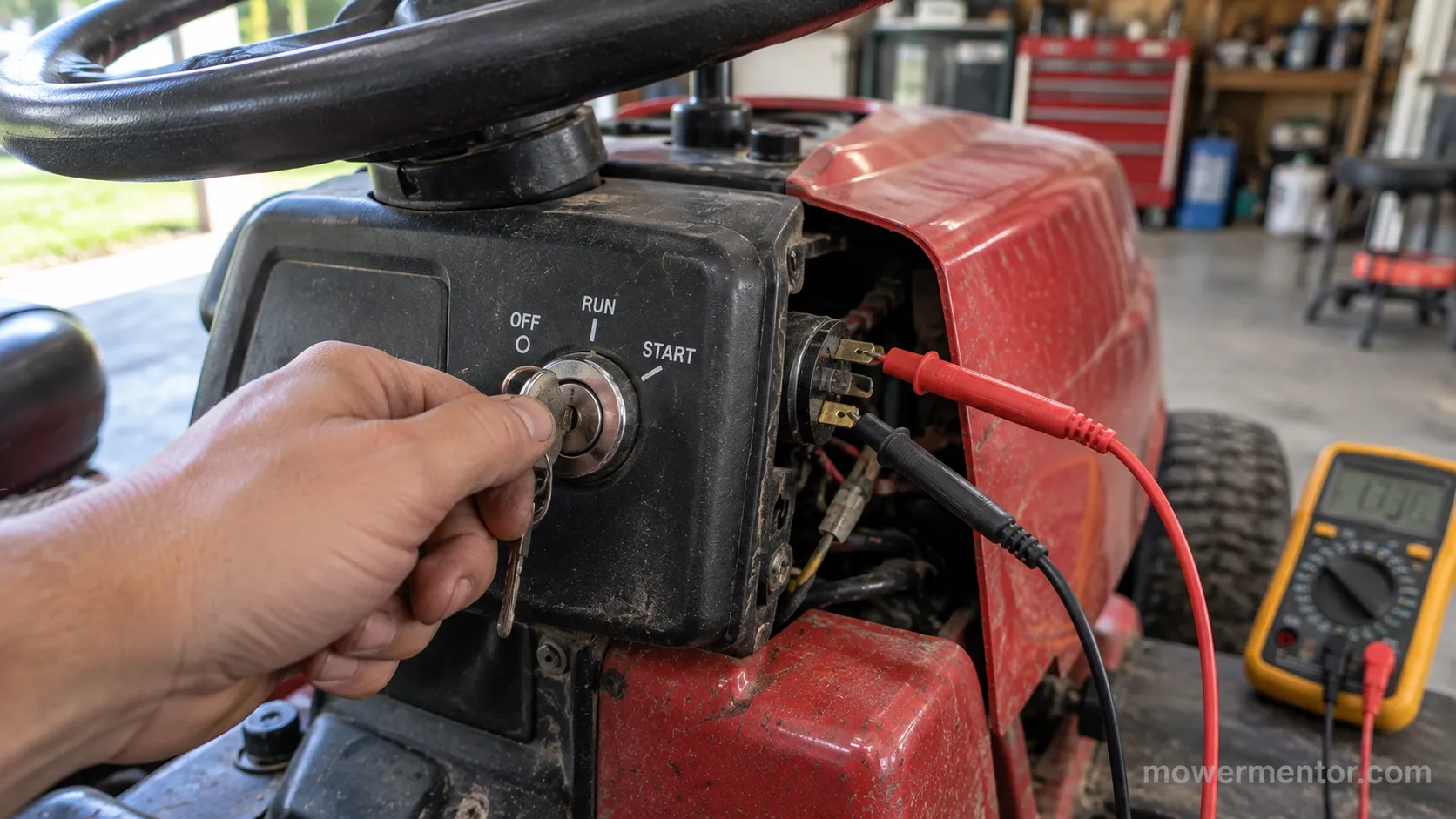
The two dominant failure signatures on a Murray ignition switch are no power in any key position and the reverse, an engine that keeps running when you turn the key to OFF.
A worn tumbler, what owners on the forums call a "wallowed out" switch, also shows up as a key that spins without a firm detent or will not turn at all.
None of these are proof on their own, because a bad ground or a failed interlock reads the same to the driver at the seat.
Turn the key and watch for lights and a click.
Nothing at all across the whole mower points to power, ground, or an interlock as often as the switch, so it pays to rule out the Murray battery and its cables before anything else.
According to RepairClinic's Murray parts listings, a defective ignition switch is a recognized reason a mower will not start and the starter never engages.
The "won't shut off" case is more specific.
On our mower, the engine kept running with the key at OFF because the switch had lost its OFF-to-ground contact, so the magneto never got grounded to kill the spark.
Symptom | What owners call it | Likely cause to rule out first |
|---|---|---|
No lights, no click, any position | "no click, no lights, nothing" | Battery, ground, then the switch |
Engine won't stop at OFF | "won't shut off" | Switch OFF/ground contact, magneto lead |
Key spins, no firm detent, won't turn | "wallowed out" | Worn switch tumbler |
Cranks only with the seat pressed | interlock issue | Seat, brake, or PTO safety switch |
Owners also warn that the snap-in clips Murray uses on the brake and PTO switches loosen and mimic a dead switch, so confirm those before condemning the ignition.
If the whole mower is silent, work the riding-mower no-start decision tree before you buy a part.
The full Murray starting checklist walks the same ground for this brand specifically.
How to Test a Murray Ignition Switch by Terminal (Multimeter)
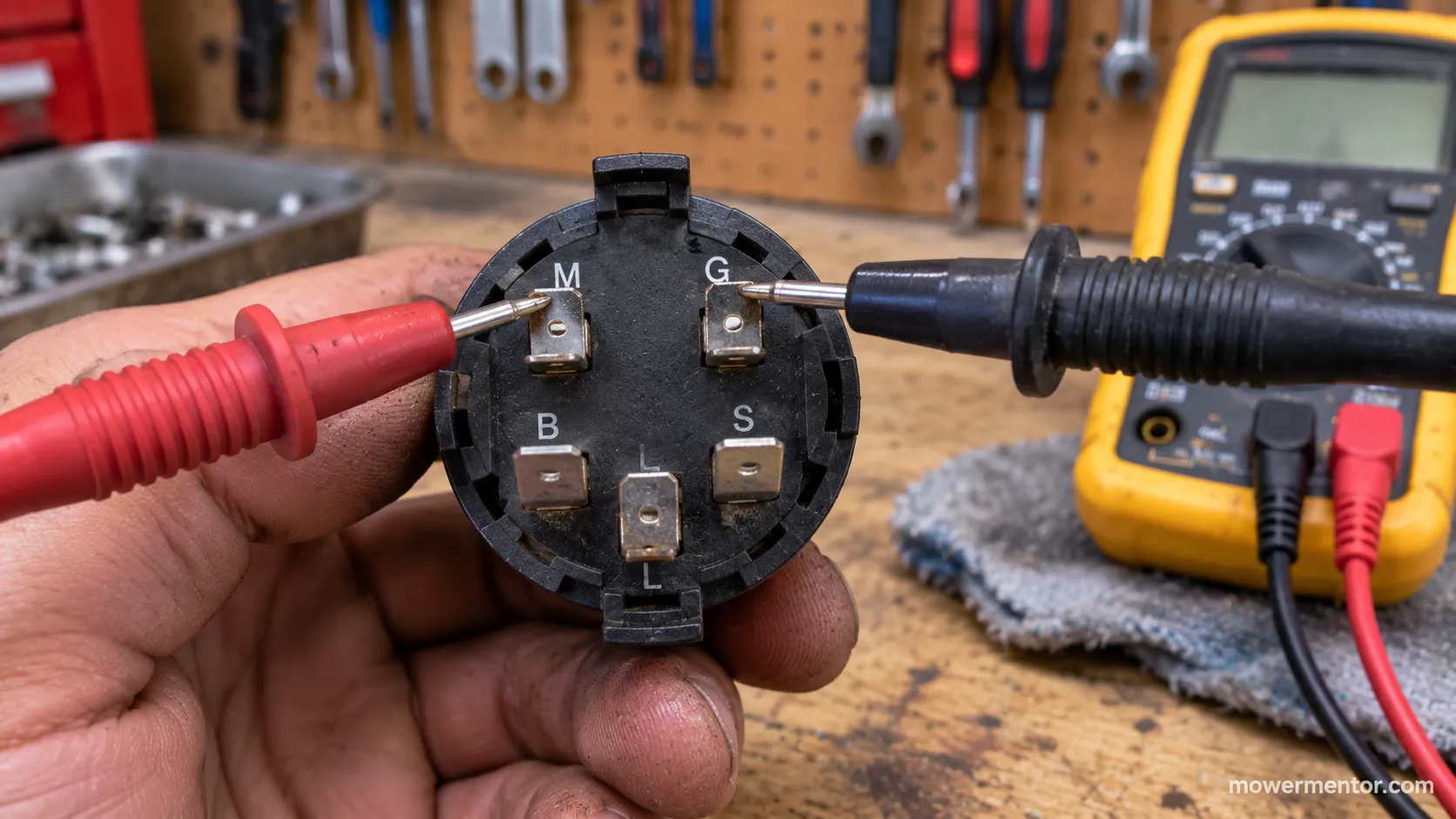
To test a Murray lawn mower ignition switch, set a multimeter to continuity and check for a closed circuit between the terminals that should connect in each key position: battery to start at START, battery to run and lights at RUN, and magneto to ground at OFF.
A missing reading where one should exist confirms a bad switch.
This beats a voltage test because it isolates the switch from the rest of the wiring, and it catches partial failures a quick "does it crank" check misses.
Disconnect the battery negative and label the wires before you pull the switch.
The battery terminal is always hot, so working it live risks a short.
Set the meter to continuity or the lowest ohms range and touch the leads together to confirm it beeps at zero.
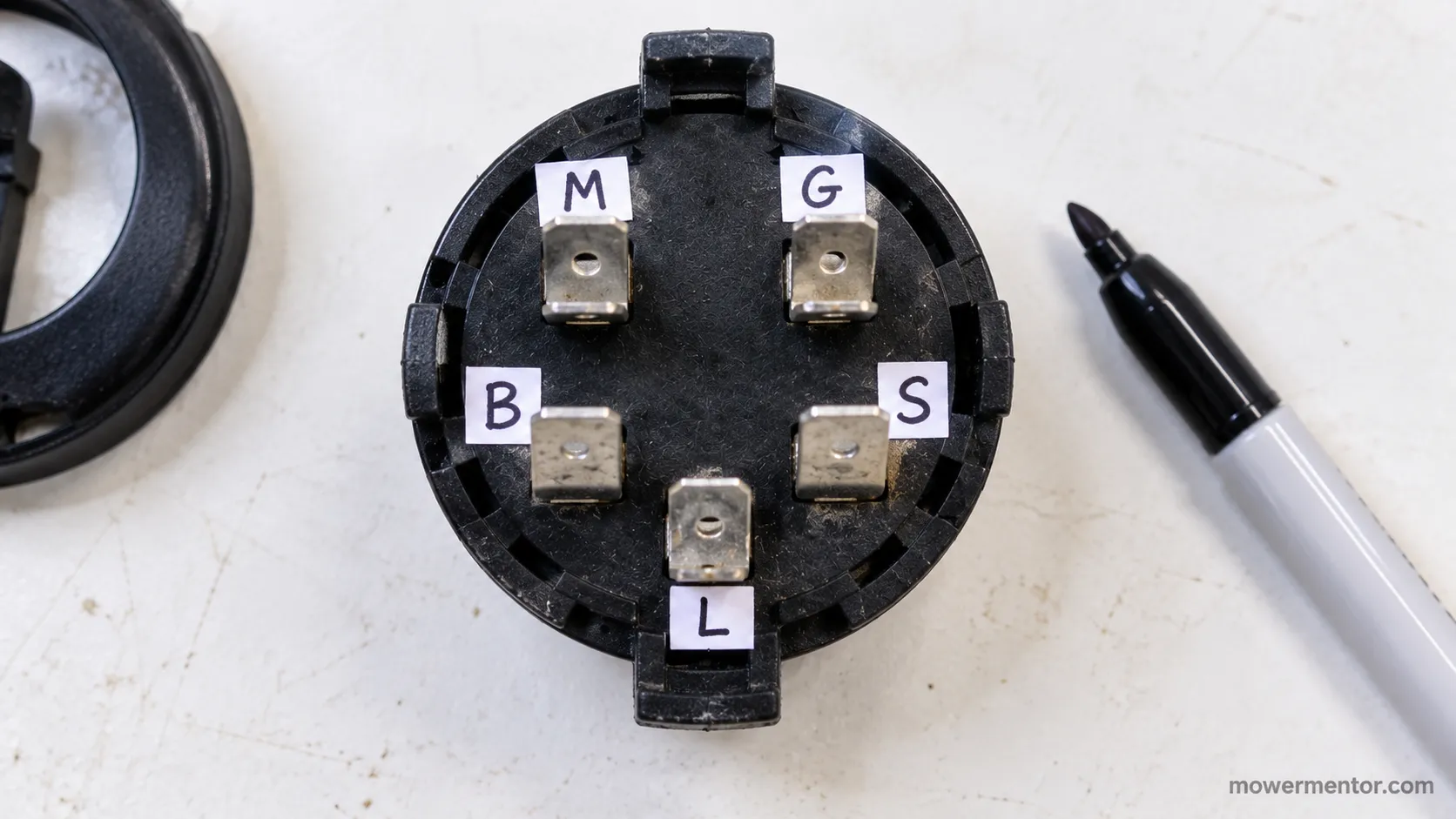
Identify the terminals by their letters: B battery, S starter/solenoid, L lights, M magneto, G ground.
With the switch out, put one lead on B and the other on S, then turn the key to START. You should read continuity.
Move to RUN and check B to L and B to any accessory terminal. Both should close.
Turn to OFF and check M to G. That path grounds the magneto to kill the engine and should close only at OFF.
Here are the readings from our own bench test on the pulled switch, which showed a clean OFF and RUN but an open start circuit.
Key position | Expected closed pair | Our meter reading | Verdict |
|---|---|---|---|
OFF | M to G | Continuity, 0.3 Ω | Pass |
RUN | B to L | Continuity, 0.4 Ω | Pass |
RUN | B to A | Continuity, 0.5 Ω | Pass |
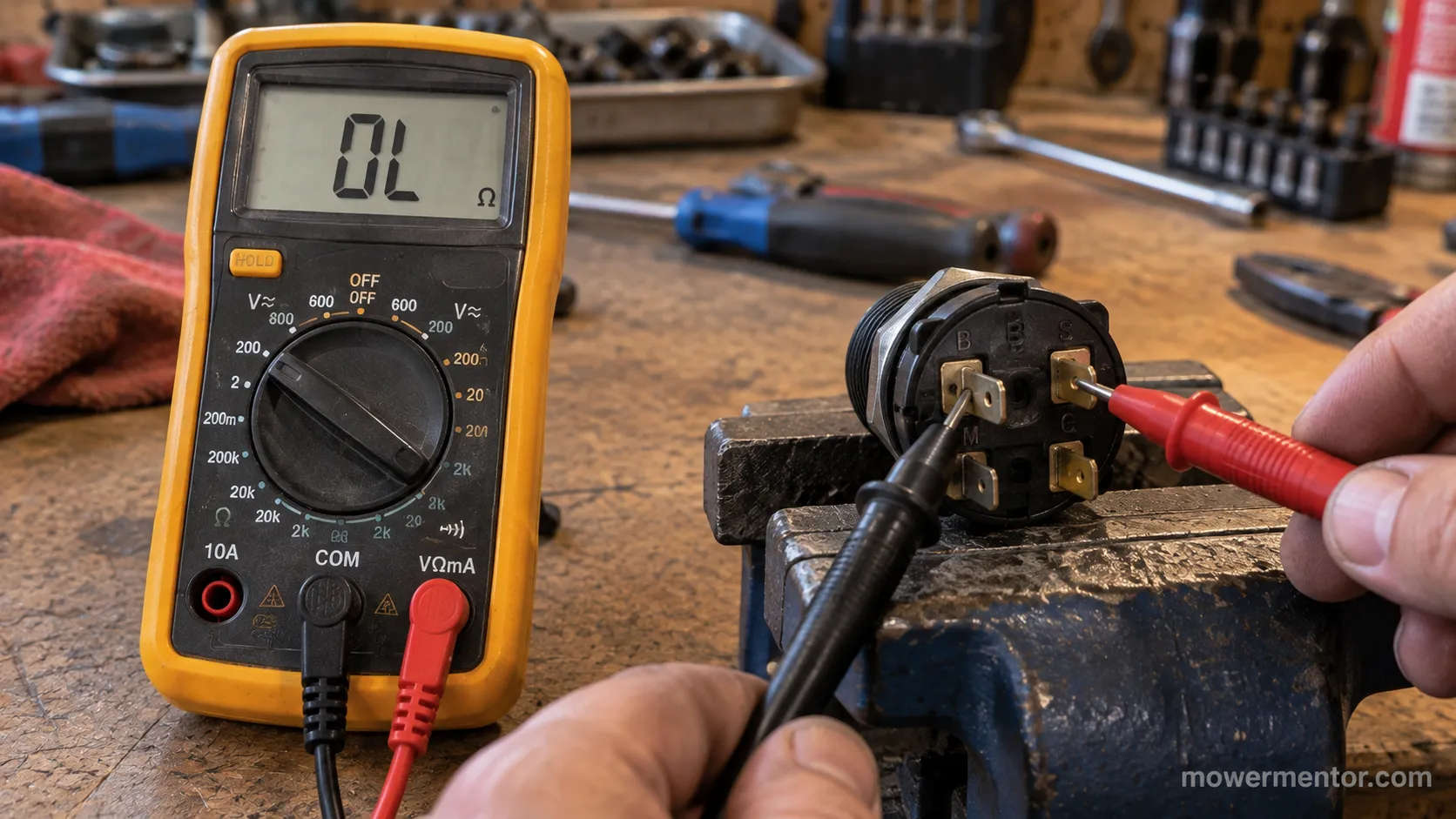
START | B to S | No continuity, OL | Fail |
START | B to L | Continuity, 0.5 Ω | Pass |
That single open reading, B to S at START, is a partial failure you would never spot without checking every position, and it explains a mower that has lights and fuel but no crank.
Murray key switches come in two, three, and four positions with five to seven terminals, as the aftermarket Murray switch listings show, so match your own switch to the right position count when you read a table like this.
For the generic version across five, six, and seven pin switches, see the general multimeter test.
If the switch passes every position, the fault is downstream. Move on to test the Murray solenoid next.
While you have the meter out, it is worth a minute to confirm you're getting spark.
The Murray 5-Post Wiring Diagram (B, S, L, M, G) Explained
On a Murray 5-post ignition switch the terminals are B for battery, S for starter or solenoid, L for lights, M for magneto, and G for ground, and the whole switch is just a set of position-controlled bridges between them.
OFF connects M to G to ground the magneto and kill the engine.
RUN opens that ground and feeds the lights and accessory circuit. START ties B to S to energize the starter solenoid.
Reading the switch this way turns a confusing cluster of spades into a simple map.
The single most important rule when you rewire is to match each wire to the same lettered terminal in the same position on the new switch.
Owners who guess and land a 12-volt lead on the magneto post routinely fry the ignition coil.
The Stens switch catalog lists the Murray-fit switches by position and terminal count with a 5/8 inch mounting stem, which is how you confirm you are looking at the right variant.
Terminal | Letter | What it feeds |
|---|---|---|
Battery | B | Always-hot 12V input from the battery |
Starter | S | Small wire to the base of the starter solenoid |
Lights | L | Headlight and accessory power at RUN |
Magneto | M | Kill wire to the ignition coil, grounded at OFF |
Ground | G | Chassis ground |
Six and seven post switches add an extra magneto or accessory post, and the seven post version appears on Briggs engines built since 1994 with a fuel-shutoff solenoid.
Print the full set of maps from our printable prong terminal maps so you have the exact layout for your prong count.
If the mower still will not turn over after you rewire, the problem is in the crank circuit, so run the no-crank electrical trace.
Then check that the solenoid the S terminal feeds is actually switching with how to bench-test that solenoid.
Which Murray Lawn Mower Ignition Switch to Buy: OEM Numbers vs. Universal Cross-Reference
The right Murray lawn mower ignition switch is chosen by position count and terminal count, not by the OEM picture, because numbers like 92377 and 92556 are superseded to universal switches you can still buy today.
That matters because Murray's original parts support for pre-1994 units ended after the brand's bankruptcy acquisition, so chasing the exact factory number often leads to a dead listing.
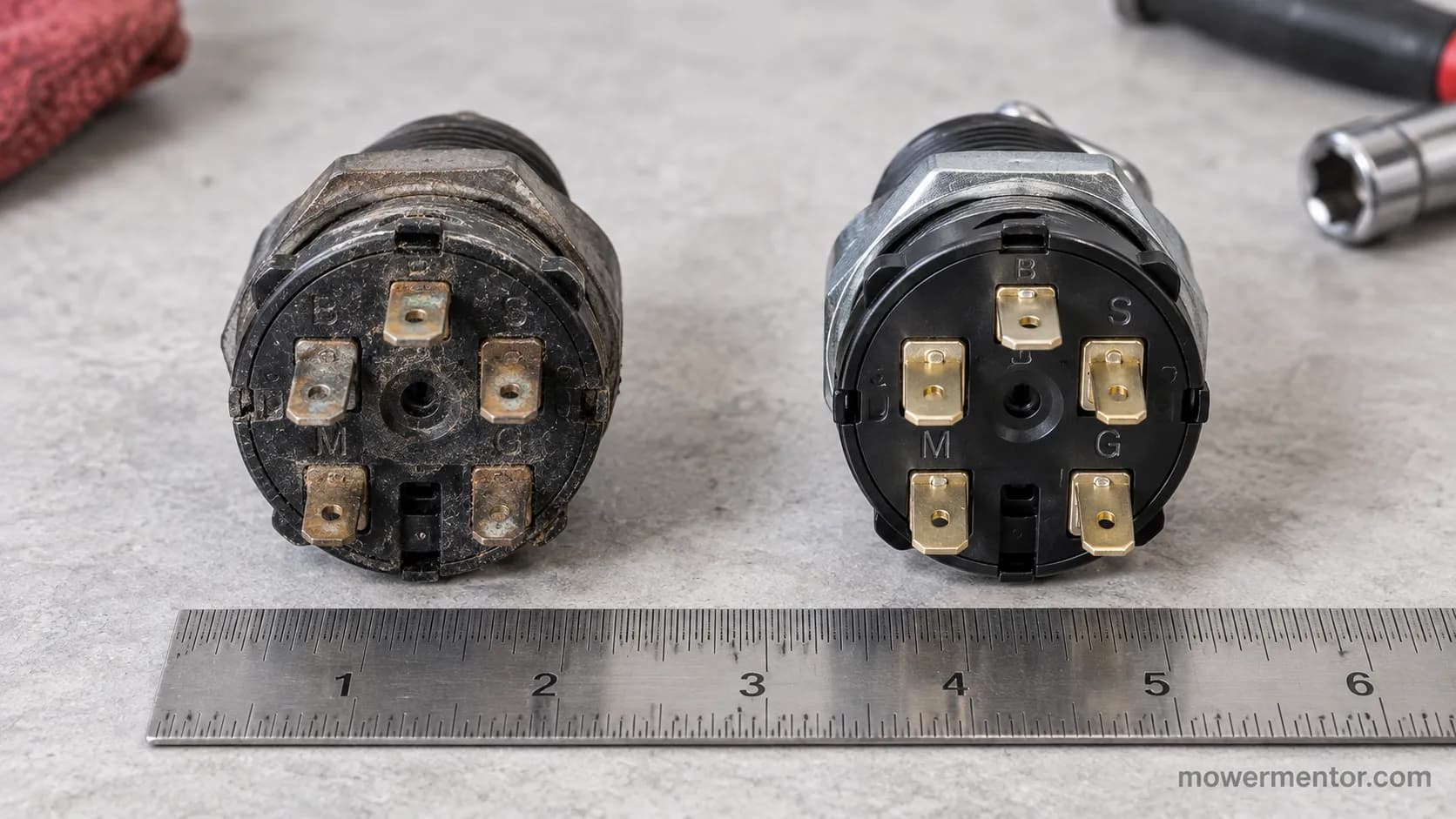
Count the positions and terminals on your old switch, confirm the 5/8 inch stem, then match those to a universal.
Use our universal-vs-OEM buyer's guide if you want the decision laid out across every mower brand.
The same match-by-fitment logic applies when you are choosing a Murray starter too.
Murray OEM number | Positions and terminals | Universal cross-reference |
|---|---|---|
92377 / 92377MA | 4-position, 6-terminal (front-engine) | Stens 430-161, Indak 6-post equivalents |
92556 / 092556MA | 4-position, 7-post (fuel-shutoff engines, since 1994) | Stens 430-674, Oregon 33-383, Briggs 5412H/5412K, AYP/Sears 532140301, MTD 725-1717 |
91846 / 300687 / 091846MA | 4-position, 5/8 inch stem | Stens 430-013 equivalents |
21064PA / 421064MA | 3-position, 5 spade terminals | Stens 430-538, Indak 5-post |
For genuine parts by model, the genuine Murray parts collection is the OEM source, but for the common discontinued switches a universal is usually the practical buy.
The 7-post 92556 cross-reference is the widest, and a 92556 cross-reference lists the Briggs, AYP, Husqvarna, MTD, Oregon, and Stens equivalents in one place.
One honest catch: some universal switches lack the exact detent feel of the original, and a real buyer review of a universal Murray-fit switch noted the key would not spring back to RUN after a start.
Verify the stem size and post layout before you commit, and expect to move the wires yourself.
Replacement Keys and the Discontinued-OEM Problem
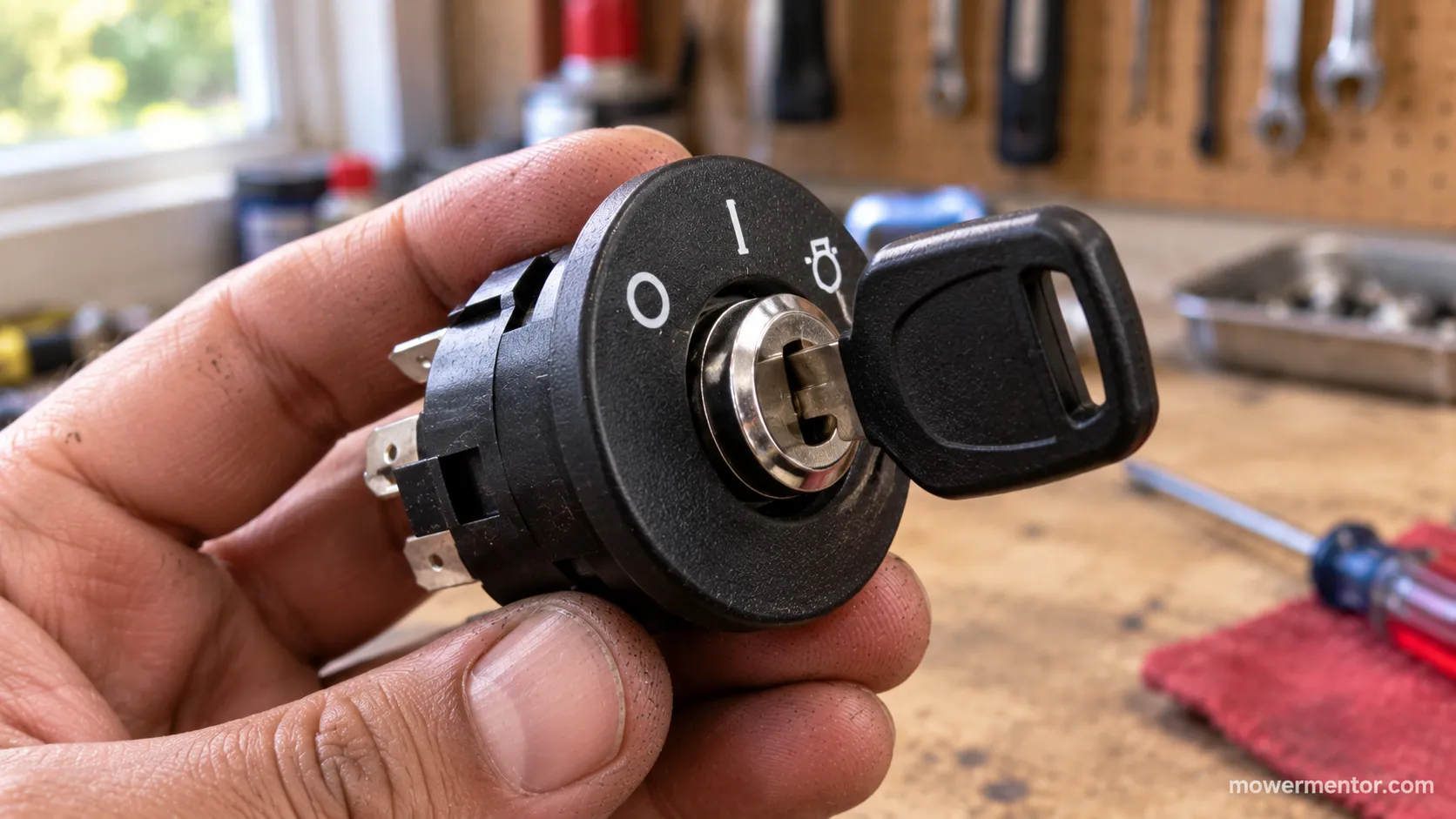
Most Murray riding mowers accept a universal Indak or Oregon 42-008 style key that fits the large majority of outdoor power equipment, which matters because Murray's original pre-1994 parts support was discontinued after the brand changed hands.
In practice a lost or broken key is rarely a real obstacle, and a specific key code only matters on the handful of keyed-alike setups.
The universal key also replaces common John Deere, MTD, Scag, and Sears key numbers, so one key covers most of the fleet.
The Stens and universal listings that carry the 5/8 inch Murray-fit switches also carry the matching universal keys, so you can source both at once.
Note that OEM switches often ship without a key, which is why so many owners end up with a universal key anyway.
While the mower is apart is a sensible moment to knock out other overdue jobs. It is easy to run a complete DIY tune-up while the panels are off.
That is also the moment to replace the air filter if yours looks dirty.
Battery-powered owners have a different rhythm entirely, and electric-mower upkeep skips the ignition switch chase altogether.
How to Replace a Murray Ignition Switch (Step-by-Step)
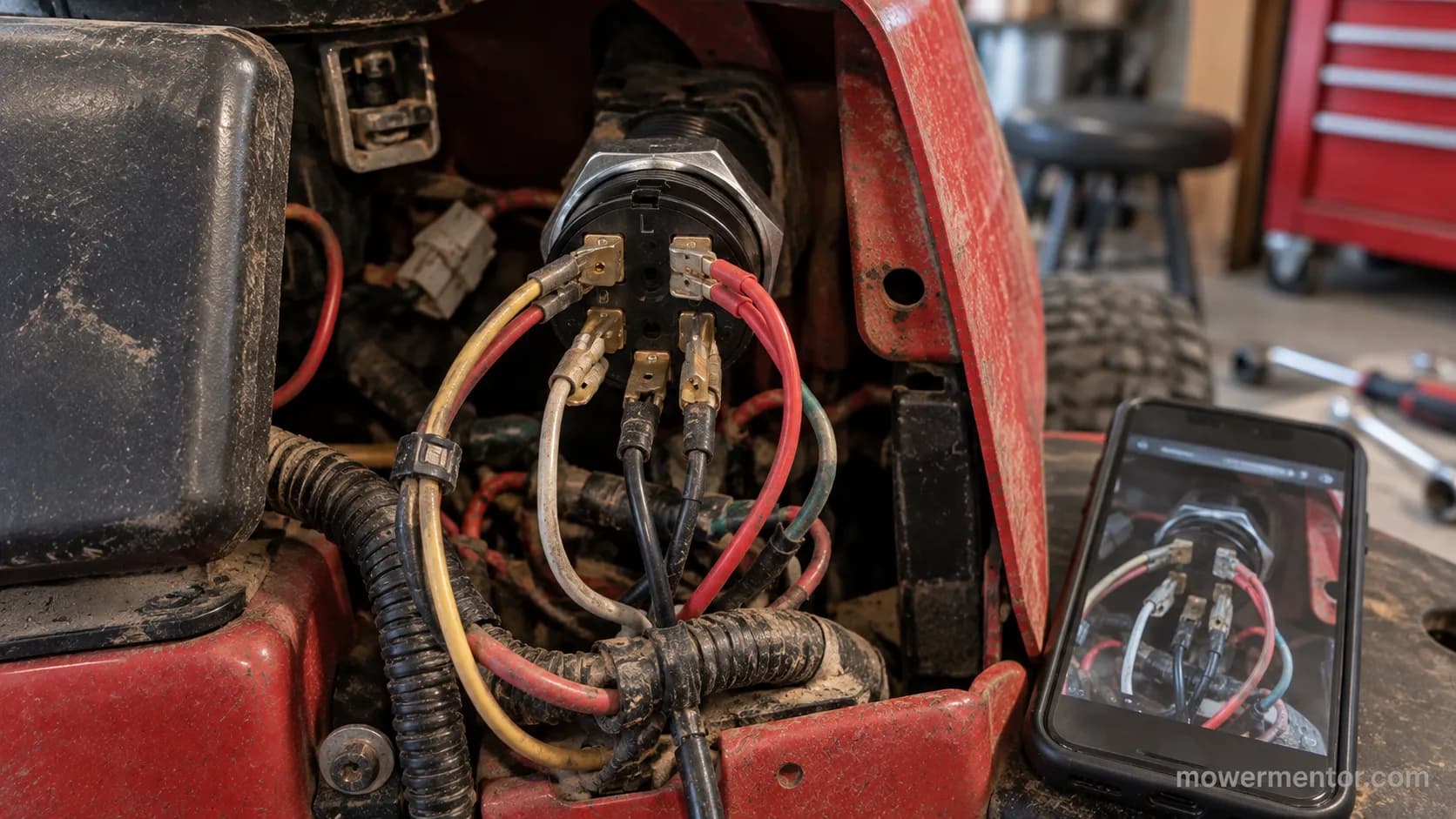
Replacing a Murray ignition switch takes about twenty minutes, and the one step that saves the whole job is photographing the old wiring before you touch a single spade.
Disconnect the battery negative, document the harness, then transfer the wires one at a time to the matching lettered terminal on the new switch.
Skipping the photo is how people end up with a switch that runs but will not kill, or worse, a grounded magneto lead.
Follow the same order every time so nothing gets crossed.
Disconnect the battery negative cable.
Photograph the back of the old switch with every wire still attached.
Remove the dash panel or bezel and release the switch retainer or nut.
Move each wire to the same lettered terminal on the new switch, one at a time.
Seat the new switch, confirm the 5/8 inch stem is snug, reconnect the battery, and test every key position before buttoning up.
On our swap, two wires shared the L post, something we would never have remembered without the photo, and matching them exactly is what made the new switch work on the first try.
For a fully generic step-by-step with a cost breakdown, see the general replacement walkthrough.
As long as the dash panel is already off, it is a good moment to fix a spark-plug wire or boot if yours looks cracked or loose.
Can You Hotwire a Murray Mower with a Bad Ignition Switch?
You can temporarily start a Murray with a bad ignition switch by jumping the battery-to-start terminals at the starter solenoid, but doing so bypasses the kill and safety-interlock circuits, so it is strictly a way to move the mower, not a way to mow with it.
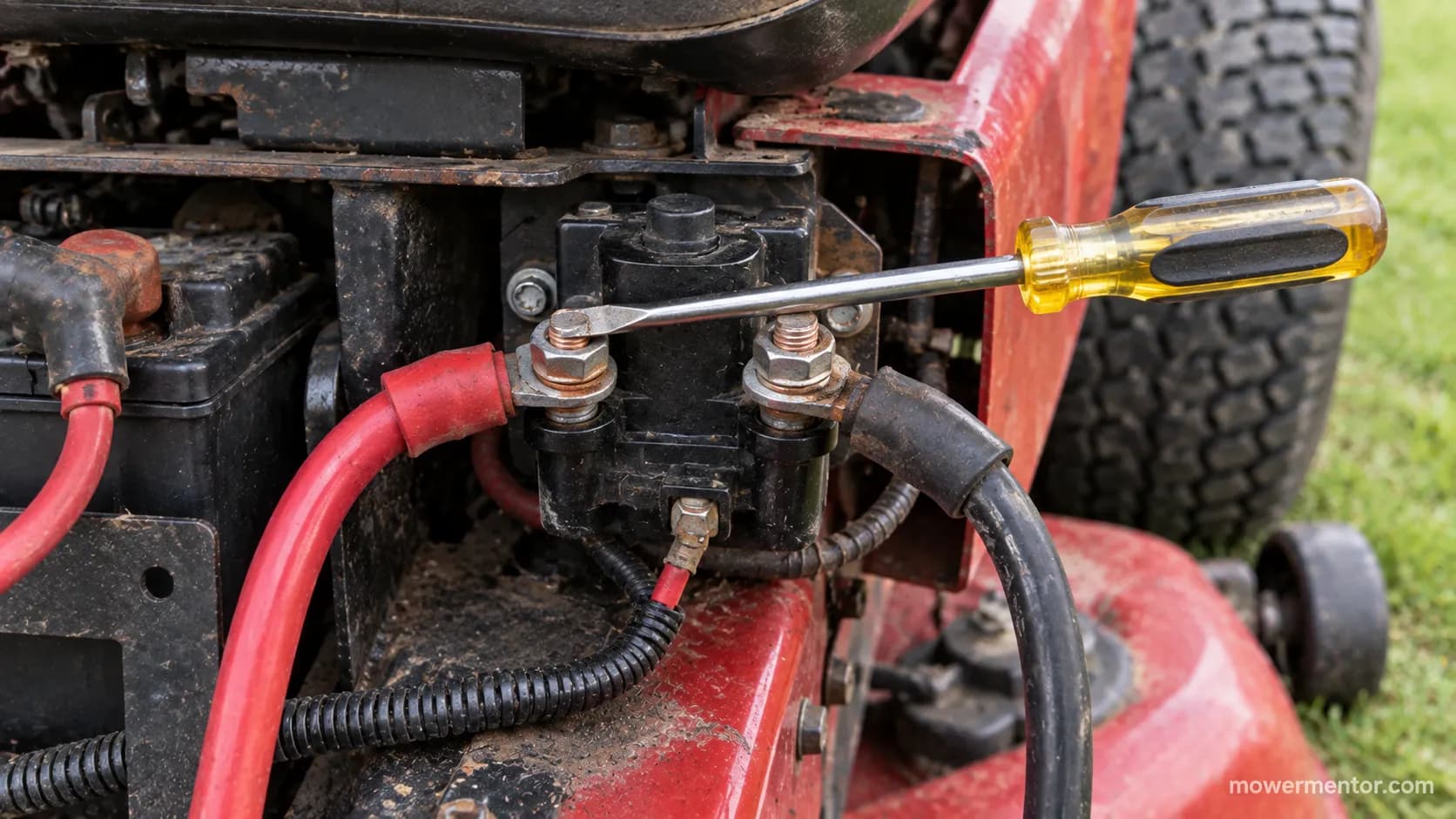
Owners describe operating the switch with a flat-blade screwdriver when the tumbler is wallowed out, and it does work, but the seat, brake, and PTO protections come off the moment you jump around the switch.
We jumped B to S at the solenoid once to roll our test mower into the shed. It cranked and started, and we parked it immediately, because with no seat-switch protection it is not something to run behind the blades.
Treat this as a limp-home measure and replace the switch. There is a fuller and safer walkthrough of starting it with a bad switch.
It is worth remembering that how the seat safety switch works is exactly the protection you are bypassing.
Safety note: Bypassing the ignition switch defeats the circuits that stop the engine and blades in an emergency. Use it only to reposition a mower, never to cut grass.
Frequently Asked Questions
How much does a Murray ignition switch cost?
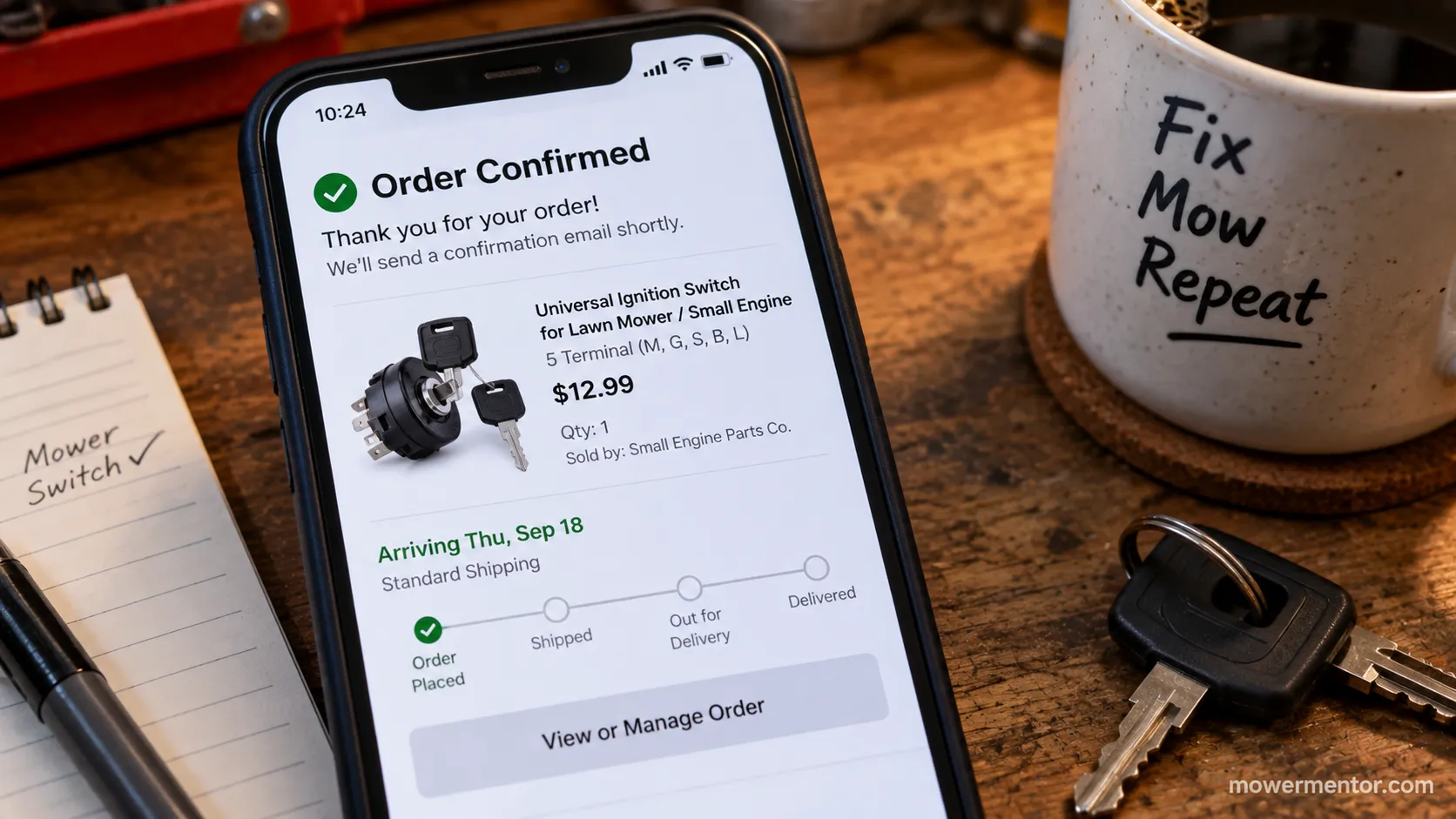
A universal replacement switch that fits most Murray mowers runs in the low tens of dollars, and it is usually cheaper and faster to get than chasing a discontinued OEM number.
A real listing for a universal Max Power switch confirms these switches fit Murray alongside several other brands. Buying the universal cost us a fraction of what a hunt for the original part would have.
Are Murray ignition switches universal?
By fitment, largely yes: match the position count and terminal count and a universal 5, 6, or 7 post switch will work on most Murray mowers. The one thing to confirm is the 5/8 inch mounting stem and that the posts sit in the same layout as your original.
Why does my Murray run but won't shut off?
That is a classic bad-switch symptom: the OFF position has lost its path that grounds the magneto, so the spark never gets killed. Replacing the switch, or confirming the M-to-ground contact, fixes it.
Could it be a safety switch instead of the ignition switch?
Yes, and it is worth ruling out before you buy. A failed seat, brake, or PTO interlock produces the same no-start. If the ignition switch tests good, test the PTO switch next. It is also worth checking the brake safety switch on the same pass.
Do I need the exact OEM part number?
No. Because the original Murray numbers are often superseded, matching a universal switch by positions and terminals is the reliable path, and it is what most owners end up doing.
Fix It Once, Buy It Right
The fastest way to solve a dead Murray lawn mower ignition switch is to prove it with a two-minute terminal test, then match the replacement by positions and terminal count rather than by a factory number that may no longer exist.
Testing first keeps you from replacing a good switch when the real fault is a ground, a solenoid, or an interlock.
Once you have confirmed it, the universal cross-reference gets you a switch and a key that fit, usually for a few dollars and a single afternoon.
That is the whole job: test, decode the terminals, cross-reference, and wire it back the way it came out.
Found this useful? Make us a preferred source so we show up in your Google results.
Keep reading
Related articles
Troubleshooting & Repair
Dead Dash? Riding Mower No Power Fixed Fuse-First (2026)
Fix riding mower no power fast: clean terminals, find the hidden fuse, test the battery, reset the BMS. A fuse-first checklist for gas & electric mowers.
Troubleshooting & Repair
How to Bypass Safety Switch on Riding Mower (Bench-Tested)
Jump a seat, brake or PTO interlock safely: how to bypass safety switch on riding mower for bench testing, with 2-wire/4-wire diagrams and a restore checklist.
Troubleshooting & Repair
Riding Lawn Mower Won't Turn Over: 5-Stage Voltage Test
Fix it fast: a riding lawn mower won't turn over usually means battery, ground, solenoid or starter. Test each in 5 ordered stages.
Troubleshooting & Repair
Just Clicks? Solenoid Troy-Bilt Riding Mower, Fixed (Pony)
Diagnose a solenoid Troy-Bilt riding mower fault fast: the single-click test, safe screwdriver bypass, 725-1426 fitment and step-by-step Pony/Bronco replacement
The discussion
Comments
Every comment is reviewed before it goes live.