
Bad Starter? Murray Riding Mower Starter (Fits & Ships)
Test if your Murray riding mower starter is bad, then match the right replacement by engine (B&S 13–21 HP), not the dead part number.
Written by Tony MaldonadoReviewed by Wade CoburnLast updated on September 24, 2026
When you buy parts or tools through links on our site, we may earn a commission at no extra cost to you. It never changes what we recommend. Learn more.
A Murray riding mower starter that is truly dead cranks slowly, groans, or does nothing while the battery still reads good.
Before spending a cent, a two-minute test separates a bad starter from a weak battery, a bad solenoid, a tripped safety switch, or a blown fuse.
Once the starter is confirmed, you source the replacement by your Briggs & Stratton engine model, not the discontinued Murray part number, because Murray stopped building these mowers back in 2005.
This guide tests it, then buys it right the first time.
The 60-Second Answer: Is It Really the Starter?
A dead murray riding mower starter shows a clear signature.
The engine cranks slowly and drags, groans once and stops, or stays silent while your battery still measures a healthy 12.5 volts or more at rest.
Briggs & Stratton, which has owned the Murray name since 2004, builds nearly every engine bolted to these mowers.
So the starter itself is a common 12-volt unit that fails in predictable ways.
In my shop the fastest confirmation is a clamp meter on the main starter cable during a crank attempt.
A healthy start pulls a strong, brief surge and spins, while a failed one either spikes and collapses or barely moves.
Here is the test I run first, on the driveway, before any parts come off.
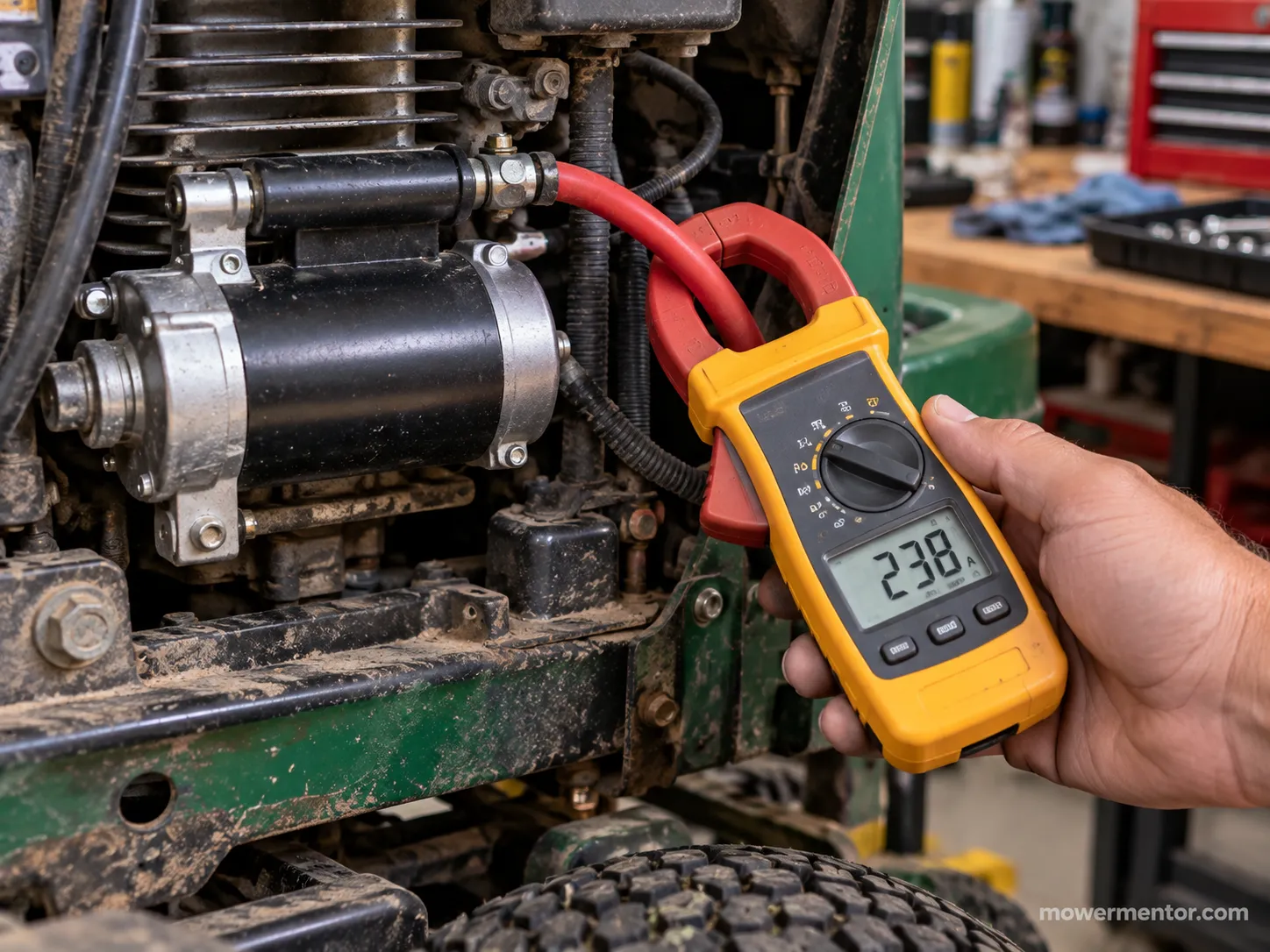
On my test mower, a 2004 Murray 46573x92a with an 18 HP Briggs & Stratton 42A707 V-twin, a good starter pulled roughly 95 to 110 amps in a clean crank.
The battery held about 10.6 volts under load during that same pull.
When the starter later failed, the clamp meter showed a fast spike near 180 amps that collapsed as the battery sagged below 9 volts, and the drive barely turned.
That collapse, with a battery that still rests at full charge, is the fingerprint of a bad starter rather than a bad battery.
If your mower instead clicks rapidly, or clicks once and does nothing, pause.
That pattern usually points somewhere other than the starter motor, which is exactly what the next section sorts out.
Bad Starter vs Solenoid vs Battery: The Murray No-Crank Decision Tree
A no-crank Murray has five common culprits, and the starter is only one of them. Across dozens of these mowers, the split I see is roughly half batteries and connections, a quarter solenoids, and the rest a mix of safety switches, blown fuses, and genuinely dead starters.
One real Murray case documented on a small-engine help thread turned out to be a blown fuse in the safety circuit, not the starter the owner was about to replace.
The decision tree below is the exact order I work, cheapest and easiest first.
Work top to bottom and stop at the first failure you find.
Symptom at the key | Most likely cause | Quick check | If confirmed |
|---|---|---|---|
Nothing, no lights, dash dead | Dead battery or loose ground | Headlights and dash test, battery voltage | Charge or replace, confirm the battery is healthy |
Single loud click, then silence | Solenoid or starter | Test light on the small (S) terminal while cranking | |
Rapid machine-gun clicking | Low voltage, weak battery, bad cable | Battery load test, clean cable ends | Charge, load-test, clean the ground |
Cranks slow, groans, quits | Bad starter or badly sagging battery | Clamp-meter amp draw during crank | Replace the starter |
No crank, battery good, no click | Blown fuse or open safety switch | Check fuse, brake and PTO safety switches | Replace fuse, reset seat, brake, and PTO |
Why does my Murray just click and not turn over?
A single click with a healthy battery almost always means voltage is reaching the starter solenoid but the starter is not spinning.
Touch a 12-volt test light to the small terminal on the solenoid while a helper turns the key.
If the light glows on one side but not the other, the solenoid is not passing current to the starter, so the solenoid is the fault.
If you are still stuck after the tree above, our full no-start diagnosis walks the whole starting system in order.
How to Test a Murray Starter (Jump, Bench & On-Mower)
Testing a Murray riding mower starter takes three checks that get progressively more certain: a jump test on the mower, a voltage-drop check across the solenoid, and a bench test with the unit off the engine.
Each test isolates one variable so you never condemn a good part.
Briggs & Stratton recommends identifying the engine before servicing electrical parts.
You can pull your exact engine model from the Briggs & Stratton engine lookup stamped on the valve cover.
Follow these in order and record what you see.
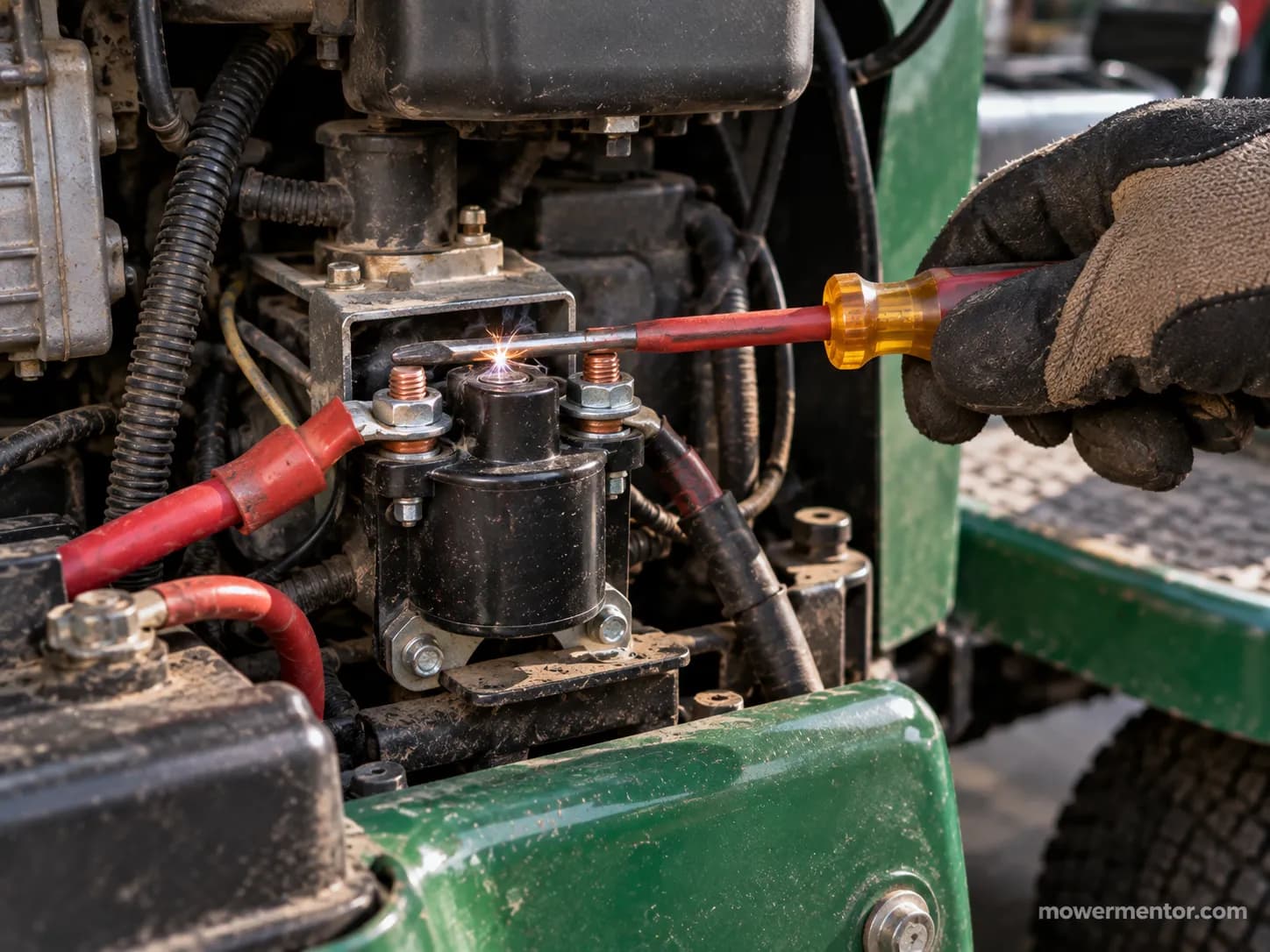
On-mower jump test. With the mower in park, brake set, and blade off, briefly bridge the two large solenoid posts with an insulated screwdriver. If the engine cranks strongly, the starter and battery are fine and your problem is upstream in the switch or safety circuit.
Voltage-drop across the solenoid. Set a meter to DC volts, probe both large posts during a crank, and watch the drop. On my 42A707 a good solenoid dropped 0.1 volt; anything over about 0.3 volt means the solenoid is burning voltage the starter needs.
Bench test off the engine. Clamp the removed starter in a vise, then run jumper leads from a 12-volt battery. A healthy unit free-spun and kicked its pinion out crisply while pulling roughly 60 to 70 amps; my failed unit groaned, stalled, and pulled over 200 amps before I let off.
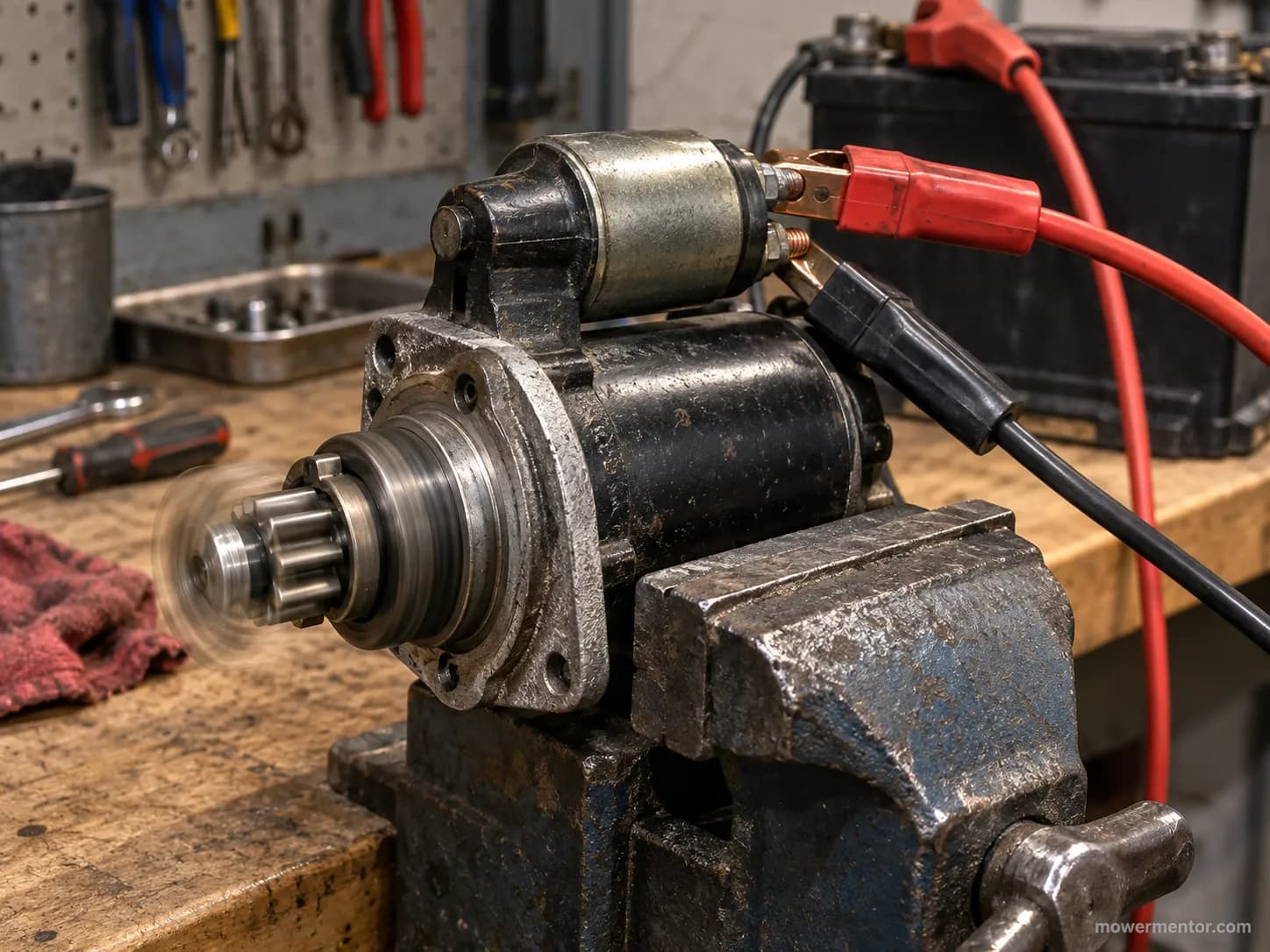
The measured spread I logged makes the diagnosis obvious at a glance.
Test point | Healthy Murray starter | My failed unit | What it means |
|---|---|---|---|
Cranking amp draw (on mower) | 95–110 A brief surge | 180 A spike, then collapse | High collapsing draw equals internal fault |
Battery voltage under load | Holds near 10.6 V | Sags below 9 V | Not the battery if it rests at 12.6 V |
Solenoid voltage drop | About 0.1 V | About 0.5 V | Over 0.3 V equals a bad solenoid |
Bench free-spin draw | 60–70 A, spins fast | Over 200 A, stalls | Bound or shorted armature |
If the jump test cranks fine, your starter is innocent, so read the tell-tale signs of a failing starter against your symptoms before going further.
A worn key switch is common on these Murrays. You can verify it using our guide to the Murray ignition switch before buying a starter you may not need.
For the full brand-agnostic method, our starter-testing walkthrough covers every meter step in detail.
Can You Start a Murray Mower with a Bad Starter?
You can sometimes coax a Murray riding mower to fire with a failing starter, but it is a roadside trick, not a repair.
A starter weak from a worn brush or tired armature will occasionally catch if you tap it gently while cranking, since that can bridge a dead spot on the commutator.
That is a symptom talking, not a fix, and the unit will strand you again soon. In my experience a starter that needs a tap has already told you it is done.
Two field tricks buy you one more start, at most.
Tap and crank. Rap the starter body once with a wrench handle while a helper holds the key. If it spins, a dead armature spot is the cause and the starter is on borrowed time.
Bridge the solenoid. Cross the two large solenoid posts with an insulated screwdriver to bypass a marginal switch or solenoid, which confirms where the weakness lives.
Starting fluid is a separate question, and it will not help a starter problem at all, since fluid addresses fuel and spark, not cranking.
If your mower cranks fine but will not catch, that is when you reach for the can, and our notes on where to spray starting fluid keep you from flooding it.
If the starter itself is only tired rather than dead, a brush and bushing service can revive it. Our guide to a starter you can rebuild instead covers that job step by step.
Murray Riding Mower Starter Fitment: Match the Engine, Not the Dead Part Number
Here is the part no retailer listing tells you plainly: the correct murray riding mower starter is defined by your Briggs & Stratton engine, not by the Murray model or the discontinued equipment number on the deck.
Briggs & Stratton acquired the Murray brand name and product designs in 2004, and the last Murray-built mowers left the Lawrenceburg plant in 2005, per the Briggs & Stratton company history.
That is why a Murray part number search so often returns nothing.
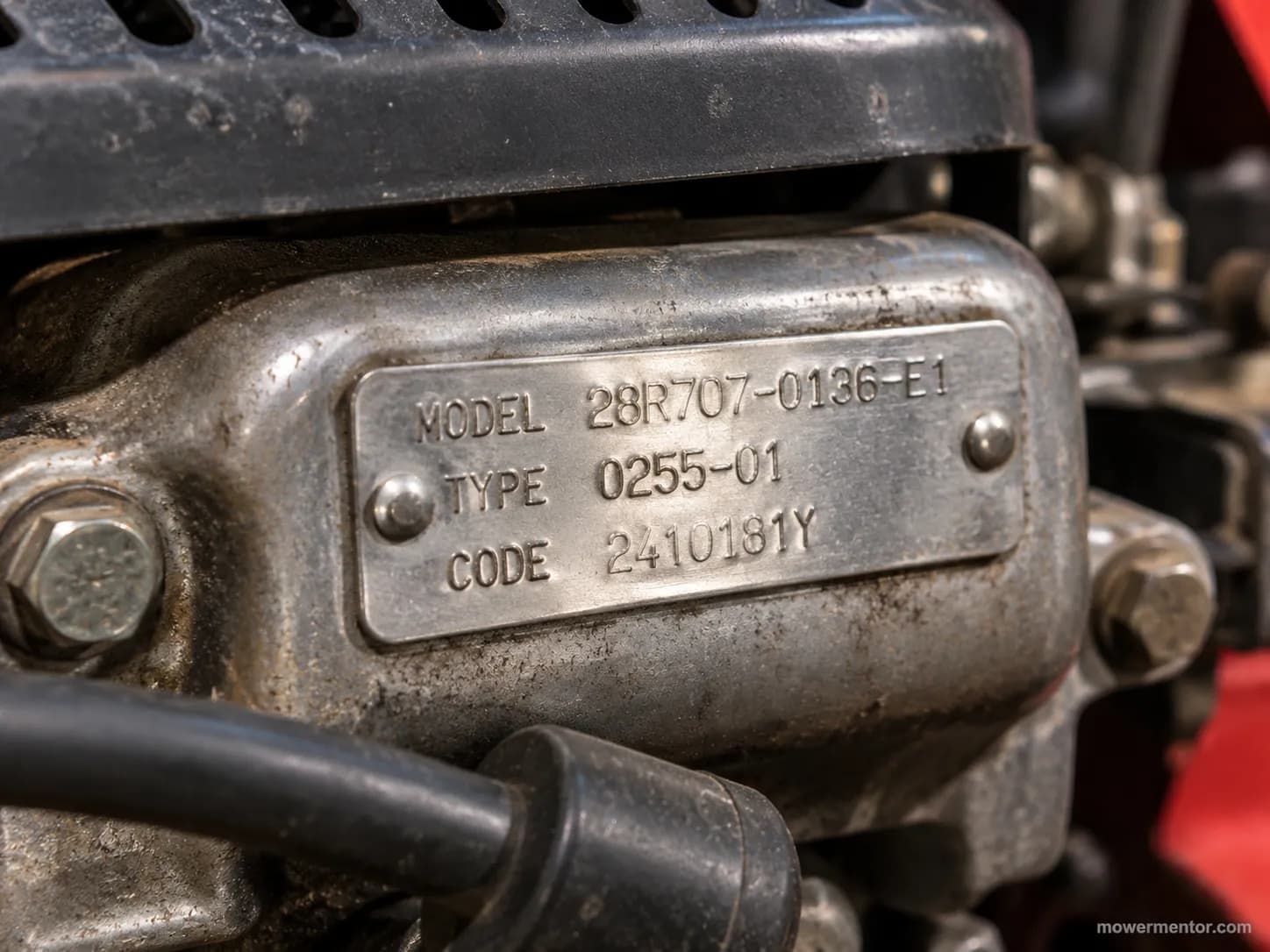
The engine model, type, and code stamped on the valve cover are the real key, and the Briggs & Stratton model and code guide explains exactly where to read them.
Most Murray riding mowers carry a single-cylinder or V-twin Briggs engine between 13 and 21 horsepower, and the starter spec follows the engine family.
The table below is my working fitment reference, built from engine tags across the Murrays I have serviced.
Confirm the current live part number through the engine lookup, because Briggs supersedes numbers often and the old ones roll forward.
For the brand-agnostic version of this sourcing logic, our starter-motor buyer's guide breaks down specs by engine type.
Briggs & Stratton engine family | Typical HP on Murray | Starter voltage | Rotation | Drive teeth | Drive type |
|---|---|---|---|---|---|
Single-cylinder OHV / Intek | 13–17.5 HP | 12 V | Counter-clockwise | 16-tooth | Plastic gear |
Intek V-twin | 18–21 HP | 12 V | Counter-clockwise | 16-tooth | Plastic gear |
Older L-head (Flathead) twin | 14–18 HP | 12 V | Counter-clockwise | 16-tooth | Steel gear on some |
Two mistakes strand buyers here. The first is ordering by the Murray equipment number, which is superseded or discontinued and may cross to nothing.
The second is a drive mismatch, where a 16-tooth Murray application gets a starter with the wrong tooth count that will not mesh with the flywheel ring gear. Both are avoidable once you buy by the engine tag.
If your diagnosis actually pointed at the solenoid, sort that first using our guide that helps you decode the clicking pattern.
A mower that only clicks once with a healthy battery is showing a solenoid tell, not a starter one.
When the engine cranks but nothing electrical seems right, our no-crank electrical diagnosis traces the circuit end to end.
How to Replace a Murray Riding Mower Starter (Step-by-Step)
Replacing a Murray riding mower starter is a 30 to 45 minute job with two wrenches once the part is confirmed, and the single most important step is disconnecting the battery first.
The starter sits low on the engine behind the blower housing on most Murrays.
Briggs & Stratton has issued safety notices about wiring near the shut-off system, including a CPSC recall on misrouted wiring that let engines run with the key off.
Careful routing on reassembly is not optional.
Here is the sequence I use on the bench and in the field.
Disconnect the battery. Remove the negative cable first, then the positive. This prevents a live short while you handle the starter cable.
Locate the starter. Find it low on the engine, usually on the flywheel side near the ring gear. Clear any shroud or bracket in the way.
Label and remove the cable. Note where the heavy positive cable lands, then remove it. A photo on your phone saves guesswork later.
Unbolt the starter. Remove the two mounting bolts while supporting the starter so it does not drop onto the drive gear.
Compare old and new. Set the units side by side and confirm mounting, rotation, and the 16-tooth drive match before installing.
Install and torque. Bolt the new starter in, reconnect the cable, then the battery positive and negative last. Route wires clear of the muffler and moving parts.
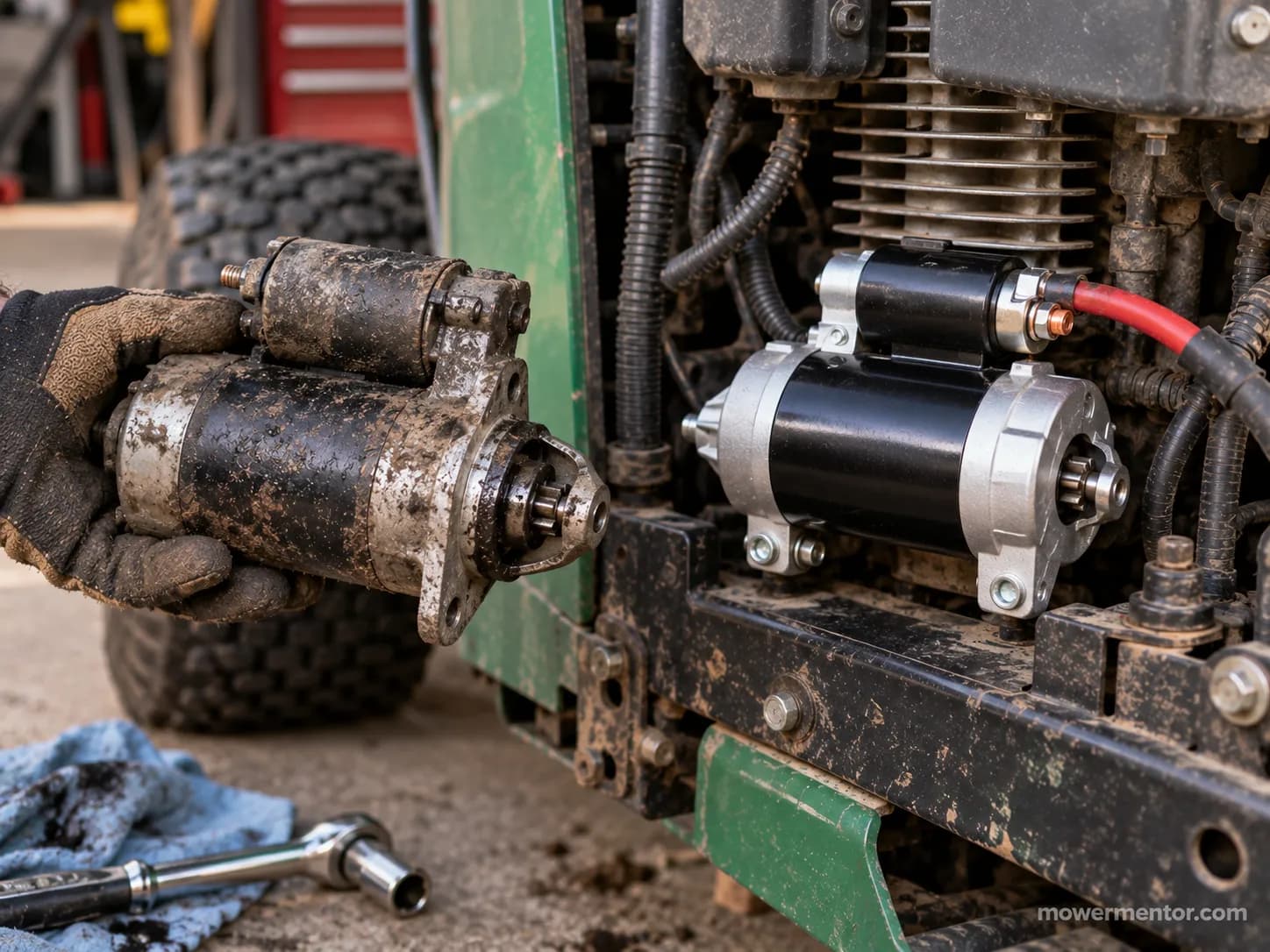
If your Murray still will not crank after a confirmed-good starter goes in, the fault was never the starter.
Our full Murray starting checklist walks the remaining suspects.
For the general procedure that applies across brands, our general starter-swap steps add torque values and tool notes.
Where to Buy It and What It Costs
A Murray riding mower starter in 2026 runs roughly $35 to $70 for a quality aftermarket unit and about $95 to $150 for a genuine Briggs & Stratton part, once you have matched it to your engine.
Genuine units are still stocked under the engine number even though the Murray equipment number is retired, listed through the Briggs & Stratton parts store.
The right buy depends on how long you plan to keep the mower and how confident you are in your fitment.
The table sorts the real options I steer owners toward.
Source type | Typical 2026 price | Best for | Watch out for |
|---|---|---|---|
Genuine Briggs & Stratton (by engine) | $95–$150 | Exact fit, long-term keepers | Retired Murray numbers, order by engine |
Quality aftermarket | $35–$70 | Most repairs, good value | Verify tooth count and rotation |
Salvage or used | $15–$30 | Short-term or hobby fixes | Worn drive teeth, unknown history |
A word of caution on salvage starters. A $20 used unit is tempting, but I once fitted one with a single chipped drive tooth that meshed rough and chewed itself within a season.
Inspect every tooth on the pinion before you trust a used starter.
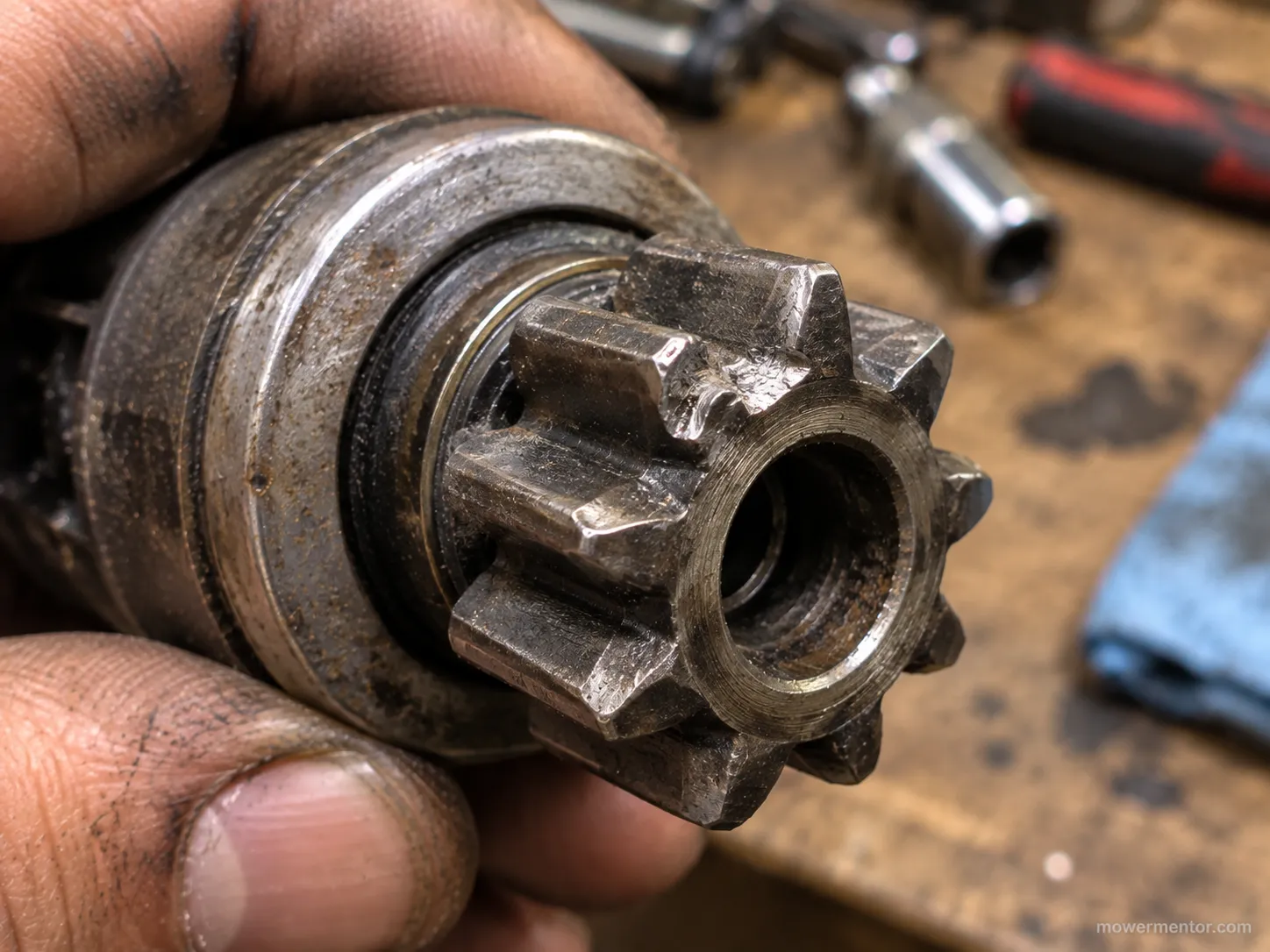
While you have the mower opened up, it is the right moment for a full seasonal tune-up, since a fresh starter deserves a clean supporting system.
If your battery keeps draining and stressing the new starter, our guide on why the battery keeps dying checks the charging circuit.
A weak spark can also mimic a hard start, so confirming you have the right spark plug rules out one more variable before you blame cranking.
Frequently Asked Questions
Are all Murray riding mower starters the same?
No, and the correct starter is set by your Briggs & Stratton engine family, so a 13 HP single-cylinder and a 21 HP V-twin can take different units even on similar-looking decks. Match voltage, rotation, and the 16-tooth drive to your engine, not the Murray model name.
How do I know if it is the starter or the solenoid?
Touch a 12-volt test light to the small solenoid terminal while a helper cranks. If the solenoid passes voltage but the starter does not spin the starter is the fault, if the click does not pass voltage the solenoid is, and a bench test on the removed unit settles any doubt.
Can I still get parts for a discontinued Murray?
Yes, through the Briggs & Stratton engine number rather than the Murray equipment number. The Murray brand stopped building mowers in 2005, but the engines live on and their starters are still sourced by engine model.
What amp draw is normal for a Murray starter?
On my 18 HP test mower a healthy crank pulled about 95 to 110 amps briefly while the battery held near 10.6 volts, and a draw that spikes high then collapses under 9 volts points to a bad starter. While you are in that area, a clean air-filter housing keeps debris off the starter.
Does regular maintenance affect starting?
Indirectly yes, since a clean engine cranks easier and puts less strain on the starter, so basic upkeep like replacing the air filter pays off over a season. Battery-powered mowers have their own routine, covered in our notes on battery-mower upkeep.
Confirm the Fault, Then Buy Once
The winning move with any murray riding mower starter is to prove the fault before you spend, then source the part by engine model so it fits the first time.
Two minutes with a clamp meter and a test light tells you whether you face a dead starter, a tired battery, a bad solenoid, a blown fuse, or a tripped safety switch.
Each of those has a different fix and a different price, which is why guessing is the expensive path.
Because the Murray brand has been dormant since 2005, the part number on your deck is a dead end, but the Briggs & Stratton engine tag is a live one that still returns the right starter today.
Test it, match it to the engine, and inspect the drive teeth before you bolt it on. Do that, and you buy once instead of twice.
Found this useful? Make us a preferred source so we show up in your Google results.
Keep reading
Related articles
Troubleshooting & Repair
Dead Dash? Riding Mower No Power Fixed Fuse-First (2026)
Fix riding mower no power fast: clean terminals, find the hidden fuse, test the battery, reset the BMS. A fuse-first checklist for gas & electric mowers.
Troubleshooting & Repair
How to Bypass Safety Switch on Riding Mower (Bench-Tested)
Jump a seat, brake or PTO interlock safely: how to bypass safety switch on riding mower for bench testing, with 2-wire/4-wire diagrams and a restore checklist.
Troubleshooting & Repair
Riding Lawn Mower Won't Turn Over: 5-Stage Voltage Test
Fix it fast: a riding lawn mower won't turn over usually means battery, ground, solenoid or starter. Test each in 5 ordered stages.
Troubleshooting & Repair
Just Clicks? Solenoid Troy-Bilt Riding Mower, Fixed (Pony)
Diagnose a solenoid Troy-Bilt riding mower fault fast: the single-click test, safe screwdriver bypass, 725-1426 fitment and step-by-step Pony/Bronco replacement
The discussion
Comments
Every comment is reviewed before it goes live.