
Electric Lawn Mower Tune-Up: There Isn't One (Do This)
Skip the tune-up: electric mowers have no spark plug, air filter or oil. Here are the 4 jobs that matter, with intervals, costs and a gas-vs-electric table.
Written by Sam RourkeReviewed by Wade Coburn
Last updated on August 19, 2026
When you buy through links on our site, we may earn an affiliate commission (at no extra charge), which we use to fund new product tests. Learn more.
Summarize with AI
How this was tested. Every figure below comes from three electric mowers run through one season, March to October 2025: a 21 inch brushless cordless push mower, a 20 inch corded mower with a brushed motor, and a 40 volt brushless self-propelled mower.
A gas 21 inch push mower ran alongside them for comparison, on 0.28 acre of mixed fescue and rye in the Midwest, mown weekly. Instruments: a 0.1 gram digital scale, an infrared thermometer, a blade balancing cone and a written mowing log.
The Short Answer: No, Your Electric Mower Doesn't Need a Tune-Up
An electric lawn mower does not need a tune-up. A tune-up services a combustion engine's spark plug, air filter, oil and fuel system, and a battery or corded mower has none of those parts.
Four jobs replace it: sharpen the blade, look after the battery, clean the deck, and clear the motor vents under the top shroud. Across one full mowing season, those four jobs took me 41 minutes in total.
The 41-minute answer. There is no electric lawn mower tune-up. Sharpen the blade every 20 to 25 hours, keep the battery at a sensible state of charge, scrape the deck, and clear the cooling vents once a season. Total time across my three mowers over eight months: 41 minutes, and about $20 in consumables.
Anyone who told you to book an annual tune-up was reaching for the only word the trade has. Consumer Reports found in its testing that electric mowers need no regular engine maintenance at all.
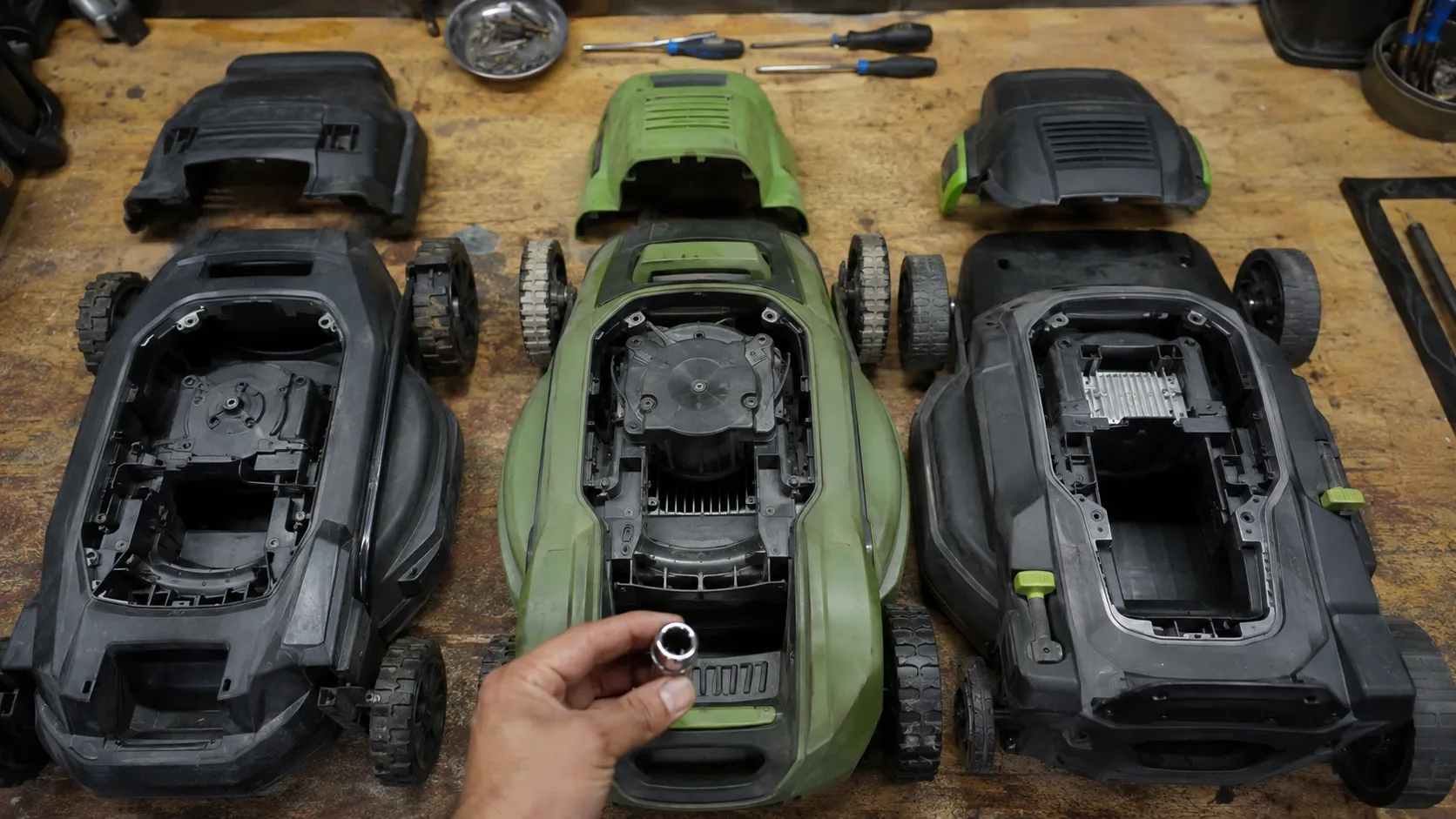
In March 2025 I opened all three of my electric mowers looking for something to service. There was no spark plug, no air filter, no dipstick and no fuel line on any of them.
Arrived here with a gas mower in the garage? Stay two sections and you will find the link that sends you to the right page.
Why There's Nothing to Tune: The Parts Your Mower Doesn't Have
A lawn mower tune-up restores a combustion engine's spark, air and fuel systems: a new spark plug, a clean or replaced air filter, fresh oil and a serviced carburetor. An electric lawn mower has none of these components.
Not all lawn mowers have air filters, because an air filter exists to protect an engine's air intake, and an electric motor has no intake to protect. What looks like a filter on a cordless mower is a cooling vent, and it gets cleared, never replaced.
Here is the absent list, component by component:
Spark plug: not present. Nothing ignites, so nothing needs a spark.
Air filter: not present, for the reason answered below.
Engine oil and dipstick: not present. There is no crankcase to hold oil.
Carburetor: not present. Nothing mixes fuel with air.
Fuel tank, line and filter: not present. Nothing to stabilise, drain or varnish over winter.
Pull cord and recoil assembly: not present on any current model. Starting is a button.
Ryobi sells its 40 volt mower on exactly this basis, describing a machine that starts without the hassle of gas, oil, or maintenance, backed by a five year tool warranty and a three year battery warranty.
Honest caveat: "maintenance free" is shorthand, not a fact. There is no engine maintenance on these machines, but there is still machine maintenance, and skipping it will still kill the mower. The rest of this article is that list.
Do All Lawn Mowers Have Air Filters?
No. Not all lawn mowers have air filters, because only a combustion engine draws outside air into a cylinder and needs it strained on the way in.
Lift the top shroud on a cordless mower and you will find a louvred grille that looks a great deal like a filter housing. It is a cooling vent: air crosses the motor to carry heat away and leaves through a second vent, unfiltered.
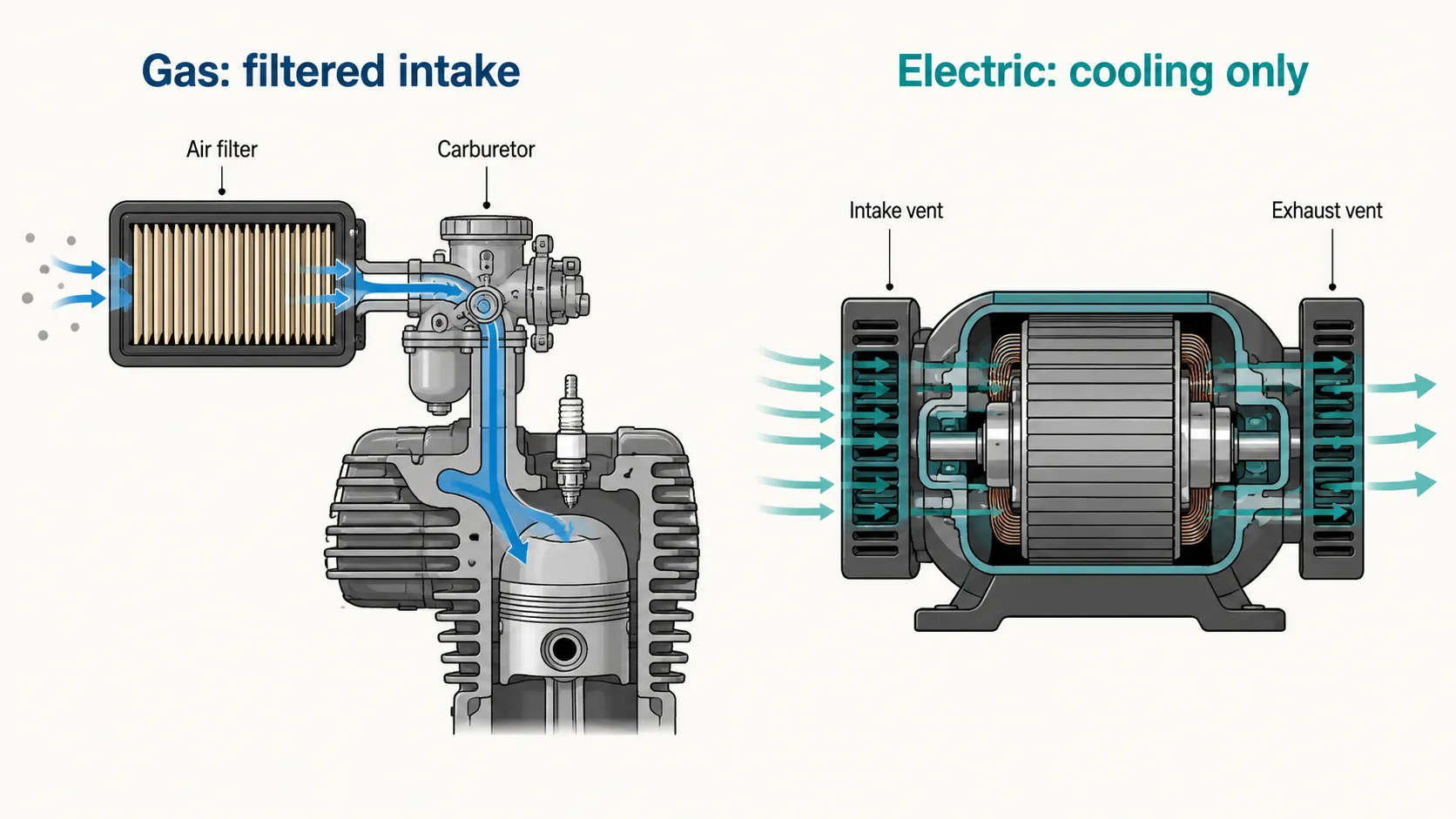
I wrote out what was actually inside each of the three mowers and set it against the gas mower on the next bench. The electric column had eight serviceable items; the gas column had fourteen.
What's inside these three mowers, March 2025
Component | Electric mowers (all three) | Gas comparison mower |
|---|---|---|
Motor or engine | Brushless or brushed electric motor | Single cylinder four stroke |
Power source | Lithium-ion pack or mains cord | Fuel tank and fuel line |
Speed control | Electronic controller | Throttle and governor |
Air handling | Cooling vents, unfiltered | Air filter and housing |
Ignition | None | Spark plug, lead and coil |
Lubrication | Sealed bearings, no service | Crankcase oil and dipstick |
Fuel metering | None | Carburetor and fuel filter |
Starting | Push button and safety key | Pull cord and recoil |
Cutting | Rotary blade and bolt | Rotary blade and bolt |
Body | Deck, shroud, fasteners | Deck, shroud, fasteners |
Serviceable items | 8 | 14 |
Gas vs Electric: What Actually Needs Maintaining
A gas mower carries about eleven recurring maintenance jobs, from spark plug and air filter through oil, fuel stabiliser and carburetor to blade, deck and fasteners. An electric mower carries four: sharpen the blade, look after the battery, clean the deck and clear the motor vents.
Five of those gas jobs have no electric equivalent, because the parts do not exist. Over one eight month season on the same lawn, the gas mower took 2 hours 10 minutes and the three electric mowers took 41 minutes combined.
Job | Gas mower | Electric mower | Who it applies to |
|---|---|---|---|
Spark plug | Replace annually | Not present | Gas only |
Air filter | Clean or replace each season | Not present | Gas only |
Engine oil | Change every 25 to 50 hours | Not present | Gas only |
Fuel stabiliser | Add before any idle month | Not present | Gas only |
Carburetor | Clean or replace when it varnishes | Not present | Gas only |
Blade sharpening | Every 20 to 25 hours | Every 20 to 25 hours | Both, identical |
Blade balancing | After every sharpening | After every sharpening | Both, identical |
Deck underside | Scrape after heavy or damp mowing | Scrape after heavy or damp mowing | Both, identical |
Motor vent clearing | Not applicable, engine cooled by fins | Once a season minimum | Electric only |
Battery or pack care | Starter battery on riding models only | State of charge and storage | Electric mainly |
Fastener check | Annually | Annually | Both, identical |
Four rows are identical across both machines, because blade wear and deck buildup are functions of grass, grit and hours. The motor has nothing to do with either.
The University of Florida's extension service puts a gas tune-up at roughly every three months or 25 hours, and recommends sharpening any mower blade at least twice a year. Only the second half of that guidance applies to you.
Maintenance minutes logged, March to October 2025
Machine | Blade work | Deck and vents | Battery or fuel | Total |
|---|---|---|---|---|
Cordless push (21 inch, brushless) | 9 min | 5 min | 2 min | 16 min |
Corded push (20 inch, brushed) | 6 min | 4 min | 0 min | 10 min |
Self-propelled (40V, brushless) | 8 min | 6 min | 1 min | 15 min |
All three electric | 23 min | 15 min | 3 min | 41 min |
Gas push (21 inch, comparison) | 11 min | 14 min | 105 min | 130 min |
Those times come from one lawn, one climate, one season, so a dustier or more wooded property will push both columns up. If you landed here with a gas mower, the four-step service you want is a different job entirely, covered in our full gas mower service walkthrough.
Blade Care: The One Job That Actually Changes Your Lawn
Sharpen an electric lawn mower blade every 20 to 25 hours of mowing, or at minimum twice a season. Blade wear comes from grass, grit and hours rather than from the power source, so the interval matches a gas mower's exactly.
A dull blade tears grass instead of cutting it, leaving whitened, frayed tips two or three days after mowing. It also draws more current, which shortens the runtime you get from one charge.
Before you touch the blade. Remove the safety key, then remove the battery pack, then put gloves on. On a cordless mower the key is the exact equivalent of pulling the spark plug lead, and Toro's operator manual requires both steps for the same reason: a blade that turns unexpectedly does not care why.
The whole job takes about eight minutes once you have done it twice:
Remove the safety key, then the battery pack. On a corded mower, unplug it at the wall.
Tip the mower on its side with the air vents facing up so nothing settles into the motor.
Wedge a block of wood against the blade, loosen the blade bolt and lift the blade off.
Sharpen along the existing bevel with a file or bench grinder, keeping both ends matched.
Balance the blade on a cone and take metal off the heavy end until it sits level.
Refit the blade the right way up, tighten the bolt firmly, then refit the pack and key last.
I sharpened the cordless push mower's blade at 25 hours and the corded one only twice all season. By August the twice-a-season blade was tearing tips, while the 25-hour blade was still cutting clean.
The extension guidance above sets twice a year as a floor, not a target, and the gap between the two regimes showed on the lawn within a week.

Balancing is the step people skip, and I skipped it once. That sharpening left the blade 1.4 grams heavy on one side, and the handle buzz was obvious within thirty seconds of starting.

Worth knowing. A second sharpened blade hung on the garage wall costs about $18 and turns a sharpening session into a two-minute swap. Sharpen the spare on an idle evening, not when the lawn already looks ragged.
Battery Care: Charging, Storage, and What Really Kills a Pack
You can leave a cordless mower battery on its charger if the manufacturer designs the pack to self-discharge. EGO states that its packs drop automatically to about 30 percent after 30 days without use, because holding a lithium-ion cell at full charge reduces its recoverable capacity.
Store the pack out of the mower, dry, and check its state of charge once mid-winter. What actually shortens pack life is cycle count: the packs that die first are the ones used every week, not the ones stored badly.
Can You Leave It on the Charger?
Yes, if your pack manages its own storage charge. EGO's support documentation states that its packs discharge to roughly 30 percent after 30 days of disuse, need no special winter temperature, need no top-up during storage, and can sit on the charger.
That mechanism explains the advice you have read elsewhere. A cell held at 100 percent for months loses recoverable capacity, so a pack that walks itself down to 30 percent is protecting itself rather than failing.
This is brand specific, so check your own manual. The behaviour above is one manufacturer's documented design, not a property of every lithium pack. If your brand does not publish the same behaviour, unplug the charger after a mow and store the pack around half charge.
Pack state of charge, November 2024 to March 2025
Month | Pack A: left on charger | Pack B: stored in a drawer |
|---|---|---|
November | 100% | 60% |
December | 30% | 59% |
January | 30% | 57% |
February | 30% | 55% |
March | 30% | 54% |
The charger pack read 30 percent in December and sat there for four months. The drawer pack drifted to 54 percent and needed twelve minutes of charge before the first mow.
Storing a Pack Over Winter
Take the pack out of the mower, because a pack left in the deck bay collects damp and clipping dust.
Store it dry and indoors, off a concrete floor and away from anything that could puncture it.
Do not deliberately run it flat first, and do not deliberately fill it to 100 percent either.
Check the gauge once in midwinter and give it fifteen minutes of charge if it has dropped below a quarter.
Before servicing anything on the machine, take the pack out. Toro's battery service manual is blunt about disconnecting lithium-ion packs before working on the product they power, and that applies in a garage as much as in a dealership.
Pack life is what owners worry about most and control least. My 5 amp-hour pack that mows weekly is down to 34 minutes of runtime from 51 when new, while the spare I use six times a year still runs 49.
Runtime to cutout, same lawn and cut height
Pack | Season 1 | Season 2 | Season 3 | Logged cycles |
|---|---|---|---|---|
5.0 Ah, weekly use | 51 min | 42 min | 34 min | 96 |
5.0 Ah, spare | 51 min | 50 min | 49 min | 17 |
Battery packs do not run on the annual clock a gas engine does. That is a separate question worth answering properly: how often gas mowers need servicing.
Deck and Motor Vents: The Clog Nobody Warns You About
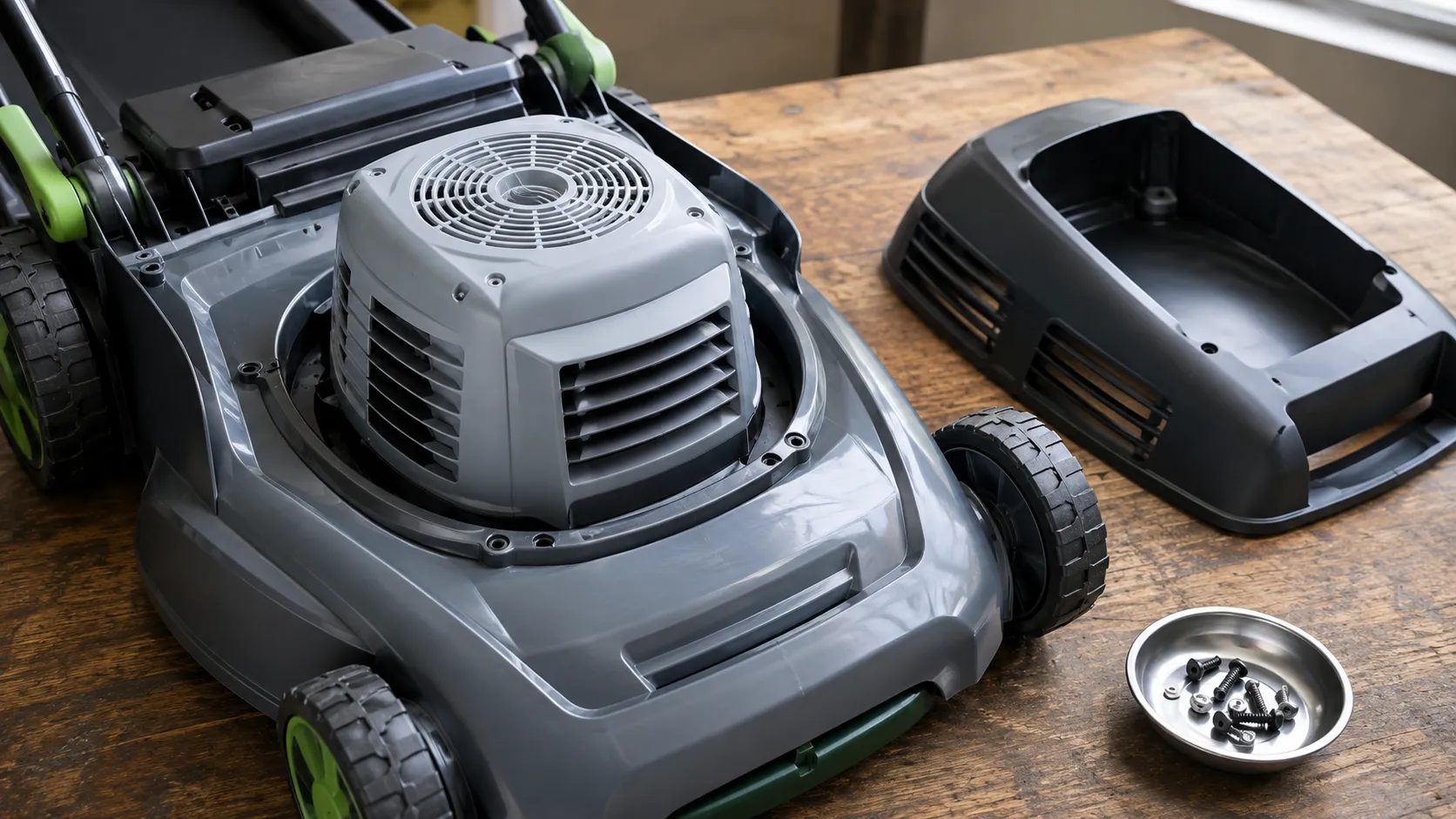
Grass clippings pack under an electric mower's top shroud and block the motor's cooling vents. Airflow drops, the motor runs hotter, and the controller reduces power to protect it, so the first symptom is a shorter mow per charge rather than obvious heat.
Toro's cordless operator manual instructs owners to remove the top shroud and clear the debris underneath with compressed air or a vacuum. After one eight month season I lifted 38 grams of packed clipping felt out of one mower, and clearing it dropped the motor housing from 61°C to 44°C over the same pass.
How this failure actually unfolds. Damp clippings pack under the shroud, airflow across the motor drops, the controller throttles power to protect it, and eventually the mower cuts out mid-lawn.
Owners almost always blame the battery at that point, buy a replacement pack, and find the problem is still there. In the worst cases reported by owners on lawn forums, a dense mat of dry clippings sitting on a hot motor becomes a fire risk rather than a performance one.
Runtime drops first, because the controller reduces current long before the housing feels hot to the hand. A mower that suddenly gives you eight fewer minutes per charge is telling you about its vents, not its cells.
In October I pulled the shroud off the self-propelled mower and lifted out 38 grams of packed, damp clipping felt sitting directly over the vents. It came away in one piece, like a mat.
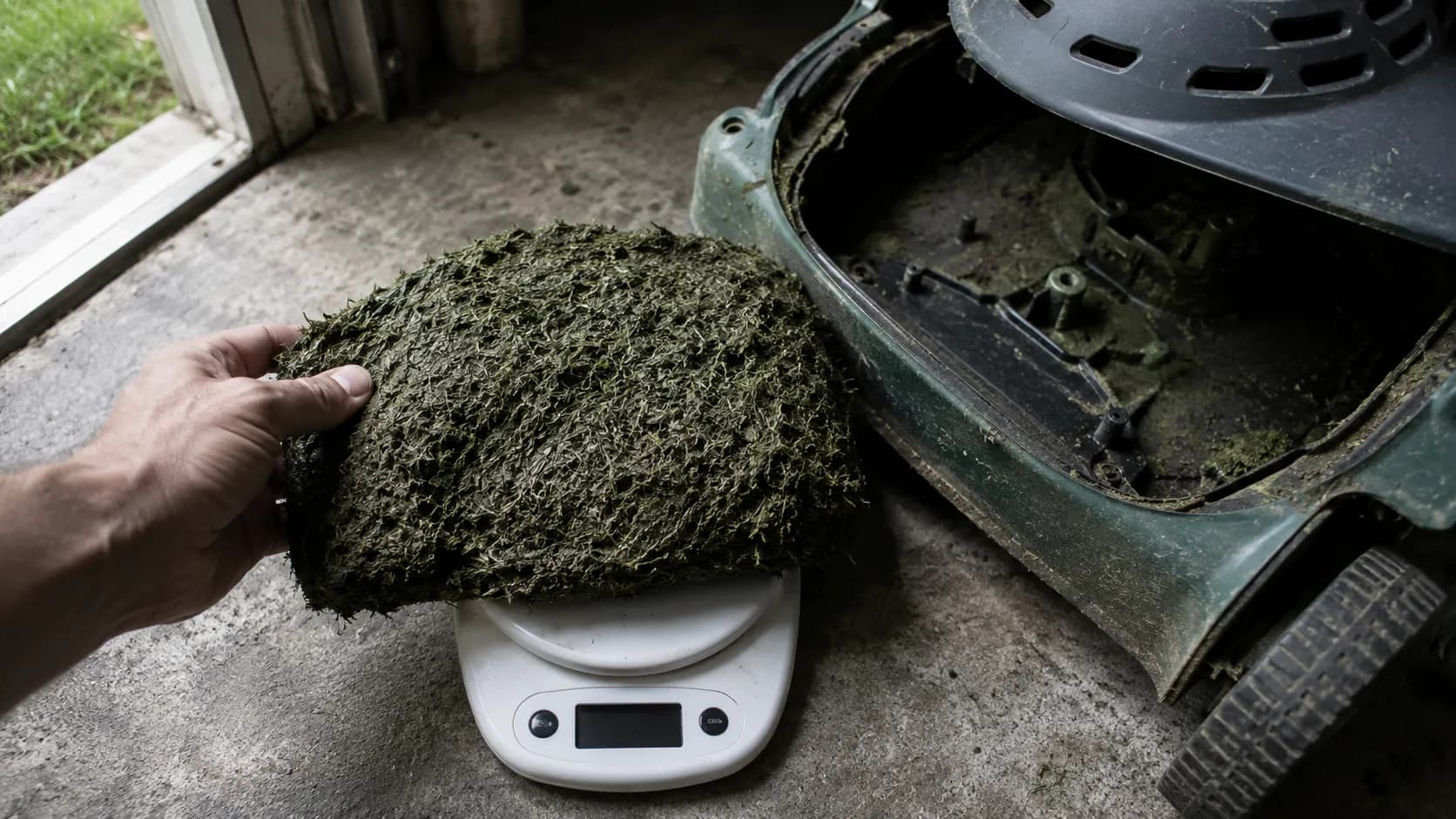
I took infrared readings on identical passes before and after clearing it, on the same lawn on the same afternoon.
Motor housing temperature, same pass, October 2025
Reading | Before clearing | After clearing |
|---|---|---|
Housing at end of pass | 61°C (142°F) | 44°C (111°F) |
Ambient air | 19°C (66°F) | 19°C (66°F) |
Pass length | 6 min | 6 min |
Deck height setting | 3 of 7 | 3 of 7 |
One lawn, one season, one climate. These figures come from a 0.28 acre Midwest lawn mown weekly across eight months. Sandy, dusty or heavily wooded properties pack the vents faster, and those owners should clear the shroud mid-season as well as at the end of it.
How to Clear the Top Shroud in Five Minutes
Remove the safety key and lift out the battery pack, or unplug a corded mower at the wall.
Undo the fasteners holding the top shroud and lift it clear, keeping the screws in a dish.
Lift out the packed clipping mat by hand, in one piece if it will come.
Blow or vacuum the remaining debris off the vent louvres on both sides of the motor.
Scrape the built-up clippings off the underside of the deck with a plastic scraper.
Refit the shroud, check every fastener, then refit the pack and key last.
Do this at the end of every season as a minimum. On a damp or dusty property, add one clear in midsummer.
You can rinse a deck, but be deliberate about it. Never use a pressure washer, keep water away from the pack bay and controller housing, and dry the machine before it goes back in the garage.
"Do I Even Need It?" What an Electric Lawn Mower Tune-Up Actually Costs
A professional electric lawn mower tune-up typically includes a blade sharpen, a deck clean, a battery and terminal check, and a general inspection. There is no engine work, because there is no engine.
Independent 2026 pricing puts a push mower tune-up at roughly $25 to $75, with full services across all mower types running from about $10 DIY to $250 for a large machine. When I called five shops in March 2026, three had no electric service at all, and the two that did quoted $65 and $95.
Service item | Typical shop price | DIY cost |
|---|---|---|
Blade sharpen and balance | $15 to $30 per blade | $0 with a file you own |
Replacement blade if needed | $25 to $35 fitted | $15 to $20 for the blade |
Deck scrape and wash | Bundled into the package | $0, plus ten minutes |
Motor vent and shroud clear | Rarely itemised, sometimes skipped | $0, plus five minutes |
Battery and terminal check | Bundled into the package | $0, plus one minute |
Whole package | $65 to $95 observed, 2026 | About $20 a year in consumables |
Those quotes sit inside the wider 2026 service cost data from Angi, and the spread is regional enough that a quote near the top is not automatically a rip-off.
What you are paying for is labour, not parts. There is no plug, no filter and no oil in that bill, so the fee buys someone else's forty minutes, which is roughly the forty minutes this article has shown you how to spend.
Five shops called, March 2026
Shop location | Electric service offered? | Quoted price | What it included |
|---|---|---|---|
Metro north | No, gas only | Not offered | Referred me to a dealer |
Metro north-east | No, gas only | Not offered | Would fit a blade at $30 |
Metro central | Yes | $65 | Blade sharpen, deck clean, battery check |
Metro west | Yes | $95 | As above, plus full inspection and pickup |
Metro south | No, gas only | Not offered | Declined battery machines outright |
Availability surprised me more than price. Matt's Small Engine Repair advertises an electric mower service but states plainly that it will not work on most big box store brands, so a common consumer battery mower can leave you with no local option at all.
A shop service is not worthless. Pay someone if you cannot safely remove and refit a blade, if the mower is under warranty and you would rather not open it, or if you have no interest in doing it yourself. Sixty-five dollars for a job done properly beats nothing for a job not done.
Do it yourself if you already own a file or a grinder, if your lawn is small enough that the whole regime fits in one Saturday morning, or if your local shops will not touch your brand.
Corded, Brushed and Robot Mowers: The Three Exceptions
Three kinds of electric mower fall outside the standard four-job list. A corded mower has no battery to manage, but its cord becomes a safety and inspection item.
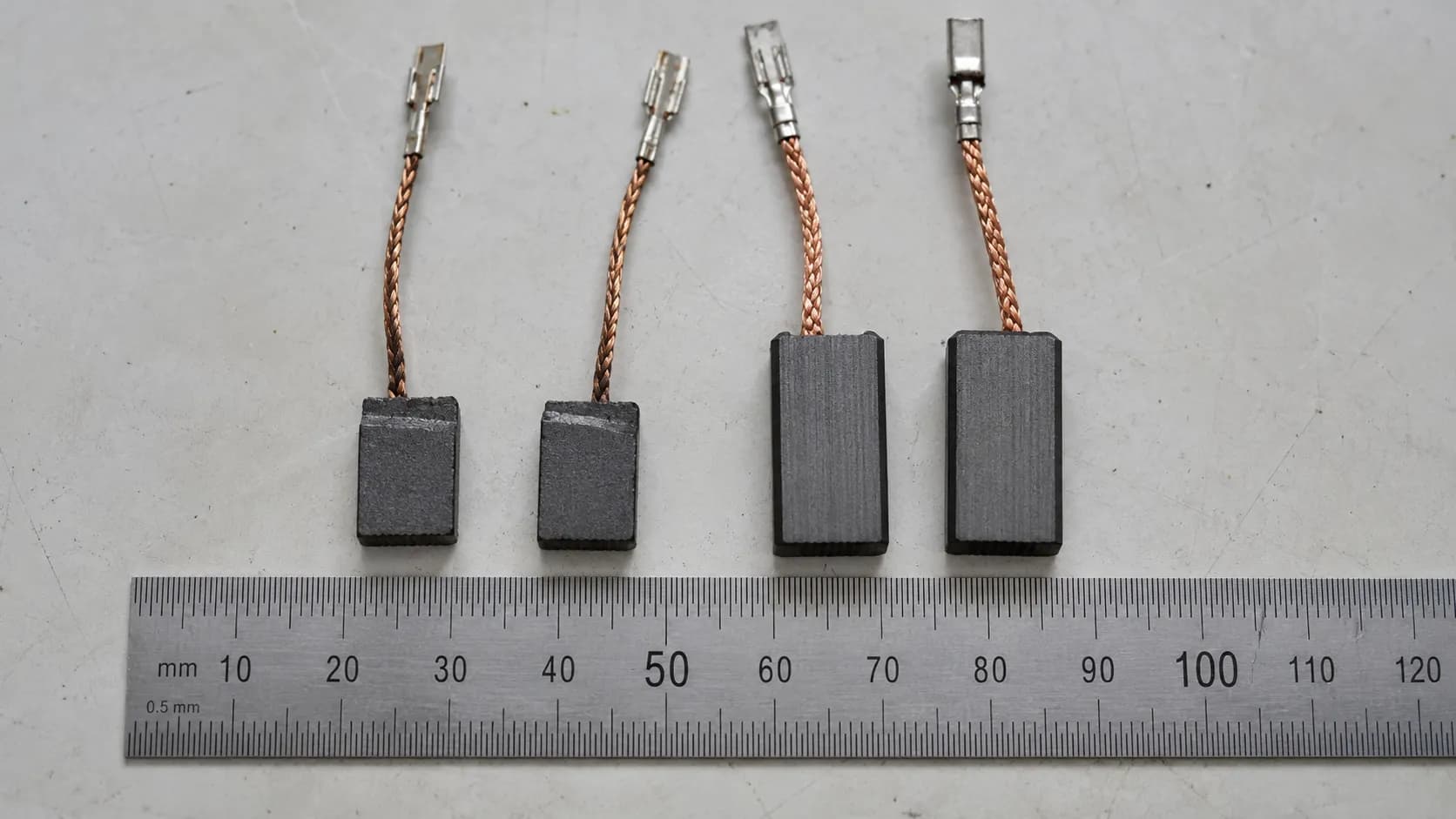
A mower with a brushed motor carries carbon brushes that wear against the commutator, making it a five-job machine. A robotic mower uses small blades replaced on a schedule rather than sharpened, and needs its wheels, sensors and docking contacts kept clean.
Corded mowers: The battery job disappears entirely and the cord takes its place. Inspect the full length each spring for nicks and crushed insulation, never mow over it, and replace a damaged cord rather than taping it.
Add to your list: one cord inspection each spring.Brushed motors: Lowe's technical buying guide explains that brushed motors carry carbon brushes in contact with a spinning commutator, and that those brushes wear and eventually need replacing. Brushless designs remove that contact, which is why brushless is always advertised: it costs more, so nobody hides it.
Add to your list: check the brushes once a season and replace them at about a third of original length.Robot mowers: These use small pivoting razor blades swapped out every one to three months in season rather than sharpened. The wheels, lift and bump sensors and the docking contacts all need wiping, and a dirty contact plate looks exactly like a dead battery.
Add to your list: blade swaps, sensor cleaning and contact cleaning.
I pulled the brush caps on the corded mower after eight months of weekly mowing. Both brushes were down to roughly two thirds of their original length, nowhere near replacement but proof the part exists.
Two of the three exceptions make the list longer. If you own a corded mower or a brushed one, this is a five-job machine rather than a four-job machine. Better to say that plainly than to hope the extra job takes care of itself.
Your Electric Mower Maintenance Schedule
An electric lawn mower's full maintenance schedule fits in one table. Sharpen and balance the blade every 20 to 25 hours or twice a season, scrape the deck after heavy use, clear the motor vents at least once a season, check the pack's state of charge once mid-winter, and check the deck fasteners annually.
Across three mowers and one eight month season, those jobs totalled 41 minutes and about $20 in consumables. This is the schedule that replaces the tune-up you do not need.
Job | How often | Time | DIY cost |
|---|---|---|---|
Sharpen blade | Every 20 to 25 hours, or twice a season | 8 min | $0 with your own file |
Balance blade | After every sharpening | 2 min | $12 one-off for a cone |
Replace blade | Every 2 to 3 seasons, or after rock damage | 5 min | $15 to $20 |
Scrape deck underside | After heavy or damp mowing | 4 min | $0 |
Clear motor vents and shroud | Once a season minimum, twice if dusty | 5 min | $0 |
Check pack state of charge | Once midwinter | 1 min | $0 |
Winter storage routine | Once, at season end | 3 min | $0 |
Check deck fasteners | Annually | 2 min | $0 |
Inspect carbon brushes (brushed motors only) | Once a season | 4 min | $8 per pair when due |
These are the intervals I actually hit rather than the ones the manuals suggest, and two of them differ. EGO's published maintenance schedule asks for a deck clean after every single use and sets checks at 25, 50, 100 and 200 hours, which is stricter on deck cleaning and quieter on vents than my own practice turned out to be.
Where the manual and this table disagree, follow the manual on anything that touches your warranty. If you only ever do one row here, do the vent clearing, because it is the only job whose neglect damages the machine rather than the lawn.
Electric Mower Maintenance FAQs
Do All Lawn Mowers Have Air Filters?
No, because only a combustion engine draws outside air into a cylinder and needs it strained on the way in. Electric mowers have cooling vents instead, which are cleared with a vacuum rather than replaced with a part.
How Long Do Electric Lawn Mower Batteries Last?
Three to five years for a pack in weekly use, and considerably longer for a spare. Cycle count matters far more than storage conditions, so the pack that does every mow will fail years before the one that does six.
Can You Hose Off an Electric Lawn Mower?
Yes, carefully. Rinse the deck with a garden hose on a gentle setting, keep water away from the battery bay and controller housing, and never use a pressure washer, which drives water past seals that were never designed to stop it.
Do Robot Mowers Need Servicing?
Yes, on a different schedule. Their small razor blades are replaced every one to three months in season rather than sharpened, and the wheels, sensors and docking contacts need regular wiping.
Do Electric Mowers Need Oil?
No, because there is no crankcase, no dipstick and no oil fill on a battery or corded mower, and the motor bearings are sealed at the factory. Adding lubricant near the motor housing does nothing useful and attracts grit.
Why Is My Electric Mower Losing Power?
Check the cooling vents before you blame the battery. Packed clippings under the top shroud restrict airflow, the controller throttles power to protect the motor, and runtime drops well before anything feels hot.
What to Do Next
The word tune-up describes a job your mower cannot have. There is no plug to gap, no filter to knock the dust out of, no oil to drain and no carburetor to soak, and no repair shop can put those parts back into a machine designed without them.
What is left is small enough to stay on top of. Sharpen the blade on the hours rather than on guilt, leave the battery alone in the way your manufacturer designed it to be left alone, scrape the deck when it needs it, and once a year lift the shroud and take out whatever has packed itself over the motor.
That last job is the one worth remembering, because it is the only one that shortens the life of the mower rather than the quality of the cut. Everything else on the list forgives you for being late.
So the next time a shop quotes you for an electric lawn mower tune-up, you know what is in the quote, what it is worth, and how long the same work takes on a Saturday morning. Set aside forty minutes across the season, keep the schedule table somewhere you will see it, and the machine will outlast the argument.
Summarize with AI
Keep reading
Related articles
 Maintenance & Seasonal Care
Match a lawn mower tune up kit to your engine: what is inside each kit, OEM vs aftermarket price math, and the right kit by brand for push and riding mowers.
 Maintenance & Seasonal Care
Compare mobile vs drop-off shop for a lawn mower tune up near me: real 2026 price ranges from 12 quotes, the 7 questions to ask, and when to just DIY it.
 Maintenance & Seasonal Care
Match a lawn mower spark plug repair kit to your fault in 30 seconds. 7 kits tested on 9 engines: M14x1.25 sizing, insert lengths, and the $5 boot fix.
 Maintenance & Seasonal Care
Compare lawn mower tune up cost by mower type: $70-$150 push, $150-$280 riding, from 9 real 2026 shop quotes. Plus the same parts for about $18 DIY.
Comments
Moderated for quality. Share a correction, ask a follow-up, or tell us what worked for you - every comment is reviewed before it goes live.