
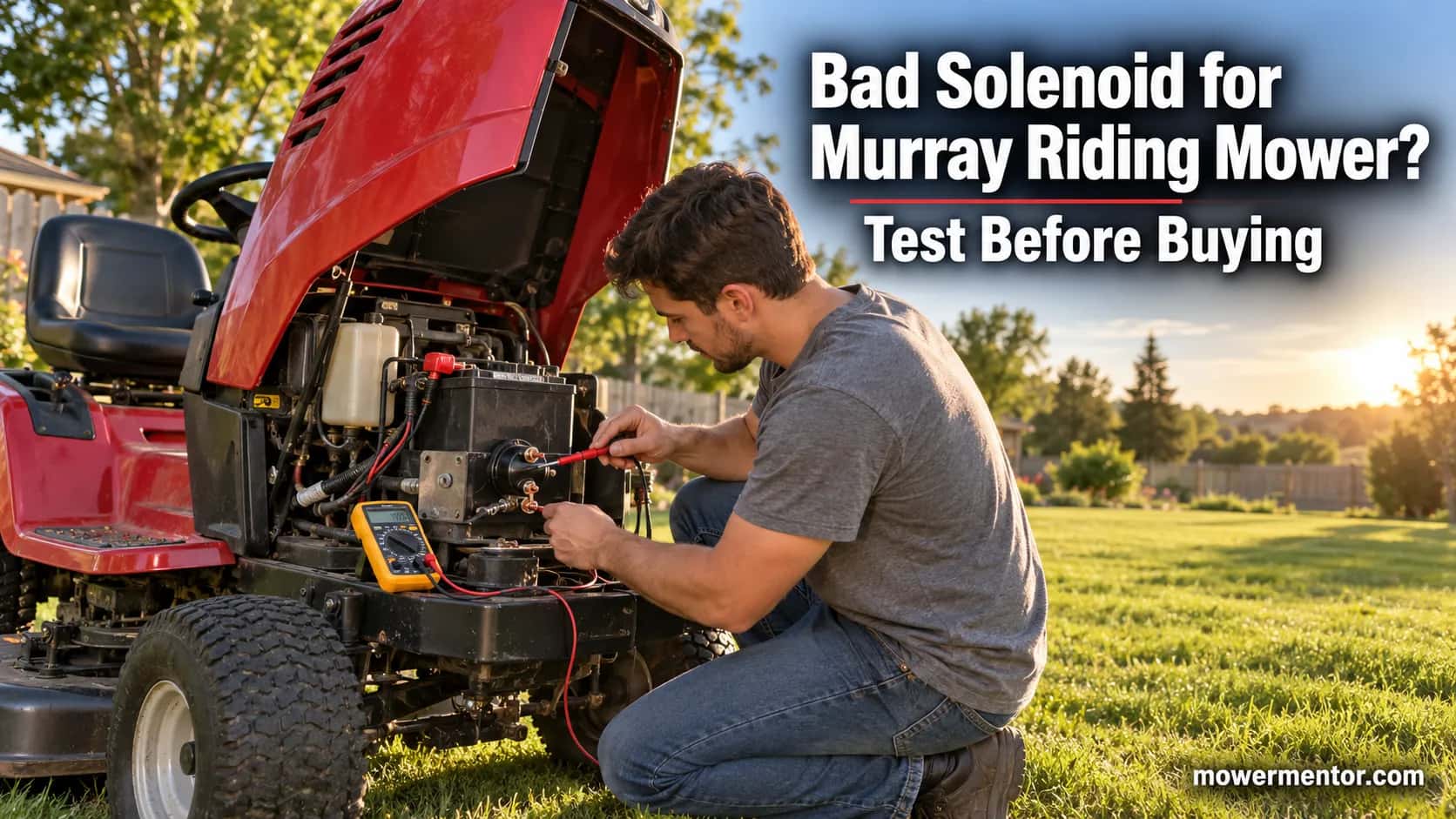
Bad Solenoid for Murray Riding Mower? Test Before Buying
Test the solenoid for Murray riding mower in 5 minutes with a screwdriver or multimeter, then use our cross-reference chart to buy the right part.
Written by Tony MaldonadoReviewed by Wade CoburnLast updated on September 24, 2026
When you buy parts or tools through links on our site, we may earn a commission at no extra cost to you. It never changes what we recommend. Learn more.
You turned the key, heard one sharp click, and the engine did nothing.
Before you spend a Saturday and $25 chasing a part, a two-minute screwdriver test tells you whether the solenoid for Murray riding mower starting is actually the culprit, or whether the battery, starter, or a rusty ground is faking it.
This guide walks that test, shows you where the part sits, and then hands you a cross-reference chart so you buy the right one once.
A single loud click with the dash lights still on usually points to the starter solenoid.
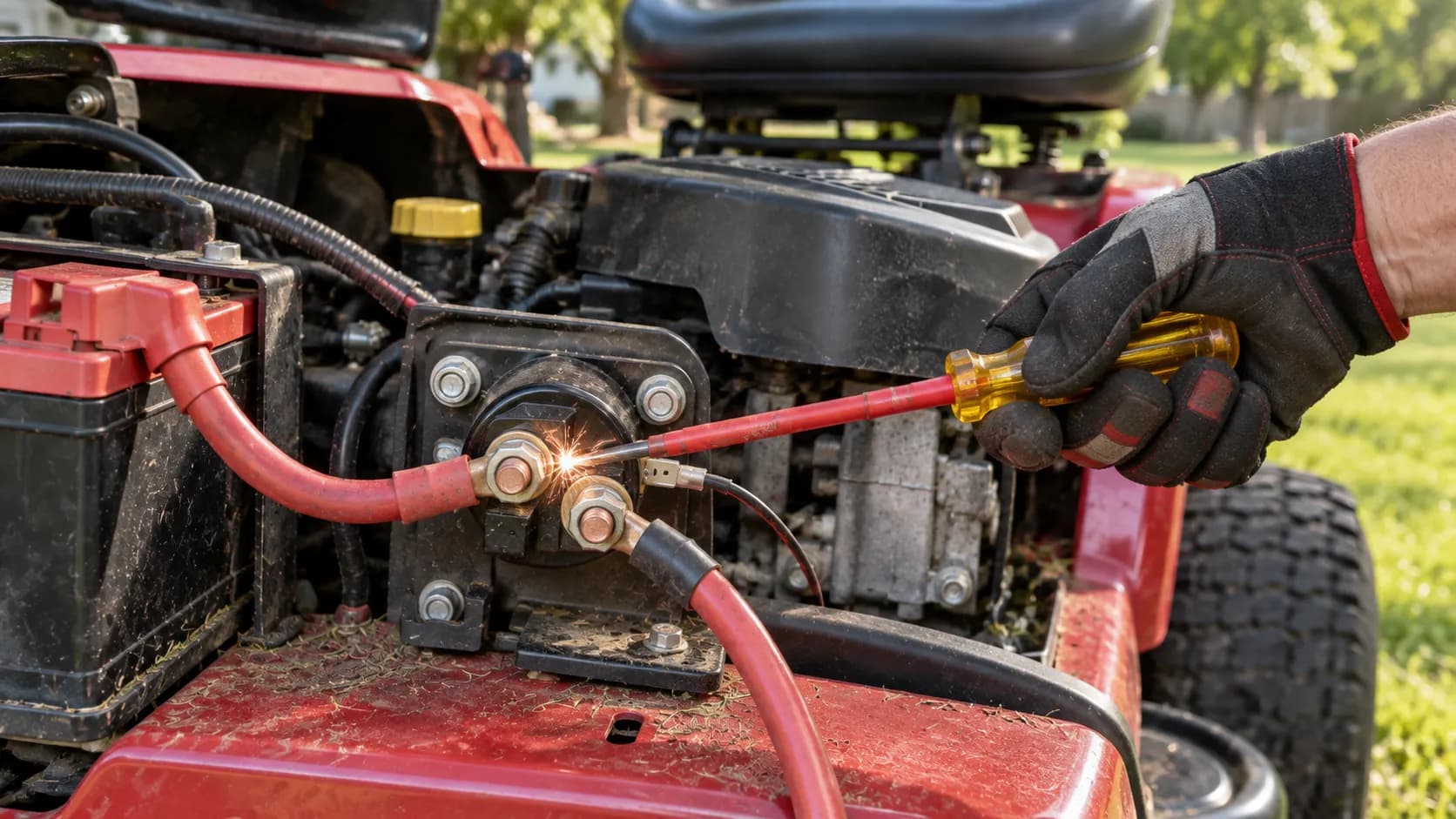
Confirm it by bridging the two large posts with an insulated screwdriver: if the starter spins strongly, the solenoid is bad and the starter is fine.
The genuine part is Briggs and Stratton 7701100MA, and because Murray has been a Briggs and Stratton brand since 2004, it cross-references to common units like MaxPower 334017 for roughly $10 to $25.
Is It the Solenoid? A 60-Second Symptom Check
On a Murray riding mower, a single loud click when you turn the key usually points to the starter solenoid, while rapid clicking or chatter usually means a weak battery or a loose connection, and total silence with no dash lights points to the battery, a blown fuse, or a bad ground.
According to Briggs and Stratton's starter guidance, a 12-volt starting system should show 12 volts or more at the parts you test, so confirm a charged battery before you blame anything.
That one guardrail saves more wasted solenoids than any other step.
Here is the fast read on our own machine.
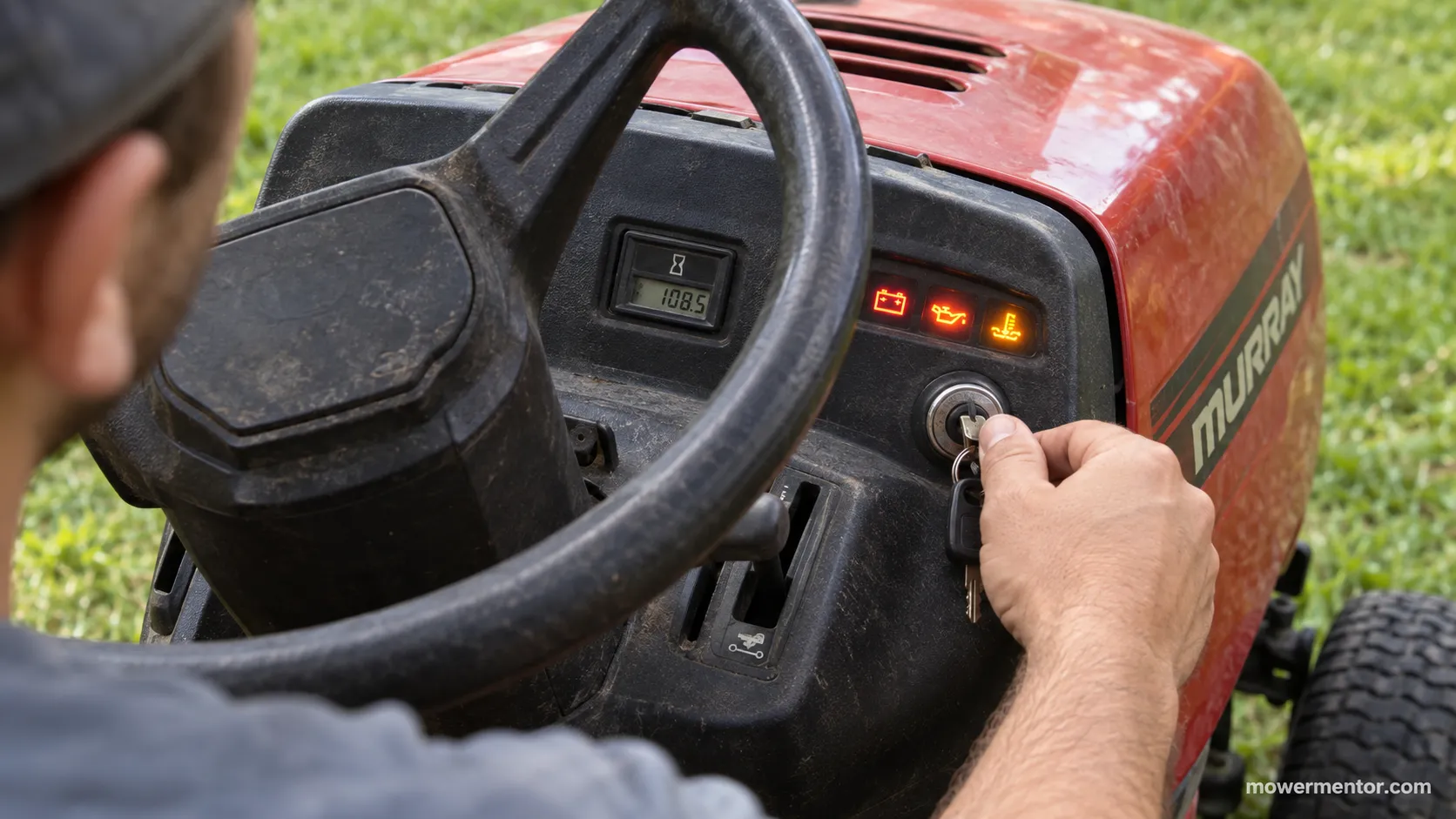
On a 2003 Murray riding mower with a 15.5 HP Briggs and Stratton engine, the key gave a single crisp click while the dash lights stayed lit, which is exactly what sent me to the solenoid instead of the battery.
What the Starter Solenoid Does and Where It Sits on a Murray
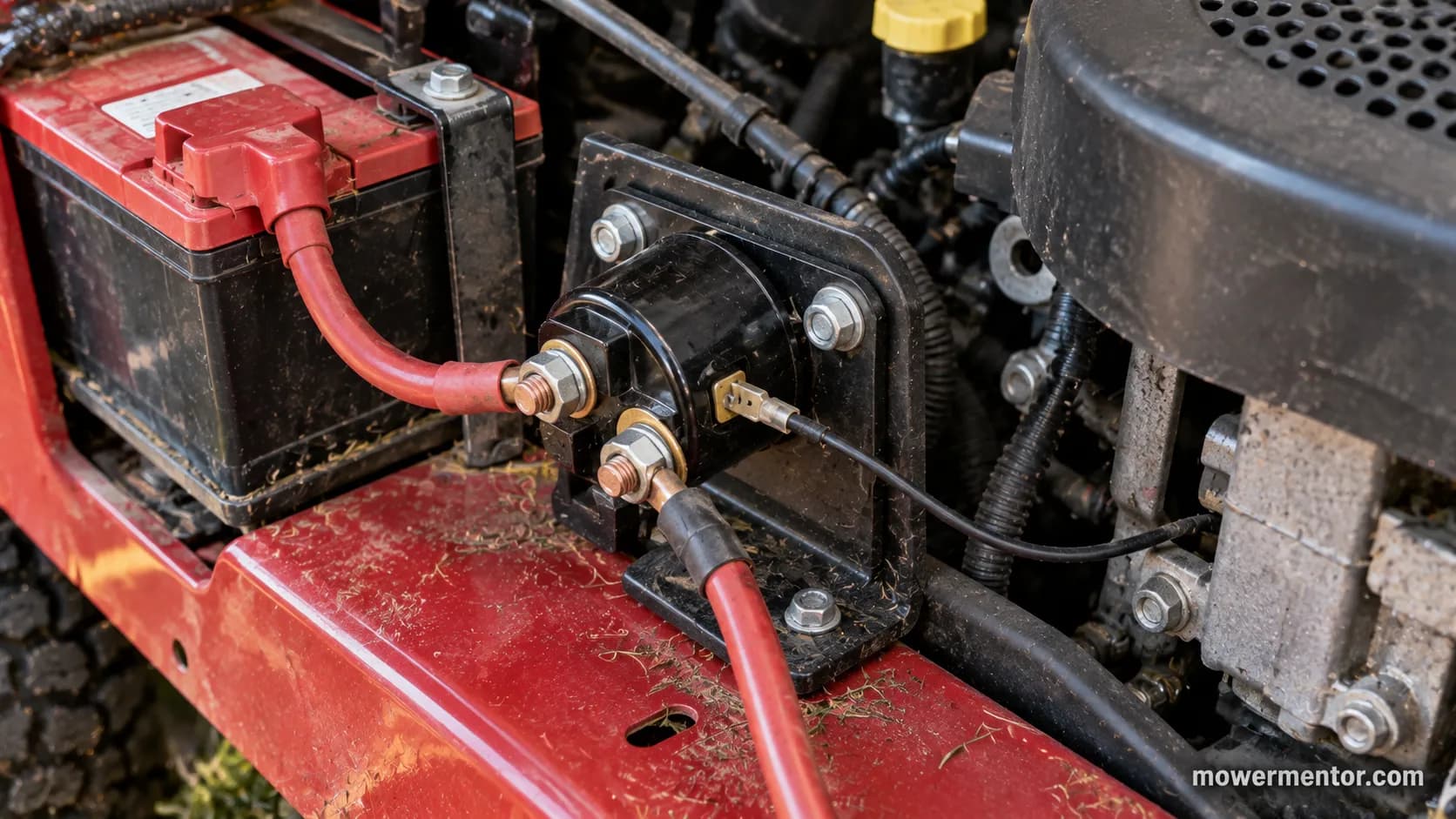
The starter solenoid on a Murray riding mower is a small 12-volt relay mounted near the battery, usually on the firewall or a fender bracket.
It has two large posts, battery-in and starter-out, plus one small spade terminal for the key's start signal.
Most Murray units use a single-pole solenoid that grounds through its mounting bracket, so a corroded bracket can mimic a dead solenoid even when the part is fine.
If your unit shows no life at all, it is worth stepping back to walk the full starting-circuit check before you focus on one part.
The job itself is simple.
A tiny current from the key energizes a coil, the coil snaps two heavy contacts closed, and battery current floods through to the starter, which is what a starter solenoid actually does on any riding mower.
On our Murray the solenoid sat on a painted fender bracket, and the mounting bolt that grounded it was lightly corroded.
Cleaning that bolt to bare metal restored a solid ground, which matters because a single-pole unit has no dedicated ground wire.
If your wire colors or post count do not match ours, read a solenoid terminal map before you disconnect anything.
The genuine part is documented in Briggs and Stratton's parts listing as 7701100MA, measuring about 3 inches by 2 inches by 2.5 inches and fitting electric-start Murray riders.
A 3-pole solenoid grounds through its bracket; a 4-pole solenoid adds a dedicated ground terminal.
Check which one yours is before assuming the part failed, because a bad frame ground behaves like a dead solenoid.
Bad Solenoid Symptoms on a Murray Riding Mower
A bad starter solenoid on a Murray riding mower most often causes a single loud click with no crank when the battery is good.
Rapid clicking or chatter usually means a weak battery or loose ground, not the solenoid, and no click with no dash lights points to the battery, a blown fuse, or a bad frame ground.
A solenoid that works cold but chatters when the engine is hot is failing internally and should be replaced.
As DB Electrical's starter guide notes, that clicking is the solenoid trying to engage while too little current passes through.
Match your symptom in the table below, then jump to the test that confirms it.
Symptom | Most likely cause | How to confirm |
|---|---|---|
One loud click, no crank, dash lit | Solenoid contacts | Screwdriver bridge and multimeter (next section) |
Rapid clicking or chatter | Weak battery or loose ground | Load-test or charge the battery first |
No click, no dash lights, nothing at all | Battery, ground, or fuse | Check battery voltage and the fuse |
Starts cold, chatters when hot | Solenoid failing internally | Replace the solenoid |
Clicks but starter silent | Solenoid or starter motor | Bridge the posts to isolate the starter |
Rule the battery out first, because a weak one mimics almost every solenoid symptom, so check your Murray's battery first.
If the sound is dead silence rather than a click, the fault may sit upstream, and it helps to trace a no-crank riding mower from battery to ground.
The single most useful distinction is click type, so if yours is a rhythmic machine-gun rattle rather than one clean thump, read what single, rapid, and no-click mean before replacing parts.
Here is the heat pattern we logged on the Murray after fitting a fresh unit, which is the classic Murray complaint that fools people into buying a second solenoid.
Date | Ambient temp | Run time to chatter | Result |
|---|---|---|---|
Aug 3, 2026 | 71°F cold start | Started first try | Normal |
Aug 3, 2026 | 94°F after mowing | About 20 minutes | Chatter returned on hot restart |
Chatter is usually the battery, not the solenoid, so confirm charge before you replace the part.
Over-replacing solenoids is the most common wasted repair on these machines.
How to Test the Solenoid With a Screwdriver and Multimeter
To test the starter solenoid on a Murray riding mower, first bridge the two large posts with an insulated screwdriver: if the starter spins strongly, the solenoid's contacts are bad and the starter is fine.
To confirm with a multimeter on DC volts, read about 12.7 volts at the large battery-side post, then, with a helper turning the key to start, check the large starter-side post.
Full voltage in but none out, while the small spade terminal has voltage, means the solenoid has failed.
Set your meter and probe on bare metal per Fluke's multimeter guidance for clean readings.
Work safely first. Put the mower in neutral, set the parking brake, and keep the blade or PTO off before you touch anything.
Follow this order:
Peel back the rubber boots to expose the two large posts.
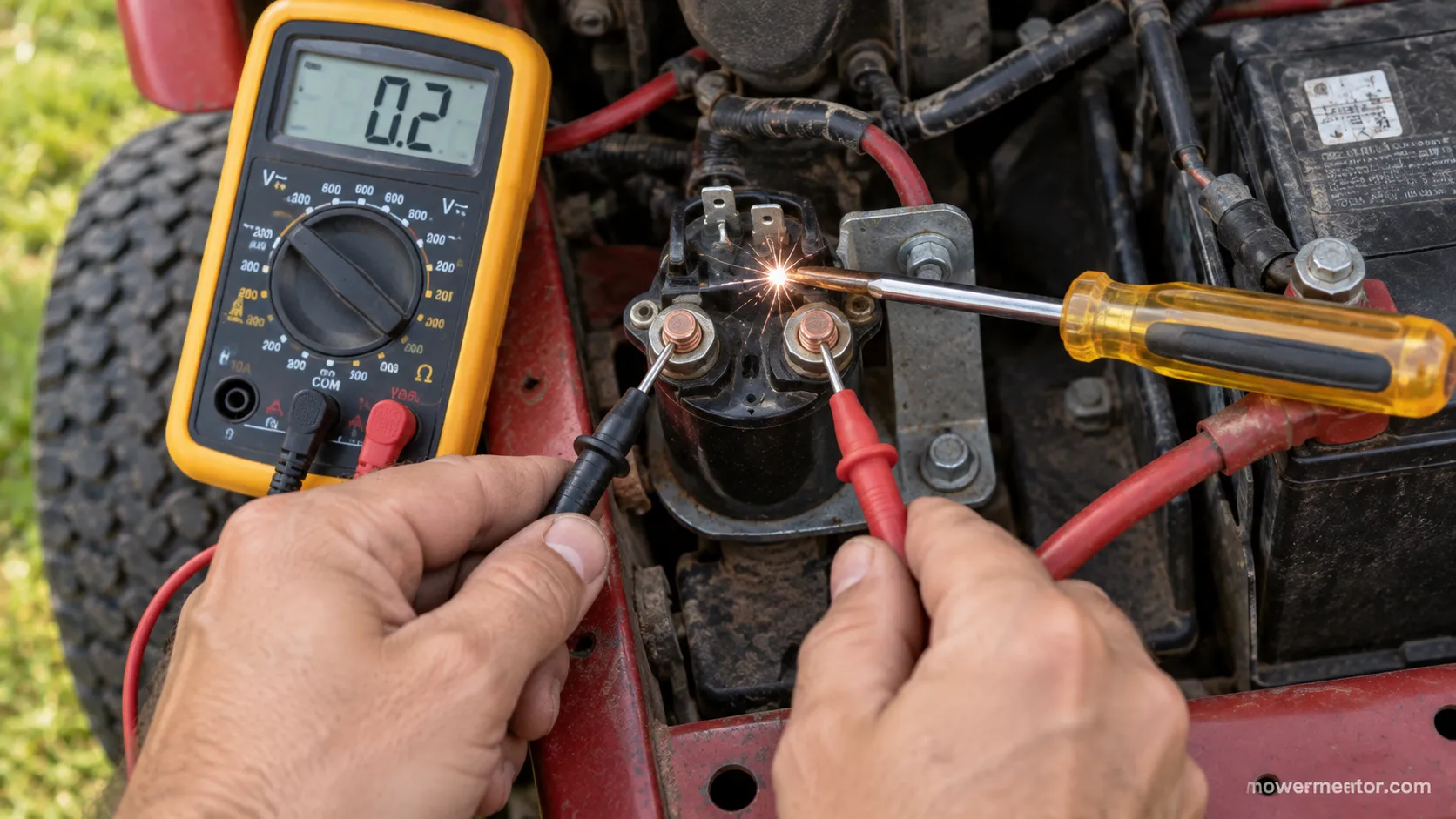
Bridge both large posts with an insulated-handle screwdriver and expect a spark. Strong crank means the solenoid is bad; nothing means the fault is the starter, cables, or battery.
Set the multimeter to DC volts and read the large battery-side post to ground. On our Murray this read 12.7 volts.
Have a helper turn the key to start and read the small spade terminal. Ours read 11.9 volts, so the switch and safety circuit were delivering the signal.
Read the large starter-side post on key-to-start. A good solenoid passes roughly battery voltage; ours read 0 volts out, confirming a dead solenoid.
For a bench check, set the meter to continuity across the large posts. Off reads OL (open), and a working unit drops to about 0.2 ohms when engaged.
The measured readings on our unit are laid out below so you know what pass and fail look like.
Test point | Good reading | Bad reading (ours) |
|---|---|---|
Large input post to ground | 12.7 V | 12.7 V |
Small spade on key-to-start | About battery voltage (11.9 V) | 11.9 V present |
Large output post on key-to-start | About battery voltage (12.4 V) | 0 V |
Continuity across large posts, engaged | Near 0 Ω (0.2 Ω) | OL (open) |
Coil continuity, spade to ground | A few ohms (4 to 6 Ω) | OL (burned coil) |
Test light shows power on one side but not the other, is the solenoid bad?
Yes. If a test light or meter shows voltage arriving at the large battery post and at the small spade on key-to-start, but nothing at the large starter post, the solenoid's internal contacts are not closing and the part has failed.
For a fuller walkthrough of each method, see our complete solenoid testing methods.
If the solenoid passes every test but the mower still will not crank, the next suspect is the starter itself, so diagnose a bad Murray starter.
If instead the small spade shows no voltage on key-to-start, the signal is not arriving, which usually means the key or safety circuit, so test the Murray ignition switch.
Still stuck after all of that, and it is worth running the full Murray no-start checklist from the top.
One honest caveat: if it cranks fine but never fires, the solenoid is innocent and the problem is spark or fuel, so pick the right spark plug and check ignition instead.
How to Bypass the Solenoid to Start It (For Testing Only)
You can bypass a Murray riding mower's starter solenoid by bridging its two large posts with an insulated screwdriver, but only as a diagnostic test with the mower in neutral, the parking brake set, and the blade disengaged.
If it cranks and starts, the solenoid's contacts have failed and it should be replaced.
Bypassing is a confirmation, not a repair, because it defeats the safety interlocks that normally protect you.
On our Murray the bridge cranked the engine instantly, so I kept it to a three-second confirmation and stood clear of the deck the whole time.
That short test is all you need to prove the point.
A bypass defeats the seat, brake, and PTO safety switches, so never mow or drive with a solenoid bypassed.
Stop immediately if you smell burning or see melted posts.
For the safe, repeatable version of this move, follow the dedicated guide to safely jump the solenoid with a screwdriver.
If the trigger circuit keeps dropping out during the test, a blown or wrong-size fuse can be the reason, so check your mower's fuse size.
If it cranks strongly on the bypass but still will not run, look past the starting circuit and spot a bad spark plug next.
How to Replace the Solenoid on a Murray Riding Mower
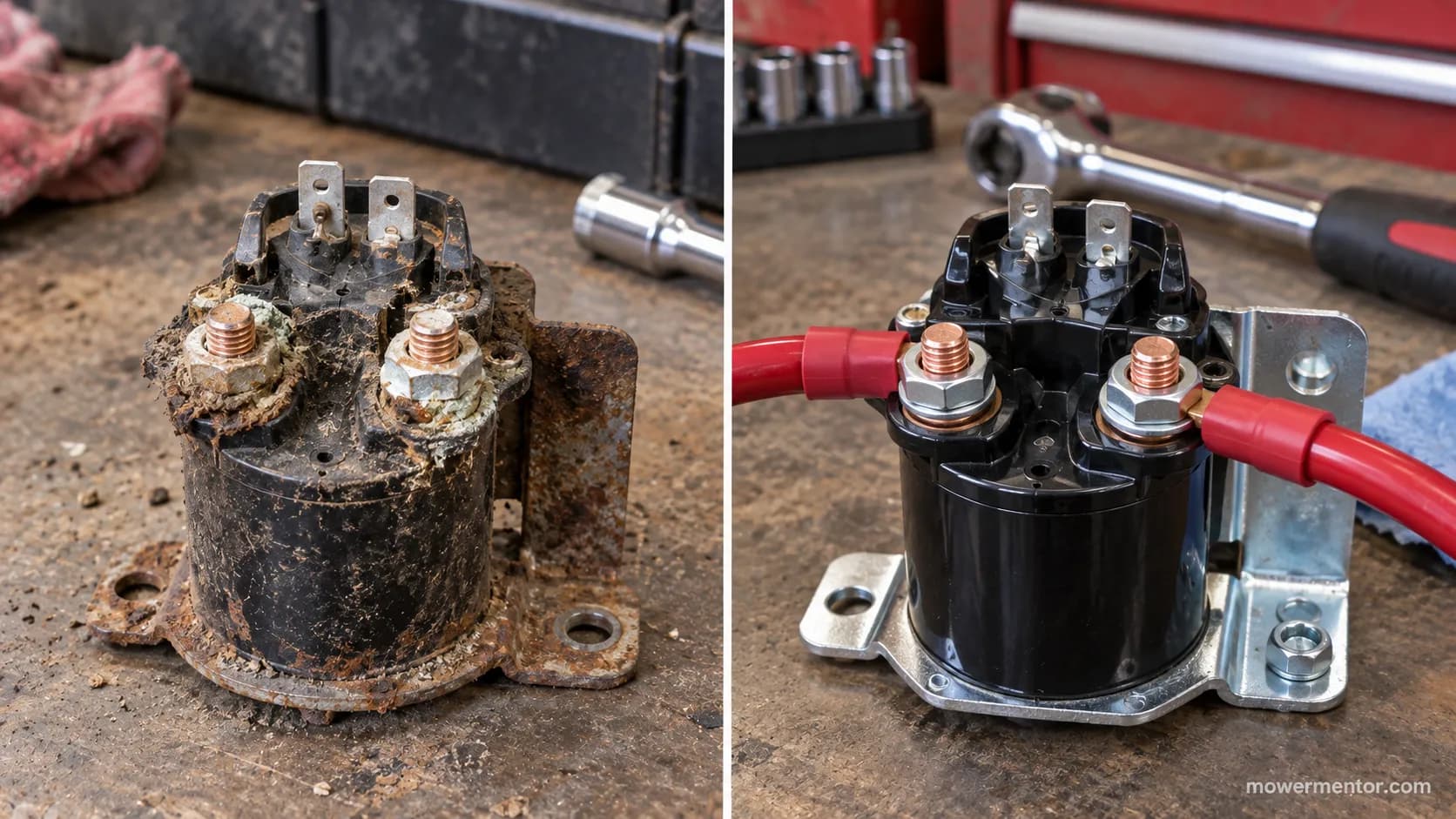
To replace the starter solenoid on a Murray riding mower, disconnect the negative battery terminal, photograph the wiring, then remove the two large cable nuts and the small trigger wire and unbolt the mounting bracket.
Fit the new single-pole solenoid, clean the bracket to bare metal for a solid ground, and reconnect the cables in the same order.
The job takes about 15 minutes and the part costs roughly $10 to $27. A quick photo before you start is the cheapest insurance against a mis-wire.
Here is the sequence I used on the Murray:
Disconnect the negative battery cable first.
Photograph the posts and spade orientation so you can copy it exactly.
Remove the two large cable nuts and unclip the small spade wire.
Unbolt the bracket and lift the old solenoid out.
Clean the bracket to bare metal, then bolt the new solenoid down.
Reconnect the large cables and the spade wire in the same order, reconnect the battery, and repeat the test from the previous section.
The swap took about 15 minutes with a single socket wrench, and cleaning the corroded bracket ground mattered as much as the new part.
Afterward the starter-side post read 12.5 volts on key-to-start, confirming the fix. For a fuller version with cost breakdowns, see our full solenoid replacement steps.
Detail | Value |
|---|---|
Tools | One socket wrench, a rag, a wire brush |
Time | About 15 minutes |
Part cost | $10 to $27 |
Key step | Clean the bracket ground to bare metal |
If the mower now cranks but is slow to catch, a controlled shot of aid can confirm fuel delivery, so learn where to spray starting fluid.
To keep the new solenoid happy, hold a healthy charge and keep the battery topped up through the season.
Cheap generic solenoids vary in quality, so buy a proven cross-reference rather than the lowest listing. A $3 saving is not worth a repeat teardown.
Which Solenoid for Murray Riding Mower Fits? Cross-Reference and Fitment
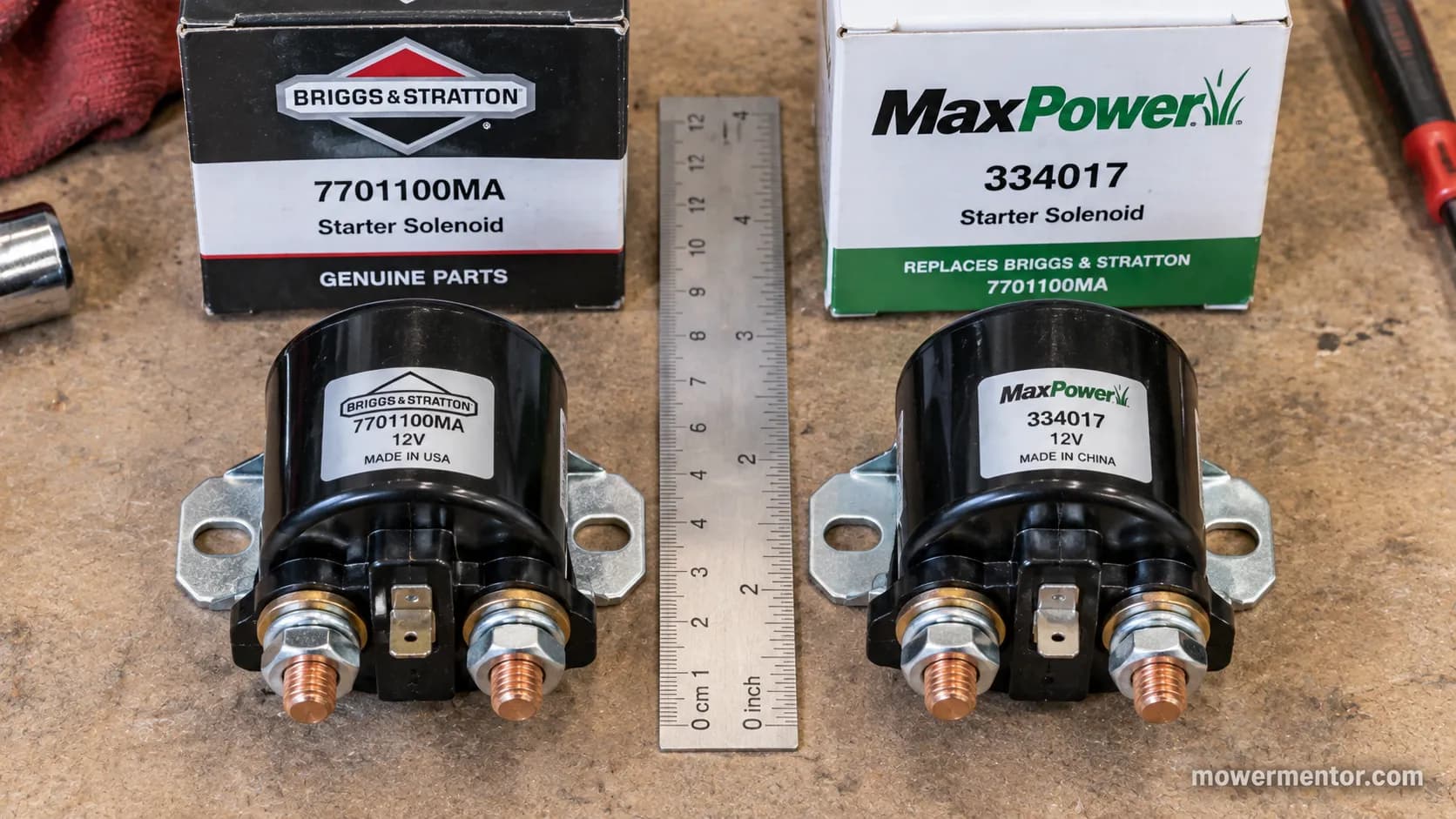
The genuine solenoid for Murray riding mower starting is Briggs and Stratton part 7701100MA, which replaces older Murray numbers 21261, 24285, 424285, and 924285.
Because it is a single-pole 12-volt starter solenoid, it cross-references to common aftermarket units like MaxPower 334017 and to equivalents for Toro, Husqvarna, MTD, and John Deere.
Most electric-start Murrays built since 1979 accept any single-pole solenoid with matching stud sizes, so just confirm your OEM number and pole count before buying.
The MaxPower fitment listing spells out the numbers it replaces.
The reason a Briggs and Stratton part fits a Murray is ownership: Murray's assets were bought by Briggs and Stratton in 2004, a detail confirmed in Murray's brand history.
That is why the OEM box says Briggs even when your deck says Murray.
Use this chart to match a genuine number to a cheaper interchangeable unit.
Murray OEM | Briggs and Stratton | Common aftermarket | Cross-brand equivalents |
|---|---|---|---|
21261, 24285, 424285, 924285 | 7701100MA | MaxPower 334017, Stens 435-431, Canamax 435-097 | Toro 111674, Husqvarna 539101714, MTD 725-0530, John Deere 30577, Ariens 03057700 |
I fitted a MaxPower 334017 to our Murray in place of the OEM 7701100MA, and the stud sizes and bracket lined up so it cranked identically.
That side-by-side is the practical proof behind the "are they universal" question.
Are Murray solenoids universal? Mostly yes within the single-pole family, but confirm two things: your OEM number appears on the box, and the pole count and stud size match, since 3-pole and 4-pole units wire differently.
Once starting is sorted, a seasonal service keeps the whole machine reliable, so give your mower a seasonal tune-up while you have tools out.
A fresh filter is a cheap reliability win too, so swap in the right air filter at the same time.
Frequently Asked Questions
How do I know if it is the solenoid or the starter?
Bridge the two large solenoid posts with an insulated screwdriver. If the starter spins strongly, the solenoid's contacts have failed and the starter is fine; if nothing happens, the fault is the starter, cables, or battery.
A multimeter confirms it: voltage in with no voltage out, while the spade has voltage, means the solenoid is dead.
Why does my Murray only start when I jump the solenoid?
If a Murray riding mower only starts when you bridge the solenoid's posts, the solenoid's internal contacts have failed and it should be replaced. Jumping the posts sends battery current straight to the starter and skips the worn contacts, which is a diagnostic confirmation, not a lasting fix.
Are Murray solenoids universal?
Mostly, within the single-pole 12-volt family. Confirm your OEM number is listed on the replacement and that the pole count and stud size match, then any equivalent in the 7701100MA cross-reference group will fit most electric-start Murrays. The chart above lists the compatible numbers.
How much is a solenoid for a Murray riding mower?
Expect roughly $10 to $27. Aftermarket units such as MaxPower 334017 sit near the low end, while the genuine Briggs and Stratton 7701100MA runs toward the higher end.
Can I mow with a bypassed solenoid?
No. A bypass defeats the seat, brake, and PTO safety switches, so it is only for a quick diagnostic crank. Replace the solenoid before you use the mower normally.
When is it worth calling a pro?
If a new solenoid fails again quickly, the real fault is usually deeper, such as corroded cables, a poor frame ground, or a charging-system problem, and a repeated failure is the signal to stop swapping parts. If you are not comfortable working near battery current, a shop visit is money well spent.
Diagnosing the solenoid for Murray riding mower starting comes down to one habit: prove it with a screwdriver and a meter before you buy, then match the part by number and pole count rather than by brand.
Do that, and a $12 unit fixes a no-start that a parts-counter guess would have turned into a $60 afternoon.
Keep the readings you took, because the next time the key only clicks, you will know in sixty seconds whether the solenoid, the battery, or a rusty ground is to blame.
Found this useful? Make us a preferred source so we show up in your Google results.
Keep reading
Related articles
Troubleshooting & Repair
Dead Dash? Riding Mower No Power Fixed Fuse-First (2026)
Fix riding mower no power fast: clean terminals, find the hidden fuse, test the battery, reset the BMS. A fuse-first checklist for gas & electric mowers.
Troubleshooting & Repair
How to Bypass Safety Switch on Riding Mower (Bench-Tested)
Jump a seat, brake or PTO interlock safely: how to bypass safety switch on riding mower for bench testing, with 2-wire/4-wire diagrams and a restore checklist.
Troubleshooting & Repair
Riding Lawn Mower Won't Turn Over: 5-Stage Voltage Test
Fix it fast: a riding lawn mower won't turn over usually means battery, ground, solenoid or starter. Test each in 5 ordered stages.
Troubleshooting & Repair
Just Clicks? Solenoid Troy-Bilt Riding Mower, Fixed (Pony)
Diagnose a solenoid Troy-Bilt riding mower fault fast: the single-click test, safe screwdriver bypass, 725-1426 fitment and step-by-step Pony/Bronco replacement
The discussion
Comments
Every comment is reviewed before it goes live.