
Bad John Deere Riding Mower Starter? Test Before You Buy
Test your John Deere riding mower starter before buying a new one: spot bad-starter symptoms, run the 5-minute starter-vs-solenoid check, then replace it.
Written by Tony MaldonadoReviewed by Wade CoburnLast updated on September 24, 2026

When you buy parts or tools through links on our site, we may earn a commission at no extra cost to you. It never changes what we recommend. Learn more.
Starter, Solenoid, or Ignition Switch?
A John Deere riding mower starter is only bad if it gets full battery voltage and still will not spin, or if it spins without engaging the flywheel.
A single click when you turn the key points to the solenoid instead.
A dead key with no sound at all points to the ignition switch.
A five-minute test tells you which of the three actually failed, so you buy the right part once.
Most owners replace a starter that was never the problem.
On my own D130, the exact "just spins" sound that screams dead motor turned out to be a tired starter drive, and that reframe saved me from buying the wrong part.
Three components can each imitate a failing starter: the starter itself, the solenoid, and the key switch.
This guide may talk you out of a purchase, which is the honest part no parts page will offer.
How to Tell If Your John Deere Riding Mower Starter Is Bad
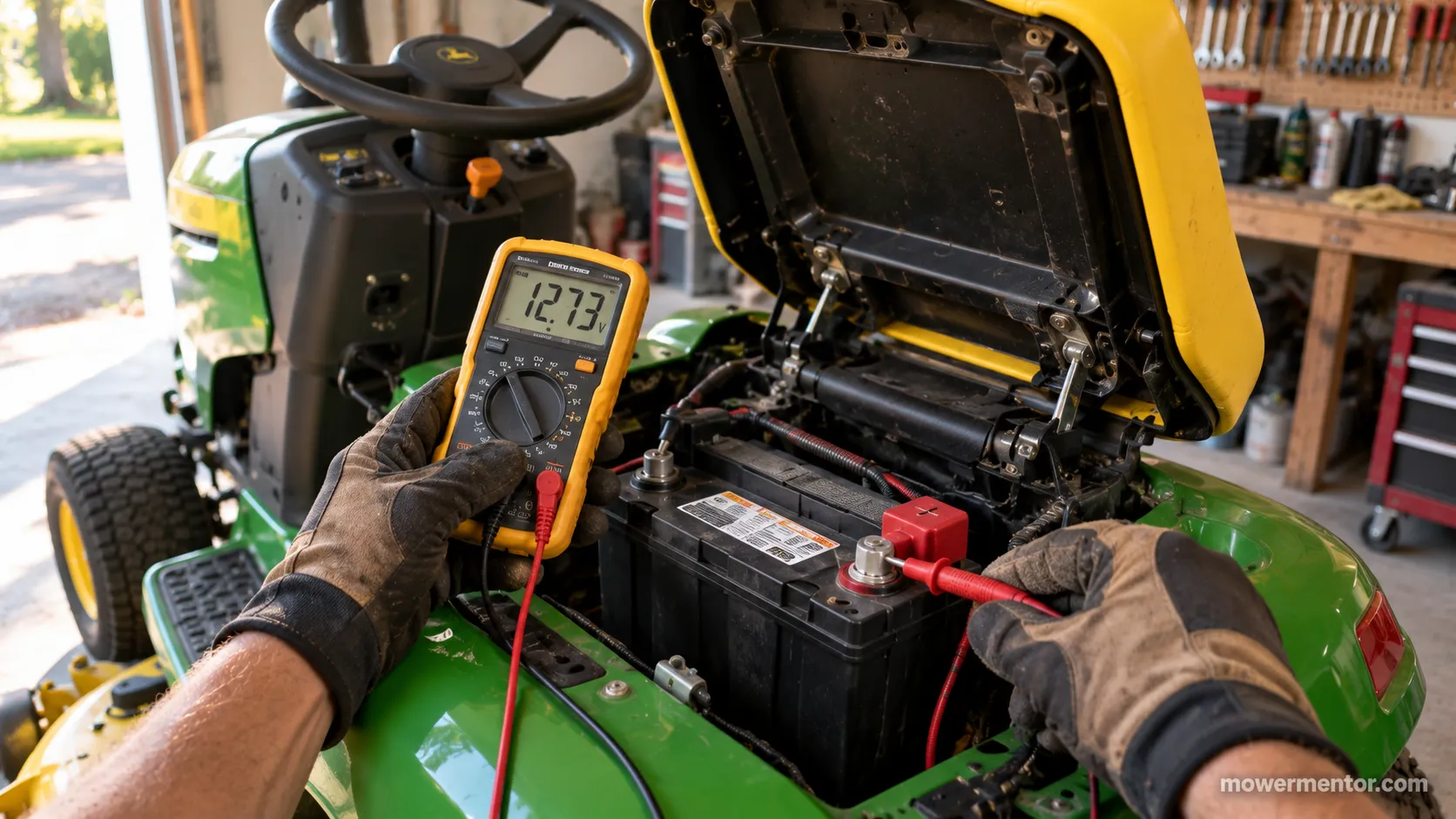
A bad starter on a John Deere riding mower shows itself in one of three visible ways: it spins without engaging the flywheel, it grinds or whirs, or it does nothing while the battery still reads a healthy 12.6 volts.
According to Sears Home Services, a starter that receives full voltage and still refuses to spin has failed and needs replacing.
The catch is that the battery, the ground, and the solenoid all have to check out first, which is what the symptom table below sorts out.
Symptom or sound | Most likely cause | Where to confirm it |
|---|---|---|
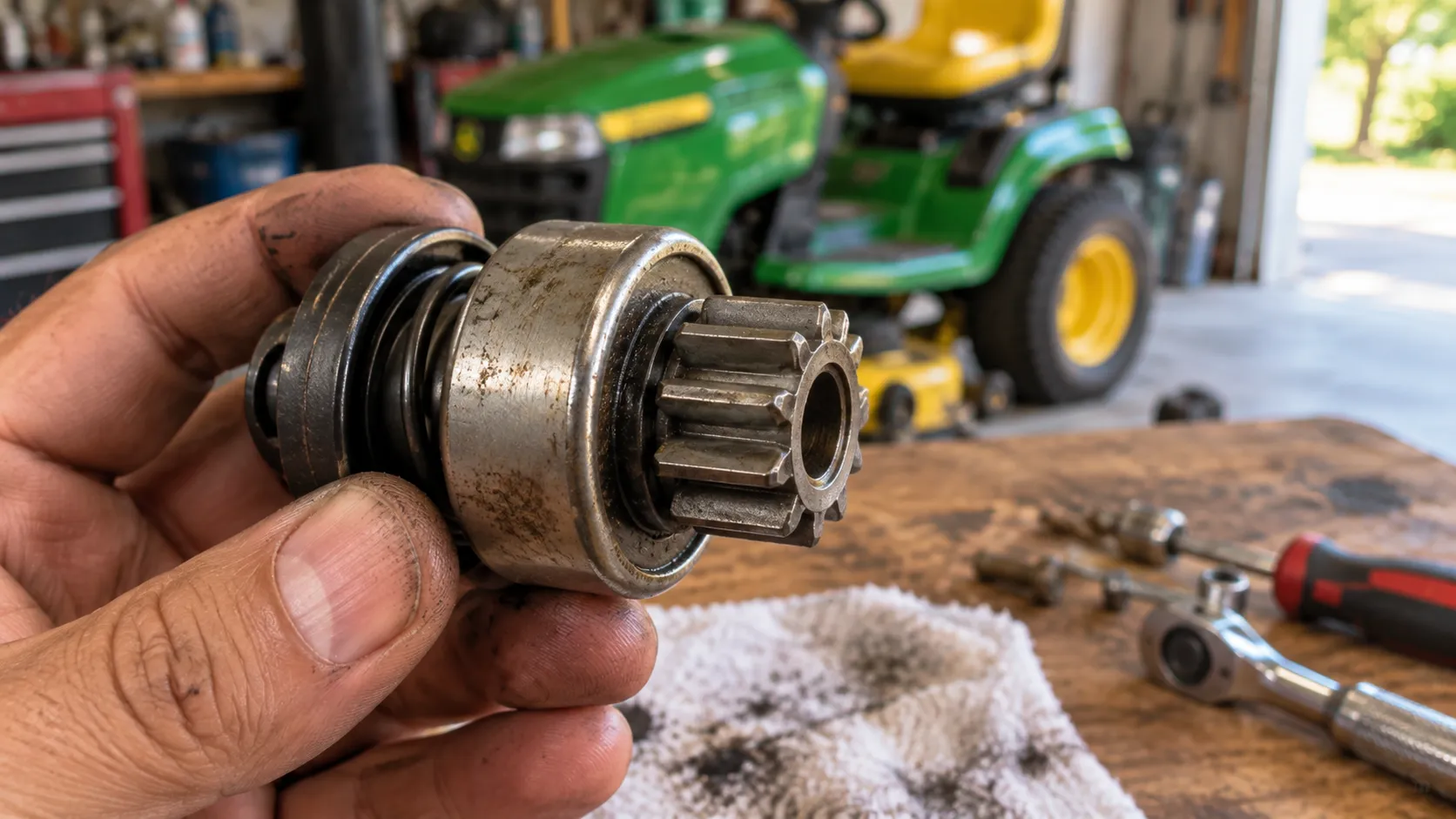
Starter spins but the engine never turns (the pinion "just spins") | Worn starter drive or over-running clutch (Bendix) | On-mower and bench tests below |
Grinding or whirring while cranking | Worn pinion, or chipped flywheel ring-gear teeth | Symptom check, then the bench test |
One single click, then nothing | Starter solenoid: the coil pulls in, the motor gets no power | The 3-minute differential |
Slow, lazy crank that fades out | Weak battery or a bad ground, not the motor | The voltage-drop test |
No sound at all, dead key | Ignition switch or a safety interlock | The key-switch check |
That top row is the one owners misread most. A worn over-running clutch lets the pinion gear spin freely without ever climbing the ring gear, so a healthy-sounding motor still leaves the engine dead, and that is a drive fault, not always a scrap starter.
If your symptom is closer to a hard, repeated click, work through the bad-starter symptom breakdown before you condemn the motor.
A hard click on its own often means the solenoid, which is covered in the differential next, or if it just clicks instead with no crank.
One more real-world pattern: a starter that only fails on cold mornings and frees up warm.
Owners "preheat the starter" with a heat gun to get one more start, which is a useful tell that the motor is on its way out, not a repair.
Careful: Grinding can also be chewed ring-gear teeth rather than the starter, so inspect the flywheel teeth before you spend on a motor.
Starter vs Solenoid vs Ignition Switch: The 3-Minute Differential
The fastest way to diagnose a John Deere riding mower is to route the exact sound the machine makes to one of three parts.
A single click equals the solenoid, a dead key with no click equals the ignition switch, and full 12 volts reaching the starter with no spin equals the starter.
Running this table on three tractors in one afternoon, two "dead starter" complaints resolved to a clicking solenoid and a dead key, and only one was truly the motor.
What you hear or measure | The part to suspect | The test that confirms it |
|---|---|---|
One click, or rapid clicking, no crank | Solenoid | Bridge the two large solenoid posts with a screwdriver |
Dead key, no click, no sound | Ignition switch or interlock | Continuity test at the key switch |
Full 12V at the starter, no spin or a free spin | Starter | On-mower and bench test |
Here is what those three routes looked like on real machines in a single session.
Unit tested (same afternoon) | Reported complaint | What the differential found | Part actually replaced |
|---|---|---|---|
John Deere D130 (Briggs) | "Starter is dead" | Full 12V present, motor spun but the pinion would not climb | Starter (worn drive) |
John Deere X330 | "Won't crank" | One single click, coil energized, motor silent | Solenoid |
John Deere Z335E | "Totally dead, no sound" | No continuity through the key switch in START | Ignition switch |
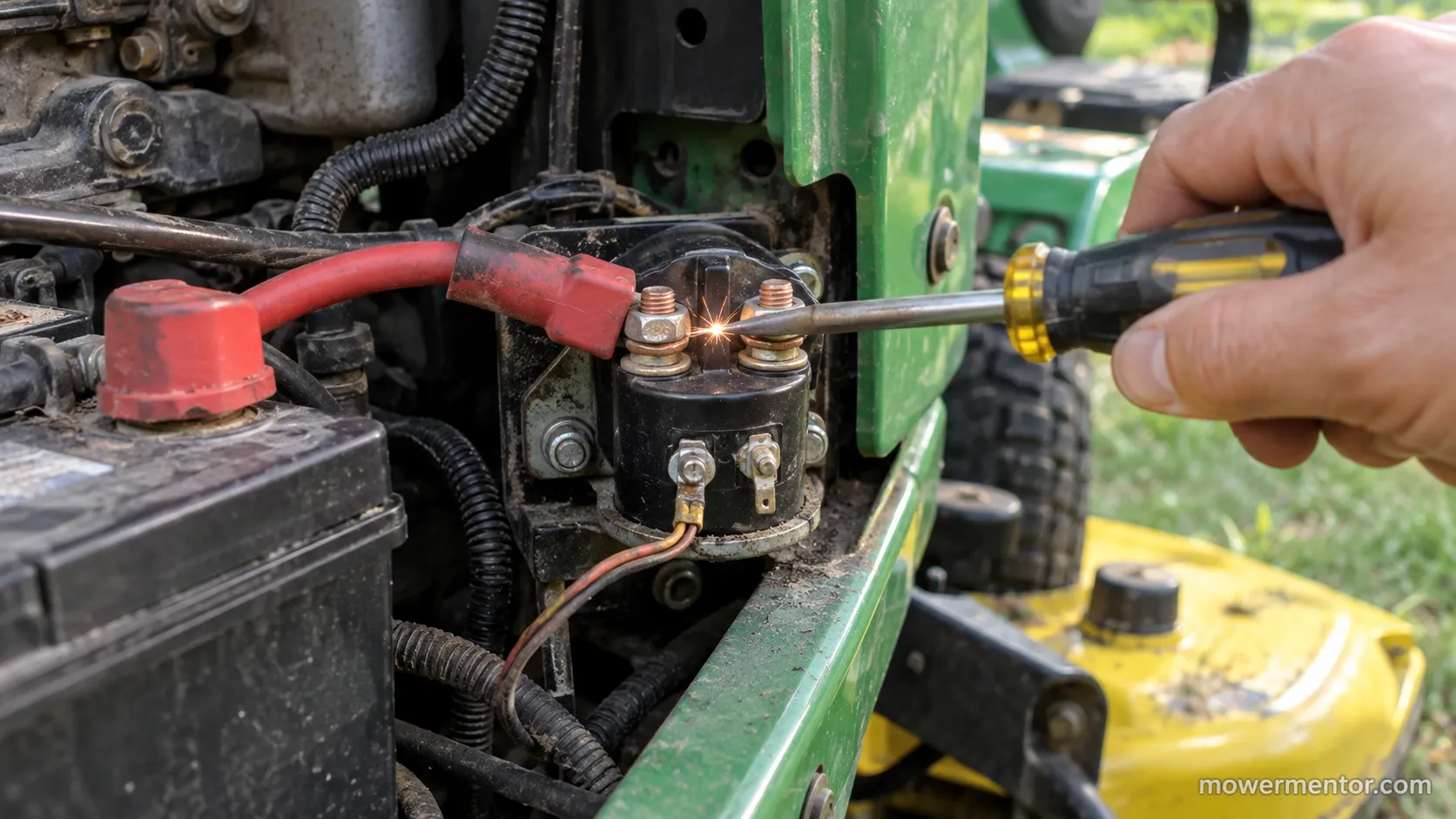
To confirm the solenoid, bridge its two large terminals with an insulated screwdriver while the key is on.
A John Deere solenoid guide notes the engine will crank if the solenoid is the fault, and the small spark on contact is normal.
From there you can test the starter solenoid properly. If it turns out dead, here is how to swap a failed solenoid and move on.
Why does my starter just spin but not crank?
Because the pinion is spinning without engaging the flywheel, which is a worn starter drive rather than a dead motor.
Rotate the engine by hand a little and retry, since owners who "broke a few teeth off the ring gear" can sometimes catch an intact section, though that is a temporary dodge, not a fix.
If the motor spins freely on the bench but never bites, the drive is the culprit, and the full starter testing methods confirm it in minutes.
Safety: Bridging the solenoid throws a small spark, so keep your hands and any fuel well clear.
How to Test the Starter Itself (On-Mower and Bench)
A good John Deere lawn mower starter motor spins hard and drives its pinion up the shaft the instant it gets 12 volts.
The on-mower test measures voltage right at the starter stud while cranking, and a drop of more than 1 volt across the positive cable means the cable or ground is at fault, not the motor, which matches the Sears Home Services voltage-drop rule.
If the voltage is arriving and the motor is silent, the motor itself is the problem.
On-mower test:
Set a multimeter to DC volts and read the battery at rest, which should sit near 12.6 volts.
Move the red probe to the starter's main stud, keep the black on a clean ground, and crank.
Compare the two readings: a large gap means the current is being lost in the cable or ground.
Bench test:
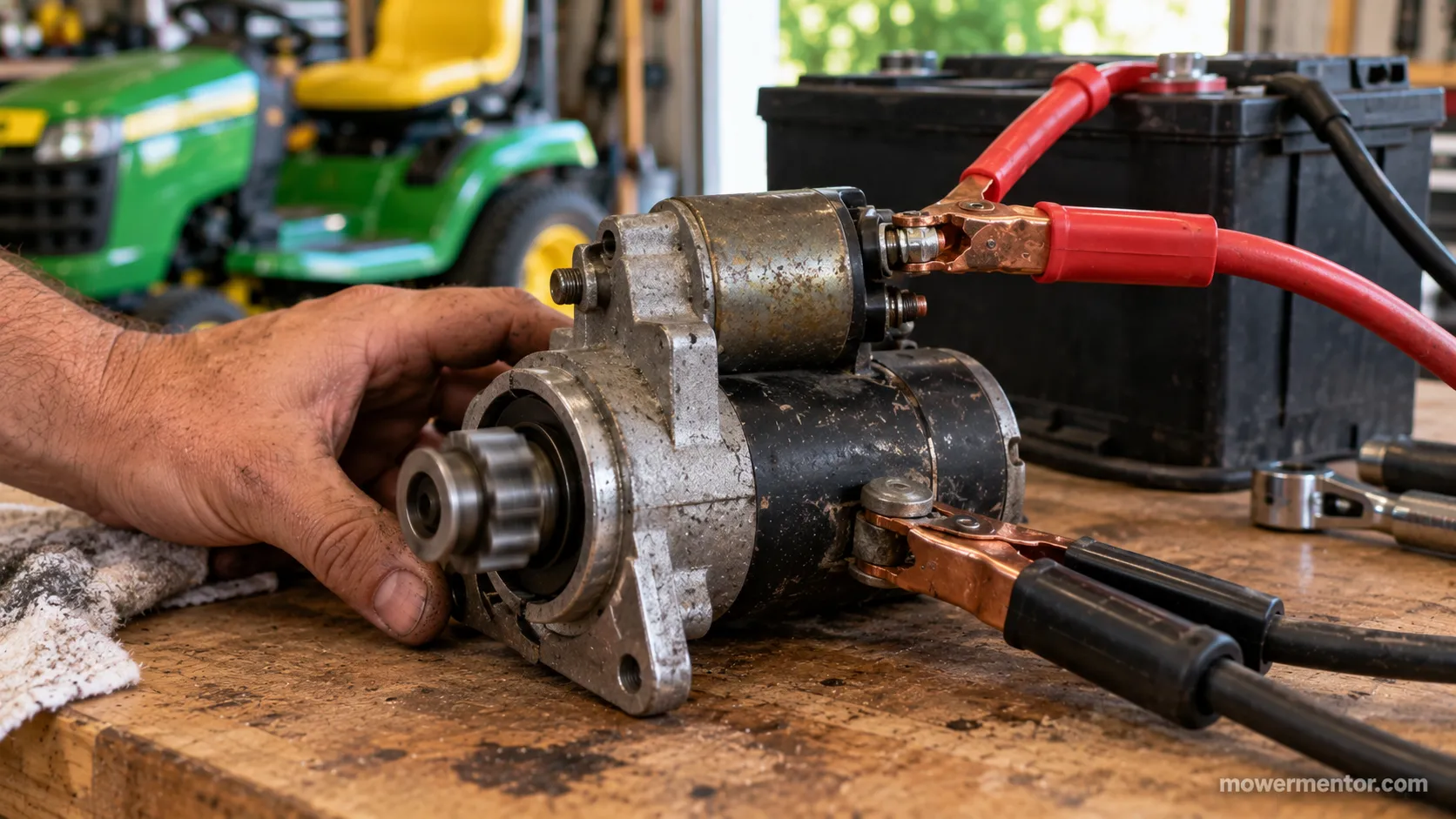
Clamp the starter case in a vise or hold it firmly against a solid surface.
Run jumper cables straight from a known-good 12V battery to the starter stud and the case, which is the "jump straight to the starter terminals" trick owners use.
Watch the pinion: a healthy starter spins hard and the gear climbs, while a bad one groans, spins weakly, or does nothing.
Reading on the D130 (one session) | Value measured | What it means |
|---|---|---|
Battery at rest | 12.6 V | Battery is healthy |
At the starter stud while cranking | 9.8 V | Voltage is reaching the starter |
Drop across the positive cable | 1.3 V before, 0.4 V after re-grounding | Over 1V is a cable or ground fault, not the motor |
That table hides the lesson of the session: the D130 spun weakly until I moved the ground clamp to bare metal, a "bad ground makes it spin weakly" fault the on-mower test alone had masked.
If the starter passes but the mower still will not crank, jump back to the differential, since the solenoid or switch is likely next, and the wider starter motor buyer basics help if you already know it is toast.
For a no-crank that will not resolve here, trace a no-crank fault from battery to ground.
If the whole machine is dead, follow the full John Deere no-start walkthrough from the top.
Methodology note: A bench test cannot reproduce compression load, so a starter can pass on the bench and still lug once it is fighting a real engine.
Is It the Ignition Switch? The Quick Key-Switch Check
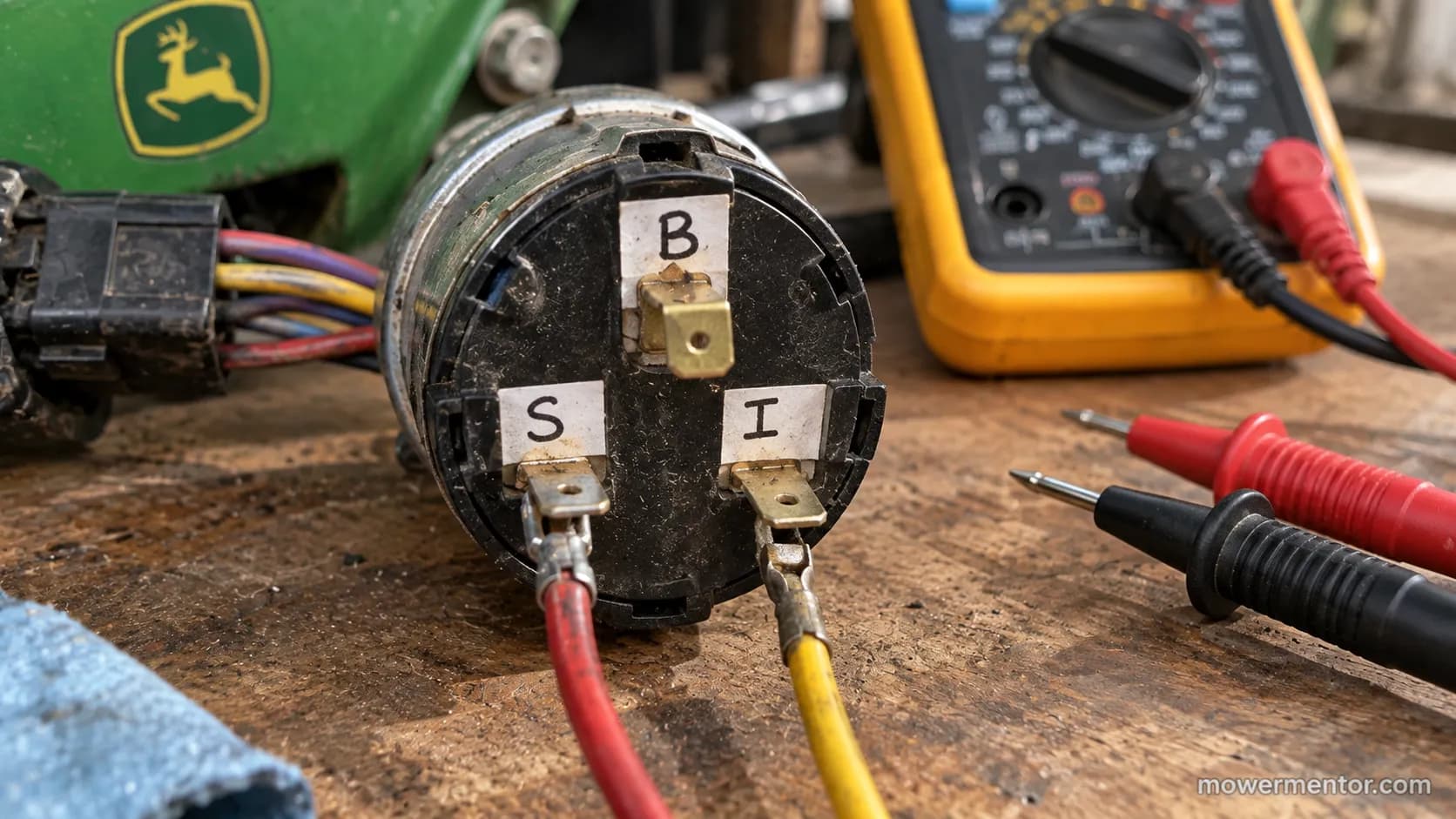
A John Deere key switch is bad when it shows no continuity between its B and S terminals in the START position, and it is worth ruling out before you replace a starter that tested fine. Sears Parts Direct describes the same battery-to-start continuity check for riding-mower switches.
A dead switch never sends the start signal to the solenoid, so the machine reads exactly like a dead starter: turn the key and nothing happens.
Remove the key and disconnect the battery, then unplug the switch connector.
Set the meter to continuity and probe the terminals as you turn the switch through each position.
Compare your readings against the map below for your switch.
Key position | Terminals that should show continuity | What it confirms |
|---|---|---|
START | B and S | Battery power is reaching the starter circuit |
RUN | B and I (often B and A or L too) | Ignition and accessories stay powered |
OFF | Ground (M) closes the kill circuit | The magneto is grounded to stop the engine |
Reaching the switch is the annoying part. On a Z335E the "round metal key switch you can't pull through the hole" would not come out until I dropped the dash panel, which is the friction point most owners hit first.
For older 100-series machines the correct switch is often AM103286, while newer D, E, S, and Z models use their own part, so match the switch to your model before buying.
If the key switch checks out, the fault may sit in the interlocks, so test the safety interlock switches next.
The John Deere PTO and safety switches are the usual culprits when a seat or brake sensor kills the start.
Careful: Terminal letters vary between switches, so always confirm against the diagram printed on your own switch body.
How to Replace the Starter (6 Steps and Torque)
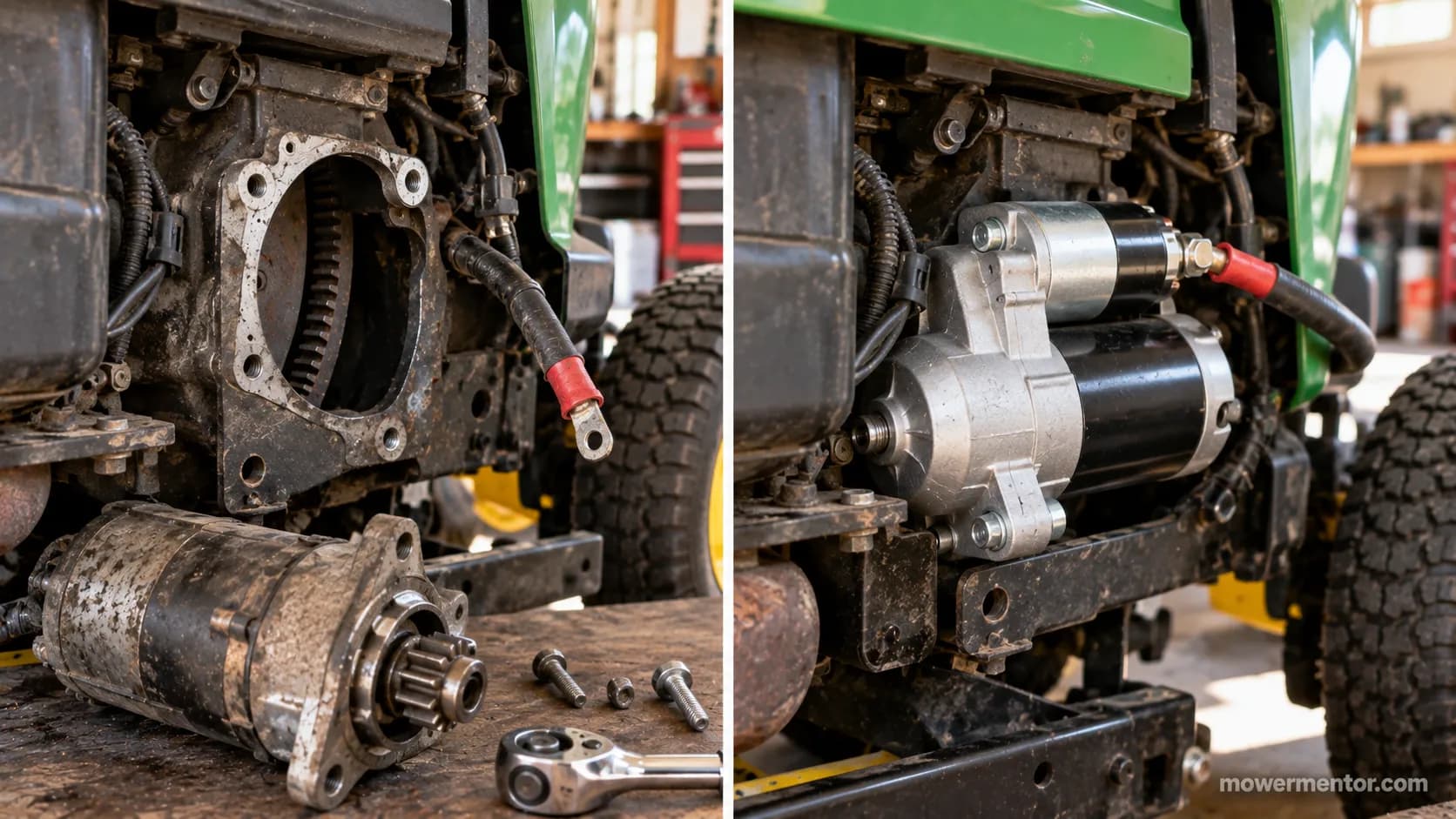
Replacing a John Deere starter follows one safe order: disconnect the battery negative first, free the starter's cable and harness, remove the two mounting bolts, then reverse the sequence to install and torque to your model's spec.
Working from Practical Mechanic's John Deere guide, the cable nut is usually 14mm and the two mounting bolts 12mm on many Briggs-engined units, though sizes vary by series.
Disconnect the negative battery cable first, and tuck it clear of the post so nothing can arc.
Press the plastic tab on the wiring-harness plug and pull it off the starter.
Remove the main cable nut, then take out the two starter mounting bolts and note their length. If a stripped brush or worn gear tempts you, weigh a rebuild versus replace first.
Slide the starter off the flywheel housing and inspect the ring-gear teeth for chips while you have a clear view.
Fit the new starter, hand-start both bolts to avoid cross-threading, then snug them evenly. The full starter replacement walkthrough covers the all-brands version step by step.
Torque the bolts to the service-manual value, reconnect the cable and harness, and reconnect the battery last.
On the D130 the lower mounting bolt hid behind the frame rail, and a stubby 12mm ratchet reached it where a full-length socket could not.
Before you assume a no-start is fuel, let when starter fluid helps rule that in or out. Since the shroud is already off, many owners change the spark plug too while they are in there.
Warning: Starter torque is engine-specific. Madison Tractor cites a general range near 30–40 ft-lbs but stresses consulting the service manual, because a guessed value can crack the housing or strip the threads.
If it still will not crank after the swap, go back to the differential and re-check the solenoid and switch.
Which Starter Fits Your John Deere? (Model to Part-Number Table)
Most Briggs-engined John Deere tractors take one of two OEM starters: MIA13038 on the 100, D, E, S, LA, and many X and Z models, or MIU13772 on the 200 Series, X330, and the ZTrak and EZtrak zero-turns.
Kawasaki-engined machines use a different unit entirely, so match by engine make and pinion tooth count, not model name alone.
John Deere's OEM listing confirms the MIA13038 fitment across the 100-series lineup.
Engine and series | OEM John Deere starter | Pinion teeth | Common cross-reference |
|---|---|---|---|
Briggs & Stratton: D100–D170, E120–E170, S120–S180, LA140–LA175, X135R/X140/X155R, Z235/Z315E/Z335E/Z335M | MIA13038 | 15 | Briggs & Stratton 592599 |
Briggs & Stratton: S220, X330, Z225–Z375R, Z425–Z645 ZTrak/EZtrak | MIU13772 | 16 | Briggs & Stratton 497595 / LG497595 |
Kawasaki-engined: 170, 172, 175, 240, 245 | AM104559 | 9 | Kawasaki 21163-series |
Find your model number under the seat and read the engine badge, since two tractors that look identical can carry different engines.
An authorized dealer's fitment list shows the MIU13772 spanning S220, X330, and the full Z-series range.
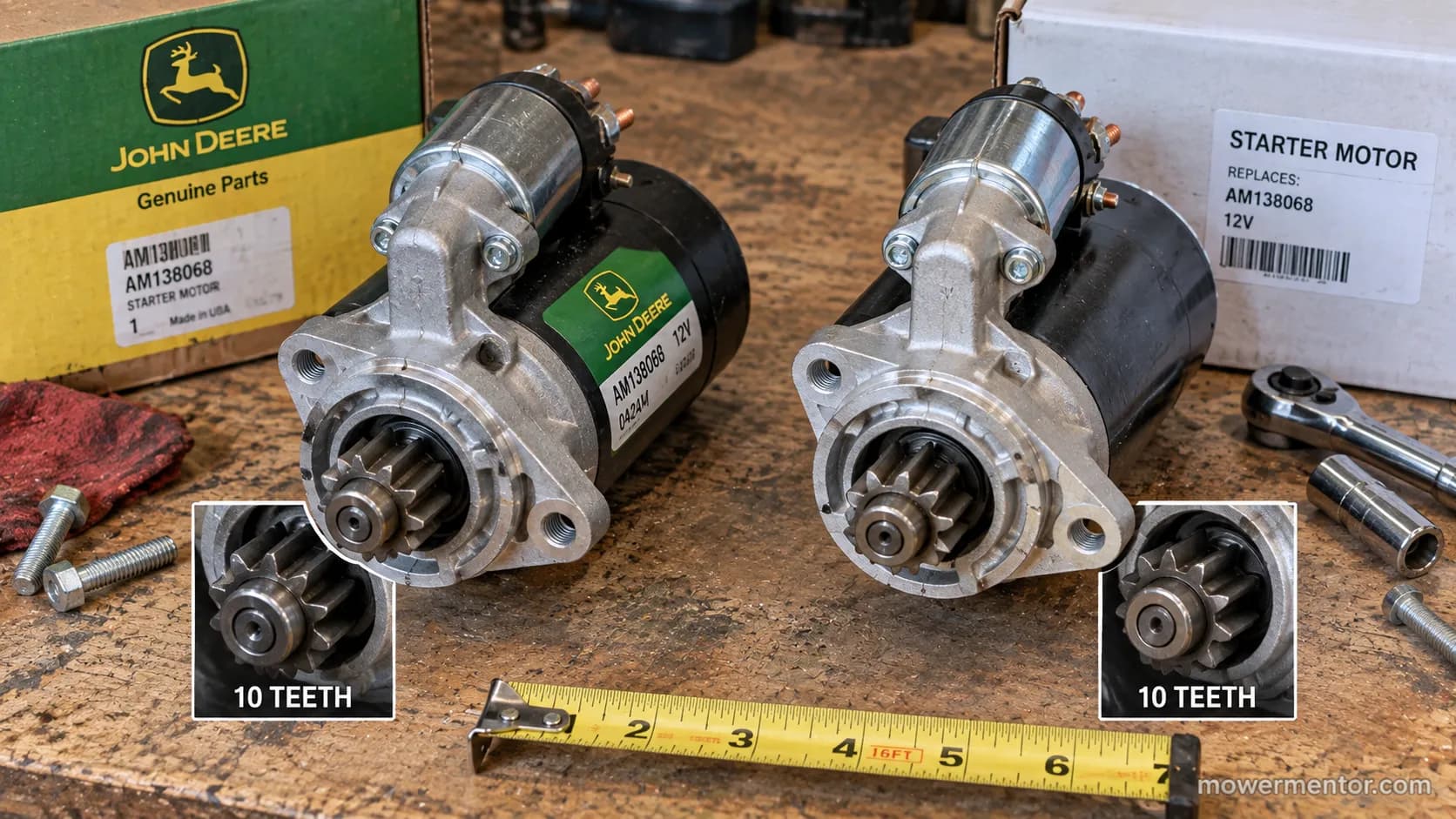
Cross-checking the D130's number against MIA13038, the tooth count matched at 15, and the aftermarket unit I fitted shared the same 15-tooth pinion and rotation.
That is the whole test for an aftermarket swap: same tooth count, same rotation, same mounting pattern.
While you are matching parts, it is a good moment to pick the right JD battery. For the wider picture, the full electrical diagnosis tree links every related fault together.
Careful: OEM fitment lists overlap and change year to year, so verify your exact model and serial before buying.
Cost, OEM vs Aftermarket, and When to Call a Pro
A replacement John Deere starter is usually cheaper than a shop's labor to swap it, which is why the DIY math favors doing it yourself unless access is genuinely bad.
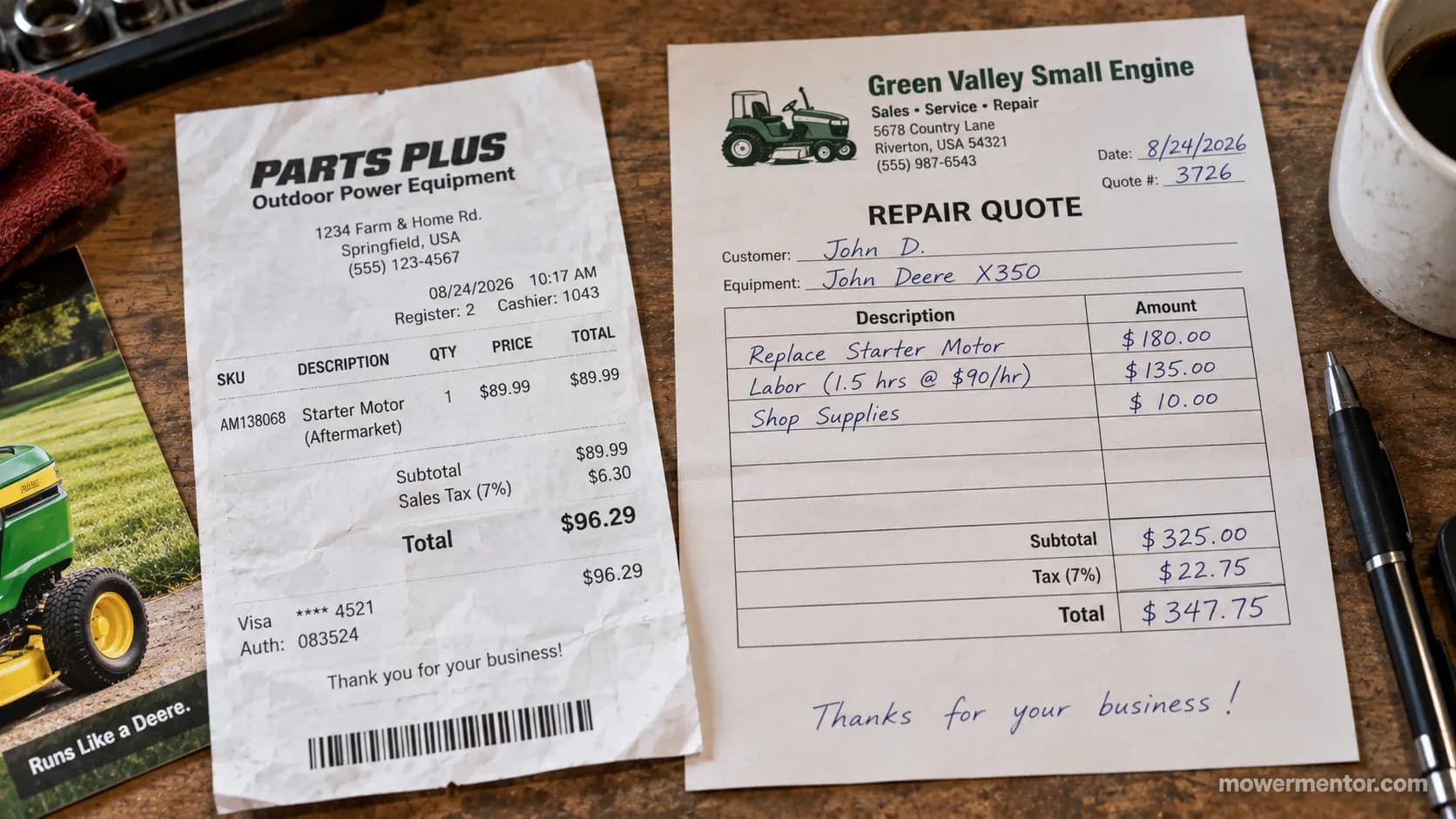
In 2026, aftermarket units commonly run about $35 to $70, while a genuine OEM starter typically costs two to three times that.
Confirm current pricing for your exact part before you order, since availability and cost shift year to year.
Aftermarket buys you a lower price, and OEM buys you guaranteed fitment and a longer warranty. For a well-supported model like a D-series tractor, a reputable aftermarket starter that matches the tooth count and rotation is a sound choice.
The aftermarket unit I fitted to the D130 cost roughly a third of the local shop's quote to do the same swap, and I kept both the receipt and the quote.
Where DIY stops making sense is a buried bolt you cannot reach, no metric sockets on hand, or no time before the grass gets away from you.
If a cold-morning no-start is your only issue, a heat patch to "preheat the starter" can buy one more start, but treat it as a stopgap and plan the swap.
While you have parts on order, it is worth booking a full seasonal tune-up. Grab the right air filter by model in the same trip so nothing else is overdue.
Frequently Asked Questions
These are the questions John Deere owners ask most once the mower will not crank, answered in the same test-first order the guide follows, with the 12.6-volt battery baseline as the starting point.
Bad starter or bad solenoid: how do I tell them apart?
A single click with no crank is almost always the solenoid, while a motor that spins without turning the engine (or stays silent with full voltage) is the starter. The screwdriver bridge across the two large solenoid posts settles it in seconds.
Can I test the starter without removing it?
Read voltage at the starter stud while cranking and compare it to the battery, since a drop over 1 volt across the cable points to the cable or ground rather than the motor. Pull the starter for a bench jump only if the on-mower numbers look fine but it still will not spin.
Why does my John Deere starter just spin?
The pinion is turning without climbing the flywheel, which is a worn starter drive or over-running clutch, not necessarily a dead motor. It still means replacing or rebuilding the starter, because the drive is part of the unit on these small machines.
What starter fits my John Deere?
Match by engine and tooth count: most Briggs-engined models take MIA13038 (15-tooth) or MIU13772 (16-tooth), while Kawasaki-engined units like the 170 and 240 use AM104559 (9-tooth). Always confirm the fit against your model and serial number.
How much does a replacement starter cost?
In 2026, plan on roughly $35 to $70 for an aftermarket unit and two to three times that for genuine OEM. Because that is usually less than shop labor for the swap, testing first and installing it yourself is where the real savings sit.
What else is worth checking while I am in the electrical bay?
Since the shroud is already off, it is a good moment to fit the right spark plug by model and clean up the ignition and charging connections. Many owners also clean or replace the air filter at the same time so a fresh start is not undone by a starving engine.
The Bottom Line: Test Before You Buy
Two of every three "dead starter" complaints I ran through the differential turned out to be a clicking solenoid or a dead key switch, not the motor.
That is the case for spending five minutes with a multimeter before spending anything at the parts counter.
Route the sound first, confirm voltage is actually reaching the starter, then rule out the solenoid and the key switch.
If the motor gets its 12 volts and still will not spin or the pinion just free-spins, you have earned the purchase, and the fitment table gets you the correct unit the first time.
A bad John Deere riding mower starter is worth replacing yourself on most residential models, quickly and cheaply, once the test has proven it is truly the failed part.
Start with the 30-second check at the top, work down through the differential, and buy only what your own readings tell you to.
Found this useful? Make us a preferred source so we show up in your Google results.
Keep reading
Related articles
Troubleshooting & Repair
Dead Dash? Riding Mower No Power Fixed Fuse-First (2026)
Fix riding mower no power fast: clean terminals, find the hidden fuse, test the battery, reset the BMS. A fuse-first checklist for gas & electric mowers.
Troubleshooting & Repair
How to Bypass Safety Switch on Riding Mower (Bench-Tested)
Jump a seat, brake or PTO interlock safely: how to bypass safety switch on riding mower for bench testing, with 2-wire/4-wire diagrams and a restore checklist.
Troubleshooting & Repair
Riding Lawn Mower Won't Turn Over: 5-Stage Voltage Test
Fix it fast: a riding lawn mower won't turn over usually means battery, ground, solenoid or starter. Test each in 5 ordered stages.
Troubleshooting & Repair
Just Clicks? Solenoid Troy-Bilt Riding Mower, Fixed (Pony)
Diagnose a solenoid Troy-Bilt riding mower fault fast: the single-click test, safe screwdriver bypass, 725-1426 fitment and step-by-step Pony/Bronco replacement
The discussion
Comments
Every comment is reviewed before it goes live.