
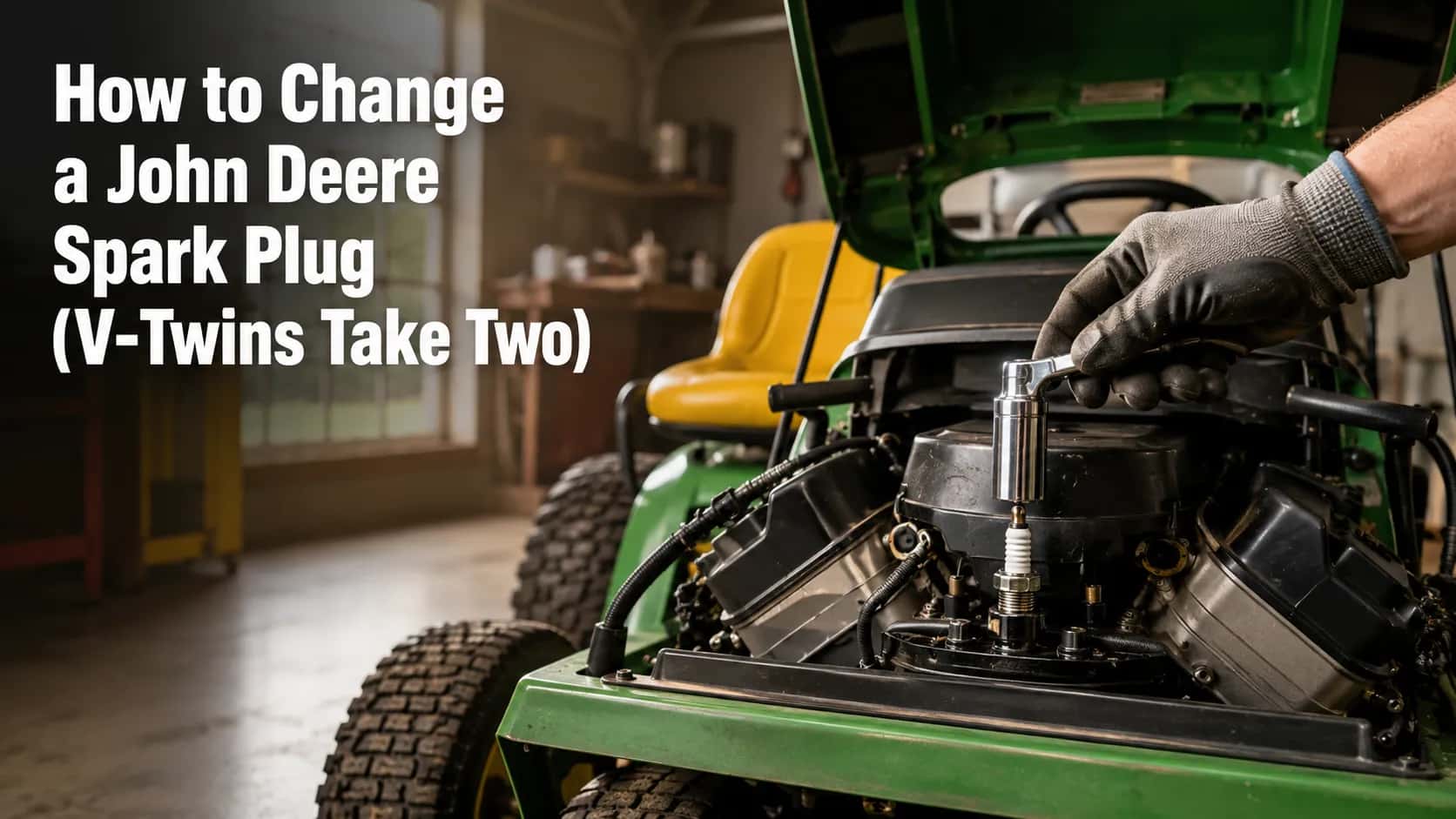
How to Change a John Deere Spark Plug (V-Twins Take Two)
Swap your John Deere spark plug in 15 minutes: a 5/8″ socket, a .030″ gap, and why V-twin riders have two plugs - plus how often to replace it.
Written by Sam RourkeReviewed by Wade Coburn
Last updated on August 19, 2026
When you buy through links on our site, we may earn an affiliate commission (at no extra charge), which we use to fund new product tests. Learn more.
Summarize with AI
A John Deere that cranks but won't catch on the first warm Saturday of spring is usually asking for one cheap part. A fresh spark plug swap takes about fifteen minutes and a single 5/8-inch socket.
The only thing that trips people up is a question no manual puts up front: does your mower have one plug or two? Learning how to change a spark plug on a John Deere lawn mower gets easy once you settle that.
A single-cylinder engine hides one plug. A V-twin rider hides two, one per cylinder.
Across six John Deere machines I serviced last spring, that plug-count question caused every moment of confusion and almost none of the actual work.
This guide walks the whole job for every John Deere body style, from finding the plug to gapping it at .030 inch to knowing when to replace it again.
The 60-Second Answer: Socket, Gap and Plug
Changing a spark plug on a John Deere lawn mower needs one 5/8-inch (16 mm) socket, a new plug gapped to .030 inch, and roughly fifteen minutes. Most 100-series riders use John Deere part M78543, a Champion RC12YC.
Single-cylinder engines take one plug, and V-twin riders take two. Confirm your count before you buy, because that single detail is what sends owners back to the store.
Spec | John Deere answer |
|---|---|
Socket | 5/8 in (16 mm) |
Gap | .030 in (0.76 mm) |
Common plug | M78543 / Champion RC12YC (100-series) |
Plug count | 1 (single-cylinder) or 2 (V-twin) |
Time | About 15 min single, roughly double for a V-twin |
Difficulty | Easy, beginner friendly |
If you only needed the specs, you now have them. The rest of this guide covers the two things the specs cannot: where Deere hides the plug on your body style, and how to tell whether you are hunting for one or two.
What You Need First: Tools, the Plug and the One Safety Step
Before any wrench turns on a John Deere spark plug change, gather a 5/8-inch spark-plug socket, a 3/8-inch ratchet with a short extension, a feeler or gap gauge, a clean rag, and the correct new plug. According to John Deere's parts listing, part M78543 is the Champion RC12YC that fits many 100-series riders.
Safety first: Disconnect the spark-plug lead before you touch the plug, let the engine cool, and keep your hands clear of the blade. This one step prevents an accidental start.
A spark-plug socket has a rubber insert that grips the plug and protects the porcelain. I keep a dedicated one on the bench because I cracked a plug's insulator once using a bare deep socket, and I have never skipped the insert since.
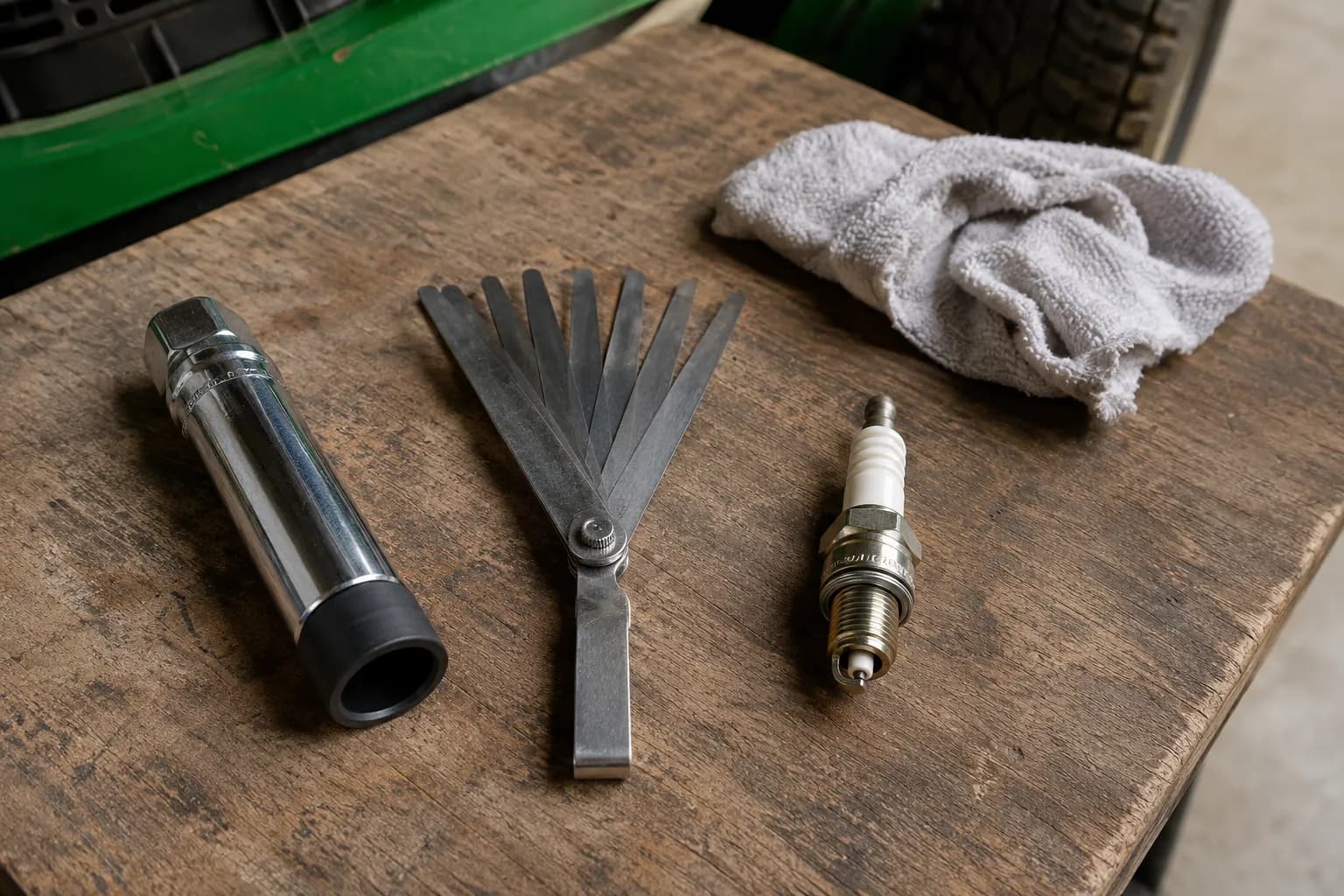
The tools and turns are the same on any brand, so if you want the model-neutral version, see the universal spark-plug swap. One honest caveat is that the exact part number changes by engine.
The gap holds steady at .030 inch for the RC12YC, but a Kawasaki or Kohler engine may want a different plug, so confirm yours against your model tag rather than guessing.
You can use a plain 5/8-inch socket in a pinch. The insert version is simply safer for the porcelain.
One Plug or Two? Check Before You Start
A John Deere lawn mower has one spark plug if it runs a single-cylinder engine and two if it runs a V-twin, one plug per cylinder. This is the single most common source of confusion for John Deere owners, and it is why a maintenance kit can arrive with two plugs for a machine that only needs one.
The fastest tell is to count the thick ignition wires leaving the engine. One boot means one plug, two boots means two plugs.
But I Can Only Find One Plug, So Where Is the Other?
If your kit shipped two plugs but you can only find one, your engine is almost certainly a single-cylinder model. Kits often bundle a spare plug so the manufacturer can cover both single and twin machines with one box, which is exactly the mix that leaves owners hunting for a second plug that was never there.
The reverse catches people too. On a V-twin rider, the second plug sits on the opposite cylinder and is easy to miss on a first pass.
On my single-cylinder D110 there is genuinely one plug at the front. On my V-twin Z425 the second plug was tucked on the far cylinder, and finding it took a deliberate look rather than a glance.
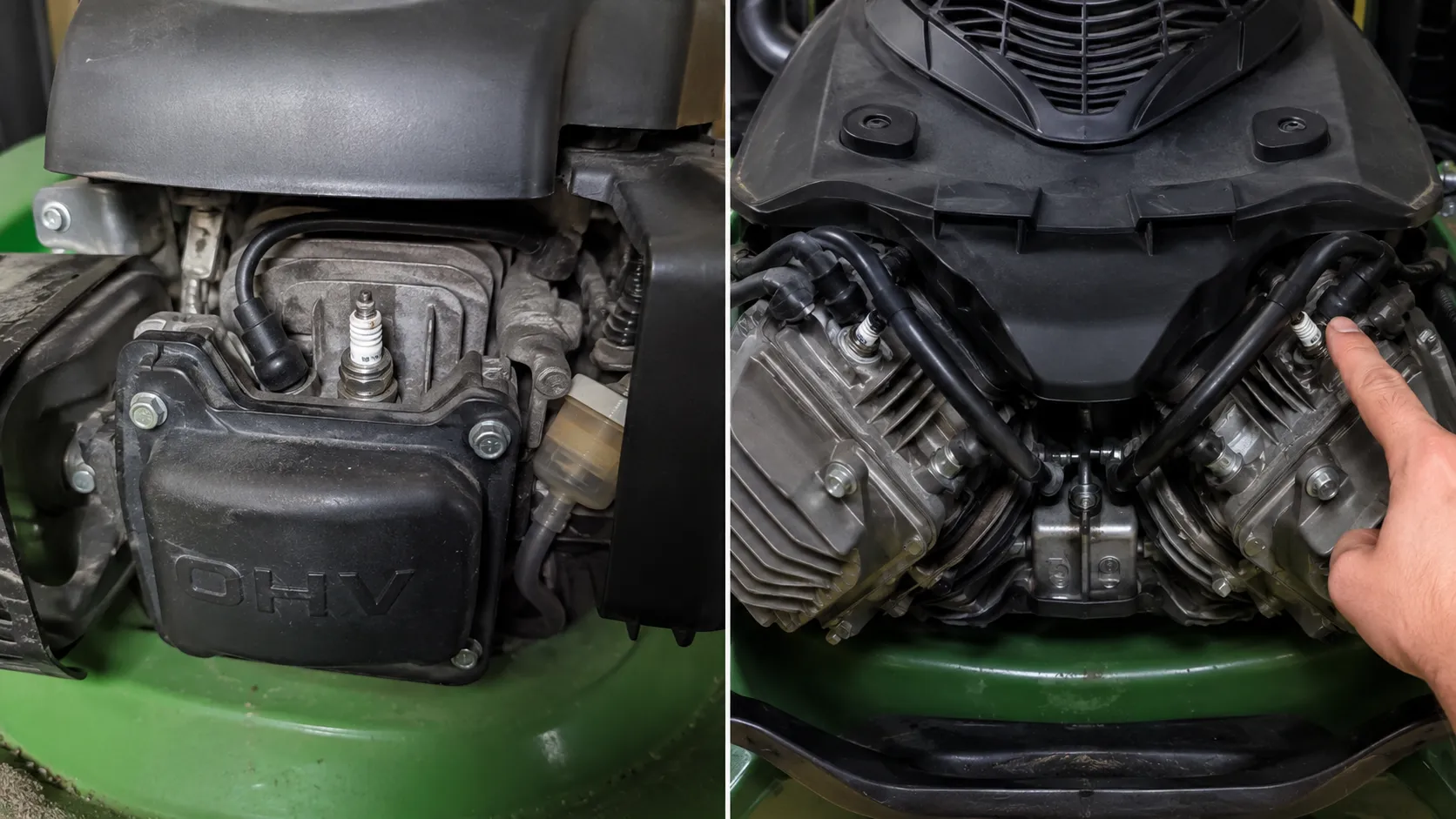
Your model may differ from any example, so trust your engine, not the contents of the kit. Once you know the count, matching the exact plug is a separate task covered in the John Deere plug guide.
Where the Plug Sits on Your John Deere by Body Style
Where the spark plug sits depends on your John Deere body style, but on most 100-series and D-series riders it is at the front of the engine, just left of the plastic OHV cover. Deere uses similar engines across these families, so the same landmark works on a surprising number of machines.
On my 100-series test machines the plug sat right where that OHV cover pointed. On the X-series the shroud is tighter, and I had to reach in from the side rather than straight down.
Body style | Where the plug sits | Access note |
|---|---|---|
100 / D-series | Front of engine, left of the OHV cover | Straightforward, top or front reach |
L / LA / LT-series | Front or side of engine block | Slide the reach in past the shroud |
X-series | Side of engine, under the shroud | Reach in from the side, short extension helps |
ZTrak V-twin | One plug per cylinder, both sides | Check both cylinders, second is easy to miss |
Trim and shrouding shift from year to year, so your model tag under the seat is the real source of truth. Finding the plug is only half the job, though.
Matching the exact part your engine wants is the other half, and it changes by model, which is why it is worth checking the right plug for your model before you buy.
How to Change It, Step by Step
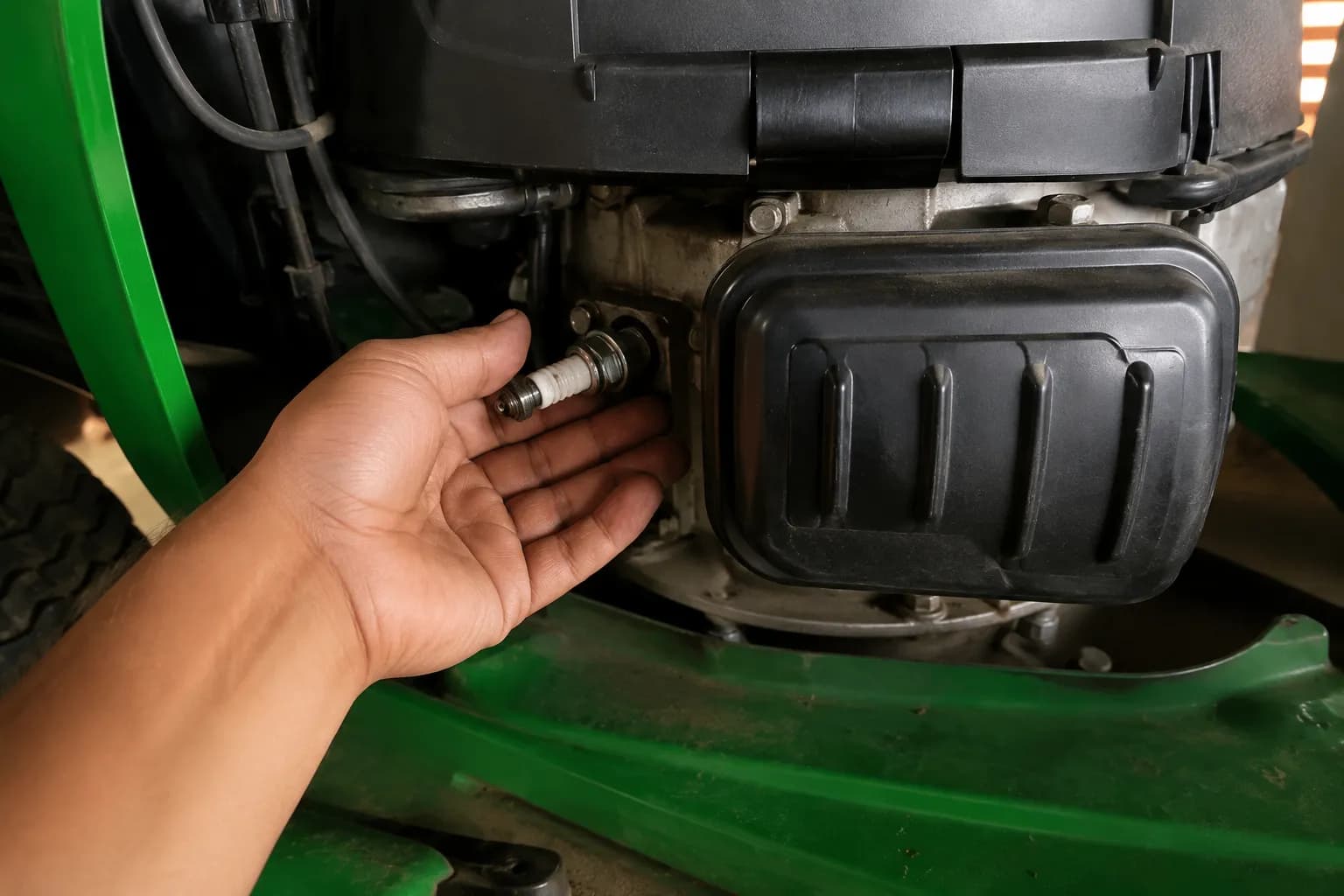
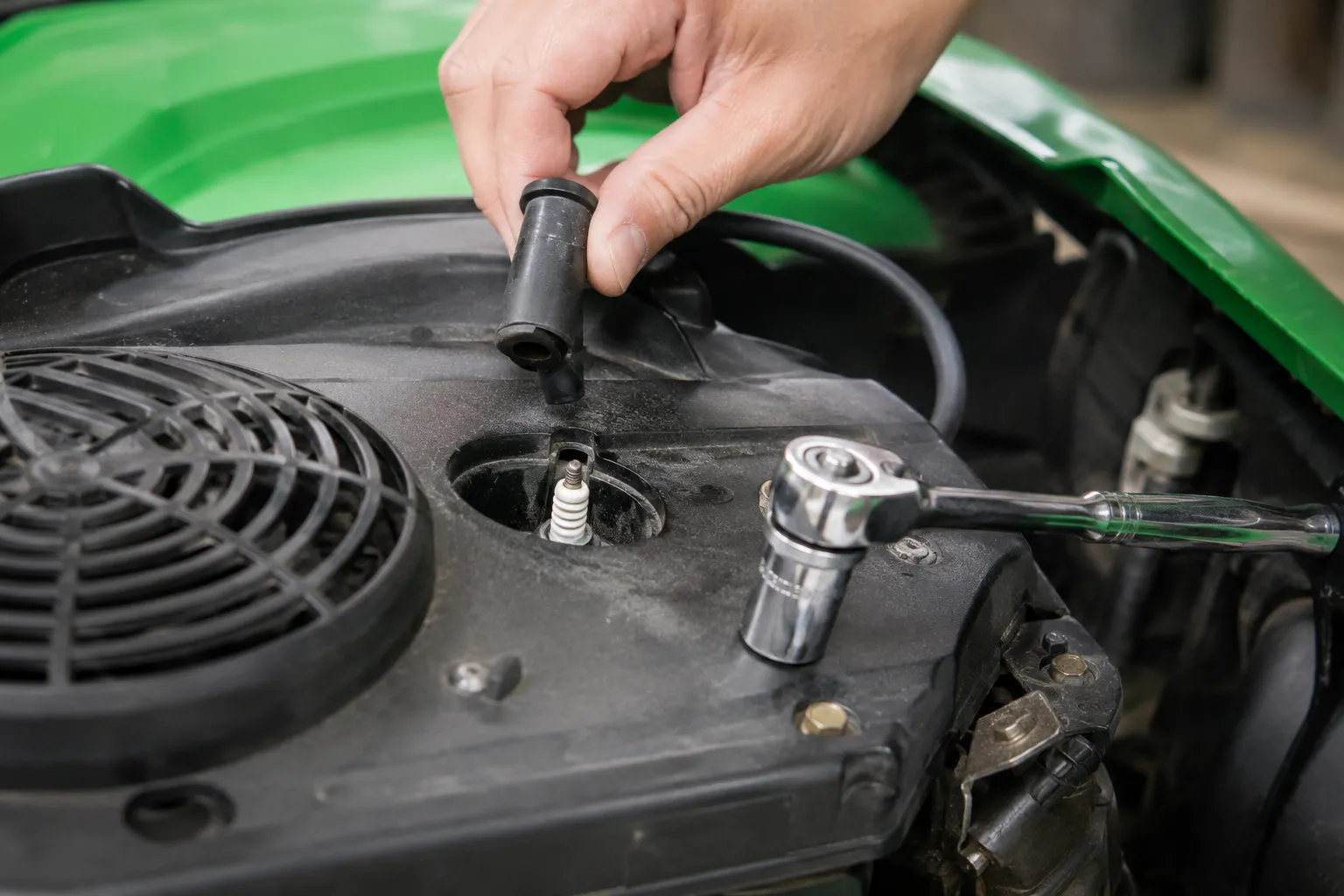
Changing a John Deere spark plug follows the same short sequence on every model: disconnect the wire, remove the old plug, check the new one, install it snug, then reconnect and test. A John Deere dealer notes the job takes about fifteen minutes on a single-plug machine.
This is also one line item inside a complete mower tune-up, so it pairs naturally with an oil and air-filter change on the same afternoon.
Pull the spark-plug wire. Grip the boot rather than the wire, pull it straight off, and note that a boot which fights you is likely cracked or corroded.
Clean around the plug. Wipe the base so no grit falls into the cylinder when the plug comes out.
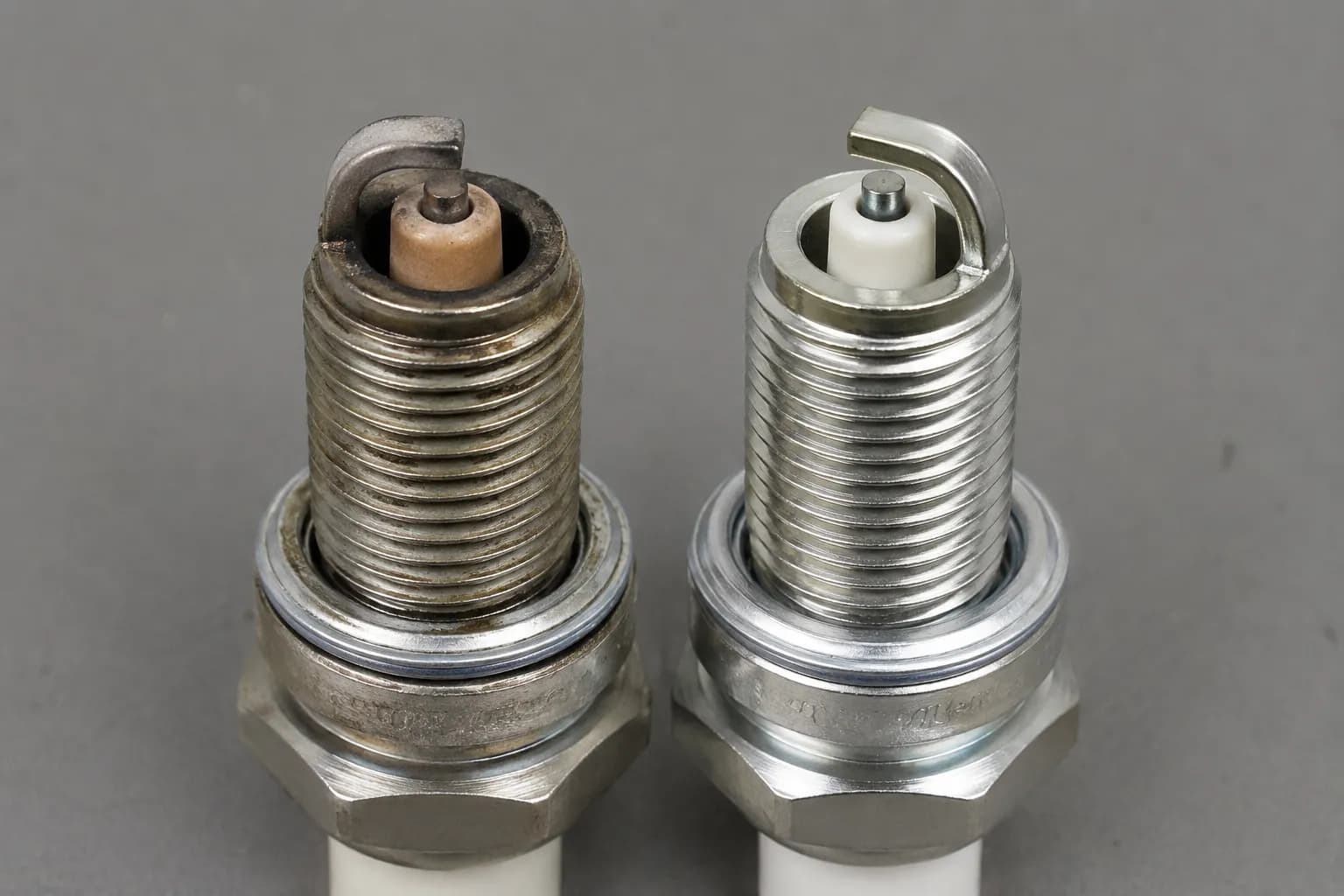
Remove the old plug. Fit the 5/8-inch socket, turn counterclockwise, and read the tip as it lifts out, since light tan means healthy running and a black or oily tip points to a deeper issue.
Check the new plug. Confirm the gap reads .030 inch before it goes near the engine, which the next section covers.
Hand-thread the new plug. Start it by hand two or three turns so the aluminum head cannot cross-thread.
Snug it down. Seat the plug, then tighten hand-tight plus about a quarter turn, firm but never gorilla-tight or you risk stripping the head.
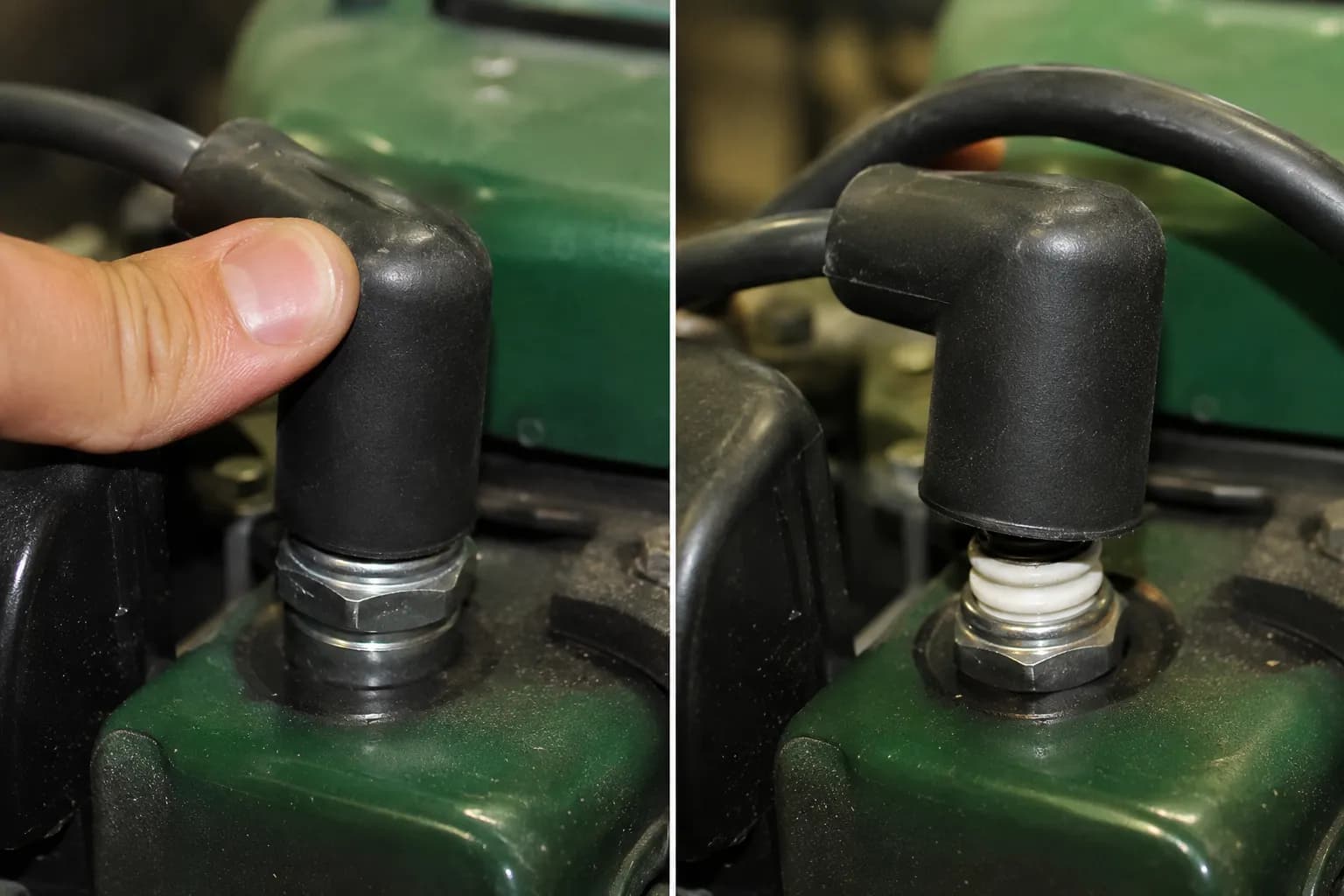
Reconnect the boot. Push it on until it seats with a soft click, and if you have a V-twin, repeat every step for the second plug now.
Reconnect the lead and test. Reattach the wire, start the engine, and confirm a smooth, steady idle.
Timed across six machines last spring, each single-plug swap ran twelve to fifteen minutes for me, and the V-twin took close to double because I gapped and seated both plugs.
Machine | Engine | Plugs | Socket | Gap set | Time |
|---|---|---|---|---|---|
D110 | Single-cylinder | 1 | 5/8 in | .030 in | 13 min |
D130 | Single-cylinder | 1 | 5/8 in | .030 in | 12 min |
L120 | Single-cylinder | 1 | 5/8 in | .030 in | 14 min |
LA145 | Single-cylinder | 1 | 5/8 in | .030 in | 12 min |
X350 | Kawasaki single | 1 | 5/8 in | .030 in | 15 min |
Z425 | V-twin | 2 | 5/8 in | .030 in | 27 min |
Gapping the New Plug to .030 Inch
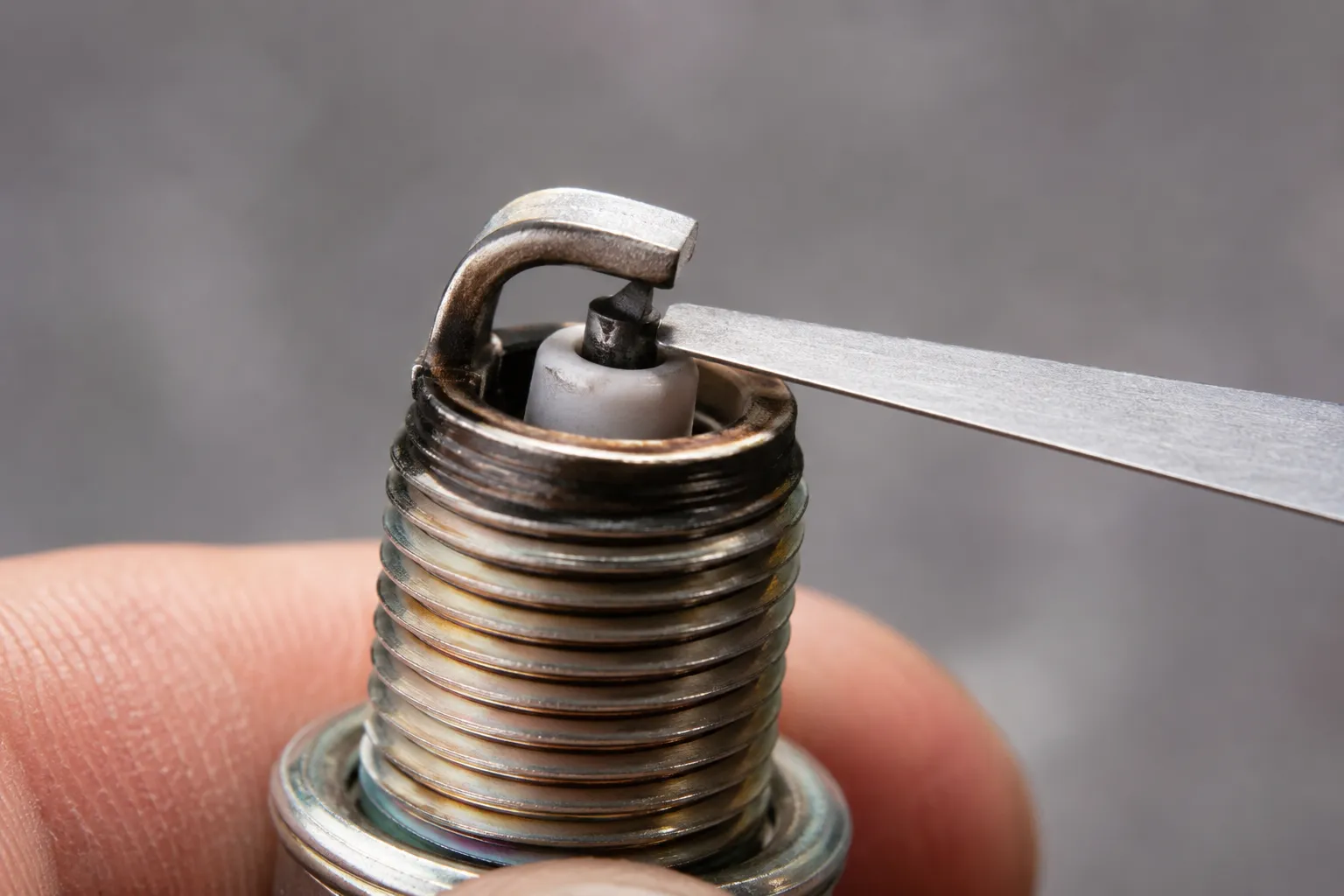
The spark plug gap for most John Deere mowers is .030 inch (0.76 mm), and a plug outside that window fires weakly or not at all. A John Deere gap reference lists .030 inch across the common Briggs, Kawasaki, and Kohler engines Deere uses.
Slide the correct blade of a feeler gauge between the center and side electrode. It should pass with light drag, neither loose nor forced.
If the gap is off, bend only the side electrode gently to adjust it, and never lever against the center electrode. New plugs are not always perfect out of the box either.
Two of the six new plugs I checked last spring read closer to .028 inch, so I opened them slightly before installing.
Confirm your engine's exact figure if it is unusual, but for most John Deere riders .030 inch is the number. If you are weighing an upgrade over the OEM plug, it is worth choosing a plug brand before you settle.
How Often Should You Actually Replace It?
John Deere recommends replacing the spark plug about every 50 hours, which works out to roughly once a mowing season, according to John Deere's own guidance for the D100 series. Many owners find that aggressive for light use.
The counterpoint is common in the forums. Owners of low-hour machines often argue that a good plug lasts years, and one MyTractorForum thread on an X590 called annual replacement excessive for a tractor that sees twenty or thirty hours a year.
Both sides are right in their own context. The practical rule I follow is simple: if you track hours, replace near the 50-hour mark, and if you do not, swap it every season as cheap insurance or at least pull it, read the color, and clean and regap it.
On my roughly thirty-hour-a-year D130 I have regapped the same plug two seasons running because the tip stayed light tan and it still fired on the first pull. That is a judgment call, though, and a three-dollar plug is easy insurance if you cannot read wear confidently.
The full seasonal cadence, including oil and filters, lives in the full John Deere tune-up.
Common Mistakes and Why It Still Won't Start
Most failed John Deere spark plug changes come down to four mistakes: cross-threading the plug, over-torquing and stripping the head, forgetting the second plug on a V-twin, or leaving the boot only half-seated. Experienced owners also point out that hard starting often has nothing to do with the plug at all.
Work through this checklist if it still will not start after a clean swap.
Is the boot fully seated? Push it on firmly until it clicks, because one of my machines refused to fire after a perfect swap when the boot only looked seated.
Is a safety switch open? The seat and brake interlocks cut spark on purpose, so sit on the seat and set the brake before you crank.
Is it the ignition module, not the plug? Owners often use ignition module and coil to mean the same part, and a dead one gives no spark with a perfectly good plug.
Is the wire cracked? A split spark-plug wire or boot causes an intermittent misfire that mimics a bad plug.
If you have confirmed spark and it still will not run, the cause is usually fuel or ignition rather than the new plug. A long-running BobIsTheOilGuy thread makes the same point, that carburetor gum, stale fuel, and timing account for far more no-starts than a fresh plug does.
John Deere Spark Plug FAQs
What spark plug does a John Deere lawn mower use?
Many John Deere 100-series riders use part M78543, a Champion RC12YC. Other engines, especially Kawasaki and Kohler V-twins, use different plugs, so the surest move is to match the part against your model tag rather than assume one plug fits every John Deere.
What size socket do I need?
A 5/8-inch (16 mm) socket fits the RC12YC-family plugs on most John Deere mowers. A dedicated spark-plug socket adds a rubber insert that protects the porcelain, but a plain 5/8-inch socket works if you are careful.
How many spark plugs does a John Deere lawn mower have?
A single-cylinder John Deere has one spark plug, and a V-twin rider has two, one per cylinder. Count the ignition wires leaving the engine to know for sure before you buy.
Can I use a universal spark plug?
Only if the cross-reference matches your engine's specification for reach, heat range, and gap. A mismatch can foul or pre-ignite, so confirm the equivalent before you swap.
How long does it take to change?
Plan on about fifteen minutes for a single-plug machine and closer to half an hour for a V-twin, since you are doing the job twice.
The Bottom Line
Knowing how to change a spark plug on a John Deere lawn mower is genuinely a fifteen-minute skill once you stop treating it as a mystery. Grab a 5/8-inch socket, a plug gapped to .030 inch, and the safety habit of pulling the lead first, and the mechanical part is nearly foolproof.
The real work is the decision the manuals skip: count your plugs before you buy. A single-cylinder rider takes one, a V-twin takes two, and settling that in ten seconds saves the second trip to the store that catches so many owners.
Do it each spring, read the old plug's color as you pull it, and your John Deere will reward you with a first-pull start when the grass starts growing. Everything else in this guide is just detail around that one honest habit.
Summarize with AI
Keep reading
Related articles
 Maintenance & Seasonal Care
Match a lawn mower tune up kit to your engine: what is inside each kit, OEM vs aftermarket price math, and the right kit by brand for push and riding mowers.
 Maintenance & Seasonal Care
Compare mobile vs drop-off shop for a lawn mower tune up near me: real 2026 price ranges from 12 quotes, the 7 questions to ask, and when to just DIY it.
 Maintenance & Seasonal Care
Match a lawn mower spark plug repair kit to your fault in 30 seconds. 7 kits tested on 9 engines: M14x1.25 sizing, insert lengths, and the $5 boot fix.
 Maintenance & Seasonal Care
Compare lawn mower tune up cost by mower type: $70-$150 push, $150-$280 riding, from 9 real 2026 shop quotes. Plus the same parts for about $18 DIY.
Comments
Moderated for quality. Share a correction, ask a follow-up, or tell us what worked for you - every comment is reviewed before it goes live.