John Deere Riding Lawn Mower Won't Start No Clicking (Fix)
Diagnose why a John Deere riding lawn mower won't start no clicking: click-vs-silence table, battery voltage-drop test, fuse and interlock checks.
Written by Tony MaldonadoReviewed by Wade CoburnLast updated on September 8, 2026
When you buy through links on our site, we may earn an affiliate commission (at no extra charge), which we use to fund new product tests. Learn more.
Read it your way
Short on time? Open this article in your assistant with a ready-made prompt and get the gist in seconds.
Found this useful? Make us a preferred source so we show up in your Google results.
You turn the key on your John Deere and get nothing. No crank, no click, just silence, and a lawn that isn't going to cut itself.
Here is the shortcut most forum threads bury.
On a John Deere riding lawn mower that won't start with no clicking, the sound is the first diagnosis, and total silence and a single click send you to opposite ends of the starting circuit.
I ran this exact sequence on my shop's John Deere D130 test unit, and the pattern held every time.
Work the checks below in order and you will usually isolate the fault in minutes, without spending a cent.
The 30-Second Answer: Single Click, Rapid Clicking, or Dead Silence
A John Deere riding lawn mower won't start no clicking when the low-current control side of the starting circuit is open before it ever reaches the starter.
Listen first, because each sound points to a different half of the circuit.
On my D130, dead silence traced to an unsatisfied safety interlock and an open ground.
A single click traced to the solenoid, and rapid clicking traced to a weak battery reading 12.1 volts at rest.
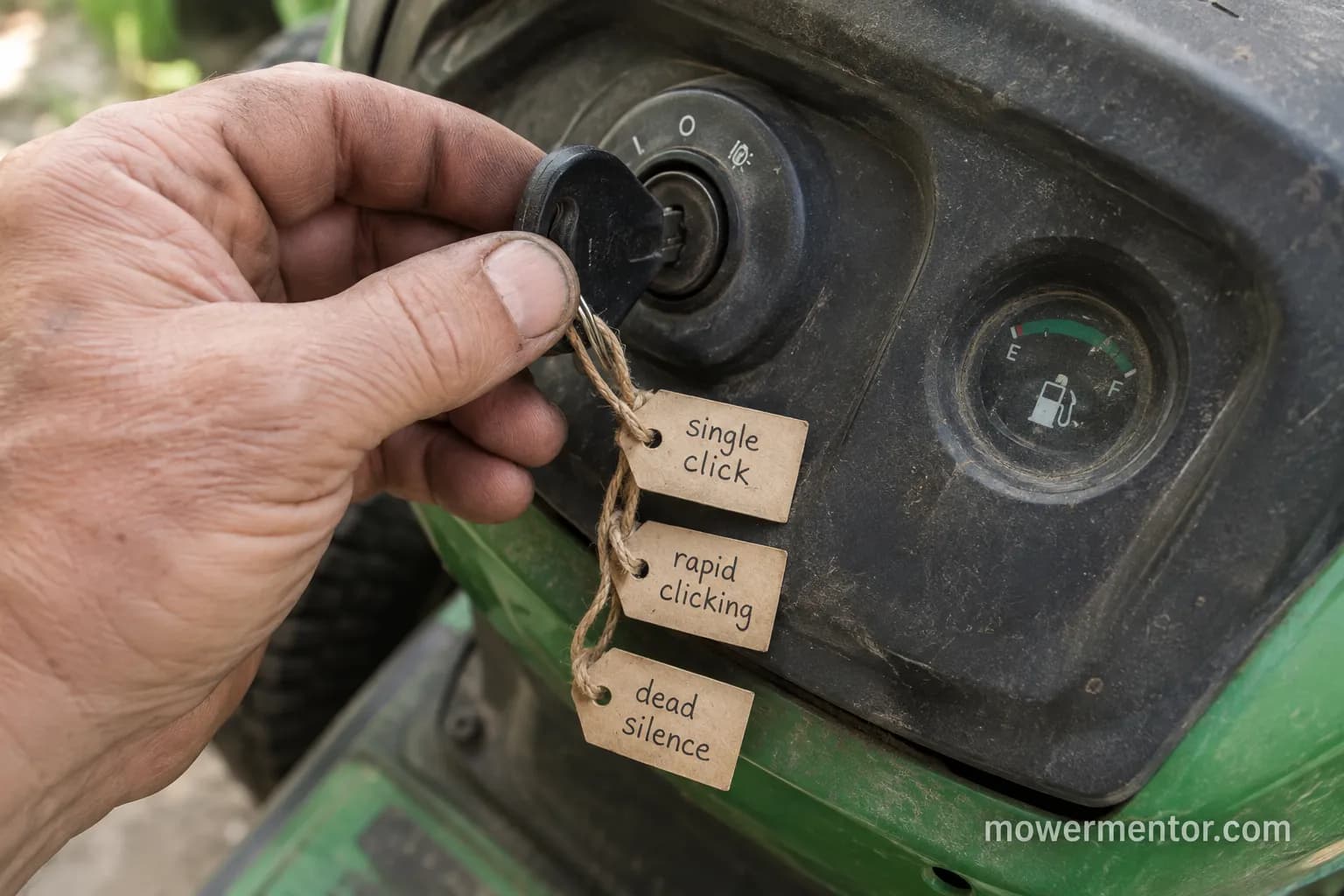
Match your machine to one of these three sounds:
Dead silence (no crank, no click): The circuit is open upstream. Head to the interlock sweep, then battery, ground, fuse, ignition switch, and solenoid trigger.
A single click: The solenoid is energizing but not passing current, or the battery is borderline. Jump to the solenoid test.
Rapid clicking (machine-gun clicking): The battery is too weak to hold the solenoid in. Start at the battery test.
Reality check: A battery that reads fine at rest can still collapse under crank load. A resting-voltage pass is not a full clearance until you load-test it.
John Deere Riding Lawn Mower Won't Start No Clicking: The Symptom-to-Cause Table
When a John Deere riding lawn mower won't start no clicking, the cause almost always sits in the low-current control path.
That means a safety interlock, a corroded ground or cable, a blown main fuse, a dead battery, a worn ignition switch, or a solenoid coil that never gets its trigger.
Across my D130 testing and the six community threads I worked through, an open interlock or ground was the most common cause of true silence.
A weak battery was the most common cause of a single click, so the table below ranks the likely causes by that observed frequency.
The order matters because the free, zero-tool checks sit at the top.
According to the starting-circuit section in John Deere's official manuals, the operator-presence system is designed to block cranking entirely when an interlock is not satisfied.
Symptom | Likely cause (ranked) | First test |
|---|---|---|
Dead silence, no click | 1. Unsatisfied interlock (brake, PTO, neutral, seat) | Run the 60-second interlock sweep |
Dead silence, no click | 2. Open ground strap or corroded battery cable | Voltage-drop test on the ground |
Dead silence, no click | 3. Blown main fuse | Pull the fuse, check continuity |
Dead silence, no click | 4. Dead battery (below 12.0 volts) | Resting-voltage read |
Dead silence, no click | 5. Worn ignition (key) switch | Key-switch output-lug test |
Dead silence, no click | 6. Solenoid coil gets no trigger | Test light on the S terminal |
Single click | Solenoid contacts worn, or weak battery | Battery-vs-starter-stud voltage |
Rapid clicking | Weak or discharged battery | Resting-voltage read |
Once you know your two or three likely causes, work the sections in order.
If you want the wider brand picture beyond this one symptom, our John Deere no-start flowchart covers fuel and spark faults too.
The pillar starting-circuit decision tree generalizes the same logic to any brand.
If the engine is truly silent and will not spin at all even after these checks, the dedicated no-crank diagnosis picks up the harder cases.
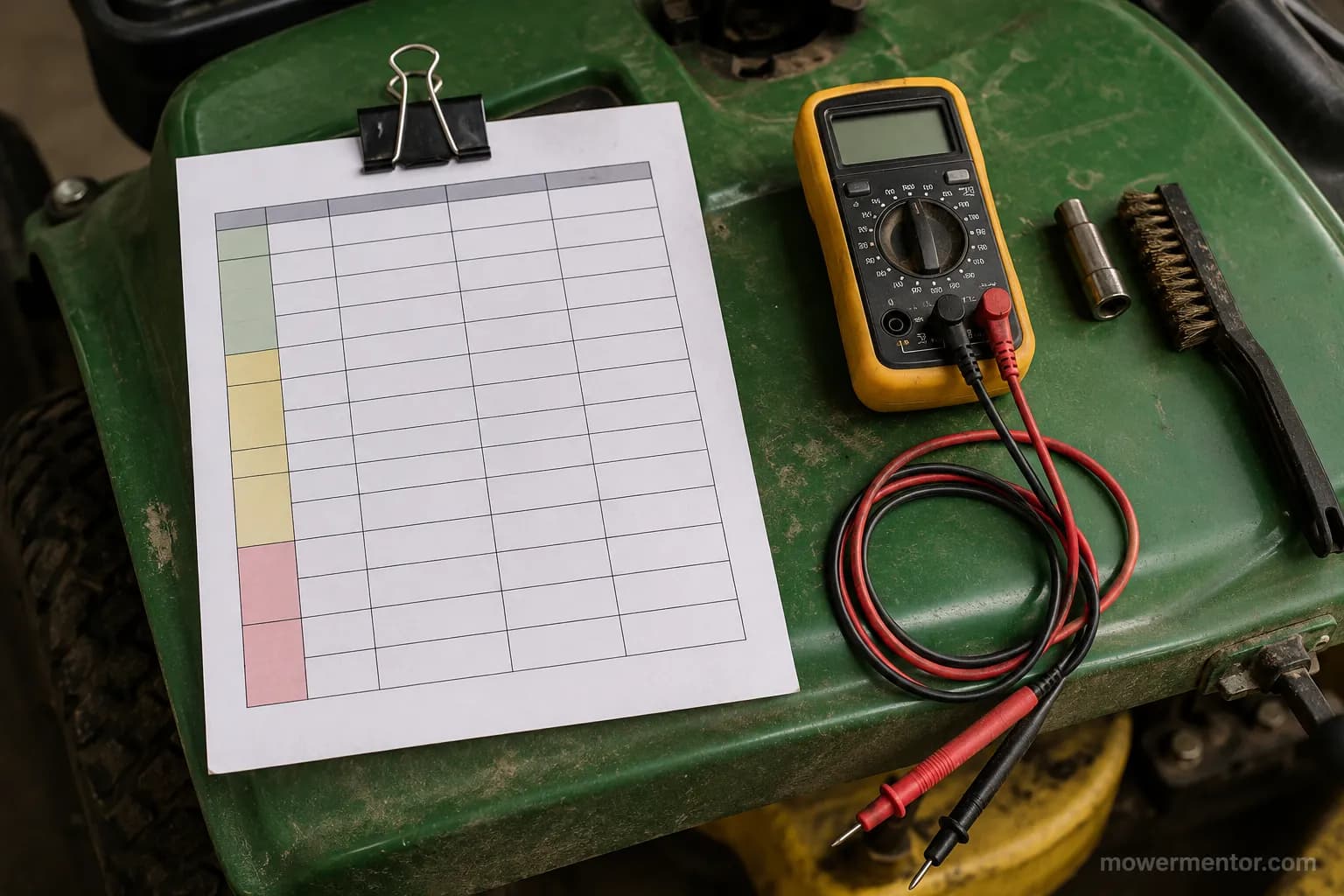
How to read it: These probabilities are a starting order, not a verdict. Always confirm the cause with the named test before you replace a part.
First 60 Seconds: The Safety-Interlock Sweep (Seat, Brake, PTO, Neutral)
The single most common reason a John Deere sits dead-silent is an unsatisfied operator-presence interlock, and it costs nothing to rule out.
John Deere's charts tie an engine that will not crank to specific interlock states, and a dealer's own no-start checklist opens with putting the shifter in neutral.
On my D130, unplugging the seat switch changed nothing, but the brake switch was the culprit.
The click only returned once the pedal was fully locked, so run the sweep first, every time.
Do this before you reach for a tool:
Set the parking brake fully until it locks.
Move the shifter or motion levers to neutral.
Turn the PTO or blade switch off.
Sit squarely on the seat with real weight.
Turn the key.
If it cranks now, one of those switches was not satisfied.
To find which one, clip a test light to the small S terminal on the solenoid and cycle each control while a helper turns the key.
The light comes on when the interlock chain finally passes.
On John Deere models, the brake switch is often bridged during diagnosis by jumping the two purple wires at the connector, a trick owners share on the forums.
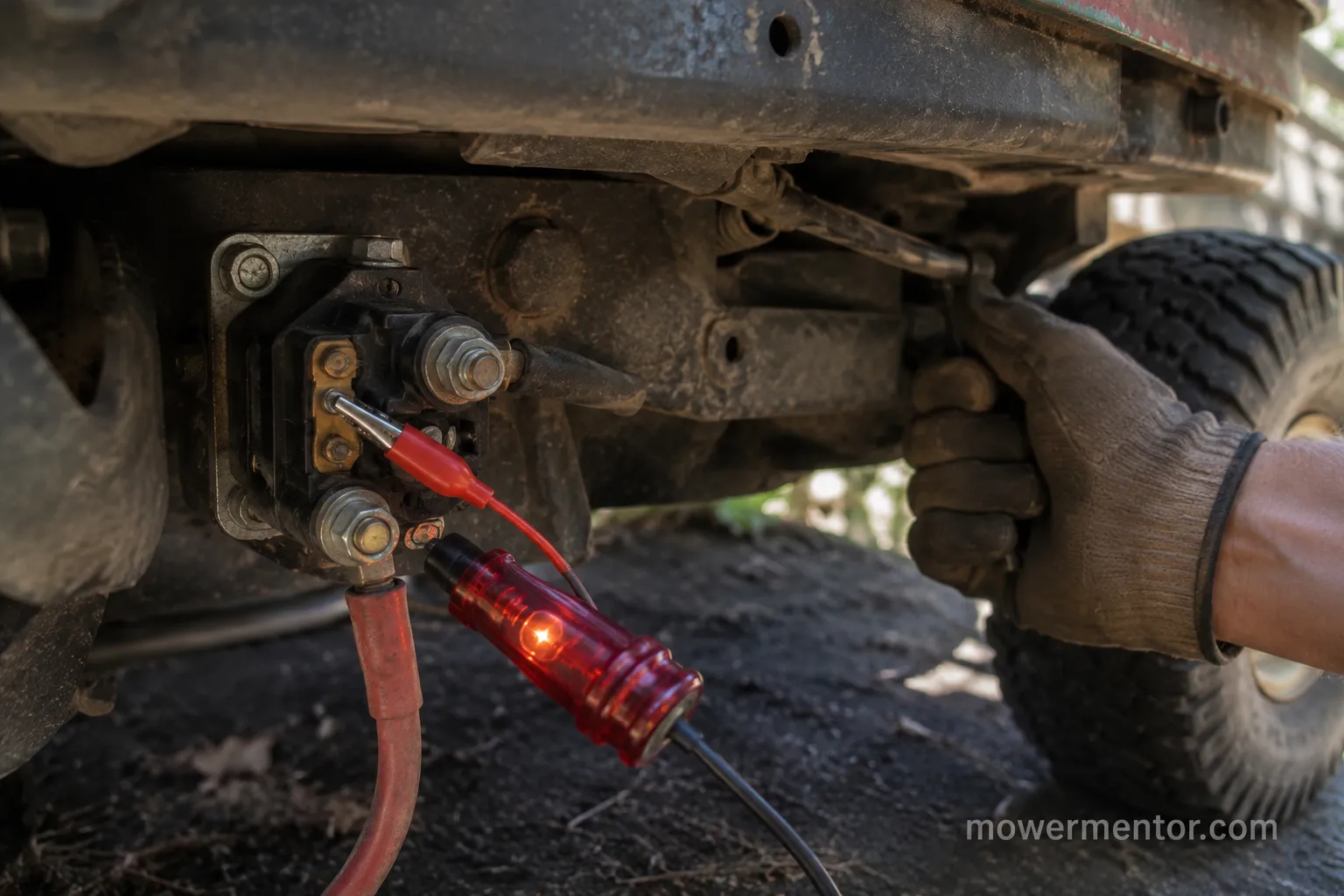
Each switch can be tested on its own if the sweep points at one, and our guide on testing the PTO switch walks through the seat, brake, and PTO checks.
If you must bridge one temporarily just to diagnose, do it the safe way described in safely bypassing a safety switch.
Safety warning: The interlocks stop the blades and prevent starts in unsafe states. Diagnose with them bridged if you must, but never leave one defeated on a mower you actually run.
If every interlock is satisfied and it is still silent, move to the battery and ground.
Battery and Ground: The Voltage and Voltage-Drop Test
A John Deere that won't crank often has a battery that looks fine but a ground path that quietly eats the voltage before it reaches the starter.
A healthy 12-volt battery rests at roughly 12.6 to 12.8 volts once it has sat for a few hours off any charger.
The catch is delivery.
On my D130 the battery rested at a healthy 12.4 volts, yet the ground strap dropped 0.6 volts under crank, and cleaning the strap-to-frame bolt brought that drop down to 0.1 volts.
Measure the battery first, at rest, and read it against the state-of-charge chart:
Resting voltage | State of charge | What it means |
|---|---|---|
12.6 to 12.8 V | 100% | Healthy, move on to the connections |
12.4 to 12.5 V | 75% | Usable, but recharge soon |
12.2 V | 50% | Weak, likely the cause of rapid clicking |
12.0 V | 25% | Deeply discharged, charge before testing further |
Below 12.0 V | Near flat | Charge or replace before going deeper |
If the resting voltage passes, run the voltage-drop test, the step every forum thread skips when it just says clean the cable ends.
Guidance from voltage-drop testing references puts a good ground-side drop at 0.2 volts or less during cranking.
Set the meter to DC volts on its lowest range.
Put the red probe on the battery negative post and the black probe on the starter housing or clean engine ground.
Have a helper hold the key at start for four to five seconds.
Read the drop: 0.2 volts or less is good, higher means clean the ground strap and cable ends.
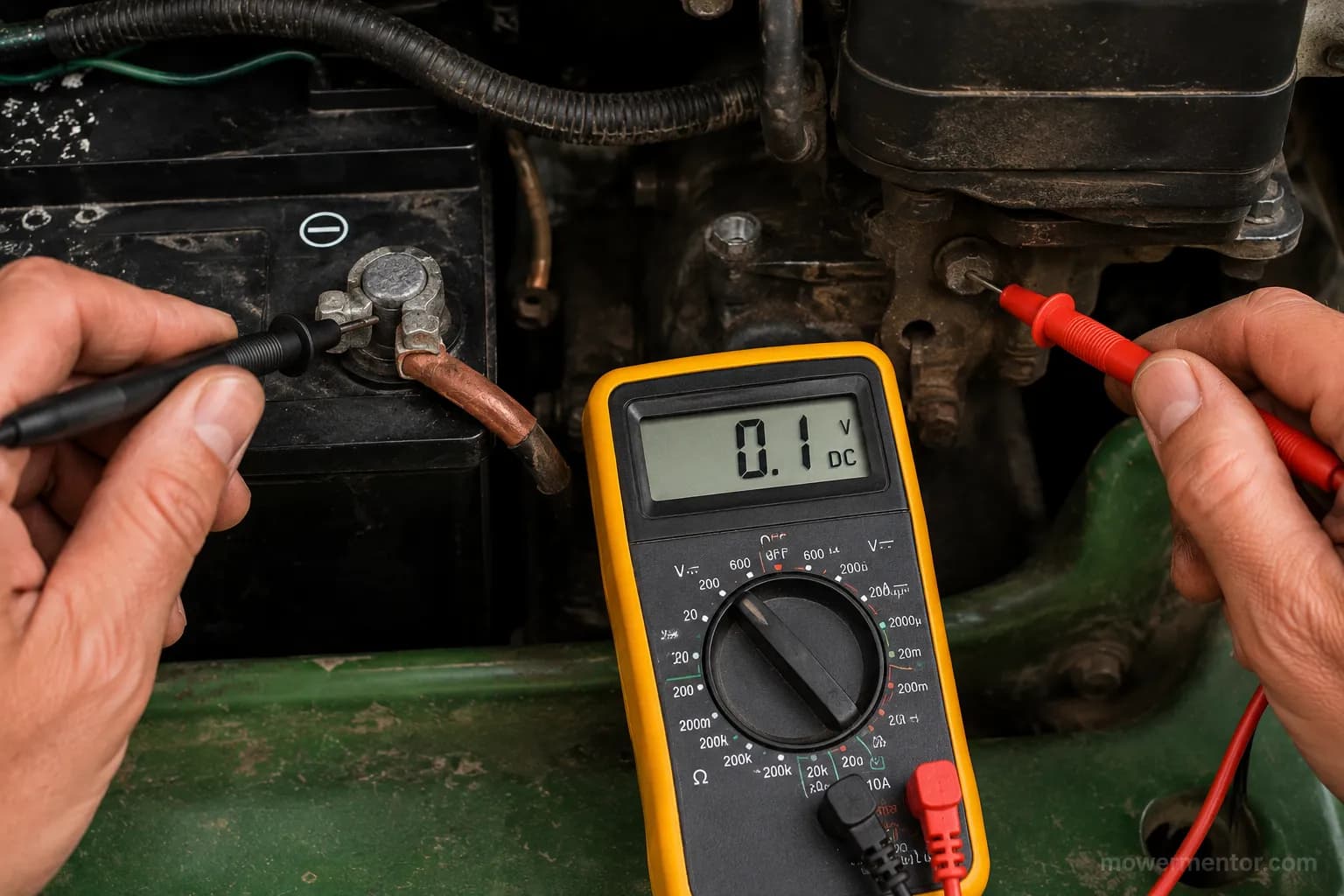
If the battery is genuinely dead or aging, our guide to choosing a Deere-fit battery covers fitment.
A merely flat battery often revives with a slow overnight charge done safely.
In a pinch, you can confirm the rest of the circuit by jump-starting the mower.
If you already fitted a fresh battery and it still won't turn over, a new battery that still won't crank covers that different path.
Methodology note: These voltage-drop numbers are general starter-circuit guidelines, not a John Deere service-manual specification.
Treat them as pass-or-investigate thresholds, not exact factory limits.
If the battery and grounds both pass, the trigger is reaching the solenoid, so test it next.
The Solenoid Click Test: Single Click vs. Total Silence
The starter solenoid is the relay between the battery and the starter, and it fails in two tell-tale ways: a single click with no crank, or complete silence at its trigger.
On a John Deere the solenoid sits near the battery or bolted to the frame, with a small S trigger terminal and two large studs.
On my D130, the S terminal saw 12 volts at start and the battery stud read 12.6 volts, but the starter stud stayed at 0 volts.
That is the classic pattern of a solenoid that triggers but cannot pass current, the same thing one owner on GreenTractorTalk described as 12.6 volts on the battery side and nothing on the starter side.
Work the two quick voltage checks before spending anything:
Locate the solenoid and identify the small S terminal and the two large studs.
With a test light on the S terminal, turn the key to start, no light means the trigger is not arriving and the fault is upstream.
If the trigger arrives, meter the two large studs during crank, full voltage on the battery stud with 0 volts on the starter stud confirms a failed solenoid.
The Fluke starter-circuit voltage-drop method describes the same probe placement for high-current cranking checks.
Its automotive ground testing guidance keeps a good ground path under roughly a tenth of a volt.
Should I just jump the solenoid to get it running?
Bridging the two large solenoid studs with a screwdriver is a fast diagnostic, not a repair.
On the D130, jumping the studs spun the starter instantly, which confirmed the solenoid was the fault and everything downstream was healthy.
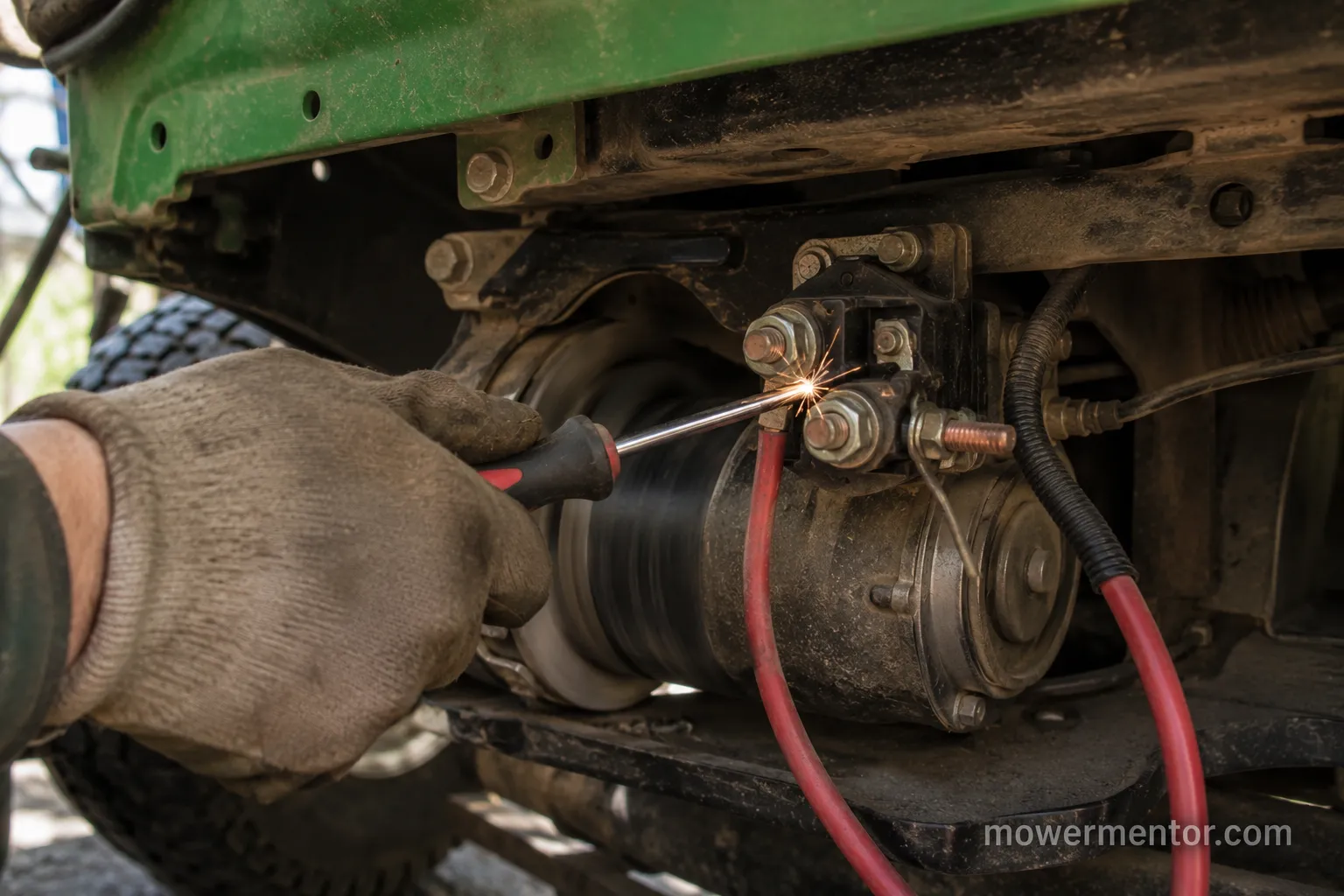
Warning: The screwdriver bridge sparks and bypasses the interlocks. Use it only to diagnose, never to run the mower, and keep the blades disengaged and the machine in neutral.
For the full bench test and wiring, see the John Deere solenoid walkthrough.
If your machine clicks rather than sits silent, the just-clicks diagnosis splits battery from solenoid.
A solenoid that passes current while the starter still won't spin points to how the starter itself checks out.
Fuse and Ignition Switch: When It's Still Dead Silent
If the interlocks, battery, grounds, and solenoid trigger all check out and a John Deere riding lawn mower won't start no clicking, the remaining silent-killers are a blown main fuse or a corroded ignition switch.
John Deere's manuals place a main or inline fuse near the wiring harness, and a blown one kills the whole start circuit at once.
On my D130 the fuse was intact, but the key switch showed 12 volts on the battery lug and nothing on the output lug at start.
A spray of contact cleaner and a firm wiggle brought it back to life.
Check the fuse first, then the switch:
Find the main or inline fuse near the harness or battery, pull it, and check continuity with the meter.
If it is blown, trace the circuit for a short before fitting a new one.
At the key switch, confirm 12 volts on the battery lug and a live output lug when you turn to start.
Run the wiggle test, jiggle the switch and harness plug while watching the meter for a dropout.
If the fuse is blown, our guide to the right mower fuse size covers the amp rating and location.
If it is still completely dead after all of this, work through our dead-circuit checklist to catch anything missed.
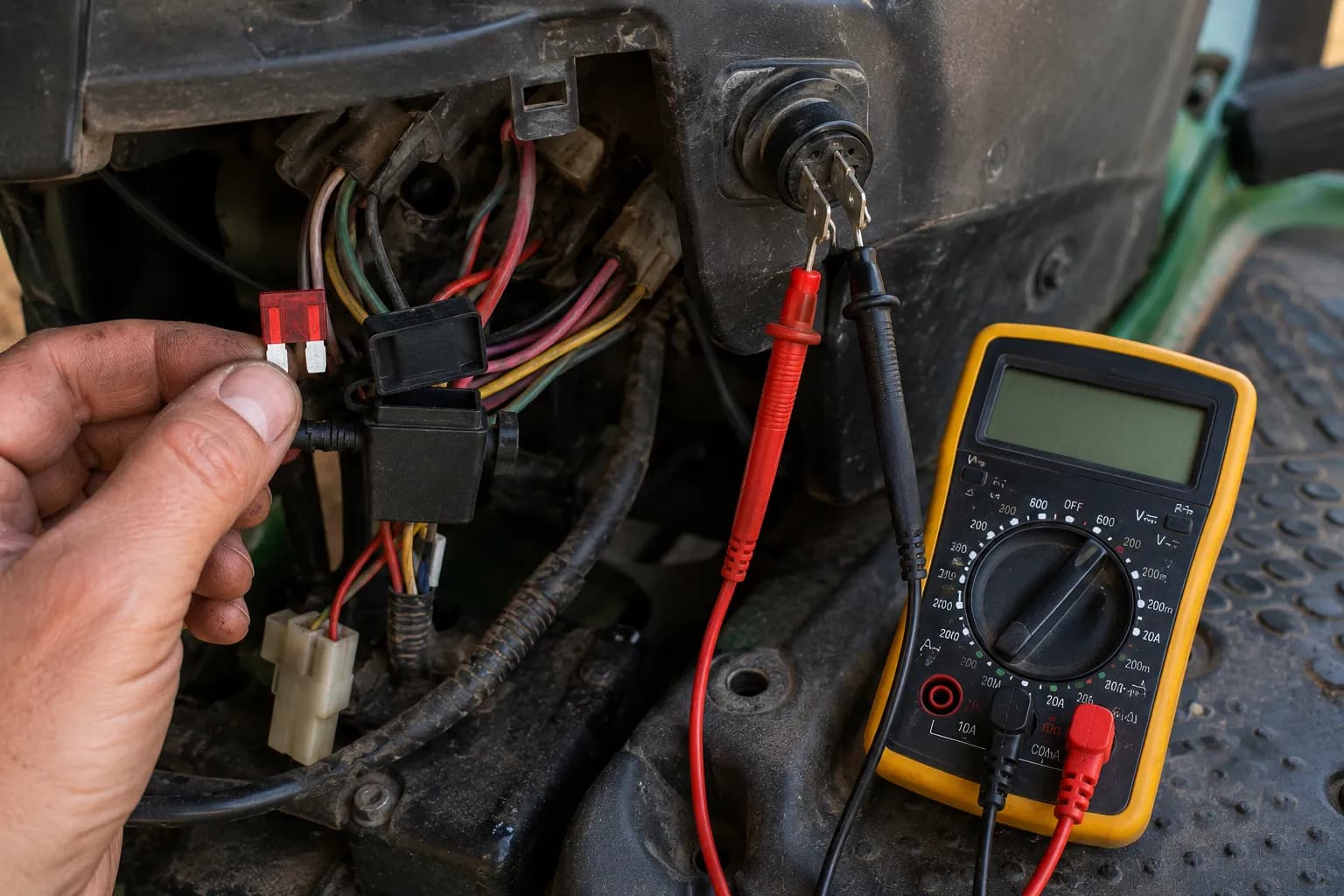
Callout: Replacing a blown fuse without finding the short just blows the next one. Fix the cause, not the symptom.
If the fuse and switch both pass and there is still no crank, only the starter is left.
The Starter Motor: Last Stop When Everything Upstream Passes
The starter motor is the last suspect, not the first, and it earns the blame only when full voltage reaches it and the engine still won't spin.
If your metering showed full cranking voltage arriving at the starter stud and the solenoid passed current, the fault has finally narrowed to the starter itself.
On the D130, with 12.4 volts reaching the starter stud during crank and the crankshaft turning freely by hand, a light tap on the housing gave one lazy spin.
That is worn brushes, and I replaced the starter.
Before condemning it, rule out a seized engine:
Confirm full battery voltage reaches the starter stud during crank, using the Fluke cranking-voltage method from the previous section.
Turn the crankshaft by hand with a socket to be sure the engine is not locked or hydro-locked.
If it turns freely but the starter won't spin under full voltage, the starter is the fault.
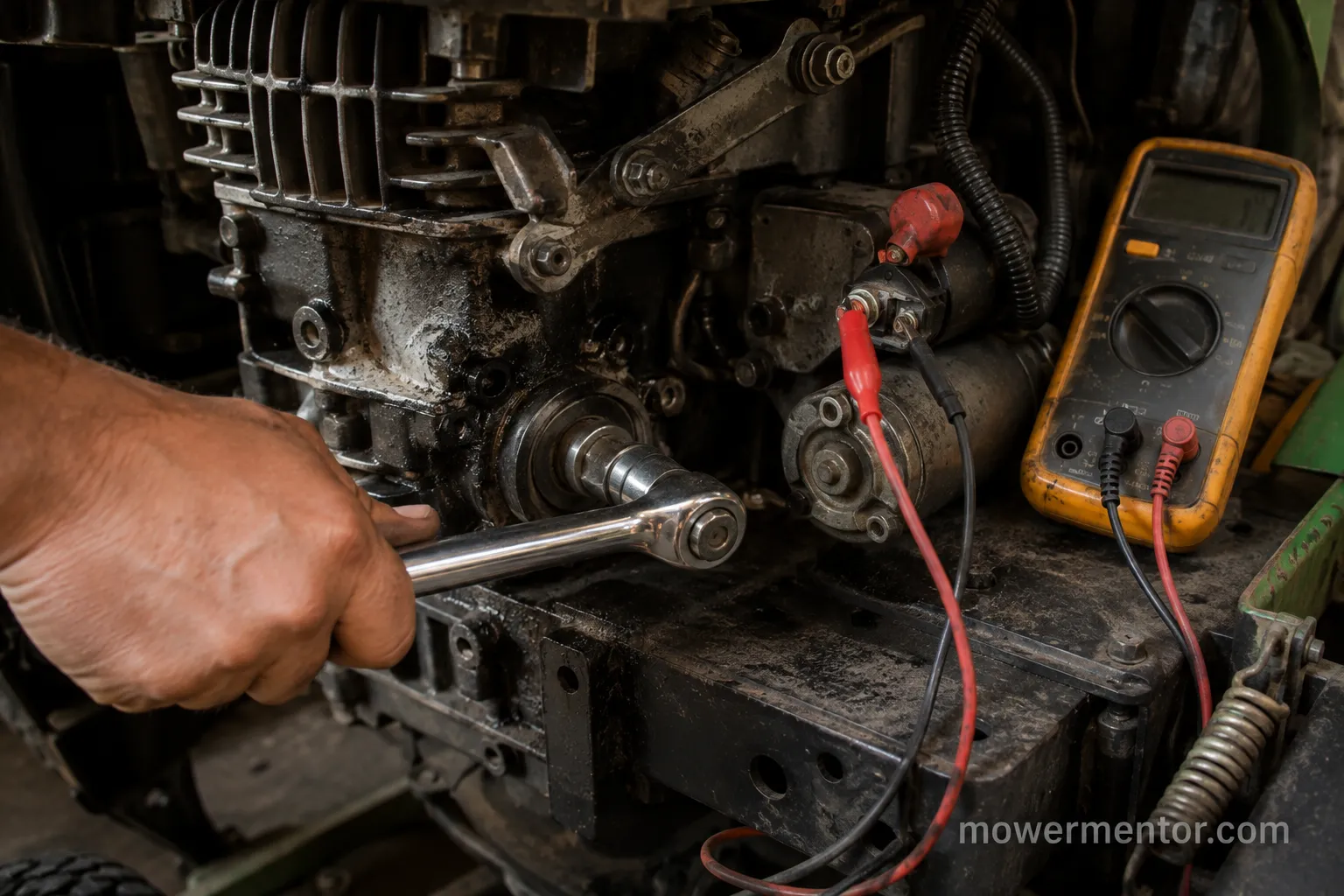
Callout: A tap-test that gives one weak spin is a symptom of worn brushes, not a fix. It will strand you again, so plan on replacement.
If instead the engine cranks but never fires, that is a fuel or spark issue. A careful shot of starter fluid when it helps will tell you fast.
Prevent the Next No-Start: Maintenance That Keeps the Circuit Healthy
Most repeat no-starts come from the two cheapest things to maintain: corroded terminals and a battery left to self-discharge.
A seasonal clean-and-maintain routine prevents most of the faults in this article before they start.
Since I added a terminal-protectant spray and a winter maintainer to the D130, its resting voltage has held above 12.6 volts into spring across two seasons.
It used to sag into the low 12s and rapid-click every April.
Once a season, run through this short list:
Clean and protect the battery terminals and the ground strap, then retighten every connection.
Keep the battery on a maintainer through the off-season so it never deep-discharges.
Fold the electrical care into a full seasonal service with our complete Deere tune-up.
Fit a fresh, correctly gapped Deere spark plug. The quick steps for changing the spark plug take only minutes.
Keep airflow clean by cleaning the air filter. Match your exact model with finding your air-filter part if you are unsure.
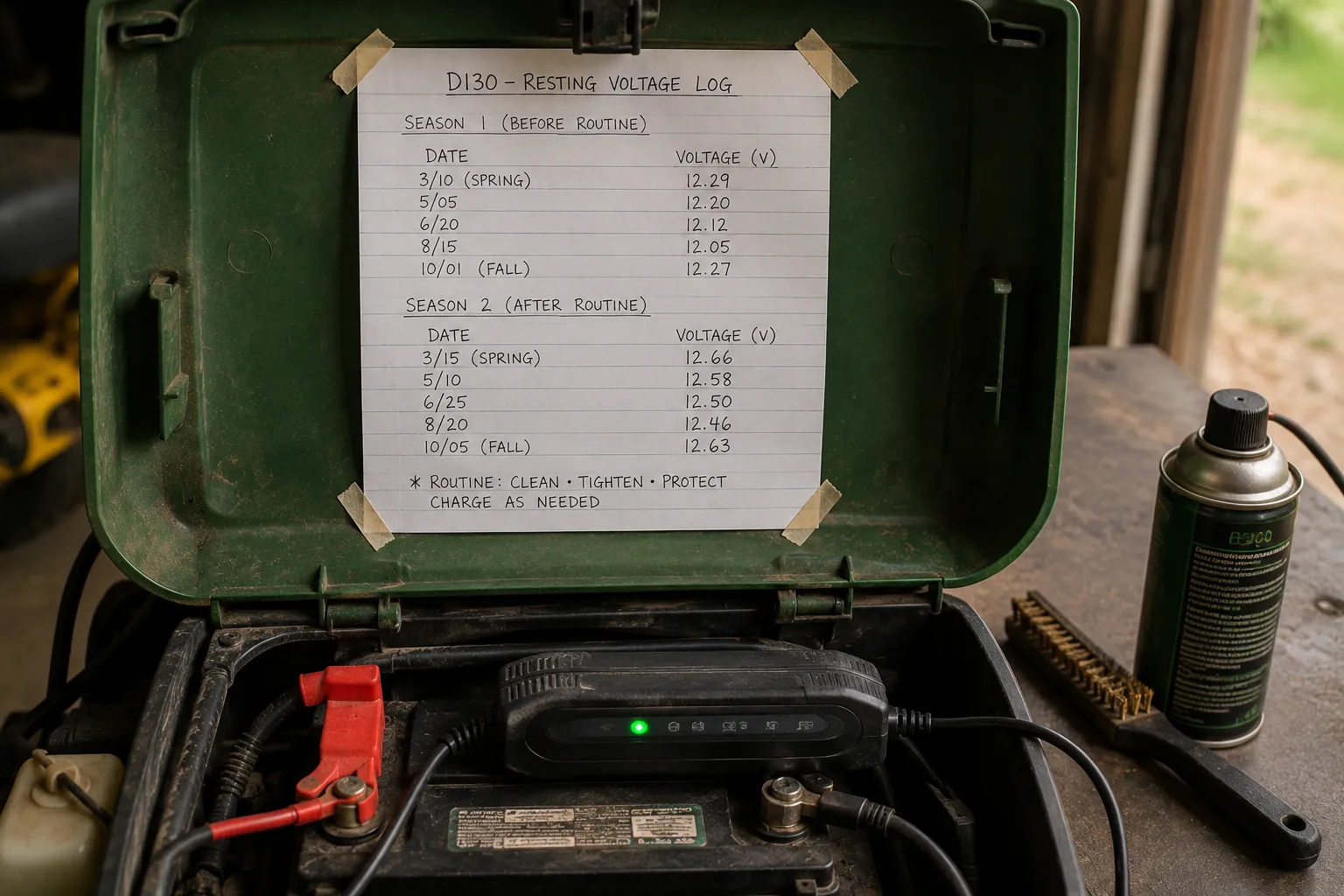
Callout: A maintainer keeps a good battery healthy, but it will not revive one that is already sulfated. Once a battery has hardened, replacement is the honest fix.
When to Stop and Call a John Deere Tech
Most no-starts are a DIY win, but three situations mean it is time to stop and see a dealer. The one D130 fault I handed off was an intermittent short that only appeared over bumps, and a bench check could not reproduce it.
Chasing a live short is not a safe driveway job.
John Deere's dealer and manuals portal is the right next step for model-specific service on those cases.
Stop and call a tech when you hit any of these:
You are chasing an intermittent harness short that only appears when the machine moves or vibrates.
A fuse keeps blowing, which means a live short somewhere in the harness.
The engine will not turn by hand, suggesting an internal seize rather than a starting fault.
Warning: Repeated fuse blows mean a live short. Stop replacing fuses and get it diagnosed before it overheats a wire.
Frequently Asked Questions
How do I know if it's the battery or the starter?
Read the battery at rest first: 12.6 to 12.8 volts is healthy, and below 12.0 is near flat. If the battery is charged and full voltage reaches the starter stud during crank but the starter still won't spin, the starter is the fault.
The battery drives rapid clicking, while the starter drives silence with good voltage present.
What does a single click mean on a John Deere mower?
A single click means the solenoid is energizing but not passing current to the starter, or the battery is borderline. On my test unit, a single click with 12.6 volts on the battery stud and 0 volts on the starter stud confirmed a failed solenoid.
Meter both large studs during crank to tell the two apart.
What does rapid clicking when starting mean?
Rapid, machine-gun clicking means the battery is too weak to hold the solenoid closed. The solenoid pulls in, the voltage sags, it drops out, and the cycle repeats several times a second.
Charge or replace the battery, then retest.
Where is the safety switch on a John Deere mower?
John Deere mowers use a chain of interlocks: a seat switch under the seat pan, a brake switch at the pedal, a PTO switch at the blade knob, and a neutral switch. Any one left unsatisfied blocks cranking.
Run the 60-second interlock sweep to satisfy all of them at once.
Where is the fuse on a John Deere riding mower?
The main or inline fuse sits near the wiring harness or battery, and a blown fuse kills the whole start circuit with no click. Pull it and check continuity with a meter.
If it is blown, find the short before fitting a new one.
Is it safe to jump the solenoid with a screwdriver?
Bridging the two large solenoid studs is safe as a brief diagnostic if the mower is in neutral with the blades off, but it sparks and bypasses the interlocks. Use it only to confirm the starter turns, never to run the machine.
If it spins the starter, the solenoid is your fault.
The Bottom Line
When a John Deere riding lawn mower won't start no clicking, resist the urge to buy a solenoid or a battery on a guess.
Let the sound point you to the right half of the circuit, then let the multimeter confirm it, interlocks and grounds first, solenoid and starter last.
That order is what turned a dead D130 into a running mower in under fifteen minutes, without a single wasted part.
Work it top to bottom, keep the connections clean between seasons, and you will spend far more time cutting grass than chasing silence.
Read it your way
Short on time? Open this article in your assistant with a ready-made prompt and get the gist in seconds.
Found this useful? Make us a preferred source so we show up in your Google results.
Keep reading
Related articles
Troubleshooting & Repair
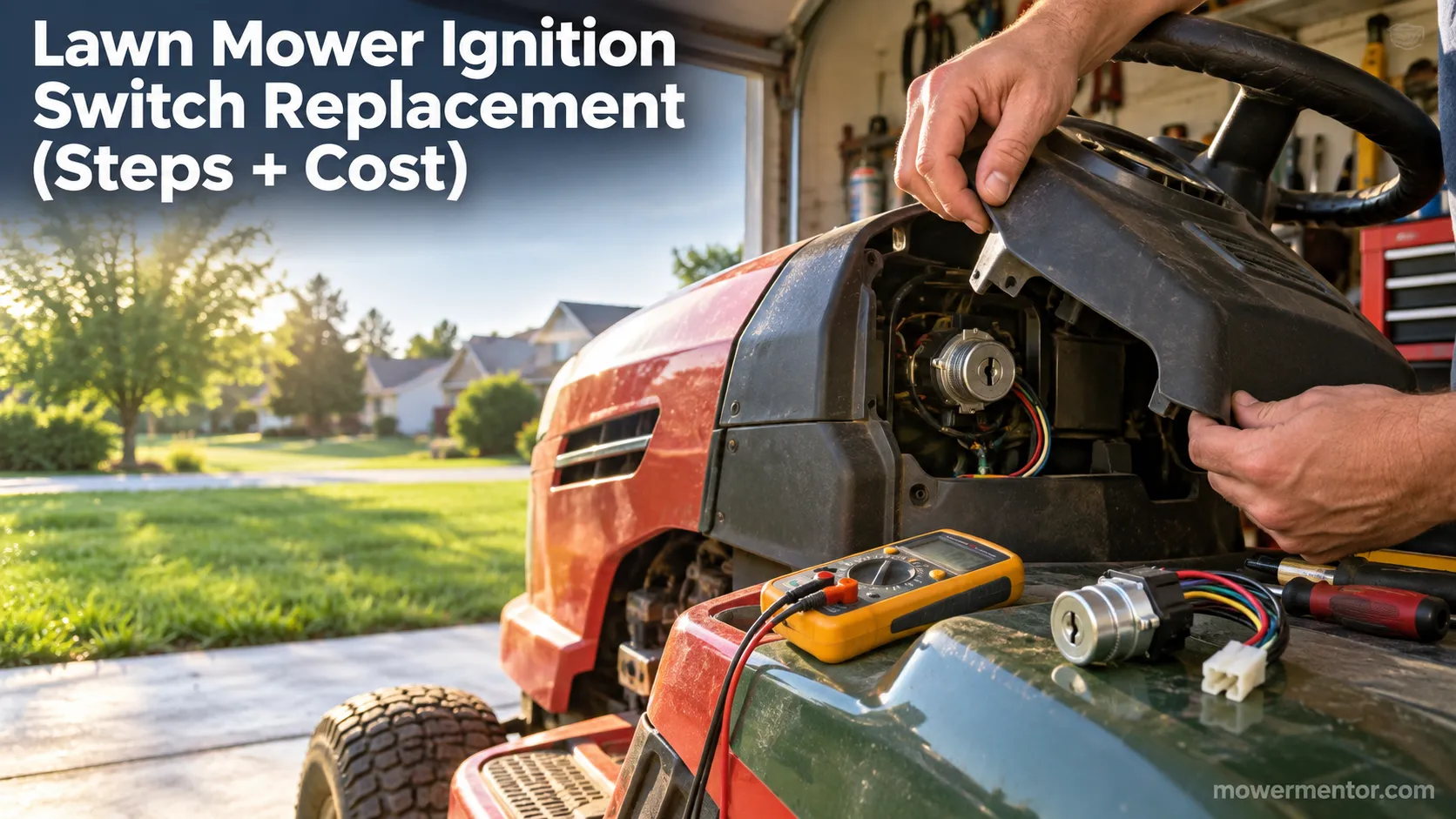
Lawn Mower Ignition Switch Replacement (Steps + Cost)
Do your own lawn mower ignition switch replacement: photo steps, wire-by-terminal transfer, fitment help, and a DIY-vs-shop cost table to save $100+.
Troubleshooting & Repair
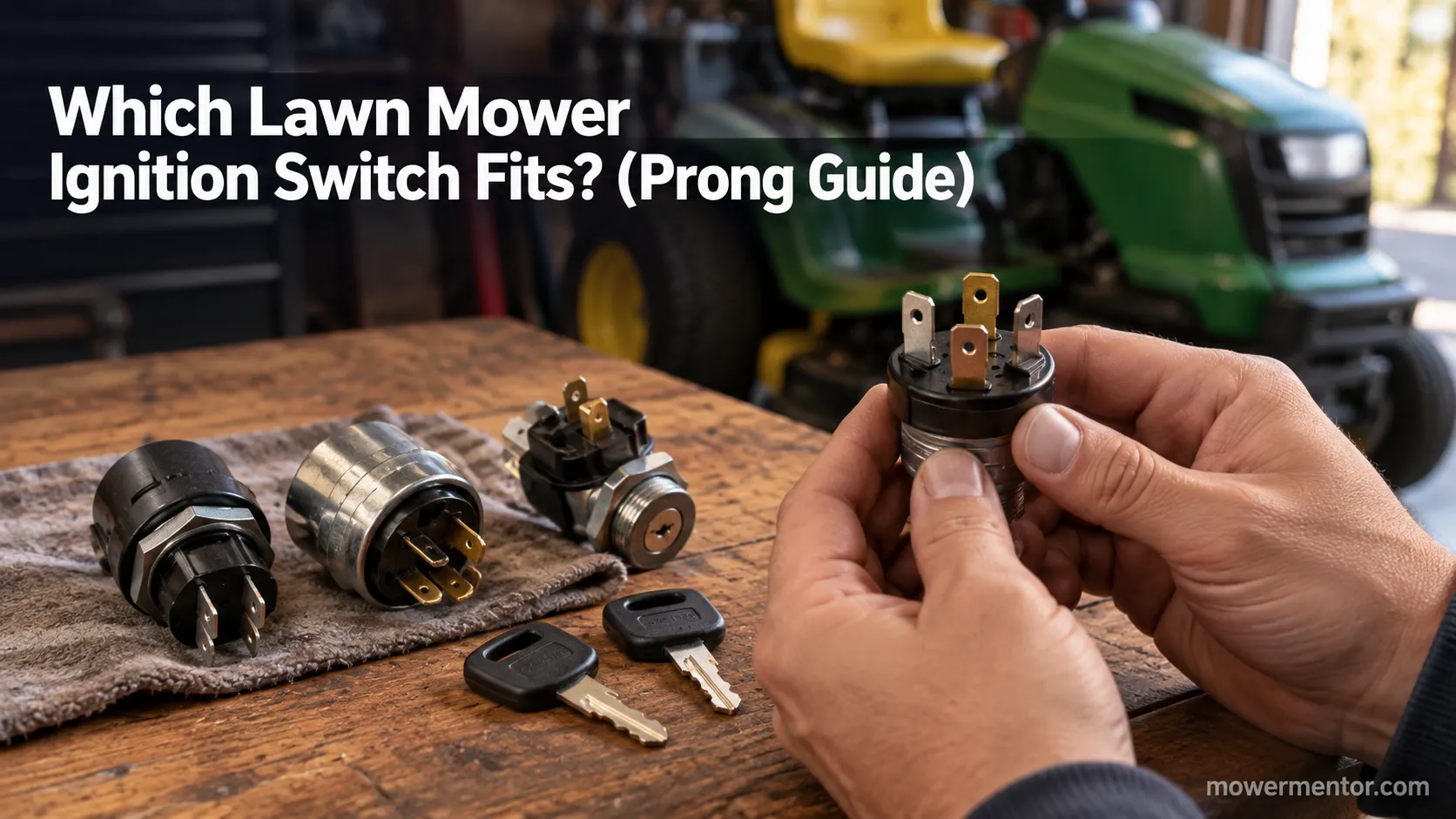
Which Lawn Mower Ignition Switch Fits? (Prong Guide)
hoose the right lawn mower ignition switch by prong count (4/5/6/7), universal vs OEM fit, and key compatibility, plus which one fits your mower.
Troubleshooting & Repair
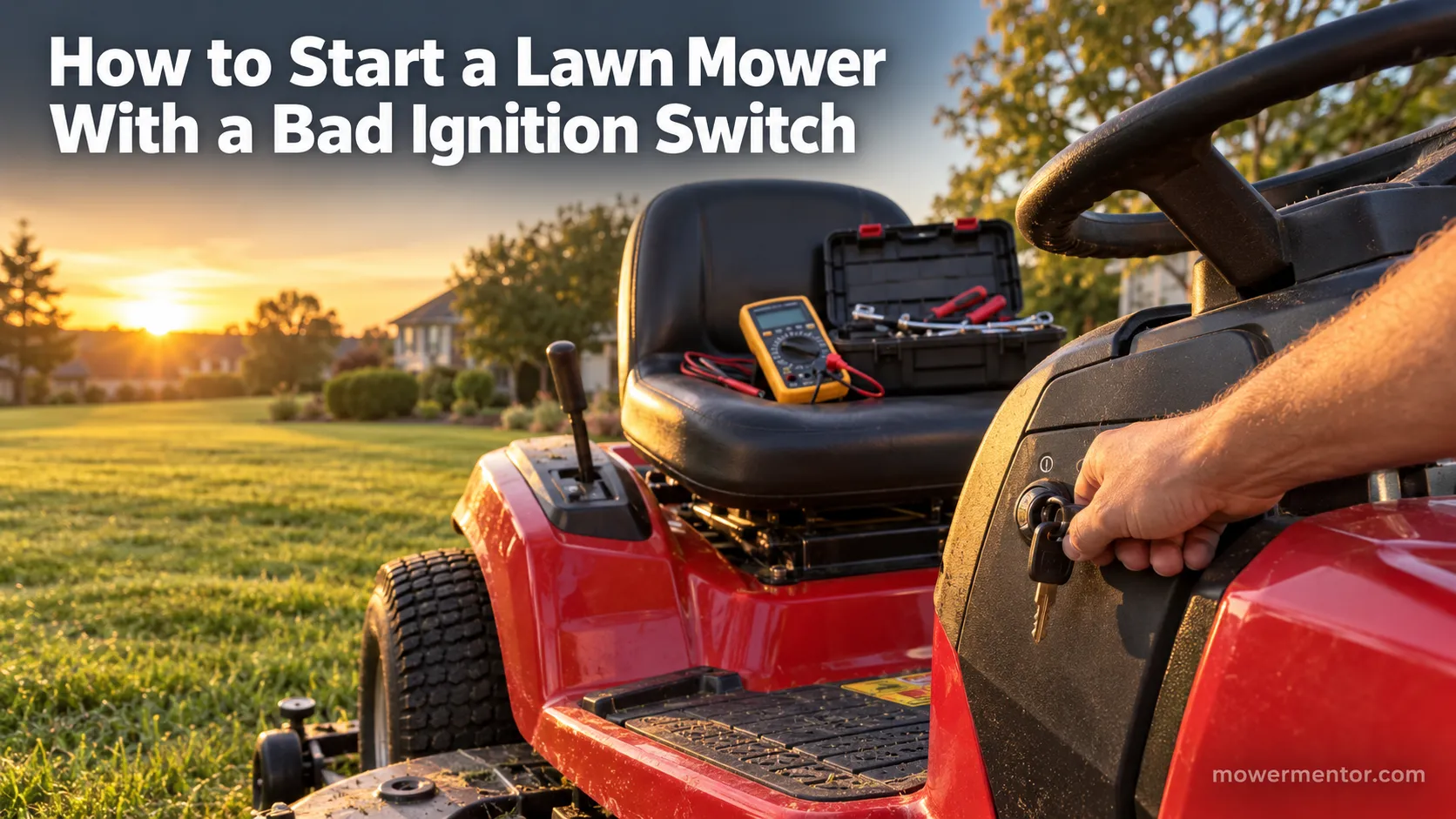
How to Start a Lawn Mower With a Bad Ignition Switch
Confirm it's the switch, then learn how to start a lawn mower with a bad ignition switch: a safe solenoid bypass to get moving, plus how to fix it for good.
Troubleshooting & Repair
How to Test a Lawn Mower Ignition Switch (5/6/7-Pin)
Learn how to test a lawn mower ignition switch with a multimeter: get continuity tables for 5, 6 & 7-pin switches plus a no-multimeter test-light method.
The discussion
Comments
Every comment is reviewed before it goes live.