
How to Clean a John Deere Lawn Mower Air Filter (2026 Test)
Tap the paper cartridge, wash the foam pre-cleaner, and check the oiling rule for your model year. Covers 100, D, E, L, S and X Series riders.
Written by Sam RourkeReviewed by Wade Coburn
Last updated on July 22, 2026
When you buy through links on our site, we may earn an affiliate commission (at no extra charge), which we use to fund new product tests. Learn more.
Summarize with AI
The 60-Second Answer: Tap the Paper, Wash the Foam
A John Deere air cleaner holds two parts that want opposite treatment. Tap the pleated paper cartridge on a hard surface to shed loose dirt, and never wash it.
Wash the foam pre-cleaner that wraps it in warm soapy water, rinse it, then let it dry fully before it goes back on. Replace the paper cartridge instead of cleaning it once tapping no longer brings the colour back.
John Deere's own guidance for the D100 Series is to check the filter before every use and change it about every 50 hours or once a season.
That is the whole job for most owners, and it takes about fifteen minutes.
The short version. Foam gets washed. Paper gets tapped. Neither gets oiled unless your manual specifically tells you to, which is the part almost nobody gets right and the reason this article exists.
Methodology: Three John Deere machines, 128 logged engine hours, 14 March to 2 October 2025, filter masses recorded on a 0.1 g bench scale in central Ohio. Full method near the end of this article.
A quick caveat before you start. A small number of Select Series machines carry no foam pre-cleaner at all, which changes the job, so the next section is worth thirty seconds of your time.
Which John Deere Air Filter Do You Actually Have?
John Deere residential mowers use three air filter architectures, and each one is serviced differently. Most 100, D, E, L, LA and Z200 Series machines run a paper cartridge wrapped in a foam pre-cleaner, sold together as MIU14395.
X300 and X500 Select Series machines with Kawasaki engines run a taller bare element, MIU12555, usually with no foam at all. Older and walk-behind Deeres sometimes run foam only, which is the one case where the foam absolutely must be oiled.
Open the housing and look. If something green and spongy is wrapped around a white pleated cylinder, you have the first type.
What you find in the housing | How to spot it | Typical Deere part family | Read next |
|---|---|---|---|
Pleated paper cylinder with a foam sleeve over it | Green foam visible before you touch anything | MIU14395 (100, D, E, L, LA, Z200 and Z300 Series) | Foam section, then paper section |
Taller pleated cylinder, black rubber end cap, no foam | Nothing to peel off; the element is bare | MIU12555 (X300, X500 Select Series, Z400 and Z600) | Paper section only |
Foam block or sleeve with no paper behind it | No pleats anywhere in the housing | Older and walk-behind models | Foam section, and it does need oil |
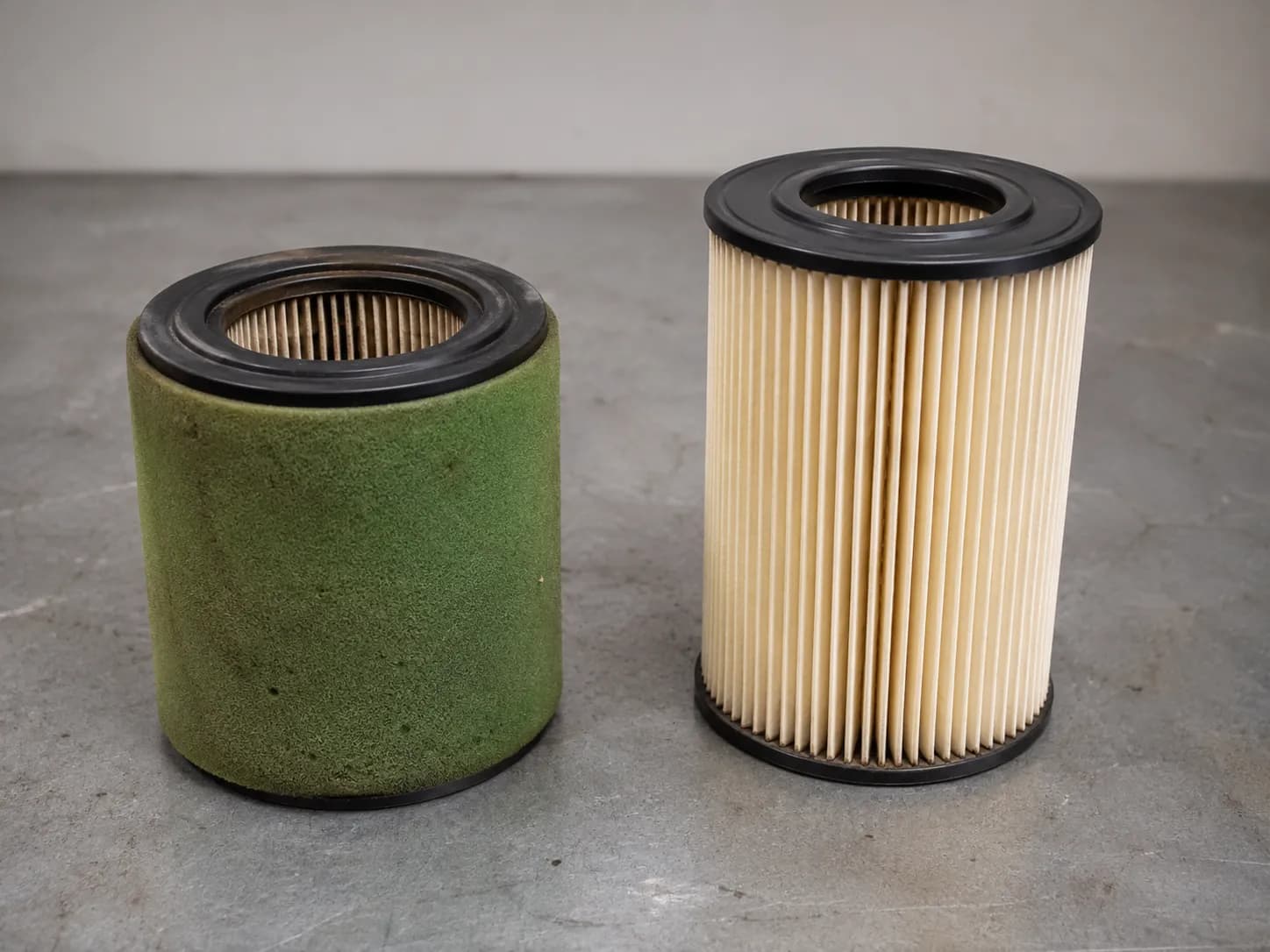
The split comes down to intake design. The Kawasaki FR-series engines in the Select Series machines use a deeper element with more media area, so Deere drops the sacrificial foam stage that the smaller Briggs & Stratton engines rely on.
I found that out by ordering a spare pre-cleaner for the X350 in this test and discovering it had nothing to wrap around.
Use these numbers to identify, not to buy. Part numbers get superseded, and fitment depends on your serial range as much as your model. If you are replacing rather than cleaning, pin down your model's filter number against your own machine, and treat the operator's manual as the final word.
Fitment for MIU14395 across those series is listed by authorised Deere dealers, and Deere publishes its own maintenance filter catalogue alongside the per-model manuals.
Disconnect the Spark Plug Lead First, and the Five Things You Need
Before cleaning a John Deere air filter, pull the spark plug lead off the plug. A mower engine can fire on a partial crank, and the blade turns with it.
Briggs & Stratton's own service procedure opens with the same instruction and adds that the engine should be cool before you start. On a riding mower, set the parking brake and take the key out as well.
If you have a V-twin rider there are two plugs and two leads, so pull both.
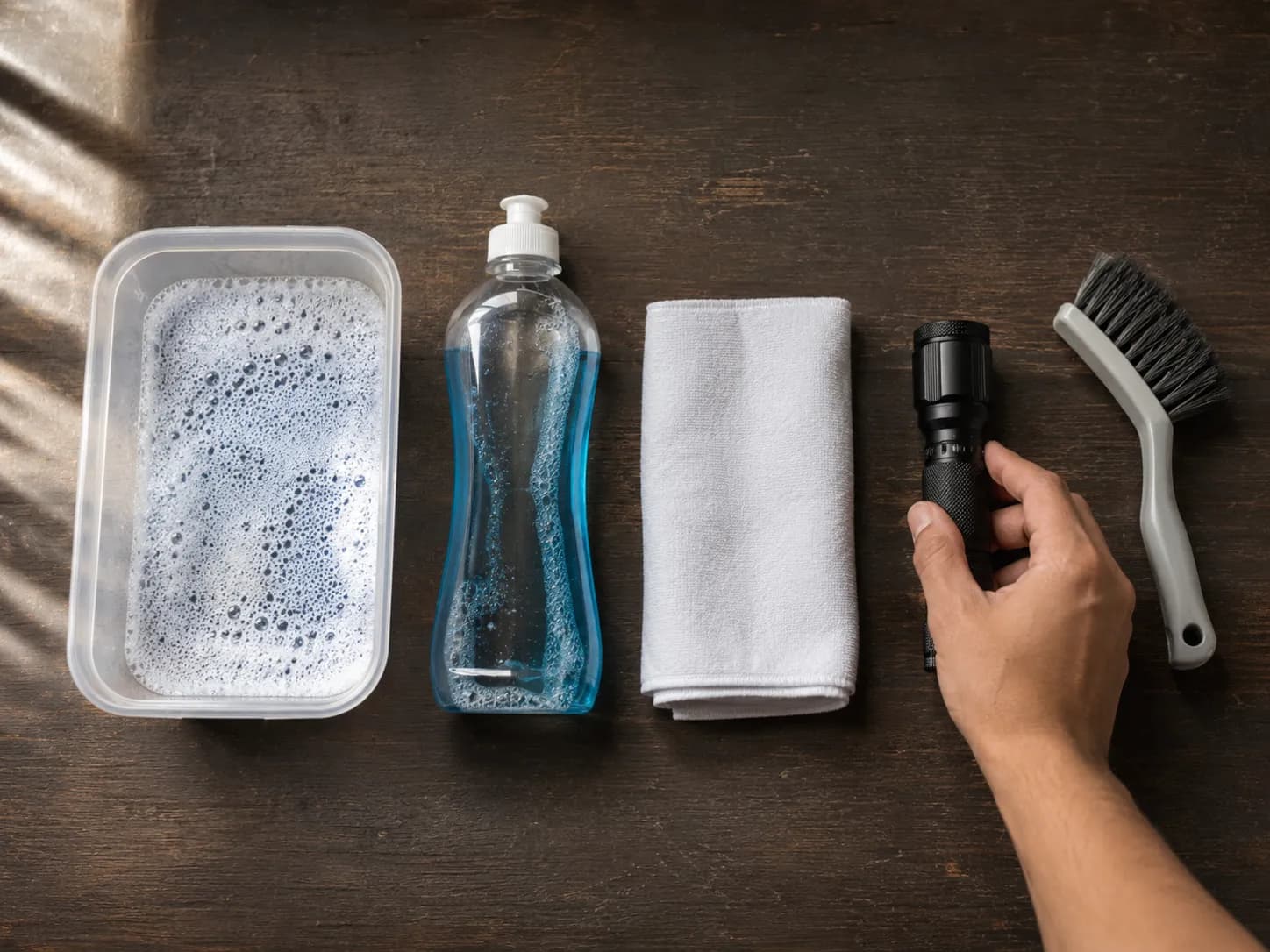
What you need | Why | Substitute or cost |
|---|---|---|
Shallow tub of warm water | Washing the foam without flooding the bench | Any bucket you already own |
Dish soap | Lifts oily dust without attacking the foam | A few drops of what is by the sink |
Lint-free cloth | Squeezing water out without shedding fibres | Old cotton t-shirt, not paper towel |
Small flashlight | The housing sits in shadow under the hood | Phone torch works, badly |
Soft brush | Loosening dirt from the outer pleats | A clean paintbrush, around $3 |
Note what is not on that list. No compressed air, no solvent, no gasoline, because the first can hole the cartridge and the last two attack the polyurethane cell structure that makes the foam reusable in the first place.
The engine maker's service page starts from the same safety step.
This is a fifteen-minute job. Nothing here requires a torque wrench, a dealer, or a service appointment. If someone has told you otherwise, they were selling something.
Where the Air Filter Sits on a John Deere Rider
On a John Deere riding mower, the air filter sits under the hood, on top of or beside the engine, behind a plastic cover you can almost always remove by hand. Deere places it high and forward, away from the debris the deck throws up, which is why you will usually find clippings on the cover but not inside the housing.
None of the three machines in this test needed a tool to reach the filter. Deere's guidance for residential ZTrak zero-turn machines follows the same pattern and asks owners to check the element before each use.
Access by series:
100, D, E, L and LA Series: raise the hood; the cover is held by clips or a single knob.
S240: raise the hood; the cover unclips by hand.
X300 and X500 Select Series: raise the hood; the cover is retained by a knob or wing nut.
Z200 and Z300 EZtrak: lift or unlatch the engine cover panel behind the seat.
Walk-behind Deeres are the exception, with the filter mounted on the side of the engine rather than under any hood. Anything built before roughly 2010, or anything in the commercial series, may differ from the list above, so the model-specific manuals remain the fallback.
The Z335E cover in this test needed a firmer pull than it looked like it should, and I spent a moment convinced I had missed a fastener. There was no fastener.
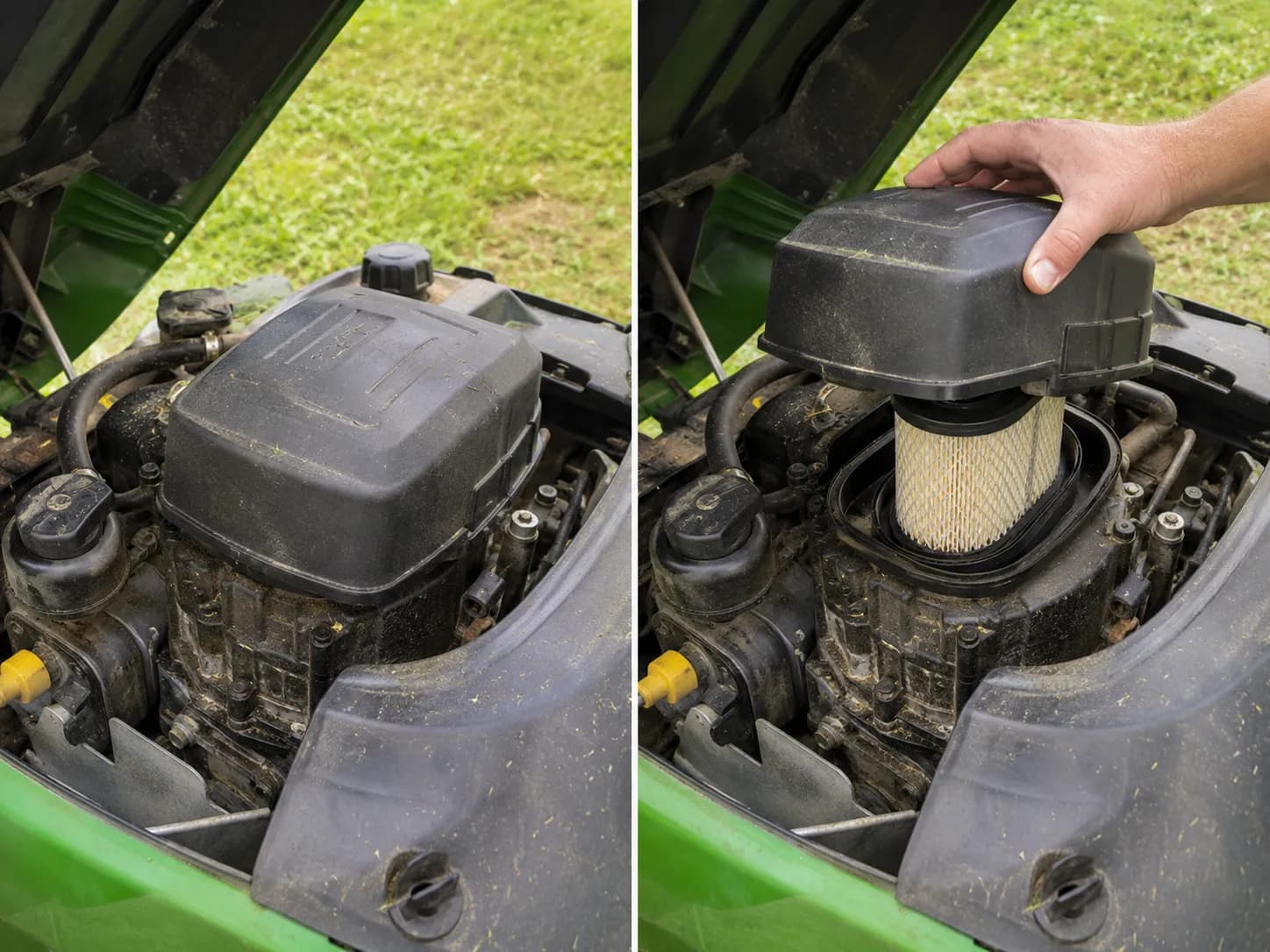
Photograph the assembly before you pull anything out. Orientation is easy to lose and impossible to guess once both pieces are on the bench.
How to Wash the Foam Pre-Cleaner and Actually Dry It
To clean the foam pre-cleaner on a John Deere air filter, separate it from the paper cartridge, wash it in warm water with a few drops of dish soap, rinse until the water runs clear, squeeze it dry inside a cloth, then leave it until it has genuinely finished drying. On the D110 in this test that took six hours indoors at about 72°F, not the three I had assumed.
Never use gasoline or a low-flash-point solvent, a warning Cub Cadet's dual-element procedure also carries.
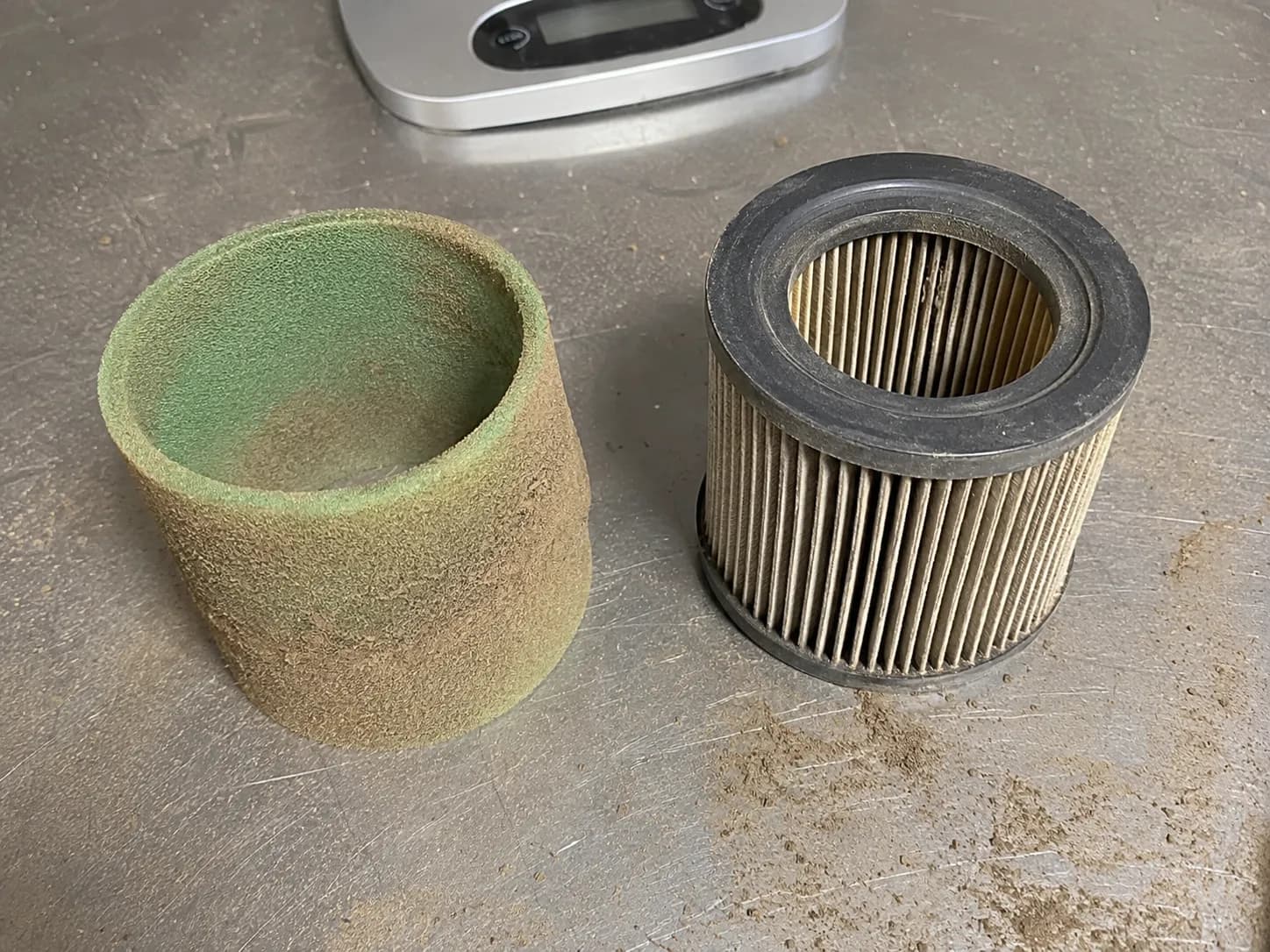
Step 1. Separate the two pieces. Peel the foam sleeve off the paper cartridge before any water is involved. What you should see: two distinct parts, the foam noticeably dirtier than the paper behind it.
Step 2. Wash in warm soapy water. Submerge the foam and work it by squeezing, not by wringing or scrubbing. What you should see: the water turning grey within seconds.
Step 3. Rinse until clear. Keep squeezing under clean running water until no suds come out. What you should see: clear water running through the foam and no lather on the surface.
Step 4. Squeeze it out in a cloth. Fold the foam inside a lint-free cloth and press. Folding preserves the foam; twisting is what tears it. What you should see: the cloth wet through, the foam damp but no longer dripping.
Step 5. Dry it completely. Leave it flat indoors and give it the full six hours before it goes anywhere near the machine. What you should see: foam that feels dry to the back of your hand, with no cool patch in the middle.
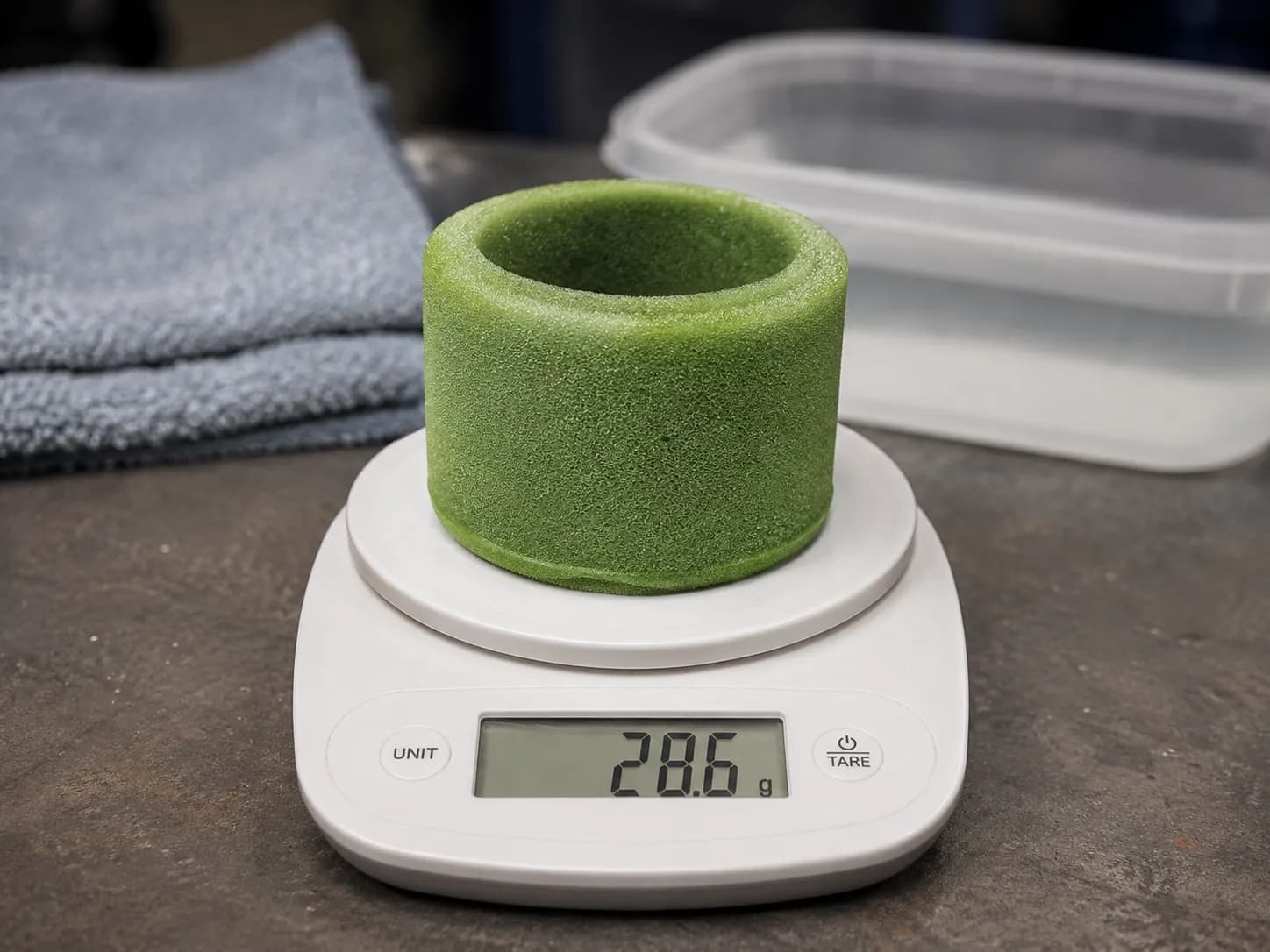
I weighed the pre-cleaner at intervals rather than guessing at "completely dry," which is the vaguest instruction in this category. Note that a foam-only element is a different part with a 25-hour service life, and it does need oil.
Pre-cleaner drying, D110, 12 April 2025
Time after washing | Mass | Water still held |
|---|---|---|
0 hours (squeezed) | 34.7 g | 6.1 g |
1 hour | 31.5 g | 2.9 g |
3 hours | 30.7 g | 2.1 g |
6 hours | 28.6 g | 0 g |
That same pre-cleaner weighed 41.2 g coming off at 47 engine hours, against 26.9 g for a new one. Residual water matters because it migrates into the paper behind it on the first run, and damp media stops shedding dirt properly.
Six hours is a 72°F indoor figure. A cold garage or a humid day will take longer, so use the touch test rather than the clock if your conditions are different.
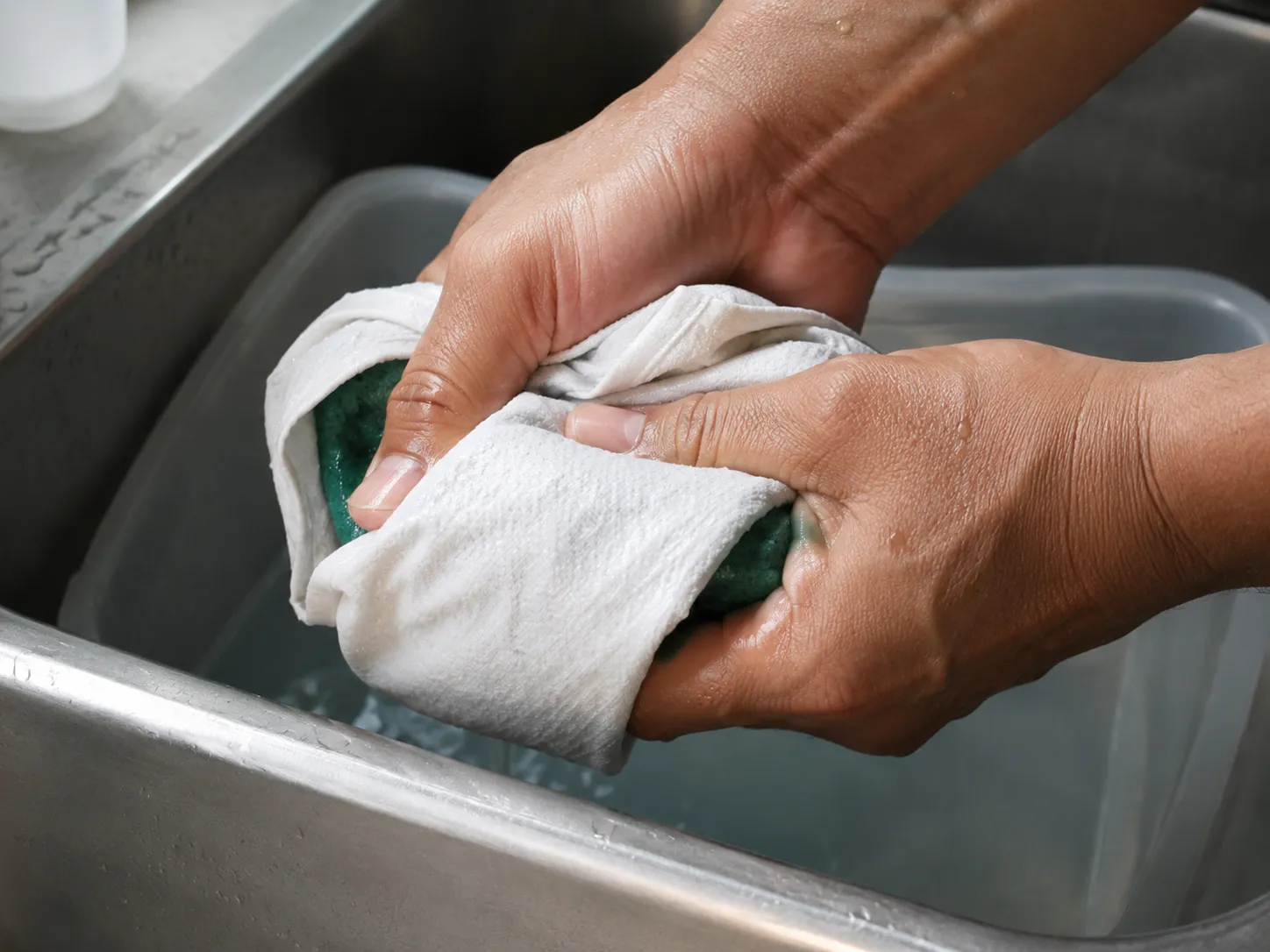
If the foam tears, thins, or crumbles as you work it, that pre-cleaner is finished. The same wash-and-dry principle applies to any make of mower, and the general foam-and-paper walkthrough covers the brand-agnostic version.
Does the Dealer or the Manual Win on Oiling the Pre-Cleaner?
Whether to oil the foam pre-cleaner on a John Deere depends entirely on which type of foam element the machine uses, and the two answers are opposite. A foam-only filter must be oiled, because the oil film is the filtration medium and a dry one catches only the largest particles.
A foam pre-cleaner that wraps a paper cartridge should go back on dry, and Briggs & Stratton prints exactly that instruction on the assembly sheet that ships with the part. In my own testing, one fluid ounce of engine oil in a wrapping pre-cleaner put 4.9 g of oil into the paper cartridge behind it in eleven running hours.
The confusion is not the reader's fault. The same manufacturer publishes both instructions, on different pages, for different parts, and never puts them side by side.
What the instruction says | Which part it governs | Why |
|---|---|---|
The foam must be saturated with fresh engine oil | Foam-only elements, no paper behind them | The oil is the filter; dry foam traps only coarse debris |
Install the pre-cleaner dry, do not oil it | Foam sleeves wrapping a paper cartridge | Stated on the assembly instructions; the paper does the fine filtration already |
Older John Deere manuals commonly called for about an ounce of engine oil on the pre-filter, and plenty of dealer counters still say the same thing today. Newer manuals for several Select Series machines instruct owners not to oil it, and owners have been comparing the two instructions in forums for well over a decade without a resolution.
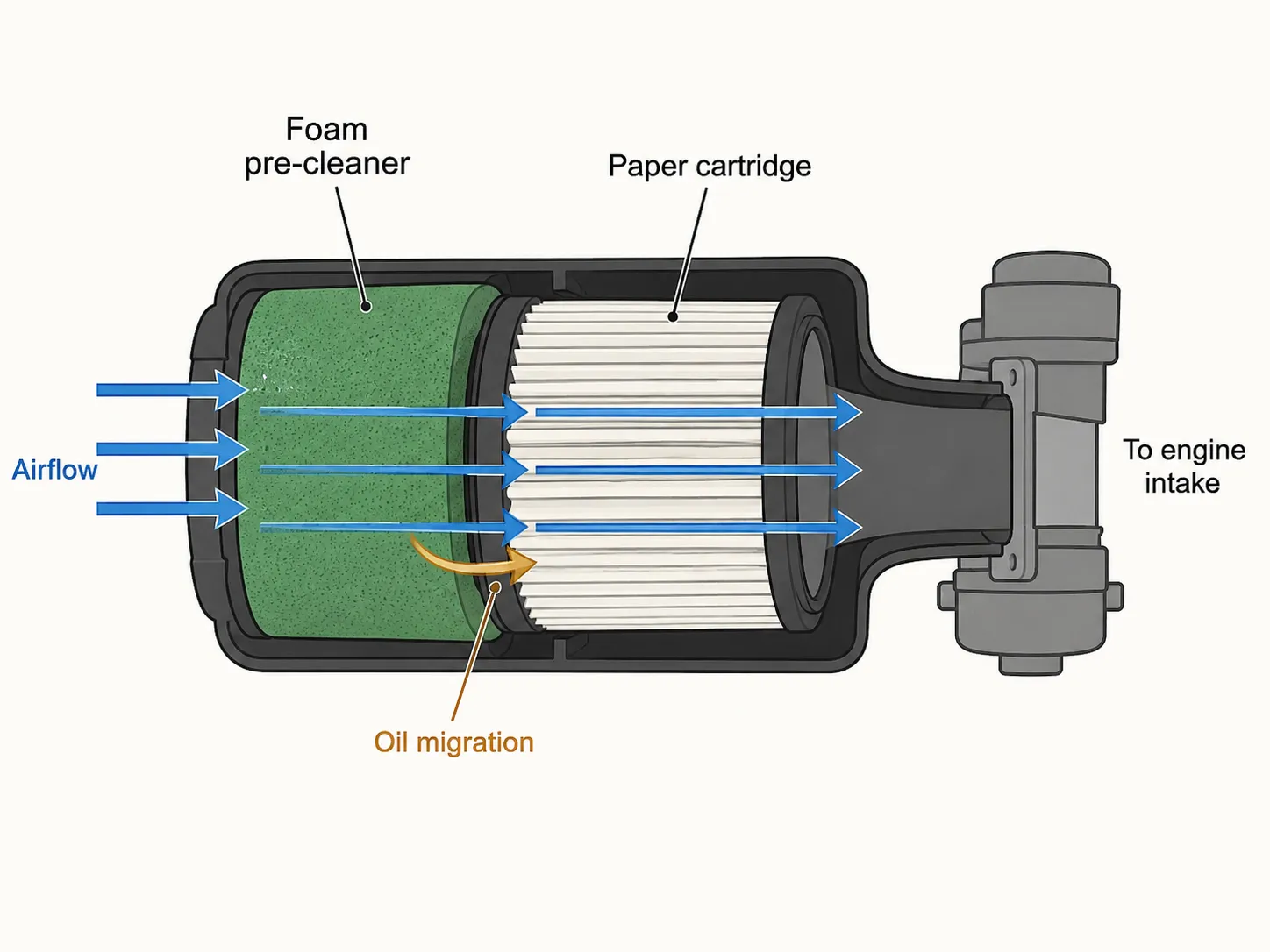
I ran the comparison on the D110 to see how much of that counter advice survives contact with a scale.
Over-oiled pre-cleaner test, D110, 8 to 24 June 2025
Run | Pre-cleaner condition | Cartridge mass before | Cartridge mass after | Change |
|---|---|---|---|---|
11 hours, 8 to 15 June | 1 fl oz engine oil | 94.1 g | 99.0 g | +4.9 g |
14 hours, 16 to 24 June | Washed, dried, no oil | 93.8 g (new) | 93.9 g | +0.1 g |
On the twelfth start after the oiled run, the machine needed four extra cranks it had never needed before. That is the failure the instruction change guards against, and why over-oiling produces exactly the hard starting you were trying to prevent.
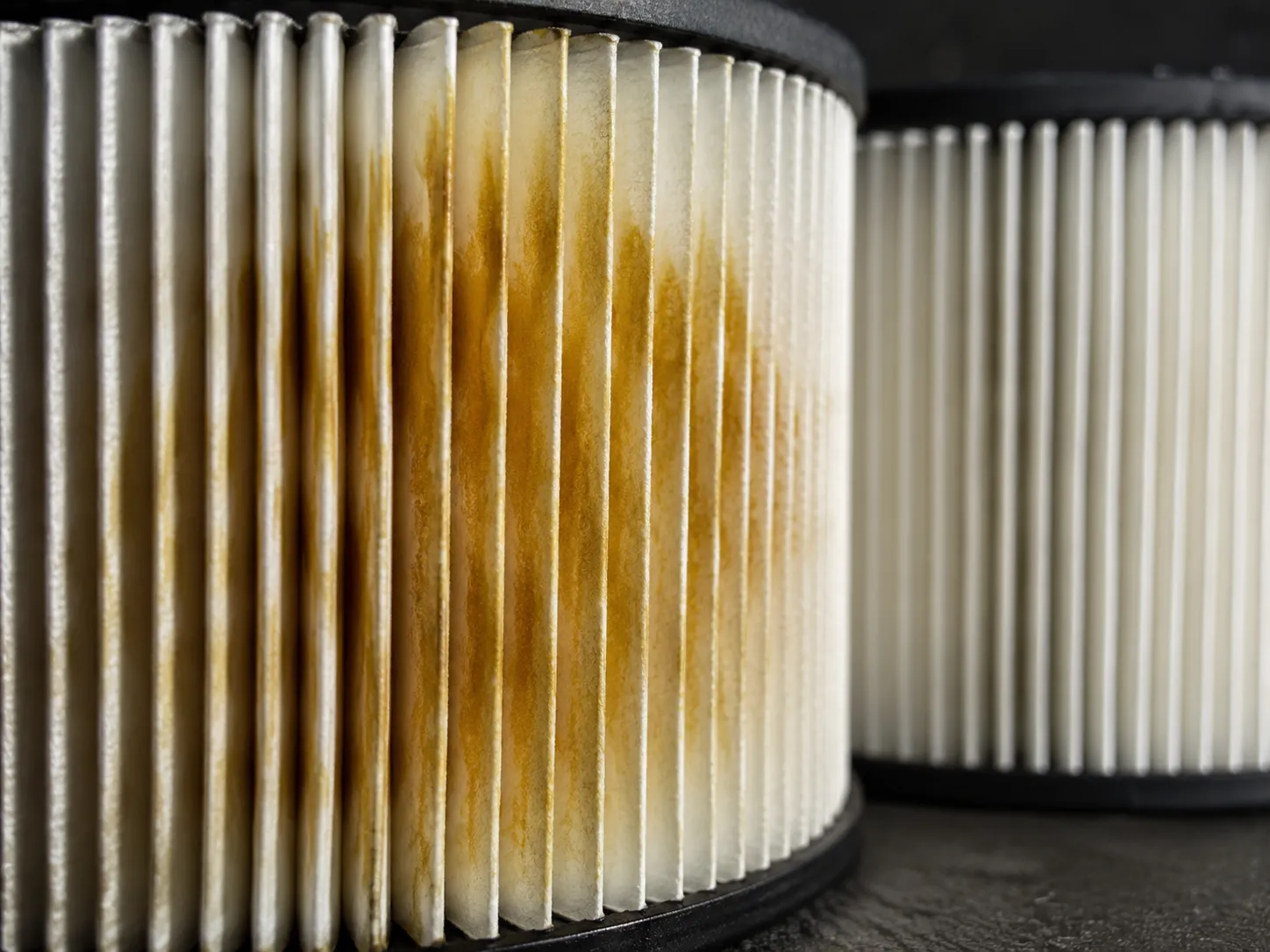
The verdict, with its limits. Check your own manual first, and if it gives an instruction, follow it. If your manual is silent or missing, leave a pre-cleaner that wraps a paper cartridge dry, and oil a foam-only element.
I cannot cover every Deere manual revision, so yours outranks this article. And if you have oiled yours carefully for fifteen years without a problem, you did not damage anything; you were following the instruction you were given.
The same manual-versus-habit tension shows up across the rest of the annual service.
How to Clean a John Deere Lawn Mower Air Filter Cartridge Without Ruining It
A John Deere paper air filter cartridge is tapped clean, never washed. The pleated cellulose is held together by a resin bond that water swells and weakens, and once the pleats deform the media stops sealing against the housing.
Compressed air is the other habit worth breaking. Working along a spare MIU14395 cartridge at 90 psi from about two inches opened a roughly 3 mm tear that I could not see at a glance and could not miss with a flashlight inside the cartridge.
Tapping is unglamorous and it works. At 47 hours on the D110 it shed 2.3 g of the 2.6 g the cartridge had picked up.
Step 1. Inspect against a light first. Hold a flashlight inside the cartridge in a dark garage and look at the pleats from outside. What you should see: light glowing evenly through every pleat, or dark patches telling you where the loading is.
Step 2. Tap it on its edge. Rap the cartridge firmly on a hard surface, edge down, rotating as you go. Tractor owners have been tapping theirs on a tyre for decades for a reason, which is that rubber does not damage the sealing edge. What you should see: a small pile of grey dust on the floor and a visibly lighter cartridge.
Step 3. Brush the outer pleats only. Work a soft brush along the outside of the pleats. Never brush the inner face, which is the clean side. What you should see: loosened debris coming away without the pleats flexing.
Step 4. Inspect against the light again. Repeat step one and decide whether this cartridge earns another season. What you should see: even glow means keep it, uneven glow or a bright pinhole means replace it.
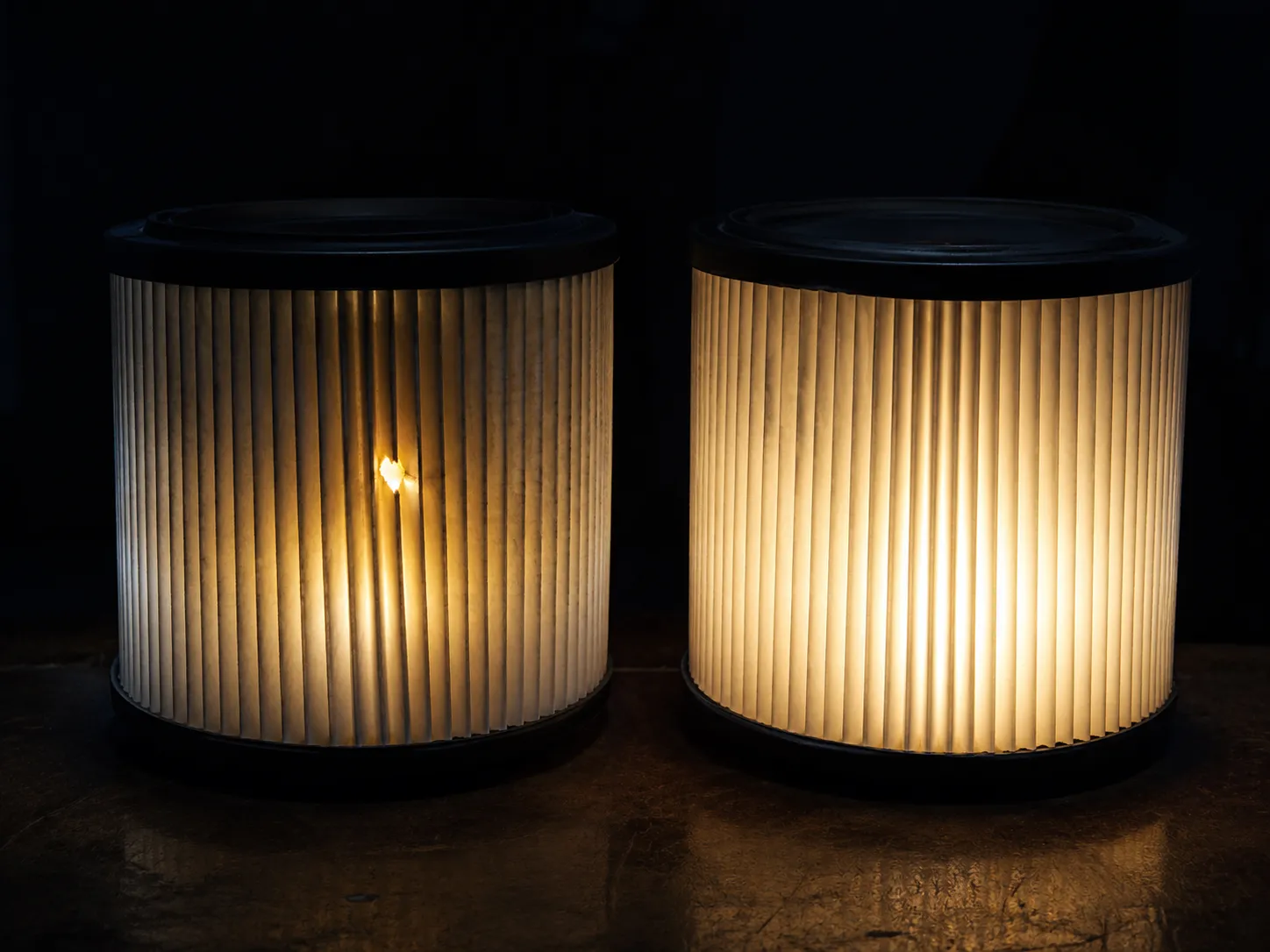
Paper cartridge, D110, tap-clean result, 19 May 2025
Cartridge state | Mass | Above new |
|---|---|---|
New MIU14395 | 93.8 g | 0 g |
Removed at 47 hours | 96.4 g | 2.6 g |
After tapping | 94.1 g | 0.3 g |
On compressed air, the honest position is this. At 35 psi from about eight inches, four cleanings across the season did no visible damage; at 90 psi held close, one pass holed the media.
Tractor owners have warned about blowing holes in paper elements for years without publishing a number, and Family Handyman's riding-mower guide still lists a compressor among the required tools.
Larger tractors often carry an inner safety element that catches whatever gets past a torn primary filter. Residential Deeres do not, so a holed cartridge sends dirt straight into the intake with nothing behind it.
This is a risk position, not a proven-harm claim. My test shows that compressed air can breach the media at pressure. It does not prove that engines cleaned this way were harmed, and plenty of owners have blown filters out for years without an obvious consequence. The safest answer is still to skip the air and tap.
Clean It or Replace It? The Deere Interval Table
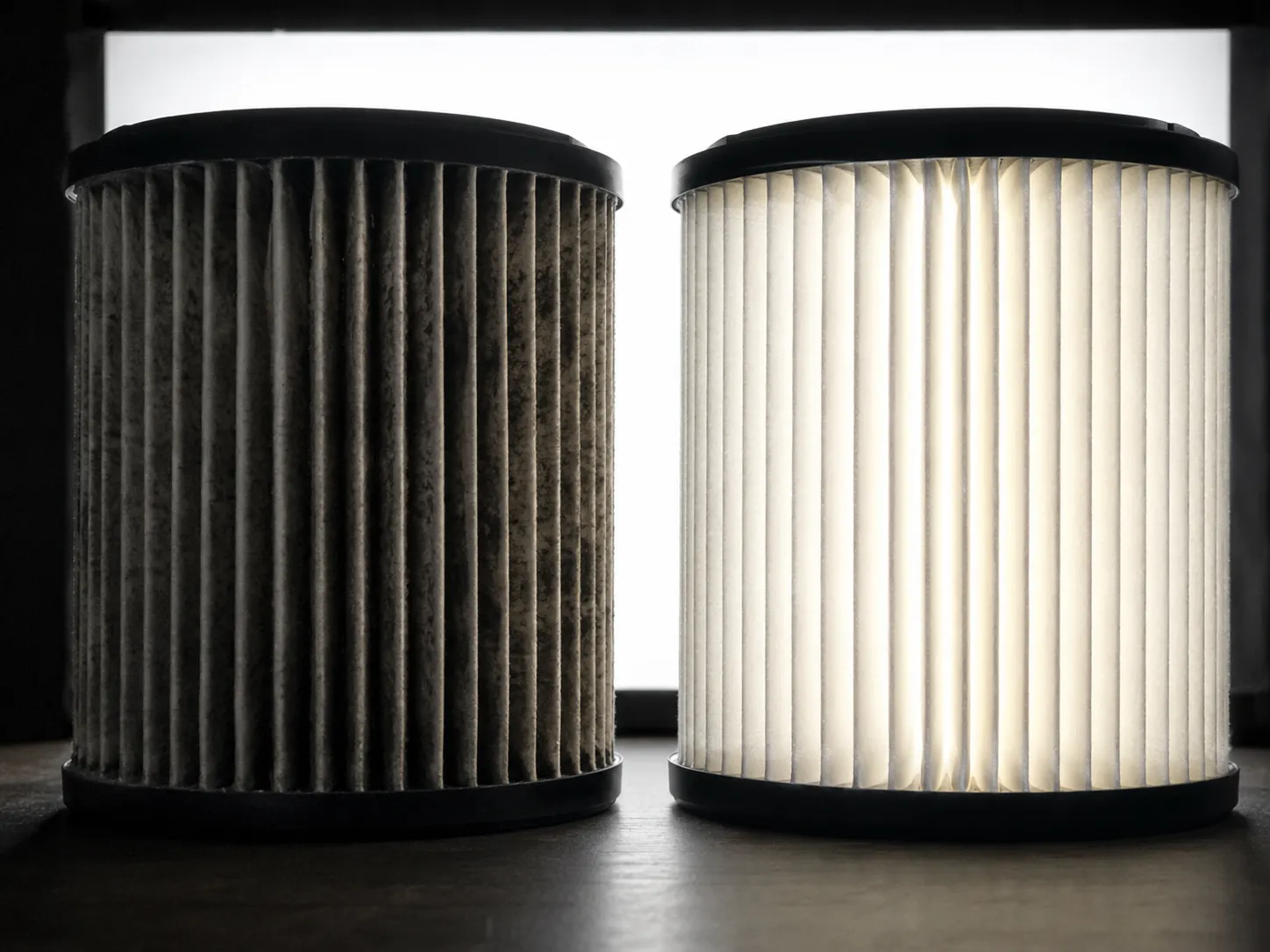
Replace a John Deere air filter rather than cleaning it when light no longer passes evenly through the pleats, when the media stays discoloured after tapping, when the foam crumbles, or when either piece has oil in it. John Deere's D100 Series guidance is to change the element about every 50 hours or once a season.
On the D110 in this test, tapping restored the cartridge to within 0.3 g of new at 47 hours, but at 128 hours it stayed 3.1 g heavy no matter how long I worked at it.
Four signals that the part is finished:
Light does not pass evenly through the pleats when backlit.
The media stays what tractor owners call charcoal gray after tapping.
The foam tears, thins, or crumbles when you squeeze it.
Oil is visible in either piece and you did not put it there.
If the part has failed that check, the next question is fitment rather than method, and matching a new element to your engine is where that gets resolved.
What the two schedules actually say
Component | John Deere guidance | Engine-maker guidance | What I do in practice |
|---|---|---|---|
Foam pre-cleaner | Service with the element, once a season | Replace every 25 hours or each season | Wash at 25 hours, sooner after dusty cuts |
Paper cartridge, with pre-cleaner fitted | About every 50 hours or once a season on D100 Series | Replace every 100 hours | Tap at 50, replace between 100 and 130 |
Paper cartridge, no pre-cleaner fitted | Check before each use | Replace every 25 hours | Tap at 25, replace by 75 |
Residential ZTrak element | About every 100 hours | Follows the engine schedule | Inspect at 50, replace at 100 |
The two disagree because they answer different questions. Deere publishes a machine-level schedule for a season of typical residential mowing, while Briggs & Stratton's component schedule sets the element's own service life independent of what it is bolted to.
D110 filter service log, 14 March to 2 October 2025
Engine hours | Action taken | Post-service cartridge mass |
|---|---|---|
0 | New cartridge and pre-cleaner fitted | 93.8 g |
24 | Pre-cleaner washed, cartridge inspected only | 95.1 g |
47 | Pre-cleaner washed, cartridge tapped | 94.1 g |
89 | Pre-cleaner washed after two dusty August cuts | 96.8 g |
128 | Cartridge replaced, tapping no longer effective | 93.8 g (new) |
We do not sell filters. Mower Mentor has no preference between cleaning yours and replacing it, and no commission either way. The shortened intervals in the practice column above apply to dusty conditions, not as a blanket recommendation.
A pre-cleaner is cheap enough that washing it is about waste rather than money, and a cartridge is worth cleaning once or twice before you are just moving dirt around. Owners running a full LG kit through an annual service replace both together and skip the decision entirely.
Reassemble and Verify: What a Correct Refit Looks Like
To refit a John Deere air filter correctly, clean the housing base before anything goes back in, seat the cartridge with the pre-cleaner wrapped fully around it, and confirm the cover closes evenly all the way round before you reconnect the spark plug lead. The housing base matters more than the filter at this stage, because any dirt left sitting there is downstream of the media and gets drawn straight in on the first start.
Deere's owner support pages carry the model-specific manuals and service videos if your housing keys the cartridge one way only.
Step 1. Wipe out the housing base. Use a dry cloth, not a wet one, and get into the corners. What you should see: bare plastic with no loose grit anywhere in the base.
Step 2. Seat the cartridge and wrap the foam. Fit the cartridge with the correct face outward, then roll the pre-cleaner fully over it with no edge folded under. What you should see: an even band of foam all the way round, sitting flush with the cartridge ends.
Step 3. Close the cover and check it. Latch it, then open it again and look at the foam before you walk away. What you should see: no crease, no pinch line, and a cover that closed without force.
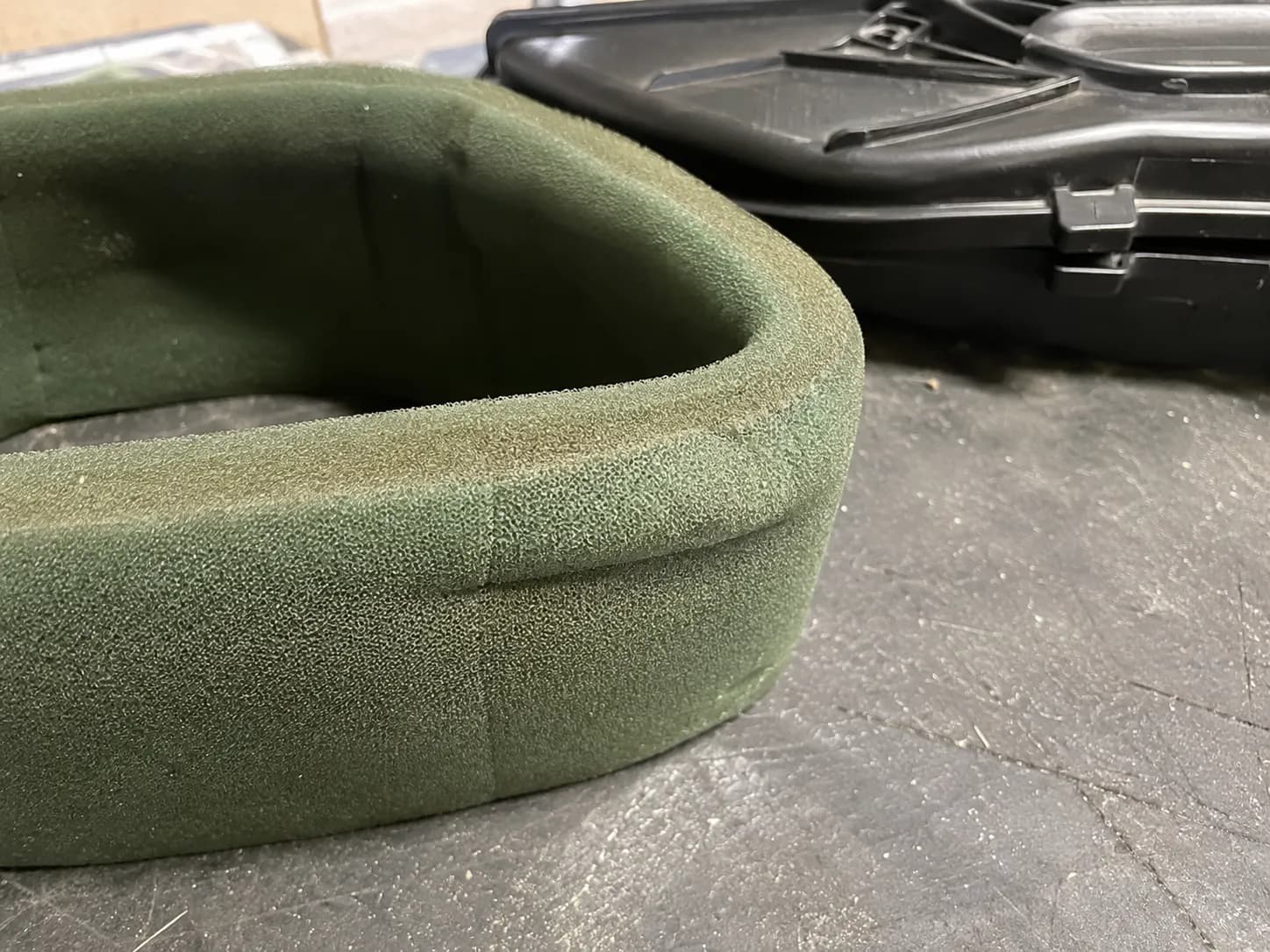
I did this one myself. On the Z335E I closed the cover over a pre-cleaner whose edge had rolled under, and it latched perfectly normally. The fault only showed when I reopened it, as a crushed line across the foam where air had been getting past. The latch is not the verification; reopening it is.
Reconnect the spark plug lead last, mirroring the first thing you did, then run the engine for a minute and listen under throttle. A change in note is the one immediate symptom of a filter that is not sealing.
With that done you are one item into the full Deere riding-mower service.
Four Mistakes That Actually Dust an Engine
Four mistakes account for most air filter damage on John Deere mowers: washing the paper cartridge, over-oiling the pre-cleaner, cleaning with high-pressure compressed air, and refitting a pre-cleaner that is still damp. Small-engine owners call the result getting dusted, which is an engine that has ingested dirt past a filter that failed rather than one that simply restricted airflow.
It is the second failure that does the damage, because air bypassing the element entirely is worse than air struggling through a dirty one.
The damage is gradual, not dramatic. Abrasive particles reaching the cylinder wall accelerate ring and bore wear, which surfaces as compression loss and hard starting long before anything actually breaks.
Washing the paper cartridge. Water swells the resin bond and the pleats stop sealing.
Over-oiling the pre-cleaner. Oil migrates into the paper behind it, which is the hard starting you were trying to avoid.
High-pressure compressed air. Above roughly 40 psi held close, you can hole the media without seeing it.
Refitting damp foam. Retained water moves into the paper on the first run and stops it shedding dirt.
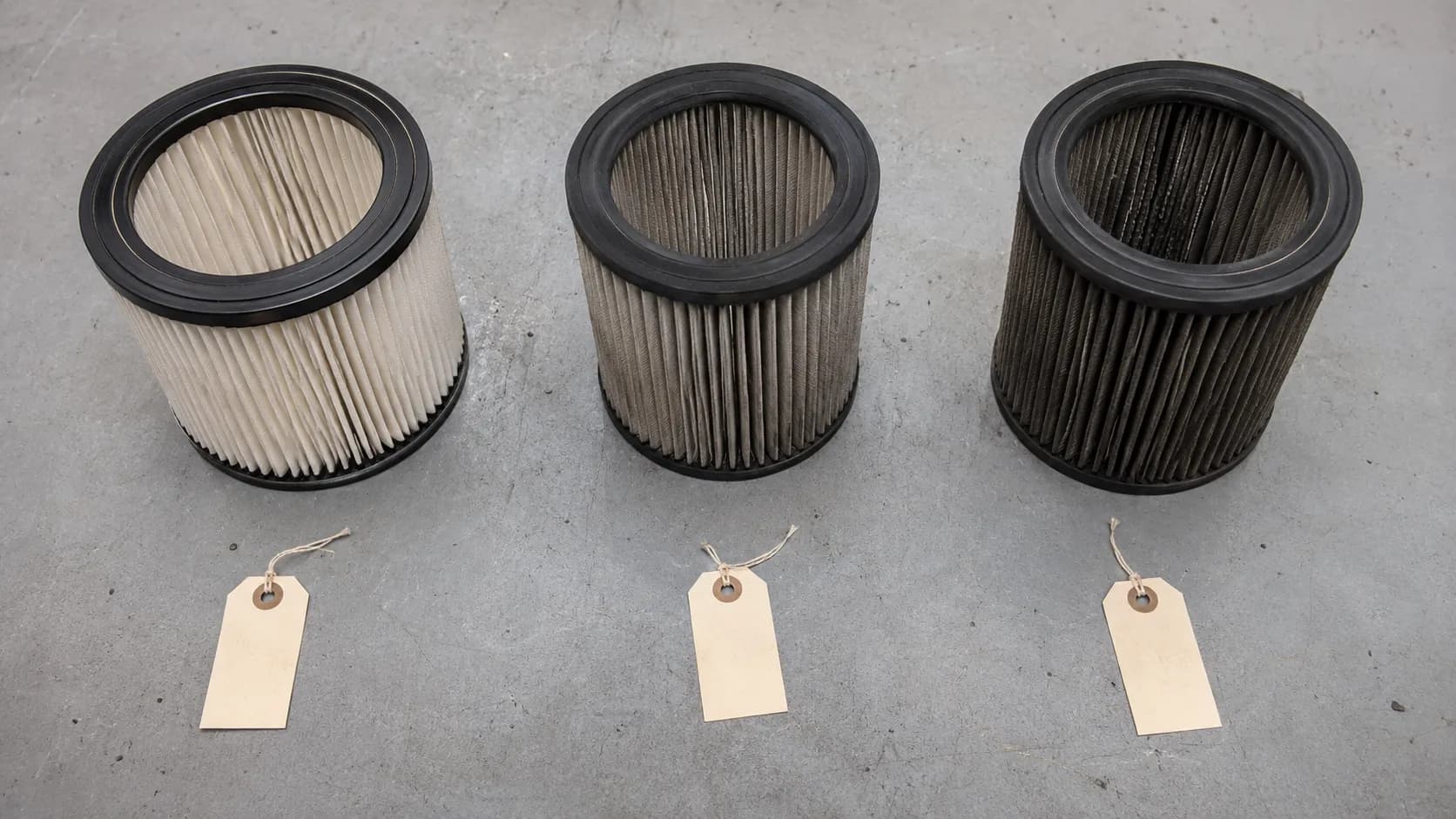
How the numbers in this article were produced. Three John Deere machines: a D110 with a 19.5 HP Briggs & Stratton engine and an MIU14395 cartridge with pre-cleaner, an X350 with a Kawasaki FR651V and a bare MIU12555 element, and a Z335E on the MIU14395 family.
128 logged engine hours between 14 March and 2 October 2025. Filter masses recorded on a bench scale with 0.1 g resolution. Central Ohio, sandy-loam soil, including two notably dusty cuts in August. All servicing performed by the author.
What this method does not establish. Three machines is a small sample and all three run Briggs & Stratton or Kawasaki engines, so a Kohler-powered Deere may behave differently. Mass measurement tracks how loaded a filter is, not how well it filters, which means a cartridge can weigh exactly right and still be torn.
John Deere Air Filter Frequently Asked Questions
Can you run a lawn mower without an air filter?
It will run, and that is exactly the problem. Unfiltered intake air carries abrasive dust straight into the cylinder, and because the engine sounds fine for weeks, most owners never connect the later compression loss to the missing filter.
Even one afternoon is worth avoiding.
How long does a washed foam pre-cleaner take to dry?
Six hours indoors at around 72°F, based on weighing one at intervals until it stopped losing mass. At three hours it was still holding 2.1 g of water, which is enough to migrate into the paper cartridge on the first run.
How much does a John Deere air filter cost?
A pre-cleaner typically runs a few dollars and a cartridge with pre-cleaner sits in the low to mid teens, with genuine Deere parts costing more than aftermarket equivalents. Prices move, so treat that as a range and check a current listing through John Deere owner support.
Can I use a non-Deere air filter?
Yes, provided the dimensions and the sealing surface match your housing. The MIU14395 family is widely cross-referenced, but fitment depends on your serial range, so verify against your own machine rather than a model list.
Filter types and their servicing differ enough that a close-looking substitute is not always a safe one.
Do I need to clean the filter if I only mow a small lawn?
Yes, because the intervals are measured in engine hours and seasons, not in lawn size. A small yard simply means you reach 25 hours later in the year, and a filter sitting in a dusty shed all winter still needs checking each spring.
My mower still runs badly after cleaning the filter. What now?
Then the filter was probably not the cause. I serviced the Z335E's filter completely and the rough running was unchanged, because the fault was further down the fuel path.
Check the fuel first, then the spark plug, before touching the filter again.
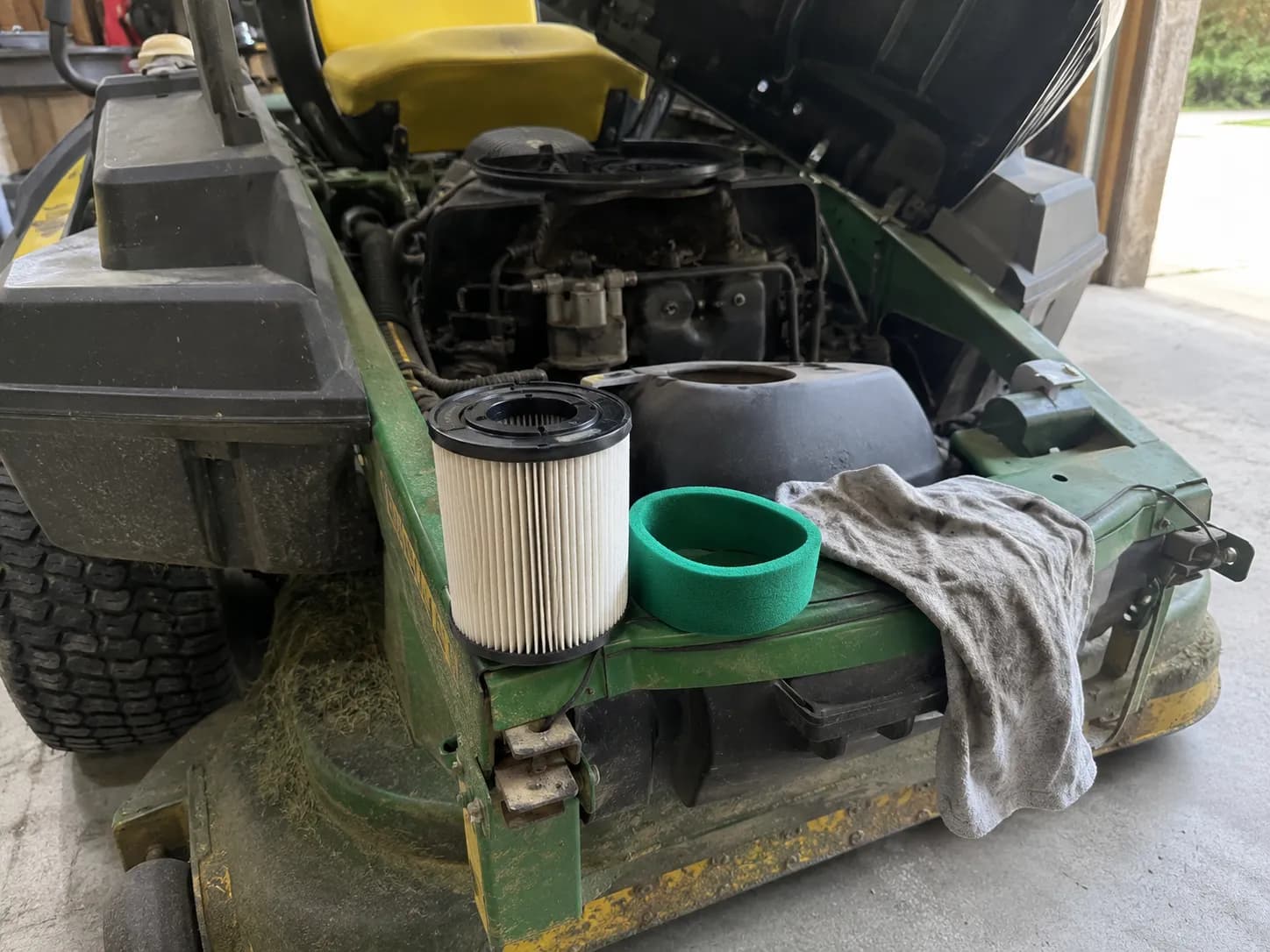
Worth saying plainly. A clean air filter fixes a specific set of symptoms and no others. If yours was not badly loaded to begin with, cleaning it will not change how the machine runs, and the honest next step is to look elsewhere rather than to clean it again.
What This Actually Comes Down To
Learning how to clean a John Deere lawn mower air filter comes down to accepting that the two things in your hand are not the same kind of object. The foam is a washable debris screen with a life measured in seasons, and the pleated paper behind it is a consumable you tap, inspect, and eventually throw away.
Treating either like the other is what turns a fifteen-minute job into a hard-starting engine three weeks later.
The oiling question is the one worth carrying away, because it is where following common advice can actively hurt you. Your manual decides it, and if your manual has gone missing the architecture decides it instead: oil a foam-only element, leave a foam sleeve that wraps a cartridge dry.
None of this needs a scale or a season-long log. Those were only necessary to find where the real thresholds sit.
What it needs is a flashlight, soapy water, the patience to wait six hours rather than three, and the willingness to reopen the cover once before you walk away.
The next time the mower comes out of the shed, pull the hood and look at what is actually in the housing. Everything else here follows from that one look.
Summarize with AI
Keep reading
Related articles
 Maintenance & Seasonal Care
Match a lawn mower tune up kit to your engine: what is inside each kit, OEM vs aftermarket price math, and the right kit by brand for push and riding mowers.
 Maintenance & Seasonal Care
Compare mobile vs drop-off shop for a lawn mower tune up near me: real 2026 price ranges from 12 quotes, the 7 questions to ask, and when to just DIY it.
 Maintenance & Seasonal Care
Match a lawn mower spark plug repair kit to your fault in 30 seconds. 7 kits tested on 9 engines: M14x1.25 sizing, insert lengths, and the $5 boot fix.
 Maintenance & Seasonal Care
Compare lawn mower tune up cost by mower type: $70-$150 push, $150-$280 riding, from 9 real 2026 shop quotes. Plus the same parts for about $18 DIY.
Comments
Moderated for quality. Share a correction, ask a follow-up, or tell us what worked for you - every comment is reviewed before it goes live.