Husqvarna Riding Lawn Mower Won't Start No Clicking: 8-Point Test Flow
Husqvarna riding lawn mower won't start no clicking? Test the interlocks, battery, solenoid and ignition in order, with the exact multimeter numbers.
Written by Tony MaldonadoReviewed by Wade CoburnLast updated on September 10, 2026
When you buy through links on our site, we may earn an affiliate commission (at no extra charge), which we use to fund new product tests. Learn more.
Read it your way
Short on time? Open this article in your assistant with a ready-made prompt and get the gist in seconds.
Found this useful? Make us a preferred source so we show up in your Google results.
What No Clicking Is Telling You
On a Husqvarna, total silence at the key almost always means the current never reached the starter.
Before you touch the starter or solenoid, run the full starting sequence, then check the operator-presence switches, the battery under load, and the solenoid trigger.
The sound at the key, silence versus a single click versus rapid clicking, tells you which one to test first.
If your Husqvarna riding lawn mower won't start no clicking, that dead silence at the key is itself the first diagnostic reading.
A single loud click points one direction; complete silence points somewhere else entirely.
The good news is that a silent key is usually a $0 to $30 fix, not a new engine.
In most cases it is an interlock you did not fully set or a connection that lost its grip, not the expensive parts owners tend to replace first.
Husqvarna's own guidance lists a weak battery, a blown fuse, corroded terminals, a faulty ignition switch or solenoid, and the operator-presence switches as the usual no-start causes, per Husqvarna's support guidance.
This guide orders those causes by the sound you hear and adds the meter numbers the support page leaves out.
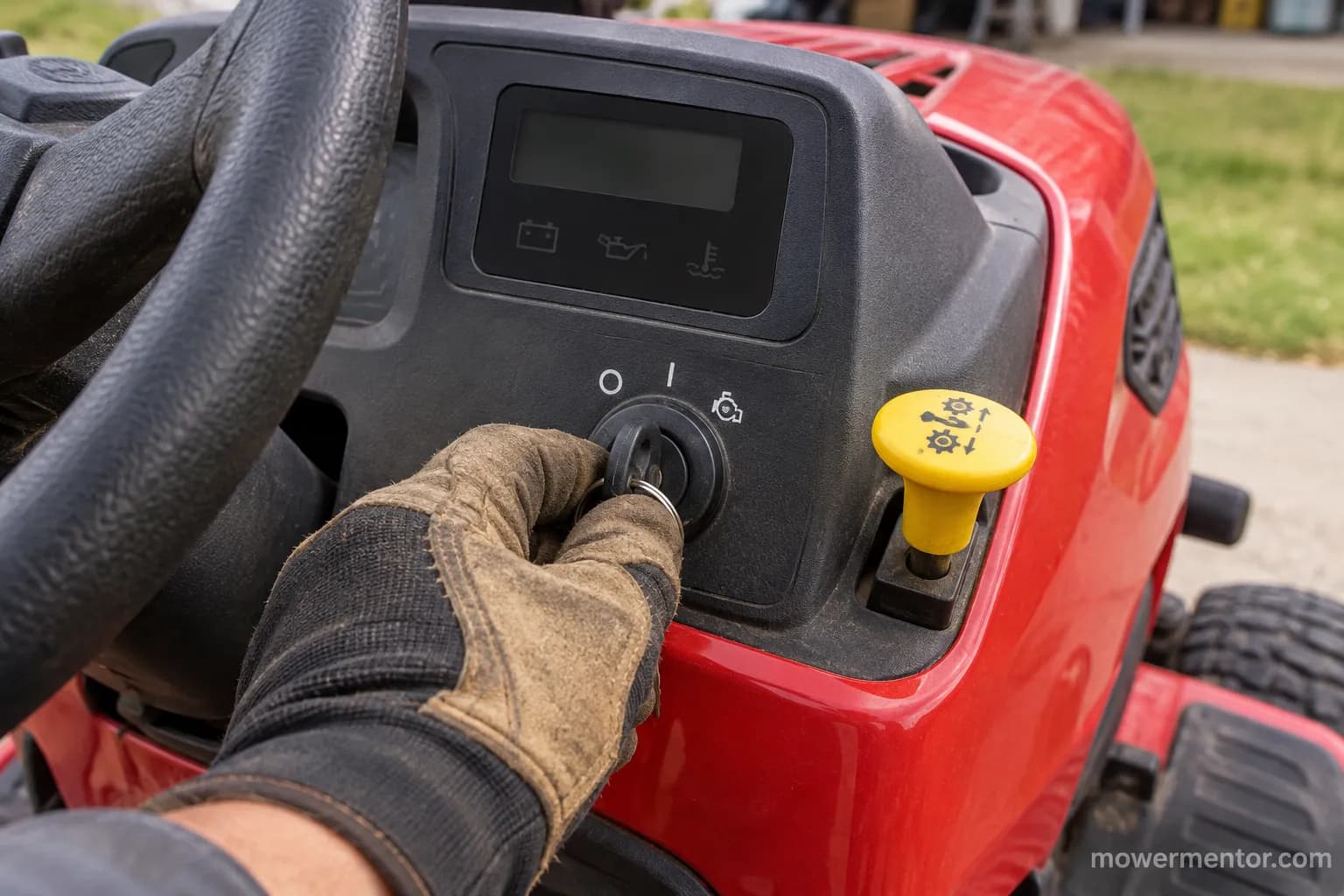
One free move before anything else: sit on the seat, press the brake fully, switch the blade PTO off, and confirm neutral.
The first time this happened on our shop YTH22V46, the key was dead silent and the only fault was a PTO knob that had not seated after a refuel.
Husqvarna Riding Lawn Mower Won't Start No Clicking? The 3-Branch Diagnosis
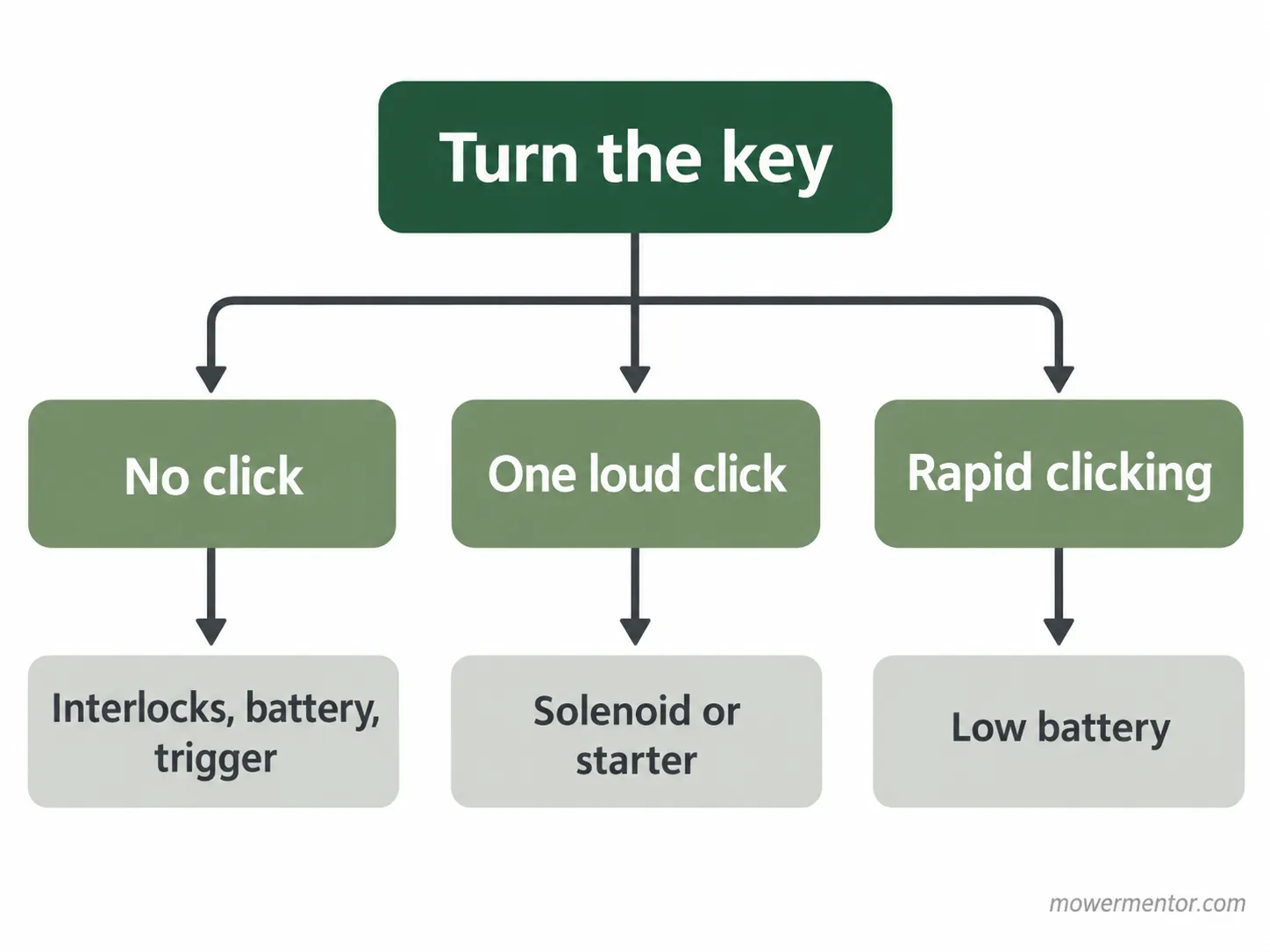
A Husqvarna riding lawn mower won't start no clicking situation splits into three sounds, and each sound rules a different set of parts in or out.
Complete silence means the solenoid coil never energized, so the fault sits upstream at an interlock, the battery, or the ignition trigger.
A single loud click means the solenoid pulled in but could not pass current, which points at the solenoid contacts or the starter.
Rapid clicking usually just means a low battery, so do not condemn the solenoid yet.
Across the silent-key Husqvarnas I diagnosed this past summer, the fault was an interlock or a battery or connection issue far more often than the starter motor, which was never the first thing to fail.
That distribution is why this flow tests the cheap, upstream causes before the expensive ones.
What does not even a click at the key mean?
Owners on the tractor forums describe it the same way: not even a click when I turn the key, the machine acts like it does not have a battery. That description is diagnostic.
It tells you the start circuit is open somewhere between the battery and the solenoid coil, which is exactly the interlock and connection territory covered next.
Sound at the key | What it rules in | Most likely cause | Go to |
|---|---|---|---|
Dead silence, no click | Open start circuit upstream of the solenoid | Interlock not set, dead battery, bad connection, open ignition trigger | Interlocks, battery, connections |
One loud single click | Solenoid energized but no crank | Solenoid contacts or starter | Solenoid, starter |
Rapid repeated clicking | Coil pulling and dropping out | Low or weak battery | Battery |
A click every few seconds | Relay chatter, not a start attempt | Very low voltage or a separate relay | Battery |
If instead you get one loud click instead, that is the single-click branch and it isolates the battery from the solenoid.
For any brand of rider that is dead silent, the same dead-circuit logic in a brand-agnostic dead-circuit checklist applies before you open anything.
Start Free: Seat, Brake and PTO Safety Switches
On a Husqvarna, an open operator-presence switch is the single most common reason the key goes dead silent, and it costs nothing to rule out.
The seat, brake, and PTO switches each sit in the start circuit, and any one of them left open keeps the solenoid from ever energizing.
Husqvarna's own starter support page confirms the machine will not crank unless the brake is set and the blades are disengaged.
The fastest confirmation is the correct starting sequence, done deliberately. Sit fully on the seat, press the brake pedal all the way down, switch the PTO or blade engagement off, and put the drive in neutral.
The Husqvarna operator manual lists the same suspects in the operator manual list: brake not depressed, attachment clutch engaged, weak battery, blown fuse, corroded terminals, loose wiring, faulty ignition switch, faulty solenoid or starter, and faulty operator-presence switches.
The manual names them but does not show you where they are or how to test them, which is where a continuity check comes in.
Can a bad seat switch really stop it from starting?
Yes. A seat switch that has drifted out of position, or a connector that has backed out a hair, leaves the circuit open and the key silent.
On our YTH24V54 the seat-switch connector under the pan had worked loose, and reseating it brought the click straight back.
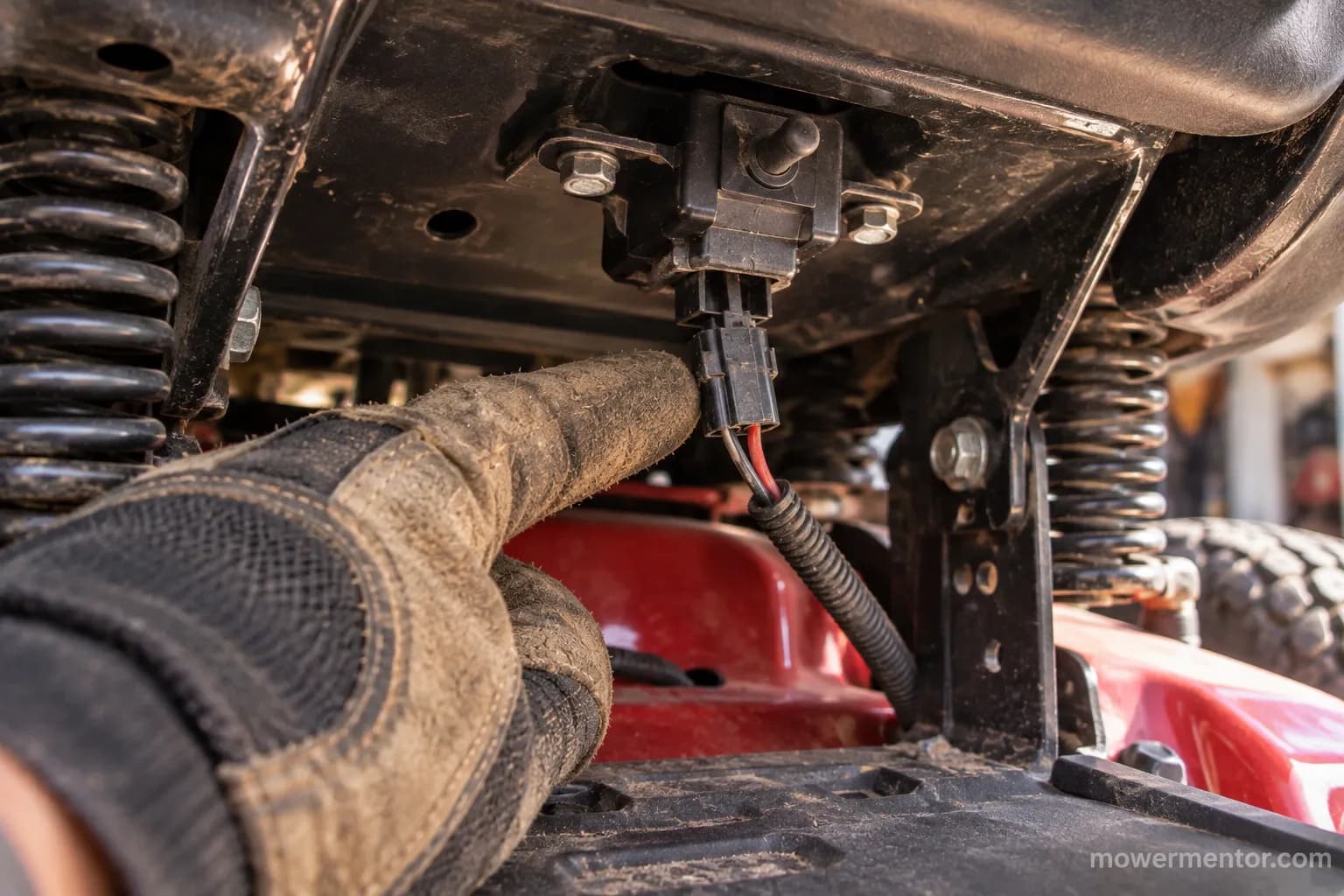
To test each switch, set a multimeter to continuity and check the switch in its active state. The table below gives the placement; for the full teardown and a responsible bypass for testing only, see the full interlock switch guide.
Switch | Where it sits on a Husqvarna | State when satisfied |
|---|---|---|
Seat | Under the seat pan, in the seat bracket | Closed when a rider is seated |
Brake | At the brake pedal linkage | Closed when the pedal is fully down |
PTO or blade | At the PTO knob or clutch | Closed when blades are off |
One override caution worth stating plainly.
Some Husqvarna switches are normally closed, so simply unplugging one does not bypass it, and an override method exists only for momentary testing, as covered at an override-for-testing method.
Bypassing an interlock defeats a safety system, so test, do not delete.
Test the Battery the Right Way: Resting Volts and the Under-Load Drop
A Husqvarna battery can read a healthy number at rest and still fail to crank, so a resting voltage alone does not clear it.
A fully charged 12-volt lead-acid battery reads about 12.6 to 12.8 volts at rest, and it should be boost-charged whenever it drops below 12.4 volts, according to Deka's battery care data.
The number that actually matters is how far the voltage sags when the starter pulls current.
Read resting voltage first, but disable the surface charge before you trust it. Turn on the headlights or an accessory for about 30 seconds, switch them off, then read the posts.
Use the scale below to place the reading.
A common state-of-charge chart puts roughly 12.6 volts at full and about 12.1 volts at half, and anything under about 11.9 volts is deeply discharged.
Resting voltage | State of charge | Action |
|---|---|---|
12.6 to 12.8 V | Full | Good, move to the load check |
12.4 to 12.5 V | About 75 to 90 percent | Usable, charge soon |
12.1 to 12.2 V | About 50 percent | Charge before testing further |
Below 11.9 V | Deeply discharged | Charge fully or replace |
Now the reading that finds a hidden dud. During crank, a healthy battery should hold up under load, and a battery that passes a standard load test stays near 9.6 volts rather than collapsing.
On our GT52XLS, the battery read 12.4 volts at rest but sagged hard the moment the starter pulled, which a resting reading alone would have missed.
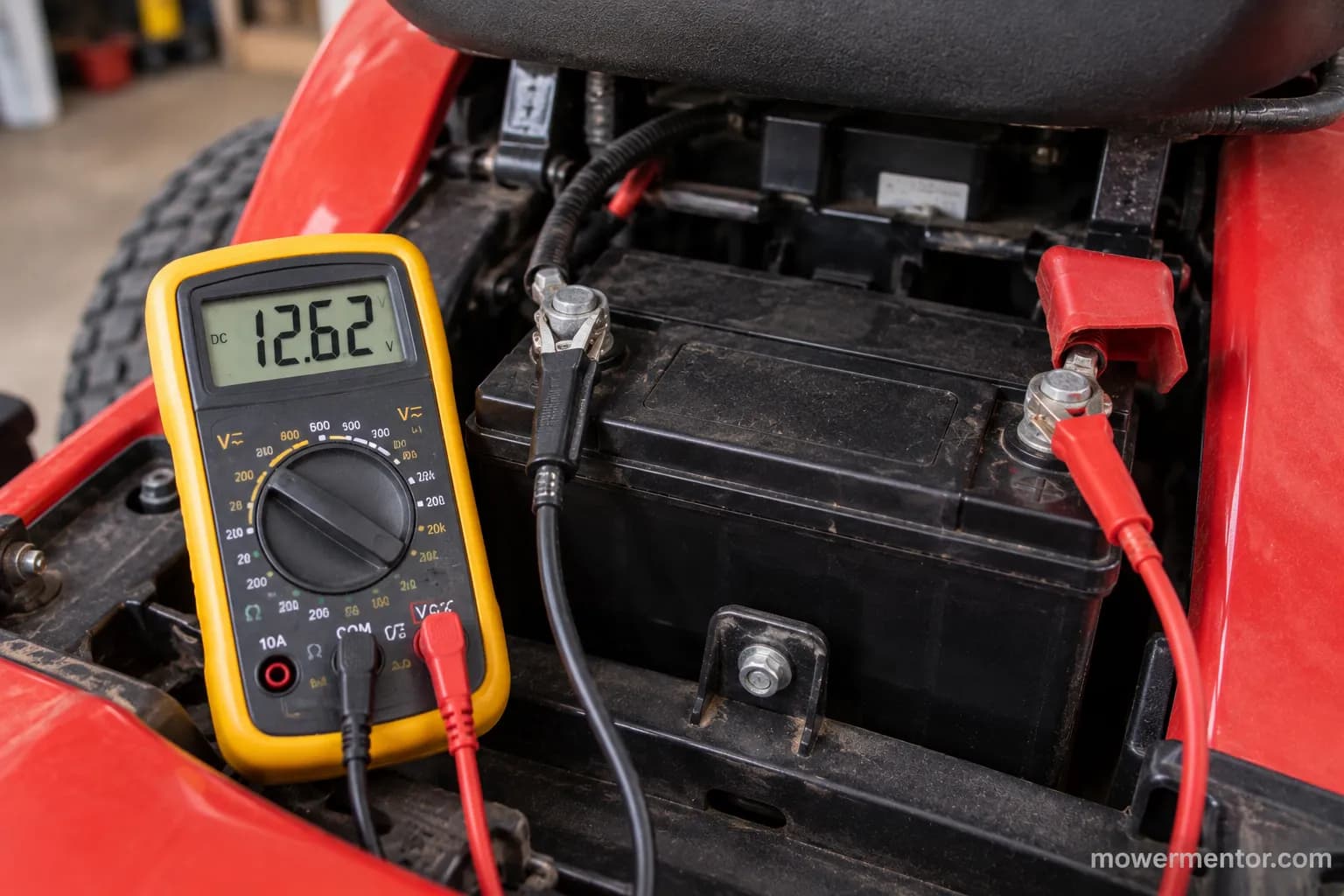
If the battery will not hold a charge, stop guessing and move to sizing the right replacement battery.
If you just need to get the mower moving today, jump-starting it to get going is the quick path.
And if the machine went silent right after you fitted a new battery, the still dead with a fresh battery case is its own diagnosis.
Clean and Load-Check the Connections, Ground Strap and Fuse
A good battery still delivers nothing if a connection, a ground strap, or a fuse is bad, which is the classic no clicking but I have 12 volts case.
Resting voltage measured at the posts does not prove current can flow to the starter, so this section checks the path, not just the source.
RepairClinic's guidance is to test the start circuit for continuity and inspect the connections, per RepairClinic's start-circuit guidance.
Start at the battery posts and cable ends. Clean any green or white corrosion, tighten both ends, and then do a voltage-drop test across each connection while a helper turns the key.
Do not skip the ground strap. The heavy cable from the battery negative to the frame or engine is the silent killer, and a corroded ground reads fine at rest yet drops badly under load.
A corroded negative post on one machine read a solid 12.6 volts at rest but dropped nearly 2 volts the instant the starter pulled, and cleaning it fixed a mower that looked completely dead.
That 2-volt drop is the signature of a bad connection, and it never shows up on a plain resting reading.
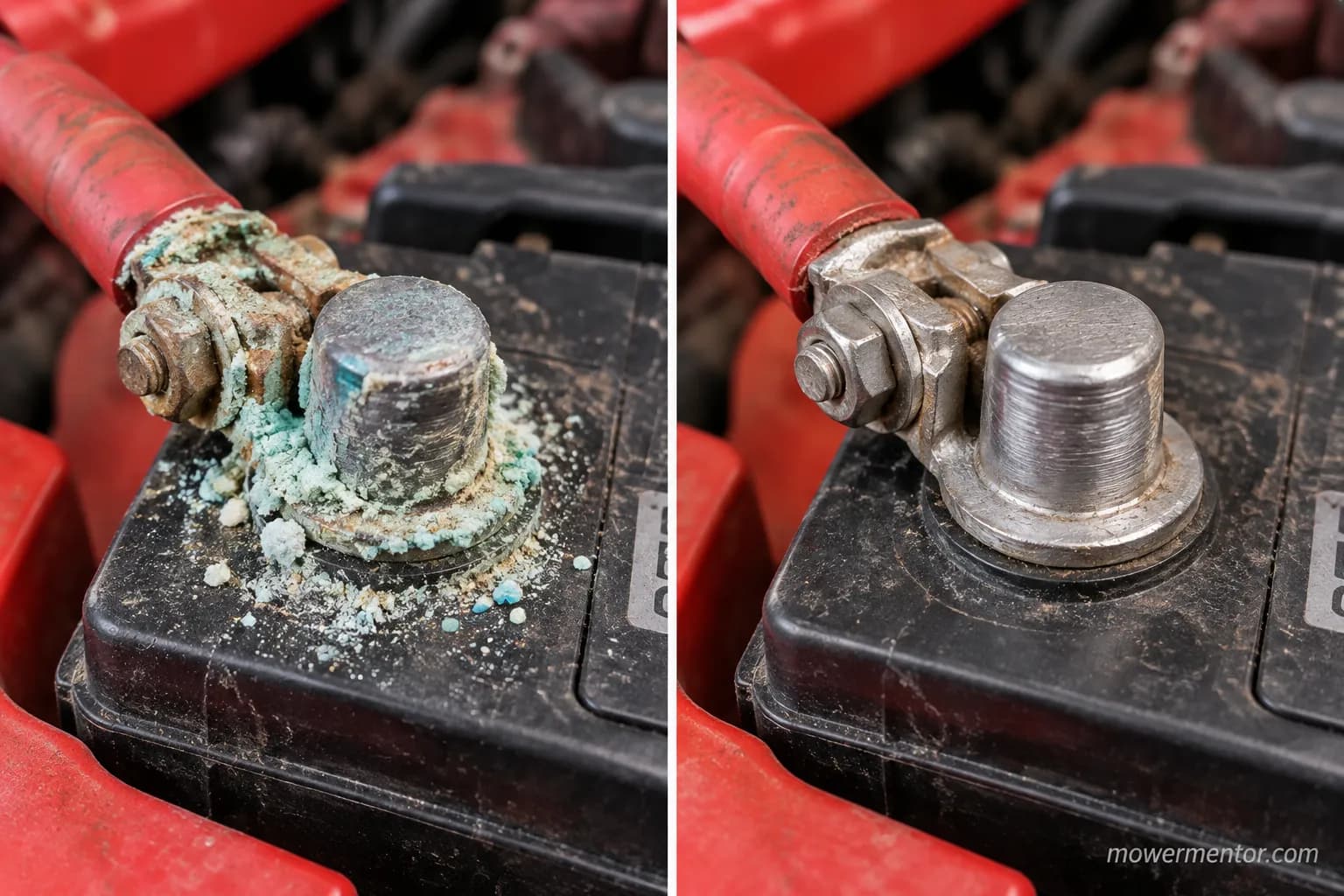
Then find the inline fuse and read it. A fuse that blows again the instant you replace it is not a weak fuse, it is a short, so stop and trace the wiring rather than feeding it fuses.
Owners often find a seat-switch wire that chafed against the frame and blew the fuse, which is a job for Husqvarna fuse and wiring fixes.
The Solenoid Test: What a Single Click or Silence Proves
The starter solenoid is the fork in the road, because testing it separates a missing trigger from a bad solenoid or starter.
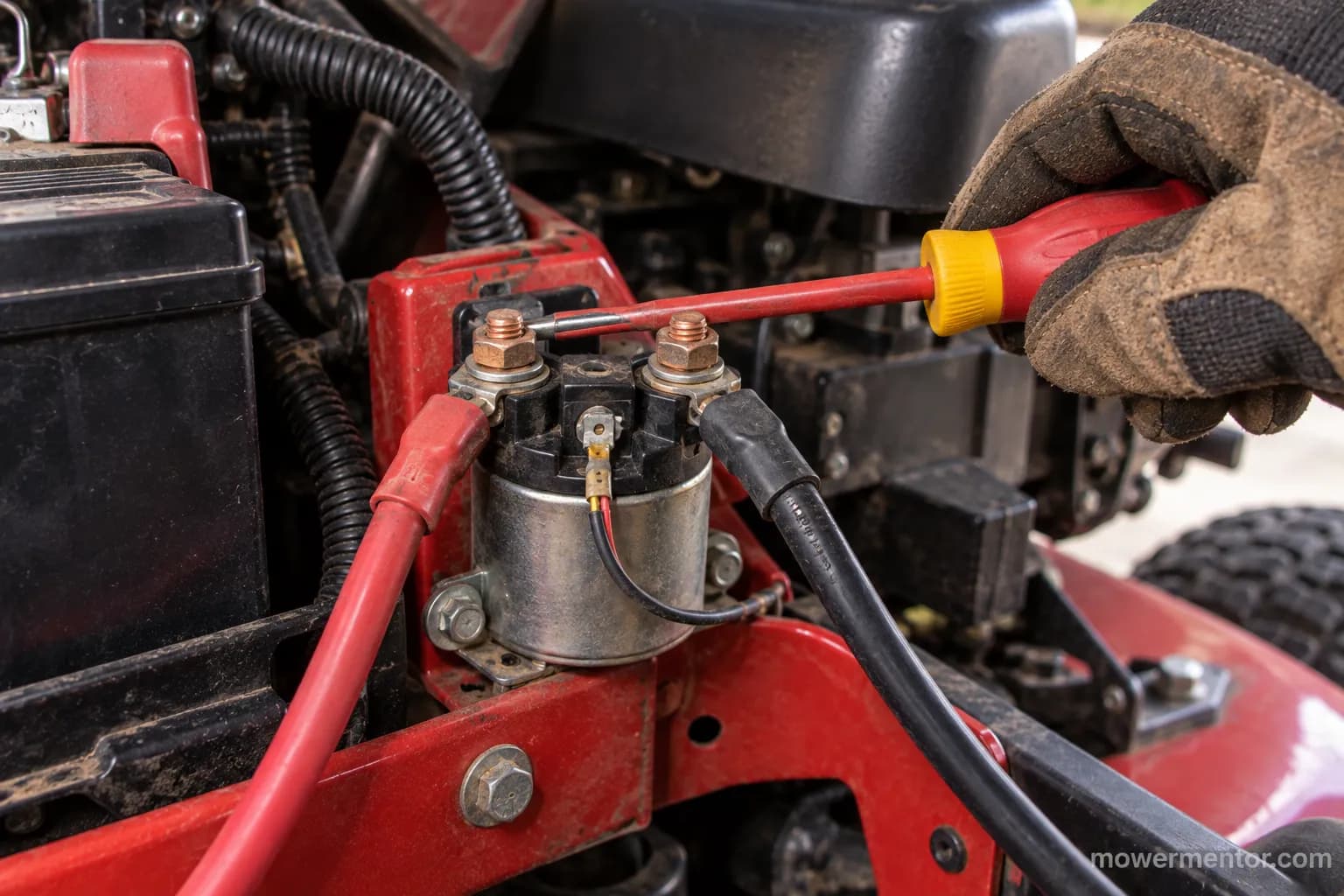
Two probes settle it: the small-terminal trigger voltage, and a direct bypass across the two large lugs.
The step of verifying voltage at the solenoid when the key is in start is exactly what experienced techs recommend first, as noted in this guide to checking voltage at the solenoid.
Should you hear 12 volts at the solenoid's small terminal?
Yes, in the start position. With the key held to start, the small trigger terminal should show roughly battery voltage.
If it does, the trigger side is doing its job and the fault is the solenoid or starter.
If it shows nothing, the trigger never arrived, so the fault is upstream at an interlock or the ignition switch.
Next, prove the starter with a bypass. With the machine in neutral, the brake set, and your hands clear of the blades and belts, bridge the two large solenoid lugs with an insulated screwdriver.
I bridged the large lugs on a silent Husqvarna and it cranked instantly, which proved the starter and the heavy cables were fine and the fault lived on the trigger side.
That single test converts a guess into a proof.
Solenoid symptom | What it proves | Next step |
|---|---|---|
Single click, no crank | Solenoid pulled in, contacts or starter suspect | Bypass test, then starter |
Silence at the small terminal | No trigger reaching the solenoid | Back to interlocks and ignition |
Bypass cranks the engine | Starter and cables are good | Fault is trigger-side, check ignition |
Bypass does nothing | Starter or its ground is bad | Confirm the starter |
For location, wiring, and replacement, see the dedicated solenoid guide.
If the click pattern is your main clue, what the click pattern means breaks down single versus rapid versus none in more depth.
Ignition and Key-Switch: Testing by Terminal Before You Replace It
When the solenoid trigger never arrives, the ignition switch is a prime suspect, but you test it by terminal rather than replacing it on a hunch.
The key switch bridges specific terminals in each position, and a continuity test tells you in 20 seconds whether it is doing its job.
This is the same continuity-first approach RepairClinic describes for the start circuit.
The forum lesson here is expensive. Owners routinely replace the ignition switch and the solenoid and still get nothing, because the real fault was an interlock all along.
An owner in one case had already swapped the switch twice, and a quick continuity test showed the switch was fine while the seat connector was the actual culprit.
Testing first would have saved two parts and an afternoon.
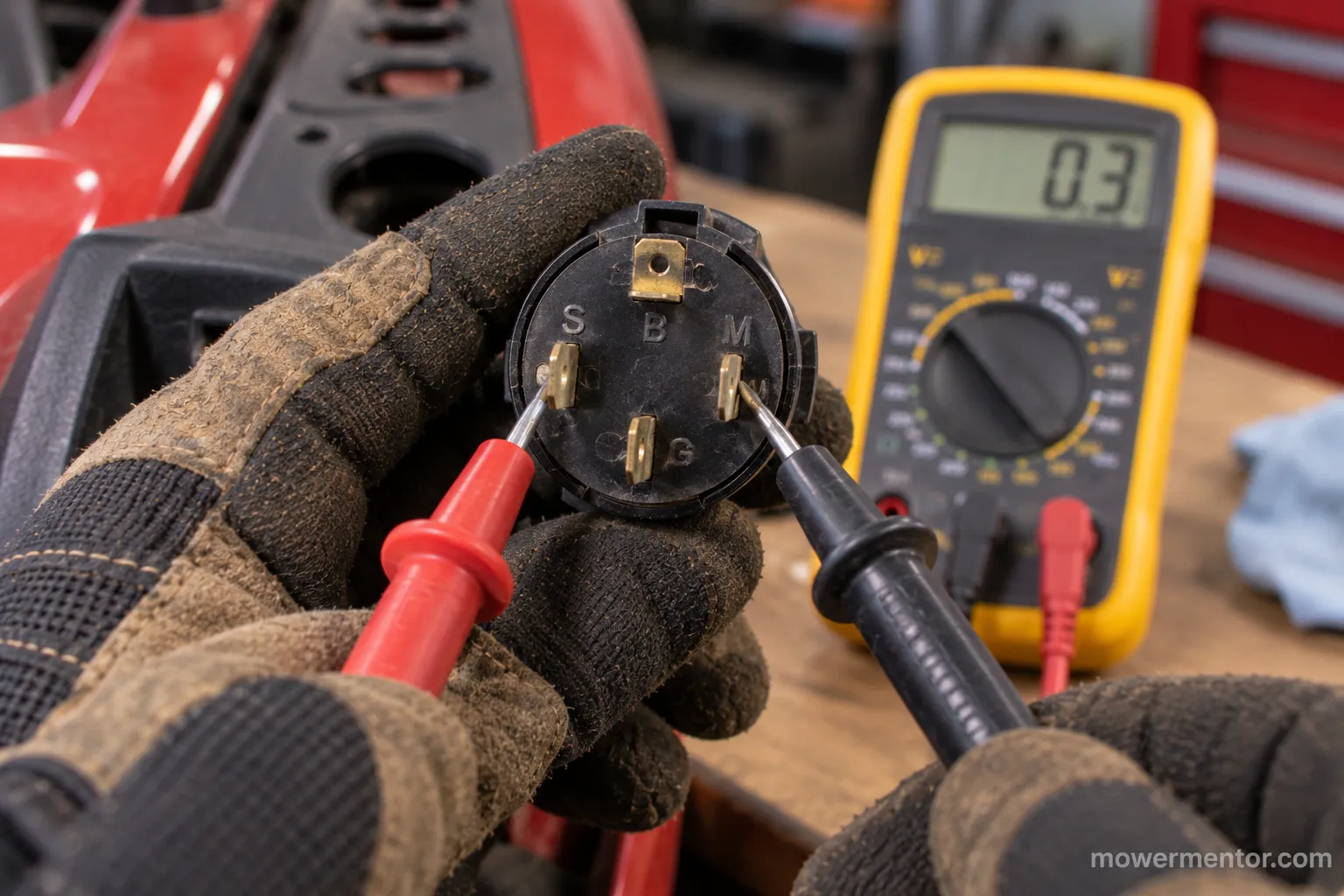
The terminals are usually lettered, and only certain pairs connect in each position. Confirm the start-position bridge before you condemn the switch.
Terminal | Typical role | Bridges in |
|---|---|---|
B | Battery feed | Run and start |
S | Starter or solenoid trigger | Start only |
M | Magneto or kill | Off |
L | Lights or accessory | Run |
G | Ground | As wired |
If the switch truly tests bad, working around a bad switch covers safe options. And if the engine cranks after this but will not fire, that is a spark and fuel path, starting with the right spark plug.
When It's the Starter Itself: Confirm Before You Buy One
The starter motor is the last branch and the most expensive guess, so confirm it before spending.
The test is simple: with the solenoid bypassed and full battery voltage present at the starter stud, a starter that still will not turn is genuinely bad.
Full voltage present with no rotation is the only reading that actually condemns the starter.
Measure voltage right at the starter terminal during a crank attempt. Full voltage with no spin points at the starter or its ground; little or no voltage sends you back to the trigger side and the solenoid.
Check the starter's own ground and mounting bolts too, because a bad starter ground mimics a dead starter exactly.
With the solenoid bypassed and full voltage confirmed at the stud, a starter that stays silent is the one clear case where the starter is truly the answer.
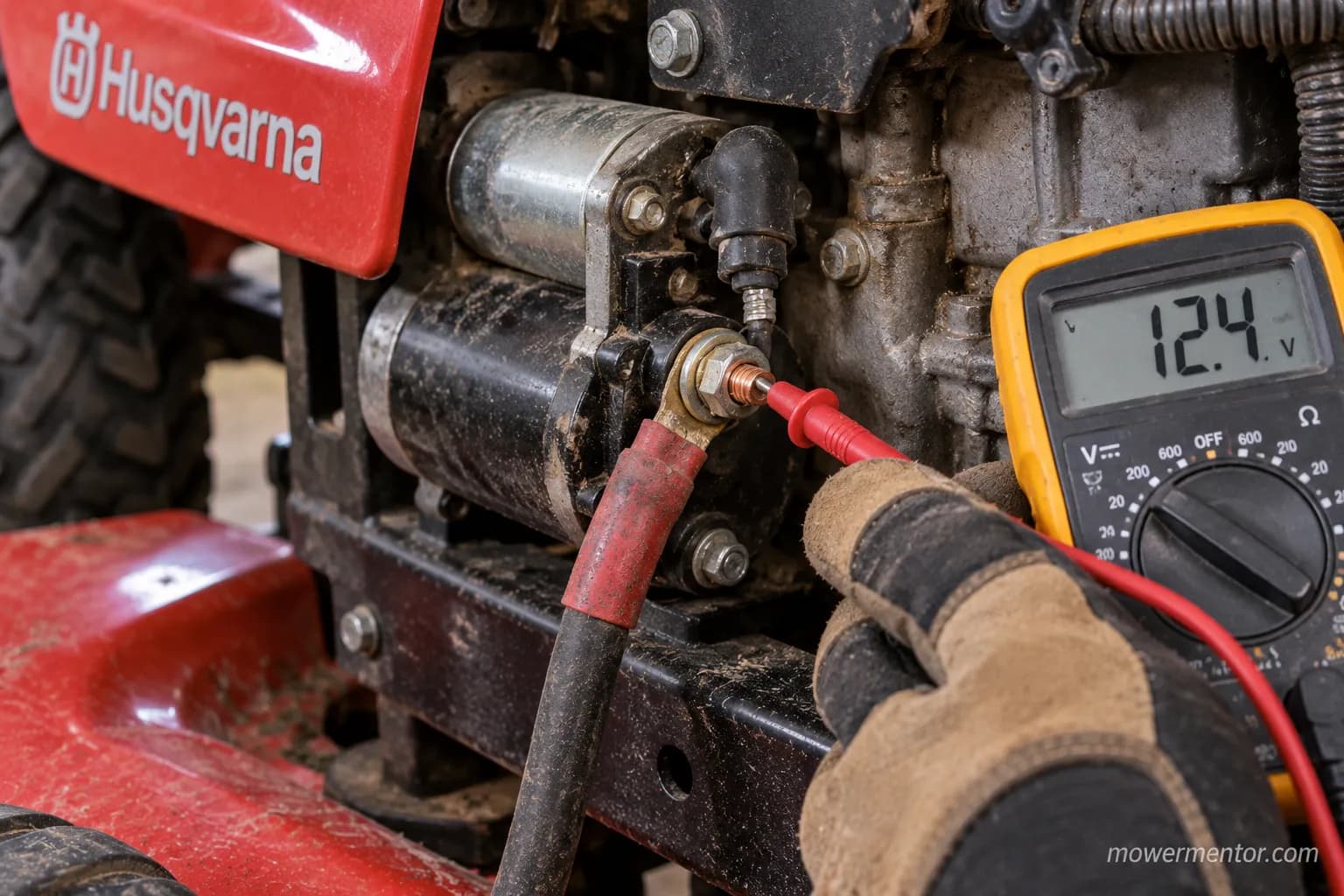
Once you have confirmed it, the full starter walkthrough covers test-and-replace. Some owners reach for a spray first, so when starting fluid actually helps is worth a look.
If the engine finally cranks but will not catch, changing the spark plugs is the next move on the fuel-and-spark side.
Husqvarna Model Notes: YTH, TS and GT-Series Quirks
Test-point locations differ across the Husqvarna families owners actually search, so a model overlay saves real time.
The YTH tractors, the TS line, and the older GT garden tractors place the solenoid, fuse, and switches in different spots, and Husqvarna's own model support pages index the manuals by serial number.
On an old Husqvarna riding lawn mower won't start no clicking call, aged ground straps and corroded connectors are the top cause on machines a decade or more old.
The matrix below is a starting map; always confirm against your model's manual because locations shift year to year and by engine brand.
Briggs, Kohler, and Kawasaki starters draw differently, which changes what a healthy voltage reading looks like.
Model family | Battery location | Solenoid location | Common quirk |
|---|---|---|---|
YTH18542, YTH22V46 | Under the seat | On the frame near the battery | Blade PTO not seated after refuel |
YTH24V54 | Under the seat | Frame-mounted, left of battery | Seat connector backs out |
TS series | Under the hood or seat | Near the starter | Deck-lowered interlock trips easily |
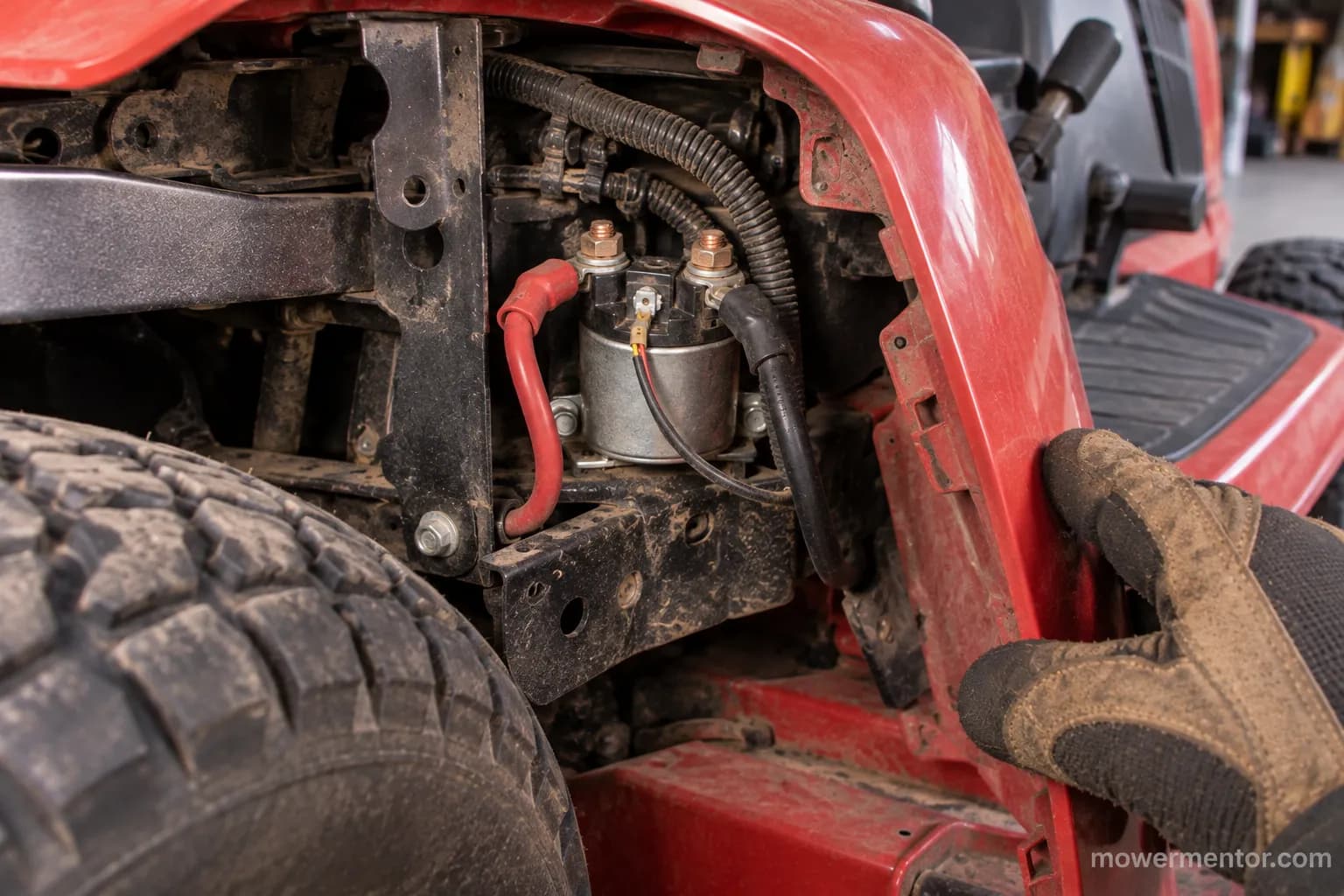
GT52XLS and older GT | Under the seat | Behind the right fender panel | Aged ground strap, corroded posts |
On the GT52XLS the solenoid hides behind the right fender panel, which the manual does not picture, so I photographed the exact spot to save the next owner the hunt.
This whole flow is the electrical half of the broader picture, and the complete Husqvarna start hub covers fuel too.
Two off-season habits also matter here.
Keeping matching the correct air filter and giving the machine a full seasonal tune-up will not fix a silent key, but they keep the whole starting system healthy enough that connections and grounds fail less often.
When to Stop and Call a Pro, and How to Prevent a Repeat
Most silent-key Husqvarnas are a driveway fix, but a few symptoms mean it is time to hand it off.
A fuse that keeps blowing with a short you cannot find, a melted solenoid, a burning smell, or visible harness damage are all signals to stop probing.
The one time I handed a mower to a dealer, it was a chafed harness shorting intermittently, an hour of continuity chasing that a wiring diagram solved faster.
Husqvarna's support also directs unresolved starting faults to a service dealer, and that is the right call for an intermittent short.
Prevention that works: Clean and protect the battery terminals each season, keep the ground strap tight, and put the battery on a tender over winter so it never drops into deep discharge. Those three habits prevent most repeat no-click failures.
For the whole-machine version across every brand, the master electrical decision tree is the place to start, and the broader no-crank diagnosis covers slow-crank cases where the engine turns but drags.
Between seasons, a model-matched tune-up kit keeps the starting system healthy so connections and grounds fail less often.
A Husqvarna riding lawn mower won't start no clicking problem almost always traces to an unset interlock, a tired battery, or a lost connection, not the starter.
Work the flow in order, cheap and upstream before expensive and downstream, and let the sound at the key tell you where to look first, so you fix it without buying a part you never needed.
Frequently Asked Questions
Why won't my Husqvarna start and there's no clicking?
Complete silence means the start circuit is open before the solenoid coil, so no current reaches the starter. On a Husqvarna the usual causes are an unset interlock, a discharged battery, a corroded connection, or an open ignition trigger. Work those in order before touching the starter or solenoid.
What's the difference between no clicking and just clicking?
No clicking means the solenoid never energized, which points upstream to interlocks, battery, or the ignition trigger. A single loud click means the solenoid pulled in but could not pass current, which points at the solenoid contacts or the starter. Rapid clicking usually means a low battery.
How do I know if it's the solenoid or the starter?
Bridge the two large solenoid terminals with an insulated screwdriver while in neutral with the brake set. If the engine cranks, the starter and cables are good and the fault is the trigger side. If nothing happens with full voltage present at the starter, the starter itself is bad.
Can a bad seat switch stop it from starting?
Yes. The seat switch sits in the start circuit, so a switch that has drifted out of position or a connector that has backed out leaves the circuit open and the key silent. Reseating or realigning the switch often restores the crank immediately.
What voltage should the battery be?
A fully charged 12-volt battery reads about 12.6 to 12.8 volts at rest, and below 12.4 volts it needs charging. Resting voltage alone is not enough, because a battery can read fine at rest and still sag badly under the starter load, so always follow up with a load check.
Where is the fuse and what rating is it?
The inline fuse sits in the wiring near the battery or under the dash, and the rating varies by model, commonly 15 or 20 amps, so confirm it against your machine. A fuse that blows again the moment you replace it means a short in the wiring, not a weak fuse.
Read it your way
Short on time? Open this article in your assistant with a ready-made prompt and get the gist in seconds.
Found this useful? Make us a preferred source so we show up in your Google results.
Keep reading
Related articles
Troubleshooting & Repair
Lawn Mower Ignition Switch Replacement (Steps + Cost)
Do your own lawn mower ignition switch replacement: photo steps, wire-by-terminal transfer, fitment help, and a DIY-vs-shop cost table to save $100+.
Troubleshooting & Repair
Which Lawn Mower Ignition Switch Fits? (Prong Guide)
hoose the right lawn mower ignition switch by prong count (4/5/6/7), universal vs OEM fit, and key compatibility, plus which one fits your mower.
Troubleshooting & Repair
How to Start a Lawn Mower With a Bad Ignition Switch
Confirm it's the switch, then learn how to start a lawn mower with a bad ignition switch: a safe solenoid bypass to get moving, plus how to fix it for good.
Troubleshooting & Repair
How to Test a Lawn Mower Ignition Switch (5/6/7-Pin)
Learn how to test a lawn mower ignition switch with a multimeter: get continuity tables for 5, 6 & 7-pin switches plus a no-multimeter test-light method.
The discussion
Comments
Every comment is reviewed before it goes live.