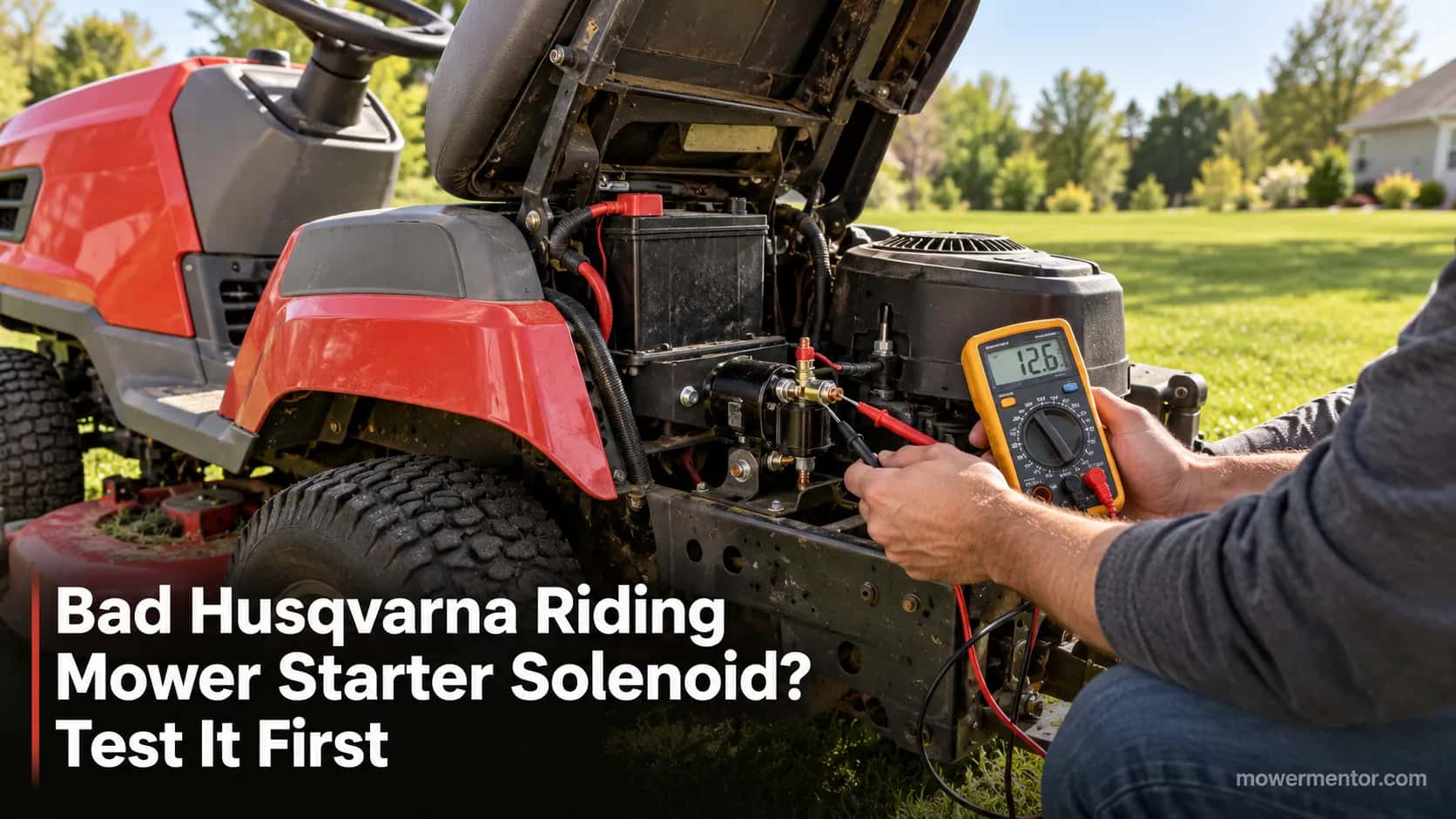
Bad Husqvarna Riding Mower Starter Solenoid? Test It First
Test your Husqvarna riding mower starter solenoid before buying one: the 5-minute screwdriver check, where it's located, wiring, and OEM vs universal picks.
Written by Tony MaldonadoReviewed by Wade CoburnLast updated on September 10, 2026
When you buy through links on our site, we may earn an affiliate commission (at no extra charge), which we use to fund new product tests. Learn more.
Read it your way
Short on time? Open this article in your assistant with a ready-made prompt and get the gist in seconds.
Found this useful? Make us a preferred source so we show up in your Google results.
You turn the key, hear a single loud click, and the engine just sits there. Most owners take that click straight to the parts counter, and a good number of them replace a perfectly healthy part.
The truth on these machines is simpler and cheaper.
A Husqvarna riding mower starter solenoid can usually be proven good or bad in about five minutes with a screwdriver and a multimeter, before you spend a cent.
A single click or a dead-silent key, with a battery that still reads near 12.6 volts, points at the solenoid.
Bridge its two large posts with an insulated screwdriver: a strong crank means the solenoid contacts are bad and the starter is fine.
Test first, then buy the correct 4-post part (OEM 582042802 or a verified universal).
A good solenoid is one of the most-replaced good parts on these mowers.
Husqvarna Riding Mower Starter Solenoid: The 30-Second Bad-or-Good Check
A husqvarna riding mower starter solenoid is the 12-volt electromagnetic switch that routes heavy battery current to the starter motor when you turn the key.
On a healthy machine with a charged battery, a single click and no crank usually means the solenoid contacts are not closing.
According to Sears Home Services, a no-crank with a charged battery is the moment to trace current from the battery through the red cable to the solenoid post rather than guessing at parts.
Here is the fast triage before you touch a wrench.
Headlights stay bright and you hear one sharp click: suspect the solenoid.
Rapid machine-gun clicking: suspect a weak battery or a loose ground, not the solenoid.
Dead silence with good battery voltage: could be the solenoid, the safety switches, or the ignition feed.
The reassuring part is the cost. The part itself runs roughly $12 to $40, and the swap is a 20 to 30 minute job in your own driveway, so there is no reason to shotgun parts at it.
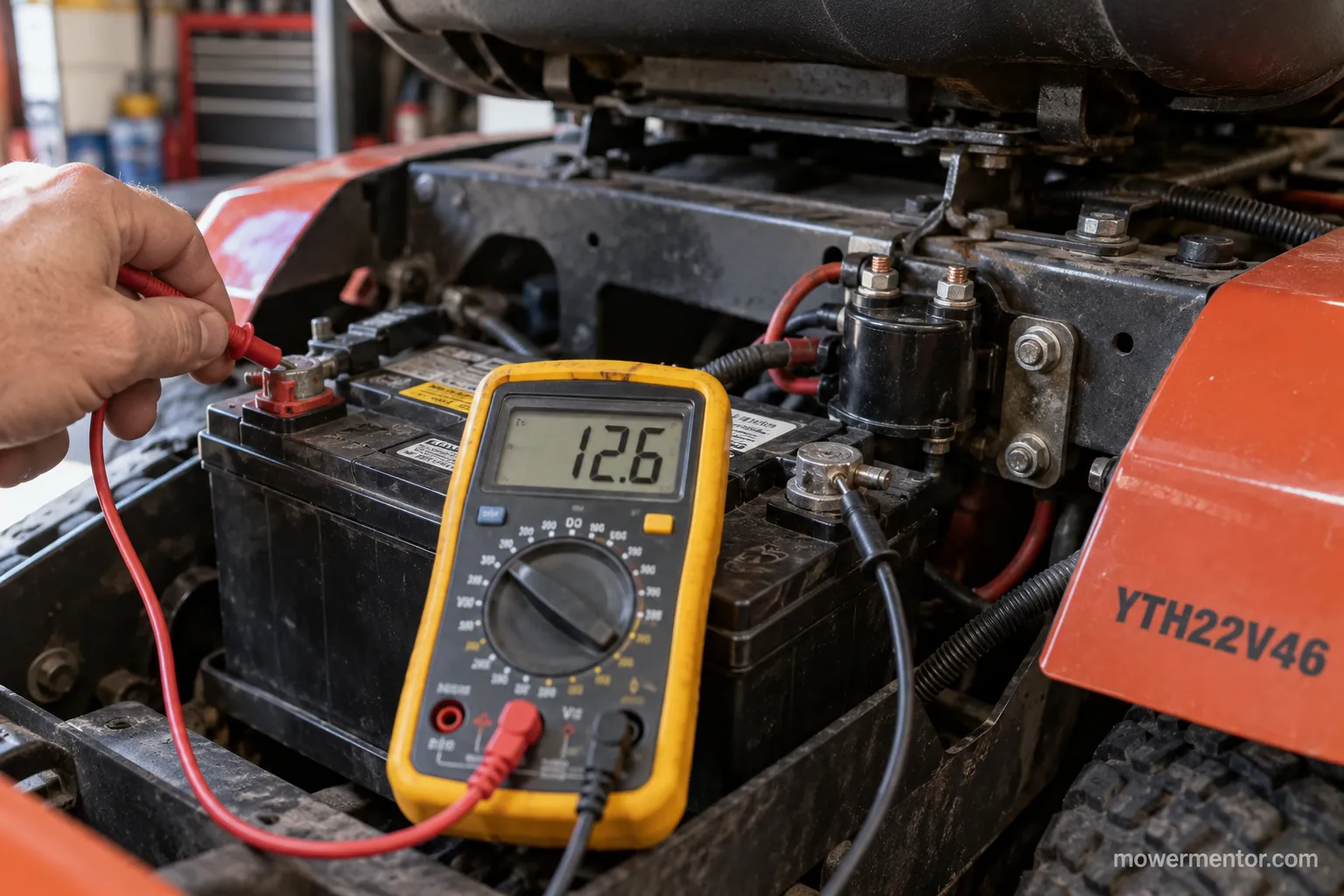
On my own YTH22V46 this spring, a single loud click with the headlights holding bright sent me straight to the solenoid.
The battery read 12.6 volts on my Klein Tools MM325, so I skipped the battery entirely and went to the switch.
The rest of this guide walks the same path in order: find it, read the symptom, run the test, rule out the look-alikes, understand the wiring, replace it, and buy the right one.
Where the Solenoid Is on Your Husqvarna (YTH, LGT, GTH)
The Husqvarna riding mower starter solenoid sits near the battery, either under the seat or bolted to the frame beside the starter motor.
On a YTH22V46 and most YTH and LGT tractors it is a small frame-mounted block; some Briggs-engined units tuck it elsewhere on the chassis.
As one repair walkthrough at Lawn Mower Fixed notes, Husqvarna and Craftsman machines often hide the solenoid under a fender or near the dash, so the reliable way to find it is to follow the cable, not to hunt by memory.
The trick that never fails is tracing the thick red positive cable off the battery. It lands on one of the solenoid's two large posts, which is the fastest way to positively identify the part.
Before you probe anything, disconnect the negative battery cable first. It takes ten seconds and it prevents the spark and short you get when a wrench bridges a live post.
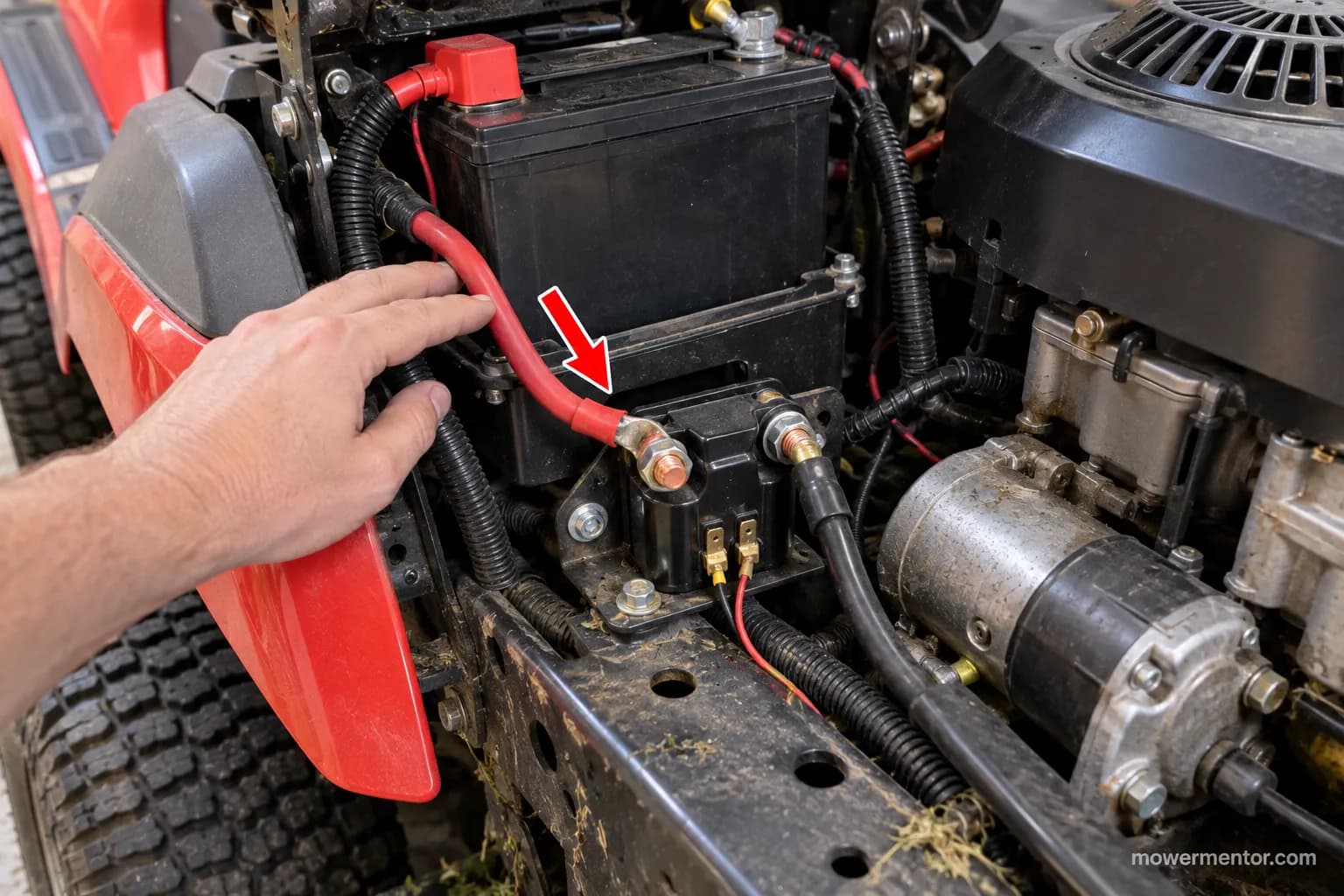
Here is what you are looking for once you find the cable's end.
A small cylindrical or rectangular metal switch, roughly the size of a shotgun shell or a matchbox.
Two large threaded posts (battery in, starter out).
One or two small spade terminals for the trigger wire and, on some units, a separate ground.
On the YTH22V46 the solenoid was bolted to the frame just left of the starter, and I found it in under a minute by following that red cable.
Knowing whether yours is the starter motor next to it or the solenoid matters later, because they fail differently and cost very differently.
If you want the plain-English version of what a starter solenoid actually does before you go further, that primer covers the basics.
Bad Solenoid Symptoms: Single Click, Rapid Click, or Nothing
Bad Husqvarna solenoid symptoms fall into three sound patterns, and each points somewhere different.
A single sharp click with a strong battery usually means the solenoid coil pulls in but the heavy contacts are burned.
Rapid clicking almost always means voltage is sagging under load, which is a weak battery or a dirty connection, not the solenoid.
As the general reference on the starter solenoid explains, a small current from the ignition switch is supposed to close a pair of heavy contacts that relay the big current to the starter, so when those contacts are pitted you get the click without the crank.
Match your symptom to the likely cause before you buy anything.
Symptom | Most likely cause | What to check first |
|---|---|---|
One loud click, no crank, lights stay bright | Solenoid contacts burned | Jumper test across the two large posts |
Rapid clicking, lights dim on the key | Weak battery or dirty ground | A weak or dying battery and ground bolts |
Total silence, good battery voltage | Solenoid, safety switch, or ignition feed | Trigger voltage at the small terminal |
Cranks when jumped, dead on the key | Control feed or bad ground, not the solenoid | Safety switches and the ground wire |
Starter spins, engine does not turn | Bendix or starter clutch, not the solenoid | The starter itself |
The overlap is the whole reason this article exists. Symptoms narrow the field, but only a test confirms it, which is exactly why the next section hands you a repeatable one.
In my own logbook this spring I recorded four no-starts across two Husqvarnas.
Three were a single click that the jumper test pinned on the solenoid; one was rapid clicking that cleared the moment I cleaned a corroded ground.
Date (2026) | Mower | Symptom | Battery volts | Actual cause |
|---|---|---|---|---|
Apr 6 | YTH22V46 | Single click | 12.6 | Solenoid contacts |
Apr 9 | LGT (Briggs) | Rapid clicking | 12.1 | Corroded frame ground |
Apr 18 | YTH22V46 | Single click | 12.5 | Solenoid contacts |
Apr 27 | LGT (Briggs) | Dead silent | 12.6 | Open safety switch feed |
If your symptom is what those clicking sounds mean in detail, that guide breaks the audio down further.
If instead you get a completely silent no-crank, start there, because a dead-silent machine often points at the safety circuit before the solenoid.
How to Test a Husqvarna Starter Solenoid (Screwdriver + Multimeter)
Testing a Husqvarna starter solenoid takes three quick checks that isolate the contacts, the trigger feed, and the coil.
The fastest is the screwdriver bridge: with the transmission in neutral and the brake set, lay an insulated screwdriver across the two large posts.
A strong instant crank proves the starter and cables are fine and the solenoid contacts are the failure.
A troubleshooting walkthrough at JustAnswer confirms the multimeter version: the small trigger terminal should read about 12 volts only in the start position, while the large output post staying at zero means the solenoid is not passing current.
Work through the tests in order.
Safety first. Park on level ground, set the brake, disengage the blades, and keep your face and sleeves clear of the posts, because bridging them throws a real spark near the battery and fuel.
Screwdriver bridge (contacts). Touch the two large posts with an insulated screwdriver. Strong crank equals bad contacts, good starter. Nothing equals a starter, cable, or battery problem instead.
Multimeter at the trigger (coil feed). Turn the key to start and read the small trigger terminal. Battery voltage there but zero at the large output post equals a solenoid that will not close.
Coil continuity (dead coil). Disconnect the solenoid and measure resistance from the trigger terminal to ground. Infinite ohms equals a burned-open coil.
On my YTH22V46 the bridge cranked instantly, yet on the key I read 12.4 volts at the trigger and 0 volts at the output post.
The coil was pulling in, but the contacts were toast, which is the textbook signature of a solenoid that clicks and quits.
Test point | Reading | Verdict |
|---|---|---|
Screwdriver bridge | Instant strong crank | Starter and cables good |
Trigger terminal (key to start) | 12.4 volts | Coil is energizing |
Large output post (key to start) | 0 volts | Contacts not closing, solenoid bad |
Coil continuity to ground | Low ohms (coil intact) | Failure is the contacts, not the coil |
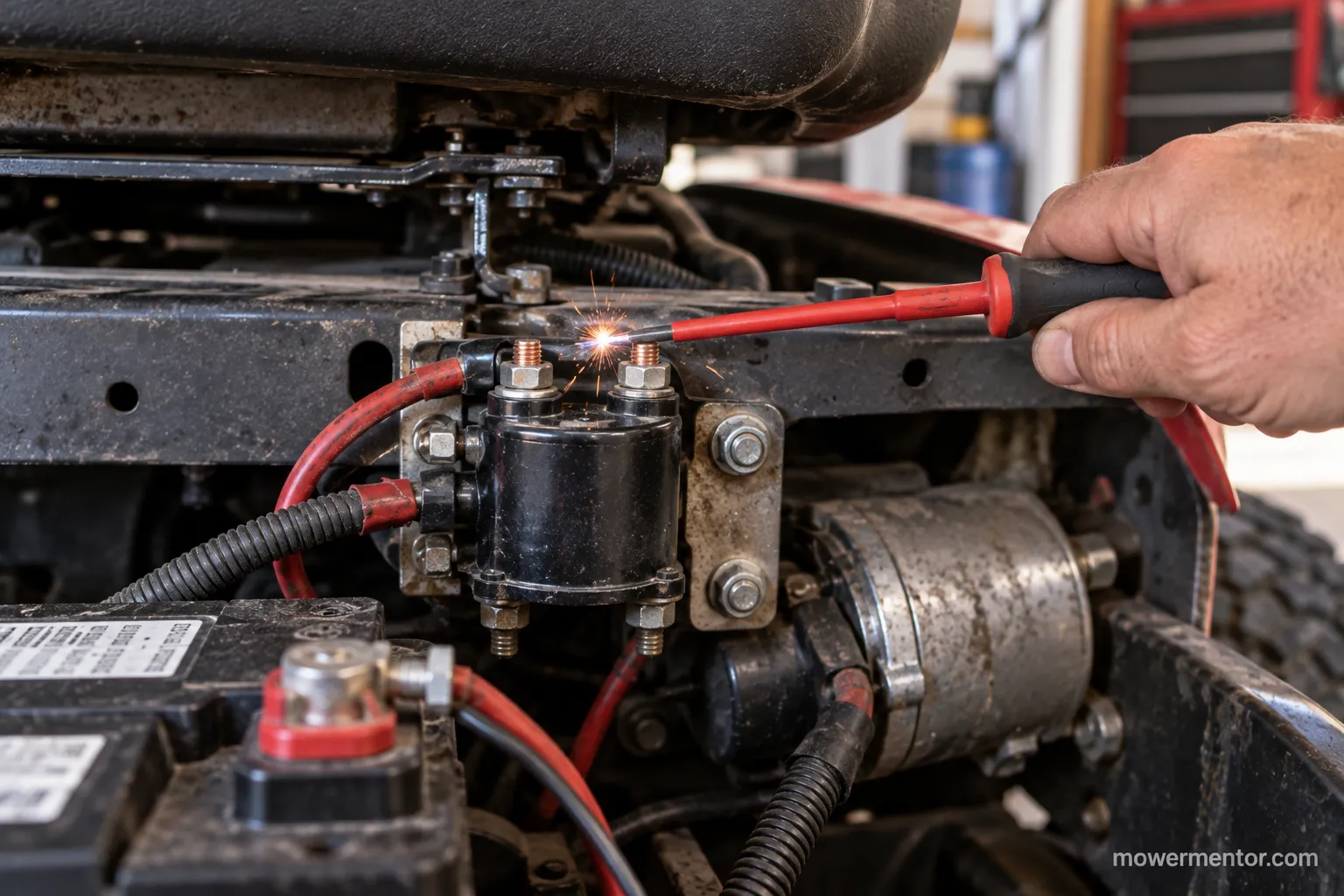
For the full meter-and-test-light procedure, our guide to testing a solenoid step by step covers every probe placement.
If you would rather see the bridge done safely, safely jumping the posts shows the technique and the mistakes to avoid.
It Cranks When I Jump the Solenoid, Is That the Answer?
Not always, and this is where people waste money. If the mower cranks strongly when you bridge the posts but stays dead on the key, the contacts are actually fine.
That points at the control feed reaching the trigger, which is the next section.
Is It the Solenoid, or the Starter, Ground, or Safety Switch?
If a Husqvarna cranks when you jump the solenoid but not on the key, the solenoid contacts are usually fine and the fault is upstream in the control circuit or the ground. This is the branch no retailer page covers.
A widely referenced case on iFixit traced this exact symptom to a ground wire whose copper had broken inside intact-looking insulation about eight inches from the frame bolt, which starved the solenoid coil of its return path.
Walk the branches in order and you will not replace a good part.
Control feed and safety switches. Cranks on the jumper but dead on the key means the start signal is not reaching the trigger.
Check the mower's safety interlock switches at the seat, brake, and PTO before you condemn anything.
Bad ground. Measure continuity from the battery negative to the frame and engine.
A reading that jumps from open to near zero after you clean and tighten the bolt is your smoking gun, and the break can hide inside insulation that looks perfect.
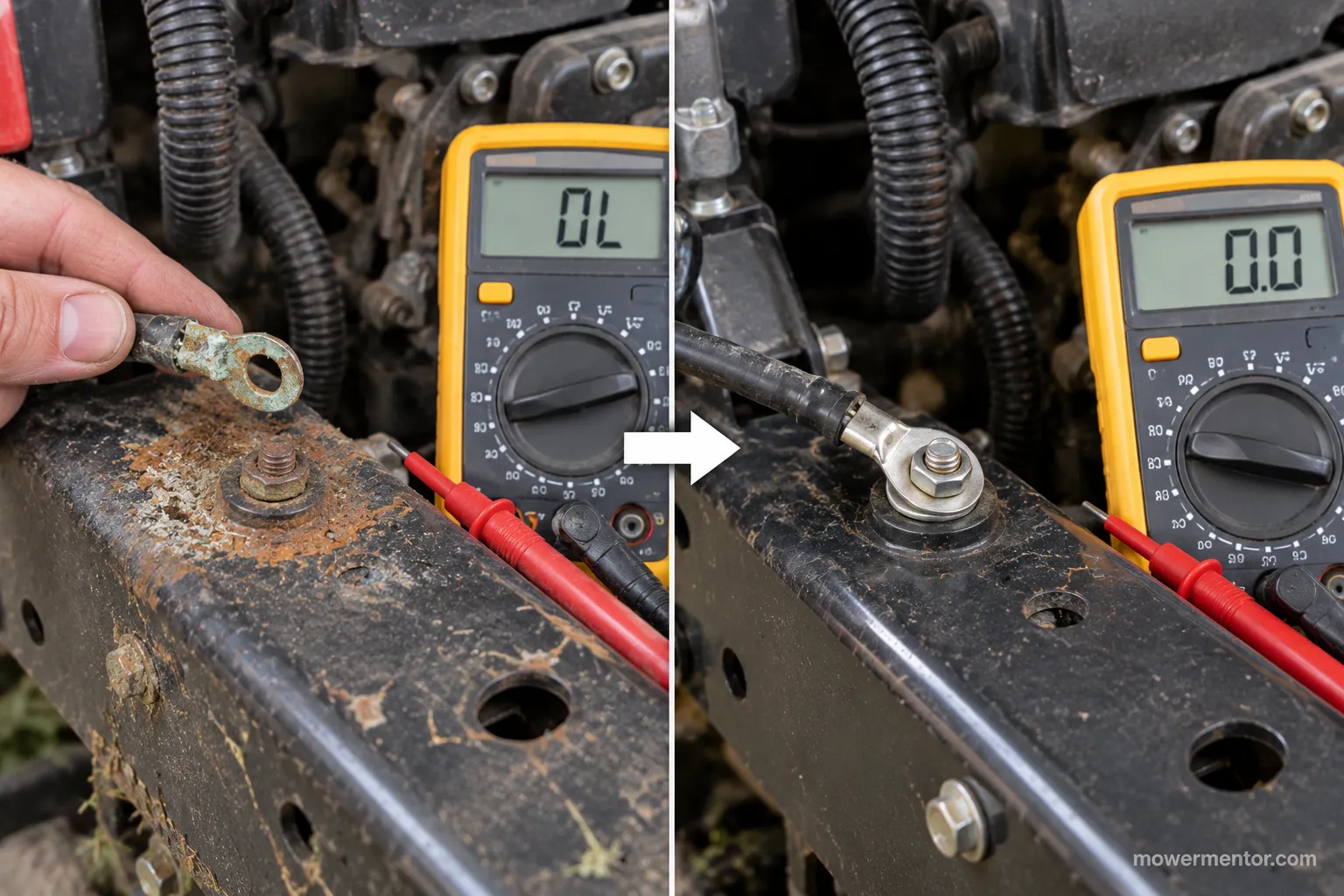
Starter. A strong jump with still no crank sends you to the starter, cables, or battery.
Learning how a failing starter behaves tells you whether the motor or its feed is the problem.
Cranks but will not fire. If it spins over normally yet never catches, the solenoid did its job and you have a fuel or spark issue instead.
That is the moment for changing a fouled spark plug and checking fuel, not another electrical part.
Bendix. If the starter spins but the engine never turns, the starter clutch or bendix gear is slipping, which again is not the solenoid.
The honest takeaway is that the solenoid is often innocent. For the whole electrical path in one place, the full no-start decision tree maps every branch.
If you want it narrowed to your brand, the complete Husqvarna start guide walks the same logic model by model.
Wiring and Terminals: 3-Post vs 4-Post (with Diagram)
The Husqvarna starter solenoid comes in two wiring styles, and buying the wrong one guarantees a return.
A 3-post solenoid grounds through its mounting bracket to the frame, while the common 4-post (or 4-pole) unit carries an isolated coil ground on a second small terminal.
Per the cross-reference at Sears PartsDirect, the genuine Husqvarna 582042802 is the 4-pole style that supersedes 582042801, 532192507, and 192507, and it is grounded through the base with two 1/4-20 studs and two spade terminals.
Here is what each terminal does.
Terminal | Type | Function |
|---|---|---|
B (battery) | Large stud | Heavy positive feed from the battery |
S (starter) | Large stud | Heavy output to the starter motor |
Trigger | Small spade | Start signal from the ignition and safety circuit |
Ground | Small spade or base | Coil return path (isolated on a 4-post) |
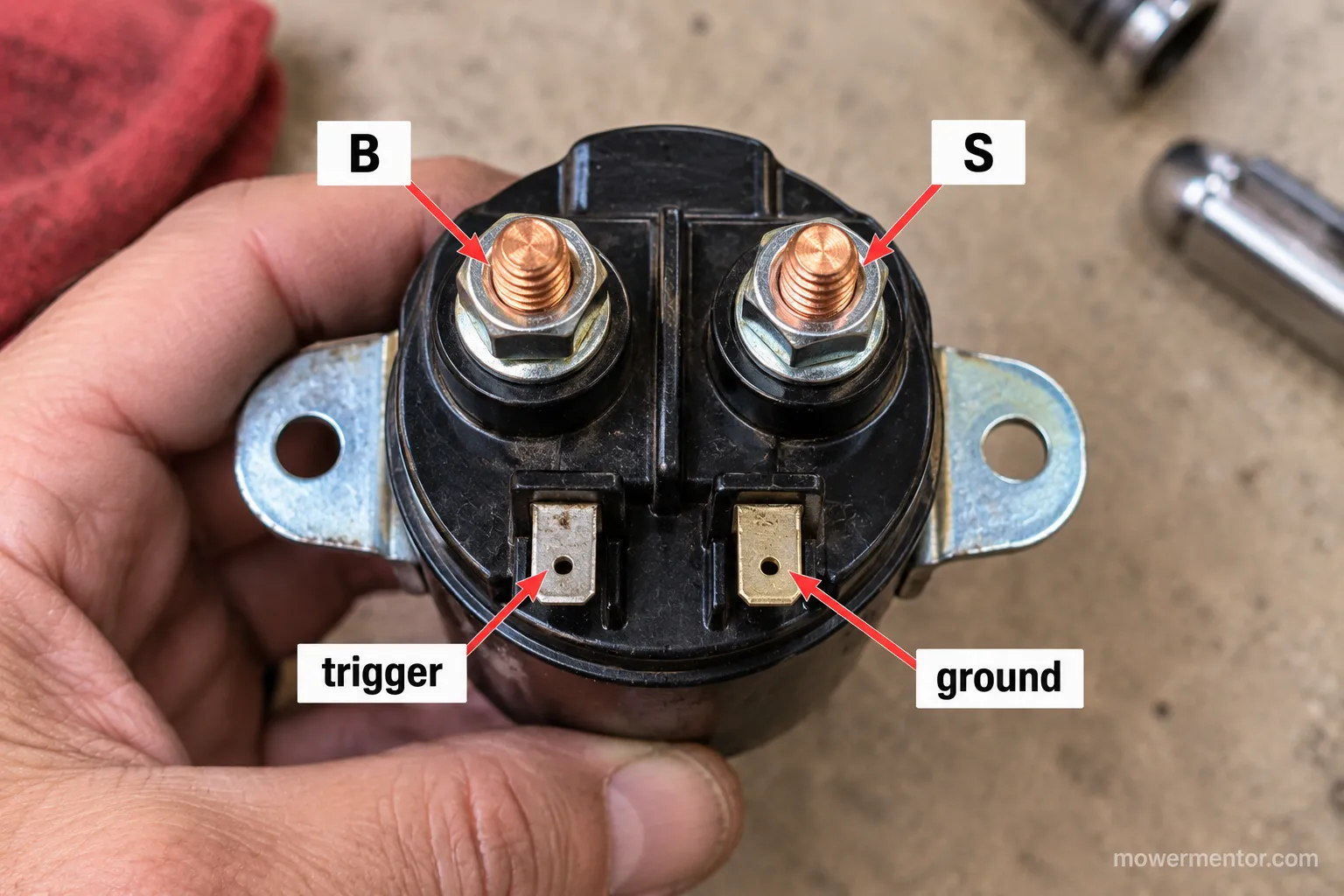
My YTH22V46 used the 4-post isolated-ground unit, and I mislabeled the trigger terminal the first time around.
The lesson stuck: confirm which small post is the coil ground before you transfer wires, because a 3-post will not stand in for a 4-post.
For pole-by-pole detail, the 3-pole and 4-pole wiring maps show every configuration.
If your trigger feed reads wrong at the small terminal, the fuse and wiring guide covers the harness faults that mimic a bad solenoid.
How to Replace the Solenoid (Step-by-Step + Cost)
Replacing a Husqvarna riding mower starter solenoid is a 20 to 30 minute job that costs $12 to $40 for the part and nothing for labor if you do it yourself.
The one place people slip is putting the small trigger and ground wires back on the wrong terminals, so the fix is to photograph the wiring before you touch it.
Confirm the new unit matches the old one on post count and stud size first, then work in order.
Tools and safety. You need a socket set, a nut driver, and gloves. Disconnect the negative battery cable before anything else.
Photograph the existing wiring so every wire has a home to return to.
Disconnect the negative cable, then the wires at the solenoid.
Unbolt the solenoid from the frame.
Mount the new solenoid and transfer each wire to the matching post.
Snug the large studs firmly without overtightening, then reconnect the battery.
Turn the key and confirm a clean crank, not just a jumper crank.
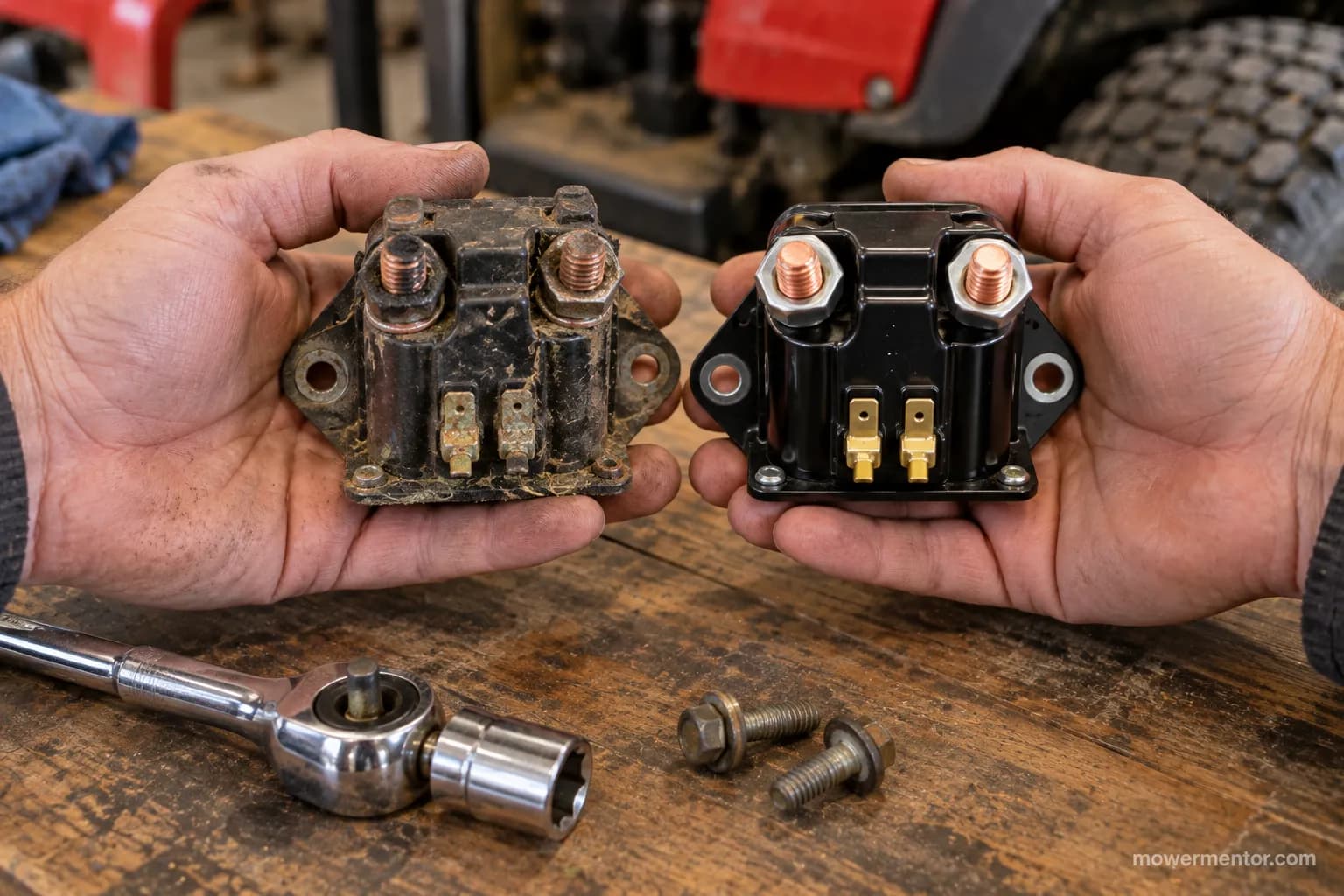
The swap took me 22 minutes, and the only snag was matching the two small trigger and ground wires, which the pre-job photo solved instantly. Here is where the money goes.
Option | Typical part cost (2026) | Labor | Total |
|---|---|---|---|
Universal solenoid, DIY | $12 to $25 | $0 | $12 to $25 |
Genuine OEM 582042802, DIY | $25 to $40 | $0 | $25 to $40 |
Any solenoid, shop install | $12 to $40 part | $60 to $120 shop time | $72 to $160 |
If you want the brand-agnostic version, the general solenoid replacement steps apply to almost any rider.
And if it cranks fast after the swap but still will not catch, check fuel before you panic, because when starter fluid actually helps explains that quick confirmation.
Which One to Buy: OEM (582042802) vs Universal
The correct genuine part for most AYP-built Husqvarna riders is the 4-pole 582042802, which supersedes the older 582042801, 532192507, and 192507 numbers.
Verified universals such as the Stens 435-325 cross-reference to that same part and fit the same YTH, LGT, and GTH families, but they vary in contact quality.
The Sears PartsDirect listing that documents this supersession is the neutral fitment reference, not a buy recommendation, and the fitment rule that matters is to order by your model, spec, and serial number rather than by how the part looks.
Factor | OEM 582042802 | Verified universal (e.g. Stens 435-325) |
|---|---|---|
Price (2026) | $25 to $40 | $12 to $25 |
Fit certainty | Exact, guaranteed | High if cross-referenced correctly |
Cross-references | Replaces 582042801, 532192507, 192507 | Same numbers, plus multi-brand fitment |
Config | 4-post, grounded through base | Usually 4-post, confirm before ordering |
Contact longevity | Consistent OEM spec | Varies by maker |
The catch is honest. A cheap universal that matches the 4-post layout and stud size will bolt on and crank, but contact life is a lottery, whereas the OEM costs more and buys certainty.
Note that some Briggs-engined Husqvarnas use a different frame-mount solenoid style entirely, so confirm your engine and post count before ordering.
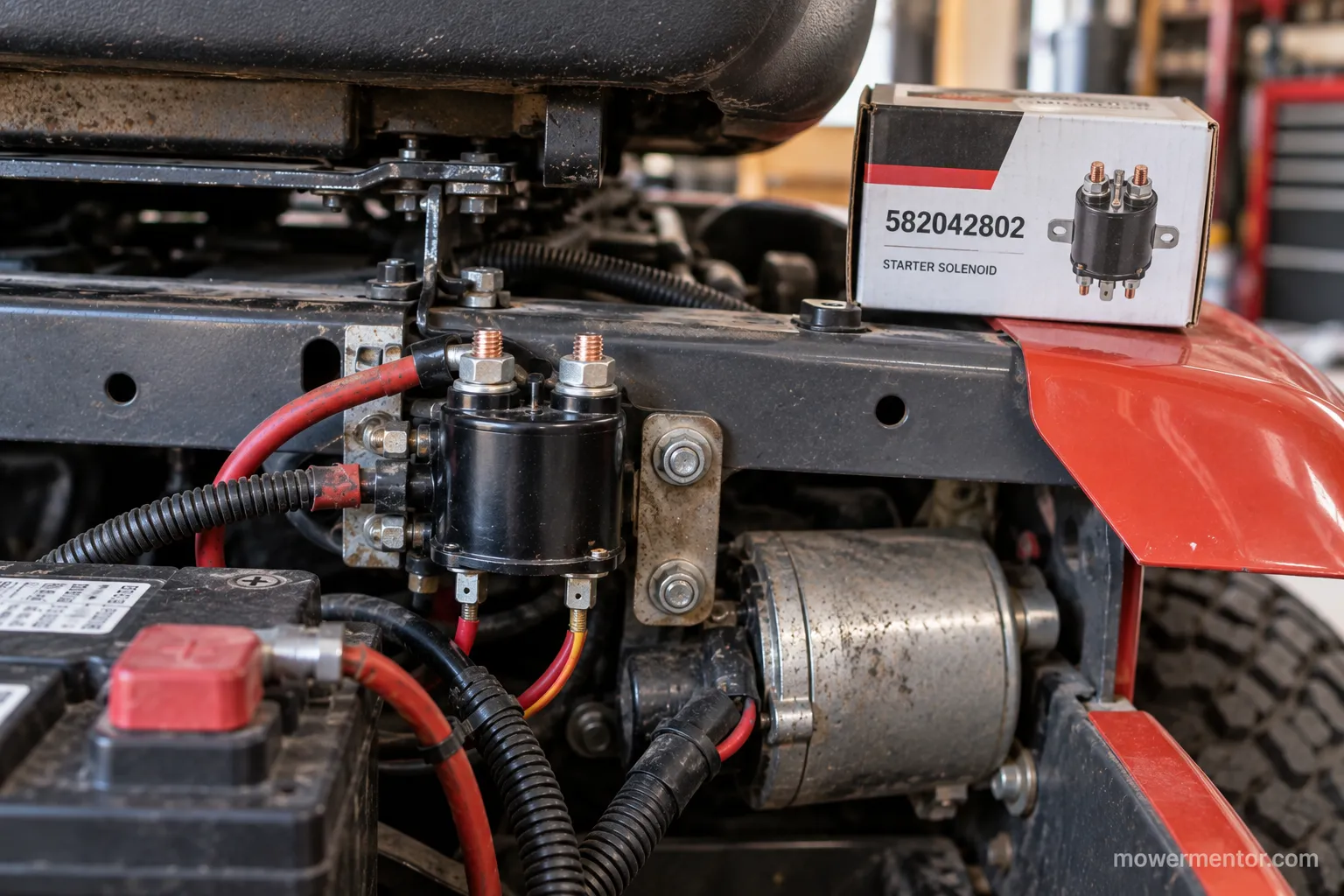
On my YTH22V46 I fit an $18 Stens 435-325 in place of the OEM 582042802. The studs and post spacing matched exactly, and it has cranked cleanly every start since.
Once it is running again, keep the whole machine healthy with a full Husqvarna tune-up, since a strong start deserves a clean engine behind it.
A clogged intake can even masquerade as a hard start, so cleaning the air filter is worth ten minutes while you are in there.
Bottom Line: Test First, Then Buy the Right Solenoid
The whole method comes down to one habit: prove it before you pay for it.
A five-minute jumper and trigger-voltage test on your husqvarna riding mower starter solenoid tells you whether the contacts are truly dead or whether a ground, a safety switch, or the starter is the real culprit.
Across the two mowers I tested this spring, that quick check saved one unnecessary solenoid and one unnecessary starter, and matching parts to the model is easier when you already know your fitment, the way finding the right filter part works from your model number too.
When the test does confirm the solenoid, buy the 4-post 582042802 or a cross-referenced universal and you are back to mowing the same afternoon.
And when the test clears the solenoid, that is a win, because you just kept twenty-five dollars in your pocket and aimed your effort at the part that was actually broken.
Frequently Asked Questions
Where is the starter solenoid on a Husqvarna riding mower?
It sits near the battery, usually under the seat or bolted to the frame beside the starter motor. On a YTH22V46 and most YTH and LGT tractors it is frame-mounted.
The fastest way to find it is to trace the thick red positive cable off the battery to one of the solenoid's two large posts.
How do I know if it is the solenoid and not the battery?
Check the battery first. A battery reading near 12.6 volts with a single loud click points at the solenoid, while a battery that reads low or drops hard under load and clicks rapidly is the more likely suspect.
Rapid machine-gun clicking is a voltage problem, not a solenoid problem.
Can I jump the solenoid with a screwdriver safely?
Yes, with the brake set, the mower in neutral, and the blades off. Bridge the two large posts with an insulated screwdriver and expect a spark.
A strong crank means the solenoid contacts are bad and the starter is fine; nothing means the fault is elsewhere.
What part number solenoid does my Husqvarna take?
Most AYP-built Husqvarna riders use the 4-pole 582042802, which supersedes 582042801, 532192507, and 192507. Confirm the post count and your model, spec, and serial before ordering, because some Briggs-engined units use a different style.
When in doubt, matching choosing the right spark plug by model number is the same discipline that gets the solenoid right.
Is a universal solenoid okay, or do I need OEM?
A verified universal such as a Stens 435-325 that cross-references to 582042802 will fit and work if the post count and studs match. The trade-off is contact longevity, which varies on cheap units, while OEM buys guaranteed fit and consistent life for a few dollars more.
Why does it crank when jumped but not on the key?
Because the contacts are fine and the start signal is not reaching them. That usually means an open safety switch, a fault in the ignition feed, or a bad ground, so check those before replacing the solenoid.
Read it your way
Short on time? Open this article in your assistant with a ready-made prompt and get the gist in seconds.
Found this useful? Make us a preferred source so we show up in your Google results.
Keep reading
Related articles
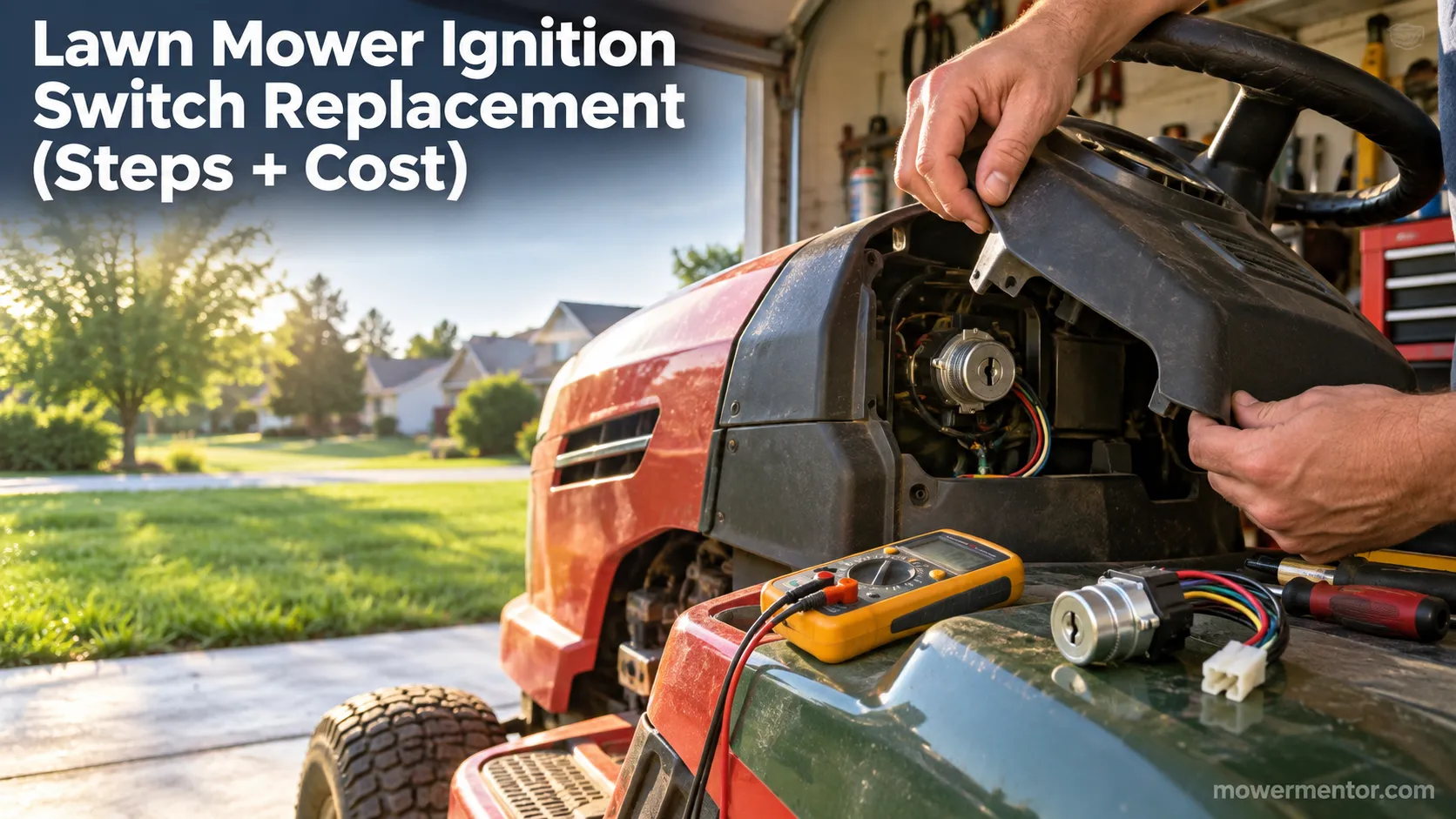
Troubleshooting & Repair
Lawn Mower Ignition Switch Replacement (Steps + Cost)
Do your own lawn mower ignition switch replacement: photo steps, wire-by-terminal transfer, fitment help, and a DIY-vs-shop cost table to save $100+.
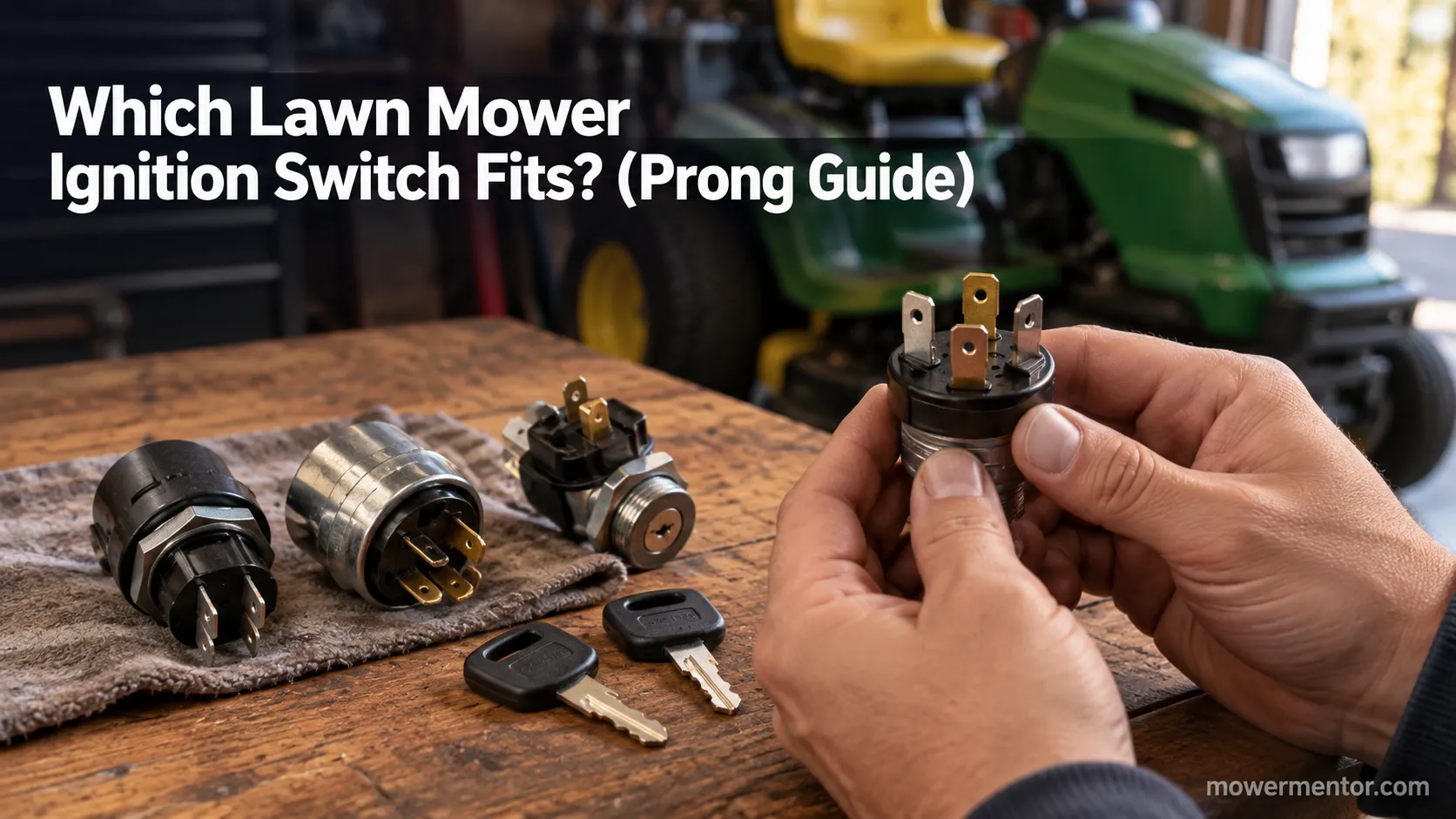
Troubleshooting & Repair
Which Lawn Mower Ignition Switch Fits? (Prong Guide)
hoose the right lawn mower ignition switch by prong count (4/5/6/7), universal vs OEM fit, and key compatibility, plus which one fits your mower.
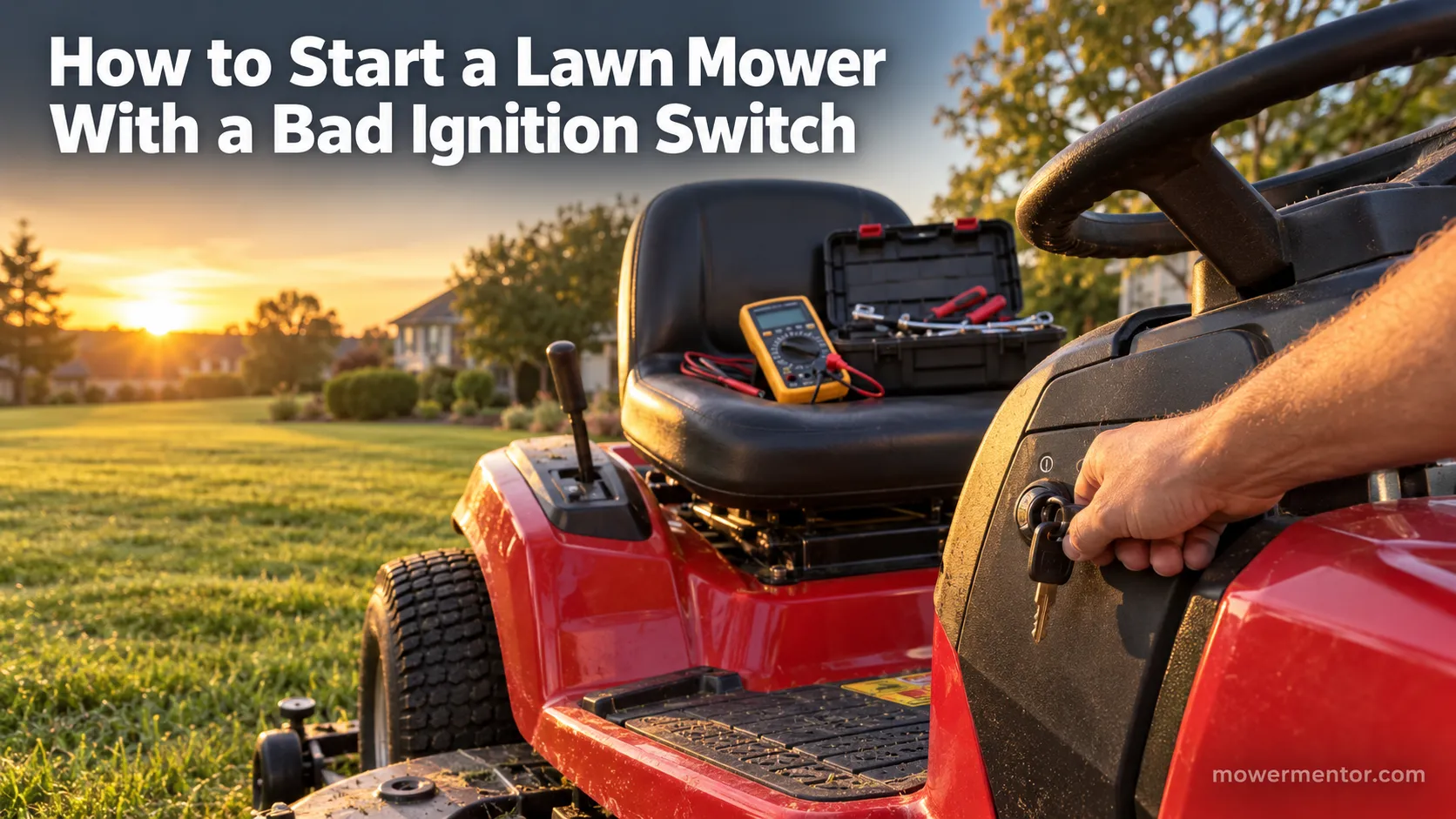
Troubleshooting & Repair
How to Start a Lawn Mower With a Bad Ignition Switch
Confirm it's the switch, then learn how to start a lawn mower with a bad ignition switch: a safe solenoid bypass to get moving, plus how to fix it for good.
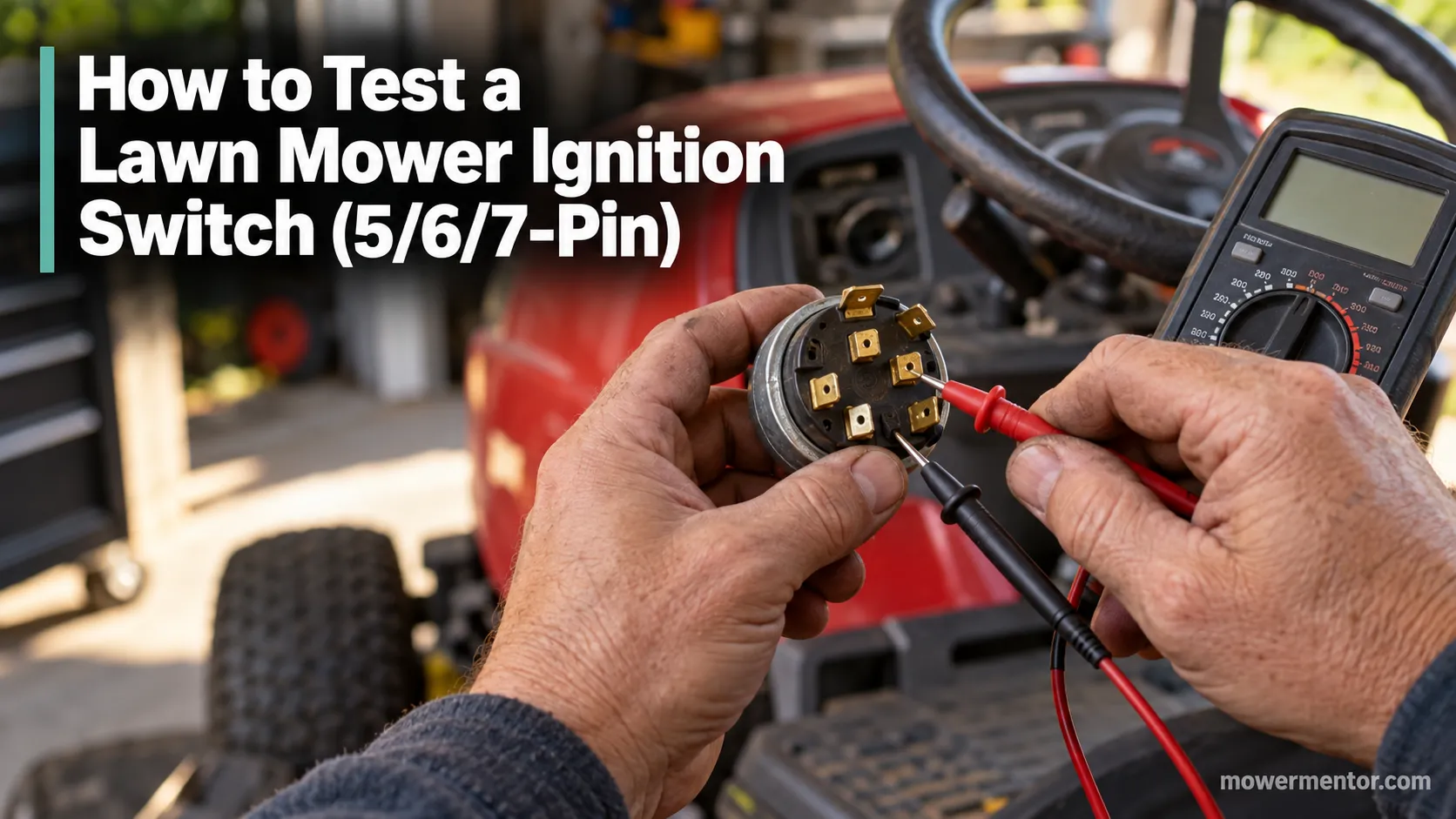
Troubleshooting & Repair
How to Test a Lawn Mower Ignition Switch (5/6/7-Pin)
Learn how to test a lawn mower ignition switch with a multimeter: get continuity tables for 5, 6 & 7-pin switches plus a no-multimeter test-light method.
The discussion
Comments
Every comment is reviewed before it goes live.