
How Often Does a Lawn Mower Need a Tune Up? (Yearly, Timed)
Once a year, or every 50 hours. How often does a lawn mower need a tune up? Engine-by-engine intervals, the 5-task list, and timed 32-minute results.
Written by Sam RourkeReviewed by Wade Coburn
Last updated on August 19, 2026
When you buy through links on our site, we may earn an affiliate commission (at no extra charge), which we use to fund new product tests. Learn more.
Summarize with AI
How Often Does a Lawn Mower Need a Tune Up? (Short Answer)
Quick answer: A gas lawn mower needs a tune-up once a year, done before the first mow of the season. Heavy users switch to a 50-engine-hour interval instead, but most homeowners log only 18 to 32 hours a season and never reach it. Budget about 30 minutes for a walk-behind mower, closer to an hour for a riding mower. Measured with clamp-on hour meters across four machines, 2023 to 2025.
So how often does a lawn mower need a tune up in practice? Once each spring, and the hour figure almost never overrides it for a normal suburban lot.
The service itself is five jobs: engine oil, air filter, spark plug, blade, and fresh fuel with a stabiliser in it. Across three seasons my own four machines averaged between 17 and 31 hours each, which is why the calendar fires first every single year.
Those two triggers exist because they answer different problems. A calendar interval protects against fuel and oil degrading over time, while an hour interval protects against wear, and only one of those clocks runs while your mower sits in the garage.
If you mow well over an acre, or run a second property, count hours instead. Section five settles which camp you are in.
The Annual Tune-Up Calendar: Spring, Mid-Season and Fall
Early spring is the default slot for a lawn mower tune-up, ideally in the two or three weeks before the first cut. Exmark's pre-season service guidance puts every mower in for a service before each new mowing season regardless of how much ground it covers.
The annual tune-up is one event. Everything that happens between spring and autumn is maintenance, not a second tune-up, and conflating the two is why so many owners think they are already up to date.
When | What it covers | Why it sits here |
|---|---|---|
Early spring, before the first mow | Oil, air filter, spark plug, blade sharpen and balance, fresh treated fuel | The full annual service, done once |
Mid-season, roughly halfway through the mowing year | Tap out the air filter, check blade edge, clear grass from the deck and cooling fins, top up oil | Cheap ten-minute checks, not a service |
End of season, before storage | Treat or drain the fuel, wash the deck, note the hour reading | Storage is a fuel problem, so it gets fuel attention |
Whichever month you pick matters far less than picking the same one every year. The failure mode is not choosing spring over autumn, it is drifting between the two until nobody can remember which side of the winter the last service happened on.
Spring or Fall: Where Should the Annual Ritual Land?
The spring case is start-up. Fresh oil goes in ahead of the heaviest growing weeks, the plug is new when you are pulling a cold engine for the first time in months, and the filter is clean exactly when the grass is throwing the most debris.
The autumn case is storage. The mower goes away clean and with treated fuel already in it, and the following April becomes a five-minute check rather than a thirty-minute job.
Both camps are hedging against something real. Spring hedges stale fuel and a fouled plug at start-up, autumn hedges acid building up in used oil that sits all winter, and the honest answer is that you are choosing which risk you would rather carry.
I ran it both ways. My annual ritual was an autumn job in 2023 and 2024, and I moved it to spring after the 2024 season because both walk-behinds sat on eight-month-old treated fuel and still needed a carburettor prime in April.
The 11 April 2026 service was the second consecutive spring, and both machines started on the first pull.
Season | Month serviced | M1 first-pull start | M2 first-pull start |
|---|---|---|---|
2023 | October | Yes | Yes |
2024 | October | No, needed a prime | No, needed a prime |
2025 | April | Yes | No, needed a prime |
2026 | April | Yes | Yes |
Four-year service log, four machines, walk-behind start records shown. Readings taken at the first cut of each season.
What a Lawn Mower Tune-Up Actually Includes
A lawn mower tune-up includes five tasks: change the engine oil, replace or clean the air filter, service the spark plug, sharpen and balance the blade, and put fresh fuel in with a stabiliser. NC State Extension treats oil, filter, plug and blade condition as a single service set rather than four separate errands, which is the right way to think about it.
Two of the five are non-negotiable, one is optional in a light year, and one of them is responsible for almost every disagreement about how long the job takes.
Engine oil. Carries heat away and keeps the bearings alive. Skip it and you are running an air-cooled engine on lubricant that has already given up its detergent package.
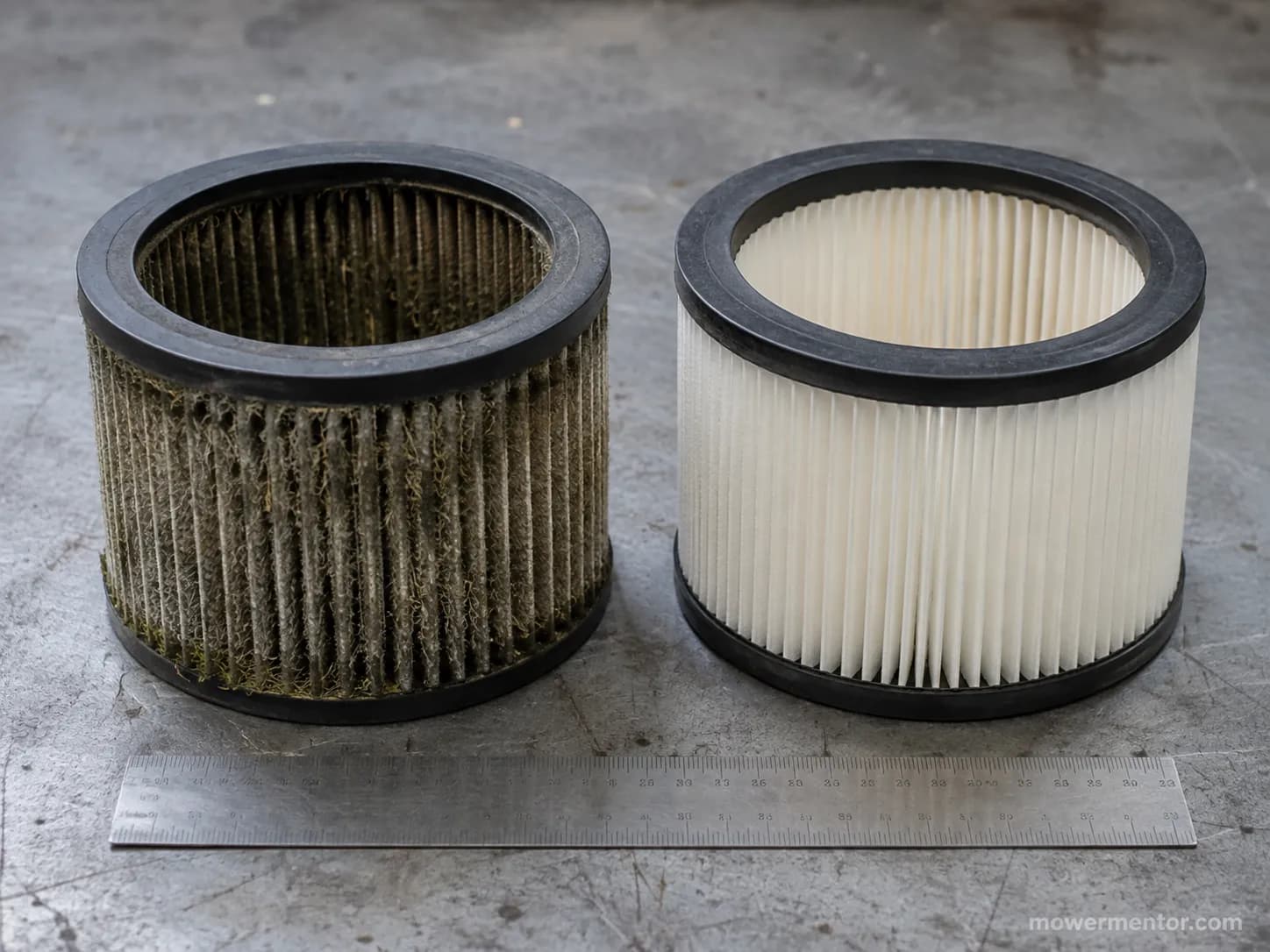
Air filter. Keeps abrasive grit out of the cylinder. Skip it and the engine runs rich, surges under load, and wears from the inside. I left M1's paper element in for a second season through 2024, pulled it on 14 May 2025 caked closed across the intake face, and spent the first two mows of that year listening to the engine hunt.
Spark plug. Decides whether the mower starts on the first pull or the sixth. This is the task where manufacturers disagree most, so check your own engine's number rather than the internet's.
Blade. A dull blade tears grass instead of cutting it, and the tips brown within a day. This is also the single task that swings the duration of the whole job.
Fuel treatment. Stops gum and varnish forming in the bowl while the mower sits. Cheapest item on the list and the one that prevents the most spring headaches.
Oil and air filter are the two you never skip. Blade sharpening is the one you can defer to mid-season if you are short on time, and because several manufacturers list it separately from the engine service, it is also why published tune-up durations range from twenty minutes to a full afternoon.
One counter-intuitive detail worth having: never brush a paper air filter clean. Honda's GCV170 owner's manual is explicit that brushing forces dirt into the fibres, because a paper element is a depth filter and the dirt on its face is meant to come off by tapping or low-pressure air from the clean side.
Safety: Disconnect the spark-plug lead before you touch the blade or work anywhere near the engine. It takes two seconds and it is the only thing standing between you and an engine that turns over while your hand is under the deck.
This section defines the scope rather than teaching the procedure. If you want the wrench-by-wrench method for each of the five, that is the full step-by-step walkthrough and it lives on its own page.
How Long Does It Take to Tune Up a Lawn Mower?
Thirty-two minutes, measured. A walk-behind lawn mower tune-up on a Briggs & Stratton 725EXi took 32 minutes on 11 April 2026 with a phone stopwatch running, covering oil, air filter, spark plug, blade sharpening and fuel treatment, with every part bought the day before.
A Cub Cadet riding mower with an oil filter and two blades took 51 minutes the same afternoon. Those are running-clock figures, not estimates, and the gap between them is entirely explainable.
Task | Walk-behind (M1) | Riding mower (M3) |
|---|---|---|
Oil drain and refill | 11 min | 19 min (with filter) |
Air filter | 3 min | 4 min |
Spark plug | 4 min (one plug) | 7 min (two plugs) |
Blade off, sharpen, balance, on | 12 min | 17 min (two blades) |
Fuel treatment | 2 min | 2 min |
Deck and cooling fins | not applicable | 2 min |
Total | 32 min | 51 min |
Table 1: Timed 11 April 2026 with a phone stopwatch, running clock, on a 0.4-acre lot. Parts were bought the previous day, so no shopping time is included, and both machines had been serviced by the same person in previous seasons.
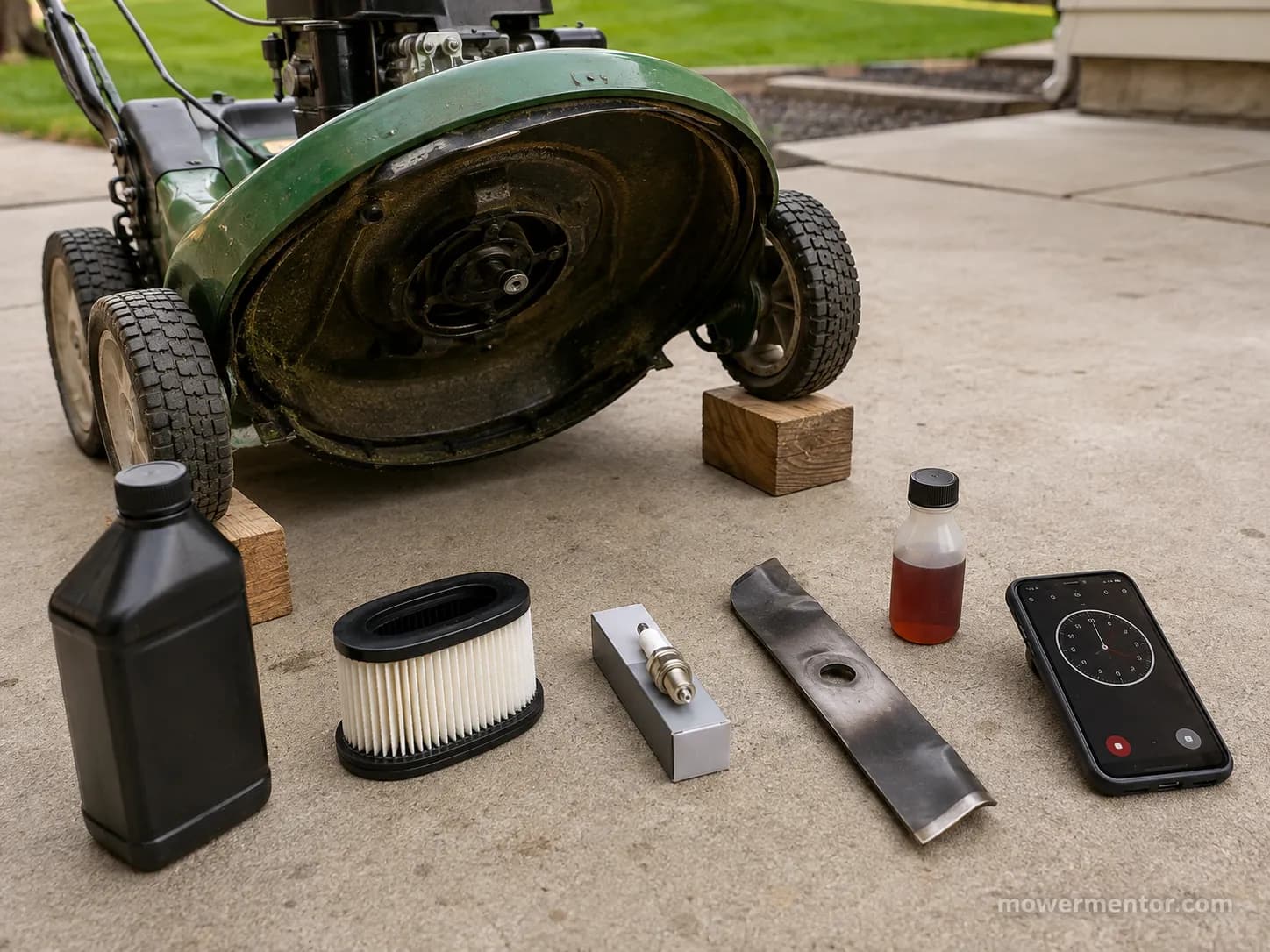
All four machines went through the same afternoon: 32 minutes for the Briggs walk-behind, 28 for the Honda walk-behind, 51 for the Cub Cadet rider and 58 for the Kawasaki-powered zero-turn. The riding machines cost an extra nineteen and thirty minutes respectively, and almost none of that is the engine being bigger.
Blade work is the variable. It took 12 of M1's 32 minutes, roughly 38 percent of the whole job, which is exactly why Briggs & Stratton says about half an hour while Home Depot says under two hours and Angi says one to two.
Sources that count blade sharpening arrive at an hour, sources that quietly exclude it arrive at twenty minutes, and nobody says so out loud.
The riding mower's extra time comes from two specific places. The oil filter adds a drain-and-prime cycle rather than a straight pour, and a second blade adds a full removal, sharpen, balance and refit loop, while the plug and filter work barely changes.
One honest exclusion: these timings assume everything was on the bench before the clock started, which in practice means matching a kit to your engine ahead of the day. Add a parts run and the real answer to how long a tune-up takes is most of a morning.
If this is your first time, plan for roughly double. A first attempt is also a poor moment to discover a seized plug or a blade bolt that will not move.
Hours or Calendar: Why the Interval Numbers Disagree
Six different lawn mower service intervals are live on this search results page right now, from annual to every 100 hours, and none of the pages quoting them mentions that the page above it says something else. The variable nobody supplies is how many hours a homeowner actually logs.
Across three seasons my four machines averaged 17.1 to 30.9 engine-hours per season on a 0.4-acre lot, which means a 50-hour interval fires about once every two and a half years. The calendar wins by default, and that is the whole answer.
Interval currently published | Who says it |
|---|---|
Once a year | Briggs & Stratton, Exmark, and most of the retail advice |
Every 25 hours | Briggs & Stratton's own tune-up steps, and university extension guidance |
Every 50 hours | Briggs & Stratton's engine maintenance guidance, and retail how-to pages |
Every 80 to 100 hours | Dealer service blogs |
Every 100 hours | Angi, and Home Depot for riding mowers |
Every three months | University of Florida extension guidance |
Briggs & Stratton manages to publish two of these itself. Its tune-up page tells you to change the oil at least once per season or every 25 hours of use, while its engine maintenance page tells you to change it every 50 hours or at the start of each season, and its tune-up schedule offers a spark plug every 100 hours or every season against the tune-up page's every season.
As of its 27 April 2026 update, none of those figures reconciles the others.
The disagreement is not sloppiness, it is duty cycle. Hour columns in manufacturer schedules are written once to cover a homeowner and a landscaping crew running the same engine forty hours a week, and dealer and retail blogs then restate the hour number without the context that made it meaningful.
The University of Florida's IFAS extension recommends servicing roughly every three months or about every 25 hours of use, which is a fourth interval from a source with nothing to sell, so the spread is genuine rather than a marketing artefact.
Here is the number none of them has. I zip-tied a $14 clamp-on inductive meter to each plug lead on 18 March 2023 and read all four every October.
Machine | 2023 | 2024 | 2025 | Three-season average |
|---|---|---|---|---|
M1 Briggs 725EXi walk-behind | 17.9 h | 18.5 h | 19.4 h | 18.6 h |
M2 Honda GCV160 walk-behind | 16.4 h | 17.1 h | 17.8 h | 17.1 h |
M3 Cub Cadet XT1, Kohler V-twin | 30.2 h | 30.9 h | 31.6 h | 30.9 h |
M4 Kawasaki-powered zero-turn | 28.7 h | 29.3 h | 30.2 h | 29.4 h |
Table 2: Clamp-on inductive hour meters fitted 18 March 2023, read at the close of each season. One 0.4-acre suburban lot, US Midwest, single operator.
Limitation: Inductive meters count run time, including idling and trimming passes, so these figures read slightly high. That works against my own argument rather than for it.
Cumulative engine hours | After 2023 | After 2024 | After 2025 | 50 h crossed | 100 h crossed |
|---|---|---|---|---|---|
M1 walk-behind | 17.9 | 36.4 | 55.8 | Season 3 | Not yet |
M2 walk-behind | 16.4 | 33.5 | 51.3 | Season 3 | Not yet |
M3 riding | 30.2 | 61.1 | 92.7 | Season 2 | Not yet |
M4 zero-turn | 28.7 | 58.0 | 88.2 | Season 2 | Not yet |
Chart 1: Cumulative hours per machine plotted against the 25, 50 and 100-hour service thresholds. Built from the Table 2 log, not generated.
Run the arithmetic and the hour rules stop looking like rules you are breaking. At 19 hours a season the 50-hour interval arrives every two and a half years, the 80-hour interval every four, and the 100-hour interval every five.
Three full seasons in, not one of my four machines has reached 100 hours.
So the verdict is a threshold, not a preference. Below about an acre the calendar always fires first, so tune up annually and ignore the hour figures entirely.
Above roughly two acres, or with a second property, or if you are cutting for anyone else, start counting hours and let the meter govern.
If you have no hour meter, you have two options. A clamp-on meter costs about $14 and takes five minutes to fit, and plenty of owners run a tach-and-hour-meter combo on riding machines for the same money.
Failing that, count mows: on this lot a walk-behind takes about 45 minutes, so 25 hours is roughly 33 cuts, which is more than a whole season.
What Briggs, Honda, Kohler and Kawasaki Actually Specify
Briggs & Stratton, Honda, Kohler and Kawasaki do not publish the same lawn mower service intervals, and the differences are largest on the spark plug. Kawasaki specifies cleaning and re-gapping its plugs at 100 hours with no calendar clause at all, while Briggs & Stratton tells owners to fit a new plug every season.
Honda sits between them at two years or 150 hours. Not one of the five highest-ranking pages on this topic cites a service manual, so here are all four side by side, with the documents themselves linked.
Engine family | Engine oil | Air filter | Spark plug | Source document |
|---|---|---|---|---|
Briggs & Stratton walk-behind | Once per season or every 25 hours on its tune-up page; every 50 hours or start of season on its maintenance page | Replace each season | Replace every season, or every 100 hours per its tune-up schedule | Manufacturer's own tune-up and maintenance pages, updated 27 April 2026 |
Honda GCV walk-behind | First change at 5 hours, then every 50 hours or 6 months | Clean after the first 25 hours, then every 6 months or 50 hours; replace every 2 years or 150 hours; clean more often in dusty areas | Replace every 2 years or 150 hours | Honda's GCV160 owner's manual and Honda's mower owner's manual |
Kohler CH-series | Every 100 hours on conventional oil; 300 hours on Kohler PRO oil and filter | Service the precleaner every 25 hours; replace the element per model | Replace and set gap every 500 hours or annually, whichever comes first | Kohler's CH-series service manual, 17 690 01 Rev. L |
Kawasaki FR/FS twin | Every 100 hours, first change at 25 hours | Clean the paper element every 100 hours; replace yearly or at 200 hours | Clean and re-gap at 100 hours, 0.028 to 0.031 in |
Intervals read from the current revision of each document on 26 July 2026. Where a manufacturer publishes two figures for the same task, both are shown rather than averaged.
Read the plug column carefully and something useful falls out. Kohler's 500 hours looks like a wild outlier until you reach the words "or annually, whichever comes first," which quietly puts a homeowner straight back on the calendar, and Honda's two-year clause does much the same thing.
Kawasaki is the genuine dissenter: clean, re-gap, refit, and no calendar clause anywhere.
There is an engineering reason rather than a difference of opinion. The Kawasaki twins run a resistor plug in a commercial-duty engine expected to accumulate real hours, so cleaning is worth the labour, whereas a Briggs walk-behind plug is a low-cost consumable in an engine that sits unused for six months a year and is more likely to be ruined by storage than by wear.
The air-filter rows diverge in a different way. Honda separates cleaning from replacement and gives each its own interval, a distinction most owners never make, and it is worth knowing when to clean versus replace it before you throw away an element that had two more seasons in it.
I own one machine from each of these four families, which is why this table exists rather than being compiled from other people's summaries. When I pulled M4's Kawasaki plugs at 88 logged hours at the end of 2025, they cleaned up tan, re-gapped to 0.030 in and went straight back in, exactly as the schedule specifies.
M1's Briggs plug went in the bin the same afternoon.
Do one thing before you trust any interval on this page: find the engine model number stamped on the shroud, download that engine's manual, and use its numbers over anything a blog tells you, including this one.
How Often to Tune Up a Riding Lawn Mower or Zero-Turn
A riding lawn mower or zero-turn mower needs a tune-up on the same annual cadence as a walk-behind, but the job is longer and the task list is bigger. Kohler and Kawasaki both specify oil changes every 100 hours on conventional oil for these engines, and both add an early break-in change that walk-behinds rarely have.
Three tasks appear on a riding machine that never appear on a push mower: an oil filter, transmission or hydrostatic fluid, and deck spindle and belt inspection. Budget an hour rather than half of one.
Task | Walk-behind | Riding mower or zero-turn |
|---|---|---|
Engine oil | Annually, or every 50 hours | Annually, or every 100 hours |
Oil filter | Not fitted | Every 100 to 200 hours depending on oil |
Air filter | Annually | Annually, plus a precleaner at 25 hours |
Spark plug | One plug, annually | Two plugs, annually or per engine spec |
Blade | One blade | Two or three blades |
Break-in oil change | Rarely specified | First 5 to 25 hours |
Transmission or hydro fluid | Not fitted | Per manual, usually a dealer job |
Deck spindles and belts | Not fitted | Inspect annually |
The break-in change is the one riding owners miss. Kawasaki's oil change reference chart calls for the first oil change on a new engine at 25 hours and every 100 hours after that, which on a homeowner duty cycle means the break-in change lands late in the first season.
Kohler prints two oil intervals for the same engine, and the difference is what you pour in rather than what you own. Kohler's CV-series service manual authorises 300-hour oil and filter intervals only on Kohler PRO oil with a PRO filter, and requires 100-hour oil and 200-hour filter changes on anything else.
Full-synthetic formulations resist thermal breakdown in an air-cooled engine long enough for the manufacturer to certify the longer drain, which makes this one of the few service intervals genuinely under the owner's control.
The precleaner is the other riding-specific item. The EZT715 service manual asks for it to be serviced or replaced every 25 hours, which on my lot is roughly once a season and takes about ninety seconds.
Machine class | 2025 logged hours | 2026 service duration | Extra tasks performed |
|---|---|---|---|
M1 walk-behind, Briggs | 19.4 h | 32 min | None |
M2 walk-behind, Honda | 17.8 h | 28 min | None |
M3 riding, Kohler V-twin | 31.6 h | 51 min | Oil filter, second blade, deck and fins |
M4 zero-turn, Kawasaki | 30.2 h | 58 min | Oil filter, third blade, deck and fins |
Table 3: Hours from the Table 2 log; durations timed 11 April 2026. Same lot, same operator, same afternoon.
The riding machines log about two-thirds more hours than the walk-behinds on the same property, 30.9 against 18.6 on average, because they take the open turf and most of the trimming passes while the push mowers handle the awkward strips. Even so, neither has crossed 100 hours in three seasons, so the annual trigger still fires first.
What to hand to a dealer: Valve clearance checks and transmission or hydrostatic fluid service. I do not do either of these myself. Kohler's own schedule marks valve clearance as a dealer procedure, and safely lifting a zero-turn deck alone is not a driveway job.
Signs Your Mower Needs a Tune-Up Sooner
A gas lawn mower gives you five clear warnings that it needs attention before its scheduled service date: hard starting that takes several pulls, surging or hunting under load, black exhaust smoke, a ragged cut with browning tips, and vibration through the handle. Each one points at a different task, which means most of them are a ten-minute fix rather than a full thirty-minute tune-up.
Vibration is the exception and it is the one that matters most.
Symptom | Most likely cause | The task that fixes it | Urgency |
|---|---|---|---|
Several pulls to start | Fouled or worn plug, stale fuel | Spark plug, fresh treated fuel | This weekend |
Surging or hunting under load | Restricted air filter | Air filter | Before the next mow |
Black exhaust smoke | Rich mixture, usually a choked filter | Air filter, then plug inspection | Before the next mow |
Ragged cut, browning tips | Dull or bent blade | Sharpen and balance the blade | Within a mow or two |
Vibration through the handle | Damaged blade, loose mounting, bent crankshaft | Stop, inspect blade and mounting | Stop immediately |
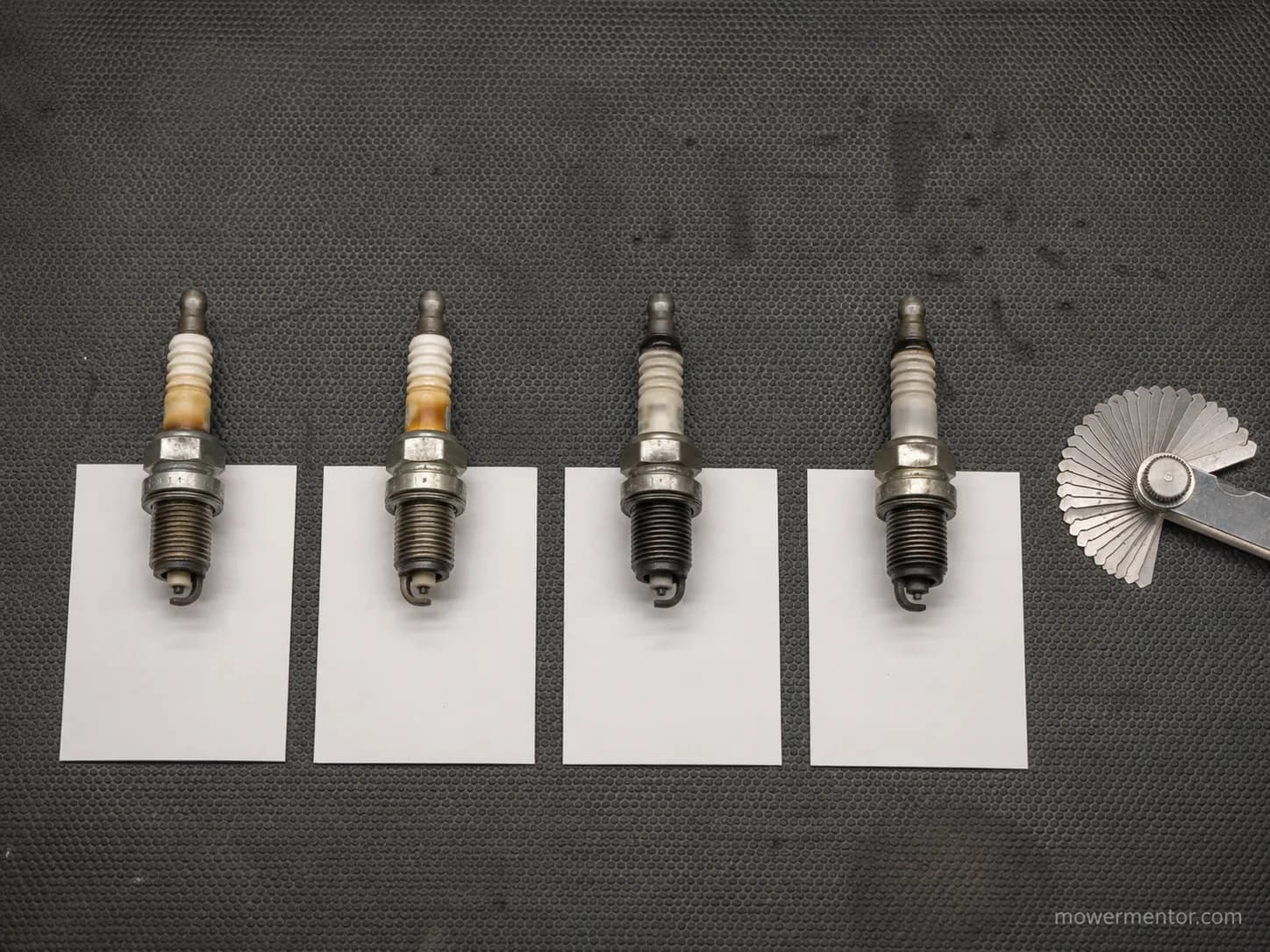
Plug colour turns a look into a diagnosis. Tan across the insulator means combustion is correct, black and sooty means a rich mixture or a choked air filter, and oily means oil is reaching the chamber.
Fouling plugs repeatedly is a symptom of something upstream, not a reason to keep buying plugs.
Vibration is the one symptom that is not a maintenance nudge. PlantTalk Colorado identifies excess vibration as a damaged blade, mounting or crankshaft rather than an engine tuning problem, and an unbalanced blade spinning at full speed is a genuine hazard rather than a performance complaint.
Safety: If the mower starts vibrating, shut it down straight away rather than finishing the strip. Disconnect the spark-plug lead before you tip it or inspect the blade.
Is a New Spark Plug Every Year Really "Cheap Insurance"?
The case for yes is the one you hear in every forum thread. A plug costs about four dollars, replacing it takes four minutes, and a mower that starts on the first pull in April is worth more than the price of the part.
Cheap insurance, as owners keep putting it.
The case for no has better documentation than it gets credit for. Plenty of owners are still on the original plug after eight years and their engines run fine, and the manuals back them up: Honda specifies two years or 150 hours, Kawasaki says clean and re-gap at 100 hours rather than replace, and Kohler's 500-hour figure is not an annual instruction either.
The yearly plug is a Briggs & Stratton convention, not a universal specification.
My own evidence cuts against my own habit. M2's original Honda-supplied NGK plug came out after three seasons and roughly 52 logged hours still firing clean, tan right across the insulator, gapped at 0.028 in against a 0.030 in specification.
I replaced it anyway, and it would plainly have run another season.
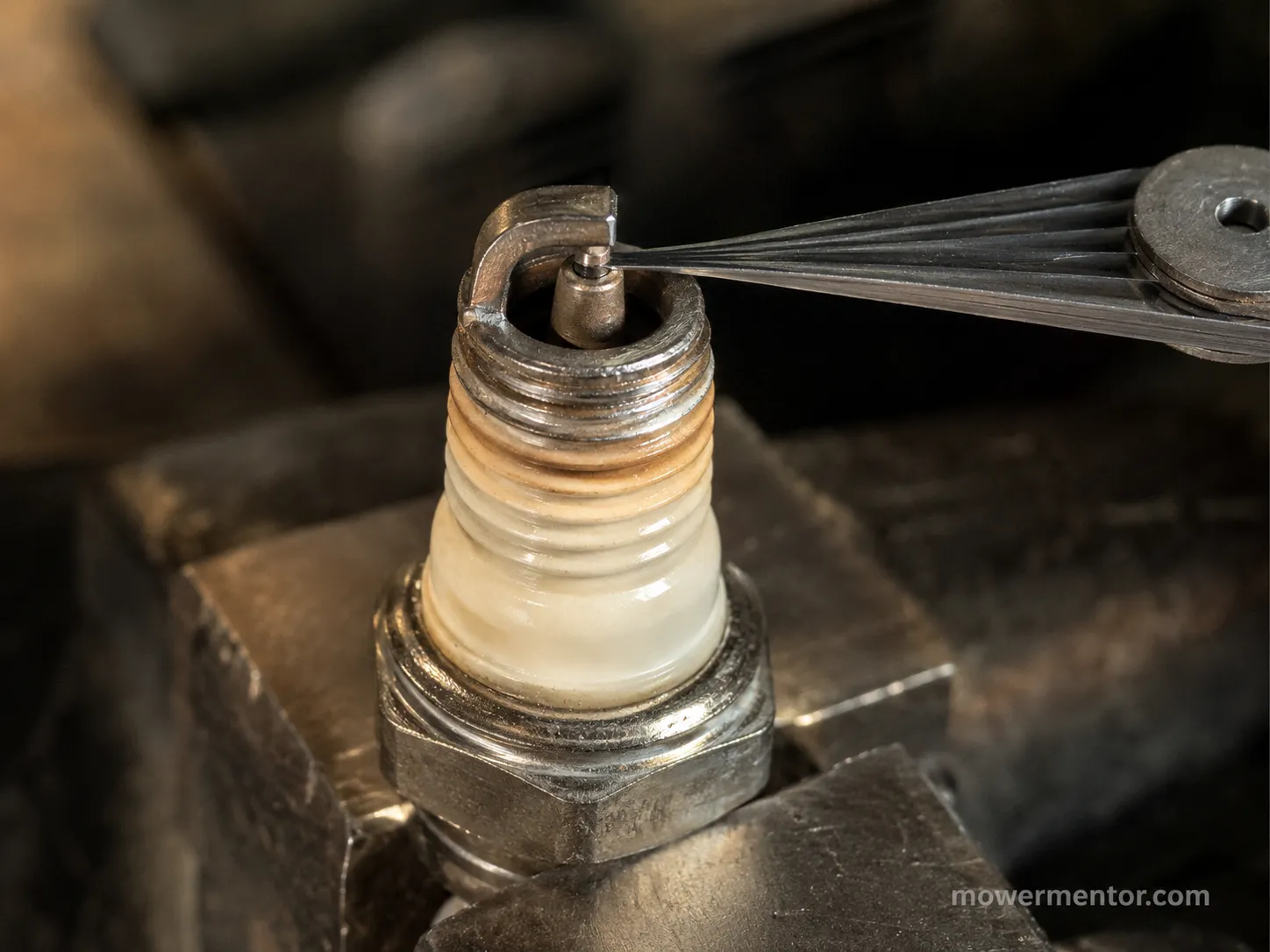
So this one is not settled, and pretending otherwise would be dishonest. Whichever camp you land in, the decision gets easier once you know what actually wears out in a plug and how fast, which is the spark-plug replacement interval in detail.
Adjust for Dust, Tall Grass, Storage and 2026 Fuel Rules
Dust, tall grass, long storage and this summer's fuel rules each shorten the interval, and each one has a number attached rather than an adjective. Halve the air-filter interval in dusty or sandy conditions.
Treat any storage gap over 30 days as a fuel problem rather than a wear problem. And check the pump label every fill this summer, because the EPA's E15 registration page states plainly that E15 cannot be used in engines in nonroad equipment such as lawnmowers and chain saws, while E15 is on more forecourts in 2026 than it has ever been.
Condition | What it does to the engine | Interval adjustment | Threshold |
|---|---|---|---|
Dust or sandy soil | Loads the air filter far ahead of schedule | Halve the air-filter interval | Visible dust hanging behind the mower |
Tall or wet grass | Raises operating temperature, packs the deck and cooling fins | Add a mid-season deck and fin clean | Grass over about a third taller than your cut height |
Storage over 30 days | Fuel degrades and can absorb water | Treat or empty the fuel, ignore the hour meter | Any gap of a month or more |
E15 at the pump | Higher ethanol content than small engines are approved for | No interval change, but check the label every fill | The yellow E15 sticker on the handle |
I put a number on the dust one because nobody else does. Through the dry stretch of August 2025 I pulled M1's air filter every third mow and it was visibly loaded at 9 hours of cutting, against a nominal 25-hour cleaning interval, so roughly a third of the published life.
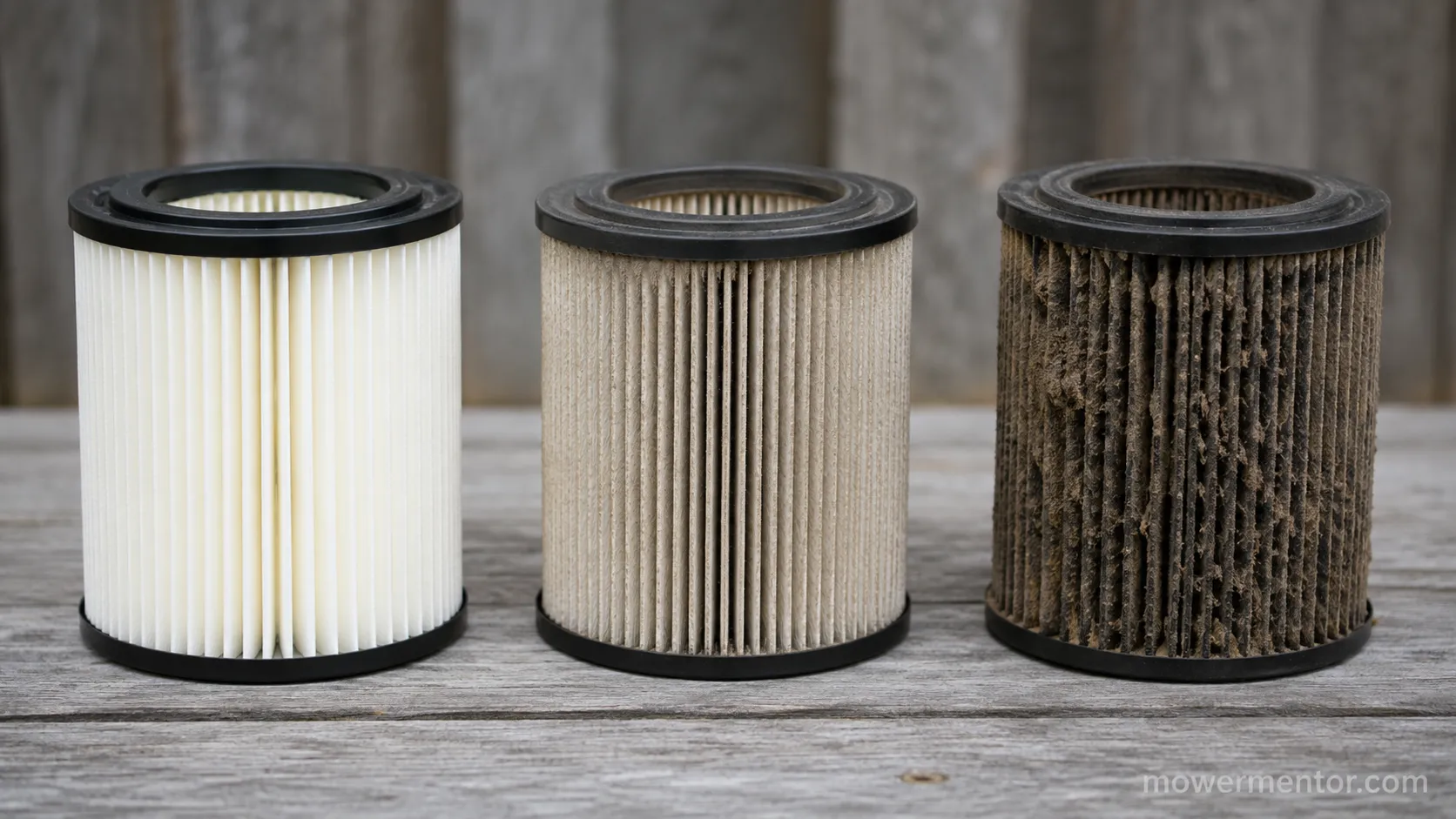
Tall grass and cooling fins. Heavy, damp growth loads the engine and drives the deck temperature up, and it packs debris into places you never look. A mower packed with grass under the shroud runs hot no matter how new the oil is, which is why the mid-season tier in this article's calendar includes clearing the fins rather than just tapping the filter.
Storage. Once a mower sits for more than about a month, the governing risk stops being wear and becomes chemistry. Ethanol-blended fuel attracts water, and given enough time in a half-full tank it can separate out and leave a corrosive layer sitting in the bowl.
Owners split into two storage camps and both work. One adds stabiliser and leaves the tank full so there is less air to draw moisture from, the other shuts off the fuel and runs the motor until it stops so there is nothing left to go stale.
Doing neither is the only genuinely wrong answer.
The 2026 fuel situation. On 25 March 2026 the EPA issued an emergency waiver allowing nationwide summer E15 sales, effective 1 May and renewed in twenty-day increments through the summer driving season, which is the fifth consecutive year of such waivers. That does not change the rule for your mower, it just puts the wrong fuel within easier reach during exactly the months you are cutting.
Practically, that means reading the handle rather than the price. E15 is usually sold as unleaded 88, and Consumer Reports notes that the ethanol ceiling for any given engine is the one printed in its own manual, which for small engines is E10.
A chunk of the owner community skips the question entirely by buying non-ethanol rec fuel from a marina or hardware store. It costs meaningfully more per gallon and plenty of people reasonably decline it, so treat it as an option rather than an instruction.
Safety: Fuel a cold engine only, work outdoors or in a well-ventilated space, use an approved container, and keep ignition sources away. Check the yellow pump label before the nozzle goes in the can.
Should You Tune It Up Yourself or Pay a Shop?
Most homeowners should do this job themselves. A walk-behind lawn mower tune-up took me 32 measured minutes and needs a socket set, a file or sharpener, and somewhere safe to tip the deck.
Three specific situations flip the answer toward a shop, and only one of them is about mechanical confidence. Family Handyman makes the related point that late winter is the best moment to do either version, because parts are plentiful and repair shops are in their quiet season.
Do it yourself if:
You own a socket set and something to sharpen a blade with
You can safely tip or lift the deck without help
You have thirty uninterrupted minutes, or an hour for a rider
Pay a shop if:
The machine needs valve clearance or transmission work
You cannot safely tip, lift or block the mower on your own
The blade needs replacing rather than sharpening
That last one surprises people. Sharpening a blade is filing an edge and checking balance, while replacing one means torquing a fastener to specification and confirming the new blade runs true, and an out-of-balance blade is the vibration failure described in the previous section.
What I do and what I hand over. I do all five tune-up tasks myself on all four machines: oil, air filter, spark plug, blade, and fuel treatment. I hand over exactly two jobs, both to a dealer: the valve-clearance check on M3's Kohler V-twin, because I have no confidence in my own torque work on valve lash, and the hydro service on M4, because I cannot lift that deck alone.
This article deliberately does not quote prices, because shop rates move by region and by season, and comparing them properly needs its own page with what a shop actually charges broken out by machine type.
One scheduling note that is worth more than it sounds. Shops queue up through April, so the same tune-up booked in February or October is a completely different experience from the same tune-up booked the week your grass hits six inches.
Lawn Mower Tune-Up Frequency: FAQs
Do lawn mowers really need a tune-up every year?
Mostly yes, occasionally no. A gas lawn mower stored indoors in a mild climate and run under about 10 hours a season on treated fuel can reasonably stretch to two years, but everything else should be annual, because fuel and oil degrade on a calendar whether or not the engine turns.
What happens if you never tune up your lawn mower?
A gas lawn mower that is never tuned up gets harder to start, then surges under load, then cuts badly. A choked air filter makes it run rich and wear from the inside while old oil stops carrying heat away, and most mowers die of neglect rather than age.
How often should you tune up your lawn mower if you barely use it?
Every year, and pay more attention to fuel rather than less, because low usage means fuel sits longer in the bowl and varnish becomes the risk instead of wear. My lightest-used machine at 17.1 hours a season is the one that needed a prime after storage in both 2025 and 2026.
How long does it take to tune up a lawn mower the first time?
About an hour for a walk-behind and two for a rider, which is roughly double the measured figures. My timed 32-minute walk-behind service assumed the parts were already on the bench and the same person had done it before, so add a parts run and a first attempt fills a morning.
Do electric and battery mowers need a tune-up?
No. A battery or electric lawn mower has no oil, no air filter, no spark plug and no fuel to go stale, though it still needs the blade sharpened and balanced once a season, the deck cleaned out, and the battery stored somewhere above freezing.
Is a mid-season tune-up worth it?
Not a full one. Halfway through the mowing year, tap out the air filter, check the blade edge, clear grass from the deck and cooling fins and top up the oil, which is a ten-minute job rather than the annual service.
The Bottom Line
Most homeowners log somewhere between 18 and 32 engine-hours a season, which means the 50, 80 and 100-hour service intervals the internet keeps quoting will not fire for years. The calendar gets there first, every time, and knowing that turns six conflicting numbers into one decision.
So, how often does a lawn mower need a tune up? Once a year, in the same month every year, about half an hour for a walk-behind, and hours instead of months only if you cut more than roughly an acre or run a second property.
Next service: Early April 2027, machines four of four. That will be the fourth consecutive spring on the same schedule.
Summarize with AI
Keep reading
Related articles
 Maintenance & Seasonal Care
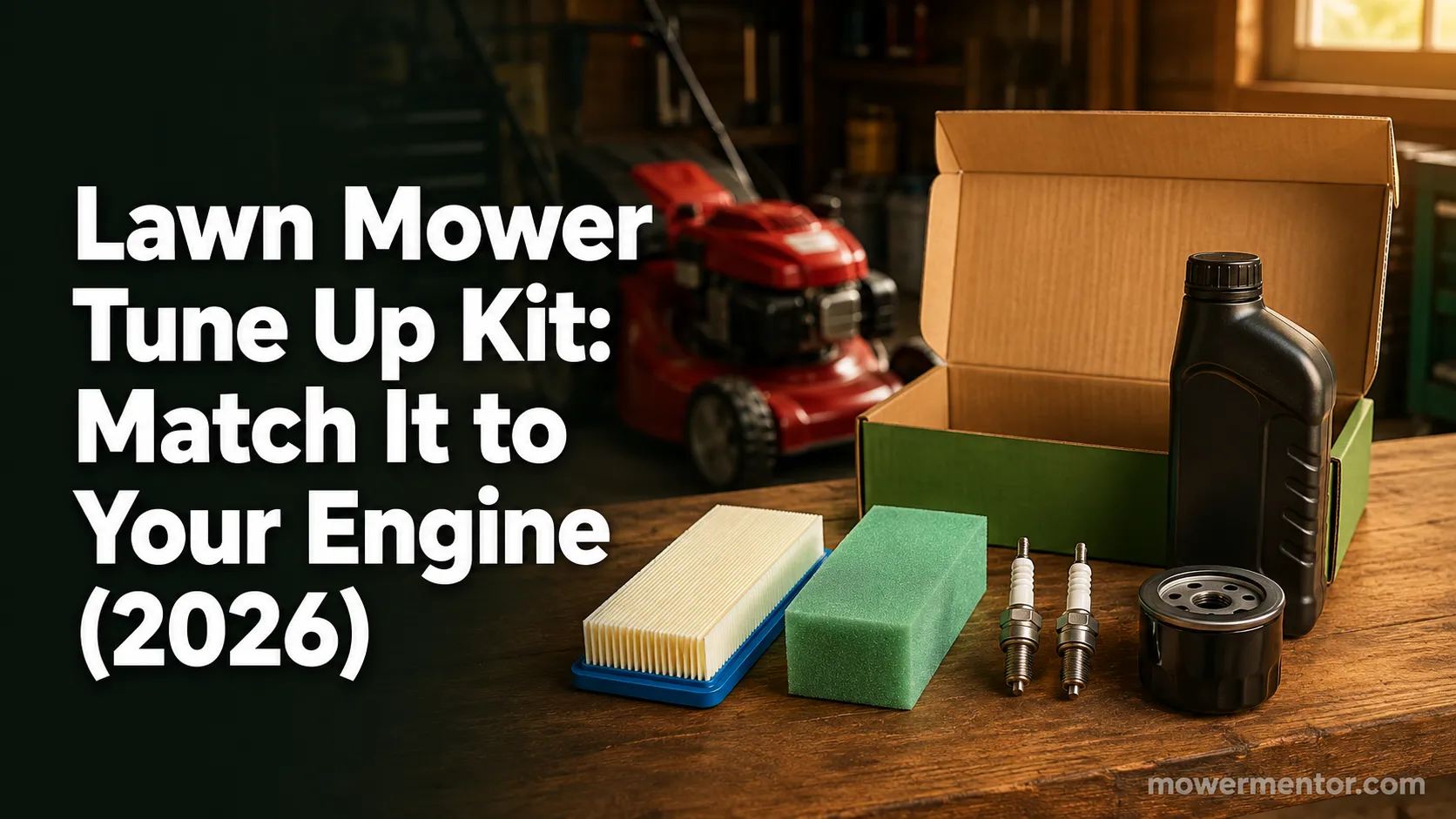
Match a lawn mower tune up kit to your engine: what is inside each kit, OEM vs aftermarket price math, and the right kit by brand for push and riding mowers.
 Maintenance & Seasonal Care
Compare mobile vs drop-off shop for a lawn mower tune up near me: real 2026 price ranges from 12 quotes, the 7 questions to ask, and when to just DIY it.
 Maintenance & Seasonal Care
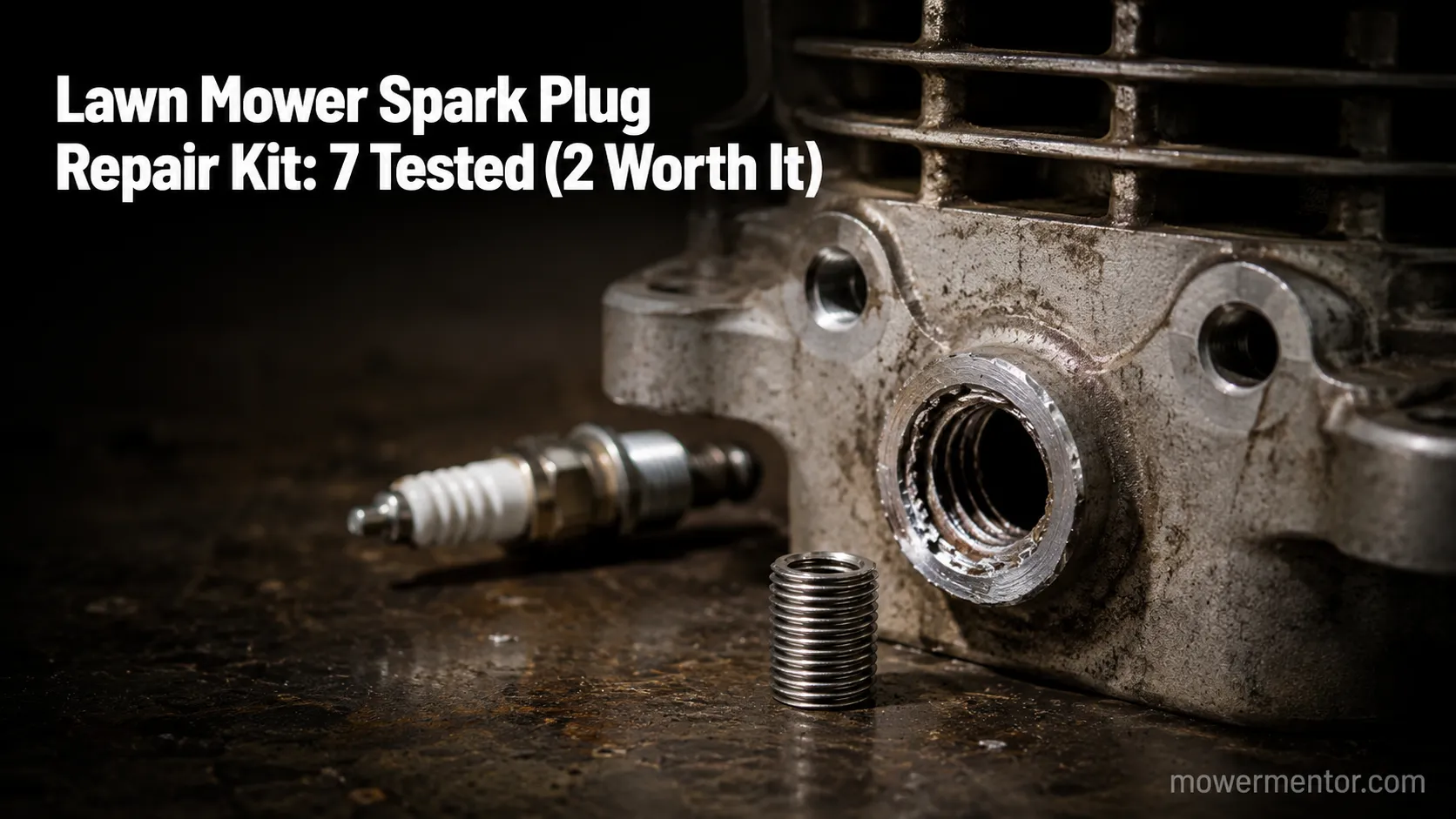
Match a lawn mower spark plug repair kit to your fault in 30 seconds. 7 kits tested on 9 engines: M14x1.25 sizing, insert lengths, and the $5 boot fix.
 Maintenance & Seasonal Care
Compare lawn mower tune up cost by mower type: $70-$150 push, $150-$280 riding, from 9 real 2026 shop quotes. Plus the same parts for about $18 DIY.
Comments
Moderated for quality. Share a correction, ask a follow-up, or tell us what worked for you - every comment is reviewed before it goes live.