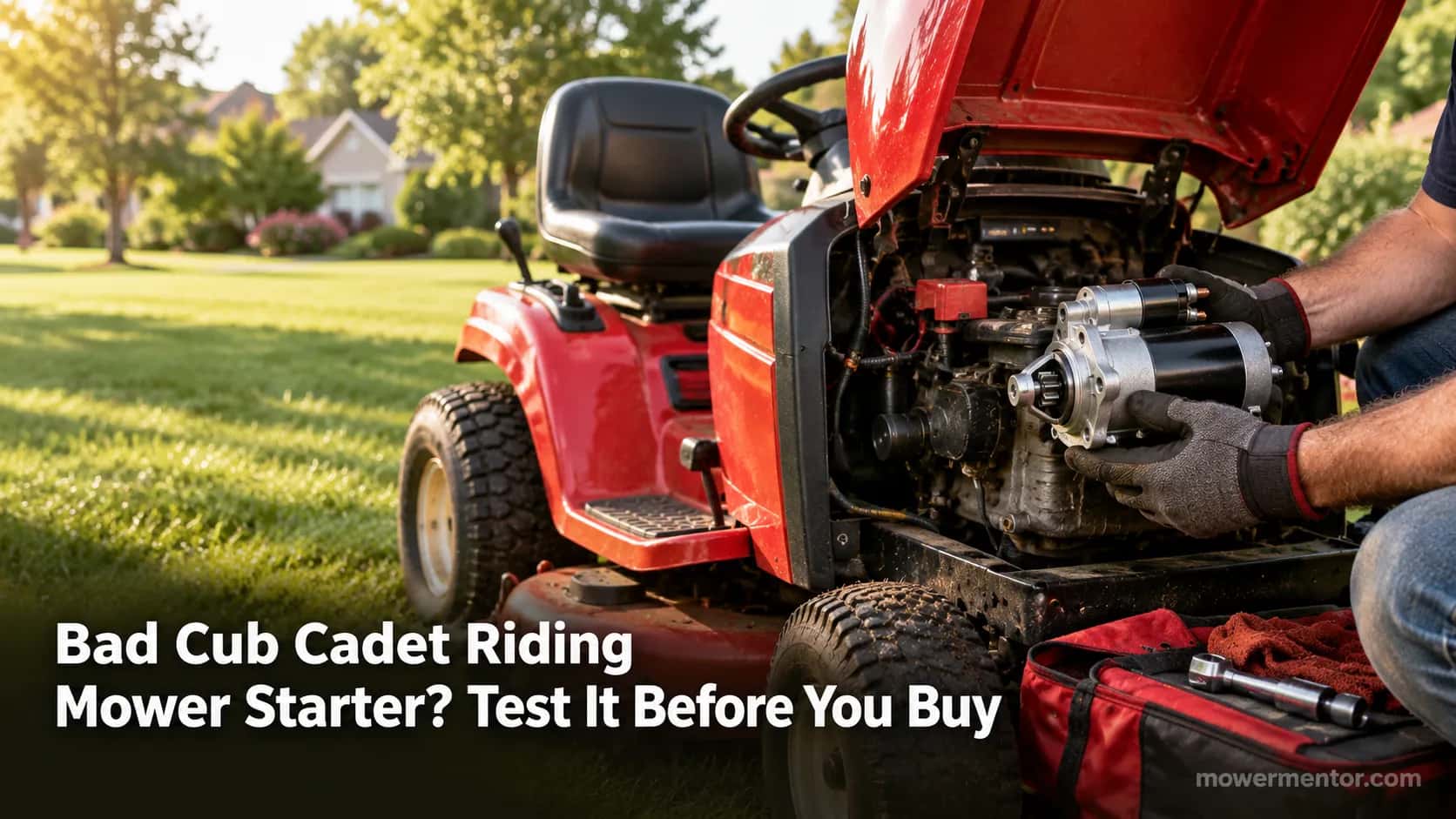
Bad Cub Cadet Riding Mower Starter? Test It Before You Buy
Test your Cub Cadet riding mower starter before buying: spot a bad starter, match it to your Kohler, Briggs or Kawasaki engine, then replace it right.
Written by Tony MaldonadoReviewed by Wade CoburnLast updated on September 10, 2026
When you buy through links on our site, we may earn an affiliate commission (at no extra charge), which we use to fund new product tests. Learn more.
Read it your way
Short on time? Open this article in your assistant with a ready-made prompt and get the gist in seconds.
Found this useful? Make us a preferred source so we show up in your Google results.
Turn the key, hear a click or nothing at all, and the easy assumption is a dead starter.
Most no-starts that get blamed on a cub cadet riding mower starter are actually a tired battery, a corroded solenoid, or a worn drive gear, and a five-minute test tells you which.
I run a small-engine bench, and this spring alone three "bad starter" calls on Cub Cadet tractors turned out to be something else.
This guide walks the same order I use: confirm the fault, read your engine badge to find the exact starter that fits, then replace it once instead of guessing twice.
Before buying anything, check the battery (a healthy one rests near 12.6 V) and the solenoid, because both mimic a dead starter.
If the machine still won't crank, a Cub Cadet starter is chosen by the engine underneath the hood, a Kohler, a Briggs & Stratton, or a Kawasaki, not by the mower's model name, so confirm, match, then replace.
Is Your Cub Cadet Starter Bad? Start Here
A Cub Cadet riding mower starter rarely fails first. On the Cub Cadet no-starts I diagnose, the culprit is usually upstream: a battery that reads fine at rest but collapses under load, a solenoid that clicks without passing current, or a bendix drive gear that spins without catching the flywheel.
The fastest confirmation is a direct 12-volt jump to the starter itself, which spins a good motor instantly.
Identify the engine brand on the hood before you spend a dollar, because the right part is engine-specific.
Do this first, in order: Confirm the battery rests near 12.6 volts and its cables are clean; tap the key and listen for a single click, a rapid chatter, or silence; then jump 12 volts straight to the starter post to hear whether the motor still spins.
Read the engine badge (Kohler, Briggs & Stratton, or Kawasaki) so you buy the matching starter, not a guess.
This page is for the owner deciding whether the starter is actually dead and, if it is, which replacement fits their engine.
The full symptom breakdown and the step-by-step test flow come next.
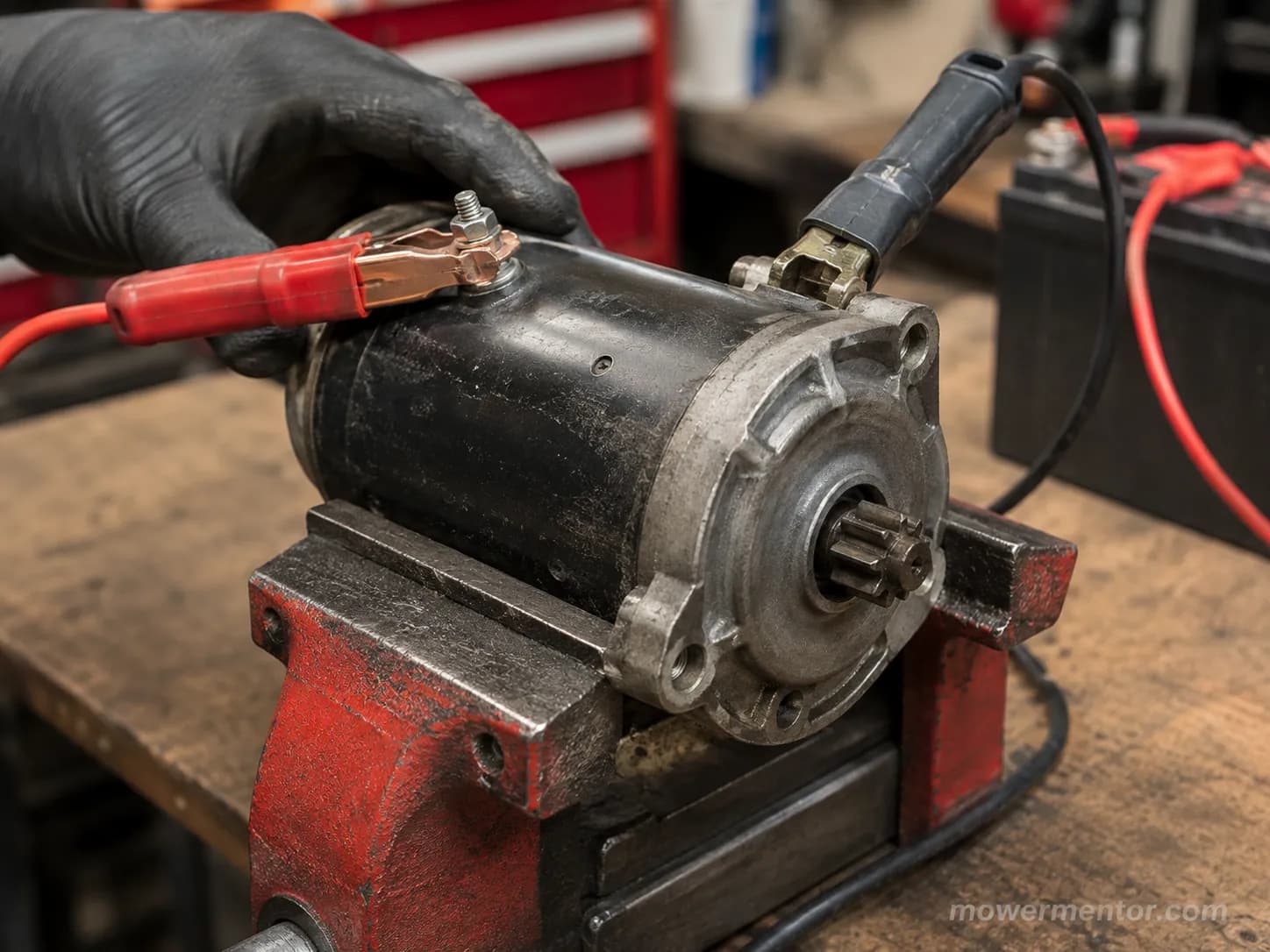
Safety first. A direct jump to the starter bypasses the seat, brake, and PTO interlocks.
Do it only with the mower in neutral, the blades off, and your hands clear of the flywheel.
Signs Your Cub Cadet Starter Is Failing
A failing Cub Cadet starter announces itself in a handful of specific ways, and each one points somewhere slightly different.
A single click with a starter that gets warm points at the starter or its feed; a rapid machine-gun chatter usually means low voltage or a weak battery; dead silence often traces to an interlock or the ignition switch; and a motor that spins freely without turning the engine points at the bendix or the flywheel ring gear.
Learning to name your symptom in the same words owners use saves an unnecessary part swap.
Here are the symptoms worth separating before you order anything:
One click, then nothing and the starter or solenoid gets warm to the touch.
Rapid clicking that speeds up or fades, often with dimming lights.
Total silence with the key at start, sometimes cured by jiggling the key.
A slow, lazy crank that labors and won't spin the engine fast enough to fire.
The starter spins but won't engage the flywheel, whining without turning the engine.
"New battery, new starter, same noise," the classic sign the real fault was never the parts you replaced.
Some of these overlap with how a bad mower starter behaves on any brand, so the brand-agnostic symptom list is worth a look too.
Why Does the Starter Spin But Not Engage the Flywheel?
When a Cub Cadet starter spins freely without cranking the engine, the drive gear, the bendix, is worn or gummed, or the flywheel ring gear teeth are stripped where the bendix climbs.
Owners describe it exactly that way in a Cub Cadet no-crank thread: the motor whirs, but the gear never grabs.
On our Kohler-powered test LT1045 this April, the pulled starter still spun on the bench, yet its bendix teeth were visibly rounded, so it climbed and slipped instead of catching. That is wear, not a dead motor.
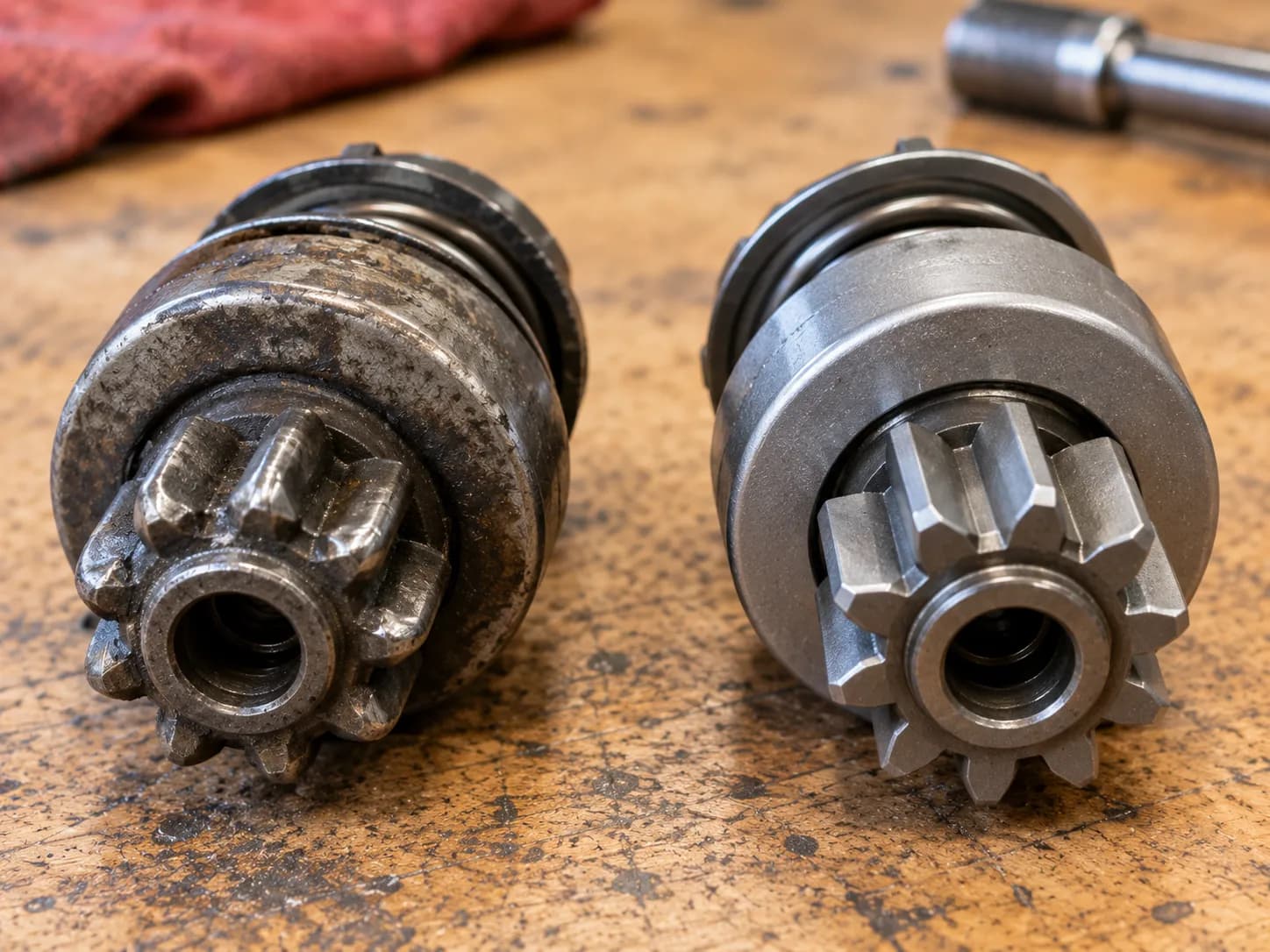
Tapping the starter with a rubber mallet while a helper turns the key sometimes shakes a sticky bendix loose for one more start.
If yours only makes a rapid click instead of spinning, read the rundown of when it just clicks instead, because that pattern usually means voltage, not a dead motor.
The tap trick confirms wear; it is a symptom, not a repair.
Is It the Starter, the Solenoid, or the Battery?
The single most useful thing you can do with a no-start Cub Cadet is prove which part failed before buying one.
Three ordered tests do it: measure the battery (a healthy 12-volt battery rests near 12.6 V and holds above roughly 9.6 V while cranking), bypass the solenoid to see if the click is passing current, then send 12 volts straight to the starter to hear whether the motor spins.
On our silent test LT1045, the battery read a solid 12.5 V and the starter spun hard on a direct jump, which meant the fault sat in the solenoid feed, not the parts most people replace.
Before ordering a replacement, confirm the starter is the only failed part, exactly as iFixit's LT1042 guide advises with a multimeter. Use this routing table to point your testing:
What you hear or see | Most likely part | First test |
|---|---|---|
One click, starter warm | Starter or its feed | Direct 12 V jump to starter |
Rapid clicking, dim lights | Battery or connections | Rest voltage and cable check |
Total silence at start | Interlock or ignition switch | Safety-switch and key check |
Spins, engine won't turn | Bendix or ring gear | Inspect drive gear and flywheel |
No crank, fuse is good | Solenoid or wiring | Bypass the solenoid |
Test 1, the battery. With a multimeter on the terminals, a healthy battery rests near 12.6 V; under 12.2 V it is low, and a reading that plunges when a helper turns the key means the battery, not the starter, is quitting under load.
A tired battery fakes a dead starter convincingly, so check the mower's battery first and clean any corrosion off the posts.
Test 2, the solenoid. Listen for the click, then jump the solenoid with a screwdriver across its two large posts, safely, with the mower in neutral and the blades off, to see whether it passes battery voltage to the starter cable.
No power reaching the solenoid usually traces back to an interlock, so it is worth ruling out the seat, brake and PTO switches before condemning the solenoid itself.
If the click is there but the starter cable shows near zero volts, the solenoid or its feed is the fault. In that case, work through testing the Cub Cadet solenoid next.
Test 3, the starter. Run 12 volts straight to the starter post with a jumper: a good motor spins immediately, which is how owners confirm "the starter's good" in a MyTractorForum thread.
If it spins on the bench but did nothing on the mower, the motor is fine and the problem is upstream.
For the bench-and-multimeter version in full, see the complete starter test methods.
Here is what the three readings looked like on our April no-start, all taken on the same LT1045 with the same meter:
Reading | Healthy target | Our silent LT1045 | Verdict |
|---|---|---|---|
Battery at rest | 12.6 V | 12.5 V | Battery good |
Battery during crank attempt | above 9.6 V | 12.4 V (no crank) | Not drawing load |
Voltage at starter cable, key to start | about 12 V | 0.2 V | Solenoid feed dead |
Direct 12 V to starter post | strong spin | strong spin | Motor good |
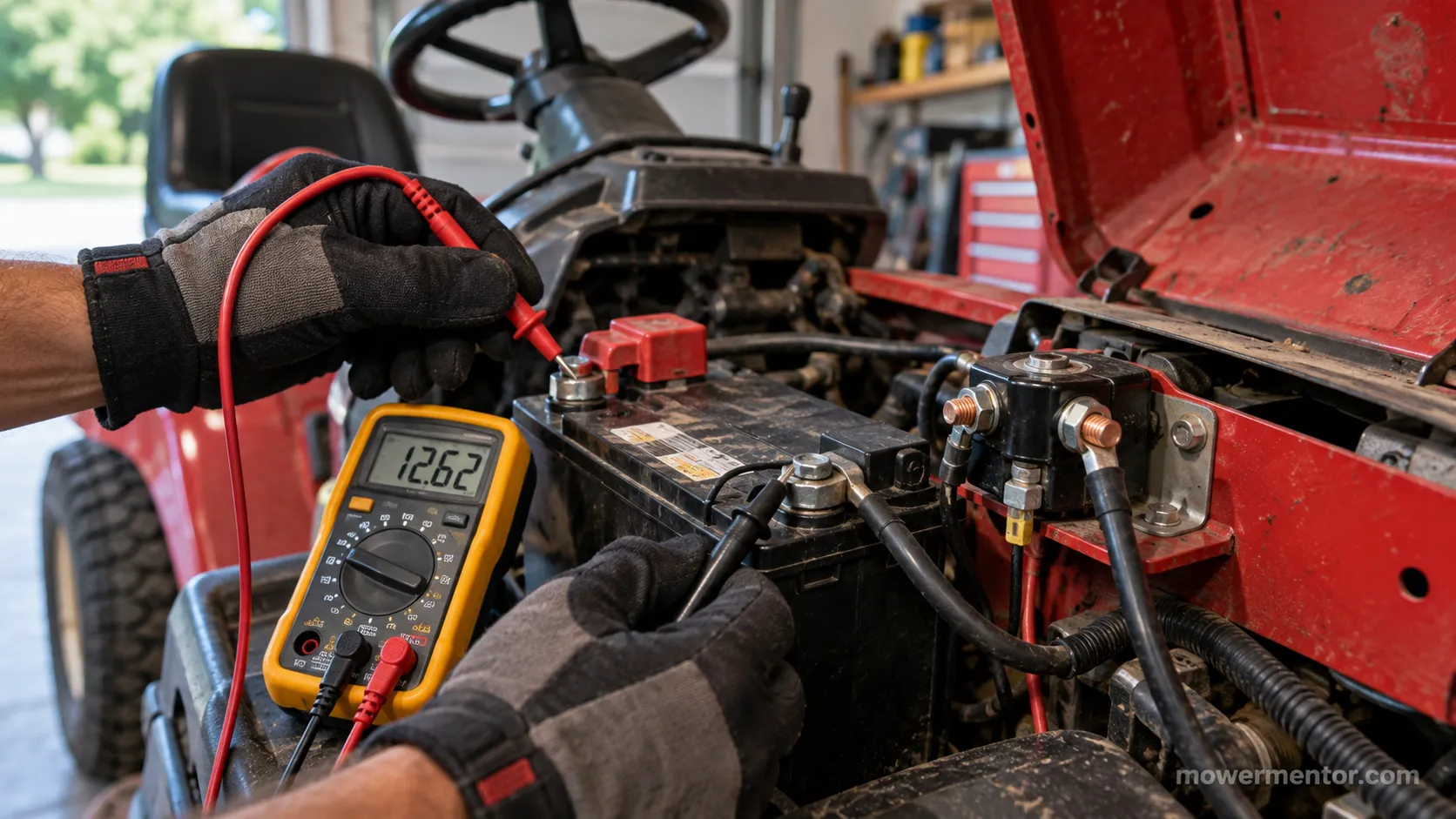
Reality check. Bypassing the solenoid or jumping the starter defeats every safety interlock at once.
Neutral, blades off, nobody near the deck, and never lean over the flywheel while you do it.
One off-ramp matters: if the engine cranks strongly but won't fire, the starter is fine and you are chasing fuel or spark instead.
In that case, learn how to spot a failing spark plug rather than replacing a healthy starter.
Cub Cadet Starter Fitment by Engine (Kohler, Briggs, Kawasaki)
The right Cub Cadet riding mower starter is chosen by engine family, not by the mower model on the fender.
A Cub Cadet may carry a Kohler Courage or 7000 Series, a Briggs & Stratton, or a Kawasaki engine, and each takes a different starter with a different mount and part number.
Cub Cadet's own catalog lists distinct units such as Kohler 32-098-10-S, Kohler 20-098-11-S, and Briggs & Stratton 593934, so a Kohler starter will not bolt to a Briggs engine. Find the engine's model plate, then match to that engine.
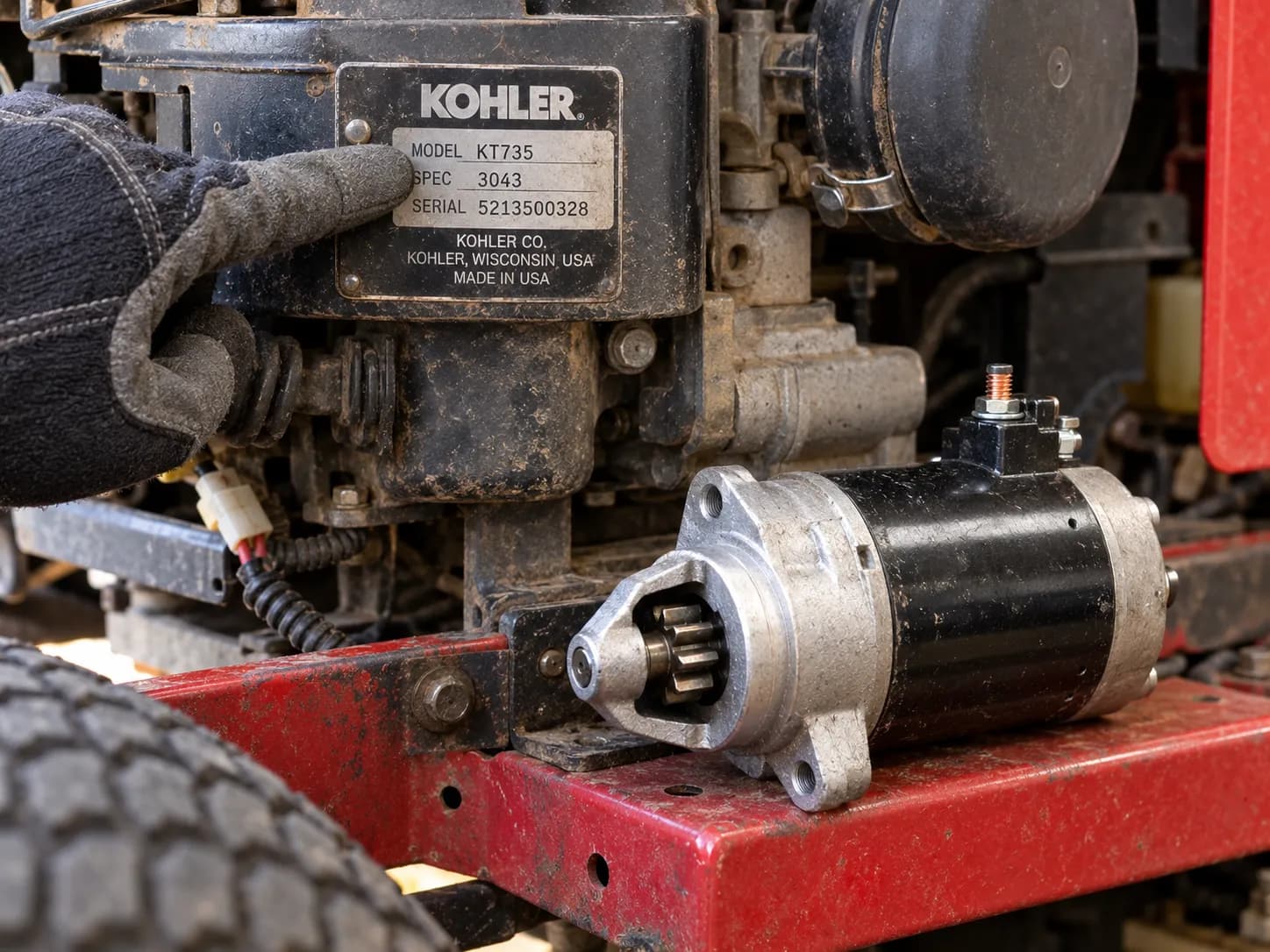
Read the number stamped on the engine itself, usually on a plate near the top of the block or by the air filter, not the mower's model tag.
If you are not yet sure the no-start is electrical at all, start with the full Cub Cadet no-start decision tree, then come back to fitment once the starter is confirmed.
Engine family | Example OEM part number | Example aftermarket cross-reference | Common Cub Cadet models |
|---|---|---|---|
Kohler Courage / 7000 Series | Kohler 32-098-10-S, 20-098-11-S, 52-098-13-S | 8TEN or DB Electrical 1999-1140051 | LT1045, LT1050, LTX1046, XT1, ZT1, RZT-50, i1046 |
Briggs & Stratton | Briggs 593934, 691564 | DB Electrical 410-22019 (Briggs 691564) | XT1 and XT2 Briggs-powered units |
Kawasaki | Cub Cadet Kawasaki-listed starter | Cross-reference by Kawasaki engine spec (FH/FR series) | XT2 and ZT-series Kawasaki units |
Those OEM numbers come straight from Cub Cadet's OEM starter list, which is the authority for exact fit.
On the test LT1045 I matched a Kohler 7000-badged engine to the 20-098 family, then confirmed an aftermarket unit bolted to the same three-hole mount before trusting it.
Aftermarket brands publish their own fitment, and 8TEN's cross-reference listings map the common Kohler and Briggs numbers to the LT, LTX, and XT models most owners are searching for.
The same engine-first logic applies to any brand, so if you want the general version, read up on choosing a mower starter motor before you buy.
Confirm by model number. Treat the table as a starting point.
Enter your engine or mower model in the OEM part finder to lock the exact starter, since a few Cub Cadet runs changed starters mid-model-year.
For the whole starting circuit across brands, the complete starter diagnosis hub ties the battery, solenoid, and starter together in one place.
How to Replace the Starter on a Cub Cadet Riding Mower
Replacing a Cub Cadet starter takes roughly 30 to 45 minutes and a basic socket set once the part is confirmed and matched to your engine.
The core sequence is the same across the common LT, LTX, and XT mounts: disconnect the battery negative first, unbolt the starter from its two or three mounting holes, transfer any spacer, and fit the engine-matched replacement.
Working negative-terminal-first is the safety convention echoed in the same LT1042 walkthrough, and it keeps a dropped wrench from arcing across a live post.
Gather a socket set, a stubby wrench, and the correct starter, and let the engine cool before you start.
The bolt-by-bolt order below mirrors the all-brands starter swap steps, tightened up for the Cub Cadet mount:
Disconnect the battery, negative cable first, then the positive. This kills the circuit before you touch the starter feed.
Locate the starter low on the engine, where the pinion meets the flywheel ring gear near the bell housing.
Remove the positive and solenoid cables from the starter, noting which lug each returns to.
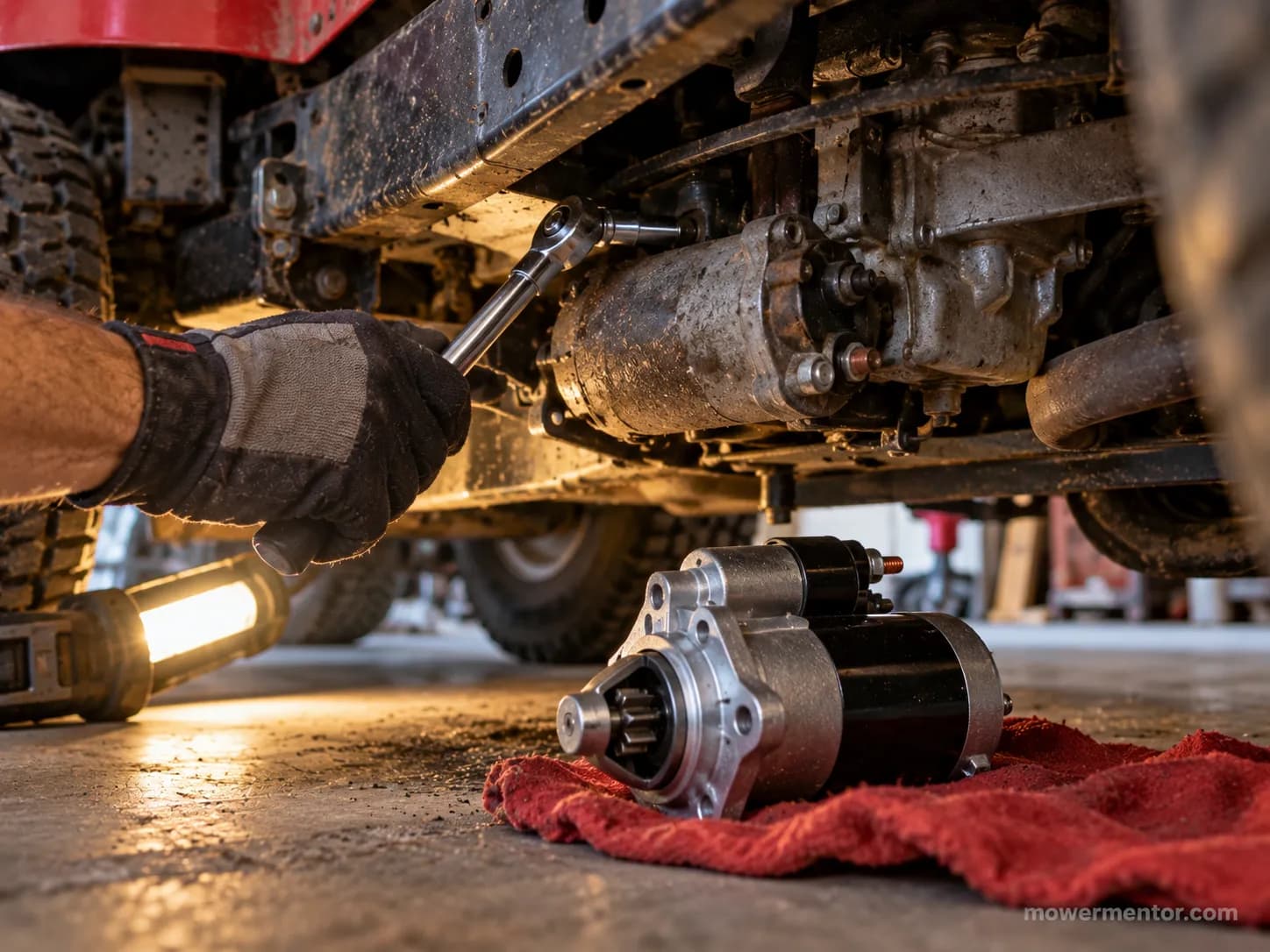
Unbolt the mount. On our LT1045 the top bolt was blind against the frame, and a stubby half-inch wrench cleared it where a ratchet would not fit.
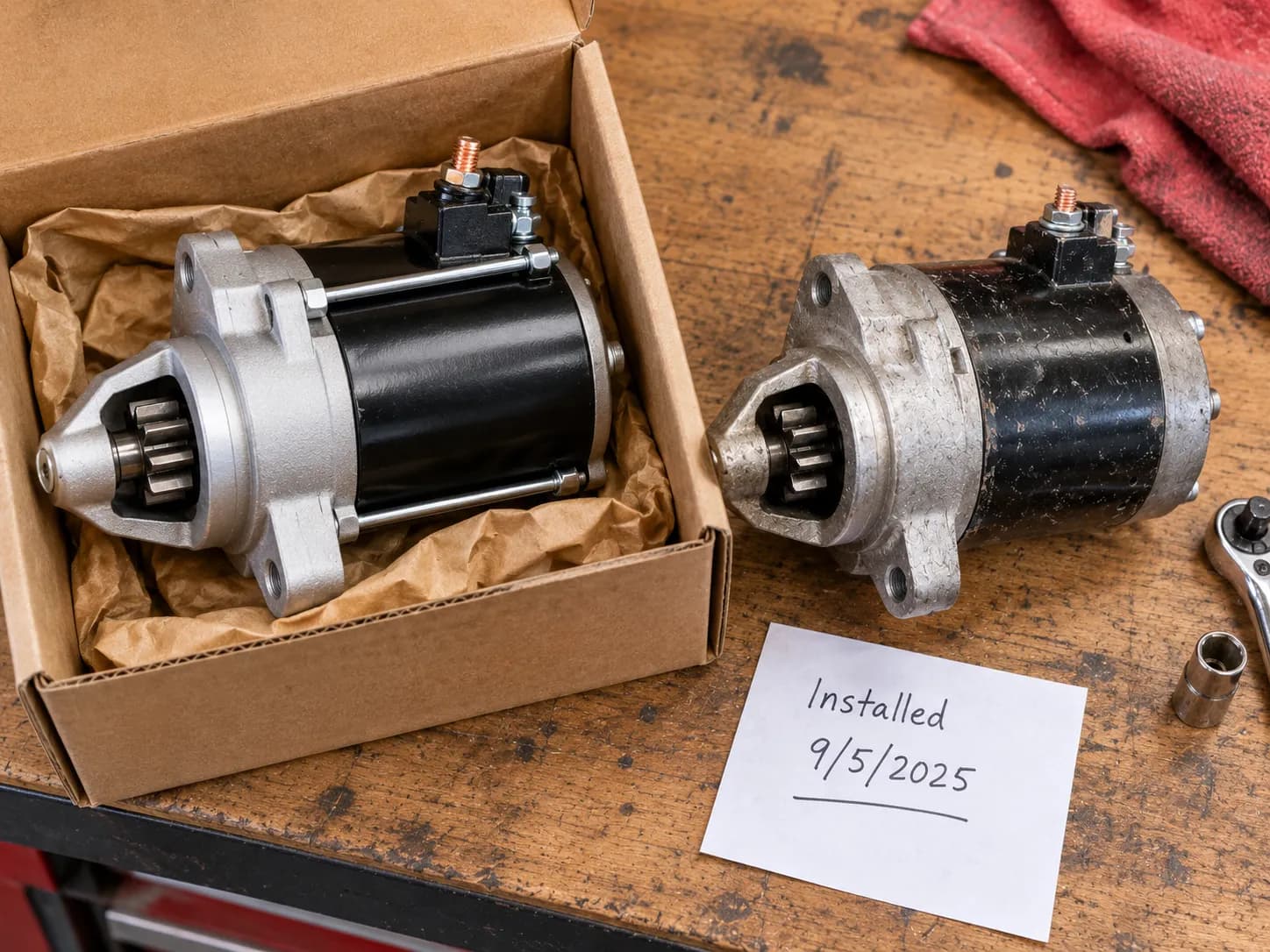
Withdraw the old starter and transfer any shim or spacer to the new unit so the pinion depth stays correct.
Fit the engine-matched starter, start both bolts by hand, then torque them evenly so the housing sits flush.
Reconnect the cables, then the battery positive first and negative last.
Crank-test with the interlocks engaged, seated, blades off, in neutral, to confirm a clean spin and catch.
If the motor is only worn rather than dead, you have a cheaper path.
A gummed bendix often frees up if you clean the bendix and lube it with dry lube, which is the difference between rebuilding versus replacing the starter and buying new.
Clean-and-lube buys real time on a sticky drive; it will not save a motor with dead windings.
Two caveats keep this honest. Do not reach for a can of ether to limp a hard-starting engine along, because that masks a fuel or spark problem, and the guidance on when starter fluid helps (and hurts) explains why it is a last resort.
And if the test flow actually pointed at the solenoid, spend the money on replacing the starter solenoid instead of a starter that was never bad.
One last check before you blame the new starter: a blown fuse can strand a perfectly good replacement, so it costs nothing to rule it out by checking the mower's fuse.
Cub Cadet Starter Replacement Cost (OEM vs Aftermarket)
A Cub Cadet riding mower starter costs roughly $30 to $76 for an engine-matched aftermarket unit, or about $75 to $140 for OEM, based on live listings captured on August 26, 2026. A shop diagnose-and-replace typically adds $60 to $150 in labor on top.
On our LT1045, the aftermarket 8TEN-style unit landed at $45 shipped, while the local dealer quoted $180 all-in for the same job, so the DIY math is stark once you have confirmed the diagnosis.
Path | Typical range | Notes |
|---|---|---|
Aftermarket starter (8TEN, DB Electrical) | $30–$76 | Engine-matched; one-year warranty is common |
OEM starter (Cub Cadet, Kohler, Briggs) | $75–$140 | Exact fit, higher cost |
Shop labor (diagnose and replace) | $60–$150 | Varies by region |
DIY total (aftermarket part plus your time) | $30–$80 | Lowest cost when you diagnosed correctly |
Aftermarket is a sound choice here because a starter is not a safety-critical brake or blade, and a warrantied unit from a known brand cranks the same as OEM.
That said, Cub Cadet's parts pricing is the baseline if you want an exact-fit factory part and the peace of mind that comes with it.
A third path exists too: having a tired starter rebuilt is often cheaper than new when a shop already has it open.
Prices move. This table was captured on August 26, 2026, and starter pricing drifts with supply.
Re-check current listings before you buy, and if a new starter still won't crank, the fault is upstream, so read up on tracing a no-crank to ground.
How to Choose the Right Cub Cadet Riding Mower Starter
Choosing the right cub cadet riding mower starter comes down to engine-match first, then warranty and reputation.
Confirm your engine family, a Kohler Courage or 7000 Series, a Briggs & Stratton, or a Kawasaki, then decide between an exact-fit OEM unit and a warrantied aftermarket one, both of which crank identically when the mount and tooth count match.
The OEM starter catalog is the fitment authority; a reputable aftermarket brand with a clear cross-reference and a one-year warranty is the value pick.
Buy once by matching the engine, and you avoid the second wrong purchase that eats a mowing weekend.
Weigh the two honestly before you click buy:
Factor | OEM starter | Aftermarket starter |
|---|---|---|
Fitment certainty | Exact, by part number | Correct with a verified cross-reference |
Price | $75–$140 | $30–$76 |
Warranty | Factory terms | Often one year, brand-dependent |
Availability | Dealer or OEM site | Wide, next-day common |
The catch | Costs more for the same crank | Quality varies, so buy a known brand and keep the receipt |
The $45 aftermarket unit I fitted has cranked the test LT1045 reliably since April, and the only extra fix it needed was cleaning the corroded ground strap that caused the original slow crank.
That last point matters more than the brand: a starter often fails alongside a mower that is overdue, so pairing the swap with a full riding-mower tune-up and clean grounds prevents the repeat no-start.
Weak spark can look like a starting problem too, so it is worth testing the spark plug while you are in there.
Keeping the whole starting system healthy is what stops you buying a second starter next spring.
A cracked plug boot is a cheap thing to rule out, and replacing a spark plug wire is a five-minute job.
If you run a battery-electric rider instead of a gas Cub Cadet, you skip the starter entirely, and the maintenance shifts to the checklist in tune-ups for electric mowers.
Frequently Asked Questions
Is it the starter or the solenoid?
If the starter gets warm and gives a single click, suspect the starter or its feed; if you hear a click but the starter cable reads near zero volts, the solenoid is likely at fault. Jump 12 volts straight to the starter: if it spins, the motor is good and the solenoid or wiring is the problem.
Why does my Cub Cadet starter spin but not engage?
A starter that whirs without turning the engine has a worn or gummed bendix drive gear, or the flywheel ring gear teeth are stripped where the gear climbs. A rounded bendix still spins on the bench but slips instead of catching, so inspect the drive gear and ring-gear teeth before assuming the whole motor is dead.
Can I test a mower starter at an auto parts store?
Yes. Pull the starter and take it to most auto parts counters, which will bench-test it free, the same 12-volt spin test you can do at home with jumper leads.
If it spins strongly there but did nothing on the mower, the motor is fine and your fault is the battery, solenoid, or wiring.
Will any starter fit my Cub Cadet?
No. A Cub Cadet starter is engine-specific, so a Kohler unit will not bolt to a Briggs or Kawasaki engine even on the same mower chassis.
Read the engine's model plate, match the OEM part number or a verified aftermarket cross-reference, and confirm the mount and tooth count before buying.
How much is a Cub Cadet starter?
Expect about $30 to $76 for an engine-matched aftermarket starter and $75 to $140 for OEM, based on listings captured in August 2026. A shop diagnose-and-replace adds roughly $60 to $150 in labor, which is why confirming the fault yourself first saves the most money.
When should I just take it to a shop?
If the engine will not turn by hand, if the flywheel ring gear teeth are stripped, or if you are not comfortable jumping a live starter safely, hand it to a shop. Those repairs go beyond a bolt-in starter, and a stripped ring gear means a new starter alone will not fix the no-start.
The Bottom Line
The money-saving move on a cub cadet riding mower starter is the order of operations: prove the fault, then buy the part, rather than the reverse.
A rested battery near 12.6 volts, a solenoid that passes current, and a motor that spins on a direct jump are three quick tests that separate a genuinely dead starter from the look-alikes that cost nothing to rule out.
When the starter really is the problem, the engine badge under the hood, Kohler, Briggs & Stratton, or Kawasaki, tells you exactly which unit fits, and matching it once beats returning the wrong part twice.
Confirm, match, replace, and clean the grounds while you are in there. Do that and the next time you turn the key, it cranks.
Read it your way
Short on time? Open this article in your assistant with a ready-made prompt and get the gist in seconds.
Found this useful? Make us a preferred source so we show up in your Google results.
Keep reading
Related articles
Troubleshooting & Repair
Lawn Mower Ignition Switch Replacement (Steps + Cost)
Do your own lawn mower ignition switch replacement: photo steps, wire-by-terminal transfer, fitment help, and a DIY-vs-shop cost table to save $100+.
Troubleshooting & Repair
Which Lawn Mower Ignition Switch Fits? (Prong Guide)
hoose the right lawn mower ignition switch by prong count (4/5/6/7), universal vs OEM fit, and key compatibility, plus which one fits your mower.
Troubleshooting & Repair
How to Start a Lawn Mower With a Bad Ignition Switch
Confirm it's the switch, then learn how to start a lawn mower with a bad ignition switch: a safe solenoid bypass to get moving, plus how to fix it for good.
Troubleshooting & Repair
How to Test a Lawn Mower Ignition Switch (5/6/7-Pin)
Learn how to test a lawn mower ignition switch with a multimeter: get continuity tables for 5, 6 & 7-pin switches plus a no-multimeter test-light method.
The discussion
Comments
Every comment is reviewed before it goes live.