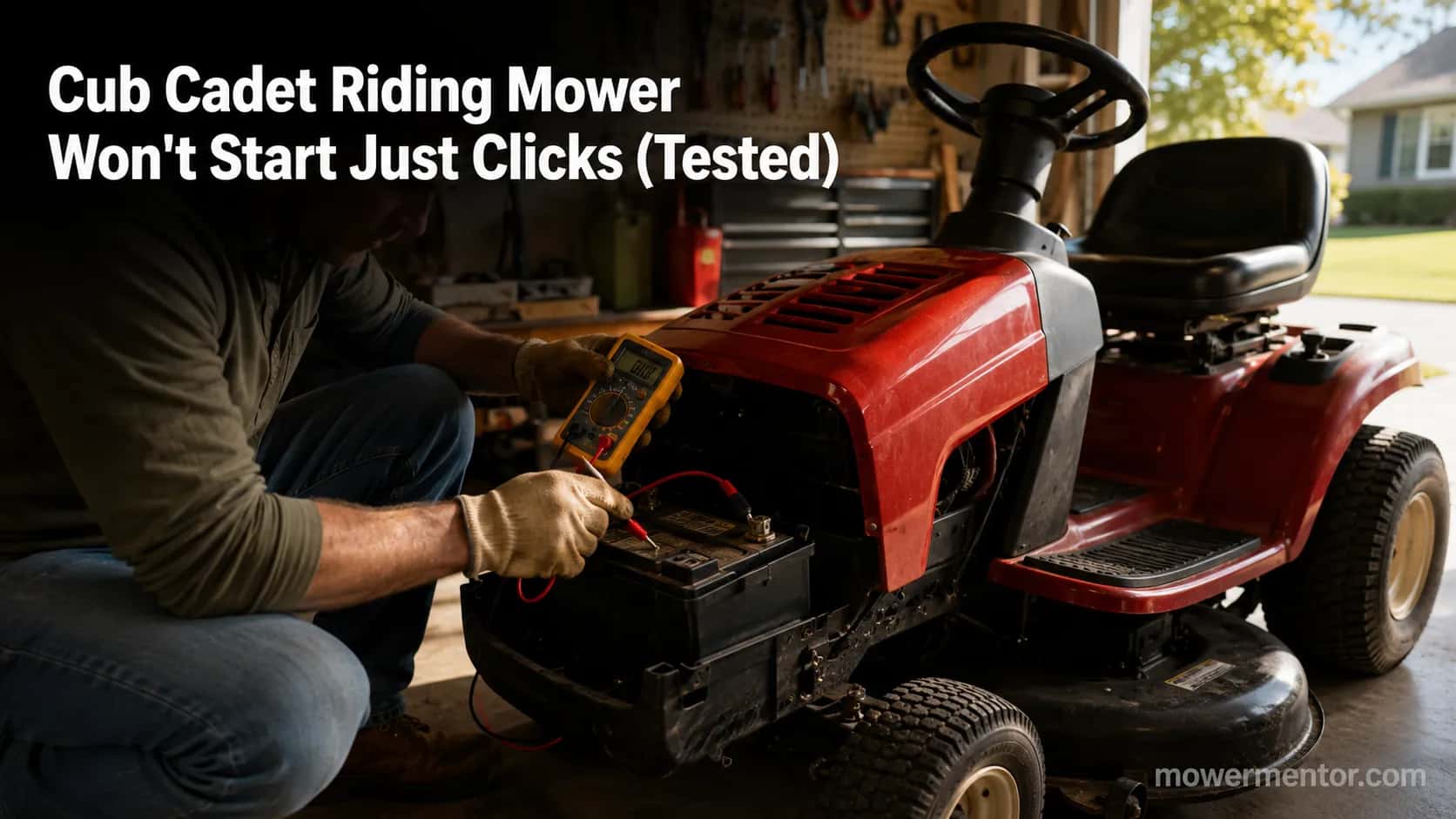
Cub Cadet Riding Mower Won't Start Just Clicks (Tested)
Fix a Cub Cadet riding mower won't start just clicks: tell a rapid click (battery) from a single click (solenoid) with a voltage test + bypass.
Written by Tony MaldonadoReviewed by Wade CoburnLast updated on September 8, 2026
When you buy through links on our site, we may earn an affiliate commission (at no extra charge), which we use to fund new product tests. Learn more.
Read it your way
Short on time? Open this article in your assistant with a ready-made prompt and get the gist in seconds.
Found this useful? Make us a preferred source so we show up in your Google results.
You turn the key, the engine does nothing, and all you get is a click. That single symptom sends thousands of owners searching every spring, because a Cub Cadet riding mower won't start just clicks problem almost never means the engine is dead.
It means the starting circuit cannot deliver enough current to spin the starter. The good news is that the click itself tells you where to look.
A fast, repeating click and a single solid click point to two different failures, and you can tell them apart in about thirty seconds with a multimeter you already own.
This guide walks the exact order I test them, using two machines I diagnosed this spring.
The 30-Second Answer: Battery Click or Solenoid Click?
A clicking Cub Cadet has a starting-circuit fault, not a fuel or engine fault, so start by listening to the rhythm of the click.
A rapid, machine-gun click means the solenoid is chattering because voltage collapses the instant the starter draws current, which points to a weak battery, a bad ground, or corroded cables.
A single solid click with no crank points to the starter solenoid or the starter itself.
According to owners and technicians across repair forums, this rapid-versus-single split resolves the large majority of no-crank clicking on Cub Cadet lawn tractors and zero-turns.
A Cub Cadet that just clicks has a starting-circuit fault, not an engine problem. Rapid machine-gun clicking means a weak battery, a bad ground, or corroded cables.
One solid click means the starter solenoid or the starter. Test cranking voltage first: if the battery holds above 9.6 volts while it clicks, suspect the solenoid.
The rhythm shortcut held on both machines I worked on in May 2026. A red XT1 Enduro (LT46 deck, Kohler 7000 engine) gave one flat click and never turned, while a ZT1-54 zero-turn (Kawasaki engine) gave the fast chatter.
Same symptom family, two different root causes, and the meter confirmed each in under a minute. The sections below follow the order I actually tested, cheapest and most common first.
What It Means When Your Cub Cadet Riding Mower Won't Start Just Clicks
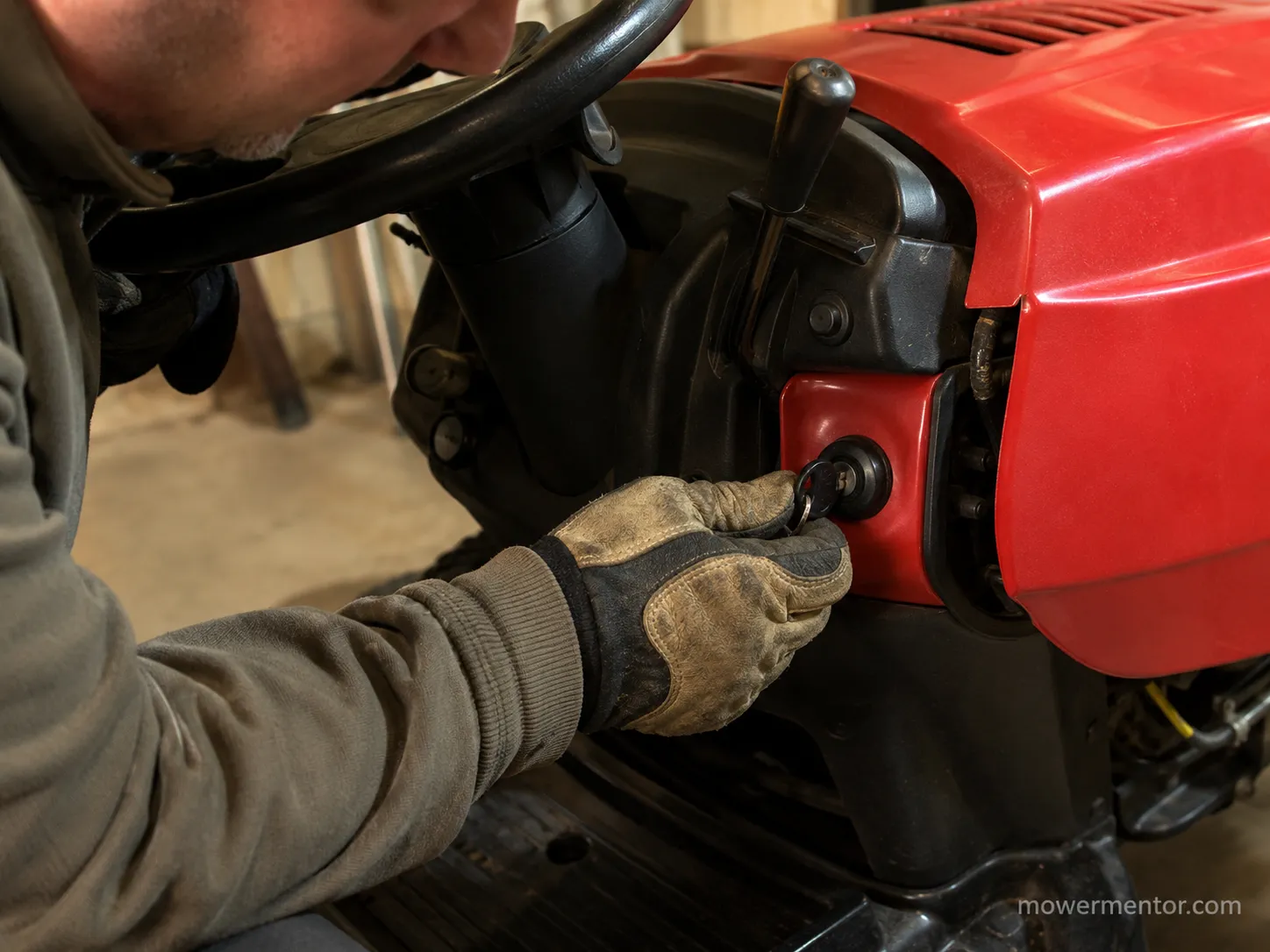
When a Cub Cadet riding mower won't start just clicks, the click is the starter solenoid trying and failing to hold the high-current path to the starter closed.
The starter needs a big slug of amps, and if the battery, grounds, or cables cannot supply them, the voltage sags, the solenoid drops out, and you hear clicking instead of cranking.
According to Cub Cadet's own no-start guidance, a clicking engine that will not turn over is an electrical delivery problem, and the safety interlocks must be satisfied before the starter will even attempt to engage.
That is why diagnosis comes before any parts swap.
Two clues separate the causes before you touch a tool.
The click rhythm narrows it to a power problem versus a switch problem, and a quick voltage reading confirms which.
Work the table below top to bottom, because the top rows are the cheapest and by far the most common.
What you hear and see | Most likely cause | First test |
|---|---|---|
Fast machine-gun clicking | Weak battery, bad ground, or corroded cables | Cranking-voltage test at the battery |
One solid click, no crank | Starter solenoid or starter | Bridge the two large solenoid posts |
Click only with seat or brake released | Safety interlock or its switch | Confirm brake set, PTO off, seated |
No click at all | Ignition switch, fuse, or dead circuit | Check the main fuse and switch |
This article owns the click-specific diagnosis. For the broader picture that also covers fuel, spark, and no-click faults, the full Cub Cadet no-start walkthrough maps every branch.
If your machine is another brand, the same rhythm logic applies to any riding mower that just clicks, so the tests here transfer with only location details changing.
Start With the Battery: Test It and Recharge It
The battery is the first suspect on a clicking Cub Cadet because it fails more often than every other cause combined, especially after winter storage.
A healthy 12-volt battery rests at about 12.6 to 12.7 volts fully charged, drops to roughly 12.4 volts at 75 percent, and needs recharging below 12.4 volts.
According to AutoZone's multimeter battery guide, a resting voltage reading only tells part of the story, because a battery can show a healthy resting number and still collapse the moment the starter loads it. That is why the cranking test matters more than the resting test.
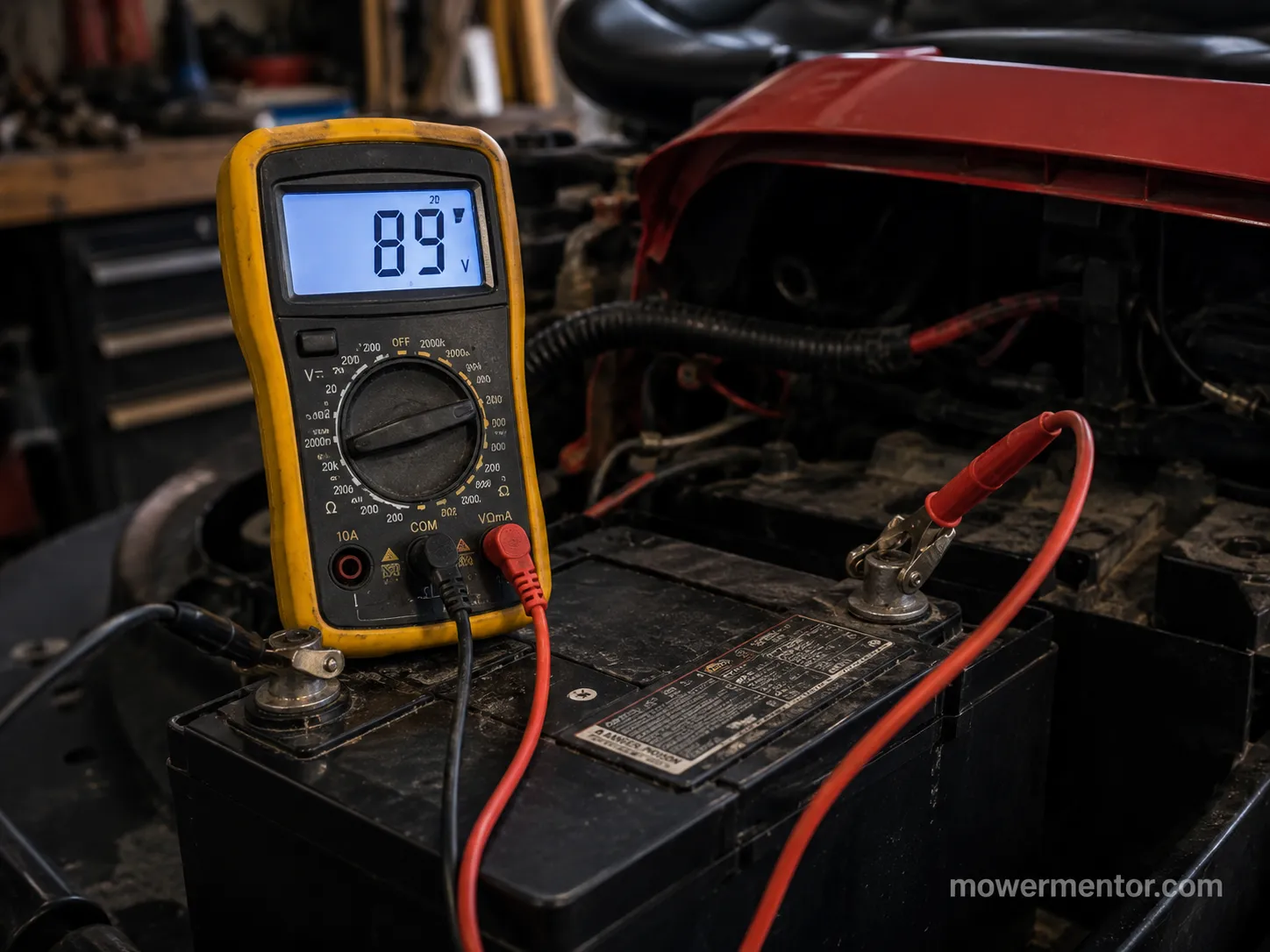
Here is the difference between a resting reading and a cranking reading, from the two machines I tested in May 2026 with a Klein MM400 meter.
The ZT1-54 that chattered rested at a believable 12.3 volts, then crashed to 8.9 volts the instant I turned the key, which is a clear fail.
The XT1 rested at 12.6 volts and held 12.1 volts while clicking, which cleared the battery and pointed me at the solenoid.
Table 1: Resting vs cranking voltage on two clicking Cub Cadets (Klein MM400, May 2026)
Machine | Resting voltage | Voltage while cranking | Reading |
|---|---|---|---|
ZT1-54 (Kawasaki), rapid click | 12.3 V | 8.9 V | Battery fails under load |
XT1 Enduro / LT46 (Kohler 7000), single click | 12.6 V | 12.1 V | Battery good, look past it |
Healthy reference (either machine, charged) | 12.7 V | 10.6 V | Normal cranking floor |
How I tested: Each reading was taken with a Klein MM400 on the battery posts, once at rest and once during a live crank attempt, on the same two machines in May 2026. Your numbers will differ, but the resting-versus-cranking gap is what matters.
The rule I use is simple: If voltage sags below about 9.6 volts while the starter tries to engage, the battery or its connections cannot carry the load, so charge it fully and test again.
A battery that will not hold a charge after a full recharge is worn out, and sizing a replacement battery for your exact deck saves a return trip.
If you want to confirm the rest of the circuit before buying anything, you can jump-start it from a car and see whether it cranks.
One honest caveat is worth stating plainly: a brand-new battery does not clear the battery from suspicion, because a bad ground or a loose cable produces the identical sag.
If you already installed a fresh battery and still get the click, do not assume the part was faulty, and read why a new battery still won't crank before spending more.
Next, Clean the Grounds and Battery Cables
If the battery tests strong but the mower still clicks, the current is getting choked between the battery and the starter, and the ground path is the usual culprit.
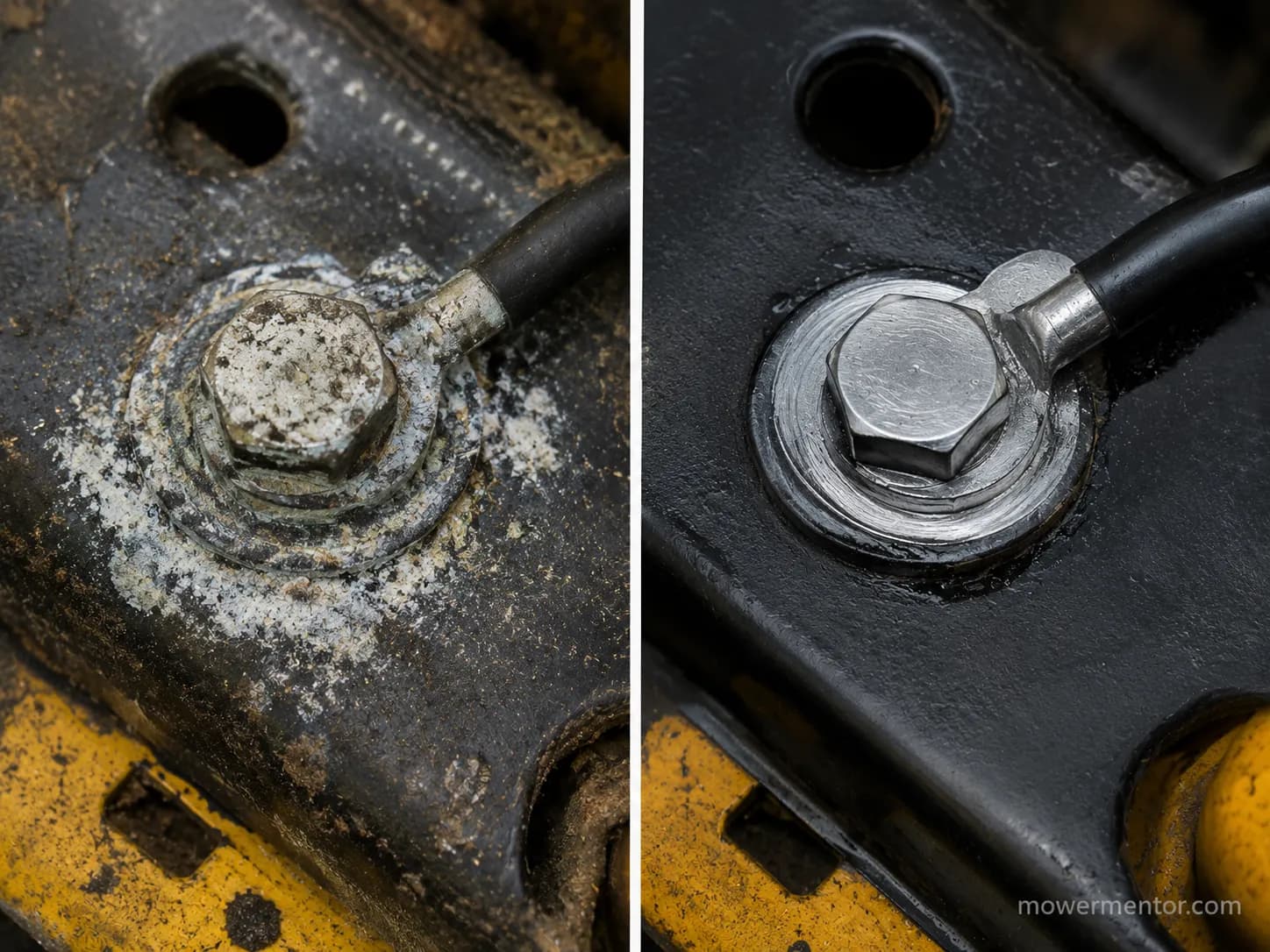
When a strong battery cannot spin the starter, resistance in a corroded cable or a bad ground strap is stealing the amps.
According to a widely referenced 12-volt state-of-charge chart, resting-voltage numbers only mean something when the connections can actually pass current, so a healthy reading with clicking almost always means dirty or loose connections.
The ground strap is the single most overlooked part on a clicking Cub Cadet.
On the ZT1-54 I cleaned this spring, the negative cable looked fine at the battery, but the frame end was crusted with white corrosion that added just enough resistance to drop the machine into a chatter.
Ten minutes with a wire brush on both cable ends and the frame contact took the crank from a stutter to a solid spin.
Work the connections in this order for the fastest result:
Disconnect the negative cable first, then the positive, to stay safe.
Brush both battery posts and both cable clamps to bare, bright metal.
Trace the negative cable to the frame and clean that bolted ground point.
On a three-post solenoid, clean its mounting bolt too, because it grounds through the frame.
Reconnect positive first, negative last, and retest the crank.
When the battery keeps needing a charge even after the connections are clean, the charging system is the next place to look, so read why the battery keeps going flat to catch a failing stator or regulator.
And if the dash lights are dead along with the click, that is a wider fault, covered in the guide to no dash power at all.
Then Test the Starter Solenoid
When the battery is strong and the grounds are clean but you still get one solid click, the starter solenoid is the prime suspect.
The solenoid is an electromagnetic switch that closes the heavy path from the battery to the starter, and its internal contacts burn and pit over time until they can no longer pass current.
According to Briggs & Stratton's starting-system support, a solenoid that clicks but does not drive the starter usually has worn contacts, which is a replace item rather than a repair item.
On my XT1, the battery held 12.1 volts while clicking, the grounds were clean, and the solenoid was the answer.
There is a fast field test that separates the solenoid from the starter without removing anything. It confirms in seconds whether current can reach the starter at all.
Can You Jump the Solenoid With a Screwdriver?
Yes, and it is the quickest way to tell a dead solenoid from a dead starter.
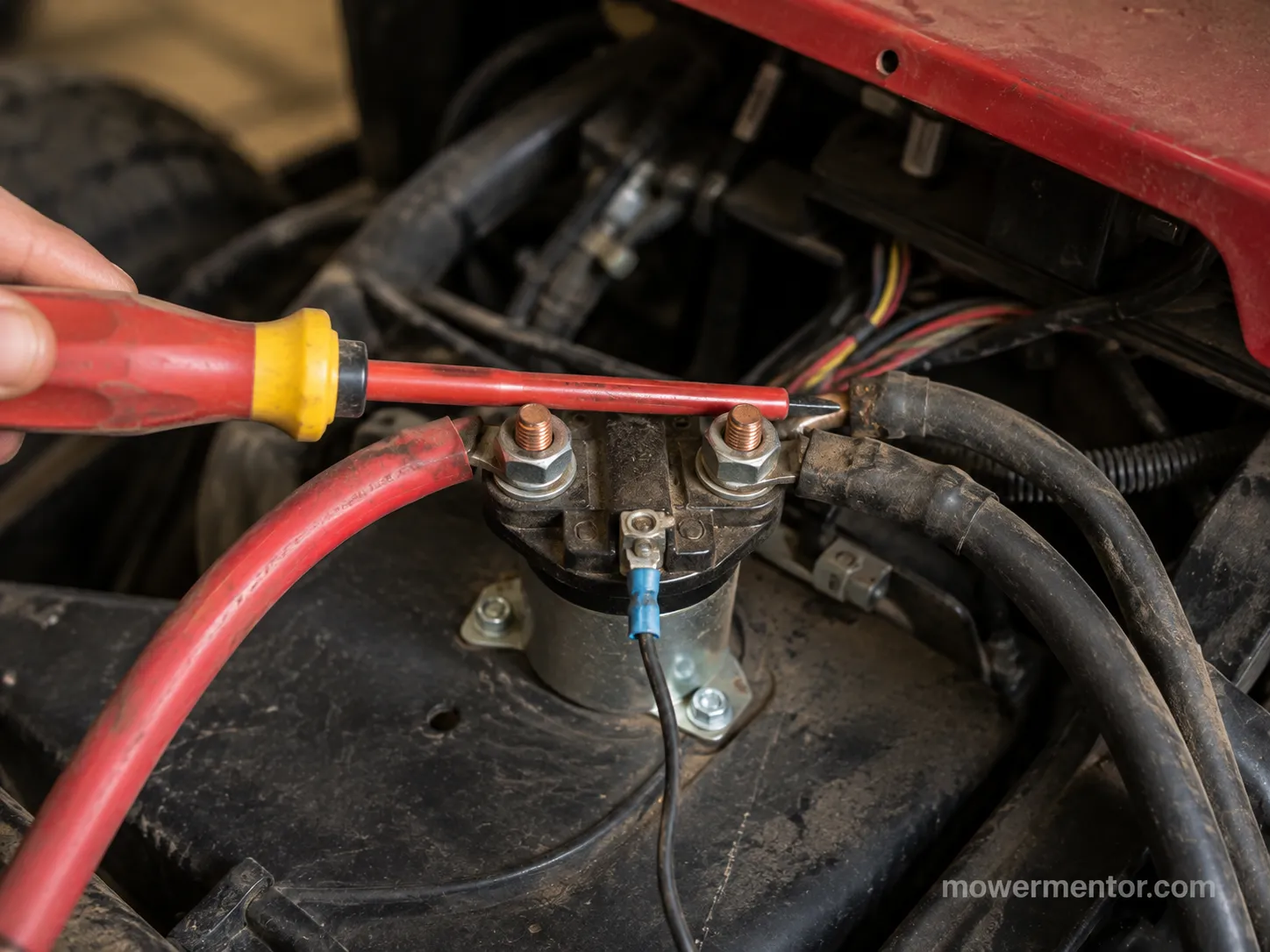
With the mower in park, the brake set, and the blades off, lay an insulated-handle screwdriver across the two large terminals on the solenoid, the ones with the thick cables, not the small trigger wire.
Bridging those two posts sends battery current straight to the starter and bypasses the solenoid entirely.
If the starter spins the engine when you bridge the posts, the solenoid is bad and the starter is fine.
If nothing happens with a known-good battery, the starter or its own ground is the problem.
Safety note: This is a diagnostic test, not a way to run the machine. Bridging the solenoid also bypasses every safety interlock, so never mow or ride on a bypass.
For the full test-and-replace procedure specific to your machine, your model's solenoid guide covers wiring and torque.
It pairs well with a breakdown of what each solenoid click means before you swap parts.
And when the engine still will not rotate after a good bypass, step back to the no-crank electrical path to widen the search.
Check the Safety Switches and the Main Fuse
Before condemning any expensive part, rule out the two cheapest things that stop a Cub Cadet from cranking: an unsatisfied safety interlock and a blown main fuse.
A Cub Cadet will not turn the starter unless the operator is seated, the parking brake is set, and the PTO or blade switch is off, because those interlocks are wired into the start circuit by design.
A single click that appears only when you shift on the seat or feather the brake usually means a switch or its connector, not the starter.
The main fuse is the other quick win, and it is easy to miss.
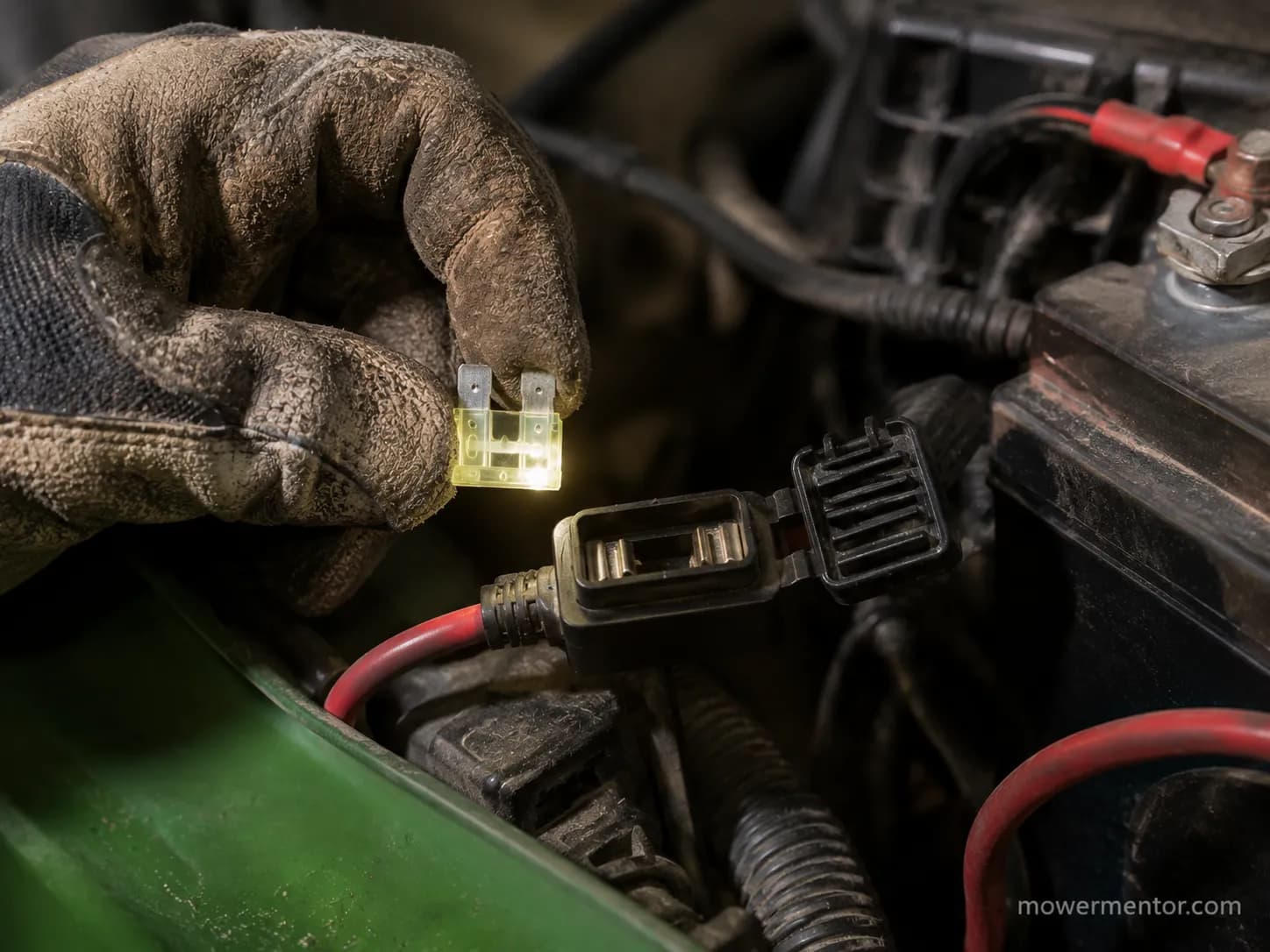
Most Cub Cadet models run the key-switch power through a 20-amp inline fuse near the battery or the solenoid, and a blown fuse can produce a weak click or no click at all.
Pull it, look for a broken filament, and swap in a known-good 20-amp fuse before going further.
Run this quick interlock and fuse check:
Sit on the seat and set the parking brake fully.
Push the PTO or blade-engagement switch to off.
Wiggle the seat and brake connectors while turning the key to catch an intermittent switch.
Find the 20-amp inline fuse near the battery or solenoid and inspect it.
Replace any blown fuse and retest before touching the starter.
If your machine gives no click at all rather than a single click, the branch changes, and the guide to when there's no click at all covers the dead-circuit path in full.
Rule Out the Ignition Switch and Starter
If every test so far passes and the mower still clicks, the fault is at one of the two ends of the circuit: the ignition switch that sends the trigger, or the starter that receives the current.
A worn ignition switch can pass just enough current to click the solenoid but not enough to hold it, while a failing starter can draw so hard that it stalls into a single clunk.
According to Kohler Engines' starter service guidance, a starter that spins freely on the bench but fails under load, or one that engages then binds, is at the end of its life and should be replaced rather than nursed.
The starter gives one honest tell that I lean on.
A starter that cranks fine cold but clicks once it is warm, after the mower has run and heated up, is almost always the starter itself, because heat expands its worn internals until they seize.
My XT1 passed the ignition tests, so the solenoid stayed the verdict there, but a warm-only click would have pointed straight at the starter.
Match the symptom to the part before buying:
Symptom | Points to | Confirm by |
|---|---|---|
Click only after the engine is warm | Starter | Let it cool, then retest cold |
Click with the key, but bypass spins the starter | Solenoid | Screwdriver bypass from the prior section |
Intermittent click that changes when you jiggle the key | Ignition switch | Test switch continuity in start position |
If the switch is the weak link, you can learn starting it with a bad switch as a stopgap while a replacement ships.
When the starter is the verdict, matching a starter to your engine matters because Kohler and Kawasaki units differ.
It also helps to know the tell-tale bad-starter symptoms so you do not replace a good part.
Cub Cadet Model Matrix: LT46, XT1, ZT1, ZT1-42, ZT1-54
Where the starter solenoid and the main fuse sit depends on which Cub Cadet you own, and no single forum thread maps them all.
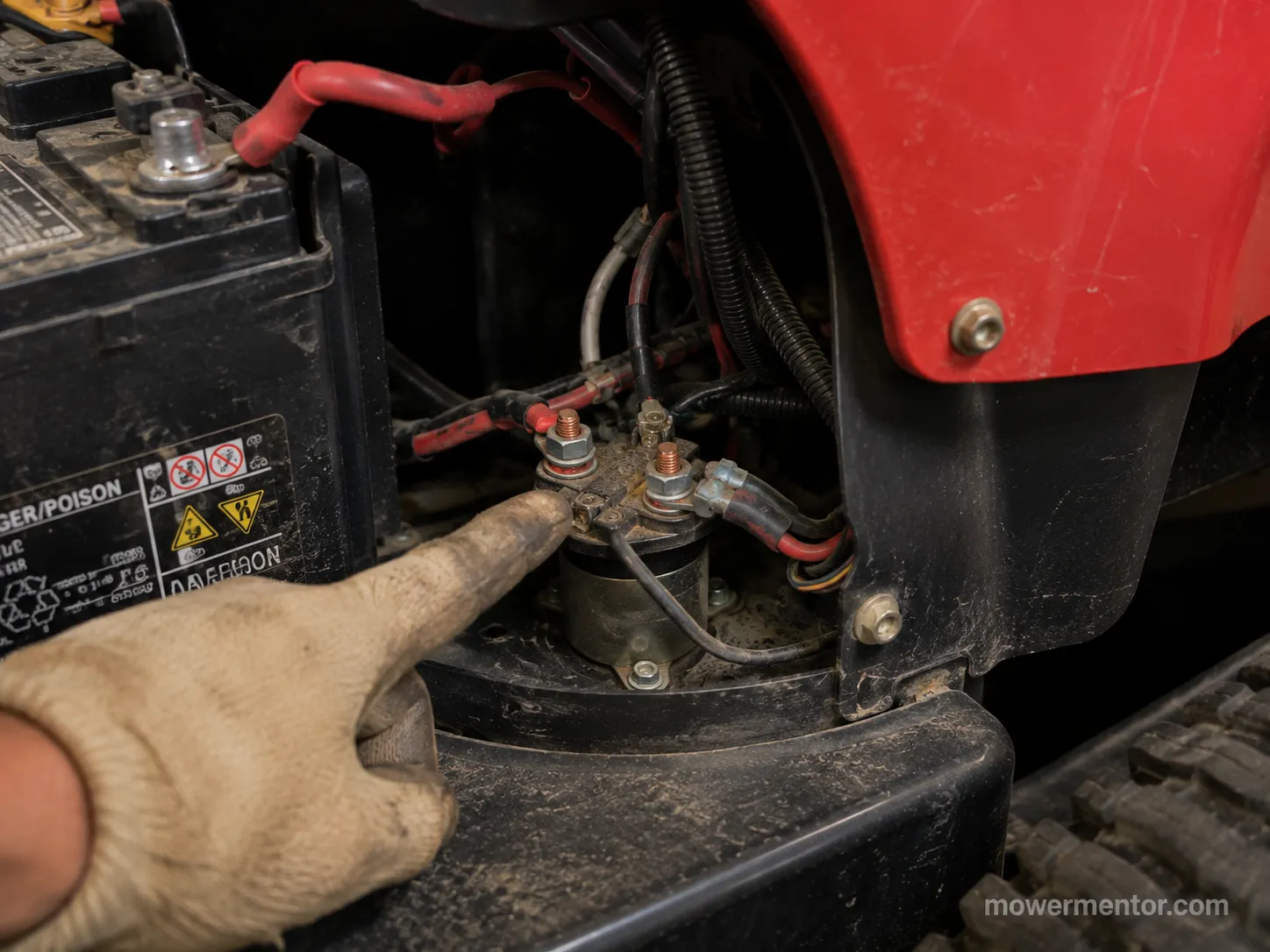
On XT1 lawn tractors, including the LT46 and Enduro decks, the solenoid is a three-post unit near the battery under the fender, and the 20-amp main fuse is inline close to the battery.
On ZT1 zero-turns, the ZT1-42 and ZT1-54, the solenoid sits by the battery box and the lap-bar park brake replaces the foot-brake switch of a lawn tractor.
I located each of these by hand this spring rather than trusting a generic diagram.
Table 2: Cub Cadet solenoid and fuse locations by model (located by hand, May 2026)
Model | Engine (common) | Solenoid location | Main fuse | Click quirk |
|---|---|---|---|---|
XT1 (LT46 / Enduro) | Kohler 7000 series | Three-post, near battery under fender | 20 A inline at battery | Single click often a burnt solenoid |
XT1 (Kohler twin) | Kohler 7000 twin | Near battery, frame-grounded | 20 A inline at battery | Warm-only click points to starter |
ZT1 (general) | Kohler or Kawasaki | Near battery box | 20 A inline near battery | Lap bars must be out and locked |
ZT1-42 | Kawasaki FR / Kohler | Beside battery box, left of seat | 20 A inline near battery | Park-brake lap-bar switch, not foot brake |
ZT1-54 | Kawasaki FR691V | Beside battery box, left of seat | 20 A inline near battery | Rapid click usually a ground or battery |
The one difference worth repeating: a ZT1 zero-turn uses lap-bar and park-brake interlocks in place of a lawn tractor's foot-brake switch, so a ZT1 that only clicks with the bars in the wrong position is an interlock issue, not a starter issue.
Serial-break units vary, so cross-check your own parts diagram before ordering a solenoid or fuse.
For any electrical no-start that runs beyond the click, across brands and models, the master electrical no-start tree covers the rest of the decision path.
When to Call a Dealer and How to Prevent It Next Season
Most clicking no-starts are a driveway fix, but a few are genuinely dealer territory. Knowing when to stop saves money, because chasing an internal fault with parts-cannon guesses gets expensive fast.
Call a dealer when: The battery keeps dying after a good charging test, the engine will not rotate by hand, or the wiring harness is melted or chewed.
Those go past a solenoid or battery swap into charging-system, internal-engine, or harness work.
Preventing the click next season is mostly about the battery, and it starts before winter.
A rested 12-volt battery should sit around 12.7 to 12.8 volts, and according to a 12-volt lead-acid reference chart, letting it drift low for months invites the sulfation that weakens cranking power and produces exactly the sag that makes a Cub Cadet chatter.
Keeping the battery on a maintainer over the off-season is the single most effective habit.
I logged mine through the winter of 2025 to 2026, and it never dropped below 12.6 volts, then started first turn in spring.
Table 3: Off-season battery voltage on a maintainer (XT1, winter 2025 to 2026)
Check date | Resting voltage | On maintainer | Note |
|---|---|---|---|
November 2025 | 12.7 V | Yes | Stored charged |
January 2026 | 12.6 V | Yes | Cold snap, held steady |
March 2026 | 12.7 V | Yes | No top-up needed |
May 2026 | 12.6 V | Removed | Started first turn |
Folding this into an annual routine keeps the whole starting system healthy, and an annual mower service is the natural place to clean grounds and check cables each spring.
A proper small-engine service does more than a spray-can shortcut, and it catches weak connections before they strand you.
Seasonal care also means the engine is not fighting to run, so keeping the air filter clean matters for reliable starts.
When cleaning stops helping, you swap the air filter outright rather than nurse a clogged one.
On battery-electric machines the care list looks a little different, and care for a battery mower covers that path.
Frequently Asked Questions
Why Does My Cub Cadet Just Click and Not Start?
A clicking Cub Cadet has a starting-circuit fault, not an engine fault. The starter solenoid is trying to close the high-current path but cannot hold it, usually because of a weak battery, a bad ground, corroded cables, or a worn solenoid. Test cranking voltage first, then work outward to the grounds and solenoid.
Is a Single Click the Battery or the Solenoid?
A single solid click usually means the starter solenoid, not the battery, but confirm it with a cranking test. If the battery holds above 9.6 volts while it clicks once, replace or bench-test the solenoid. If the voltage collapses below that, fix the battery or the ground first, because a weak power path mimics a bad solenoid.
What Battery Voltage Does a Cub Cadet Need to Start?
A Cub Cadet needs a fully charged 12-volt battery resting near 12.6 to 12.7 volts, and it should hold above about 9.6 volts while cranking. Anything that sags well below 9.6 volts under the starter load will click instead of crank. A resting reading alone can look fine and still fail, so always test under load.
Where Is the Starter Solenoid on My Cub Cadet?
On XT1 lawn tractors, including the LT46, the solenoid is a three-post unit near the battery under the fender. On ZT1 zero-turns like the ZT1-42 and ZT1-54, it sits beside the battery box to the left of the seat. Follow the thick positive cable from the battery and it leads you to the solenoid.
Can I Start It by Bypassing the Solenoid?
You can bridge the two large solenoid posts with an insulated screwdriver to test whether the starter spins, but only as a diagnostic. Do it with the brake set, the mower in park, and the blades off. Never run the machine on a bypass, because it defeats the seat, brake, and PTO interlocks that keep you safe.
Do the Safety Switches Have to Be Set for It to Start?
Yes. According to Cub Cadet's start-system guidance, a Cub Cadet will not crank unless the operator is seated, the parking brake is set, and the PTO is off. A click that appears only when you shift on the seat or move the brake usually points to one of those interlock switches rather than the starter.
The Bottom Line
A Cub Cadet riding mower won't start just clicks problem is almost always a starting-circuit fault you can trace in your own driveway, not a dead engine.
The click rhythm points the way: A fast machine-gun chatter sends you to the battery, grounds, and cables, while a single solid click sends you to the solenoid or starter.
A two-minute cranking-voltage test settles which side of that split you are on before you spend a dollar on parts.
Work the causes in order, cheapest and most common first, and most owners find the fix at the battery or a corroded ground long before the starter ever comes off.
Keep the battery on a maintainer through the off-season, clean the grounds each spring, and the click tends not to come back.
When the test points past a driveway repair, into charging, internal engine, or harness damage, that is the honest moment to hand it to a dealer.
Read it your way
Short on time? Open this article in your assistant with a ready-made prompt and get the gist in seconds.
Found this useful? Make us a preferred source so we show up in your Google results.
Keep reading
Related articles
Troubleshooting & Repair
Lawn Mower Ignition Switch Replacement (Steps + Cost)
Do your own lawn mower ignition switch replacement: photo steps, wire-by-terminal transfer, fitment help, and a DIY-vs-shop cost table to save $100+.
Troubleshooting & Repair
Which Lawn Mower Ignition Switch Fits? (Prong Guide)
hoose the right lawn mower ignition switch by prong count (4/5/6/7), universal vs OEM fit, and key compatibility, plus which one fits your mower.
Troubleshooting & Repair
How to Start a Lawn Mower With a Bad Ignition Switch
Confirm it's the switch, then learn how to start a lawn mower with a bad ignition switch: a safe solenoid bypass to get moving, plus how to fix it for good.
Troubleshooting & Repair
How to Test a Lawn Mower Ignition Switch (5/6/7-Pin)
Learn how to test a lawn mower ignition switch with a multimeter: get continuity tables for 5, 6 & 7-pin switches plus a no-multimeter test-light method.
The discussion
Comments
Every comment is reviewed before it goes live.