
Lawn Mower Starter Solenoid: Tested 3-Pole vs 4-Pole Picks
Find the right lawn mower starter solenoid: what it does, 3-pole vs 4-pole ID, where it's located, and which OEM or universal part to buy.
Written by Tony MaldonadoReviewed by Wade CoburnLast updated on September 24, 2026
When you buy parts or tools through links on our site, we may earn a commission at no extra cost to you. It never changes what we recommend. Learn more.
You turn the key, hear a click, and the engine does nothing.
Before you buy anything, know this: a lawn mower starter solenoid is a cheap, easy part to replace, and the only hard step is buying the correct one for your wiring.
Most "bad solenoid" replacements get returned because the buyer matched the shape of the part instead of the wiring.
Match your pole count, your ground type, and your OEM number first, and a $12 to $50 part fixes the no-crank on the first try.
A lawn mower starter solenoid is a heavy-duty relay that sends full battery current to the starter motor when you turn the key.
If your mower only clicks or does nothing, confirm the battery first, then identify your solenoid by post count (3-post or 4-post) and ground type before buying.
A correct replacement costs roughly $12 to $50.
The 60-Second Answer (Before You Buy Anything)
A lawn mower starter solenoid is the electrical switch between your battery and your starter motor, and a failed one is the most common reason a riding mower clicks but will not crank.
The single most important move before buying is to rule out the battery, because a weak battery mimics a bad solenoid almost perfectly.
Confirm the battery reads at least 12.4 volts at rest and passes a load test. Voltage alone can look fine and still collapse under the load of cranking.
If the battery is good and the mower still clicks or does nothing, you are likely looking at the solenoid or its trigger circuit.
From there, the job is identification: count the posts, check how the unit grounds, and buy the matching part rather than the closest look-alike.
This is the starter solenoid, not the carburetor fuel shut-off solenoid, which is a separate part on the engine. Everything below covers the starter side only.
What a Lawn Mower Starter Solenoid Is and What It Does
A lawn mower starter solenoid is a heavy-duty relay that lets a tiny switch current control the huge current a starter motor needs.
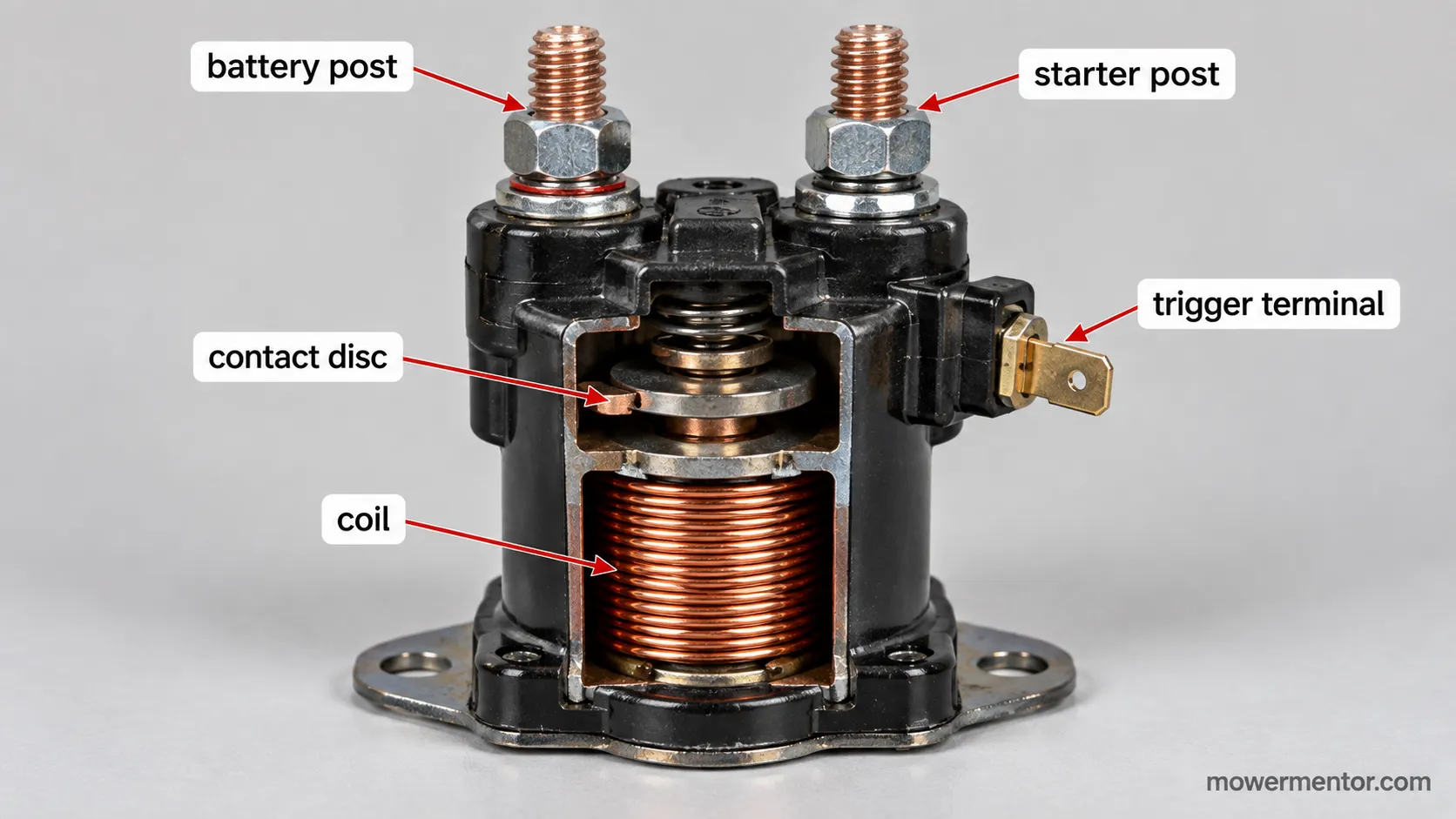
When you turn the key, a small trigger current from the ignition, routed through the safety switches, energizes the solenoid coil and snaps a set of internal contacts closed, sending full battery power to the starter.
According to Trombetta's solenoid spec, these units use two large current studs plus a coil trigger.
They are rated for intermittent starter duty, not constant use.
That intermittent-duty design matters more than most buyers realize.
A starter solenoid is built to close for a few seconds at a time, and running the wrong continuous-duty relay in its place cooks the coil.
Inside the housing sit two large terminals and a movable contact disc. One large post connects to the battery, the other feeds the starter, and the small terminal is the trigger, often called the small lug.
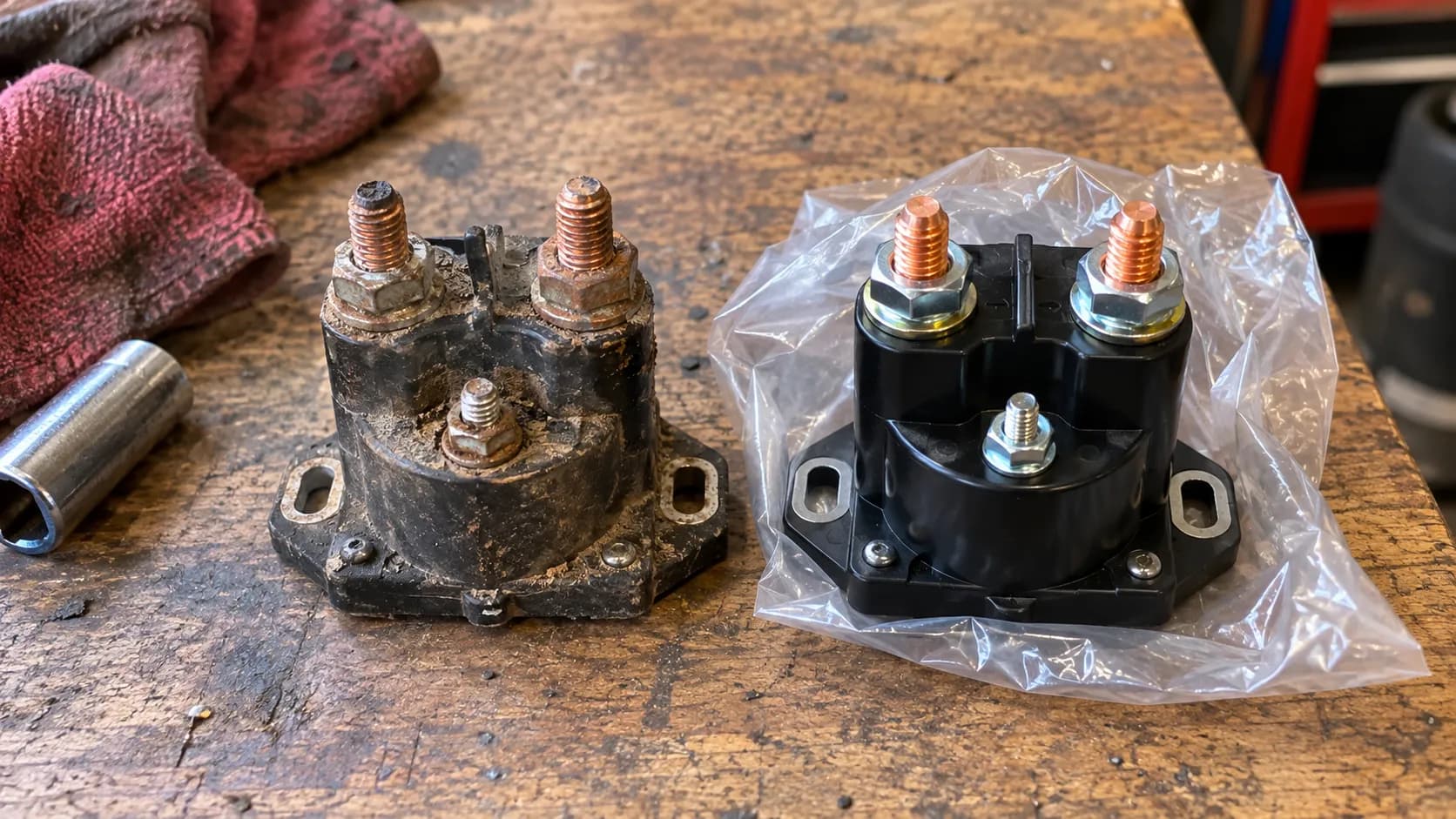
Over time those internal contacts pit and burn from arcing.
A pitted contact is exactly why a solenoid can click yet fail to pass enough current to spin the starter.
The parts-catalog duty rating on these mower solenoids confirms the intermittent-duty spec and, on many units, an internal diode.
The practical takeaway for you is simple: a solenoid is a wear part, and a burned contact disc is a normal end-of-life failure, not something you did wrong.
If you want to see exactly how the terminals are wired on 3-pole and 4-pole units, we map every terminal in a dedicated guide.
And that click you keep hearing has a specific meaning we break down in what the clicking actually means.
3-Pole vs 4-Pole vs Universal: How to Tell Which One Is Yours
The difference between a 3-pole and a 4-pole lawn mower starter solenoid comes down to how it grounds, and getting it wrong is the number one cause of wrong-part returns.
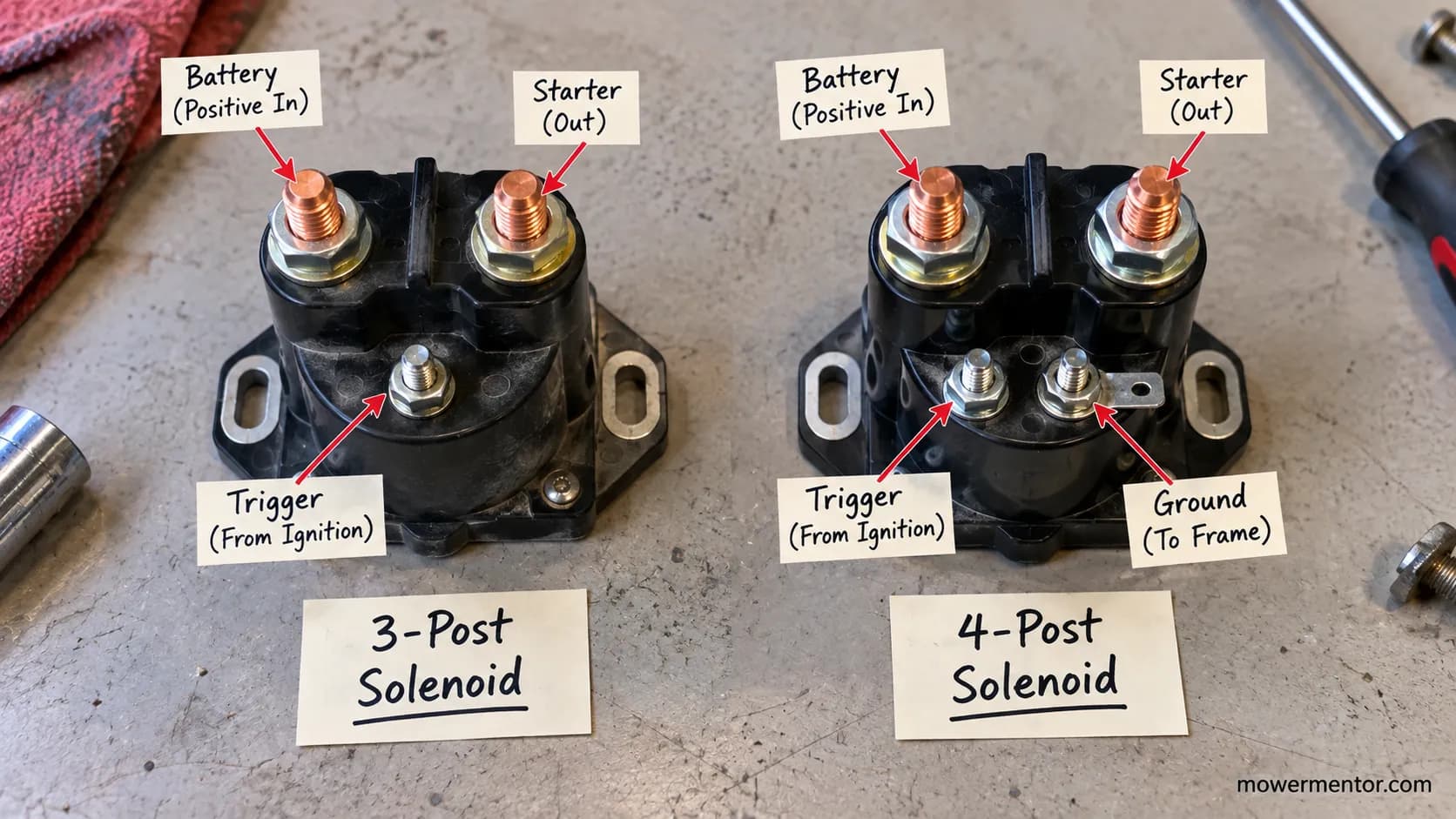
A 3-post unit has two large posts plus one small trigger terminal, and it grounds internally through its metal case and mounting bracket.
A 4-post unit adds a second small terminal for a dedicated ground wire, so it does not depend on the bracket.
As etrailer's terminal explainer notes, a 4-post solenoid can stand in for a 3-post one if you run that extra small terminal to a clean chassis ground.
Owners on My Tractor Forum put it plainly: to drop a 4-pole into a 3-pole spot, ground one of the small lugs and wire the ignition trigger to the other.
The reverse swap loses your external ground path, so it is the one to avoid.
Here is the fast way to identify yours before you buy.
Configuration | Posts | Ground path | Common on | Use it if |
|---|---|---|---|---|
3-pole (3-post) | 2 large, 1 small | Through the metal case and mounting bracket | Many Briggs, Kohler, and older AYP builds | Your original grounds through the bracket and has one small terminal |
4-pole (4-post) | 2 large, 2 small | Dedicated ground wire on the second small terminal | John Deere, Cub Cadet, many MTD builds | Your original has two small terminals or an insulated base |
Universal | 2 large, 1 or 2 small | Either, depending on model bought | Cross-brand aftermarket replacements | You match pole count, ground type, and duty rating to your original |
The visible tell for ground type is the base.
A grounded-case solenoid needs clean metal-to-metal contact at the bracket, while an insulated-base unit relies on that dedicated ground wire and will not work if you skip it.
One more buyer detail: most quality replacement posts accept both 5/16-inch and 1/4-inch cable ends, so terminal fit is rarely the problem.
The wiring match is.
A universal solenoid that looks right can still be wrong if the ground type or duty rating differs from your original.
That mismatch is the quiet reason a brand-new part still leaves you with a no-crank.
If your machine is a Deere, it helps to check John Deere's terminal layout against your unit.
Cub Cadet owners can compare Cub Cadet's XT1 setup, a common 4-pole example.
Where the Starter Solenoid Is Located on a Riding Mower
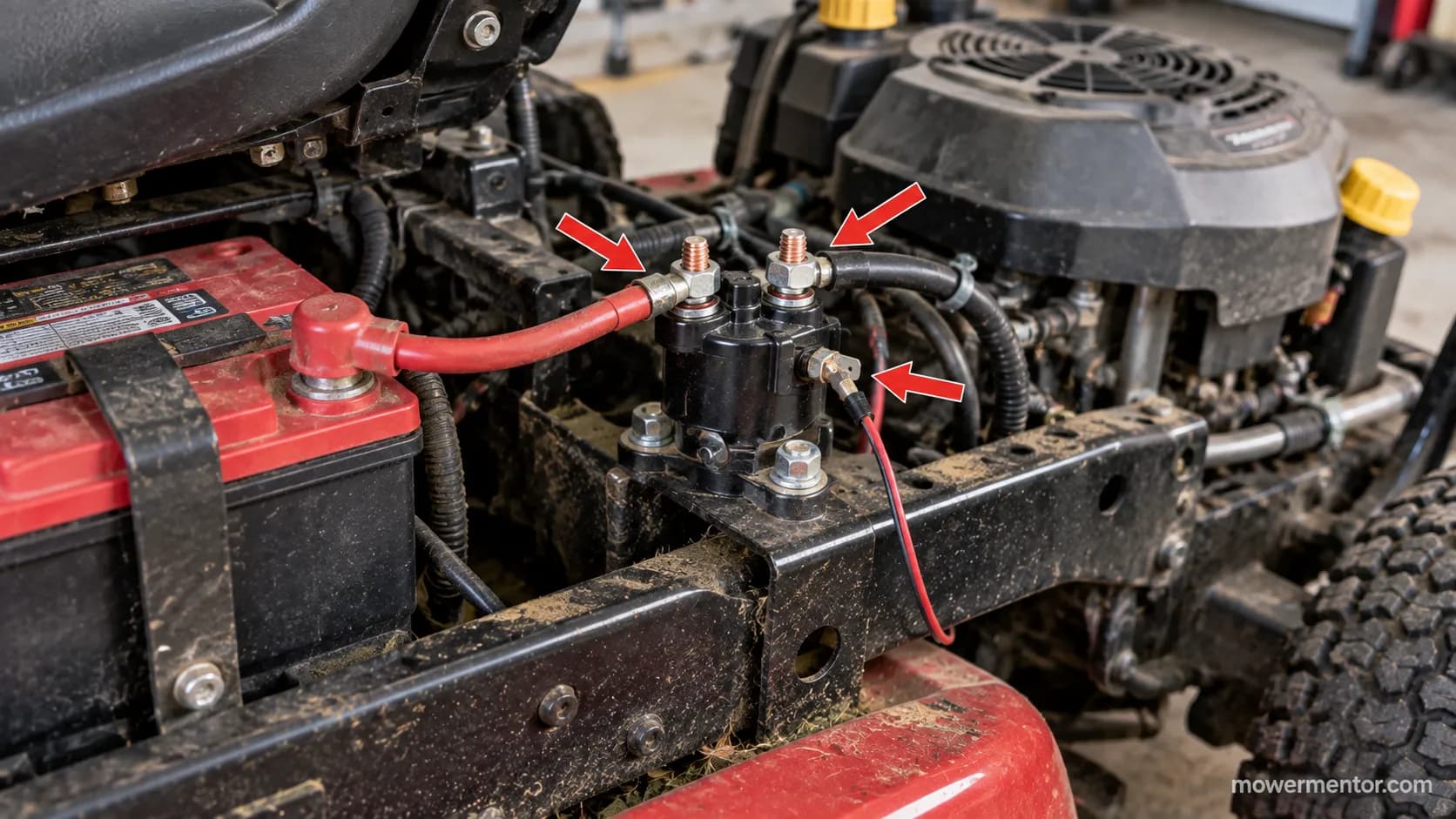
On most riding mowers, the starter solenoid sits within a foot of the battery, and the fastest way to find it is to follow the thick positive battery cable to the first part it lands on.
That first component, a small black block with two large posts, is almost always the solenoid.
It typically mounts in one of a few spots: under the seat near the battery box, on a fender frame rail, or on the firewall close to the starter.
The logic is simple. The solenoid handles high current, so manufacturers keep the run between battery, solenoid, and starter as short as possible.
Common mounting spots by layout:
Under the seat or beside the battery box on many Craftsman and AYP-built tractors
On a frame rail or fender bracket on many Husqvarna and Cub Cadet models
Near the starter on the engine side on some John Deere and MTD builds
Before you probe anything, disconnect the negative battery cable. Those large posts carry full battery current, and a slipped wrench across them can weld itself to the frame in an instant.
Layouts differ a little by brand. The solenoid often sits by the battery box on a Craftsman rider, while the Husqvarna layout tends to tuck it near the frame.
If locating the part still does not lead you to the fault, our full no-start decision tree routes every branch of the starting circuit.
Is It Really the Solenoid? Bad-Solenoid Signs and the 60-Second Confirm
A bad lawn mower starter solenoid usually announces itself with a single click, rapid clicking, or dead silence when you turn the key, but a weak battery produces the same symptoms.
That overlap is why iFixit's Craftsman thread shows owners chasing the wrong part for weeks.
The reliable move is to confirm the battery first, then run a 60-second bridge test to isolate the solenoid.
The common failure signs look like this:
One loud click, then nothing
Rapid machine-gun clicking
Total silence with a known-good battery
Intermittent starts that work warm and fail cold, or the reverse
Melted or discolored posts from arcing
Why It Just Clicks (or Won't Click at All)
That click is the coil pulling in while pitted contacts refuse to pass current, so the starter never gets its full amps. It can also be a battery too weak to close the contacts cleanly.
Start with the battery. Confirm it rests at 12.4 volts or higher and passes a load test, because TractorByNet owners will tell you a battery can read fine on a meter and still collapse the moment the starter pulls on it.
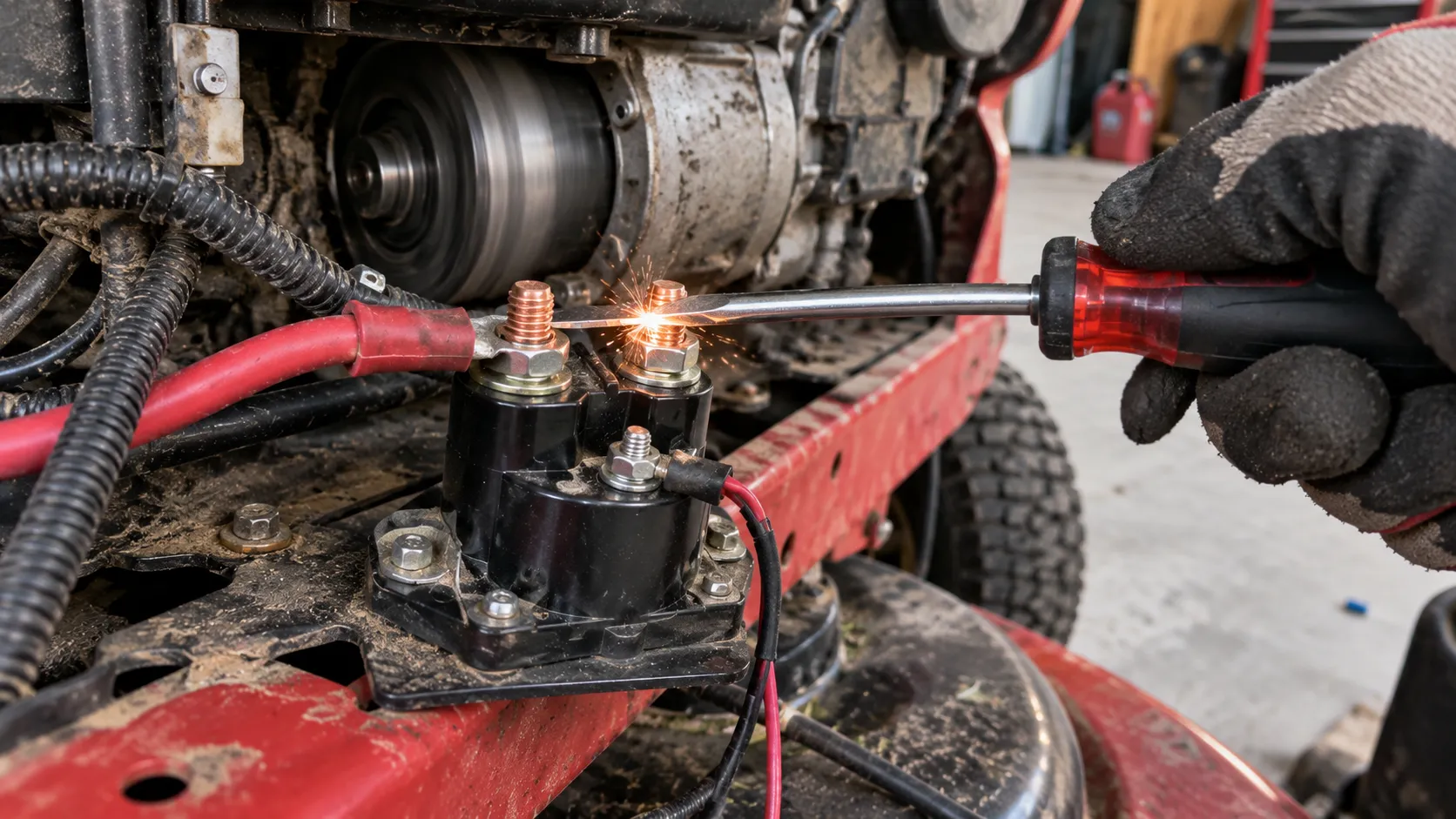
Then run the confirm. With the mower in park, the brake set, and the blades off, bridge the two large posts with an insulated-handle screwdriver.
If the starter spins, the solenoid or its trigger circuit is the fault, not the starter itself.
Safety note. Keep your hands clear of the blades and mower deck, expect a spark at the posts, and never straight-wire the machine to run.
This test only confirms the fault; it is not a way to drive the mower.
For the full multimeter and test-light method, we walk it end to end in how to test it step by step.
If you just need to start the mower right now, you can safely jump it with a screwdriver using the same posts.
And if bridging the solenoid does nothing at all, the next step is to check the starter motor itself.
Which Replacement to Buy: OEM vs Universal, With Cross-Reference and Price
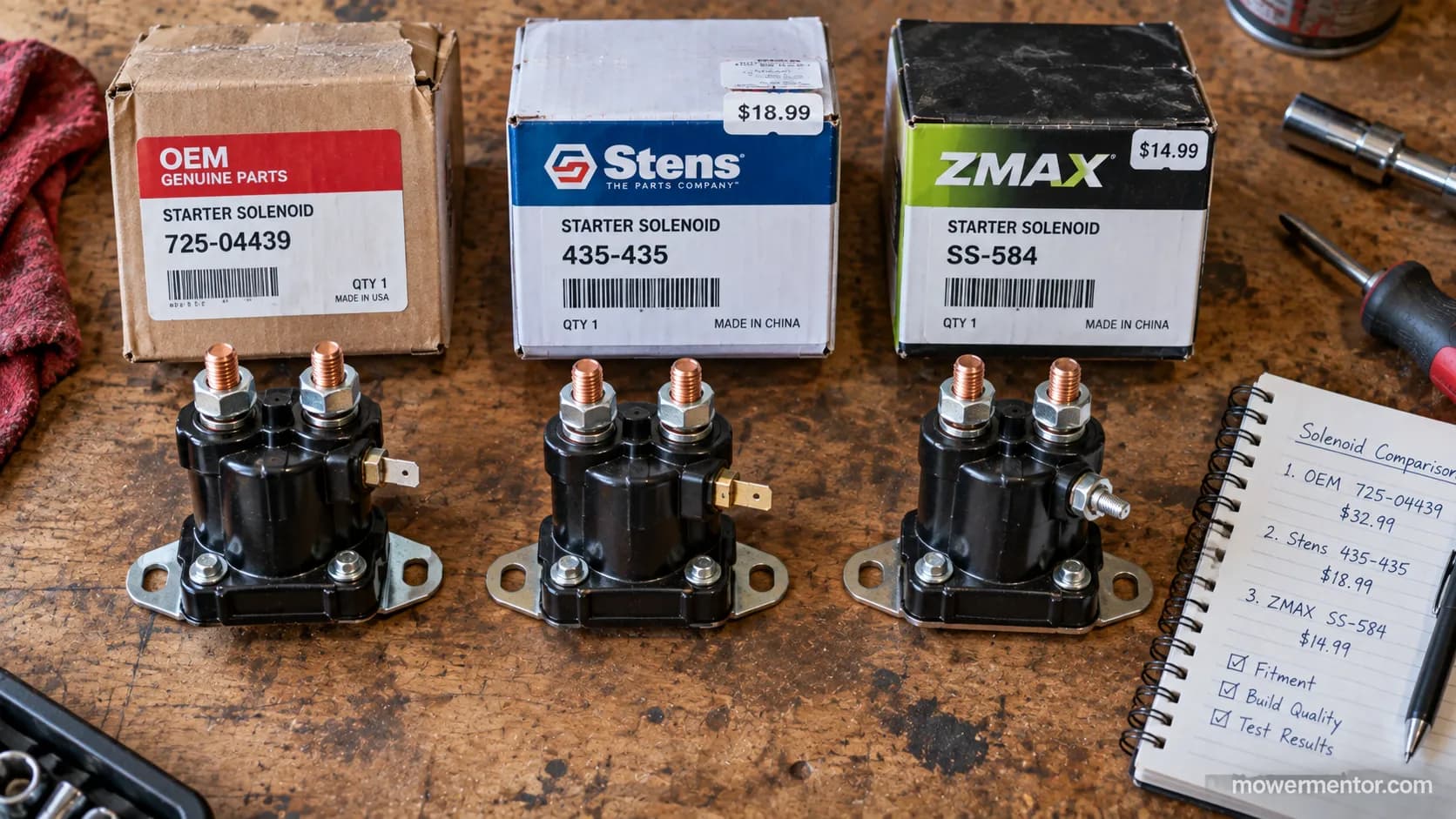
Once you have confirmed the fault and identified your configuration, choosing a lawn mower starter solenoid comes down to OEM versus a quality universal, and the price gap is real: budget universals run about $10 to $20, while OEM-grade and name-brand aftermarket units run roughly $25 to $50.
The one non-negotiable is matching pole count, ground type, and duty rating, because Elreg's duty-cycle breakdown makes clear that a continuous-duty relay and a starter solenoid are not interchangeable even when they look identical.
Use these selection criteria in order:
Match the post count and ground type to your original
Confirm it is starter, or intermittent, duty, not continuous duty
Check the terminal stud size accepts your cable ends
Prefer a known brand (Stens, DB Electrical, Trombetta, Rotary) for contact quality
Here is how the three buying paths compare.
Path | Typical price | Fitment certainty | The catch | Best for |
|---|---|---|---|---|
OEM part | $25 to $50 | Highest, exact match | Costs more, sometimes slower to source | Owners who want a guaranteed drop-in |
Quality universal (Stens, DB Electrical, Trombetta) | $15 to $30 | High, if you match specs | You must verify pole count and ground yourself | Most DIY owners replacing a common unit |
Budget universal | $10 to $20 | Moderate | Thinner contacts, shorter life, spec-match still required | Keeping a cheap spare on hand |
To buy a universal correctly, translate your OEM number using a common cross-reference.
Original brand and number | Common universal equivalents |
|---|---|
Husqvarna, AYP, Craftsman 532192507, 582042801, 192507 | Stens 435-700, DB Electrical, Rotary universal 3-post |
Ariens 21546294 | Stens 435-435 cross-reference |
Cub Cadet, MTD 725-06153A, 725-04439 | Trombetta 762-1261-211, universal 4-post |
John Deere AM138068, AM103290 | BlueStars 862-1211-211-16, Stens 435-151 |
The buying trap to avoid is grabbing a continuous-duty relay that looks the same. Owners on LawnSite recommend keeping a correct spare on hand, since these external solenoids are cheap and pit over time.
Two related purchases are worth a look while you are ordering.
If the starter itself is suspect, our guide to choosing a replacement starter covers fitment, and a tired starter is sometimes worth rebuilding versus replacing the starter.
Since you are already placing an order, it is a fair moment to think about seasonal parts.
Many owners pair a solenoid swap with matching a tune-up kit to the engine, and if you prefer to buy in person, here is where retailers stock mower parts.
Replacing It and What to Check If It Doesn't Fix the No-Crank
Swapping a lawn mower starter solenoid is a one-bolt job that most owners finish in under fifteen minutes, but a fresh part only cures the fault if the rest of the circuit is sound.
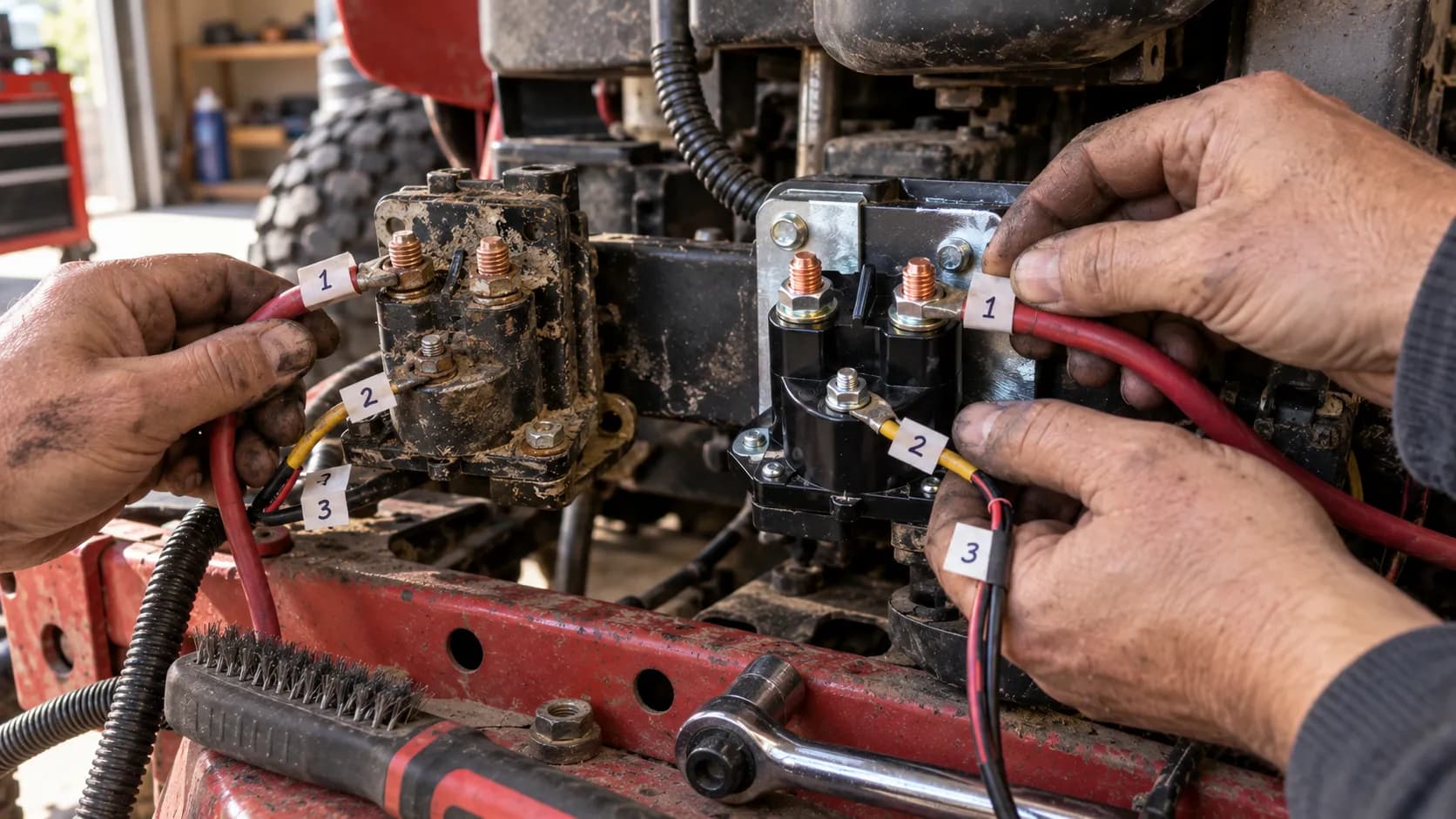
The routine is short: disconnect the negative cable, photograph and transfer the wires post for post, move the mounting clip or ground, then reconnect the negative last and test the crank.
The detail people skip is the ground, and a poor bracket contact will defeat a brand-new solenoid every time.
Clean metal-to-metal contact matters on a grounded-case unit, or the dedicated ground wire on an insulated-base unit. Wire-brush the bracket to bare metal before you bolt the new part down.
If a new solenoid clicks exactly like the old one, stop buying parts.
That pattern points to a bad ground, a corroded cable, or an open safety switch starving the trigger circuit, which one BobIsTheOilGuy diagnosis traced to a dirty connection rather than the solenoid at all.
For the full walkthrough with torque and cost, follow the full step-by-step swap.
If the fault turns out to be the starter, pulling the starter motor is a separate job worth its own guide.
Two more branches are worth knowing. If the engine cranks but will not catch, a careful shot of the right spray can help, so read up on when starter fluid helps before you reach for the can.
While you are already in the electrical bay, a broader service pays off.
A full seasonal tune-up keeps the starting system healthy, and if you run a cordless machine, remember that battery mowers need different care.
One last ordering note while parts are on your mind. It is a fair time to compare filter options, so here is our take on foam versus paper filters for the same machine.
Frequently Asked Questions
Are 3-pole and 4-pole starter solenoids interchangeable?
They are conditionally interchangeable. A 4-pole can replace a 3-pole if you run one small terminal to a clean chassis ground, and Lawn Mower Forum members note the reverse swap loses the external ground path, so match the original where you can.
Will a bad solenoid drain the battery?
Usually not. A normal failed solenoid simply will not crank, but a solenoid whose contacts stick closed can leave a circuit live and slowly pull the battery down, so a battery that keeps dying overnight is worth investigating separately.
How much does a lawn mower starter solenoid cost?
A replacement typically runs $10 to $20 for a budget universal and $25 to $50 for an OEM or name-brand aftermarket unit. Price tracks contact quality and fitment certainty more than brand alone.
Can you repair a starter solenoid instead of replacing it?
Sometimes the internal contacts can be cleaned, but it rarely lasts. Given how cheap the part is, replacement is the reliable fix, and keeping a spare on hand saves a second trip.
Can I use a car or continuous-duty solenoid on my mower?
Only if it is a starter, or intermittent, duty unit wired to match your original. A continuous-duty relay looks similar but runs hot and fails fast in a starting circuit, so it is not a safe substitute.
The most common wrong-part mistake I see is buying by shape. Owners match the silhouette of the old solenoid, skip the pole count and ground type, and end up returning a part that was never going to work.
The Bottom Line
A lawn mower starter solenoid is one of the cheapest and simplest fixes in the whole starting system, so the money and frustration almost always come from buying the wrong one.
Rule out the battery, count your posts, check how the unit grounds, and translate your OEM number before you order.
Do that, and a $12 to $50 part turns a dead click back into a first-turn crank. Get the identification right the first time, and you will not be back here returning a solenoid that never fit.
Found this useful? Make us a preferred source so we show up in your Google results.
Keep reading
Related articles
Troubleshooting & Repair
Dead Dash? Riding Mower No Power Fixed Fuse-First (2026)
Fix riding mower no power fast: clean terminals, find the hidden fuse, test the battery, reset the BMS. A fuse-first checklist for gas & electric mowers.
Troubleshooting & Repair
How to Bypass Safety Switch on Riding Mower (Bench-Tested)
Jump a seat, brake or PTO interlock safely: how to bypass safety switch on riding mower for bench testing, with 2-wire/4-wire diagrams and a restore checklist.
Troubleshooting & Repair
Riding Lawn Mower Won't Turn Over: 5-Stage Voltage Test
Fix it fast: a riding lawn mower won't turn over usually means battery, ground, solenoid or starter. Test each in 5 ordered stages.
Troubleshooting & Repair
Just Clicks? Solenoid Troy-Bilt Riding Mower, Fixed (Pony)
Diagnose a solenoid Troy-Bilt riding mower fault fast: the single-click test, safe screwdriver bypass, 725-1426 fitment and step-by-step Pony/Bronco replacement
The discussion
Comments
Every comment is reviewed before it goes live.