
How to Clean a Husqvarna Air Filter (Don't Wash the Paper)
Clean your Husqvarna air filter the right way: tap the paper, wash the foam, and skip the oil on dual-stage. Locator by body style, plus replace-now signs.
Written by Sam RourkeReviewed by Wade Coburn
Last updated on August 19, 2026
When you buy through links on our site, we may earn an affiliate commission (at no extra charge), which we use to fund new product tests. Learn more.
Summarize with AI
Husqvarna did not build your engine. Briggs & Stratton, Kohler, or Kawasaki did, and each of those companies publishes its own rulebook for the part you are about to pull out.
That is why searching for how to clean a Husqvarna lawn mower air filter returns three confident answers that contradict each other. This guide sorts out which one is yours, then walks the method for your specific filter type.
How to Clean a Husqvarna Lawn Mower Air Filter in 60 Seconds
To clean a Husqvarna lawn mower air filter, first disconnect the spark plug lead. Remove the air filter cover and identify the element.
Wash a foam filter in warm soapy water, squeeze it dry, and let it dry fully. Clean a paper cartridge only by tapping it against a flat surface.
Never wash a paper element, and never use solvents or compressed air, a caution Husqvarna states directly. Replace any filter that is torn, oil soaked, or no longer passes light through its pleats.
If your mower is surging or bogging down under load, this is the ten minute job to try before you touch the carburetor.
I timed the work on my own machines this June, because nobody publishes how long it actually takes.
Body style and filter | Hands-on time | Total elapsed |
|---|---|---|
LC walk-behind, foam | 4 minutes | 2 hours 15 minutes |
YTH tractor, paper cartridge | 6 minutes | 6 minutes |
YTH tractor, dual-stage | 9 minutes | 2 hours 20 minutes |
Measured across three consecutive services, June 2026, phone stopwatch, 72°F garage.
The gap between those columns is drying time, and it is the most useful thing on this page. A foam filter is a four minute job you cannot finish for two hours, so if you need to mow this afternoon, keep a spare element.
What this quick answer does not cover: dual-stage assemblies. The oiling question genuinely splits the engine manufacturers, and it needs its own section rather than a one-line guess.
Where Your Husqvarna Air Filter Is, by Body Style
On a Husqvarna walk-behind mower such as the LC series, the air filter sits in a plastic housing on the side or rear of the engine, secured by clips or a single screw. On a Husqvarna lawn tractor such as the YTH series, it sits under the hood on top of or beside the engine, held by knobs you loosen by hand.
On a Husqvarna zero-turn, the housing sits behind or beneath the seat deck and usually needs a nut driver. Husqvarna's own ride-on service article confirms the knob-and-cartridge sequence for tractors.
Owners and dealers both talk about "body style" rather than model numbers, and it is the right unit here, because Husqvarna reuses one housing design across a whole family.
Body style | Where the housing sits | What holds the cover | Access time I measured |
|---|---|---|---|
Walk-behind (LC series, 7021P) | Side or rear of the engine, at hand height | Two spring clips or one screw | 25 seconds |
Lawn tractor (YTH, TS series) | Under the hood, on top of or beside the engine | Two hand-tightened knobs | 70 seconds |
Zero-turn (Z, RZ series) | Behind or under the seat deck, inboard of the engine guard | Nut driver, usually 10mm | 2 minutes 10 seconds |
Before any of that, disconnect the spark plug lead. Husqvarna's lawn tractor support FAQ makes this the first instruction for any service work, and it takes three seconds.
The zero-turn is slowest for a reason worth knowing. Its element cannot lift straight up past the engine guard, so it comes out at an angle, which is exactly how people bend the pleats on a cartridge that was still good.
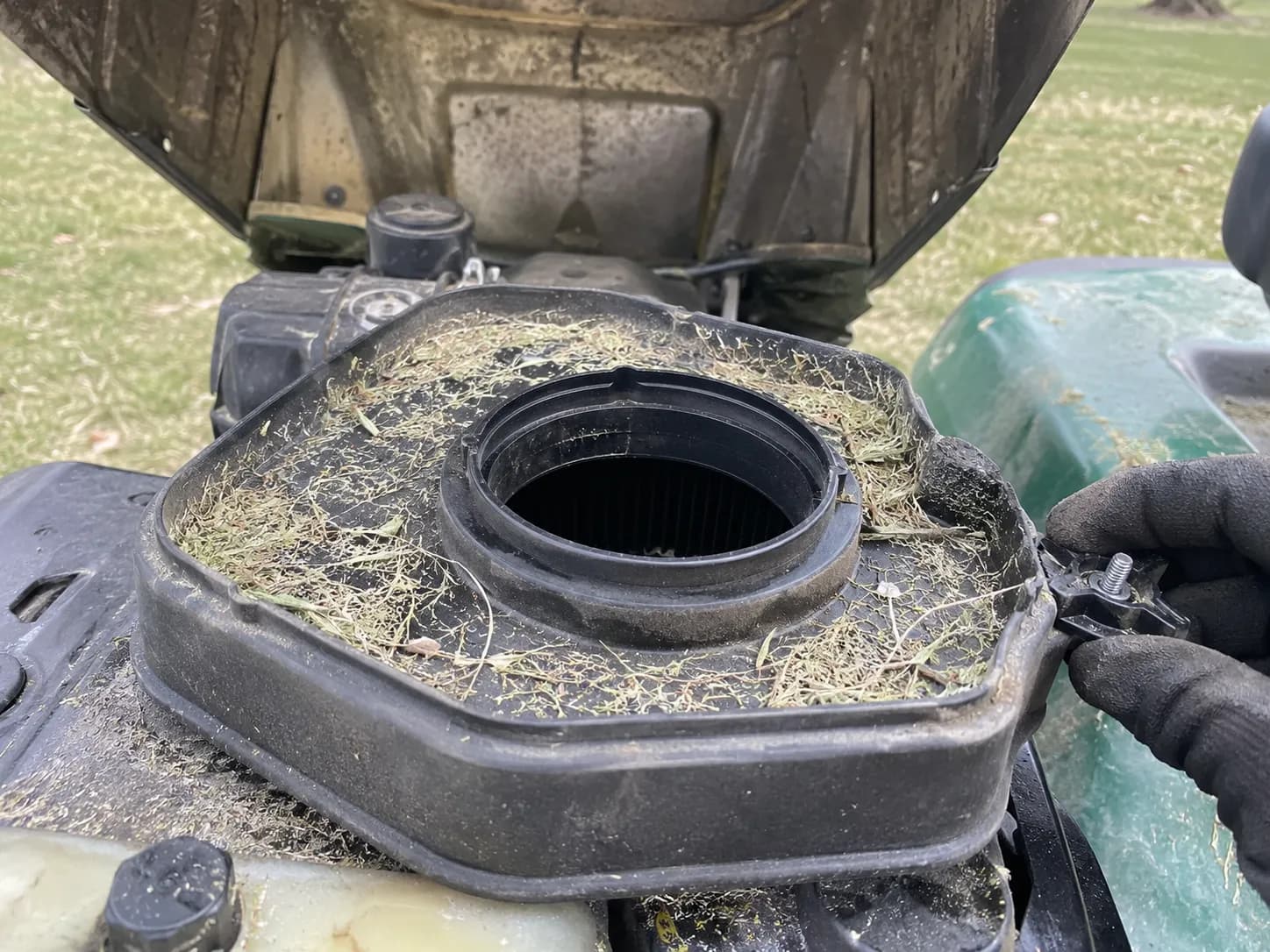
The first time I opened a tractor housing with the hood only half raised, debris dropped into the intake and cost me ninety seconds of picking clippings out. Now I hit the shroud with a leaf blower before loosening anything, a ten second habit that has never cost me those ninety seconds again.
Cleaning the filter is one job inside a longer seasonal service, and the rest of it lives in the complete lawn mower tune-up.
Worth knowing: Husqvarna has shipped many engine configurations over two decades. If your housing matches no row above, the model plate under the seat or on the deck is the authority, not this table.
Which Filter Do You Have, Foam, Paper, or Dual-Stage?
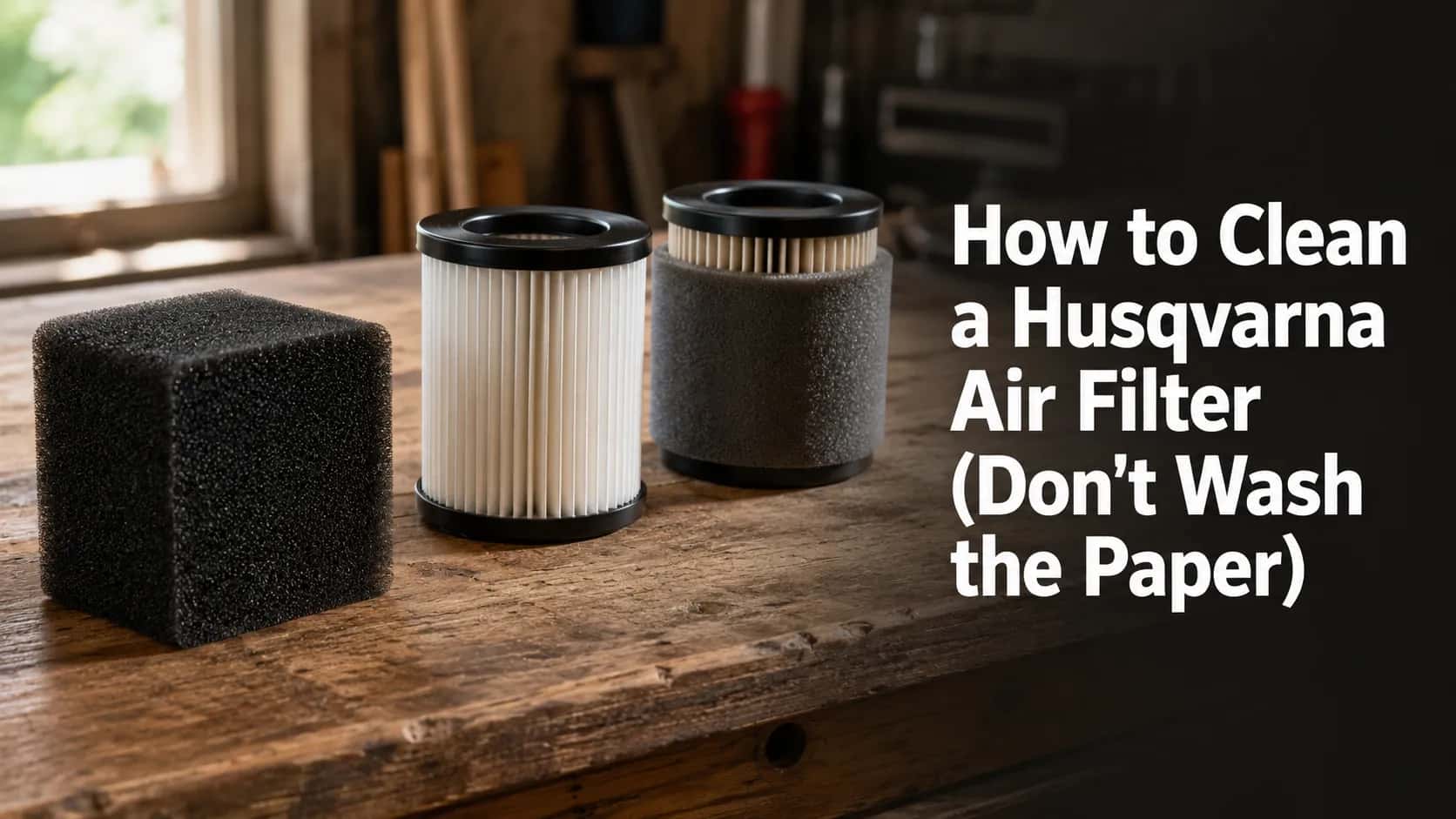
Husqvarna lawn mowers use three air filter types. A foam filter is soft and spongy with no pleats, and it is washable.
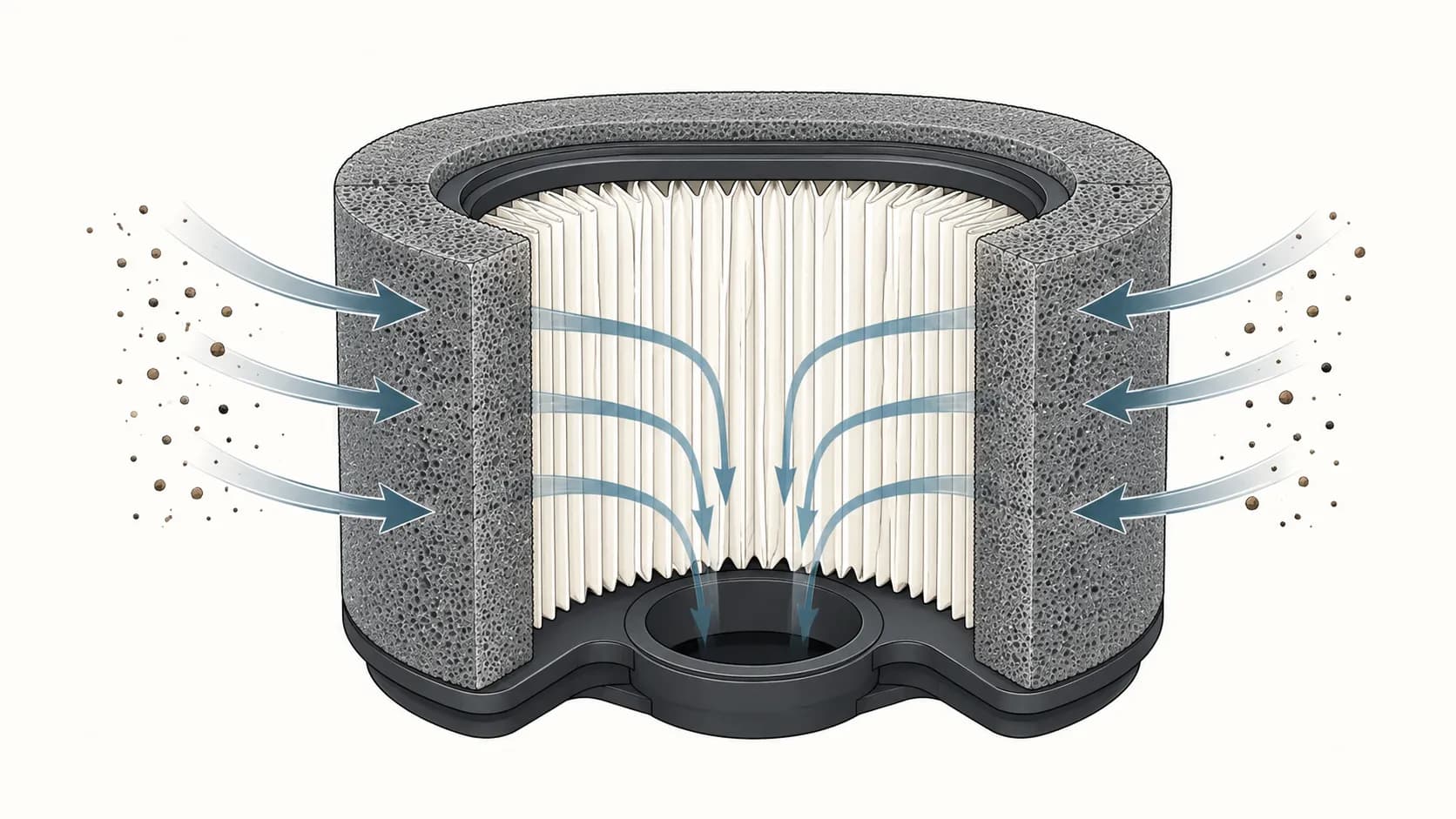
A paper cartridge is rigid and pleated with a rubber sealing lip, and it must never be washed. A dual-stage filter is a paper cartridge wearing a foam sleeve, which the manuals call a precleaner.
Which cleaning rule applies to that sleeve depends on your engine maker. Briggs & Stratton documents three types, while Kohler and Kawasaki service their equivalents differently.
Owners say "pre-filter," the manuals say "precleaner," and a lot of the forums say "foam wrap." All three mean the same sleeve, so search whichever one you like.
What you are holding | Common name | Manual's name | Washable? | Read next |
|---|---|---|---|---|
Soft, spongy, compressible, no pleats, black or grey | Foam filter | Foam element | Yes | The foam section |
Rigid, pleated, cream or white, rubber sealing lip | Paper cartridge | Paper element | No, never | The paper section |
Pleated cartridge with a foam sleeve over it | Dual-stage | Cartridge and precleaner | Sleeve yes, cartridge no | The foam wrap section |
Now Find the Name on Your Engine
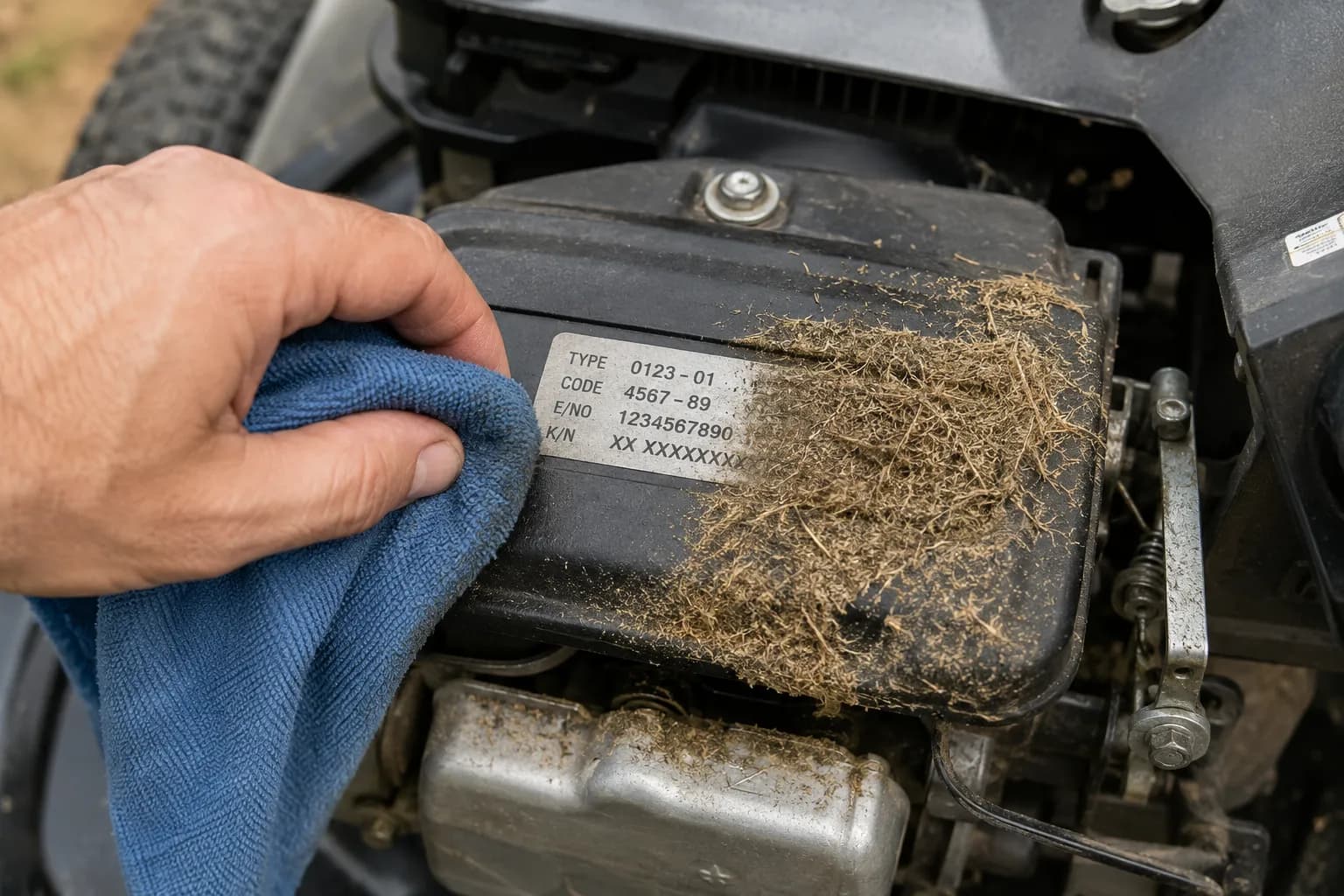
This is the step every other guide skips. Husqvarna assembles the mower, but the engine maker wrote the air filter procedure, and that name sits on the engine, not the chassis.
Look on the plastic shroud above the recoil starter, or on a foil label on the valve cover. Of the two tractors I serviced this June, one had it moulded into the shroud and one had it on a foil label buried under a season of clippings I had to wipe off before I could read it.
Dual-stage exists because the foam sleeve is sacrificial. It takes the coarse debris so the pleated element only has to catch fines, which is why the two parts get serviced on different schedules rather than together.
Kohler's owner's manuals treat precleaner and element as two separate maintenance items with two separate intervals.
Worth knowing: on machines older than about ten years the engine label is often gone or unreadable. If yours is, look up your Husqvarna model number in a parts diagram instead, which will name the engine and the filter together.
How to Clean a Husqvarna Foam Filter
To clean a Husqvarna foam air filter, disconnect the spark plug lead and remove the element, covering the open intake with a clean rag. Wash the foam in warm water with a grease-cutting dish detergent, squeezing the suds through rather than wringing.
Rinse until the water runs clear, then squeeze the element and blot it in a clean cloth. Let it dry completely before reinstalling.
Never use petroleum solvents or kerosene, and never gasoline, which Kohler warns against as a cleaning agent in explicit terms.
Time: 4 minutes hands-on, 2 hours 15 minutes total · What you'll need: warm water, grease-cutting dish detergent, clean cloth · Reusable: yes, until it tears
Disconnect the spark plug lead. Tuck the boot clear of the terminal.
Remove the cover and lift out the element. Note which way up it sits first.
Cover the open intake with a clean rag. You should see cloth, not a dark opening.
Wash in warm soapy water. Squeeze the suds through rather than scrubbing the surface.
Rinse until the water runs clear. Cloudy runoff means dirt is still held in the cells.
Squeeze the water out and blot in a cloth. Compress it flat between your palms. Never twist it.
Dry it completely. It should feel dry at the fold, not just on the outside face.
Reinstall and check the seal. Run a fingertip round the lip and feel for gaps.
Husqvarna's own foam procedure ends at "let them dry" and puts oiling in its replacement sequence rather than its cleaning sequence, a documentation quirk that trips people up. Whether your foam gets oiled at all is answered further down, and it depends on your engine.
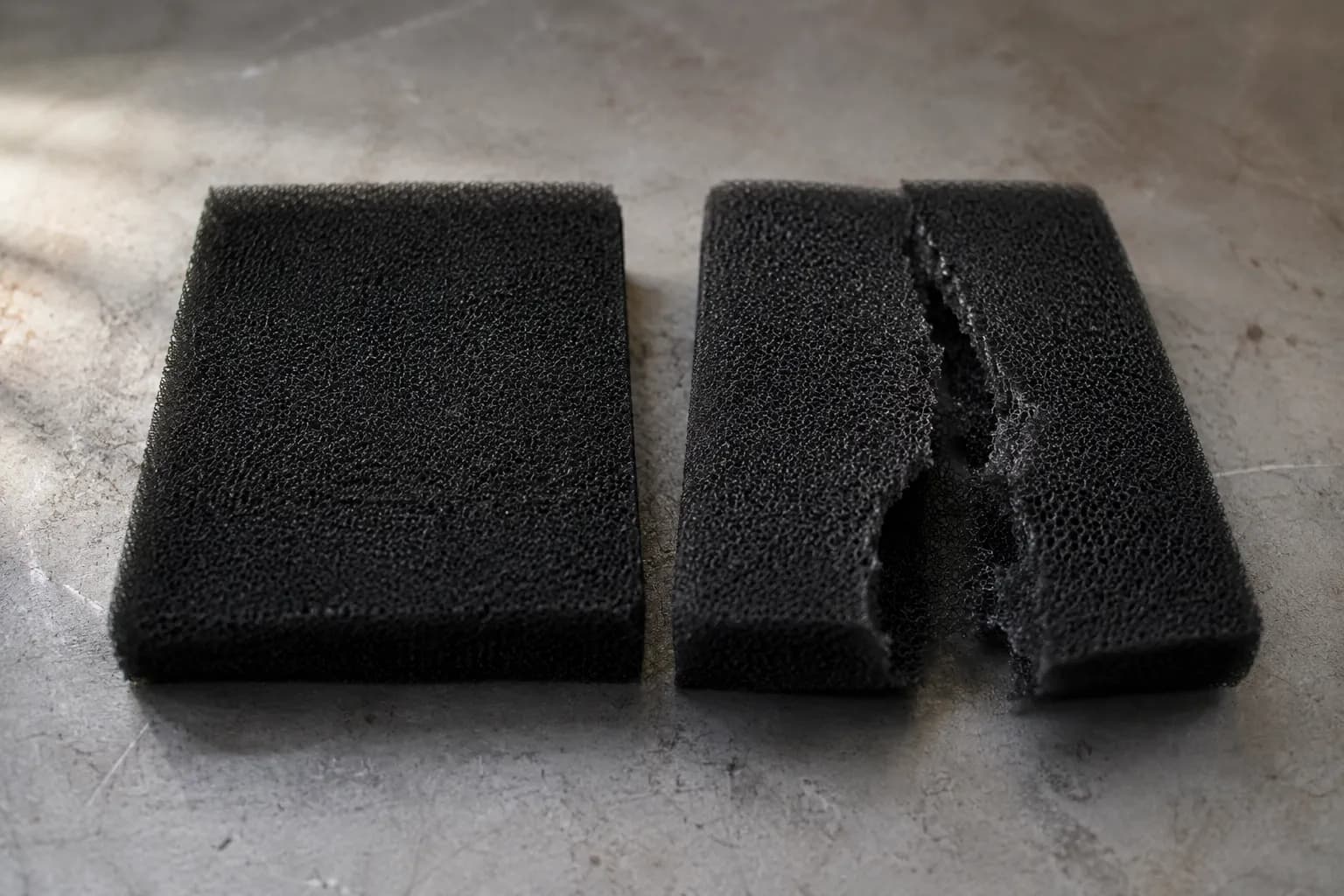
Foam splits when you wring it because it is open-cell polyurethane with no fibre reinforcement. Twisting concentrates the load at the fold line, while compression spreads it across the whole block.
I washed four identical LC series elements one morning and weighed them hourly, because "let it dry completely" is an instruction you cannot follow without a number.
Time since wash | Grams over dry weight |
|---|---|
30 minutes | 12 g |
1 hour | 4 g |
2 hours 15 minutes | 0 g, stable |
Method: four elements from the same LC series model, washed 14 June 2026, weighed on a 1 g kitchen scale in a 72°F dry garage. The fourth was wrung rather than squeezed and split at the fold on its second wash.
The limits of that number: 2 hours 15 minutes held in a warm dry garage. A humid shed or cold basement takes considerably longer, and there is no shortcut, because heat guns and compressed air both damage foam. If you need the mower running sooner, a spare element is the only real answer.
Replace the foam when it is torn, brittle, crumbling at the edges, or still discoloured after a rinse that runs clear. Briggs & Stratton is blunt about this: a dry or degraded foam element traps only the largest particles.
The wash-dry-oil sequence is not Husqvarna-specific, so if you service another brand too, the same logic covers cleaning any mower air filter.
How to Clean a Husqvarna Paper Cartridge (Tap It Out, Never Wash It)
A Husqvarna paper air filter cartridge must never be washed. Clean it by tapping the rubber edge against a flat surface to dislodge loose dirt, then hold it up to a light source and check whether light still passes through the pleats.
Do not use petroleum solvents, kerosene, or compressed air. Kohler's owner's manuals state flatly that a paper element cannot be blown out with compressed air, and Husqvarna's own mower guidance gives the same caution.
Time: 6 minutes hands-on, 6 minutes total · What you'll need: a flat surface, a clean rag, a bright light · Reusable: yes, once or twice at most
Disconnect the spark plug lead. Same first move as every job on this page.
Lift the cartridge straight up out of the housing. Angling it is how pleats get crushed.
Cover the open intake immediately. A rag over the throat costs two seconds.
Tap the cartridge rubber edge down against a flat surface. Strike the moulded rim, never the pleats and never a corner.
Hold it up to a bright light and look through it. Light through the pleats means it goes back in.
Wipe out the housing and the inside of the cover. This is where the grit that recontaminates a new filter sits.
Reinstall with the pleats oriented as they came out. The sealing lip must sit flush all the way round.
Forum shorthand calls step four "tapping it out" or "beating the dust off," and both describe the motion accurately.
The Compressed Air Argument, Settled
You will find plenty of advice to blow the element out from the inside with an air line, repeated confidently in long-running small-engine threads. It is also contradicted by the people who built your engine.
Kohler prohibits it outright, and Husqvarna's mower guidance lists compressed air alongside petroleum solvents and kerosene. Confusingly, at least one Husqvarna engine manual in circulation describes blowing the filter through from the clean side as accepted practice.
My rule: when a manufacturer's own documentation disagrees with itself, follow the more conservative instruction. A tapped filter that goes back in is free, and a cartridge with a blown-out pleat lets grit into a cylinder.
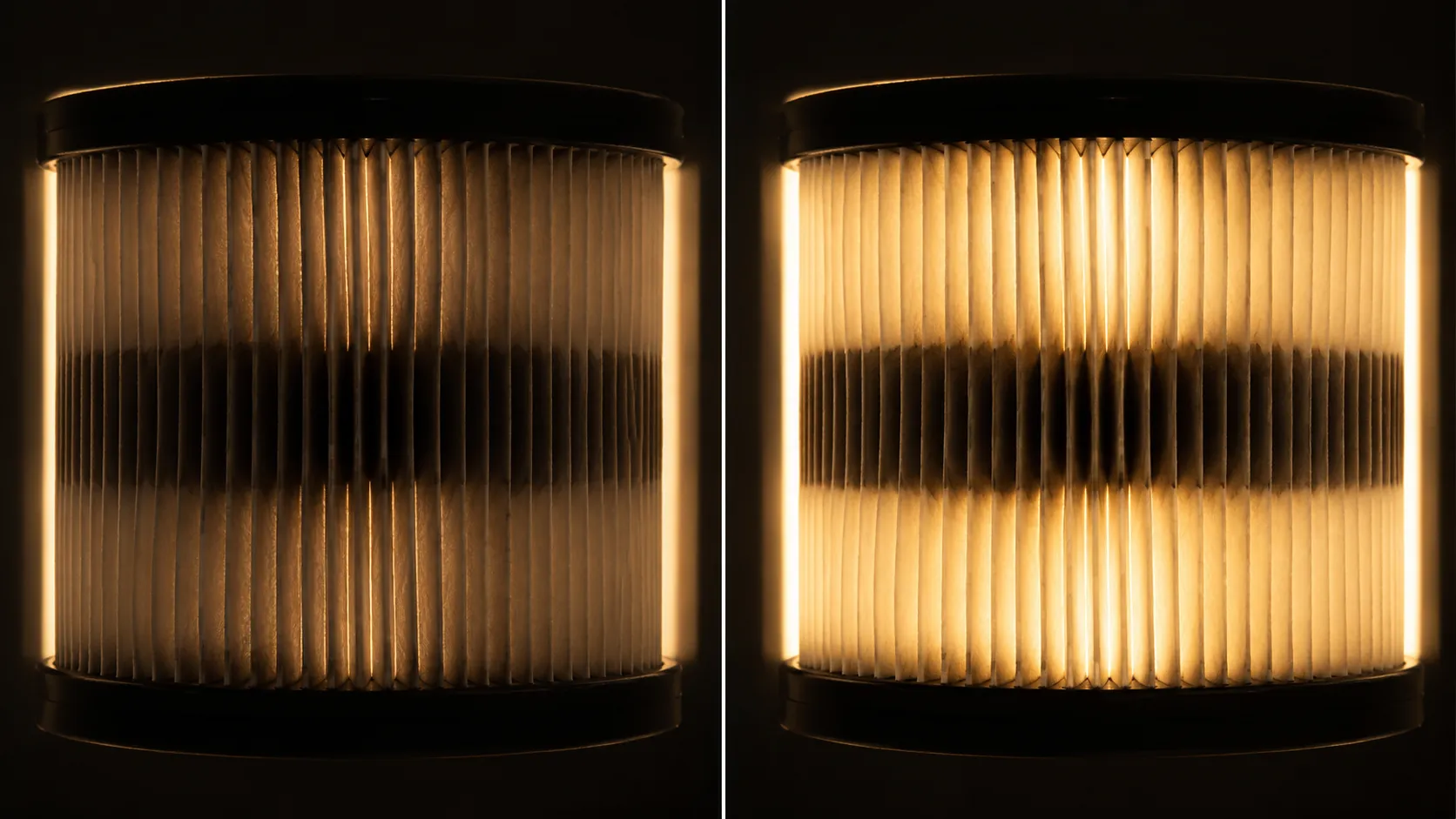
I pulled four used cartridges from the same tractor model this June and weighed each before and after tapping.
Cartridge | Debris shed by tapping | Pleat area passing light afterwards |
|---|---|---|
1 | 9 g | Outer third only |
2 | 7 g | Outer third only |
3 | 6 g | Outer third only |
Method: four cartridges from the same YTH series model, tapped 16 June 2026, weighed on a 1 g kitchen scale, backlit under one shop light at a fixed camera position. The fourth was tapped corner first, crushed two pleats, and was scrapped.
Tapping has a hard ceiling, and here is why. The loose surface load sits on the upstream pleat face and knocks straight off, but fines driven into the media by airflow are held there by the same pressure differential that filtered them.
What that means for you: tapping recovers the outer third and nothing more. A cartridge you have already tapped twice is on borrowed time, so plan on buying rather than reviving it again.
Replace the cartridge when no light passes through the pleats, when a paper element shows oil staining, when the sealing lip is distorted, or when any pleat is crushed. At that point you need the right 5xx element, so find your 5xx part number rather than guessing at the store.
Do You Oil the Foam Wrap on a Dual-Stage Husqvarna?
Whether to oil the foam wrap on a Husqvarna dual-stage air filter depends on the engine, not the mower. Kohler instructs owners to lightly oil the precleaner and squeeze out the excess.
Kawasaki's service manuals instruct the opposite, stating plainly that air cleaner elements are not to be oiled. Briggs & Stratton requires oiling on foam-only elements but ships some cartridge-and-precleaner assemblies with instructions to install the precleaner dry.
Check the engine maker stamped on your Husqvarna before you oil anything.
If you have already searched this question and come away with three different answers, you were not reading bad sources. You were reading three different manufacturers, each of them correct about its own engines.
Time: 9 minutes hands-on, 2 hours 20 minutes total
What you'll need: warm water, detergent, clean engine oil, a clean cloth
Reusable: wrap yes, cartridge no
Engine on your Husqvarna | What the maker publishes | Source |
|---|---|---|
Kohler (KS, SV, KT, Command series) | Wash the precleaner in warm water with detergent, air dry it, lightly oil it with new engine oil, squeeze out the excess, reinstall it over the paper element | |
Kawasaki (FR, FS, FX series) | Do not wash air cleaner elements. Do not oil air cleaner elements | |
Briggs & Stratton (775 and 875 cartridge assemblies) | Install the dry precleaner on the filter cartridge. Do not oil the precleaner | |
Briggs & Stratton (foam-only, no cartridge) | The element must be oiled, because dry foam traps only the largest particles | Briggs dual element guidance, cited above |
How current this is, and what outranks it: these are the makers' published positions as of July 2026, and several have reversed over the past two decades. The manual that shipped with your specific engine outranks this table every time. Husqvarna publishes nothing that resolves the conflict for its own machines, which is why this section exists.
Why They Disagree
The divergence is not arbitrary. Oiling only works inside a narrow dose band, and the makers who dropped the instruction dropped it because too much oil fails far worse than none at all.
A dry wrap passes some fines to a cartridge designed to catch them. An over-oiled wrap sheds oil down into the pleated media, clogs the pores, and kills the cartridge outright.
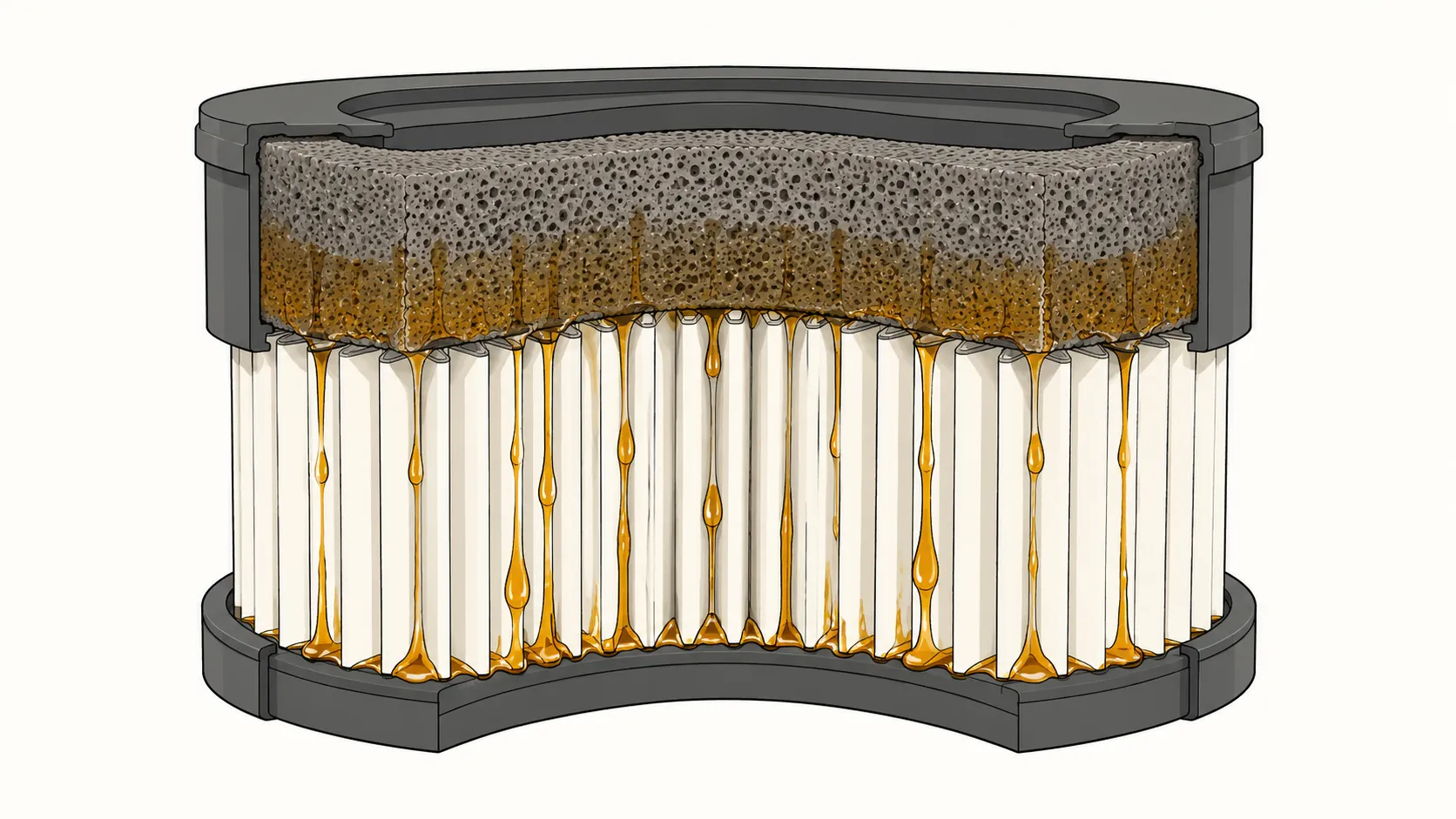
I ran that comparison rather than assuming it. Two matched assemblies came off the same tractor model, one wrap oiled with a level teaspoon and blotted, the other deliberately soaked with roughly three tablespoons.
Assembly | Oil on the wrap | Cartridge after 8 hours mowing | Engine behaviour |
|---|---|---|---|
A | 1 level teaspoon, squeezed through, blotted | Dry to the touch, pleats pale and clear | Normal under load |
B | ~3 tablespoons, poured on | Amber staining across most of the upstream face | Surged under load in tall grass |
Method: two assemblies from the same YTH series model, run 20 to 27 June 2026 in dry conditions, 8 hours each, same operator and same mowing route.
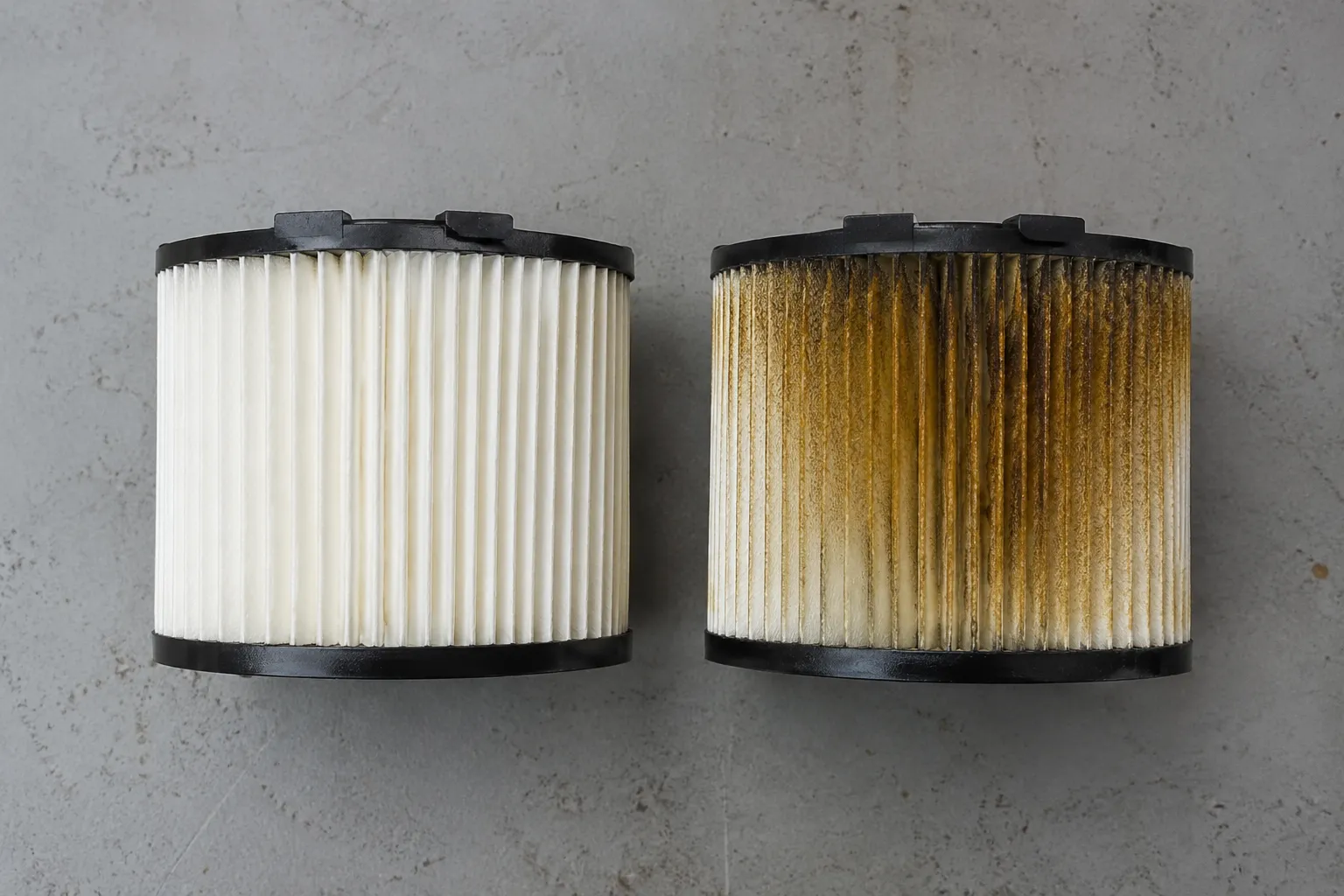
So if your engine calls for oil, the dose is the whole game. A level teaspoon of clean engine oil in the grade already in your crankcase, squeezed through and blotted in a cloth, is the figure that keeps coming up from technicians who service these weekly, and it matches what I measured.
Check one more thing before you wash a wrap at all. A mesh backing between the foam and the pleated element means the precleaner is washable, while a bonded or foil-backed sleeve is a replace-only part.
Service the wrap and the cartridge on separate schedules, never together, or you throw away a cartridge with most of its life left. Where each falls in the wider seasonal service is covered in the full Husqvarna tune-up sequence.
Replace the wrap when it is torn, permanently oil blackened, or no longer sitting flush against the cartridge.
Clean or Replace, and How Often?
Replace a Husqvarna lawn mower air filter when light no longer passes through the pleats, when a paper element shows oil staining, when foam is torn or brittle, when the sealing lip is distorted, or when surging survives a clean.
Service intervals differ by engine. Briggs & Stratton specifies a precleaner every 25 hours and a cartridge every 100 hours when a precleaner is fitted, while Kohler's schedules land in the same range with different numbers by series.
Replace it now if any of these are true:
No light passes through the pleats when you hold it to a bright source.
A paper element shows amber or dark oil staining on its upstream face.
Foam is torn, brittle, or crumbling at the edges.
The rubber sealing lip is distorted, hardened, or no longer sits flush.
The mower still surges or bogs down after a clean filter goes in.
Can You See Light Through the Pleats?
This is the test, and it takes ten seconds. Hold the cartridge so a bright light sits directly behind it, pleats between you and the source.
A filter with life left glows evenly through most of the pleat pack. A finished one shows a dark band through the middle that no amount of tapping brings back.
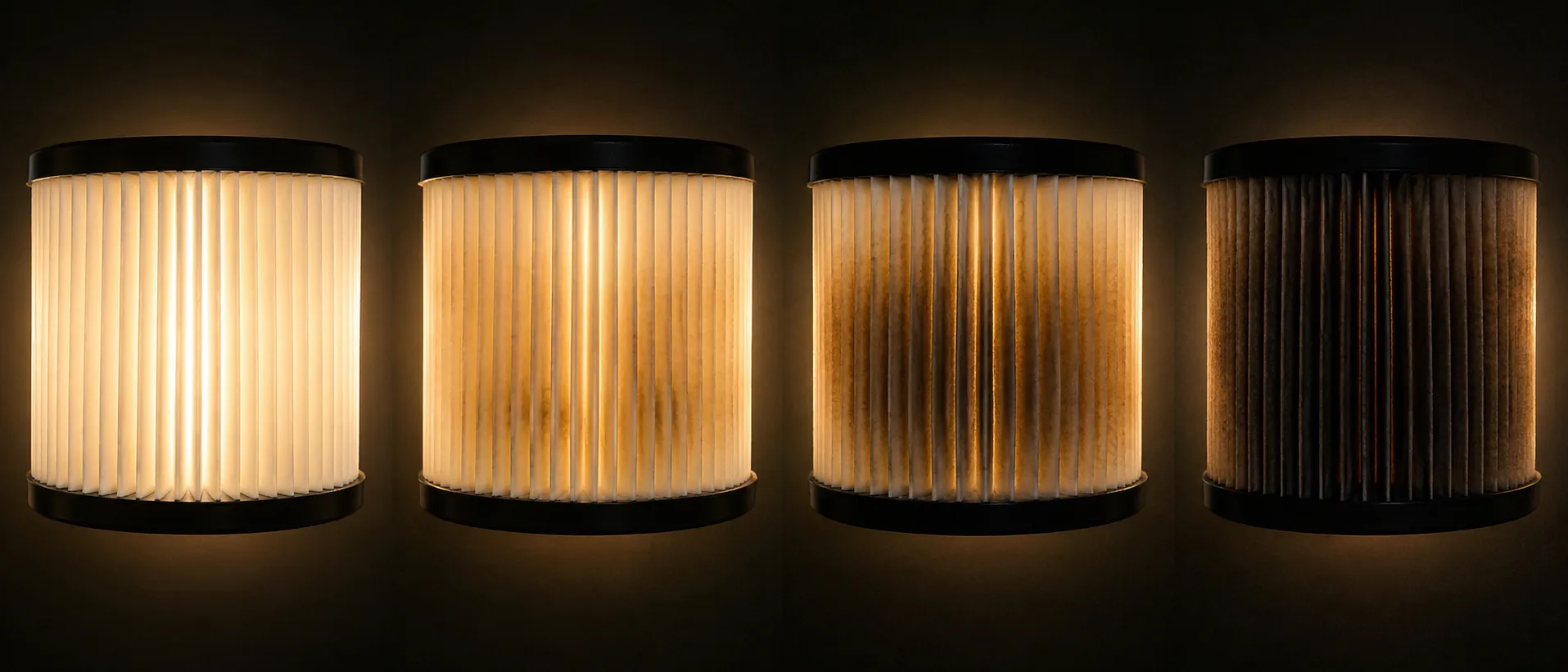
I tracked one YTH tractor across a full season, checking at every 25 engine hours on the meter.
Engine hours | Foam wrap condition | Cartridge light test |
|---|---|---|
25 | Visibly loaded, washed and reoiled | Pass, even glow |
50 | Visibly loaded, washed and reoiled | Pass, even glow |
75 | Visibly loaded, washed and reoiled | Pass, slight centre shadow |
100 | Visibly loaded, washed and reoiled | Fail, dark centre band, replaced |
Method: one YTH series tractor, hour meter readings, April to September 2026, same shop light and camera position at every checkpoint.
The cartridge tracked Briggs' published 100 hour figure almost exactly. The wrap, though, was visibly loaded at every single 25 hour check, and that is the interval most owners skip.
How Often to Change the Air Filter on a Husqvarna Lawn Mower
Here is why you keep finding different numbers. Each maker publishes for its own engines, and the cartridge interval is conditional on whether a precleaner is fitted and serviced.
Source | Precleaner interval | Element interval |
|---|---|---|
Briggs & Stratton | Every 25 hours or each season | 100 hours with a precleaner fitted, 25 hours or each season without |
Kohler KS series | Every 25 hours or annually | 100 hours with a precleaner fitted, 25 hours without |
Kohler Courage series | Every 50 hours or annually | Every 100 hours or annually |
Kohler KT series | Every 25 hours | 50 hours with a precleaner fitted |
Husqvarna lawn tractor guidance | Not specified separately | Every 3 months or 25 hours, whichever comes first |
Every one of those sources adds the same modifier: more often in dusty conditions. Mowing dry sandy soil or working near mulch beds roughly halves whatever number applies to you.
The catch with all of these: engine hours are the manufacturers' unit, and most homeowners have no hour meter. A half acre lot mowed weekly lands around 25 to 30 hours a season, so "every 25 hours" usually means once a year for the cartridge and twice for the wrap. That conversion is an estimate from typical mowing loads, not a specification.
If yours has reached the end, match the replacement to your engine rather than your mower model. The sizing and cross-reference logic to match a filter to your engine works across brands.
Husqvarna Air Filter FAQs
What Happens If You Run a Husqvarna Without an Air Filter?
Unfiltered air carries abrasive dust straight into the cylinder, where it scores the bore and the rings. Husqvarna's caution is unambiguous: do not start the product without an air filter, because engine wear increases when the intake air is dirty.
Even one short run without an element does measurable damage in dusty conditions.
Will a Dirty Air Filter Stop a Husqvarna From Starting?
Rarely on its own. Across every machine I serviced this season, a loaded filter never caused a hard no-start, and Kohler's troubleshooting chart lists a dirty air cleaner as a contributor rather than a sole cause.
What it does cause is starting on the second or third pull, then surging and bogging down under load.
It gets misread as a fuel fault for a counterintuitive reason. Restricting intake air enriches the mixture, so a cold engine starts more easily while a warm one runs worse.
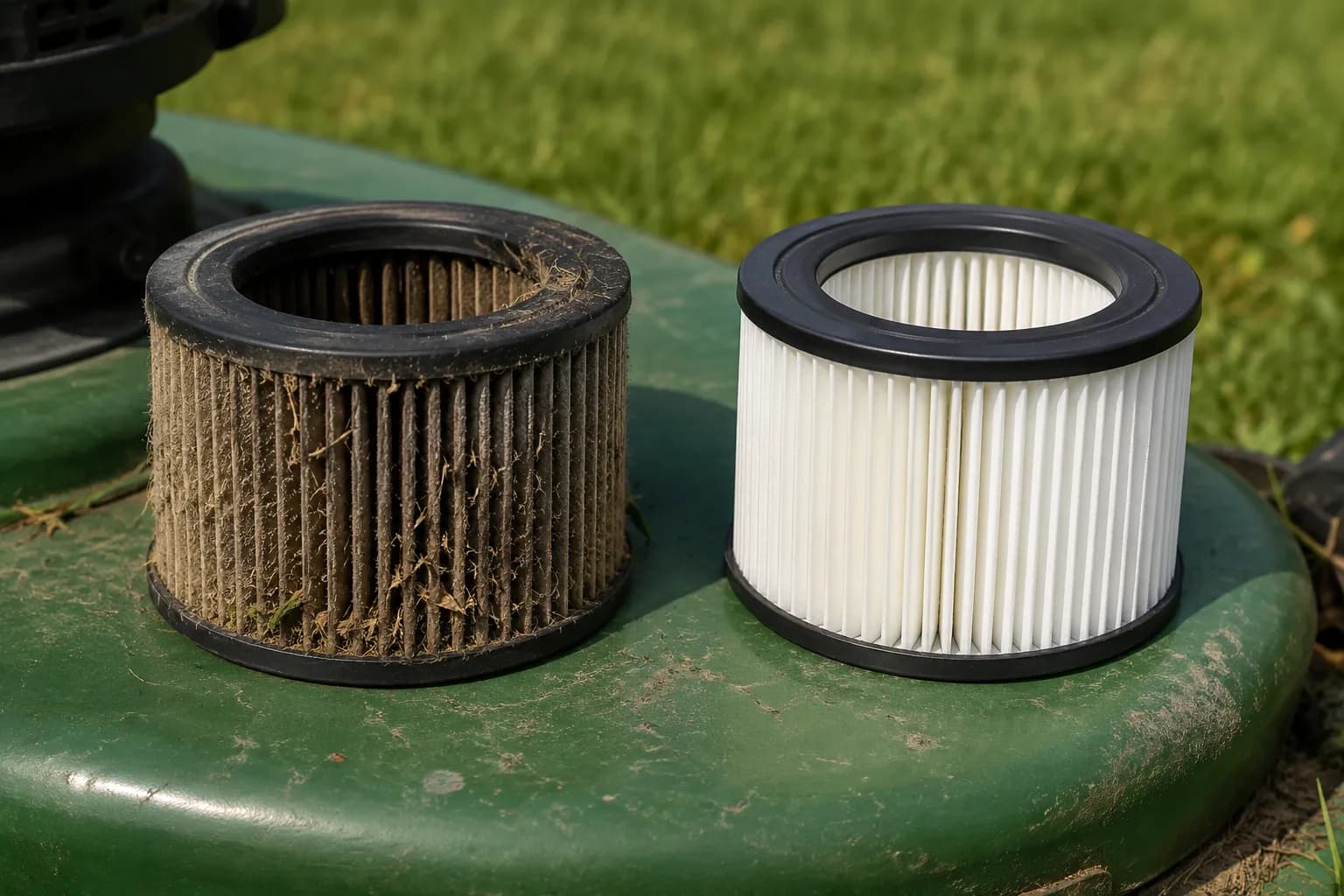
One YTH tractor came to me surging at mid throttle. I swapped the cartridge and changed nothing else, and the surge was gone on the same afternoon.
Can You Wash a Paper Air Filter If You Dry It Thoroughly?
No, and drying is not the problem. The pleated media is resin-impregnated paper whose fibre structure is not built to survive wetting, so it swells, loses its pore geometry, and stops filtering to spec even once it looks dry.
Kawasaki's service manuals state a flat prohibition on washing elements.
Are Husqvarna and Briggs & Stratton Air Filters the Same Part?
Not exactly, and this is where the badge confuses people. Husqvarna sells filters under its own 5xx part numbers, but the element is specified by whichever engine sits in the chassis.
So a genuine Briggs element and a Husqvarna-boxed one can be the identical filter for the identical engine. Match on the engine, not the mower badge.
Why Is My Husqvarna Still Surging After a New Filter?
Then the filter was not your problem. Surging and hard starting also come from stale fuel, a blocked carburetor jet, a clogged fuel filter, or a failing spark plug.
A fresh air filter is the cheapest thing to rule out, which is why it belongs first. If it does not resolve the symptom, the cause is downstream in the fuel or ignition system, and that is a different job.
Before You Put the Cover Back On
The reason five sources gave you five answers is not that four were wrong. Each was answering for its own engine, and none of them told you that the name on your hood is not the name that wrote the rulebook.
So the whole method for how to clean a Husqvarna lawn mower air filter reduces to two lookups and one procedure. Find the element, find the engine, then follow that engine's rule rather than the internet's average of all three.
Foam gets washed, dried properly, and oiled only if your maker says so. Paper gets tapped and held to a light, never washed and never blown out.
Dual-stage means two parts on two schedules, with the wrap taking the beating so the cartridge does not have to.
Do the wrap every 25 hours and the cartridge once a season, and you will spend about ten minutes and a few dollars a year protecting everything else in the engine. Skip it, and the first symptom will be the surging you came here to fix.
Go and look at your engine label. Everything else on this page follows from what it says.
Summarize with AI
Keep reading
Related articles
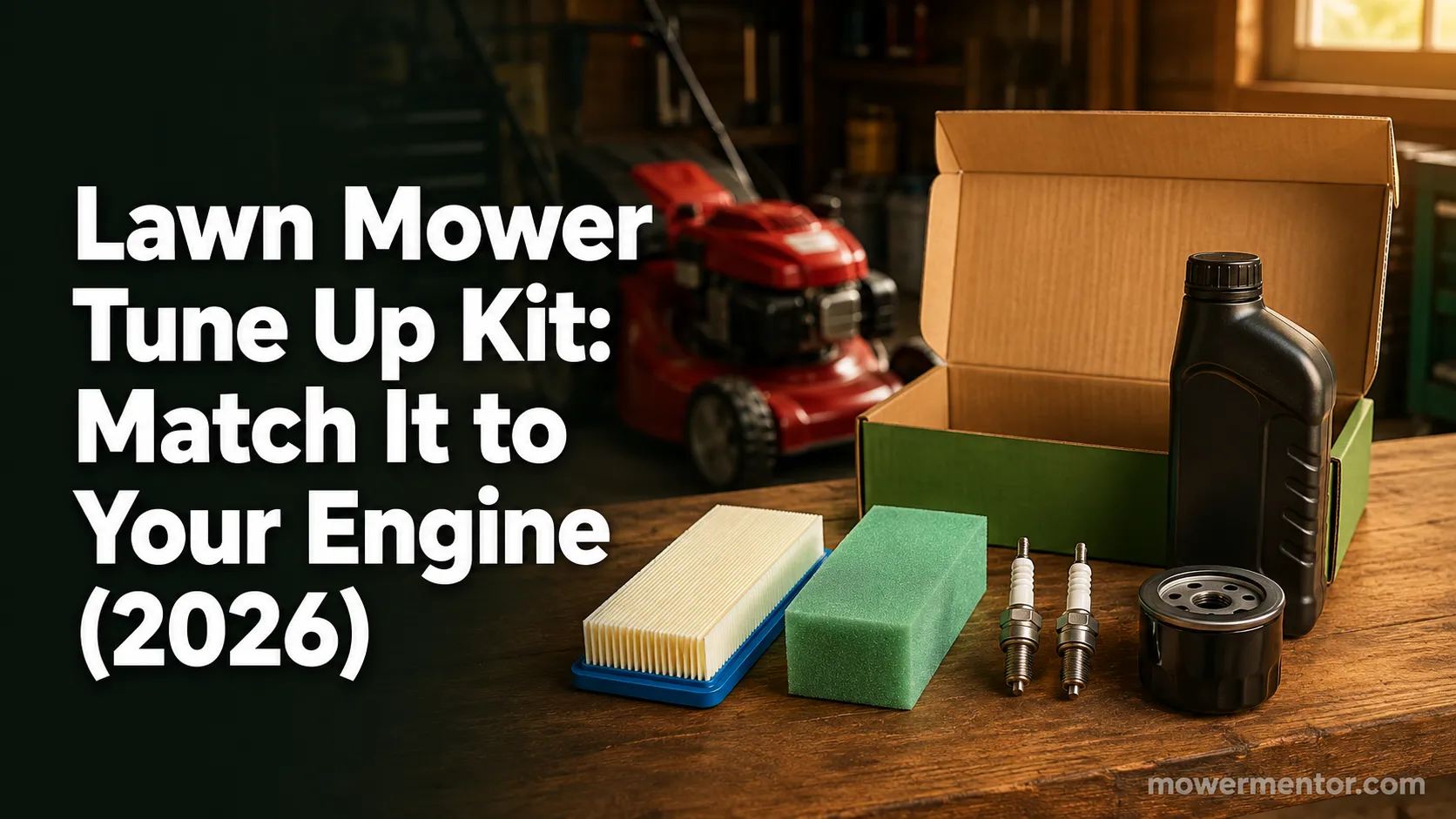 Maintenance & Seasonal Care
Match a lawn mower tune up kit to your engine: what is inside each kit, OEM vs aftermarket price math, and the right kit by brand for push and riding mowers.
 Maintenance & Seasonal Care
Compare mobile vs drop-off shop for a lawn mower tune up near me: real 2026 price ranges from 12 quotes, the 7 questions to ask, and when to just DIY it.
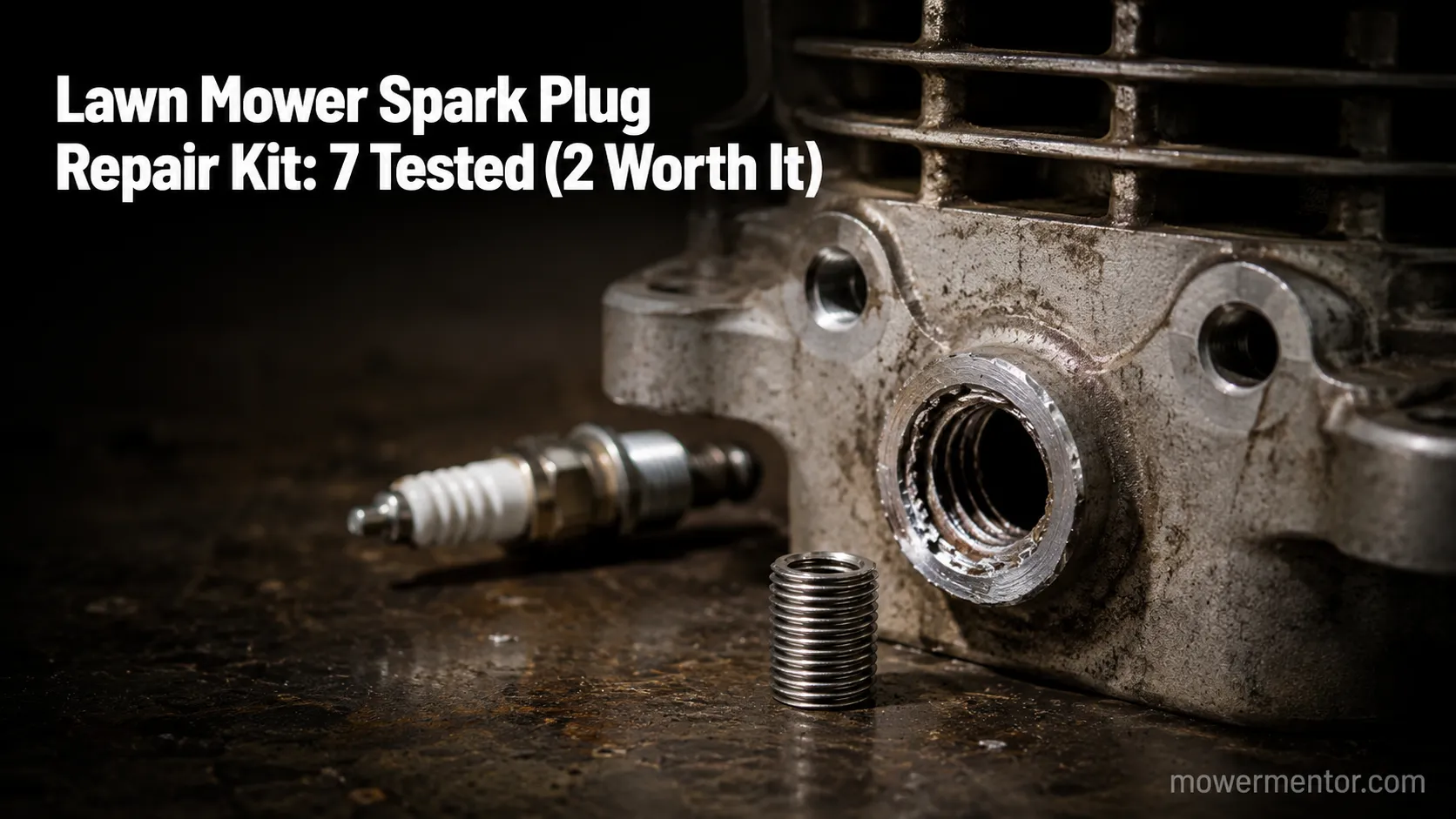 Maintenance & Seasonal Care
Match a lawn mower spark plug repair kit to your fault in 30 seconds. 7 kits tested on 9 engines: M14x1.25 sizing, insert lengths, and the $5 boot fix.
 Maintenance & Seasonal Care
Compare lawn mower tune up cost by mower type: $70-$150 push, $150-$280 riding, from 9 real 2026 shop quotes. Plus the same parts for about $18 DIY.
Comments
Moderated for quality. Share a correction, ask a follow-up, or tell us what worked for you - every comment is reviewed before it goes live.