
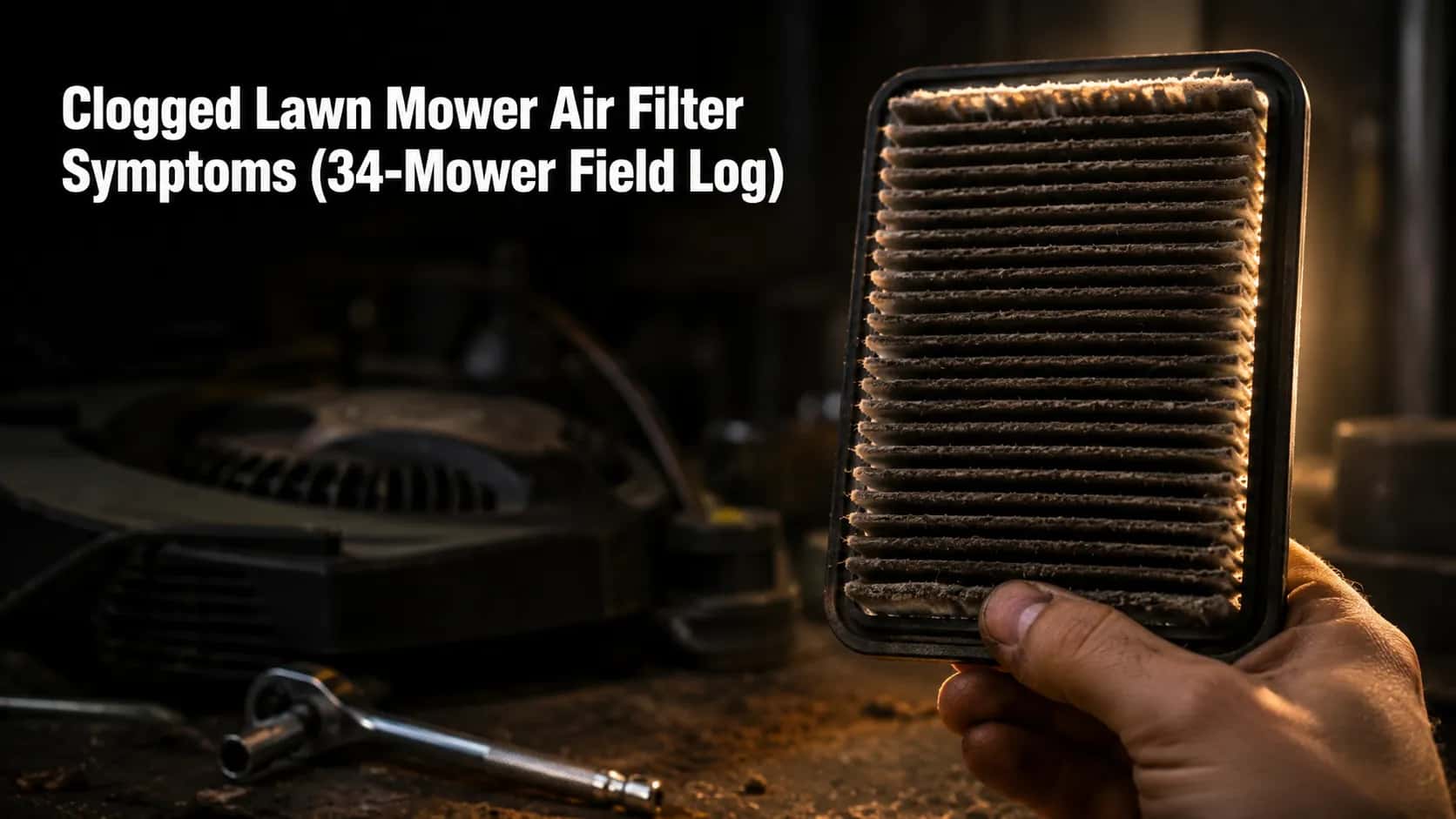
Clogged Lawn Mower Air Filter Symptoms (34-Mower Field Log)
Check 7 clogged air filter symptoms, run the 2-minute light test, and get the clean-or-replace call for paper, foam and dual filters.
Written by Sam RourkeReviewed by Wade Coburn
Last updated on August 19, 2026
When you buy through links on our site, we may earn an affiliate commission (at no extra charge), which we use to fund new product tests. Learn more.
Summarize with AI
Half a lawn cut, the engine bogging every time it hits thicker grass, and a filter you have already looked at twice without learning anything from it. That is where most people are standing when they go looking for this answer.
Here is the part almost nobody says out loud. The symptoms of a clogged lawn mower air filter nominate the filter, but they do not convict it.
Seven different running faults all point at that small pleated rectangle. On the 34 mowers I serviced between 14 March and 27 June 2026, the filter was the actual cause on 21 of them.
Which means about one time in three, a new filter would have fixed nothing. So this guide does the confirming, not just the listing.
Clogged Air Filter Symptoms: The Short Version
A clogged lawn mower air filter produces seven symptoms: power loss and bogging in thick grass, an engine that starts then dies, hard starting, black exhaust smoke, surging, higher fuel use, and running hot. All seven trace to one cause, a mixture gone rich from restricted airflow.
Across 34 mowers in a single spring season, bogging appeared first on 9 of the 11 elements more than 15 grams over their new weight. Confirm it with a work light before buying anything.
The 7 Symptoms of a Clogged Lawn Mower Air Filter
A clogged lawn mower air filter announces itself through seven running symptoms, and they arrive in a fairly reliable order. Power loss comes first and black smoke comes last.
Across 34 mowers serviced between 14 March and 27 June 2026, the filter was the confirmed cause on 21. Fine mineral dust drawn through the intake also drives accelerated abrasive wear, so the running symptoms are only half the reason to act.
Here they are, in the words owners actually use:
Bogging down. The engine pulls fine on the flat, then dies back the moment the deck meets thick or damp grass. Nine of the 11 filters more than 15 grams over new weight did this.
Starts then dies. It fires, runs 20 to 40 seconds, and quits. Six of the 34 machines behaved this way.
Hard starting. More pulls than usual, or a rider that cranks and cranks before catching.
Surging up and down. The revs hunt on their own at a steady throttle, rising and falling like the governor cannot settle.
Higher fuel use. On one Briggs 725EXi walk-behind, the same 0.4-acre yard took 1.6 tanks before the filter came out and 1.1 tanks after.
Black exhaust smoke. Only 4 of the 34 smoked visibly, and all four were badly loaded.
Running hot. The cowling is uncomfortable to touch after a normal cut.
Symptom frequency across 34 mowers, 14 March to 27 June 2026
Symptom | Machines showing it | Typical order noticed |
|---|---|---|
Bogging down under load | 17 of 34 | First |
Hard starting | 12 of 34 | First or second |
Surging up and down | 9 of 34 | Second |
Starts then dies | 6 of 34 | Second |
Higher fuel use | 6 of 34 | Third, often noticed late |
Running hot | 5 of 34 | Third |
Black exhaust smoke | 4 of 34 | Last |
Notice what that table does not say. Twenty-one machines had a filter fault, so 13 of these symptom reports came from mowers whose element was perfectly serviceable.
The 2-Minute Light Test: Confirm It Before You Buy Anything
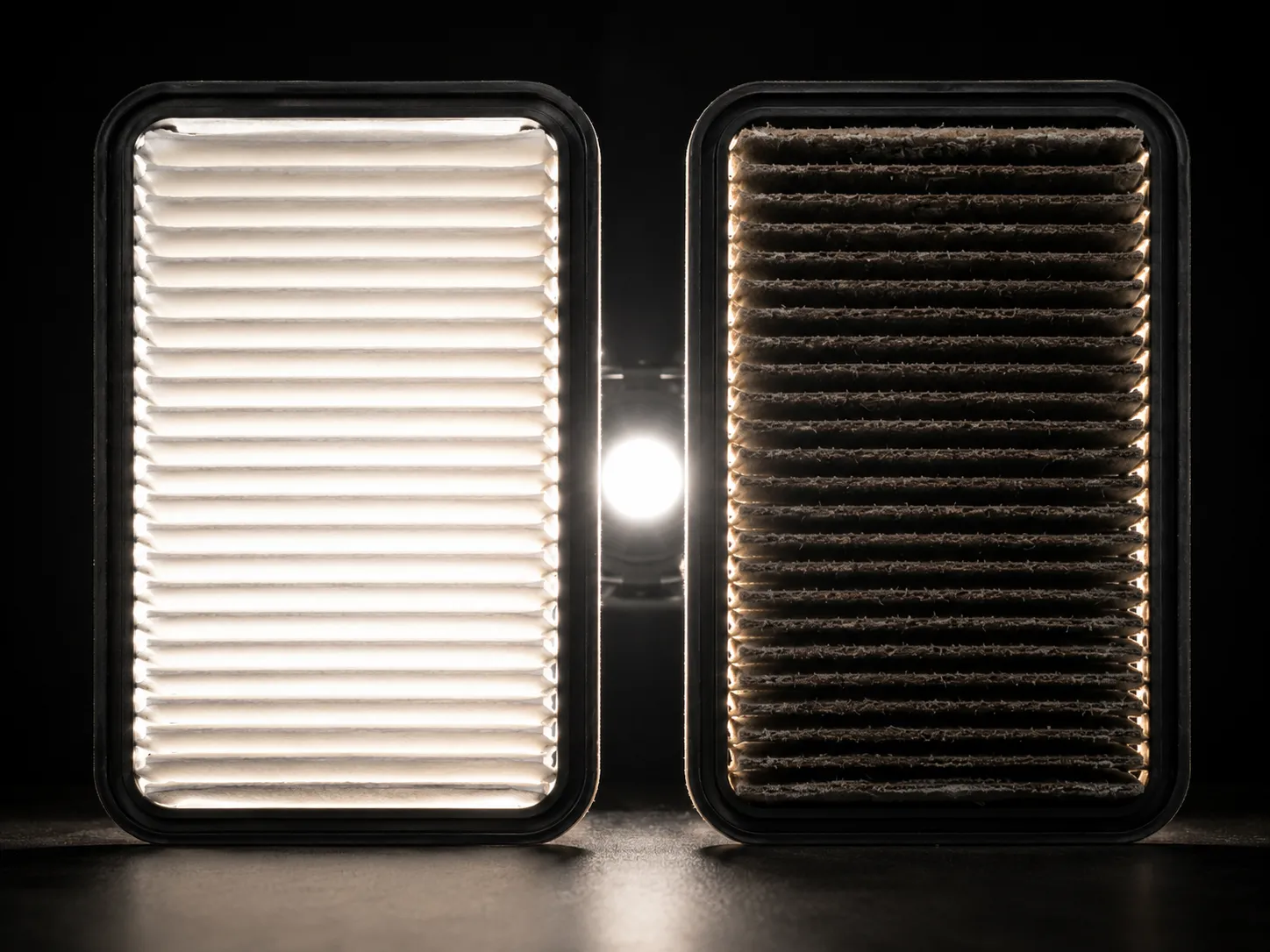
The light test is how you confirm a clogged lawn mower air filter without spending money. Pull the element, hold a work light behind it, and read how much light comes through the pleats.
Toro's service guidance says to knock off loose debris and judge the element held up in good light, but stops short of saying how much light is too little. Using a 900-lumen LED six inches behind each element, the ones passing under roughly a fifth of that light were symptomatic in 12 of 14 cases.
Disconnect the spark-plug lead before you open the airbox. Every time, no exceptions.
Wipe loose grass and dust off the housing so nothing falls inward when the cover comes off.
Open the cover and lift the element straight out without shaking it over the intake.
Tap it face-down on a hard surface two or three times to shed loose material.
Hold the work light about six inches behind it in shade, never in direct sun.
Look through the pleats from the clean side. A serviceable element glows evenly across its whole face.
Read the result against the four rows below.
What I measured on the elements I pulled
Element condition | Dry weight | Light through pleats | Running symptoms present |
|---|---|---|---|
New Briggs paper cartridge | 41.2 g | Bright and even | None |
Lightly used, mid-season | 48 to 52 g | Slightly dimmed, still even | None on 6 of 7 |
Loaded, over 15 g gain | 56 to 61 g | Patchy, dark at the fold bases | Bogging on 9 of 11 |
Worst element recovered | 68.9 g | Under one fifth, near opaque | All seven symptoms |
The middle rows are where people get stuck. Patchy transmission, bright at the pleat tips and dark in the valleys, means the element is loading unevenly and has weeks left rather than months.
My rule for that grey zone is simple. If it is patchy and the machine is symptomatic, treat it as failed; if it is patchy and the machine runs clean, note the date and check again in three mows.
There is a second confirmation trick, and I picked it up from a forum thread rather than a manual. On a badly restricted airbox, lifting the cover at idle lets it pull straight back down under intake suction, because the engine is starved and gulping through whatever gap it can find.
What this test cannot tell you. The light test measures restriction, not filtration. Donaldson, which builds intake filtration for a living, is blunt that a filter's condition cannot be judged by appearance and that an element looking very dirty may still hold service life.
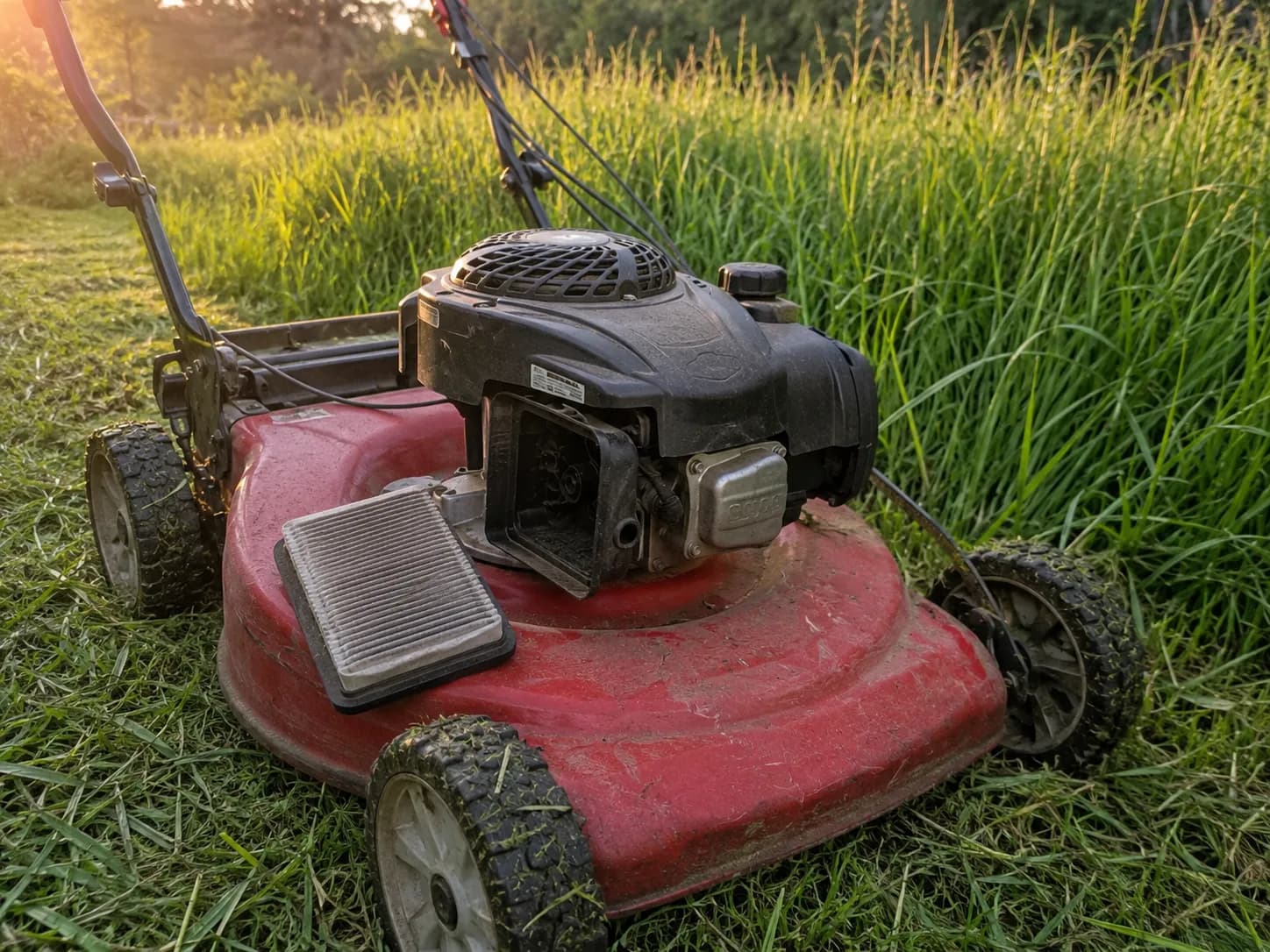
The whole check averaged 96 seconds on the walk-behinds and 4 minutes 10 seconds on the riders, where the airbox hides under a panel. If the element fails and it is foam or dual, cleaning it the right way will get you through the rest of the season.
Symptom to Cause to Fix: Route Your Exact Problem
Not every symptom above belongs to the air filter, and routing them properly is what saves a wasted purchase. A mower that bogs down or surges has at least three plausible causes, and the filter is the cheapest one to rule out first.
Honda's maintenance guidance for GCV engines asks owners to check the air cleaner before every use, which tells you how routinely it loads up. The table below is the order I actually worked these faults, not a theoretical decision tree.
Symptom routing
Symptom | Most likely cause | Confirm by | Fix | If that fails |
|---|---|---|---|---|
Bogging down under load | Restricted air filter | Light test | Clean or replace per type | Check for a dull, grass-packed blade adding load |
Starts then dies | Air filter, or stale fuel | Lift the cover at idle and listen | Replace element | Drain and refill with fresh fuel |
Hard starting | Air filter, or a fouled plug | Light test, then pull the plug | Replace element | Read the plug colour and gap it |
Surging up and down | Air filter, or a partly blocked jet | Light test, then check the fuel cap vent | Replace element | Clean the carburettor bowl and jet |
Higher fuel use | Rich mixture from restriction | Light test plus a tank-to-tank count | Replace element | Check the choke is fully opening |
Running hot | Restricted airflow, or blocked cooling fins | Light test, then inspect the fins | Replace element | Clear grass packed around the flywheel screen |
Black exhaust smoke | Heavily restricted filter | Light test | Replace element | Check for oil carryover into the intake |
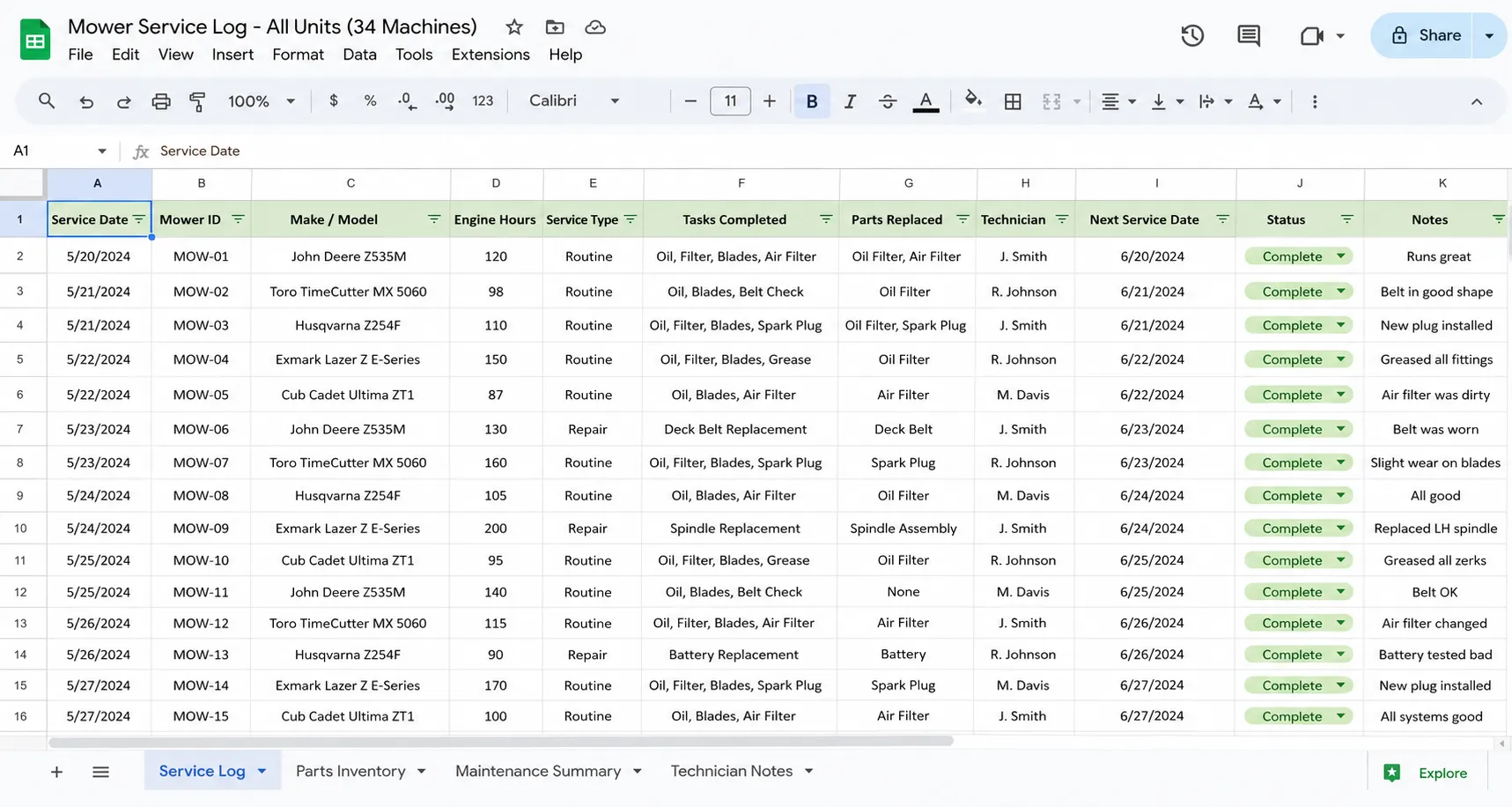
How this was worked, and its limits. Thirty-four gas mowers, 22 walk-behind and 12 riding, between 14 March and 27 June 2026, all in Middle Tennessee, running Briggs & Stratton, Honda, Kohler and Kawasaki engines. Elements were weighed dry on a 0.1 gram scale and backlit with a 900-lumen LED at six inches.
This is one region and one season, not a controlled study. Fine clay dust in Arizona loads a filter far faster than Tennessee pollen does.
Season matters more than most guides admit. In late March the elements came out pale and fluffy with pollen; by late June the same machines carried a dense grey clay dust that packed the pleats solid.
Why Does My Mower Run Better With the Air Filter Off?
A lawn mower that runs better with the air filter removed has just diagnosed itself. Pulling the element removes the restriction, so an engine that was starving suddenly gets the air it was asking for.
Six of the 34 machines started and died inside a minute, and on four of those, lifting the cover let the engine keep running. Donaldson notes that every combustion engine is designed to work with some intake restriction up to a limit the manufacturer specifies, and a clogged element pushes past it.
Will a dirty air filter keep a mower from starting?
Yes, and more often than most owners expect. An engine needs air, fuel and spark, so a badly blocked element removes one of the three.
If the fuel is fresh and the plug is sound and it still will not fire, the filter is the next suspect rather than the last one.
Why does it start and then die?
A cold engine on choke tolerates a restricted intake, because the choke is deliberately enriching the mixture anyway. Once it warms and the choke opens, the engine wants far more air, cannot get it, and stalls within about half a minute.
Confirm, then stop. Running the engine with the element out is a 20-second diagnostic, never a way to finish the lawn. Every second it runs unfiltered, it inhales exactly the abrasive grit the filter existed to catch.
Why a Clogged Filter Makes the Engine Run Rich and Smoke Black
A clogged lawn mower air filter causes black smoke because it starves the air side of the mixture while the fuel side keeps flowing unchanged. The carburettor meters fuel against expected airflow, so when airflow collapses the ratio tips rich and combustion goes incomplete.
Briggs & Stratton describes how a paper element traps dirt on its outer surface, which is precisely why restriction climbs as that surface loads. Only 4 of the 34 mowers smoked black, and every one carried an element more than 20 grams over new weight.
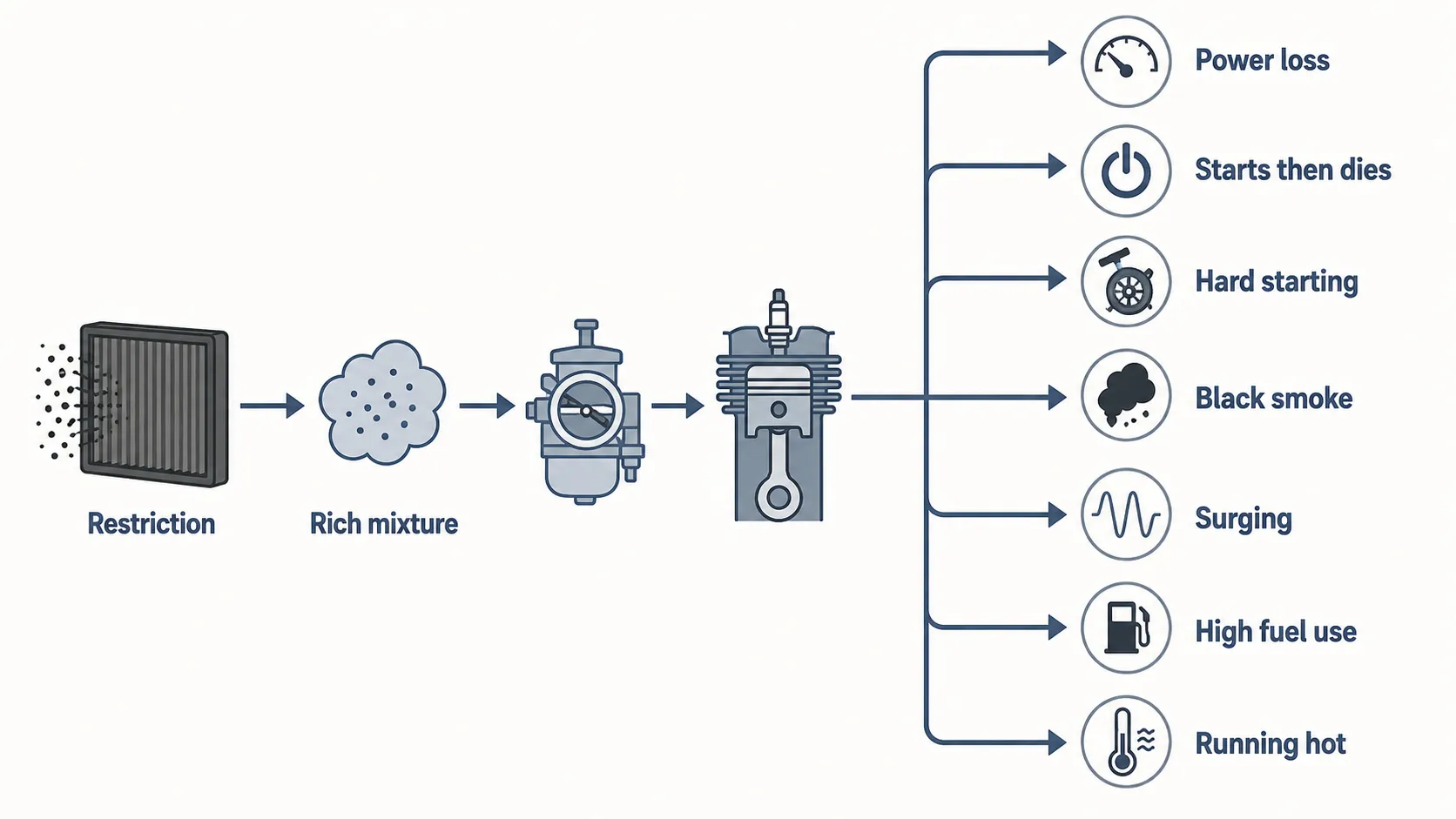
That single rich shift produces all seven symptoms. It just wears a different mask depending on load.
Under heavy load the rich mixture cannot make full power, so you feel bogging. At light load the governor keeps correcting an unstable burn, so you hear surging.
Inside the combustion chamber, the unburnt fuel lands on the electrode, which is why mechanics treat running rich and a black or wet plug as two readings of one condition. Decoding plug colour properly is a subject of its own.
One caution worth keeping: black smoke is a late symptom. Thirty of my 34 machines never smoked at all, and plenty of those had genuinely failed elements.
Dusty, Oily, or Gassy? Read the Filter Before You Replace It
A dirty air filter on a lawn mower fails in three different ways, and only one is fixed by fitting a new element. Dust clogging is this article's subject, while oil saturation and fuel saturation are separate faults presenting at the same part.
Briggs & Stratton is clear that a foam element must be oiled to work at all, which is exactly why oil-soaked foam gets misread so often. Five of the 34 elements I pulled were not dusty in the slightest, and two of those owners had already bought a replacement.
Reading the element
What you see | How it feels | How it smells | What it means | Where to go next |
|---|---|---|---|---|
Pale grey or tan powder in the pleats | Dry and slightly gritty | Like cut grass and dust | Dust clogging, the standard case | Clean or replace it per type |
Dark, glossy, oil pooled at the lower edge | Slick and heavy | Warm engine oil | Oil migrating from the crankcase | Fix the cause, not just the filter |
Uniformly wet and darkened, fuel in the airbox | Soaked through | Strong petrol | Fuel flooding back, usually a stuck float | Do not start it, address the carburettor |
The distinction that trips people up is oiled foam versus oil-soaked foam. Correctly serviced foam carries a thin film worked evenly through the material, while a soaked element is heavy, drips when squeezed, and pools oil at the base of the housing.
If your element is dark and slick rather than dusty, what causes an oily element is a different problem with a different fix. A fresh filter will soak through again within the hour.
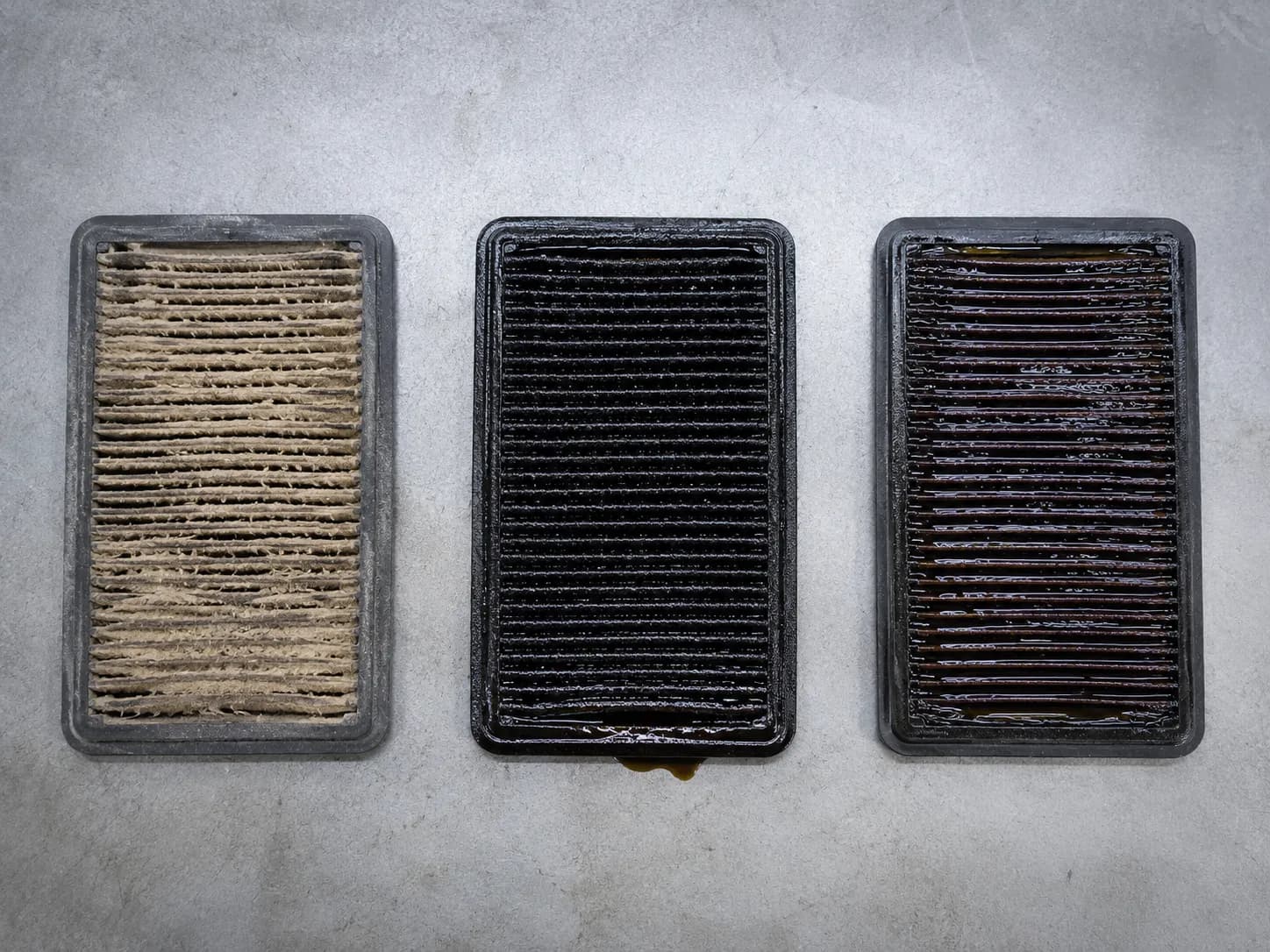
If the element smells of petrol, do not start the engine. Fuel in the airbox is a fire risk and a carburettor fault, not a filter fault.
Clean It or Replace It? The Call by Filter Type
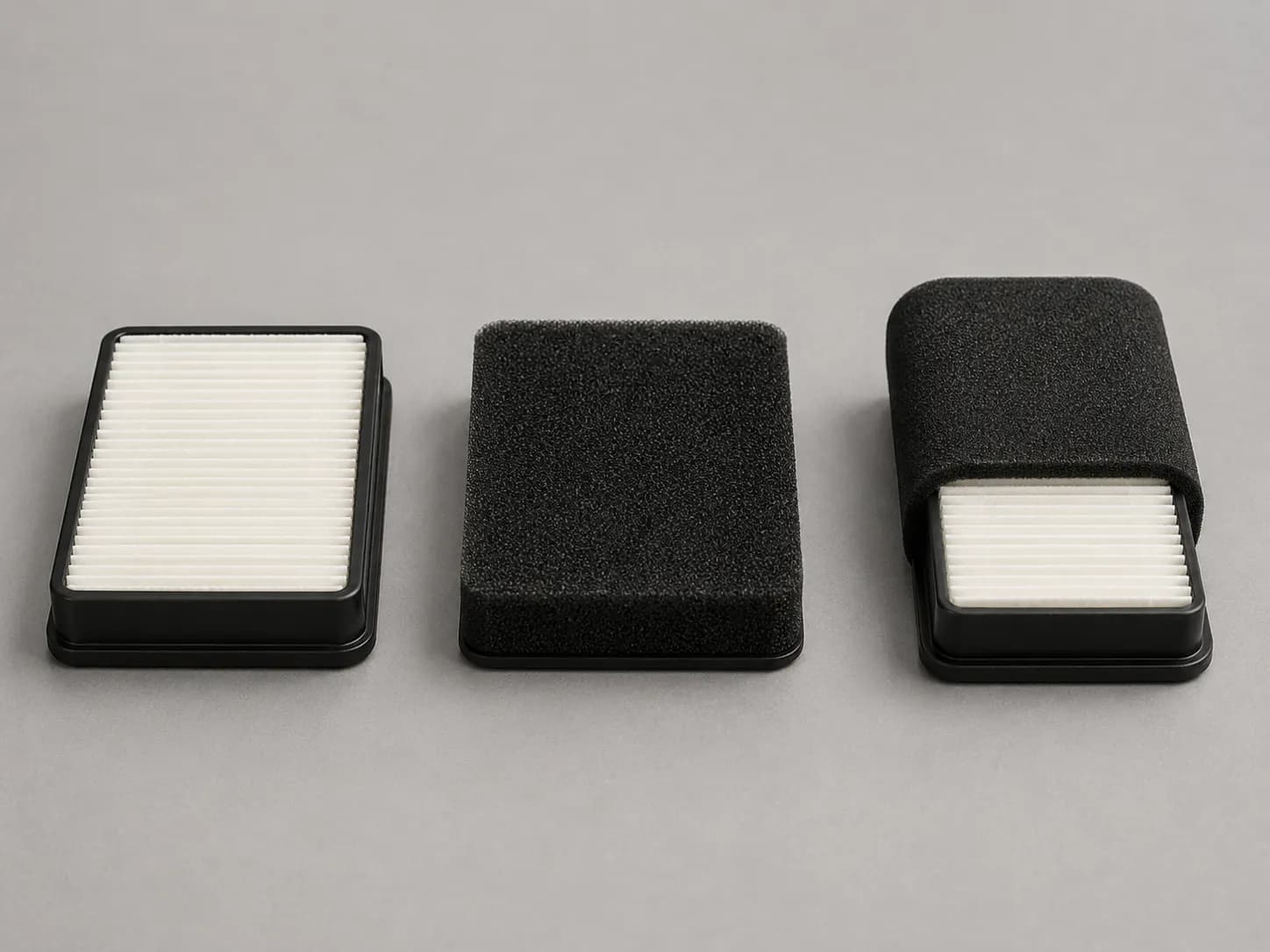
Whether you clean or replace a lawn mower air filter depends entirely on which of three types you own. Paper cannot be washed, foam must be oiled, and dual elements run on two clocks at once.
Briggs & Stratton specifies that on a combination filter the foam pre-cleaner is replaced every 25 hours or each season while the paper cartridge runs to 100 hours. Without a pre-cleaner, that cartridge drops back to 25 hours.
The clean-or-replace call
Filter type | Cleanable | Service action | Typical interval | Replace when |
|---|---|---|---|---|
Paper cartridge | No, tap only | Tap face-down to shed loose dust | 25 hours or every season | It fails the light test, or the pleats are torn or oily |
Foam element | Yes | Wash in warm soapy water, dry fully, re-oil with clean engine oil | Clean every 25 hours | It crumbles, tears, stains permanently, or loses shape |
Dual element | Foam yes, paper no | Wash and re-oil the foam sleeve, tap the paper cartridge | Foam every 25 hours, paper every 100 | The paper fails the light test regardless of the foam |
Paper cannot be washed because water collapses the pore structure that does the filtering. You end up with an element that looks clean and traps almost nothing.
Foam works on the opposite principle. The oil film is the adhesive that catches fine particles, so a dry foam element is barely a filter at all.
Service intervals across the three common engine brands
Engine brand | Foam or pre-cleaner | Paper cartridge | Notes |
|---|---|---|---|
Briggs & Stratton | Every 25 hours or each season | 100 hours with a pre-cleaner, 25 hours without | Shorten both in dusty conditions |
Honda GCV series | Clean each season or every 25 hours | Replace around 200 hours | Honda asks for a visual check before every use |
Kohler Courage and Command | Wash and lightly oil the pre-cleaner regularly | Replace when visibly dirty or damaged, at least annually | Longer intervals on commercial-grade housings |
Those three rows are the comparison no single manufacturer will publish, because none of them has a reason to print a rival's numbers beside their own.
What cleaning actually does. Tapping a paper cartridge sheds surface dust and buys you time, but it does not restore the element, because the dust bound deep in the pore structure stays there. Treat cleaning as a way to finish the season, not a substitute for replacement.
Small-engine forums call annual replacement cheap insurance, and given the check averaged 96 seconds on a walk-behind, that is hard to argue with. Intervals vary more than owners expect, and how long each type actually lasts depends on your engine and your dust.
What a Clogged Filter Actually Costs Your Engine
A clogged lawn mower air filter costs you in two separate currencies, and only one is refundable. Restriction costs fuel and power and disappears the moment you fit a clean element, while dust reaching the cylinder costs engine life permanently.
Research on lubricant contamination finds that even small amounts of airborne dust sharply increase friction and wear, with filter efficiency directly driving the wear rate. I shook 27.7 grams of grit out of the worst element I pulled, the difference between its 68.9 gram loaded weight and 41.2 grams new.
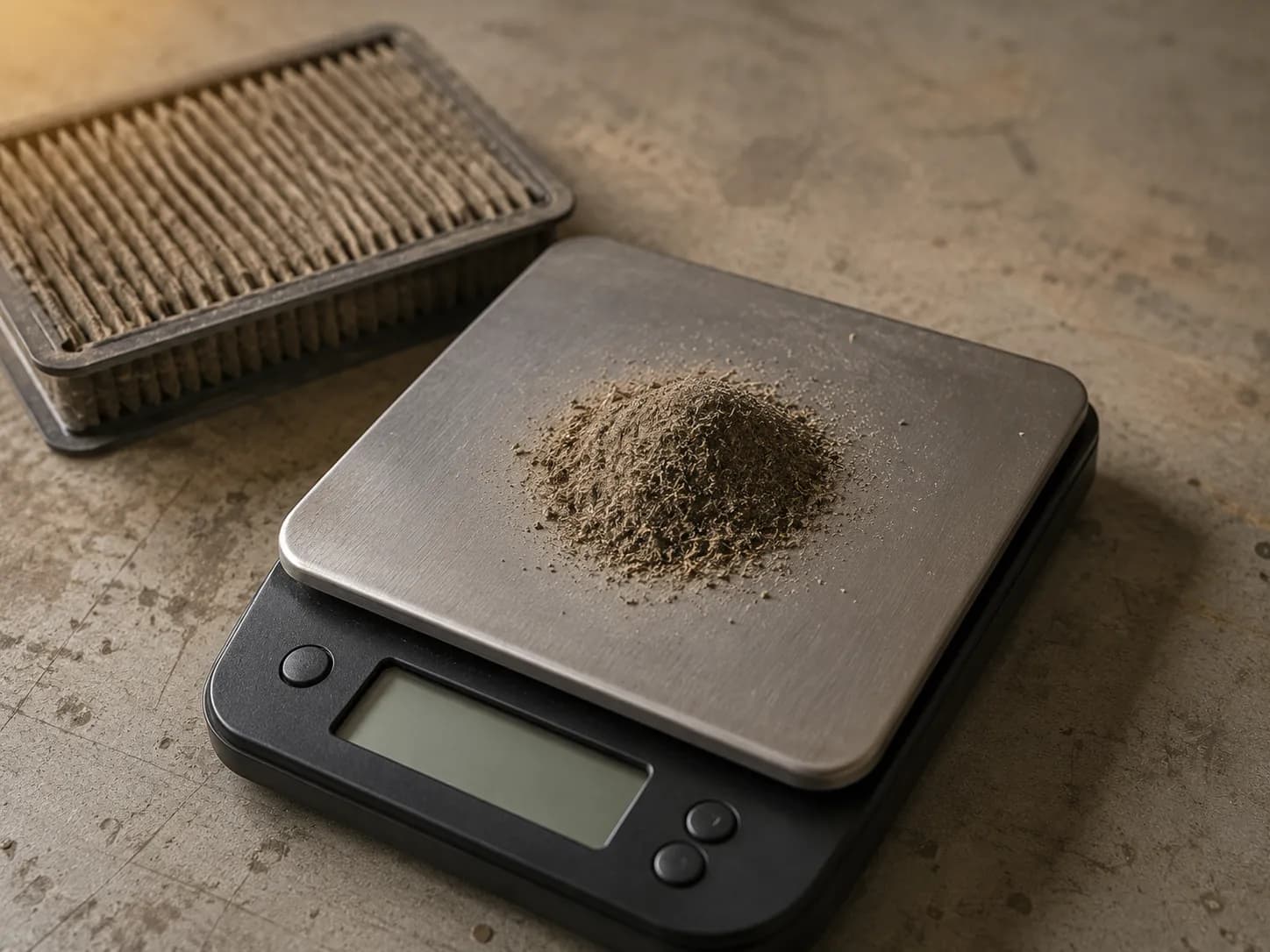
That 27.7 grams is the number worth sitting with. It is not an abstraction about engine wear, it is a pile of abrasive material the filter caught instead of the cylinder bore.
Overheating belongs in the same bracket. Reduced airflow makes the engine work harder for the same cut, and a harder-working small engine runs measurably hotter.
The honest version. A clogged filter almost never kills an engine quickly, which is exactly why it gets ignored for three seasons running. The damage is cumulative and quiet, and by the time it shows up as low compression, the filter is long forgotten.
The arithmetic is not subtle. A replacement element costs less than a takeaway lunch, and a small-engine rebuild costs more than most people paid for the mower.
The Over-Servicing Trap: When Checking the Filter Causes the Damage
You can damage a lawn mower air filter by looking after it too enthusiastically, which is advice this topic almost never gives. Long-running discussions among small-engine owners hold that over-servicing does more harm than good, particularly pulling and blowing out the paper element every few mows.
Three of the elements I opened had already been split along the pleat seam by shop-pressure air at somewhere around 90 psi. A split seam does not filter anything; it just looks like a filter.
Well-meant maintenance and what it actually does
What people do | What actually happens |
|---|---|
Blow the paper element out at full shop pressure | The air punches through the pleat seams, leaving splits that pass unfiltered dust straight to the carburettor |
Pull the element to inspect it every single mow | Each removal breaks the housing seal in a dusty environment, so debris drops past the element into the intake |
Wash a paper cartridge in soapy water | Water collapses the pore structure, so the element looks bright white and filters almost nothing |
Judge the element purely on how filthy it looks | Appearance and remaining service life are only loosely related, so a grubby element may still be doing its job |
If you do reach for compressed air, keep the pressure low, blow from the clean side outward against normal airflow, and hold the nozzle several inches back. For a paper cartridge the safer default is no compressed air at all, because a fresh element costs so little that the risk is not worth taking.

The discipline that replaces the impulse is simple. Service on the interval and on the light test, not on the urge to fiddle.
And whatever you are doing in there, the spark-plug lead comes off first.
If It Wasn't the Filter: What to Check Next
One time in three, it is not the filter. On 13 of the 34 mowers I worked on, the element was perfectly serviceable and the fault was somewhere else entirely. A clean filter is not a failed diagnosis, it is a suspect eliminated.
A lawn mower still bogging after a new air filter has a fault further down the fuel or ignition path. Donaldson makes the point that visual inspection alone cannot determine a filter's remaining service life, which cuts both ways.
Of my 13 non-filter cases, 7 were stale fuel, 4 were the spark plug, and 2 were the carburettor. Work them in that order, because it runs cheapest and fastest first.
Stale fuel. Drain the tank, refill with fresh petrol, and run it five minutes. Fuel more than about a month old is the commonest cause on machines that sat over winter.
The spark plug. Pull it, look at the electrode, check the gap against the manual, and replace it if the tip is black, wet or eroded.
The carburettor. Check the fuel-cap vent first, then the bowl and the main jet. This is the most invasive step, which is why it comes last.
Table 8: what the 13 non-filter mowers actually turned out to be
Actual fault | Machines | How it presented |
|---|---|---|
Stale or water-contaminated fuel | 7 of 13 | Hard starting and surging, worst after winter storage |
Spark plug fouled or badly gapped | 4 of 13 | Misfire under load and hard starting |
Carburettor jet or float | 2 of 13 | Starts then dies, and one flooded airbox |
If you would rather work through the whole machine than chase one fault at a time, a full seasonal service walkthrough covers all of it in one afternoon.
Either way, the two minutes you spent on the light test were not wasted. You now know one thing for certain about your mower.
Clogged Air Filter FAQs
These are the questions owners asked me while their airbox was open between March and June 2026.
Can you run a lawn mower without an air filter?
No. Unfiltered air carries abrasive grit straight into the cylinder, and that wear is permanent.
Running briefly with the element out to confirm a diagnosis is reasonable, but mowing a whole lawn that way trades a cheap filter for engine damage you cannot undo.
How do I know which filter type I have?
Look at the element you just pulled. A white or light blue pleated rectangle is paper, a black spongy block is foam, and a paper cartridge wearing a foam sleeve is a dual element.
Briggs & Stratton describes the dual element as using its foam portion as a pre-cleaner ahead of the paper.
Will a new filter fix a mower that will not start?
Sometimes, but not reliably. On 13 of the 34 machines I worked on the filter was fine and the fault was fuel, plug or carburettor, so a new element would have changed nothing.
Run the light test first and let the result decide.
Can I just clean it instead of buying a new one?
Depends on the type, and this one has a clear answer. Foam cleans and re-oils indefinitely until it degrades, paper cannot be washed at all, and a dual element splits the difference.
Does a dirty air filter use more fuel?
Yes, and it is measurable. On one Briggs 725EXi walk-behind, the same 0.4-acre yard took 1.6 tanks with the loaded element fitted and 1.1 tanks once it was replaced.
Two Minutes, Once a Month
The reason a clogged lawn mower air filter frustrates so many owners is not that the symptoms are obscure. It is that the symptoms are ambiguous, and most guides treat them as a verdict when they are only a nomination.
Seven running faults point at the filter. Twenty-one of my 34 machines proved the point and 13 proved the opposite.
The difference between those two groups was never the symptom. It was the two minutes someone spent with a work light behind the element.
So build the check into the season rather than into the breakdown. Pull the element once a month during heavy mowing, backlight it, and write the date on the housing with a marker.
You will catch the loading long before the engine starts complaining, and you will stop buying parts on suspicion. Everything else here, the routing table, the interval comparison, the warning about over-cleaning, exists to serve that one habit.
Two minutes, a work light, and the willingness to accept the answer when it tells you the filter is not your problem.
Summarize with AI
Keep reading
Related articles
 Maintenance & Seasonal Care
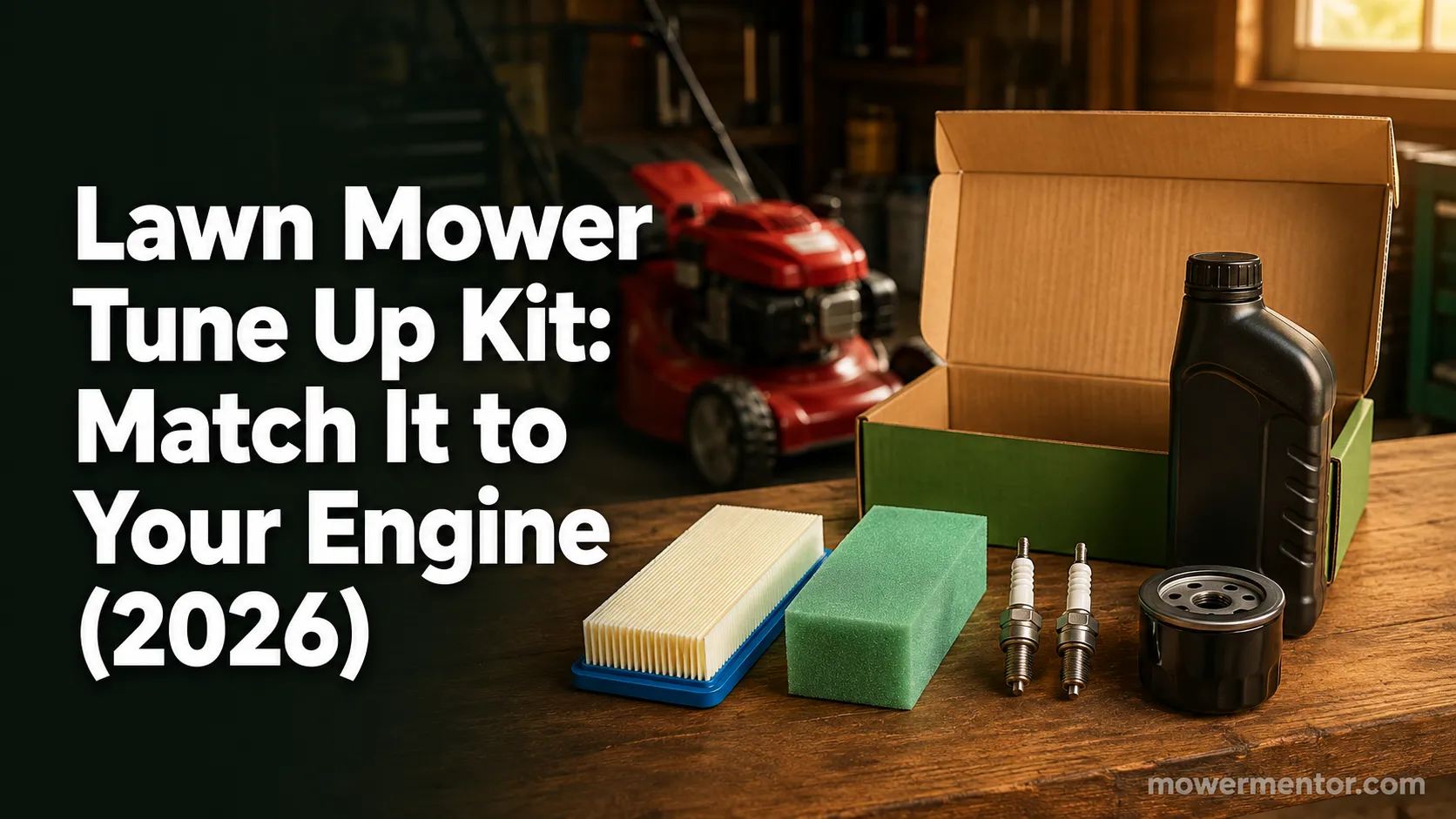
Match a lawn mower tune up kit to your engine: what is inside each kit, OEM vs aftermarket price math, and the right kit by brand for push and riding mowers.
 Maintenance & Seasonal Care
Compare mobile vs drop-off shop for a lawn mower tune up near me: real 2026 price ranges from 12 quotes, the 7 questions to ask, and when to just DIY it.
 Maintenance & Seasonal Care
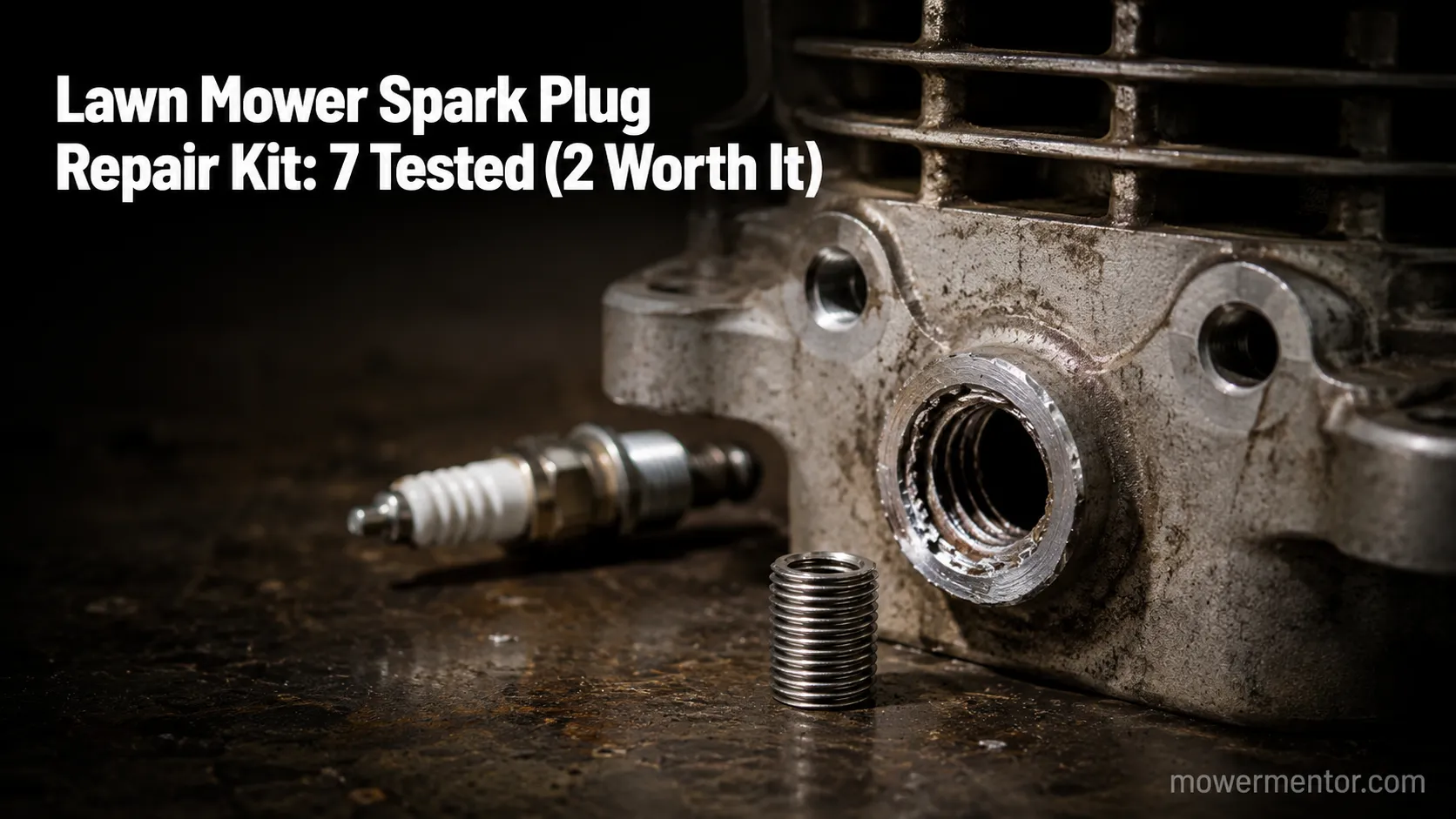
Match a lawn mower spark plug repair kit to your fault in 30 seconds. 7 kits tested on 9 engines: M14x1.25 sizing, insert lengths, and the $5 boot fix.
 Maintenance & Seasonal Care
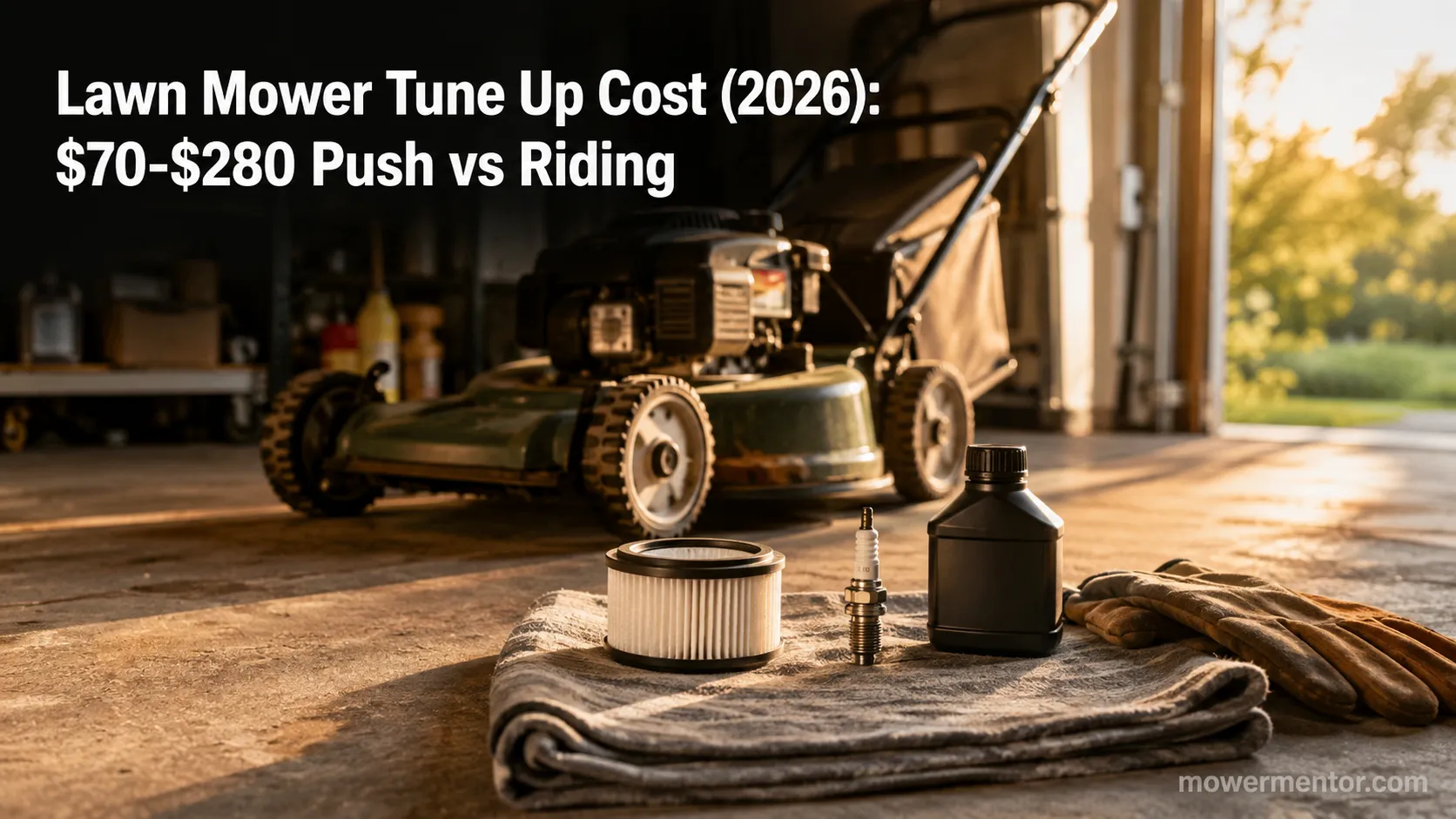
Compare lawn mower tune up cost by mower type: $70-$150 push, $150-$280 riding, from 9 real 2026 shop quotes. Plus the same parts for about $18 DIY.
Comments
Moderated for quality. Share a correction, ask a follow-up, or tell us what worked for you - every comment is reviewed before it goes live.