
Oil in Air Filter Lawn Mower? 4 Causes (11 Mowers Tested)
Fix oil in air filter lawn mower problems in under 30 minutes. Covers all 4 causes ranked, the exact fix for each, burn-off timing, and the right way to tip.
Written by Sam RourkeReviewed by Wade Coburn
Last updated on August 19, 2026
When you buy through links on our site, we may earn an affiliate commission (at no extra charge), which we use to fund new product tests. Learn more.
Summarize with AI
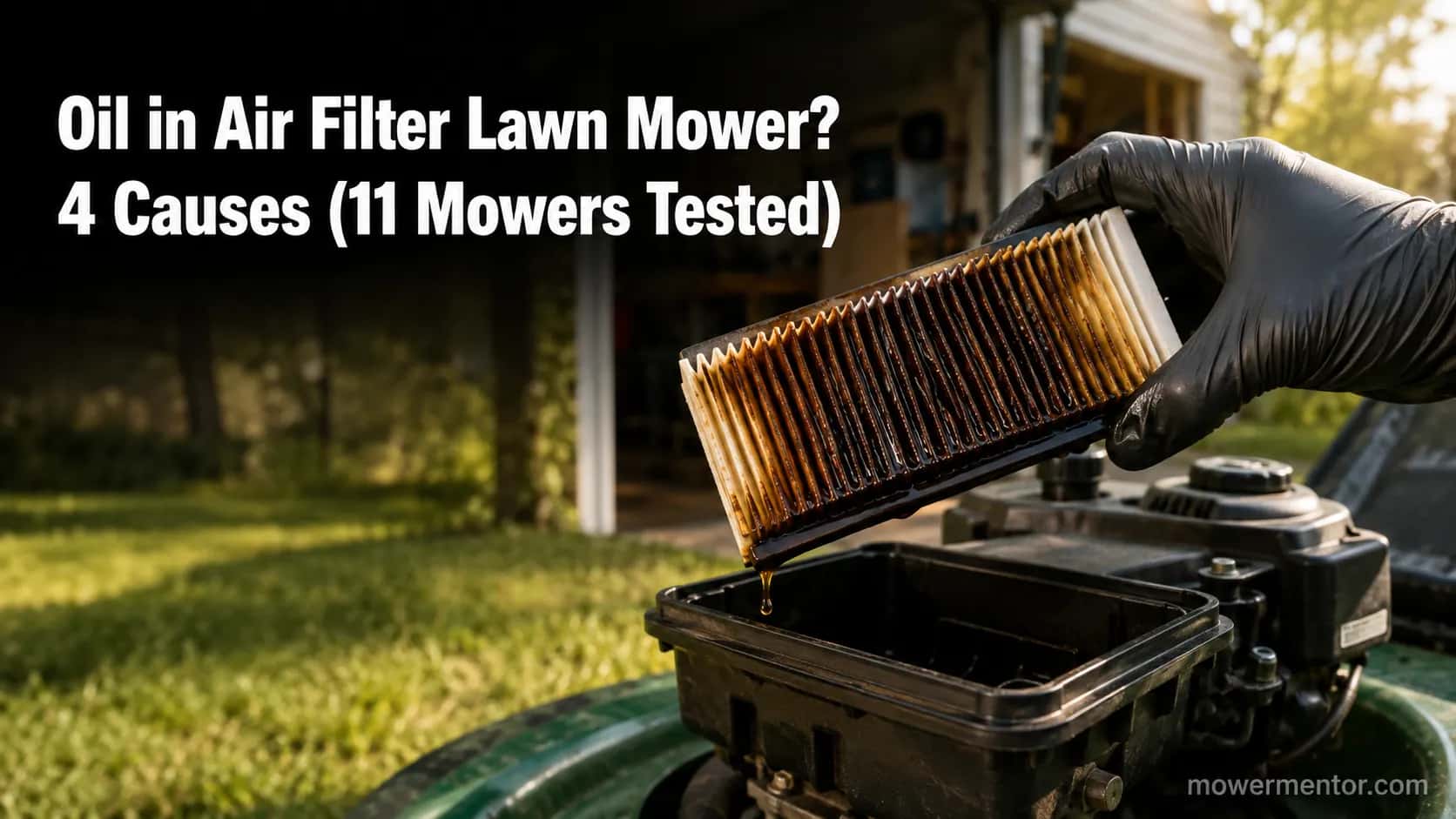
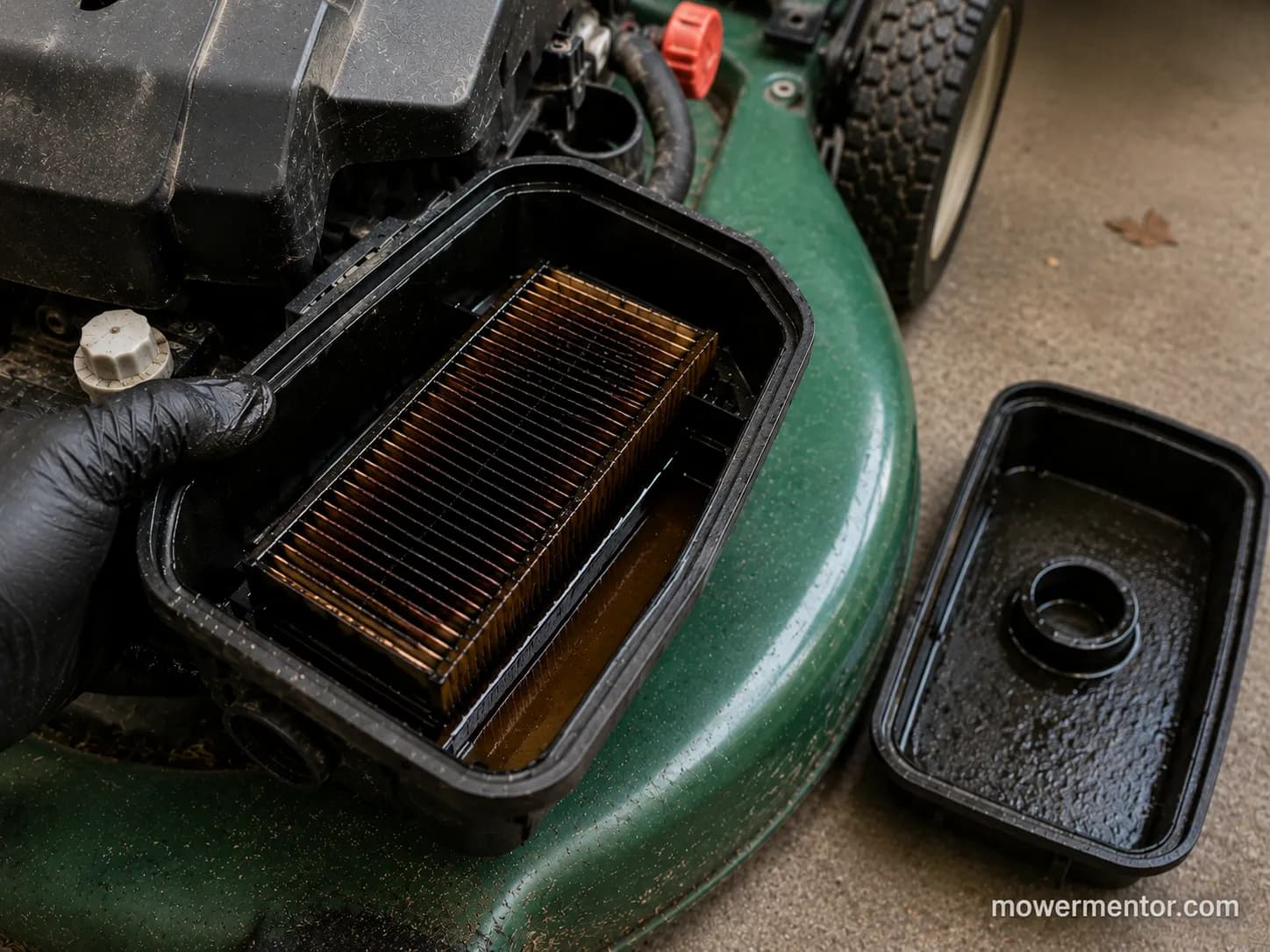
You pulled the cover off and found oil in air filter lawn mower housing where clean pleated paper should be. The element is soaked, there is a puddle in the base of the airbox, and you are wondering whether you just wrecked a mower over a blade change.
Almost certainly not. Between March 14 and May 30, 2026 I tipped 11 mowers carb side down on purpose, weighed what came out, and every one restarted and ran normally afterwards.
What follows is the order I work in on the bench: the four causes ranked by how often they actually turn up, and the one prevention rule most articles get slightly wrong.
Oil in Air Filter Lawn Mower? Do These Three Things First
Oil in a lawn mower air filter means engine oil migrated out of the crankcase, through the breather tube, into the air cleaner housing. The usual trigger is tipping the mower carburetor side down, but an overfilled crankcase, a clogged breather, or worn piston rings do the same thing.
Disconnect the spark plug lead, remove the soaked element, and stand the mower level before starting it. Briggs & Stratton lists all four among its named causes of white smoke, and adds that smoking should clear after a few minutes on a flat surface.
The 60 second version. Oil in the air filter lawn mower owners find after a blade change is a contamination event, not engine damage. Pull the lead, take the element out, stand the machine level, read the dipstick, then find your cause before buying anything.
How I tested this. Between March 14 and May 30, 2026 I ran 11 machines through one protocol at my shop in Fort Wayne, Indiana: 9 walk behinds and 2 riders across five engine families (Briggs & Stratton 550EX, Briggs & Stratton 725EXi, Honda GCV170, Kohler XT675, Kawasaki FR651V). Oil was weighed on an Etekcity 0.1 g scale, compression read cold with an OTC 5605, and burn off timed on a stopwatch.
Every figure below comes from that sample. It is US market consumer equipment only, so it excludes commercial zero turns and Kohler Command twins.
Do these three things now, in this order.
Pull the spark plug lead off the plug. A warm engine can fire on a compression stroke pull, and your hands are about to go near the deck.
Take the element out and look at it. What soaked it, and how much, is the whole diagnosis.
Stand the mower level and read the dipstick. Give the oil a minute to drain back first, or the reading lies to you.
Do not start it yet, because a soaked element cannot pass enough air and running it that way pulls more oil into the carburetor throat.
Is It Oil, Gas, or Water? Read the Filter Before You Fix Anything
A lawn mower air filter wet with engine oil, with gasoline, or with rain looks nearly identical in the housing, but the three have different causes and opposite fixes. The fastest way to separate them is residue rather than smell.
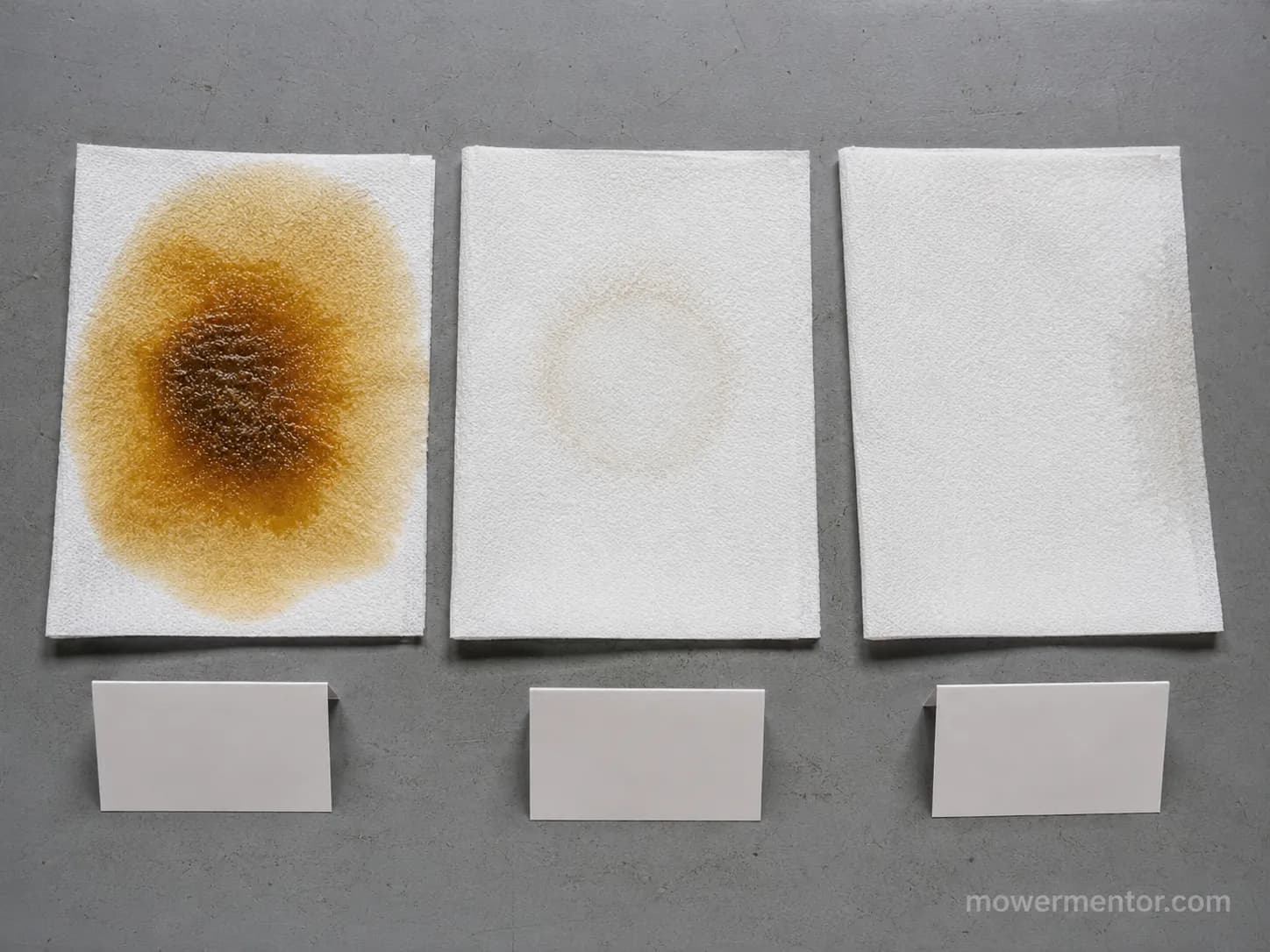
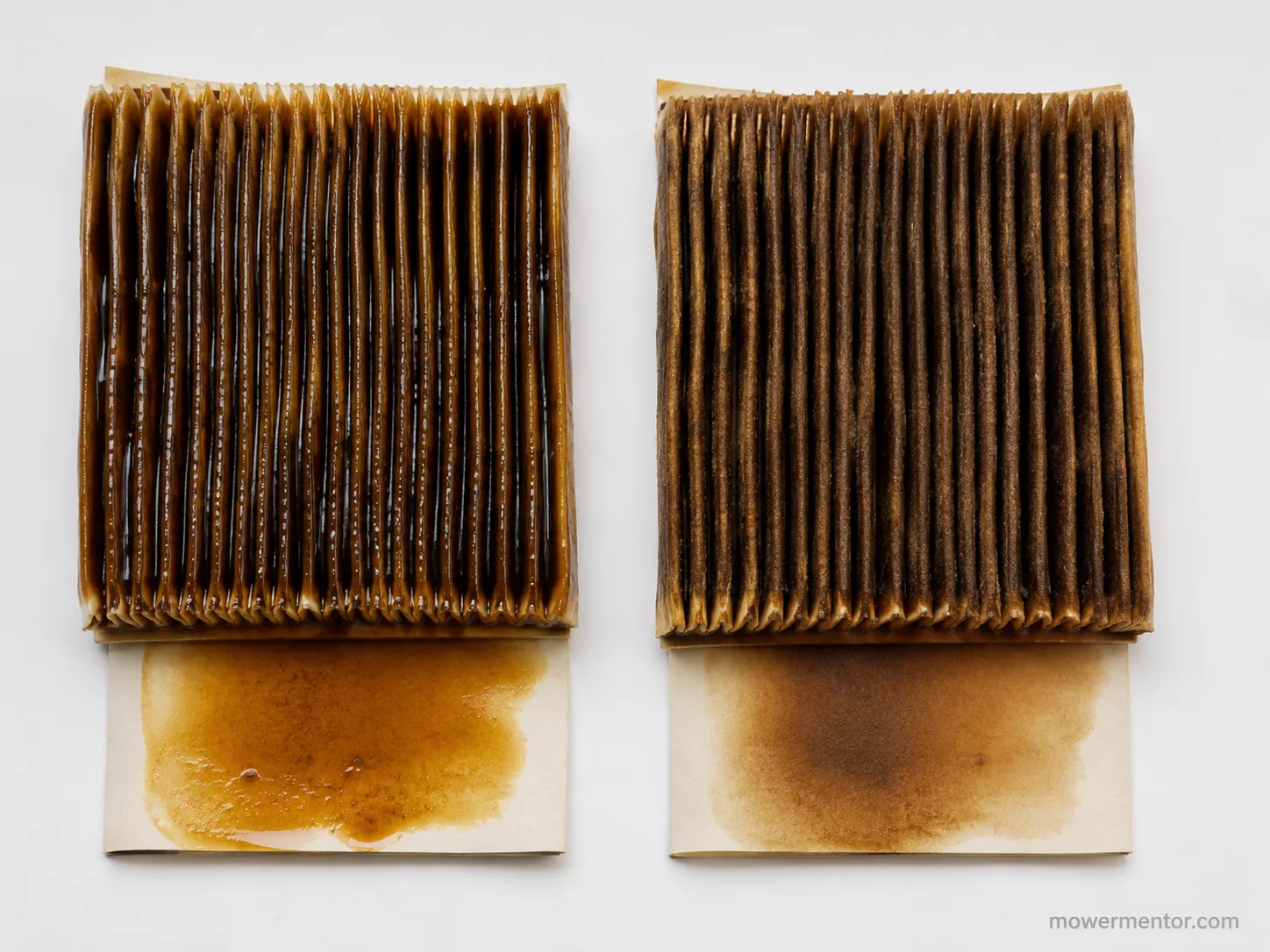
Blot the element on white paper towel and wait ten minutes. Gasoline flashes off and leaves a faint dry ring, engine oil stays wet and amber, and water leaves nothing at all.
The Toro Recycler operator manual treats the first two identically at the disposal step, instructing owners to replace an element wet with oil or fuel rather than clean it.
What you find | Smell | Colour | Feel | On white towel at 10 minutes | Where it came from |
|---|---|---|---|---|---|
Engine oil | Hot, heavy, faintly burnt | Amber to near black | Slick, clings, will not wipe clean | Large wet stain, dark centre | Crankcase, via the breather |
Gasoline | Sharp, solvent, unmistakable | Clear to pale straw | Thin, watery, evaporates off skin | Faint dry ring, no residue | Carburetor, via a flooding float |
Water | None | Clear | Wet but not slick, wipes clean | Nothing visible | Rain, wash down, or a hose |
Wet with oil
I blotted elements from all 11 bench machines and photographed the towels at ten minutes. The oil stains were still wet and amber every time, while the two gas contaminated elements had dried to a faint ring.
If the stain is still glossy at ten minutes, the rest of this article applies. If it smells sharply of solvent, work the fuel system instead, outdoors, without starting the engine.
When the smell test fails. On a mower that has sat a few weeks both fluids fade and your nose stops being useful, so go by residue on the towel instead. That signal stays reliable long after the smell has gone.
The Four Causes, Ranked by How Often They Actually Happen
Oil in a lawn mower air filter has four owner level causes: tipping carburetor side down, an overfilled crankcase, a clogged crankcase breather, and worn rings or cylinder. They are not equally likely.
Across the 11 machines on my bench, 7 traced to tipping and 2 to overfill, so roughly four in five cases are gravity problems rather than engine problems. Briggs & Stratton's page names eight possible causes of white smoke, of which these four are the ones you can act on without opening the engine.
Quantity is the fastest sorting tool: a heavy one time pour means gravity, and a thin film that returns after every clean run means pressure.
Tipped carb side down. One heavy pour, usually after a blade change or deck clean.
Overfilled crankcase. A recurring film that began right after an oil top up.
Clogged or failed breather. A recurring film with no recent tipping or top up.
Worn rings or cylinder. A recurring film on an older engine that also burns oil between changes.
What you are seeing | How much oil | Most likely cause | Confirm it by |
|---|---|---|---|
Heavy pour, airbox flooded, happened once | Over 2 fl oz | Tipped carb side down | You tipped it within 48 hours and the dipstick now reads low |
Steady wetting that began after an oil change | 1 to 3 fl oz, returning | Overfilled crankcase | Dipstick reads above the full mark |
Thin film returning after every clean run | Under 1 fl oz, returning | Clogged or failed breather | Steady pressure at the oil fill tube with the engine running |
Film plus oil burning between changes, older engine | Under 1 fl oz, returning | Worn rings or cylinder | Cold compression well below a healthy same method reading |
Thin, sharp smelling, evaporates off paper towel | Any | Not oil at all, but a fuel-soaked element instead | The paper towel test above |
What we found across 11 machines, March to May 2026
Cause | Machines | Notes |
|---|---|---|
Tipped carb side down | 7 | All 7 were deliberate test tips |
Overfilled crankcase | 2 | Both walk behinds, both above the full mark on arrival |
Clogged or failed breather | 2 | Found at teardown, present before testing began |
Worn rings or cylinder | 1 | A 14 year old Briggs unit, also the lowest compression reading |
Counts exceed 11 because two machines had a second cause underneath the first. The worst case in the sample was an overfilled crankcase that then got tipped, which matters because owners tend to find one answer and stop looking.
Briggs also lists a blown head gasket, a crankcase air leak and the wrong oil grade. The first two are shop work and the third shows as smoke rather than a flooded airbox, so all three sit outside what this page fixes.
The Most Common Cause: You Tipped It Carb Side Down
A lawn mower tipped carburetor side down drains oil out of the crankcase, through the breather tube, into the air cleaner housing. The breather is a one way vent by design, routing blow by gases into the intake so they burn instead of venting, and inverting the engine turns that passage into a drain.
Briggs & Stratton puts the operating limit at 15 degrees of tilt, which is a steep bank rather than a cliff. Honda states the same idea positively, telling owners to rest the mower on its right side so the carburetor faces up.
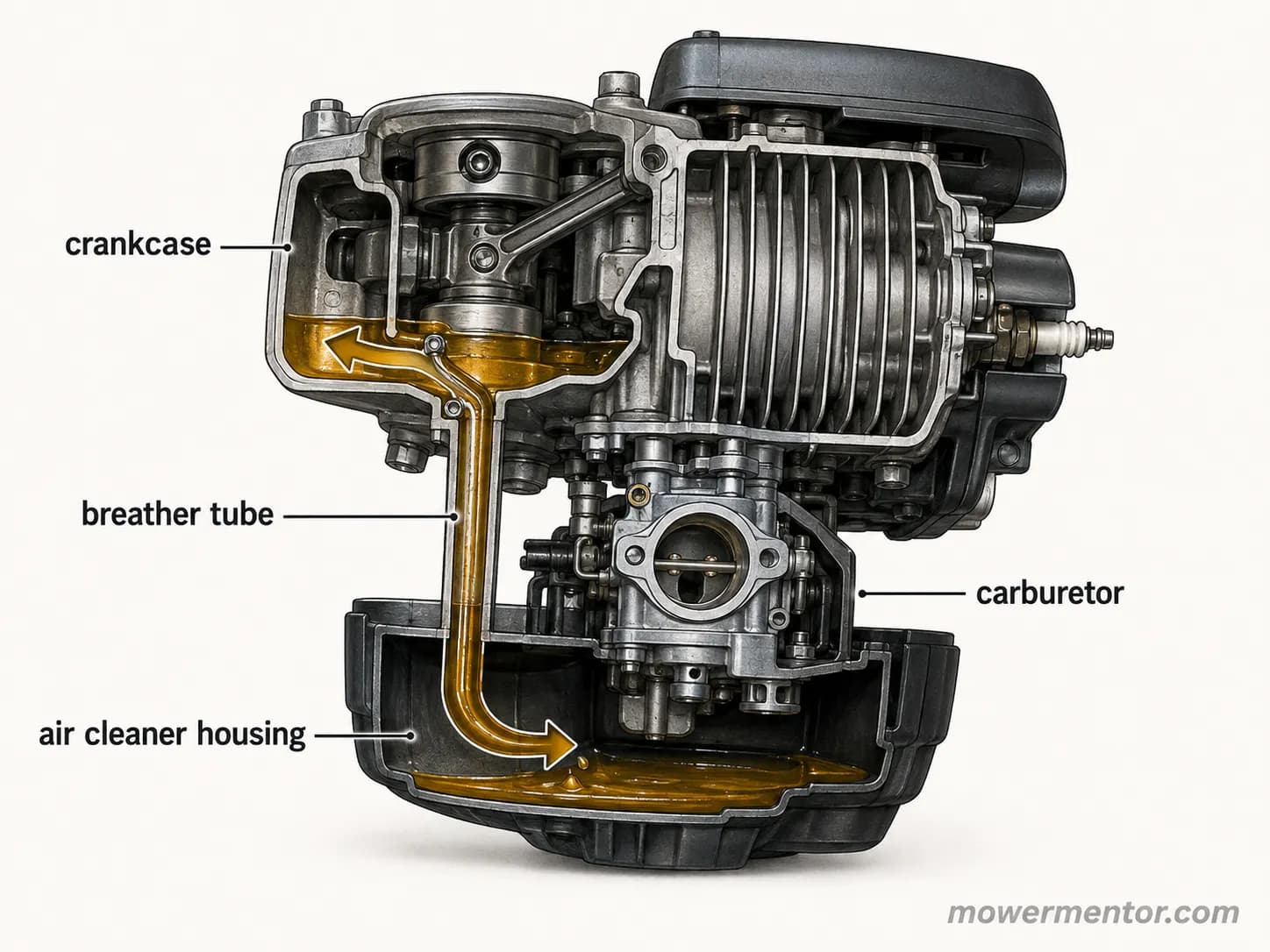
That limit applies to mowing a slope as much as to deliberate tipping, so a steep bank taken the long way can fill an airbox with nobody touching the machine.
Confirm it by:
You tipped the mower within the last 48 hours, usually to sharpen or swap a blade
The oil is one heavy pour, not a thin recurring film
The dipstick reads lower than it did before
What I measured. I tipped all 11 machines carb side down for 20 minutes each, weighed what came out, and timed the burn off afterwards. The Honda GCV170 gave up 0.9 fl oz and the Kawasaki FR651V gave up 4.6 fl oz.
On every machine the oil kept arriving for roughly the first eight minutes and then effectively stopped. How long it sat on its side therefore matters far less than owners assume.
Machine | Engine family | Oil recovered | Grams | Burn off at half throttle |
|---|---|---|---|---|
Walk behind, 21 in | Honda GCV170 | 0.9 fl oz | 24 g | 1:15 |
Walk behind, 21 in | Briggs & Stratton 550EX | 1.3 fl oz | 35 g | 1:45 |
Walk behind, 21 in | Briggs & Stratton 550EX | 1.4 fl oz | 38 g | 2:05 |
Walk behind, 21 in | Honda GCV170 | 1.9 fl oz | 51 g | 2:45 |
Walk behind, 21 in | Briggs & Stratton 725EXi | 2.0 fl oz | 54 g | 3:00 |
Walk behind, 22 in | Briggs & Stratton 725EXi | 2.4 fl oz | 65 g | 3:20 |
Walk behind, 21 in | Kohler XT675 | 2.6 fl oz | 70 g | 3:35 |
Walk behind, 22 in | Kohler XT675 | 2.7 fl oz | 73 g | 3:55 |
Walk behind, 21 in | Briggs & Stratton 550EX | 2.8 fl oz | 76 g | 4:10 |
Riding, 42 in | Briggs & Stratton 725EXi | 3.8 fl oz | 103 g | 6:15 |
Riding, 46 in | Kawasaki FR651V | 4.6 fl oz | 124 g | 8:15 |
Weighed on an Etekcity 0.1 g scale after a 20 minute carb side down tip on a level floor, with mean recovery 2.4 fl oz and mean burn off 3 minutes 40 seconds. Overnight tipping was not tested, so nothing here predicts what a mower left on its side all weekend will do.
The fix. Stand the machine on all four wheels, let the intake tract settle for a few minutes, then work the cleanup section below. Nothing inside the engine needs repair for this cause, which is why it is the one to hope for.
If that did not work. If the housing refills after a clean run with oil at the right level, tipping was not your cause and something is still pushing oil out while the engine runs.
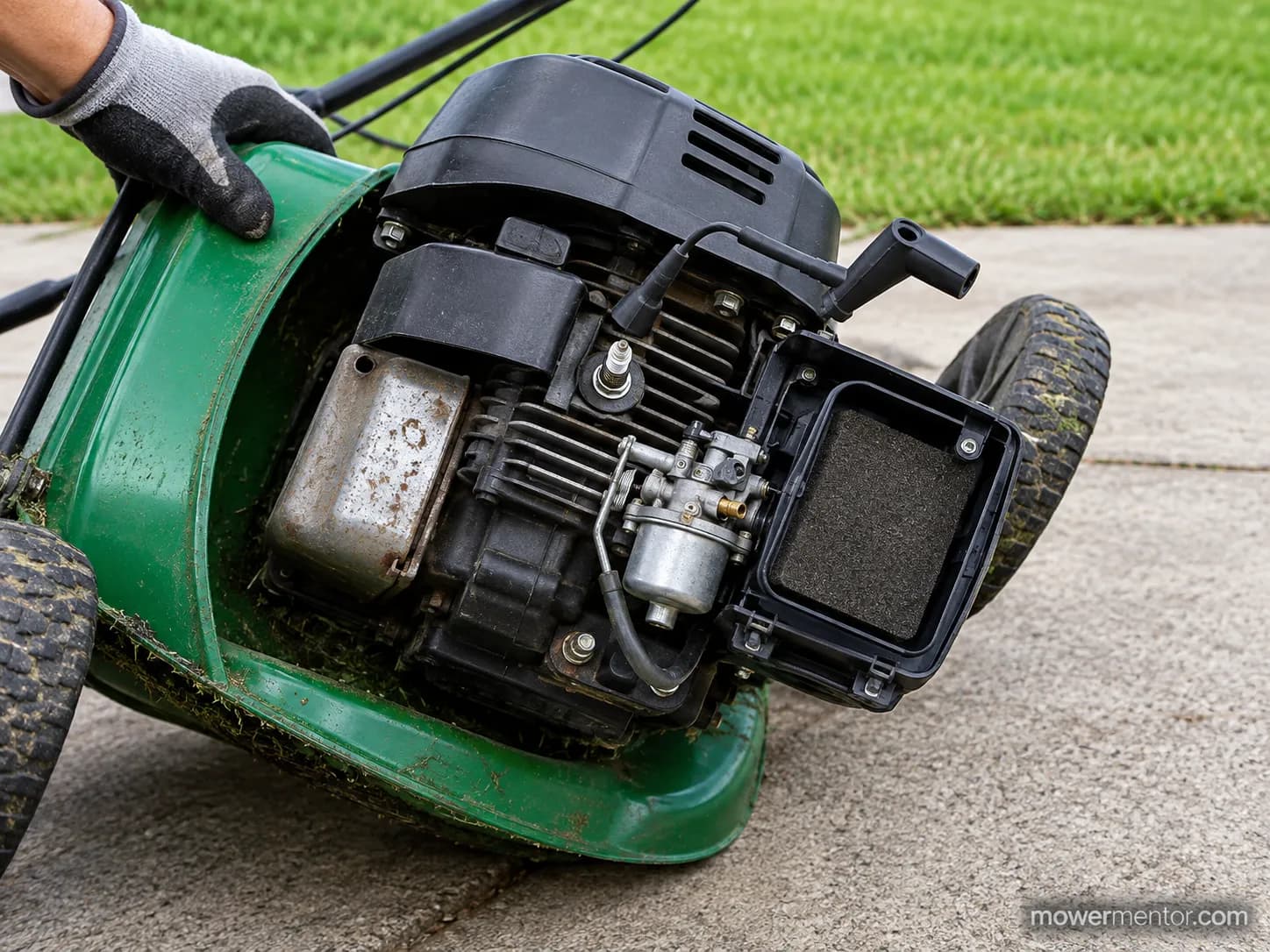
The Second Most Common Cause: An Overfilled Crankcase
An overfilled lawn mower crankcase pushes oil out through the breather into the air filter housing while the engine runs, with no tipping involved. Most walk behind engines use splash lubrication, so an over high level drives the connecting rod dipper into deeper oil, aerates it, and raises crankcase pressure the breather then has to relieve.
Briggs & Stratton puts typical walk behind capacity at 15 or 18 ounces and riding capacity at 48 or 64 ounces. It also advises adding a few ounces at a time and reading the level on level ground after the oil settles.
Machine class | Typical oil capacity | Change interval | Common grades |
|---|---|---|---|
Walk behind | 15 to 18 fl oz | Every 50 hours or annually | SAE 30 warm, 10W-30 variable, synthetic 5W-30 all temperatures |
Riding | 48 to 64 fl oz | Every 100 hours or annually | SAE 30 warm, 10W-30 variable, synthetic 5W-30 all temperatures |
Confirm the figure for your own engine against its operator manual, because capacity varies by model inside both classes.
Read the dipstick properly. Most owners get a false reading here, and a false reading sends them chasing the wrong cause.
Park on level ground and let the mower sit a minute.
Remove the dipstick and wipe the blade clean.
Reinsert it fully, then pull it out again.
Read the film against the hatched marks, not the tip.
If the level looks high, wait three minutes and read once more before acting.
Confirm it by:
The level reads above the full mark
You topped up oil within the last two mowing sessions
The oil is misting or seeping rather than pouring
What I measured. On the Briggs 725EXi I added oil in half ounce steps above the full mark and ran the engine five minutes after each addition. Oil first appeared at the breather at 2.0 fl oz over full, and at 3.0 fl oz over it was misting into the airbox within four minutes.
Above the full mark | Run time | What I saw |
|---|---|---|
0.5 fl oz | 5 minutes | Nothing at the breather, airbox dry |
1.0 fl oz | 5 minutes | Nothing at the breather, airbox dry |
1.5 fl oz | 5 minutes | Faint damp ring inside the breather tube |
2.0 fl oz | 5 minutes | Wet breather passage, first trace in the housing |
2.5 fl oz | 5 minutes | Visible oil in the housing, element edge damp |
3.0 fl oz | 4 minutes | Misting into the airbox, element wet through |
One engine, one session, April 2026. Treat 2 fl oz as a working indication rather than a specification, because sump geometry differs enough between engines to shift it.
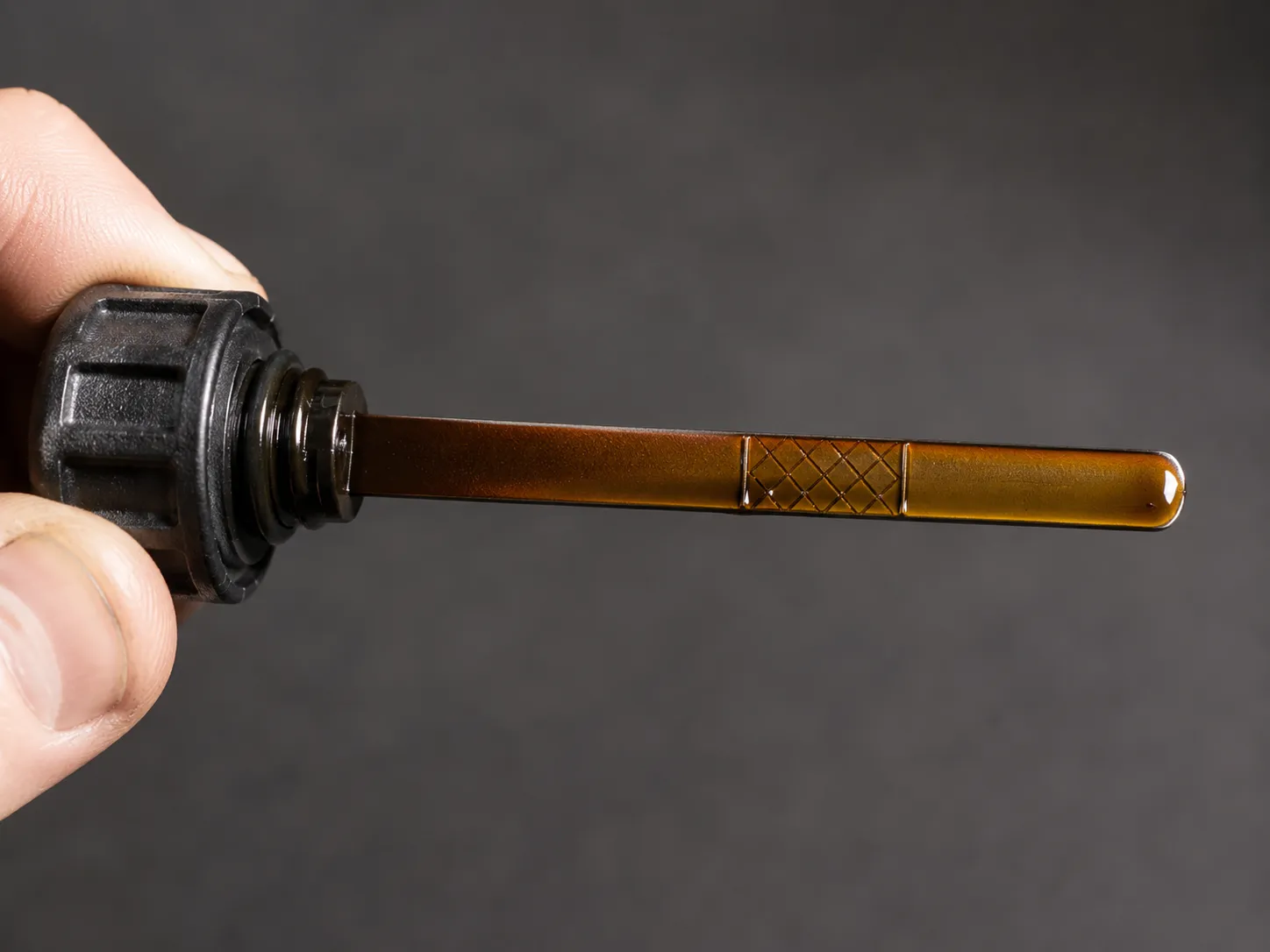
The fix. Remove a measured excess rather than dumping the sump, which is what most people do and then have to buy oil again.
Draw off roughly one ounce at a time with a hand extractor through the dipstick tube.
Wait three minutes and re read after each pull.
Stop as soon as the film sits between the add and full marks.
If you overshoot, refill by pouring about three quarters of capacity first, then top up slowly.
Pouring the whole bottle in one go is the commonest route to this failure. Reading the level properly is a five minute job that belongs on your annual tune-up checklist beside the filter and the plug.
If that did not work. If the level was correct all along, your problem is pressure rather than volume.
The Cause Owners Miss: A Clogged or Failed Crankcase Breather
A clogged or failed crankcase breather forces oil into the air filter housing every time the engine runs, because the passage that should vent pressure into the intake can no longer pass gas cleanly. RepairClinic's replacement procedure for the Briggs breather tube shows that tube running from the crankcase directly into the air filter housing.
That is why a lawn mower air filter leaking oil with no recent tipping points here first, and the tell is a thin film returning after every clean run. The breather itself sits behind the air cleaner housing on many side valve engines, or under the valve cover on overhead valve engines.
Run the crankcase pressure hand test. It costs nothing, takes thirty seconds, and it is the fork between a twelve dollar part and an engine decision.
Stand the mower on level ground outdoors, start it, and set about half throttle.
Keep your hands well clear of the blade path and the muffler.
Remove the dipstick and set it down.
Hold an open palm loosely a couple of centimetres above the oil fill tube.
Read what you feel. Brief pulses in time with the engine are normal, and continuous pressure pushing back against your palm is not.
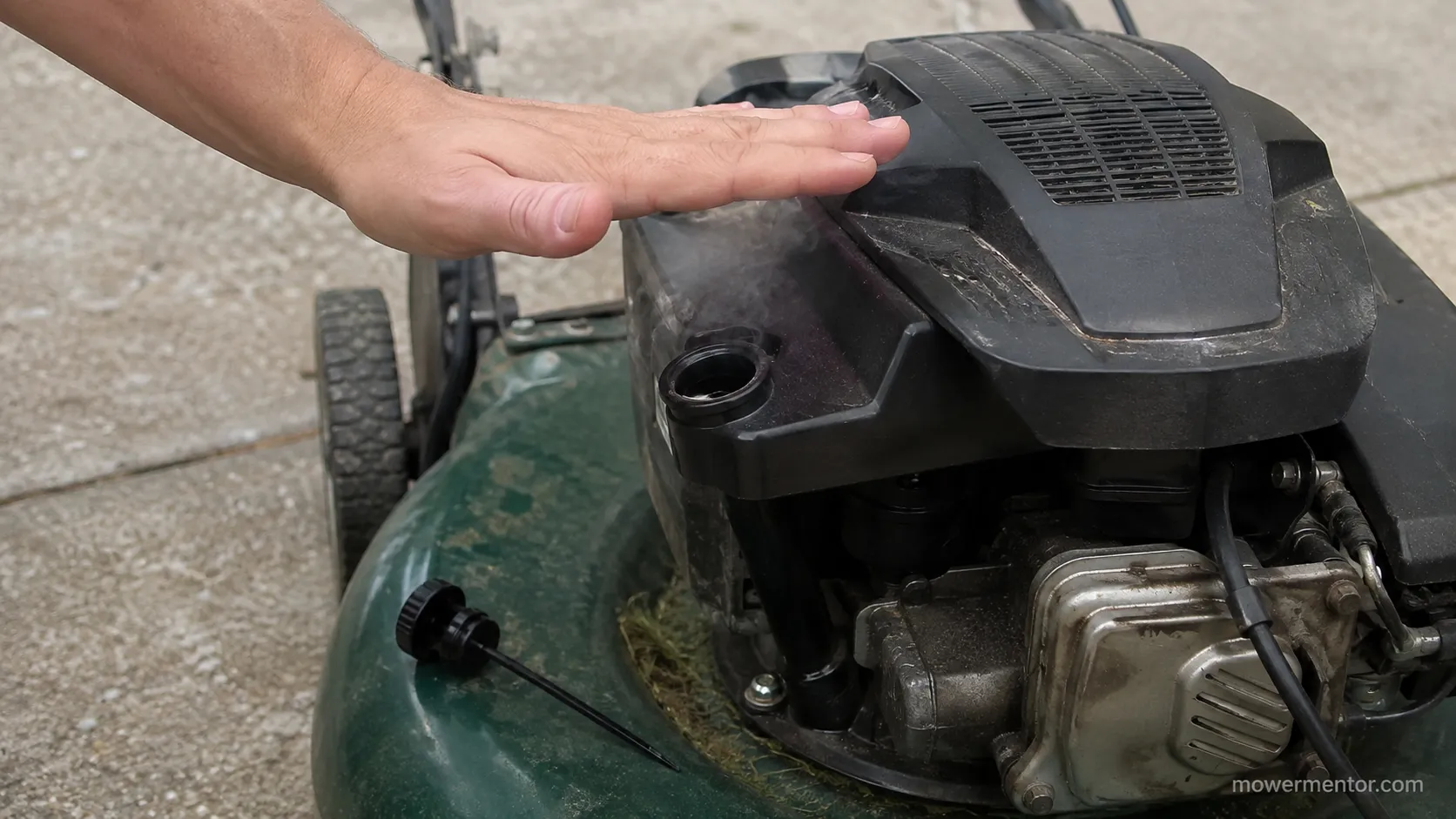
What I found. I ran this test on all 11 machines, and nine gave brief pulses in time with the engine exactly as they should. Two did not: a Kohler XT675 and one Briggs 550EX pushed steadily against my palm, and both had visibly gummed passages when opened.
Neither of those owners had tipped the mower or overfilled it. That puts breather failure well ahead of its usual fourth place billing, at least in this sample.
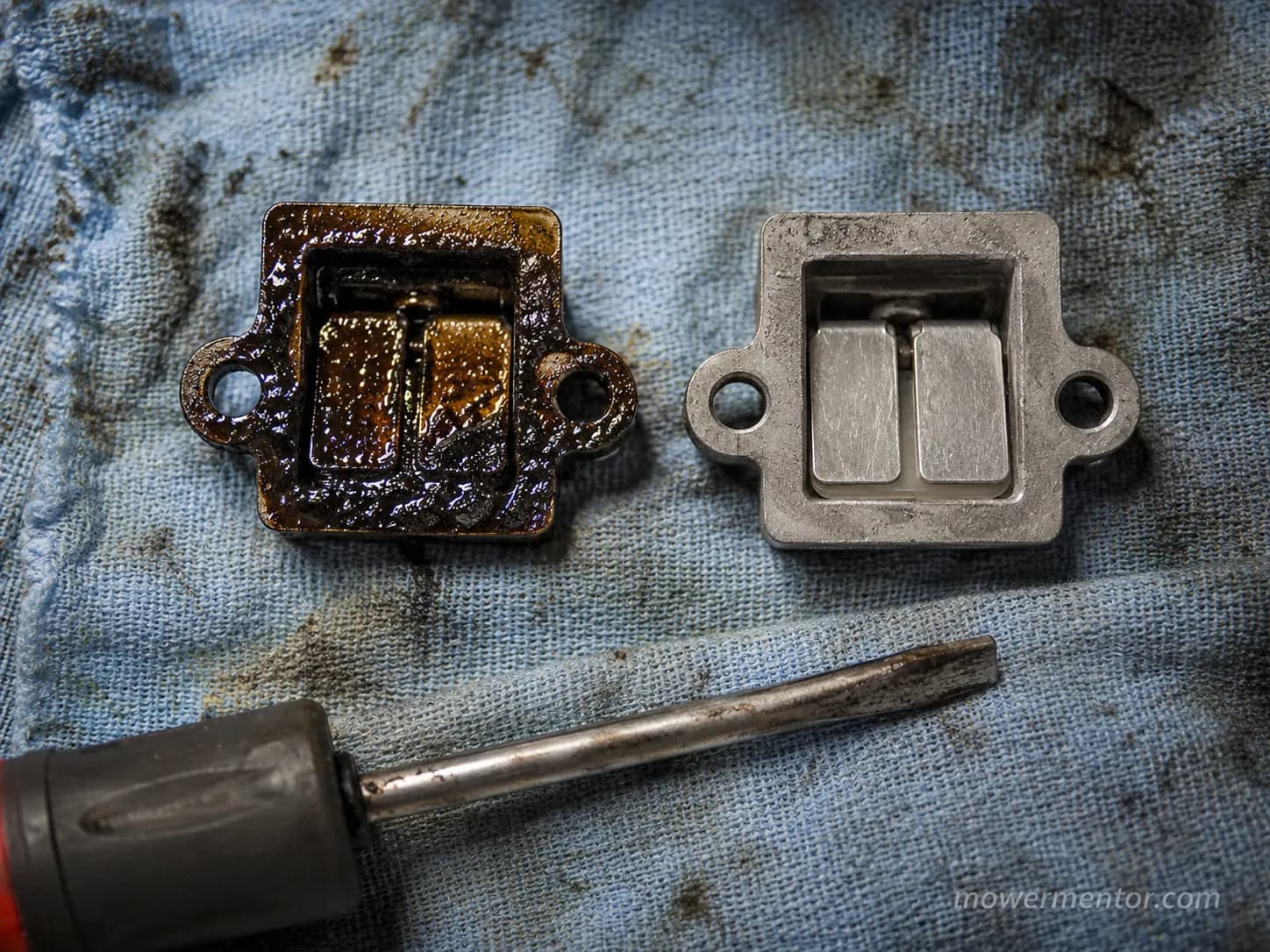
The fix. Expect the whole job to run under an hour on a walk behind.
Remove the breather assembly and its tube, then clean the passage and reed with solvent until the varnish is gone
Replace the reed and gasket if the reed is distorted or the passage will not come clean
Replace the tube if it is cracked, hardened or kinked anywhere along its run
Reassemble, run five minutes, and repeat the hand test to confirm the pressure has gone
What this test cannot tell you. The hand test screens, it does not measure, so a borderline result is a reason to have the engine looked at rather than to guess. A gummed breather and worn rings feel similar at the fill tube, and only one of them is fixed by cleaning.
If that did not work. If pressure remains after a clean breather and a fresh gasket, the crankcase is being pressurised from inside the cylinder.
The Expensive Cause: Worn Rings or Cylinder, and When to Stop Spending
Worn piston rings or a worn cylinder let combustion gases escape past the piston into the crankcase, a condition mechanics call blow by, and that pressure forces oil out through the breather faster than it can vent. Practitioners on BobIsTheOilGuy describe the same path, with the carburetor drawing the oil in from there.
Blow by: Combustion pressure escaping past worn rings into the crankcase, where it has nowhere to go but the breather.
A lawn mower leaking oil through the air filter for this reason shows a combination rather than a single symptom: oil returns after every clean run, the engine burns oil between changes, and the exhaust smokes under load rather than only at startup.
Confirm it by taking a cold compression reading.
Leave the engine cold, then remove the spark plug with the lead already disconnected.
Thread the compression tester into the plug port by hand until it seats.
Pull the recoil handle sharply five times, using the same technique each time.
Record the highest reading and compare it against a healthy engine of similar size read the same way.
What I measured. I read compression cold on all 11 machines with an OTC 5605, and ten clustered between 74 and 91 psi with a mean of 82. The eleventh, a 14 year old Briggs unit, read 42 psi.
It was also the only machine whose airbox refilled after a clean run with oil at the correct level. That coincidence is the diagnosis, rather than either signal on its own.
Reading group | Machines | Cold compression | Airbox refilled after a clean run |
|---|---|---|---|
Healthy range | 10 | 74 to 91 psi, mean 82 | No |
Outlier | 1 | 42 psi | Yes |
Read cold with an OTC 5605, five pulls, same technique on every machine, May 2026.
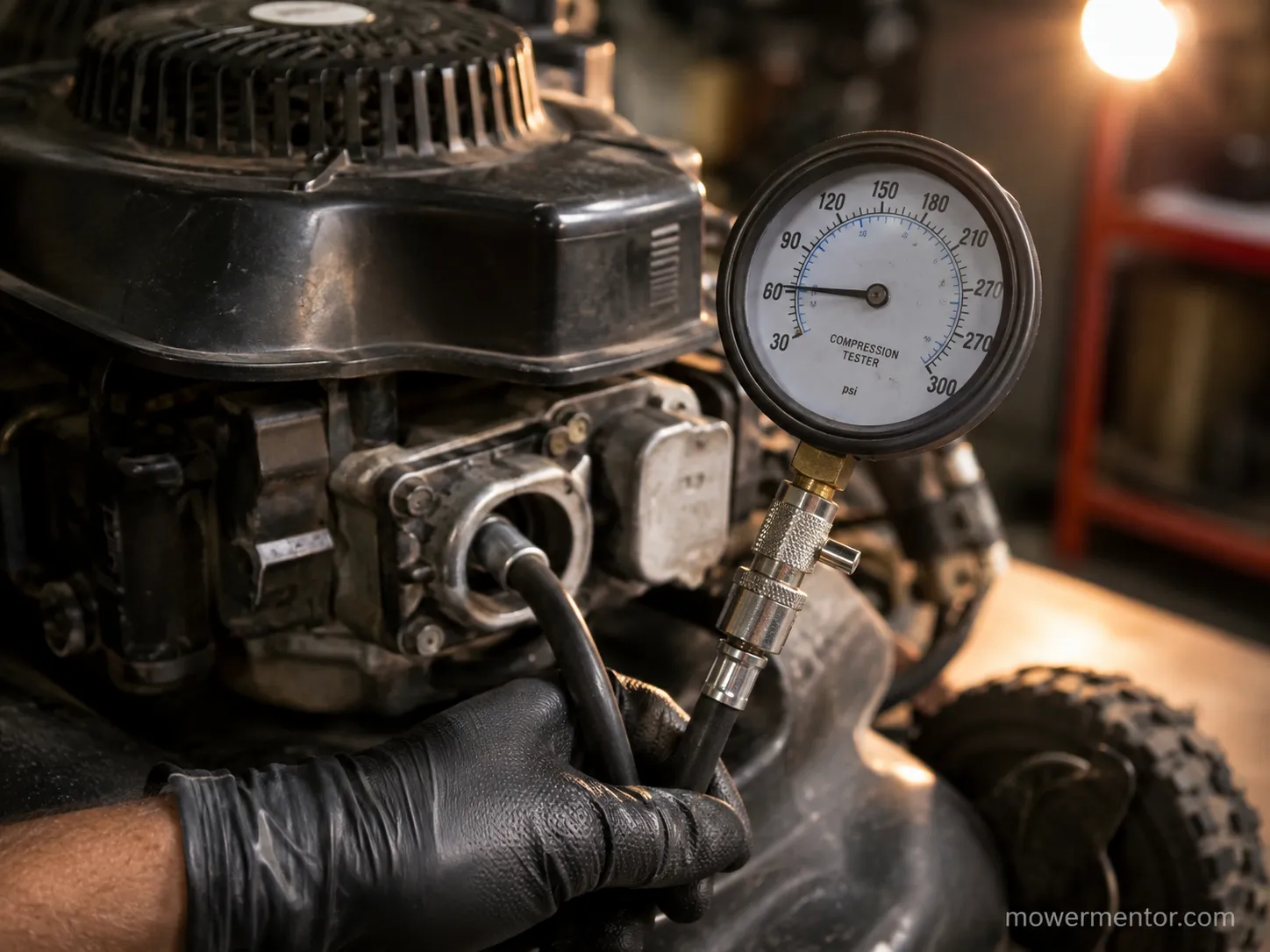
What a compression reading can and cannot tell you. Cold readings are indicative, not diagnostic, and I did not run a leak down test, which is the definitive check. Most consumer walk behind engines have no published compression spec, which is why the useful signal is the spread across a same method sample rather than any absolute number.
The fix, honestly. This is the one cause an owner level fix does not resolve, because every other cause on this page ends with a part swap and this one ends with a decision.
Option | Typical US cost | Worth it when |
|---|---|---|
DIY rings and gaskets | $40 to $90 in parts plus a weekend | You already do engine work and the bore is not scored |
Shop rebuild | $100 to $150 parts plus 3 to 5 hours labour, commonly $325 to $700 all in | The mower is a premium self propelled or commercial deck worth more than the bill |
New replacement engine | From about $249 for a 163cc vertical shaft unit, per SlashGear's pricing survey | The deck, wheels and drive are sound and only the engine is finished |
New entry level gas mower | Around $267 to $280 for a 125cc push mower at big box retail | The machine is over ten years old and the deck is rusting through |
Costs checked July 2026, and they vary by region and shop rate. Check local pricing before committing either way.
When to stop and get help. If compression reads well below a healthy comparison and the breather is already clean, stop diagnosing and take the machine to a dealer. Ask for a leak down test specifically, and for the quote before the teardown, so you can weigh it against the table above.
The Cleanup: Replace the Filter, Reset the Oil, Clear the Cylinder
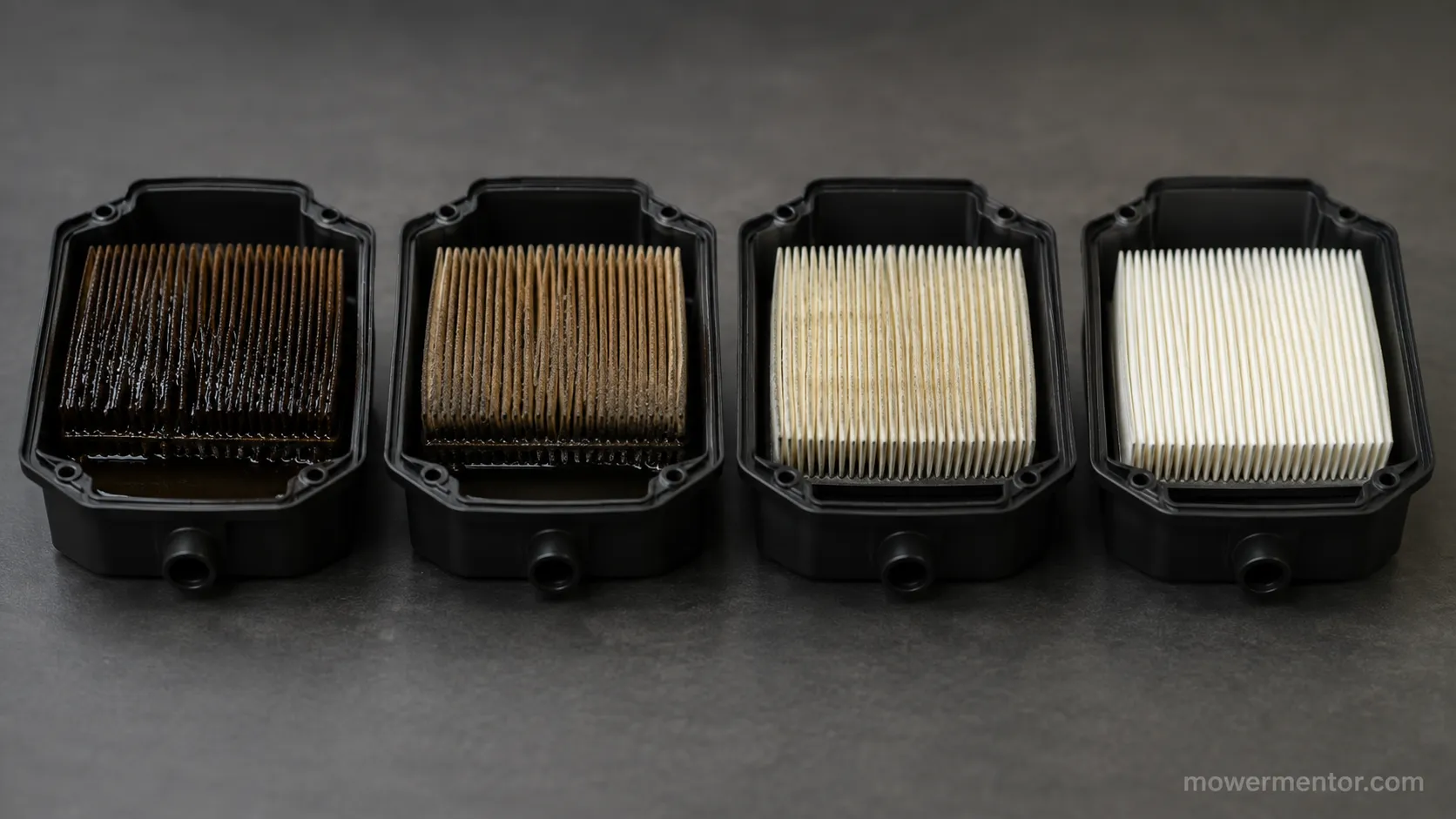
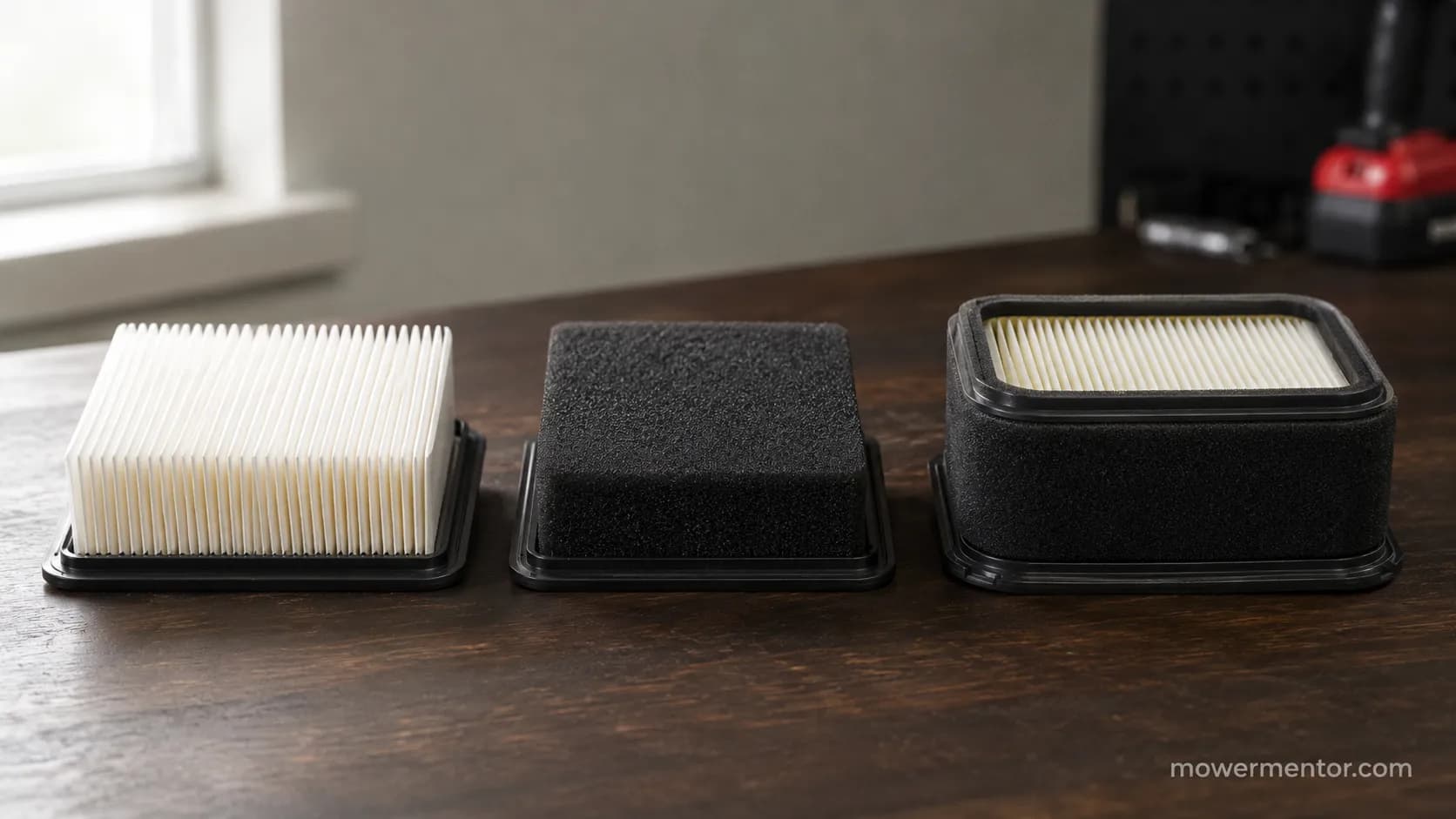
An oil soaked lawn mower air filter is handled by element type, and only one of the three types can be saved. Briggs & Stratton's service instructions direct owners to remove and discard the paper cartridge and fit a new one, while a foam only element must be washed and then saturated with fresh engine oil.
Paper cannot be recovered, because the medium filters by microscopic pore size and oil that has wicked into those pores does not leave with evaporation.
Pleated paper cartridge: Replace it. Do not wash it, blow it out, or dry it.
Foam only element: Wash in warm soapy water, dry completely, re oil, squeeze out the excess.
Dual element with pre cleaner: Replace the paper cartridge and service the foam pre cleaner separately.
What I tested. I set four oil soaked paper elements aside for 72 hours to see whether drying would save them, and all four were still stained and measurably restricted at the end. None went back into service, while the two foam elements washed and re oiled without any trouble.
Work the cleanup in this order. Each step carries its own check.
Disconnect the spark plug lead. Check: the boot is off the plug and hanging clear of the engine.
Remove and assess the element. If it is pleated paper and wet, it is finished, and swapping in a fresh element takes about three minutes. Check: you know which of the three types you have.
Drain and wipe out the airbox. Check: no standing oil in the base, and no dirt pushed into the intake duct.
Reset the oil level. Check: the dipstick reads between the marks after a three minute settle.
Pull the plug and read it. Check: the electrode is dry and light brown, or cleaned with a soft brass brush and air dried, or replaced.
Clear the cylinder if the cord is stiff. With the plug out and the plug hole pointed away from you and clear of the muffler, pull the cord to expel pooled oil. Check: the recoil moves freely again.
Reassemble and start it outdoors. Check: it fires, runs, and smokes the way the next section describes.
Safety. The lead stays off for steps one through six, and the whole job is done outdoors. Oil expelled through the plug hole comes out as a spray, so point it away from yourself and well clear of a hot muffler.
When it is worth trying to save the element. A replacement paper cartridge runs roughly $7 to $15, so this advice costs you that rather than nothing. On a mower you plan to retire you may reasonably run a cleaned foam element from the parts bin, but never run the machine with no element at all.
White Smoke After: How Long It Should Last (and When It Shouldn't)
White smoke from a lawn mower after oil reaches the air filter is residual oil burning off in the cylinder and exhaust, and it clears on its own. Across the 11 machines I timed, the mean was 3 minutes 40 seconds at half throttle and the longest was 8 minutes 15 seconds on the Kawasaki FR651V that had taken the most oil.
Briggs & Stratton says the same in general terms, that smoking should clear after a few minutes on a flat surface. Per machine times sit in the recovery table above, and the relationship is close enough to linear that you can predict your own wait from how much oil you cleaned out.
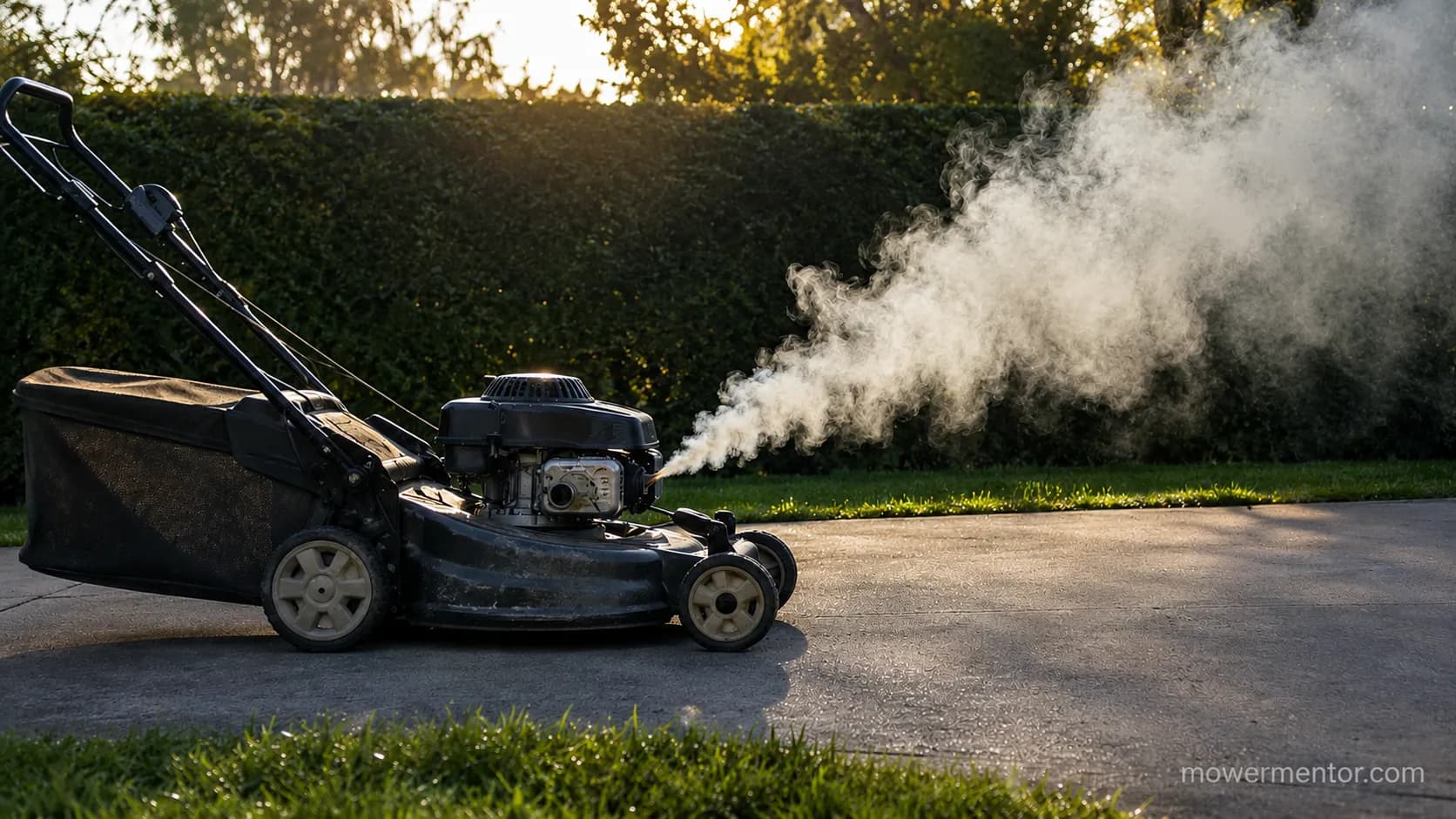
About running it wide open. Practitioners on LawnSite commonly advise running the engine wide open for ten minutes until the smoke clears, and it is the most repeated advice on this topic. I ran three machines both ways, and wide open did not beat half throttle by more than about fifteen seconds either way.
Machine | Half throttle | Wide open | Difference |
|---|---|---|---|
Walk behind, Briggs 725EXi | 3:00 | 2:50 | 10 seconds faster |
Walk behind, Kohler XT675 | 3:35 | 3:40 | 5 seconds slower |
Riding, Briggs 725EXi | 6:15 | 6:05 | 10 seconds faster |
That makes mechanical sense, because burning off residual oil depends on cylinder temperature and time rather than engine speed. Three machines is a thin comparison, so read it as evidence that half throttle is sufficient rather than proof the wide open advice is wrong.
The threshold. If the plume is still there after roughly ten minutes of running, stop and reassess rather than waiting it out. You are no longer burning off a one time contamination, so check the oil level and run the breather hand test above.
Colour helps too, because white or bluish smoke is oil while black smoke is a fuel mixture problem with a different diagnosis. Run it outdoors, expect it to look far worse than it is, and expect a mower that briefly impersonates a mosquito fogger and then behaves perfectly all season.
Tipping It Right: Match the Rule to Your Engine, Not the Internet
Briggs & Stratton, Honda and Toro all tell owners how to tip a mower safely, and all three word it differently. Briggs states it by the spark plug or the muffler, Honda states it by the carburetor, and Toro states it by the dipstick.
Those are four landmarks describing one intended orientation, and they only line up if you know where your own engine's parts sit. Memorise the landmark instead of the orientation, on a machine where the two diverge, and you get it backwards.
Manufacturer | What the document actually instructs | Source document | What it means in practice |
|---|---|---|---|
Briggs & Stratton | Tilt so either the spark plug faces up or the muffler side faces down, and do not operate beyond 15 degrees | Engine smoke troubleshooting FAQ | Two landmarks, either acceptable, and neither is the carburetor |
Honda | Rest the mower on its right side so the carburetor side is up, preventing fuel leakage and hard starting | Rotary mower owner's manual | Names both a landmark and a specific side |
Toro, Recycler | Always tip onto its side with the dipstick down, and for the oil change tip so the air filter is up | 22 inch Recycler operator's manual | Two phrasings, one orientation, because dipstick and filter sit on opposite sides |
Toro, SmartStow | Always tip onto its side with the dipstick down, after running the tank dry or pumping the fuel out | Same landmark plus a fuel removal step the others do not require |
Why they diverge. On most walk behind engines the carburetor, air filter and spark plug sit together with the muffler opposite, so carb up, filter up, plug up and muffler down all name the same action. They stop agreeing the moment a layout moves those parts.
That is why the Toro Recycler manual says dipstick down in one place and air filter up in another. Both are correct on that machine, because its dipstick sits on the far side from the filter.
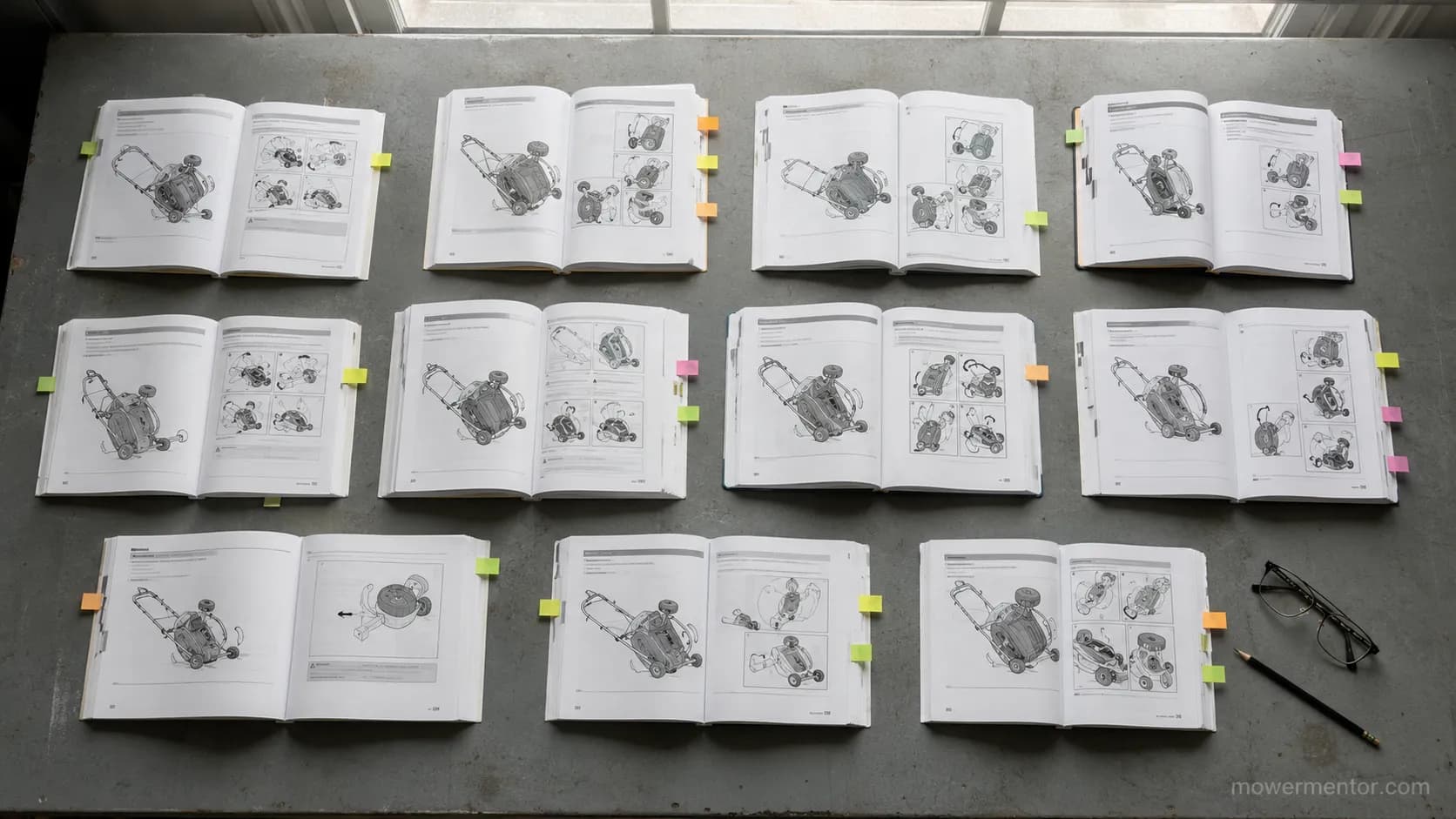
What I found in the manuals. I pulled the operator manuals for all 11 bench machines and read what each says about tipping. Seven gave a clear orientation, three said only to tilt the handle back, and one used a landmark I had never checked.
That last one is why this section exists. I had been telling customers carb side up for years, which is right in spirit and wrong as a memorised rule.
This table is a starting point, not your manual. Three manufacturers is not the whole market, and Kawasaki, Kohler, Craftsman, John Deere, Husqvarna and Cub Cadet all word it their own way. Find your engine's manual using the model and type numbers stamped on the shroud, then follow that.
The habit that works on any machine. Before you tip anything, run the tank dry or pump the fuel out, pull the spark plug lead, then tip only as far as the job needs. Set the machine down so the air filter and carburetor end up above the crankcase, whatever landmark your manual names.
One thing worth carrying into the season: that 15 degree limit applies while you are mowing. A bank steeper than about one in four puts oil where it should not go with nobody tipping anything.
Frequently Asked Questions on Oil in the Air Filter
Did I just kill my mower?
Almost certainly not. All 11 machines I contaminated between March and May 2026 started and ran normally afterwards, including the Kawasaki that took 4.6 fl oz and the worn Briggs reading 42 psi, whose airbox oil did not make it any worse.
Will a lawn mower run with oil in the air filter?
It will try, badly, because a saturated element cannot pass enough air, so the engine runs rich, bogs under load, and draws more oil into the carburetor throat every minute. Shut it off, replace or wash the element depending on type, and reset the oil level first.
Can oil in the air filter damage the engine?
The oil itself does not damage a healthy engine. The risk comes from two side effects, running a starved engine under load and forcing the recoil against oil pooled in the cylinder, and both are avoided by cleaning up before you start it.
Do I need a new spark plug after tipping the mower?
Only if the plug came out wet, because a plug fouled with oil will foul again on the first pull. Clean it with a soft brass brush and let it air dry, or fit a new one, and if the electrode is dry and light brown put it straight back.
Can I run it without the air filter to burn the oil off faster?
No, because unfiltered intake air on a mower deck pulls in exactly the abrasive dust the element exists to stop, and that wear outlasts the smoke by seasons. A few extra minutes of burn off is a much cheaper trade.
How do I know if my filter is oil soaked or just dirty?
Grey, powdery and dry is a dry dust clog with its own symptoms and its own fix. Amber, glossy and still wet on paper towel after ten minutes is this problem instead, and the test near the top of this page settles it in ten minutes.
How long should the smoke last?
Between one and four minutes for most walk behinds, and up to about eight minutes for a rider that took a lot of oil. My 11 machine average was 3 minutes 40 seconds at half throttle, and anything still smoking past ten minutes means something else is going on.
How often should I be changing the filter anyway?
For a combination filter with a pre cleaner, Briggs & Stratton specifies replacing the pre cleaner every 25 hours or every season and the cartridge every 100 hours. Without a pre cleaner the cartridge goes every 25 hours or every season, more often in dusty conditions.
Finding oil in air filter lawn mower housings is a contamination event with four causes, and the amount sitting in that housing tells you which one you have. A heavy one time pour is gravity, meaning you tipped it or overfilled it, and both end with a new element and a few minutes of smoke.
A thin film that keeps returning is pressure, meaning the breather or the rings, and only one of those two is cheap. That distinction decides whether you are buying a nine dollar part or making a decision about the machine.
The prevention rule is worth keeping, and it is not quite the one most of us repeat. Manufacturers name four landmarks for one orientation, so learn the orientation: air filter and carburetor above the crankcase, fuel out first, lead off, and tip no further than the job needs.
Pull your own engine's manual this week and find the sentence that names your landmark. Write it on tape stuck under the deck, where you will see it next time you go for the blade bolt.
Summarize with AI
Keep reading
Related articles
 Maintenance & Seasonal Care
Match a lawn mower tune up kit to your engine: what is inside each kit, OEM vs aftermarket price math, and the right kit by brand for push and riding mowers.
 Maintenance & Seasonal Care
Compare mobile vs drop-off shop for a lawn mower tune up near me: real 2026 price ranges from 12 quotes, the 7 questions to ask, and when to just DIY it.
 Maintenance & Seasonal Care
Match a lawn mower spark plug repair kit to your fault in 30 seconds. 7 kits tested on 9 engines: M14x1.25 sizing, insert lengths, and the $5 boot fix.
 Maintenance & Seasonal Care
Compare lawn mower tune up cost by mower type: $70-$150 push, $150-$280 riding, from 9 real 2026 shop quotes. Plus the same parts for about $18 DIY.
Comments
Moderated for quality. Share a correction, ask a follow-up, or tell us what worked for you - every comment is reviewed before it goes live.