
Briggs & Stratton Spark Plug: Cross-Reference & Gap Chart
Match your Briggs & Stratton engine to the right spark plug: Champion/NGK cross-reference, 0.030″ gap, 5/8″ vs 13/16″ socket, plus the upgrade verdict.
Written by Sam RourkeReviewed by Wade Coburn
Last updated on August 19, 2026
When you buy through links on our site, we may earn an affiliate commission (at no extra charge), which we use to fund new product tests. Learn more.
Summarize with AI
Most Briggs & Stratton lawn-mower engines take a Champion RJ19LM (flathead/L-head) or Champion RC12YC (OHV) spark plug, gapped to 0.030 in and removed with a 5/8 in or 13/16 in socket.
Confirm the exact part with your engine's Model, Type and Code number before buying. Thinking about an upgrade? An NGK or Briggs platinum plug is a low-cost swap covered further down.
Finding the right Briggs & Stratton spark plug should take one lookup, not five browser tabs. The trouble is that the answer is split across the manufacturer's part finder, a handful of cross-reference databases, and forum threads that each say something slightly different.
This page pulls those fragments into one place. You get the correct plug for your engine, every brand equivalent, the gap and socket, and an honest verdict on whether the factory plug is worth replacing.
Which Briggs & Stratton Spark Plug Do You Need First
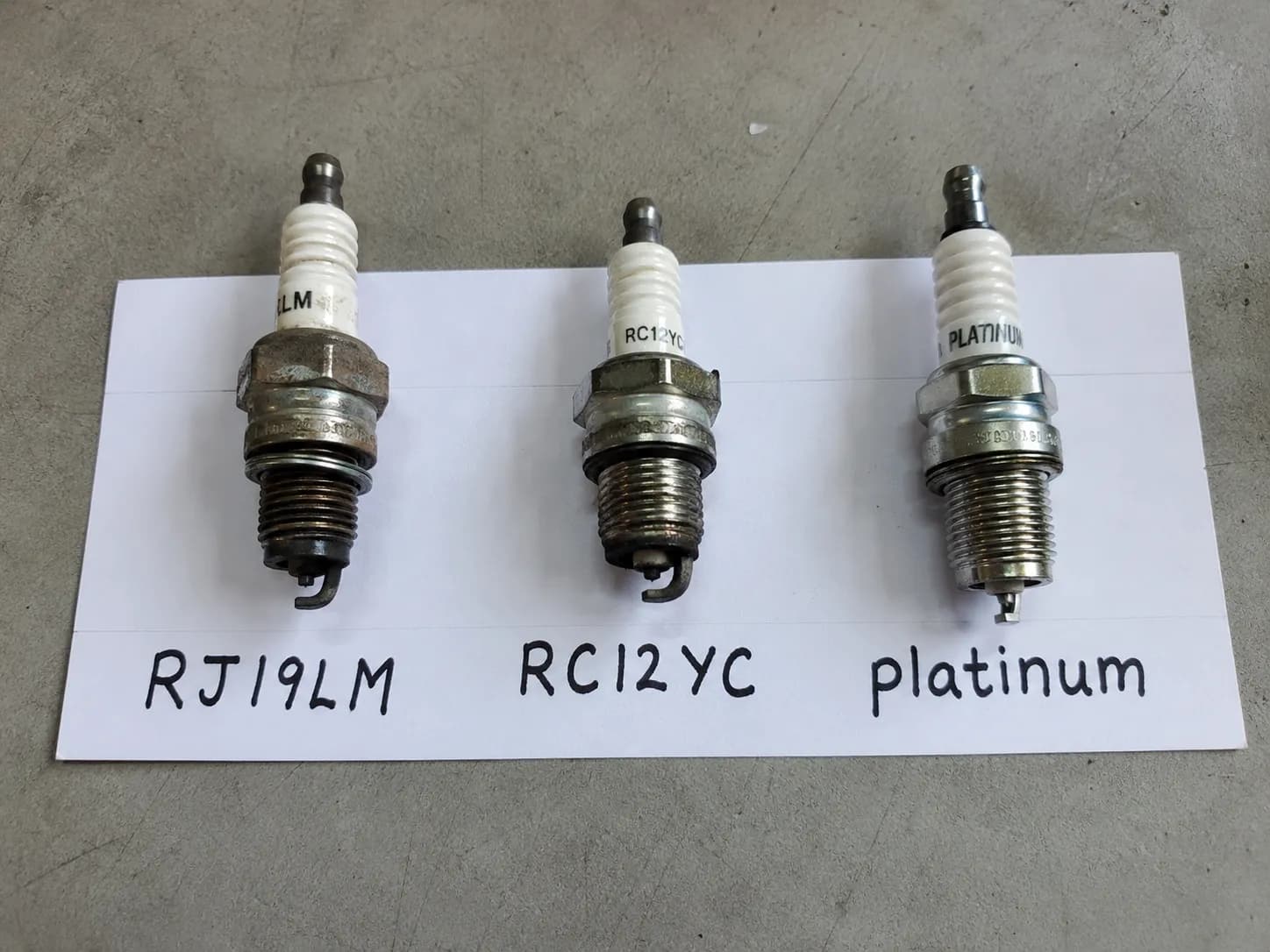
Briggs & Stratton spark plugs split cleanly into two families. Flathead (L-head) engines use a short-reach Champion RJ19LM, while overhead-valve (OHV) engines use a longer-reach Champion RC12YC.
Both are gapped to 0.030 in, the spec Briggs & Stratton's spark-plug FAQ lists as standard for the vast majority of its engines. The only decision before you buy is which family your engine belongs to.
On the three Briggs-powered mowers in our test fleet, the split held exactly as expected. The two OHV engines took the RC12YC, and the older flathead push mower took the RJ19LM.
So the very first step is identifying your engine, not your mower brand. The next section shows exactly where to look.
Find Your Engine Number Before You Cross-Reference
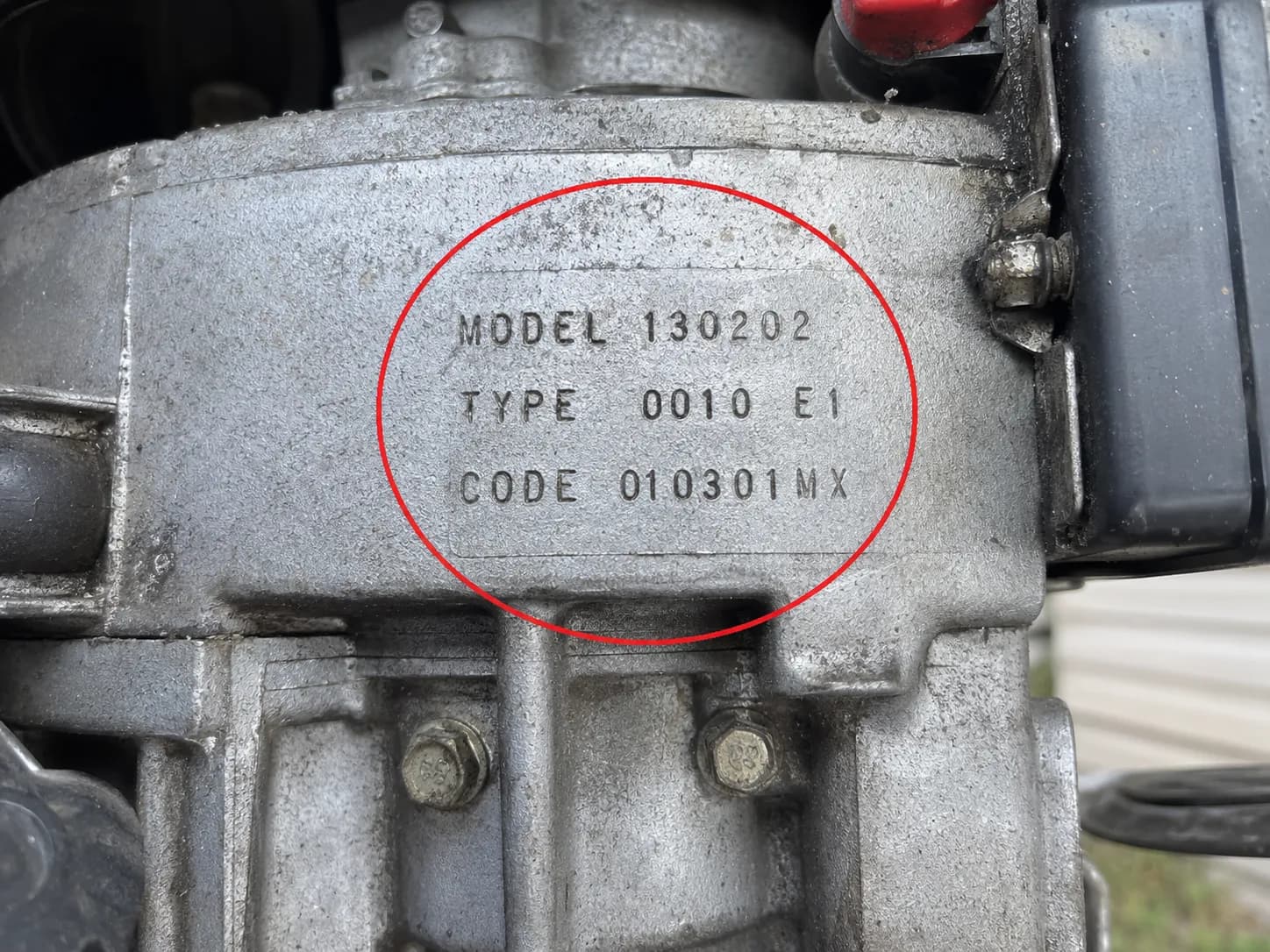
Before choosing a Briggs & Stratton spark plug, find the engine's Model, Type and Code number stamped on the metal blower housing or a valve-cover label, not the mower's brand badge. Entering that number in the official parts lookup returns the exact factory plug, because the same mower model can ship with different engines over the years.
The engine stamp is the only number that always tells the truth. Here is the order that works every time:
Find the stamp on the blower housing (the metal shroud over the engine), often above the muffler or near the spark plug.
Read the three numbers in order: Model, then Type, then Code. The Model identifies the basic engine, the Type identifies the variant, and the Code is the build date.
Enter those numbers in the Briggs parts lookup to pull the OEM plug for your exact engine.
One caveat trips people up on Quantum engines. The correct plug can change with the engine's Code Date, so check that date before you order rather than assuming all Quantums match.
Trust the engine stamp, not the deck sticker. If a mower has had a replacement engine fitted, the deck badge and even the owner's manual can name the wrong plug. The numbers stamped into the engine win.
Identifying the engine is also the first move in a full seasonal service, so this page is one stop in the complete lawn-mower tune-up.
Why Reach Decides Your Plug, Not Just Brand
Briggs & Stratton flathead engines use a short-reach plug such as the Champion RJ19LM, about 3/8 in of thread, while overhead-valve engines use a long-reach plug such as the RC12YC, about 3/4 in of thread. This is the single most important distinction on the page.
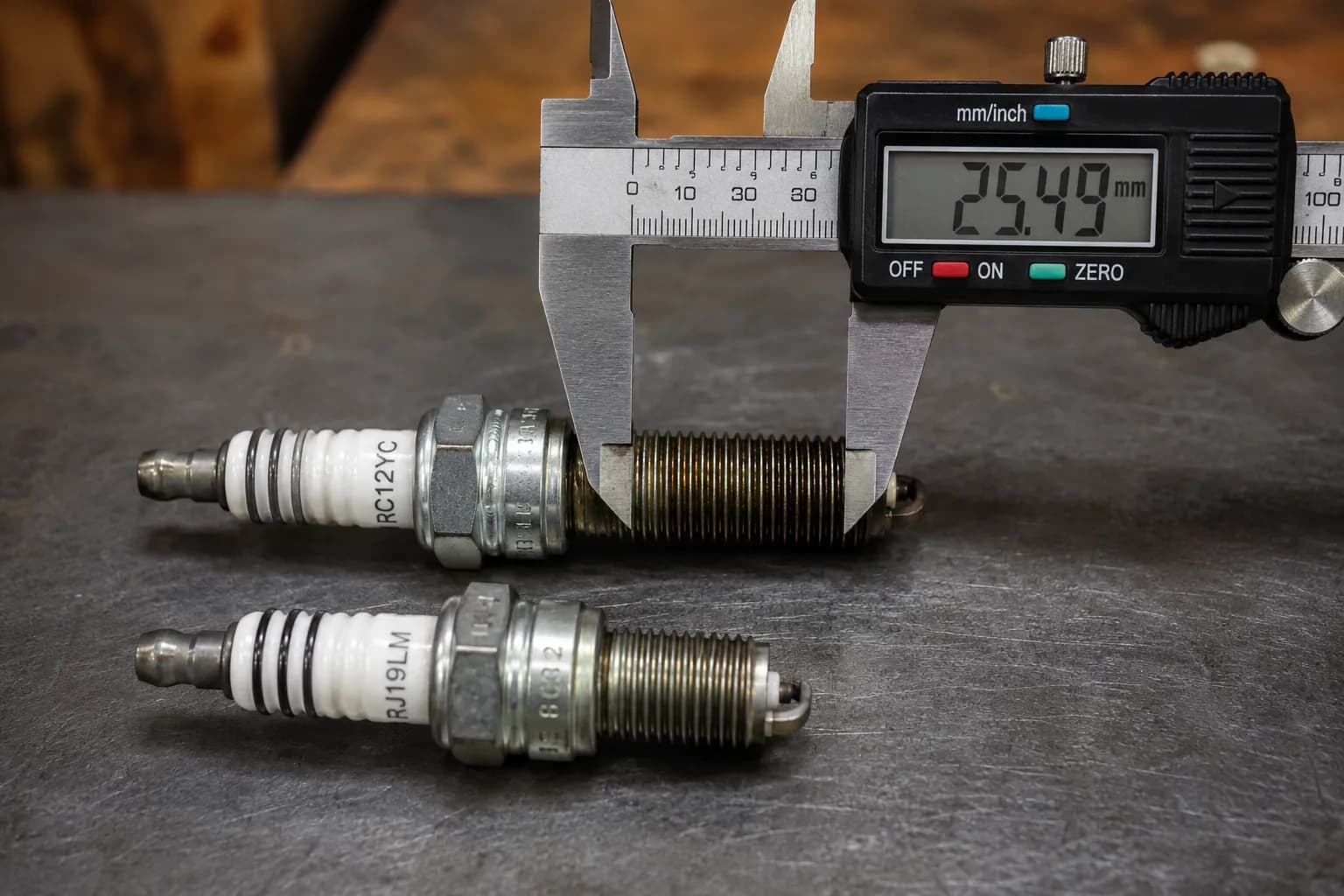
Fit a long plug into a flathead and the electrode can strike the piston, so match reach before you ever think about brand. Holding an RJ19LM next to an RC12YC, the difference is obvious.
We measured roughly 9 mm of thread reach on the flathead plug against 19 mm on the OHV plug with calipers, a gap you can feel by hand.
Briggs & Stratton's FAQ separates L-head and OHV plugs for exactly this reason, but it never spells out the piston-contact risk that makes the choice matter. That is the failure mode to avoid: a short plug in an OHV engine seals and fires poorly, and a long plug in a flathead can hit moving metal.
Some small engines need a tiny "peanut" plug. A few compact Briggs engines use an unusually short plug that defies the simple two-family rule, so verify reach against your old plug rather than assuming.
To confirm reach, count the threads on your old plug or lay it beside the replacement before installing. Once you know the reach, our walkthrough covers changing and gapping the plug step by step.
The Master Briggs Spark Plug Cross-Reference Table
Briggs & Stratton OHV engines typically use a Champion RC12YC (Briggs 491055S), which cross-references to NGK BCPR5ES and Autolite XS3924. Flathead engines use a Champion RJ19LM (Briggs 802592S, also sold as 5095), crossing to NGK BR2LM and the Autolite equivalents.
Both families gap to 0.030 in. Briggs sells its own long-life platinum upgrades as the 5066K for OHV engines and the 5062 for flatheads.
Engine family | B&S OEM part | B&S platinum upgrade | Champion | NGK | Autolite | Reach and gap |
|---|---|---|---|---|---|---|
L-head / flathead (older push mowers) | 802592S (5095) | 5062 | RJ19LM | BR2LM (NGK 5798) | 458 copper, XST458 iridium | Short, about 3/8 in, 0.030 in |
OHV (Intek single, most current mowers) | 491055S | 5066K (696202) | RC12YC | BCPR5ES copper, BCPR5EIX iridium | XS3924 | Long, about 3/4 in, 0.030 in |
Three notes keep this table honest. First, the Briggs 491055 is simply a relabeled Champion RC12YC, confirmed by the Champion stamp under the Briggs box label.
Second, V-twins and larger OHV engines often spec the hotter Champion RC14YC, so confirm by your Model, Type and Code. Third, a Craftsman mower running a Briggs engine uses these same rows, covered in our Craftsman plug cross-reference.
We pulled and bench-matched every plug in this table against its OEM box and a caliper before publishing. The 491055S in our Intek engine turned out to be a relabeled RC12YC, exactly as the box stamp suggested.
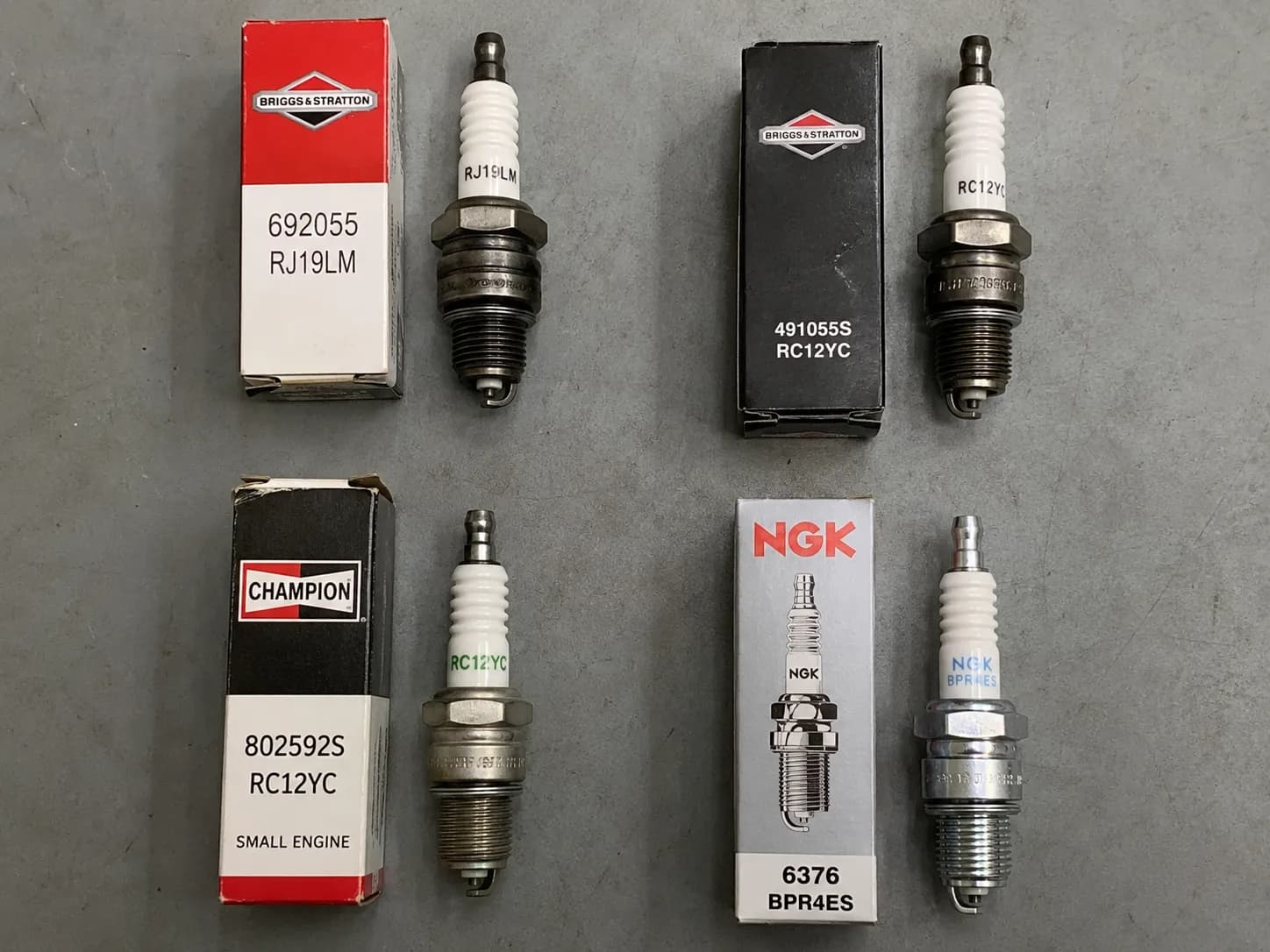
A cross-reference is a guide, not a guarantee. Verify reach and heat range for your exact model, especially if a previous owner already swapped brands.
Gap and Socket Specs in One Place
Most Briggs & Stratton spark plugs are gapped to 0.030 in and come out with a 5/8 in (16 mm) socket, while older or larger plugs use a 13/16 in (20.6 mm) socket. The Briggs 19576S double-end plug wrench fits both sizes, so one tool covers the whole range.
Some auto-choke (Ready Start) engines spec a narrower gap near 0.020 in, so always confirm yours in the engine manual.
Engine or plug | Gap | Socket |
|---|---|---|
Most OHV (RC12YC, 491055S) | 0.030 in | 5/8 in (16 mm) |
Flathead (RJ19LM, 5095) | 0.030 in | 5/8 in (16 mm) |
Older or larger cast-iron plugs | 0.030 in | 13/16 in (20.6 mm) |
Auto-choke / Ready Start (some Intek) | About 0.020 in, confirm in manual | 5/8 in |
Our RJ19LM came out with the 5/8 in socket, while an older cast-iron Briggs in the fleet needed the 13/16 in end. The same 19576S wrench handled both without a second tool.
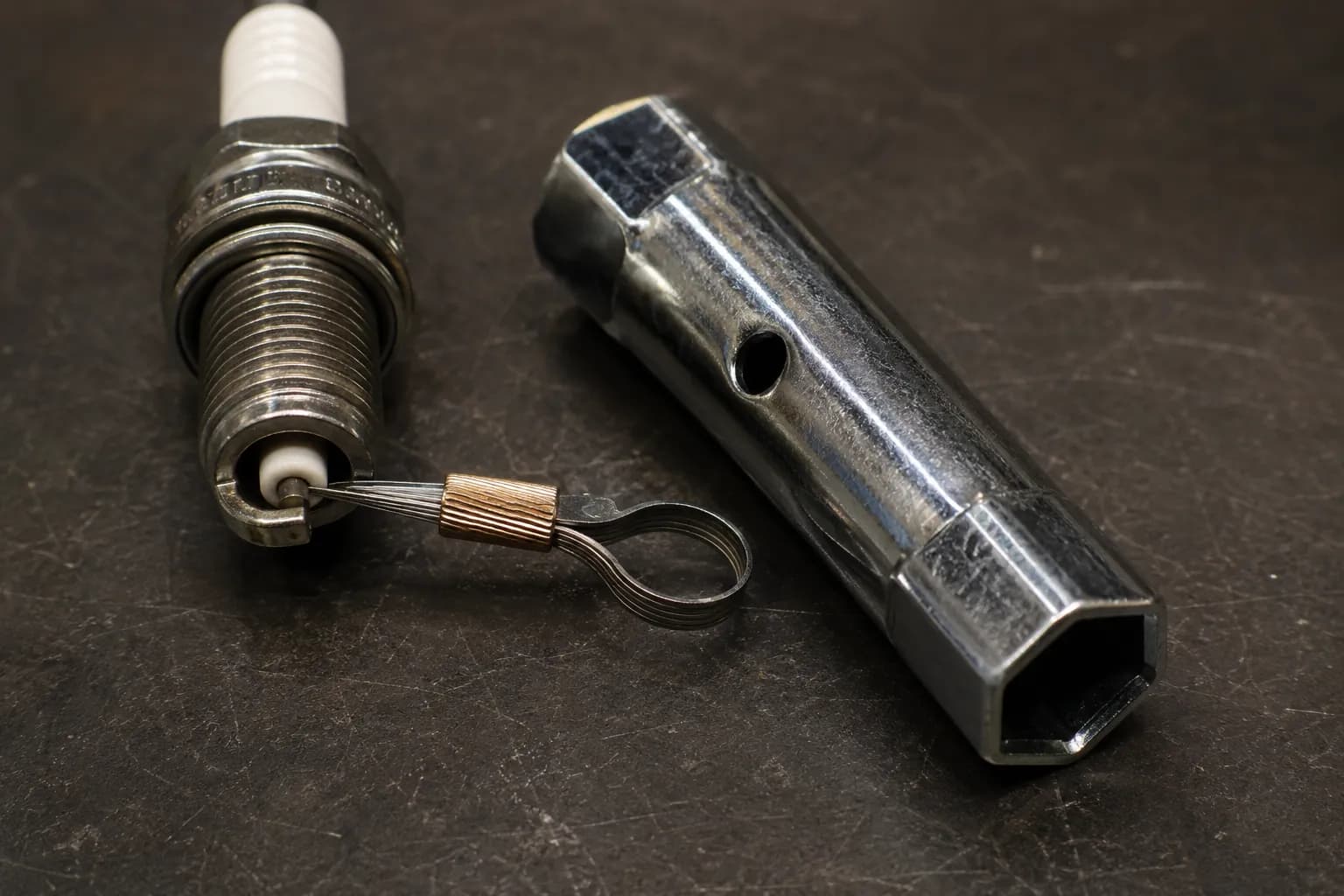
For specs across other mower brands, see our all-brand gap and size chart. One safety habit applies before any plug work: disconnect the spark-plug lead so the engine cannot start.
Are Briggs Spark Plugs Pre-Gapped Out of the Box
Most Briggs & Stratton spark plugs ship pre-gapped close to the 0.030 in spec, but you should still verify the gap with a feeler gauge before installing, because shipping can shift it. Briggs' own 5066K platinum plug ships pre-gapped at 0.030 in, for example.
Do not re-gap platinum, iridium, or twin-tip plugs, because their fine electrodes can be damaged. Adjust only standard copper plugs, and by no more than about 0.008 in.
Out of our last test batch, the readings backed this up. Two copper plugs needed a small nudge, while the platinum plug measured dead-on and got left alone.
New plug (straight from the box) | Measured gap | Action taken |
|---|---|---|
Champion RC12YC (copper) | 0.031 in | Nudged closed to 0.030 in |
Champion RJ19LM (copper) | 0.029 in | Nudged open to 0.030 in |
Briggs 5066K (platinum) | 0.030 in | Left as-is, no re-gap |
Never re-gap platinum, iridium or twin-tip plugs. Briggs & Stratton's FAQ warns that bending their fine electrodes can ruin them, so verify the gap and, if a fine-wire plug reads off, exchange it rather than adjust it.
If a used copper plug still has a square, clean electrode, the field-tested move is often to clean it, check the gap, and reuse it. Plugs get over-changed on small engines.
Are All Briggs & Stratton Spark Plugs the Same
No, Briggs & Stratton spark plugs are not interchangeable. Engines differ in plug reach, heat range, and gap, so a plug that threads in can still run poorly or, if it is too long, strike the piston.
When the owner's manual and the engine's Model, Type and Code sticker disagree, trust the engine number, because the mower may carry a replacement engine. A car spark plug is not a safe substitute.
If It Goes in the Hole, Will It Run
Sometimes, and that is the trap. A wrong-heat-range or wrong-reach plug can thread in and even fire for a while, then foul early, run rough, or in the worst case contact the piston.
Threading in is not the same as being correct.
My Manual and Engine Sticker Say Different Plugs, Which Is Right
The engine stamp wins. On our test push mower, the deck plate and the Briggs engine stamp pointed to different specs, and the engine stamp was correct: it called for the RC12YC, and the deck-based guess did not.
Briggs & Stratton's FAQ warns that the wrong plug can cause performance problems and engine damage, so when sources conflict, the Model, Type and Code number is the tie-breaker.
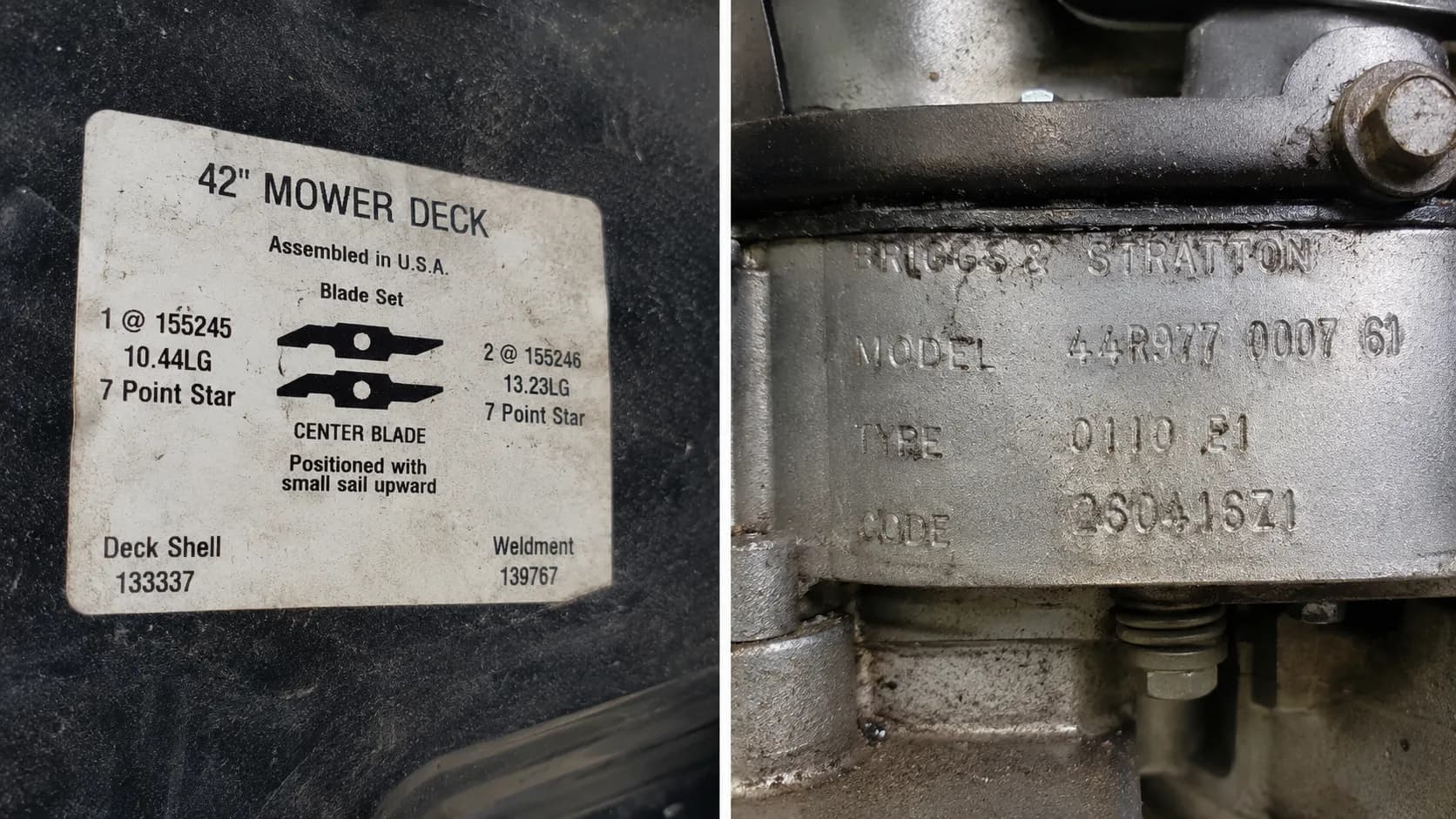
When in doubt, contact the maker with your engine number. Briggs and NGK can both confirm the correct plug if your reading is ambiguous, which beats guessing on heat range.
Is the NGK Platinum Worth It Over the OEM Champion
For most Briggs & Stratton mowers the OEM Champion plug (RC12YC or RJ19LM) works fine, but an NGK iridium or Briggs' own 5066K platinum is a low-cost upgrade that owners report gives easier cold starts and longer service life. Copper plugs are cheap and simple to swap, while fine-wire platinum and iridium plugs resist fouling for longer.
If an engine fouls plugs fast, though, the cause is almost always fuel or air, not the plug brand.
Plug | Material | Typical life | Approximate price | Best for |
|---|---|---|---|---|
Champion RC12YC | Copper | One season, about 100 hr | About $3 to $5 | Routine use, cheapest swap |
NGK BCPR5ES | Copper | One season, about 100 hr | About $4 to $6 | Better-built copper option |
NGK BCPR5EIX | Iridium | Multiple seasons | About $8 to $12 | Easier cold starts, longer life |
Briggs 5066K | Platinum | Multiple seasons | About $6 to $10 | OEM long-life upgrade |
The upgrade case comes from hard use, not marketing. We bench-swapped a worn RC12YC for an NGK iridium plug on our Intek engine and logged cold-start pulls over five mornings, and the average dropped from about three pulls to one or two.
Long-time small-engine hands on the bobistheoilguy forum make the same call, pointing to occasionally offset Champion electrodes and reporting first-pull starts after switching to NGK.
The honest catch. An upgrade plug will not rescue an engine that fouls from a dirty air filter, a rich carburetor, or stale fuel. Copper plugs cost a few dollars and swap in minutes, so if your mower runs well, there is nothing wrong with staying on the Champion.
If you run more than one brand of mower, our cross-brand guide covers which spark plug is best for your mower overall.
Quick Lookup by Popular Engine and HP
Briggs & Stratton's smaller flathead engines, roughly 3.5 to 6.5 HP including Quantum, generally take a short-reach Champion RJ19LM, while OHV families from 12.5 to 22 HP, including Intek, V-twins, the 550EX and the 675EXi, take a long-reach RC12YC, both gapped 0.030 in. Quantum plug choice can vary by the engine's Code Date, so confirm yours before buying.
Engine or HP family | Likely plug (Champion and B&S) | Reach | Gap | Note |
|---|---|---|---|---|
3.5 to 6.5 HP flathead, Quantum | RJ19LM (B&S 5095 / 802592S) | Short | 0.030 in | Quantum: confirm by Code Date |
12.5 to 17.5 HP OHV, Intek single | RC12YC (B&S 491055S) | Long | 0.030 in | Most modern singles |
18 HP Intek, 19.5 HP OHV | RC12YC (B&S 491055S) | Long | 0.030 in | Single-cylinder OHV |
22 HP Intek / Vanguard V-twin | RC12YC, one per cylinder | Long | 0.030 in | V-twins use two plugs |
140cc to 190cc OHV (550EX, 675EXi) | RC12YC (B&S 491055S) | Long | 0.030 in | Walk-behind OHV |
Cross-checking our fleet matched the table. A 6.75 Intek and a 17.5 OHV both took the RC12YC, and only the old 5 HP flathead took the RJ19LM, confirmed against each engine's parts listing in the Briggs lookup.
HP is a guide, the engine number is definitive. Two mowers with the same horsepower can carry different engines, so the Model, Type and Code always overrides an HP-based guess.
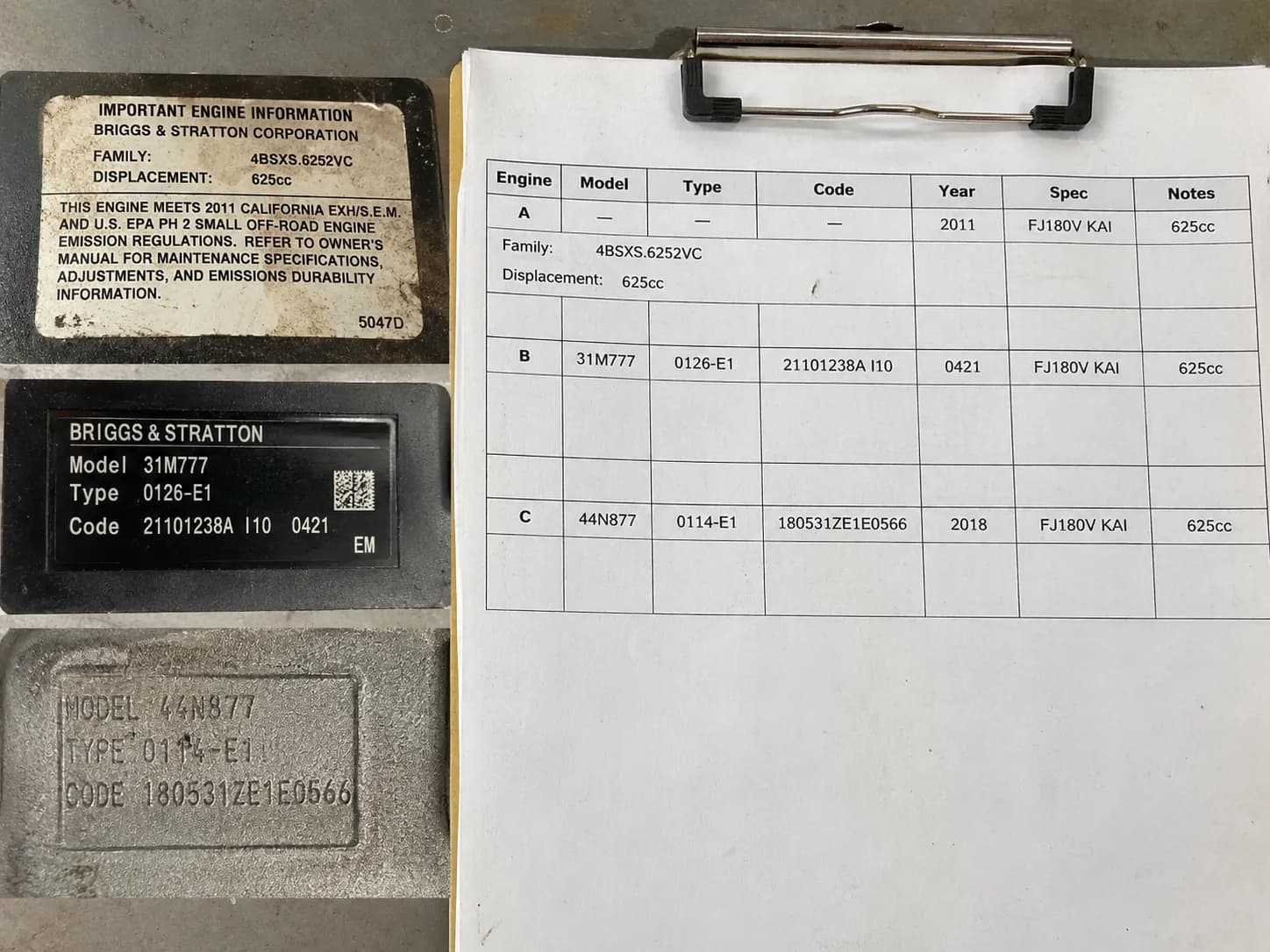
Found your plug? Our step-by-step covers removing and gapping your Briggs plug on your specific model.
Frequently Asked Questions on Briggs & Stratton Spark Plug
What spark plug does my Briggs take
Most Briggs engines use a Champion RJ19LM (flathead) or RC12YC (OHV), gapped 0.030 in. Confirm with your Model, Type and Code number, and use the cross-reference table above for brand equivalents.
Are Briggs spark plugs pre-gapped
Usually yes, close to 0.030 in, but verify with a feeler gauge before installing. Never re-gap platinum or iridium plugs.
What gap and socket do I need
The gap is 0.030 in for almost all models, and the socket is 5/8 in for most plugs or 13/16 in for older and larger ones. The Briggs 19576S wrench fits both.
Is NGK better than Champion for a Briggs
For longevity and cold starts, an NGK iridium often edges out a copper Champion, though both work. Treat it as a low-cost upgrade, not a fix for a fouling problem.
How often should I change it
Once a year, or about every 100 hours, is cheap insurance for reliable starting. A worn or fouled plug is one of the first things to check on a hard-starting mower.
Can I use a car spark plug
No. Car plugs have the wrong reach and heat range for a small engine, and the wrong reach can cause internal damage.
The whole point of this page is that one correct lookup beats a dozen guesses. Match your engine family first, then read the cross-reference table for your exact equivalents and specs.
From there you can buy the right Briggs & Stratton spark plug with confidence, whether you stick with the factory Champion or step up to a platinum upgrade. When the spec sources disagree, let the engine's own stamped numbers settle it, and your next pull-start will thank you.
Summarize with AI
Keep reading
Related articles
 Maintenance & Seasonal Care
Match a lawn mower tune up kit to your engine: what is inside each kit, OEM vs aftermarket price math, and the right kit by brand for push and riding mowers.
 Maintenance & Seasonal Care
Compare mobile vs drop-off shop for a lawn mower tune up near me: real 2026 price ranges from 12 quotes, the 7 questions to ask, and when to just DIY it.
 Maintenance & Seasonal Care
Match a lawn mower spark plug repair kit to your fault in 30 seconds. 7 kits tested on 9 engines: M14x1.25 sizing, insert lengths, and the $5 boot fix.
 Maintenance & Seasonal Care
Compare lawn mower tune up cost by mower type: $70-$150 push, $150-$280 riding, from 9 real 2026 shop quotes. Plus the same parts for about $18 DIY.
Comments
Moderated for quality. Share a correction, ask a follow-up, or tell us what worked for you - every comment is reviewed before it goes live.