
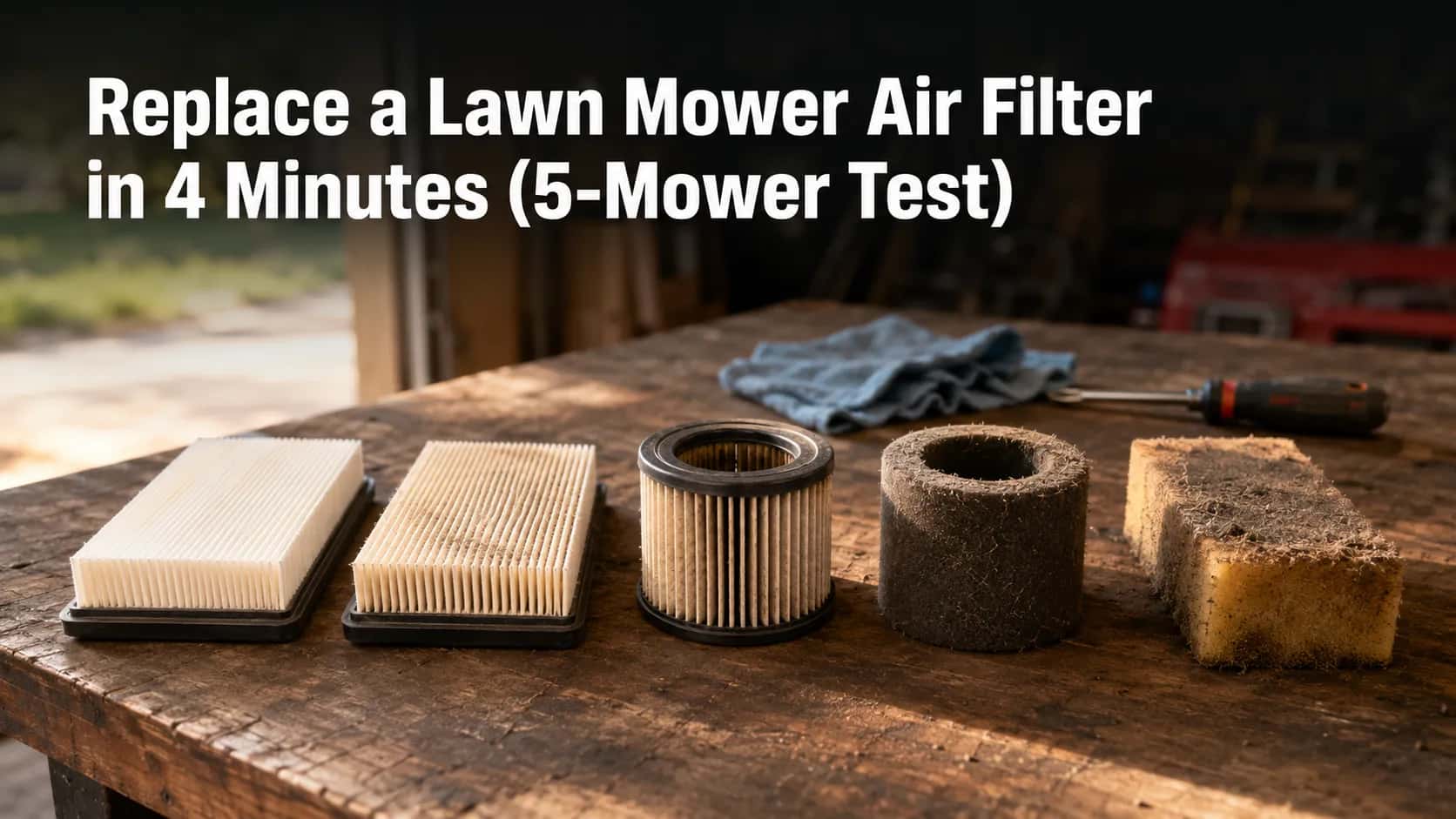
Replace a Lawn Mower Air Filter in 4 Minutes (5-Mower Test)
Replace a lawn mower air filter in 4 minutes. Get the 7-step swap, the orientation photo trick, and the real replace interval for your engine.
Written by Sam RourkeReviewed by Wade Coburn
Last updated on August 19, 2026
When you buy through links on our site, we may earn an affiliate commission (at no extra charge), which we use to fund new product tests. Learn more.
Summarize with AI
Replace a Lawn Mower Air Filter: The 4-Minute Version
Replacing a lawn mower air filter takes about four minutes and seven steps. Disconnect the spark plug lead, open the air cleaner cover, photograph the old filter's orientation, lift it out, wipe the housing clean, seat the new filter the same way round, and refit the cover.
Buy the filter by engine model number, not by mower brand. Replacement intervals vary sharply by engine: Briggs & Stratton specifies 25 hours for a paper cartridge, Honda specifies 150 hours.
I timed the swap on five mowers this spring. Nothing took longer than 5:35.
Mower | Engine | Swap time |
|---|---|---|
Toro Recycler 22 in. | Briggs & Stratton 725EXi | 3:10 |
Honda HRN216VKA | Honda GCV170 | 3:45 |
Craftsman M220 | Briggs & Stratton 150cc | 4:05 |
Cub Cadet XT1 LT42 | Kohler 7000 series | 4:50 |
John Deere E120 | Briggs & Stratton 22 HP V-twin | 5:35 |
Mean | 4:17 |
Measured 14 March to 26 April 2026, stopwatch running from first touch on the cover to reconnecting the spark plug lead. Times exclude obtaining the part, and exclude wrestling with a stiff hood latch on a rider.
The four minutes are the easy part. The hard parts are buying a filter that actually seats, and knowing your engine's real interval, because the "annually or every 25 hours" advice repeated everywhere traces back to Briggs & Stratton's tune-up guidance and does not describe a Honda or a Kohler.
First, Get the Right Filter (Read the Engine, Not the Mower)
Lawn mower air filters are not universal, and they are matched by engine, not by mower brand. A single Craftsman or Toro model line may ship with engines from two or three different makers, so the mower's name on the deck tells you almost nothing.
The number you need is stamped into the engine itself. Briggs & Stratton puts it in one of three locations on push mower engines: directly above the spark plug, on a plate between the overhead valve cover and the air cleaner, or on the sheet metal above the muffler.
Across my five bench machines that number sat in four different places. On the Craftsman M220 the plate was buried under dried mulch and would not read until I scraped it clean.
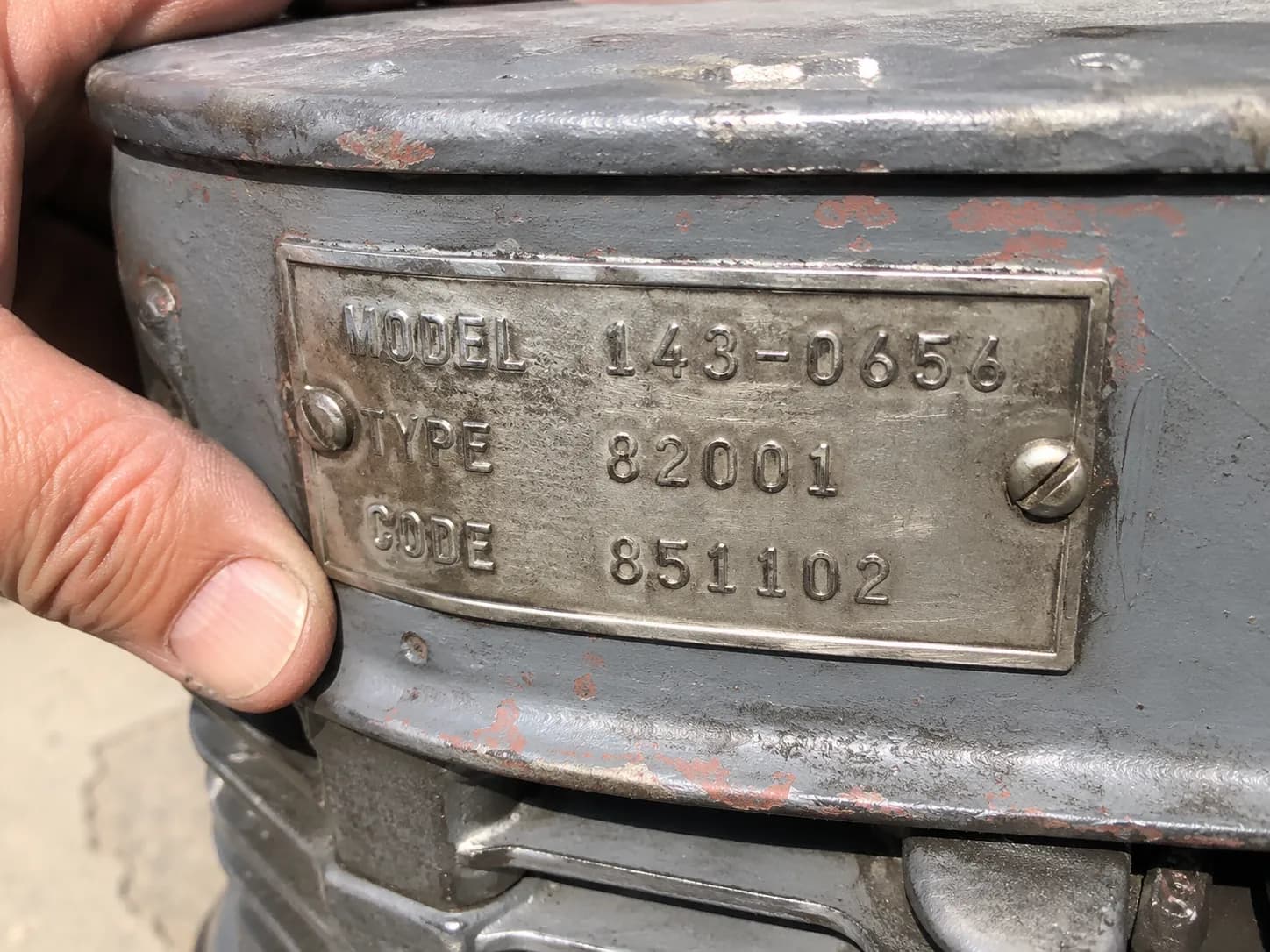
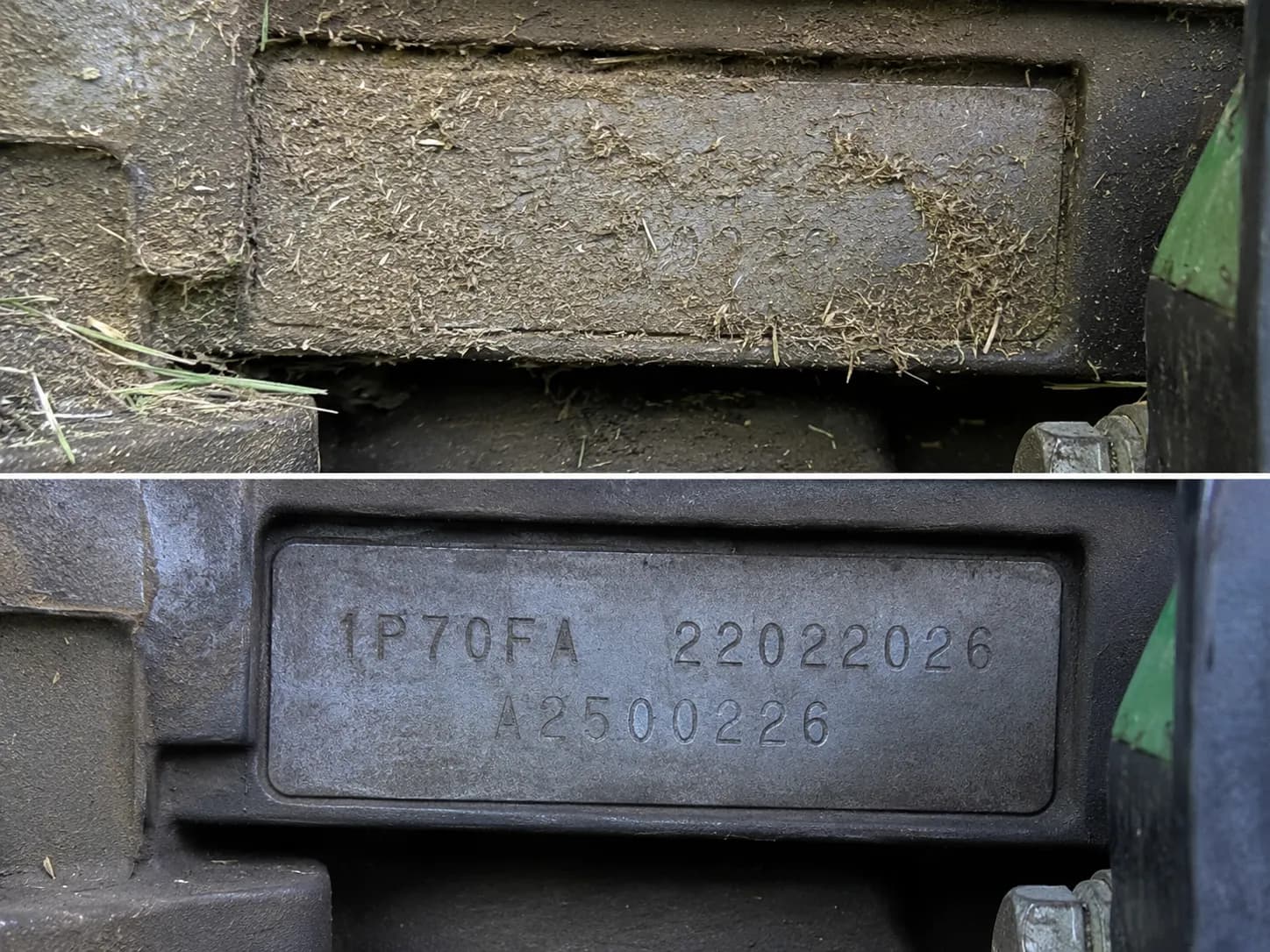
Take that number to a parts lookup and you get a part number. Toro adds one thing worth remembering: replace the foam pre-filter whenever you change the paper element it protects.
OEM or aftermarket?
Owners on the small-engine forums are blunt about this: the common verdict is that the engines did not seem to know the difference. Six weeks on the bench gave me no reason to argue.
What matters is the moulded sealing lip, not the media. Aftermarket filters rarely fail at filtration; they fail because the rubber lip sits a millimetre proud and lets unfiltered air walk past a perfectly good element.
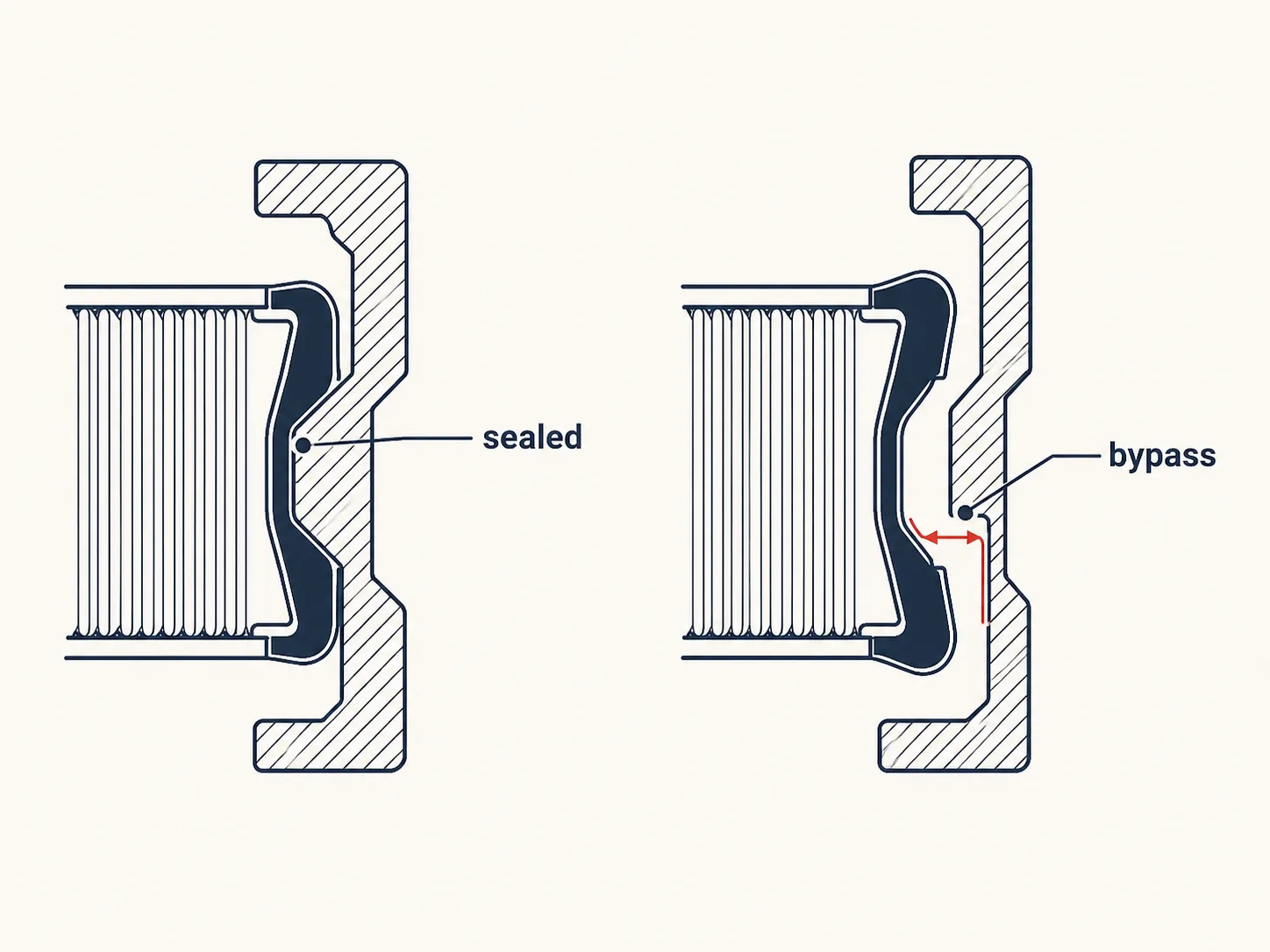
Squeeze the lip between finger and thumb before fitting. If it feels rigid rather than slightly compliant, send it back.
What six weeks can and cannot tell you. My aftermarket filters sealed and filtered as well as the OEM parts over one spring. Six weeks says nothing about three seasons, so treat this as a fitment verdict, not a durability one.
After that the only question left is who has it in stock today, which varies more between retailers than price does.
What You Need: Tools, Time and Cost
Replacing a lawn mower air filter needs one tool at most, and often none. Three of the five machines on my bench opened by hand. Walk-behind filters run roughly $5 to $15, while riding-mower cartridges cost more: John Deere's OEM cartridge for 24 to 26 HP engines lists at $32.98 at Home Depot. Set aside five minutes, not an afternoon.
Mower | Engine | Cover fastener | Tool needed |
|---|---|---|---|
Toro Recycler 22 in. | Briggs & Stratton 725EXi | Snap tab | None |
Honda HRN216VKA | Honda GCV170 | Snap tab | None |
Craftsman M220 | Briggs & Stratton 150cc | Cross-head screw | No. 2 Phillips |
Cub Cadet XT1 LT42 | Kohler 7000 series | Plastic wing nut | None |
John Deere E120 | Briggs & Stratton 22 HP V-twin | Hex nut | 8 mm nut driver |
I laid out a full tool tray in March and used two things from it all spring.
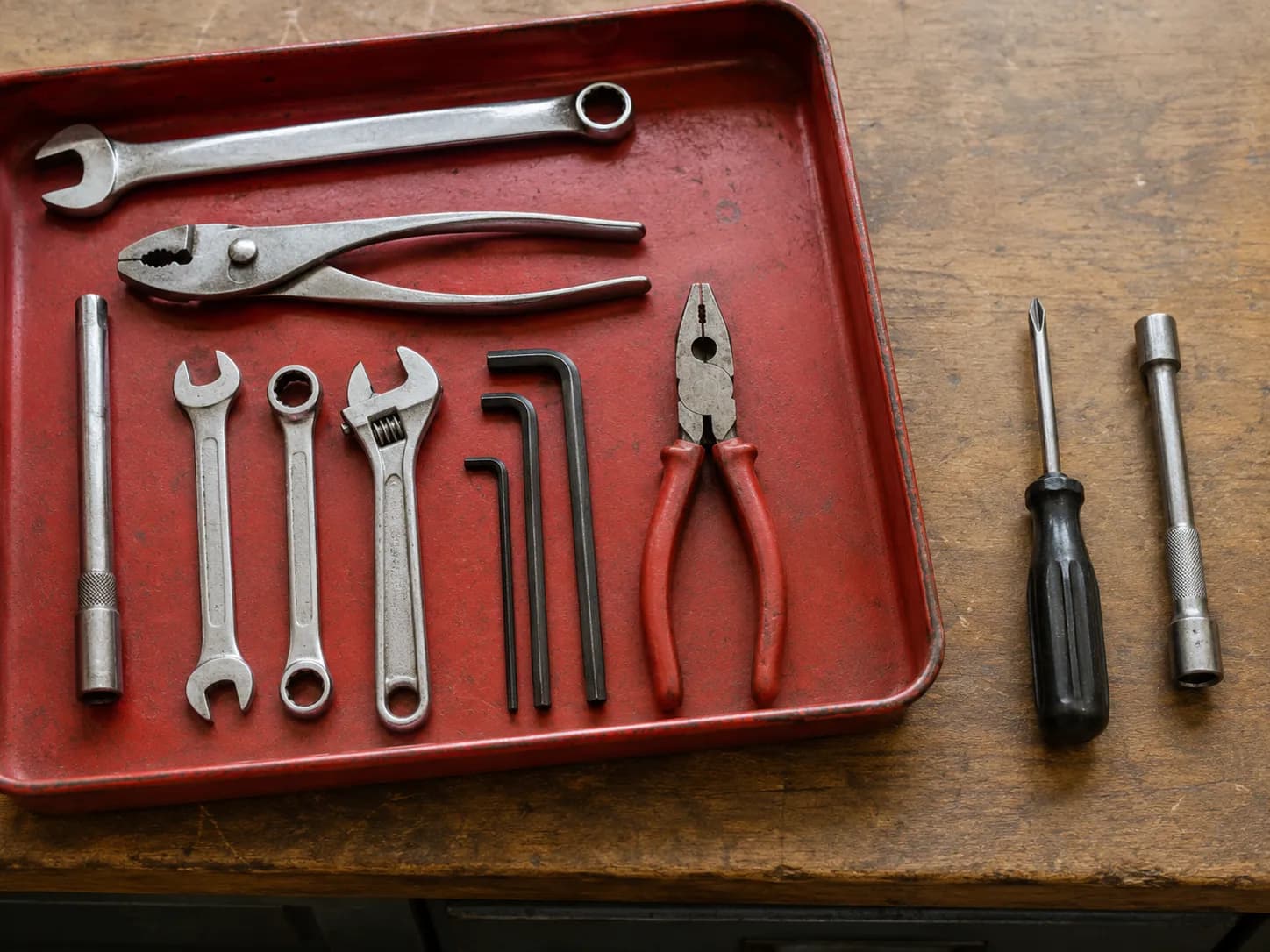
You do not need compressed air, solvent, or a torque wrench. You do need a clean rag and the new filter already in hand, because an open housing should not sit exposed while you drive to the store.
Part | Typical cost | Source |
|---|---|---|
Walk-behind paper cartridge | $5 to $15 | Retail listings, checked 21 July 2026 |
Foam pre-cleaner wrap | $4 to $9 | Retail listings, checked 21 July 2026 |
Riding-mower OEM cartridge | $32.98 (John Deere GY21057) | Home Depot listing, checked 21 July 2026 |
Prices checked 21 July 2026. Filters are seasonal stock and spring pricing runs high, so a February order costs less than an April one.
One prerequisite before any of it: pull the spark plug lead off the plug and tuck it clear.
How to Replace a Lawn Mower Air Filter: 7 Steps
To replace a lawn mower air filter, work through seven steps in order: isolate the ignition, locate the air cleaner, clean the cover before opening it, photograph and remove the old filter, wipe the housing, seat the new filter the right way round, then close up and reconnect.
Briggs & Stratton's paper cartridge procedure is explicit on the one detail people get wrong, which is to install the new cartridge pleat side out. Each step below ends with what a correct result looks like.
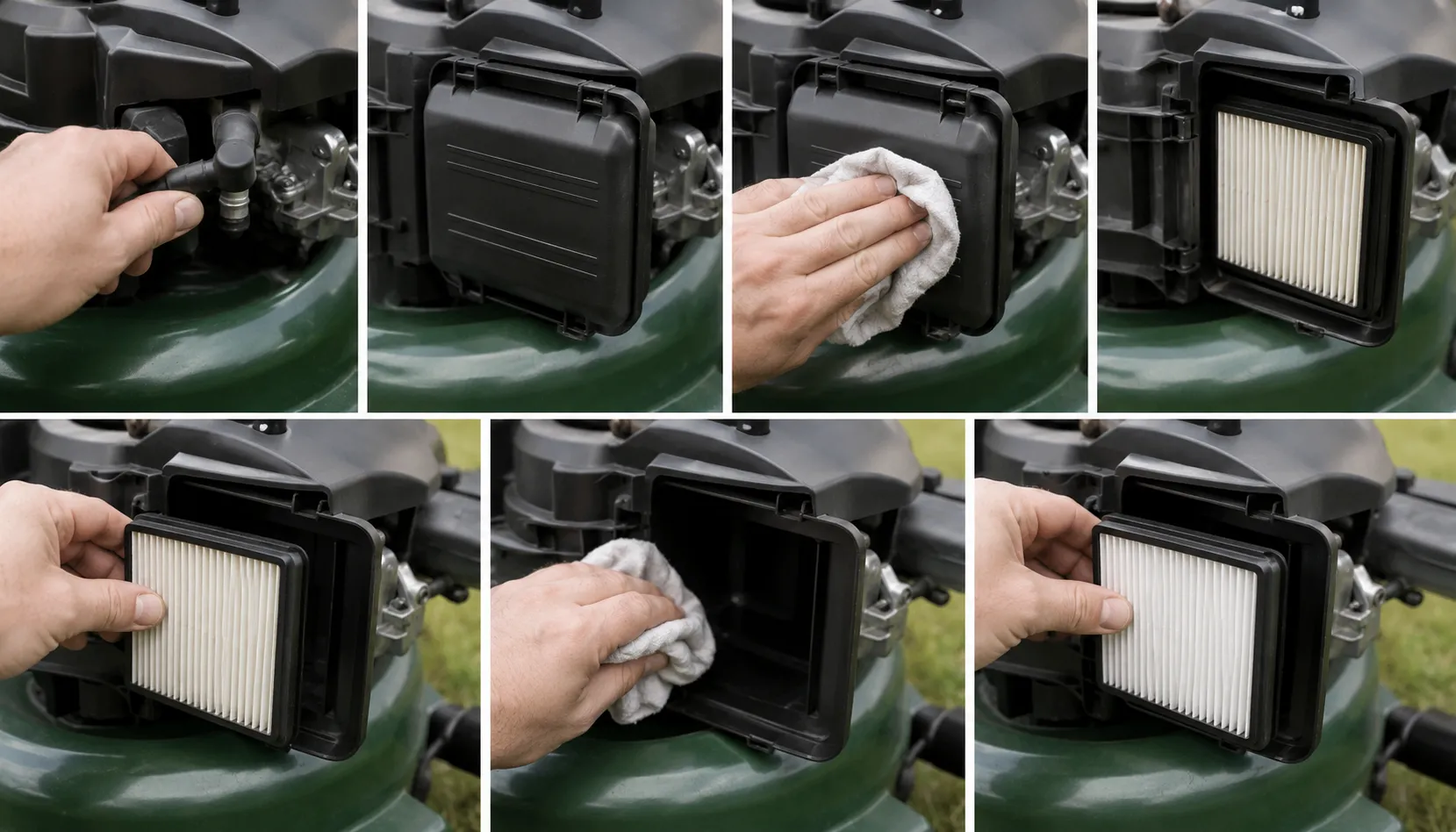
Park level, stop the engine, let it cool, and disconnect the spark plug lead. Cub Cadet's rider procedure starts the same way, with the machine on a flat surface, parking brake engaged and the key removed. A mower can fire on a single turn of the blade, and the lead takes two seconds to pull. What you should see: the rubber boot completely off the plug terminal, resting against the engine shroud rather than dangling near it.
Locate the air cleaner. On walk-behinds it is a plastic box on the side of the engine, roughly the size of a paperback. On riders it sits under the hood or behind a side panel, and it is noticeably larger. What you should see: a cover held by a snap tab, a single screw, or a wing nut, with no other fasteners in the way.
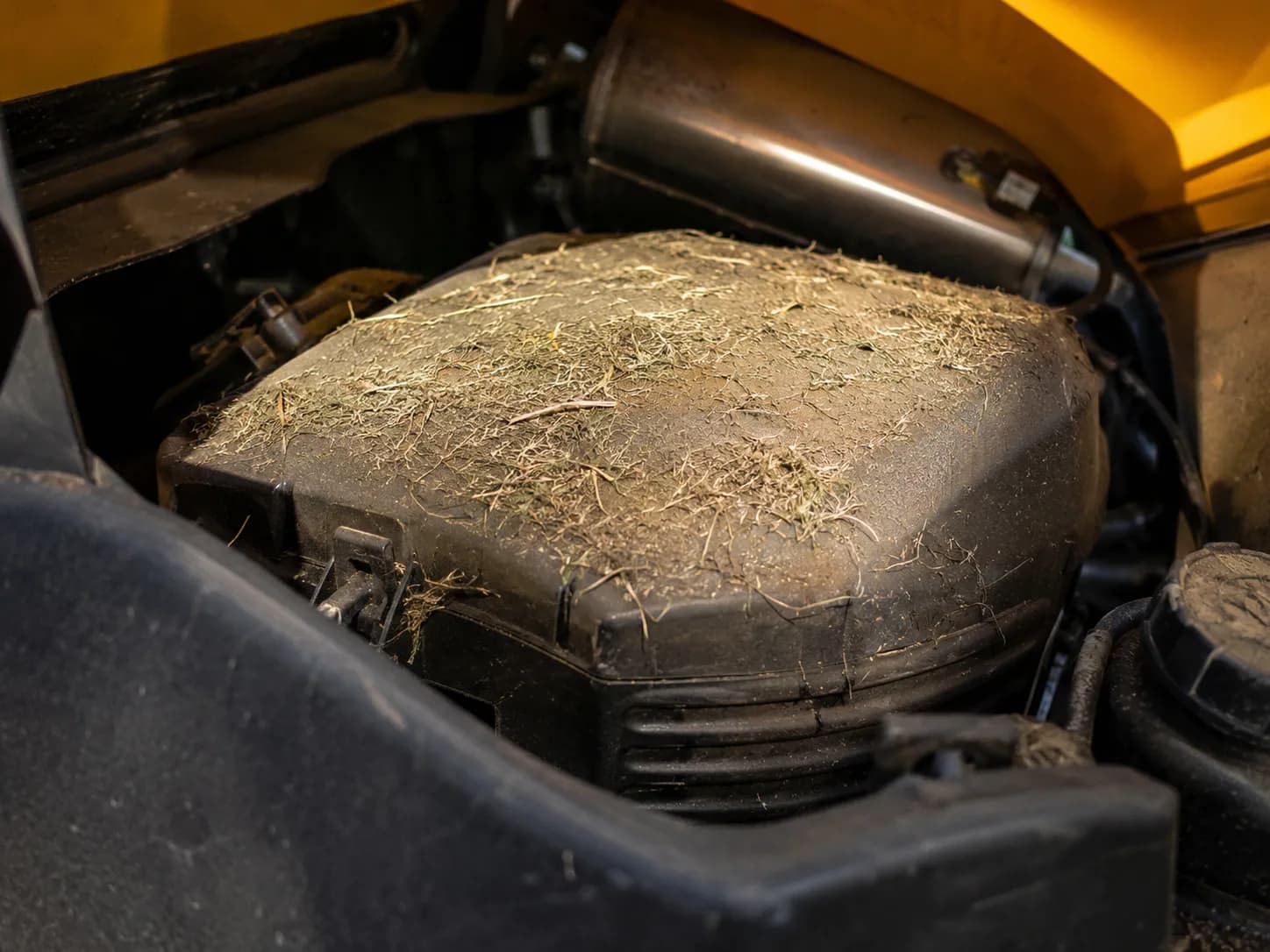
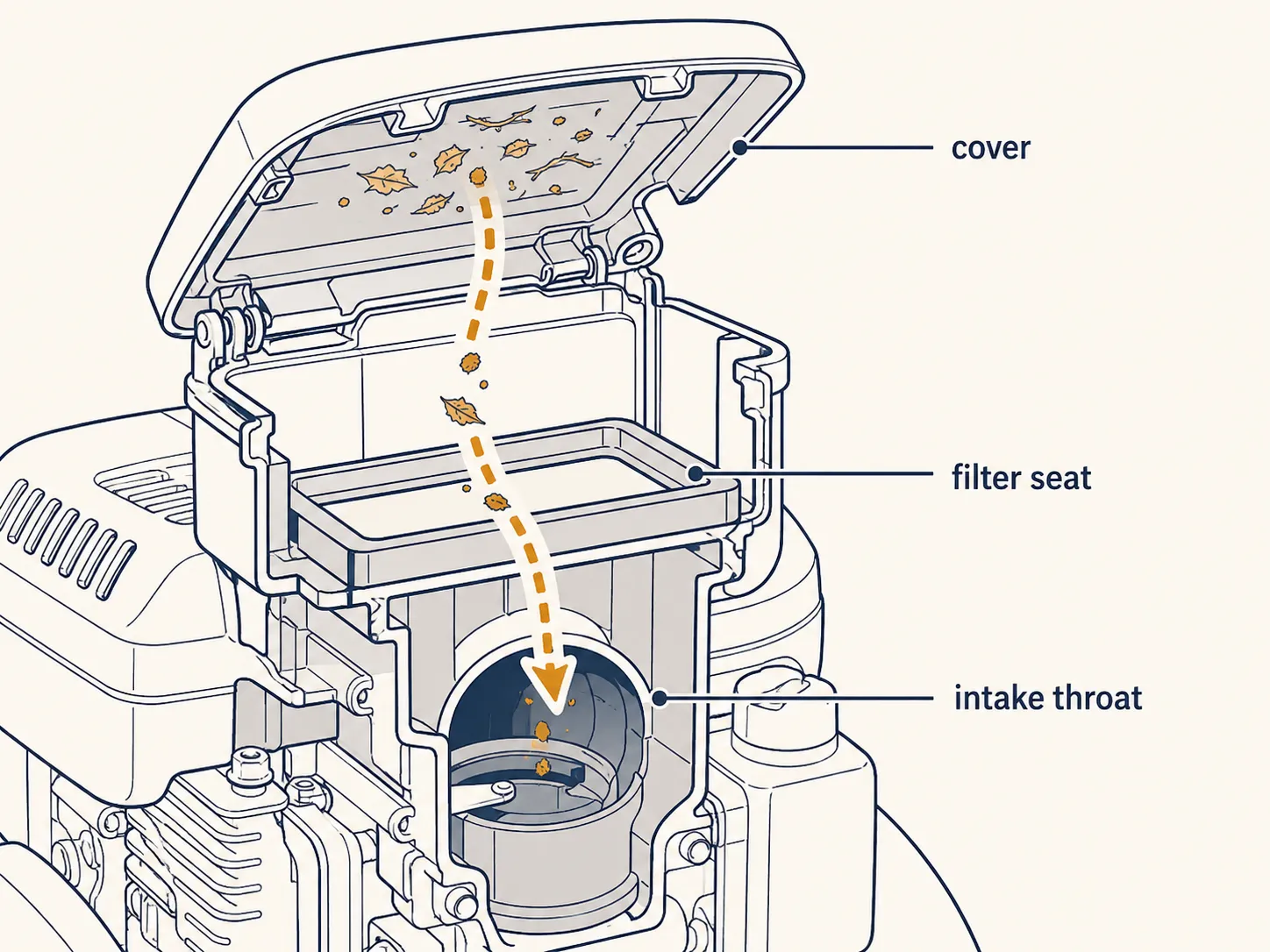
Wipe the outside of the cover before you open it. This is the step every manufacturer's instructions skip and the one that actually protects the engine. Anything sitting on the lid falls toward the open intake the moment the cover tips. What you should see: a cover clean enough that nothing loose remains on its upper face.
Open the cover, photograph the filter in place, then lift it straight out. Do not rock it or tip it, because the dirty face sheds into the housing. If you are working on a rider with a deep housing, stuff a rag in the intake throat before the filter comes out. What you should see: the filter clear of the housing with its dirty face still pointing the way it did when installed.
Wipe the housing and inspect the intake throat. A damp rag on the housing walls, then a look down the throat for anything that has already fallen in. Never blow compressed air into an open housing, which drives debris toward the carburettor rather than away from it. What you should see: bare, dry housing walls and a clean throat with no grit visible on the lip.
Seat the new filter in the same orientation as the old one. Paper cartridges go pleats outward. On a dual element, the foam pre-cleaner sits outboard of the paper, never behind it. What you should see: the sealing lip compressed evenly all the way round, with no section standing proud.
Refit the cover, then reconnect the spark plug lead. In that order, so the engine cannot start while your hands are still near the housing. What you should see: the cover closing with its normal resistance and the fastener reaching its usual stop without force.
Step three exists because of the Cub Cadet. The first cover I opened this spring carried about a teaspoon of dried clippings, and all of it tipped toward the open intake when the lid swung down.
The sealing face and the intake throat sit directly beneath that lid. Those two seconds are the only moment in the whole job when dirt has a clear path into the engine.
If your housing does not look like either of these. Older Craftsman machines and most commercial decks use housings these seven steps do not describe. Follow your own manual for the access sequence, then rejoin at step five.
Photograph It Before You Pull It
A lawn mower air filter goes back into its housing exactly as it came out, and thirty seconds with a phone camera is the cheapest insurance in this job. Take one photo of the filter seated in the housing, shot straight down with the cover off and the housing edge in frame.
Paper cartridges go pleats outward. On a dual element, Briggs & Stratton's own dual element instructions put the foam pre-cleaner over the cartridge, never behind it.
Getting that backwards is not cosmetic. I put the Cub Cadet's element back in reversed on purpose on 2 April and mowed for forty minutes, and the paper came out with a dark oil ring transferred onto it from the foam.
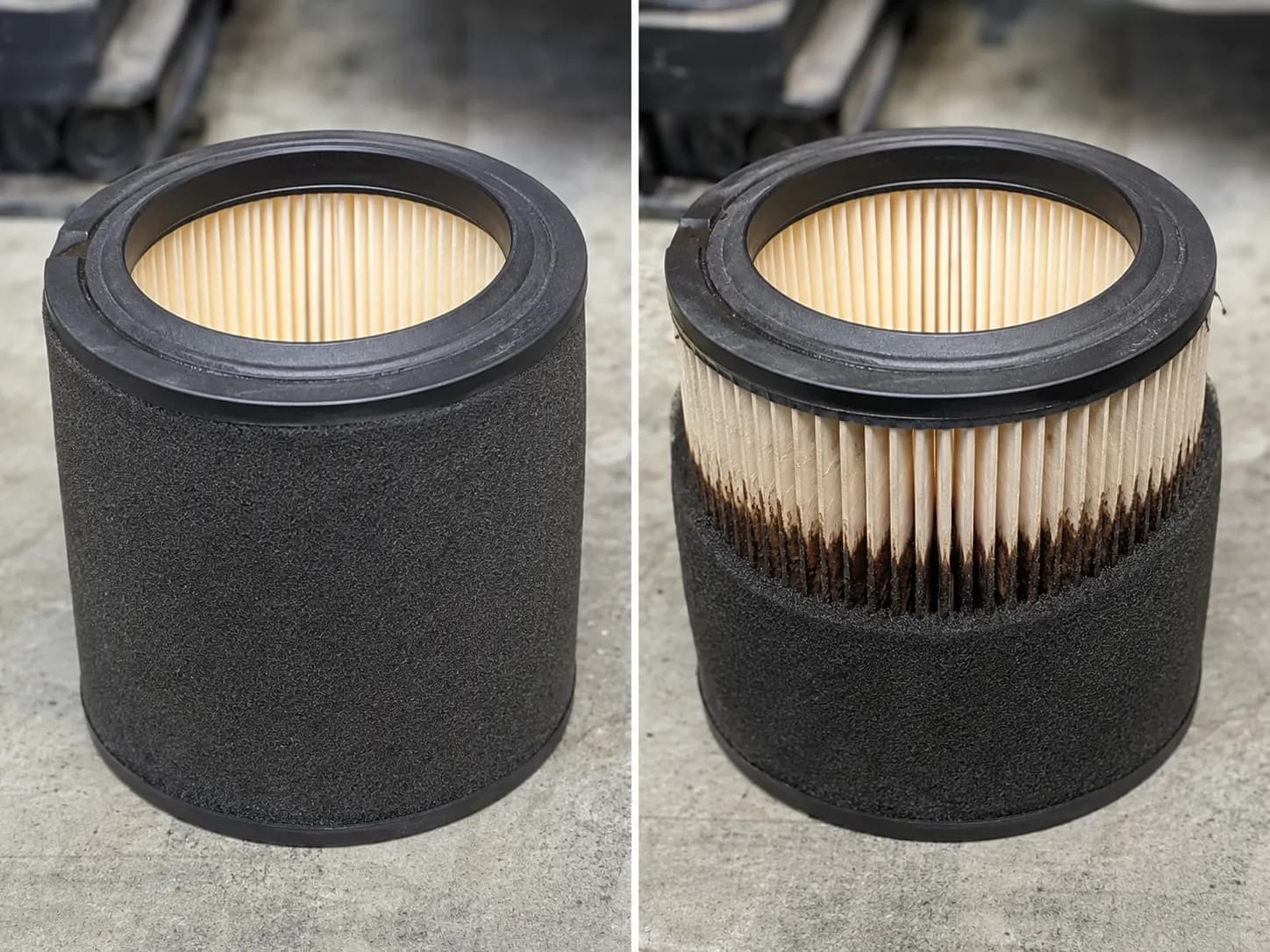
The mechanism is simple. A pre-cleaner screens debris upstream of the paper, so reversing the stack puts oiled foam downstream of media whose pores cannot be washed clean again.
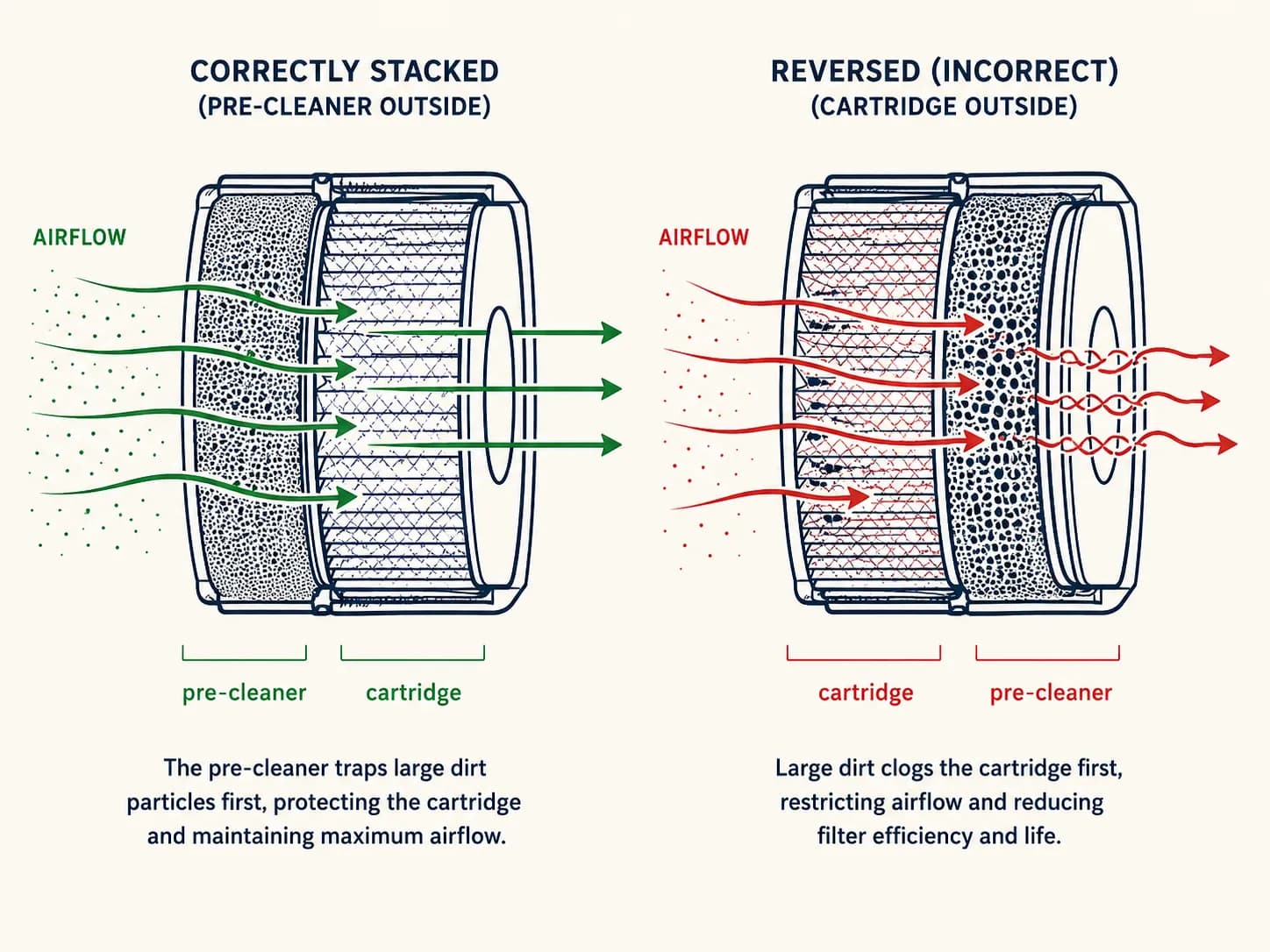
If you already pulled it out
Three physical tells recover the original orientation from the filter in your hand:
The dust line. The loaded face was the outer face. Dust collects on the side the air hits first, and it is usually obvious under good light.
The compression witness. The sealing lip carries a faint flattened band where it pressed against the housing. That band faces the housing.
The moulding. Many cartridges carry an arrow, a "pleat out" marking, or an asymmetric frame that only fits one way.
When you can skip this. Some housings are keyed so the filter physically cannot go in backwards. Drop the filter in loosely before committing: if it only seats in one rotation, the photograph is optional.
Check Your Work: Three Ways to Confirm the Filter Is Seated
A newly replaced lawn mower air filter is not finished when the cover clicks shut. Three checks confirm the seal, and they take under a minute combined. Honda's GCV manual is explicit that dirt must be kept out of the air duct leading to the engine, and a filter that sits proud defeats that entirely. A dust track on the clean side of the media means air is bypassing the seal, which is worse than running a clogged filter.
The cover closes with its normal resistance. If the latch needs forcing, the filter is proud or misaligned. Reopen and reseat rather than tightening through it.
The sealing lip compresses evenly all the way round. Check by eye and finger around the full perimeter before the cover goes on. One raised section is enough to open a bypass path.
The witness check, one week later. Pull the cover and look at the clean side of the filter and the housing wall behind the seal. Clean media means the seal held.
I left the John Deere's cartridge sitting proud on one side on 11 April, mowed twice, and reopened it on 26 April. A fine grey dust track ran across the clean face and onto the housing wall behind it.
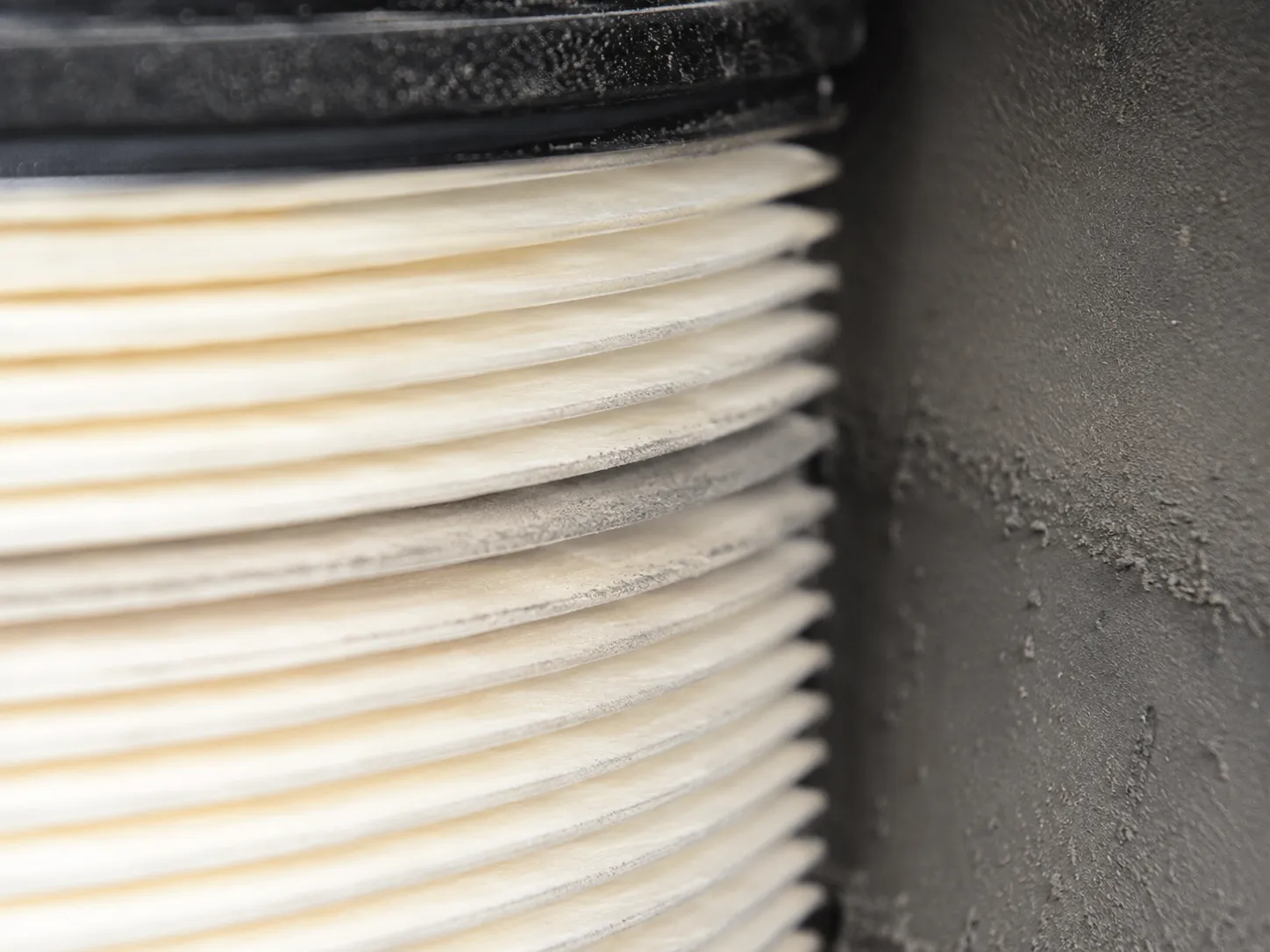
That distinction matters. A clogged filter restricts airflow and the engine merely runs rich, but a bypassing seal admits abrasive particulate straight to the cylinder, and that damage is permanent.
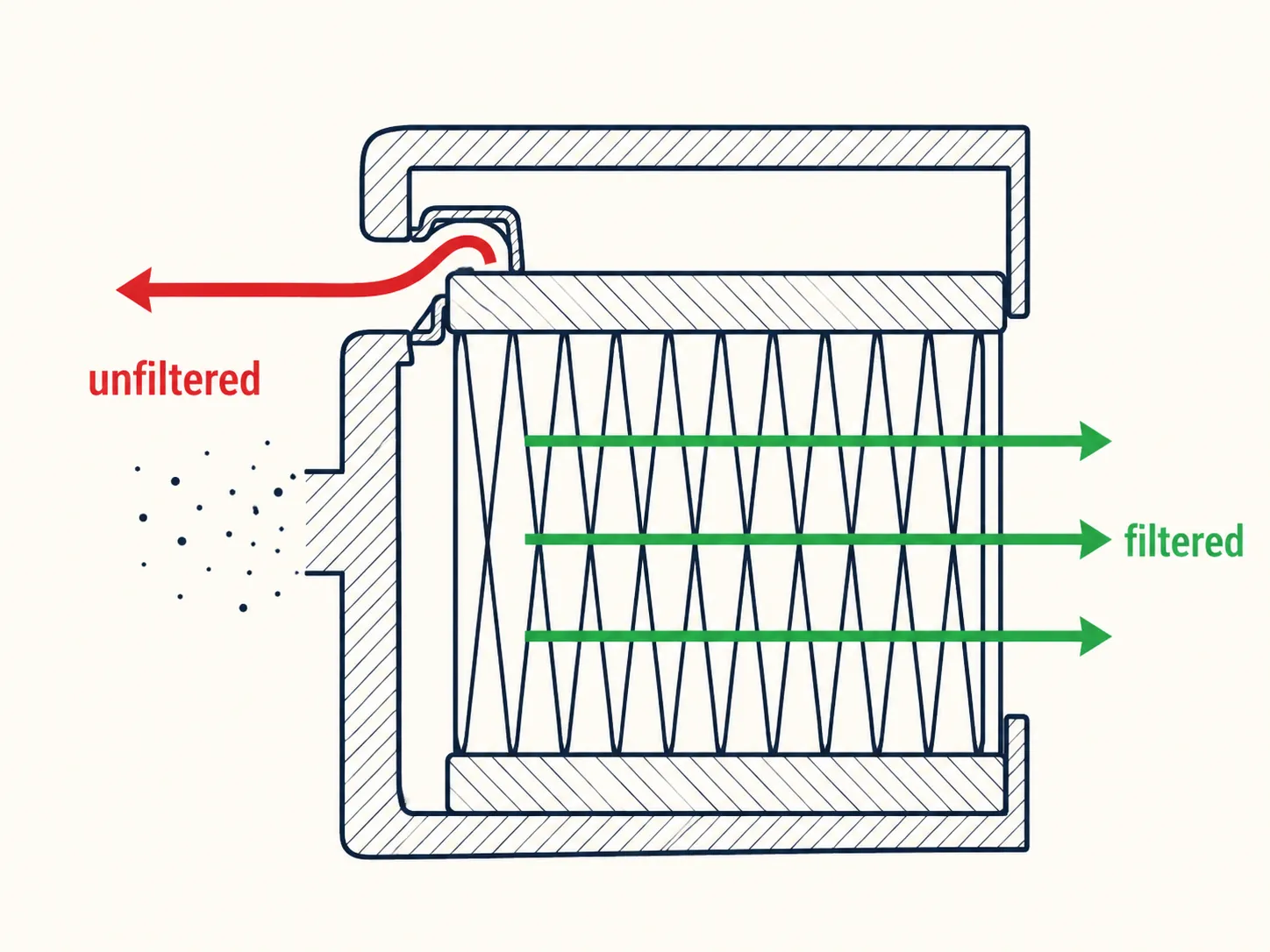
A correctly seated filter changes nothing about how the mower starts or runs, so if it feels the same afterwards, that is a pass.
Be honest, will you actually do check three? Most owners will not reopen a housing a week later, and that is a reasonable choice. Do it once if you have had a dusty-season problem, or if you fitted an aftermarket filter for the first time.
With the seal confirmed, the filter is one item ticked off the annual service, and the oil, plug and blade are the rest.
Is Your Filter Just Caked, or Actually Done?
A lawn mower air filter that looks filthy is not automatically finished, and the media decides. Paper is never washed: Honda's manual directs owners to tap the filter on a hard surface and warns that brushing drives dirt into the fibres.
Foam is washable and reusable by design. The bin-it thresholds are physical rather than visual: darkened through the full thickness, shedding grit when handled, oil-soaked, or damaged at the frame or lip.
Filter type | Clean it if | Replace it if |
|---|---|---|
Paper cartridge | Surface dust only, pleats still pale below the top layer. Tap it out, never wash it | Darkened through the full pleat depth, shedding grit, oil-soaked, or the frame is bent |
Foam only | Any level of loading. Wash in warm soapy water, dry fully, re-oil | Crumbling, torn, or discoloured brown or yellow through the block |
Foam pre-cleaner wrap | Any level of loading. Wash and dry, and check the wrap for holes | Torn, thinning, or permanently stained with oil |
Dual element paper cartridge | Surface dust only, with the wrap doing its job | Any oil transfer from the wrap, or full-depth darkening |
I weighed every filter new and again at removal, on a scale readable to 0.1 g.
Mower | Engine | Hours run | New mass | Mass at pull | Gain |
|---|---|---|---|---|---|
Toro Recycler 22 in. | Briggs & Stratton 725EXi | 28.5 | 38.2 g | 49.6 g | +11.4 g |
Honda HRN216VKA | Honda GCV170 | 31.0 | 41.0 g | 45.2 g | +4.2 g |
Craftsman M220 | Briggs & Stratton 150cc | 22.0 | 35.6 g | 44.9 g | +9.3 g |
Cub Cadet XT1 LT42 | Kohler 7000 series | 47.5 | 96.4 g | 121.7 g | +25.3 g |
John Deere E120 | Briggs & Stratton 22 HP V-twin | 52.0 | 88.1 g | 110.8 g | +22.7 g |
Weighed 14 March and 26 April 2026 on a 0.1 g digital scale. All five machines cut the same lawns in Licking County, Ohio, on dry clay through a heavy pollen spring. Dusty regions and sandy soil will produce materially higher numbers.
The Honda picked up 4.2 g over 31 hours; the Toro picked up 11.4 g over 28.5. Same lawns, same weeks, nearly triple the loading, which is why one blanket interval was never going to work.
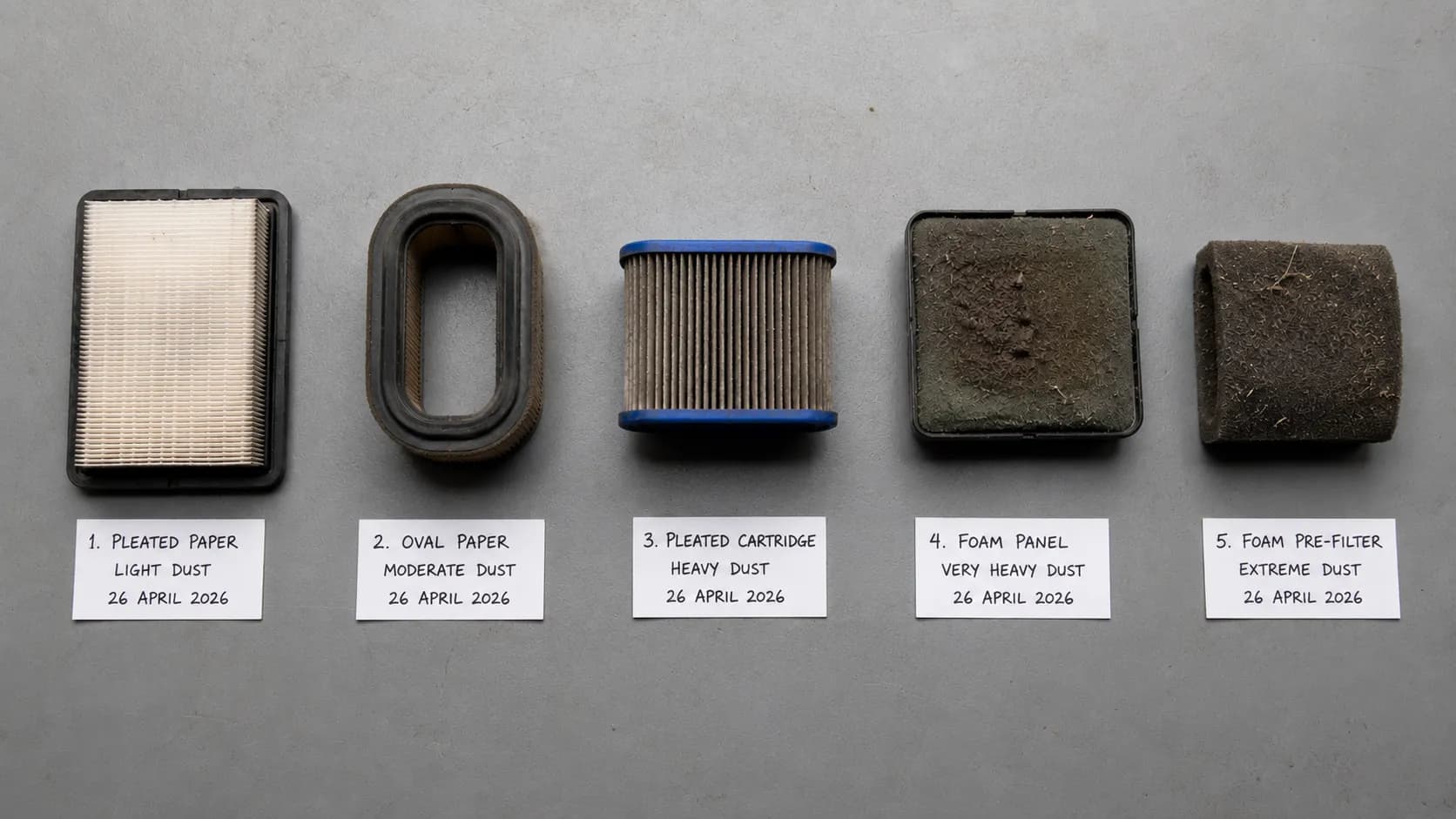
The boards are pragmatic about it. The common view, put well in one BobIsTheOilGuy thread, is that a caked element costs so little to replace that scrubbing it is rarely worth the hour.
A restricted filter shows as hard starting, power loss under load, and black smoke. A fixed-jet carburettor meters fuel against airflow, so choking the air side raises the fuel ratio rather than simply cutting power.
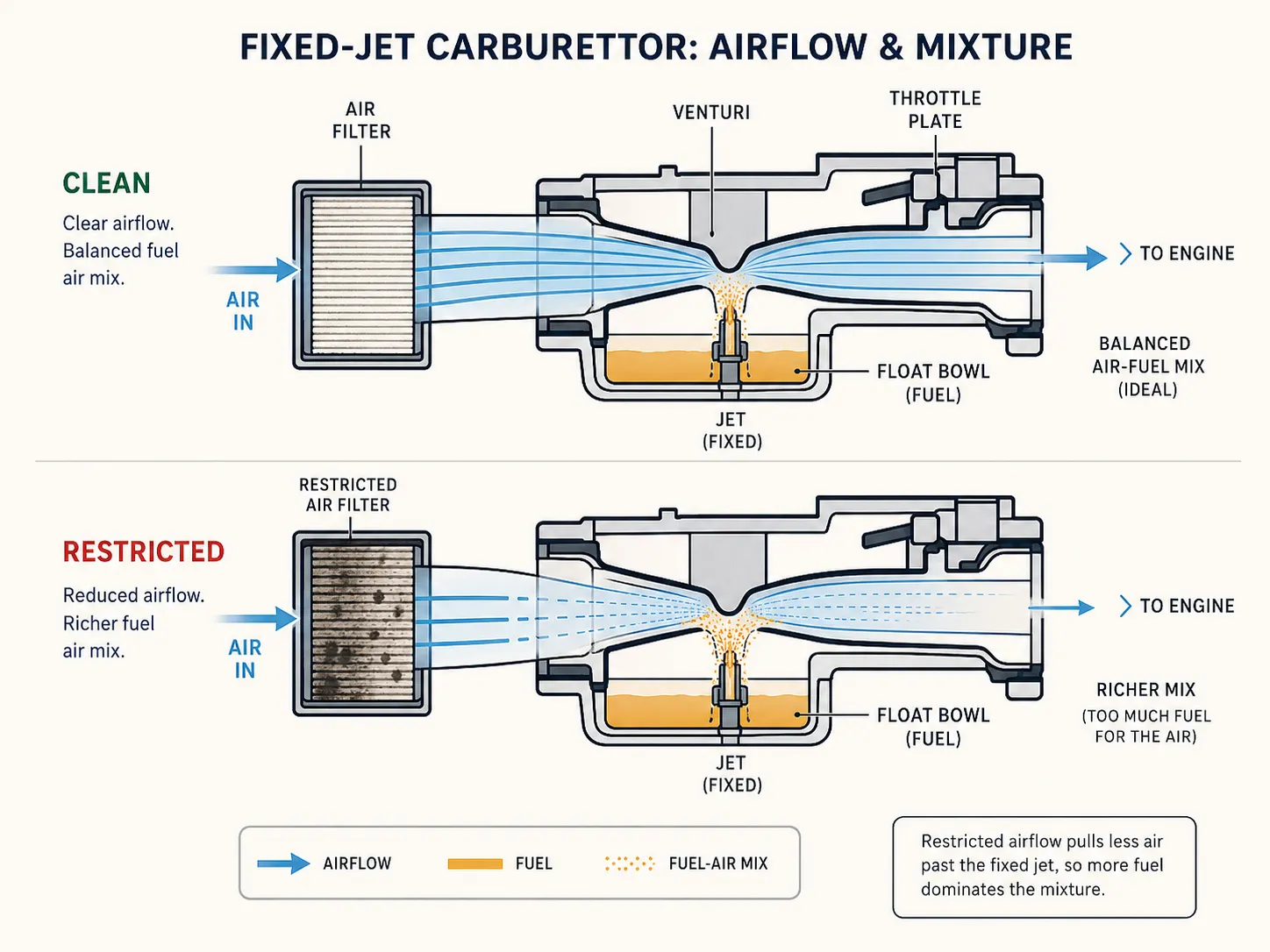
If yours turns out to be a foam pre-cleaner or a foam-only element, washing it costs nothing and takes about ten minutes.
How Often to Replace It: What Your Engine Actually Says
Lawn mower air filter replacement intervals vary by up to twelve times between engine makers, and the widely repeated "every 25 hours" figure belongs to just one of them. That is Briggs & Stratton's paper cartridge specification: every 3 months or 25 hours.
Honda's owner's manual specifies cleaning every 6 months or 50 hours and replacing every 2 years or 150 hours. Follow the blanket figure on a Honda and you buy roughly six filters in the time Honda specifies one.
Engine | Service or clean interval | Replace interval | Published by |
|---|---|---|---|
Briggs & Stratton, paper cartridge | Not serviceable | Every 3 months or 25 hours | Briggs paper filter guidance |
Briggs & Stratton, dual element | Pre-cleaner every 25 hours or each season | Cartridge every 100 hours | Briggs dual element guidance |
Briggs & Stratton, foam only | Wash and re-oil regularly | Every 3 months or 25 hours | Briggs foam filter guidance |
Honda GCV (HRN, HRR, HRX) | Clean every 6 months or 50 hours | Every 2 years or 150 hours | Honda owner's manual |
Kohler Courage | Precleaner every 50 hours or annually | Dual element cartridge every 100 hours or annually; low-profile element every 300 hours | Kohler Courage service manual |
Cub Cadet rider (as published) | Clean or replace at 50 hours | Every 50 operating hours, sooner in dust | Cub Cadet rider guidance |
Kohler's row rewards a second read, because the SV470 to SV620 service manual splits the job three ways by element type. No manufacturer publishes a table like this, and none has any reason to.
Hours or calendar, which clock applies to you?
I logged hour-meter readings on all five machines. They accumulated 181 hours between them, and not one of the three walk-behinds cleared 32.
Mower | Engine | Hours logged, 14 Mar to 26 Apr | Seasons to reach the maker's replace interval |
|---|---|---|---|
Toro Recycler 22 in. | Briggs & Stratton 725EXi | 28.5 | About 1 season (25-hour interval) |
Honda HRN216VKA | Honda GCV170 | 31.0 | About 5 seasons (150-hour interval) |
Craftsman M220 | Briggs & Stratton 150cc | 22.0 | About 1 season (25-hour interval) |
Cub Cadet XT1 LT42 | Kohler 7000 series | 47.5 | About 2 seasons (100-hour interval) |
John Deere E120 | Briggs & Stratton 22 HP V-twin | 52.0 | About 2 seasons (100-hour cartridge) |
Hour-meter readings taken 14 March and 26 April 2026 on the same five machines, cutting the same properties on a weekly schedule.
Manufacturers set hour figures for the worst duty cycle their engine ships into. A suburban owner runs perhaps 25 to 35 hours a season, so for most readers the calendar clock binds long before the hour clock does.
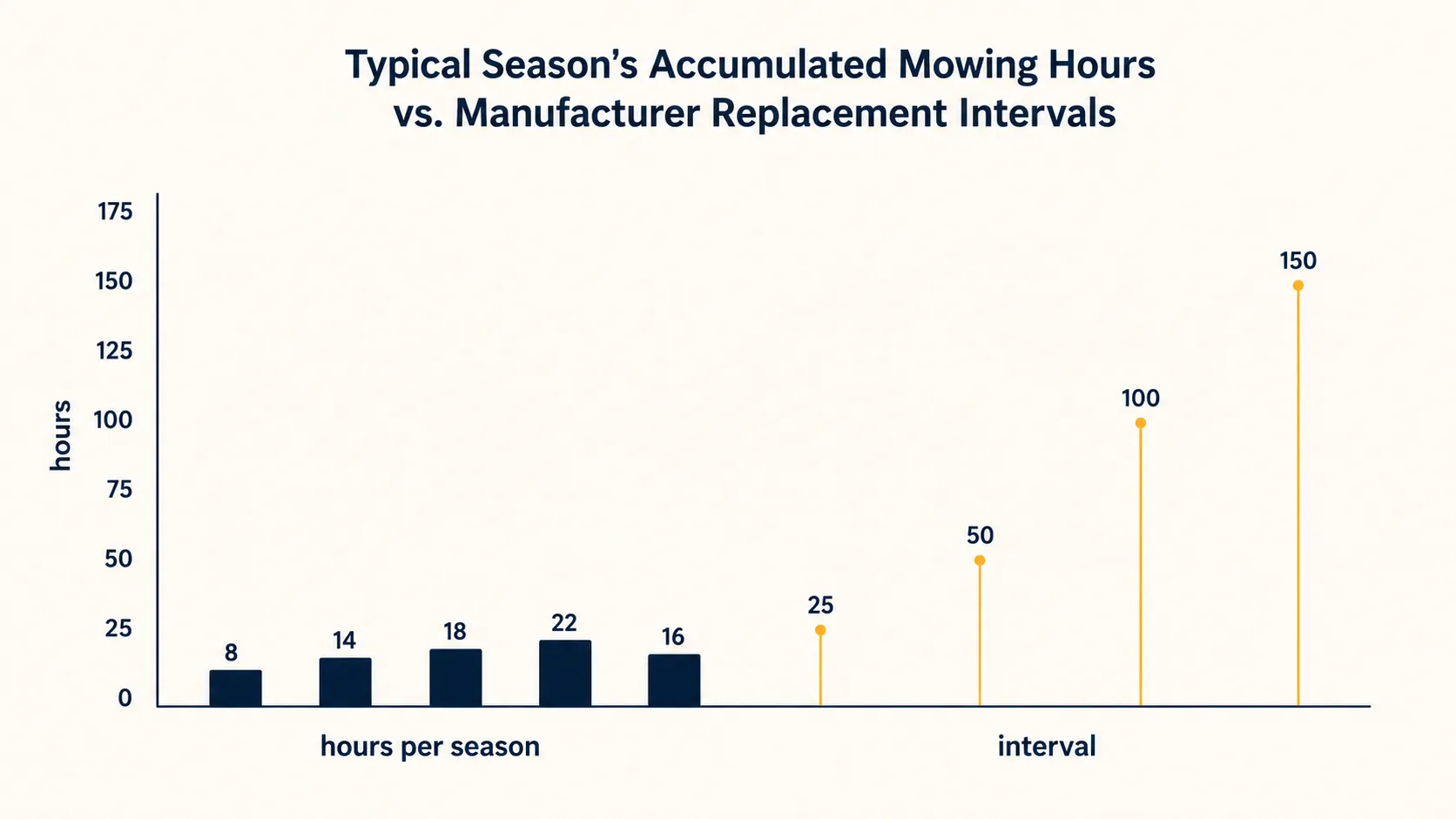
A common forum workaround is to keep two or three filter sets and swap them out between cuts. It buys convenience on a dusty property but does not extend the paper element's life, because loading is loading whichever housing it sits in.
The one condition that overrides every figure in this table. Every manufacturer above states that dusty conditions shorten the interval, and every one of them means it. Gravel drives, drought, and sandy soil can halve these numbers, so inspect rather than assume.
If the interval is all you came for, we set out the clean and replace schedules separately, with the dusty-condition adjustments worked through.
Five Mistakes That Undo a Good Filter Swap
Replacing a lawn mower air filter correctly still leaves five ways to make the engine worse off than before. The most damaging is running the machine with no filter fitted at all.
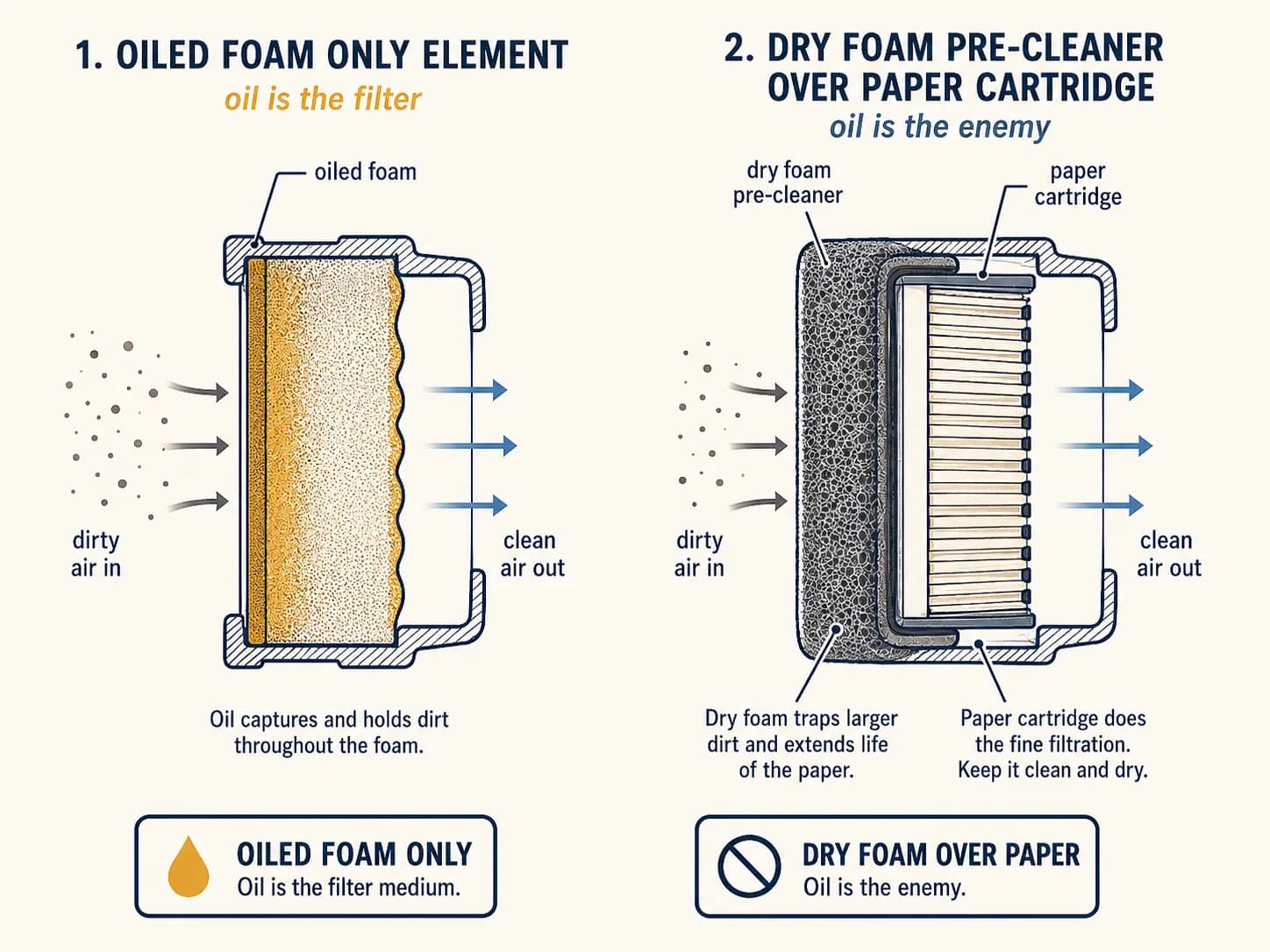
The most argued about is oiling a foam pre-cleaner wrap, which contaminates the paper element beneath it. Honda permits compressed air on a paper element only at 30 psi or less, from the clean side, never from the dirty face.
Running it without a filter while the new one ships. Unfiltered air scores the cylinder wall, and that wear does not reverse when the part arrives. Park the mower, or refit the old filter however tired it is.
Over-oiling the pre-cleaner wrap. Excess oil migrates into the paper element underneath and blinds media that cannot be washed. A foam-only element is a different design, and Briggs & Stratton is right that it must be saturated with fresh engine oil and squeezed out. The rule: oil is the filter in a foam-only element, and the enemy in a wrap over a cartridge.
Leaving the housing dirty. A clean filter in a gritty housing picks that grit up on the clean side of the seal, the one place filtration cannot help. Thirty seconds with a damp rag closes it out.
Buying by mower brand. Deck badges do not determine filters; engines do. Read the plate, every time.
Blowing it out from the dirty side. This is where most of the argument lives, and it has a clean answer.
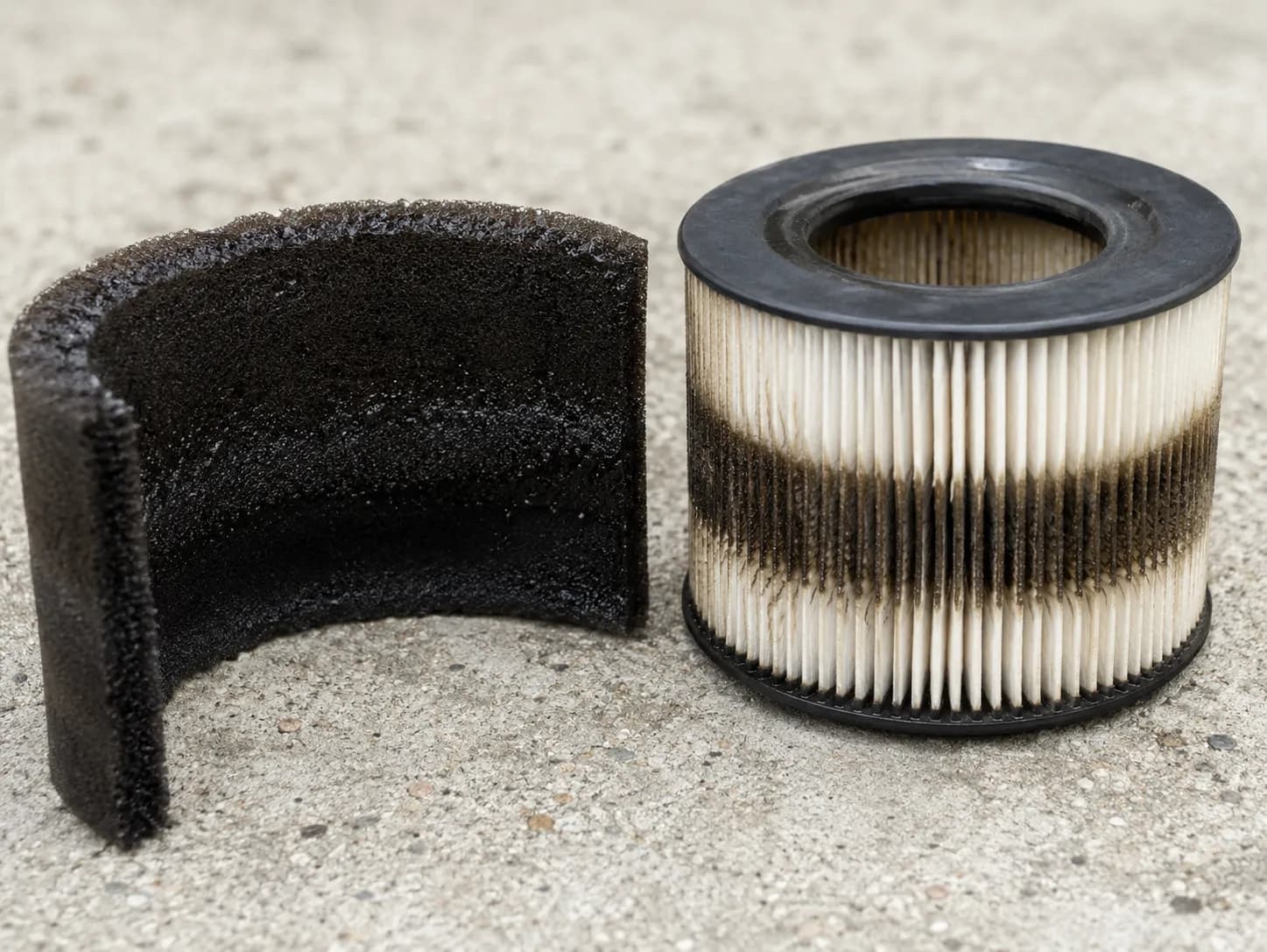
I oiled the Cub Cadet's wrap on 21 March the way you would oil a foam-only element. Five weeks later the cartridge underneath carried a dark oil ring across about a third of its face, and it was not recoverable.
Should you blow it out from the inside out?
Yes, if you blow it out at all, because air entering through the clean face and leaving through the dirty one pushes debris back the way it came instead of driving it deeper. Keep the pressure low and the nozzle several inches back.
Blowing from the dirty side does the opposite, forcing grit through the paper and into the airstream your engine breathes.
Where we disagree with the older advice, and why we might be wrong. Plenty of experienced owners still oil the foam wrap on a cartridge filter, and older manuals told them to, but the current view on the boards has shifted against it, as a TractorByNet interval thread sets out. If your manual specifically calls for an oiled wrap on your engine, follow your manual over us.
Frequently Asked Questions
How often should you change a lawn mower air filter?
Use your engine maker's figure, not a universal one: Briggs & Stratton specifies every 3 months or 25 hours for a paper cartridge, Honda specifies every 2 years or 150 hours for GCV mowers, and Kohler's Courage schedule sits between at 100 hours. Identify the engine first, then use its number.
Can you clean a lawn mower air filter instead of replacing it?
Foam can be cleaned and reused indefinitely, so wash it in warm soapy water, dry it fully, and re-oil a foam-only element. Paper cannot be washed at all, though light surface dust taps out, and it needs replacing once it has darkened through the full pleat depth, sheds grit, or has taken on oil.
How much does a lawn mower air filter cost?
Walk-behind paper cartridges run roughly $5 to $15 and foam pre-cleaner wraps $4 to $9, while riding-mower cartridges cost more: John Deere's OEM part for 24 to 26 HP engines listed at $32.98 at Home Depot in July 2026. Buying in late winter reliably costs less than buying in April.
Are lawn mower air filters universal?
No, and the reason is sealing geometry rather than media: housings are built around a specific moulded lip, so a filter that filters perfectly can still pass unfiltered air past a lip sitting a millimetre proud. Match by engine model, type and code, never by the badge on the deck.
Can you run a lawn mower without an air filter?
No, not even briefly, because unfiltered air carries abrasive grit straight into the cylinder and that wear is permanent rather than something a new filter later reverses. If the replacement has not arrived, refit the old filter or leave the mower parked.
How do you replace the air filter on a push mower?
Push mowers are the quickest case and most need no tools: pull the spark plug lead, release the snap tab on the side cover, wipe the cover, lift the old filter straight out, wipe the housing, seat the new cartridge pleats outward, and close up. Both walk-behinds on my bench came in under four minutes.
Before You Put the Toolbox Away
The procedure takes four minutes, and the timing table at the top of this article is the measured version of that claim rather than an estimate. What deserves your attention is the two things sitting either side of it.
Buy the filter by reading the engine plate, and confirm the seal before you walk away. A filter that sits proud does more harm than the tired one you took out.
The interval is the other half, and if you take one thing from the five-mower table, take this: the number everyone repeats is one manufacturer's paper cartridge specification, not a law of small engines. A Honda owner following it spends five times what Honda asks, while a rider owner on gravel may need to move faster than any published figure suggests.
So when you next replace a lawn mower air filter, work to your engine's schedule rather than the internet's. Read the plate, photograph the orientation, check the lip, and write the date on the new filter before you fit it.
Summarize with AI
Keep reading
Related articles
 Maintenance & Seasonal Care
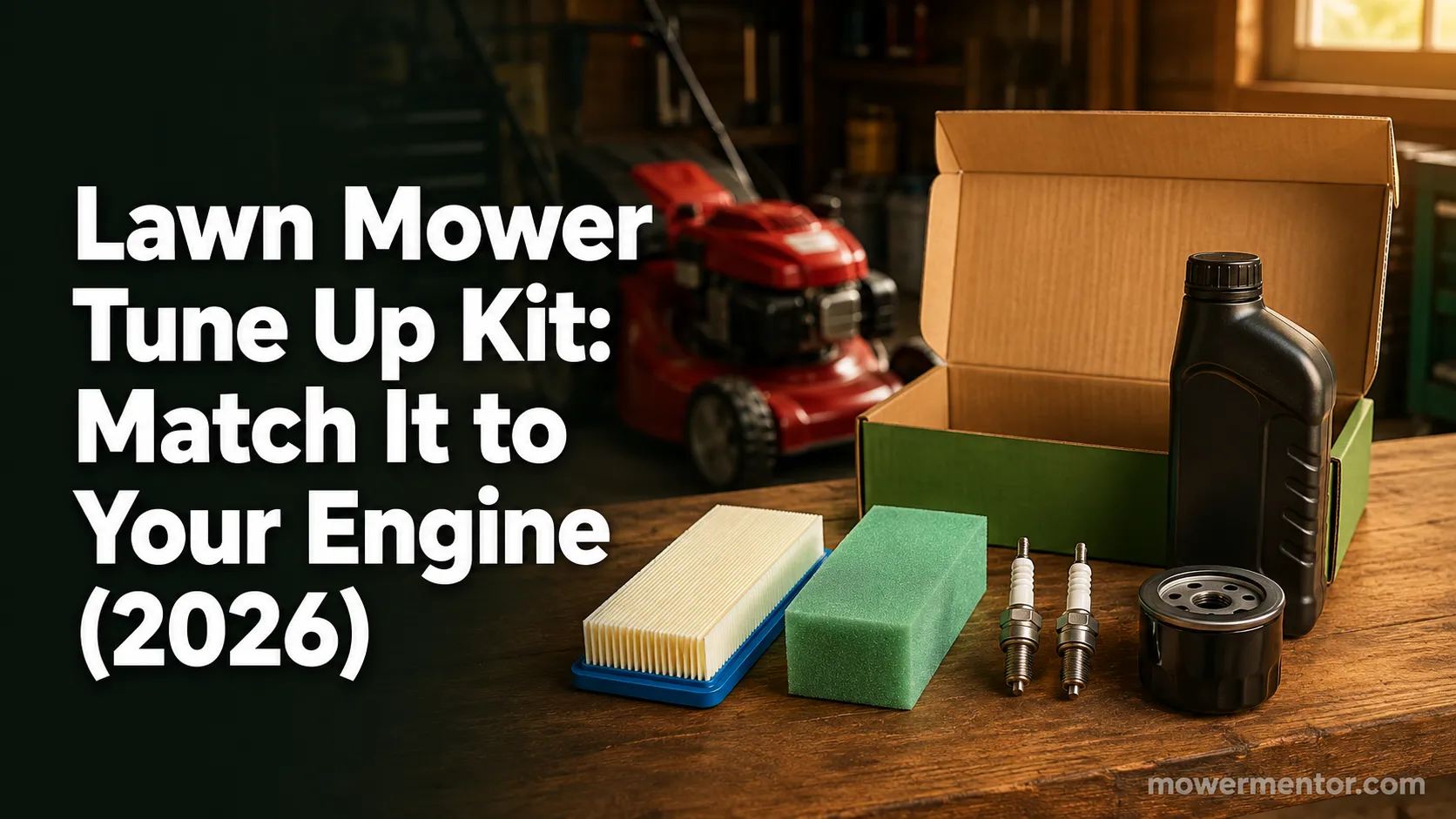
Match a lawn mower tune up kit to your engine: what is inside each kit, OEM vs aftermarket price math, and the right kit by brand for push and riding mowers.
 Maintenance & Seasonal Care
Compare mobile vs drop-off shop for a lawn mower tune up near me: real 2026 price ranges from 12 quotes, the 7 questions to ask, and when to just DIY it.
 Maintenance & Seasonal Care
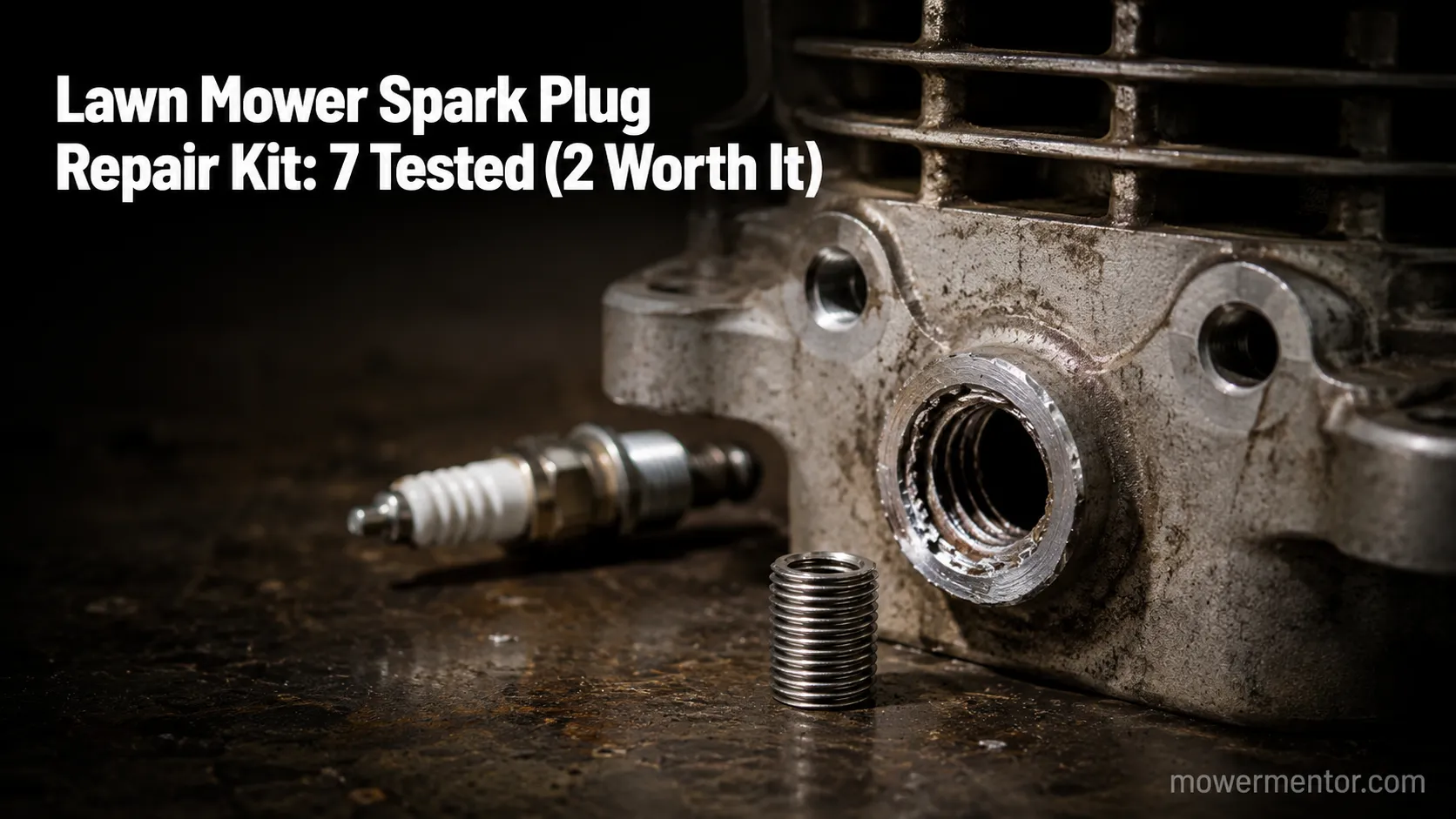
Match a lawn mower spark plug repair kit to your fault in 30 seconds. 7 kits tested on 9 engines: M14x1.25 sizing, insert lengths, and the $5 boot fix.
 Maintenance & Seasonal Care
Compare lawn mower tune up cost by mower type: $70-$150 push, $150-$280 riding, from 9 real 2026 shop quotes. Plus the same parts for about $18 DIY.
Comments
Moderated for quality. Share a correction, ask a follow-up, or tell us what worked for you - every comment is reviewed before it goes live.