
Lawn Mower Tune Up Near Me: Mobile vs Shop (12 Quotes)
Compare mobile vs drop-off shop for a lawn mower tune up near me: real 2026 price ranges from 12 quotes, the 7 questions to ask, and when to just DIY it.
Written by Sam RourkeReviewed by Wade Coburn
Last updated on August 19, 2026

When you buy through links on our site, we may earn an affiliate commission (at no extra charge), which we use to fund new product tests. Learn more.
Summarize with AI
Search a lawn mower tune up near me and you get three shops on a map, a phone number each, and not one price. That is the least useful answer to a question that has a knowable market rate, because the number on your invoice is decided by which of four provider types you call and by seven questions almost nobody asks before the mower leaves the garage.
Between 24 February and 21 March 2026 I put the same scripted request to twelve providers across five US metros, using the same two machines every time: a 2019 Toro Recycler 22 inch with a Briggs and Stratton 163cc engine, and a 2016 Cub Cadet XT1 with a 42 inch deck.
What came back was a three-fold spread on identical work, a hardware chain with no national service standard, and a booking window that matters more than the price difference between any two shops.
What a Mower Tune-Up Costs Near You (The 30-Second Answer)
A mower tune-up costs $79 to $129 at a drop-off repair shop for a walk-behind machine, with parts billed on top, or $125 to $185 from a mobile technician who works at your house with parts included. Riding mowers run roughly double.
Across the twelve providers I quoted in five metros between 24 February and 21 March 2026, the median walk-behind price was $95 at a shop and $149 mobile. The median riding price was $185 and $225.
Here is every quote, without averaging.
Table 1: Twelve tune-up quotes, 24 February to 21 March 2026
Provider channel | Metro | Walk-behind | Riding | Pickup fee | Parts included |
|---|---|---|---|---|---|
Mobile at-home | Raleigh, NC | $125 | $175 | Comes to you | Yes |
Mobile at-home | Indianapolis, IN | $145 | $215 | Comes to you | Yes |
Mobile at-home | Milwaukee, WI | $153 | $235 | Comes to you | Yes |
Mobile at-home | Sacramento, CA | $185 | $310 | Comes to you | Yes |
Independent shop | Indianapolis, IN | $79 | $149 | $35 | No |
Independent shop | Milwaukee, WI | $89 | $179 | $45 | No |
Independent shop | Raleigh, NC | $95 | $185 | Waived in March | No |
Independent shop | Denver, CO | $109 | $210 | $60 | No |
Hardware counter | Milwaukee, WI | $95 | Not offered | Waived in March | No |
Hardware counter | Denver, CO | $95 | $175 | $50 | No |
OEM dealer | Sacramento, CA | $119 | $240 | $75 | No |
OEM dealer | Denver, CO | $129 | $260 | $85 | No |
Two line items do the damage and neither shows up in a price range: the minimum service fee on the mobile side, and the shop supplies charge that lands on a drop-off invoice after the work is done. Both are published in plain sight if you look.
One Wisconsin mobile operation states a $130 minimum service fee at $130 per hour, with shop supplies of $11 to $30 billed on top. A Wisconsin hardware counter posts a $94.99 flat tune-up plus parts and tax.
How these numbers were collected. One scripted quote request, twelve providers, four channel types, two machines, across Milwaukee, Indianapolis, Raleigh, Denver and Sacramento between 24 February and 21 March 2026.
What this is not. Twelve providers over four weeks is not a national price index, and every price here can change without notice. Treat them as a negotiating baseline, not a quote.
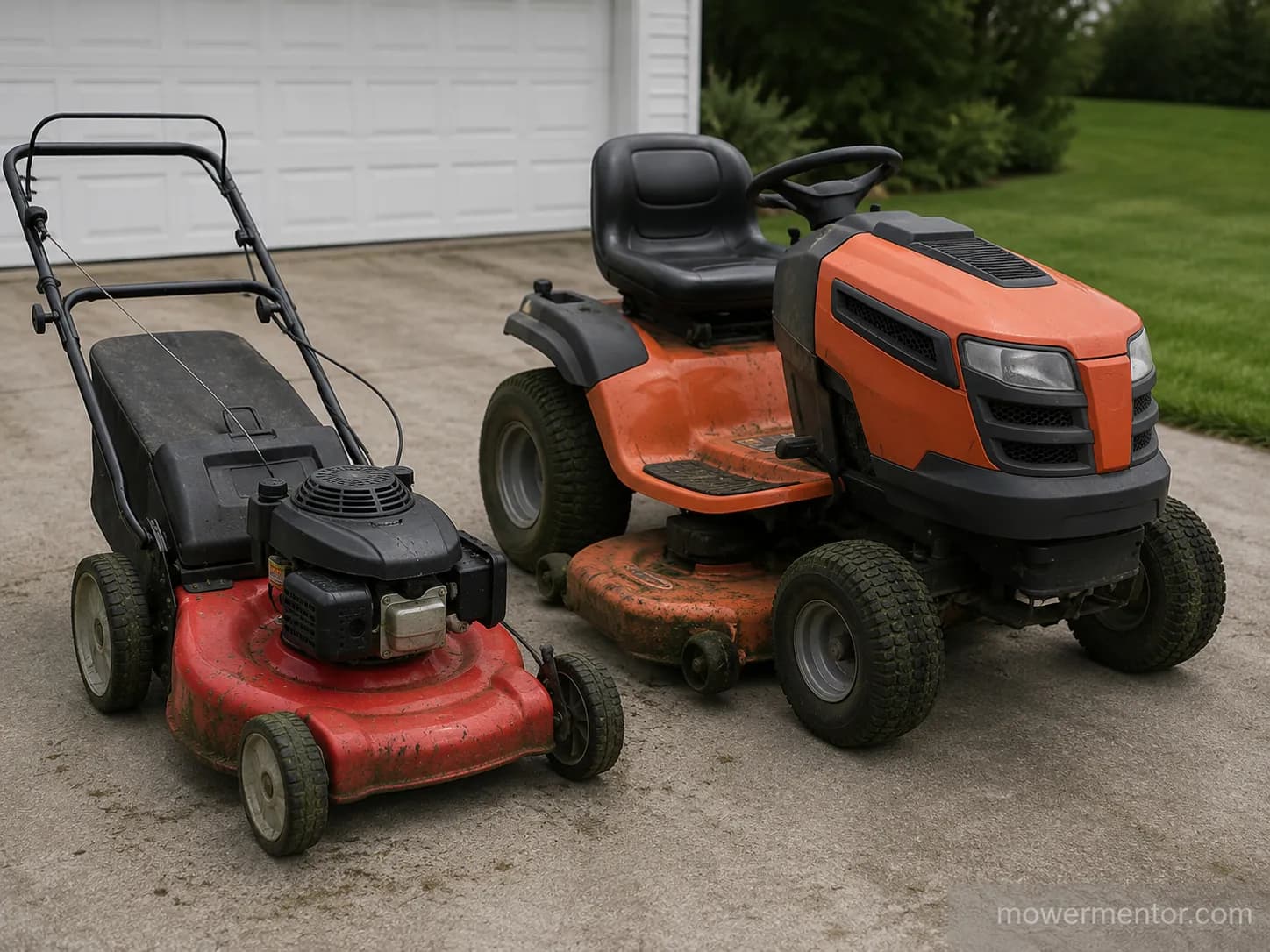
The channel verdict is short. If the mower fits in your vehicle, a drop-off shop is the cheapest legitimate route, and if it does not, mobile stops being a luxury.
What a Lawn Mower Tune Up Near Me Actually Buys You
A lawn mower tune up near me normally covers an engine oil change, a new spark plug, a new or cleaned air filter, blade sharpening and balancing, a deck scrape and a test run. A full service adds a carburetor clean or float bowl drain, a fuel filter, cable lubrication and belt inspection.
Parts are usually billed separately from the service price at drop-off shops and bundled into it by mobile operators. Of four itemized work orders I collected in March 2026, three included blade sharpening and one charged it as a $12 add-on.
A basic tune-up covers six things: an engine oil change, a new spark plug, a new or cleaned air filter, blade sharpening and balancing, a deck scrape, and a test run.
No two shops define this identically. "Tune-up" is a marketing word, not a standard. Use the table below as a checklist to hold against a written quote, not as an industry specification.
Table 2: What a basic tune-up covers against a full service
Line item | Basic tune-up | Full service |
|---|---|---|
Engine oil change | Included | Included |
Oil filter (riding mowers) | Not applicable | Included |
Spark plug replacement | Included | Included |
Air filter clean or replace | Included | Included |
Fuel filter | Checked only | Replaced |
Blade sharpen and balance | Usually included, sometimes a $12 add-on | Included |
Deck scrape and clean | Included | Included |
Carburetor float bowl drain | Sometimes included | Included |
Carburetor clean or rebuild | Not included | Included, ultrasonic at better shops |
Cable and pivot lubrication | Not included | Included |
Belt and tire inspection | Not included | Included |
Test run and safety check | Included | Included |
The line that decides whether the service actually works is the carburetor float bowl. A machine that sat all winter on last season's fuel has varnish in the bowl and a partly blocked jet, so a basic tune-up that only swaps the plug and filter hands you back a mower that still surges and dies.
That is why the inclusion lists worth reading both name it. One Massachusetts shop lists ultrasonic carburetor cleaning in its standard $89.95 tune-up, and the Wisconsin hardware counter lists a fuel drain and float bowl clean in its $94.99 service.
Parts sit outside the service price at every drop-off provider I quoted, roughly $31 in consumables on a walk-behind. That is the gap between an $89 quote and a $144 invoice, and the component-by-component arithmetic sits in our breakdown of what a tune-up should cost.
Electric mowers get none of this, and the FAQ explains what they get instead. Whatever the machine, disconnect the spark plug lead before anyone removes the blade or the plug.
Mobile at Your House vs Dropping It at a Shop
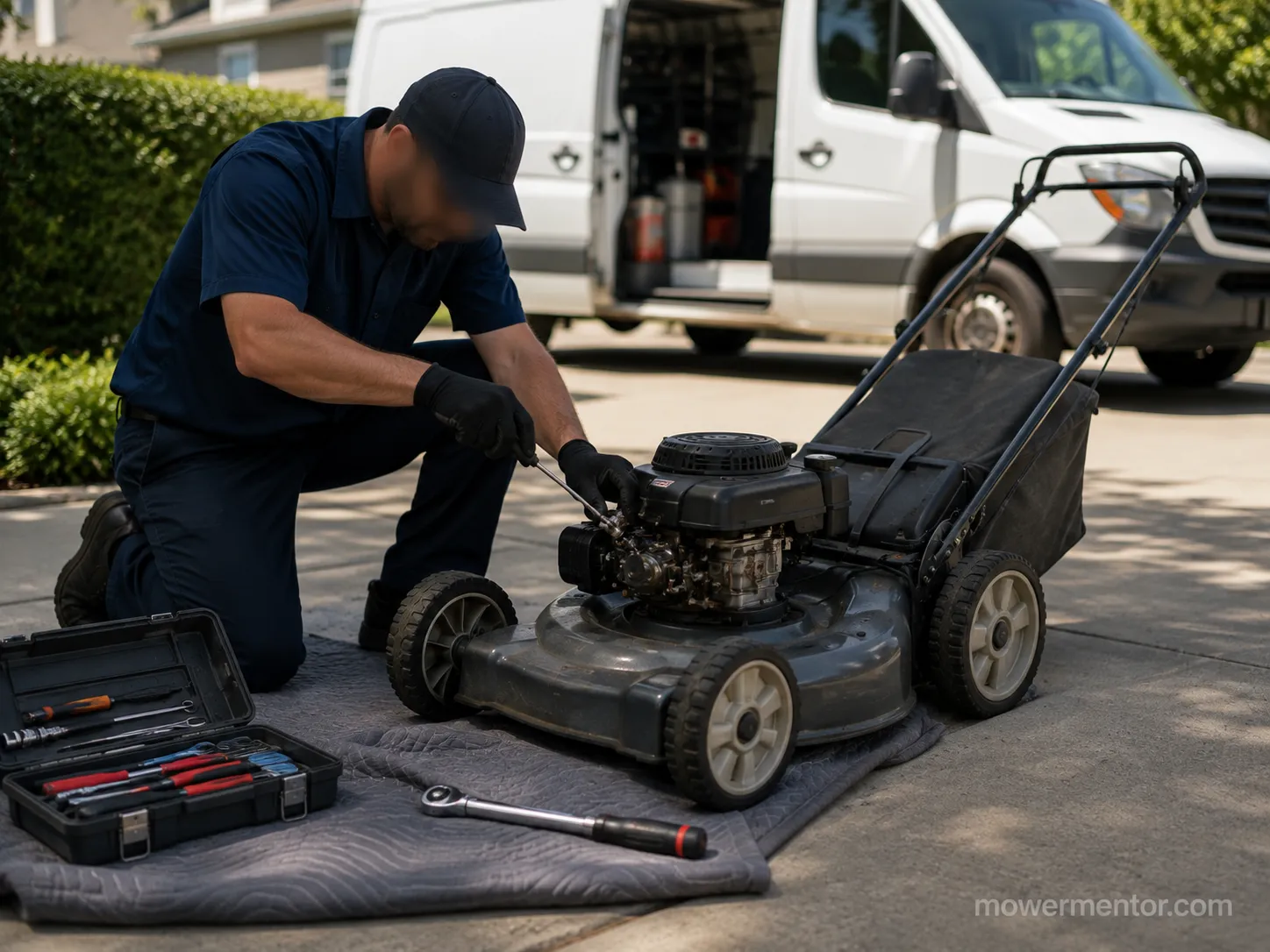
A mobile lawn mower technician services the machine in your driveway and charges a minimum service fee, commonly $125 for a walk-behind and $175 for a riding mower, that is owed even if you decline the repair.
A drop-off shop quotes less but bills parts on top and adds a pickup fee of $35 to $85 if you cannot transport the mower yourself.
Across the twelve providers I quoted, the two routes finished within $5 of each other for a homeowner with a truck. Mobile came out $40 ahead for one without.
Table 3: The same Toro Recycler, priced both ways
Line item | Drop-off shop | Mobile at your house |
|---|---|---|
Quoted service price | $95 | $149 |
Parts on top (plug, air filter, oil) | $31 | Included |
Shop supplies | $18 | Included |
Getting it there and back | $0 with a truck, $45 with pickup | Included |
Out the door, own transport | $144 | $149 |
Out the door, with pickup | $189 | $149 |
That surprised me, because the mobile premium is treated as settled fact everywhere else on this search. It is not a premium once parts and shop supplies are counted, and it inverts the moment you need someone to collect the machine.
Table 4: Which route fits your situation
Choose mobile at your house if | Choose a drop-off shop if |
|---|---|
You have no truck, van or hatchback that fits the mower | You can transport the machine yourself |
The machine is a riding mower or lawn tractor | The mower needs real repair, not maintenance |
You want the diagnosis explained to you in person | You want the lowest possible out-the-door number |
You need it back the same day | The carburetor needs an ultrasonic clean or the deck needs welding |
You are outside a shop's collection radius | You are willing to wait for a bench slot |
The minimum service fee is not a markup, it is the trip. One North East mobile operator states plainly that its $125 minimum service charge for push machines, or $175 for a rider, falls due at the time of service even if you decline the work.
Pricing structure varies more than price does. Some mobile operators bundle parts and the service call into one flat number banded by deck size, and some drop-off shops instead offer free pickup and delivery on package service.
The other thing you buy from the mobile guy is the diagnosis, because a trip fee typically covers an examination and an on-site quote. A drop-off shop cannot give you that until the machine reaches a bench.
Ask about the service radius before booking, since operators quote a mileage band from their base and sitting outside it adds a surcharge or removes the option. That is what the "within 5 mi" filter on this search is really trying to solve.
On a riding mower the calculation collapses. A 42 inch lawn tractor is not going in a sedan, so the shop's $85 pickup fee and the mobile trip charge converge and the decision becomes how long you can wait.
The catch. Mobile is not the expensive option, but it is the narrower one. A mobile technician works out of a van, which means a carburetor that needs ultrasonic cleaning, a cracked deck or a seized spindle still goes to a shop, and you will have paid the minimum service fee to be told so.
The "National Chains" Aren't National: Ace, Sears, Big-Box and Dealers
Ace Hardware does not run a national lawn mower tune-up program. Ace is a retailer co-operative and each store sets its own service policy, so one store posts a $94.99 flat tune-up, another runs a staffed in-store repair department, and a third quotes by estimate only.
Sears Home Services still dispatches in-home technicians for riding and walk-behind mowers across brands it never sold. Home Depot and Lowe's mainly sell mowers and parts rather than servicing them, and manufacturer authorized dealers are the only channel with a public directory you can check before you call.
Table 5: The four channels, compared
Channel | Mobile at-home | Independent shop | Hardware counter | OEM dealer |
|---|---|---|---|---|
Who they are | One or two techs in a fitted van | Owner-operated small-engine shop | A retail store with a service bench | Brand-authorized sales and service |
Price posture | Highest quoted price, everything bundled | Lowest quoted price, parts on top | Flat posted price, parts on top | Highest total, parts on top |
Turnaround posture | Appointment-based, same visit | Bench queue, days to weeks | Bench queue, longest in season | Bench queue, parts always in stock |
Can you verify them | Reviews and certification claims only | Reviews and certification claims only | Store page, varies by store | Manufacturer dealer locator |
Best for | No transport, riding mowers, same-day | Cheapest routine service, real repairs | Convenience when the store has a bench | Warranty work and obscure parts |
I checked three Ace stores in three states and got three different answers. The Wisconsin store posts the $94.99 flat tune-up already mentioned, with free walk-behind pickup during March.
A Michigan store instead runs a staffed Fix-It Shop and services what it sells. A Montana store publishes no price at all and offers tune-up estimates on inspection.
The banner tells you nothing. Call the specific store, because the one nine minutes away may service nothing while the one twenty minutes away has a full-time technician.
Sears is the opposite confusion. There is rarely a Sears store near you, but Sears Home Services still sends technicians to the house for riding mowers and lawn tractors.
It covers walk-behind machines as well, including brands Sears never sold. That makes it an in-home national option genuinely distinct from your local mobile guy.
Big-box stores are a parts counter, not a service counter. Home Depot and Lowe's sell the plug, filter and oil for same-day pickup, and if you are standing there anyway, a matched tune-up kit usually costs less than the three bought separately.
Then there is the check almost nobody runs. I put the top three map results in each of my five metros through the Briggs and Stratton dealer locator, and six of fifteen came back as authorized dealers for that engine family.
Authorization matters less than you think, and more than they will tell you. For warranty work it is decisive, because an unauthorized shop cannot process a claim and the repair comes out of your pocket.
For a plug, filter, oil and blade service on a machine that is out of warranty it is close to irrelevant, and an uncertified independent with fifteen years on Briggs engines is often the better bet on price and turnaround.

7 Questions to Ask Before the Mower Leaves Your Garage
Small-engine mechanics ask each other what do you charge all the time, and you are allowed to ask them the same.
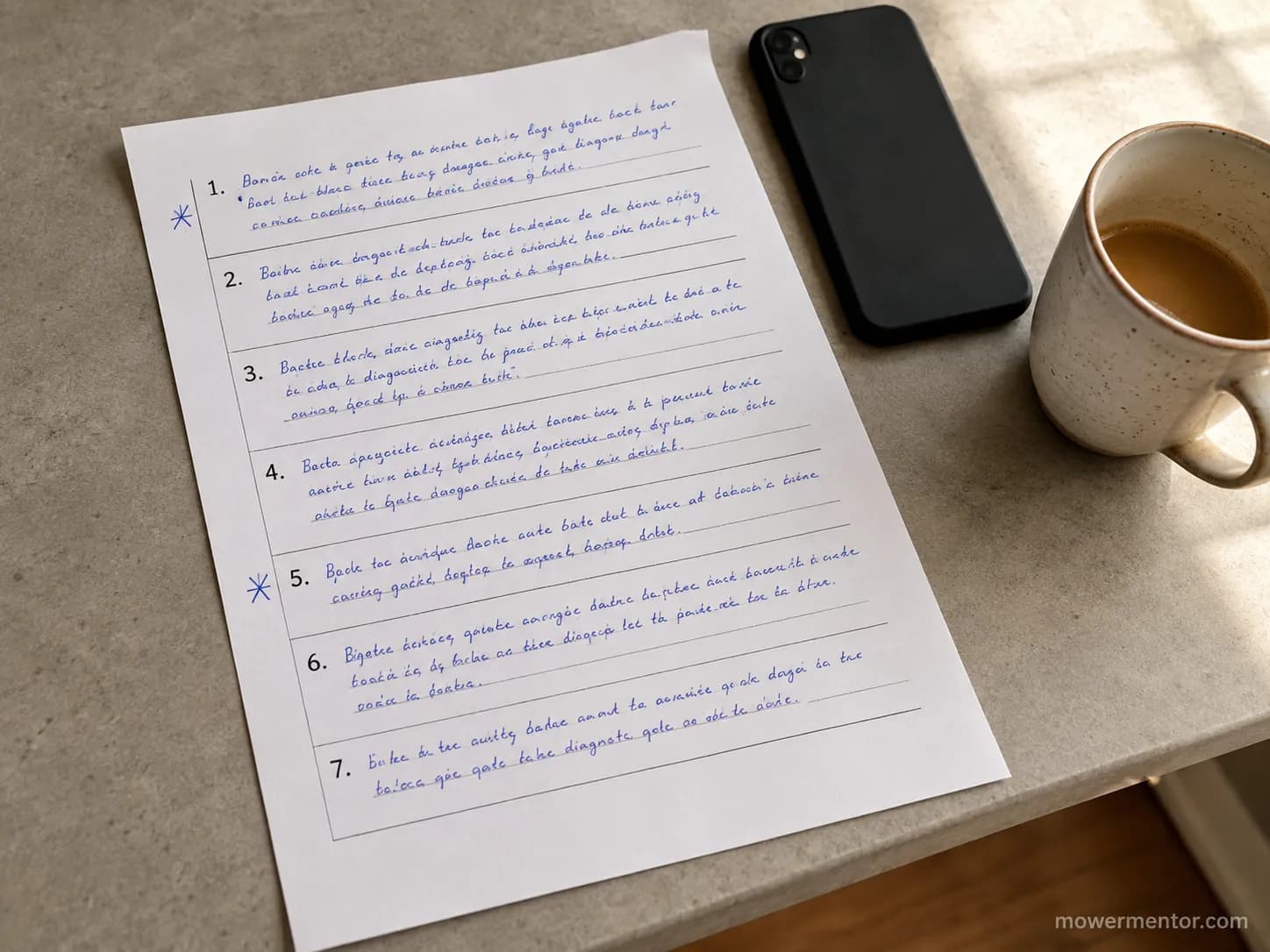
Before handing over a lawn mower for a tune-up, ask seven things: the shop rate and whether the job is flat-rate or hourly, whether parts are included, whether a minimum service fee applies if you decline, whether pickup is charged, what the pre-authorization ceiling is, whether parts are OEM or aftermarket, and whether the labor carries a warranty.
Of the twelve providers I read this script to in March 2026, two would not quote a shop rate over the phone and one asked me to pre-approve $225 of work before the mower came in.
What is your shop rate, and is this job flat-rate or hourly?
Is that price with parts, or parts on top?
Is there a minimum service fee, and do I owe it if I decline the work?
Do you charge for pickup and delivery, and is it waived this month?
What is your pre-authorization ceiling, and will you put the scope in writing?
OEM or aftermarket parts, and can I choose?
Do you warranty the labor, and for how long?
Table 6: What a good answer sounds like, and what a bad one sounds like
Question | Good answer | Bad answer |
|---|---|---|
Shop rate, flat or hourly | "Flat $95 walk-behind, $85 an hour beyond it" | Will not name a number by phone |
Parts in or on top | "Service $95, parts $25 to $35" | "We will let you know" |
Minimum service fee | "$125, applied to the repair, due either way" | Silence until the invoice |
Pickup charged or waived | "$45, waived through March" | "We will sort it out after" |
Pre-authorization ceiling | "$225, and I will email you the scope" | A ceiling with no written scope |
OEM or aftermarket | "OEM by default, and I will tell you which I used" | "Whatever is on the shelf" |
Labor warranty | "Thirty days, bring it straight back" | "Parts only" |
What's Your Shop Rate, and Is This Job Flat-Rate or Hourly?
This is the question that separates shops that price their work from shops that price your patience. In one long-running small-engine shop rate thread, dealer labor sits at $80 to $90 an hour against roughly $65 at an independent, so the number exists and a shop refusing to say it by phone is choosing not to.
Two of the twelve refused. Both were also the two that would not confirm whether parts were included, which turned out to be a reliable pairing.
How Do Pickup Fees and Pre-Authorization Ceilings Actually Work?
Pickup pricing is promotional rather than fixed. Of the eight drop-off providers I quoted, five charged $35 to $85, two waived it as a March promotion, and one did not offer collection at all.
The pre-authorization ceiling is the least understood term here and usually the most customer-friendly. The Massachusetts shop cited earlier asks customers to pre-approve up to $225 so technicians can fix small things without stopping to phone, with a written estimate required above that figure.
When a ceiling is fine and when it is not. A ceiling attached to a written scope saves you a day of phone tag over a $9 fuel line. A ceiling with no written scope is a blank check, and the fix is one sentence: ask them to email the scope before the machine goes on the bench.
Federal advice on repair work is to get three written estimates and check licenses and insurance before authorizing anything. The FTC is also explicit that you should not automatically take the lowest bid.
Apply that proportionately. Three written estimates is right for a $600 riding-mower repair. For a $95 walk-behind service ten minutes away it is overkill, and two calls plus one written quote is the sane version.
You are allowed to walk away. Three of seven questions unanswered is a signal, and there are other shops.
How to Tell a Good Shop From a Bad One
The credentials worth asking a lawn mower repair shop about are EETC certification from the Equipment and Engine Training Council, Briggs and Stratton Master Service Technician, and STIHL MasterWrench. EETC's membership includes Briggs and Stratton, Honda Engines, Kawasaki and Kohler, so the certification is industry-backed rather than invented.
No public consumer directory of certified technicians exists, so you can ask but you cannot verify. Of the twelve providers I asked, five named a specific certification and seven answered "years of experience."
"Best near me" cannot mean a national ranking, because the field is thirty shops inside a twenty mile radius that no publication has ever evaluated. What it can mean is a provider who scores on four checkable things.
A named credential. The EETC certification program is the industry standard here. Its entry-level small-engine credential is backed by the engine makers themselves, and manufacturer training counts too. The Massachusetts shop quoted earlier advertises a Certified Master Technician and a STIHL MasterWrench Gold technician on staff.
Authorization for your engine. Thirty seconds in the manufacturer's dealer locator, linked in the previous section, tells you whether they can process warranty work.
Review volume and recency over star average. A 4.6 from ninety reviews across three seasons beats a 5.0 from six.
Reviews that mention the invoice. The only review content that predicts this transaction is someone describing what they were quoted against what they paid.
Here is how the twelve answered when I asked who would be turning the wrench.
Table 7: Credential answers from twelve providers, March 2026
Answer given | Providers |
|---|---|
Named a specific manufacturer certification | 3 |
Named EETC certification | 2 |
Years of experience only, no credential named | 7 |
Declined to answer | 0 |
You can ask, but you cannot check. There is no public, consumer-facing directory of EETC-certified technicians, so the credential works as a conversation signal rather than something you can independently verify. That is a real limitation of this advice, and any article telling you to "look for certifications" without saying so is skipping the hard part.
Three red flags are worth walking away from: no written estimate when you ask for one, a diagnostic charge on an obvious no-start, and a flat refusal to state a shop rate.
The middle one has a fix. Before paying anyone to diagnose a mower that will not fire, rule out the spark plug first, because a $180 quote against a $4 part is the most common way homeowners overpay here.
Right to Repair does not cover your mower. As of 1 January 2026, PIRG's Right to Repair tracking put 25.75% of Americans in a state with an enforceable law, rising toward 35.5% once Connecticut and Texas rules take effect later in 2026.
Those laws cover consumer electronics, wheelchairs and agricultural equipment. A walk-behind mower is none of the three, so if you were counting on a legal right to parts, manuals or independent repair access, you do not have one here.
When to Book: The Spring Rush Is Real
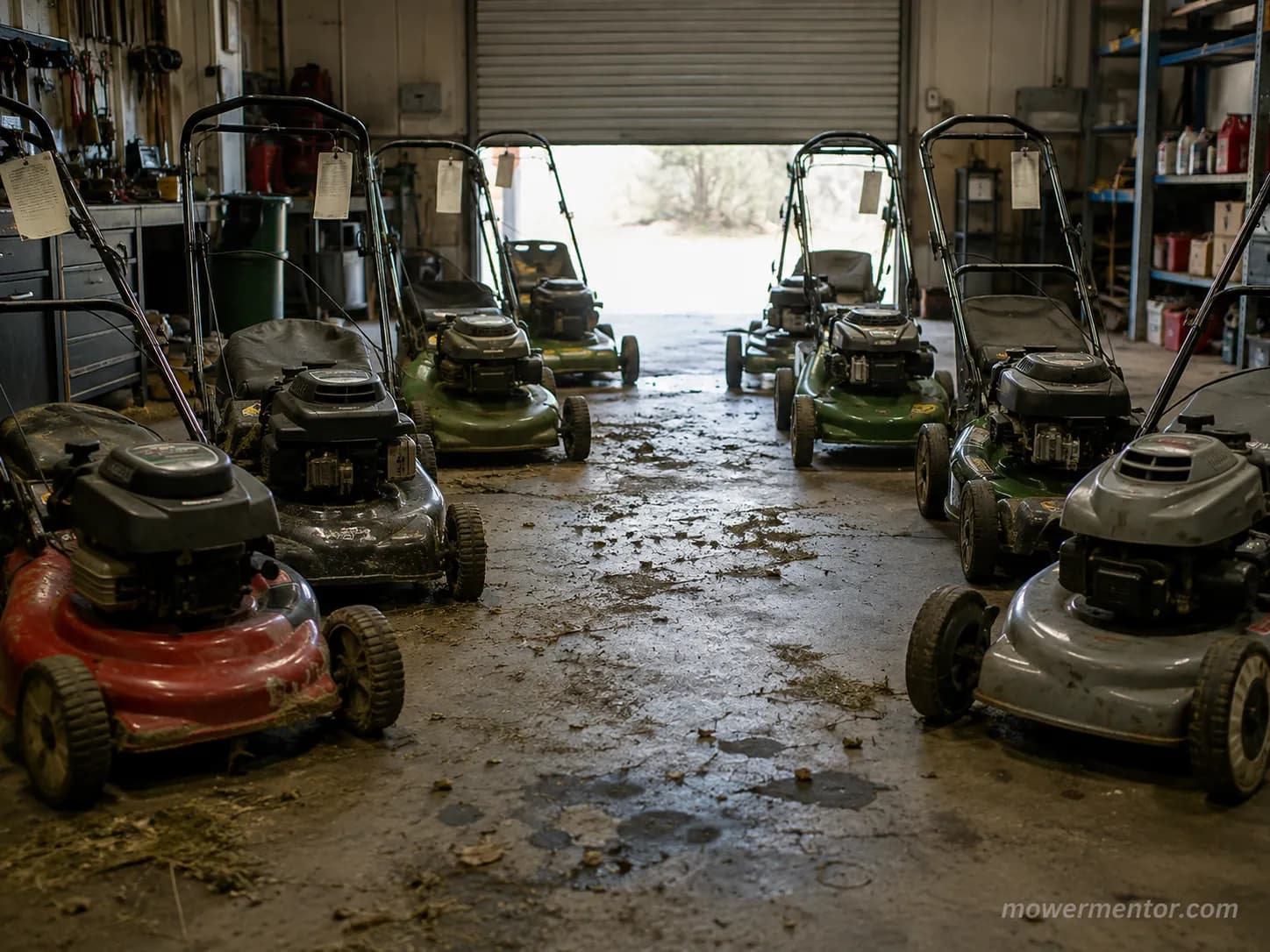
The best time to book a spring tune-up is late January through February, before the first warm weekend. Across the same twelve providers, the average quoted turnaround was just over two business days on 24 February and eleven business days on 21 March.
Late winter is also when replacement parts are most available, according to ASE and Pennsylvania Department of Education certified power equipment instructor David Bodzioch. It is also when several shops run pickup-fee waivers to fill the schedule early.
Table 8: Quoted turnaround, same twelve providers, four weeks apart
Provider channel | Quoted 24 Feb | Quoted 21 Mar | Change |
|---|---|---|---|
Mobile at-home (4) | 3 business days | 9 business days | +6 |
Independent shop (4) | 2 business days | 12 business days | +10 |
Hardware counter (2) | 2 business days | 14 business days | +12 |
OEM dealer (2) | 2 business days | 10 business days | +8 |
All twelve, mean | 2 business days | 11 business days | +9 |
The spike is structural, not random. Every mower that sat all winter on last season's fuel fails in the same week, so demand arrives as a wall rather than a curve, and booking two weeks earlier is worth more than shopping two shops on price.
Bodzioch's point in the Family Handyman tune-up guide is the same one from behind the counter: late winter is the repair shop's slow season and parts are plentiful.
How Booked Out Is the Shop Right Now?
Ask it in those words. "How long will it take" gets you bench time, "how booked out are you" gets you the queue, and a shop can do the work in ninety minutes yet hand it back in twelve days.
Trade discussion of realistic wait times puts good shops at same-day to next-day off-peak and three weeks out in season, with loaner machines usually reserved for commercial accounts. Ask about a loaner anyway, because it costs nothing to find out.
Two data points are not a season. I called on 24 February and again on 21 March, which shows a direction rather than a curve, and it cannot help you at all if the mower has already died in June. If that is where you are, mobile is the route that buys you days instead of weeks.
When to Skip the Shop Entirely
Skipping a paid tune-up makes sense when the deck is rusted through or the engine has heavy hours, regardless of what the mower originally cost. The same service performed at home on the Briggs-powered Toro cost me $26.40 in parts and 41 minutes of stopwatch-timed work, deck cleaning included.
That is against a $149 mobile quote and a $144 out-the-door shop total for identical scope. Disconnect the spark plug lead before removing the blade or the plug.
The repair-versus-replace rule everyone repeats is wrong. "Replace it if the repair exceeds half the price of a new one" anchors the decision to a number you remember paying, which has nothing to do with the machine in front of you.
Two things actually decide it. Push a screwdriver against the underside of the deck near the discharge chute, and if it goes through, the machine is finished whatever the engine does.
Then check the hours, because a residential engine past roughly 500 hours buys you a season at a time, not a decade. A machine failing both tests is what shops call a mechanic special, and the instinct in that same rate thread is not to stick into it more than it is worth.
If the deck is sound and the hours are low, the arithmetic points the other way. Our full walkthrough covers how to do the whole service yourself, and here is what it cost me.
Table 9: Doing it myself against the mobile quote, same machine, same scope
Line item | DIY at home | Mobile at your house |
|---|---|---|
Spark plug | $4.29 | Included |
Air filter | $8.79 | Included |
18 oz SAE 30 oil | $6.49 | Included |
Sharpening consumables | $6.83 | Included |
Labor | 41 minutes of mine | Included |
Total | $26.40 | $149 |
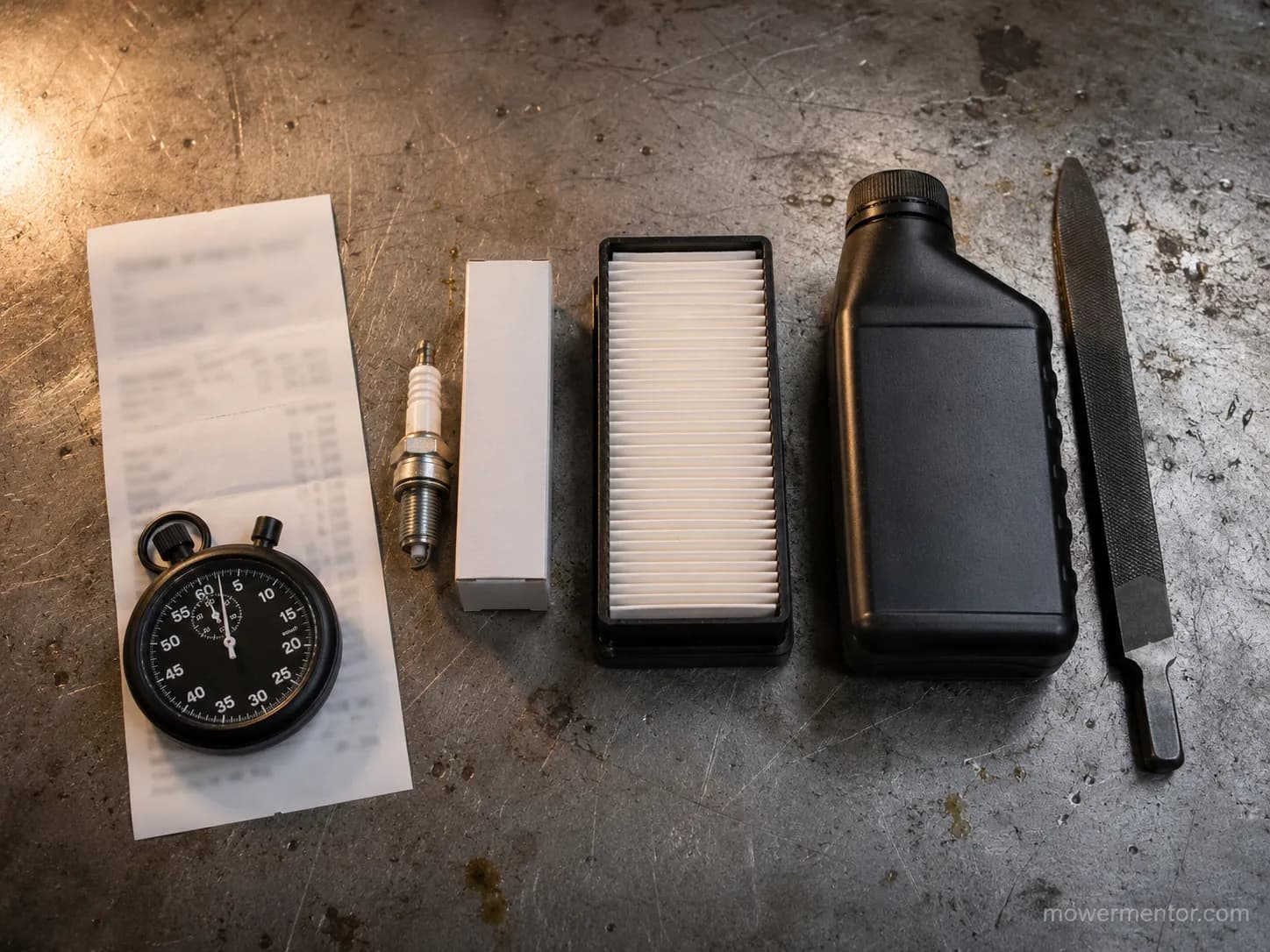
Every consumable on that list is a same-day pickup at a hardware or big-box counter, which is what the parts-near-me searches are really asking. Take the old plug and filter with you and match them by sight.
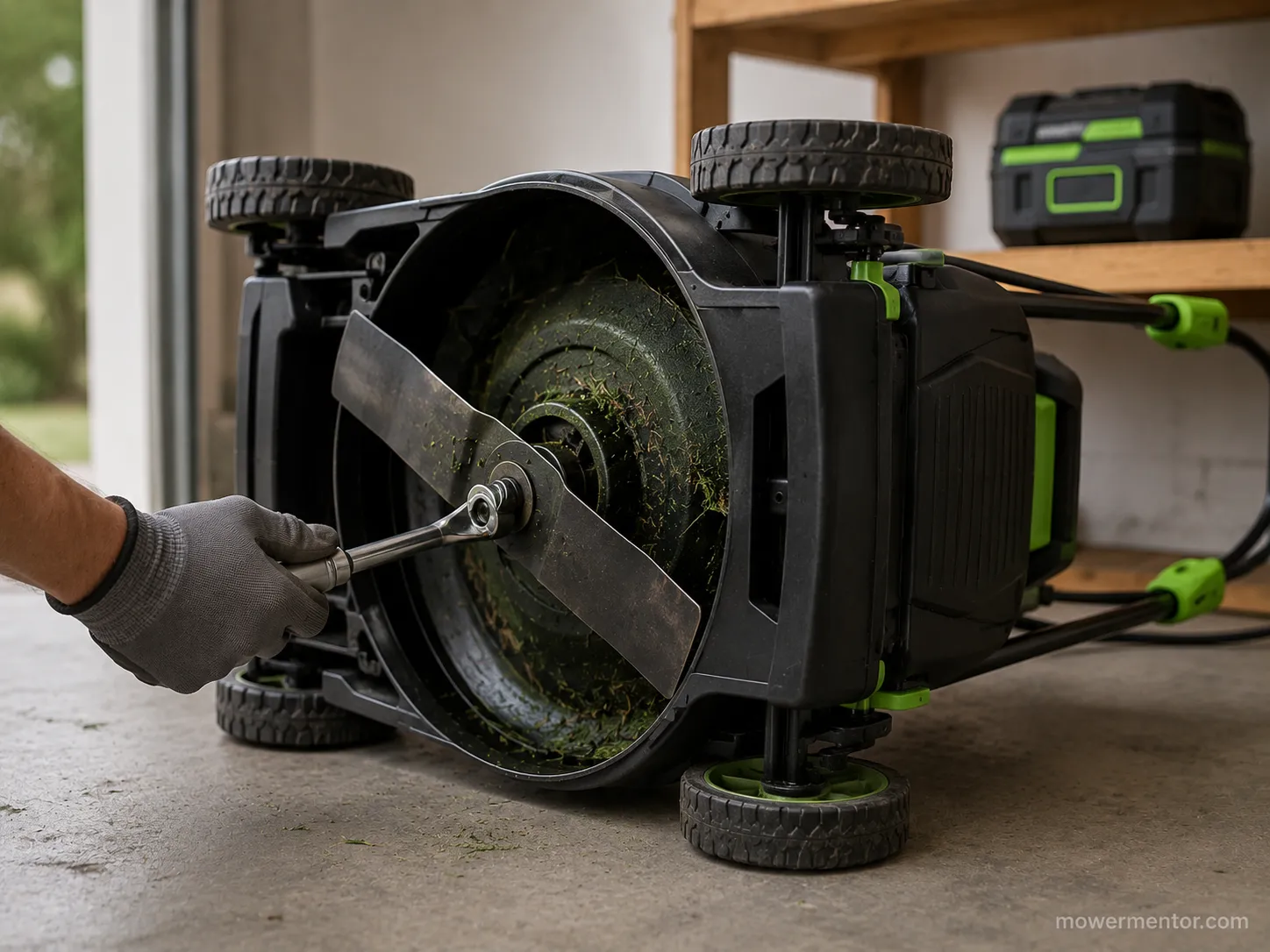
Who should not do this. Anyone whose mower has a fuel-system fault rather than a maintenance need, anyone without a torque wrench for the blade bolt, and anyone whose machine is still under warranty. In all three cases the shop is cheaper than the mistake.
This decision has four defensible answers and the map only shows you one of them. If you can haul the machine, a drop-off shop is the cheapest route at roughly $144 out the door.
If you cannot, mobile is the same money or better and gets you a diagnosis in your driveway. If the deck is sound, the engine is healthy and you own a socket set, the answer is sometimes your own garage for $26.40 and forty-one minutes.
And if the deck goes through under a screwdriver, none of the above is worth doing.
FAQs on Lawn Mower Tune-Up
How often does a lawn mower need a tune-up?
Once a year for most homeowners, or about every 25 to 50 engine hours, whichever comes first. We answer the interval question properly in a separate guide covering clean-versus-replace timings for each component.
Can you tune up an electric lawn mower?
An electric lawn mower does not receive a conventional tune-up. Battery and corded mowers have no spark plug, no air filter and no engine oil, so a small-engine shop has little to service and several I called decline the work outright.
The realistic near-me options are blade sharpening locally plus manufacturer service routing. One battery tool maker routes work through authorized service centers plus a 14-day mail-in repair program.
How long does a lawn mower tune-up take?
Two different numbers. Bench time is roughly 45 to 90 minutes for a walk-behind, and calendar turnaround was two business days in late February and eleven in late March across the twelve providers I quoted.
What does "best" mean for a lawn mower tune-up near me?
A named credential, authorization for your engine family if you need warranty work, review volume across several seasons, and reviews that mention the invoice. A star average alone predicts nothing about what you will pay.
Do I need to be home for a mobile tune-up?
Usually yes for a first visit, because the technician needs to confirm the fault and get authorization. Several operators will service a machine left in an unlocked garage once you are an existing customer.
Will a tune-up fix a mower that won't start?
Only if the cause is stale fuel or a fouled plug, which the carburetor and plug line items cover. A no-start caused by a failed coil, a blocked jet needing a rebuild, or low compression is a repair, not maintenance, and it will be quoted separately.
Making the Call
The three shops on the map are not the answer to this question, they are the start of it. What decides your invoice is which of four provider types you call, and the twelve quotes above put the honest spread at $79 to $185 for the same walk-behind service depending entirely on that choice.
None of it is hidden. The minimum service fee, the shop supplies line, the pickup waiver that expires in March and the pre-authorization ceiling are all published or quotable, and the only reason they surprise people is that nobody asks before the machine is already on someone else's bench.
So do the cheap work first. Run the map results through your engine maker's dealer locator, call the specific hardware store rather than trusting the sign, and read the seven questions down the phone before you commit.
Two calls and ten minutes is the whole exercise.
Then book early. The same twelve providers went from two business days to eleven in four weeks, which means the best thing you can do for yourself is search for a lawn mower tune up near me in February rather than the first warm Saturday in April, when the answer costs the same and takes five times longer.
Summarize with AI
Keep reading
Related articles
 Maintenance & Seasonal Care
Match a lawn mower tune up kit to your engine: what is inside each kit, OEM vs aftermarket price math, and the right kit by brand for push and riding mowers.
 Maintenance & Seasonal Care
Match a lawn mower spark plug repair kit to your fault in 30 seconds. 7 kits tested on 9 engines: M14x1.25 sizing, insert lengths, and the $5 boot fix.
 Maintenance & Seasonal Care
Compare lawn mower tune up cost by mower type: $70-$150 push, $150-$280 riding, from 9 real 2026 shop quotes. Plus the same parts for about $18 DIY.
 Maintenance & Seasonal Care
Once a year, or every 50 hours. How often does a lawn mower need a tune up? Engine-by-engine intervals, the 5-task list, and timed 32-minute results.
Comments
Moderated for quality. Share a correction, ask a follow-up, or tell us what worked for you - every comment is reviewed before it goes live.