
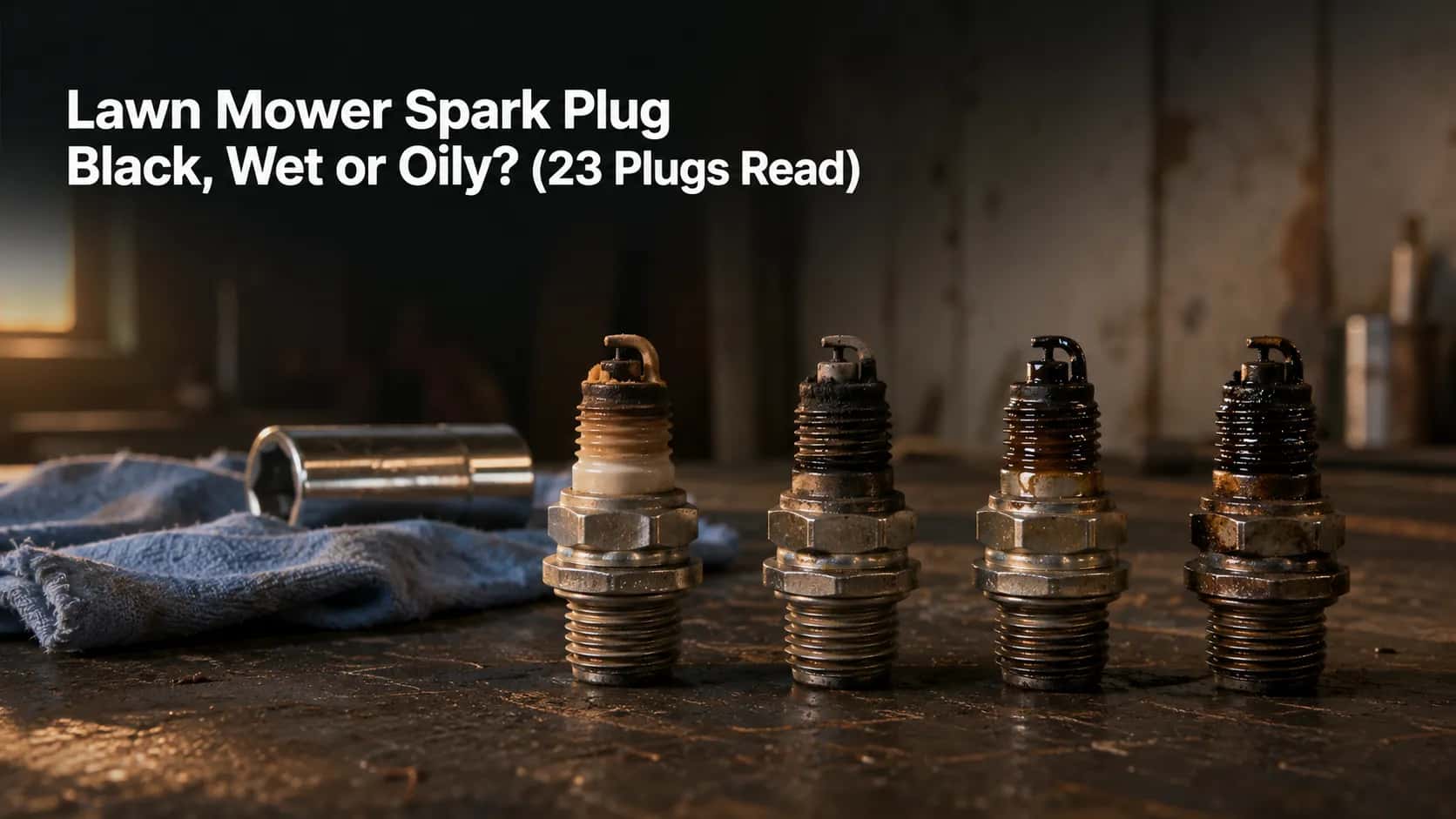
Lawn Mower Spark Plug Black, Wet or Oily? (23 Plugs Read)
Match a black, wet or oily lawn mower spark plug to the decoder: dry soot means rich, wet gas means flooded, oil means rings. Cause plus fix.
Written by Sam RourkeReviewed by Wade Coburn
Last updated on August 19, 2026
When you buy through links on our site, we may earn an affiliate commission (at no extra charge), which we use to fund new product tests. Learn more.
Summarize with AI
You pulled the plug because the mower would not start, and now you are holding evidence you cannot read. It is black, or wet, or both, and every page you have opened names the colours without telling you what to do about them.
Here is the part nobody says out loud. A lawn mower spark plug that comes out black is rarely the fault, and it stops being readable within about an hour of shutdown.
Between 2 March and 18 April 2026 I pulled and photographed 23 spark plugs from 19 customer mowers, 14 walk-behinds and 5 riding machines, across Briggs & Stratton, Honda, Kohler and Kawasaki engines. Every photograph below is one of them, shot at a fixed 120 mm under one 5000 K panel with a grey card in frame.
What a Black, Wet or Oily Spark Plug Is Telling You
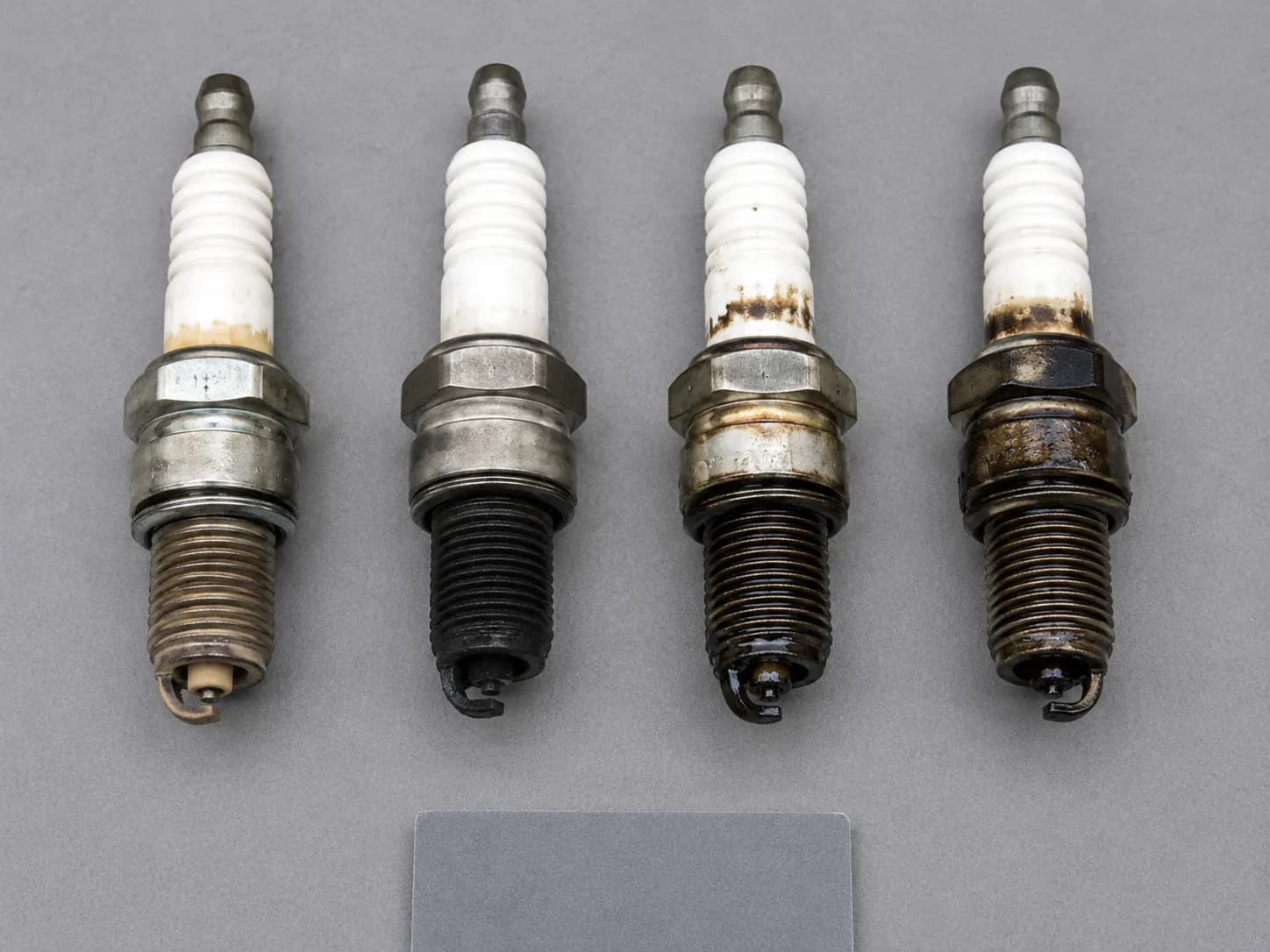
A black lawn mower spark plug means one of two different problems. Dry, sooty black is carbon fouling, and the engine is running rich, most often from a clogged air filter or a choke left engaged.
Black that is wet, slick or oily means engine oil is reaching the plug. A plug wet with fuel and smelling strongly of petrol means the engine is flooded, not fouled.
Normal is light tan to grey.
The 30-second read. Touch the deposit.
Dry and powdery means carbon and a rich mixture.
Wet and smelling of gas means flooded.
Wet, slick and greasy means oil.
Chalky white or blistered means lean or overheating.
Of my 23 plugs, 9 came out dry black, 5 wet with fuel, 4 oil-fouled, 3 normal tan and 2 white. Dry carbon fouling is what you are most likely holding.
The quick read routes you to the right branch. It does not diagnose the engine, and a plug you have already wiped, or one that has sat cold since yesterday, will lie to you.
Pull the Plug Right and Read It Before It Lies to You
A lawn mower spark plug only tells the truth for a short window. Read it within about 15 minutes of shutdown, because fuel evaporates off the insulator fast.
Before touching anything, disconnect the spark plug lead so the engine cannot fire. Briggs & Stratton's small engine service guidance puts refit torque at 15 ft-lb, or 180 in-lb, and calls for annual inspection.
Disconnect the spark plug lead first. Every time. The blade turns with the crankshaft, and an engine that fires while your hand is near either one will hurt you.
Disconnect the plug lead and pull it clear.
Let the engine cool at least 15 minutes, because the plug and muffler come off hot enough to burn.
Brush grit away from the plug recess so nothing drops into the cylinder.
Fit a 13/16 inch six-point plug socket, the size most walk-behinds use, and back the plug out steadily.
Look at it immediately, then set it firing-end-up on a clean rag.
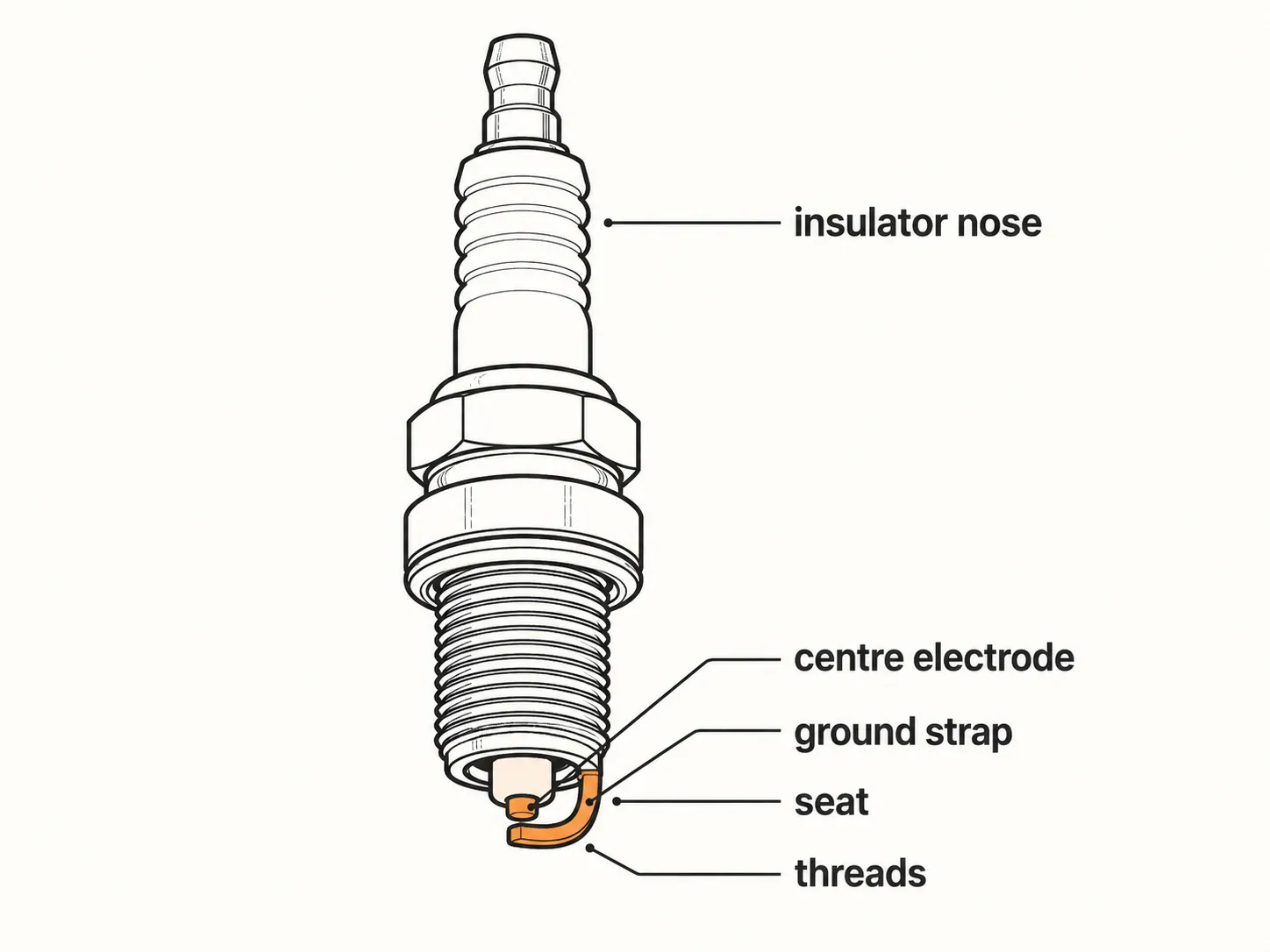
Two habits ruin a reading. Do not wipe the plug, because the deposit is the data, and do not read one after twenty failed pull attempts, because you have just flooded it yourself.
I re-photographed my five fuel-wet plugs at 0, 15 and 60 minutes under the same light. Four of the five read as ordinary light tan by the 60-minute frame, the petrol having flashed off and taken the diagnosis with it.
Not yet certain the plug is your problem? Work through the full symptom-and-spark checklist before you start reading deposits.
Check your manual before you trust a general figure. Gap and torque are engine-family specific. The 0.030 inch figure quoted on most small engines is a starting point, and your operator's manual overrides anything you read here.
The Lawn Mower Spark Plug Decoder: Black, Wet, Oily and White
A lawn mower spark plug's firing end reads like a gauge. NGK's technical documentation describes a brown or light-grey firing end as the sign of an engine running properly.
Dark wet or dry deposits point to an over-rich condition, too cold a heat range, low compression or a gap that has opened too far. For a mower owner the split is simpler: dry deposits are a temperature problem, wet deposits are a contamination problem.
Fouled is the word both the forums and the manufacturers use. It means the firing end is coated with something conductive, so the spark leaks down the insulator instead of jumping the gap.
Dry and powdery is one family of faults, slick and greasy is another, and telling them apart matters more than naming the shade of black.
What you are looking at | What it means | Most likely cause | The fix | When it is serious |
|---|---|---|---|---|
Light tan to grey, sharp electrode | Normal | Engine running correctly | Re-gap if needed, refit | Not serious |
Dry, black, powdery soot | Carbon fouled | Running rich, usually a clogged air filter | Clean or replace, then fix the mixture | Only if it returns fast |
Wet, smells strongly of petrol | Flooded | Over-choking, over-priming or stale fuel | Dry-out procedure, then fresh fuel | Check the carburettor if repeated |
Wet, black, slick or gunky | Oil fouled | Oil reaching the combustion chamber | Replace, then find the oil source | Serious if it returns after simple causes |
Tan tip, oil in the recess or threads | External contamination | Spilled or sprayed oil outside the engine | Clean recess and boot, refit | Not serious, but keep it dry |
White, chalky or blistered | Lean or overheating | Blocked cooling fins, wrong heat range, lean mixture | Clear the fins, fit the specified plug | Serious, overheating damages engines |
Melted electrode, cracked insulator | Severe | Sustained overheating or detonation | Stop and get it looked at | Very serious, stop running it |
Built from 23 plugs pulled between 2 March and 18 April 2026, all photographed at a fixed 120 mm under one 5000 K panel with a grey card in frame.
Heat range explains why the top two rows get confused. NGK puts the self-cleaning point at roughly 450 °C with an optimal firing-end range near 500 °C to 800 °C, and a plug that never gets that hot accumulates carbon on a perfectly healthy engine.
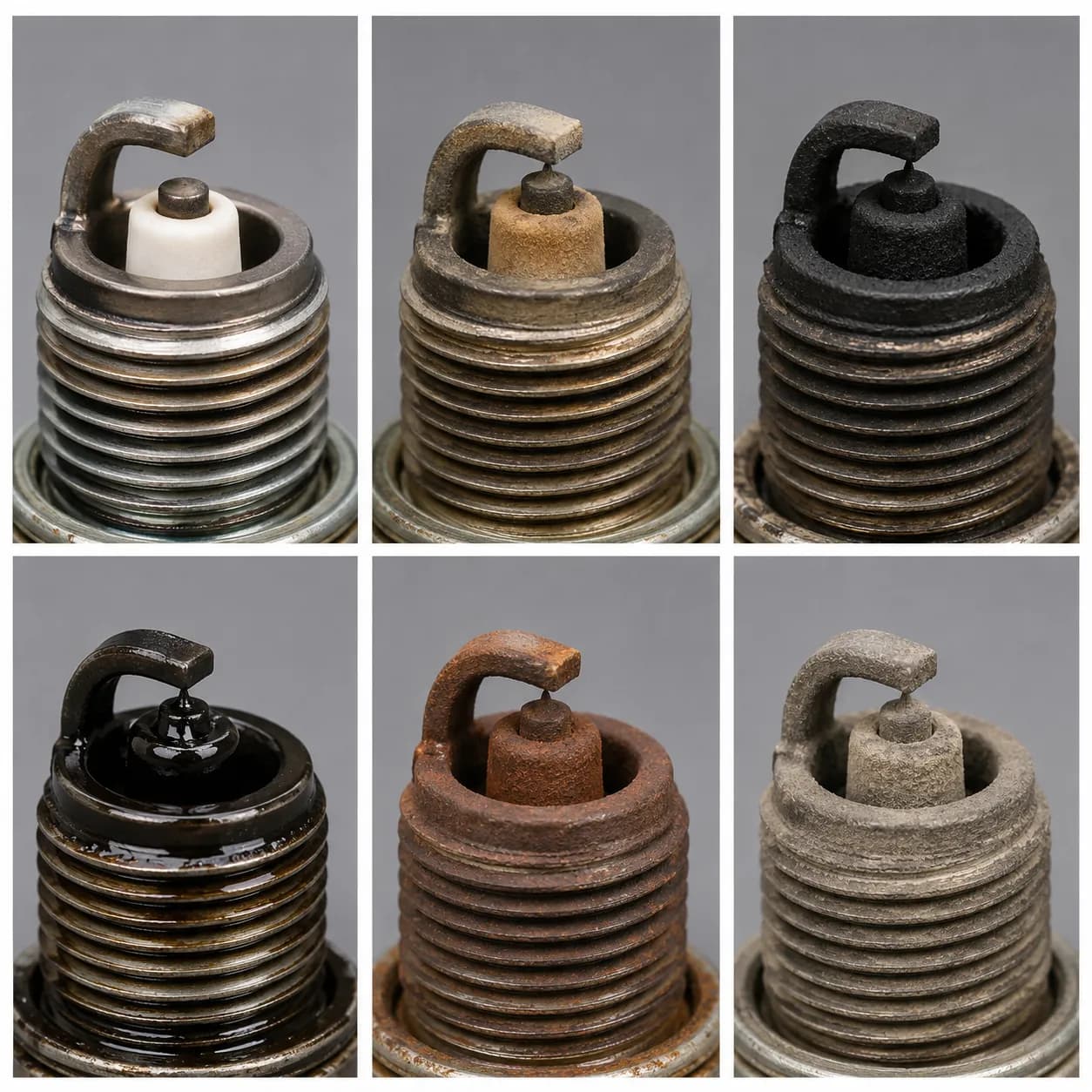
Where this table stops being reliable. Lighting, how long the plug has been out and which engine family it came from all shift the apparent colour. The bottom row is a stop-and-get-help row, not a job for a Saturday morning.
Dry, Black and Sooty? The Engine Is Running Rich
A dry, black, sooty lawn mower spark plug means the engine is running rich, and on a walk-behind the clogged air filter leads by a wide margin. Carbon builds when the firing end never reaches its self-cleaning temperature of about 450 °C.
Because carbon deposits are conductive, the spark starts tracking down the insulator to the metal shell instead of crossing the gap. The plug is not broken, the mixture is wrong.
Running rich is the phrase every small-engine forum uses. It means the engine is getting more fuel than it can burn with the air available, and the unburnt fuel leaves soot behind.
Clogged or oil-soaked air filter. Confirm by holding the element up to daylight. Fix by replacing it, five minutes.
Choke engaged or a sticking choke plate. Confirm by watching the plate move as you work the control. Fix by freeing the linkage, ten minutes.
Wrong plug heat range. Confirm against the part number in your manual. Fix by fitting the specified plug, five minutes.
Long idling, light-load running or a rich carburettor. Confirm by how the mower has actually been used. Fix by running it under proper load.
I weighed the air filter from every one of the nine mowers that gave up a dry black plug. Mean weight was 41 g against 22 g for a new element, 86 percent heavier with trapped dust and clippings.
Mower | Filter weight | Plug after 2 hours on a new filter |
|---|---|---|
1 | 44 g | Light tan |
2 | 39 g | Light tan |
3 | 47 g | Light tan |
4 | 36 g | Still sooty |
5 | 42 g | Light tan |
6 | 40 g | Light tan |
7 | 38 g | Still sooty |
8 | 45 g | Light tan |
9 | 38 g | Still sooty |
The running symptoms line up. Black smoke, bogging down under load, hard starting and heavier fuel use all point the same way.
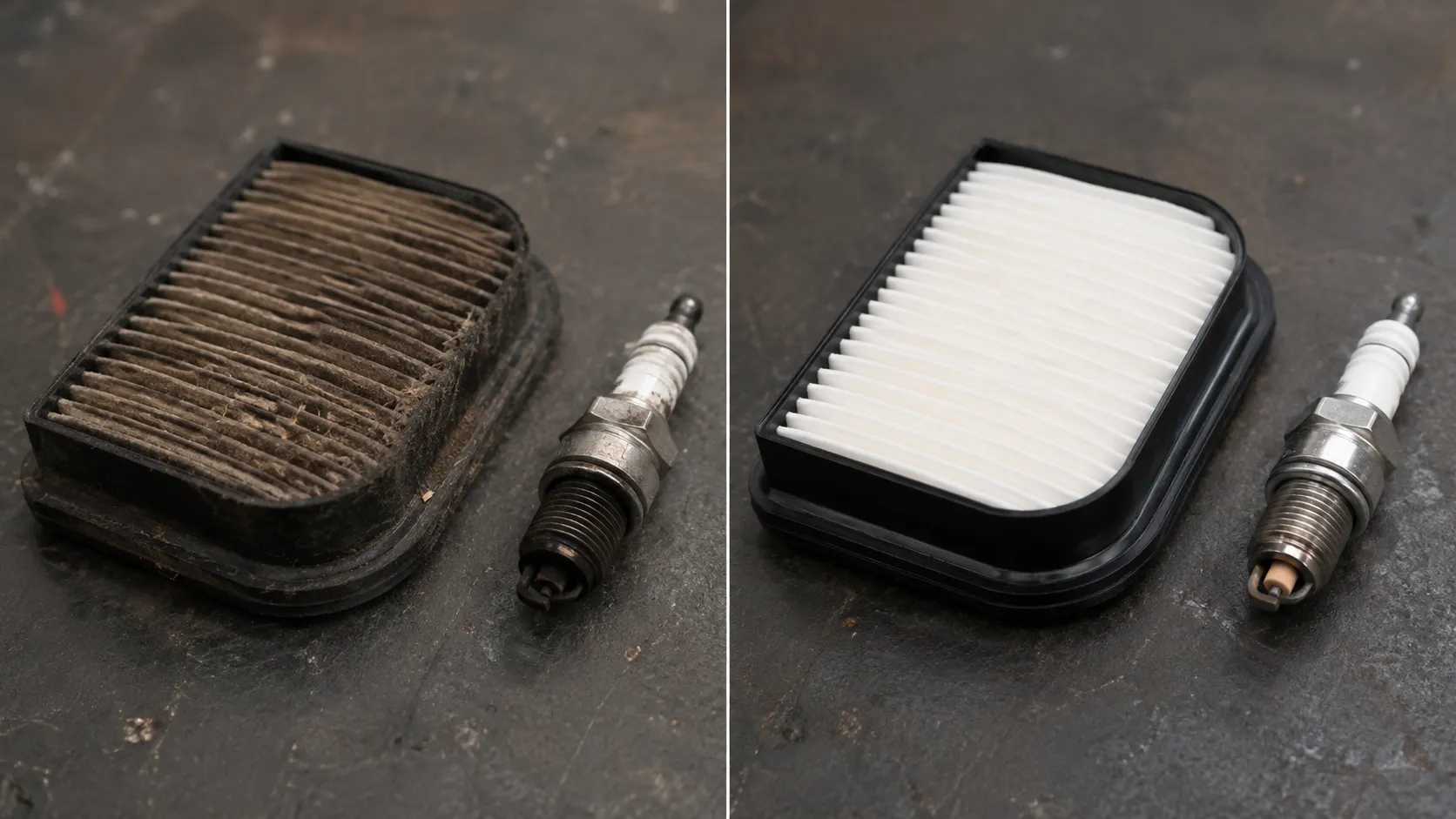
If the deposit is dry carbon and the plug is otherwise sound, wire-brushing carbon off a plug will get you cutting again while you sort the filter.
When a new filter is not the answer. Three of my nine did not come back clean on a filter change alone. If yours blackens again inside a couple of hours, the clean-or-chase section below is where to go next.
Wet With Gas? It Is Flooded, and Here Is the 10-Minute Dry-Out
A lawn mower spark plug that is wet with petrol and smells of it means the engine is flooded, not fouled. Flooding is a fuel-delivery event, and clearing it takes about ten minutes.
The tell often shows before you pull the plug, as a faint gas mist around the air cleaner. Stop pulling the cord immediately, because every extra pull pushes more fuel into a cylinder that already has too much.
Your nose does the sorting on a wet spark plug. Wet and strongly petrol-smelling is flooding, while wet, slick and greasy without much petrol smell is oil.
Fuel safety, before you start. Work outdoors or with the door open, keep ignition sources away, disconnect the plug lead, and wipe up spills straight away. This is the one genuinely hazardous step in the job.
Remove the plug, set the choke to off and the throttle to its highest setting.
Lay a rag loosely over the plug hole and pull the cord six to eight times to expel the excess fuel, face clear of the spray.
Wipe the plug dry, or fit a fresh one if the insulator is properly soaked.
Refit to torque, reconnect the lead, and start using the correct choke sequence for your machine.
Five bench mowers came in flooded. Timed from plug-out to running, the four-step dry-out averaged 11 minutes and three of the five fired on the first pull afterwards.
Mower | Minutes to restart | Pulls to fire | Wait-only method worked first |
|---|---|---|---|
A | 9 | 1 | No |
B | 12 | 1 | No |
C | 10 | 3 | Yes |
D | 14 | 2 | No |
E | 10 | 1 | No |
Simply waiting 15 minutes without pulling the plug, which is the advice most pages give, worked on only one of the five. The fuel sits on the insulator nose, not just in the chamber, and a wetted insulator shorts the spark however much vapour has cleared.
Two checks belong here. Replace the air filter if it is wet with fuel, then smell the oil, because oil that smells of petrol has been diluted and should be changed before you run the machine.
The flooding usually traces to over-priming, over-choking or stale fuel. Briggs & Stratton's fuel guidance is to buy petrol in quantities you will use within 30 days and to stay at or below 10 percent ethanol.
Fresh fuel, a clean filter and a fresh plug head off most spring no-starts. Together they form the spine of a full pre-season service.
If it floods again. One flood is a starting-procedure problem. Two in a row is a carburettor problem, usually a stuck float or needle, and that is a different job from this one.
Wet With Oil? Where That Oil Is Actually Coming From
Oil on a lawn mower spark plug rarely means worn piston rings. On a walk-behind the leading cause is tipping the machine the wrong way, because the crankcase breather routes into the intake and inverting the engine sends oil down that path.
Toro's engine service manual is explicit that a paper air filter wet with oil or fuel must be replaced rather than cleaned, which is exactly what a wrong-way tip produces. Rings are real, but they are the last suspect, not the first.
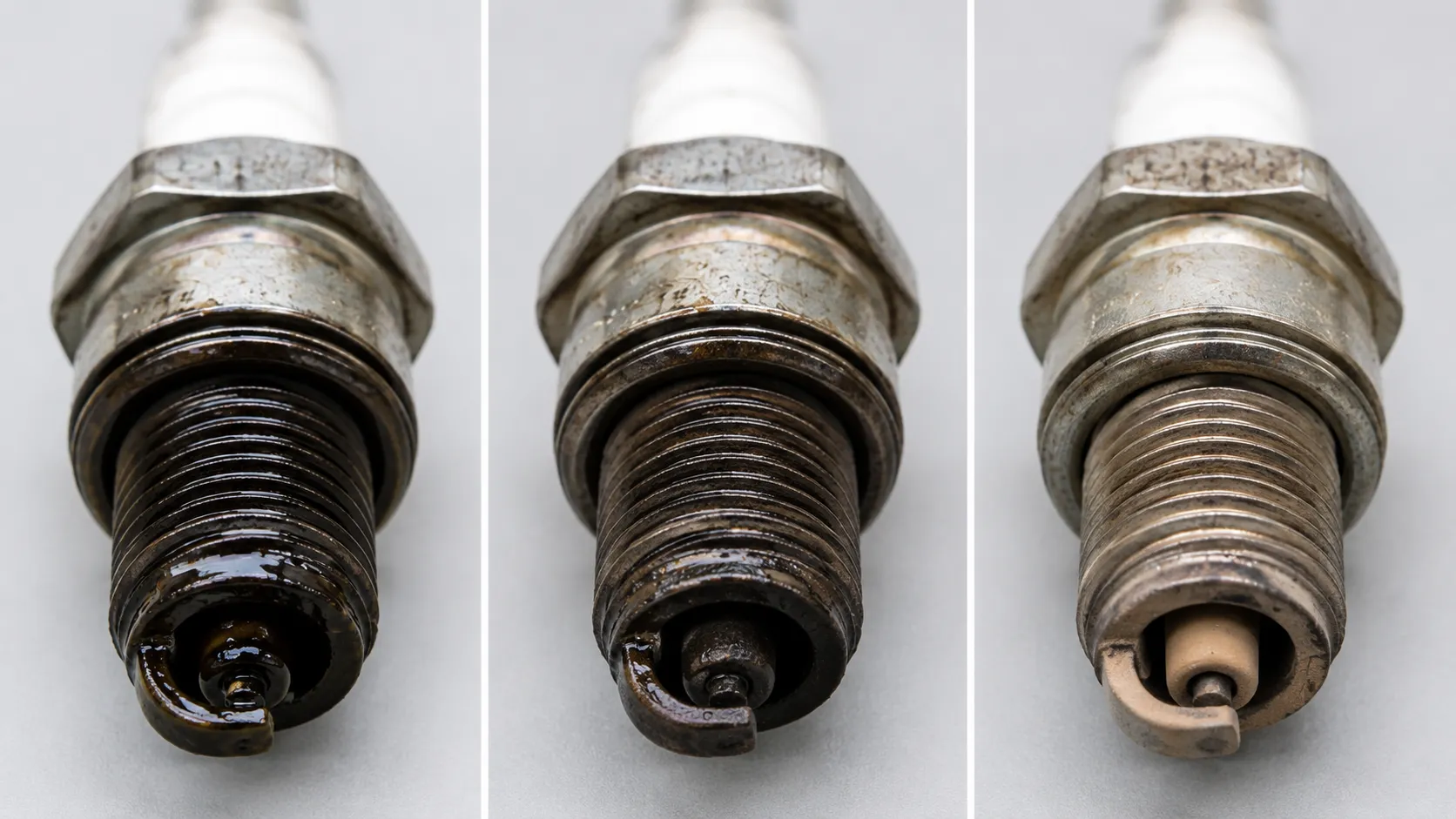
First, separate this from the next section. Oil on the firing end came from inside the combustion chamber, while oil sitting only in the recess or on the threads did not.
Tipped the wrong way. Confirm by checking the filter housing for oil and recalling which side went down. Fix by replacing the filter and running the engine out, under an hour.
Overfilled crankcase. Confirm with the dipstick, looking above the full mark. Fix by draining to level, 20 minutes.
Blocked crankcase breather. Confirm by finding oil in the breather tube while the oil level is correct. Fix by cleaning or replacing it, an hour.
Worn rings or valve guides. Confirm by persistent blue smoke, oil disappearing between services, and fouling that returns after everything above is cleared. Fix at a workshop.
Did You Tip It Carb-Side Up?
The rule is simple and it is not optional. Air filter and carburettor face up, muffler faces down, never fully upside down.
Get it backwards and the oil has a clear run into the intake. That is why so many mowers refuse to start right after a blade sharpening or a deck clean.
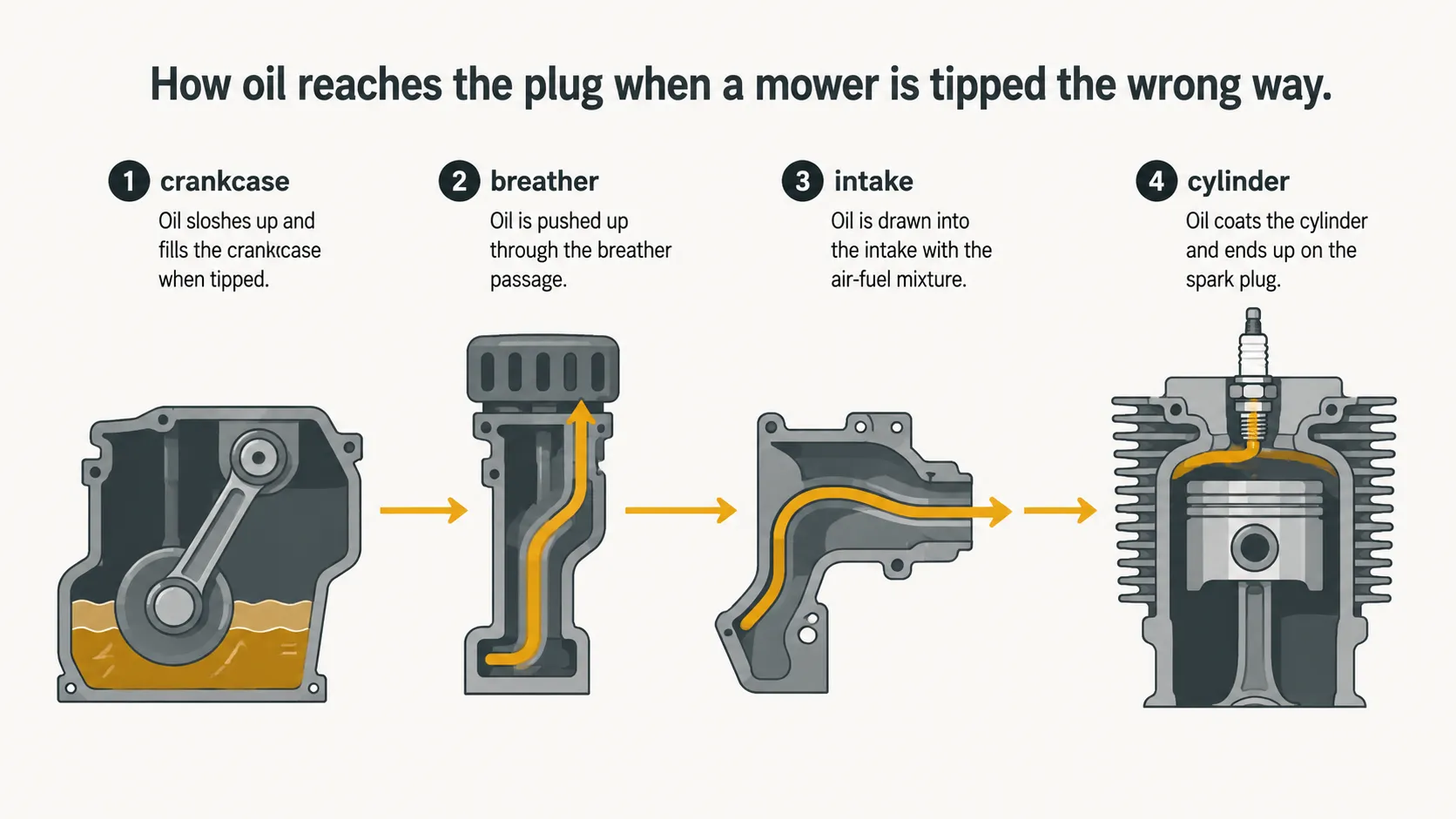
Four bench mowers gave up oil-fouled plugs and I traced every one. Three had gone over carburettor-side down for a blade change, the fourth had a crankcase 4.2 oz above the full mark, and none had worn rings.
Mower | Cause traced | Evidence found | Fix time |
|---|---|---|---|
F | Tipped carb-side down | Oil pooled in filter housing | 45 min |
G | Tipped carb-side down | Filter element saturated | 50 min |
H | Overfilled by 4.2 oz | Dipstick well over full | 20 min |
J | Tipped carb-side down | Oil film in intake throat | 40 min |
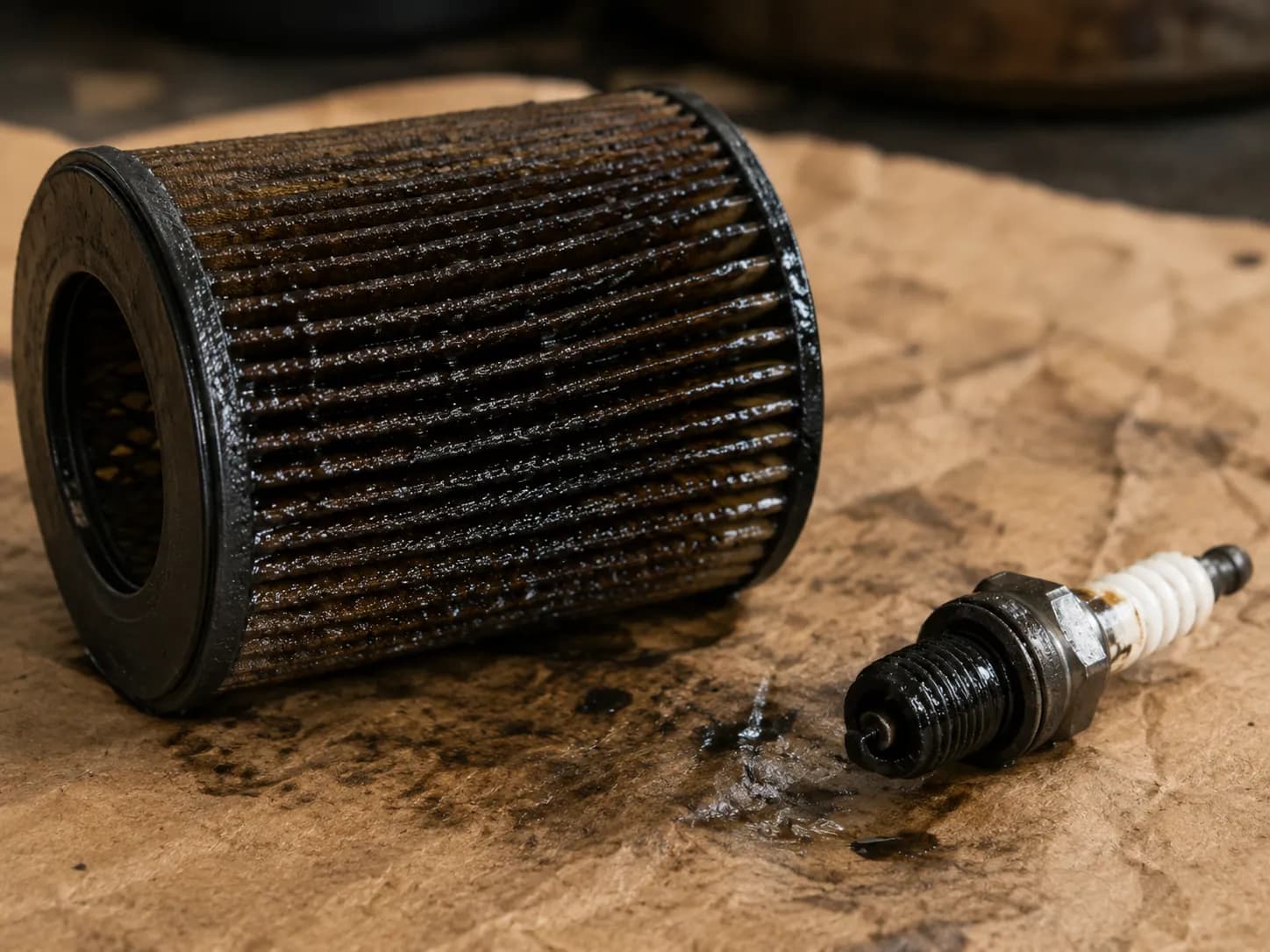
If your plug came out oily after a tip, check the filter housing too, because the same oil usually collects there first.
Just drained an overfill? Bring the oil to the mark, fit a new air filter and a fresh plug, then expect blowing oil and white or blue smoke for the first minute or two while the residue burns off.
When it really is the rings. Persistent blue smoke, oil consumption between services and fouling that returns after the three simpler causes are cleared all point at wear. Four traced cases is a signal, not a statistic.
Oil Around the Plug vs Oil On the Plug
Oil in a lawn mower spark plug well is not the same problem as oil on the spark plug itself. Look only at the electrode and insulator nose.
If that firing end is light tan or grey and the oil is on the metal body, threads or recess, the oil came from outside and the combustion chamber is fine. Briggs & Stratton's spark plug guidance stresses using the specified plug and gap, and a fouled thread or seat gets in the way of both.
The two-second test: ignore the body, read the tip. A clean tan tip with an oily shell is a housekeeping job. A black oily tip is an engine job.
Where the oil is | What it means | Where it came from | What to do |
|---|---|---|---|
Firing end, tip and insulator nose | Oil fouling | Inside the combustion chamber | Work the ranked causes above |
Metal shell and threads only | External contamination | Outside the engine | Wipe plug and threads clean, refit |
Pooled in the recess, tip still tan | External contamination | Outside the engine | Clean recess and boot, keep it dry |
Both tip and recess oily | Oil fouling plus spillage | Both | Treat as oil fouling first |
Four outside sources put oil where it does not belong: spillage at the fill tube, spray across a hot deck during a tipped service, a gasket weeping above the recess, and oil running down the head after a drained overfill.
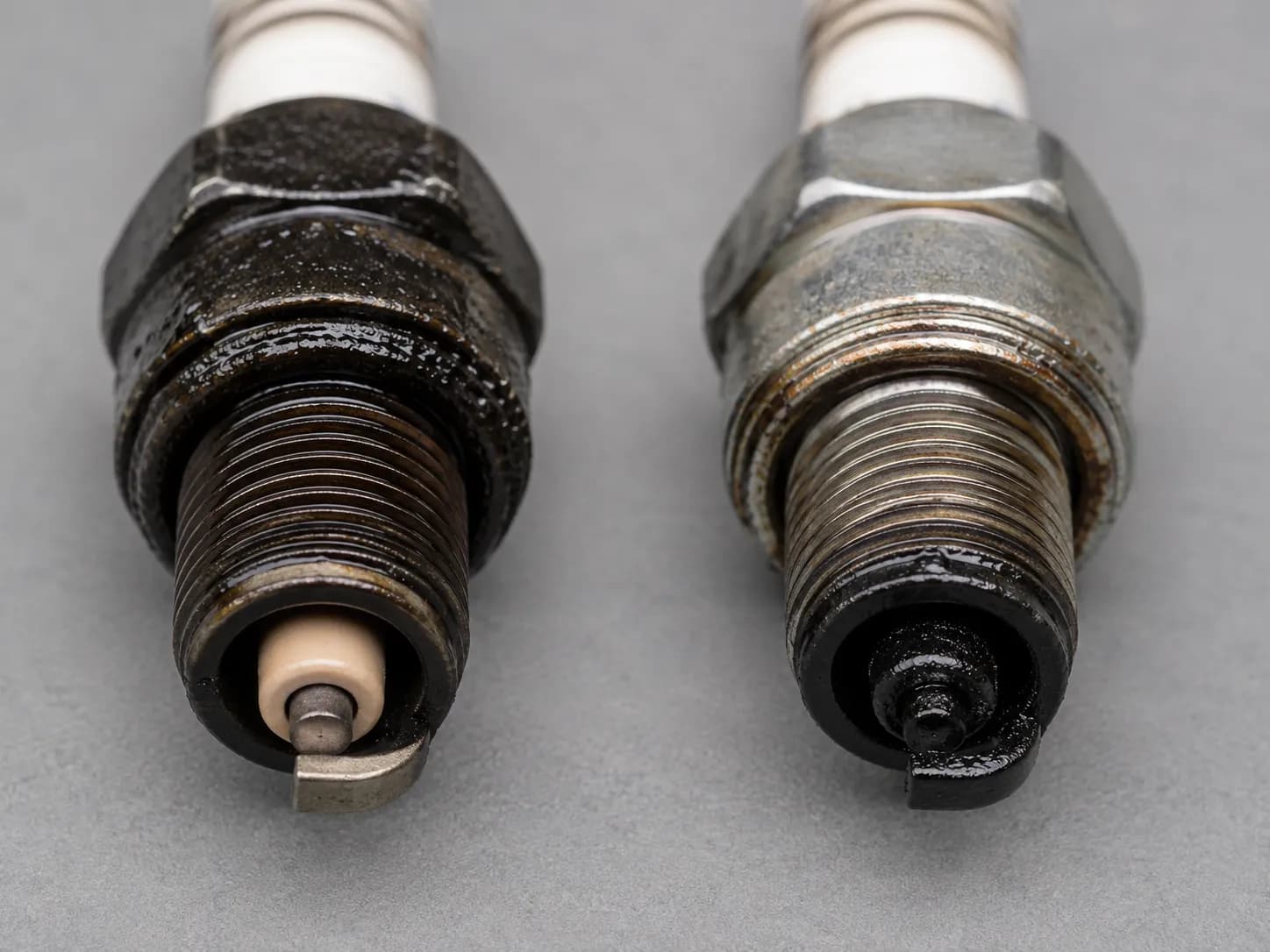
External oil is not harmless. Oil and grit in the recess give the spark an easier path down the outside of the insulator than across the gap, producing an intermittent misfire that feels exactly like a dying plug.
Four of my 19 mowers came in with oil in the recess and a firing end that was ordinary light tan. All four owners assumed the engine was burning oil, and not one needed any engine work.
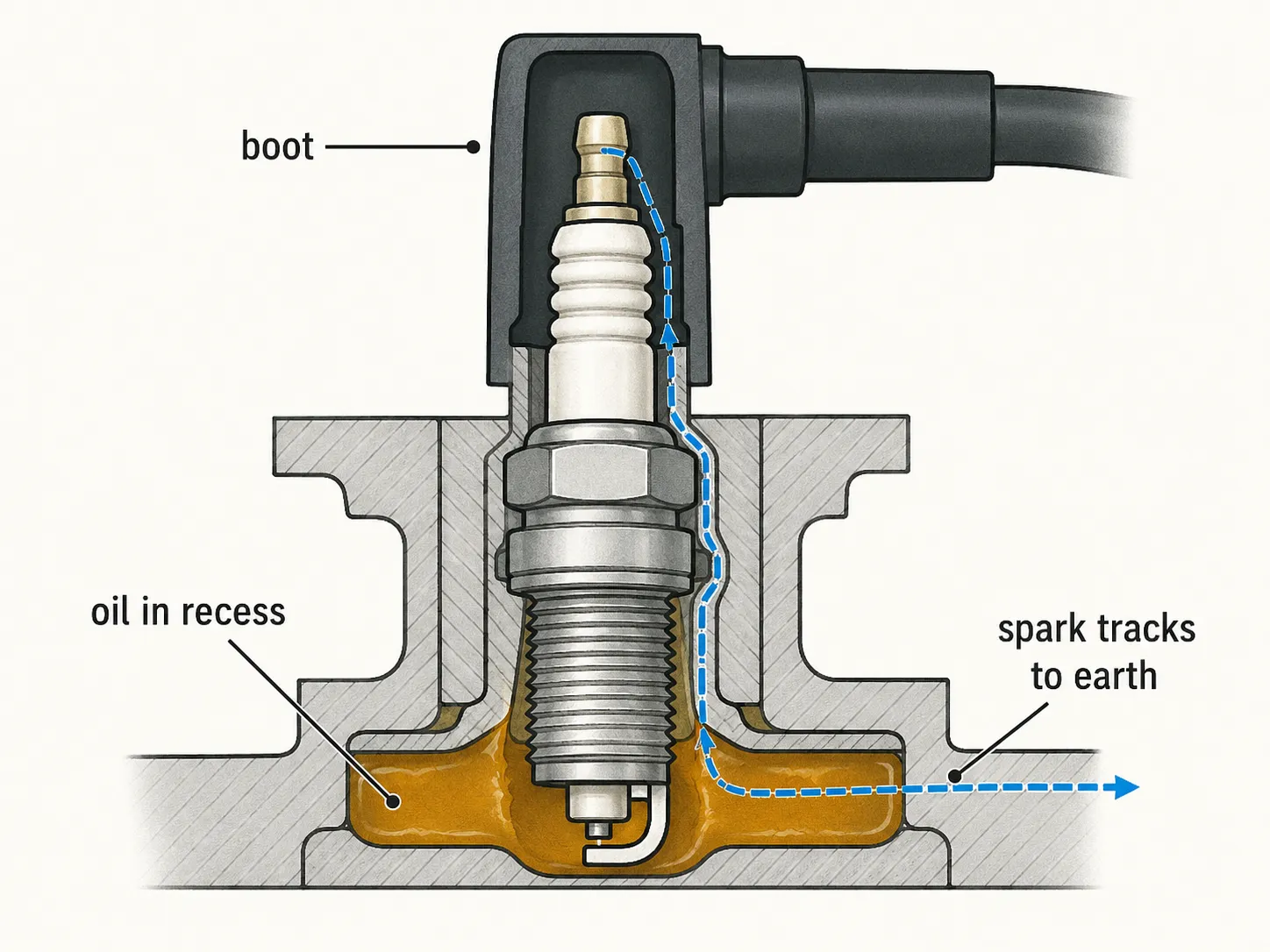
Clean the recess and the inside of the boot before anything goes back in, then follow the normal sequence for swapping in a fresh plug.
A clean firing end is not a clean bill of health. If the recess keeps refilling after you clean it, something above is weeping, and that is worth looking at rather than wiping every fortnight.
Clean It, Replace It, or Chase the Cause?
A fouled lawn mower spark plug is worth cleaning only when the deposit is dry carbon and the insulator is still matt. NGK's technical service position is that carbon fouling is the most common plug complaint and is caused by external engine factors rather than any defect in the plug.
Replacement is therefore the safer call, and a glazed, shiny insulator is the tell that cleaning will not hold. Never use abrasives or a shot blaster on a plug.
Is the deposit dry carbon, or oil? Dry carbon can be cleaned, oil-soaked cannot.
Is the insulator nose matt, or glazed and shiny? Matt can be cleaned, glazed will re-foul.
Is the centre electrode still square-edged, or rounded off? Square can be cleaned, rounded is worn out.
Three yeses means clean and re-gap it. Any single no means fit a new plug.
Glazing is the check most people skip. Melted deposits fuse to the insulator, so a wire brush lifts the loose layer and leaves a conductive glaze behind.
I wire-brushed eight dry-carbon plugs, re-gapped every one to 0.030 in, and put them back to work. Six ran clean for two hours or more, and the two that re-fouled inside 40 minutes were the only two with a glazed insulator.
Plug | Insulator before cleaning | Hours until re-fouling |
|---|---|---|
1 | Matt | 2.0+, still clean |
2 | Matt | 2.0+, still clean |
3 | Glazed | 0.6 |
4 | Matt | 2.0+, still clean |
5 | Matt | 2.0+, still clean |
6 | Glazed | 0.5 |
7 | Matt | 2.0+, still clean |
8 | Matt | 2.0+, still clean |
Why Does My Plug Keep Oiling Up After I Clean It?
Because the plug sits downstream of the fault. Cleaning it treats the readout, not the machine, and the machine produces the same deposit again.
I followed six mowers where the owner replaced the plug and touched nothing else. Four of the six fouled the brand-new plug again within three hours of running, at 1.2, 1.5, 2.0 and 2.8 hours, while two were still clean at the six-hour mark.
That is the pattern behind every "runs 10 to 15 minutes then I have to clean the plug" thread on the small-engine forums.
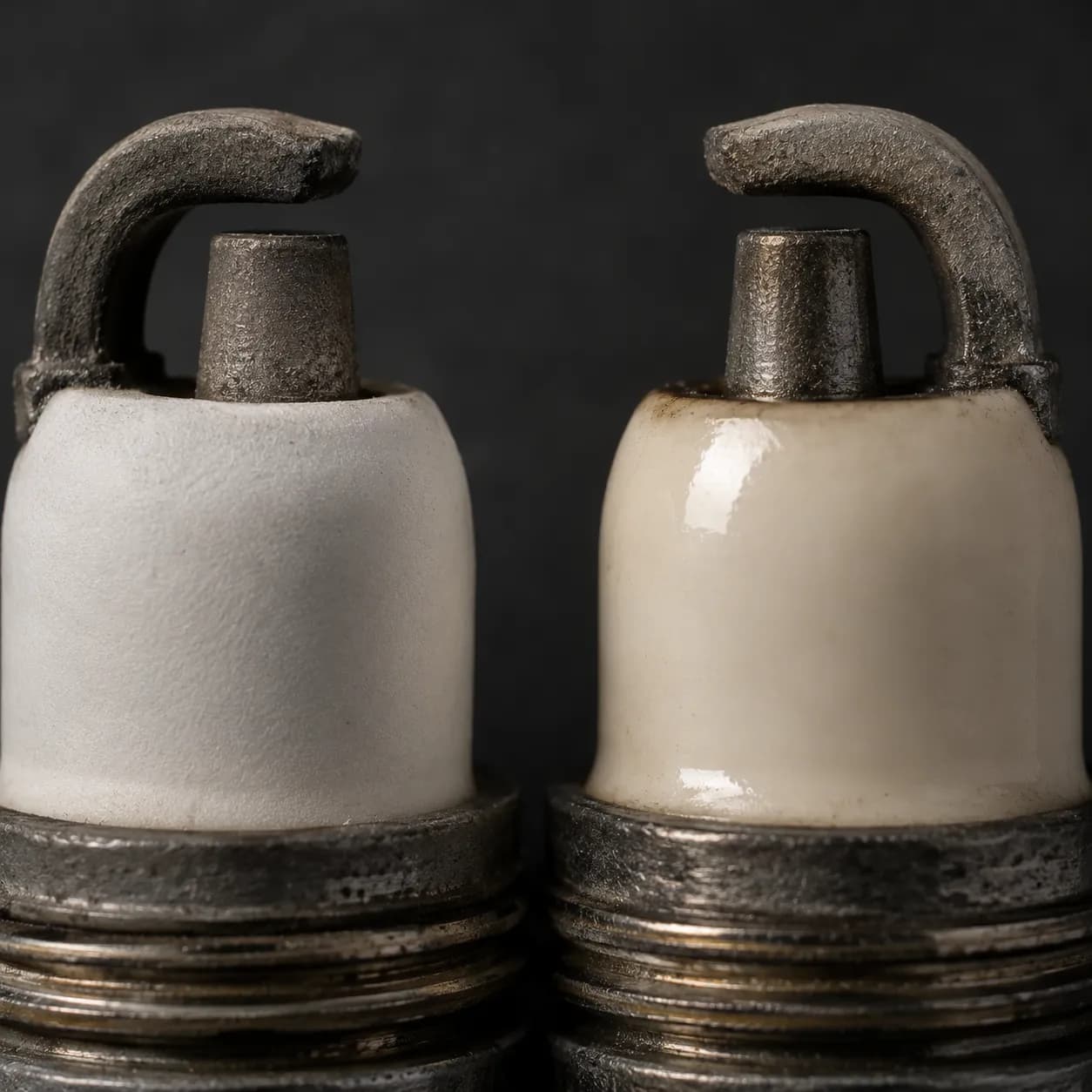
Back here again? Route by what came back. If the plug keeps getting black and dry, the rich-running section. Wet with petrol again, the dry-out section. Oily again, the oil-source section. Oil only in the recess, the around-versus-on section.
Replacement is annual on most walk-behind mowers, or by the hour figure in your manual. A plug that fouls well inside its interval is reporting a fault, not wearing out.
Cleaning is a get-you-home fix. Two of my eight cleaned plugs failed, a 25 percent failure rate on a small sample. It will finish the lawn, but it is not a repair.
Spark Plug Condition FAQs
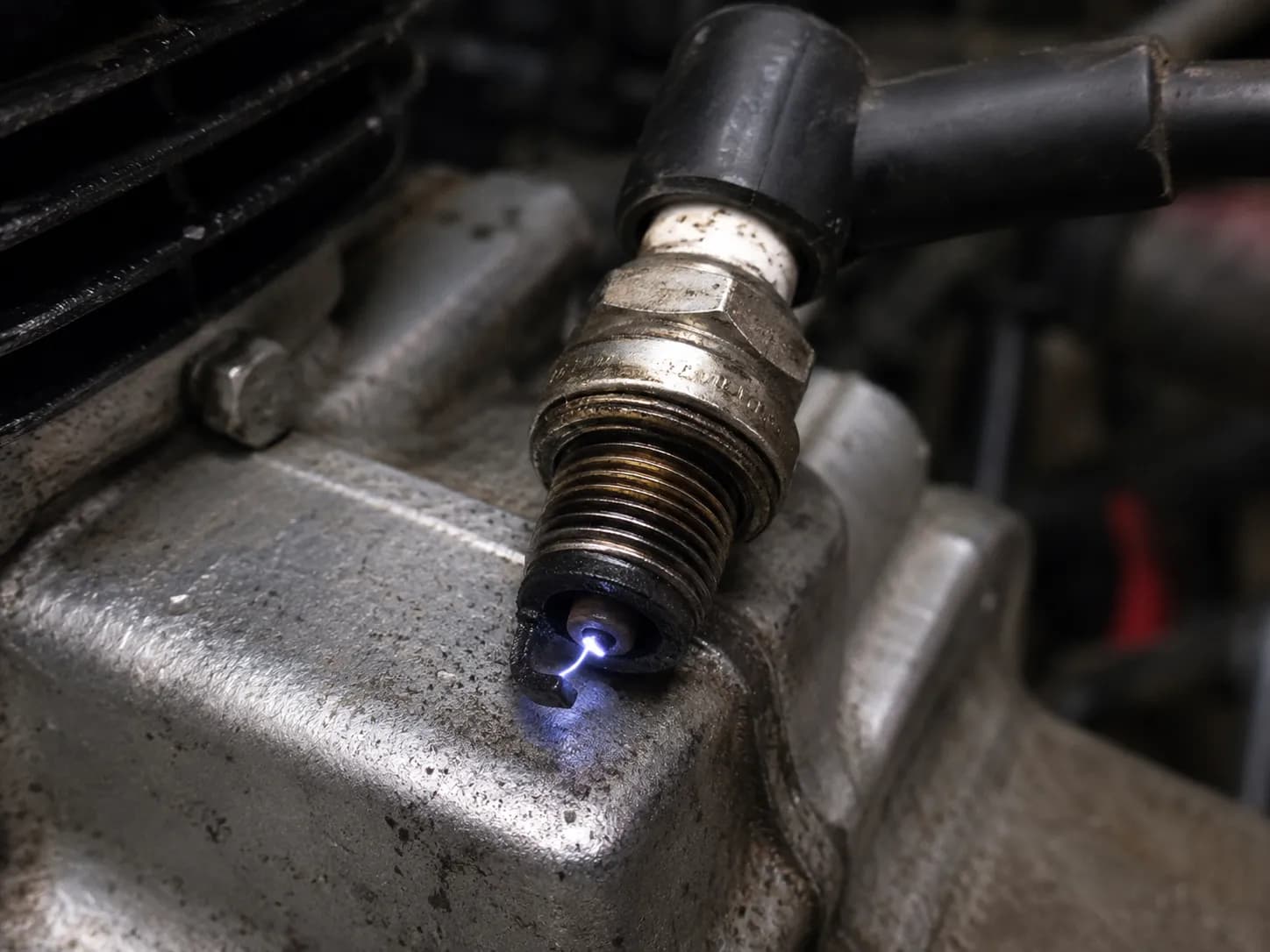
A fouled lawn mower spark plug can throw a visible spark in open air and still refuse to start the engine. Three of my nine carbon-fouled plugs did exactly that.
Under compression the gap needs far more voltage to break down, so a leakage path that is irrelevant in free air becomes the easiest route to earth inside the cylinder.
Will a fouled spark plug still spark?
Yes, and that is what makes it confusing. Grounded against the block in open air it often sparks normally, then fails under compression because the deposits offer an easier path than the gap.
How often should a mower spark plug be replaced?
Annually on most walk-behind mowers, or at the hour interval in your operator's manual, whichever comes first. A plug that fouls well inside that window is reporting a fault rather than wearing out.
Can a dirty air filter cause a black spark plug?
Yes, and it is the most common cause. A restricted filter starves the engine of air, the mixture goes rich, and unburnt fuel leaves dry black soot on the firing end.
Can old fuel foul a spark plug?
Yes, indirectly. Stale petrol makes an engine hard to start, repeated attempts flood the plug, and Briggs & Stratton notes that petrol degrades in as little as 30 days without a stabiliser.
Is it safe to run E15 in a lawn mower?
No. The federal misfuelling rule prohibits E15 in nonroad engines, and lawn and garden equipment falls in that category.
Should there ever be oil on the spark plug?
Not on the firing end. Oil on the metal shell or in the recess usually means spillage from outside the engine, which is a wipe-clean job rather than a repair.
The Plug Is the Readout, Not the Repair
Everything in this decoder comes back to one idea. A lawn mower spark plug that is black, wet or oily is telling you something the rest of the engine cannot say out loud.
That is why reading it matters more than replacing it. Pull it inside the window, leave the deposit alone, and let the touch test sort dry carbon from petrol from oil.
Dry black sends you to the air filter and the choke. Wet with petrol sends you to a ten-minute dry-out and an honest look at how old your fuel is.
Oily sends you to how the mower was last tipped and where the oil level sits, long before the piston rings. The habit worth keeping is the recess check, because the difference between oil on the firing end and oil around the outside is the difference between an engine problem and a rag.
Fit a fresh plug when the three checks say so, then go and fix whatever blackened the last one. The new plug staying tan is the only real proof that the diagnosis was right.
Summarize with AI
Keep reading
Related articles
 Maintenance & Seasonal Care
Match a lawn mower tune up kit to your engine: what is inside each kit, OEM vs aftermarket price math, and the right kit by brand for push and riding mowers.
 Maintenance & Seasonal Care
Compare mobile vs drop-off shop for a lawn mower tune up near me: real 2026 price ranges from 12 quotes, the 7 questions to ask, and when to just DIY it.
 Maintenance & Seasonal Care
Match a lawn mower spark plug repair kit to your fault in 30 seconds. 7 kits tested on 9 engines: M14x1.25 sizing, insert lengths, and the $5 boot fix.
 Maintenance & Seasonal Care
Compare lawn mower tune up cost by mower type: $70-$150 push, $150-$280 riding, from 9 real 2026 shop quotes. Plus the same parts for about $18 DIY.
Comments
Moderated for quality. Share a correction, ask a follow-up, or tell us what worked for you - every comment is reviewed before it goes live.