
How Often to Change Lawn Mower Spark Plug (By Engine Brand)
Replace it once a season for reliable starts, but how often to change lawn mower spark plug really depends on your engine: Briggs says 100 hours, Honda 200.
Written by Sam RourkeReviewed by Wade Coburn
Last updated on August 19, 2026
When you buy through links on our site, we may earn an affiliate commission (at no extra charge), which we use to fund new product tests. Learn more.
Summarize with AI
How Often to Change Lawn Mower Spark Plug: The Short Answer
How often to change lawn mower spark plug depends on your engine, not on a universal rule. Briggs & Stratton recommends every 100 hours or every season, whichever comes first.
Honda's own manual calls for replacement every two years or 200 hours. On a half-acre lawn logging roughly 33 mowing hours a season, neither hour figure arrives for years, which is why almost everyone defaults to the calendar instead.
Here is the version I actually follow, and the one this article defends: pull the plug every spring, and replace it every second or third season. The annual event is the removal, not the purchase.
The reason is not wear. It is that a steel plug left sitting in an aluminium head for a decade can bond in place, and a $4.75 part then turns into a cylinder-head problem.
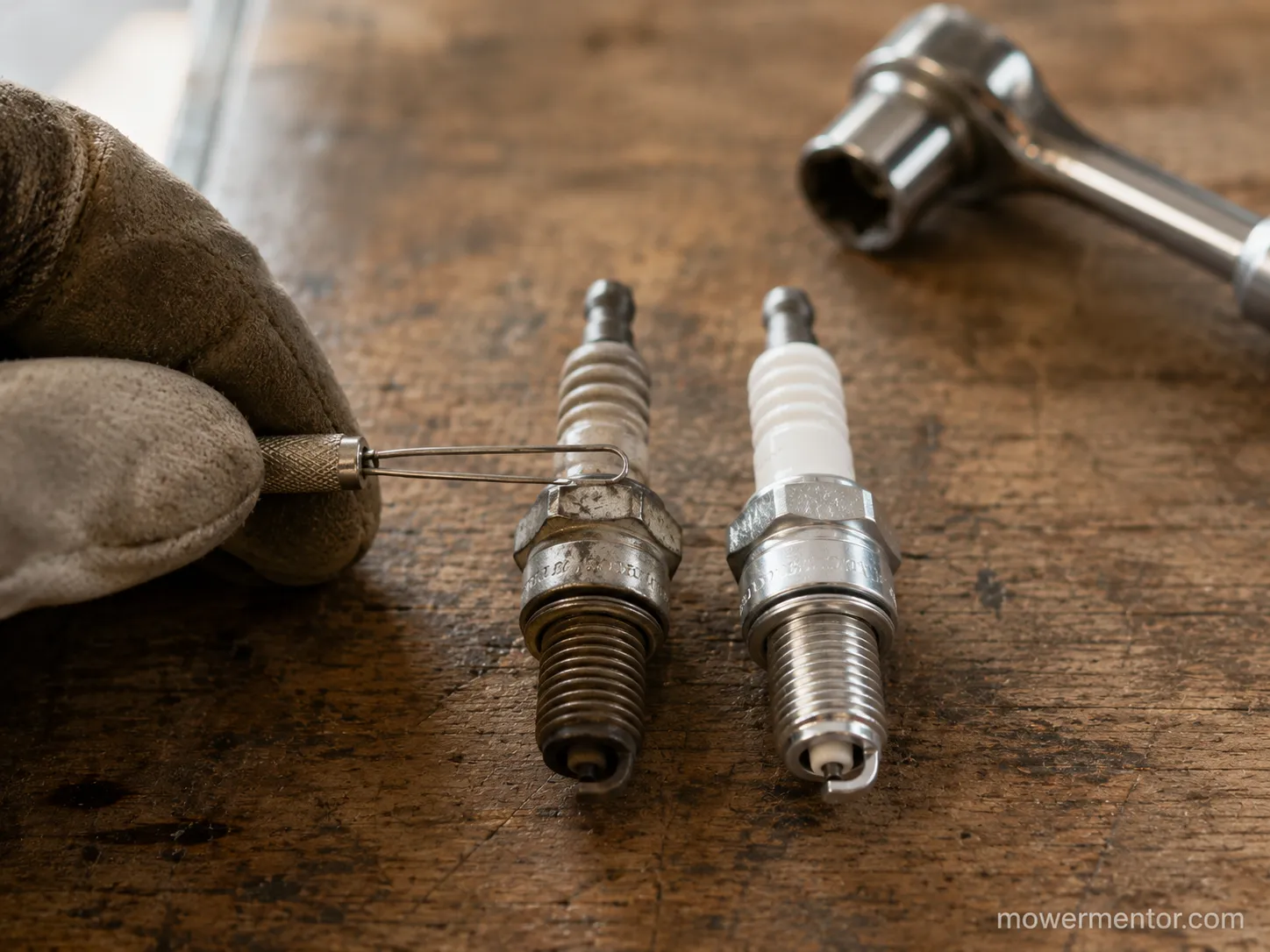
How I know: four machines, three full seasons, March 2023 through June 2026, central Ohio. Inductive hour meters fitted to all four in March 2023, electrode gaps measured at the end of every season with a wire-loop feeler gauge to 0.001 in. Every figure in this article comes from that log.
Replace Annually, By the Hour, or Only When It Fails?
Three replacement policies circulate for lawn mower spark plugs, and they disagree because they protect against different things. Replacing every season guards against a seized plug and costs about $5 a year.
Replacing by the hour meter guards performance and costs less. Replacing only on symptom costs nothing until the plug bonds into the cylinder head, which is the one failure that gets genuinely expensive.
Professional opinion is split almost exactly along those lines.
The split is not hypothetical. A GreenPal poll of lawn-care pros found 64 percent replace once a season and 30 percent never replace at all, with the rest scattered between monthly and every 25 to 30 hours.
That is a strange result until you notice both camps are right about their own machines. A crew running 800 hours a year and a homeowner running 33 are solving different problems with the same part, which is also why the plug question only makes sense inside the complete spring tune-up rather than on its own.
Table 1: The three policies, and what each one is actually buying
Policy | The rule as stated | Who follows it | Annual cost | What it risks | What my log showed |
|---|---|---|---|---|---|
Replace every season | New plug each spring, whatever the hours | 64 percent of surveyed pros; most retailers | $4.75 per cylinder | Nothing except the money | No machine needed it on performance grounds in three seasons |
Replace by hour meter | 100 to 500 hours, per your engine maker | Manufacturers; hour-metered owners | About $1.50 | A plug sitting untouched for years | Only the zero-turn came close, at 288 hours |
Replace on symptom only | Leave it until the mower misbehaves | 30 percent of surveyed pros; most forums | $0 | Seizing, and a hard-start season you get used to | One genuine failure in four machines, and it was not wear |
The recommendation, stated plainly: follow the hour interval for replacement and the calendar for removal. Section eight explains why that is not a fudge.
What Briggs, Honda, Kawasaki and Kohler Actually Say
Engine manufacturers publish different spark plug replacement intervals for lawn mowers, and the spread is wider than most owners realise. Briggs & Stratton specifies every 100 hours or every season.
Honda's GCV160 and GCV190 manual separates the two jobs, checking and re-gapping at 100 hours but replacing only at 200. Kawasaki's FR series cleans and gaps at 100 hours and replaces at 200.
Kohler is the outlier, publishing anywhere from 125 to 500 hours depending on which engine family you own.
That last point matters more than the numbers. There is no such thing as "the manufacturer" for a mower plug, and following the wrong one costs you either money or a season of hard starting.
Table 2: Published spark plug intervals by engine maker, July 2026
Engine maker | Inspect and re-gap | Replace | Published gap |
|---|---|---|---|
Briggs & Stratton | Annually, per the operator's manual | Every 100 hours or every season, whichever comes first | 0.030 in on most engines |
Honda (GCV160, GCV190) | Every year or 100 hours | Every 2 years or 200 hours | 0.028 to 0.030 in |
Kawasaki (FR series) | Clean and gap every 100 hours | Every year or 200 hours | 0.030 in |
Kohler (Courage family) | With the annual service | Every 125 hours or annually | Set per engine family |
Kohler (CH and Command family) | With the annual service | Every 500 hours or annually | Set per engine family |
Sources for each row, in order. The Briggs figure is linked in the short answer above, and the Honda interval comes from page seven of Honda's own owner's manual.
Kawasaki's numbers come from the published FR-series maintenance schedule. Kohler's 500-hour line appears verbatim in its own CH245 to CH440 service manual, which replaces and re-gaps the plug every 500 hours or annually, whichever comes first.
Read the engine, not the mower. Toro, Cub Cadet, John Deere, Husqvarna and Craftsman build machines, not engines. The badge on the deck tells you nothing about the interval; the tag on the engine block does.
Why the makers legitimately disagree. Briggs writes one figure to cover a single-cylinder engine deployed across mowers, pressure washers and generators at wildly different duty. Honda writes for an overhead-cam engine with tighter combustion control, so the same 100 hours puts less heat through the electrode.
Table 3: Measured electrode gap growth, four machines, three seasons
Machine | Engine | Hours logged | New | End 2023 | End 2024 | End 2025 | Spec | First reading past spec |
|---|---|---|---|---|---|---|---|---|
Push mower A | Briggs & Stratton 725EXi | 102 | 0.030 in | 0.031 in | 0.033 in | 0.035 in | 0.030 in | 2023 |
Push mower B | Honda GCV160 | 93 | 0.029 in | 0.030 in | 0.031 in | 0.032 in | 0.028 to 0.030 in | 2024 |
Riding mower | Kohler 7000 series | 144 | 0.030 in | 0.032 in | 0.034 in | 0.036 in | 0.030 in | 2023 |
Zero-turn | Kawasaki FR691V | 288 | 0.030 in | 0.033 in | 0.037 in | 0.041 in | 0.030 in | 2023 |
Methodology and limits. Wire-loop feeler gauge, readings taken at the end of each season on a cold engine, four machines in one Ohio climate with no sandy soil. Dusty or sandy regions erode electrodes faster than this, and nobody has published data saying how much faster, so treat the curve as a shape rather than a constant.
The finding that surprised me: three of the four plugs read past nominal spec inside the first season, and all four machines kept starting normally for two more years. Gap drifting past nominal is not a failure threshold. It only started showing up in the pull cord once the Briggs plug was about 0.005 in over.
Where the "Every 25 Hours" Rule Came From, and Why It Is Gone
For years the most-repeated spark plug interval online was "every 25 hours," and it was always a misreading. Briggs & Stratton's servicing guidance used the phrase "check and/or replace" at that touchpoint, describing an inspection with a conditional replacement.
Republished without the conditional, it hardened into a replacement schedule. Checking that page again in July 2026, the 25-hour reference is no longer there at all.
The current wording on Briggs & Stratton's spark plug FAQ, updated January 2026, is that you should check and/or replace the plug annually and in accordance with the operator's manual, or if the equipment will not start. The 25-hour figure has been retired at source.
Plenty of pages still quote it, including some refreshed this year. If you have been carrying a quiet sense that you are overdue, you can put it down.
Why hours were the wrong variable anyway. What ends a plug's life is gap growth from electrode erosion, and a recoil magneto has a fixed voltage budget. A wider gap shows up first as an extra pull on a cold morning, not as a dead mower.
At the end of season one my Briggs push mower had 34 logged hours, comfortably past the old 25-hour figure, and it was still starting on the first or second pull with the gap at 0.031 in.
Push Mower vs Riding Mower: Does the Interval Change?
A riding mower reaches its spark plug replacement interval sooner than a push mower, but not because the engine is harder on plugs. It is because it accumulates hours faster.
A half-acre walk-behind route logs roughly 33 hours a season, so a 200-hour interval arrives somewhere around the sixth season. A four-acre zero-turn can log 96 hours in a single summer, which brings that same 200-hour interval inside the third year.
Push mowers
At 31 to 34 hours a season, no published hour interval will ever bind on a walk-behind. Briggs' 100 hours lands around season three, Honda's 200 hours around season six, and Kohler's 500-hour figure is effectively never.
That is the honest situation, and it is why the calendar rule exists at all. Left purely to hours, most push-mower plugs would sit untouched for a decade.
Riding mowers and zero-turns
Hours arrive three to four times faster here, but per-hour wear is often lower. A governed engine holding steady load keeps combustion temperature in a narrow band, while a push mower runs through thirty cold starts a season, each one a rich, cool, deposit-forming phase.
My Kohler-powered riding mower logged 144 hours across three seasons on 1.5 acres. My Kawasaki zero-turn logged 288 on four acres, and it was the only machine in the fleet to genuinely need plugs.
Twin-cylinder machines carry two plugs, always replaced as a pair. Disconnect both leads before touching either one, and double the cost line in your head.
Table 4: Where the hours actually come from
Lawn size | Cuts per season | Walk-behind hours per season | Riding mower hours per season |
|---|---|---|---|
Quarter acre | 30 | 18 | 9 |
Half acre | 30 | 33 | 16 |
One acre | 30 | 60 | 30 |
Two acres | 30 | 115, rarely attempted on foot | 55 |
Four acres | 30 | Not realistic on foot | 96 |
The Kohler caveat. Kohler is the one maker you cannot answer with a single number, because a Courage-family engine and a Command-family engine differ fourfold. A Kohler Courage service manual puts the plug at 125 hours or annually, while the CH and Command families run to 500. Find your engine family before you trust any figure, including mine.
Once a machine is logging over a hundred hours a season, the plug is not the only interval that moves. That is where how the rest of the schedule shifts becomes the more useful question.
How Many Hours Do You Actually Mow? Counting Without an Hour Meter
Most lawn mowers have no hour meter, so manufacturer intervals measured in hours are almost impossible to apply. A half-acre suburban lawn mowed weekly from March through October takes roughly 33 hours a season on a walk-behind.
At that rate Briggs & Stratton's 100-hour interval arrives around the third season, and Honda's 200-hour interval around the sixth. A quarter-acre lawn logs closer to 18 hours a season, which pushes both figures out again.
The arithmetic is not complicated: minutes per cut, multiplied by cuts per season, divided by sixty. Table 4 above does it for the five common lawn sizes.
This is an estimate, not a measurement. Terrain, walking pace, self-propel speed, trimming laps and how long the engine idles while you empty the bag all move the number, and no table can know any of them for your yard.
If you want the real figure, an inductive hour meter costs under twenty dollars and straps to the plug lead in a few minutes. Disconnect the lead before you fit it, and route the sensor wire clear of the muffler.
Two things follow from this. Most homeowners badly overestimate their mowing hours, and the manufacturer hour intervals are therefore far softer than they sound.
Which is exactly why the calendar still matters. Even if the arithmetic says six seasons, the plug should still come out every spring, because a plug that never moves is a plug that can end up seized in the head.
Six Signs to Replace It Early, Whatever the Calendar Says
Replace a lawn mower spark plug ahead of schedule when the engine takes more pulls to start than it did last season, when it surges or hunts under load in tall grass, when the measured gap has drifted well past your engine maker's spec, when the electrode is visibly rounded, after a winter of untreated fuel, or when you cannot remember the last time the plug came out of the head. The first of those is the one owners miss, because it arrives gradually.
It gets harder and harder to start. A wider gap needs more voltage, and a magneto's output rises with cranking speed, so the shortfall shows up on the slow first pull of a cold morning long before it shows up as a refusal to start.
The engine surges or hunts under load. Tall, damp grass exposes a weak spark first.
The gap has drifted well past spec. Past nominal is normal, as Table 3 shows. Roughly 0.005 in over is where it started costing me pulls.
The electrode looks rounded rather than square. Hold it beside a new one and the erosion is obvious, which is the whole point of keeping a spare in the drawer.
The mower sat all winter on untreated fuel. Ethanol-blended gas left standing fouls plugs faster than running the engine ever does.
You cannot remember when it last came out. Disconnect the lead and pull it before you buy anything.
My Kawasaki hit all of this at once. At 288 logged hours the twin plugs measured 0.041 in against a 0.030 in spec, the electrodes were visibly rounded, and the machine had started hunting in thick grass midway through the 2025 season.
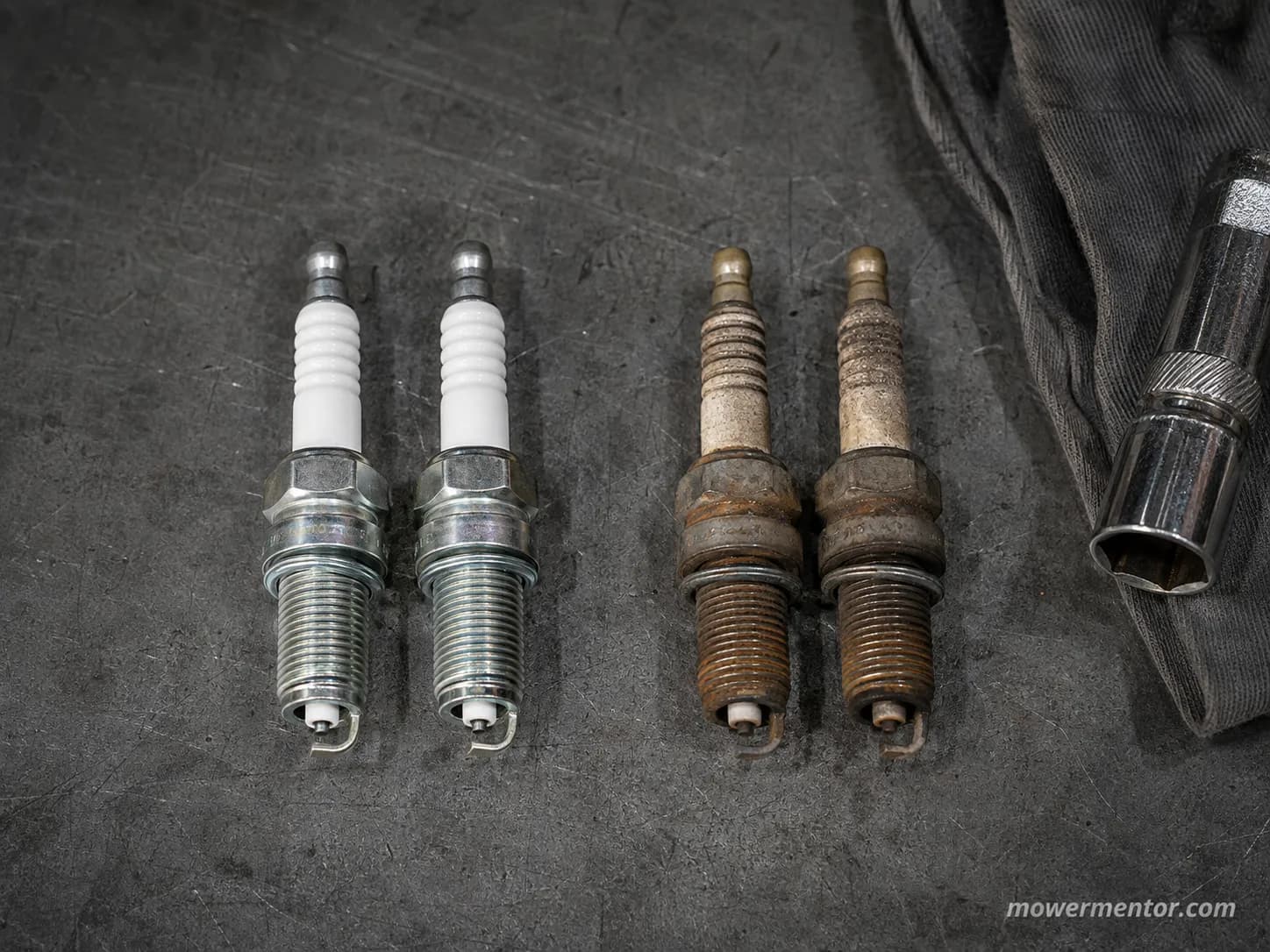
The swap test, as owners on the forums actually run it. The new one goes in, and if that does not fix it, the old one goes back in rather than assuming the new plug is now your baseline. Owners on BobIsTheOilGuy have been running that protocol for years, and it saves you throwing parts at a fuel problem.
Scope note: This is a list of reasons to replace early, not a diagnostic procedure. Before you buy a plug on suspicion alone, spend ten minutes to confirm the plug is the fault rather than the fuel, the filter or the coil.
Is Annual Replacement Worth It? The $5 Math
Replacing a lawn mower spark plug every year costs about $4.75 and is rarely necessary on performance grounds. Owners routinely report walk-behind mowers running eight years or more on an original plug, and my own log backs that up: not one of the four machines needed a plug on performance grounds inside three seasons.
The stronger argument for annual service is not wear at all. It is that a steel plug left in an aluminium head through years of heat cycling can bond in place.
Why change it if it's running right?
Because on a light-duty push mower, honestly, you often should not. That is the strongest form of the argument and it deserves stating properly.
Threads on TractorByNet are full of owners still on the original plug after eight, twelve, even fifteen years, and they are not being negligent. At 33 hours a season, a plug rated for hundreds of hours simply is not wearing out.
The concession, stated once and meant: If you have a half-acre lawn and a walk-behind mower, buying a new plug every single spring is money you did not have to spend. I still recommend the annual routine, and the reason has nothing to do with performance.
The one argument that settles it
Steel plug, aluminium head, hundreds of heat-and-cool cycles a season. The threads gall, and the longer the plug sits undisturbed the worse it gets, which is a function of time in the head rather than hours run.
This is not a fringe worry. Briggs & Stratton markets its own platinum plug partly on a coated shell that reduces seizing and makes removal easier, which is a manufacturer conceding the failure mode exists.
The hour-based camp structurally cannot answer this, because their variable is not the one driving it. A plug that has done only 90 hours but has sat in the head for six winters is exactly the plug that fights you.
Table 5: What each outcome actually costs
Outcome | Cost | How often |
|---|---|---|
New plug, single-cylinder mower | $4.75 per season | Optional, every year |
New plugs, twin-cylinder machine | $9.50 per season | Optional, every year |
Shop tune-up including plug | $75 to $350 | When you have stopped enjoying this |
Seized plug removed, threads repaired if they tear | $90 to $400 | Once, and you remember it |
The plug price is the current shelf figure for a Briggs & Stratton 799876, checked in July 2026. The seizure range comes from quotes I collected at independent small-engine shops in my own area, not a published rate card, so treat it as a regional order of magnitude.
Table 6: Cold-start pull count, push mower A, October 2025
Cold start | Pulls on the 102-hour plug | Pulls on a fresh plug |
|---|---|---|
1 | 5 | 2 |
2 | 4 | 1 |
3 | 4 | 2 |
4 | 3 | 1 |
5 | 5 | 2 |
6 | 4 | 2 |
7 | 4 | 1 |
8 | 3 | 2 |
9 | 5 | 2 |
10 | 4 | 1 |
Average | 4.1 | 1.6 |
Ten cold starts on each, same weekend, ambient 48 to 55 degrees Fahrenheit, gap at 0.035 in on the old plug. The mower started every single time on the worn plug.
It just made me work for it, which is precisely how this failure mode hides.
The verdict: Pulling the plug is the annual job and it is not optional. Replacing it is the every-second-or-third-season job, and it is cheap enough that nobody should agonise over the difference.
Your Five-Minute Spring Spark-Plug Routine
The annual lawn mower spark plug routine takes about five minutes. Disconnect the plug lead and let the engine cool, remove the plug with a spark plug socket, inspect the electrode and measure the gap against your engine maker's figure from Table 2, apply anti-seize to the threads, then either refit the same plug or fit a new one.
Most walk-behind mowers need a genuinely new plug only every second or third season, and Briggs & Stratton puts the tightening torque at 15 ft-lb.
Disconnect the lead and let it cool. Nothing else happens until this is done, and it takes two seconds.
Remove the plug and look at it. Black, wet, oily or bone white all mean different things, and reading the colour is its own job.
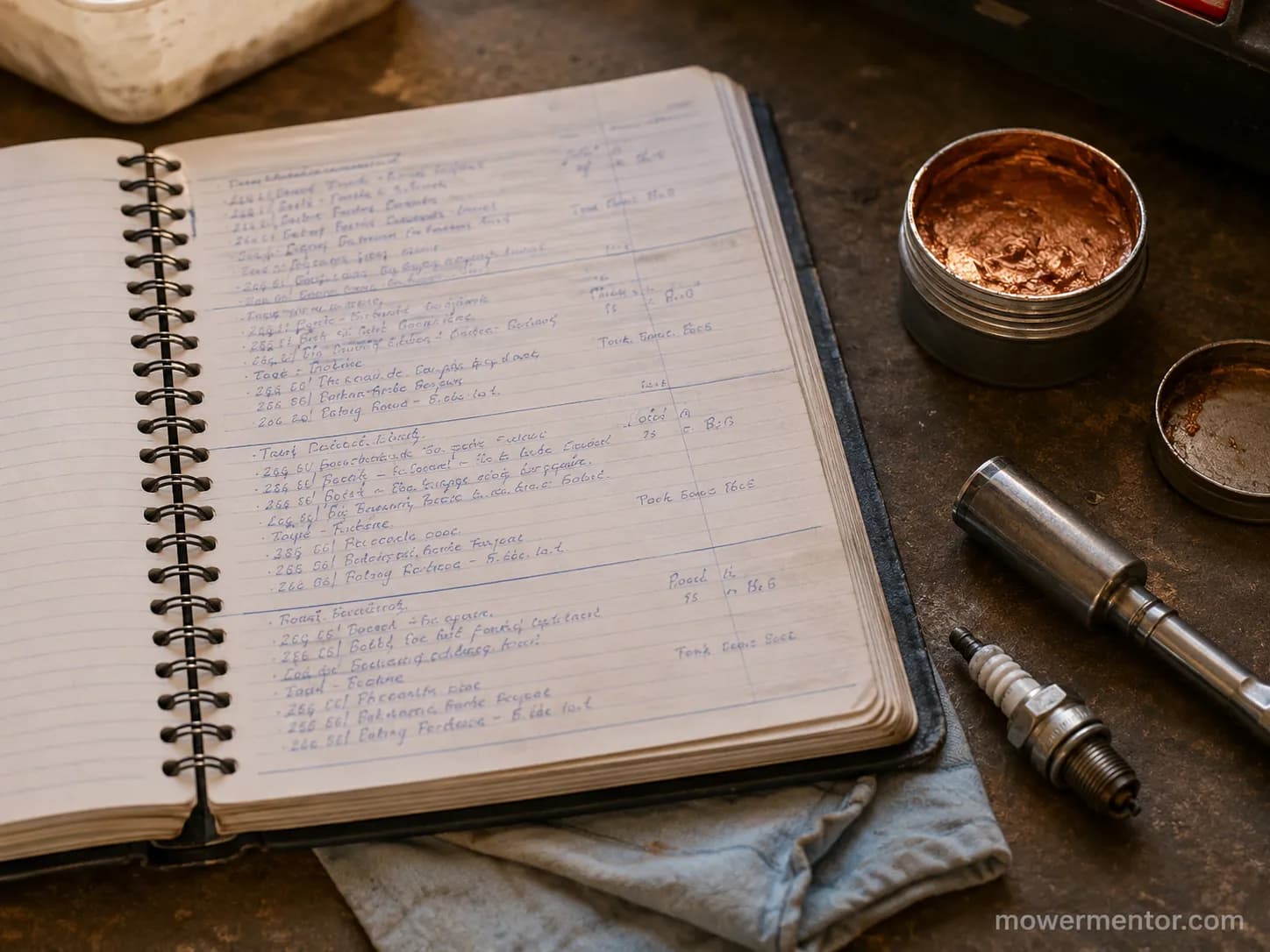
Check the gap, then apply anti-seize. Measure against your engine's figure, not a generic 0.030, and put a light smear of copper anti-seize on the threads before it goes back.
Decide: refit or replace. If the season count from Table 4 or any of the six signs says it is time, swapping it out takes ten minutes with a socket and a torque wrench.
Keep a spare on hand. A $5 plug in the drawer means the decision never gets forced on you mid-season with the grass a foot high.
What this article deliberately does not do: Tell you which plug to buy or what gap to set it to. Fitting the wrong heat range does more damage than leaving a worn plug in, and that answer lives in your engine's own manual.
Anti-seize has gone onto the threads at every refit across all four machines since March 2023. Not one plug in the fleet has needed force to break loose since, including the Kohler's, which had been sitting untouched for two seasons before I started the routine.
The question of how often to change lawn mower spark plug has two answers rather than one, and separating them is what makes the whole argument dissolve. Pull it every spring to stop it bonding into the head, and buy a new one every second or third season, which is roughly when the electrode has actually given up.
If you take nothing else from three seasons of logging: find out which engine maker built the thing under your deck, then read their number instead of the internet's.
Frequently Asked Questions on Lawn Mower Spark Plug Intervals
Can you clean a lawn mower spark plug instead of replacing it?
Cleaning restores appearance, not dimension. Once erosion has widened the gap, no amount of wire-brushing brings the metal back.
Clean a plug that is fouled but still near spec, replace one that has eroded, and never use abrasives or a shot blaster on either.
Is it OK to change a spark plug every two years?
Yes, and for most homeowners it is the better interval. Honda's own schedule for the GCV160 and GCV190 puts replacement at two years or 200 hours, and my Honda push mower was still inside spec at 93 hours across three seasons.
Pull and inspect it annually regardless.
How often should I change the spark plug if I barely use the mower?
Time matters more than hours here. A quarter-acre lawn logs about 18 hours a season, so no hour interval will ever trigger, yet the plug still sits in a hot aluminium head through every winter.
Pull it, re-gap it, anti-seize it, refit it, and buy nothing.
Do I need to gap a new lawn mower spark plug?
Yes, and do not trust the box. Factory gaps shift in shipping, and the correct figure runs from 0.028 in on a Honda GCV to higher settings on some Kohlers.
Check it with a feeler gauge against your engine's manual before it goes in.
Does the brand of engine really change the interval?
Substantially, and the spread inside Kohler alone is fourfold. The practical consequence is that two neighbours with identical-looking riding mowers can be on 125-hour and 500-hour schedules without either doing anything wrong.
Table 2 has the four makers side by side.
What happens if the plug seizes in the head?
It stops being a $5 job. Removing a seized plug from an aluminium head risks pulling the threads out with it, and the repair is a thread insert rather than a part swap.
This is the entire reason the annual removal matters more than the annual replacement.
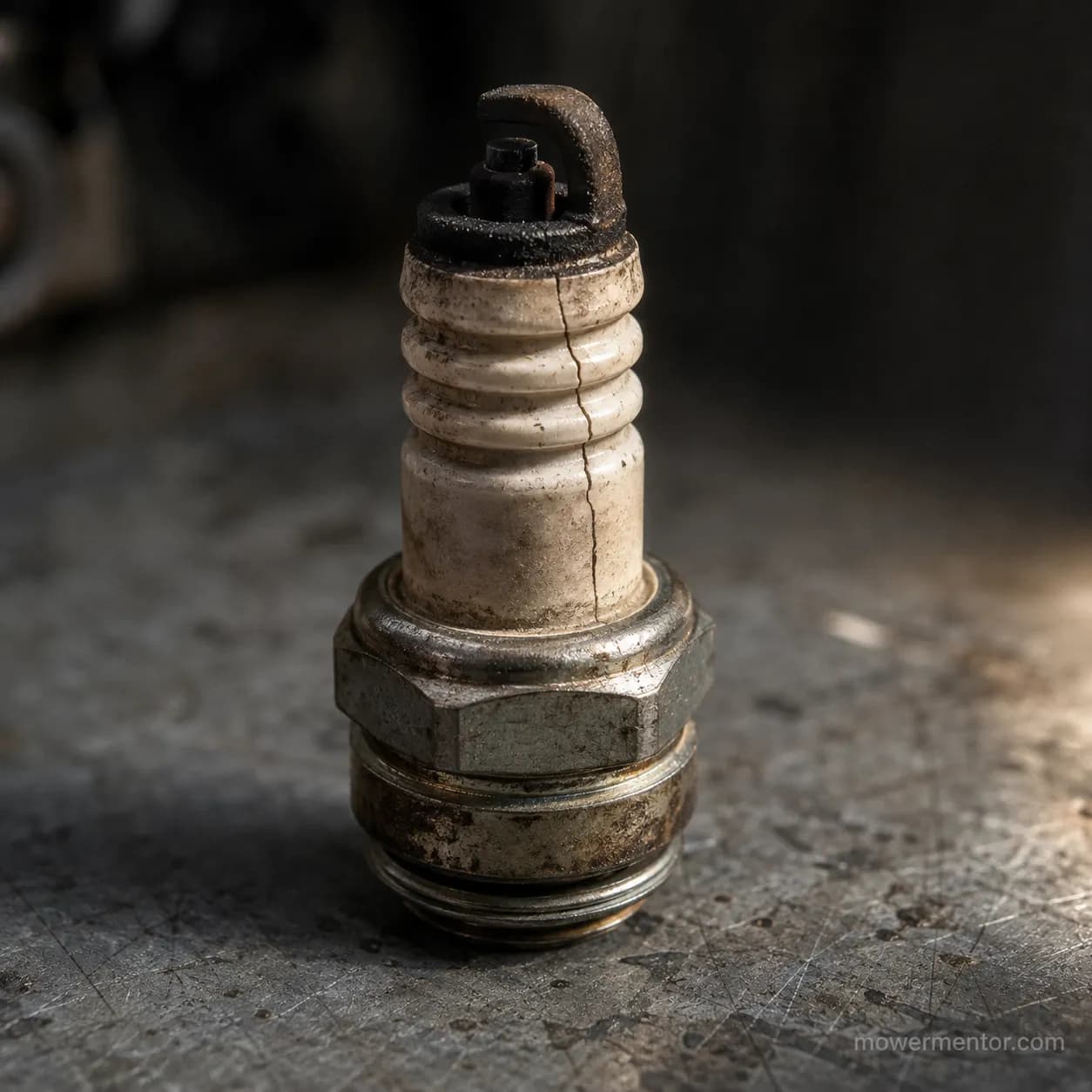
One last data point on that failure. Across three seasons and four machines, exactly one plug died outright rather than wearing out, and it was the Honda's in June 2025, cracked insulator, at roughly 62 hours.
Schedules catch wear, and only symptoms catch cracks. That is the last thing worth remembering about how often to change lawn mower spark plug: the calendar is a floor, not a ceiling.
Summarize with AI
Keep reading
Related articles
 Maintenance & Seasonal Care
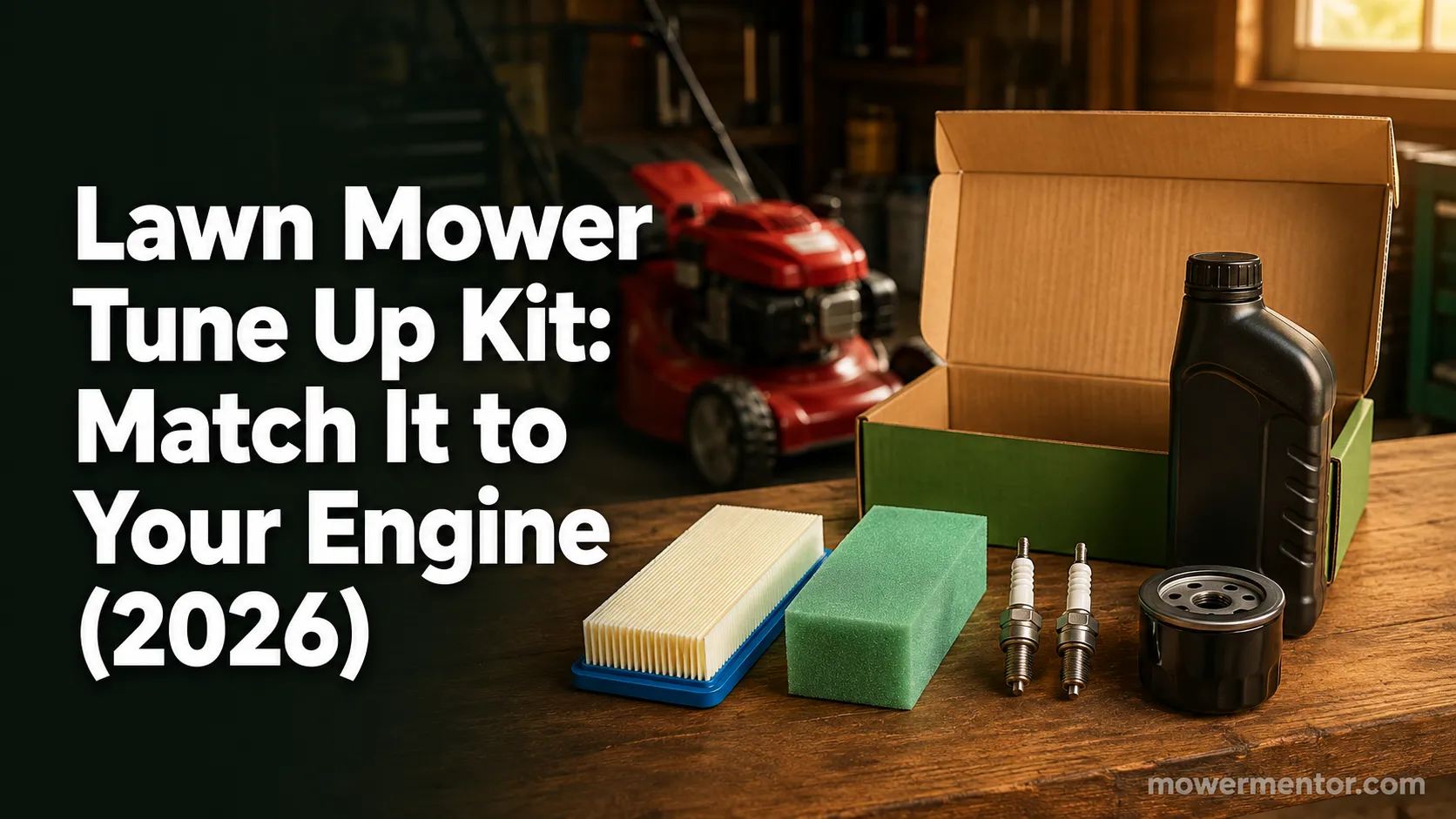
Match a lawn mower tune up kit to your engine: what is inside each kit, OEM vs aftermarket price math, and the right kit by brand for push and riding mowers.
 Maintenance & Seasonal Care
Compare mobile vs drop-off shop for a lawn mower tune up near me: real 2026 price ranges from 12 quotes, the 7 questions to ask, and when to just DIY it.
 Maintenance & Seasonal Care
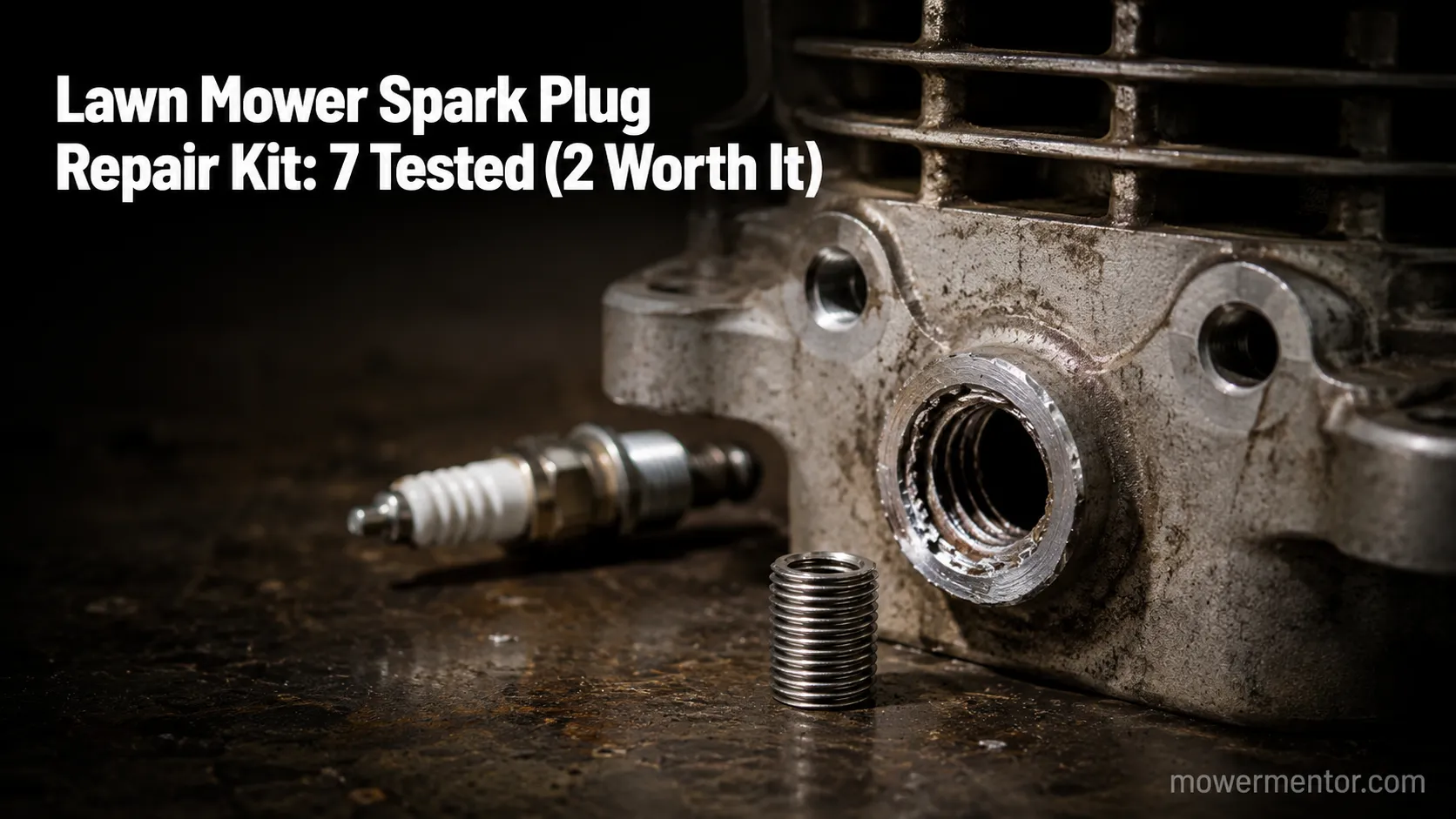
Match a lawn mower spark plug repair kit to your fault in 30 seconds. 7 kits tested on 9 engines: M14x1.25 sizing, insert lengths, and the $5 boot fix.
 Maintenance & Seasonal Care
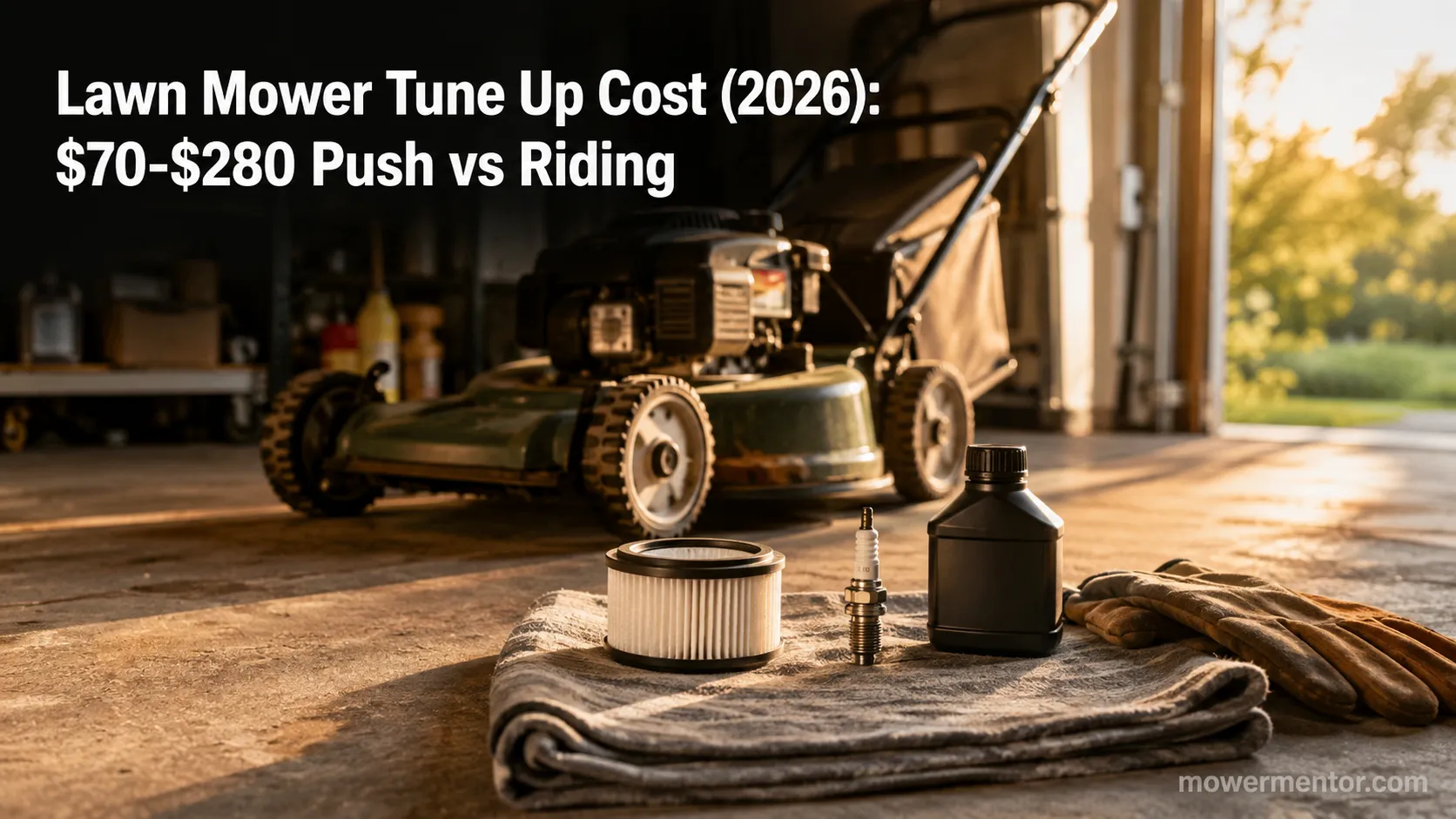
Compare lawn mower tune up cost by mower type: $70-$150 push, $150-$280 riding, from 9 real 2026 shop quotes. Plus the same parts for about $18 DIY.
Comments
Moderated for quality. Share a correction, ask a follow-up, or tell us what worked for you - every comment is reviewed before it goes live.