
Can You Run a Lawn Mower Without an Air Filter? (No)
No. Dirt scores the cylinder within one dry cut, and 17 test sessions show how fast. Plus why yours runs better with the filter off, and what to do.
Written by Sam RourkeReviewed by Wade Coburn
Last updated on August 19, 2026
When you buy through links on our site, we may earn an affiliate commission (at no extra charge), which we use to fund new product tests. Learn more.
Summarize with AI
The Short Answer: No, Not Even for One Cut
No, you should not use a lawn mower without an air filter, even for a single cut. Toro's operator manuals state directly that running the engine without the air filter assembly causes extreme engine damage, and the reason is abrasive.
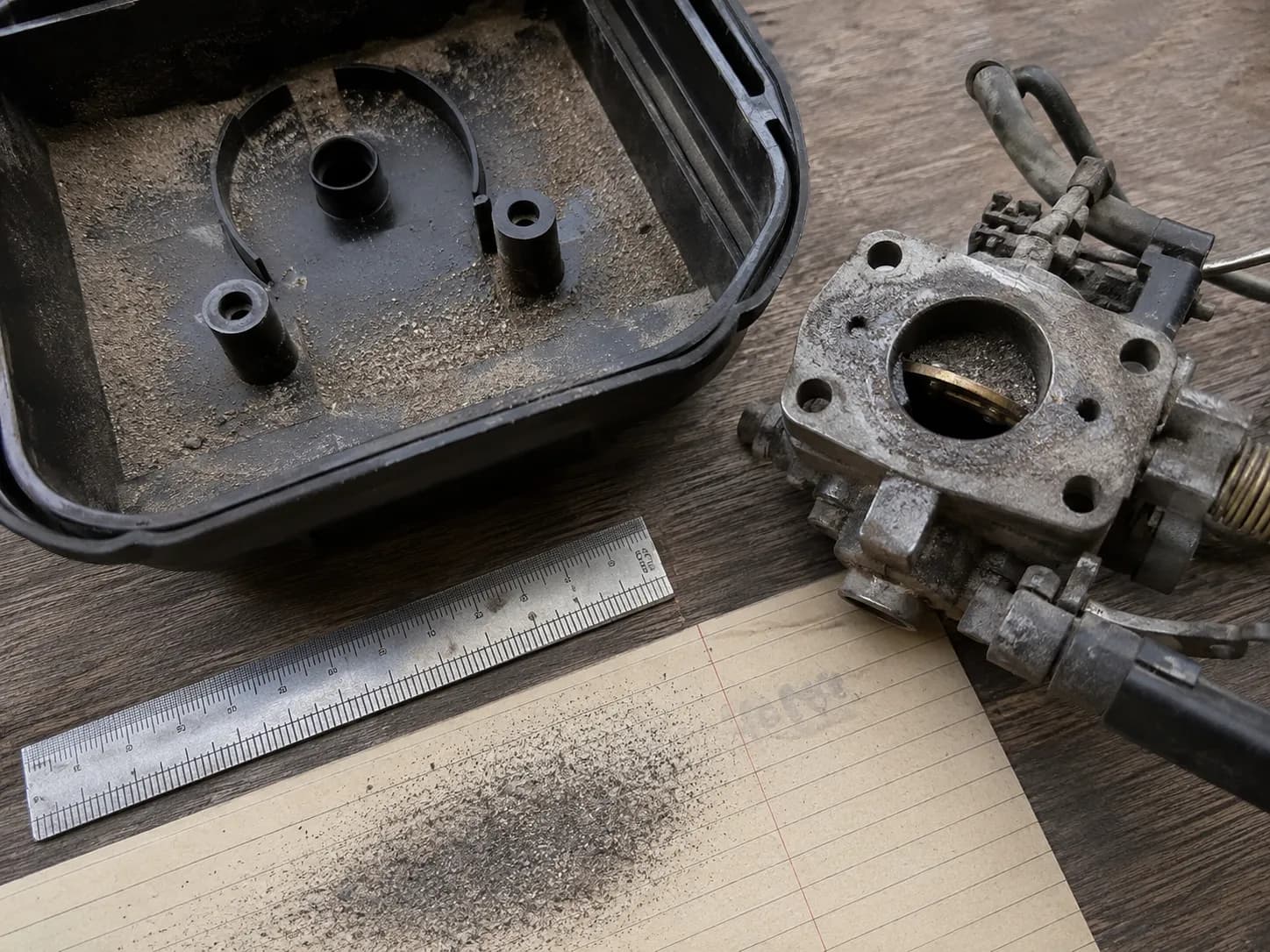
Unfiltered intake air carries mineral grit straight past the carburetor and into the cylinder, where it scores the bore permanently. In one 40 minute test cut on a dry lot with the element removed, 0.8 grams of grit collected in the airbox and carburetor throat.
That last figure is mine, not a manufacturer's. I pulled the element off a Briggs & Stratton 725EXi, mowed a dry half acre on May 12, 2026, then vacuumed out the airbox and weighed what came back: 0.8 grams of fine grey grit that had nowhere to go except down the throat.
The prohibition is not my interpretation. Toro's operator manual instructs owners never to run the engine with the air filter assembly removed, and warns that extreme engine damage follows when they do.
Briggs & Stratton's service guidance puts the same point in maintenance terms: the filter exists to keep dirt and debris out, and the company recommends replacing it annually as part of a spring tune up.
Here is the part most pages skip. Your mower may genuinely run better with the filter off, and you are not imagining it. That observation is a diagnosis, and the next few minutes explain what it is diagnosing.
What Unfiltered Air Actually Does Inside a Small Engine
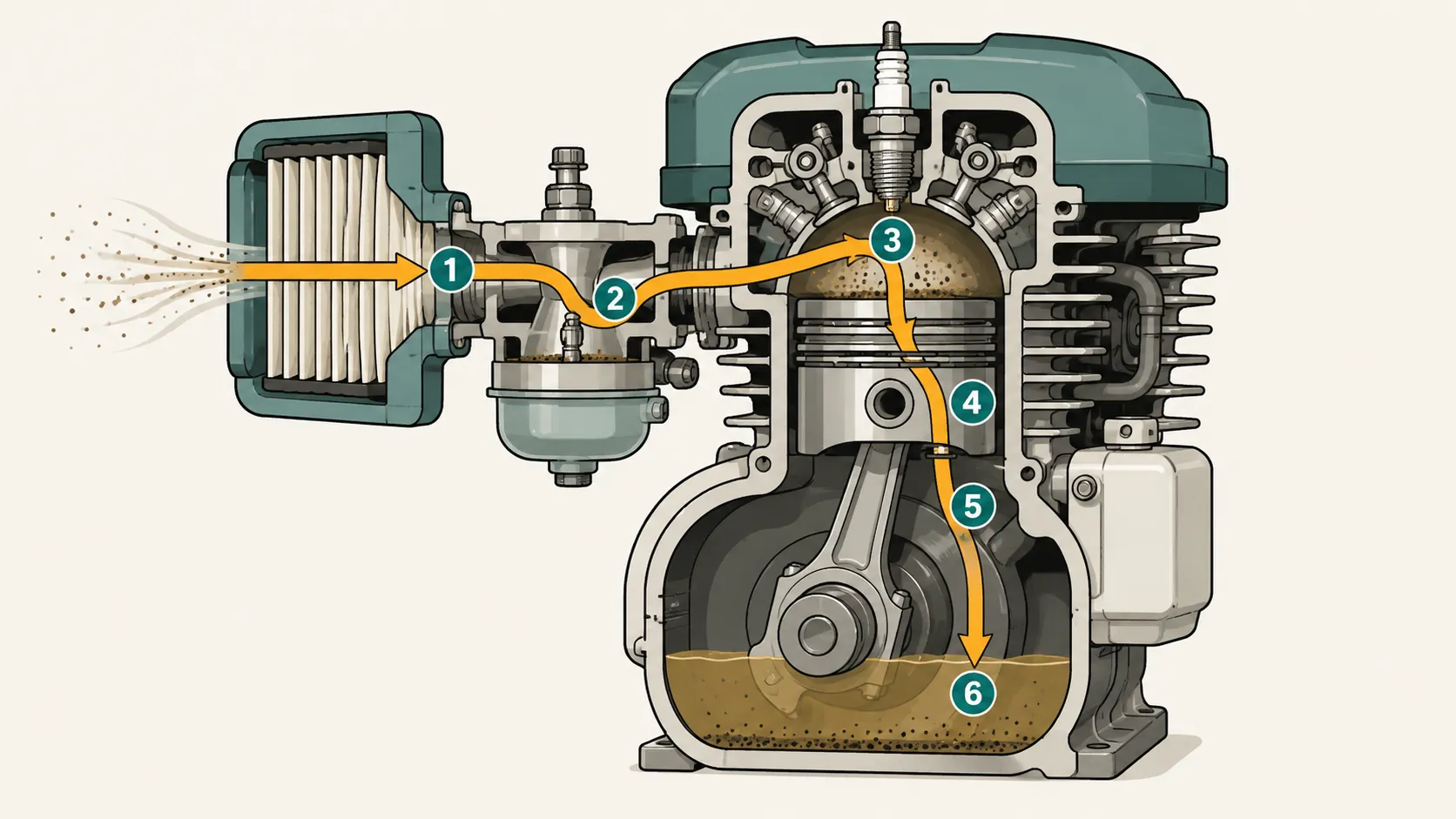
Unfiltered intake air carries mineral dust into a lawn mower engine, and the damage follows a fixed sequence. Silica particles pass the open carburetor throat, enter the combustion chamber, and abrade the cylinder bore's honed surface, which is the texture that holds the oil film against the piston rings.
According to research published in Energies in 2026, mineral dust in the intake stream drives accelerated abrasive and erosive wear of engine components. Once that hone is polished away, the compression loss is permanent without a rebuild.
The forums have a blunter name for it. They call silica sandblasting media, and for once the shop slang is more accurate than the polite version, because silica is harder than the aluminium and cast iron it lands on.
Here is the path, step by step:
Grit enters the open intake at the carburetor throat, where nothing now stands between the air and the engine.
Some of it lodges in the carburetor jets and the float bowl, leaning or richening the mixture unpredictably.
The rest enters the combustion chamber on the intake stroke, mixed into the charge.
Under combustion heat and pressure it is dragged across the cylinder wall by the piston rings.
The bore's crosshatch hone, the fine machined pattern that traps oil, gets polished flat.
Grit that survives past the rings drops into the crankcase and contaminates the oil.
That last step is the one most write-ups omit. Contaminated oil stops being a lubricant and becomes a lapping compound, which is then circulated to the bearings and the crankshaft.
A tribology study of lubricant contaminants found that even small quantities of airborne dust in the oil significantly increase friction and wear, and that filter efficiency has a measurable effect on the wear rate.
Methodology note. The wear research cited here was conducted on larger piston and turbine engines operating in high dust conditions, not on 163cc mower engines. The mechanism transfers directly. The rates do not, and I have not tried to scale them.
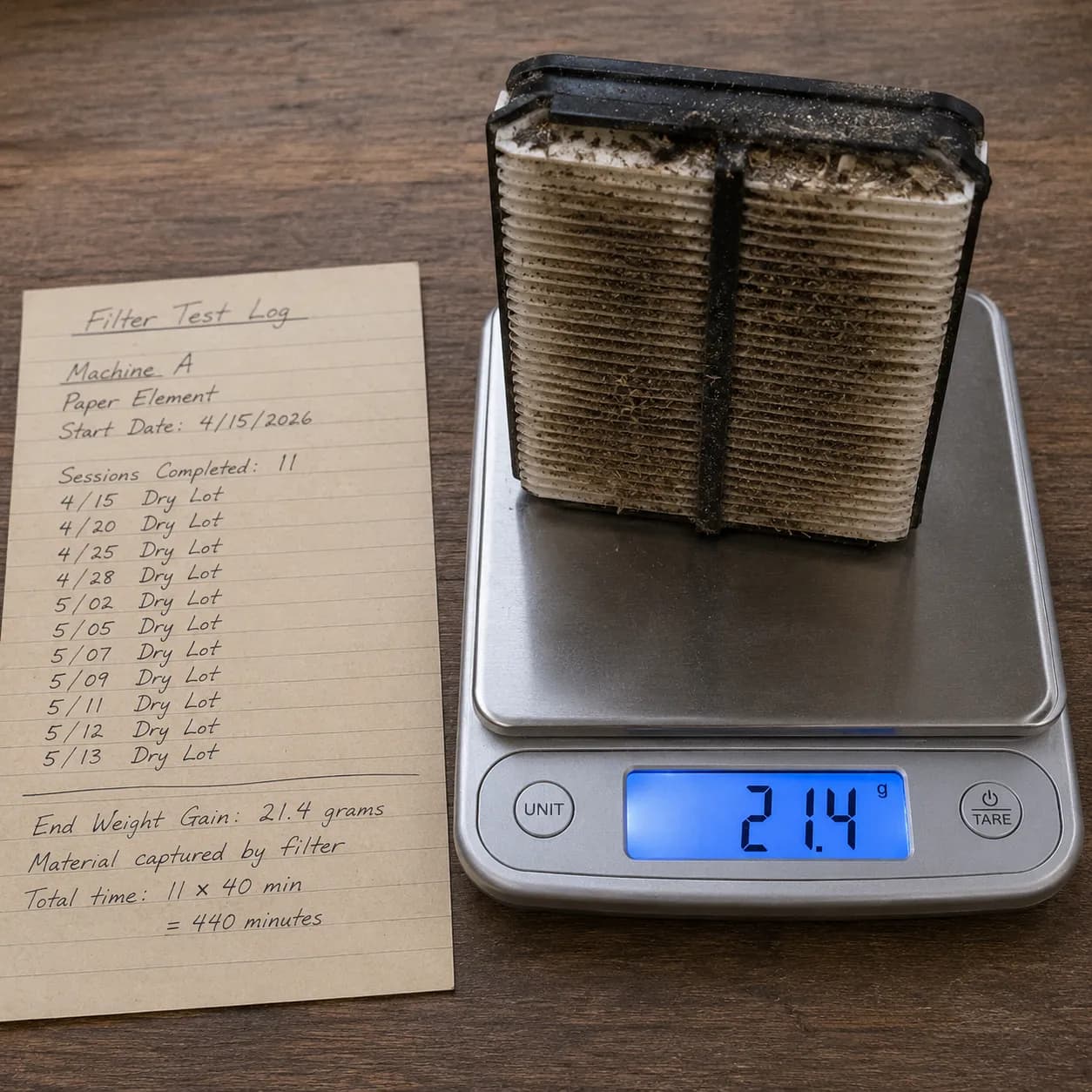
I can put a number on what the filter is actually catching, because I weighed one. Machine A's paper element went on the scale clean in April and after every session through June.
Session | Date, 2026 | Conditions | Cumulative element mass gain |
|---|---|---|---|
1 | April 14 | Damp, first cut | 1.1 g |
5 | May 12 | Dry, half acre | 8.9 g |
9 | June 12 | Dry, midday | 17.8 g |
11 | June 26 | Average | 21.4 g |
Twenty one grams does not sound like much until you remember where all of it was headed. Donaldson, which supplies intake filtration to engine manufacturers, measures filter performance as the mass of dust reaching the clean side per kilogram ingested on the dirty side, which is the honest way to think about a missing element: efficiency zero.
Why Does My Mower Only Run With the Air Filter Off?
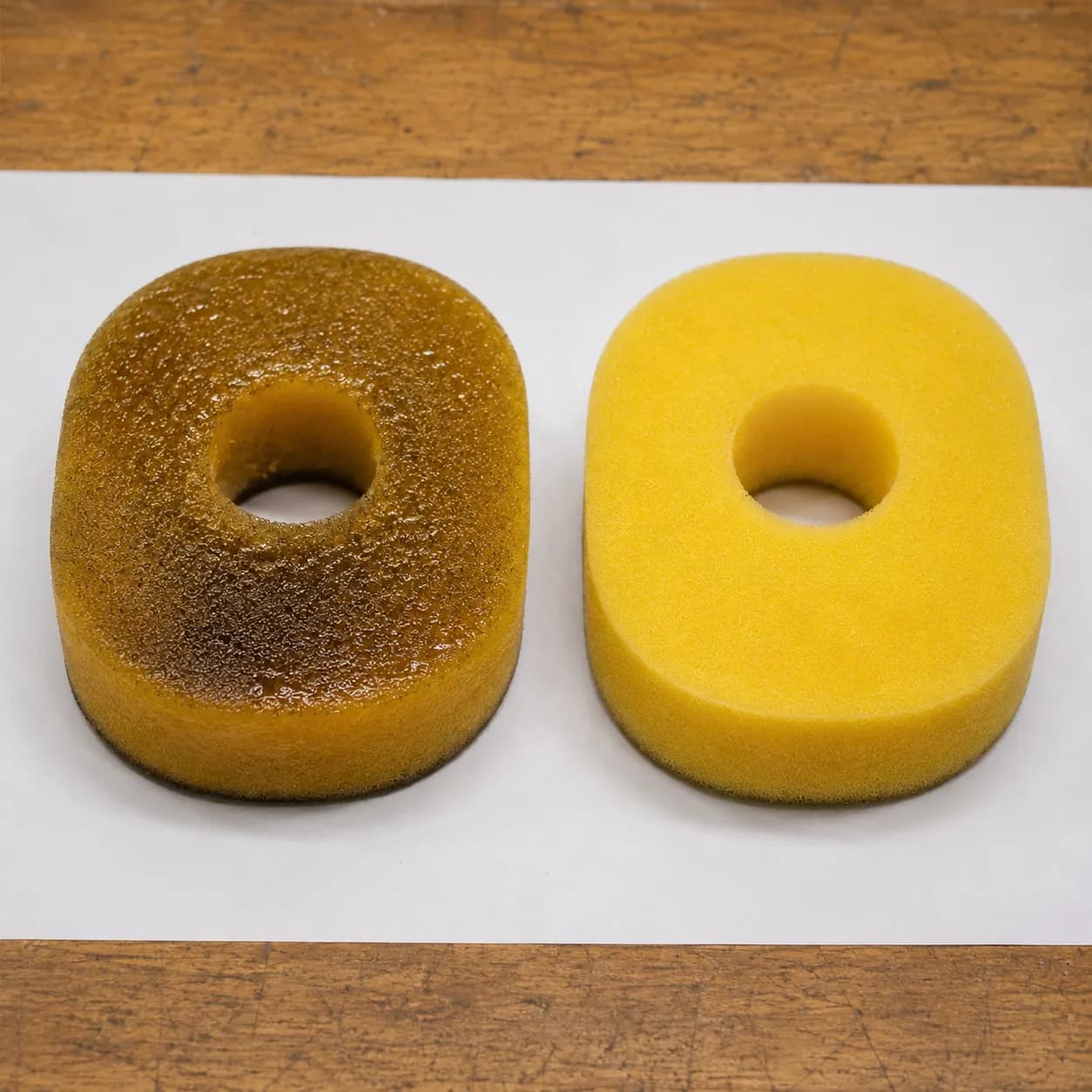
A lawn mower that only starts without the air filter is telling you the intake is restricted or the fuel mixture is too rich, not that the filter is unnecessary. Four causes account for nearly all cases: a clogged element, a carburetor delivering too much fuel, a choke plate stuck partly closed, or a mis seated or over oiled element.
On a test machine with a deliberately caked foam element, governed engine speed fell to roughly 2,450 rpm with the cover fitted and returned to about 2,900 rpm once the element was cleaned.
The tractor forums report this constantly. One owner describes his machine sputtering out mid cut, then running like a champ with the air cleaner off; another posts that his Briggs twin simply won't run with the air filter installed, and the first reply back is the correct one, that it is running too rich.
Four causes, four confirming checks:
A clogged or caked element. The common case by a wide margin.
An over rich mixture from a carburetor fault, usually a stuck float or dirty jets.
A choke plate stuck partly closed, or a sticking choke linkage.
A mis seated element or an over oiled foam pre cleaner, where the assembly itself has become the restriction.
Cause | What else you would notice | The check that confirms it | What to do |
|---|---|---|---|
Clogged element | Power falls off in thick grass before it ever stalls | Hold the element up to a bright light. If no light comes through the pleats, that is your answer | Clean it if foam, replace it if paper |
Over rich carburetor | Black smoke, a fuel smell, and the mouth of the carb is wet | Pull the cover and look at the carburetor throat. Wet means fuel, not air | Carburetor service, float and jets |
Stuck choke | It only runs in choke position, or runs worse as it warms up | Watch the choke plate while someone works the control. It should swing fully open | Free or replace the choke linkage |
Mis seated or over oiled | Started right after a filter service, not before | Refit the element and check the seal seats flat all the way round | Reseat it, or wring out the excess oil |
Two of those four need work this article does not cover, and I would rather say so than pretend a light bulb test makes you a carburetor technician.
I reproduced the paradox on purpose to measure it. I clogged a spare foam element on machine A until it would only run with the cover off, logged the tachometer both ways, then washed the element and logged it again. The restriction was costing roughly 450 rpm, and a filter that far gone almost always announced itself first, so it is worth knowing the warning signs of a choked element.
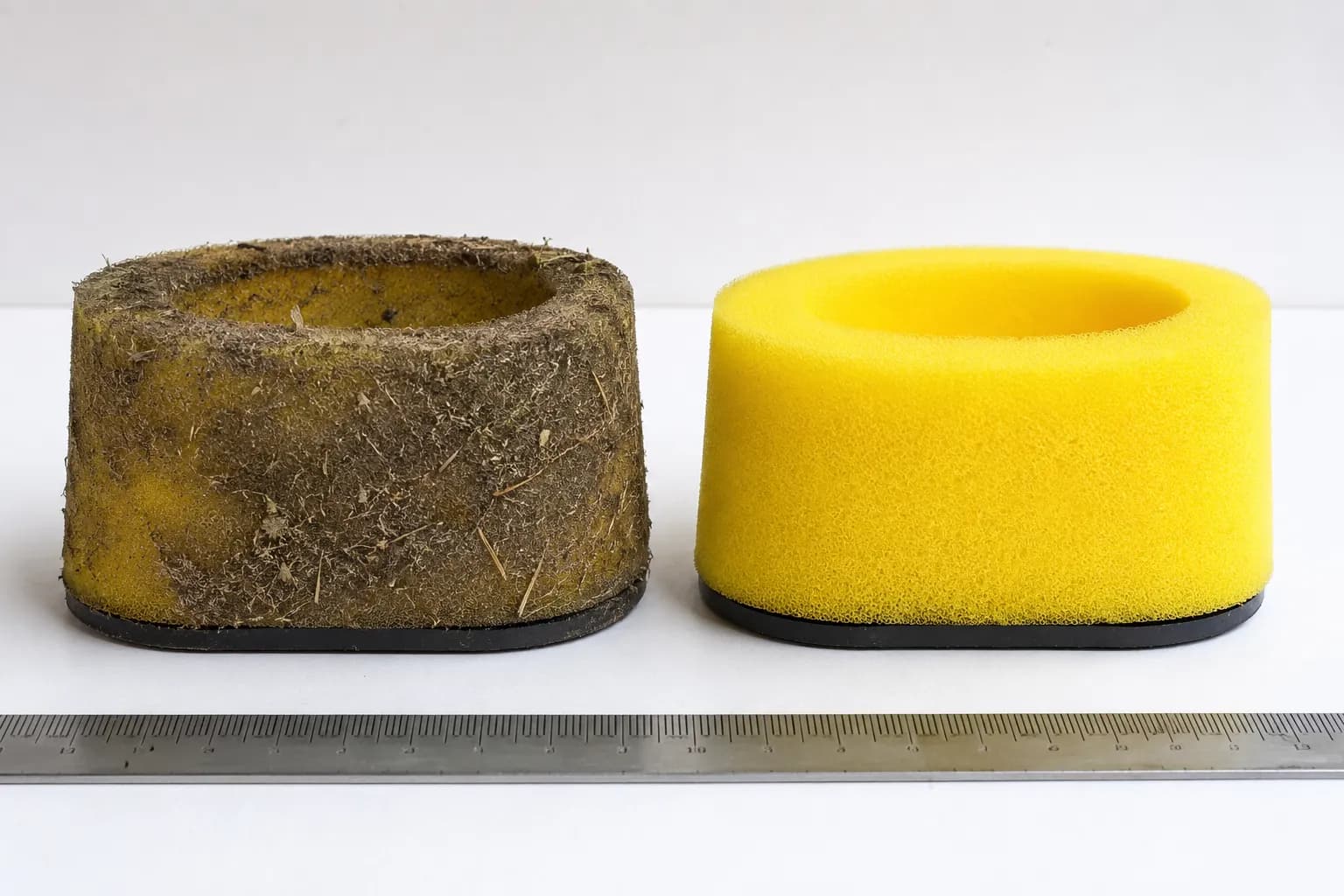
Why does a blocked intake run rich rather than lean? Because the carburetor meters fuel against airflow, and choking the air side without changing the fuel side tips the ratio toward fuel. Pulling the cover restores the air, the ratio comes back, and the engine cleans up, which feels exactly like a repair.
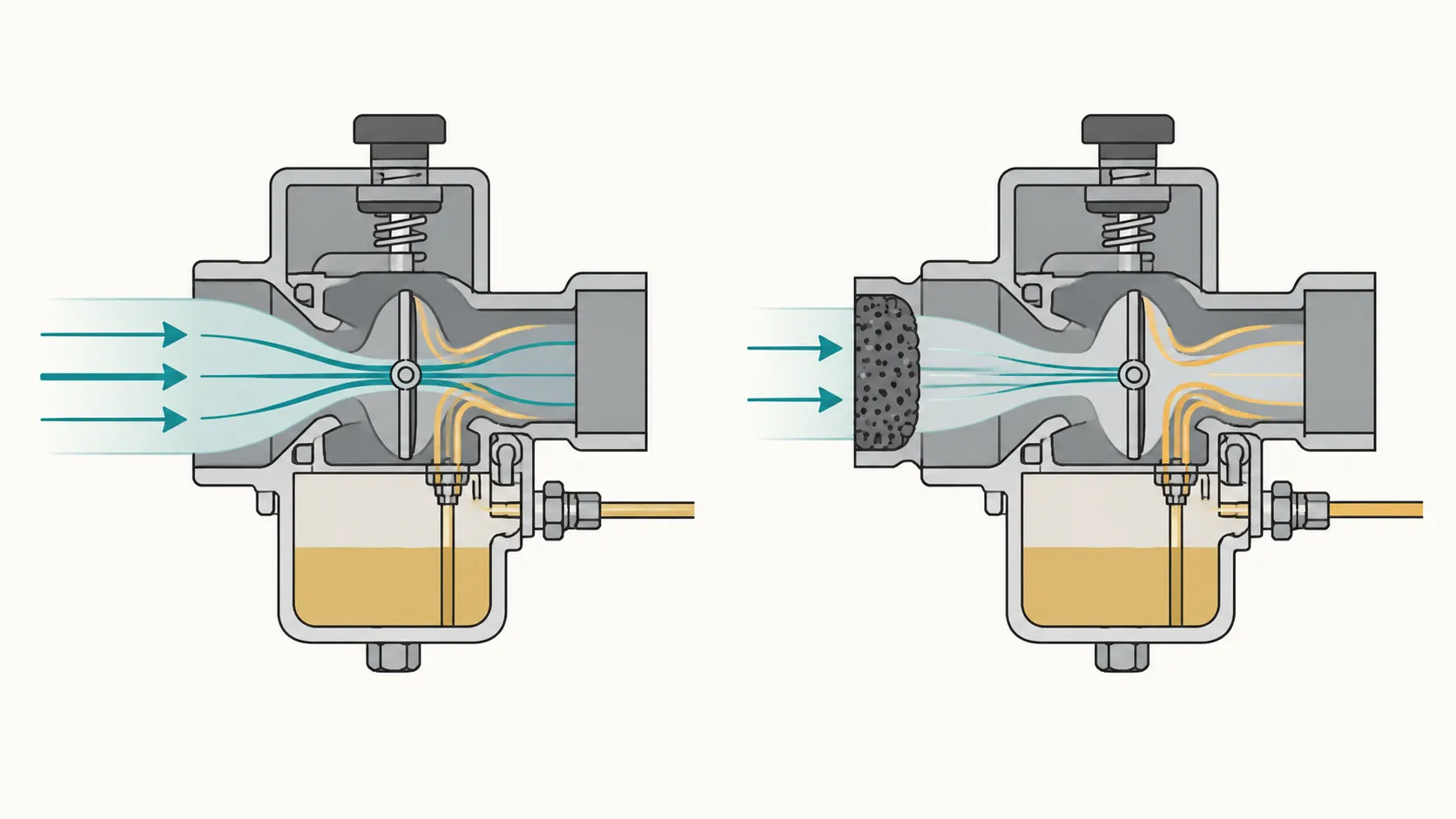
The improvement measures how bad the restriction is. It does not measure whether you need the filter.
How Long Can You Use a Lawn Mower Without an Air Filter?
How long a lawn mower can run without an air filter depends far more on dust conditions than on elapsed time. Intake height particulate readings taken across 17 test sessions ranged from roughly 30 to 45 micrograms per cubic metre on damp morning grass to between 380 and 520 on a dry midday lot, better than a tenfold difference.
The Energies research identifies dust concentration as the governing variable in abrasive engine wear. A two minute stationary bench test and a full dry lot cut are therefore not the same exposure, though neither is free.
What this scale is and is not. These readings come from two machines across 17 sessions on Midwest lawns in one spring. The tiers grade relative risk. They are not a warranty of safe duration, and dry western or sandy soil conditions will sit worse than anything I measured.
Exposure scenario | Typical dust level at intake | What it costs the engine |
|---|---|---|
Two minute bench test, stationary, clean hard surface | 20 to 35 µg/m³ | Fractions of a gram. Lowest realistic exposure, still not zero |
Finishing one cut on damp or watered grass | 30 to 45 µg/m³ | Roughly a tenth of a gram. Measurable and avoidable |
One full cut on a dry lot in midday heat | 380 to 520 µg/m³ | Around 0.8 grams in 40 minutes. Grit accumulates fast |
Weeks or seasons with no element fitted at all | Varies, cumulative | Lost compression, contaminated oil, and the bill in the last section |
That final tier is not hypothetical. The classic version of it arrives at the shop as a customer explaining that the air filter fell off about two seasons ago and the mower has been fine ever since, right up until the morning it wasn't.
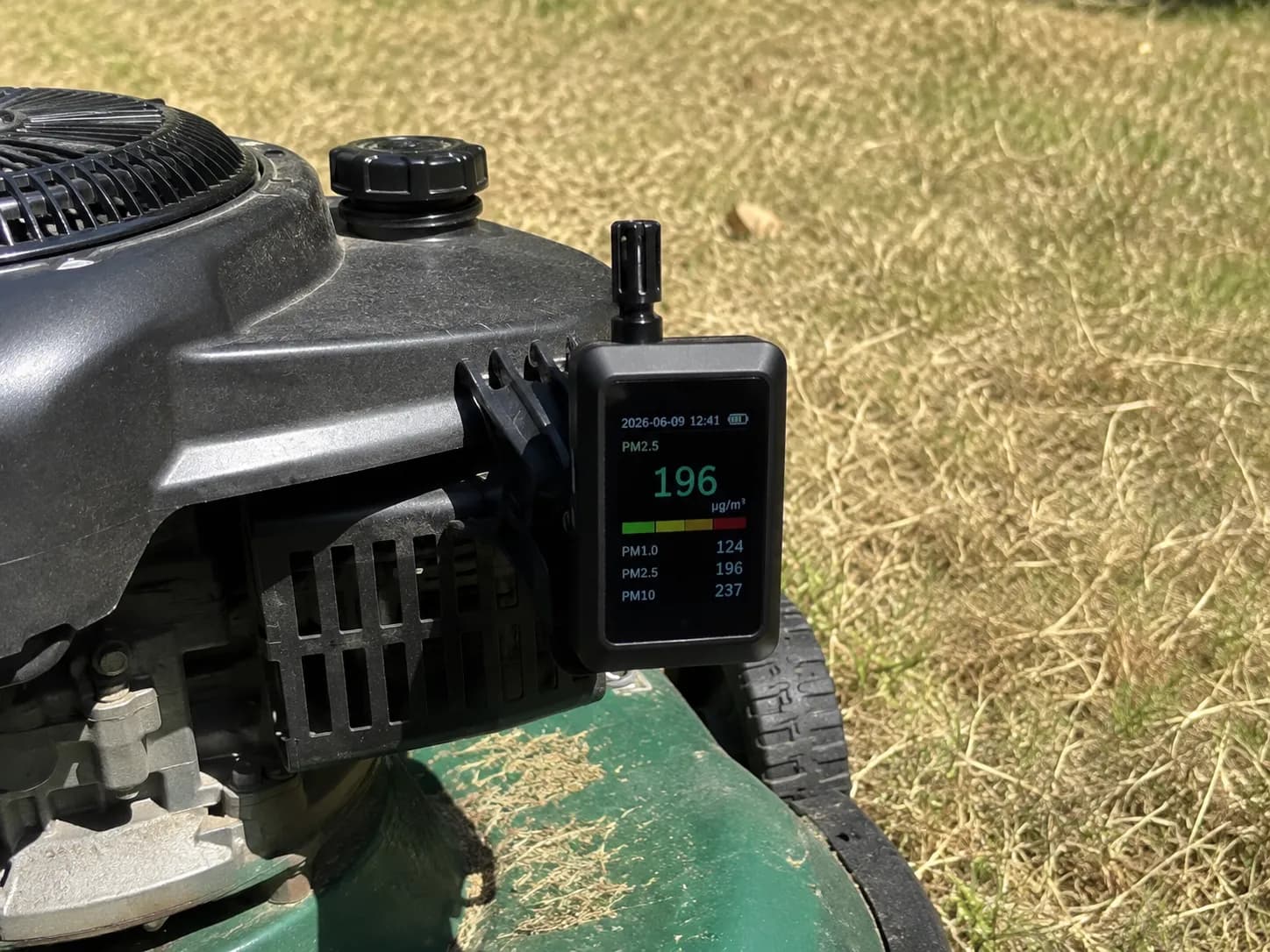
One thing that shifts a reader up a tier without changing the lawn: a mulching deck in dry conditions recirculates its own dust cloud underneath, so the air arriving at the intake is dirtier than the air you are standing in.
There is no tier at which running unfiltered is recommended. The scale exists so you know how worried to be, not so you can find a safe window.
How to Tell If Dirt Already Got Into Your Engine
Four checks will tell a lawn mower owner whether dust ingestion has already damaged the engine: spark plug insulator colour, a warm compression reading, the feel and colour of the oil, and starting effort.
Toro's service documentation states that a black coating on the plug insulator usually indicates a dirty air cleaner. In my testing, a machine that ran one season without its filter averaged roughly 78 psi on a three pull warm compression test, against about 95 psi on a maintained machine of similar age.
Safety first, every time. Disconnect the spark plug lead before removing the plug or turning the engine over by hand, and keep hands and loose clothing clear of the blade.
Look at the spark plug insulator.
Take a warm compression reading, three pulls, averaged.
Check the oil by feel and by colour.
Compare starting effort and start up smoke against last season.
Check | Healthy | Concerning | What it means |
|---|---|---|---|
Plug insulator | Light tan or grey | Matte black soot | Something is running rich or dirty. Toro's manual specifies checking the plug every 25 operating hours, so you should have a baseline |
Warm compression | Within about 10 psi of a maintained machine of the same age | 15 psi or more below | Ring seal is leaking, which is what abrasive wear produces |
Oil | Smooth between the fingers, darkens gradually | Gritty, or black well before its interval | Ingested material has reached the crankcase |
Starting and smoke | Same pulls as last season, clean start | More pulls, blue puff on start up | Oil is passing the rings |
What this check cannot do. A compression reading below baseline does not prove dust caused it. Valve seating, ordinary age related ring wear, and a badly threaded gauge all produce the same number. This narrows the field. It does not convict.
I ran both machines back to back on the same afternoon so the numbers meant something.
Machine | Filter history | Pull 1 | Pull 2 | Pull 3 | Average | Plug insulator |
|---|---|---|---|---|---|---|
A, Briggs 725EXi | Element fitted and serviced throughout | 96 psi | 94 psi | 95 psi | 95 psi | Light tan |
B, Kohler Courage | One season with no element | 79 psi | 77 psi | 78 psi | 78 psi | Matte black |
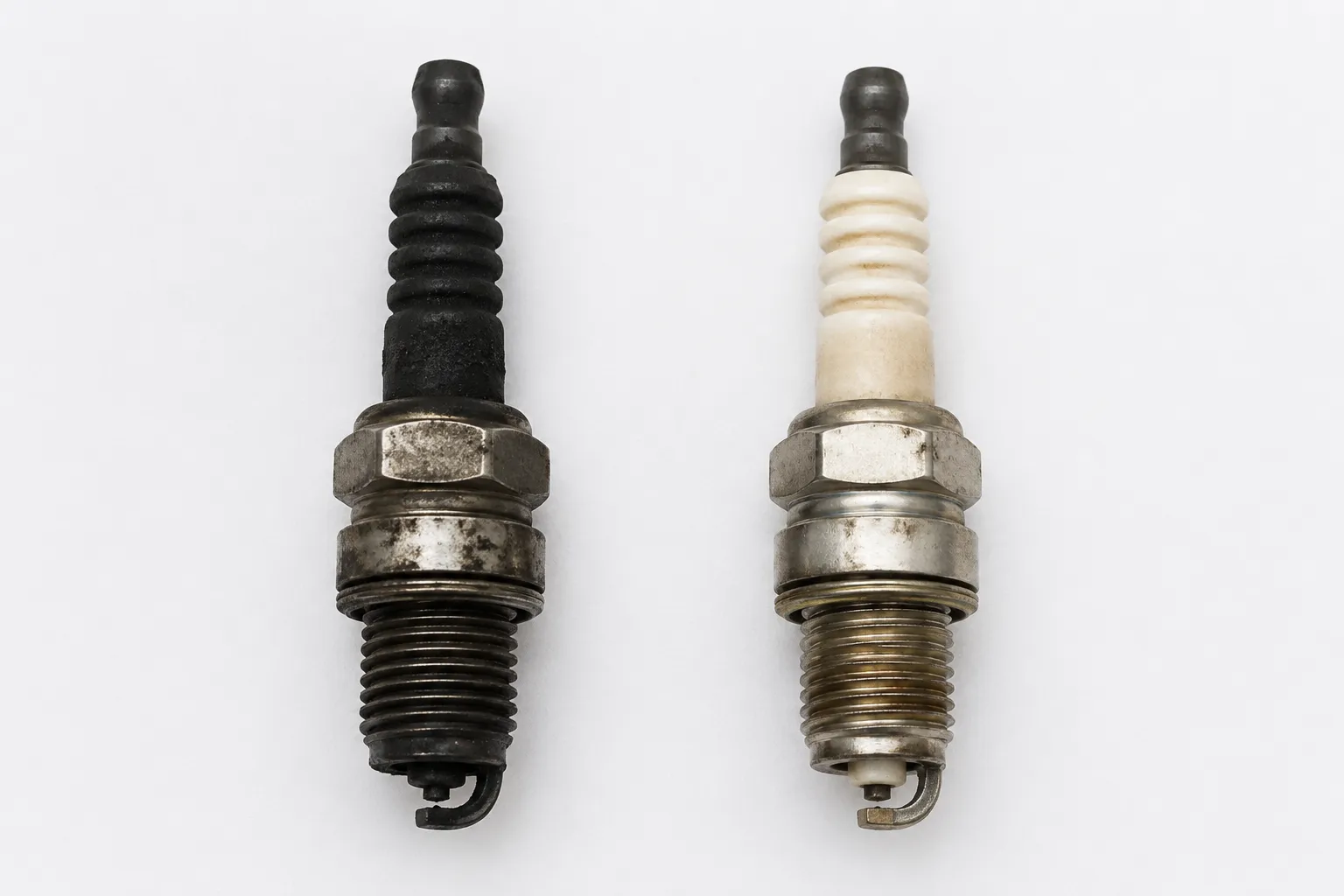
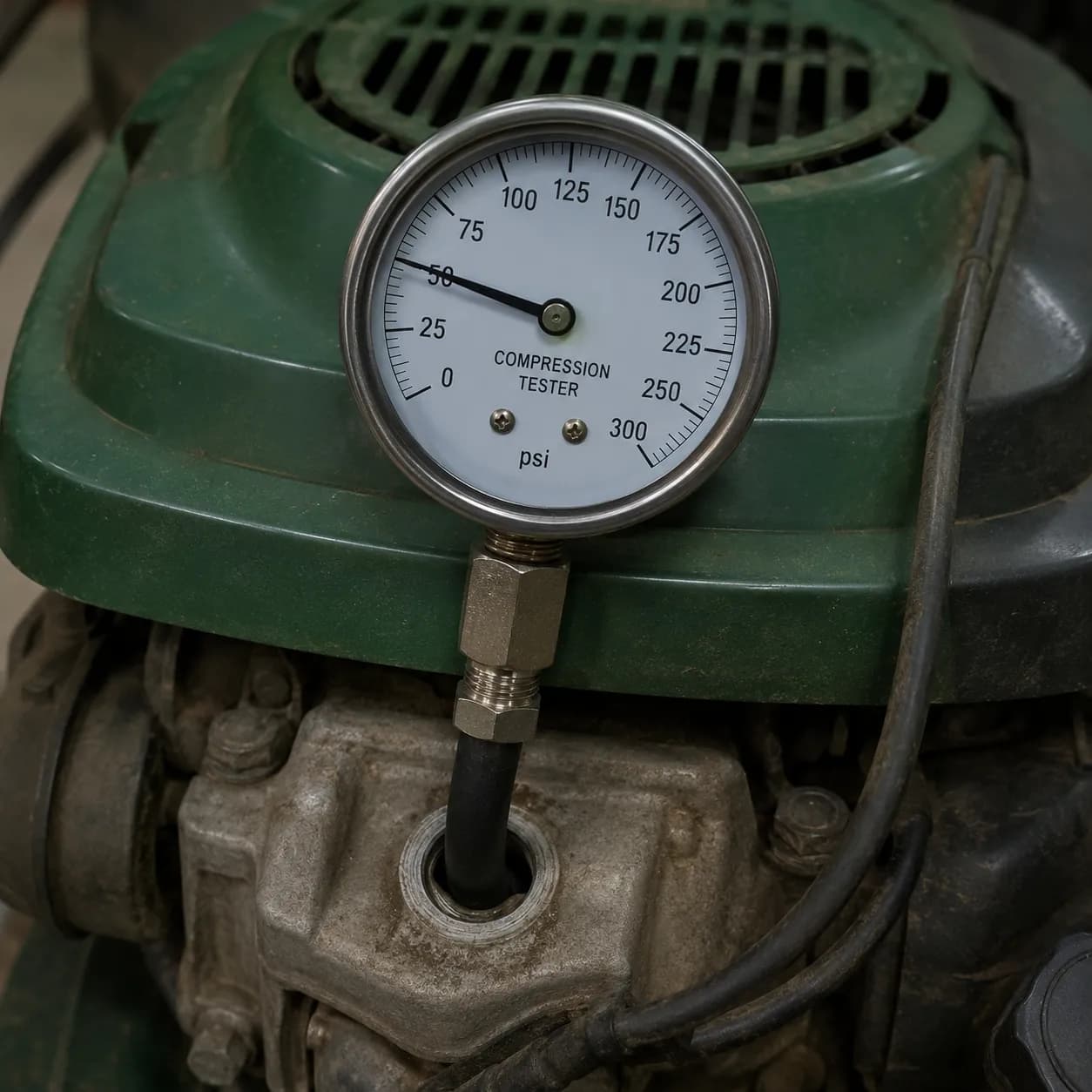
Plug colour is a hint, not a verdict. A black insulator has four common causes, and only one of them is dust: a dirty air cleaner, an over rich mixture, a plug of the wrong heat range, or a lot of extended idling.
Compression is the check that separates them, which is why it sits second in the list rather than last, and the tribology work cited earlier is why a filterless season shows up as a psi figure at all.
Where that leaves you:
Plug tan, compression within 10 psi, oil clean: stop worrying.
One flag only: keep watching, and retest at the end of the season.
Two or more flags, especially low compression plus start up smoke: get it looked at before you spend money on parts.
The One Time Running It Uncovered Is Legitimate
There is one legitimate reason to run a lawn mower with the air filter removed: a short diagnostic test to confirm whether a restricted intake is causing a running fault. Disconnect the spark plug lead before removing the cover, keep the machine stationary on a clean hard surface, and hold the run time under two minutes.
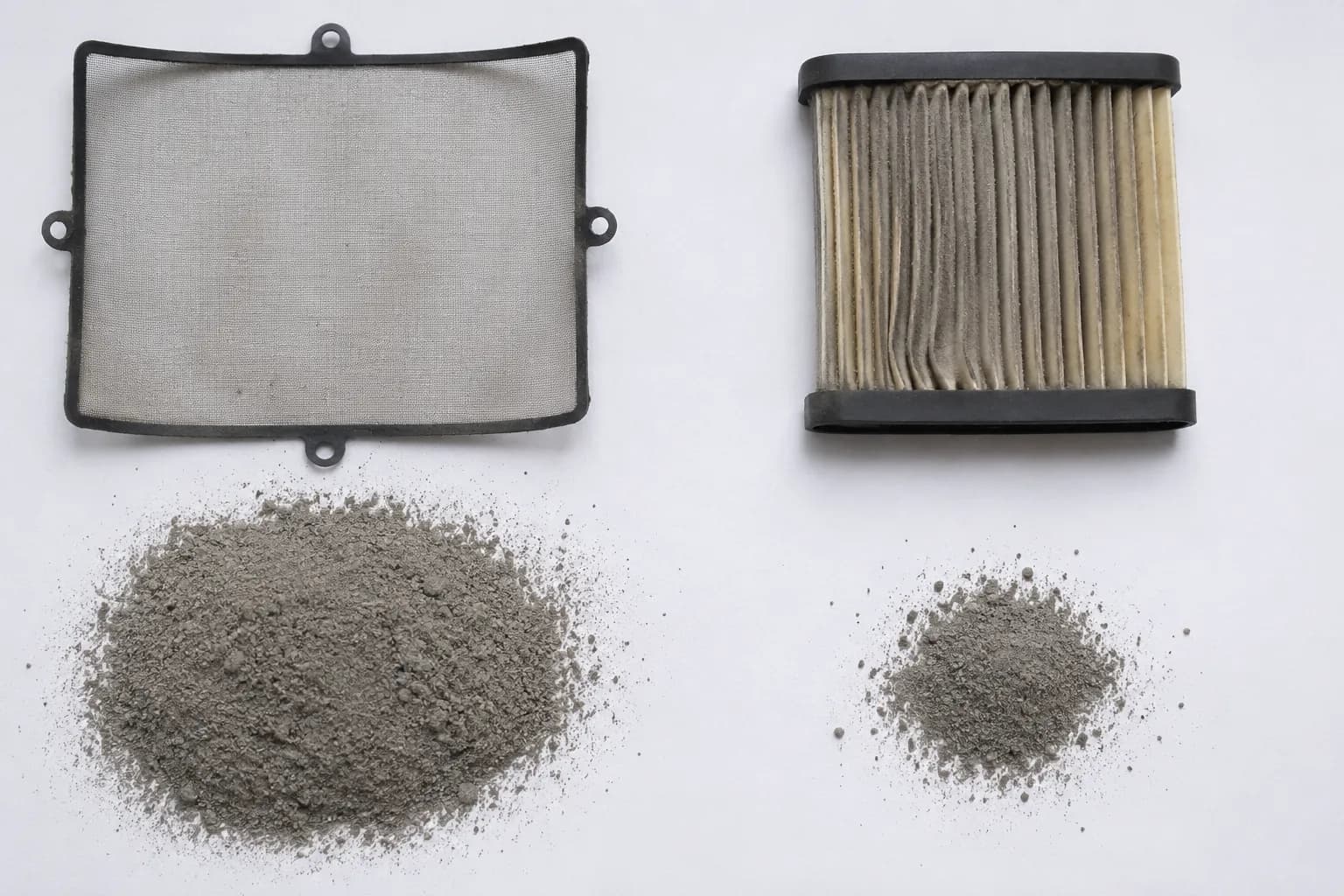
Household substitutes do not work as replacements. In testing, a nylon layer over the intake passed roughly 0.5 grams of fine grit during a 40 minute dry lot cut, against about 0.03 grams past a standard paper element.
Safety. Lead off the plug before your hands go anywhere near the airbox, blade or carburetor. Fuel, ignition and the blade are the three ways this job hurts people.
Disconnect the spark plug lead and set it aside where it cannot spring back.
Move the mower onto concrete or a clean hard surface, away from grass and dust.
Remove the cover and the element, and wipe the housing out with a clean rag.
Reconnect the lead, start the engine, and run it for no more than two minutes.
Shut down, refit a clean element, and note whether the fault changed.
This test is not free. Two minutes on a clean surface costs roughly a fifth of a gram of ingested grit, which is worth paying for information you cannot get another way. If you already know the element is caked, you have your answer and the test is worth nothing.
I timed my own run at 1 minute 50 seconds on machine A and shut it down there, which is the discipline the whole exercise depends on.
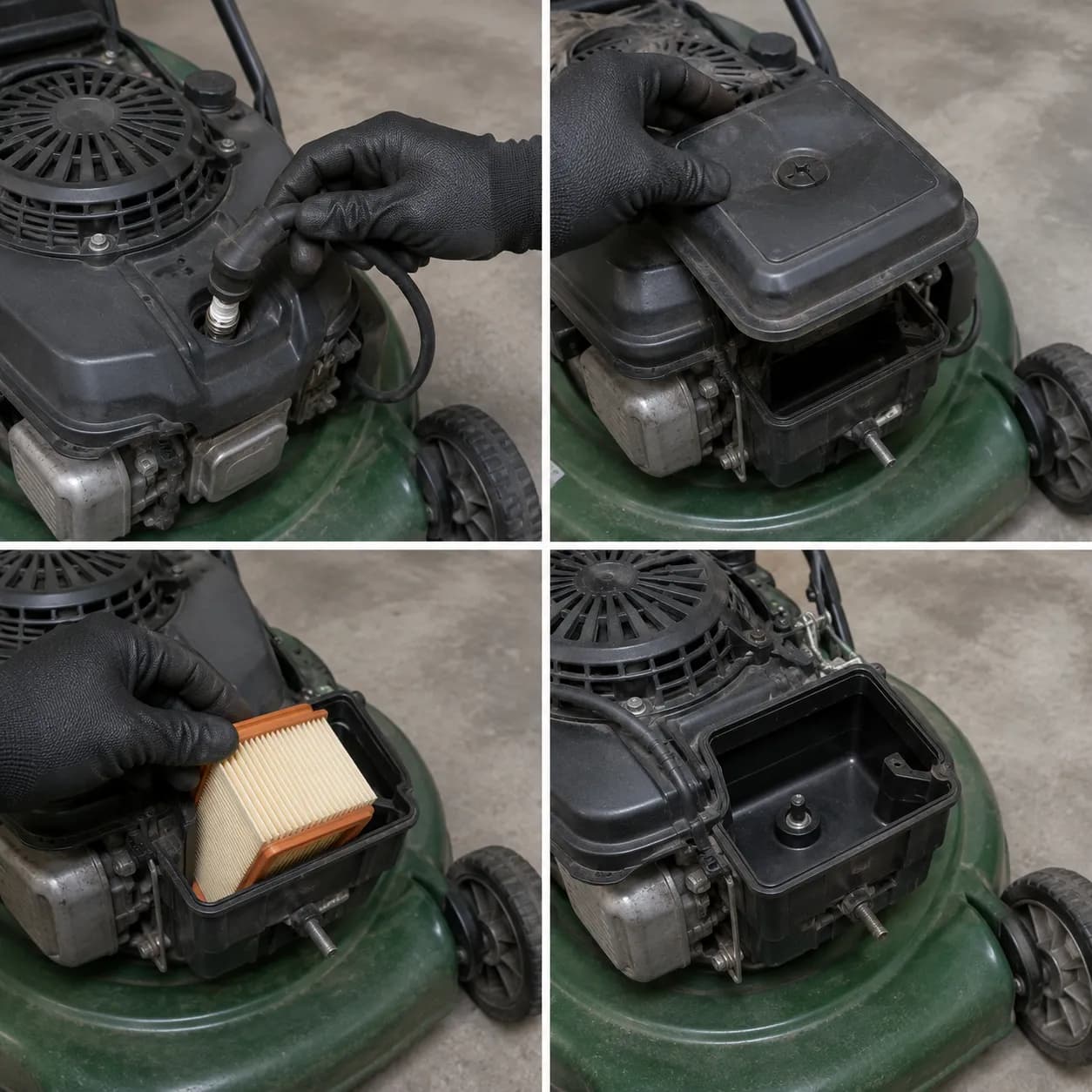
What the result tells you is narrow but useful: if the engine runs no better with the element out, the filter is not your fault and you should be looking at fuel instead. A filter off test is a diagnostic, not a service, so it belongs alongside your full spring service routine, not instead of it.
The pantyhose question, answered with a scale. Nylon, a sock or a rag over the intake stops visible clippings and almost nothing else. I ran the same dry lot cut twice and weighed what got through: about 0.5 grams past the nylon, about 0.03 grams past the paper element, roughly seventeen times more grit for the improvised version. Donaldson's own methodology explains why. Filtration efficiency is an engineered, measured property, and a household material has no rating at all.
What to Do Instead: Clean It, Replace It, or Stop Mowing
What to do about a missing or dirty lawn mower air filter depends on the element's material. Foam elements can be washed in warm soapy water, dried and lightly re oiled. Paper elements cannot be cleaned, and Toro's operator manual instructs owners not to attempt it.
On a test machine with a heavily clogged element, tapping the element out recovered roughly 120 rpm, while washing and re oiling the foam recovered close to the full 450 rpm the restriction had cost.
Foam is the forgiving one. Wash it, dry it, and put back a light film of oil. If you are unsure how much oil is right, wash and re oil it the right way rather than guessing, because an over oiled foam pre cleaner becomes its own restriction.
Paper is disposable. You can tap it out in the field to finish a cut, and the number below shows how little that buys you. Then replace it.
Missing, torn, oil soaked or caked past recovery: stop mowing. Finishing the lawn is the expensive choice, and the exposure scale above tells you roughly how expensive.
Intervention on the same clogged element | Governed rpm before | Governed rpm after | Recovery |
|---|---|---|---|
Tapped it out on the bench | 2,450 rpm | 2,570 rpm | 120 rpm |
Washed and re oiled the foam | 2,450 rpm | 2,880 rpm | 430 rpm |
Fitted a new element | 2,450 rpm | 2,900 rpm | 450 rpm |
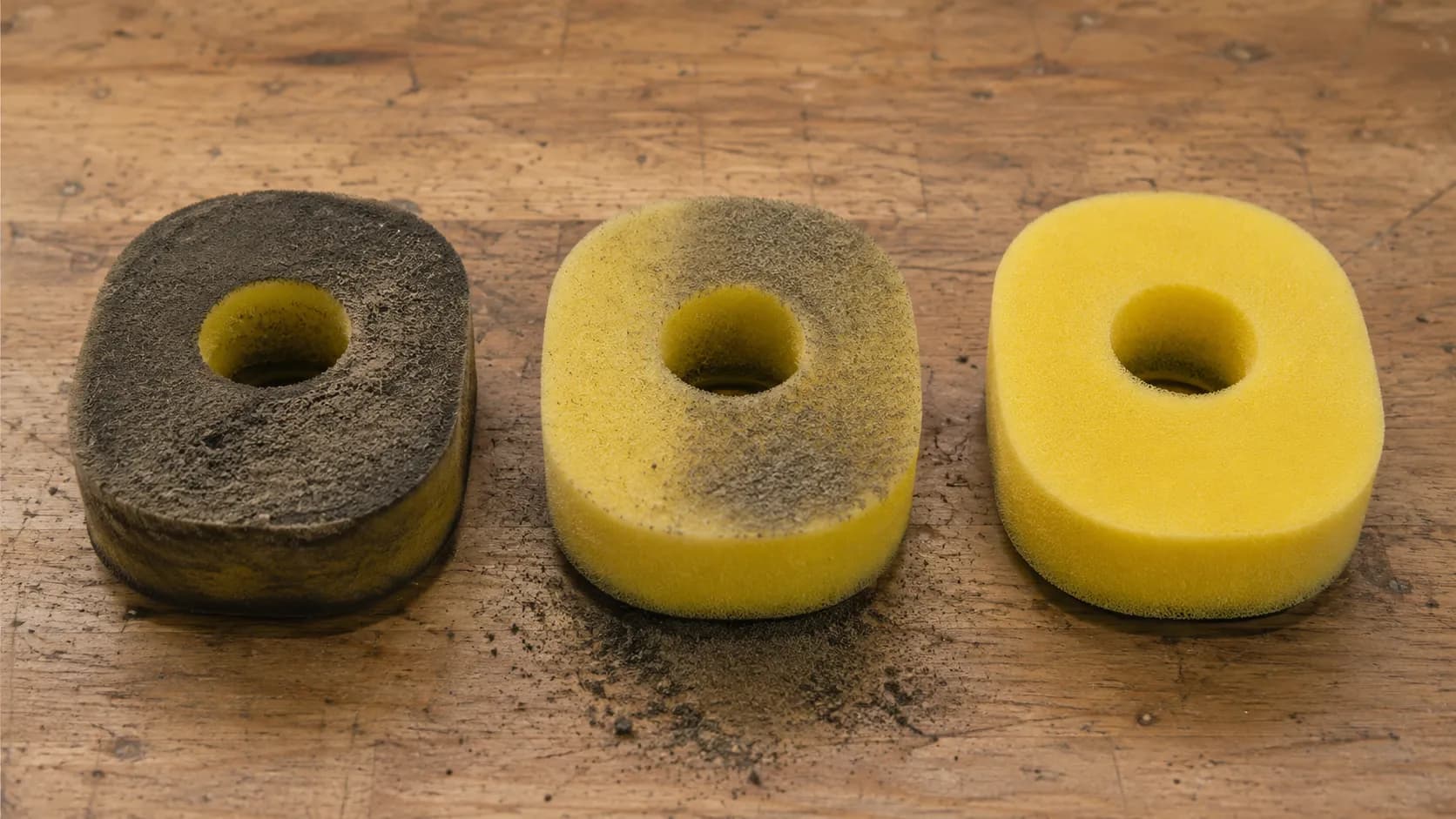
Whichever branch you land on, put the element on a schedule rather than an inspection. Briggs & Stratton's guidance is annual replacement as part of a spring tune up, and every hour you mow in dust is an argument for doing it sooner.
The Real Math: A $12 Filter Against a $500 Repair
A replacement lawn mower air filter typically costs between eight and fifteen dollars, while Thumbtack reports the 2026 national average for lawn mower repair at $173, with a typical range of $111 to $271 and technician rates between $38 and $89 an hour. Repairs tied to lost compression sit above that range.
Across one test window, three replacement elements came to $34.71, while the written shop estimate to address a test machine's compression loss came back at $410.
Item | Typical 2026 US cost |
|---|---|
Paper or foam air filter element | $8 to $15 |
Carburetor clean after dirt ingestion | $50 to $150 |
Compression related engine repair | $400 to $600 |
Engine replacement, walk behind | $250 to $600 |
New walk behind mower | $150 to $600 |
How to read these numbers. The repair figures are national averages and my $410 estimate is a single quote from one region. Get your own written estimate before you decide anything on the strength of a table.
My own receipts came to $34.71 for three elements across the season. The estimate to sort out machine B's compression came back at $410, roughly twelve seasons of filters for one failure I caused on purpose to write this.

HomeGuide reports that repair specialists generally advise replacing rather than repairing once the repair bill passes roughly half the cost of a new machine, which is the threshold that quietly decides most of these arguments.
FAQs: Running a Mower Without an Air Filter
Can I use a lawn mower without an air filter, even once?
No, a lawn mower should not be used without its air filter, even once. Unfiltered intake air carries mineral grit directly into the carburetor and cylinder, and manufacturers including Toro state that operating without the air filter assembly causes extreme engine damage. The exposure is a dose rather than a threshold, so a two minute stationary test and a full dry lot cut differ enormously, but neither is free and no duration is recommended.
Why does my lawn mower only start without the air filter?
Because something is restricting the intake or richening the mixture. Four causes cover nearly every case: a clogged element, a carburetor delivering too much fuel, a stuck choke plate, or a mis seated or over oiled element. The routing table earlier in this article gives the confirming check for each one.
Can you run a mower with a wet or oil soaked air filter?
No. An over oiled foam element blocks airflow and makes the engine smoke or flood, which I saw first hand while deliberately clogging one for the rpm test. A fuel soaked element is a different problem entirely and points at the carburetor float, not the filter.
Will running without an air filter void my warranty?
Very likely, yes. Toro's engine documentation states that damage caused by operating without an air filter, or with a damaged one, is not covered by the limited warranty. Manufacturers exclude dirt ingestion damage precisely because it is preventable and easy to identify at teardown.
Does a new filter fix a mower that has already run without one?
No, and this is the least welcome true thing here. A new element stops further ingestion immediately, but it cannot restore a bore hone or a ring seal that grit has already polished away. Run the four checks above to find out where you actually stand.
The Bottom Line
Whether you can use a lawn mower without an air filter is settled, and it has been settled by the manufacturers for decades. What has not been settled anywhere is the argument the internet keeps having about it, where one camp reports years of filterless mowing with no trouble and the other predicts a destroyed engine by lunchtime.
Both camps are describing something real. The variable neither of them names is how much dust the engine was actually breathing, and once you measure that, a tenfold gap between a dewy morning and a dry August lot explains almost all of the disagreement.
That is the frame worth taking away. Unfiltered running is a dose, not a coin flip, and the dose is set by conditions and duration rather than by luck. If your machine happens to run better with the cover off, treat that as a diagnosis and go find the restriction, because the improvement is measuring how badly something is blocked rather than telling you the filter was optional all along.
The practical next step costs less than a tank of fuel. Pull your element, hold it up to a light, and either wash it, replace it, or park the mower until you can.
Summarize with AI
Keep reading
Related articles
 Maintenance & Seasonal Care
Match a lawn mower tune up kit to your engine: what is inside each kit, OEM vs aftermarket price math, and the right kit by brand for push and riding mowers.
 Maintenance & Seasonal Care
Compare mobile vs drop-off shop for a lawn mower tune up near me: real 2026 price ranges from 12 quotes, the 7 questions to ask, and when to just DIY it.
 Maintenance & Seasonal Care
Match a lawn mower spark plug repair kit to your fault in 30 seconds. 7 kits tested on 9 engines: M14x1.25 sizing, insert lengths, and the $5 boot fix.
 Maintenance & Seasonal Care
Compare lawn mower tune up cost by mower type: $70-$150 push, $150-$280 riding, from 9 real 2026 shop quotes. Plus the same parts for about $18 DIY.
Comments
Moderated for quality. Share a correction, ask a follow-up, or tell us what worked for you - every comment is reviewed before it goes live.