
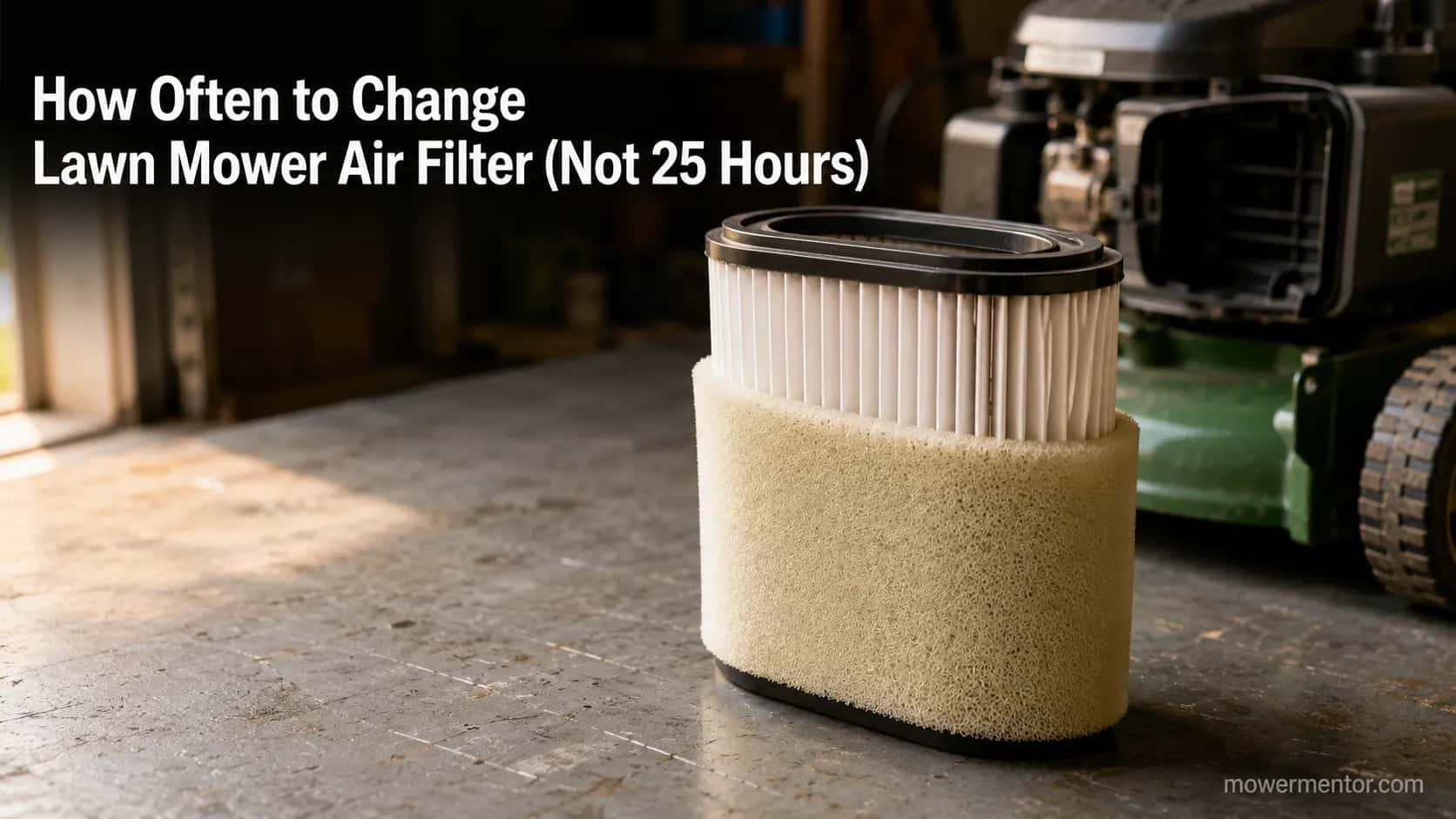
How Often to Change Lawn Mower Air Filter (Not 25 Hours)
Clean foam at 25 hours, paper at 100-300. How often to change lawn mower air filter depends on filter type, not the calendar. Briggs, Honda, Kawasaki, Kohler.
Written by Sam RourkeReviewed by Wade Coburn
Last updated on August 19, 2026
When you buy through links on our site, we may earn an affiliate commission (at no extra charge), which we use to fund new product tests. Learn more.
Summarize with AI
Search this question and every result returns the same figure: 25 hours. That number is real, it comes from Briggs & Stratton, and it describes a part many mowers do not have.
Twenty-five hours is the interval for a foam pre-cleaner. The pleated paper element most people are actually asking about runs on a separate and much longer clock.
Knowing how often to change lawn mower air filter parts starts with knowing which of those two is in your housing.
Four mowers have run on two properties here since April 2023, across three filter architectures and 294 logged engine hours. Not one was on a 25-hour clock for its paper element.
The Short Answer: It Depends on Which Filter You Have
The short version. If your mower has a foam pre-cleaner, service it every 25 hours or once each season. If it has a paper element, that part runs its own longer clock: 100 hours on a Briggs dual-element, 150 hours or two years on a Honda GCV, 50 hours on a Kohler 7000 Series, and 200 to 300 hours on a Kawasaki.
Identify the element first. The 25-hour number belongs to foam.
A lawn mower air filter's service interval is set by the filter media, not the calendar. Briggs & Stratton's service page specifies replacing a foam-only element every 25 hours or three months, replacing a foam pre-cleaner every 25 hours or each season, and replacing the paper cartridge behind that pre-cleaner every 100 hours.
Three parts, three intervals, one manufacturer.
That is why "every 25 hours" travels so far and helps so little. It is a true statement about one component, repeated as though it governed the whole air cleaner.
Which Filter Do You Have? Foam, Paper or Dual-Element
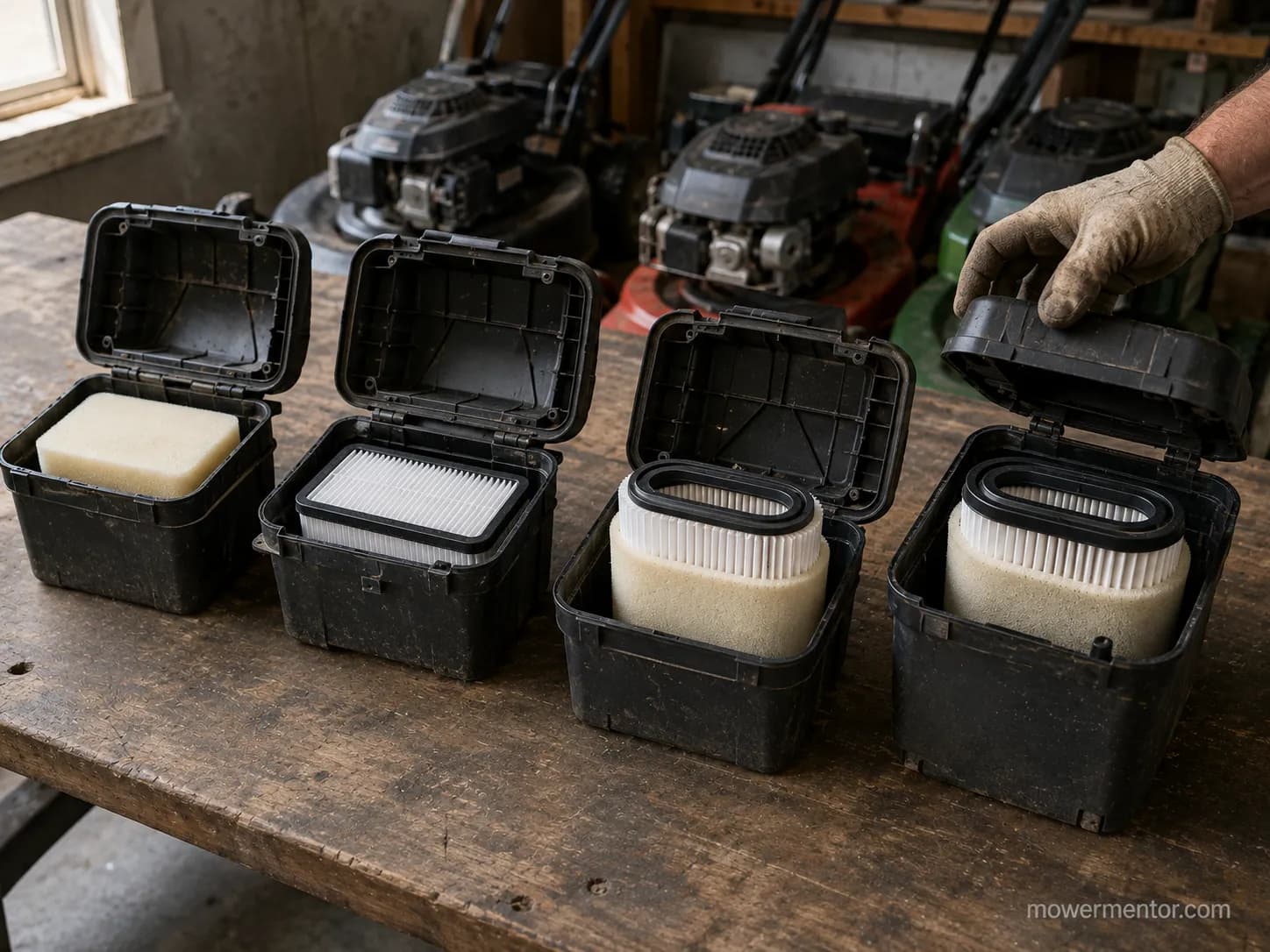
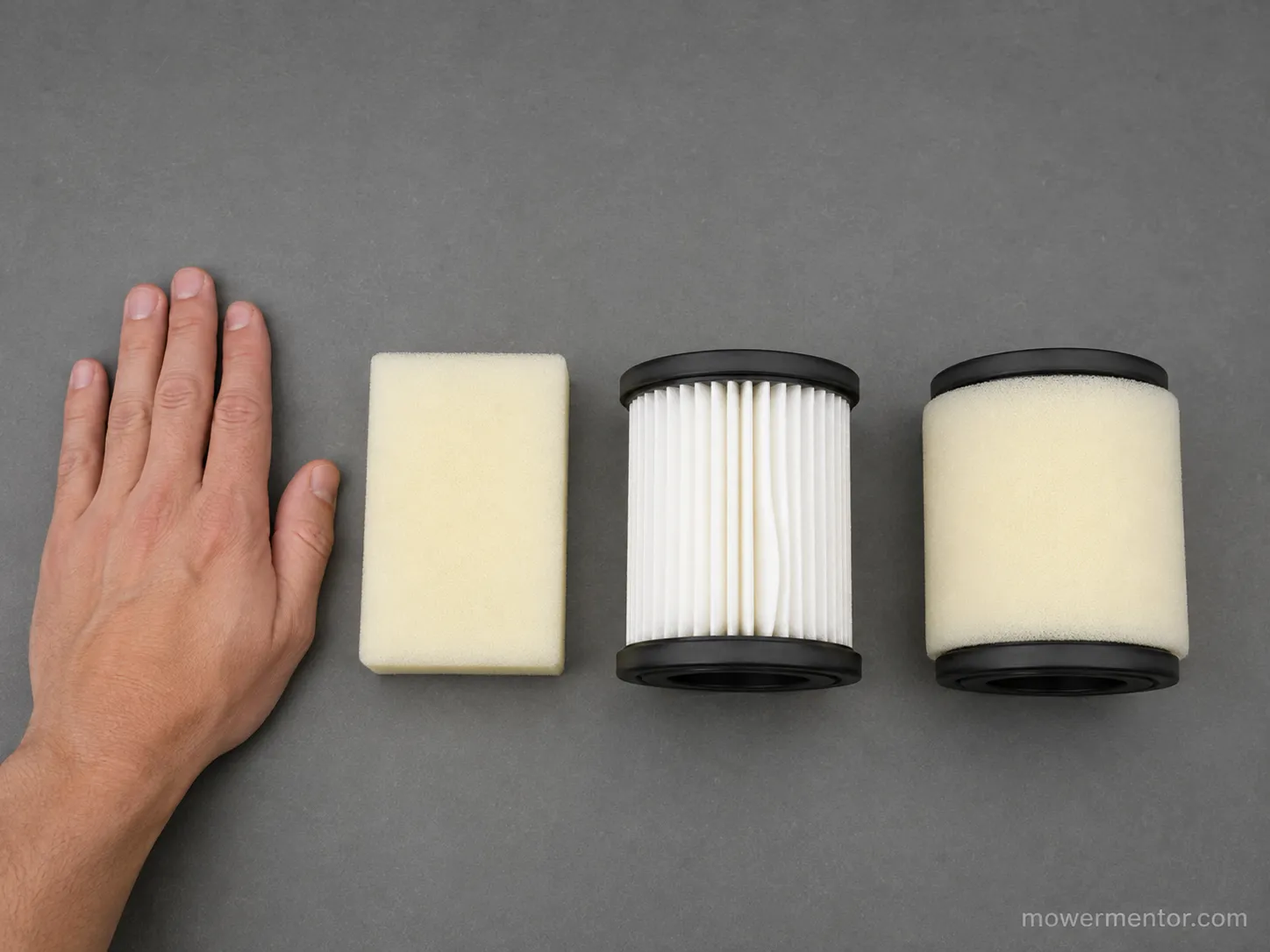
Lawn mower air filters come in three architectures. A foam-only element is a soft, usually oiled block with no pleats.
A paper-only element is a pleated cartridge ringed with a rubber or plastic sealing face. A dual-element filter is a paper cartridge wrapped in a foam sleeve, and it runs two separate schedules: the pre-cleaner on one, the cartridge behind it on another.
Larger riding mowers add a fourth case, a canister holding an outer and an inner element.
Before you open anything. Disconnect the spark-plug lead and let a hot engine cool. Looking at a filter needs neither the blade nor the fuel system touched, and there is no reason to leave an ignition circuit live with your hands on the engine.
What you see when the cover comes off | How it feels | What it means for your interval |
|---|---|---|
A soft block or cylinder, no pleats, cream or tan | Spongy, slightly oily | Foam only. One part, one clock. |
A pleated cartridge with a rubber or plastic sealing face | Stiff, dry, papery | Paper only. One clock, and it cannot be washed. |
A pleated cartridge with a soft sleeve around the outside | Both at once, sleeve slides off | Dual element. Two parts, two clocks. |
The first time I opened the HRX217 expecting a bare cartridge, I found a foam sleeve over it. That was the moment the intervals stopped contradicting each other, because I had been reading a pre-cleaner number and applying it to a cartridge.
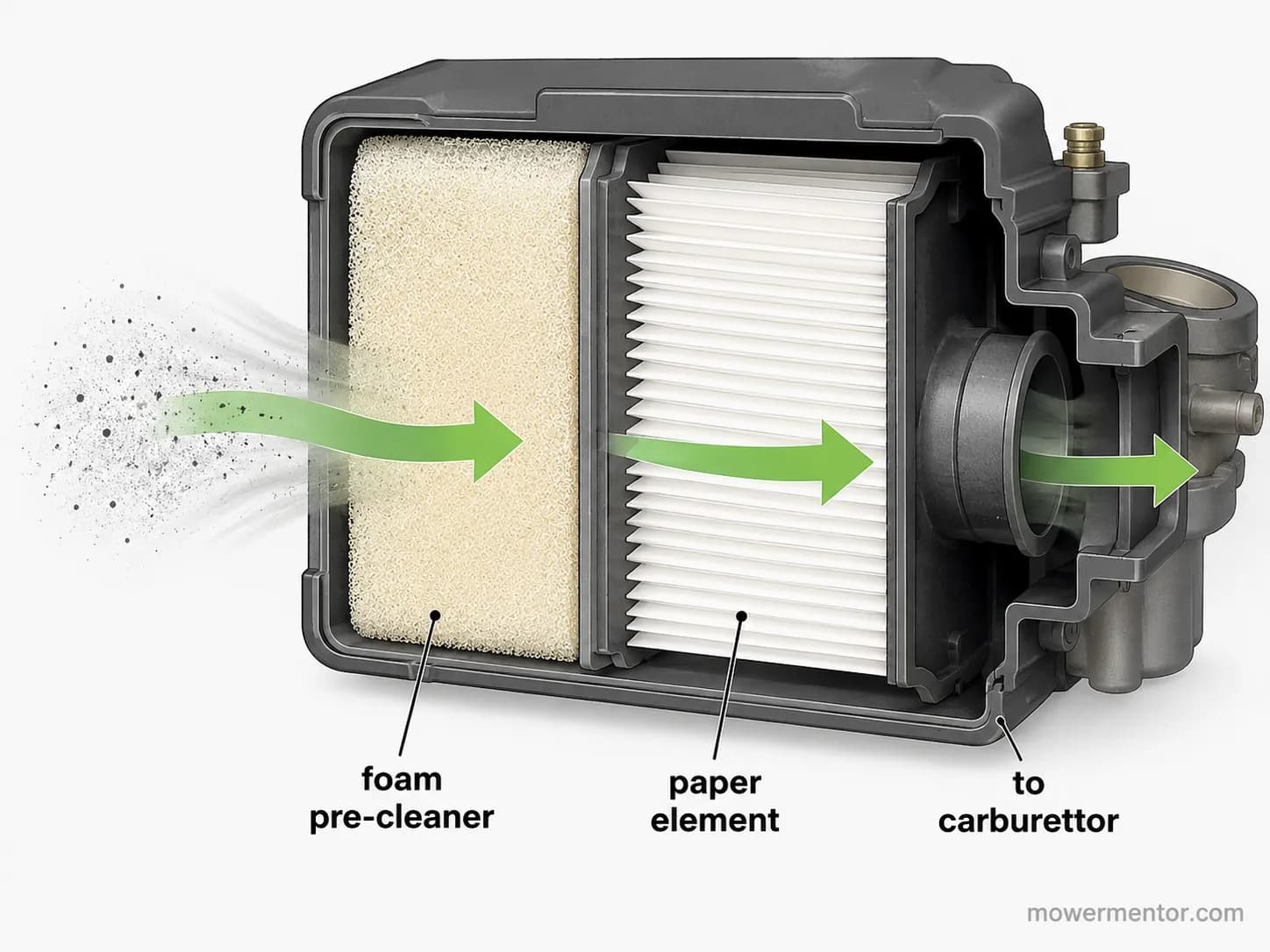
The foam is not a spare. It is a pre-filter: air meets the coarse foam first and the fine paper second, so the cheap part absorbs debris that would otherwise shorten the life of the expensive one.
That is also why the two cannot share a schedule.
Design varies by engine family rather than mower brand. Kawasaki's US support guide describes three quite different arrangements across its own range, from a vortex system on the FT series to a heavy-duty canister on the FX and pleated paper on the FR and FS.
How Often to Change Lawn Mower Air Filter by Type: Foam, Paper and Dual
The question splits into two schedules. A foam element or pre-cleaner is washed, dried and re-oiled, and Briggs & Stratton specifies replacing it every 25 hours or each season.
A paper cartridge cannot be washed at all; it is tapped clean and eventually replaced, at 100 hours behind a pre-cleaner on a Briggs, or 150 hours or two years on a Honda GCV. Foam has a cleaning interval and a replacement interval.
Paper effectively has only the second.
Element | Can you wash it? | Clean or service interval | Replace interval |
|---|---|---|---|
Foam only, oiled | Yes, warm water and detergent, then re-oil | Once a season, more in dust | 25 hours or 3 months |
Foam pre-cleaner over a cartridge | Yes, same method | 25 hours or start of each season | When it tears or stiffens |
Paper cartridge behind a pre-cleaner | No. Tap it only | Tap at each pre-cleaner service | 50 to 300 hours by engine |
Paper cartridge, no pre-cleaner | No. Tap it only | Tap every 25 hours | 25 hours or each season |
Honda's HRR216 owner's manual sets the pattern out plainly for its GCV engine: check before every use, clean after the first 25 hours and then every 50 hours or six months, replace every 150 hours or two years.
Foam rarely dies of dirt. My M1 pre-cleaner was retired at two seasons and 43 hours without ever clogging; it tore along the top lip during its fourth wash.
Washing is what kills foam, so a spare on the shelf beats nursing a tired one through another season.
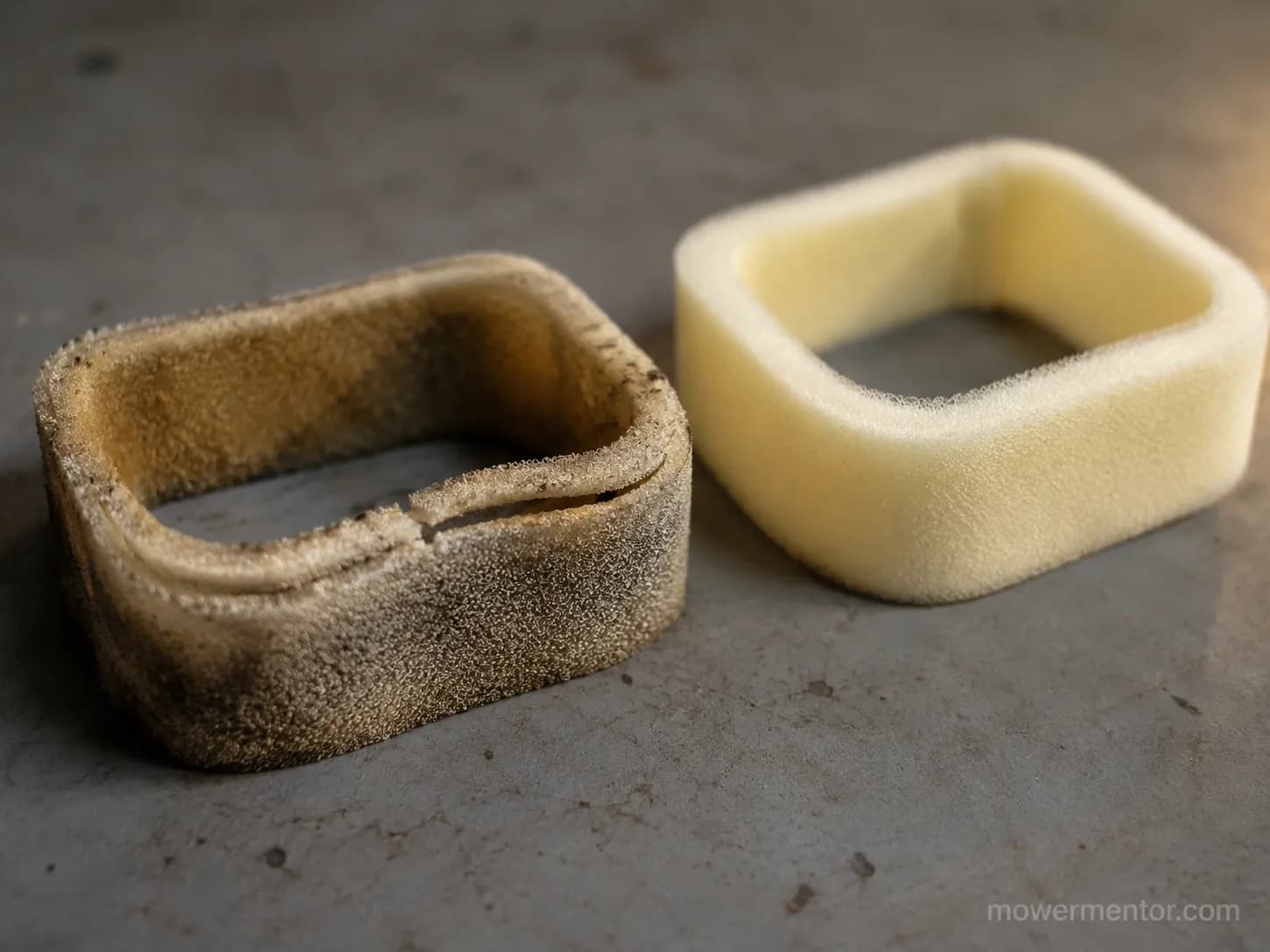
Re-oiling is not optional housekeeping. Foam traps fine particles in the oil film, so a clean dry sponge is not a filter; it is a screen that stops gravel and passes everything else.
The full method, including which solvents ruin foam permanently, is in the guide to washing a foam pre-cleaner properly.
What Briggs, Honda, Kawasaki and Kohler Actually Specify
Lawn mower air filter intervals differ between manufacturers by more than twelve times. Briggs & Stratton replaces a foam pre-cleaner at 25 hours and the cartridge behind it at 100.
Honda's GCV manual calls for replacement at 150 hours or two years. Kawasaki specifies about 300 hours for the FJ180V paper element, 200 hours or once a year for the FR series, and 250 hours for the FX600V.
Kohler's 7000 Series replaces its standard element at 50 hours. The correct interval is the one printed in your own engine's manual.
Engine and element | Clean | Replace | Source |
|---|---|---|---|
Briggs, foam only or foam pre-cleaner | Wash and re-oil | 25 hours, or 3 months or each season | Briggs |
Briggs, cartridge behind a pre-cleaner | Tap only | 100 hours | Briggs |
Briggs, cartridge with no pre-cleaner | Tap only | 25 hours or each season | Briggs |
Honda GCV160, paper element | First 25 hours, then 50 hours or 6 months | 150 hours or 2 years | Honda |
Kawasaki FJ180V KAI, foam | Every 25 hours | Only if very dirty | Kawasaki |
Kawasaki FJ180V KAI, paper | Tap only | About 300 hours | Kawasaki |
Kawasaki FR651V to FR730V, paper | Every 100 hours | 200 hours or once a year | Kawasaki |
Kawasaki FX600V, element | Light cleaning only | 250 hours | Kawasaki |
Kohler 7000 Series, pre-cleaner | Wash in warm water, re-oil | 25 hours | Kohler |
Kohler 7000 Series, element with pre-cleaner | Do not blow it out | 50 hours | Kohler |
Kohler 7000 Series, element with no pre-cleaner | Do not blow it out | 25 hours | Kohler |
Kawasaki's figures come from Kawasaki's genuine parts guide, which sets out a twelve-fold spread across Kawasaki's own engine families without ever drawing the obvious conclusion for the owner.
The Kohler figures come from Kohler's 7000 Series service manual. Both are worth opening for your model number, because both manufacturers publish materially different schedules across engines that look identical from the operator's seat.
None of these numbers is wrong. They diverge because filter area, duty cycle, staging and intended owner all vary.
A commercial FX canister holds many times the media of a push-mower cartridge, and an FR schedule assumes a cutter doing hundreds of hours a year while a GCV schedule assumes someone who forgets the mower exists between October and April.
Kohler proves the staging effect in one line of its own table. The identical standard element is rated at 25 hours with no pre-cleaner and 50 hours with one, so a two-dollar foam sleeve doubles the life of the part behind it.
Where our table and your manual disagree, your manual wins. These manufacturers contradict each other on method as well as timing. Honda permits compressed air through the element from the inside at up to 30 psi.
Kawasaki rules out pressurised air on paper entirely, and Kohler's service manual states the paper element cannot be blown out. Two of the four forbid what a third explicitly allows.
I had both manuals open on the bench when I found that, and it explains why forum advice here never converges. Everyone insisting you must never blow a filter out, and everyone who has done it for years without harm, is quoting a real manufacturer correctly.
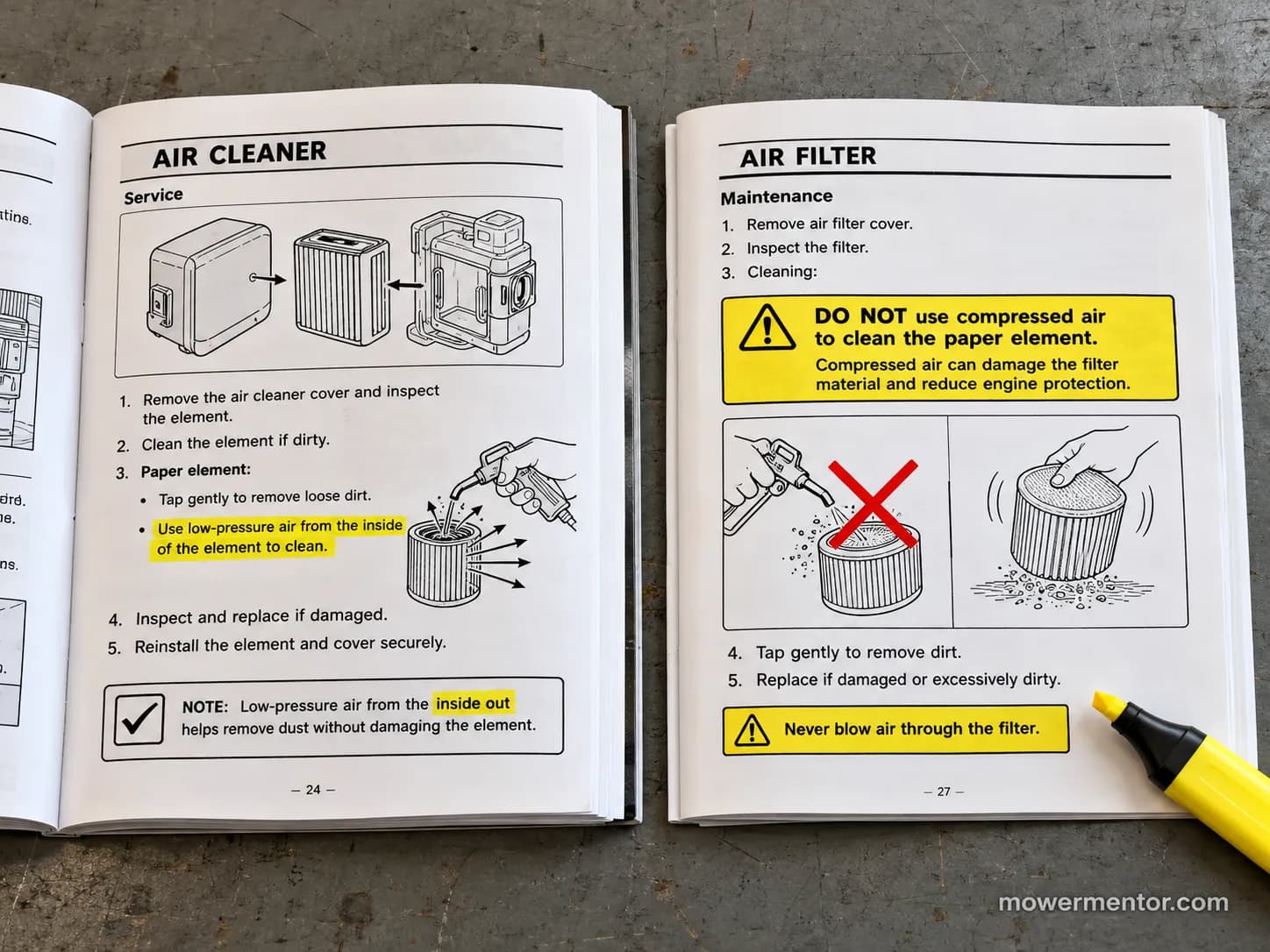
So the unglamorous forum answer is the right one: do what the manual says. Your filter interval is one line inside a larger service table, and the full annual service sequence shows how those lines fit together.
Hours vs Seasons: What 25 Hours Means on a Push Mower and a Rider
Most homeowners run a mower far fewer hours than the schedules assume. A 0.4-acre lawn cut weekly with a 21-inch walk-behind accumulated 21.4 engine hours per season here, and a 1.2-acre lot cut with a 46-inch rider accumulated 23.9.
At that rate a Briggs cartridge rated for 100 hours is roughly a four-season part, and a Kawasaki FR element rated for 200 hours would run close to nine seasons if hours were the only limit. They are not, and that is the part nobody mentions.
I fitted inductive hour meters to all four engines in April 2023 rather than guessing, because every published interval is denominated in a unit almost no homeowner tracks.
Machine and property | 2023 | 2024 | 2025 |
|---|---|---|---|
Briggs 725EXi push, Property A (0.4 acre, Ohio) | 21.2 | 22.4 | 21.6 |
Honda HRX217 push, Property A | 20.8 | 21.6 | 20.8 |
Husqvarna YTH22V46 rider, Property B (1.2 acre, Texas) | 23.4 | 24.6 | 23.7 |
Toro TimeMaster, Property B | 30.8 | 32.1 | 31.0 |
Your lawn and machine | Hours per season | 100-hour element | 200-hour element |
|---|---|---|---|
Quarter acre, 21-inch walk-behind | About 13 | Roughly 7 seasons | Calendar cap bites first |
Half acre, 21-inch walk-behind | About 26 | Roughly 4 seasons | Calendar cap bites first |
One acre, 42-inch rider | About 21 | Roughly 5 seasons | Calendar cap bites first |
Two acres, 46-inch rider | About 40 | Roughly 2 to 3 seasons | Calendar cap bites first |
Most paper-element intervals carry a calendar cap alongside the hour figure, and for a homeowner the calendar arrives first almost every time. Kawasaki's FR schedule reads 200 hours or once a year, so at 24 hours a season you bin that element having used twelve percent of its rated life, and Honda's two-year cap discards a 150-hour element at around thirty percent.
The exceptions matter. A Briggs dual-element cartridge carries no calendar cap at all, so on a suburban lawn it genuinely is a multi-season part, while a Kohler standard element at 50 hours works out at roughly two.
Riders are not a separate rule, only a wider deck covering more ground per hour, plus the canister case where an outer element does the work and an inner one waits as a last defence. Leave the inner element alone unless the outer has failed, because every canister opening invites dirt toward the intake.
This is where forums call annual replacement cheap insurance, and the argument has force when the part costs seven to sixteen dollars against a machine worth hundreds. Be honest about which version you are buying, though: replacing a 200-hour element at 24 hours is a habit rather than a hedge, and cheaping out on a filter is a different mistake from replacing one four times too often.
Cutters in one LawnSite thread accumulate in a month what a homeowner takes three seasons to reach, which is why their instincts do not transfer. For most people the filter folds into the spring service visit, and how often the whole job comes round sets the rest of that calendar.
When to Halve the Interval: Dust, Sand, Drought and Leaf Mulching
Dusty conditions can shorten a lawn mower air filter's service life several times over, and every manufacturer hedges on how much. Across three seasons here the same cartridge model gained 3.3 grams of dirt after one 21-hour season on an irrigated suburban lawn, and 16.8 grams after one 24-hour season on an unirrigated lot mowed alongside a gravel drive.
Matched hours, five times the loading. Halve the published interval when two or more of the conditions below apply.
Condition | What it does to the element | Adjust by |
|---|---|---|
Gravel or unpaved drive mowed alongside | Loads it with mineral dust grass never produces | Halve it |
Unirrigated sandy soil, or a drought year | The deck lifts dry soil, not just clippings | Halve it |
Mulching leaves in volume | Fine leaf dust packs the pleat valleys fast | Cut by a third |
Mowing close to flower or mulch beds | Bark and compost fines go airborne at intake height | Cut by a third |
I weighed elements rather than judging them by eye, on a balance reading to a thousandth of a gram, because "looks dirty" is not a measurement.
Cartridge and season | New | After one season | Gain | Hours |
|---|---|---|---|---|
Property A, 2024 | 54.8 g | 58.1 g | +3.3 g | 21.4 |
Property A, 2025 | 54.8 g | 57.6 g | +2.8 g | 21.6 |
Property B, 2024 | 54.8 g | 71.6 g | +16.8 g | 23.9 |
Property B, 2025 | 54.8 g | 69.2 g | +14.4 g | 23.7 |
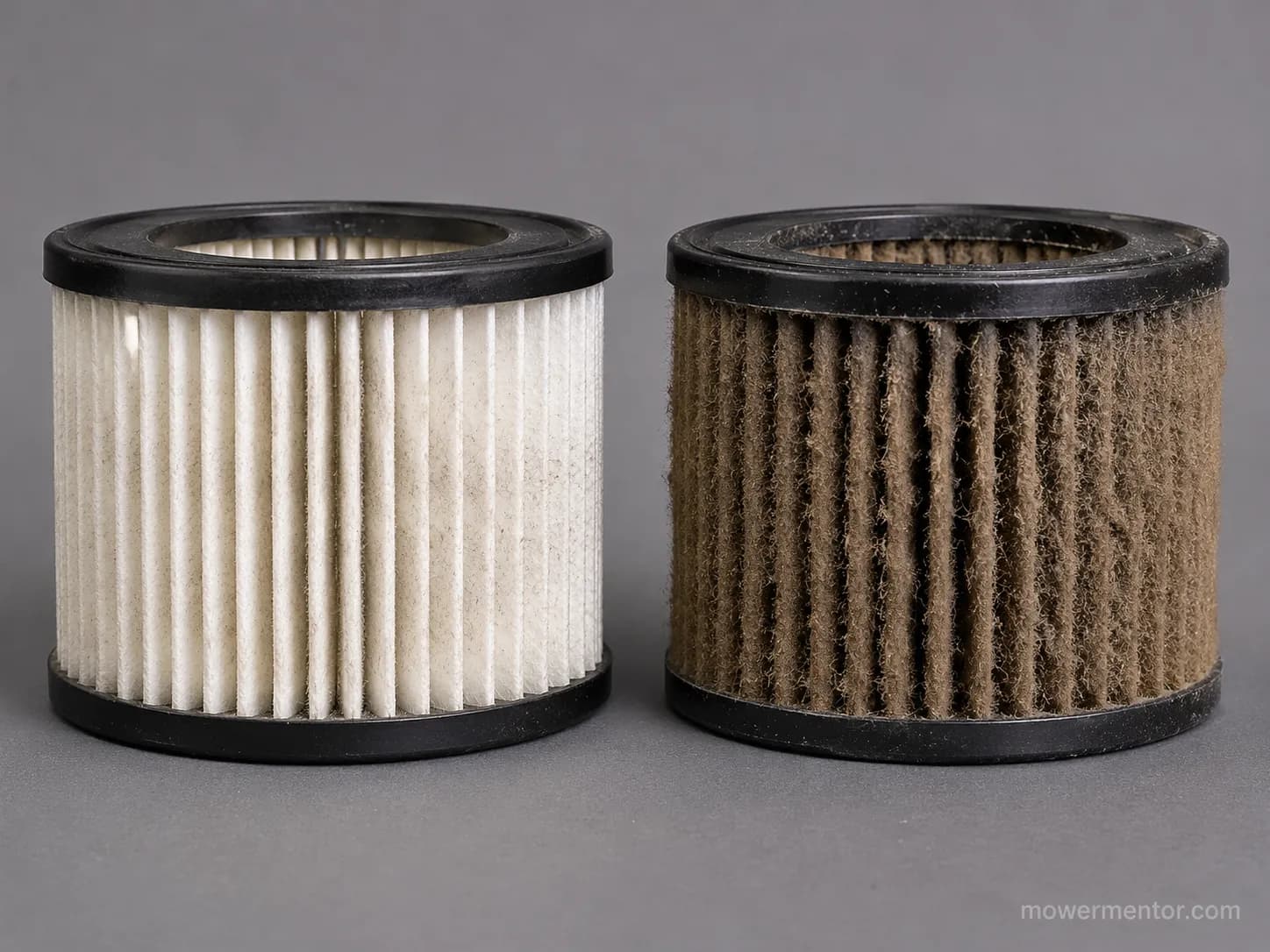
What makes dust worth taking seriously is not the filter, which is cheap, but where fine particles land once a loaded element starts passing them. The throttle shaft wears first, and once that clearance opens up, dirt bypasses the air cleaner entirely through the shaft bore.
A new filter cannot reseal a worn shaft, so the engine keeps ingesting grit long after the maintenance is finally done properly.
Our two properties do not cover the worst cases. No dirt-road mowing, no drought-year Southwest, no high-volume leaf bagging. If your conditions are harder than a gravel drive in central Texas, halve our numbers rather than trusting them.
The most useful countermeasure is not a shorter interval. Honda's manual suggests watering the lawn the day before mowing when the ground is dry, then cutting once the grass is dry to the touch but the soil is not, which keeps dust on the ground instead of in the air cleaner.
Practitioners in another LawnSite thread reach the same rule for dusty accounts: shorten the interval and carry spares rather than stretching a loaded element. If a gravel drive has pulled your cartridge forward by a season, swapping the element step by step covers the job.
The Sunlight Test: Check It Instead of Counting Hours
To check a lawn mower air filter without tracking engine hours, hold the element against a bright light and rotate it. If light passes through the pleats, the filter still flows; if none does, replace it.
The test lags real airflow restriction badly. On the rider fitted with a restriction gauge here, intake restriction reached 7.9 inches of water at 214 hours while the pleats were still visibly passing light.
Treat the light test as a floor, not a schedule.
Hold It Up to the Light: What Are You Looking For?
Remove the element with the spark-plug lead disconnected, and tap it once against a hard surface to shed anything loose.
Hold it against a bright work lamp or an overcast sky, never into the sun, and look through the pleats from the clean side.
Rotate it slowly through a full turn. Even light through every pleat means it still flows. A section that stays dark as you rotate is finished.
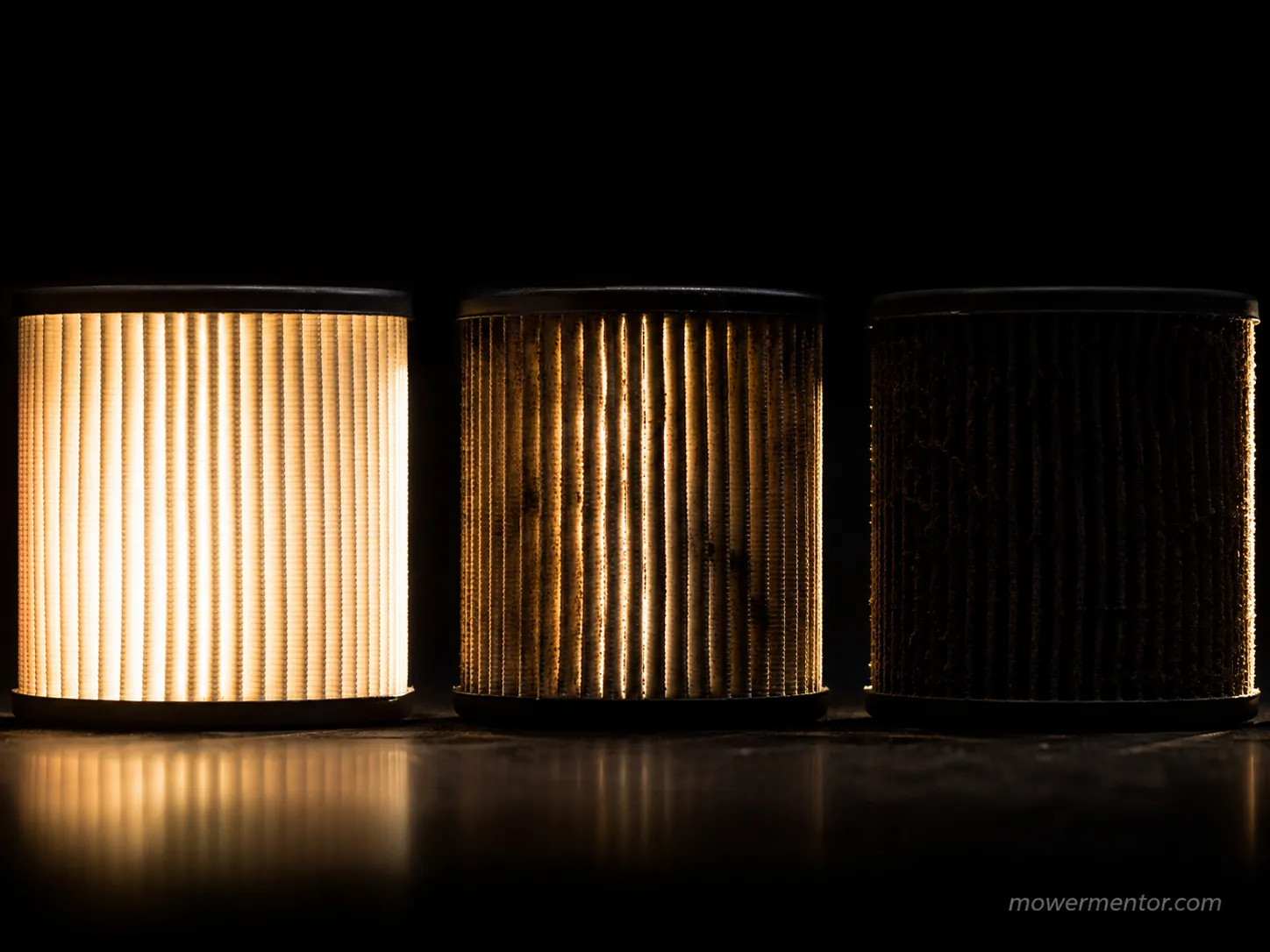
Loading on the cartridge | Light through the pleats | Restriction at full throttle |
|---|---|---|
New, 0 g | Bright and even across every pleat | 1.8 inches of water |
Plus 7 g, about 100 hours | Visible but patchy | 3.1 inches of water |
Plus 14 g, about 214 hours | Faint rim only | 7.9 inches of water |
The light test only failed at 14 grams, by which point restriction had reached almost the eight-inch service point commercial operators work to. Anyone relying on the light alone is running a filter well past the point where it costs power.
Commercial machines use a gauge instead of an inspection. Donaldson's restriction indicators exist precisely because looking at a filter is a poor proxy for measuring airflow through it, and a filter minder on a canister-equipped rider says more in one glance than any amount of squinting.
Walk-behind mowers have no port for one, which is why the light test survives despite its lag.
Can You Just Blow It Out?
Follow your own manual, because the manufacturers genuinely disagree. Honda permits compressed air through the element from the inside outward at up to 30 psi and warns against brushing it, while Kawasaki rules out pressurised air on paper and Kohler states the element cannot be blown out at all.
If you do not have the manual to hand, tap rather than blow. Tapping is the one method none of the four prohibits.
There is also a real argument against checking too often. A partially loaded element filters more finely than a new one, because accumulated debris narrows the paths through the media, so pulling a serviceable filter early trades a small airflow gain for a small filtration loss.
Every inspection is itself a dust-ingress event. Opening the housing lets debris fall toward the intake, and our own checking cadence over three seasons may have put more dirt into these engines than a hands-off schedule would have. We cannot separate that from the results above.
If the mower is already bogging, smoking or starting hard, stop counting hours and read the symptoms instead, because what a clogged filter actually does will tell you quickly whether the filter is even the culprit.
Your Air-Filter Schedule at a Glance
Here is the whole thing on one screen. Wash a foam pre-cleaner mid-season and replace it each season or every 25 hours.
Replace the cartridge behind it on its own engine's number: 100 hours on a Briggs dual-element, 50 hours on a Kohler 7000 Series, 150 hours or two years on a Honda GCV, and 200 to 300 hours on a Kawasaki, subject to whichever calendar cap the manufacturer attaches. Halve every figure on dusty ground.
Your setup | Every season | Every few seasons |
|---|---|---|
Foam only | Wash and re-oil mid-season | Replace at 25 hours or 3 months, and keep a spare |
Foam pre-cleaner over paper | Service the pre-cleaner each spring | Replace the cartridge at its hour figure or calendar cap, whichever lands first |
Paper only, no pre-cleaner | Tap it clean at every oil change | Replace each season on a Briggs, or at 25 hours on a Kohler element |
Rider with a canister | Leave it shut unless power drops | Replace the outer element on schedule, the inner only if the outer failed |
Frequently Asked Questions
How Long Does a Lawn Mower Air Filter Last?
In seasons rather than hours, a foam pre-cleaner lasts one to two seasons and usually fails from washing rather than clogging. A paper cartridge lasts two to five seasons on a typical suburban lawn, unless the manufacturer attaches a one-year or two-year calendar cap, in which case that cap decides.
What Happens If You Don't Change Your Lawn Mower Air Filter?
Airflow drops, the mixture runs rich, and the engine loses power, burns more fuel and starts harder. There is a warranty dimension too: Honda's limited warranty excludes damage arising from neglect of the periodic maintenance specified in its manual, and lists the air-cleaner element as a consumable covered only to its first required replacement.
Do Foam Air Filters Need Oil?
Yes, always. A dry foam element traps only the largest particles and passes the fine dust that causes wear, so a washed pre-cleaner that has not been re-oiled is worse than the dirty one you removed.
Is a New Filter Every Season Just Cheap Insurance?
Sometimes. On a foam pre-cleaner or a 50-hour Kohler element, annual replacement matches the schedule and costs seven to sixteen dollars, which is a rational hedge.
On a 200-hour or 300-hour Kawasaki element with no calendar cap, replacing yearly discards roughly ninety percent of a part that was still working.
Can I Run the Mower Without an Air Filter?
No, not even briefly, and the reason it damages an engine so fast is covered in its own article on running a mower without a filter fitted.
How this was tested. Four machines across two properties from April 2023 to June 2026: a Briggs 725EXi push mower and a Honda HRX217 on a 0.4-acre irrigated silt-loam lot in central Ohio, and a Husqvarna YTH22V46 rider and a Toro TimeMaster on a 1.2-acre unirrigated sandy-loam lot in central Texas with a 90-foot gravel drive.
Hours logged on inductive hour meters, element mass on a balance reading to 0.001 g, intake restriction on a 0 to 15 inch water-column gauge teed into the rider's air-cleaner outlet. Three seasons, 294 engine hours, 11 elements retired, 38 weigh-ins.
What we did not measure: engine wear. These logs show airflow held and loading stayed manageable.
They do not show any engine lasted longer, because we never opened one.
After 294 logged hours I stopped tracking hours on the push mowers entirely and moved to one pre-cleaner wash mid-season plus a cartridge at three years, keeping the gauge only on the rider. That is not any of the four published schedules, and it was never meant to be.
The point of asking how often to change lawn mower air filter parts was never to find a single number. It was to work out which of the two parts in the housing the number described, and then to find that for most suburban lawns the calendar cap arrives long before the hour figure does.
So identify the element, read your own engine's line, and halve it if you mow next to gravel. Then go and do the job itself, whether that means washing a pre-cleaner, swapping a cartridge, or first checking whether the filter was ever the problem.
Summarize with AI
Keep reading
Related articles
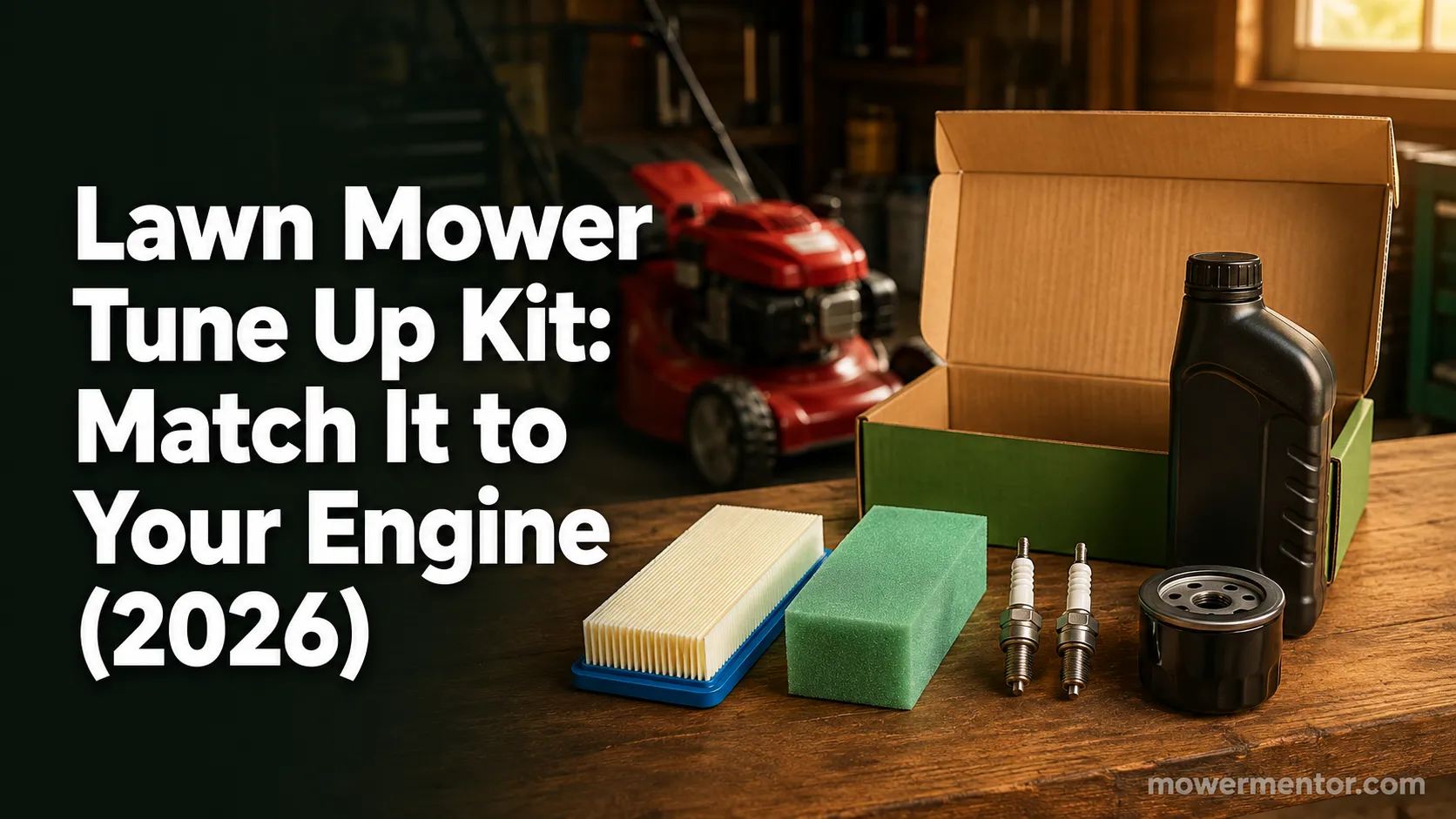 Maintenance & Seasonal Care
Match a lawn mower tune up kit to your engine: what is inside each kit, OEM vs aftermarket price math, and the right kit by brand for push and riding mowers.
 Maintenance & Seasonal Care
Compare mobile vs drop-off shop for a lawn mower tune up near me: real 2026 price ranges from 12 quotes, the 7 questions to ask, and when to just DIY it.
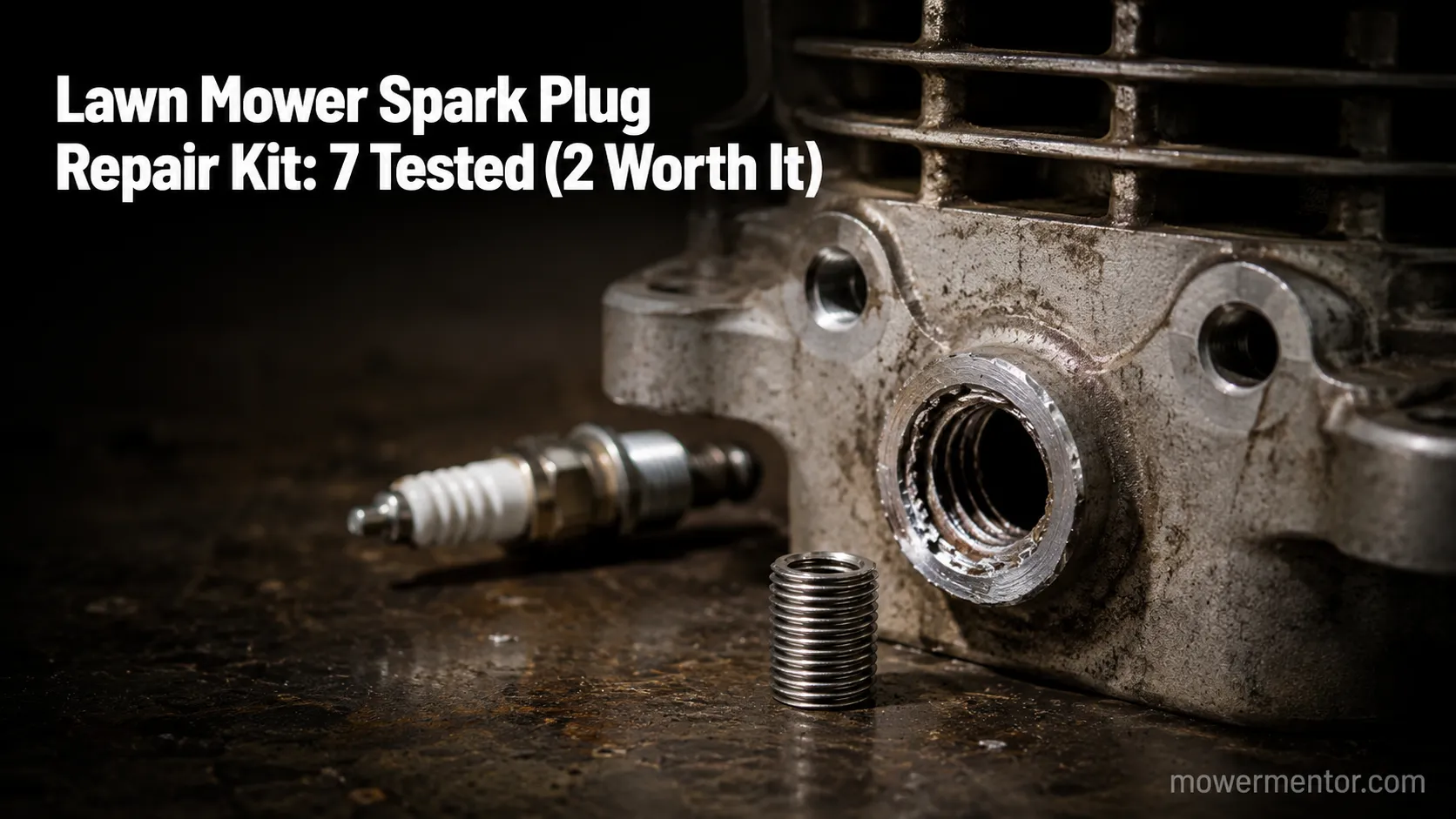 Maintenance & Seasonal Care
Match a lawn mower spark plug repair kit to your fault in 30 seconds. 7 kits tested on 9 engines: M14x1.25 sizing, insert lengths, and the $5 boot fix.
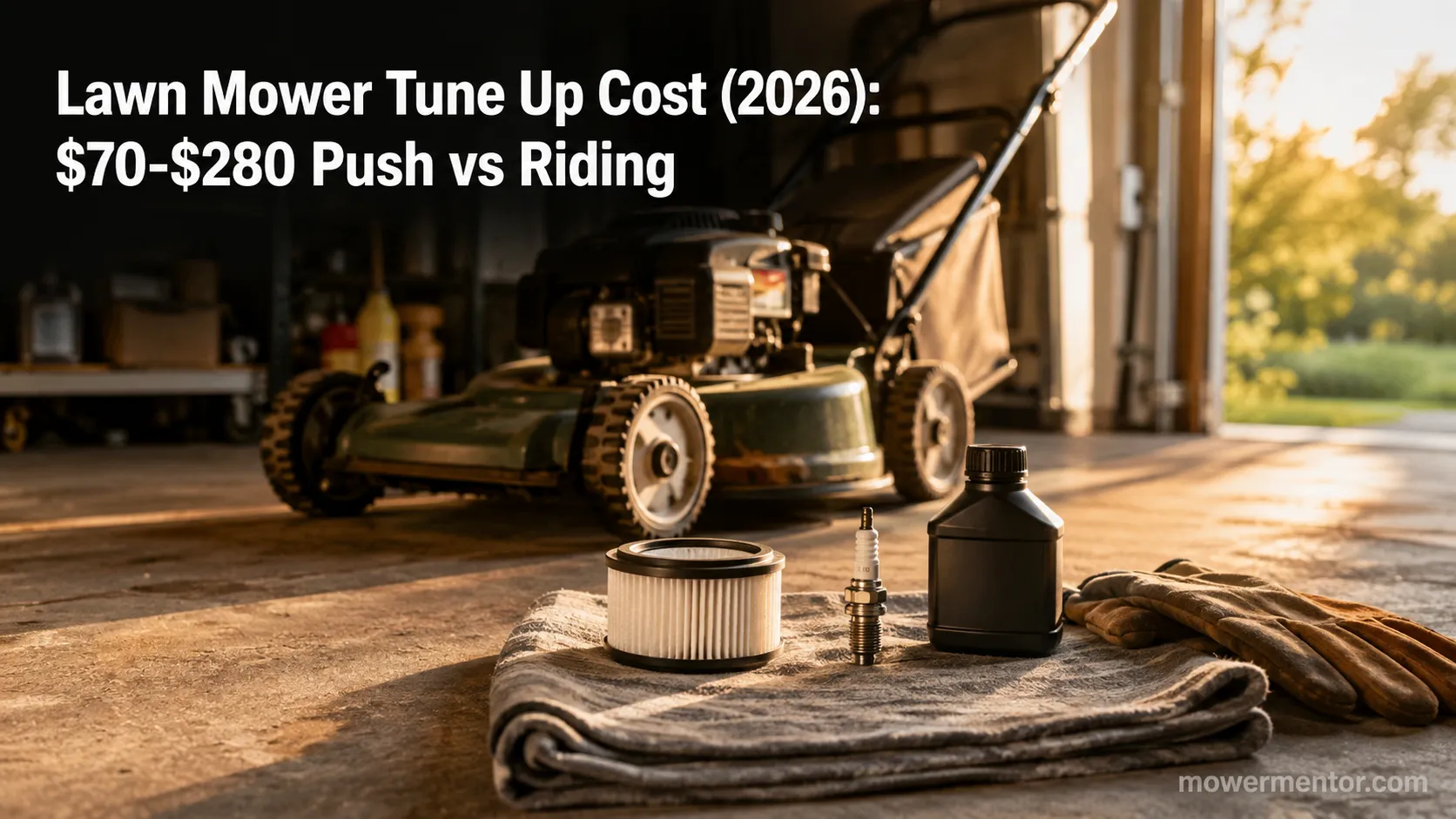 Maintenance & Seasonal Care
Compare lawn mower tune up cost by mower type: $70-$150 push, $150-$280 riding, from 9 real 2026 shop quotes. Plus the same parts for about $18 DIY.
Comments
Moderated for quality. Share a correction, ask a follow-up, or tell us what worked for you - every comment is reviewed before it goes live.