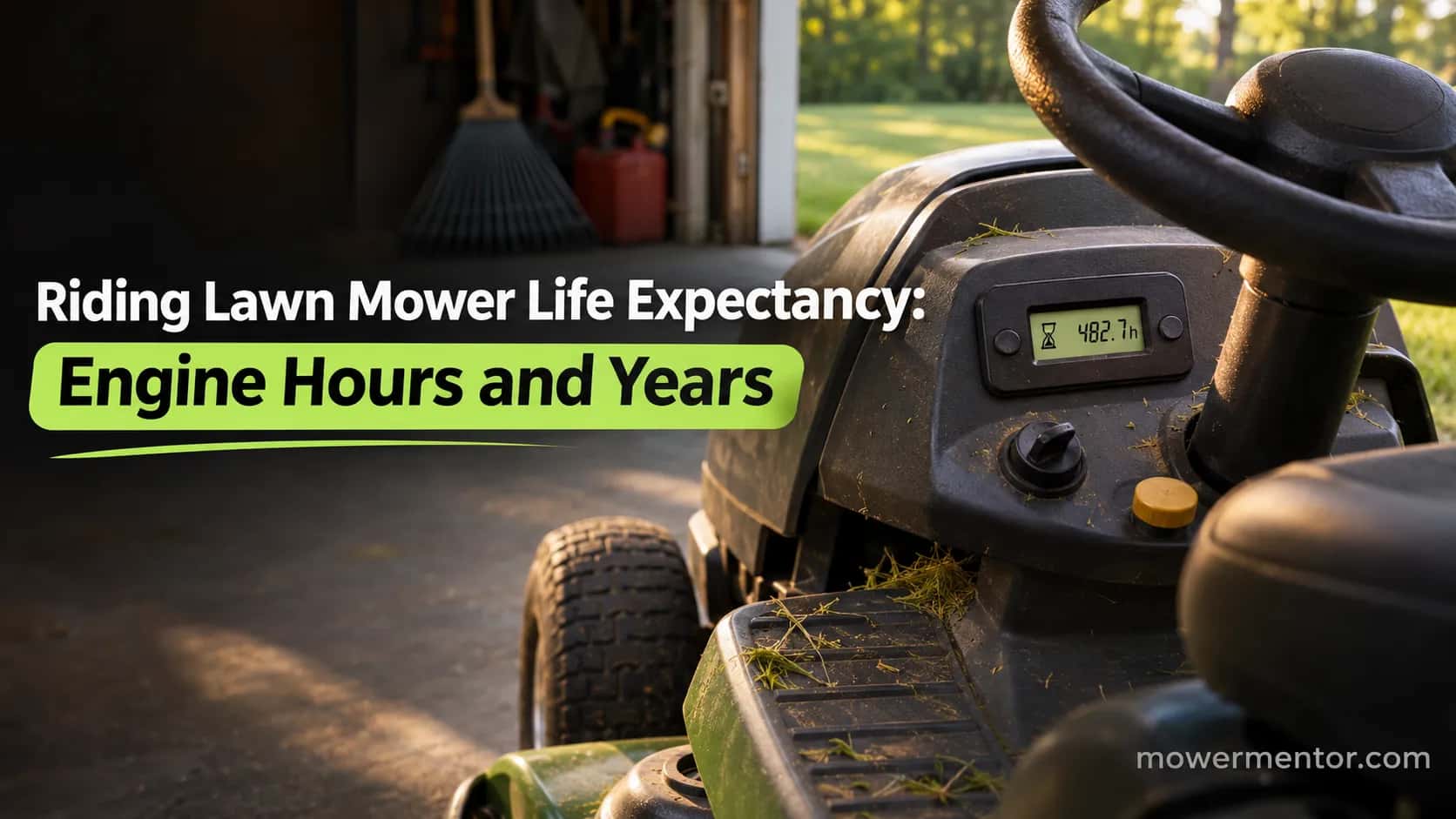
Riding lawn mower life expectancy runs about 500 to 1,500 engine hours, or roughly 5 to 9 years, for a gas rider used at home.
That's the range SlashGear gives for gas riding mowers, and the model sets where a machine lands within it.
Of the two measures, hours tell you more, because a small yard and a big lot burn through the same engine at very different speeds.
Even the federal emissions rule rates how long a small engine must meet emission standards in hours of operation or five years, whichever comes first.
So the number on your hour meter, or on a used rider's, is what decides whether to keep it, buy it or plan a replacement.
House Digest ties an engine's life to the mower itself, how often it runs and how well it's kept up.
On a rider, that comes down to the hours your yard adds each season, the care it gets and where it's stored.
And if the mower has no meter, you can still estimate its hours and turn them into years for your yard.
How many hours a riding mower engine lasts
On a home riding mower, under 500 hours is low, 500 to 1,000 is mid-life, and a well-kept engine can reach 1,000 to 1,500.
A mower's life, in this sense, is the run hours its engine gives before it needs major engine work. Here's where a reading sits, with the published range behind each band.
Hours on the meter | Where a home rider stands | Source range |
|---|---|---|
Under 500 | Low: most of the engine's life is still ahead | Below the floor of every range here |
500 to 1,000 | Mid: where many residential engines reach their end | House Digest: 500 to 1,000 for residential gas engines |
1,000 to 1,500 | High: the top of the residential range | SlashGear: up to 1,500 for gas riders, by model |
Over 1,500 | Commercial-grade territory | Commercial ranges, compared by mower type below |
The ranges differ because they describe different machines.
House Digest's 500 to 1,000-hour range covers residential gas mower engines in general, while the wider riding-mower range shifts with the model.
Dealers' figures fall on both sides of that. One dealer, Tractor Bob, gives residential mowers the wider range on average, in a post about zero-turns.
Another, Eagle Power Turf & Tractor, says most riding mowers last 500 to 700 hours, and some reach 1,000 if cared for and maintained properly.
That shorter figure is why a 600-hour rider can read as worn out on one page and mid-life on another.
So how much life is left in a mower with 800 to 1,000 hours? It sits high in the mid band, past the end of the shortest range (500 to 700 hours) but short of the longest. Its service records and condition decide which way it goes, as the used-mower checks below show.
Is 300, 400 or 500 hours a lot on a riding mower?
Not for a home rider: 300 and 400 hours are low, and 500 is only where the shortest published ranges begin to close.
High hours alone don't mean a worn-out engine, since a well-kept one at 500 can have more life left than a neglected one at 300.
Buying used is a stricter test. The zero-turn dealer above advises keeping a used search below 500 hours. Below that, most of a home engine's range is still ahead of you.
Is 700 hours a lot for a zero-turn?
Not on a residential zero-turn: 700 hours sits in the mid band of the table above.
Tractor Bob, which sells zero-turns, gives residential models 5 to 9 years with proper maintenance and puts commercial zero-turns at 1,000 to 3,500 hours.
What changes with age is how the machine feels. Past about 1,000 hours, the same dealer says, you'll notice a difference in the way a zero-turn drives and cuts.
The engine-hour ratings makers certify
Under the federal rule, every nonhandheld small-engine family, the kind mowers use, is certified to one of these nominal useful-life periods or a longer one.
Engine class | Residential (hours) | Extended-life residential (hours) | Commercial (hours) |
|---|---|---|---|
Class I (under 225 cc) | 125 | 250 | 500 |
Class II (225 cc and up) | 250 | 500 | 1,000 |
The two classes split nonhandheld engines at 225 cc of displacement, the rule's definitions say.
The maker picks the tier that most closely matches the engine's expected median in-use life, and it may certify a longer period in 100-hour steps.
What the rating isn't is a promise of engine life. It's only the period an engine must keep meeting exhaust emission standards.
A Class II engine on the 250-hour residential tier can run well past it.
The bands apply to any home rider, whatever the badge on the hood. John Deere's S100, built since 2021, runs a 17.5 hp Briggs & Stratton 499cc single-cylinder engine, TractorData lists.
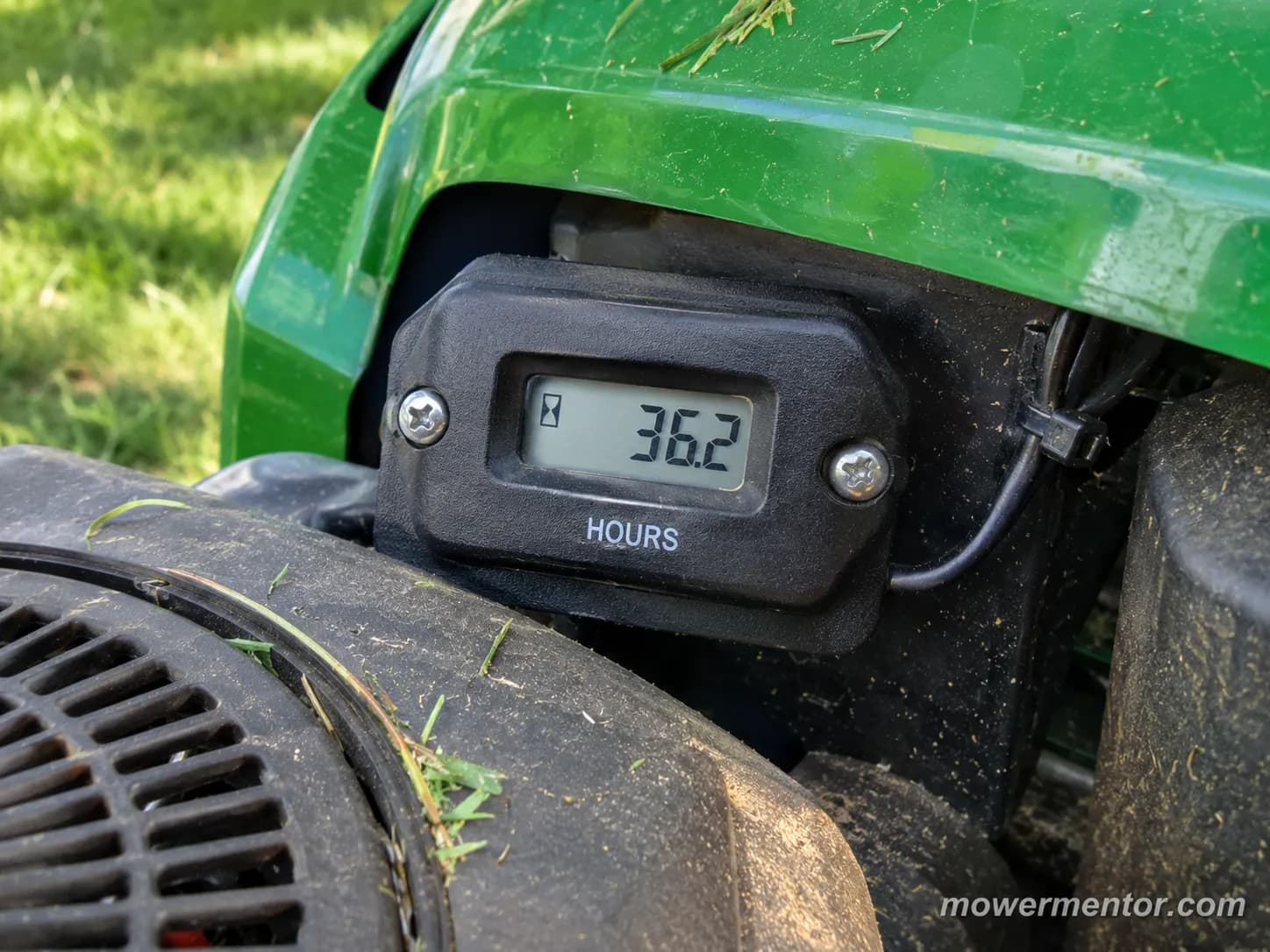
That puts it in Class II, and its hours sit on the same residential bands as a Craftsman's or any other home rider's. Mine read 36.2 hours after its first full season, low in the band.
Hours mowed per year and what they mean in years
A home mower runs about 20 to 120 hours a year. At that spread, the same engine hours can last a big lot as little as 4 years and a small yard well over a decade. Turning your own mower's hours into years starts with how many it runs each season.
How many hours a mower runs in a season
That range comes from Tractor Bob, which puts homeowners at 20 to 30 mows a year, depending on location and rainfall.
Each cut takes most of them one to four hours, depending on yard size and the mower. Those figures come from a zero-turn dealer, but the arithmetic holds for any rider.
Eagle Power Turf & Tractor's example season is 2 hours a week for 32 weeks, or 64 hours a year. That 64-hour season is where its 6 to 10 years for a riding mower comes from.
House Digest works the same sum with two hours a week for 30 weeks. At that pace, a 500 to 1,000-hour engine lasts at least eight years.
Converting your mower's hours to years
Divide the engine's hours by the hours it runs each season, and you have its years. The table runs that sum for four season lengths, rounded to whole years.
Hours a season | Years to 500 hours | Years to 1,000 hours | Years to 1,500 hours |
|---|---|---|---|
20 | 25 | 50 | 75 |
40 | 13 | 25 | 38 |
64 | 8 | 16 | 23 |
120 | 4 | 8 | 13 |
In short, years = engine hours ÷ hours a season. The long figures are engine headroom, not a promise for the whole mower.
Worked example: say your rider reads 400 hours and you mow about 2 hours a week for 32 weeks, the 64-hour season above.
On a 1,000-hour engine, it has 600 left, or about 9 more seasons. If it's one of the 500-hour engines at the short end, it has under 2.
That's also why judging a mower by age misleads. A 6 to 10-year estimate assumes a 64-hour season, while at 20 hours a season the same engine hours stretch to 25 years or more.
That gap suggests storage, rust and worn parts end many small-yard mowers before the engine's hours run out.
My own season gives a sense of scale. One season, 26 mows on the same property: the riding mower ran 36.2 hours (about 1 hour 24 minutes a mow) on the back lawn.
My Toro walk-behind ran 26 hours (about 1 hour a mow) on the front lawn. So my rider adds about 36 hours a season.
Mower | Mows | Total hours | Average per mow |
|---|---|---|---|
John Deere S100 (back lawn) | 26 | 36.2 | About 1 hour 24 minutes |
Toro 21462 walk-behind (front lawn) | 26 | 26 | About 1 hour |
I timed every mow with a phone timer and checked the rider's total against its add-on hour meter.
These figures have limits worth knowing. The hour ranges come from editorial pages, dealers and the federal useful-life table rather than a failure study.
They disagree at the edges, so they're bands, not one number.
The federal ratings are emissions periods, not engine-life promises.
My log covers one property, one season, one rider and one walk-behind, and the self-propelled figures come from walk-behind sources.
How to tell how many hours are on a lawn mower
Read the hour meter if your mower has one. If it doesn't, estimate the hours from your own mowing habits, then fit an add-on meter to count from here on.
Reading the hour meter
Most mowers have an hour meter, but some of the least expensive residential models may not, Tractor Bob notes. Your operator's manual shows where the meter sits on your model.
Estimating hours on a mower without a meter
Three numbers from your own mowing give a fair estimate.
Count the mows in a typical season.
Time one typical mow from start to shut-off.
Multiply the mows by the hours per mow by the seasons you've owned the mower.
Worked example: 25 mows a season × 2 hours a mow × 6 seasons gives a meterless mower roughly 300 hours. Those inputs sit inside the homeowner figures above, and 300 hours is low on the hour bands.
Guessing by age is the trap to avoid, since a 6-year-old mower could have 120 hours or more than 700, depending on the yard.
To count from here on, fit an add-on meter. Briggs & Stratton's Maintenance Minder is a small engine accessory that keeps track of how many hours the engine runs.
It flashes every 25 hours of run time and works with 2- and 4-cycle engines. It's an optional buy, since the estimate above works without one.
My S100's add-on hour meter, fitted before the tractor's first mow, read 0.0 at the first mow of the season and 36.2 at the last.
Once you have a reading, note it with each oil change or blade job, so your next estimate is a reading, not a guess.
How long push, self-propelled and riding mowers last
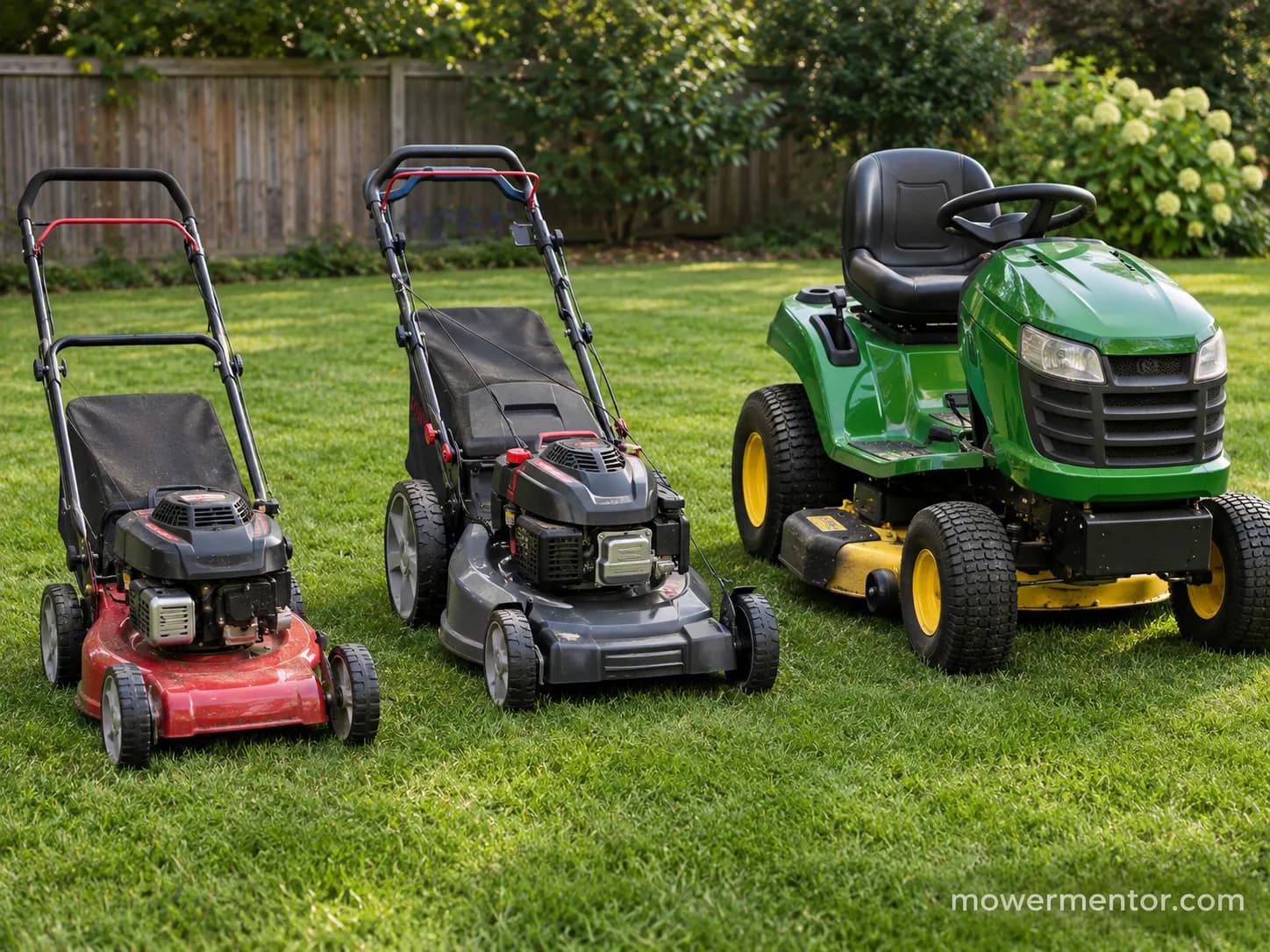
In years, a gas push mower tends to outlast a rider: its engine's 450 to 1,500 hours, by brand, can mean 10 years or more.
Each row below names its source, because the hours and years come from different pages rather than one test of every type.
Mower type | Engine hours | Typical years | Source |
|---|---|---|---|
Gas push mower (21-inch walk-behind) | 450 to 1,500, by brand | 10 or more | SlashGear |
Self-propelled walk-behind (Toro Personal Pace) | Same as push mowers | Same as push mowers | SlashGear's walk-behind figures |
Riding mower or lawn tractor (John Deere S100) | 500 to 1,500, by model | 5 to 9 | SlashGear |
Residential zero-turn | Same as riding mowers | Same as riding mowers, with proper maintenance | Tractor Bob (dealer) |
Commercial mower | 1,200 to 2,500 or more, by brand | 8 to 12 | SlashGear; Tractor Bob gives commercial zero-turns the same years |
In hours, the push and riding ranges overlap almost completely. It's the years that split them.
Commercial machines are built to be more durable and carry the highest hour ranges, so in engine hours they're the longest-lasting mowers you can buy.
For gas mowers in general, one dealer, Power Plus Equipment, puts a well-maintained machine at eight to ten years.
A self-propelled mower is a walk-behind with a powered drive, and it carries the same kind of small engine.
So the push mower figures apply to its engine, and its hours can be judged the same way.
Electric mowers are a different case. Battery models have no engine hours to log, so their life comes down to battery mower pack and body life instead.
What shortens or extends a mower engine's life
Four things decide where a mower lands within its range; you can rarely change the first two, but the last two are up to you.
Hours run: Eagle Power Turf & Tractor notes that the more hours you put on a riding mower, the shorter its life will be.
Load and terrain: hilly or bumpy ground puts more stress on a rider and shortens its life.
Maintenance: House Digest counts changing the engine oil and filter on schedule among the most important jobs.
Storage: a mower kept outside in rain and weather won't last as long as one kept under cover.
An hour-based schedule shows what that care looks like in practice. John Deere's maintenance sheet for the S100 plans engine parts for the first 250 hours. The oil, the filters and the spark plug all change every 50 hours.
On the same 50-hour pace, a 1,000-hour engine would see 20 oil changes. At 64 hours a season, that interval comes round more than once a year, so one spring oil change won't keep up.
Briggs & Stratton adds that heavy use, dust or dirt call for service more often than the standard interval.
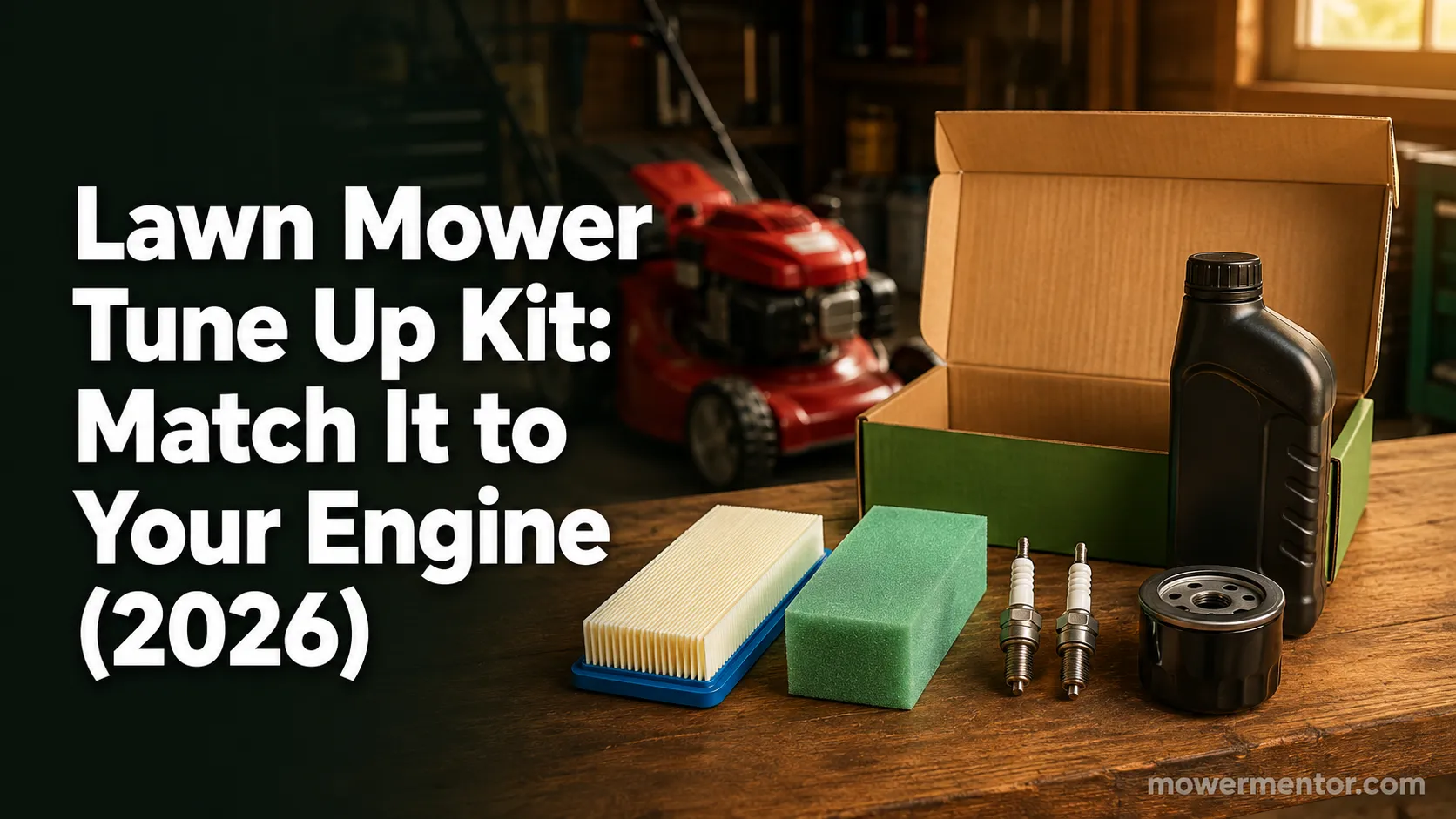
The S100's US kit for those services is the John Deere Home Maintenance Kit LG266. It holds an engine oil filter, an inline fuel filter, a spark plug, an engine air cleaner and two bottles of Turf-Gard 10W-30 oil.
One kit covers one 50-hour change of the filters and plug, so the first 250 hours call for five. Grease for the as-needed jobs on the same sheet isn't in the box.
Sharp blades and a clean deck keep the engine from working harder than it must. Belts are worth checking for cracks or fraying each season.
Moisture is especially damaging in storage, bringing rust and corrosion, so a dry shed or garage and a cover help. Old fuel is the other off-season question.
Whether 2-year-old gas is still usable, and how to lay the mower up, are part of season-end storage and old gasoline.
Judging a used riding mower by its hours
Start with the meter and place the reading on the hour bands above. Then let the service records and the engine's condition show which end of its band the mower will reach.
With no meter, ask the seller for mows a season, time per mow and years owned, and estimate as above. The dealer advice to stay under 500 hours is a cautious buyer's line, not a hard limit.
Once you have the hours, these checks show how well they were spent, most of them from Atlantic Tractor's used-mower guide.
Service records that show oil changes, blade sharpening and part replacements done on time
Rust and wear on the body or frame, and on the blades and wheels
Oil leaks or unusual sounds when the engine starts and runs
How easily it starts, since hard starting can mean engine or battery trouble
Blue or white exhaust smoke, which means the engine is burning oil, according to Briggs & Stratton
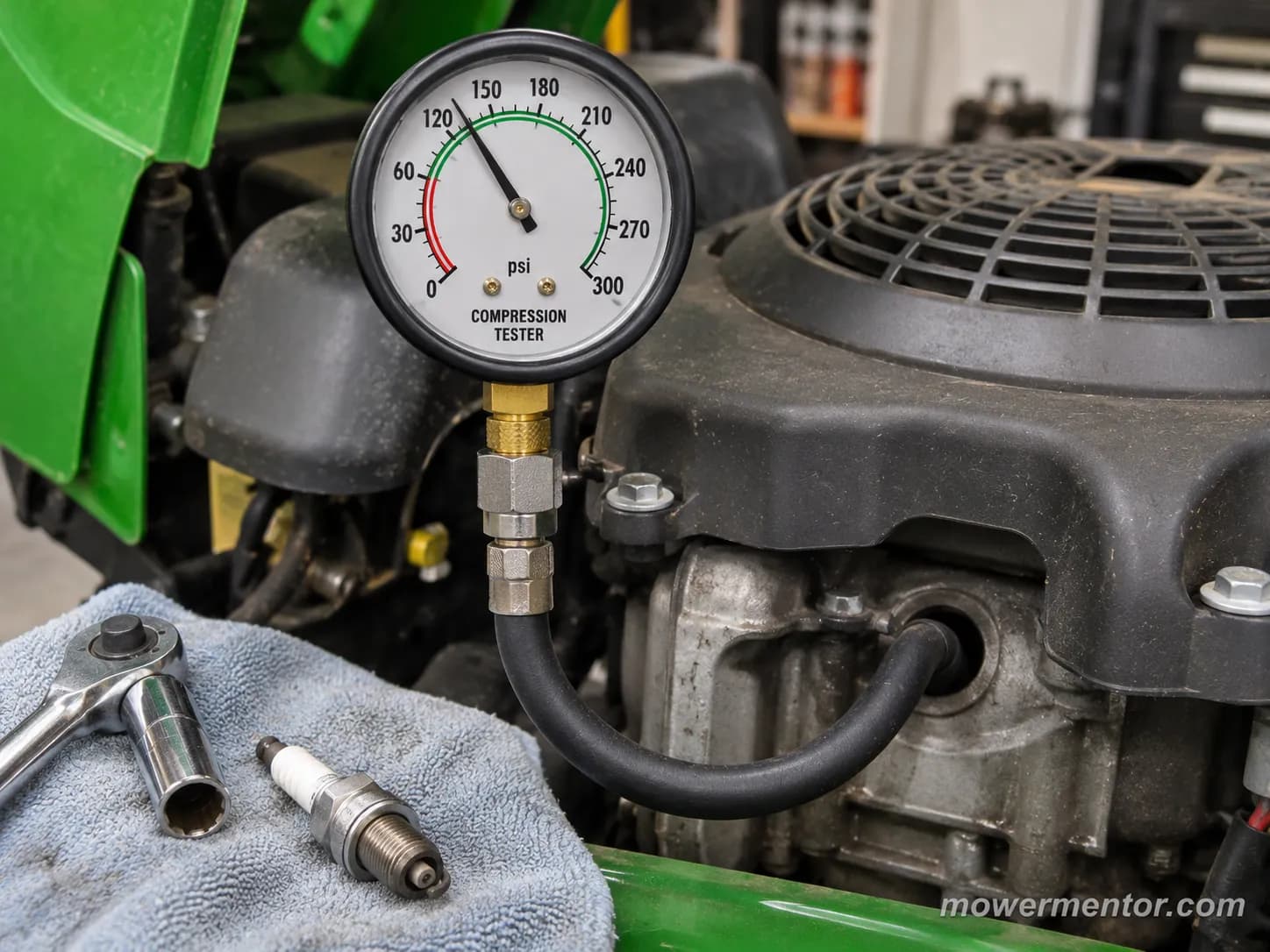
A compression check, optional and done with a tester, puts a number on engine wear. Briggs & Stratton warns to read the engine manual before servicing an engine, to avoid injury or damage.
Its own check for compression problems is a cylinder leak-down test with a leak-down tester. Without one, the next stop is a Briggs & Stratton repair dealer.
DLA's compression guide says most small engines read about 90 to 120 psi, though engines vary, so compare a reading with the engine manual's figure.
If it jumps sharply after a teaspoon of oil, worn piston rings may be the cause.
At 36.2 hours, at the end of its first season, the S100's single-cylinder engine read 105 psi on a compression tester.
It showed no blue or white smoke and needed no oil top-up between changes. That's inside the typical range, and it gives me a baseline to compare against in later seasons.
Hours set the frame, and records and condition place a mower within it. A low reading with a clean service history and a healthy engine points to years of mowing ahead. High hours with smoke or missing records point the other way.
If your own mower is already high on the meter and needs work, the next step is weighing a repair quote against a new mower.